Understanding Donald Trump’s Appeal

Trump runs over GOP

W.J. Astore

I lived and taught in a rural and conservative area in Pennsylvania for nine years, an area that’s “flyover country” for Beltway elites.  Back in 2008, I remember how the locals went gaga over Sarah Palin’s visit to the area, and how crestfallen so many people were when Barack Obama was elected president.  I remember how people sported Bush/Cheney stickers on their cars and trucks (even the faculty at the largely vocational college at which I taught), long after these men had left office.  Sadly, I also recall a lot of Confederate flag license plates, especially on trucks, but there were also people who flew them at home from their flagpoles.  This was not about “heritage,” since Pennsylvania was Union country in the Civil War.  No – it was about being a White “redneck” and taking the country back from, well, the “other” – Blacks, Muslims, immigrants, anyone considered to be an outsider, anyone part of the “influx,” a racially-loaded word that referred to outsiders (where I lived, mainly Blacks from Philadelphia and its environs).

Rural PA, previously Sarah Palin country, is now Trump country.  In the recent presidential primary, fifty thousand Democrats in PA changed party affiliation so they could vote Republican.  An educated guess: they weren’t switching parties to vote for Kasich or Cruz.  They were caught up in Trump hype about making America great again!
download
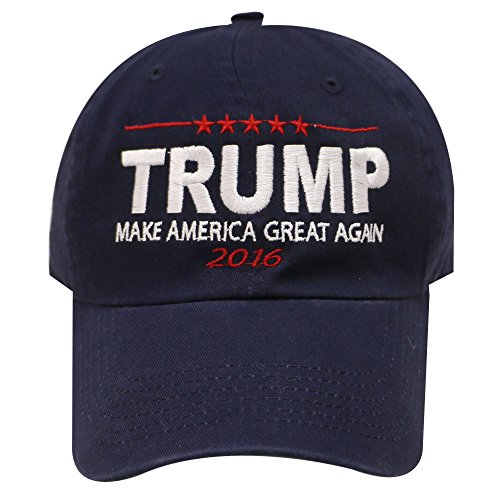
It says so on his hat!

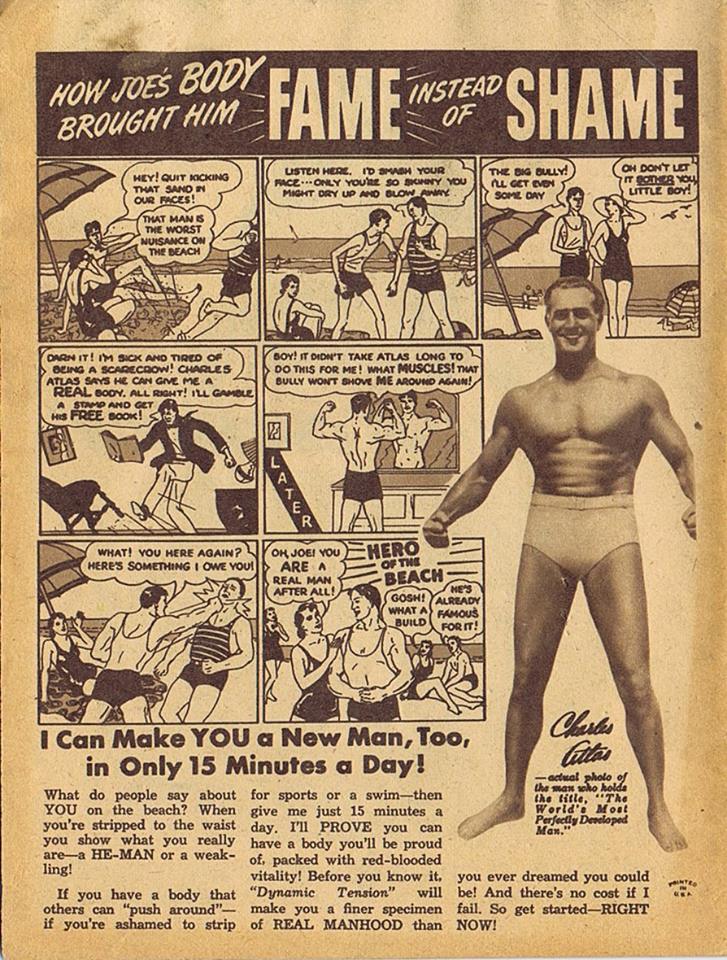
That’s a slogan to be reckoned with.  Some say it’s a racist dog whistle.  Those with ears attuned to the frequency hear the message as “making America great again by making it White again.”  There’s truth to this, but the message is also one of nostalgia.  Trump, like many of his followers, has recognized that the USA is no longer NUMBER ONE in all things, and he’s got the balls (as his followers might say) to say it plainly.  No BS about America being the exceptional nation, the bestest, the kind of nonsense that flows freely from the mouths of most U.S. politicians.  America is acting like a 99-pound weakling, Trump says, and he’s the Charles Atlas to whip us back into shape.
atlas

Trump’s vulgarity, his elaborate comb over, his tackiness, the shallowness of his knowledge (especially on foreign affairs), have contributed to the establishment’s ongoing dismissal of him.  A recent article by Glenn Greenwald and Zaid Jilani documented the many dead certain (yet dead wrong) predictions of Trump’s imminent demise, even as he was winning primary after primary and gaining in the polls.  The establishment elites just couldn’t believe that a man not vetted by them – a man best known for bloated casinos and lowbrow reality TV – could be a viable candidate for the presidency.  And indeed they continue to predict his imminent demise at the hands of one of their own (Hillary Clinton) in the fall.  Yet as I wrote back in July 2015, Trump is not to be underestimated.

What exactly is the appeal of Trump?  Speaking his mind is one.  Yes, he’s vulgar, he’s boorish, he’s ignorant, he’s sexist.  Just like many of his followers.  In a way, Trump revels in his flaws.  He has the confidence to own them.  Many people are attracted to him simply because (like Sarah Palin) he’s not a typical mealy-mouthed politician.

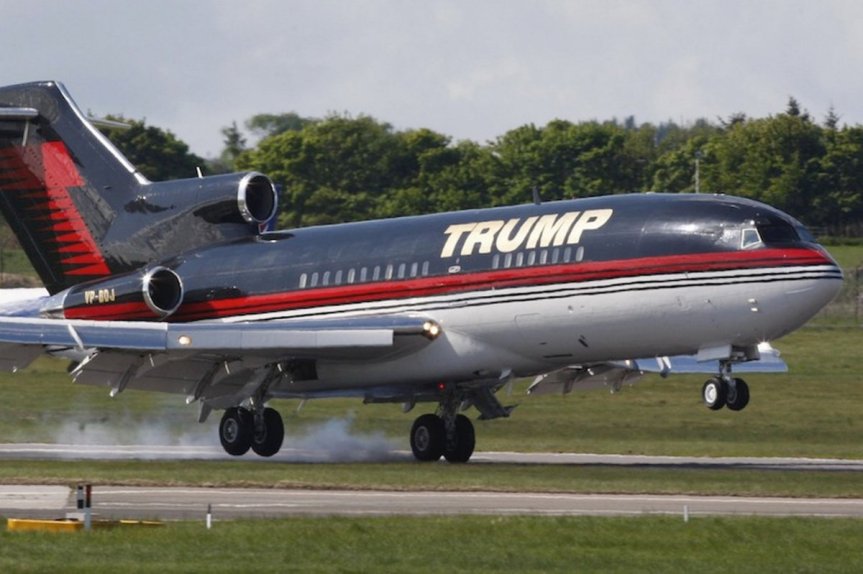
Another obvious appeal: He’s a rich celebrity who acts like a rube.  Indeed, he acts like many regular folks would if they’d just won a Powerball jackpot.  He’s got the trophy wife.  He’s got a lot of pricey toys (How about that Trump jet?).  He doesn’t have much class, but so what?  Trump is Archie Bunker with money, a blowhard, an American classic.  What you see is pretty much what you get.  And that’s a refreshing feature for many of his followers, who have little use for complexity or nuance.
trump jet
Not presidential?  He already has his own “Trump Force One”

For all that, let’s not ignore Trump’s positions (such as they are) on the issues.  He’s against a lot of things that many Americans are also against.  He’s critical of immigration.  He’s more than wary of Muslims.  He despises “political correctness.”  He’s against trade deals (so he says).  The Chinese and Japanese come in for special opprobrium as trade cheaters.  “And China!  And China!” Trump declaims as he launches another round of attacks on the Chinese for stealing American jobs.  Trump’s followers believe they’ve finally found their man, someone who will stand up to the Chinese, the Mexicans, the Muslims, and all those other foreigners who are taking their jobs and hurting America.

Trump is a master of scapegoating.  But more than this, he takes positions that show a willingness to depart from Republican orthodoxy.  He’s expressed support for Planned Parenthood (except for its abortion services) because of the health care it provides to women.  He’s outspokenly critical of U.S. wars and nation-building (as well as Bush/Cheney and company).  He wants to rebuild America’s infrastructure.  He wants to force America’s allies to pay a greater share of their own defense costs.  He’s not slavishly pro-Israel.  He’s not enamored with neo-conservative principles and the status quo in U.S. foreign policy.  He wants to put “America first.”  As far as they go, these are respectable positions.

Yet I’ve not come to praise Trump but to explain, at least partially, his appeal and its persistence.  Trump’s negatives are well known, and indeed I’ve written articles that are highly critical of him (see here and here and here).  Most of Trump’s supporters are aware of the negatives yet plan to vote for him regardless.  Why?

Desperation, to start.  Americans are drowning in debt.  They’re scared.  Not just the lower classes but the middle classes as well.  Just consider the title of a recent article at The Atlantic: The Secret Shame of Middle-Class Americans: Nearly half of Americans would have trouble finding $400 to pay for an emergency.  Times are far tighter for ordinary Americans than Beltway elites know or are willing to admit.

large

In tough times an unconventional candidate like Trump (or Bernie Sanders) offers hope – the promise of significant change.  What does Hillary Clinton offer?  So far, more of the same.  But scared or desperate people don’t want the same, with perhaps a few more crumbs thrown their way by establishment-types.  They want a political revolution, to quote Bernie Sanders.  They want freshness.  Authenticity.

Strangely, despite all his flaws and insults and bigotry, or rather in part because of them, Trump seems more genuine, more of a candidate of the people, than does Hillary.  Bernie Sanders, another genuine candidate with big ideas, beats him handily in the fall, I believe.  But Bernie is being elbowed out by the establishment powerbrokers in the Democratic Party.  The big money (of both parties) is pegging its hopes on Hillary.  It’s already predicted her sobriety and “experience” will triumph over Trump’s wildness and inexperience.

Given the record of “expert” predictions so far in this election, as well as Trump’s own track record, I wouldn’t be too confident in betting against The Donald.

Hillary Clinton: The MOTS Candidate

image
More of the same (MOTS) versus Feeling the Bern

W.J. Astore

With Trump now the presumptive nominee after his victory in Indiana and Ted Cruz’s withdrawal from the race, the Republican narrative seems clear.  Trump’s appeal is summed up nicely here by NBC:

Trump won by discovering a primal desire among GOP voters for a swaggering populist who would buck orthodoxy on trade, protect entitlements, build a border wall, deport all undocumented immigrants, and implement an “America First” foreign policy that demanded allies pay for U.S. protection or go it alone.

Millions of supporters, distrustful of their party’s leaders, rallied behind him as a unique figure whose personal fortune enabled him to spurn donors and say what he wanted with impunity.

His presumptive opponent: Hillary Clinton.  But not so fast!  Playing the spoiler, Bernie Sanders won in Indiana and has an outside chance of denying the nomination to Hillary. As Bernie pointed out in Indiana, he’s winning the vote of those 45 years of age and younger, and his appeal is strong among liberals and independents.

A large part of Bernie’s appeal is that he’s a man of principle with a clear message.  I can easily tell you what Bernie is for.  He’s for a political revolution.  He wants a single-payer health care system.  He wants free college tuition for students at state colleges.  He wants campaign finance reform.  He wants a $15 minimum wage.  He wants to break up big banks.  He was against the Iraq War and wants a less bellicose foreign policy.  The man knows how to take a stand and stick with it.

Now: What does Hillary Clinton want, besides the presidency of course?  It’s hard to say. For the last few months, she’s essentially been responding to Bernie.  As his progressive and idealistic message resonates with voters, Hillary cautiously adopts aspects of it.  For example, she was against a $15 minimum wage until she was for it.  She’s made noises about getting big money out of politics even as she’s siphoned up as many Benjamins as she could.  Lately, she’s pivoted and begun to run against Trump, as if Bernie has no chance at all to deny her the nomination.

Here’s the problem for Hillary: She’s a MOTS candidate, or more of the same.  She’s promised a continuation of President Obama’s policies, at least domestically, while in foreign policy she’s promised to take a harder line than Obama.  But I’m hard-pressed to name a single major policy initiative that’s uniquely hers, and I’ve watched virtually all of the Democratic debates and town halls.  She’s running as a technocrat, as an insider, as Obama in a pantsuit but with iron fists.

Assuming it’s Hillary versus Trump in the fall, it’ll be Trump who has the ideas, crazy or divisive or unsustainable as they may be.  And it’ll be Hillary who’ll be running as the “safe” candidate, the anti-Trump, the one whose motto might be, “the audacity of establishment incrementalism.”

Is that what American voters are looking for?  Establishment incrementalism?  More of the same?

Stay in the race, Bernie Sanders, and give us a real choice this fall.

Can Trump Beat Hillary?

trump
Who knew?

W.J. Astore

You’ve seen the headlines: Can Donald Trump beat Hillary Clinton?

The short answer: Of course he can.  And so can she beat him.

It’s a long time until November, and so much can (and will) happen between now and then.  But some obvious points about the volatility of this year’s presidential race:

1. Both candidates have high negatives. An NBC/Wall Street Poll suggests that 68% of voters doubt whether they could vote for Trump – and 58% of voters doubt they could vote for Hillary.  High negatives suggest lack of enthusiasm as well as antipathy.  Turned off by the candidates, many voters may simply stay home in November.  And that makes for a volatile race.

2. Trump is prone to gaffes. The man will say almost anything: Women seeking an abortion deserve to be punished.  Women reporters who challenge him are cranky from their period.  Mexican immigrants are thugs and rapists.  Muslims must be banned from the U.S.  Terrorists’ families should be hunted down and killed.  Protesters at his rallies should be punched and thrown out.  And on and on.  So far, Trump has been a Teflon candidate: His outlandish statements have not harmed him appreciably.  But how long before he says something equally offensive, or worse, as we head toward the general election this fall?

3. Trump’s business record. Trump University, anyone?  That trial should be interesting.  As lawsuits stalk Trump, how long before some past deal, either dodgy or dishonest, blows up in his face?

4. Hillary’s political record. Benghazi, anyone?  But potentially worse than Libya is the ongoing FBI investigation into Hillary’s emails.  Perhaps she’ll be cleared of wrongdoing, but the taint of wrongdoing will remain.  Indeed, a hint of scandal has always surrounded the Clintons – and it’s not just because of a “vast right-wing conspiracy.”

5. Hillary’s lack of political acumen: It’s hard to get enthusiastic about Clinton. Other than the fact she’d be the first female president (a big milestone, of course), there’s nothing new about her.  Consider her race against Bernie Sanders.  It was Bernie who drove the narrative.  It was Bernie who won the vote among the young, both male and female. Hillary is the staid old establishment.  When she raves, it’s about continuity.  But who wants continuity in America today?  What American is truly happy with the status quo (besides members of the establishment, of course)?

6. Wildcard events: Another 9/11-like attack. A bear market on Wall Street.  Wider conflict in the Middle East.  An incident with China in the Pacific.  A Russian move against Ukraine.  Will a crisis favor the “experience” of Clinton, or will people prefer Trump because “he gets things done” or “puts America first”?  As Yoda the Jedi Master says, “Difficult to see.  Always in motion the future.”

7. Finally, consider the fact that Bernie Sanders has run an issues-oriented campaign against Clinton. He hasn’t attacked her on her emails.  He’s left Bill Clinton’s past behavior out of the mix.  But just wait until the fall when the Republican attack dogs are unleashed.  Hillary is fond of saying she’s seen it all from Republicans, but with the stakes this high, I’m guessing there’s much she hasn’t seen.

So, yes, Trump can beat Clinton, and vice-versa.  The sorry fact is that regardless of which candidate wins, the country will be left with a deeply flawed leader who’ll be despised or disliked by more than half the electorate.

Clinton versus Trump this fall?

trump
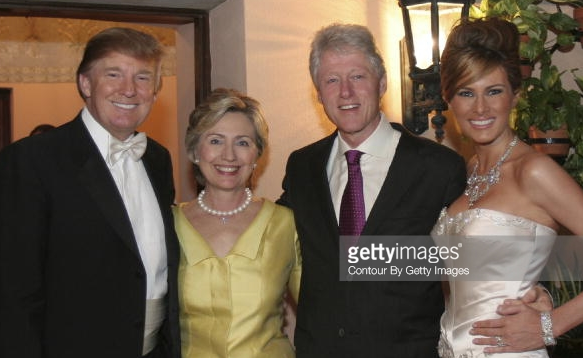
Good chums back in 2005

W.J. Astore

Last night’s primary results suggest it’s Hillary Clinton versus Donald Trump come this fall.  What does this mean for America?

Hillary is the easiest to gauge.  She’s been in politics for a long time and possesses a lengthy and controversial record.  She is of course a transformative candidate, the first female candidate for president from a major party.  That’s where the revolution begins — and ends.  Hillary is a pragmatist who promises a continuation of Obama’s policies.  Even more so than Obama, she is an establishment candidate, well ensconced among Wall Street financiers, K Street lobbyists, and all the other special interests that rule America today through money and power.  If this were 1976, you could well imagine her running as a moderate Republican against a Democratic candidate like Jimmy Carter (or Bernie Sanders).  With respect to foreign policy, she promises a hard line and the continuation of perpetual wars in Iraq, Afghanistan, and elsewhere.

Many liberal Democrats, and more than a few Republicans, will likely vote for her with noses held and fingers crossed.  Mainline Democrats will vote for her based on certain issues, such as Supreme Court vacancies, her pro-choice stance on abortion, and so on.  In a normal election year, an establishment Republican would have a good shot at beating her since Hillary’s negatives are so high.  But this is not a normal year.

Enter Donald Trump.  If Hillary promises more of the same, Trump promises unpredictability.  His simplistic rhetoric about making America great again has obviously resonated, just as Obama’s similarly simplistic message of “hope” and “change” did in 2008.  Trump is a man of (certain) people: unlike Hillary, he’s not a career politician. Unlike Hillary, he’s not tied to the political establishment.  In essence, he’s part wild card, part joker, and his outlandish statements on Muslims and Mexicans and walls and women suggest he’s not playing with a full deck.

No one really knows what a Trump presidency would look like.  I don’t think even Trump knows.  Trump has a habit of speaking off the cuff, of making statements that are more than a little grandiose, partly because he loves to grandstand.  He’s easy to dismiss — all too easy — yet look where he is now, closing in on the Republican nomination despite long odds.

Trump, as I wrote back in July 2015, likes to pose as a proto-fascist.  He likes to boast that the military will follow his orders even if they’re illegal.  (He backed off that statement, but the fact he made it speaks loudly about his judgement.)  On occasion he says something insightful and honest, as when he insisted the Iraq war was a mistake, costing the nation trillions of dollars, or when he attacks poorly negotiated trade deals as hurting working-class Americans.  But with the good comes lots of bad.

A big challenge for Trump this fall will be appearing presidential.  So far his policy knowledge in debates has been a mile wide and an inch deep.  He’s gotten away with this because of the size of the Republican field, but Hillary, the consummate policy wonk, will make mincemeat of him in the fall debates if he continues to speak off the cuff and glide over specifics.

Clinton versus Trump: it’s a grim choice for America.  An establishment oligarch versus a quixotic autocrat.  More of the same versus God knows what.  What they collectively represent is both the decline of progressivism and of conservatism in America.

For now I’m putting my crystal ball aside, except to say that one day (perhaps very soon) Americans may look back with fondness on the eight years Obama was president.

Hillary Clinton: A Deeply Compromised Candidate

hillary henry
Hillary and Henry

W.J. Astore

Hillary Clinton is a deeply compromised candidate.  She and her husband have made over $125 million in paid speeches since 2001, including $30 million in 16 months.  There’s nothing wrong with making lots of money: this is America, after all.  But there’s something wrong about accepting big checks from powerful banks and investment houses and then positioning yourself as the champion of “everyday people” in your run for the presidency.

Along with her close alliance with Wall Street, Hillary is essentially a neo-conservative on foreign policy who admires the Real Politik of men like Henry Kissinger.  She promises more interventionism overseas and doubtless more wars.  She is especially close to Israel and advertises herself as a loyal ally to Benjamin Netanyahu.

The person she most closely resembles in recent U.S. politics is Richard Nixon.  Like Nixon, she’s aggressive in foreign policy (recall her infamous quip about the fall of Qaddafi in Libya: “We came, we saw, he died”).  Like Nixon, she is secretive and economical with the truth, despite her truth-telling vows.  Like Nixon, she is a complex person, not without talent, but a person who often doesn’t appear fully comfortable, especially when pressed about her record.  Like Nixon, she leaves very little to chance; there’s calculation to nearly everything she does.

A Hillary Clinton administration promises to be even less transparent than Obama’s.  It would be more in service to the powers that be (big money donors such as the health care industry will come calling for their payback, and they’ll get it).  Despite protestations of being “progressive,” a Clinton administration promises to be regressive in terms of peace, social progress, and fairness for the working classes.

Despite this, her path to the presidency seems remarkably clear.  Bernie Sanders, an honest man of conviction, lacks establishment support.  Hillary’s Republican opponent of the moment, Donald Trump, is an opportunistic business tycoon who apparently says whatever pops into his head.  Trump may be the one candidate with more negative baggage than Hillary.

A Hillary/Trump matchup this fall promises lots of drama, but it’s a lose/lose scenario for anyone looking for real progressive change.

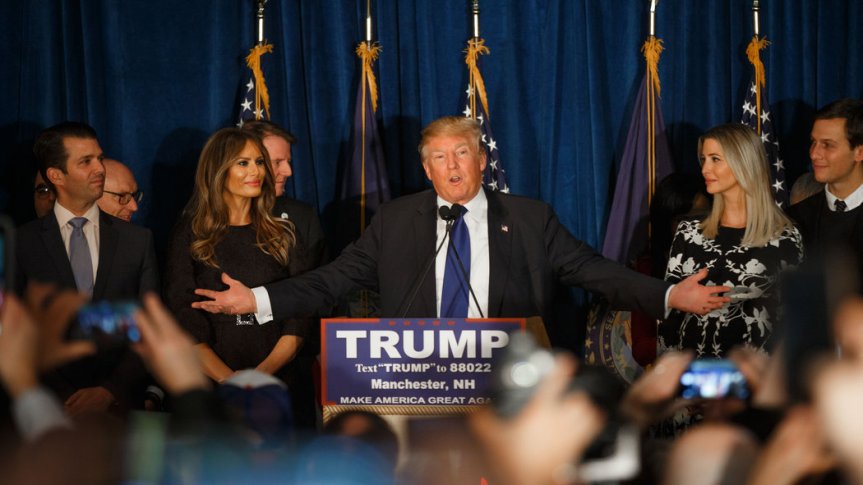
A Message of Uplift Won New Hampshire

SUB-TRUMP2-videoSixteenByNine1050
He’ll make America great again — it says so on his podium!

W.J. Astore

My wife and I watched the results come in last night on MSNBC and the four speeches by Hillary Clinton, Bernie Sanders, Donald Trump, and John Kasich.  Surprisingly, the best speech of the bunch was by Kasich, but more on that in a moment.

Hillary charged ahead with a concession speech that was basically a recycled stump speech.  It looked like she was using teleprompters.  She offered the obligatory thanks to her supporters, to New Hampshire, and so on, but you could tell she just wanted to move on from her crushing defeat.  She has real difficulty connecting with an audience, and her campaign’s message that she’s the most competent candidate, the one best able to step into the Oval Office on day one, simply isn’t resonating with voters who are fed up with establishment politics.

Bernie went next and also gave a modified version of his stump speech.  He spoke too long, but I’m guessing he was doing his best to exploit his “prime time” moment.  He offered kind words for Clinton but then proceeded to attack the politics as usual that she represents.  What got me most was the genuine excitement in the room for Bernie.  The people cheering behind him were an especially eclectic and vibrant mix (I know the “optics” are usually managed, but still).  There was a young black guy wearing a hat and a Bernie t-shirt who was simply a riot.  (He was standing behind and to Bernie’s left.)  My wife and I looked at each other and said: “He should be Bernie’s Vice President.”

Trump came on the heels of Bernie, and the shift in tone was immediate.  With Bernie, it’s all about the movement.  With Trump, it’s all about Trump.  Flanked by his photogenic family, Trump once again told Americans how he is going to make America “great” again, how America is going to win again — at negotiating treaties, with the economy, with wars — heck, I guess we’re going to win at EVERYTHING with Trump in command.  Again he boasted how he’s going to make the U.S. military so big and so strong that no one will dare attack us.  In a word, he bloviated.  But Trump should never be dismissed lightly, certainly not after his decisive victory in New Hampshire.

Kasich came next after Trump, and again the tone shifted.  Coming in a strong second in NH, Kasich talked about listening to the American people, and how the 100+ “town halls” he had done had changed him as a candidate and as a person.  He told personal stories and connected with the audience; he closed on a note of compassion, asking Americans to decompress, to take time to listen to one another, to find time for reflection.  His speech was the most personal and heartfelt of the four that I heard, and I found myself hoping that Kasich’s message would ultimately triumph over the bellicosity of Trump, Cruz, Rubio, and the rest of the Republicans.

Overall, last night was a night of surprises, with two unconventional candidates, Sanders and Trump, winning convincingly.  Their messages, of course, are polar opposites. Bernie wants a better future for all Americans, especially for the disadvantaged, whereas Trump is all about making America big and strong, a “winner.”  Put differently, Sanders sees a lot of ordinary Americans who are losing in today’s “rigged” economy, and he wants to lift them up.  Trump sees America writ large as losing, even some of the wealthiest, vis-a-vis foreign competitors like China, and he says he’ll lift all of America up.

It’s that message of uplift, expressed so differently by Sanders and Trump, that resonated so powerfully in New Hampshire.


The 2016 Presidential Candidates in a Word

face plant
Politics: Sometimes I just want to do a face plant (Photo: Barbara Neiberg)

W.J. Astore

Continuing our election coverage, I thought I’d try to sum up each major candidate with a single word (excluding profanities).  I encourage readers to submit your own words for each candidate in the comments section below.


The Democrats

Clinton: Compromised.  No candidate is more beholden to special interests and the establishment than Hillary.

Sanders: Revolutionary.  Let’s face it: It would be revolutionary for a Socialist Jew to win the Democratic nomination.  And “revolution” is one of Bernie’s favorite words.

O’Malley: Eclipsed.  I had to strain to remember his name, and I’ve watched the debates.  Simply overshadowed by Hillary and Bernie.


The Republicans

Trump: Bombastic.  Trump makes a lot of noise, and my dad always told me “the empty barrel makes the most noise.”

Cruz: Oleaginous.  There’s something slippery about Cruz.

Rubio: Callow.  An eager beaver, apple-polishing type.  Not quite ready for prime time.

Bush: Uncertain.  He doesn’t seem to believe the words coming out of his own mouth.  This is one reason why Trump calls him “weak,” because The Donald never doubts himself.

Carson: Serene.  His calm is perfect for a neurosurgeon, but he’s out of his element on the political stage.

Christie: Angry.  He seems to despise both Obama (“feckless weakling”) and Hillary.  Like Tony Soprano but without the charm.

Kasich: Grey.  A conventional Republican governor, he blends into the background due to the strutting peacocks that surround him.

What do you think, readers?  Have at it!


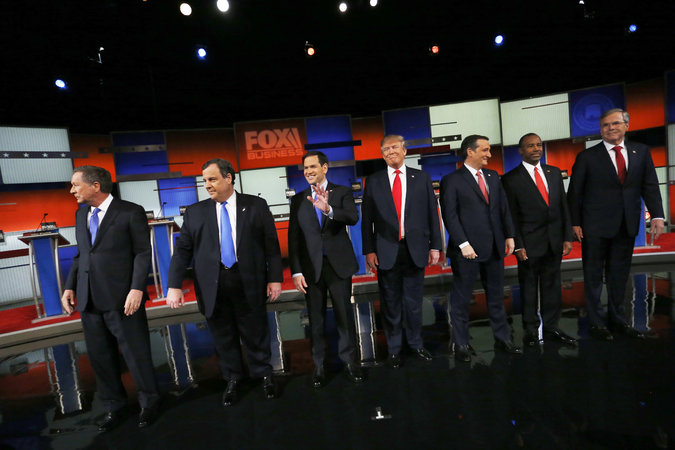
The Republican Alternate Universe of Paranoia

repubdebate-162-master675
Paranoia will destroy ya

W.J. Astore

I watched last night’s Republican debate so you wouldn’t have to.  Leaving aside the usual mugging by Donald Trump, the usual jousting over side issues like whether Ted Cruz is a natural born citizen, I thought I’d take an impressionistic approach to the debate.  You can read the debate transcript here (if you dare), but here is my admittedly personal take on the main messages of the debate.

  1. Barack Obama and Hillary Clinton are coming to take your guns. So you need to elect a Republican who will allow you to keep your guns and to buy many, many more guns while carrying them openly in public.
  2. Related to (1), ISIS is coming to these shores. In fact, they’re already here.  That’s one big reason why everyone needs guns – to protect ourselves from ISIS and other terrorists out to kill Americans on Main Street USA.
  3. America is weak. Obama has gutted our military.  The Iranians and Russians laugh at us.  To stop them from laughing, America needs to rebuild its military, buy more weapons, and use them freely.  In fact, all the next commander-in-chief needs to do is ask military leaders what they need to win, give them exactly that, then stand back as our military (especially Special Ops troops) kicks ass.  Victory!
  4. America is weak (again), this time economically. The Chinese are kicking our ass.  They’re tougher than us and smarter than us.  We need to teach them who’s boss, perhaps with a big tariff on Chinese imports, combined with intense pressure on them to revalue their currency.
  5. The American tax system is unfair to corporations. We need to lower corporate tax rates so that American companies won’t relocate, and also so that American businesses will be more competitive vis-à-vis foreign competitors.
  6. The most oppressed “minority” in the U.S. are not Blacks or Hispanics or the poor: it’s the police. Yes, the police.  They are mistreated and disrespected.  Americans need to recognize the police are there to protect them and to defer to them accordingly.
  7. The only amendment worth citing in the U.S. Constitution is the Second Amendment.
  8. The National Security Agency, along with all the other intelligence agencies in America, need to be given more power, not less. They need broad and sweeping surveillance powers to keep America safe.  Privacy issues and the Fourth Amendment can be ignored.  People like Edward Snowden are traitors. “Safety” is everything.
  9. Bernie Sanders is a joke. Hillary Clinton just might be the anti-Christ.
  10. Immigrants are a threat, especially if they’re Muslim. They must be kept out of America so that they don’t steal American jobs and/or kill us all.

What I didn’t hear: Anything about the poor, or true minorities, or gender inequities, or the dangers of more war, and so on.

My main takeaway from this debate: Republican candidates live in the United States of Paranoia, a hostile land in which fear rules.  Think “Mad Max, Fury Road,” but without any tough females about.  (I have to admit I missed Carly Fiorina/Imperator Furiosa on the main stage.)

Only one candidate struck a few tentative notes of accord through bipartisan collaboration and compromise: Ohio governor John Kasich.  In his closing statement, he spoke eloquently of his parents’ working-class background.  He’s also the only candidate with the guts not to wear the by-now obligatory flag lapel pin.  I’m not a Republican, but if I had to vote for one, it would be him.  Why?  Because he’s the least batshit crazy of the bunch.

Yes, it was a depressing night, one spent in an alternate universe detached from reality.  In the end, old song lyrics popped into my head: “paranoia will destroy ya.”  Yes, yes it will, America.

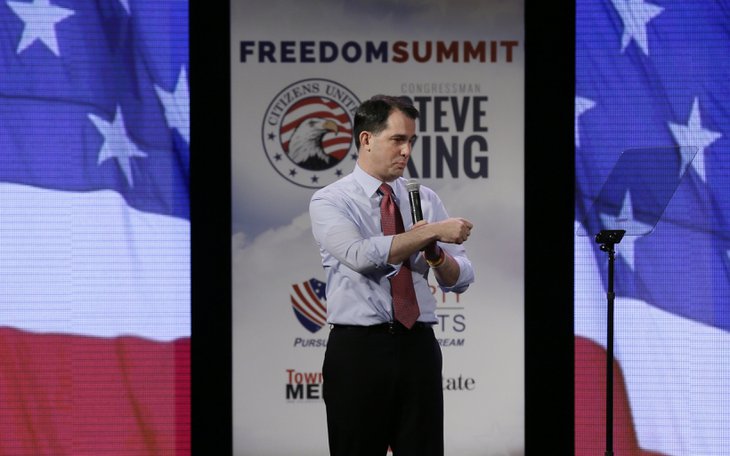
Conservative Kookiness in Iowa

Scott Walker serves up some red meat

W.J. Astore

OK.  I should know better.  When you pay attention to what conservatives are saying at the Iowa Freedom Forum, attended as it is by religious activists, you’re going to hear kookiness and craziness.  But what’s sad is how the “red meat” issues raised by the likes of Ted Cruz, Scott Walker, and Rick Santorum are so devoid of nutritional value.  Empty calories, all of it.

You hear the usual talk about lower taxes and less governmental regulation, even though Republicans under Reagan and the Bushes (along with the Democrats as well) oversaw expansions in government.  George H.W. Bush famously said, “Read my lips — no new taxes,” before proceeding to raise taxes once he became president.  Along with lower taxes and smaller government, Republicans also claim to support “family values,” a vapid phrase that basically means whatever you want to read into it.  I’m not a fan of Obama’s priorities and policies, but one thing I can say for the man is that his life, his wife, and his teenage girls have exuded family values, Thanksgiving controversy or no.

So we know Republicans are supposedly for lower taxes, smaller government, and family values.  What else are they for? Abortion, of course, as in restricting it further or even eliminating it.  Voter ID laws, because we all know how the “wrong” kind of people are being bussed in en masse to skew voting results in favor of socialism (talk about an urban myth!).  And more gun rights, like open carry laws and easier approval for concealed permits to carry.

Egads!  These are the issues that sway the activist base of the Republican Party?  Fetuses, the specter of more disadvantaged people of color voting, and guns.

Wow.  Our country faces serious issues.  A crumbling infrastructure.  An unsustainable prison system.  Perpetual wars.  Climate change (even Republicans admit it’s real, though they won’t blame humans for it).  Ever widening gaps between rich and poor.  Student loan and credit card debt that threaten a fragile economic recovery.  Mediocre education.  Ever rising health care costs (still the number one cause for personal bankruptcies in America).  But forget all that: let’s talk about fetuses, non-existent voter fraud, and guns.

And Republicans like Santorum wonder why “too many people don’t think we care about them.”  Gee… I wonder why, Rick.

(A personal note: In 1976, though too young to vote, I supported Gerald Ford rather than Jimmy Carter.  In 1984, I voted for Ronald Reagan because I believed Walter Mondale lacked the gravitas to be president at a crucial moment in US-Soviet affairs.  Ever since then, the Republican Party has lost me with its cynical culture wars and active suppression of democracy, among other reasons.)

Inserting American Bodies in Iraqi and Afghan Dikes

Image is everything
Bush rebranded as a war president: Mission Accomplished!

W.J. Astore

The United States continues to insert the bodies of its troops into leaky Iraqi and Afghan dikes.  That’s the image that came to mind with the recent news from Iraq and Afghanistan.  More American “advisers” and weapons being sent to Iraq.  The revival of night raids by U.S. Special Forces in Afghanistan.  No matter the piss-poor results in Iraq or Afghanistan, the U.S. continues to double down on losing hands.

Why is there no learning curve in Washington?  A big reason is that President Obama’s decisions have been, are, and will be driven by domestic politics.  The Democrats don’t dare withdraw from either war since ISIS or the Taliban would grow in strength (at least in the short-term), and the Republicans would eagerly blame the Democrats for “losing” wars that George W. Bush and General David Petraeus and U.S. troops had allegedly won.

The cynical Democratic solution to this dilemma is to plug the Iraqi and Afghan dikes with more U.S. troops (and, most likely, more casualties) until after the election of 2016.

Domestic political advantage is often the major reason for continued folly in lost wars.  We saw it in Vietnam: neither LBJ nor Nixon wanted to be seen as having “lost” Vietnam.  Nixon in particular had his eye on the election of 1972 as well as on posterity as he made decisions about the war.

America’s wars overseas are far too often driven by public relations for domestic consumption.  Consider the invasion of Iraq in 2003 and the Bush Administration’s announcement of “Mission Accomplished,” a staged Hollywood photo op meant to cement Bush’s status domestically as a war leader.  Far better it was to have an image of co-pilot Bush landing in a flight suit on an aircraft carrier than one of a befuddled Bush reading about pet goats to schoolchildren on the morning of 9/11.  Obama is hardly guiltless here.  Even as he questioned the Iraq war, he ran in 2008 on the idea of Afghanistan being the necessary war, thus immunizing himself from charges of being “soft” on defense.  Afghanistan is no closer to being “won” for the U.S. today than it was six years ago, yet Obama’s folly continues, aggravated by recent orders to return American troops to Iraq.

Internationally, it’s strategic folly for the U.S. to persist in these wars.  But domestically, endless wars act as a coat of armor to deflect charges of being a wimp (for Obama) or of being incompetent (for Bush after 9/11).  With his drone strikes, Obama has become the assassin-in-chief, even as Bush with the invasions of Afghanistan and Iraq became the “war president” (at least in his own mind, together with the minds of a subservient and fawning media).

Christ said, “Blessed are the peacemakers,” but America has no time for peace.  Not when “peace” leaves one open to political charges of being an un-American wimp and loser.

Want to help change this?  At the very least, vote for the candidate in 2016 who vows to end America’s wars in Iraq and Afghanistan.  Vote for the candidate who vows to end the practice of stuffing American bodies into so many of the world’s leaky dikes.  Vote for the candidate who stands for peace rather than for war.  Regardless of the election results, that candidate won’t be a “loser.”  For in America today, in a land tortured by gusty winds of war, it’s far gutsier to stand for peace.