Last January, I published “My Father’s Journal,” which recounts my dad’s experience surviving the Great Depression, serving in the Civilian Conservation Corps in Oregon fighting forest fires, military service in the Army during World War II, and bringing up five children during the “Baby Boom” years of the 1950s and 1960s while serving as a city firefighter. If you’re interested, it’s available at Amazon for $10 for the paperback and $5 for the Kindle version. Follow this link, and thanks!
*****
I received two interesting queries this week, one on Blitzkrieg and the other on how much the U.S. spends on weapons and war. On the first subject, I was asked about the characteristics of Blitzkrieg, when the concept was developed and seen in battle, and for post-World War II examples. I was also asked about Russia-Ukraine and the recent U.S. attack on Venezuela. Here are my answers:
1. Speed, surprise, combined arms, and disruption are the main characteristics of Blitzkrieg. “Combined arms” refers to all combat arms working synergistically, i.e. infantry, armor, artillery, supported by air forces (nowadays, drones might be involved in large numbers). Special forces like airborne units may also be involved. Deception and misdirection are also aspects of Blitzkrieg. The fundamental idea is to move and maneuver so quickly that the enemy can’t keep pace–to disrupt the enemy’s cohesion. To place them in an untenable position where they have to withdraw or perhaps even surrender.
2. Blitzkrieg, though associated with Nazi Germany in World War II, is an old concept in warfare. Perhaps the best practitioners were the Mongols in the 13th century. The Western concept has its roots in World War I and the stalemate of trench warfare. Ideas associated with what became known as Blitzkrieg were tried on various World War I battlefields. The idea was to break the stalemate of fixed lines and fortifications without getting into costly battles of attrition. These ideas came to maturity in World War II.
3. Blitzkrieg, perhaps ironically, is sometimes attached to the Israeli Defense Forces, as in their attacks in 1967 in the Six Day War. You might say the USA used Blitzkrieg against Iraq in 1991. Russia’s initial attack on Ukraine in 2022 was not a Blitzkrieg–it was more of an uncoordinated show of force that backfired. The USA attack on Venezuela was a “snatch and grab” kidnapping, not a military campaign per se.
*****
The second query focused on how much the U.S. spends on weaponry and war and how we measure that as a percentage of the federal budget. Here’s my answer to that:
Yes, it’s a numbers game. If you include all federal spending (including non-discretionary spending like social security and Medicare/Medicaid), it’s a smaller percentage. Roughly 15% of the federal budget.
If you focus on discretionary spending, it’s more than 50%. It depends on how you count it. If you add Pentagon spending to Homeland Security, the VA, the DOE (nukes), and interest on the federal debt due to wars and military spending, the percentage is 60% or even higher.
When the warmongers really want to minimize war spending, they compare it to GDP.
*****
No matter how you measure it (or attempt to minimize it), a trillion dollars is a lot of money. Of course, the best way to think of “defense” spending is from President Dwight D. Eisenhower’s “Cross of Iron” speech in 1953:
Every gun that is made, every warship launched, every rocket fired signifies, in the final sense, a theft from those who hunger and are not fed, those who are cold and are not clothed. This world in arms is not spending money alone. It is spending the sweat of its laborers, the genius of its scientists, the hopes of its children… This is not a way of life at all, in any true sense. Under the cloud of threatening war, it is humanity hanging from a cross of iron.
That is the true cost of spending on weapons and war.
Today, I learned the Trump administration is proposing 8% cuts in Pentagon spending each year for the next five years. This is indeed a welcome—and long overdue—initiative.
Here’s the report from the Guardian:
*****
The US defense secretary, Pete Hegseth has ordered senior leaders at the Pentagon and throughout the US military to develop plans for cutting 8% from the defense budget in each of the next five years, according to a memo obtained by the Washington Post.
Pete Hegseth ordered the proposed cuts to be drawn up by 24 February, according to the memo. Photograph: Ron Sachs/EPA
Hegseth ordered the proposed cuts to be drawn up by 24 February, according to the memo, which includes a list of 17 categories that the Trump administration wants exempted. Among them: operations at the southern US border, modernization of nuclear weapons and missile defense and acquisition of one-way attack drones and other munitions. If adopted in full, the proposed cuts would include tens of billions of dollars in each of the next five years.
*****
Just over two years ago, I called for a 50% reduction in Pentagon spending in an article for TomDispatch. I’m reposting the article below, in full. Maybe SecDef Hegseth can mine some ideas from it. 🙂
Can the Military-Industrial Complex Be Tamed?
Cutting the Pentagon Budget in Half Would Finally Force the Generals to Think
My name is Bill Astore and I’m a card-carrying member of the military-industrial complex (MIC).
Sure, I hung up my military uniform for the last time in 2005. Since 2007, I’ve been writing articles for TomDispatch focused largely on critiquing that same MIC and America’s permanent war economy. I’ve written against this country’s wasteful and unwise wars in Iraq and Afghanistan, its costly and disastrous weapons systems, and its undemocratic embrace of warriors and militarism. Nevertheless, I remain a lieutenant colonel, if a retired one. I still have my military ID card, if only to get on bases, and I still tend to say “we” when I talk about my fellow soldiers, Marines, sailors, and airmen (and our “guardians,” too, now that we have a Space Force).
So, when I talk to organizations that are antiwar, that seek to downsize, dismantle, or otherwise weaken the MIC, I’m upfront about my military biases even as I add my own voice to their critiques. Of course, you don’t have to be antiwar to be highly suspicious of the U.S. military. Senior leaders in “my” military have lied so often, whether in the Vietnam War era of the last century or in this one about “progress” in Iraq and Afghanistan, that you’d have to be asleep at the wheel or ignorant not to have suspected the official story.
Yet I also urge antiwar forces to see more than mendacity or malice in “our” military. It was retired general and then-President Dwight D. Eisenhower, after all, who first warned Americans of the profound dangers of the military-industrial complex in his 1961 farewell address. Not enough Americans heeded Ike’s warning then and, judging by our near-constant state of warfare since that time, not to speak of our ever-ballooning “defense” budgets, very few have heeded his warning to this day. How to explain that?
Well, give the MIC credit. Its tenacity has been amazing. You might compare it to an invasive weed, a parasitic cowbird (an image I’ve used before), or even a metastasizing cancer. As a weed, it’s choking democracy; as a cowbird, it’s gobbling up most of the “food” (at least half of the federal discretionary budget) with no end in sight; as a cancer, it continues to spread, weakening our individual freedoms and liberty.
Call it what you will. The question is: How do we stop it? I’ve offered suggestions in the past; so, too, have writers for TomDispatch like retired Army Colonel Andrew Bacevich and retired Army Major Danny Sjursen, as well as William Hartung, Julia Gledhill, and Alfred McCoy among others. Despite our critiques, the MIC grows ever stronger. If Ike’s warning wasn’t eye-opening enough, enhanced by an even more powerful speech, “Beyond Vietnam,” by Martin Luther King, Jr., in 1967, what could I and my fellow TomDispatch writers possibly say or do to make a difference?
Maybe nothing, but that won’t stop me from trying. Since I am the MIC, so to speak, maybe I can look within for a few lessons that came to me the hard way (in the sense that I had to live them). So, what have l learned of value?
War Racketeers Enjoy Their Racket
In the 1930s, Smedley Butler, a Marine general twice decorated with the Medal of Honor, wrote a book entitled War Is a Racket. He knew better than most since, as he confessed in that volume, when he wore a military uniform, he served as “a racketeer, a gangster for capitalism.” And the corporate-driven racket he helped enable almost a century ago by busting heads from the Caribbean to China was small-scale indeed compared to today’s thoroughly global one.
There’s an obvious lesson to be drawn from its striking endurance, never-ending enlargement, and distinct engorgement in our moment (even after all those lost wars it fought): the system will not reform itself. It will always demand and take more — more money, more authority, more power. It will never be geared for peace. By its nature, it’s authoritarian and distinctly less than honorable, replacing patriotism with service loyalty and victory with triumphant budgetary authority. And it always favors the darkest of scenarios, including at present a new cold war with China and Russia, because that’s the best and most expedient way for it to thrive.
Within the military-industrial complex, there are no incentives to do the right thing. Those few who have a conscience and speak out honorably are punished, including truth-tellers in the enlisted ranks like Chelsea Manning and Daniel Hale. Even being an officer doesn’t make you immune. For his temerity in resisting the Vietnam War, David M. Shoup, a retired Marine Corps general and Medal of Honor recipient, was typically dismissed by his peers as unbalanced and of questionable sanity.
For all the talk of “mavericks,” whether in Top Gun or elsewhere, we — there’s that “we” again (I can’t help myself!) — in the military are a hotbed of go-along-to-get-along conformity.
Recently, I was talking with a senior enlisted colleague about why so few top-ranking officers are willing to speak truth to the powerless (that’s you and me) even after they retire. He mentioned credibility. To question the system, to criticize it, to air dirty laundry in public is to risk losing credibility within the club and so to be rejected as a malcontent, disloyal, even “unbalanced.” Then, of course, that infamous revolving doorbetween the military and giant weapons makers like Boeing and Raytheon simply won’t spin for you. Seven-figure compensation packages, like the one current Secretary of Defense Lloyd Austin gained from Raytheon after his retirement as an Army general, won’t be an option. And in America, who doesn’t want to cash in while gaining more power within the system?
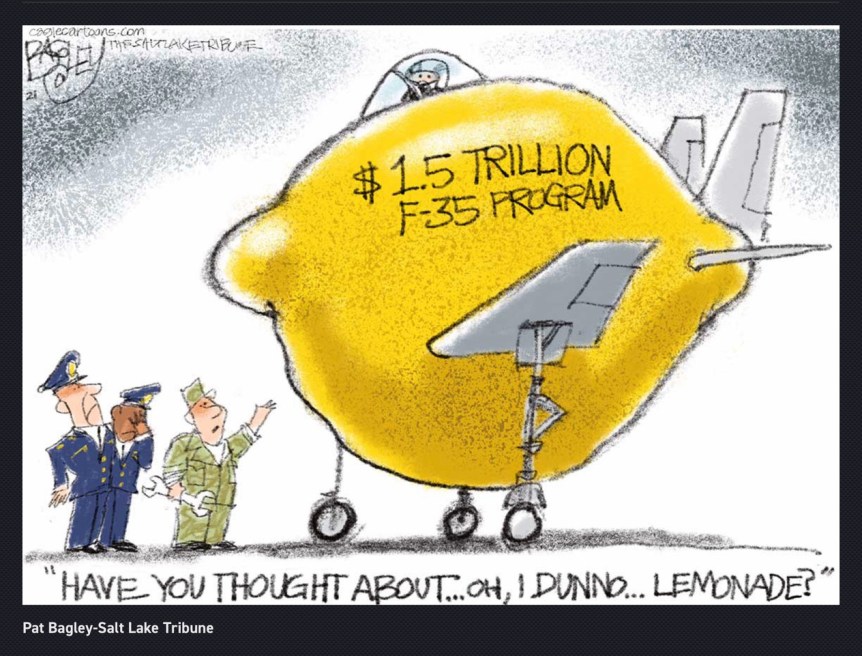
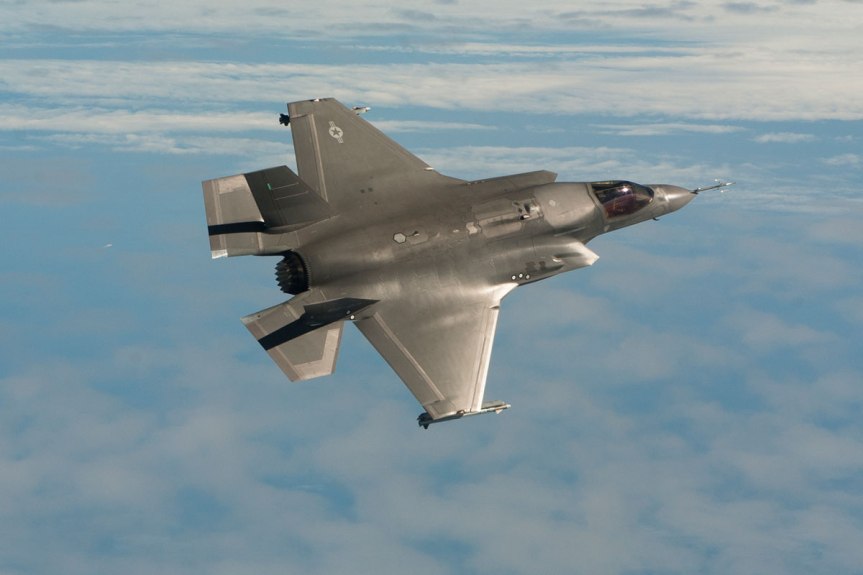
Quite simply, it pays so much better to mouth untruths, or at least distinctly less-than-full-truths, in service to the powerful. And with that in mind, here, at least as I see it, are a few full truths about my old service, the Air Force, that I guarantee you I won’t be applauded for mentioning. How about this as a start: that the production of F-35s — an overpriced “Ferrari” of a fighter jet that’s both too complex and remarkably successful as an underperformer — should be canceled (savings: as much as $1 trillion over time); that the much-touted new B-21 nuclear bomber isn’t needed (savings: at least $200 billion) and neither is the new Sentinel Intercontinental Ballistic Missile(savings: another $200 billion and possibly the entire Earth from doomsday); that the KC-46 tanker is seriously flawed and should be canceled (savings: another $50 billion).
Now, tote it up. By canceling the F-35, the B-21, the Sentinel, and the KC-46, I singlehandedly saved the American taxpayer roughly $1.5 trillion without hurting America’s national defense in the least. But I’ve also just lost all credibility (assuming I had any left) with my old service.
Look, what matters to the military-industrial complex isn’t either the truth or saving your taxpayer dollars but keeping those weapons programs going and the money flowing. What matters, above all, is keeping America’s economy on a permanent wartime footing both by buying endless new (and old) weapons systems for the military and selling them globally in a bizarrely Orwellian pursuit of peace through war.
How are Americans, Ike’s “alert and knowledgeable citizenry,” supposed to end a racket like this? We certainly should know one thing by now: the MIC will never check itself and Congress, already part of it thanks to impressive campaign donations and the like by major weapons makers, won’t corral it either. Indeed, last year, Congress shoveled $45 billion more than the Biden administration requested (more even than the Pentagon asked for) to that complex, all ostensibly in your name. Who cares that it hasn’t won a war of the faintest significance since 1945. Even “victory” in the Cold War (after the Soviet Union imploded in 1991) was thrown away. And now the complex warns us of an onrushing “new cold war” to be waged, naturally, at tremendous cost to you, the American taxpayer.
As citizens, we must be informed, willing, and able to act. And that’s precisely why the complex seeks to deny you knowledge, precisely why it seeks to isolate you from its actions in this world. So, it’s up to you — to us! — to remain alert and involved. Most of all, each of us must struggle to keep our identity and autonomy as a citizen, a rank higher than that of any general or admiral, for, as we all need to be reminded, those wearing uniforms are supposed to serve you, not vice-versa.
I know you hear otherwise. You’ve been told repeatedly in these years that it’s your job to “support our troops.” Yet, in truth, those troops should only exist to support and defend you, and of course the Constitution, the compact that binds us all together as a nation.
When misguided citizens genuflect before those troops (and then ignore everything that’s done in their name), I’m reminded yet again of Ike’s sage warning that only Americans can truly hurt this country. Military service may be necessary, but it’s not necessarily ennobling. America’s founders were profoundly skeptical of large militaries, of entangling alliances with foreign powers, and of permanent wars and threats of the same. So should we all be.
Citizens United Is the Answer
No, not that “Citizens United,” not the case in which the Supreme Court decided corporations had the same free speech rights as you and me, allowing them to coopt the legislative process by drowning us out with massive amounts of “speech,” aka dark-money-driven propaganda. We need citizens united against America’s war machine.
Understanding how that machine works — not just its waste and corruption, but also its positive attributes — is the best way to wrestle it down, to make it submit to the people’s will. Yet activists are sometimes ignorant of the most basic facts about “their” military. So what? Does the difference between a sergeant major and a major, or a chief petty officer and the chief of naval operations matter? The answer is: yes.
An antimilitary approach anchored in ignorance won’t resonate with the American people. An antiwar message anchored in knowledge could, however. It’s important, that is, to hit the proverbial nail on the head. Look, for example, at the traction Donald Trump gained in the presidential race of 2015-2016 when he did something few other politicians then dared do: dismiss the Iraq War as wasteful and stupid. His election win in 2016 was not primarily about racism, nor the result of a nefarious Russian plot. Trump won, at least in part because, despite his ignorance on so many other things, he spoke a fundamental truth — that America’s wars of this century were horrendous blunders.
Trump, of course, was anything but antimilitary. He dreamed of military parades in Washington, D.C. But I (grudgingly) give him credit for boasting that he knew morethan his generals and by that I mean many more Americans need to challenge those in authority, especially those in uniform.
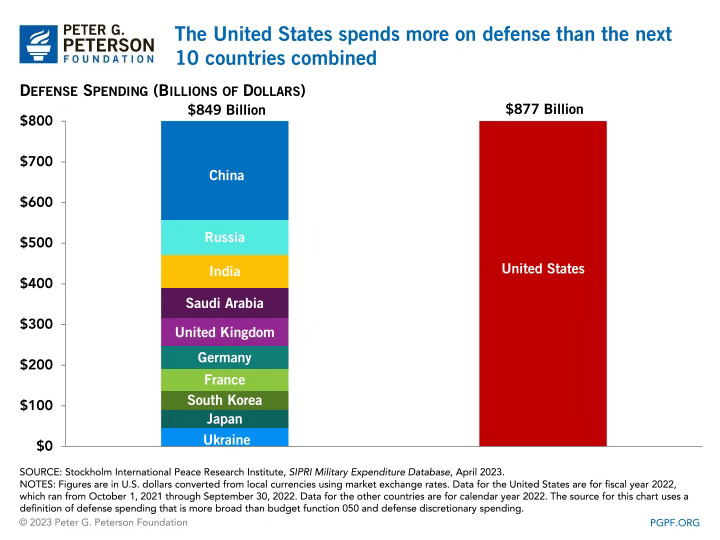
Yet challenging them is just a start. The only real way to wrestle the military-industrial complex to the ground is to cut its funding in half, whether gradually over years or in one fell swoop. Yes, indeed, it’s the understatement of the century to note how much easier that’s said than done. It’s not like any of us could wave a military swagger stick like a magic wand and make half the Pentagon budget disappear. But consider this: If I could do so, that military budget would still be roughly $430 billion, easily more than China’s and Russia’s combined, and more than seven times what this country spends on the State Department. As usual, you get what you pay for, which for America has meant more weapons and disastrous wars.
Join me in imagining the (almost) inconceivable — a Pentagon budget cut in half. Yes, generals and admirals would scream and Congress would squeal. But it would truly matter because, as a retired Army major general once told me, major budget cuts would force the Pentagon to think — for once. With any luck, a few sane and patriotic officers would emerge to place the defense of America first, meaning that hubristic imperial designs and forever wars would truly be reined in because there’d simply be no more money for them.
Currently, Americans are giving the Pentagon all it wants — plus some. And how’s that been working out for the rest of us? Isn’t it finally time for us to exercise real oversight, as Ike challenged us to do in 1961? Isn’t it time to force the Pentagon to pass an audit each year — it’s failed the last five! — or else cut its budget even more deeply? Isn’t it time to hold Congress truly responsible for enabling ever more war by voting out military sycophants? Isn’t it time to recognize, as America’s founders did, that sustaining a vast military establishment constitutes the slow and certain death of democracy?
Just remember one thing: the military-industrial complex won’t reform itself. It just might have no choice, however, but to respond to our demands, if we as citizens remain alert, knowledgeable, determined, and united. And if it should refuse to, if the MIC can’t be tamed, whether because of its strength or our weakness, you will know beyond doubt that this country has truly lost its way.
P.S. Since I wrote this early in 2023, the Pentagon has failed two more audits as its budget has soared toward $900 billion and above. Yes: It’s high time for major cuts to the Pentagon war budget. Make it so!
Peace Activist John Rachel Challenges Us to Imagine a Better World
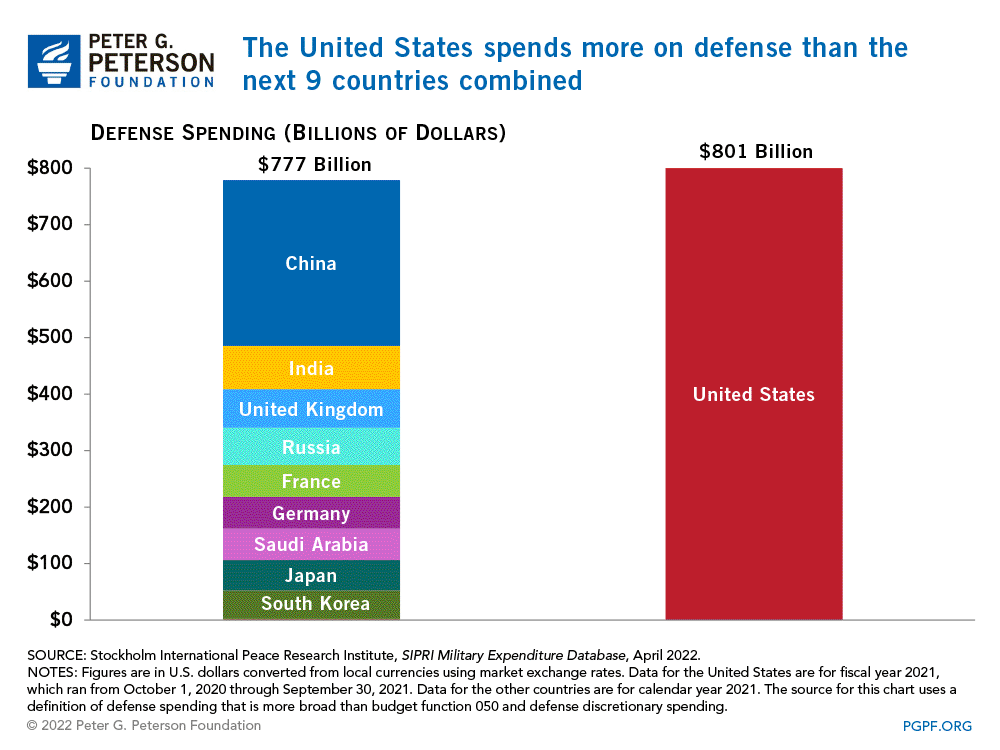
War is the health of the (anti-democratic) state. On those terms, America is very healthy indeed. America dominates the global trade in weaponry, accounting for 40% of that trade over the last five years (“We’re #1 in bombs, bullets, and blowing things up!”). America spends more on its military than the next ten nations combined (most of them being U.S. allies). Roughly 60% of federal discretionary spending is devoted to the Pentagon, sold to the American people as an “investment” in national security, even as it’s truly all about imperial dominance and resource extraction and exploitation.
John Rachel knows this. He asked me to write a foreword to his new book. “War Is Making Us Poor,” and what follows is that foreword. Check out his website and consider buying his book. Its succinct title sums up much about what’s wrong in America.
FOREWORD
Recently, I was reading the letters of Thomas Henry Huxley, who made a wise assertion in 1888: “Battles, like hypotheses, are not to be multiplied beyond necessity.”
My country, the United States of America, has been needlessly multiplying its battles around the world without necessity. The result has been a series of devastating wars in places like Vietnam, Iraq, and Afghanistan, wars that killed millions for little purpose other than the enrichment of what President Dwight D. Eisenhower in 1961 termed the military-industrial complex. Thus, Martin Luther King Jr. was right to conclude in 1967 that the United States had become the greatest purveyor of violence on the planet, its unbridled pursuit of militarism producing a form of spiritual death.
As James Madison, one of America’s founders, wrote near the close of the eighteenth century, no nation can preserve its freedom and maintain a healthy democracy when it embraces and pursues endless warfare. John Rachel knows this, feels this, and embraces the challenge of fighting against it. He knows America is dedicating more than half of its federal discretionary spending to wars, as the Pentagon budget soars toward $900 billion in 2024. He knows America is suffering from a form of spiritual death. He knows militarism will be the death, not only of democracy in America, but possibly of our planet itself, whether in quick time due to global nuclear war or in slow motion due to war-driven calamities aggravated by climate change.
America needs to change course. It needs to learn the word “peace” again. It needs to embrace diplomacy and reject militarism. It needs to stop being the world’s greatest purveyor of violence. It needs to dismantle its global network of 800 military bases, it needs to reject its vision of “full-spectrum dominance,” it needs to end its glorification of warriors and warfighters as heroes, it needs to stop exporting weapons to the world’s worst hotspots. But how?
As I write this, the U.S. government is sending massive arms shipments to Israel to enable ethnic cleansing in Gaza. Palestinian innocents, including thousands of women and children, are being pummeled and eviscerated by bombs and missiles carrying the label, “Made in USA.” America, which fancies itself a beacon of freedom, has become an abattoir of death through endless war.
I served in the U.S. military for twenty years. I taught thousands of military cadets the lessons of history. Yet I failed to question and challenge the system in meaningful ways until after I retired from the military. Somehow, collectively, Americans need to find the courage to change our violent ways. We need to act—now.
John Rachel’s book, by provoking us to think and to examine our often-unquestioned biases and assumptions, is just what we need to execute an “about-face” in America’s constant march to war.
In an age when American presidents routinely boast of having the world’s finest military, where nearly trillion-dollar war budgets are now a new version of routine, let me bring up one vitally important but seldom mentioned fact: making major cuts to military spending would increase U.S. national security.
Why? Because real national security can neither be measured nor safeguarded solely by military power (especially the might of a military that hasn’t won a major war since 1945). Economic vitality matters so much more, as does the availability and affordability of health care, education, housing, and other crucial aspects of life unrelated to weaponry and war. Add to that the importance of a Congress responsive to the needs of the working poor, the hungry and the homeless among us. And don’t forget that the moral fabric of our nation should be based not on a military eternally ready to make war but on a determination to uphold international law and defend human rights. It’s high time for America to put aside its conveniently generic “rules-based order” anchored in imperial imperatives and face its real problems. A frank look in the mirror is what’s most needed here.
It should be simple really: national security is best advanced not by endlessly preparing for war, but by fostering peace. Yet, despite their all-too-louddisagreements, Washington’s politicians share a remarkably bipartisan consensus when it comes to genuflecting before and wildly overfunding the military-industrial complex. In truth, ever-rising military spending and yet more wars are a measure of how profoundly unhealthy our country actually is.
“The Scholarly Junior Senator from South Dakota”
Such insights are anything but new and, once upon a time, could even be heard in the halls of Congress. They were, in fact, being aired there within a month of my birth as, on August 2, 1963, Democratic Senator George McGovern of South Dakota — later a hero of mine — rose to address his fellow senators about “New Perspectives on American Security.”
George McGovern
Nine years later, he (and his vision of the military) would, of course, lose badly to Republican Richard Nixon in the 1972 presidential election. No matter that he had been the one who served in combat with distinction in World War II, piloting a B-24 bomber on 35 missions over enemy territory, even as Nixon, then a Navy officer, amassed a tidy sum playing poker. Somehow, McGovern, a decorated hero, became associated with “weakness” because he opposed this country’s disastrous Vietnam War, while Nixon manufactured a self-image as the staunchest Cold Warrior around, never missing a chance to pose as tough on communism (until, as president, he memorably visited Communist China, opening relations with that country).
But back to 1963, when McGovern gave that speech (which you can read in the onlineSenate Congressional Record, volume 109, pages 13,986-94). At that time, the government was already dedicating more than half of all federal discretionary spending to the Pentagon, roughly the same percentage as today. Yet was it spending all that money wisely? McGovern’s answer was a resounding no. Congress, he argued, could instantly cut 10% of the Pentagon budget without compromising national security one bit. Indeed, security would be enhanced by investing in this country instead of buying yet more overpriced weaponry. The senator and former bomber pilot was especially critical of the massive amounts then being spent on the U.S. nuclear arsenal and the absurd planetary “overkill” it represented vis-à-vis the Soviet Union, America’s main competitor in the nuclear arms race. As he put it then:
“What possible advantage [can be had] in appropriating additional billions of dollars to build more [nuclear] missiles and bombs when we already have excess capacity to destroy the potential enemy? How many times is it necessary to kill a man or kill a nation?”
How many, indeed? Think about that question as today’s Congress continues to ramp up spending, now estimated at nearly $2 trillion over the next 30 years, on — and yes, this really is the phrase — “modernizing” the country’s nuclear triad of intercontinental ballistic missiles (ICBMs), as well as its ultra-expensive nuclear-missile-firing submarines and stealth bombers. And keep in mind that the U.S. already has an arsenal quite capable of wiping out life on several Earth-sized planets.
What, according to McGovern, was this country sacrificing in its boundless pursuit of mass death? In arguments that should resonate strongly today, he noted that America’s manufacturing base was losing vigor and vitality compared to those of countries like Germany and Japan, while the economy was weakening, thanks to trade imbalances and the exploding costs of that nuclear arms race. Mind you, back then, this country was still on the gold standard and unburdened by an almost inconceivable national debt, 60 years later, of more than $34 trillion, significant parts of it thanks to this country’s failed “war on terror” in Iraq, Afghanistan, and elsewhere across all too much of the planet.
McGovern did recognize that, given how the economy was (and still is) organized, meaningful cuts to military spending could hurt in the short term. So, he suggested that Congress create an Economic Conversion Commission to ensure a smoother transition from guns to butter. His goal was simple: to make the economy “less dependent upon arms spending.” Excess military spending, he noted, was “wasting” this country’s human resources, while “restricting” its political leadership in the world.
In short, that distinguished veteran of World War II, then serving as “the scholarly junior Senator from South Dakota” (in the words of Senator Jennings Randolph of West Virginia), was anything but proud of America’s “arsenal of democracy.” He wasn’t, in fact, a fan of arsenals at all. Rather, he wanted to foster a democracy worthy of the American people, while freeing us as much as possible from the presence of just such an arsenal.
To that end, he explained what he meant by defending democracy:
“When a major percentage of the public resources of our society is devoted to the accumulation of devastating weapons of war, the spirit of democracy suffers. When our laboratories and our universities and our scientists and our youth are caught up in war preparations, the spirit of [freedom] is hampered.
“America must, of course, maintain a fully adequate military defense. But we have a rich heritage and a glorious future that are too precious to risk in an arms race that goes beyond any reasonable criteria of need.
“We need to remind ourselves that we have sources of strength, of prestige, and international leadership based on other than nuclear bombs.”
Imagine if his call had been heeded. This country might today be a far less militaristicplace.
Something was, in fact, afoot in the early 1960s in America. In 1962, despite the wishes of the Pentagon, President John F. Kennedy used diplomacy to get us out of the Cuban Missile Crisis with the Soviet Union and then, in June 1963, made a classic commencement addressabout peace at American University. Similarly, in support of his call for substantial reductions in military spending, McGovern cited the farewell address of President Dwight D. Eisenhower in 1961 during which he introduced the now-classic phrase “military-industrial complex,” warning that “we must never let the weight of this combination [of the military with industry, abetted by Congress] endanger our liberties or democratic processes.”
Echoing Ike’s warning in what truly seems like another age, McGovern earned the approbation of his Senate peers. His vision of a better, more just, more humane America seemed, however briefly, to resonate. He wanted to spend money not on more nuclear bombs and missiles but on “more classrooms, laboratories, libraries, and capable teachers.” On better hospitals and expanded nursing-home care. On a cleaner environment, with rivers and streams saved from pollution related to excessive military production. And he hoped as well that, as military bases were closed, they would be converted to vocational schools or healthcare centers.
McGovern’s vision, in other words, was aspirational and inspirational. He saw a future America increasingly at peace with the world, eschewing arms races for investments in our own country and each other. It was a vision of the future that went down fast in the Vietnam War era to come, yet one that’s even more needed today.
Praise from Senate Peers
Here’s another way in which times have changed: McGovern’s vision won high praise from his Senate peers in the Democratic Party. Jennings Randolph of West Virginia agreed that “unsurpassed military power in combination with areas of grave economic weakness is not a manifestation of sound security policy.” Like McGovern, he called for a reinvestment in America, especially in underdeveloped rural areas like those in his home state. Joseph Clark, Jr., of Pennsylvania, also a World War II veteran, “thoroughly” agreed that the Pentagon budget “needs most careful scrutiny on the floor of the Senate, and that in former years it has not received that scrutiny.” Stephen Young of Ohio, who served in both World War I and World War II, looked ahead toward an age of peace, expressing hope that “perhaps the necessity for these stupendous appropriations [for weaponry] will not be as real in the future.”
Possibly the strongest response came from Frank Church of Idaho, who reminded his fellow senators of their duty to the Constitution. That sacred document, he noted, “vests in Congress the power to determine the size of our military budget, and I feel we have tended too much to rubberstamp the recommendations that come to us from the Pentagon, without making the kind of critical analysis that the Senator from South Dakota has attempted… We cannot any longer shirk this responsibility.” Church saluted McGovern as someone who “dared to look a sacred cow [the Pentagon budget] in the teeth.”
A final word came from Wayne Morse of Oregon. Very much a gadfly, Morse shifted the topic to U.S. foreign aid, noting that too much of that aid was military-related, constituting a “shocking waste” to the taxpayer even as it proved detrimental to the development of democracy abroad, most notably in Latin America. “We should be spending the money for bread, rather than for military aid,” he concluded.
Imagine that! Bread instead of bullets and bombs for the world. Of course, even then, it didn’t happen, but in the 60 years since then, the rhetoric of the Senate has certainly changed. A McGovern-style speech today would undoubtedly be booed down on both sides of the aisle. Consider, for example, consistent presidential and Congressional clamoring now for more military aid to Israel during a genocide in Gaza. So far, U.S. government actions are more consistent with letting starving children in Gaza eat lead instead of bread.
Peace Must Be Our Profession
What was true then remains true today. Real national defense should not be synonymous with massive spending on wars and weaponry. Quite the reverse: whenever possible, wars should be avoided; whenever possible, weapons should be beaten into plowshares, and those plowshares used to improve the health and well-being of people everywhere.
Oh, and that Biblical reference of mine (swords into plowshares) is intentional. It’s meant to highlight the ancient roots of the wisdom of avoiding war, of converting weapons into useful tools to sustain and provide for the rest of us.
Yet America’s leaders on both sides of the aisle have long lost the vision of George McGovern, of John F. Kennedy, of Dwight D. Eisenhower. Today’s president and today’s Congress, Republicans and Democrats alike, boast of spending vast sums on weapons, not only to strengthen America’s imperial power but to defeat Russia and deter China, while bragging all the while of the “good” jobs they’re allegedly creatinghere in America in the process. (This country’s major weapons makers would agreewith them, of course!)
McGovern had a telling rejoinder to such thinking. “Building weapons,” he noted in 1963, “is a seriously limited device for building the economy,” while an “excessive reliance on arms,” as well as overly “rigid diplomacy,” serve only to torpedo promising opportunities for peace.
Back then, it seemed to politicians like McGovern, as well as President Kennedy, that clearing a path toward peace was not only possible but imperative, especially considering the previous year’s near-cataclysmic Cuban Missile Crisis. Yet just a few months after McGovern’s inspiring address in the Senate, Kennedy had been assassinated and his calls for peace put on ice as a new president, Lyndon B. Johnson, succumbed to pressure by escalating U.S. military involvement in what mushroomed into the catastrophic Vietnam War.
In today’s climate of perpetual war, the dream of peace continues to wither. Still, despite worsening odds, it’s important that it must not be allowed to die. The high ground must be wrested away from our self-styled “warriors,” who aim to keep the factories of death churning, no matter the cost to humanity and the planet.
My fellow Americans, we need to wake up from the nightmare of forever war. This country’s wars aren’t simply being fought “over there” in faraway and, at least to us, seemingly forgettable places like Syria and Somalia. In some grim fashion, our wars are already very much being fought right here in this deeply over-armed country of ours.
George McGovern, a bomber pilot from World War II, knew the harsh face of war and fought in the Senate for a more peaceful future, one no longer haunted by debilitating arms races and the prospect of a doomsday version of overkill. Joining him in that fight was John F. Kennedy, who, in 1963, suggested that “this generation of Americans has already had enough, more than enough, of war, and hate, and oppression.”
If only.
Today’s generation of “leaders” seems not yet to have had their fill of war, hate, and oppression. That tragic fact — not China, not Russia, not any foreign power — is now the greatest threat to this country’s “national security.” And it’s a threat only aggravated by ever more colossal Pentagon budgets still being rubberstamped by a spinelessly complicit Congress.
The Pentagon Budget Keeps Soaring Up, Up, and Away!
When the Soviet Union collapsed in 1991 and the Cold War ended, I heard a lot about peace dividends. It was time to become a normal country in normal (more peaceful) times, said Jeanne Kirkpatrick, an early neocon who served under Ronald Reagan. More than thirty years later, America still awaits its peace dividends from the Cold War.
When the Afghan War came to a sputtering and ignominious end in 2021, I didn’t hear much at all about peace dividends. Even though the Afghan War was costing the United States almost $50 billion a year before it crashed and burned, the Pentagon budget for 2022 went up by that amount rather than down. You’d think the end of wars would lead to a decrease in military spending, but not in America.
And so we come to today, when I learned that the Pentagon budget for 2023, which sat at $802 billion per the request of the Biden administration, has been boosted big time to $847 billion by the House and Senate Armed Services Committees. That’s $45 billion extra for more wars and weapons, a whopping sum of money that would likely end homelessness if it was invested in America.
One thing is certain: war dividends always come through. Peace dividends? Not so much.
How does the Washington Beltway crowd justify such enormous sums for “national defense”? Threat inflation, of course. Because of its debilitating war with Ukraine, Russia is weaker but somehow that means America must spend more because Putin or something. Chinese maneuvers near Taiwan are treated like direct incursions into U.S. coastal waters. A few North Korean missiles are enough to justify more than a trillion dollars for new or revamped nuclear forces over the next thirty years. And of course military Keynesianism is always a factor, as in Pentagon-related jobs spread as widely as possible through every Congressional district.
The Pentagon can’t even pass an audit (for the fifth year in a row!), yet it still gets more and more billions from you the taxpayer.
I took a quick look at NBC News online to see if there were any objections to this massive $847 billion budget for the Pentagon. The only story featured warned that “GOP senators threaten to delay military bill over vaccine mandate.” Yes, what’s truly worrisome is that a few troops might have to accept a COVID vaccine against their will. Geez, where were these senators when the military was jabbing me in the arm every year with a mandatory flu vaccine?
Trees are falling in the forest to print all the money the Pentagon wants (and then some), but few Americans hear a sound since the mainstream media refuses to cover wasteful military spending and disastrous American wars.
If you should want a sure bet in America, don’t toss money at your favorite sports team. Place your bet on America’s war horse. Whether it wins, places, or shows, or even comes up lame, it will always pay dividends.
Isn’t it reassuring to know your taxpayer dollars are buying lots of “Ferraris” for the U.S. military?
W.J. Astore
If you truly want to help the U.S. military, slash its yearly budget.
It’s counterintuitive, right? We think more money will help the Pentagon field effective forces and to be better prepared to defend America. But that hasn’t proven to be the case. The more money the Pentagon gets, the more money gets spent on unnecessary and often poorly performing weapons systems. Take my old service, the U.S. Air Force. It doesn’t need the B-21 bomber. It doesn’t need new ICBMs. The F-35 fighter is a major disappointment, a “Ferrari” according to the Air Force Chief of Staff, i.e. an exotic and temperamental plane you fly only on occasion, which isn’t what the Air Force wanted or needed. Similarly, the Navy is building aircraft carriers that can’t launch planes effectively and “little crappy ships” that have no role at all. And the Army has thousands of M-1 Abrams tanks parked in storage that it’ll probably never use.
Do you have a friend with too much money? Maybe he got an inheritance or some other windfall. And the money makes him stupid. It’s stipulated in the inheritance that he must spend all of it within a year or two (the way Pentagon appropriations work), and if he fails to spend it, he’ll get less in the future. So he spends wildly, without giving it much thought, because he’s got the money and because he has to. And spending money on expensive “Ferraris” is fun. He’s not encouraged to think about how to use the money wisely, rather the reverse. So he just buys big ticket items willy-nilly.
Congress, of course, is the Pentagon’s enabler. Whatever the military wants nowadays, Congress is determined to give the brass more, in the false name of supporting the troops. It’s not the troops that see the money, it’s the industrial side of Ike’s military-industrial complex that profits the most. There’s something truly unseemly about Congress throwing money at the Pentagon while camp-following weapons contractors siphon it up.
Technically, incredibly, the U.S. military is no longer at war, i.e. “large-scale combat operations,” according to Secretary of Defense Lloyd Austin. Perhaps you missed the announcement that new U.S. troops coming on active duty wouldn’t automatically receive the National Defense Service Medal, as they have since 9/11 and the subsequent global war on terror. With those “large-scale” wars finally ended, shouldn’t the Pentagon’s budget decrease in a big way? Wars in Iraq and Afghanistan were costing the U.S. over $100 billion a year, yet as they have ended, the Pentagon’s budget has increased by more than $100 billion. Talk about counterintuitive! Wars end as war budgets increase. Only in America.
There is no logic here. I’m reminded of a scene from the original Star Trek in which Spock is befuddled by an attack on Captain Kirk because there’s apparently no logic to it. As an alien patiently explains to Spock, “Perhaps you should forget logic and devote yourself to motivations of passion or gain.” It’s a telling lesson for anyone looking to explain the illogic of America’s defense budget.
Get rid of the passion and gain in the Pentagon’s budget, America. It’s time to use logic and make major cuts. Force the military to think rather than to spend. Who knows … we may end up with a leaner, even a smarter, military, one committed less to war and more to supporting and defending the U.S. Constitution.
The Pentagon will never be forced to make choices if Congress keeps shoveling money its way
W.J. Astore
In the tradition of the U.S. Army, which talks about BLUF, or bottom line up front, here’s what I consider to be a sane defense budget for the United States: $333 billion.
I arrived at this figure by complex math. The U.S. population currently sits at just under 333 million. A reasonable figure to spend per person on national defense is $1000. Hence my figure for a sane defense budget.
How does this immense sum compare to other countries’ budgets? Russia’s defense budget (before its war with Ukraine) hovered around $70 billion a year. China’s defense budget hovered around $245 billion. So my “sane” defense budget easily surpasses the combined budgets of Russia and China, America’s main rivals, or so our military experts say.
Other countries that spend impressively on defense include Germany, France, and the U.K. But note that these are American allies; their spending should serve to lessen the need for our own.
Now, I wish to stress my budget is about defense, as in defending the U.S. against all enemies, foreign and domestic. My budget is not about projecting imperial power around the globe; it’s not about full-spectrum dominance; it’s not about spending more than a trillion dollars over the next thirty years on unneeded nuclear weapons, or more than a trillion to buy and maintain more underperforming F-35 jet fighters.
Again, my sane budget is not a war budget, an imperial budget, or a budget to enrich U.S. weapons makers. It’s a budget intended to DEFEND our country.
So, let’s now compare my sane budget to the actual “defense” budget planned for FY2023. It appears that budget will likely exceed $833 billion, more than half a trillion higher than mine!
What could America do with half a trillion dollars? Think of how many good-paying jobs we could create, how much better our country could be, with safer roads and bridges, more alternative sources of energy, improved schools and hospitals, a cleaner environment. How about drinking water without lead in it? The list is long because we have so many needs as a country.
It wasn’t that long ago that $300 billion was considered more than enough for national defense. But since 9/11 the budget has spiraled upwards as the U.S. government pursued forever wars like Iraq and Afghanistan that ended disastrously. Things are now so bad that the Pentagon can’t even begin to pass a basic audit. Send a small army of accountants to the Pentagon and the brass surrenders instantly.
$333 billion is still an enormous sum of money, yet there will be many who’ll suggest this figure isn’t close to being enough for the brass, all those wearing stars who call the shots. My response: try it. If it doesn’t work, you can always boost the budget. But if you really want the Pentagon to think creatively, cut the budget to $333 billion and watch the real wars begin within the five-sided puzzle palace on the Potomac.
What does “security” mean to you? My dad had a utilitarian definition. Born in 1917, he found himself in a fatherless immigrant family with four siblings during the height of the Great Depression. To help his family survive, he enlisted in the Civilian Conservation Corps in 1935 and served for two years, earning a dollar a day, most of it sent home to his mother. For my dad, security meant a roof over one’s head, three square meals a day, and warm clothes on one’s back. Food, shelter, clothing: it really was that simple.
Of course, you needed to pay for those bare necessities, meaning you needed a job with decent pay and benefits. Personal security, therefore, hinges on good pay and affordable health care, which many U.S. workers today – in the richest country in the world – continue to scratch and claw for. Another aspect of personal security is education because pay and career advancement within U.S. society often depend on one’s educational level. A college education is proven to lead to higher pay and better career prospects throughout one’s life.
Personal security is in many ways related to national security. Certainly, a nation as large as the U.S. needs a coast guard, border controls, an air force, a national guard, and similar structures for defensive purposes. What it doesn’t need is a colossal, power-projecting juggernaut of a military at $800+ billion a year that focuses on imperial domination facilitated by 750 overseas bases that annually cost more than $100 billion just to maintain. True security, whether personal or national, shouldn’t be about domination. It should be focused on providing a collective standard of living that ensures all Americans can afford nutritious food, a decent place to live, adequate clothing, a life-enriching education, and health care.
President Dwight D. Eisenhower understood this. In his farewell address as president in 1961, he warned us about the military-industrial complex and its anti-democratic nature. Even more importantly, he called for military disarmament as a “continuing imperative,” and he talked of peace, which he tied to human betterment, and which he said could be “guaranteed by the binding force of mutual respect and love.” Ike knew that huge, offensive-minded military budgets constituted a theft from the people; even worse, he knew they constituted a betrayal of our national ideals. A hugely powerful military establishment had “grave implications” to the “very structure of our society,” Ike presciently warned. We have failed to heed his warning.
Ike, a former five-star U.S. general who led the D-Day invasion in 1944, knew the dangers of funding an immense military establishment
For Ike, true national security was about fostering human betterment and working toward world peace. It was about securing the necessities of life for everyone. It entailed the pursuit of military disarmament, a pursuit far preferable to allowing the world to be crucified on a cross of iron erected by wars and weapons manufacturers.
Tragically, America’s “councils of government” no longer guard against militarism; rather, they have been captured, often willingly, by the military-industrial complex. The “alert and knowledgeable citizenry” that Ike was counting on to hold the line against incessant warfare and wasteful weaponry is largely uninterested, or uninformed, or uneducated in matters of civics and public policy. Meanwhile, military spending keeps soaring, and the result is greater national insecurity.
In a paradox Ike warned us about, the more money the government devotes to its military, the less secure the nation becomes. Because security isn’t measured in guns and bullets and warheads. It’s measured in a healthy life, a life of meaning, a life of liberty. The pursuit of happiness, not eternal belligerence, should be the goal.
Consider the following fable. A man lives in a castle. He says he seeks security. So he digs moats and erects walls and piles cannon ball upon cannon ball. He posts armed guards and launches raids into the surrounding countryside to intimidate “near-peer” rivals. He builds outlying fortifications and garrisons them, thinking these will secure his castle from attack. Meanwhile, his family and relations in the castle are starving; the roof leaks and internal walls are covered in mold; the people, shivering and in rags, are uneducated and in poor health. Has this man truly provided security for his people? Would we call this man wise?
Grossly overspending on the military and weaponry — on castles and cannons everywhere — produces insecurity. It’s the very opposite of wisdom. Let’s end this folly, America, and seek human betterment and world peace as Ike advised us to do.
Addendum: these are the words Ike spoke in 1953
Every gun that is made, every warship launched, every rocket fired signifies, in the final sense, a theft from those who hunger and are not fed, those who are cold and are not clothed.
This world in arms is not spending money alone. It is spending the sweat of its laborers, the genius of its scientists, the hopes of its children. The cost of one modern heavy bomber is this: a modern brick school in more than 30 cities. It is two electric power plants, each serving a town of 60,000 population. It is two fine, fully equipped hospitals. It is some fifty miles of concrete pavement. We pay for a single fighter plane with a half million bushels of wheat. We pay for a single destroyer with new homes that could have housed more than 8,000 people.
This is, I repeat, the best way of life to be found on the road the world has been taking. This is not a way of life at all, in any true sense. Under the cloud of threatening war, it is humanity hanging from a cross of iron.
Overall, the Russian invasion of Ukraine isn’t going well for Russia. If reports are correct, the Russian military hasn’t distinguished itself. Poor logistics, bad intelligence, lack of effective air support, and an increasing reliance on brute strength appear to be features of this campaign. Meanwhile, Russia is suffering from debilitating economic sanctions imposed by the West. In sum, Russia is weaker today than it was three weeks ago before the invasion. So why is Pentagon spending set to soar in the coming fiscal years?
A friend sent an article along from the New York Times that sums up this insane moment in Washington. He suggested that I re-post it here and make some comments on it. Here goes (my comments in italics):
War in Ukraine rallies support in Congress for more military spending
Catie Edmondson
The New York Times
WASHINGTON — From his perch as chairman of the Armed Services Committee, Rep. Adam Smith, D-Wash., has long lamented what he sees as a Pentagon budget bloated by inefficient spending. When hawkish lawmakers led a successful charge last year to pour nearly $24 billion more into the military’s coffers, he opposed the move.
But last week, as Russian forces continued their assault on Ukraine and he pondered the size of the coming year’s military budget, Mr. Smith sounded a different tone.
“I haven’t picked a number yet,” he said, “but without question, it’s going to have to be bigger than we thought.”
Yes, the Pentagon budget is “bloated” and “inefficient.” You don’t solve that by giving the Pentagon yet more billions!
He added: “The Russian invasion of Ukraine fundamentally altered what our national security posture and what our defense posture needs to be. It made it more complicated, and it made it more expensive.”
No, the invasion hasn’t “fundamentally altered” America’s “defense posture.” If anything, a weakening Russia means we can spend less money on defense, not more.
His shift signals a stark new reality facing President Joe Biden on Capitol Hill, where Democrats had already shown they had little appetite for controlling the defense budget, even as Mr. Biden declared an end to the era of ground wars and indicated he wanted to reimagine the use of American power abroad.
How interesting. I thought “American power” was about “defense.” Why does this have to be “reimagined”?
Now, facing a military onslaught by President Vladimir Putin in Ukraine, and rising fears of a protracted war in Europe and an emboldened China, lawmakers in both parties — including some who had resisted in the past — are pressing for vast increases in military spending to address a changed security landscape.
Why are more weapons and more wars always the answer to a “changed security landscape”?What is the sense of “vast increases”?
As images pour out of Ukrainian cities devastated by a relentless and indiscriminate volley of Russian missiles, Democrats and Republicans who have struggled to coalesce behind meaningful legislation to aid the Ukrainian cause are rallying around one of the few substantive tools available to them: sending money and weapons.
The House this week is poised to approve $10 billion in emergency funds to Ukraine, including $4.8 billion to cover the costs of weapons already sent to Ukraine and eastern flank allies, as well as the deployment of U.S. troops. But already on Monday, Sen. Chuck Schumer, D-N.Y., the Senate majority leader, suggested lawmakers could approve a $12 billion package, in a sign of how eager lawmakers were to send more aid to Kyiv. The United States alone has deployed more than 15,000 troops to Europe, while committing an additional 12,000 to NATO’s response force if necessary.
$10 billion in “emergency funds” is now more than $13 billion for Ukraine. How come America’s poor and neediest can’t get that level of aid, and that quickly?
Beyond funding immediate needs, the consensus around more generous Pentagon spending previews a dynamic that is likely to drive negotiations around next year’s defense budget, potentially locking in the kind of large increases that Mr. Biden and many Democrats had hoped to end.
This is false. Biden ran for president promising increases in Pentagon spending over and above what Trump had proposed.
“I think people are sort of waking up out of this haze that we were living somehow in a secure world,” said Rep. Elaine Luria, D-Va., who sits on the Armed Services Committee.
WTF? We live in an insecure world because of wanton spending by the military-industrial-congressional complex.
Ms. Luria added: “I was not satisfied with the budget that came over last year from the White House, especially in regards to China, especially in regards to the Navy or shipbuilding, and I’ll be very disappointed, in light of the new world situation, if they come up with a budget like that again.”
The rapid shift in thinking is a setback for progressives who had hoped that unified Democratic control of the House, the Senate and the White House would translate into a smaller Pentagon budget and a reduced footprint of American troops around the world.
Democrats, as a party, never wanted a smaller Pentagon budget.
Rep. Ilhan Omar, D-Minn., said in a brief interview that she believed it was crucial that the United States provide Ukrainians with some defensive weapons, but added: “Do I think that there is a point where it becomes too much? Yes.”
Ms. Omar said she was particularly worried about the prospect of arming an insurgency, especially as civilians from around the world have flocked to Ukraine to help push back against the Russian army.
“We’ve seen what the result of that was in Afghanistan, when we armed so many people to fight against the Russians,” said Ms. Omar, who was born in Somalia. “Many of those people went back to their own countries and caused a lot of havoc, including the one I come from.”
A little bit of sense by Rep. Omar, but she has no support here.
Mr. Biden last weekend authorized a $350 million package of weapons that included Javelin anti-tank missiles and Stinger anti-aircraft missiles as well as small arms and munitions, a shipment that represented the largest single authorized transfer of arms from U.S. military warehouses to another country.
Weapons bought for U.S. troops are being sent for free to Ukraine to be used (in some cases) by neo-Nazi forces. I’m sure nothing bad will come from this.
Many lawmakers want to go further. Several Republican senators have endorsed setting up a separate fund to support the Ukrainian resistance, signaling an appetite to continue arming those in Ukraine willing to fight for an extended period of time, even in the event their government falls.
“I want to see more Javelins,” said Sen. Jim Risch, of Idaho, the top Republican on the Armed Services Committee. “I want to see more Stingers.”
Missiles are the answer! More Russian and Ukrainian dead! Hooah!
An emotional virtual meeting on Saturday in which President Volodymyr Zelenskyy, of Ukraine, who has been defiant in the face of continuing Russian attacks, pleaded with senators for additional weapons rallied more support for his cause.
Sen. Ted Cruz, R-Texas, called for Congress to pass an additional military aid emergency spending bill. And Rep. Tom Malinowski, D-N.J., suggested that Congress quickly approve funding to reimburse Eastern European allies if they provide Ukraine with planes or surface-to-air missiles.
“We should be signaling to the Poles and Romanians and others that this is something we would want to help them do,” Mr. Malinowski said.
Lawmakers are eyeing long-term solutions, too, in Europe and beyond. At an Armed Services Committee hearing last week, both Republicans and Democrats endorsed increasing the U.S. military presence in the Baltics.
Rep. Elissa Slotkin, D-Mich., who is a former Pentagon official, called Mr. Putin’s invasion “a sea change” for “how both the Defense Department and the State Department should think about our presence in Europe.”
“I couldn’t agree more with my colleagues who have talked about putting more force in right now,” Ms. Slotkin said, adding later, “We have to completely re-evaluate deterrence and how we re-establish it.”
What we’re witnessing is the U.S. Congress foaming at the mouth to send more weapons to Ukraine to kill more Russians (and doubtless Ukrainians too), while boosting Pentagon spending against a Russian threat that will be considerably lower, assuming this war doesn’t spiral out of control because of ill-judged and incendiary responses by the U.S.
Imagine you’re President Joe Biden. You’re looking for nearly $2 trillion to fund vital repairs and improvements to America’s infrastructure. You learn of a warplane, the F-35 Lightning II, that may cost as much as $1.7 trillion to buy, field and maintain through the next half century. Also, you learn it’s roughly $200 billion over budget and more than a decade behind schedule. You learn it was supposed to be a low-cost, high-availability jet but that through time, it’s become a high-cost, low-availability one. Your senior Air Force general compares it to a Ferrari sports car and says we’ll “drive” it only on Sundays. What do you do?
Your first thought would probably be to cancel it, save more than a trillion dollars, and fund America’s infrastructure needs. Yet instead, the U.S. military is turning on the afterburners and going into full production. What gives?
When 60 Minutes reported on the F-35 in 2014, the plane was already seven years behind schedule and $163 billion over budget. Since then, it has weathered a series of setbacks and complications: Engines that are unreliable and in short supply. An ultra-expensive software system to maintain and repair the plane that doesn’t work. Higher operating costs — as much as 300% higher — compared to previous planes like the F-16 or the A-10. An overly loud engine that creates a noise nuisance to nearby population centers. The list goes on, yet so, too, does the F-35 program.
Why? Because of the power of the military-industrial-congressional complex. The F-35’s lead contractor, Lockheed Martin, used a tried-and-true formula to insulate the plane from political pressure, spreading jobs across 45 states and 307 congressional districts. In essence, the F-35 program has become “too big to fail.” At the Pentagon level, the plane is supposed to fulfill the needs of the Air Force, Navy and Marine Corps for a “fifth generation” stealthy fighter. There is no alternative, or so you’re told.
Yet, as America’s commander-in-chief, you must always remember there are alternatives. Think about it. Why buy a deeply troubled weapon system at inflated prices? Why reward a military contractor for woeful failures to deliver on time and within budget?
Congress rarely asks such questions because of the corrosive power of corporate lobbyists, the military’s insatiable demands for tech-heavy wonder weapons, and thinly-veiled threats that program cuts will cost jobs — meaning members of Congress might face electoral defeat if they fail to safeguard the F-35 pork apportioned to their districts.
But you’re the president — you should be above all that. You take a wider view like the one President Dwight D. Eisenhower took in 1953 in his “cross of iron” speech. Here Ike, a former five-star Army general, challenged Americans to prioritize instruments of peace over tools of war. Schools and hospitals, Ike wrote, were more vital to a democracy than destroyers and fighter jets. Ike was right then — and even more right today. He famously invested in an interstate highway system that served as an accelerant to the U.S. economy. He knew that warplanes, especially overly pricey and operationally dicey ones, were much less vital to the common good.
The Pentagon tells you it’s the F-35 or bust. But for you as president, it’s the F-35 and bust. You begin to realize that so many of the experts advising you to stay the course on the F-35 stand to profit if you do so.
And then you realize as America’s commander-in-chief that no weapon system should be too big to fail. You take heart from Sen. John McCain. In 2016, that ex-naval aviator declared the F-35 program was “both a scandal and a tragedy with respect to cost, schedule and performance.”
Why continue that scandal? Why not end that tragedy? You can decide to send the strongest and clearest message to the military-industrial-congressional complex by cancelling the F-35. You can vow to reform the flawed system that produced it. And you can fund your vital infrastructure programs with the savings.
William J. Astore is a retired Air Force lieutenant colonel and history professor. He is currently a senior fellow at the Eisenhower Media Network.








 Bracing Views