The Pentagon has failed eight consecutive financial audits. For decades it has been unable to account for trillions of dollars. It has not won a major war since World War II. That is not a record of excellence. It is a record of entrenched failure.
Naturally, President Trump’s answer is to give it another $500 billion in next year’s budget.
If enacted, that would drive annual U.S. military spending north of $1.5 trillion. The math is almost too neat: U.S. GDP hovers around $30 trillion; five percent of that is $1.5 trillion. Somewhere along the way, the arbitrary idea that “defense” spending should equal 5 percent of GDP hardened into dogma. A considered strategy no longer informs budgets. Arbitrary numerology does.
Did the Pentagon request an extra half-trillion dollars? No. Has the administration identified a new existential threat that requires it? No. There is no grand strategy unveiled to justify this “surge.” Just a number — large, round, politically expedient.
An institution that cannot pass an audit is not prepared to manage another half-trillion dollars. Pouring money into a system riddled with cost overruns, duplicated programs, and strategic confusion does not produce security. It produces contractors’ profits and future disasters.
Let’s be honest about what this really is. The national security state — the blob, the military-industrial-congressional-intelligence-media-academia-think tank complex — is already the most powerful force in Washington. When you add “defense,” nuclear weapons, intelligence, veterans’ programs, and homeland security, it consumes well over half of federal discretionary spending. It is the unofficial fourth branch of government, and arguably the first in power.
Few presidents confront it. Dwight D. Eisenhower warned about the military-industrial complex — and even he presided over huge Cold War budgets. John F. Kennedy spoke of peace while deepening involvement in Vietnam. Lyndon B. Johnson escalated that war catastrophically. Barack Obama accepted a Nobel Peace Prize and then defended the necessity of permanent American war. Presidents learn quickly: you appease the Pentagon or you risk political ruin.
And so Trump does what presidents do. Even as he talks of peace, he feeds the war machine.
We are told this is about safety. That peace comes only through overwhelming force. That America must dominate every domain — land, sea, air, space, cyberspace — indefinitely. That garrisoning the globe is synonymous with freedom. That “exceptional” nations do not generate blowback.
Yet two decades in Iraq and Afghanistan ended not in triumph but exhaustion and retreat. Each failure somehow justifies a larger budget. Nothing succeeds like failure.
In a functioning democracy, military spending would be tied to actual defense. It would be scrutinized, debated, constrained. Instead, military failure yields medals and ribbons. Audit failure yields budget growth. Strategic stalemate yields expansion. The larger the disappointment, the louder the demand for more money and authority.
When an institution grows more powerful no matter how poorly it performs, accountability has died. When elected officials dare not meaningfully challenge it, civilian control becomes theater. Call it what you will, but a republic that cannot rein in its military establishment is drifting toward a system where the sword outweighs the ballot and proves mightier than the pen.
As Joe Biden once said, “Show me your budget, and I’ll tell you what you value.” A $1.5 trillion military budget tells us that war — or at least preparation for it — sits at the center of national life.
Perhaps not so happy
On Presidents’ Day, it is worth recalling that George Washington surrendered military power to constitutional authority. That was the founding act of the republic. The test of any president is whether he sees himself as bound by law — or as a ruler who commands legions.
Empires require Caesars. Republics require restraint. The colossal size of Trump’s proposed war budget suggests which path he (and America) is choosing.
Language and repetition of the same is so important. We hear about the Department of Defense (DoD) and the Pentagon budget and we think little of it. The DoD, of course, used to be called the Department of War until 1947, a far more telling and accurate name, and there wasn’t a Pentagon until we built one during World War II. In the old days, the Army fought the Navy for which service would get more money in the War Budget, with the Navy usually winning as America sought to control the seas as a means of dominating trade and “intercourse” among nations.
Those were more honest times when retired generals like Smedley Butler wrote in the 1930s that he’d served as a “gangster” for capitalism. Butler was a Marine who was twice awarded the Medal of Honor, so it wasn’t easy for the imperialists to smear him, though they certainly tried (as they did to David M. Shoup, another Marine Corps general and Medal of Honor recipient who turned against the Vietnam War in the 1960s).
Anyhow, I just saw at Antiwar.com that President Trump is proposing a $1.01 trillion budget for the Pentagon for FY2026, a 13% increase in imperial spending. Trump, of course, is proud of reaching the Trillion Dollar threshold. Big numbers have always appealed to him.
It doesn’t seem to matter who is president, whether it’s Biden or Trump, Democrat or Republican, when it comes to the Department of Empire and its bloated imperial budget. For that is what it is, a budget that seeks to sustain and enlarge America’s imperial domain. If you add other costs related to imperial dominance, such as interest on the national debt due to war spending, VA costs, nuclear weapons, and the like, the true imperial budget soars toward $1.7 trillion yearly.
No matter. A trillion here, a trillion there, and pretty soon you’re talking real money.
The Pentagon tries to disguise the enormous waste of this imperial budget by speaking of it as an “investment,” but imagine an “investment” that you’re involved in which fails seven audits in a row. How likely would you be to see this as anything other than theft?
Dwight D. Eisenhower had it right in 1953 when he spoke of military spending as a theft from those who hunger. Ike’s words are almost never heard today inside the Washington Beltway. It’s worth reflecting upon them again as America’s leaders boast of trillion-dollar war budgets:
Every gun that is made, every warship launched, every rocket fired signifies, in the final sense, a theft from those who hunger and are not fed, those who are cold and are not clothed. This world in arms is not spending money alone. It is spending the sweat of its laborers, the genius of its scientists, the hopes of its children… This is not a way of life at all, in any true sense. Under the cloud of threatening war, it is humanity hanging from a cross of iron.
President Donald Trump says he’s ready to tackle the Pentagon, which has failed seven audits in a row. He says America might save “trillions” after effective audits. Will it happen?
The Pentagon budget currently sits at roughly $900 billion for this fiscal year, representing more than half of federal discretionary spending. This vast sum doesn’t include (among other things) Homeland Security, nuclear weapons covered by the Department of Energy, the VA (Veterans Administration), and interest on the national debt due to wasteful failed wars in places like Afghanistan and Iraq.
A successful audit of the Pentagon would be a monumental victory for what’s left of American democracy. It may also prove to be a bridge too far for Trump. The National Security State is America’s unofficial fourth branch of government and arguably its most powerful. It is a colossus that hides malfeasance and corruption behind a “top secret” security classification. It deters and prevents efforts at transparency by crying that those who try to expose its crimes are endangering national security. It expects your obedience and praise, not your questions and criticism.
Presidents, of course, are supposed to serve as the commander-in-chief of the U.S. military. They rarely do. Not nowadays. The U.S. system may in theory rest on civilian control of the military, but the military has been out of control since at least 1947, when it rebranded itself the “Department of Defense” instead of the old War Department. Not coincidentally, every war America has fought since then has been undeclared, i.e. lacking a formal Congressional declaration of war.
America has fought a mind-blowing number of wasteful and illegal wars that have been sold to the people through lies, whether in Vietnam (“The Pentagon Papers”), Iraq (No WMD), Afghanistan (“The Afghan War Papers”), and elsewhere. Few things are needed more in America than an honest reckoning of Pentagon spending—and future Pentagon war plans.
Such a reckoning could very well save our lives—indeed, the world, if done honestly and transparently by true patriots. It could also prove to be a bridge too far—for any president.
In an age when American presidents routinely boast of having the world’s finest military, where nearly trillion-dollar war budgets are now a new version of routine, let me bring up one vitally important but seldom mentioned fact: making major cuts to military spending would increase U.S. national security.
Why? Because real national security can neither be measured nor safeguarded solely by military power (especially the might of a military that hasn’t won a major war since 1945). Economic vitality matters so much more, as does the availability and affordability of health care, education, housing, and other crucial aspects of life unrelated to weaponry and war. Add to that the importance of a Congress responsive to the needs of the working poor, the hungry and the homeless among us. And don’t forget that the moral fabric of our nation should be based not on a military eternally ready to make war but on a determination to uphold international law and defend human rights. It’s high time for America to put aside its conveniently generic “rules-based order” anchored in imperial imperatives and face its real problems. A frank look in the mirror is what’s most needed here.
It should be simple really: national security is best advanced not by endlessly preparing for war, but by fostering peace. Yet, despite their all-too-louddisagreements, Washington’s politicians share a remarkably bipartisan consensus when it comes to genuflecting before and wildly overfunding the military-industrial complex. In truth, ever-rising military spending and yet more wars are a measure of how profoundly unhealthy our country actually is.
“The Scholarly Junior Senator from South Dakota”
Such insights are anything but new and, once upon a time, could even be heard in the halls of Congress. They were, in fact, being aired there within a month of my birth as, on August 2, 1963, Democratic Senator George McGovern of South Dakota — later a hero of mine — rose to address his fellow senators about “New Perspectives on American Security.”
George McGovern
Nine years later, he (and his vision of the military) would, of course, lose badly to Republican Richard Nixon in the 1972 presidential election. No matter that he had been the one who served in combat with distinction in World War II, piloting a B-24 bomber on 35 missions over enemy territory, even as Nixon, then a Navy officer, amassed a tidy sum playing poker. Somehow, McGovern, a decorated hero, became associated with “weakness” because he opposed this country’s disastrous Vietnam War, while Nixon manufactured a self-image as the staunchest Cold Warrior around, never missing a chance to pose as tough on communism (until, as president, he memorably visited Communist China, opening relations with that country).
But back to 1963, when McGovern gave that speech (which you can read in the onlineSenate Congressional Record, volume 109, pages 13,986-94). At that time, the government was already dedicating more than half of all federal discretionary spending to the Pentagon, roughly the same percentage as today. Yet was it spending all that money wisely? McGovern’s answer was a resounding no. Congress, he argued, could instantly cut 10% of the Pentagon budget without compromising national security one bit. Indeed, security would be enhanced by investing in this country instead of buying yet more overpriced weaponry. The senator and former bomber pilot was especially critical of the massive amounts then being spent on the U.S. nuclear arsenal and the absurd planetary “overkill” it represented vis-à-vis the Soviet Union, America’s main competitor in the nuclear arms race. As he put it then:
“What possible advantage [can be had] in appropriating additional billions of dollars to build more [nuclear] missiles and bombs when we already have excess capacity to destroy the potential enemy? How many times is it necessary to kill a man or kill a nation?”
How many, indeed? Think about that question as today’s Congress continues to ramp up spending, now estimated at nearly $2 trillion over the next 30 years, on — and yes, this really is the phrase — “modernizing” the country’s nuclear triad of intercontinental ballistic missiles (ICBMs), as well as its ultra-expensive nuclear-missile-firing submarines and stealth bombers. And keep in mind that the U.S. already has an arsenal quite capable of wiping out life on several Earth-sized planets.
What, according to McGovern, was this country sacrificing in its boundless pursuit of mass death? In arguments that should resonate strongly today, he noted that America’s manufacturing base was losing vigor and vitality compared to those of countries like Germany and Japan, while the economy was weakening, thanks to trade imbalances and the exploding costs of that nuclear arms race. Mind you, back then, this country was still on the gold standard and unburdened by an almost inconceivable national debt, 60 years later, of more than $34 trillion, significant parts of it thanks to this country’s failed “war on terror” in Iraq, Afghanistan, and elsewhere across all too much of the planet.
McGovern did recognize that, given how the economy was (and still is) organized, meaningful cuts to military spending could hurt in the short term. So, he suggested that Congress create an Economic Conversion Commission to ensure a smoother transition from guns to butter. His goal was simple: to make the economy “less dependent upon arms spending.” Excess military spending, he noted, was “wasting” this country’s human resources, while “restricting” its political leadership in the world.
In short, that distinguished veteran of World War II, then serving as “the scholarly junior Senator from South Dakota” (in the words of Senator Jennings Randolph of West Virginia), was anything but proud of America’s “arsenal of democracy.” He wasn’t, in fact, a fan of arsenals at all. Rather, he wanted to foster a democracy worthy of the American people, while freeing us as much as possible from the presence of just such an arsenal.
To that end, he explained what he meant by defending democracy:
“When a major percentage of the public resources of our society is devoted to the accumulation of devastating weapons of war, the spirit of democracy suffers. When our laboratories and our universities and our scientists and our youth are caught up in war preparations, the spirit of [freedom] is hampered.
“America must, of course, maintain a fully adequate military defense. But we have a rich heritage and a glorious future that are too precious to risk in an arms race that goes beyond any reasonable criteria of need.
“We need to remind ourselves that we have sources of strength, of prestige, and international leadership based on other than nuclear bombs.”
Imagine if his call had been heeded. This country might today be a far less militaristicplace.
Something was, in fact, afoot in the early 1960s in America. In 1962, despite the wishes of the Pentagon, President John F. Kennedy used diplomacy to get us out of the Cuban Missile Crisis with the Soviet Union and then, in June 1963, made a classic commencement addressabout peace at American University. Similarly, in support of his call for substantial reductions in military spending, McGovern cited the farewell address of President Dwight D. Eisenhower in 1961 during which he introduced the now-classic phrase “military-industrial complex,” warning that “we must never let the weight of this combination [of the military with industry, abetted by Congress] endanger our liberties or democratic processes.”
Echoing Ike’s warning in what truly seems like another age, McGovern earned the approbation of his Senate peers. His vision of a better, more just, more humane America seemed, however briefly, to resonate. He wanted to spend money not on more nuclear bombs and missiles but on “more classrooms, laboratories, libraries, and capable teachers.” On better hospitals and expanded nursing-home care. On a cleaner environment, with rivers and streams saved from pollution related to excessive military production. And he hoped as well that, as military bases were closed, they would be converted to vocational schools or healthcare centers.
McGovern’s vision, in other words, was aspirational and inspirational. He saw a future America increasingly at peace with the world, eschewing arms races for investments in our own country and each other. It was a vision of the future that went down fast in the Vietnam War era to come, yet one that’s even more needed today.
Praise from Senate Peers
Here’s another way in which times have changed: McGovern’s vision won high praise from his Senate peers in the Democratic Party. Jennings Randolph of West Virginia agreed that “unsurpassed military power in combination with areas of grave economic weakness is not a manifestation of sound security policy.” Like McGovern, he called for a reinvestment in America, especially in underdeveloped rural areas like those in his home state. Joseph Clark, Jr., of Pennsylvania, also a World War II veteran, “thoroughly” agreed that the Pentagon budget “needs most careful scrutiny on the floor of the Senate, and that in former years it has not received that scrutiny.” Stephen Young of Ohio, who served in both World War I and World War II, looked ahead toward an age of peace, expressing hope that “perhaps the necessity for these stupendous appropriations [for weaponry] will not be as real in the future.”
Possibly the strongest response came from Frank Church of Idaho, who reminded his fellow senators of their duty to the Constitution. That sacred document, he noted, “vests in Congress the power to determine the size of our military budget, and I feel we have tended too much to rubberstamp the recommendations that come to us from the Pentagon, without making the kind of critical analysis that the Senator from South Dakota has attempted… We cannot any longer shirk this responsibility.” Church saluted McGovern as someone who “dared to look a sacred cow [the Pentagon budget] in the teeth.”
A final word came from Wayne Morse of Oregon. Very much a gadfly, Morse shifted the topic to U.S. foreign aid, noting that too much of that aid was military-related, constituting a “shocking waste” to the taxpayer even as it proved detrimental to the development of democracy abroad, most notably in Latin America. “We should be spending the money for bread, rather than for military aid,” he concluded.
Imagine that! Bread instead of bullets and bombs for the world. Of course, even then, it didn’t happen, but in the 60 years since then, the rhetoric of the Senate has certainly changed. A McGovern-style speech today would undoubtedly be booed down on both sides of the aisle. Consider, for example, consistent presidential and Congressional clamoring now for more military aid to Israel during a genocide in Gaza. So far, U.S. government actions are more consistent with letting starving children in Gaza eat lead instead of bread.
Peace Must Be Our Profession
What was true then remains true today. Real national defense should not be synonymous with massive spending on wars and weaponry. Quite the reverse: whenever possible, wars should be avoided; whenever possible, weapons should be beaten into plowshares, and those plowshares used to improve the health and well-being of people everywhere.
Oh, and that Biblical reference of mine (swords into plowshares) is intentional. It’s meant to highlight the ancient roots of the wisdom of avoiding war, of converting weapons into useful tools to sustain and provide for the rest of us.
Yet America’s leaders on both sides of the aisle have long lost the vision of George McGovern, of John F. Kennedy, of Dwight D. Eisenhower. Today’s president and today’s Congress, Republicans and Democrats alike, boast of spending vast sums on weapons, not only to strengthen America’s imperial power but to defeat Russia and deter China, while bragging all the while of the “good” jobs they’re allegedly creatinghere in America in the process. (This country’s major weapons makers would agreewith them, of course!)
McGovern had a telling rejoinder to such thinking. “Building weapons,” he noted in 1963, “is a seriously limited device for building the economy,” while an “excessive reliance on arms,” as well as overly “rigid diplomacy,” serve only to torpedo promising opportunities for peace.
Back then, it seemed to politicians like McGovern, as well as President Kennedy, that clearing a path toward peace was not only possible but imperative, especially considering the previous year’s near-cataclysmic Cuban Missile Crisis. Yet just a few months after McGovern’s inspiring address in the Senate, Kennedy had been assassinated and his calls for peace put on ice as a new president, Lyndon B. Johnson, succumbed to pressure by escalating U.S. military involvement in what mushroomed into the catastrophic Vietnam War.
In today’s climate of perpetual war, the dream of peace continues to wither. Still, despite worsening odds, it’s important that it must not be allowed to die. The high ground must be wrested away from our self-styled “warriors,” who aim to keep the factories of death churning, no matter the cost to humanity and the planet.
My fellow Americans, we need to wake up from the nightmare of forever war. This country’s wars aren’t simply being fought “over there” in faraway and, at least to us, seemingly forgettable places like Syria and Somalia. In some grim fashion, our wars are already very much being fought right here in this deeply over-armed country of ours.
George McGovern, a bomber pilot from World War II, knew the harsh face of war and fought in the Senate for a more peaceful future, one no longer haunted by debilitating arms races and the prospect of a doomsday version of overkill. Joining him in that fight was John F. Kennedy, who, in 1963, suggested that “this generation of Americans has already had enough, more than enough, of war, and hate, and oppression.”
If only.
Today’s generation of “leaders” seems not yet to have had their fill of war, hate, and oppression. That tragic fact — not China, not Russia, not any foreign power — is now the greatest threat to this country’s “national security.” And it’s a threat only aggravated by ever more colossal Pentagon budgets still being rubberstamped by a spinelessly complicit Congress.
We can’t have a president that focuses on domestic concerns!
In my “daily briefing” from Reuters yesterday, an old canard popped up again:
As Donald Trump strengthens his lead in the race for the Republican nomination, some US allies are worried about an American turn toward isolationism, a shift that would reflect an electorate largely focused on domestic issues.
We can’t have a U.S. electorate focused on domestic issues! That would be “isolationism.” America must lead! Because Iraq, Afghanistan, Syria, Libya, Somalia, Yemen, Gaza, et al.
When Donald Trump was president, the U.S. military was involved in 40% of the world’s countries in its war on terror. Isolationist? (Smithsonian Magazine, 1/19)
These concerns about “isolationism” always amuse me. The U.S. has roughly 800 overseas bases and a military configured for global reach, global power, and full-spectrum dominance. What are the odds that the U.S. empire is going to abandon all this and turn to isolationism under the visionary and dynamic leadership of Donald J. Trump? It’s not like America became isolationist when Trump was president from 2017 to 2021.
The smartest thing the next U.S. president could do is to start dismantling this costly global empire while reinvesting in America. This is not “isolationism.” This is common sense. Yet “isolationism” is the scary word that’s tossed out there to prevent any downsizing of America’s imperial bootprint.
Speaking of empire and bootprints, William Hartung has an excellent article at TomDispatch on the bottomless pit that is Pentagon spending. As Hartung succinctly puts it in his subtitle: “Overspending on the Pentagon is Stealing Our Future.” You can see how the military-industrial-congressional complex strikes back at any talk of focusing on domestic concerns—America can’t come home and put its own house in order. That’s isolationist! That would “worry” our allies, who need us and our global military.
Maybe those allies, if they’re truly worried, could choose to spend more on their own militaries? Not that I’m worried that our allies genuinely fear a less interventionist America.
As I read and digested Hartung’s article, I had the following disconnected thoughts that I sent along to a friend.
It seems one of the few things Congress can agree on is funding the military, weaponry, bases, etc. They continue to feed a monster because they personally profit from it and/or are afraid to challenge it. Presidents as diverse as Bush, Obama, Trump, and Biden refuse to challenge it as well.
The entire system is cowardly. What the British termed LMF: lack of moral fiber. Or what MLK Jr. diagnosed as a form of spiritual death.
The solution? Wish I knew. The awfulness of the Vietnam War spawned a strong and committed antiwar movement, but now America’s wars and profits have been outsourced to Ukraine, Israel, etc. The monster is flexible and adaptable. It is so intertwined with our society and culture today that to reform it meaningfully would require major invasive surgery that might just kill the patient, meaning America as we know it.
I urge you to read Hartung’s article and then ask yourself if America is in any danger of turning to isolationism under Biden or Trump or any other major candidate for the presidency in 2024. The idea is arrant nonsense.
If Dwight Eisenhower could somehow give his 1953 “Cross of Iron” address and his 1961 warning about the military-industrial complex to the American people today, I truly believe he’d be dismissed by the mainstream media (MSM) as a Putin puppet and as repeating Kremlin talking points. Why? Because Ike advocated for negotiation and peace instead of war; he documented how spending on weapons was intrinsically wasteful and a bane to democratic society; and he challenged citizens to be alert and knowledgeable, ready to take action against the growing power of a corporate-military nexus supported and strengthened by Congress.
To mark Ike’s integrity and wisdom, and also to update his cost calculations from 1953 for the present day, I wrote this article, my latest for TomDispatch.com. Again, the words of Ike, focusing on peace, the preciousness and burdens of democracy, and the dangers of militarism, are rarely if ever heard in our government and in the MSM today. And that suggests we are in a dark place indeed in this country of ours.
In April 1953, newly elected President Dwight D. Eisenhower, a retired five-star Army general who had led the landings on D-Day in France in June 1944, gave his most powerful speech. It would become known as his “Cross of Iron” address. In it, Ike warned of the cost humanity would pay if Cold War competition led to a world dominated by wars and weaponry that couldn’t be reined in. In the immediate aftermath of the death of Soviet dictator Josef Stalin, Ike extended an olive branch to the new leaders of that empire. He sought, he said, to put America and the world on a “highway to peace.” It was, of course, never to be, as this country’s emergent military-industrial-congressional complex (MICC) chose instead to build a militarized (and highly profitable) highway to hell.
Eight years later, in his famous farewell address, a frustrated and alarmed president called out “the military-industrial complex,” prophetically warning of its anti-democratic nature and the disastrous rise of misplaced power that it represented. Only an alert and knowledgeable citizenry, fully engaged in corralling, containing, and constraining it, he concluded, could save democracy and bolster peaceful methods and goals.
The MICC’s response was, of course, to ignore his warning, while waging a savage war on communism in the name of containing it. In the process, atrocious conflicts would be launched in Vietnam, Laos, and Cambodia as the contagion of war spread. Threatened with the possibility of peace in the aftermath of the Soviet Union’s collapse in 1991, the MICC bided its time with operations in Iraq (Desert Storm), Bosnia, and elsewhere, along with the expansion of NATO, until it could launch an unconstrained Global War on Terror in the aftermath of the attacks of September 11, 2001. Those “good times” (filled with lost wars) lasted until 2021 and the chaotic U.S. withdrawal from Afghanistan.
Not to be deterred by the fizzling of the nightmarish war on terror, the MICC seized on a “new cold war” with China and Russia, which only surged when, in 2022, Vladimir Putin so disastrously invaded Ukraine (as the U.S. had once invaded Afghanistan and Iraq). Yet again, Americans were told that they faced implacable foes that could only be met with overwhelming military power and, of course, the funding that went with it — again in the name of deterrence and containment.
In a way, in 1953 and later in 1961, Ike, too, had been urging Americans to launch a war of containment, only against an internal foe: what he then labeled for the first time “the military-industrial complex.” For various reasons, we failed to heed his warnings. As a result, over the last 70 years, it has grown to dominate the federal government as well as American culture in a myriad of ways. Leaving aside fundingwhere it’s beyond dominant, try movies, TV shows, video games, education, sports, you name it. Today, the MICC is remarkably uncontained. Ike’s words weren’t enough and, sadly, his actions too often conflicted with his vision (as in the CIA’s involvement in a coup in Iran in 1953). So, his worst nightmare did indeed come to pass. In 2023, along with much of the world, America does indeed hang from a cross of iron, hovering closer to the brink of nuclear war than at any time since the Cuban Missile Crisis of 1962.
Updating Ike’s Cross of Iron Speech for Today
Perhaps the most quoted passage in that 1953 speech addressed the true cost of militarism, with Ike putting it in homespun, easily grasped, terms. He started by saying, “Every gun that is made, every warship launched, every rocket fired signifies, in the final sense, a theft from those who hunger and are not fed, those who are cold and are not clothed.” (An aside: Can you imagine Donald Trump, Joe Biden, or any other recent president challenging Pentagon spending and militarism so brazenly?)
Ike then added:
“This world in arms is not spending money alone. It is spending the sweat of its laborers, the genius of its scientists, the hopes of its children. The cost of one modern heavy bomber is this: a modern brick school in more than 30 cities. It is two electric power plants, each serving a town of 60,000 population. It is two fine, fully equipped hospitals. It is some fifty miles of concrete pavement. We pay for a single fighter plane with a half million bushels of wheat. We pay for a single destroyer with new homes that could have housed more than 8,000 people.”
He concluded with a harrowing image: “This is not a way of life at all, in any true sense. Under the cloud of threatening war, it is humanity hanging from a cross of iron.”
Ike’s cost breakdown of guns versus butter, weapons versus civilian goods, got me thinking recently: What would it look like if he could give that speech today? Are we getting more bang for the military megabucks we spend, or less? How much are Americans sacrificing to their wasteful and wanton god of war?
Let’s take a closer look. A conservative cost estimate for one of the Air Force’s new “heavy” strategic nuclear bombers, the B-21 Raider, is $750 million. A conservative estimate for a single new fighter plane, in this case the F-35 Lightning II, is $100 million. A single Navy destroyer, a Zumwalt-class ship, will be anywhere from $4 to $8 billion, but let’s just stick with the lower figure. Using those weapons, and some quick Internet sleuthing, here’s how Ike’s passage might read if he stood before us now:
“The cost of one modern heavy bomber is this: a modern brick-veneer and reinforced concrete school in 75 cities. It is five electric power plants, each serving a town with 60,000 inhabitants. It is five fine, fully equipped hospitals. It is some 150 miles of pavement. We pay for a single fighter plane with more than 12 million bushels of wheat. We pay for a single destroyer with new homes that could have housed more than 64,000 people.”
(Quick and dirty figures for the calculations above: $10 million per elementary school; $150 million per power plant [$5,000/kilowatt for 30,000 homes]; $150 million per hospital; $5 million per new mile of road; $8 per bushel of wheat; $250,000 per home for four people.)
Grim stats indeed! Admittedly, those are just ballpark figures, but taken together they show that the tradeoff between guns and butter — bombers and jet fighters on the one hand, schools and hospitals on the other — is considerably worse now than in Ike’s day. Yet Congress doesn’t seem to care, as Pentagon budgets continue to soar irrespective of huge cost overruns and failed audits (five in a row!), not to speak of failed wars.
Without irony, today’s MICC speaks of “investing” in weapons, yet, unlike Ike in 1953, today’s generals, the CEOs of the major weapons-making corporations, and members of Congress never bring up the lost opportunity costs of such “investments.” Imagine the better schools and hospitals this country could have today, the improved public transportation, more affordable housing, even bushels of wheat, for the cost of those prodigal weapons and the complex that goes with them. And perish the thought of acknowledging in any significant way how so many of those “investments” have failed spectacularly, including the Zumwalt-class destroyers and the Navy’s Freedom-class littoral combat ships that came to be known in the Pentagon as “little crappy ships.”
Speaking of wasteful warships, Ike was hardly the first person to notice how much they cost or what can be sacrificed in building them. In his prescient book The War in the Air, first published in 1907, H.G. Wells, the famed author who had envisioned an alien invasion of Earth in The War of the Worlds, denounced his own epoch’s obsession with ironclad battleships in a passage that eerily anticipated Ike’s powerful critique:
The cost of those battleships, Wells wrote, must be measured by:
“The lives of countless men… spent in their service, the splendid genius and patience of thousands of engineers and inventors, wealth and material beyond estimating; to their account we must put stunted and starved lives on land, millions of children sent to toil unduly, innumerable opportunities of fine living undeveloped and lost. Money had to be found for them at any cost—that was the law of a nation’s existence during that strange time. Surely they were the weirdest, most destructive and wasteful megatheria in the whole history of mechanical invention.”
Little could he imagine our own era’s “wasteful megatheria.” These days, substitute nuclear intercontinental ballistic missiles, strategic bombers, aircraft carriers, and similar “modern” weapons for the ironclads of his era and the sentiment rings at least as true as it did then. (Interestingly, all those highly touted ironclads did nothing to avert the disaster of World War I and had little impact on its murderous course or ponderous duration.)
Returning to 1953, Eisenhower didn’t mince words about what the world faced if the iron cross mentality won out: at worst, nuclear war; at best, “a life of perpetual fear and tension; a burden of arms draining the wealth and labor of all peoples; a wasting of strength that defies the American system, or the Soviet system, or any system to achieve true abundance and happiness for the peoples of this earth.”
Ike’s worst-case scenario grows ever more likely today. Recently, Russia suspended the START treaty, the final nuclear deal still in operation, that oversaw reductions in strategic nuclear weapons. Instead of reductions, Russia, China, and the United States are now pursuing staggering “modernization” programs for their nuclear arsenals, an effort that may cost the American taxpayer nearly $2 trillion over the coming decades (though even such a huge sum matters little if most of us are dead from nuclear war).
In any case, the United States in 2023 clearly reflects Ike’s “cross of iron” scenario. It’s a country that’s become thoroughly militarized and so is slowly wasting away, marked increasingly by fear, deprivation, and unhappiness.
It’s Never Too Late to Change Course
Only Americans, Ike once said, can truly hurt America. Meaning, to put the matter in a more positive context, only we can truly help save America. A vital first step is to put the word “peace” back in our national vocabulary.
“The peace we seek,” Ike explained 70 years ago, “founded upon a decent trust and cooperative effort among nations, can be fortified, not by weapons of war but by wheat and by cotton, by milk and by wool, by meat and timber and rice. These are words that translate into every language on earth. These are the needs that challenge this world in arms.”
The real needs of humanity haven’t changed since Ike’s time. Whether in 1953 or 2023, more guns won’t serve the cause of peace. They won’t provide succor. They’ll only stunt and starve us, to echo the words of H.G. Wells, while imperiling the lives and futures of our children.
This is no way of life at all, as Ike certainly would have noted, were he alive today.
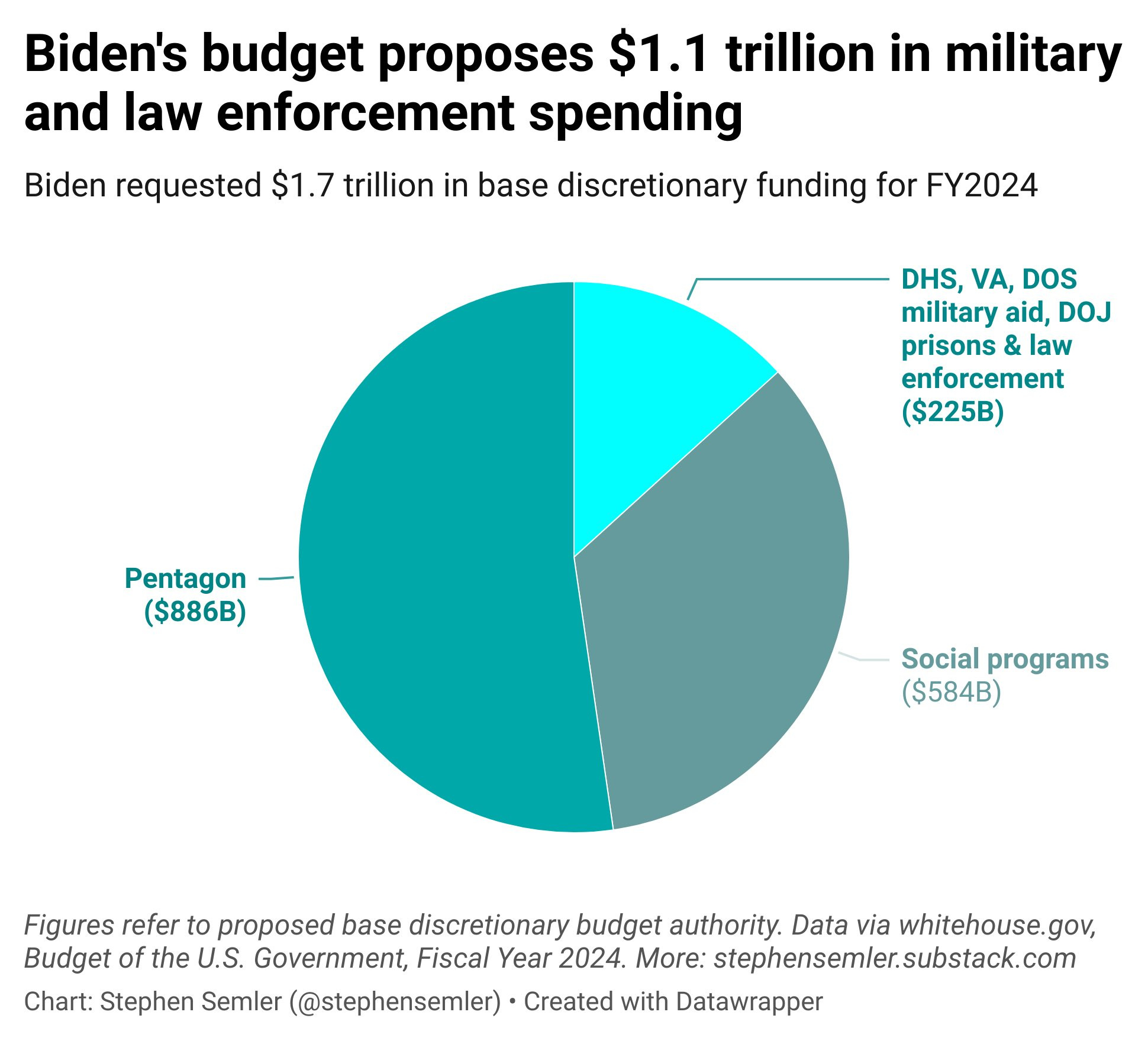
Which is why the federal budget proposal released by President Biden for 2024 was both so painfully predictable and so immensely disappointing. Calamitously so. Biden’s proposal once again boosts spending on weaponry and war in a Pentagon budget now pegged at $886 billion. It will include yet more spending on nuclear weapons and envisions only further perpetual tensions with “near-peer” rivals China and Russia.
This past year, Congress added $45 billion more to that budget than even the president and the Pentagon requested, putting this country’s 2023 Pentagon budget at $858 billion. Clearly, a trillion-dollar Pentagon budget is in our collective future, perhaps as early as 2027. Perish the thought of how high it could soar, should the U.S. find itself in a shooting war with China or Russia (as the recent Russian downing of a U.S. drone in the Black Sea brought to mind). And if that war were to go nuclear…
The Pentagon’s soaring war budget broadcast a clear and shocking message to the world. In America’s creed, blessed are the warmakers and those martyrs crucified on its cross of iron.
This was hardly the message Ike sought to convey to the world 70 years ago this April. Yet it’s the message the MICC conveys with its grossly inflated military budgets and endless saber-rattling.
Yet one thing remains true today: it’s never too late to change course, to order an “about-face.” Sadly, lacking the wisdom of Dwight D. Eisenhower, such an order won’t come from Joe Biden or Donald Trump or Ron DeSantis or any other major candidate for president in 2024. It would have to come from us, collectively. It’s time to wise up, America. Together, it’s time to find an exit ramp from the highway to hell that we’ve been on since 1953 and look for the on-ramp to Ike’s highway to peace.
And once we’re on it, let’s push the pedal to the metal and never look back.
Bank failures are never encouraging, and the recent failure of Silicon Valley Bank points to the instability of our American moment. President Biden made a short speech to affirm depositors would get their money back, only to exit the stage without taking any questions from reporters. As Biden slowly walked away from the podium, closing carefully the door behind him, I couldn’t help but see the whole act as symbolic of a tired America that has lost its way.
Yes, Biden acted to reassure markets and to rescue affluent depositors, yet he hardly reacted at all to the recent train wreck that poisoned East Palestine, Ohio. If only the train wreck had struck a major bank …
Tallying up Biden’s broken campaign promises, another one, an especially egregious one, was announced with the plan to allow oil drilling in pristine wilderness in northern Alaska. Biden had promised no more drilling on federal lands. Period. And then he approved the massive Willow drilling project on federal land in Alaska, an act of climate terrorism, notes Rebecca Solnit.
Meanwhile, Biden released his proposed Pentagon budget for 2024. You won’t be surprised to learn it’s soared to $886 billion, an almost inconceivable sum, or that the Biden budget focuses most of its discretionary spending on weaponry, wars, security, police, and prisons. Here’s a handy diagram:
I suppose the government will need all those warriors and guards with guns to maintain order while banks fail and the environment is poisoned, whether from oil drilling or train wrecks.
Perhaps you’ve seen the Daniel Day-Lewis movie about oil drilling’s early days. Its title is suggestive to what is to come: “There will be blood.”
Terminology is so important. There was a time when America spoke honestly of a Department of War. But not everyone is keen on war, even Americans, so in 1947 the national (in)security state slyly changed its name to the Department of Defense (DoD). And who can be against “defense”?
The problem is that America’s fundamental vision is offensive. We speak openly of global reach, global power, global vigilance. We never speak of regional or hemispheric defense. Regional power? Forget about it! Everything has to be “global.” Indeed, not just global but soaring above it into space. And not just outer space but virtual space and inner space, into one’s mind, so-called information dominance. For that’s what “full-spectrum” dominance is all about. To be safe, to “defend” us, the DoD must dominate everywhere, so we’re told.
This vision serves to generate yearly budgets that consume more than half of federal discretionary spending. It’s used to justify 750 military bases around the world. It’s consistent with dividing the globe into commands headed by four-star generals and admirals, e.g. AFRICOM, CENTCOM, NORTHCOM, and the like. It generates U.S. involvement in wars that few Americans know anything about, e.g. Somalia, Syria, and Yemen. It’s a vision consistent with a state of permanent warfare driven by imperial ambitions.
I don’t think there’s ever been a military more ambitious and vainglorious than the U.S. military and its various straphangers (industry, congress, intelligence agencies, the media, academe, think tanks, hence the term MICIMATT).1 No wonder its “thought” leaders keep demanding and getting more and more money: at least $858 billion for FY2023 alone. The DoD is supposed to be a means to an end. Clearly, it’s become an end in and of itself; it may yet lead to the end of everything.
He who has the gold makes the rules—and no government agency gets more gold to dominate rule-making than the DoD/Pentagon. It’s a golden fleecing of America, as the Pentagon after five attempts has yet to pass an audit. The war on terror, including failed wars in Iraq and Afghanistan cost America as much as $8 trillion, yet those failures have already been largely forgotten, with no senior officials called to account.
Our future is being stolen from us by wanton military spending. At the same time, our past is being rewritten. Lincoln’s ideal that “right makes might” and Washington’s ideal of the citizen-soldier have been replaced by might makes right enforced by warriors. Orwell rules the moment as war is sold as peace, surveillance as privacy, and censorship as free speech.
I remember my military oath of office: to support and DEFEND the Constitution of the United States against all enemies, foreign and domestic. I still believe in defending the Constitution. I just don’t see that we’re doing it when we spend $858 billion (and more) on a global quest to dominate everyone everywhere all at once.
MICIMATT: military-industrial-congressional-intelligence-media-academia-think-tank complex. Awkward acronym that has the virtue of capturing the size and scope of Ike’s old military-industrial complex.
The Pentagon Budget Keeps Soaring Up, Up, and Away!
When the Soviet Union collapsed in 1991 and the Cold War ended, I heard a lot about peace dividends. It was time to become a normal country in normal (more peaceful) times, said Jeanne Kirkpatrick, an early neocon who served under Ronald Reagan. More than thirty years later, America still awaits its peace dividends from the Cold War.
When the Afghan War came to a sputtering and ignominious end in 2021, I didn’t hear much at all about peace dividends. Even though the Afghan War was costing the United States almost $50 billion a year before it crashed and burned, the Pentagon budget for 2022 went up by that amount rather than down. You’d think the end of wars would lead to a decrease in military spending, but not in America.
And so we come to today, when I learned that the Pentagon budget for 2023, which sat at $802 billion per the request of the Biden administration, has been boosted big time to $847 billion by the House and Senate Armed Services Committees. That’s $45 billion extra for more wars and weapons, a whopping sum of money that would likely end homelessness if it was invested in America.
One thing is certain: war dividends always come through. Peace dividends? Not so much.
How does the Washington Beltway crowd justify such enormous sums for “national defense”? Threat inflation, of course. Because of its debilitating war with Ukraine, Russia is weaker but somehow that means America must spend more because Putin or something. Chinese maneuvers near Taiwan are treated like direct incursions into U.S. coastal waters. A few North Korean missiles are enough to justify more than a trillion dollars for new or revamped nuclear forces over the next thirty years. And of course military Keynesianism is always a factor, as in Pentagon-related jobs spread as widely as possible through every Congressional district.
The Pentagon can’t even pass an audit (for the fifth year in a row!), yet it still gets more and more billions from you the taxpayer.
I took a quick look at NBC News online to see if there were any objections to this massive $847 billion budget for the Pentagon. The only story featured warned that “GOP senators threaten to delay military bill over vaccine mandate.” Yes, what’s truly worrisome is that a few troops might have to accept a COVID vaccine against their will. Geez, where were these senators when the military was jabbing me in the arm every year with a mandatory flu vaccine?
Trees are falling in the forest to print all the money the Pentagon wants (and then some), but few Americans hear a sound since the mainstream media refuses to cover wasteful military spending and disastrous American wars.
If you should want a sure bet in America, don’t toss money at your favorite sports team. Place your bet on America’s war horse. Whether it wins, places, or shows, or even comes up lame, it will always pay dividends.
Isn’t it reassuring to know your taxpayer dollars are buying lots of “Ferraris” for the U.S. military?
W.J. Astore
If you truly want to help the U.S. military, slash its yearly budget.
It’s counterintuitive, right? We think more money will help the Pentagon field effective forces and to be better prepared to defend America. But that hasn’t proven to be the case. The more money the Pentagon gets, the more money gets spent on unnecessary and often poorly performing weapons systems. Take my old service, the U.S. Air Force. It doesn’t need the B-21 bomber. It doesn’t need new ICBMs. The F-35 fighter is a major disappointment, a “Ferrari” according to the Air Force Chief of Staff, i.e. an exotic and temperamental plane you fly only on occasion, which isn’t what the Air Force wanted or needed. Similarly, the Navy is building aircraft carriers that can’t launch planes effectively and “little crappy ships” that have no role at all. And the Army has thousands of M-1 Abrams tanks parked in storage that it’ll probably never use.
Do you have a friend with too much money? Maybe he got an inheritance or some other windfall. And the money makes him stupid. It’s stipulated in the inheritance that he must spend all of it within a year or two (the way Pentagon appropriations work), and if he fails to spend it, he’ll get less in the future. So he spends wildly, without giving it much thought, because he’s got the money and because he has to. And spending money on expensive “Ferraris” is fun. He’s not encouraged to think about how to use the money wisely, rather the reverse. So he just buys big ticket items willy-nilly.
Congress, of course, is the Pentagon’s enabler. Whatever the military wants nowadays, Congress is determined to give the brass more, in the false name of supporting the troops. It’s not the troops that see the money, it’s the industrial side of Ike’s military-industrial complex that profits the most. There’s something truly unseemly about Congress throwing money at the Pentagon while camp-following weapons contractors siphon it up.
Technically, incredibly, the U.S. military is no longer at war, i.e. “large-scale combat operations,” according to Secretary of Defense Lloyd Austin. Perhaps you missed the announcement that new U.S. troops coming on active duty wouldn’t automatically receive the National Defense Service Medal, as they have since 9/11 and the subsequent global war on terror. With those “large-scale” wars finally ended, shouldn’t the Pentagon’s budget decrease in a big way? Wars in Iraq and Afghanistan were costing the U.S. over $100 billion a year, yet as they have ended, the Pentagon’s budget has increased by more than $100 billion. Talk about counterintuitive! Wars end as war budgets increase. Only in America.
There is no logic here. I’m reminded of a scene from the original Star Trek in which Spock is befuddled by an attack on Captain Kirk because there’s apparently no logic to it. As an alien patiently explains to Spock, “Perhaps you should forget logic and devote yourself to motivations of passion or gain.” It’s a telling lesson for anyone looking to explain the illogic of America’s defense budget.
Get rid of the passion and gain in the Pentagon’s budget, America. It’s time to use logic and make major cuts. Force the military to think rather than to spend. Who knows … we may end up with a leaner, even a smarter, military, one committed less to war and more to supporting and defending the U.S. Constitution.









 Bracing Views