The key to getting elected in America is to raise lots of money. And you can’t do that by talking about poor people or the prospects for peace in the world.
Poor people have no powerful lobby or armies of lobbyists. With no access to the political game, they can be easily ignored. Those who advocate for peace also lack armies of lobbyists; they lack money as well compared to Raytheon, Boeing, Lockheed Martin, and similar giant weapons contractors. They can also be easily ignored.
When you look at Democrats and Republicans, both parties serve the privileged elites. Neither party is on the side of Aurora, a woman working two part-time jobs cleaning motel rooms while also cleaning houses on the side for affluent clients. She has no health care (she can’t afford it, and it doesn’t come with her part-time jobs) and she barely makes $30K a year despite working 70+ hours a week while trying to raise two kids.
Which political party is fighting (truly fighting, not just paying lip service) for higher pay for her? Which is fighting for single-payer health care for her that’s truly affordable? Child-care benefits? Anything at all? The answer is neither.
To America’s political establishment, Aurora doesn’t exist. She doesn’t count. She doesn’t matter.
This point was reinforced as I read an article by Chris Hedges on Father Michael Doyle. In Doyle’s words:
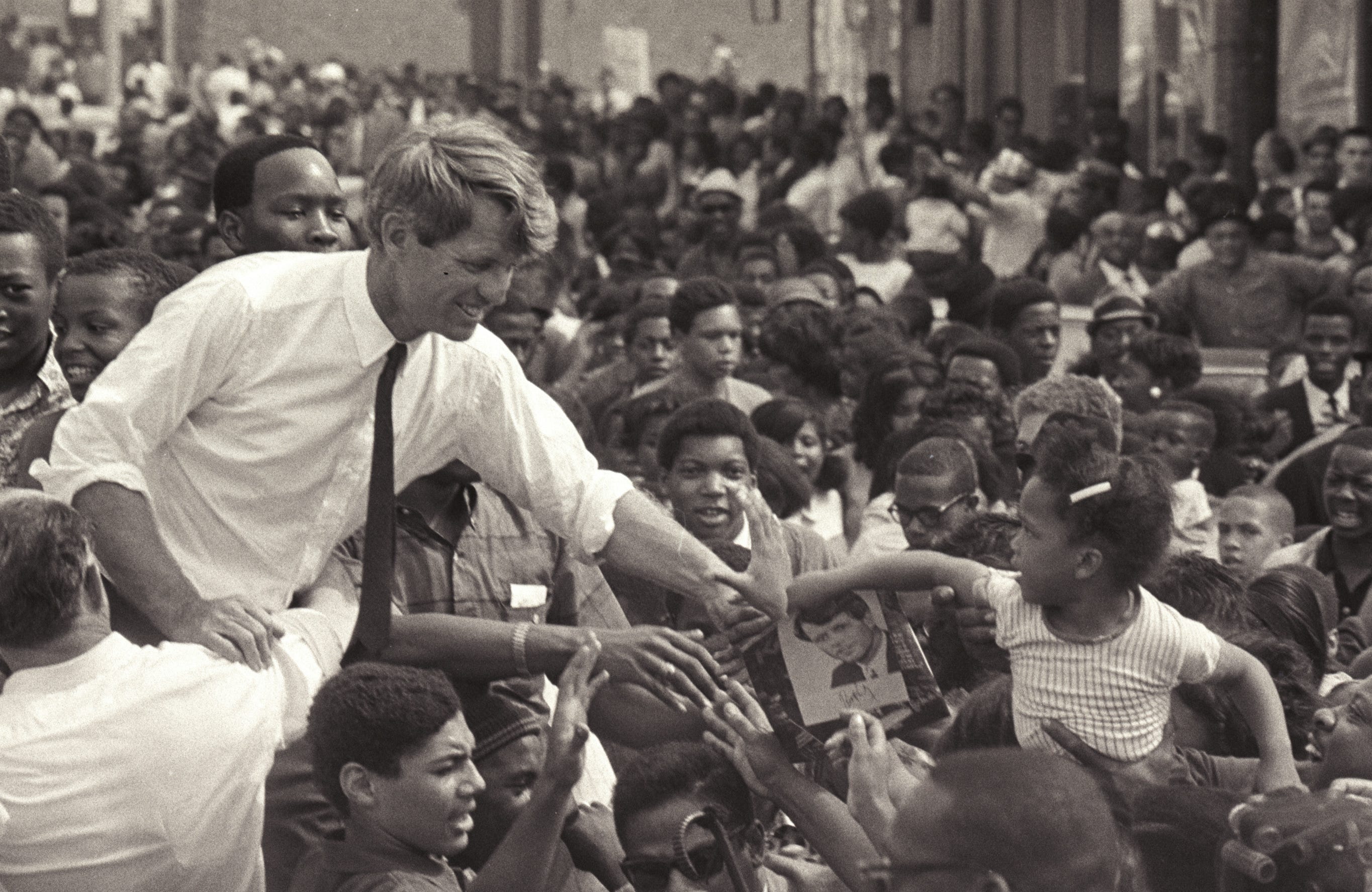
“There is a meanness that has raised its ugly head in the soul of America. Bobby Kennedy, even Lyndon Johnson, spoke about the poor. Now you can’t say the word poor and get elected. Let the poor suffer. They’re not important. Let the train roll over them.”
Bobby Kennedy reached out to everyone
This is the crux. America, we’re told, is incredibly rich and noble and good. Yet we export wars and weapons and treat the most vulnerable among us like trash.
Speaking of wars and weapons, the Biden administration is asking for nearly $38 billion more in aid for Ukraine in its war against Russia. If approved, this will bring U.S. aid to Ukraine, mainly in the form of weapons, ammunition, and the like, to almost $100 billion in less than a year. People tell me this is because America cares about the Ukrainian people. But the U.S. government doesn’t care about Americans living on the streets: do you really think it cares about Ukrainians?
Aid to Ukraine gets approved with alacrity by Congress because most of the money goes to weapons contractors like Raytheon and Lockheed Martin. To those and similar corporations, war is profitable, peace isn’t. Talk of a new cold war with Russia and China drives war-based profits higher still. Few in Congress have the temerity to suggest that peace is ultimately better for Americans (and indeed Ukrainians, Russians, and all other life on earth) than incessant wars and preparations for the same.
Imagine what $100 billion could do for the homeless in America. Imagine the shelters that could be built, the aid that could be provided, the hope that could be instilled. I’m not saying government aid is the solution to homelessness, but it sure would help.
Perhaps we need to declare war on homelessness while creating an army of well-heeled lobbyists to attack Congress with the magic bullet that always gets attention: campaign contributions. Money. At the same time, let’s eliminate the Departments of Defense and Homeland Security and replace them with a Department of Peace with an equivalent budgetary authority of roughly a trillion dollars a year.
Barring that, the poor will continue to suffer and wars and weapons will continue to find a way.
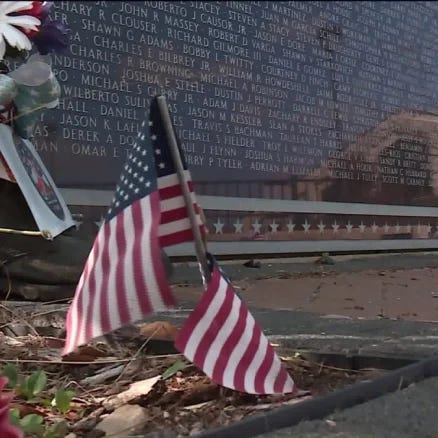
This Veterans Day, instead of thanking vets, ask instead how they’re doing
I served in the U.S. military for twenty years. It was the prime of my life, and I got a great education courtesy of you the American taxpayer. In the Air Force, I was a developmental engineer when I wasn’t teaching history (long story), and I never had to endure bullets and bombs and IEDs in a combat zone, for which I’m grateful. I really consider it an honor to have served, a privilege, because we in the military take an oath to the U.S. Constitution and to the high ideals that document represents.
So I’m always a bit surprised when someone thanks me for my service. I feel like saying, please don’t thank me, but thank you for putting your trust in me, for allowing me to serve and to uphold our nation’s highest ideals. The nation placed its special faith and trust in me, so thanks for doing that.
Of course, I say nothing like that in reply. What I typically say is “You’re welcome,” and then I move on. I don’t tell people: Please, don’t thank me, because that would be rude. My experience is that people want to thank me for sincere if sometimes vague reasons, and that’s OK with me. It’s not the time to launch into a diatribe about the military-industrial-Congressional complex or war crimes or imperialism. I have my blog for that. (Smile.)
Sometimes, though, I think thought (and responsibility) begins and ends with “thank you for your service.” For some people, it means something like this:
Thank you for your service — so I don’t have to think about your service and America’s many wars — and so I don’t have to think about my loved ones having to serve and kill and die in them.
Veterans Day started as Armistice Day, a solemn occasion to mark the end of massive bloodletting in World War I and a return to normalcy, i.e. peace. It was supposed to be the war to end all wars; the armistice on 11 November 1918 was idealistically thought to be the beginning of eternal peace. Today, “peace” is a word you almost never hear in American political discourse. Our new normal is war, which is just about the most horrible thought I could write about U.S. society and culture today.
Why? Partly because veterans often pay “an intolerable price” for their awful experiences in war, notes Kelly Denton-Borhaug at TomDispatch. That’s why most combat veterans don’t want to talk about their experiences, especially with civilians. They’d rather forget, yet it’s so hard to forget or even to forgive yourself when your mind has been scorched by the fires of war.
And it’s not just veterans who pay the price of endless war. Young people turning 21 today have never known a time when America hasn’t been at war with somebody somewhere. They’ve never known a time when massive military budgets were considered abnormal. They’ve never known, in a word, peace.
So, instead of thanking veterans for their service today, perhaps you should simply ask them how they’re doing. Be ready to lend a sympathetic ear, or a helping hand, if they admit to feeling “not so well.”
Thank you for doing this. Thank you for your service.
On learning the value of negotiation from the Outlaw Josey Wales
We’re in a strange moment when advocating for negotiations toward peace in Ukraine is dismissed as not only wrongheaded but morally wrong. We’re told that only Ukraine can determine its future, and that one must not appease a dictator (Putin), but in the same breath we’re told that peace will only come when Russia is totally defeated by force of arms, with the main arms supplier being the United States. Methinks various actors in the U.S. are evincing a conflict of interest here. When war is profitable and you keep arguing for it, it doesn’t take a detective to see motives that are suspect.
Even when it’s necessary, war is bloody awful and murderously atrocious. Not surprisingly, Jesus Christ preferred to bless the peacemakers instead of the warmongers. Yet peacemakers today in the U.S. are rare indeed in the government and in mainstream media. In God we (don’t) trust.
Being anti-war strikes me as a sane position for any human being. War, in rare cases, may be unavoidable and even necessary (I’d point to World War II as a necessary war to defeat Nazi Germany and Imperial Japan), but being anti-war should be reflexive. As I once read on a bumper sticker: “I’m already against the next war.” I laughed at that one. Peace is joyful.
I’d go further and argue that peace is pro-life and pro-choice. Everyone should be for it, unless, that is, you make your fortune from war. It’s hard to be pro-life, after all, when you’re shouting “kill” at some enemy. And you really have no choices when you’re dead. If you want more choices in life, turn away from war. There’s nothing like war to deny you choices — and perhaps life as well.
The Russia-Ukraine War may soon enter its second year. No one in their right mind should be cheering for this. I don’t want to see more dead Russians and Ukrainians. I don’t want escalating tensions between the U.S. and Russia, the world’s most powerful nuclear-armed nations. Only a fool or a war profiteer should want another cold war, considering that the previous one wasted trillions of dollars, cost millions their lives, and almost ended in nuclear Armageddon sixty years ago off the coast of Cuba.
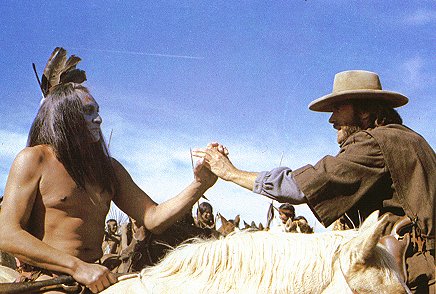
For some reason an old Clint Eastwood film comes to mind: “The Outlaw Josey Wales.” As Josey Wales says to Ten Bears, a Native American chief, in a grim life-or-death faceoff, “Men can live together without butchering one another.” Wales, unafraid to be seen as “weak” by negotiating with a Comanche chief, brought his word of death even as he sought an understanding that would preserve life. And life it was.
Negotiation is not weakness. Peace and life, as Josey Wales knew, is far preferable to war and death. If the will exists, even bitter opponents can find common ground and a path forward away from death. Words of peace have iron of their own, as Ten Bears says. They ring true when they resonate from people of honor.
Josey Wales, a man who’d lost his family to war and its butchery, a man who’d had to kill to survive, wanted nothing more than peace and a chance for a better life. So should we all.
(If you’d like to comment, please go to Bracing Views on Substack. Thanks.)
What does “security” mean to you? My dad had a utilitarian definition. Born in 1917, he found himself in a fatherless immigrant family with four siblings during the height of the Great Depression. To help his family survive, he enlisted in the Civilian Conservation Corps in 1935 and served for two years, earning a dollar a day, most of it sent home to his mother. For my dad, security meant a roof over one’s head, three square meals a day, and warm clothes on one’s back. Food, shelter, clothing: it really was that simple.
Of course, you needed to pay for those bare necessities, meaning you needed a job with decent pay and benefits. Personal security, therefore, hinges on good pay and affordable health care, which many U.S. workers today – in the richest country in the world – continue to scratch and claw for. Another aspect of personal security is education because pay and career advancement within U.S. society often depend on one’s educational level. A college education is proven to lead to higher pay and better career prospects throughout one’s life.
Personal security is in many ways related to national security. Certainly, a nation as large as the U.S. needs a coast guard, border controls, an air force, a national guard, and similar structures for defensive purposes. What it doesn’t need is a colossal, power-projecting juggernaut of a military at $800+ billion a year that focuses on imperial domination facilitated by 750 overseas bases that annually cost more than $100 billion just to maintain. True security, whether personal or national, shouldn’t be about domination. It should be focused on providing a collective standard of living that ensures all Americans can afford nutritious food, a decent place to live, adequate clothing, a life-enriching education, and health care.
President Dwight D. Eisenhower understood this. In his farewell address as president in 1961, he warned us about the military-industrial complex and its anti-democratic nature. Even more importantly, he called for military disarmament as a “continuing imperative,” and he talked of peace, which he tied to human betterment, and which he said could be “guaranteed by the binding force of mutual respect and love.” Ike knew that huge, offensive-minded military budgets constituted a theft from the people; even worse, he knew they constituted a betrayal of our national ideals. A hugely powerful military establishment had “grave implications” to the “very structure of our society,” Ike presciently warned. We have failed to heed his warning.
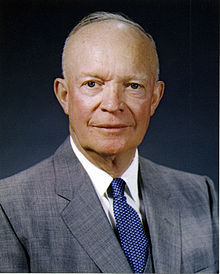
Ike, a former five-star U.S. general who led the D-Day invasion in 1944, knew the dangers of funding an immense military establishment
For Ike, true national security was about fostering human betterment and working toward world peace. It was about securing the necessities of life for everyone. It entailed the pursuit of military disarmament, a pursuit far preferable to allowing the world to be crucified on a cross of iron erected by wars and weapons manufacturers.
Tragically, America’s “councils of government” no longer guard against militarism; rather, they have been captured, often willingly, by the military-industrial complex. The “alert and knowledgeable citizenry” that Ike was counting on to hold the line against incessant warfare and wasteful weaponry is largely uninterested, or uninformed, or uneducated in matters of civics and public policy. Meanwhile, military spending keeps soaring, and the result is greater national insecurity.
In a paradox Ike warned us about, the more money the government devotes to its military, the less secure the nation becomes. Because security isn’t measured in guns and bullets and warheads. It’s measured in a healthy life, a life of meaning, a life of liberty. The pursuit of happiness, not eternal belligerence, should be the goal.
Consider the following fable. A man lives in a castle. He says he seeks security. So he digs moats and erects walls and piles cannon ball upon cannon ball. He posts armed guards and launches raids into the surrounding countryside to intimidate “near-peer” rivals. He builds outlying fortifications and garrisons them, thinking these will secure his castle from attack. Meanwhile, his family and relations in the castle are starving; the roof leaks and internal walls are covered in mold; the people, shivering and in rags, are uneducated and in poor health. Has this man truly provided security for his people? Would we call this man wise?
Grossly overspending on the military and weaponry — on castles and cannons everywhere — produces insecurity. It’s the very opposite of wisdom. Let’s end this folly, America, and seek human betterment and world peace as Ike advised us to do.
Addendum: these are the words Ike spoke in 1953
Every gun that is made, every warship launched, every rocket fired signifies, in the final sense, a theft from those who hunger and are not fed, those who are cold and are not clothed.
This world in arms is not spending money alone. It is spending the sweat of its laborers, the genius of its scientists, the hopes of its children. The cost of one modern heavy bomber is this: a modern brick school in more than 30 cities. It is two electric power plants, each serving a town of 60,000 population. It is two fine, fully equipped hospitals. It is some fifty miles of concrete pavement. We pay for a single fighter plane with a half million bushels of wheat. We pay for a single destroyer with new homes that could have housed more than 8,000 people.
This is, I repeat, the best way of life to be found on the road the world has been taking. This is not a way of life at all, in any true sense. Under the cloud of threatening war, it is humanity hanging from a cross of iron.
Mothers Against Drunk Driving (MADD) is an organization that’s helped to change the narrative on drinking and driving. Could a new organization like Mothers Against War (MAW) do the same for the world’s endless cycles of war?
In an antiwar movement that’s often fragmented and something less than the sum of its parts, a movement that unites women (and, of course, sympathetic men) in a dedicated push against war makes a lot of sense, argues Andre Sheldon. As he pointed out to me in our conversation yesterday, women united in the #MeToo movement against sexual violence; women marched on Washington in the aftermath of Trump’s election, donning pussy hats to remind us of his wanton and casual sexism (see Linda Roller’s account here for Bracing Views); Black women created the Black Lives Matter movement; and women helped to drive a movement against gun violence in the “Moms Demand Action” movement.
One thing we all have in common: we all have mothers. And there’s another thing that’s true for most of us (especially for us men): We should have listened to our mothers more, especially as a counterpoint to macho pro-war narratives being driven by powerful state and corporate interests.
As retired Army Colonel Ann Wright so eloquently put it recently: “For God’s Sake Boys, Stop this War S**t!!!”
In one of my favorite “Calvin & Hobbes” comic strips (from 1987), Calvin is shown comparing art projects with his friend, Susie. While Susie is content with a “tidy little domestic scene,” Calvin has something more ambitious in mind:
Something tells me we need more Susies and fewer Calvins.
For some reason, certain men, especially those who wear suits in the government, seem to think that toughness is all about putting on “big boy pants” and waging war. Of course, these same men usually don’t go to war themselves; they send other “boys” to fight and die for them. Macho posturing is common to both political parties in the United States, and it’s not just restricted to men. Perhaps the worst offenders were George W. Bush and Dick Cheney, who also both avoided the Vietnam War, but women like Hillary Clinton and Condoleezza Rice have shown no remorse in waging disastrous wars. Think here of Hillary’s infamous comment, “We came, we saw, he died” in the aftermath of the death of Qaddafi and the collapse of Libya into chaos.
Obviously, the answer isn’t as simple as putting women like Clinton or Rice in command. What we need instead are courageous and outspoken women like Barbara Lee and Dorothy Day. For, as Dorothy Day put it, “Our problems stem from our acceptance of this filthy, rotten system.”
Too many men have the emotional maturity of eight-year-old boys still seeking to knock each other over as they play “king of the hill.” But when the hill is Planet Earth and the toys they play with are nuclear missiles, the stakes are somewhat higher than bragging rights at the local playground.
Instead of “Jesus, take the wheel,” maybe it’s high time that women do. Something tells me we’d be better off as a people and as a planet.
Addendum: For more information on Andre Sheldon’s proposal, please check out his Facebook page.
Despite the possibility that what a deranged Vladimir Putin planned as a small war against Ukraine could morph into a nuclear catastrophe capable of engulfing us all, the United States is still the most warlike nation on earth.
Wars don’t come cheap these days, so it shouldn’t come as a surprise that the only truly non-partisan issue in Congress is the Pentagon budget. Democrats and Republicans alike, neither of whom expect to get shot at, vie with one another to show how resolute they are in keeping America strong no matter what the cost, even in human lives, though preferably those of foreigners.
The Pentagon budget, now creeping toward $800 billion, is more than three times that of China, our closest rival, a country that had the effrontery to build an aircraft carrier of its very own to challenge our eleven. The generosity of Congress enriches people who in the 1930s were stigmatized as “merchants of death,” but the latter have since learned the value of public relations. America’s military-industrial complex, as might be expected, led the way in recruiting the very best PR talent. The war to liberate Kuwait (Desert Storm) came to us thanks in part to the creativity of Hill & Knowlton (known in the trade as the Torture Lobby). Wars have persisted even as critical domestic problems continue to go unaddressed, such as American school children suffering brain damage due to lead-contaminated drinking water.
There is something immoral about all this. To be fair, the Catholic Church in the United States, for which morality is presumed to be a major concern despite some very public failings, does take notice of war now and then. Or rather it used to. It hasn’t done so lately.
The United States Council of Catholic Bishops meets twice a year, which you’d think would give a troubled bishop the opportunity to call into question the morality of much of what our armed forces have been up to. But you’d think wrong. Successive cliques of ill-educated, narrow-focused reactionaries—Burke, Gomez, Lori, Cordileone, Kurtz, and Dolan the most prominent among the current crop—have succeeded in keeping the topic of war off the agenda for more than thirty years. Nor have they seemed to have had much trouble doing so.
Recently, however, two bishops have spoken up in their own dioceses. Bishop Stowe of Lexington and Archbishop Wester of Santa Fe have pleasantly surprised Catholics like me by issuing pastoral letters calling for the abolition of nuclear weapons. Unfortunately, my pleasure is diminished by the realization that such efforts, however welcome, will do little to stave off a nuclear Armageddon after which, in the words of Nikita Khrushchev, the living will envy the dead.
The Vatican—even during the imperious reign of John Paul II, whose attention was fixed upon restoring freedom to his native land (which is now on the road to dictatorship)—has been forever calling for nuclear disarmament. But how has it called? In what tone of voice? That’s the key question.
Forty years ago, and far too long after the nuclear massacres of Hiroshima and Nagasaki—atrocities that the Catholic Church in America, like its government, has yet to condemn—the bishops of the United States, prodded, I’m sure, by Ronald Reagan’s missile-rattling rhetoric, surprised everybody by announcing that they were going to prepare a pastoral letter on war.
The deliberations of the committee, headed by Cardinal Bernardin of Chicago, got off on the wrong foot when Bernardin was forced to announce at the first meeting that they were by no means to condemn the possession of nuclear weapons, an edict from Rome that slammed the door in the face of the Holy Spirit, whose guidance they presumably would be imploring.
But the bishops labored on and brought forth “The Challenge of Peace.” It was a good but compromised document. Not compromised enough, however, for John Paul II and Cardinal Joseph Ratzinger. After the first draft was scrutinized in Rome, Bernardin and Archbishop John Roach, chairman of the U.S. Council of Bishops, were called on the carpet in Rome to defend it to the “NATO bishops” (a Vatican dicastery previously unknown to me), who were more concerned about a Soviet armor thrust through the Fulda Gap than anything that Jesus might have said.
Bernardin and Roach duly met with their critics, and the NATO bishops came away content. The concessions were major. One, for example, was purging a declaration of “no first use” of nuclear weapons in response to an attack with conventional weapons. The first draft had not done anything quite so bold. It merely proposed that any circumstances in which a first use would be morally acceptable would be difficult to imagine. Well: Ratzinger and the NATO bishops had no problem imagining one.
When the final version of The Challenge of Peace came out in May of 1983, the Pentagon, which had been a bit worried, and hawks everywhere—especially devout Catholic hawks like William F. Buckley Jr—breathed a sigh of relief. It was obvious to all who cared to read it that the bishops had waffled. With all due modesty—well, some anyway—the title of a subsequent article of mine in Commonweal, “Sidestepping The Challenge of Peace,” summed it up. (Commonweal disagreed with me, and still does, but that’s another story.)
Whatever the case, the Peace Pastoral is gone and forgotten, a failure that casts a pall to this day over subsequent (and toothless) Vatican statements on how nice peace is and how bad war is.
What do I want the Church to do? Let me quote somebody else, somebody who answered that question far better than I ever could.
In 1948 the Dominicans of Paris invited Albert Camus to address them about what he and other non-believers wanted to hear from the Catholic Church in the wake of the horrors of World War II, their hope being that they could unite to confront the horrors that yet impended.
Camus, who described himself and others like him as “isolated individuals,” was quite willing to challenge the Church. He did not share the beliefs of the Dominicans, he said, but neither did he dismiss them. He recounted how during the war he, even as a non-believer, had looked to Rome. He wanted to hear a “great voice” raised to condemn the monstrous evil of the war, but he failed to hear it. There were those who said that they had heard it, but what little the world heard from Rome was the Church speaking in what he dismissed, not without cause, as its “encyclical voice,” a form of speech that was prolix, abstract, and devoid of inspiration for all those not attuned to it. (The word “Jew,” incidentally, did not make the cut.)
The Dominicans wanted to know what the world expects of Christians. He gave them his answer:
What the world expects of Christians is that Christians should speak out loud and clear and proclaim their condemnation in such a way that never a doubt, never the slightest doubt, could rise in the heart of the simplest man. Christians must get away from abstraction and confront the bloodstained face that history has taken on today.
And what happens, Camus went on to ask, if Christianity doesn’t rise to the challenge? And here Camus shows a prescience that eludes the U.S. Council of Catholic Bishops. For it was a question quite pertinent to our own era, marked as it is by empty churches and tepid bishops.
If Christianity does turn away from the challenge, Camus told the Dominicans,
Christianity will lose once and for all the virtue of revolt and indignation that belonged to it long ago. In that case self-proclaimed Christians may still be among us, but Christianity itself will die, and world will suffer greatly for its loss.
In the spirit of Camus, here’s my recommendations. However reluctant our bishops might be to confront the blood-stained face of history, they could make a start by talking to people who know more than they do and have experienced more than they have.
In his book The Doomsday Machine, Daniel Ellsberg, working for RAND, tells how he was shocked to see an unguarded fighter plane on the tarmac armed with a nuclear bomb. (This was more than 60 years ago, but even today nuclear surety remains less than sure.). A drunken pilot could jump into the cockpit and be off to Beijing to set off World War III just like that. In any case, Ellsberg took the opportunity to place his hand on the bomb and feel the heat of radiation. I’m sure he would be happy to share his feelings at the next USCCB conference if invited.
Then there’s Bishop Botean, who leads the Romanian eastern rite Church in the United States. He’s the only Catholic bishop who issued a letter condemning the Iraq invasion, calling it an unjust war in which Catholics may in nowise participate. If the USCCB was willing to hear what he had to say, it would give some of the disgruntled brethren an opportunity to ask what prompted him to be such a spoilsport.
There’s also Andrew Bacevich, a retired colonel and veteran of the Vietnam war, who is the head of the Quincy Institute for Responsible Statecraft. He’s a conservative Catholic who is a severe critic of American foreign policy, especially in the Middle East.
Finally, Archbishop Wester had the grace to praise the late Sr. Megan Rice who appeared on the front page of the New York Times after, at age 82, invading the Holy of Holies of nuclear weaponry in Oakridge, Tennessee. The USCCB could follow up on the incredible feat that she and her two companions carried off by recognizing and commending the Plowshares Movement, founded by the Berrigans, a group of heroic men and women who have borne witness against nuclear weapons and suffered greatly for it. They have heeded Jesus’ command to shout what he taught them from the rooftops, instead of keeping their mouths shut about anything that might disturb major donors. (Those big churches and episcopal palaces aren’t going to maintain themselves!)
The bishops have much to learn from talking to people like the ones I’ve listed here. They might even learn to denounce the abomination of genocidal nuclear weapons—and especially any idea that a “first use” policy of the same is in any way morally defensible.
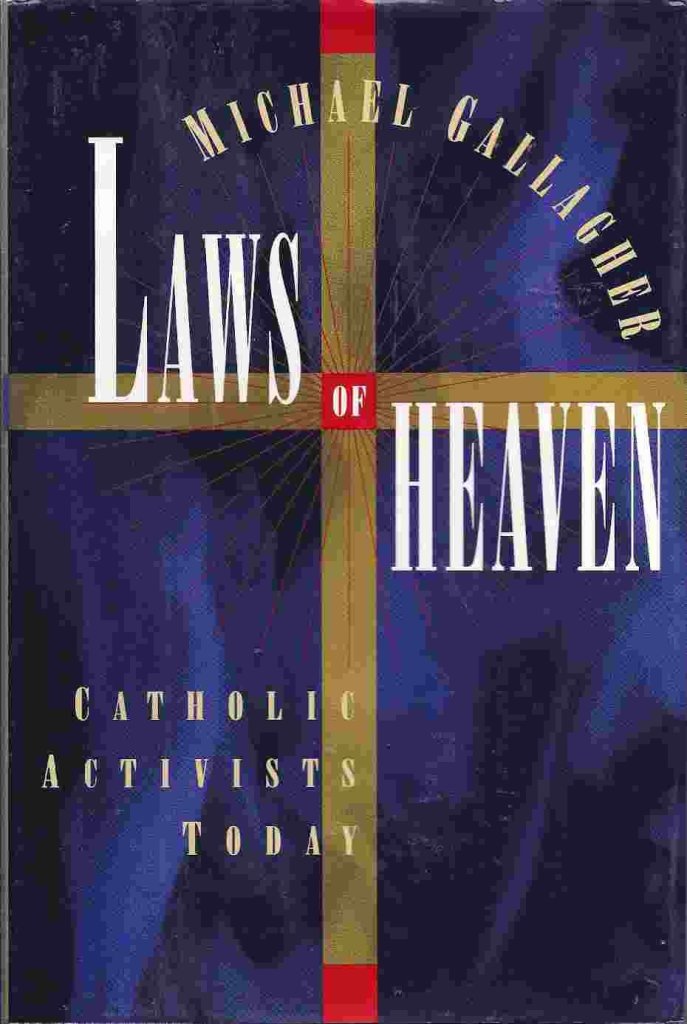
Michael Gallagher served as a paratrooper during the Korean War. His book on Catholic activists, Laws of Heaven, won the National Jesuit Book Award in theology, and his translation of Yukio Mishima’s Spring Snow was a finalist for a National Book Award.
It sure is hard to give peace a chance in America, as recent events with Russia and Ukraine show. The Washington consensus is all about weapons and more weapons, of economic sanctions, i.e. economic warfare, of not being seen as a pitiful helpless giant, as Richard Nixon once said during the Vietnam War. America can never stand on the sidelines, even when its national security interests aren’t even threatened. Something must be done, something forceful, something involving troops and weapons and ultimatums that could very well escalate into disaster.
Revealingly, Washington insiders always talk of “all options” being on a metaphorical table, meaning the most violent ones, including war, for the president to choose from. They lie. Because the one option that’s never on that imaginary table is peace.
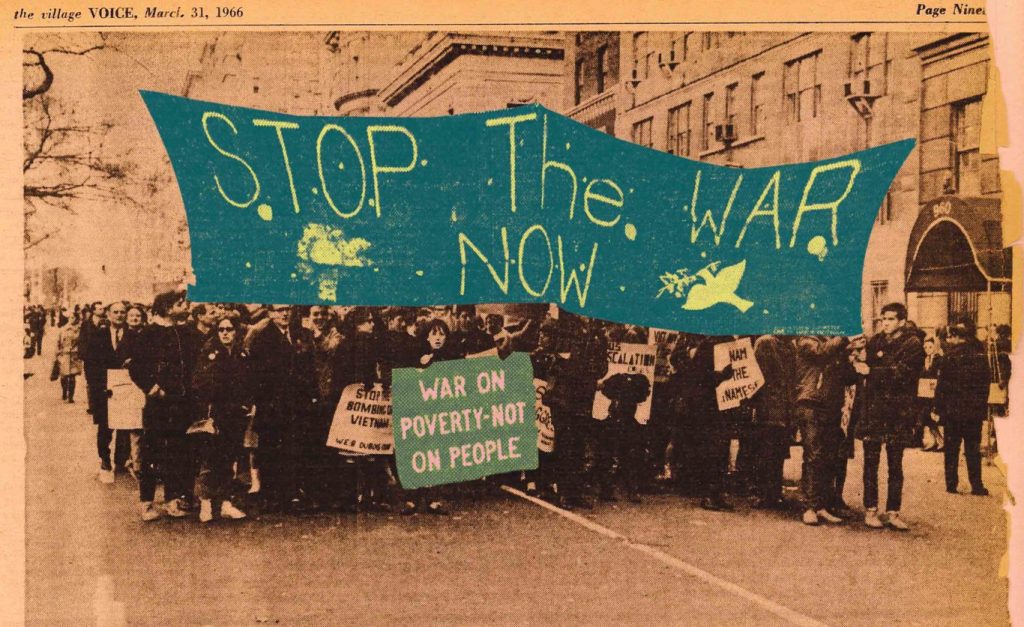
Peacemakers might be the children of God, but perhaps America is more godless than it knows. Or maybe it just worships the god of war, a Pentagod. It’s discouraging to face the obstacles to peace in America, because these obstacles are not going to be removed just by singing songs and writing articles or even by protesting. What is truly needed is a mass movement against war, as we saw during the Vietnam War years, but even that mass movement took years to have an impact. And it was motivated as well by resistance to the draft, which no longer exists.
A short list of the obstacles to peace is sobering indeed:
The power of the military-industrial-congressional complex. It doesn’t want to get smaller or less powerful. It thrives off weaponry and wars. It has no interest in peace.
The mainstream media. It’s owned by major corporations and advances corporate agendas. It smears antiwar voices as naive (at best) and often as traitorous and/or weak. Antiwar voices simply aren’t heard on the MSM. Instead, retired colonels and generals, as well as senior ex-CIA officials, are put forward as unbiased voices of reason as they promote the most hawkish lines.
The absence of a draft. Let’s face it: the youth of America are much more likely to resist war if they have to risk their lives. But America has an “all volunteer force,” and if these volunteers are sent off to war, that’s what they signed up for. Right?
American culture in general is suffused with violence and misinformed about the world, especially America’s imperial role in it. Myths about American exceptionalism and beliefs about the troops as freedom-fighters serve to inhibit antiwar criticism and protests.
The difficulty of launching any kind of sustained protest nowadays. Ready to gather in the streets to march against war? Sorry, do you have a permit? Covid restrictions may prevent you from gathering. And maybe we’ll move you to a special “free speech” zone, which I assure you will be far away from media cameras. What good is protesting if you gain no traction because few people see you and the media ignores you?
Don’t get me wrong. I’m not saying it’s impossible to give peace a chance. Just that it’s very difficult, given the power structures of our society and our collective national ethos. It’s mind-boggling that America has so many agencies for “defense” and “intelligence.” We have the Pentagon, the Department of Homeland Security (a domestic mini-Pentagon), something like 17 intelligence agencies like the CIA and NSA, the list goes on. State and local police forces are now heavily militarized and generally unsympathetic to your right to assemble and to protest vigorously. Get a job, commie peacenik!
Meanwhile, society’s heroes are U.S. military troops, or the “thin blue line” of police that “protect and serve.” Those who are committed to peace are generally not viewed as heroes, at least not by society at large. Again, Christ may have seen peacemakers as God’s children, but in the U.S. there’s a preference (judging by gun sales) for Colt Peacemakers.
How to overcome these obstacles to truly give peace a chance is perhaps the most pressing issue of our age, given the risk of war going nuclear and ending most life on our planet. Readers, I don’t have easy answers, but I’d begin with Ike’s warning about the military-industrial complex in 1961, JFK’s peace speech in 1963, MLK’s speech against the Vietnam War on April 4th, 1967, perhaps even John Lennon’s song “Imagine.”
How do we imagine — and then create — a new reality that favors peace instead of war? How do we pursue a just and lasting peace with ourselves and with all nations that Abraham Lincoln spoke of near the end of the U.S. Civil War?
The words are there. The vision is there. Tapping the nobility of Lincoln, Ike, JFK, and MLK and their antiwar messages is possible. Isn’t it?
As JFK said in his “peace speech,” to believe that war is inevitable is a “dangerous defeatist belief.” I’m with JFK.
The antiwar movement helped to stop the disastrous Vietnam War, but it sure wasn’t easy
Shouldn’t anyone who’s sane be a peace activist? And shouldn’t we question the sanity — or at least the motives — of anyone who’s constantly advocating for more spending on weapons and war?
How do we change the narrative? How do we return to Christ’s idea of “blessed are the peacemakers”?
The obstacles are many. The national security state is immensely large and incredibly powerful. The mainstream media is a big problem since it’s been captured by corporations. The few political candidates who advocate for a different path, such as Tulsi Gabbard or Dennis Kucinich, get smeared as useful idiots for the “enemy” or dismissed as impractical dreamers by that same corporate media.
Surely, we need many things to effect meaningful change. We need public funding of elections. We need better education focused on questioning and challenging authority. We need better and braver leaders — but will they simply be assassinated like JFK, MLK, and RFK? Among others?
We need to speak up, and we are. We need to enlist religion when we can. True Christianity — true religion — is our natural ally.
We need, as peace activist John Rachel reminded me, to connect cuts in military spending to helping people — that is, we need real peace dividends, “peace checks,” if you will. Rebates to the American people tied directly to much lower spending on wars and weapons.
We need to remember what Master Po said in “Kung Fu”: fear is the only darkness. And thus we need to come into the light.
We need to stop buying guns and start reading books. I once read: “Blessed are the peacemakers, for they shall be called children of God.” I don’t recall blessings being bestowed on weapons and the makers and owners of the same.
There are so many things we need to do. Most of all, I think, is that we need to respect life and our planet, because if we don’t, the human experiment is going to come crashing down, and too many other forms of life on our planet will be driven to extinction by our own myopic selfishness and folly.
You’ve heard the saying, Power concedes nothing without a demand. We need to demand an end to fear, an end to folly (as with nuclear “modernization” at a cost of $1.7 trillion, never mind the unimaginable costs of a nuclear war).
We need to demand peace.
I think the planet’s oligarchs know the danger. So they work to keep us divided, distracted, and downtrodden. (As I’ve written about here.) If we’re kept divided by partisan BS and rumors of war, distracted by infotainment and the like, and downtrodden by medical and other forms of debt, menial work at starvation wages, and so forth, it’s difficult for people to unite.
We need to unite anyway. Unite to save our planet from ourselves and our destructive impulses. From our greed and selfishness.
There was a time when we humans congratulated ourselves as being made in the image of God. When we saw the earth as God’s creation that we should revere. How do we regain reverence for each other and for this wonder-filled planet of ours, a planet that keeps surprising us with its glories?
We need a collective awakening. A mass movement. One that recognizes that peace is normal and that war is insane, one dedicated to exploration of the world around us rather than its exploitation. One that demands the best from our minds even as it touches our souls. Perhaps that’s overly mystical or utopian or just plain fuzzy, but we need something like it or things are going to get far worse for ourselves and our planet.
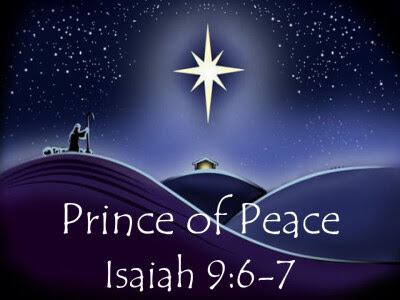
As Christmas approaches, peace is on my mind. Christ, after all, was known as the Prince of Peace. I say “was” because we hear so infrequently of peace in the United States today. In fact, peace in the U.S. seems to be contingent on enormous military budgets dedicated to weapons and warfare. It reminds me of Strategic Air Command (SAC) in the Air Force, which was prepared utterly to destroy the Soviet Union and China in the 1960s but whose motto was “peace is our profession.” Paraphrasing Tacitus, one might say that SAC was prepared to make the world an irradiated hellscape and call it “peace.”
If Christmas is to have any religious meaning, one would think it would be centered on the arrival of the Prince of Peace in the world. As a Catholic, I can’t count the number of times I recited the prayer that begins, Glory to God in the highest/and peace to His people on earth, the Gloria in adoration of Christ as a bringer of peace. By way of contrast, Easter is about the fulfillment of Christ’s mission; His death and resurrection “takes away the sins of the world,” even as we continue to implore Him to “grant us peace.”
Now that I reflect upon it, the Christian mass must be one of the few places in American culture today where we routinely hear about peace, where the idea is not mocked as fallacious or faulty or insane.
To be honest, I’m not in close contact with Christian culture today. What little I know of it confuses me and disappoints me. I can’t square the so-called Prosperity Gospel with Christ’s teachings against the corruption of earthly riches. I can’t square the evangelical emphasis on personal salvation by being born again with Christ’s command to focus on helping others in place of celebrating oneself. (OK, you’re saved; now get over yourself.) It’s so terribly easy to lose sight of the great commandments of Christianity, which boil down to loving God and loving thy neighbor.
So many Americans seem to believe they live in an exceptional nation, literally holier than other nations because of shared Judeo-Christian traditions as well as God’s special favor allegedly showered upon this “city on a hill.”
Is it OK if I say that current events (and past ones too) suggest otherwise? Garrisons across the globe bristling with weapons are not the same as a shining city on a hill. There is nothing angelic about a Predator or Reaper drone, nor is salvation to be found at any end of a Hellfire missile.
What part of “love thy neighbor” is reflected in a gargantuan war and weapons budget that officially sits just under $800 billion, and which in its total cost routinely exceeds a trillion dollars annually? Not to be presumptuous, but something tells me the Prince of Peace isn’t too happy about this.
Yes, I am stunned that there isn’t more Christian opposition to America’s war machine. I am stunned that America’s churches and ministers have made their peace, so to speak, with nuclear weapons that can destroy all of God’s creation. I am stunned that on Christmas Day, when Christians are supposed to adore Christ and to recall the miracle of His birth, that we collectively give so little thought to making peace happen, to dedicating ourselves to it in His name.
Still, I must say this about my Catholic Church and my memories of it: At least we reached out to each other to offer a sign of peace. We reached across the pews to shake hands, to share smiles, to make human contact.
Let us offer each other the sign of peace: Should this not be our gift to each other, not just this Christmas but on each and every day? What better way to adore the Prince of Peace than to spread peace?
On “Two Minutes to Midnight,” I talk about some of the themes I’ve developed at this site. Produced by Catalysta, the idea behind the series is to encourage fresh thinking on the challenges confronting us in a rapidly changing world.
In this interview, I explain how and why America spends way too much on weaponry and wars, and how we can shift the narrative and revive the idea of peace. Echoing George McGovern, it’s time to “come home, America,” to invest in our country and ourselves, rather than to fund more weaponry and more overseas wars.
Near the end of the video, I make an appeal to younger generations of America to lift their voices against the military-industrial-Congressional complex. I urge them not to be intimidated and to speak their mind, explaining that many veterans are just as fed up as they are. Collectively, we need to act. And perhaps the first and most critical step is getting big corporate money out of politics even as we work to make major cuts to the U.S. war budget.
Special thanks to Edward Goldberg at Catalysta.net for inviting me and offering me a chance to share my views with a wider audience.




 Bracing Views