From the Gaza Strip, the Hamas offensive against Israel has been murderously effective. The vaunted and much-celebrated Israeli military was caught by surprise and is responding to the Hamas attacks with its own version of murder, as captured in this announcement:
Israel Defense Minister: “I have ordered a complete siege on the Gaza Strip. There will be no electricity, no food, no fuel, everything is closed. We are fighting human animals and we act accordingly.” [emphasis added]
Actually, we have laws against allowing animals to starve. Think of the SPCA, the society for the prevention of cruelty to animals. Furthermore, comparing humans to animals is most often an insult to animals. Animals’ thirst for blood is sated quickly compared to humans and our thirst.
Let’s be clear: Hamas and the Palestinian people are not “human animals.” They are not lesser humans or beasts. Are the Jewish people forgetting the way that the Nazis reduced them to lesser humans or beasts to be exterminated during the Holocaust?
The Gaza Strip has been described as the world’s largest open-air prison.
Announcing a siege against all Palestinians in the Gaza Strip (no food, no power, mostly unsafe water) is the equivalent of launching a holocaust in slow motion. How is this in any way a proportionate and defensible response to the attacks by Hamas?
Meanwhile, as usual the U.S. government, showing its inherent unity and conformity, is 100% behind Israel, sending an aircraft carrier and issuing blank checks of unequivocal support. The mainstream media once again is telling Americans which side to hate. Think of the Palestinians as a gaggle of little Putins and you’ll be applauded for your right-think.
This is why I hate war. It turns us into killers. It leads us to hate those we kill. And hate kills our minds and makes us even more willing killers.
I applaud and support neither Hamas nor Israel. I applaud and support those who fight for a peaceful future in which we don’t see each other as “human animals” to be slaughtered with impunity.
The U.S. Mainstream Media Is Almost Always Pro-War
In the “liberal” New York Times today, I saw an article on “Putin’s forever war” that has the following short synopsis: “Vladimir Putin wants to lead Russians into a civilizational conflict with the West far larger than Ukraine. Will they follow him?”
Is this true? Does Putin truly seek a “civilizational conflict” with the West? One that’s “far larger” than the Ukraine war? It doesn’t seem likely. Russian forces have struggled in Ukraine. Already embroiled in a destructive regional war that’s become somewhat of a quagmire, why would Putin seek to widen it? Is Putin always the aggressor, the bad guy, and the West always the aggrieved party, the good guys, holding back a “red storm rising”? I thought the West won the Cold War more than 30 years ago.
It’s remarkable how easy it is to get alarmist articles about Russia or China published in the U.S. mainstream media (MSM). Wars and rumors of war dominate. The West is always portrayed as the defender of democracy; other countries such as China and Russia are portrayed as threats to civilization and its “rules-based order.” Strictly speaking, this is simplistic, one-sided, propaganda.
Back in 2017, I wrote about how difficult it is in the MSM to read honest accounts of war. In the runup to the Iraq War in 2003, critical voices were actively suppressed and punished. Back then, I focused my article on MSNBC, which like the New York Times is allegedly “liberal.” At “liberal” newspapers and networks, shouldn’t America expect at least a few critical critiques of war narratives? The answer here is “no,” as I wrote here:
Jesse Ventura, former governor of Minnesota (1999-2003), was a hot media commodity as the Bush/Cheney administration was preparing for its invasion of Iraq in 2003. Ventura, a U.S. Navy veteran who gained notoriety as a professional wrestler before he entered politics, was both popular and outspoken. MSNBC won the bidding war for his services in 2003, signing him to a lucrative three-year contract to create his own show – until, that is, the network learned he was against the Iraq war. Ventura’s show quickly went away, even as the network paid him for three years to do nothing.
I heard this revealing story from a new podcast, the TARFU Report, hosted by Matt Taibbi and Alex Pareene. By his own account, Jesse Ventura was bought off by the network, which back then was owned by General Electric, a major defense contractor that was due to make billions of dollars off the war.
Of course, Ventura was hardly the only war critic to run afoul of GE/NBC. Phil Donahue, the famous talk show host, saw his highly rated show cancelled when he gave dissenters and anti-war voices a fair hearing. Ashleigh Banfield, a reporter who covered the Iraq war, gave a speech in late April 2003 that criticized the antiseptic coverage of the war (extracts to follow below). For her perceptiveness and her honesty, she was reassigned and marginalized, demoted and silenced.
So much for freedom of speech, as well as the press.
As Phil Donahue said, his show “wasn’t good for business.” NBC didn’t want to lose ratings by being associated with “unpatriotic” elements when the other networks were waving the flag in support of the Iraq war. In sidelining Ventura and Donahue, NBC acted to squelch any serious dissent from the push for war, and punished Ashleigh Banfield in the immediate aftermath of the war for her honesty in criticizing the coverage shown (and constructed) by the mainstream media, coverage that was facilitated by the U.S. military and rubber-stamped by corporate ownership.
Speaking of Banfield’s critique, here are some excerpts from her speech on Iraq war coverage in April 2003. Note that her critique remains telling for all U.S. media war coverage since then:
That said, what didn’t you see [in U.S. media coverage of the Iraq war]? You didn’t see where those bullets landed. You didn’t see what happened when the mortar landed. A puff of smoke is not what a mortar looks like when it explodes, believe me. There are horrors that were completely left out of this war. So was this journalism or was this coverage? There is a grand difference between journalism and coverage, and getting access does not mean you’re getting the story, it just means you’re getting one more arm or leg of the story. And that’s what we got, and it was a glorious, wonderful picture that had a lot of people watching and a lot of advertisers excited about cable news. But it wasn’t journalism, because I’m not so sure that we in America are hesitant to do this again, to fight another war, because it looked like a glorious and courageous and so successful terrific endeavor, and we got rid of a horrible leader: We got rid of a dictator, we got rid of a monster, but we didn’t see what it took to do that.
With admirable honesty, Banfield spoke of the horrific face of war at Kansas State Univ. in 2003. Soon after her speech, she was demoted (Image courtesy of KSU)
I can’t tell you how bad the civilian casualties were. I saw a couple of pictures. I saw French television pictures, I saw a few things here and there, but to truly understand what war is all about you’ve got to be on both sides…
Some of the soldiers, according to our embeds had never seen a dead body throughout the entire three-week campaign. It was like Game Boy. I think that’s amazing in two different ways. It makes you a far more successful warrior because you can just barrel right along but it takes away a lot of what war is all about, which is what I mentioned earlier. The TV technology took that away too. We couldn’t see where the bullets landed. Nobody could see the horrors of this so that we seriously revisit the concept of warfare the next time we have to deal with it.
I think there were a lot of dissenting voices before this war about the horrors of war, but I’m very concerned about this three-week TV show and how it may have changed people’s opinions. It was very sanitized.
This TV show [Iraq invasion coverage] that we just gave you was extraordinarily entertaining, and I really hope that the legacy that it leaves behind is not one that shows war as glorious, because there’s nothing more dangerous than a democracy that thinks this is a glorious thing to do.
War is ugly and it’s dangerous, and in this world the way we are discussed on the Arab street, it feeds and fuels their hatred and their desire to kill themselves to take out Americans. It’s a dangerous thing to propagate…
I’m hoping that I will have a future in news in cable, but not the way some cable news operators wrap themselves in the American flag and patriotism and go after a certain target demographic, which is very lucrative. You can already see the effects, you can already see the big hires on other networks, right wing hires to chase after this effect, and you can already see that flag waving in the corners of those cable news stations where they have exciting American music to go along with their war coverage.
Nothing has changed since Banfield’s powerful critique. Indeed, the networks have only hired more retired generals and admirals to give “unbiased” coverage of America’s military actions. And reporters and “journalists” like Brian Williams have learned too. Recall how Williams cheered the “beautiful” U.S. Tomahawk cruise missiles as they were launched against Syria earlier this year [2017].
It’s not just that U.S. media coverage actively suppresses dissent of America’s wars: it passively does so as well, which is arguably more insidious. Any young journalist with smarts recognizes the way to get ahead is to be a cheerleader for U.S. military action, a stenographer to the powerful. Being a critic leads to getting fired (like Donahue); demoted and exiled (like Banfield); and, in Ventura’s case, if you can’t be fired or demoted or otherwise punished, you can simply be denied air time.
When you consider that billions and billions of dollars are at stake, whether in weapons sales or in advertising revenue tied to ratings, none of this is that surprising. What’s surprising is that so few Americans know about how pro-authority and uncritical U.S. media coverage of war and its makers is. If anything, the narrative is often that the U.S. media is too critical of the military to the detriment of the generals. Talk about false narratives and alternative facts!
America’s greed-wars persist for many reasons, but certainly a big one is the lack of critical voices in the mainstream media. Today’s journalists, thinking about their career prospects and their salaries (and who is ultimately their boss at corporate HQ), learn to censor themselves, assuming they have any radical thoughts to begin with. Some, like Brian Williams, even learn how to stop worrying and love the beautiful bombs.
[After I wrote this in 2017, I added this comment at the site.]
One thing that troubles me is the mindset that criticism of America’s wars undermines the troops. That it could even be a form of betrayal. This mindset is very dangerous. It not only protects the decisions and actions of those at the highest levels of the military and government. It acts to prolong wars and to endanger the lives of the troops (and of their “enemies” as well).
During the Iraq war, I recall instances of U.S. troops speaking clearly and frankly against the war. Their voices were heard, yet their advice was not taken. Instead, generals like David Petraeus were trotted out to assure the American people that the war was being won, even if the gains were characterized by weasel words like “fragile” and “reversible.” And so those gains have proved — even so, Petraeus remains in demand, and is still trotted out, now in mufti, to explain how we must stay the course and continue to defer to the military.
There’s a powerful book to be written here, and it should focus in part on the silencing or marginalization of anti-war voices (even those that wear or wore the uniform), even as pro-war elements are given the main stage as the voices of probity and sanity.
There is a famine of peace in the world today. I came across that phrase, “famine of peace,” in an article in the New Yorker that reported on a papal envoy sent to advocate for a truce and diplomacy to President Joe Biden. Biden, a practicing Catholic, gave the envoy a hearing, but as yet I’ve heard no change from the White House with respect to sending more weapons to Ukraine and maximum support for the war effort.
Pope Francis, working for peace, is exactly what I’d expect from Christ’s representative here on earth. Indeed, it is what I’d expect from all Christians everywhere. Yet we continue to have a glut of war in the world, with plenty of war pigs feeding at the trough.
Cardinal Matteo Maria Zuppi brought a message of peace to President Biden.
I’m a lapsed Catholic, but I have nothing but respect when the Church does its best to embody, obey, and manifest Christ’s two commandments: love God, love thy neighbor. Being faithful to these commandments is everything for Christians.
War is a terrible sin that enables and empowers so many other sins. Meanwhile, a famine of peace and a glut of war means terrible suffering for the world’s most vulnerable. War is thus to be avoided or averted under nearly all circumstances; indeed, Christ implored us to turn the other cheek when we are struck.
I’ve read enough “just war” theory to see how almost any war can be twisted as “defensive” and “necessary.” And I believe in rare circumstances the evil of war may be necessary to stop or prevent even worse evils, e.g. World War II put a stop to Nazi domination and the enslavement and massacre of millions of people, most especially Jews and gypsies, among other “undesirables” and “lesser humans” according to Nazi ideology.
The Pope in those days, Pius XII, did not speak forcibly enough to condemn the crimes of the Nazis. In Francis it is good to have a pope who’s willing to speak of today’s famine of peace. All Christians everywhere should look within to consider why peace is dying and war is thriving. Under these conditions, if we fail to act, do we dare even call ourselves “Christian”?
I’m still waiting for the blockbuster Hollywood production that celebrates peace
Last year, “Top Gun: Maverick” was all the rage. It was a silly war flick with a plot ripped from the original “Star Wars” movie featuring plenty of bloodless, high octane action sequences. I enjoyed it in the way I occasionally indulge in unhealthy fast food. The movie was instantly forgettable except for one scene where hotshot pilot Maverick, played of course by Tom Cruise, meets his old rival Iceman, played by Val Kilmer. In real life, Kilmer suffers from throat cancer, and his condition is not hidden in the movie, where Kilmer is now an admiral who still believes in his old friend, Captain Pete “Maverick” Mitchell.
Naturally, Maverick saves the day, pummeling a nameless enemy (most likely Iran) with bombs because that country is developing nuclear weapons. Nothing, of course, is said of the thousands of nuclear warheads and bombs in America’s arsenal, or that the USA is the only country to have used atomic bombs in war (Hiroshima, Nagasaki). But I digress.
Hollywood loves war movies. They sell well. Yet I still await “Top Dove: Peacenik,” in which an intrepid, brave, determined, and charismatic person stops a war without bombing or killing anyone. What a breath of fresh air that would be!
Exactly ten years ago, I posted the article below at Bracing Views. We need peacemakers now more than ever. Sadly, they are still very much forgotten, or ignored, or dismissed as unserious or even delusional.
Forgotten Are the Peacemakers (2013)
Monument to Elihu Burritt in New Marlboro, Mass. (author’s photo)The Plaque in Honor of Burritt (author’s photo)
Being Catholic, I’m a big fan of the Sermon on the Mount and Christ’s teaching that “blessed are the peacemakers.” Yet in American history it seems that “forgotten are the peacemakers” would be a more accurate lesson. We’re much more likely to remember “great” generals, even vainglorious ones like George S. Patton or Douglas MacArthur, than to recognize those who’ve fought hard against long odds for peace.
Elihu Burritt was one such peacemaker. Known in his day as “The Learned Blacksmith,” Burritt fought for peace and against slavery in the decades before the Civil War in the United States. He rose from humble roots to international significance, presiding over The League of Universal Brotherhood in the 1840s and 1850s while authoring many books on humanitarian subjects.
Interestingly, peacemakers like Burritt were often motivated by evangelical Christianity. They saw murder as a sin and murderous warfare as an especially grievous manifestation of man’s sinfulness. Many evangelicals of his day were also inspired by their religious beliefs to oppose slavery as a vile and reprehensible practice.
Christian peacemakers like Burritt may not have had much success, but they deserve to be remembered and honored as much as our nation’s most accomplished generals. That we neglect to honor men and women like Burritt says much about America’s character.
For if we truly are a peace-loving people, why do we fail to honor our most accomplished advocates for peace?
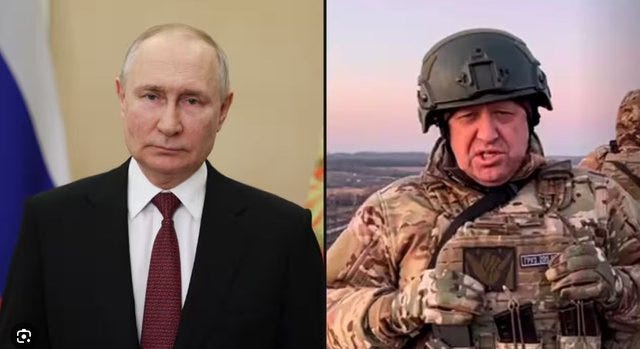
News of the rebellion of the Wagner mercenary group in Russia and the exile of its leader have led to confident announcements of Vladimir Putin’s weakening grip on power. Secretary of State Antony Blinken said the rebellion was “the latest failure” in Putin’s war against Ukraine, and NBC News declared “Putin’s rule is now more uncertain than ever.”
Vladimir Putin and the leader of the Wagner group, Yevgeny Prigozhin
Perhaps so. Wars often act as an accelerant to change, generating political chaos in their wake. The results of chaos, obviously, don’t lend themselves to predictability. Who knew in 1914, when the guns of August sounded, that four years later four empires would have collapsed under the strain of war (the Russian Empire, the Austro-Hungarian Empire, the Ottoman Empire, and the German Second Reich).
President Joe Biden was unusually frank in March of 2022 when he declared that Putin “cannot remain in power” due to his decision to invade Ukraine. Be careful what you wish for, Mr. President. Is overthrowing Putin truly a wise goal for global stability?
I honestly don’t know. A weaker, possibly fragmented Russia could increase the chances of nuclear war. A struggle for power within Russia could lead to the emergence of hardline leader who might make the West nostalgic for the relative predictability of Putin.
Most of us have heard the saying: better the devil you know than the one you don’t know. (This isn’t to suggest Putin is diabolical, of course.) In World War I, many of the allies professed to hate the Kaiser; his eventual successor as leader of the German people was Adolf Hitler. Again, wars may unleash elemental and fundamental changes, and change isn’t always for the better.
So, my position on the Russia-Ukraine War remains unchanged. Negotiate a truce. Use diplomacy to put a permanent end to this war. If Putin is truly weakened, this might be the best of times to seek a diplomatic settlement. After all, if Putin is truly worried about his grip on power within Russia, he might be open to ending the war largely on Ukraine’s terms so he can redirect his attention to consolidating his power base.
War has been given plenty of chances. Why not give peace a chance?
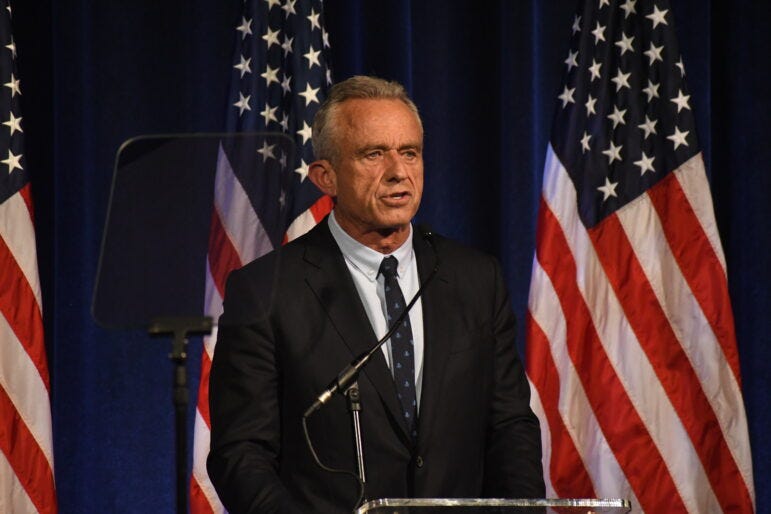
Robert F. Kennedy Jr. Echoes JFK’s Peace Speech of June 1963
Robert F. Kennedy Jr. is running against the Democratic establishment’s position on the Russia-Ukraine War and for the presidential nomination of the party in 2024. He recently gave a peace speech in New Hampshire that echoed the sentiments of the peace speech given by his uncle, President John F. Kennedy, in 1963.
In New Hampshire, RFK Jr. speaks for the possibility of peace and against the MICC and its forever war
In his speech, RFK Jr. stated that Russia has legitimate security concerns, that NATO expansion to Russia’s border was a betrayal of promises made to leaders like Mikhail Gorbachev, and that America’s military-industrial-congressional complex (MICC) is enabling forever war rather than actively seeking an end to war. He was also careful to say he abhorred Vladimir Putin’s decision to invade Ukraine.
I’ve already heard RFK Jr. being called a “Putin enabler,” if not a Putin puppet, for suggesting that Russian concerns about Ukraine’s inclusion in NATO are in any sense legitimate. Doesn’t he know, one reader asked, that Putin rejects Ukrainian identity as a country and a people? Doesn’t he know Russia is killing civilians in terror bombings? Why is he acting as an apologist for Putin’s many war crimes?
Obviously I can’t speak for RFK Jr., but I think his message is plain: a state of permanent war is causing deep harm to American democracy, what’s left of it, and any sustainable U.S. recovery must start with a rejection of war and massive military spending, including the more than $100 billion already devoted to what has become a proxy war in Ukraine. That war has greatly contributed to the rhetoric, and increasingly the reality, of a new Cold War with Russia (and China too), strengthening the MICC’s call for even vaster sums for wars and weapons in the cause of maintaining U.S. full-spectrum dominance around the globe.
Like his uncle, President Kennedy, RFK Jr. fears a world-ending nuclear cataclysm, an event that becomes more imaginable as the Russia-Ukraine War continues to escalate. Again, at no time did I hear RFK Jr. express support of the Russian invasion or its brutal methods; what he did express support for is diplomacy as a way of ending the bloodshed while reducing the risk of nuclear Armageddon.
Any reasonable diplomatic effort would have to recognize the legitimate security concerns of Russia, just as that same effort would have to recognize those of Ukraine as well.
Those who advocate for peace often face the charge of being puppets, enablers, or apologists for enemies who are usually presented as monstrous. All credit to RFK Jr. for departing from standard neocon rhetoric and practices and for extending an olive branch to Russia.
Arguing for more war is easy. It even wins salutes (and money) within today’s Democratic establishment. Striving for peace is far harder, and like his uncle, RFK Jr. has decided to take the harder path. More of us should join him.
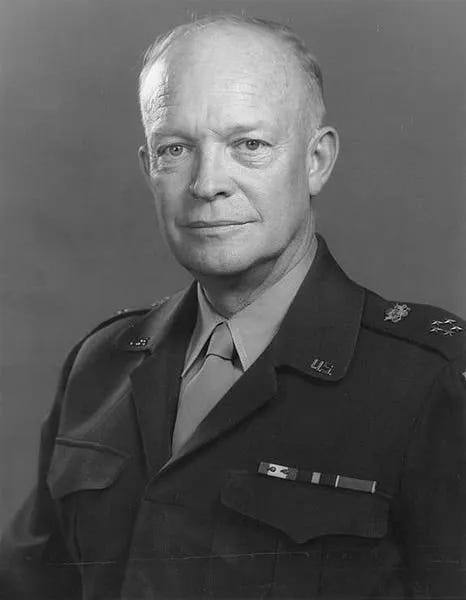
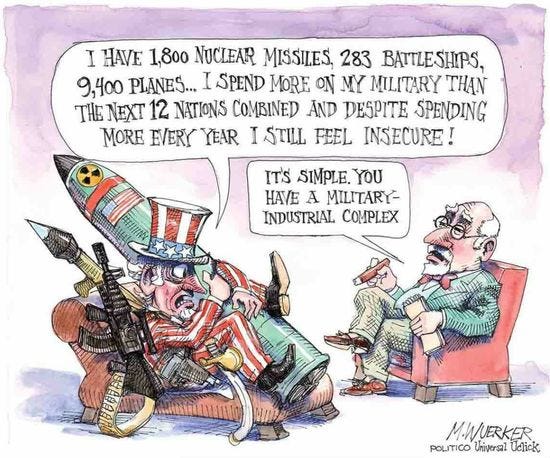
If Dwight Eisenhower could somehow give his 1953 “Cross of Iron” address and his 1961 warning about the military-industrial complex to the American people today, I truly believe he’d be dismissed by the mainstream media (MSM) as a Putin puppet and as repeating Kremlin talking points. Why? Because Ike advocated for negotiation and peace instead of war; he documented how spending on weapons was intrinsically wasteful and a bane to democratic society; and he challenged citizens to be alert and knowledgeable, ready to take action against the growing power of a corporate-military nexus supported and strengthened by Congress.
To mark Ike’s integrity and wisdom, and also to update his cost calculations from 1953 for the present day, I wrote this article, my latest for TomDispatch.com. Again, the words of Ike, focusing on peace, the preciousness and burdens of democracy, and the dangers of militarism, are rarely if ever heard in our government and in the MSM today. And that suggests we are in a dark place indeed in this country of ours.
In April 1953, newly elected President Dwight D. Eisenhower, a retired five-star Army general who had led the landings on D-Day in France in June 1944, gave his most powerful speech. It would become known as his “Cross of Iron” address. In it, Ike warned of the cost humanity would pay if Cold War competition led to a world dominated by wars and weaponry that couldn’t be reined in. In the immediate aftermath of the death of Soviet dictator Josef Stalin, Ike extended an olive branch to the new leaders of that empire. He sought, he said, to put America and the world on a “highway to peace.” It was, of course, never to be, as this country’s emergent military-industrial-congressional complex (MICC) chose instead to build a militarized (and highly profitable) highway to hell.
Eight years later, in his famous farewell address, a frustrated and alarmed president called out “the military-industrial complex,” prophetically warning of its anti-democratic nature and the disastrous rise of misplaced power that it represented. Only an alert and knowledgeable citizenry, fully engaged in corralling, containing, and constraining it, he concluded, could save democracy and bolster peaceful methods and goals.
The MICC’s response was, of course, to ignore his warning, while waging a savage war on communism in the name of containing it. In the process, atrocious conflicts would be launched in Vietnam, Laos, and Cambodia as the contagion of war spread. Threatened with the possibility of peace in the aftermath of the Soviet Union’s collapse in 1991, the MICC bided its time with operations in Iraq (Desert Storm), Bosnia, and elsewhere, along with the expansion of NATO, until it could launch an unconstrained Global War on Terror in the aftermath of the attacks of September 11, 2001. Those “good times” (filled with lost wars) lasted until 2021 and the chaotic U.S. withdrawal from Afghanistan.
Not to be deterred by the fizzling of the nightmarish war on terror, the MICC seized on a “new cold war” with China and Russia, which only surged when, in 2022, Vladimir Putin so disastrously invaded Ukraine (as the U.S. had once invaded Afghanistan and Iraq). Yet again, Americans were told that they faced implacable foes that could only be met with overwhelming military power and, of course, the funding that went with it — again in the name of deterrence and containment.
In a way, in 1953 and later in 1961, Ike, too, had been urging Americans to launch a war of containment, only against an internal foe: what he then labeled for the first time “the military-industrial complex.” For various reasons, we failed to heed his warnings. As a result, over the last 70 years, it has grown to dominate the federal government as well as American culture in a myriad of ways. Leaving aside fundingwhere it’s beyond dominant, try movies, TV shows, video games, education, sports, you name it. Today, the MICC is remarkably uncontained. Ike’s words weren’t enough and, sadly, his actions too often conflicted with his vision (as in the CIA’s involvement in a coup in Iran in 1953). So, his worst nightmare did indeed come to pass. In 2023, along with much of the world, America does indeed hang from a cross of iron, hovering closer to the brink of nuclear war than at any time since the Cuban Missile Crisis of 1962.
Updating Ike’s Cross of Iron Speech for Today
Perhaps the most quoted passage in that 1953 speech addressed the true cost of militarism, with Ike putting it in homespun, easily grasped, terms. He started by saying, “Every gun that is made, every warship launched, every rocket fired signifies, in the final sense, a theft from those who hunger and are not fed, those who are cold and are not clothed.” (An aside: Can you imagine Donald Trump, Joe Biden, or any other recent president challenging Pentagon spending and militarism so brazenly?)
Ike then added:
“This world in arms is not spending money alone. It is spending the sweat of its laborers, the genius of its scientists, the hopes of its children. The cost of one modern heavy bomber is this: a modern brick school in more than 30 cities. It is two electric power plants, each serving a town of 60,000 population. It is two fine, fully equipped hospitals. It is some fifty miles of concrete pavement. We pay for a single fighter plane with a half million bushels of wheat. We pay for a single destroyer with new homes that could have housed more than 8,000 people.”
He concluded with a harrowing image: “This is not a way of life at all, in any true sense. Under the cloud of threatening war, it is humanity hanging from a cross of iron.”
Ike’s cost breakdown of guns versus butter, weapons versus civilian goods, got me thinking recently: What would it look like if he could give that speech today? Are we getting more bang for the military megabucks we spend, or less? How much are Americans sacrificing to their wasteful and wanton god of war?
Let’s take a closer look. A conservative cost estimate for one of the Air Force’s new “heavy” strategic nuclear bombers, the B-21 Raider, is $750 million. A conservative estimate for a single new fighter plane, in this case the F-35 Lightning II, is $100 million. A single Navy destroyer, a Zumwalt-class ship, will be anywhere from $4 to $8 billion, but let’s just stick with the lower figure. Using those weapons, and some quick Internet sleuthing, here’s how Ike’s passage might read if he stood before us now:
“The cost of one modern heavy bomber is this: a modern brick-veneer and reinforced concrete school in 75 cities. It is five electric power plants, each serving a town with 60,000 inhabitants. It is five fine, fully equipped hospitals. It is some 150 miles of pavement. We pay for a single fighter plane with more than 12 million bushels of wheat. We pay for a single destroyer with new homes that could have housed more than 64,000 people.”
(Quick and dirty figures for the calculations above: $10 million per elementary school; $150 million per power plant [$5,000/kilowatt for 30,000 homes]; $150 million per hospital; $5 million per new mile of road; $8 per bushel of wheat; $250,000 per home for four people.)
Grim stats indeed! Admittedly, those are just ballpark figures, but taken together they show that the tradeoff between guns and butter — bombers and jet fighters on the one hand, schools and hospitals on the other — is considerably worse now than in Ike’s day. Yet Congress doesn’t seem to care, as Pentagon budgets continue to soar irrespective of huge cost overruns and failed audits (five in a row!), not to speak of failed wars.
Without irony, today’s MICC speaks of “investing” in weapons, yet, unlike Ike in 1953, today’s generals, the CEOs of the major weapons-making corporations, and members of Congress never bring up the lost opportunity costs of such “investments.” Imagine the better schools and hospitals this country could have today, the improved public transportation, more affordable housing, even bushels of wheat, for the cost of those prodigal weapons and the complex that goes with them. And perish the thought of acknowledging in any significant way how so many of those “investments” have failed spectacularly, including the Zumwalt-class destroyers and the Navy’s Freedom-class littoral combat ships that came to be known in the Pentagon as “little crappy ships.”
Speaking of wasteful warships, Ike was hardly the first person to notice how much they cost or what can be sacrificed in building them. In his prescient book The War in the Air, first published in 1907, H.G. Wells, the famed author who had envisioned an alien invasion of Earth in The War of the Worlds, denounced his own epoch’s obsession with ironclad battleships in a passage that eerily anticipated Ike’s powerful critique:
The cost of those battleships, Wells wrote, must be measured by:
“The lives of countless men… spent in their service, the splendid genius and patience of thousands of engineers and inventors, wealth and material beyond estimating; to their account we must put stunted and starved lives on land, millions of children sent to toil unduly, innumerable opportunities of fine living undeveloped and lost. Money had to be found for them at any cost—that was the law of a nation’s existence during that strange time. Surely they were the weirdest, most destructive and wasteful megatheria in the whole history of mechanical invention.”
Little could he imagine our own era’s “wasteful megatheria.” These days, substitute nuclear intercontinental ballistic missiles, strategic bombers, aircraft carriers, and similar “modern” weapons for the ironclads of his era and the sentiment rings at least as true as it did then. (Interestingly, all those highly touted ironclads did nothing to avert the disaster of World War I and had little impact on its murderous course or ponderous duration.)
Returning to 1953, Eisenhower didn’t mince words about what the world faced if the iron cross mentality won out: at worst, nuclear war; at best, “a life of perpetual fear and tension; a burden of arms draining the wealth and labor of all peoples; a wasting of strength that defies the American system, or the Soviet system, or any system to achieve true abundance and happiness for the peoples of this earth.”
Ike’s worst-case scenario grows ever more likely today. Recently, Russia suspended the START treaty, the final nuclear deal still in operation, that oversaw reductions in strategic nuclear weapons. Instead of reductions, Russia, China, and the United States are now pursuing staggering “modernization” programs for their nuclear arsenals, an effort that may cost the American taxpayer nearly $2 trillion over the coming decades (though even such a huge sum matters little if most of us are dead from nuclear war).
In any case, the United States in 2023 clearly reflects Ike’s “cross of iron” scenario. It’s a country that’s become thoroughly militarized and so is slowly wasting away, marked increasingly by fear, deprivation, and unhappiness.
It’s Never Too Late to Change Course
Only Americans, Ike once said, can truly hurt America. Meaning, to put the matter in a more positive context, only we can truly help save America. A vital first step is to put the word “peace” back in our national vocabulary.
“The peace we seek,” Ike explained 70 years ago, “founded upon a decent trust and cooperative effort among nations, can be fortified, not by weapons of war but by wheat and by cotton, by milk and by wool, by meat and timber and rice. These are words that translate into every language on earth. These are the needs that challenge this world in arms.”
The real needs of humanity haven’t changed since Ike’s time. Whether in 1953 or 2023, more guns won’t serve the cause of peace. They won’t provide succor. They’ll only stunt and starve us, to echo the words of H.G. Wells, while imperiling the lives and futures of our children.
This is no way of life at all, as Ike certainly would have noted, were he alive today.
Which is why the federal budget proposal released by President Biden for 2024 was both so painfully predictable and so immensely disappointing. Calamitously so. Biden’s proposal once again boosts spending on weaponry and war in a Pentagon budget now pegged at $886 billion. It will include yet more spending on nuclear weapons and envisions only further perpetual tensions with “near-peer” rivals China and Russia.
This past year, Congress added $45 billion more to that budget than even the president and the Pentagon requested, putting this country’s 2023 Pentagon budget at $858 billion. Clearly, a trillion-dollar Pentagon budget is in our collective future, perhaps as early as 2027. Perish the thought of how high it could soar, should the U.S. find itself in a shooting war with China or Russia (as the recent Russian downing of a U.S. drone in the Black Sea brought to mind). And if that war were to go nuclear…
The Pentagon’s soaring war budget broadcast a clear and shocking message to the world. In America’s creed, blessed are the warmakers and those martyrs crucified on its cross of iron.
This was hardly the message Ike sought to convey to the world 70 years ago this April. Yet it’s the message the MICC conveys with its grossly inflated military budgets and endless saber-rattling.
Yet one thing remains true today: it’s never too late to change course, to order an “about-face.” Sadly, lacking the wisdom of Dwight D. Eisenhower, such an order won’t come from Joe Biden or Donald Trump or Ron DeSantis or any other major candidate for president in 2024. It would have to come from us, collectively. It’s time to wise up, America. Together, it’s time to find an exit ramp from the highway to hell that we’ve been on since 1953 and look for the on-ramp to Ike’s highway to peace.
And once we’re on it, let’s push the pedal to the metal and never look back.
In 2023, let’s embrace the Vulcan salute, not military ones
2022 has been the year of living dangerously. The Russia-Ukraine War escalated with no immediate end in sight. U.S. government officials, most notably the Democratic Party, have gotten behind Ukraine as if it’s the 51st American state. Aid to Ukraine, mainly in the form of weapons and other war materiel, has approached $100 billion in less than a year. Zelensky has been touted as a “wartime” leader akin to Winston Churchill and lionized before Congress. President Biden, meanwhile, has called for Putin to be removed from power, joined by Republican voices like Senator Lindsey Graham. Biden, with Armageddon on his mind, as in nuclear war, nevertheless persisted in rejecting calls for diplomatic efforts to end the war.
As we turn toward 2023, wars and rumors of war persist. Fear of possible Chinese moves against Taiwan helped drive a record Pentagon budget of $858 billion, $45 billion more than Joe “Armageddon” Biden requested. The Air Force requested 100 new B-21 nuclear bombers and hundreds of new Sentinel ICBMs at a projected cost of roughly $500 billion. That the Pentagon yet again failed an audit, its fifth failure in a row, is no reason to cut or even to control massive military spending, so Congress has collectively concluded.
The so-called leftist or liberal Democrats have emerged as America’s war party; Republicans, meanwhile, are torn between calling for yet higher military spending and trying to curtail military aid to Ukraine and runaway spending on “Ferrari” weapons systems like the F-35. No one of any prominence in either party is calling for peace and for serious reductions in spending on wars and weapons.
Show me your budget and I’ll tell you what you value, Biden once said. Obviously, the Washington elites value war and profits from the same. It’s an anti-democratic commitment that fosters greater authoritarianism and repression in the so-called homeland as well as abroad.
I wish I could say 2023 promises change. It doesn’t, at least not from our government and its leaders. The change will have to come from us.
I have an old polaroid from 1/1/1980. In that photo, I’m caught rendering the Vulcan gesture of welcome with a high school friend. Recently, I got together with another old friend and gave the same salute:
Your author, out in the wild
The message, of course, of the Vulcan salute is “Peace. Live long and prosper.” The Vulcans, those eminently logical aliens of “Star Trek” fame, did their best to change their warlike nature, adopting logic and emotional control in place of violence and mass murder. While I doubt America is prepared to adopt logic and emotional control en masse, surely we can find a way to cultivate peace. We have the means as well to “live long and prosper,” assuming we can ever stop wasting so much of our energy and efforts on war and weaponry.
There is much wisdom contained in the Vulcan salute. May we learn to embrace its message in 2023.
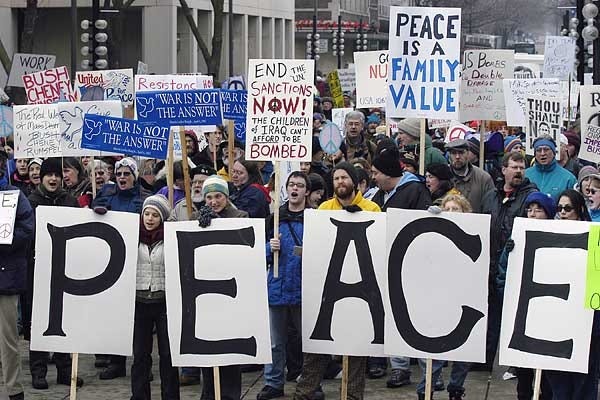
A question I hear often concerns the lack of a strong antiwar movement in America. The last large protest against war I remember preceded the Iraq invasion in 2003. The nuclear freeze movement of the early 1980s was sharply focused and somewhat effective in raising concerns about nuclear escalation between the US and USSR. But I can’t recall a truly powerful and effective antiwar movement since the Vietnam War days, when the draft was still in force and American troops were dying in the tens of thousands in a useless and atrocious war in Southeast Asia.
And those are, of course, two key reasons why America lacks a strong antiwar movement today: there is no military draft, and Americans are not dying in large numbers in a deeply unpopular war.
Rally agains the Iraq War in 2003. Photo by Jeff Miller
Another obvious (I think) reason: we get what we pay for. America pays for war and weapons, we even speak of “investing” in them, so at some (deep) level we believe in war and its efficacy. We are caught or even enraptured by it; our culture is infused with it, whether you speak of movies like “Top Gun: Maverick” or video games like the “Call of Duty” franchise or sporting events that routinely celebrate “our” troops and their weaponry. We “invest” in wars and weapons, and that investment sure pays dividends for the military and all its weapons makers.
There’s another reason as well, perhaps more subtle: the antiwar movement is fragmented whereas pro-war forces are united. What unites them is the pursuit of power, greed, profit, and their own sense they are being patriotic in “defending” America. A lot of people make a lot of money off the military-industrial complex, but it’s not solely about money. They also gain an identity from it and relatively high social status. (The military remains deeply respected within American culture.)
By comparison, antiwar forces in America are fragmented. In talking to some members, I found considerable diversity in what motivates them. This is hardly surprising. There’s no one “big” war to be against, as in the Vietnam War years or in the run up to the Iraq War. Being against war in general is not as compelling a message to fence-straddlers. Meanwhile, Americans are being told by the mainstream media that war works in places like Ukraine and that a new cold war is looming with Russia and China, so how can we afford the hypothetical comforts of peace when we’re afflicted by the grim realities of war?
Again, antiwar forces sometimes disagree about what is at the root of America’s hyper-aggressiveness and how best to counter it. I hear that we must tackle racism first; I hear that the white male patriarchy must be dismantled; I hear that indigenous peoples must finally obtain justice and reparations for the land and livelihoods stolen from them; I hear that BIPOC and LGBTQ+ communities must be heard and empowered; these motivations and agendas, and more, animate antiwar voices and communities. Diversity can be a strength, but it can also make working on a common cause problematic when there’s no clear unity of purpose.
I am perhaps most familiar with antiwar voices on the left, though I also listen to Tulsi Gabbard, Tucker Carlson, Rand Paul, and other voices that are considered right or libertarian. Generally speaking, the left doesn’t want to make common cause against war with the right, and vice-versa. There’s simply too much distrust and distaste. This is perhaps a fatal blow to building a truly effective antiwar movement.
I say this because the pro-war movement in America is truly bipartisan. Democrats and Republicans routinely come together in Congress to vote for more money for weapons and for more war. If we are to resist this, the antiwar movement must also be bipartisan. It must also pitch a big tent and let all people in, irrespective of their political affiliations.
I’d add as well that some antiwar voices in America are also anti-military. Perhaps I’m biased as a retired military officer, but I don’t think an anti-military message is attractive or compelling to most Americans. Anti-militarism, yes. Antiwar, yes. Anti-military, no. That said, I strongly believe America needs to reject warrior and warfighter nonsense and return to its roots and traditions with citizen-soldiers and a much smaller standing military.
Back in 2016, I wrote a similar article on the absence of a concerted antiwar war movement in America. Looking at that today, I think I should repeat the point I made about fear and threat inflation. To wit:
“Finally, a nebulous factor that’s always lurking: FEAR. The popular narrative today is that terrorists may kill you at any time right here in America. So you must be ready to “lockdown“; you must be ready to “shelter in place.” You must always defer to the police and military to keep you safe. You must fully fund the military or YOU WILL DIE. Repeated incantations of fear reinforce the master narrative of war.”
So, perhaps the biggest reason America lacks an effective antiwar movement is simply that we get what we pay for. America spends roughly a trillion dollars a year on wars and weaponry and an imperial military presence, so that’s what we get. We’re not spending a trillion a year on peace and diplomacy and conflict resolution. We reap what we sow, and what we sow is almost entirely favorable to more war.
Whatever else it is, the Russia-Ukraine War is a major money-making opportunity
Warfare is welfare for the merchants of death. Consider the Russia-Ukraine War. In the name of Ukrainian liberation, the U.S. Congress is preparing to approve another $37.7 billion in mostly military aid, bringing the total to nearly $100 billion in less than a year. This remarkable sum represents roughly 5% of federal discretionary spending, nearly the same as what the federal government spent on education in America this year. So far, all Democrats in Congress have supported aid to Ukraine, with only a minority of Republicans objecting.
Why is this? America is fertile ground for anti-Russian sentiment, but that’s not the main reason. It’s all about the Benjamins, as war is always immensely profitable for some sectors of society. Recall that President Dwight D. Eisenhower warned us of the disastrous rise of misplaced power represented by the military-industrial-congressional complex (MICC). Congress is heavily influenced by weapons contractors, not only through campaign contributions but by the jobs in their districts tied to the production of weapons of all sorts.
In a refreshing burst of honesty from the 1930s, the U.S. Senate referred to weapons contractors as “merchants of death,” and so they are. Weapons, from mundane bullets and artillery shells to “sexy” stealth fighters like the wildly expensive F-35, are designed to kill our fellow human beings. That’s why Eisenhower famously said in 1953 that humans essentially crucify themselves on a cross of iron when they prioritize weapons building over hospitals, schools, and other necessities of a civilized life.
More and more money to the merchants of death ensures three things: more power to weapons contractors, higher profits for them, and in this particular case a lot more dead Russians and Ukrainians. Some Americans seem to think it’s all worth it, though I’m skeptical about Ukrainian liberation being an important goal to officials in Washington.
Ike exhibited basic common sense when he noted the MICC is fundamentally anti-democratic. That it threatened our liberties and democratic processes. He told us to take nothing for granted, and challenged us to remain alert and knowledgeable. For when you empower the MICC, you weaken democracy. You also choose death over life.
Whether it’s the Russia-Ukraine War or previous ones like Vietnam, Iraq, and Afghanistan, the MICC has been and is making a killing in America and indeed across the globe— and in more ways than one. And as Ike said, that’s no way of life at all.
What is to be done? We need to start by recognizing that the MICC is fundamentally anti-democratic, often wasteful, driven by greed, and consistent with imperialism of the worst sort. Again, I’m not really saying anything new here; Ike, a five-star general and two-term president, said the same almost 70 years ago. His sentiments were echoed by James Madison when Madison wrote in 1795 that a large standing military and incessant warfare were deadly to democracy and liberty.1 Yet wars continue to find a way, and the MICC continues to thrive and expand its reach and power.
To resort to Scripture, not only is the flesh weak in America when it comes to reining in war and weapons: so too is the spirit. The spirit is unwilling because we are saturated in war and violence. An imperial vision like “full-spectrum dominance” has come to dominate American culture and society. Too many people believe that freedom is best projected and protected through the barrel of a gun.
The words of Ike come to me again when he said that only Americans could truly hurt America. The primary dangers are within not without. In that spirit, Ike warned us about a danger within, the MICC. We would do well to heed his warning if we wish to preserve and strengthen the tree of liberty.
How best to heed his warning? With respect to the Russia-Ukraine War, stop sending weapons that drive more killing. Put more effort on diplomacy. With respect to America itself, abandon the concept of a “new cold war” with Russia and China. Recognize America’s strength instead of focusing incessantly on hypothetical weaknesses. Stop listening to the screech of war hawks. Invest in life instead of death. Start from a place of life-affirming confidence rather than of fear and doubt.
There’s a powerful scene in “Enemy at the Gates” about the Battle of Stalingrad where Soviet political officers are debating how to inspire the troops to fight to the last. The Soviets had been relying on fear, and indeed at Stalingrad Soviet units killed thousands of their own troops for “cowardice” in the face of the Nazi enemy. One commissar is brave enough to offer something other than fear and death. “Give them hope!” he cries. Hope that they can and would prevail against a ruthless enemy.
That’s what we need in America today, a lot less fear and a lot more hope.
Madison wrote that: “Of all the enemies of true liberty, war is, perhaps, the most to be dreaded, because it comprises and develops the germ of every other. War is the parent of armies; from these proceed debt and taxes; and armies, and debts, and taxes are the known instruments for bringing the many under the domination of the few. In war, too, the discretionary power of the Executive is extended; its influence in dealing out offices, honors and emoluments is multiplied; and all the means of seducing the minds, are added to those of subduing the force, of the people. The same malignant aspect in republicanism may be traced in the inequality of fortunes, and the opportunities of fraud, growing out of a state of war, and in the degeneracy of manner and of morals, engendered in both. No nation can preserve its freedom in the midst of continual warfare.”








 Bracing Views