Trump weighing several options for U.S. troops inside Iran
Discussions about possible ground troops have focused on missions aimed at escalating the war in attempt to end it, sources say, but no decisions have been made.
*****
Somebody please explain to me how committing ground troops to Iran and escalating the war is in any way a sane method of deescalating the war.
The Trump administration is out-Orwelling George Orwell. Rather than a sobering warning, Orwell’s “1984” has become a user’s manual for autocrats like Trump and Hegseth, where war is waged in the name of peace and escalation is deescalation.
Meanwhile, Tulsi Gabbard, the Director of National Intelligence, told us that it’s not America’s 18 (!) intelligence agencies that determine whether we face an “imminent threat.” No—only the president can make that determination.
Can somebody please tell me why we have 18 intelligence agencies that we spend scores of billions on? All we really need is the president’s gut. I suggest we eliminate America’s entire intelligence “community” and replace it with Trump’s intestines.
If Trump has any sense left in his gut, he should declare victory and end this colossal mistake of a war.
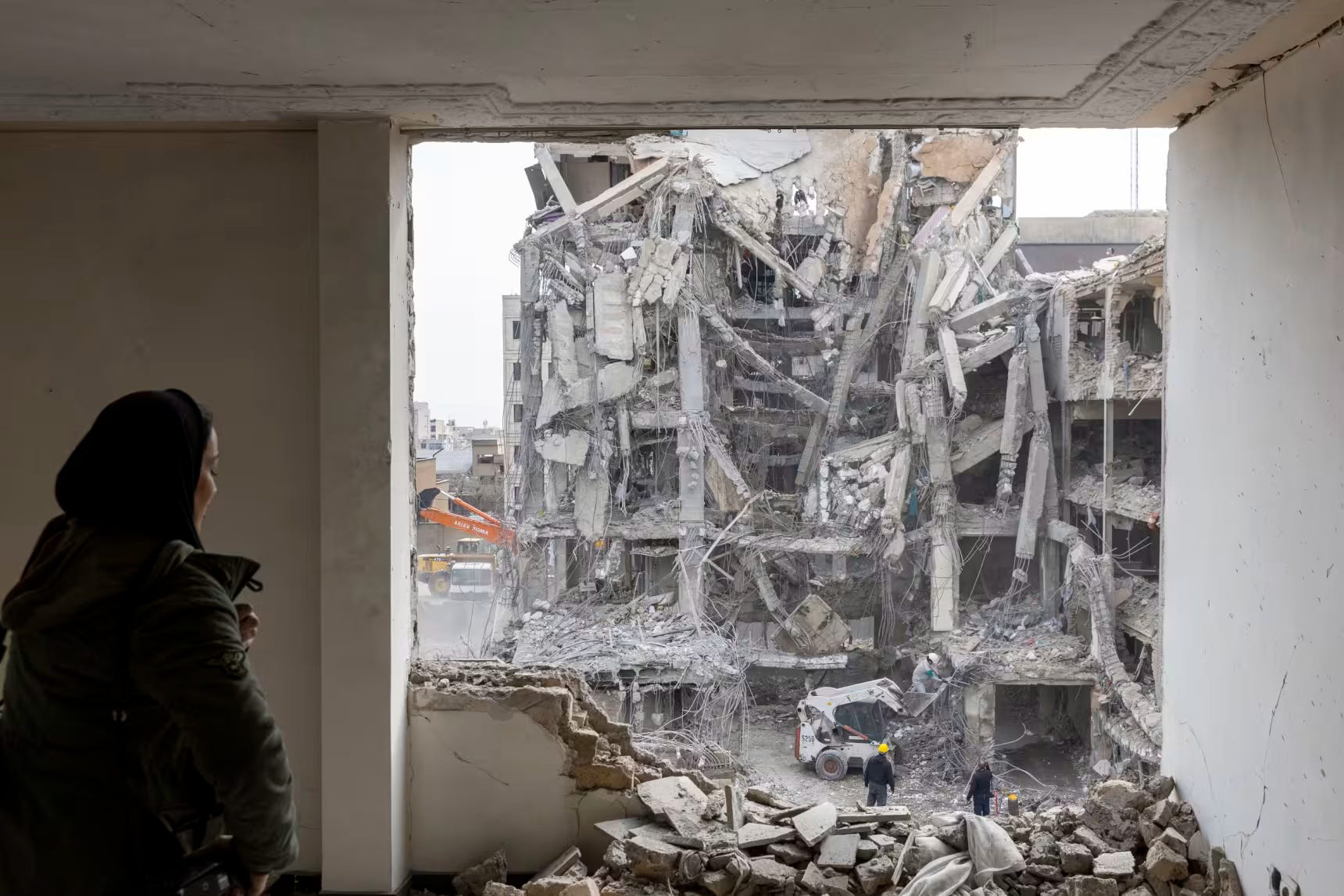
Residential building in Iran. Just imagine if Iran was raining bombs and missiles on the USA. (Majid Saeedi, Getty Images)
In an ever-changing world, the one constant in Universe USA is rising Pentagon budgets. For President Trump, a trillion-dollar war budget is something to crow about. Of course, it’s sold as “peace through strength.” For what is more peaceful than more weaponry, especially nuclear-tipped ICBMs and SLBMs?
America is always arming, uparming, rearming for war allegedly to prevent war. The problem is arming for war usually leads to yet more war. You don’t “invest” in weaponry to keep it on a shelf, rusting away in armories.
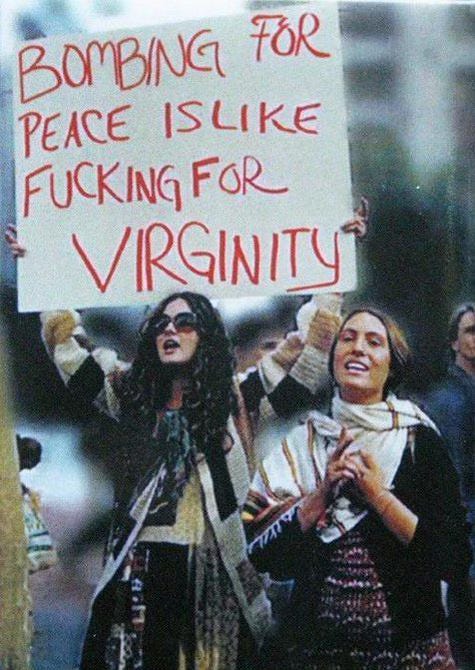
Excuse my language, but Vietnam vets and war protesters put it well: Fighting (or bombing) for peace is like fucking for virginity.
Vintage 1969. Makes sense, right?
More telling, however, is the constant state of war preparations that infect and influence our minds. Our “leaders” talk about “all options being on the table” when the only option they consider is military force. We are what we “invest” in. And weapons ‘r’ us.
In U.S. politics, strong and wrong is seen as far better than “weak” and right. And just about every politician inside the DC Beltway appeases the military-industrial complex, Israel, or both. That’s how you end up with disastrous wars of choice in Vietnam, Afghanistan, Iraq, and elsewhere, together with full-throated support for genocide in Gaza.
Who cares about right and wrong when might always makes right?
An anecdote: I have a friend who works in the belly of the beast (the DoD). He told me his job makes him think of Winston Smith in George Orwell’s “1984.” The Pentagon under Pete Hegseth has become an exercise in eliminating DEI bad speak and replacing it with doubleplusgood warrior-ethos speak. Lots of time is wasted sending “bad” terms and names down the memory hole.
Even as the DoD’s language is purged of bad speak about DEI, the Pentagon’s embrace of a permanent war economy is tightened. The very idea of a “peace dividend,” floated by Republican President George H.W. Bush in the aftermath of the Soviet Union’s collapse, is seemingly ancient history, an idea never to be considered again, not in Trump and Hegseth’s warrior-USA.
Preparing constantly for war is a powerful way to ensure more war. Overspending on esoteric and genocidal weaponry is a powerful way to hollow out one’s country while establishing the conditions for global mass death.
Perhaps our “leaders” need to recall that Orwell’s “1984” was meant to be a warning of what to avoid, not a how-to guide for authoritarian rule and perpetual war.
Yesterday, I awoke to grim news that Israel is bombing Gaza yet again, killing a few hundred people, even as the U.S. targets Yemen with “precision” bombs and strikes, apparently to intimidate Iran as well—and perhaps to provoke a war, as Israeli jets escort U.S. B-52 bombers in “exercises.”
War is in the news, incessantly, with Congress sidelined and feckless as usual.
The constant drumbeat of war—the never-ending concussion of bombs in the Middle East—put me to mind of Orwell’s 1984. Nothing favors authoritarian states more than a constant state of war. If you truly want to weaken the Trump administration, reject their “warrior” and “war fighting” rhetoric and their selling of “peace through strength,” by which they mean peace through bombing and killing. Some “peace,” right? They may as well go full Orwell and declare that “war is peace” while making the Pentagon the “Ministry of Peace.”
Speaking of Orwell, and needing a break from death and mayhem, I remembered this piece that I wrote in 2018. Citizens, you had best police not only your words and actions, but the faces you make as well, especially when our Dear Leader is talking.
Written in September 2018
Facecrime!
W.J. Astore
We’re truly living in Orwellian times. A 17-year-old high school student, now known as #plaidshirtguy due to his choice of wardrobe, was removed from a Trump rally in Montana because of the faces he was making as Trump spoke. You can read all about here, and watch an interview with him at CNN.
Not surprisingly, people who stand behind Trump are selected ahead of time and told to clap and cheer. This young man did that, but he also chose to look quizzical, skeptical, and bemused at times. This is not allowed! A Trump staffer eventually intervened to remove him from the audience due to his “face crime.” To make matters worse, he was then held by the Secret Service for ten minutes, after which he was asked to leave the event.
Leave the event? For making skeptical and quizzical facial expressions?
You may recall from George Orwell’s “1984” that “Facecrime” existed. Anyone making skeptical or otherwise unacceptable faces when the Party announced bogus victories, production figures, and so forth opened himself or herself up to serious punishment.
Thanks to plaid shirt guy, we now know that facecrime has come to America. Just remember, fellow citizens, always to smile and cheer in the presence of Our Dear Leader. Unless you want to be detained and sent away — perhaps next time to the cornfield.
*From my copy of “1984”: “In any case, to wear an improper expression on your face (to look incredulous when a victory was announced, for example) was itself a punishable offense. There was even a word for it in Newspeak: facecrime, it was called.” (From the end of Chapter 5.)
With apologies to Elton John and Bernie Taupin, “peace” seems to be the hardest word, for both Democrats and Republicans.
This is hardly surprising. The National Security State is the unofficial fourth branch of government and arguably the most powerful. Presidents and Congress serve it, and the SCOTUS carves out special exceptions for it. Back in the days of a bit more honesty, it was called the Department of War. And so it remains.
Let’s say you’re like me and you see war as humanity’s greatest failing. We kill and maim each other, we scorch and kill every living thing in the path of our weapons, we destroy the environment, we even have the capacity to destroy life on earth via nuclear weapons. War—it really is good for absolutely nothin’, unless, of course, you profit from it.
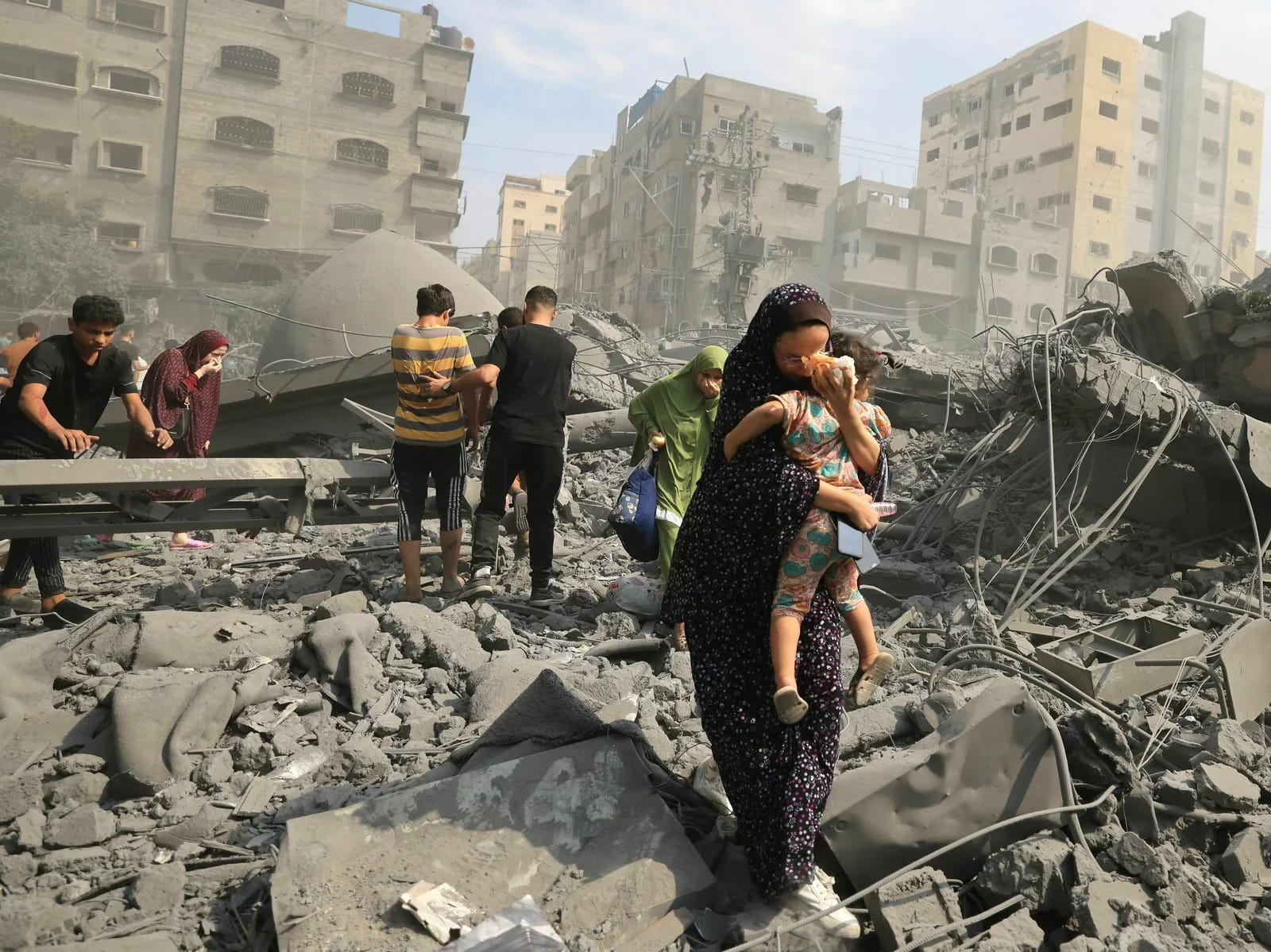
Gaza after an Israeli bombing attack. Anyone want more war?
So, who are you going to vote for in America who sees the awfulness of war and who’s willing to pursue diplomacy and peace instead? Democrats? Republicans?
Generally speaking, Democrats are fixated on war with Russia. They support massive aid to Ukraine and are against negotiations. They also support massive aid to Israel in its ongoing genocide against Palestinians in Gaza. And they fully support the military-industrial-congressional complex (MICC) and soaring spending on weapons and war, including “investing” in new nuclear weapons.
Republicans are much the same, except they tend to see China rather than Russia as the main threat, e.g. Donald Trump and J.D. Vance are willing to negotiate an end to the Russia-Ukraine War. But, in the main, Republicans fervently support Israel in its genocide, are outspoken critics of Iran (Got to punch them hard, Vance recently said), are willing enablers of the MICC, and also vote for massive spending on weaponry and war, including nuclear weapons.
Neither major U.S. political party, the red or blue teams, is pro-peace. Both are pro-aggression and pro-empire. They just occasionally choose different targets for their ire, even as they accuse the other team of “weakness,” of being “Putin puppets” or “Manchurian candidates.”
As I’ve said before, the only word or sentiment apparently forbidden among the red and blue teams is “peace.” If you want an antiwar candidate in America, you have to go outside the two main parties to the Greens or similar fringe parties.
In America, “antiwar” is defined by America’s propaganda machine, otherwise known as the corporate media, as weak and unAmerican, because “the health of the state” is war. Every election, whether the red or blue team prevails, the National Security State, the old War Department, wins. And humanity loses.
The last mainstream candidate for the presidency who spoke consistently of peace was George McGovern in 1972. Unless we the people demand peace, we will continue to get war. In fact, in a bizarrely Orwellian way, colossal military spending and incessant wars are sold to us as keeping America safe. “War is peace” is quite literally the message of the National Security State and its Ministry of Truth, the corporate-owned media.
What is the solution? Here’s one possible approach: Whenever America deploys troops overseas, those troops most immediately in harm’s way must be drawn from the ranks of America’s most privileged and their children. So, corporate CEOs, Members of Congress, lawyers at White Shoe firms, private equity billionaires and millionaires and their progeny, Hollywood celebrities and America’s best-known sports stars: those Americans who prosper and profit the most from empire should be the first to serve it. And that service must be made mandatory, no exceptions, no way to buy your way out or plead that you have “higher” priorities.
Those who want war should serve in war, leaving the rest of us alone. This rule, more than any other, might just keep the chickenhawks from screeching for more war with Russia, or China, or Iran, or North Korea, or Syria, or somebody. A few minutes at the front, facing bullets and shells and cluster munitions while hearing the screams of the dying, might just cure these wannabe “warriors” of their fever.
Want a war? Go to war. And leave the rest of us in peace.
As a retired Air Force officer and military historian, I’m familiar with all kinds of euphemisms about killing, e.g. “precision bombing” and “collateral damage.” Just as it’s easier to kill at a distance, it’s easier to kill when we use words that provide distance from the act. Words that facilitate detachment. Words that befuddle and confuse our minds.
When writing honestly about war, it’s best to use bullet-hits-the-bone words: atrocity, murder, war crime, slaughter. Rape, pillage, burn are “old” words associated with war, and these words often most fittingly describe war and its likely effects and outcomes.
Powerful, blunt, and accurate words should remind us that war is inherently horrible and also profoundly anti-democratic. War is consistent with authoritarianism and lack of freedom, yet Americans nowadays seem to think war (and words about war) is conducive to democracy and freedom, e.g. Afghanistan, Iraq, and now Ukraine.
We used to know better. Military people are fond of the saying, “freedom isn’t free,” but neither is war. Indeed, war and its various manifestations are costing this nation more than a trillion dollars a year while weakening democracy and our constitutional freedoms. And that is a very high price to pay to keep the factories of the merchants of death humming and the generals and admirals happy.
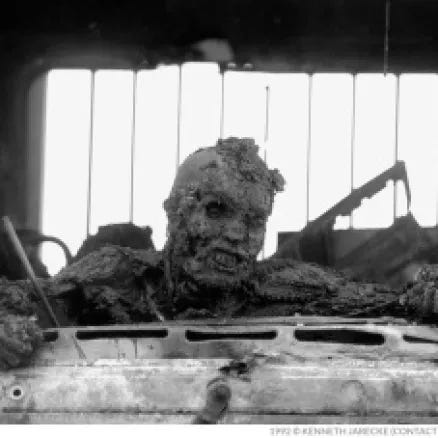
Grisly images like this one (of a dead Iraqi soldier) were censored in America. Language is censored as well.
Fortunately, there’s a new guide and website available that alerts us to the importance of language and war. The website is wordsaboutwar.org, from which you can read and download suggestions on how best to use words to convey the horrors and costs of war to people everywhere. I urge you to visit the site and peruse the guide. (Full disclosure: I was an advisor to this effort, which was ably led by David Vine.)
Here’s a sample of a few comments I made in passing to the group:
A war on terror is truly a war of terror because war itself is terrible.
Friendly fire is being killed by one’s own, often due to the chaos of war, the sheer waste of it all, exacerbated by incompetence. “Fire” is always unfriendly.
Very few troops are “heroes,” and indeed most aren’t, because heroes are rare in all walks of life.
The word “casualty” is too benign. I much prefer killed and wounded: the victims of war.
What are “enemy noncombatants”? They are usually innocent civilians.
With respect to the “War on Terror” that the U.S. has prosecuted for 22 years and counting, I noted that:
We (the U.S.) manifested a Manichean world view; as George W. Bush said soon after 9/11, you’re either for America (and all its violence) or you’re for the terrorists (with their violence). If you wanted a non-violent approach, you were dismissed as naive or “for them.” It was good versus evil, thus the infamous “axis of evil” the U.S. allegedly faced.
This is, of course, a problem with all discourse related to war. Subtlety and nuance are thrown out the window. Language is greatly simplified. The U.S. is “doubleplusgood” and the enemy must be the opposite while simultaneously being dehumanized. We kill “cowardly” enemy troops or terrorists (by drone they’re “bugsplat”) yet our “heroic” troops “fall” in battle and are revered as “the fallen.” Violent combat is disguised as “kinetic action” in U.S. military communiques.
In my view, the dishonesty of this language captures the dishonesty of America’s wars.
General William T. Sherman (U.S. Civil War) famously said that “War is all hell.” Sherman knew the hellish and harsh realities of war; he knew, as he wrote, that “war is cruelty, and you cannot refine it.” Too many people today are using and manipulating words to refine war. They’re camouflaging war’s harshest realities. Writers should write plainly and honestly, as General Sherman did, to capture war’s hellish nature. By choosing honest words, we also help to create a better future in which the threat of war recedes precisely because we recognize more clearly its horrific nature and terrifying costs.
Other high-ranking military officers, like General Smedley Butler, for example, also wrote plainly about war. As Butler famously said, war is a racket, and he described himself as a gangster for capitalism. Now that was plain speaking about war!
The chief intent of speaking and writing plainly about war is to discourage war and save lives. Some might see it as patriotic—saving the lives of U.S. troops by helping to prevent bloody awful wars—but more broadly the goal is humanistic—to save the lives of all those on the receiving end of bullets and bombs.
Interestingly, U.S. troops at lower levels are generally blunt about what war is about. Talk to sergeants at the front and you’ll hear visceral truths, probably enhanced by choice expletives. I’ve heard U.S. Marines shout “Kill!” at graduation ceremonies. Killing, after all, is what war enables. Mass killing leads to atrocities like My Lai in Vietnam. This fact should never be sugarcoated.
Few people, however, truly want to confront war’s horrors. Gazing upon the face of war is profoundly disturbing, which is why we’re encouraged to look away. And so the face of war is airbrushed and camouflaged with euphemisms and buried under a blizzard of acronyms.
If we are to end war and prevent atrocity, we must seek to name things accurately while calling up mental images (no matter how disturbing) appropriate to the horrors of war. The guide at wordsaboutwar.org is an important step in that direction.
Update: I went on Podcast by George today to talk about all this:
Reason and Rationality Have Little to Do with Them
It is often hard to understand the reasons for America’s wars, especially since World War II, but they always have a rationale backed up by lies. The rationale for Vietnam was the containment of communism and the domino theory. The lie was that U.S. naval ships had been attacked at Tonkin Gulf. The rationale for Iraq was overthrowing a ruthless dictator and spreading “freedom.” The lie was that he had WMD and that he was somehow connected to the 9/11 attacks.
Nations and peoples are not dominoes
The real reasons for America’s many disastrous wars are opaque. Domestic politics are almost always paramount. No U.S. president wants to be accused of losing a war or appearing to be weak, so starting or continuing a war is considered as “strength.” Congress doesn’t want to be accused of “tying the hands of the president” or of “betraying the troops,” so most members happily go along with wars. The military, of course, always thinks it can win, and wars are good for promotions and power. And military contractors, the “merchants of death,” are even more happy to make money off war. Not surprisingly, perhaps, President Dwight D. Eisenhower’s farewell speech in 1961 warned America of the military-industrial complex, to which Ike had added Congress in an earlier draft. Ike’s warning has been largely forgotten; even his own monument in DC obscures it.
In Washington today, the Democrats accuse the Republicans of being weak on Russia; the Republicans return the favor by accusing the Biden administration of being weak on China. Military and industry are happy to play this blame game, knowing the Pentagon budget will soar as a result, as it has. And thus a dangerous “new cold war” appears to be a certainty.
The folly and fallaciousness of America’s wars, along with their carnage, are enough to make any rational human angry, especially one who has served in one of these wars. Mike Murry, a Vietnam War veteran, is angry, and so am I. Back in 2017, I wrote a piece on the atrociousness of the Vietnam War, to which Mr. Murry appended this comment. It merits consideration by all thinking Americans.
The ”Rationale” of America’s Wars. Comment by Mike Murry in 2017.
An excellent choice of words, “rationale.” Not the reason for doing something in the first place, but a conscious lie made up beforehand just to get things started, or an excuse invented afterwards to avoid accountability and, where required, the necessary punishment that true justice occasionally administers. Marine Corps General Smedley Butler once said that we have only two acceptable reasons for going to war: to defend our homes or defend the Constitution. In not a single case after World War II has either of these conditions applied, so that none of the pointless and ruinous fighting — I won’t dignify these Presidential/Career Military misadventures by calling them “war” — has had any justifiable reason or purpose. Not surprisingly, no Congress has declared war on another nation state since 1941 because no nation state on planet earth has attacked either American homes or America’s Constitution. The United States has not just “gone abroad in search of monsters to destroy,” as our sixth President, John Quincy Adams, warned us against foolishly doing, but has invented imaginary hobgoblins at home before even setting out to vanquish them on the far side of the globe.
Of course, Smedley Butler only made his remarks after serving for thirty years as an admitted “gangster for capitalism,” probably the best summary description of the U.S. military offered to date by one who ought to know. Today, as for the past seventy-plus years, the U.S. military simply fights — aimlessly and disastrously — for the sake of fighting. The fighting has no “reason” other than to provide a steady stream of outrageous corporate CEO bonuses, stockholder dividends, and the pensions and perquisites of retired senior military officers. This Warfare Welfare and Make-work Militarism has secondary beneficiaries, of course, most notably the hothouse orchids, special snowflakes and privileged peacock pugilists known as United States as “political leaders.” Naturally, the feeding and maintenance of this system of corrupt cronyism requires a death grip on over half the nation’s discretionary budget. As George Orwell wrote in “The Theory and Practice of Oligarchical Collectivism” (the book-within-a-book from 1984):
“The primary aim of modern warfare (in accordance with the principles of doublethink, this aim is simultaneously recognized and not recognized by the directing brains of the Inner Party) is to use up the products of the machine without raising the general standard of living.”
In other words, the entire U.S. military/security monstrosity — which I like to call the Lunatic Leviathan — has only one purpose: to suck the life out of the domestic economy so that the productivity of the people’s labor will not result in the betterment of their station in life, which might in due course result in the discarding of America’s useless parasitic economic and political “elites.” Any transparent euphemism designed and deployed to disguise this ugly, fundamental truth properly deserves the label “rationale.” In no way do the usual and time-dishonored obfuscations amount to a reason. Reason has fled the United States, replaced by a deserved and rancid Ridicule. The country now consumes itself, lost in its own vicarious fears and fantasies featuring the celluloid exploits of our vaunted Visigoths vanquishing visions of vultures somewhere, someplace, at some time, until … eventually … after some “progress” and “fragile gains” … as T.S. Eliot wrote of The Hollow Men:
This is the way the world ends This is the way the world ends This is the way the world ends Not with a bang but a whimper.
Men and women so hollow that you can hear their own bullshit echoing in them even before they start moving their jaws and flapping their lips to begin lying.
Perhaps America, Home of the Brave, Simply Fears Too Much
In 1961, in his famous farewell address, President Dwight D. Eisenhower warned America about the military-industrial complex. He said it potentially posed a grave threat to liberty and democracy, noting that only an alert and knowledgable citizenry could keep its “disastrous rise” in check. In an earlier draft of his speech, Ike had included Congress as part of the complex, but he removed it from the final draft in the interest of parting with Congress on good terms.
Ike, of course, knew the military and loved it and had worked with industry as well. He knew of what he spoke. Every year when he was president, the military wanted more. So did the weapons manufacturers. And Congress was willing to give them more in the name of jobs and for that nebulous cause of national security. Ike did a decent job as president containing the ambitions of the military and the greed of America’s merchants of death. His speech in 1961 was his parting shot across the bow of the complex and a warning that’s largely been forgotten by Americans then and now.
Ike, I think, would be dismayed but not shocked at how the military-industrial complex or MIC has expanded its “misplaced” power over the last sixty years. The MIC is now the MICIMATT, or the military industrial congressional intelligence media academia think tank complex, employing millions of Americans in pursuit of full-spectrum dominance across the globe. In fact, America has proudly become a warrior nation (the citizen-soldier ideal is long dead) with 750 bases around the world and military budgets that routinely touch or exceed a trillion dollars. Permanent war is the new normal in America, justified as always in terms of making the world safe for democracy.
In the spirit of Ike, we should recognize the military or industry or Congress alone is not the enemy. It’s the conjunction of an immense military establishment with powerful industrial interests, and the enabling of the same by Congress, that needs to be addressed and reformed.
Yet, given its enormity and its power, the complex is remarkably resistant to change, let alone to being shrunk and weakened. It will take enormous national will, working against powerful propaganda forces that will paint every Pentagon budget reduction, large or small, as unsafe if not un-American.
So why did Ike fail? Or why did we fail Ike? He warned us in 1961. Why have we as “an alert and knowledgable citizenry” failed to guard against the acquisition of “disastrous” power by the MIC?
For the truth is America has become an Orwellian country where war is peace. War (or preparations for war) has been continuous since Ike’s speech. Our government wages war in the alleged cause of peace. It acts imperially in the name of democracy, and we collectively accept or tolerate the tale that Big Brother tells us.
Short of a revolution, what America needs is radical honesty. An awakening. If we truly want as a people to pursue peace, we can’t do that by constantly waging war. If we truly favor democracy, we can’t pursue one through militarism and imperialism.
What kind of nation — what kind of people — do we want to be? Judging by our federal discretionary budget and by the general affection for all things military in our nation, perhaps we want to be a bellicose empire. I’m not saying all Americans want this; even those who do probably wouldn’t state it so baldly. But maybe this is just who we are, a nation and a people convinced that it’s always at risk, and thus one that’s forever fearful, hyper-vigilant, coiled to strike and ready to rumble.
“Quite an experience to live in fear, isn’t it? That’s what it is to be a slave.” So says Roy Batty, the doomed replicant in Blade Runner, played so brilliantly by Rutger Hauer. There’s a lesson here for all of us. The first step to heeding Ike’s warning, as well as his marching orders to us, is to control our collective fear. To stop listening to threat inflation about China or Russia or Iran or terrorism or whatever. Fear is the mind-killer, Frank Herbert noted in Dune, thus to think freely requires us to master that which kills thought. Fear, Master Po said in Kung Fu, is the only darkness.
We will only begin to downsize the military-industrial complex and end our pursuit of militarism when we acknowledge our fear, stop being slaves to it, and head away from the darkness.
America is the home of the brave, so we say. Isn’t it time we acted like it?
Julian Assange before he was locked away for his truth-telling
W.J. Astore
The worst crime you can commit, in the eyes of the powerful, is to embarrass them and to reveal their crimes. That is what Julian Assange did, most notably about U.S. war crimes in Iraq, and that is why he is being hounded and punished. Assange is being made to suffer, and suffer greatly he is, because he spoke truth about the powerful to the powerless. That is arguably the number one job of a real journalist, to hold powerful people accountable, to reveal the truth when so many conspire to keep it hidden. But most journalists are not profiles in courage, just as most people aren’t. The courageous are few, and counted among their number is Assange.
If you’re a journalist looking to make a difference, to shed light in dark corners, do you dare to take on the U.S. government and national security state given its persecution of Assange? Do you want to spend years in a maximum security prison, almost in total isolation, facing extradition to the U.S. for a bogus and nonsensical charge? The U.S. government’s persecution of Assange, though it’s meant to punish him and silence him, is really about intimidating and silencing other journalists. Who now dares to follow Assange’s example?
Power operates most freely, meaning most tyrannically, when it’s unconstrained by accountability. The more Assange suffers, the more America slips into authoritarianism. Joining America in its drift toward tyranny is Great Britain and Australia, with Britain imprisoning Assange and approving his extradition and Australia doing nothing to stop the persecution of one of its own citizens. Such is the corrupting influence of power.
As usual, George Orwell explained all this in “1984” when he described the nature of power:
“The Party seeks power entirely for its own sake. We are not interested in the good of others; we are interested solely in power. Not wealth or luxury or long life or happiness; only power, pure power … [No] one ever seizes power with the intention of relinquishing it. Power is not a means, it is an end … The object of persecution is persecution. The object of torture is torture. The object of power is power. Now do you begin to understand me?”
Assange, like the character of Winston Smith in “1984,” now has a full understanding of the nature of power. It’s come at an enormous price to him. Yet Assange has also revealed the nature of our government to the rest of us, the way it brutally uses power to keep its monopoly on power.
The question is: Are we going to do anything about it? Or is it already too late? And if we do choose to resist, like Winston Smith (and Julian Assange), will we be taken to our own versions of Room 101, after which we too will profess our love for Big Brother?
Addendum: A comment by Dan White stimulated this reply by me. I think it’s worth adding here.
If not obliteration [of people like Assange], then marginalization, incarceration, diminishment, denouncement, and so on. Chelsea Manning. Daniel Hale. Daniel Ellsberg. And many more. Put them in prison and/or accuse them of treason. Seize their assets. Destroy their lives.
Most of all, intimidate those who are wavering, who are thinking, but who perhaps don’t have quite the nerve, or perhaps too much to lose.
The best way to silence whistle blowers is to make them choose to throw their whistle away before it even reaches their mouth.
In my latest article for TomDispatch.com, I examine what it would take for the Pentagon budget to go down. You can read the entire article here. What follows is the concluding section.
Ever since 9/11, endless conflict has been this country’s new normal. If you’re an American 21 years of age or younger, you’ve never known a time when your country hasn’t been at war, even if, thanks to the end of the draft in the previous century, you stand no chance of being called to arms yourself. You’ve never known a time of “normal” defense budgets. You have no conception of what military demobilization, no less peacetime might actually be like. Your normal is only reflected in the Biden administration’s staggering $813 billion Pentagon budget proposal for the next fiscal year. Naturally, many congressional Republicans are already clamoring for even highermilitary spending. Remember that Mae West quip[Too much of a good thing can be wonderful]? What a “wonderful” world!
And you’re supposed to take pride in this. As President Biden recently told soldiers from the 82nd Airborne Division now stationed in Poland, this country has the “finest fighting force in the history of the world.” Even with the mountains of cash we give to that military, the nation still “owes you big,” he assured them.
Well, I’m gobsmacked. During my 20-year career in the military, I never thought my nation owed me a thing, let alone owed me big. Now that I think of it, however, I can say that this nation owed me (and today’s troops as well) one very big thing: not to waste my life; not to send me to fight undeclared, arguably unconstitutional, wars; not to treat me like a foreign legionnaire or an imperial errand-boy. That’s what we, the people, really owe “our” troops. It should be our duty to treat their service, and potentially their deaths, with the utmost care, meaning that our leaders should wage war only as a last, not a first, resort and only in defense of our most cherished ideals.
This was anything but the case of the interminable Afghan and Iraq wars, reckless conflicts of choice that burned through trillions of dollars, with tens of thousands of U.S. troops killed and wounded, and millions of foreigners either dead or transformed into refugees, all for what turned out to be absolutely nothing. Small wonder today that a growing number of Americans want to see less military spending, not more. Citizen.org, representing 86 national and state organizations, has called on President Biden to decrease military spending. Joining that call was POGO, the Project on Government Oversight, as well as William Hartung at the Quincy Institute for Responsible Statecraft. And they couldn’t be more on target, though they’re certain to be ignored in Washington.
Consider the recent disastrous end to the Afghan War. Viewing that conflict in the aggregate, what you see is widespread corruption and untold waste, all facilitated by generals who lied openly and consistently to the rest of us about “progress,” even as they spoke frankly in private about a lost war, a reality the Afghan War Papers all too tellingly revealed. That harsh story of abysmal failure, however, highlights something far worse: a devastating record of lying on a massive scale within the highest ranks of the military and government. And are those liars and deceivers being called to account? Perish the thought! Instead, they’ve generally been rewarded with yet more money, promotions, and praise.
So, what would it take for the Pentagon budget to shrink? Blowing the whistle on wasteful and underperforming weaponry hasn’t been enough. Witnessing murderous and disastrous wars hasn’t been enough. To my mind, at this point, only a full-scale collapse of the U.S. economy might truly shrink that budget and that would be a Pyrrhic victory for the American people.
In closing, let me return to President Biden’s remark that the nation owes our troops big. There’s an element of truth there, perhaps, if you’re referring to the soldiers, Marines, sailors, and airmen, many of whom have served selflessly within its ranks. It sure as hell isn’t true, though, of the self-serving strivers and liars at or near the top, or the weapons-making corporations who profited off it all, or the politicians in Washington who kept crying out for more. They owe the rest of us and America big.
My fellow Americans, we have now reached the point in our collective history where we face three certainties: death, taxes, and ever-soaring spending on weaponry and war. In that sense, we have become George Orwell’s Oceania, where war is peace, surveillance is privacy, and censorship is free speech.
Such is the fate of a people who make war and empire their way of life.
In my latest article for TomDispatch, I tackle the new cold war and the consensus in Washington that future Pentagon budgets must soar ever higher in response to Russia’s invasion of Ukraine. You can read the entire article here. What follows is the concluding section of the article.
Your Role as a Loyal American in the New Cold War
My fellow Americans, in this new cold war of ours, the national security state expects both all too much and all too little of you. Let’s start with the little. It doesn’t expect you to enlist in the military if you’re rich or have “other priorities” (as former Vice President Dick Cheney said about the Vietnam War). It doesn’t expect you to pay close attention to our wars, let alone foreign policy. You don’t even have to vote. It does, however, expect you to cheer at the right times, be “patriotic,” wave the flag, gush about America, and celebrate its fabulous, militarized exceptionalism.
To enlist in this country’s cheerleading squad, which is of course God’s squad, you might choose to wear a flag lapel pin and affix a “Support Our Troops” sticker to your SUV. You should remind everyone that “freedom isn’t free” and that “God, guns, and guts” made America great. If the godly empire says Ukraine is a worthy friend, you might add a blue-and-yellow “frame” to your Facebook profile photo. If that same empire tells you to ignore ongoing U.S. drone strikes in Somalia and U.S. support for an atrocious Saudi war in Yemen, you are expected to comply. Naturally, you’ll also be expected to pay your taxes without complaint, for how else are we to buy all the weapons and wage all the wars that America needs to keep the peace?
Naturally, certain people need to be collectively despised in our very own version of George Orwell’s “Two Minutes Hate.” So, when Putin’s visage comes on the screen, or Xi’s, or Kim Jong-un’s, or whoever the enemy du jour is, be prepared to express your outrage. Be prepared to treat them as aliens, almost incomprehensible in their barbarity, as if, in fact, they were Klingons in the original Star Trek series. As a peaceful member of the “Federation,” dominated by the United States, you must, of course, reject those Klingon nations and their warrior vision of life, their embrace of might-makes-right, choosing instead the logic, balance, and diplomacy of America’s enlightened State Department (backed up, of course, by the world’s greatest military).
Two Minutes’ Hate: Still from the movie “1984”
Again, little is expected of you (so far) except your obedience, which should be enthusiastic rather than reluctant. Yet whether you know it or not, much is expected of you as well. You must surrender any hopes and dreams you’ve harbored of a fairer, kinder, more equitable and just society. For example, military needs in the new cold war simply won’t allow us to “build back better.” Forget about money for childcare, a $15 federal minimum wage, affordable healthcare for all, better schools, or similar “luxuries.” Maybe in some distant future (or some parallel universe), we’ll be able to afford such things, but not when we’re faced with the equivalent of the Klingon Empire that must be stopped at any cost.
But wait! I hear some of you saying that it doesn’t have to be this way! And I agree. A better future could be imagined. A saying of John F. Kennedy’s comes to mind: “We shall be judged more by what we do at home than what we preach abroad.” What we’re currently doing at home is building more weapons, sinking more tax dollars into the Pentagon, and enriching more warrior-corporations at the expense of the poor, the weak, and the vulnerable. Where’s the democratic future in that?
Sheer military might, our leaders seem to believe, will keep them forever riding high in the saddle. Yet you can ride too high in any saddle, making the fall that’s coming that much more precipitous and dangerous.
Americans, acting in concert, could stop that fall, but not by giving our current crop of leaders a firmer grasp of the reins. Do that and they’ll just spur this nation to greater heights of military folly. No, we must have the courage to unseat them from their saddles, strip them of their guns, and corral their war horses, before they lead us into yet another disastrously unending cold war that could threaten the very existence of humanity. We need to find another way that doesn’t prioritize weapons and war, but values compromise, compassion, and comity.
At this late date, I’m not sure we can do it. I only know that we must.






 Bracing Views