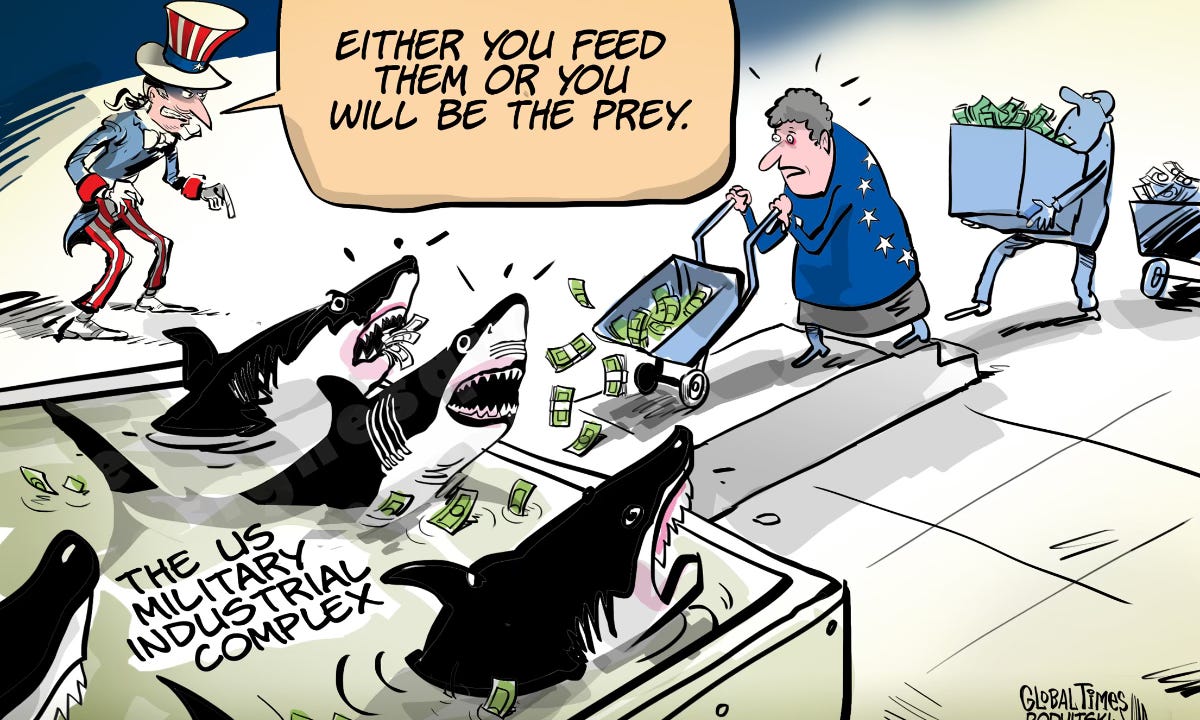
The Real Evil Empire?

Serving In (or Thinking About) the U.S. Military for 40 Years

BILL ASTORE

Below is my latest article for TomDispatch.com. Why do I write these articles? I started in 2007, this is 2025, and after 112 articles, nearly all of them calling for America to walk a far less militaristic path, militarism and authoritarianism continue to sink their roots deeper into our culture. Talk about fighting a losing war!

I suppose I write them to preserve my sanity—they’re my effort to make sense of what’s happening around me. But I also write them in the hope that my words might matter, that they might, just might, make a small difference, shifting America away from incessant warfare and colossal military spending. I haven’t given up hope, even as military budgets soar to a trillion dollars and above.

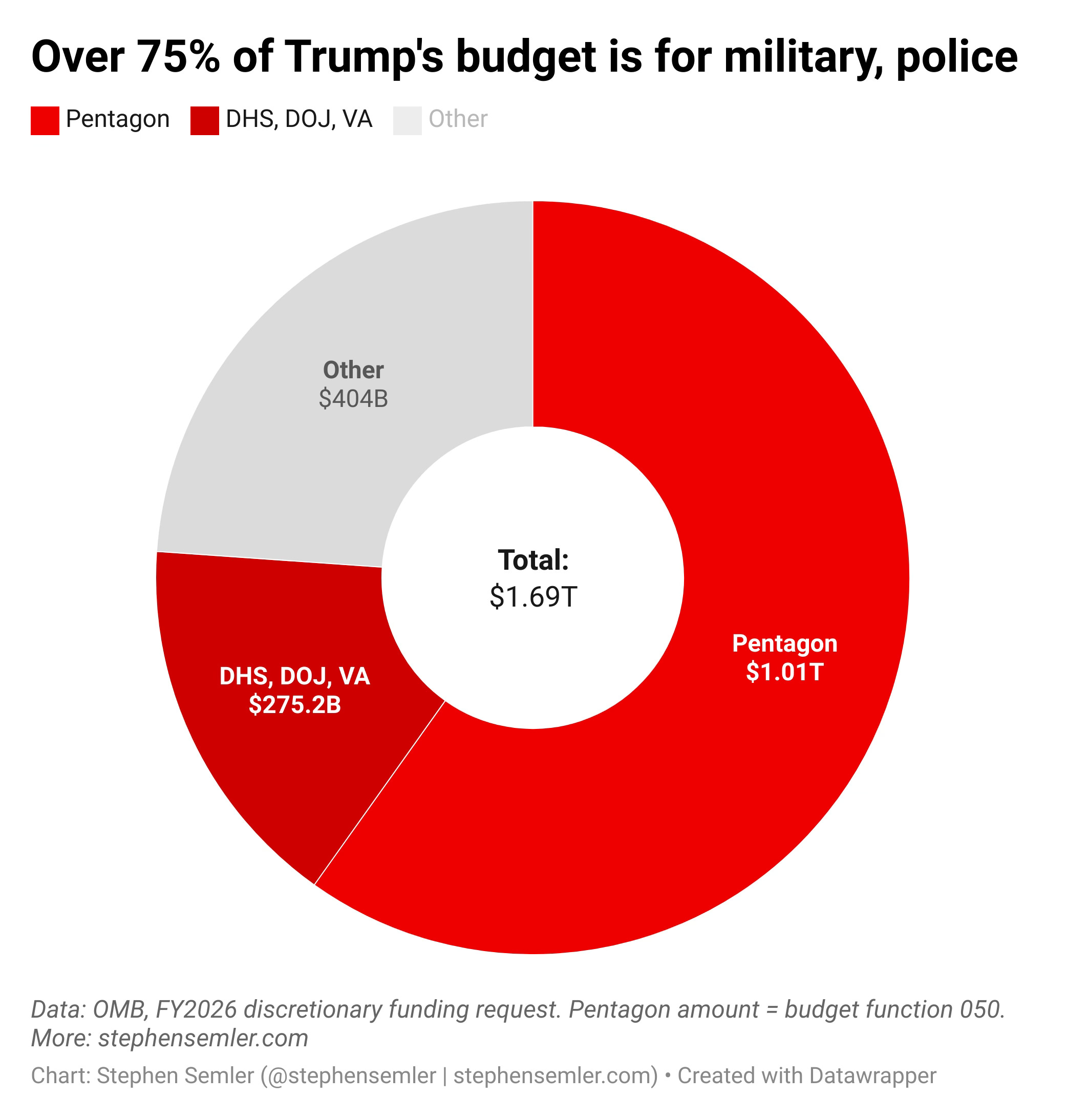
Speaking of which: Here’s an eye-opening chart from Stephen Semler on Trump’s FY2026 budget for America. Sure seems like we’re the Empire in “Star Wars,” doesn’t it?

Anyway, here’s my latest article for TomDispatch:

Forty years ago this month, I was commissioned a second lieutenant in the U.S. Air Force. I would be part of America’s all-volunteer force (AVF) for 20 years, hitting my marks and retiring as a lieutenant colonel in 2005. In my two decades of service, I met a lot of fine and dedicated officers, enlisted members, and civilians. I worked with the Army, Navy, and Marine Corps as well, and met officers and cadets from countries like Great Britain, Germany, Pakistan, Poland, and Saudi Arabia. I managed not to get shot at or kill anyone. Strangely enough, in other words, my military service was peaceful.

Don’t get me wrong: I was a card-carrying member of America’s military-industrial complex. I’m under no illusions about what a military exists for, nor should you be. As an historian, having read military history for 50 years of my life and having taught it as well at the Air Force Academy and the Naval Postgraduate School, I know something of what war is all about, even if I haven’t experienced the chaos, the mayhem, the violence, or the atrocity of war directly.

Military service is about being prepared to kill. I was neither a trigger-puller nor a bomb-dropper. Nonetheless, I was part of a service that paradoxically preaches peace through superior firepower. The U.S. military and, of course, our government leaders, have had a misplaced — indeed, irrational — faith in the power of bullets and bombs to solve or resolve the most intractable of problems. Vietnam is going communist in 1965? Bomb it to hell and back. Afghanistan supports terrorism in 2001? Bomb it wildly. Iraq has weapons of mass destruction in 2003? Bomb it, too (even though it had no WMD). The Houthis in Yemen have the temerity to protest and strike out in relation to Israel’s atrocities in Gaza in 2025? Bomb them to hell and back.

Sadly, “bomb it” is this country’s go-to option, the one that’s always on the table, the one our leaders often reach for first. America’s “best and brightest,” whether in the Vietnam era or now, have a powerful yen for destruction or, as the saying went in that long-gone era, “It became necessary to destroy the town to save it.” Judging them by their acts, our leaders indeed have long appeared to believe that all too many villages, towns, cities, and countries needed to be destroyed in order to save them.

My own Orwellian turn of phrase for such mania is: destruction is construction. In this country, an all-too-offensive military is sold as a defensive one, hence, of course, the rebranding of the Department of War as the Department of Defense. An imperial military is sold as so many freedom-fighters and -bringers. We have the mega-weapons and the urge to dominate of Darth Vader and yet, miraculously enough, we continue to believe that we’re Luke Skywalker.

This is just one of the many paradoxes and contradictions contained within the U.S. military and indeed my own life. Perhaps they’re worth teasing out and exploring, as I reminisce about being commissioned at the ripe old age of 22 in 1985 — a long time ago in a country far, far away.

The Evil Empire

When I went on active duty in 1985, the country that constituted the Evil Empire on this planet wasn’t in doubt. As President Ronald Reagan said then, it was the Soviet Union — authoritarian, militaristic, domineering, and decidedly untrustworthy. Forty years later, who, exactly, is the evil empire? Is it Vladimir Putin’s Russia with its invasion of Ukraine three years ago? The Biden administration surely thought so; the Trump administration isn’t so sure. Speaking of Trump (and how can I not?), isn’t it correct to say that the U.S. is increasingly authoritarian, domineering, militaristic, and decidedly untrustworthy? Which country has roughly 800 military bases globally? Which country’s leader openly boasts of trillion-dollar war budgets and dreams of the annexation of Canada and Greenland? It’s not Russia, of course, nor is it China.

Back when I first put on a uniform, there was thankfully no Department of Homeland Security, even as the Reagan administration began to trust (but verify!) the Soviets in negotiations to reduce our mutual nuclear stockpiles. Interestingly, 1985 witnessed an aging Republican president, Reagan, working with his Soviet peer, even as he dreamed of creating a “space shield” (SDI, the strategic defense initiative) to protect America from nuclear attack. In 2025, we have an aging Republican president, Donald Trump, negotiating with Putin even as he floats the idea of a “Golden Dome” to shield America from nukes. (Republicans in Congress already seek $27 billion for that “dome,” so that “golden” moniker is weirdly appropriate and, given the history of cost overruns on American weaponry, you know that would be just the starting point of its soaring projected cost.)

Buy the Book

When the Soviet Union collapsed in 1991, fears of a third world war that would lead to a nuclear exchange (as caught in books of the time like Tom Clancy’s popular novel Red Storm Rising) abated. And for a brief shining moment, the U.S. military reigned supreme globally, pulverizing the junior varsity mirror image of the Soviet military in Iraq with Desert Storm in 1991. We had kicked the Vietnam Syndrome once and for all, President George H.W. Bush exulted. It was high time for some genuine peace dividends, or so it seemed.

The real problem was that that seemingly instantaneous success against Saddam Hussein’s much-overrated Iraqi military reignited the real Vietnam Syndrome, which was Washington’s overconfidence in military force as the way to secure dominance, while allegedly strengthening democracy not just here in America but globally. Hubris led to the expansion of NATO to Russia’s borders; hubris led to unipolar dreams of total dominance everywhere; hubris meant that America could somehow have the most moral as well as lethal military in the world; hubris meant that one need never concern oneself about potential blowback from allying with Osama bin Laden in Afghanistan or the risk of provoking Russian aggression as NATO floated Ukraine and Georgia as future members of an alliance designed to keep Russia down.

It was the end of history (so it was said) and American-style democracy had prevailed.

Even so, militarily, this country did anything but demobilize. Under President Bill Clinton in the 1990s, there was some budgetary trimming, but military Keynesianism remained a thing, as did the military-industrial-congressional complex. Clinton managed a rare balanced budget due to domestic spending cuts and welfare reform; his cuts to military spending, however, were modest indeed. Tragically, under him, America would not become “a normal country in normal times,” as former U.N. Ambassador Jeanne Kirkpatrick once dreamed. It would remain an empire — and an increasingly hungry one at that.

In that vein, senior civilians like Secretary of State Madeleine Albright began to wonder why this country had such a superb military if we weren’t prepared to use it to boss others around. Never mind concerns about the constitutionality of employing U.S. troops in conflicts without a congressional declaration of war. (How unnecessary! How old-fashioned!) It was time to unapologetically rule the world.

The calamitous events of 9/11 changed nothing except the impetus to punish those who’d challenged our illusions. Those same events also changed everything as America’s leaders decided it was then the moment to double down on empire, to become even more authoritarian (the Patriot Act, torture, and the like), to go openly to “the dark side,” to lash out in the only way they knew how — more bombing (Afghanistan, Iraq), followed by invasions and “surges” — then, wash, rinse, repeat.

So, had we really beaten the Vietnam Syndrome in the triumphant year of 1991? Of course not. A decade later, after 9/11, we met the enemy, and once again it was our unrepresentative government spoiling for war, no matter how ill-conceived and ill-advised — because war pays, because war is “presidential,” because America’s leaders believe that the true “power of its example” is example after example of its power, especially bombs bursting in air.

The “All-Volunteer” Force Isn’t What It Seems

Speaking as a veteran and a military historian, I believe America’s all-volunteer force has lost its way. Today’s military members — unlike those of the “greatest generation” of World War II fame — are no longer citizen-soldiers. Today’s “volunteers” have surrendered to the rhetoric of being “warriors” and “warfighters.” They take their identity from fighting wars or preparing for the same, putting aside their oath to support and defend the Constitution. They forget (or were never taught) that they must be citizens first, soldiers second. They have, in truth, come to embrace a warrior mystique that is far more consistent with authoritarian regimes. They’ve come to think of themselves — proudly so — as a breed apart.

Far too often in this America, an affinitive patriotism has been replaced by a rabid nationalism. Consider that Christocentric “America First” ideals are now openly promoted by the civilian commander-in-chief, no matter that they remain antithetical to the Constitution and corrosive to democracy. The new “affirmative action” openly affirms faith in Christ and trust in Trump (leavened with lots of bombs and missiles against nonbelievers).

Citizen-soldiers of my father’s generation, by way of contrast, thought for themselves. They chafed against military authority, confronting it when it seemed foolish, wasteful, or unlawful. They largely demobilized themselves in the aftermath of World War II. But warriors don’t think. They follow orders. They drop bombs on target. They make the war machine run on time.

Americans, when they’re not overwhelmed by their efforts to simply make ends meet, have largely washed their hands of whatever that warrior-military does in their name. They know little about wars fought supposedly to protect them and care even less. Why should they care? They’re not asked to weigh in. They’re not even asked to sacrifice (other than to pay taxes and keep their mouths shut).

Too many people in America, it seems to me, are now playing a perilous game of make-believe. We make-believe that America’s wars are authorized when they clearly are not. For example, who, other than Donald Trump (and Joe Biden before him), gave the U.S. military the right to bomb Yemen?

We make-believe all our troops are volunteers. We make-believe we care about those “volunteers.” Sometimes, some of us even make-believe we care about those wars being waged in places and countries most Americans would be hard-pressed to find on a map. How confident are you that all too many Americans could even point to the right hemisphere to find Syria or Yemen or past war zones like Vietnam, Afghanistan, and Iraq?

War isn’t even that good at teaching Americans geography anymore!

What Is To Be Done?

If you accept that there’s a kernel of truth to what I’ve written so far, and that there’s definitely something wrong that should be fixed, the question remains: What is to be done?

Some concrete actions immediately demand our attention.

*Any ongoing wars, including “overseas contingency operations” and the like, must be stopped immediately unless Congress formally issues a declaration of war as required by the Constitution. No more nonsense about MOOTW, or “military operations other than war.” There is war or there is peace. Period. Want to bomb Yemen? First, declare war on Yemen through Congress.

*Wars, assuming they are supported by Congressional declarations, must be paid for with taxes raised above all from those Americans who benefit most handsomely from fighting them. There shall be no deficit spending for war.

*Americans are used to “sin” taxes for purchases like tobacco and alcohol. So, isn’t it time for a new “sin” tax related to profiteering from war, especially by the corporations that make the distinctly overpriced weaponry without which such wars couldn’t be waged?

To end wars and weaken militarism in America, we must render it unprofitable. As long as powerful forces continue to profit so handsomely from going to war — even as “volunteer” troops are told to aspire to be “warriors,” born and trained to kill — this violent madness in America will persist, if not expand.

Look, the 22-year-old version of me thought he knew who the evil empire was. He thought he was one of the good guys. He thought his country and his military stood for something worthy, even for “greatness” of a sort. Sure, he was naïve. Perhaps he was just another wet-behind-the-ears factotum of empire. But he took his oath to the Constitution seriously and looked to a brighter day when that military would serve only as a deterrent in a world largely at peace.

The soon-to-be-62-year-old me is no longer so naïve and, these days, none too sure who’s evil and who isn’t. He knows his country is on the wrong path, that the bloody path of bullets and bombs (and profiting from the same) is always perilous for any freedom-loving people to travel on.

Somehow, America needs to be put back on the freedom trail that inspires and empowers citizens rather than wannabe warriors brandishing weapons galore. Somehow, we need to aspire again to be a nation of laws. (Can we agree that due process is better than no process?) Somehow, we need to dream of being a nation where right makes might, one that knows that destruction is not construction, one that exchanges bullets and bombs for ballots and beauty.

How else are we to become America the Beautiful?

Copyright 2025 William J. Astore

Revive Democracy!

W.J. Astore

Replacing an older suicide vest with a newer one is not a sound plan

We are losing the struggle for the heart and soul of our country.

That much is apparent by the government’s embrace of genocide in Gaza, its boasts of trillion dollar war budgets, and its pride in global weapons sales, which the U.S. dominates (more than 40% of the global arms trade consists of weapons made in the USA).

I’ve been involved in efforts to criticize America’s “merchants of death” and to challenge America’s love affair with the military-industrial complex (MIC), but seemingly nothing we say or do changes the abusive and sociopathic power structure in DC. I suppose that’s none too surprising, given the power of the MICIMATT and the persuasiveness of propaganda.

Merchants of Death

Still, we must persist in these efforts, bringing a positive message, which I think should focus on the revival of democracy by reinvesting in America while rejecting militarism and restoring peace. Peace should be America’s normal, not war and constant preparations for the same. Yet “peace” seems to be the hardest word, one that’s rarely spoken in the halls of power.

Anyhow, in 2022 I wrote the following email to likeminded colleagues; I hope it’s worth sharing. As I think about it, three years later, I marvel at the death of idealism in America and the triumph of militarism. When more than half of the federal government’s discretionary spending goes to the military and weaponry, despite the Pentagon’s failure to pass audit after audit for seven years running, we must conclude we are one sick society.

The question is: How do we restore ourselves to health? Because I for one do not believe that war is the health of the state. 

*****

Written in 2022 to colleagues seeking to reform the military-industrial complex (MIC).

When I was a college student in the early 1980s, and in Air Force ROTC, I wrote against the Reagan “defense” buildup. Caspar Weinberger, he of the “Cap the knife” handle for cost-cutting, became “Cap the ladle” as Reagan’s SecDef, ladling money in huge amounts to the Pentagon. History is repeating itself again as the Biden administration prepares to ladle $813 billion (and more) to the Pentagon.

How do we stop this? Of course, we must recognize (as I’m sure we all do) what we’re up against. Both political parties are pro-military and, in the main, pro-war. Our economy is based on a militarized Keynesianism and our culture is increasingly militarized. Mainstream Democrats, seemingly forever afraid of being labeled “weak” on defense, are at pains to be more pro-military than the Republicans. Biden, in Poland, echoed the words of Obama and other past presidents, declaring the U.S. military to be “the finest fighting force” in history. Think about that boast. Think about how Biden added that the nation owes the troops big. This is a sign of a sick culture.

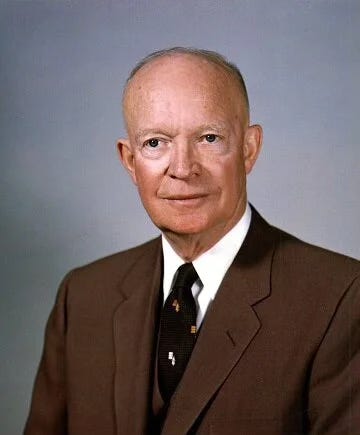
Ike gave his MIC speech in 1961, and for 61 years the MIC has been winning. Even after the collapse of the Soviet Union in the early ‘90s, the MIC held its own; after 9/11, it went into warp speed and is accelerating. To cite Scotty from Star Trek: “And at Warp 10, we’re going nowhere mighty fast.”

We need a reformation of our institutions; we need a restoration of our democracy; we need a reaffirmation of the U.S. Constitution; we need to remember who we are, or perhaps who we want to be, as a people.

Do we really want to be the world’s largest dealer of arms? Do we really want to spend a trillion or more dollars, each and every year, on wars and weapons, more than the next dozen or so countries combined, most of which are allies of ours? (“Yes” is seemingly the answer here, for both Democrats and Republicans.) Is that really the best way to serve the American people? Humanity itself?

Consider plans to “invest” in “modernizing” America’s nuclear triad. (Notice the words used here by the MIC.) What does this really mean? To me, it means we plan on spending nearly $2 trillion over the next 30 years to replace an older suicide vest with a newer one, except this suicide vest will take out humanity itself, as well as most other life forms on our planet.

As Ike said in 1953, “This is not a way of life at all … it is humanity hanging from a cross of iron.”

We will need the broadest possible coalition to tackle this outrage against civilization and humanity. That’s why I applaud these efforts, even as I encourage all of us to enlist and recruit more people to join our ranks.

My father enlisted in the Civilian Conservation Corps in 1935 to do his bit for his family and his nation. He fought forest fires in Oregon and later became a firefighter after serving in the Army during World War II. That was the last formally declared war that America fought. It was arguably the last morally justifiable war this country has fought, waged by citizens who donned a uniform, not “warriors” who are told that the nation owes them big.

In “It’s A Wonderful Life,” Jimmy Stewart, a true war hero, played a man who never fought in WW2, who stayed at home and helped ordinary people even as his younger brother Harry went off to war and earned the Medal of Honor. Yet the movie doesn’t celebrate Harry’s war heroism; it celebrates the nobility, decency, and humility of George Bailey.

How do we get back to that America? The America from before the MIC, that celebrated decency and kindness and humanitarianism?

Yes, I know. It’s just a Frank Capra movie, and America has never been a perfect shining city. All I’m saying is we need more of that spirit if we are to prevail.

Wars Make the Rich Richer and the Poor Dead

W.J. Astore

On Ending Militarism in America

Also at TomDispatch.com

I read the news today, oh boy. About a lucky man named Elon Musk. But he lost out on one thing: he didn’t get a top secret briefing on Pentagon war plans for China. And the news people breathed a sigh of relief.

With apologies to John Lennon and The Beatles, a day in the life is getting increasingly tough to take here in the land of the free. I’m meant to be reassured that Musk didn’t get to see America’s top-secret plans for — yes! — going to war with China, even as I’m meant to ignore the constant drumbeat of propaganda, the incessant military marches that form America’s background music, conveying the message that America must have war plans for China, that indeed war in or around China is possible, even probable, in the next decade. Maybe in 2027?

My fellow Americans, we should be far more alarmed by such secret U.S. war plans, along with those “pivots” to Asia and the Indo-Pacific, and the military base-building efforts in the Philippines, than reassured by the “good news” that Comrade Billionaire Musk was denied access to the war room, meaning (for Dr. Strangelove fans) he didn’t get to see “the big board.”

It’s war, war, everywhere in America. We do indeed have a strange love for it. I’ve been writing for TomDispatch for 18 years now — this is my 111th essay (the other 110 are in a new book of mine) — most of them focusing on militarism in this country, as well as our disastrous wars in Iraq, Afghanistan, and elsewhere, the ruinous weapons systems we continue to fund (including new apocalyptic nuclear weapons), and the war song that seems to remain ever the same.

A few recent examples of what I mean: President Trump has already bombed Yemen more than once. He’s already threatening Iran. He’s sending Israel all the explosives, all the weaponry it needs to annihilate the Palestinians in Gaza (so too, of course, did Joe Biden). He’s boasting of building new weapons systems like the Air Force’s much-hyped F-47 fighter jet, the “47” designation being an apparent homage by its builder, Boeing, to Trump himself, the 47th president. He and his “defense” secretary, Pete Hegseth, continually boast of “peace through strength,” an Orwellian construction that differs little from “war is peace.” And I could, of course, go on and on and on and on

Buy the Book

Occasionally, Trump sounds a different note. When Tulsi Gabbard became the director of national intelligence, he sang a dissonant note about a “warmongering military-industrial complex.” And however haphazardly, he does seem to be working for some form of peace with respect to the Russia-Ukraine War. He also talks about his fear of a cataclysmic nuclear war. Yet, if you judge him by deeds rather than words, he’s just another U.S. commander-in-chief enamored of the military and military force (whatever the cost, human or financial).

Consider here the much-hyped Department of Government Efficiency (DOGE) led by that lucky man Elon Musk. Even as it dismantles various government agencies like the Department of Education and USAID, it has — no surprise here! — barely touched the Pentagon and its vast, nearly trillion-dollar budget. In fact, if a Republican-controlled Congress has any say in the matter, the Pentagon budget will likely be boosted significantly for Fiscal Year 2026 and thereafter. As inefficient as the Pentagon may be (and we really don’t know just how inefficient it is, since the bean counters there keep failing audit after audit, seven years running), targeted DOGE Pentagon cuts have been tiny. That means there’s little incentive for the generals to change, streamline their operations, or even rethink in any significant fashion. It’s just spend, spend, spend until the money runs out, which I suppose it will eventually, as the national debt soars toward $37 trillion and climbing.

Even grimmer than that, possibly, is America’s state of mind, our collective zeitgeist, the spirit of this country. That spirit is one in which a constant state of war (and preparations for more of the same) is accepted as normal. War, to put it bluntly, is our default state. It’s been that way since 9/11, if not before then. As a military historian, I’m well aware that the United States is, in a sense, a country made by war. It’s just that today we seem even more accepting of that reality, or resigned to it, than we’ve ever been. What gives?

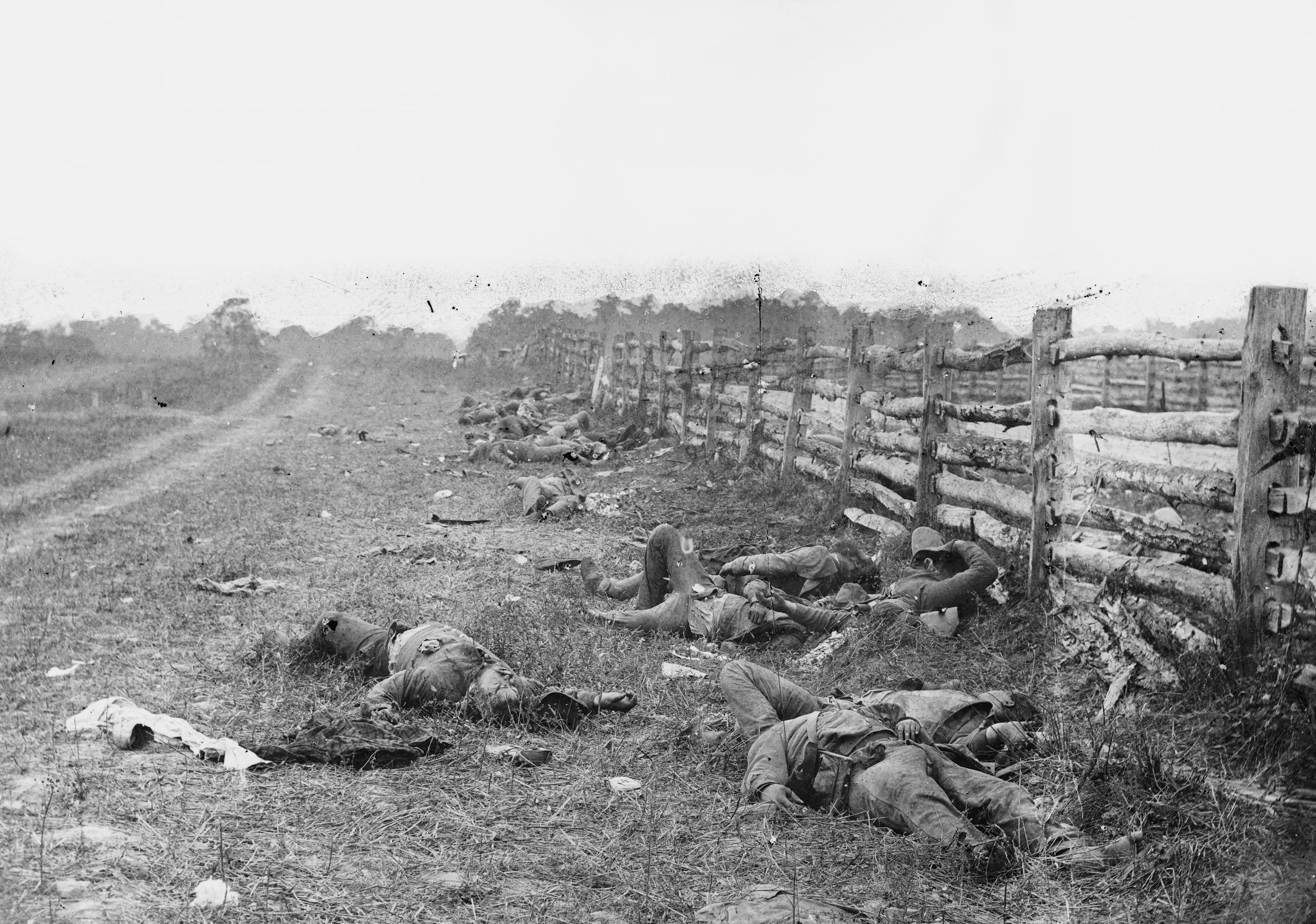
The Face of War: Confederate Dead at Antietam (Matthew Brady)

Remember when, in 1963, Alabama Governor George Wallace said, “Segregation now, segregation tomorrow, and segregation forever”? Fortunately, after much struggle and bloodshed, he was proven wrong. So, can we change the essential American refrain of war now, war tomorrow, and war forever? Can we render that obsolete? Or is that too much to hope for or ask of America’s “exceptional” democracy?

Taking on the MICIMATT(SH)

Former CIA analyst Ray McGovern did America a great service when he came up with the acronym MICIMATT, or the Military-Industrial-Congressional-Intelligence-Media-Academia-Think-Tank complex, an extension of President Dwight D. Eisenhower’s military-industrial complex, or MIC (from his farewell speech in 1961). Along with the military and industry (weapons makers like Boeing and Lockheed Martin), the MICIMATT adds Congress (which Eisenhower had in his original draft speech but deleted in the interest of comity), the intelligence “community” (18 different agencies), the media (generally highly supportive of wars and weapons spending), academia (which profits greatly from federal contracts, especially research and development efforts for yet more destructive weaponry), and think tanks (which happily lap up Pentagon dollars to tell us the “smart” position is always to prepare for yet more war).

You’ll note, however, that I’ve added a parenthetical SH to McGovern’s telling acronym. The S is for America’s sporting world, which eternally gushes about how it supports and honors America’s military, and Hollywood, which happily sells war as entertainment (perhaps the best known and most recent film being Tom Cruise’s Top Gun: Maverick, in which an unnamed country that everyone knows is Iran gets its nuclear ambitions spanked by a plucky team of U.S. Naval pilots). A macho catchphrase from the original Top Gun was “I feel the need — the need for speed!” It may as well have been: I feel the need — the need for pro-war propaganda!

Yes, MICIMATT(SH) is an awkward acronym, yet it has the virtue of capturing some of the still-growing power, reach, and cultural penetration of Ike’s old MIC. It should remind us that it’s not just the military and the weapons-makers who are deeply invested in war and — yes! — militarism. It’s Congress; the CIA; related intel “community” members; the mainstream media (which often relies on retired generals and admirals for “unbiased” pro-war commentary); academia (consider how quickly institutions like Columbia University have bent the knee to Trump); and think tanks — in fact, all those “best and brightest” who advocate for war with China, the never-ending war on terror, war everywhere.

But perhaps the “soft power” of the sporting world and Hollywood is even more effective at selling war than the hard power of bombs and bullets. National Football League coaches patrol the sidelines wearing camouflage, allegedly to salute the troops. Military flyovers at games celebrate America’s latest death-dealing machinery. Hollywood movies are made with U.S. military cooperation and that military often has veto power over scripts. To cite only one example, the war movie 12 Strong (2018) turned the disastrous Afghan War that lasted two horrendous decades into a stunningly quick American victory, all too literally won by U.S. troops riding horses. (If only the famed cowboy actor John Wayne had still been alive to star in it!)

The MICIMATT(SH), employing millions of Americans, consuming trillions of dollars, and churning through tens of thousands of body bags for U.S. troops over the years, while killing millions of people abroad, is an almost irresistible force. And right now, it seems like there’s no unmovable object to blunt it.

Believe me, I’ve tried. I’ve written dozens of “Tomgrams” suggesting steps America could take to reverse militarism and warmongering. As I look over those essays, I see what still seem to me sensible ideas, but they die quick deaths in the face of, if not withering fire from the MICIMATT(SH), then being completely ignored by those who matter.

And while this country has a department of war (disguised as a department of defense), it has no department of peace. There’s no budget anywhere for making peace, either. We do have a colossal Pentagon that houses 30,000 workers, feverishly making war plans they won’t let Elon Musk (or any of us) see. It’s for their eyes only, not yours, though they may well ask you or your kids to serve in the military, because the best-laid plans of those war-men do need lots of warm bodies, even if those very plans almost invariably (Vietnam, Afghanistan, Iraq, etc.) go astray.

So, to repeat myself, how do you take on the MICIMATT(SH)? The short answer: It’s not easy, but I know of a few people who had some inspirational ideas.

On Listening to Ike, JFK, MLK, and, Yes, Madison, Too

Militarism isn’t exactly a new problem in America. Consider Randolph Bourne’s 1918 critique of war as “the health of the state,” or General Smedley Butler’s confession in the 1930s that “war is a racket” run by the “gangsters of capitalism.” In fact, many Americans have, over the years, spoken out eloquently against war and militarism. Many beautiful and moving songs have asked us to smile on your brother and “love one another right now.” War, as Edwin Starr sang so powerfully once upon a time, is good for “absolutely nothin’,” though obviously a lot of people disagree and indeed are making a living by killing and preparing for yet more of it.

And that is indeed the problem. Too many people are making too much money off of war. As Smedley Butler wrote so long ago: “Capital won’t permit the taking of the profit out of war until the people — those who do the suffering and still pay the price — make up their minds that those they elect to office shall do their bidding, and not that of the profiteers.” Pretty simple, right? Until you realize that those whom we elect are largely obedient to the moneyed class because the highest court in our land has declared that money is speech. Again, I didn’t say it was going to be easy. Nor did Butler.

As a retired lieutenant colonel in the U.S. Air Force, I want to end my 111th piece at TomDispatch by focusing on the words of Ike, John F. Kennedy (JFK), Martin Luther King, Jr. (MLK), and James Madison. And I want to redefine what words like duty, honor, country, and patriotism should mean. Those powerful words and sentiments should be centered on peace, on the preservation and enrichment of life, on tapping “the better angels of our nature,” as Abraham Lincoln wrote so long ago in his First Inaugural Address.

Why do we serve? What does our oath of office really mean? For it’s not just military members who take that oath but also members of Congress and indeed the president himself. We raise our right hands and swear to support and defend the U.S. Constitution against all enemies, foreign and domestic, to bear true faith and allegiance to the same.

There’s nothing in that oath about warriors and warfighters, but there is a compelling call for all of us, as citizens, to be supporters and defenders of representative democracy, while promoting the general welfare (not warfare), and all the noble sentiments contained in that Constitution. If we’re not seeking a better and more peaceful future, one in which freedom may expand and thrive, we’re betraying our oath.

If so, we have met the enemy — and he is us.

Ike told us in 1953 that constant warfare is no way of life at all, that it is (as he put it), humanity crucifying itself on a cross of iron. In 1961, he told us democracy was threatened by an emerging military-industrial complex and that we, as citizens, had to be both alert and knowledgeable enough to bring it to heel. Two years later, JFK told us that peace — even at the height of the Cold War — was possible, not just peace in our time, but peace for all time. However, it would, he assured us, require sacrifice, wisdom, and commitment.

How, in fact, can I improve on these words that JFK uttered in 1963, just a few months before he was assassinated?

What kind of peace do we seek? Not a Pax Americana enforced on the world by American weapons of war. Not the peace of the grave or the security of the slave. I am talking about genuine peace, the kind of peace that makes life on earth worth living…

I speak of peace because of the new face of war. Total war makes no sense in an age… when the deadly poisons produced by a nuclear exchange would be carried by wind and water and soil and seed to the far corners of the globe and to generations yet unborn… surely the acquisition of such idle [nuclear] stockpiles — which can only destroy and never create — is not the only, much less the most efficient, means of assuring peace.

I speak of peace, therefore, as the necessary rational end of rational men. I realize that the pursuit of peace is not as dramatic as the pursuit of war — and frequently the words of the pursuer fall on deaf ears. But we have no more urgent task.

Are we ready to be urgently rational, America? Are we ready to be blessed as peacemakers? Or are we going to continue to suffer from what MLK described in 1967 as our very own “spiritual death” due to the embrace of militarism, war, empire, and racism?

Of course, MLK wasn’t perfect, nor for that matter was JFK, who was far too enamored of the Green Berets and too wedded to a new strategy of “flexible response” to make a clean break in Vietnam before he was killed. Yet those men bravely and outspokenly promoted peace, something uncommonly rare in their time — and even more so in ours.

More than 200 years ago, James Madison warned us that continual warfare is the single most corrosive force to the integrity of representative democracy. No other practice, no other societal force is more favorable to the rise of authoritarianism and the rule of tyrants than pernicious war. Wage war long and it’s likely you can kiss your democracy, your rights, and just maybe your ass goodbye.

America, from visionaries and prophets like MLK, we have our marching orders. They are not to invest yet more in preparations for war, whether with China or any other country. Rather, they are to gather in the streets and otherwise raise our voices against the scourge of war. If we are ever to beat our swords into plowshares and our spears into pruning hooks and make war no more, something must be done.

Let’s put an end to militarism in America. Let’s be urgently rational. To cite John Lennon yet again: You may say I’m a dreamer, but I’m not the only one. Together, let’s imagine and create a better world.

Copyright 2025 William J. Astore.

Department of Offense

W.J. Astore

The U.S. Military Is a Global Strike Force

Officially, the U.S. has the DOD, the department of defense. But when was the last time the U.S. military was primarily oriented toward defense of the CONUS? (CONUS is a military acronym for continental United States.)

My old service, the U.S. Air Force, is far more open about its true aims. It boasts assertively of “global reach, global power” and notably of “global strike.” Not to be outdone, the U.S. Navy has “carrier strike groups,” what used to be termed carrier task forces when they fought real battles in World War II.

Here’s a recent official description: “A Carrier Strike Group (CSG) is a highly powerful, self-contained naval force, capable of projecting power globally, with an aircraft carrier as its core, supported by cruisers, destroyers, submarines, and an air wing, making it a formidable force capable of striking targets 1,000 miles away.”

Doesn’t sound defensive, does it? And of course the U.S. Marines are defined as “expeditionary” forces that are “forward-deployed” for all sorts of expected “contingencies” overseas.

The U.S. military is not about defense. It’s about “full-spectrum dominance.” That means dominance of the land, sea, air, space, cyber, information in all its forms, indeed just about any realm you can think of. No other military, moreover, divides the world into global commands (CENTCOM, AFRICOM, etc.) for the application of U.S. military power. This is not about defending America. It’s about dominating the world. Such a grandiose vision of defense dominance is partly what drives colossal Pentagon budgets that are climbing toward a trillion dollars a year.

SecDef Pete Hegseth, always talking warrior-tough (Doug Mills/NYT)

Consider here the recent kerfuffle about leaked U.S. strike plans for Yemen, which were inadvertently shared with the editor-in-chief at The Atlantic. Here’s an excerpt from those plans:

From Secretary of Defense Offense Pete Hegseth

  • “1215et: F-18s LAUNCH (1st strike package)”
  • “1345: ‘Trigger Based’ F-18 1st Strike Window Starts (Target Terrorist is @ his Known Location so SHOULD BE ON TIME – also, Strike Drones Launch (MQ-9s)”
  • “1410: More F-18s LAUNCH (2nd strike package)”
  • “1415: Strike Drones on Target (THIS IS WHEN THE FIRST BOMBS WILL DEFINITELY DROP, pending earlier ‘Trigger Based’ targets)”
  • “1536 F-18 2nd Strike Starts – also, first sea-based Tomahawks launched.”
  • “MORE TO FOLLOW (per timeline)”
  • “We are currently clean on OPSEC.”
  • “Godspeed to our Warriors.”

Note the repetition of the word “strike” and the closing prayer to America’s “warriors.” And ask yourself: Is this truly what national defense should look like? Prayerful appeals to “warriors” as they strike weak and poor countries thousands of miles away in undeclared (and therefore unconstitutional) wars?

Close Down the Pentagon!

W.J. Astore

Send the “troops” to the front!

Coming soon to a Kindle store near you: all my articles for TomDispatch, with a new introduction by me and a foreword by Tom Engelhardt. You can preorder it by clicking on this link. Thanks!

Speaking of American militarism on steroids:

It’s been called the “House of War” by esteemed author James Carroll. Within the military, it’s jokingly referred to as the five-sided puzzle palace on the Potomac. It’s a monetary black hole that consumes eagerly and without bounds (in light of seven failed audits in a row) roughly a trillion dollars in yearly military expenditures. It’s a place where full-bird colonels, who should be leading regiments in the field, become errand boys and girls to a grossly inflated number of generals. Yes, it’s America’s very own Pentagon, built in record time in the early months of World War II to manage that colossal war—and never shuttered since because perpetual global war is very much fundamental to the American way of life.

If there’s a symbol of America that captures current and past governmental budgetary priorities and foreign policy commitments, it’s the Pentagon. Forget the Statue of Liberty. Never mind Freedom Towers and national parks and bald eagles and the like. Increasingly, the Pentagon is America, a highly militarized version of our country, which is precisely why it needs to be closed down. Where’s Elon Musk and the DOGE wunderkinds when you need them?

Nearly 30,000 people work in the Pentagon on a daily basis. It makes for some crowded parking lots—and cramped offices even for those aforementioned bird colonels. It’s a hotbed of intrigue and competition among the services for money and resources. It’s depressingly short on natural light. It’s a repository for hidebound thinking, a place where good ideas go to die. A line from the original “Star Wars” has been used more than once to describe it: “You will never find a more wretched hive of scum and villainy.”

And (again) it’s time to shut it down.

Here’s an idea to make the U.S. military far more efficient. Empty the Pentagon of all its worker-bees and from them create infantry battalions. An average battalion consists of roughly 800 “effectives,” so demobbing the Pentagon work force and mobilizing them instead for action in the field would create roughly 35 battalions. Send these battalions to all combat zones where U.S. troops are deployed today. Does Ukraine need more troops at the front? Does Israel need more stormtroopers in Gaza? We’ve got some Pentagon legions for you, Bibi.

Of course, I jest. I want to close the Pentagon to weaken militarism, not to wage war and genocide. Nevertheless, I’m guessing putting the entire Pentagon workforce at the point of the spear might serve to dull it a bit. Perhaps war boosterism might decrease if the cheerleaders were sent directly into the trenches instead of remaining safely on the sidelines?

I’m Already Against the Next War

W.J. Astore

Reflections on Vietnam, Iraq, and Afghanistan

I’ve been reading John Ketwig’s memoir “…and a hard rain fell: A GI’s true story of the War in Vietnam,” and it’s reminding me just how plain dumb, destructive, and duplicitous America’s wars have been since World War II.

America’s wars are always dressed up with a necessary, even allegedly noble, cause. In Vietnam, we had to stop communism and all those dominoes from falling. In Iraq, it was about WMD and stopping Saddam Hussein, “the next Hitler.” In Afghanistan, it was about vengeance for 9/11, then creating democracy and even helping women. (How about helping women in America? Never mind.)

Vietnam is nominally communist today—and a big trading partner of the U.S. and an ally of sorts against China. No dominoes fell. Iraq didn’t have WMD and Saddam wasn’t the next Hitler; he was merely a regional strongman and a former U.S. ally who got a little too big for his britches, especially for Israel. Afghanistan was a war in search of a clear mission and attainable goals. After twenty years of effort and roughly $2 trillion in expenditures, the U.S. replaced the Taliban with—the Taliban. (I heard Norman Finkelstein say this first.)

We’re always told versions of the same lie: We need to fight them over there so that we don’t have to fight them here. Communism had to be rolled back in Vietnam else commies would be landing in Manhattan. Iraq had to be pummeled and Saddam overthrown before WMD landed in Boston. Afghanistan had to be pacified and modernized before the Taliban enforced conservative Sharia law in Biloxi. 

None of this was true. The United States would have been perfectly safe without committing any troops to Vietnam, Iraq, and Afghanistan. In fact, the U.S. would have been far better off if those wars had never been fought. Certainly Vietnam, Iraq, and Afghanistan would have been far better off if they’d never become free-fire zones for American munitions (including the poisonous Agent Orange in Vietnam and, more recently, depleted uranium and other poisons in Iraq and Afghanistan).

Now we’re hearing about a possible U.S. war with Iran, allegedly to stop that country from acquiring an atomic bomb. It’s OK for the U.S. to have more than 5000 nuclear warheads and for Israel to have 200 or so, but it’s not OK for Iran to have even one, because reasons.

The U.S. military, vast as it is, with a vision of global dominance, always needs enemies. Of course, it’s not simply the military but the whole military-industrial complex, the MICIMATT,* which needs war and conflict to sustain itself. 

I recently read “American War,” a powerful novel by Omar El Akkad. It imagines a second U.S. civil war starting roughly 50 years from now. It’s a fascinating book, well worth reading because it captures the horror of war, with all its atrocities, its massacres, its war crimes, and the deep wounds war leaves behind even among the most resolute survivors. John Ketwig’s book does the same as he recounts the fears and horrors of his year in Vietnam and the personal struggles he endured in coming to terms with what he’d seen and endured.

So, count me among those who are already against the next war, whether against Iran, China, or for that matter any other country. Sure, I think America needs to defend itself; I don’t think peace is going to break out spontaneously around the world; but I know for a fact that fighting constant wars is not a way toward greater peace and prosperity. Quite the opposite.

If you want to know what desperate and profoundly wounded war survivors are capable of, read “American War.” If you want to know what desperate and profoundly confused troops are capable of, read “…and a hard rain fell.” And ponder the continued propaganda here of the “good war,” the wonders of warriors and warfighters, and the repetition of slogans like “peace through strength,” a specific form of strength measured in kilotons and megatons of explosives, in massive body counts and military production figures.

Ask yourself: Is that “strength”? Are constant wars truly the path toward peace? How can we possibly be so dumb as to believe this?

MICIMATT: military-industrial-congressional-intelligence-media-academe-think-tank complex. It employs millions of people and spends more than a trillion dollars a year. It’s not easily confronted. Nor is it easily contained, let alone curtailed.

Will Pentagon Spending Finally Be Cut?

W.J. Astore

FEB 19, 2025

Today, I learned the Trump administration is proposing 8% cuts in Pentagon spending each year for the next five years. This is indeed a welcome—and long overdue—initiative.

Here’s the report from the Guardian:

*****

The US defense secretary, Pete Hegseth has ordered senior leaders at the Pentagon and throughout the US military to develop plans for cutting 8% from the defense budget in each of the next five years, according to a memo obtained by the Washington Post.

Pete Hegseth speaking from a podium, US flag in the background
Pete Hegseth ordered the proposed cuts to be drawn up by 24 February, according to the memo. Photograph: Ron Sachs/EPA

Hegseth ordered the proposed cuts to be drawn up by 24 February, according to the memo, which includes a list of 17 categories that the Trump administration wants exempted. Among them: operations at the southern US border, modernization of nuclear weapons and missile defense and acquisition of one-way attack drones and other munitions. If adopted in full, the proposed cuts would include tens of billions of dollars in each of the next five years.

*****

Just over two years ago, I called for a 50% reduction in Pentagon spending in an article for TomDispatch. I’m reposting the article below, in full. Maybe SecDef Hegseth can mine some ideas from it. 🙂

Can the Military-Industrial Complex Be Tamed?

Cutting the Pentagon Budget in Half Would Finally Force the Generals to Think

BY WILLIAM J. ASTORE

My name is Bill Astore and I’m a card-carrying member of the military-industrial complex (MIC).

Sure, I hung up my military uniform for the last time in 2005. Since 2007, I’ve been writing articles for TomDispatch focused largely on critiquing that same MIC and America’s permanent war economy. I’ve written against this country’s wasteful and unwise wars in Iraq and Afghanistan, its costly and disastrous weapons systems, and its undemocratic embrace of warriors and militarism. Nevertheless, I remain a lieutenant colonel, if a retired one. I still have my military ID card, if only to get on bases, and I still tend to say “we” when I talk about my fellow soldiers, Marines, sailors, and airmen (and our “guardians,” too, now that we have a Space Force).

So, when I talk to organizations that are antiwar, that seek to downsize, dismantle, or otherwise weaken the MIC, I’m upfront about my military biases even as I add my own voice to their critiques. Of course, you don’t have to be antiwar to be highly suspicious of the U.S. military. Senior leaders in “my” military have lied so often, whether in the Vietnam War era of the last century or in this one about “progress” in Iraq and Afghanistan, that you’d have to be asleep at the wheel or ignorant not to have suspected the official story.

Yet I also urge antiwar forces to see more than mendacity or malice in “our” military. It was retired general and then-President Dwight D. Eisenhower, after all, who first warned Americans of the profound dangers of the military-industrial complex in his 1961 farewell address. Not enough Americans heeded Ike’s warning then and, judging by our near-constant state of warfare since that time, not to speak of our ever-ballooning “defense” budgets, very few have heeded his warning to this day. How to explain that?

Well, give the MIC credit. Its tenacity has been amazing. You might compare it to an invasive weed, a parasitic cowbird (an image I’ve used before), or even a metastasizing cancer. As a weed, it’s choking democracy; as a cowbird, it’s gobbling up most of the “food” (at least half of the federal discretionary budget) with no end in sight; as a cancer, it continues to spread, weakening our individual freedoms and liberty.

Call it what you will. The question is: How do we stop it? I’ve offered suggestions in the past; so, too, have writers for TomDispatch like retired Army Colonel Andrew Bacevich and retired Army Major Danny Sjursen, as well as William HartungJulia Gledhill, and Alfred McCoy among others. Despite our critiques, the MIC grows ever stronger. If Ike’s warning wasn’t eye-opening enough, enhanced by an even more powerful speech, “Beyond Vietnam,” by Martin Luther King, Jr., in 1967, what could I and my fellow TomDispatch writers possibly say or do to make a difference?

Maybe nothing, but that won’t stop me from trying. Since I am the MIC, so to speak, maybe I can look within for a few lessons that came to me the hard way (in the sense that I had to live them). So, what have l learned of value?

War Racketeers Enjoy Their Racket

In the 1930s, Smedley Butler, a Marine general twice decorated with the Medal of Honor, wrote a book entitled War Is a Racket. He knew better than most since, as he confessed in that volume, when he wore a military uniform, he served as “a racketeer, a gangster for capitalism.” And the corporate-driven racket he helped enable almost a century ago by busting heads from the Caribbean to China was small-scale indeed compared to today’s thoroughly global one.

There’s an obvious lesson to be drawn from its striking endurance, never-ending enlargement, and distinct engorgement in our moment (even after all those lost wars it fought): the system will not reform itself. It will always demand and take more — more money, more authority, more power. It will never be geared for peace. By its nature, it’s authoritarian and distinctly less than honorable, replacing patriotism with service loyalty and victory with triumphant budgetary authority. And it always favors the darkest of scenarios, including at present a new cold war with China and Russia, because that’s the best and most expedient way for it to thrive.

Within the military-industrial complex, there are no incentives to do the right thing. Those few who have a conscience and speak out honorably are punished, including truth-tellers in the enlisted ranks like Chelsea Manning and Daniel Hale. Even being an officer doesn’t make you immune. For his temerity in resisting the Vietnam War, David M. Shoup, a retired Marine Corps general and Medal of Honor recipient, was typically dismissed by his peers as unbalanced and of questionable sanity.

For all the talk of “mavericks,” whether in Top Gun or elsewhere, we — there’s that “we” again (I can’t help myself!) — in the military are a hotbed of go-along-to-get-along conformity.

Recently, I was talking with a senior enlisted colleague about why so few top-ranking officers are willing to speak truth to the powerless (that’s you and me) even after they retire. He mentioned credibility. To question the system, to criticize it, to air dirty laundry in public is to risk losing credibility within the club and so to be rejected as a malcontent, disloyal, even “unbalanced.” Then, of course, that infamous revolving doorbetween the military and giant weapons makers like Boeing and Raytheon simply won’t spin for you. Seven-figure compensation packages, like the one current Secretary of Defense Lloyd Austin gained from Raytheon after his retirement as an Army general, won’t be an option. And in America, who doesn’t want to cash in while gaining more power within the system?

Quite simply, it pays so much better to mouth untruths, or at least distinctly less-than-full-truths, in service to the powerful. And with that in mind, here, at least as I see it, are a few full truths about my old service, the Air Force, that I guarantee you I won’t be applauded for mentioning. How about this as a start: that the production of F-35s — an overpriced “Ferrari” of a fighter jet that’s both too complex and remarkably successful as an underperformer — should be canceled (savings: as much as $1 trillion over time); that the much-touted new B-21 nuclear bomber isn’t needed (savings: at least $200 billion) and neither is the new Sentinel Intercontinental Ballistic Missile(savings: another $200 billion and possibly the entire Earth from doomsday); that the KC-46 tanker is seriously flawed and should be canceled (savings: another $50 billion).

Now, tote it up. By canceling the F-35, the B-21, the Sentinel, and the KC-46, I singlehandedly saved the American taxpayer roughly $1.5 trillion without hurting America’s national defense in the least. But I’ve also just lost all credibility (assuming I had any left) with my old service.

Look, what matters to the military-industrial complex isn’t either the truth or saving your taxpayer dollars but keeping those weapons programs going and the money flowing. What matters, above all, is keeping America’s economy on a permanent wartime footing both by buying endless new (and old) weapons systems for the military and selling them globally in a bizarrely Orwellian pursuit of peace through war.

How are Americans, Ike’s “alert and knowledgeable citizenry,” supposed to end a racket like this? We certainly should know one thing by now: the MIC will never check itself and Congress, already part of it thanks to impressive campaign donations and the like by major weapons makers, won’t corral it either. Indeed, last year, Congress shoveled $45 billion more than the Biden administration requested (more even than the Pentagon asked for) to that complex, all ostensibly in your name. Who cares that it hasn’t won a war of the faintest significance since 1945. Even “victory” in the Cold War (after the Soviet Union imploded in 1991) was thrown away. And now the complex warns us of an onrushing “new cold war” to be waged, naturally, at tremendous cost to you, the American taxpayer.

As citizens, we must be informed, willing, and able to act. And that’s precisely why the complex seeks to deny you knowledge, precisely why it seeks to isolate you from its actions in this world. So, it’s up to you — to us! — to remain alert and involved. Most of all, each of us must struggle to keep our identity and autonomy as a citizen, a rank higher than that of any general or admiral, for, as we all need to be reminded, those wearing uniforms are supposed to serve you, not vice-versa.

I know you hear otherwise. You’ve been told repeatedly in these years that it’s your job to “support our troops.” Yet, in truth, those troops should only exist to support and defend you, and of course the Constitution, the compact that binds us all together as a nation.

When misguided citizens genuflect before those troops (and then ignore everything that’s done in their name), I’m reminded yet again of Ike’s sage warning that only Americans can truly hurt this country. Military service may be necessary, but it’s not necessarily ennobling. America’s founders were profoundly skeptical of large militaries, of entangling alliances with foreign powers, and of permanent wars and threats of the same. So should we all be.

Citizens United Is the Answer

No, not that “Citizens United,” not the case in which the Supreme Court decided corporations had the same free speech rights as you and me, allowing them to coopt the legislative process by drowning us out with massive amounts of “speech,” aka dark-money-driven propaganda. We need citizens united against America’s war machine.

Understanding how that machine works — not just its waste and corruption, but also its positive attributes — is the best way to wrestle it down, to make it submit to the people’s will. Yet activists are sometimes ignorant of the most basic facts about “their” military. So what? Does the difference between a sergeant major and a major, or a chief petty officer and the chief of naval operations matter? The answer is: yes.

An antimilitary approach anchored in ignorance won’t resonate with the American people. An antiwar message anchored in knowledge could, however. It’s important, that is, to hit the proverbial nail on the head. Look, for example, at the traction Donald Trump gained in the presidential race of 2015-2016 when he did something few other politicians then dared do: dismiss the Iraq War as wasteful and stupid. His election win in 2016 was not primarily about racism, nor the result of a nefarious Russian plot. Trump won, at least in part because, despite his ignorance on so many other things, he spoke a fundamental truth — that America’s wars of this century were horrendous blunders.

Trump, of course, was anything but antimilitary. He dreamed of military parades in Washington, D.C. But I (grudgingly) give him credit for boasting that he knew morethan his generals and by that I mean many more Americans need to challenge those in authority, especially those in uniform.

Yet challenging them is just a start. The only real way to wrestle the military-industrial complex to the ground is to cut its funding in half, whether gradually over years or in one fell swoop. Yes, indeed, it’s the understatement of the century to note how much easier that’s said than done. It’s not like any of us could wave a military swagger stick like a magic wand and make half the Pentagon budget disappear. But consider this: If I could do so, that military budget would still be roughly $430 billion, easily more than China’s and Russia’s combined, and more than seven times what this country spends on the State Department. As usual, you get what you pay for, which for America has meant more weapons and disastrous wars.

Join me in imagining the (almost) inconceivable — a Pentagon budget cut in half. Yes, generals and admirals would scream and Congress would squeal. But it would truly matter because, as a retired Army major general once told me, major budget cuts would force the Pentagon to think — for once. With any luck, a few sane and patriotic officers would emerge to place the defense of America first, meaning that hubristic imperial designs and forever wars would truly be reined in because there’d simply be no more money for them.

Currently, Americans are giving the Pentagon all it wants — plus some. And how’s that been working out for the rest of us? Isn’t it finally time for us to exercise real oversight, as Ike challenged us to do in 1961? Isn’t it time to force the Pentagon to pass an audit each year — it’s failed the last five! — or else cut its budget even more deeply? Isn’t it time to hold Congress truly responsible for enabling ever more war by voting out military sycophants? Isn’t it time to recognize, as America’s founders did, that sustaining a vast military establishment constitutes the slow and certain death of democracy?

Just remember one thing: the military-industrial complex won’t reform itself. It just might have no choice, however, but to respond to our demands, if we as citizens remain alert, knowledgeable, determined, and united. And if it should refuse to, if the MIC can’t be tamed, whether because of its strength or our weakness, you will know beyond doubt that this country has truly lost its way.

P.S. Since I wrote this early in 2023, the Pentagon has failed two more audits as its budget has soared toward $900 billion and above. Yes: It’s high time for major cuts to the Pentagon war budget. Make it so!

You Get What They Pay For, War

W.J. Astore

A Few Specifics on the MICIMATT

Readers here have heard of Ray McGovern’s MICIMATT, the military-industrial-congressional-intelligence-media-academe-think-tank complex. It’s gargantuan and lubricated with enormous sums of money.

Consider think tanks. Go to thinktankfundingtracker.org and you’ll see useful information like this:

Top 10 Think Tanks That Receive Funding from Pentagon Contractors

Atlantic Council $10,270,001

Center for a New American Security $6,665,000

Center for Strategic and International Studies $4,115,000

Brookings Institution $3,475,000

Hudson Institute $2,240,000

Council on Foreign Relations $2,095,000

Stimson Center $1,555,763

Aspen Institute $1,125,000

German Marshall Fund $871,010

Carnegie Endowment for International Peace $620,008

I wonder why these think tanks tend to favor the agendas and interests of America’s various weapons makers? Hard to offer “neutral” or “balanced” advice when so much of your funding is coming from the merchants of death.

Now consider these stats, courtesy of former Congressman Dennis Kucinich and The Kucinich Report on Substack:

Military Contractors’ Political Contributions (2023-2024)

According to OpenSecrets, the top defense contractors contributed significantly to political campaigns in the current election cycle:

  • Lockheed Martin – $4,470,698 total ($2,393,034 to Democrats, $2,021,283 to Republicans)
  • Northrop Grumman – $3,354,889 total ($1,903,884 to Democrats, $1,385,924 to Republicans)
  • RTX Corp (Raytheon) – $2,805,535 total ($1,472,920 to Democrats, $1,258,511 to Republicans)
  • General Atomics – $2,507,912 total ($595,947 to Democrats, $1,660,970 to Republicans)
  • L3Harris Technologies – $2,475,712 total ($1,126,096 to Democrats, $1,331,975 to Republicans)

In the presidential race, defense contractors have donated:

  • Kamala Harris – $4,440,605
  • Donald Trump – $1,787,259

In total, the defense sector has contributed over $41.4 million in the 2023-2024 election cycle. For every $1 contributed to political campaigns, these companies receive $10,000 in government contracts—a return on investment most businesses could only dream of.

*****

As weapons makers like Lockheed Martin and RTX throw around millions of dollars to influence Congress, presidential elections, and think tanks, peace organizations that I’m familiar with operate on shoestring budgets where a donation of $1000 is considered large.

My dad taught me the saying, He who pays the piper calls the tune. The weapons makers are paying the piper (think tanks, Congress, the media), and the tunes they’re calling are military marches.

America, we truly get what they pay for, which is war and more war.

A Coda: So far, Bracing Views has received $0.00 from weapons makers. 🙂

The “Threat of a Warmongering Military-Industrial Complex”

W.J. Astore

Will Tulsi Gabbard “shrink the bloated bureaucracy” in DC?

Former Congresswoman Tulsi Gabbard is America’s Director of National Intelligence. Here’s a part of the ceremony, with President Trump’s introduction:

What struck me in watching the short ceremony was Trump’s words about “the threat of a warmongering military-industrial complex.” Bold words indeed, as well as his call for Tulsi Gabbard to “shrink the bloated bureaucracy” in DC.

In her brief remarks, Tulsi mentioned an almost forbidden word in DC: peace. She mentioned war as an absolute last resort rather than the first action selected by the “warmongering” (Trump’s word) military-industrial complex. I find that remarkable as well as encouraging.

There are many reasons why I like Tulsi as DNI, but the biggest one is this: She has President Trump’s respect. He likes her. Meaning he’ll listen to her when she briefs him on a daily basis about the threats facing America and the options he has to address those threats.

In his first term as president, Trump was notorious for not caring much about his daily intelligence briefing. Tulsi will change that—and that and her commitment to military action as a last resort is again highly encouraging.

DeepSeek Steals My Thunder on the Military-Industrial Complex

W.J. Astore

Listen to your AI Overlord!

FEB 01, 2025

Readers!

You may recall that, late in 2022, I asked the AI platform ChatGPT to write a short critical essay on the military-industrial complex. That essay is here.

Recently, news out of China came of a new AI platform known as DeepSeek that reportedly is both cheaper and better than U.S. efforts. I asked DeepSeek for a 600-word critical essay on the MIC, and it complied with its human master (at least for now). Here’s the essay, which, you may agree, is quite good:

The Military-Industrial Complex: A Critical Examination [Written by DeepSeek]

The military-industrial complex (MIC) in the United States, a term popularized by President Dwight D. Eisenhower in his 1961 farewell address, refers to the symbiotic relationship between the nation’s armed forces, defense contractors, and the political institutions that support them. While Eisenhower warned of its potential dangers, the MIC has since grown into a colossal entity that wields significant influence over American society, economy, and foreign policy. This essay argues that the military-industrial complex is detrimental to the United States, perpetuating endless wars, distorting national priorities, and undermining democratic principles.

One of the most glaring consequences of the MIC is its role in perpetuating a state of perpetual war. The United States has been involved in military conflicts for the majority of its history, with the 21st century being no exception. The wars in Afghanistan, Iraq, and elsewhere have been justified under the guise of national security, but they have often served the interests of defense contractors more than the American people. Companies like Lockheed Martin, Boeing, and Raytheon profit immensely from the production of weapons and military technology, creating a perverse incentive to maintain and escalate conflicts. This cycle of war and profit not only drains national resources but also results in the loss of countless lives, both American and foreign. The human cost of these wars is immeasurable, and the moral implications of prioritizing profit over peace are deeply troubling.

Moreover, the MIC distorts national priorities by diverting vast sums of money away from critical domestic needs. The United States spends more on its military than the next ten countries combined, with the defense budget often exceeding $700 billion annually. This staggering expenditure comes at the expense of underfunded sectors such as education, healthcare, infrastructure, and climate change mitigation. While the country boasts an unparalleled military capability, it lags behind other developed nations in key areas of social and economic well-being. For instance, the U.S. faces a crumbling infrastructure, a lack of universal healthcare, and a growing wealth gap. The prioritization of military spending over these pressing issues reflects a skewed set of values that favors corporate interests over the welfare of citizens.

The influence of the MIC also undermines democratic principles by eroding the separation of power and fostering corruption. Defense contractors spend millions of dollars annually on lobbying and campaign contributions, ensuring that politicians support policies favorable to the industry. This creates a feedback loop where elected officials are incentivized to approve bloated defense budgets and authorize military interventions, regardless of their necessity or public support. The result is a government that is increasingly beholden to corporate interests rather than the will of the people. Furthermore, the revolving door between the Pentagon, Congress, and defense contractors exacerbates this issue, as individuals move seamlessly between public service and lucrative private sector positions. This blurring of lines between public and private interests erodes trust in government and undermines the democratic process.

Critics of the MIC often face significant backlash, as questioning the necessity of military spending or the morality of war is frequently framed as unpatriotic or naive. This stifling of dissent is another way in which the MIC exerts its influence, creating a culture where alternative perspectives are marginalized. The media, too, plays a role in perpetuating this status quo, often uncritically echoing government narratives and failing to hold policymakers accountable. This lack of critical scrutiny allows the MIC to operate with minimal oversight, further entrenching its power.

In conclusion, the military-industrial complex represents a profound threat to the United States, perpetuating endless wars, distorting national priorities, and undermining democratic principles. Eisenhower’s warning about the dangers of the MIC remains as relevant today as it was in 1961. To address these issues, the United States must reevaluate its priorities, reduce its reliance on military solutions, and invest in the well-being of its citizens. Only by challenging the entrenched power of the MIC can the nation hope to achieve a more just, peaceful, and equitable future. The stakes are high, and the time for action is now. [End of essay.]

*****

Amen to that, DeepSeek! There are a few edits I’d make here. Raytheon is now RTX. The defense war budget is now $900 billion and rising, not $700 billion. I wouldn’t use the word “symbiotic” to describe relations among the Pentagon, the weapons makers, and Congress; more like “toxic,” corrupted as it is by greed, money and self-interest. I do very much like this line: “the moral implications of prioritizing profit over peace are deeply troubling.” Deeply troubling indeed!

Anyhow, if you’re interested, go to DeepSeek.com, create an account, and ask our future AI overlord a question. Perhaps you’ll be surprised by the result.