Last Tuesday, I appeared again on Judge Napolitano’s show. We talked about the Russia-Ukraine War and President Trump’s efforts to foster a peace deal, as well as the so-called Deep State and (briefly) the CIA.
The show’s lede raises a provocative question: Can America be rid of the CIA? Anything is possible in theory; the problem is the sprawling size and enormous power of the so-called intelligence community, or IC. (This idea of “community” was already a euphemism in the 1970s, as the movie “Three Days of the Condor” reveals; I’ve always liked how Robert Redford’s character scoffs at the “community” conceit.)
There are eighteen (18!) agencies that make up the IC with a combined yearly budget just north of $100 billion. For all that spending on intelligence, America has not fared well in recent wars in places like Iraq and Afghanistan. A bureaucracy of that size and reach is difficult to corral and control, especially since its budget keeps rising. Threat inflation is a major component of these rising budgets; you’re not going to get a threat assessment from the IC that says, well, actually, America’s pretty safe, let’s spend money on infrastructure, education, and social uplift.
As Chuck Schumer once said about Trump’s efforts to challenge the IC, the community has “six ways from Sunday” to get back at the president. That is, of course, more than worrisome. POTUS is supposed to command the IC; the IC is supposed to serve the president while upholding the U.S. Constitution. The IC shouldn’t scheme to “get back” at the president—any president.
My guess is that Trump has learned that lesson from Schumer. He’s appeasing the IC by giving it more and more money. Meanwhile, a Trump loyalist, Tulsi Gabbard, is trying to exert a measure of control as DNI, or Director of National Intelligence. I can’t imagine the in-fighting going in within the “community” as Gabbard releases files that suggest elements within the IC put their thumbs on the scale against Trump’s runs for president.
Eighteen agencies, $100 billion, and less than impressive results suggest a deep state that is out of control and in urgent need of major reform. Meanwhile, Edward Snowden’s revelations show a power structure that is more than willing to illegally spy on and surveil Americans.
For democracy to prosper, Americans need privacy and the government should be transparent to and controllable by the people. Instead, the IC is shrouded in secrecy and Americans are the ones whose lives are transparent to and controllable by the IC.
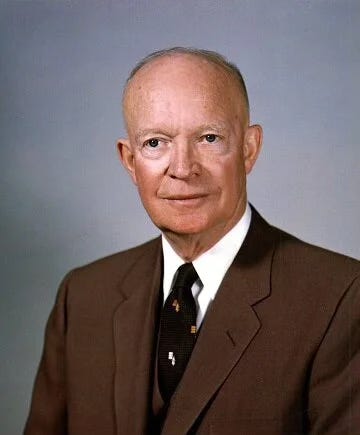
Of course, I’m not suggesting the IC is peeking under every door—unless you’re some kind of crazy dissident who believes genocide is wrong and the military-industrial complex is dangerous. You know—someone like Dwight D. Eisenhower.
The business of nuclear weapons is booming in the U.S., as Part II of a documentary on the military-industrial complex reveals. It’s well worth a few minutes of your time:
The documentary is especially strong in its focus on the Sentinel ICBM program, the least survivable leg of the nuclear triad. I didn’t know, for example, that Northrop Grumman has already spent $220 million lobbying for the Sentinel. Meanwhile, the projected cost of the Sentinel system, the documentary points out, has mushroomed from $78 billion to $140 billion. And I see estimates today have risen to $160 billion. All this for a system that’s not needed. Land-based ICBMs should be retired, not replaced.
Because land-based ICBMs represent a fixed target (unlike bombers and submarines, the other two legs of the triad), they are likely to be attacked first in a nuclear war, contributing to a “launch on warning (of attack)” mentality. But with warnings of nuclear attacks being both uncertain (false alarms have occurred in the past) and “time-sensitive,” i.e. urgent and pressure-packed, it’s likely a U.S. president, faced with a crisis, would only have 5-10 minutes to decide whether to launch ICBMs.
As the U.S. prepares to spend as much as $1.7 trillion on upgrading the triad, more money is also being dedicated to low-yield nuclear weapons, lowering the threshold for going nuclear. An escalatory spiral could follow from any use of nuclear weapons, but that concern doesn’t seem to trouble advocates for so-called tactical nukes.
Even as President Trump in the past has bragged about the size of his nuclear button, he does appear to view nuclear weapons as awful things, which they are. They are genocidal weapons. In essence, America is “investing” $1.7 trillion in weapons that are genocidal, indeed ecocidal, for any “general exchange” of nuclear weapons in a future war would destroy most life on earth (blast and heat, followed by radiation and nuclear winter).
As the Outlaw Josey Wales once mused, “Dyin’ ain’t much of a living.” The same applies to mass dying.
America’s war budget now exceeds $1 trillion a year—an almost unimaginable sum.
The Pentagon plans to spend $1.7 trillion “modernizing” a nuclear triad that should instead be downsized. A proposed “Golden Dome” missile defense system may cost $500 billion while making nuclear war more likely. And a “new” Cold War with China and Russia is already underway, with threat inflation as one of its defining features.
With military spending so high—and the military so valorized—Washington offers it as the solution to nearly everything: crime in D.C., eliminating drug cartels south of the border, containing China and Russia, “winning” in Somalia, preventing Iran from acquiring nuclear weapons—the list is endless. Supporting and defending the Constitution, however, is rarely mentioned.
War has become America’s new normal. “Peace” is now a word that dare not speak its name. According to the Pentagon, the only peace worth pursuing is “peace through [military] strength.” A warrior ethos is marketed as if it were synonymous with democratic virtue.
I once called for a 10% reduction in Pentagon spending. That’s no longer enough. We need a 50% cut—we need a military dedicated to genuine national defense, not imperial dominance. Surely we can protect America for $500 billion a year rather than the $1 trillion we’re spending now.
Changing the narrative is crucial. Why do we need 750+ bases overseas? Why expand our nuclear arsenal when we already have 5,000 warheads? We don’t need these things—they are the hallmarks of wasteful militarism. They escalate tensions, endanger us, and drain the nation’s wealth.
And why do we have 17 or 18 intelligence agencies? Despite all that intelligence, we still lost in Vietnam, Iraq, and Afghanistan. Where is the accountability? Why are no generals relieved of command for such failures? In fact, they’re more likely to fail upwards.
“All governments lie,” as I.F. Stone warned. Combine that with the truth that war’s first casualty is truth itself, and you begin to see the rot in America today. Perpetual war fuels deception and government overreach. Almost anything can be justified when the cry is, “We’re at war!”—even when the reasons for going to war are false.
Consider the Gulf of Tonkin incident—revealed later as phony—and the Pentagon Papers during the Vietnam War. Consider Iraq’s mythical WMDs. Consider the lies revealed in the Afghan War Papers. Consider the weasel words of generals like David Petraeus, forever hedging “gains” as “fragile” and “reversible.” Consider the U.S. military’s record since World War II—generally ineffective because there’s been little accountability for failure. (And yes, civilian leaders share the blame.)
The military-industrial complex grows ever more powerful, sidelining the American people while democracy withers.
Something is rotten in the States of America.
Many thanks to Judge Napolitano for asking me to discuss some of these issues on his show, “Judging Freedom.”
It’s well worth a few minutes of your time to watch the first episode of this series on the military-industrial complex and its enormous reach and power, especially in American society.
I remember when I used to see thoughtful series like this on Frontline. Occasionally, you’d see critical reports on the mainstream media: I’m referring here to the 1970s and 1980s and shows like “60 Minutes” and “20/20.” Those days, dear reader, are long gone.
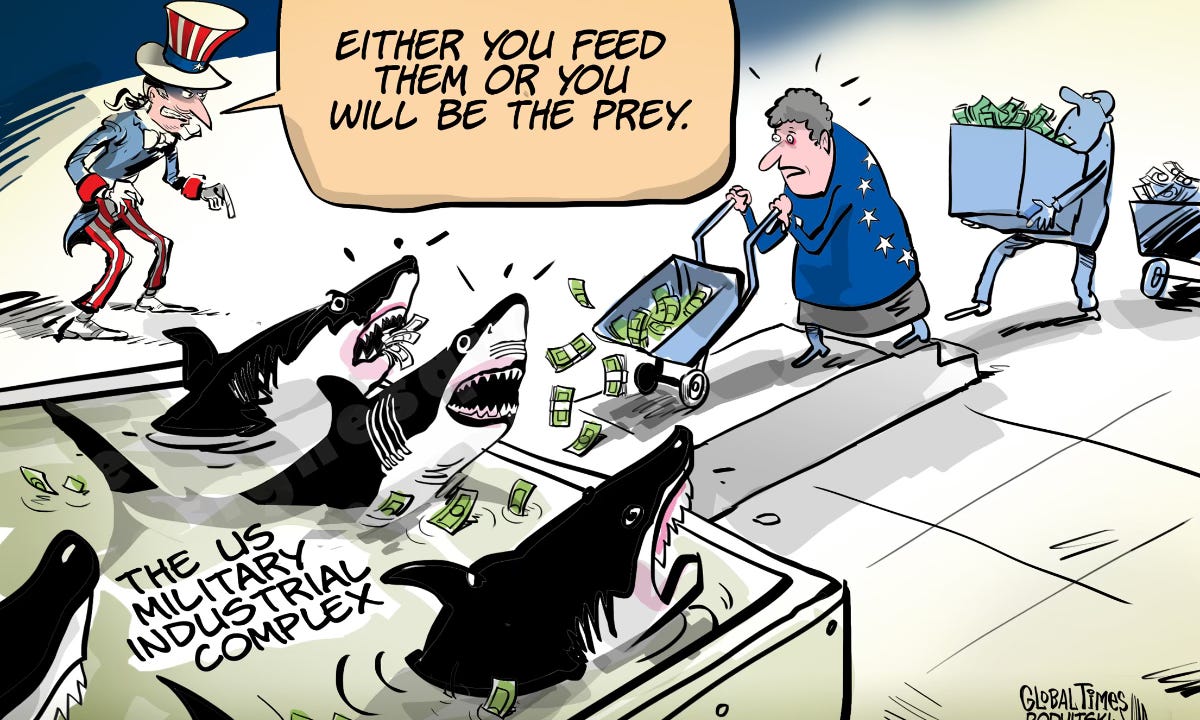
It’s rather amazing that Americans have to look to Al Jazeera for critical and sensible reporting on our very own military-industrial complex. Remember what Ike warned us about in 1961? Remember when he challenged us to remain alert and knowledgeable? America, we have a trillion-dollar “pentagon of power” to monitor—and we’re not doing the greatest job at it, are we? In fact, that pentagon of power is doing a far better job at monitoring us.
Indeed, when our mainstream media covers the Pentagon, it usually relies on retired generals and admirals, who often have unreported conflicts of interest (they may sit on corporate boards of weapons contractors, for example, or even get their talking points handed to them by the Pentagon). Let’s just say you rarely hear a negative word about the MIC in this very much unbalanced and biased coverage.
I see that YouTube is cautioning us that Al Jazeera is partially funded by the Qatari government. The horror!
Anyway, Al Jazeera is promising three more episodes in the series, the next one on America’s $1.7 trillion “investment” in new nuclear weapons. Should be sobering.
Hello Everyone: Here’s my latest article at TomDispatch.com. Whereas my articles for BV are usually 400-600 words, my articles for TomDispatch are usually just over 2000 words, which allows me to develop my points further, supported by plenty of links. Oh, and my wife and I really do use the expression, “But Bibi needs bombs,” whenever the government says it can’t fund something for the American people. It’s funny but I’ve never heard anyone in Congress ask: Bombs for Bibi—how are you going to pay for that? America’s bipartisan warmongers always find plenty of money for weapons and war, even as money for health care and other needs evaporates. It’s almost as if America has a powerful military-industrial complex combined with pushy lobbying groups like AIPAC.
*****
As a retired U.S. Air Force officer, I firmly believe in civilian control of our military. This country should be a nation of laws — not of special interests, oligarchs, or kings. Before committing our forces to battle, Congress should always declare war in the name of the people. Our military should indeed be a citizen-soldier force, not an isolated caste driven by a warrior ethos. And above all, the United States should be a republic ruled by law and shaped by sound moral values, not a greed-driven empire fueled by militarism.
Yet when I express such views, I feel like I’m clinging to a belief in the tooth fairy, the Easter Bunny, and Santa Claus. It feels idealistic, naïve, even painful to think that way. Yes, I served this country in uniform for 20 years, and now, in the age of Donald Trump, it has, as far as I can tell, thoroughly lost its way. The unraveling began so long ago — most obviously with the disastrous Vietnam War of the 1960s and 1970s, though in truth this country’s imperial desires predated even the Spanish-American War of 1898, stretching back to the wanton suppression of indigenous peoples as part of its founding and expansion.
A glance at U.S. history reveals major atrocities: the displacement and murder of Native Americans, slavery, and all too many imperial misadventures abroad. I knew of such realities when I joined the military in 1985, near the end of the Cold War. Despite its flaws, I believed then that this country was more committed to freedom than the Soviet Union. We could still claim some moral authority as the leader of what we then referred to as “the free world,” however compromised or imperfect our actions were.
That moral authority, however, is now gone. U.S. leaders fully support and unapologetically serve an ongoing genocide against the Palestinian people in Gaza. They sell weapons to nearly every regime imaginable, irrespective of human rights violations. They wage war without Congressional approval — the recent 12-day assault on Iran being just the latest example. (The second Trump administration has, in fact, launched almost as many air strikes, especially in Yemen and Somalia, in its first five months as the Biden administration did in four years.) Those same leaders have been doing a bang-up job dismantling the America I thought I was serving when I took that oath and put on second lieutenant’s bars four decades ago. That America — assuming it ever existed — may now be gone forever.
FUBAR: A Republic in Ruins
My fellow citizens, America is FUBAR (a term that dates from World War II). We are not faintly who we claim to be. Rather than a functioning republic, we are an ailing, flailing, perhaps even failing empire. We embrace war, glorify warriors, and profit mightily from the global arms trade, no matter the civilian toll, including tens of thousands of dead and wounded children in Gaza, among the latest victims of U.S.-made bombs, bullets, and missiles.
Signs of moral rot are everywhere. Our president, who would like to be known for his budget cuts, nonetheless giddily celebrates a record trillion-dollar war budget. Our secretary of defense gleefully promotes a warrior ethos. Congress almost unanimously supports or acquiesces in the destruction of Gaza. Images from the region resemble bombed-out Stalingrad in 1942 or Berlin in 1945. Meanwhile, for more than two decades now, America’s leaders have claimed to be waging a successful global “war on terror” even as they fuel terror across the globe. What do they think all those U.S. weapons are for — spreading peace?
My wife and I cope through dark humor. We see news on cuts to Medicaid, the mentally ill in the streets, and crumbling infrastructure, and quip: “But Bibi [Netanyahu] needs bombs. Or Ukraine does. Or the Pentagon needs more nukes.” That’s why Americans can’t have nice things like health care. That’s why all too many of us are unhoused, in debt, out of work, and desperate. In 1967 — yes, that’s almost 60 years ago! — Martin Luther King warned of exactly this: America’s approaching spiritual death through militarism (aggravated by extreme materialism and racism). That death is visibly here, now.
Washington is not even faintly committed to “peace through strength,” a vapid slogan touted by the Trump administration, and an unintentional echo of George Orwell’s dystopian “war is peace.” It is committed instead to what passes for dominance through colossal military spending and persistent war. And let’s face it, that warpath may well end in the death of the American experiment.
The Mediocrity of Our Generals
In this era of creeping authoritarianism and mass surveillance, perhaps the U.S. is lucky that its generals are, by and large, so utterly uninspired. Today’s American military isn’t open to the mercurial and meteoric talents of a Napoleon or a Caesar. Not in its upper ranks, at least.
One struggles to name a truly great American general or admiral since World War II. That war produced household names like George C. Marshall, Dwight D. Eisenhower, George S. Patton, and Chester W. Nimitz. In contrast, America’s recent generals — Norman Schwarzkopf and Colin Powell of Desert Storm fame, Tommy Franks in Iraq in 2003, David Petraeus and Stanley McChrystal of the “fragile” and “reversible” Iraq and Afghan “surges” — have left anything but a legacy of excellence or moral leadership, not to speak of decisive victory. At best, they were narrowly competent; at worst, morally compromised and dangerously deluded.
Mind you, this isn’t a criticism of this country’s rank-and-file troops. The young Americans I served with showed no lack of courage. It wasn’t their fault that the wars they found themselves in were misbegotten and mismanaged. Twenty years have passed since I served alongside those young troops, glowing with pride and purpose in their dedication, their idealism, their commitment to their oath of service. Many paid a high price in limbs, minds, or lives. Too often, they were lions led by donkeys, to borrow a phrase once used to describe the inept and callous British leadership during World War I at bloody battles like the Somme (1916) and Passchendaele (1917).
Today, I fear that America’s lions may, sooner or later, be led into even deeper catastrophe — this time possibly a war with China. Any conflict with China would likely rival, if not surpass, the disasters produced by World War I. The world’s best military, which U.S. presidents have been telling us we have since the 9/11 attacks of September 2001, stands all too close to being committed to just such a war in Asia by donkeys like Donald Trump and Secretary of Defense Pete Hegseth.
And for what? The island of Taiwan is often mentioned, but the actual reason would undoubtedly be to preserve imperial hegemony in the service of corporate interests. War, as General Smedley Butler wrote in 1935 after he retired from the military, is indeed a racket, one from which the rich exempt themselves (except when it comes to taking profits from the same).
A disastrous conflict with China, likely ending in a U.S. defeat (or a planetary one), could very well lead to a repeat of some even more extreme version of Trump’s Make America Great Again campaign, amplified and intensified by humiliation and resentment. From the ashes of that possible defeat, an American Napoleon or Caesar (or at least a wannabe imitator) could very well emerge to administer the coup de grace to what’s left of our democracy and freedom.
Avoiding a Colossal Act of Folly
War with China isn’t, of course, inevitable, but America’s current posture makes it more likely. Trump’s tariffs, his bombastic rhetoric, and this country’s extensive military exercises in the Pacific contribute to rising tensions, not de-escalation and rapprochement.
While this country invests in war and more war, China invests in infrastructure and trade, in the process becoming what the U.S. used to be: the world’s indispensable workhorse. As the 10 BRICS countries, including China, expand and global power becomes more multipolar, this country’s addiction to military dominance may drive it to lash out. With ever more invested in a massive military war hammer, impetuous leaders like Trump and Hegseth may see China as just another nail to be driven down. It would, of course, be a colossal act of folly, though anything but a first in history.
And speaking of folly, the U.S. military as it’s configured today is remarkably similar to the force I joined in 1985. The focus remains on ultra-expensive weapons systems, including the dodgy F-35 jet fighter, the unnecessary B-21 Raider bomber, the escalatory Sentinel Intercontinental Ballistic Missile, and Trump’s truly fantastical “Golden Dome” missile defense system (a ghostly rehash of President Ronald Reagan’s “Star Wars” proposal, vintage 1983). Other militaries, meanwhile, are improvising, notably in low-cost drone technology (also known as UAS, or uncrewed autonomous systems) as seen in the Russia-Ukraine War, a crucial new arena of war-making where the U.S. has fallen significantly behind China.
The Pentagon’s “solution” here is to continue the massive funding of Cold War-era weapons systems while posing as open to innovation, as an embarrassing video of Hegseth walking with drones suggests. America’s military is, in short, well-prepared to fight a major conventional war against an obliging enemy like Iraq in 1991, but such a scenario is unlikely to lie in our future.
With respect to drones or UAS, I can hear the wheels of the military-industrial complex grinding away. A decentralized, low-cost, flexible cottage industry will likely be transformed into a centralized, high-cost, inflexible cash cow for the merchants of death. When the Pentagon faces a perceived crisis or shortfall, the answer is always to throw more money at it. Ka-ching!
Indeed, the recent profit margins of major military contractors like Lockheed Martin, Boeing, and RTX (formerly Raytheon) have been astounding. Since 9/11, Boeing’s stock has risen more than 400%. RTX shares are up more than 600%. Lockheed Martin, maker of the faltering F-35, has seen its shares soar by nearly 1,000%. And Northrop Grumman, maker of the B-21 Raider bomber and Sentinel ICBM, two legs of America’s “modernized” nuclear triad, has seen its shares increase by more than 1,400%. Who says that war (even the threat of a global nuclear war) doesn’t pay?
Meanwhile, the Pentagon’s war budget, soaring to unprecedented levels, has been virtually immune to DOGE cuts. While Elon Musk and his whiz kids searched for a few billion in savings by gutting education or squelching funding for public media like PBS and NPR, the Pentagon emerged with about $160 billion in new spending authority. As President Biden once reminded us: Show me your budget and I’ll tell you what you value. Far too often, America’s leaders, whatever they’ve said in their election campaigns, have valued weapons and wars over almost anything else.
What Is To Be Done
I’ve written against warriors, warfighters, and U.S. militarism since 2007. And yes, it often feels futile, but silence means surrender to warmongering fools like Hegseth, Senator Tom Cotton, and the farrago of grifters, clowns, toadies, con men, and zealots who inhabit the Trump administration and much of Congress as well. The fight against them must go on.
All leaders, military and civilian, must remember their oath: loyalty to the Constitution, not to any man. Illegal orders must be resisted. Congress must impeach and remove a president who acts unlawfully. It must also reassert its distinctly lost authority to declare war. And it must stop taking “legal” bribes from the lobbyists/foot soldiers who flood the halls of Congress, peddling influence with campaign “contributions.”
For tyranny to be stopped, for a catastrophic war with China (and who knows what else) to be avoided, America must have profiles in courage, not cowardice. Yet even despair is being weaponized. As a retired colonel and friend of mine wrote to me recently: “I don’t even know where to start anymore, Bill. I have no hope for anything ever improving.”
And don’t think of that despair as incidental or accidental. It’s a distinct feature of the present system of government.
Trump and Hegseth are not faintly what the founders of this country envisioned when they placed the military under civilian control. Yet power ultimately resides in the people (if we remember our duties as citizens). Isn’t it high time that we Americans recover our ideals, as well as our guts?
After all, the few can do little without the consent of the many. It’s up to the many (that’s us!) to reclaim and restore America.
The real enemy of America isn’t Russia or China or Iran or any other country. It’s America’s own pursuit of persistent, pernicious, perpetual, and more or less permanent war or preparations for the same.
It’s undeniable. America’s war and weapons budget is a trillion dollars a year. And rising. There are no plans in the foreseeable future to reduce spending on wars and weapons. Predictably, Americans are told this colossal spending on wars and weapons is for “defense” and “national security.” This is a lie. This spending enriches the few at the expense of the many. It sustains imperialism at the expense of democracy. It serves the desires of Wall Street while ignoring the real needs of Main Street USA. And it is supported by a bipartisan majority in Congress as well as the Trump administration (and the Biden administration before it).
War and weapons are making the American people poorer and less free. Sure, some people are getting rich selling murderous weaponry around the globe, yet America itself is being hollowed out. The warmongers in charge tell us that we can’t have nice things because America, or Israel, or Ukraine, or all three need more weapons (never mind the price tag). Yet it’s our money—it’s our taxpayer dollars.
Ike knew the score
We can’t say we weren’t warned about this. President Dwight D. Eisenhower in 1953 told us that pursuing war and weapons would lead to our crucifixion on a “cross of iron.” Eight years later, Ike warned that a military-industrial complex already existed that was undermining American democracy and that we urgently needed to act to curb its power.
Sadly, what gives the military-industrial complex its unity is, among other things, greed and power. Congress is more than happy to serve it. So are America’s presidents. The last U.S. president to speak sincerely and powerfully about peace, John F. Kennedy, was assassinated just over six decades ago. There hasn’t been a peace president since then.
Meanwhile, since 9/11/2001, if not before then, the U.S. military has enthusiastically embraced a warrior ethos, abandoning its own citizen-soldier tradition. America, of course, is supposed to be a constitutional republic, not Sparta or Prussia. But instead of a nation of justice and the rule of law, we have an empire and culture in which wars and warriors rule.
War is not peace. Warriors don’t seek peace. War is war, and perpetual war will destroy both the U.S. empire and the kernel of democracy that remains (however weak or shrinking) at its core.
The choice is clear. We must seek peace. We must cut war and weapons spending dramatically—I’d suggest by 50%—and reinvest that money in Main Street USA. We can have nice things again, if we’re willing to stop empowering the warmongers among us.
In an ever-changing world, the one constant in Universe USA is rising Pentagon budgets. For President Trump, a trillion-dollar war budget is something to crow about. Of course, it’s sold as “peace through strength.” For what is more peaceful than more weaponry, especially nuclear-tipped ICBMs and SLBMs?
America is always arming, uparming, rearming for war allegedly to prevent war. The problem is arming for war usually leads to yet more war. You don’t “invest” in weaponry to keep it on a shelf, rusting away in armories.
Excuse my language, but Vietnam vets and war protesters put it well: Fighting (or bombing) for peace is like fucking for virginity.
Vintage 1969. Makes sense, right?
More telling, however, is the constant state of war preparations that infect and influence our minds. Our “leaders” talk about “all options being on the table” when the only option they consider is military force. We are what we “invest” in. And weapons ‘r’ us.
In U.S. politics, strong and wrong is seen as far better than “weak” and right. And just about every politician inside the DC Beltway appeases the military-industrial complex, Israel, or both. That’s how you end up with disastrous wars of choice in Vietnam, Afghanistan, Iraq, and elsewhere, together with full-throated support for genocide in Gaza.
Who cares about right and wrong when might always makes right?
An anecdote: I have a friend who works in the belly of the beast (the DoD). He told me his job makes him think of Winston Smith in George Orwell’s “1984.” The Pentagon under Pete Hegseth has become an exercise in eliminating DEI bad speak and replacing it with doubleplusgood warrior-ethos speak. Lots of time is wasted sending “bad” terms and names down the memory hole.
Even as the DoD’s language is purged of bad speak about DEI, the Pentagon’s embrace of a permanent war economy is tightened. The very idea of a “peace dividend,” floated by Republican President George H.W. Bush in the aftermath of the Soviet Union’s collapse, is seemingly ancient history, an idea never to be considered again, not in Trump and Hegseth’s warrior-USA.
Preparing constantly for war is a powerful way to ensure more war. Overspending on esoteric and genocidal weaponry is a powerful way to hollow out one’s country while establishing the conditions for global mass death.
Perhaps our “leaders” need to recall that Orwell’s “1984” was meant to be a warning of what to avoid, not a how-to guide for authoritarian rule and perpetual war.
Yesterday, I talked to Dick Price, a Vietnam War veteran, at the LA Progressive about the U.S. military, the Vietnam War, the all-volunteer military, media coverage, and why America just can’t stop making war.
When no one is held accountable for failure, when lies are used as the basis for killing, when war produces colossal profits for a select few, when Congress refuses to take responsibility for oversight, when war budgets keep climbing to the trillion dollar mark, it isn’t all that surprising that wars prove essentially endless as democracy withers.
Below is my latest article for TomDispatch.com. Why do I write these articles? I started in 2007, this is 2025, and after 112 articles, nearly all of them calling for America to walk a far less militaristic path, militarism and authoritarianism continue to sink their roots deeper into our culture. Talk about fighting a losing war!
I suppose I write them to preserve my sanity—they’re my effort to make sense of what’s happening around me. But I also write them in the hope that my words might matter, that they might, just might, make a small difference, shifting America away from incessant warfare and colossal military spending. I haven’t given up hope, even as military budgets soar to a trillion dollars and above.
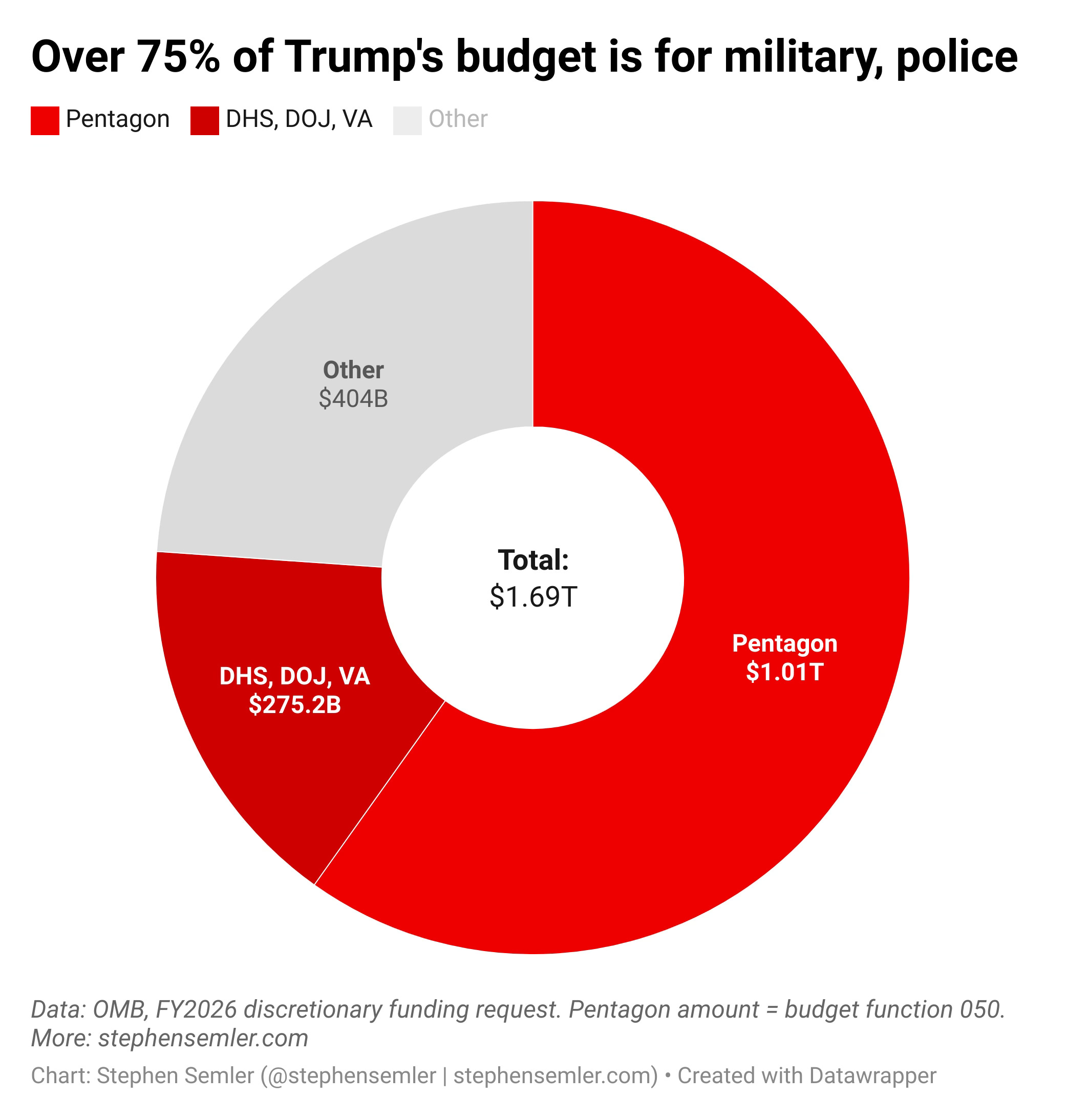
Speaking of which: Here’s an eye-opening chart from Stephen Semler on Trump’s FY2026 budget for America. Sure seems like we’re the Empire in “Star Wars,” doesn’t it?
Anyway, here’s my latest article for TomDispatch:
Forty years ago this month, I was commissioned a second lieutenant in the U.S. Air Force. I would be part of America’s all-volunteer force (AVF) for 20 years, hitting my marks and retiring as a lieutenant colonel in 2005. In my two decades of service, I met a lot of fine and dedicated officers, enlisted members, and civilians. I worked with the Army, Navy, and Marine Corps as well, and met officers and cadets from countries like Great Britain, Germany, Pakistan, Poland, and Saudi Arabia. I managed not to get shot at or kill anyone. Strangely enough, in other words, my military service was peaceful.
Don’t get me wrong: I was a card-carrying member of America’s military-industrial complex. I’m under no illusions about what a military exists for, nor should you be. As an historian, having read military history for 50 years of my life and having taught it as well at the Air Force Academy and the Naval Postgraduate School, I know something of what war is all about, even if I haven’t experienced the chaos, the mayhem, the violence, or the atrocity of war directly.
Military service is about being prepared to kill. I was neither a trigger-puller nor a bomb-dropper. Nonetheless, I was part of a service that paradoxically preaches peace through superior firepower. The U.S. military and, of course, our government leaders, have had a misplaced — indeed, irrational — faith in the power of bullets and bombs to solve or resolve the most intractable of problems. Vietnam is going communist in 1965? Bomb it to hell and back. Afghanistan supports terrorism in 2001? Bomb it wildly. Iraq has weapons of mass destruction in 2003? Bomb it, too (even though it had no WMD). The Houthis in Yemen have the temerity to protest and strike out in relation to Israel’s atrocities in Gaza in 2025? Bomb them to hell and back.
Sadly, “bomb it” is this country’s go-to option, the one that’s always on the table, the one our leaders often reach for first. America’s “best and brightest,” whether in the Vietnam era or now, have a powerful yen for destruction or, as the saying went in that long-gone era, “It became necessary to destroy the town to save it.” Judging them by their acts, our leaders indeed have long appeared to believe that all too many villages, towns, cities, and countries needed to be destroyed in order to save them.
My own Orwellian turn of phrase for such mania is: destruction is construction. In this country, an all-too-offensive military is sold as a defensive one, hence, of course, the rebranding of the Department of War as the Department of Defense. An imperial military is sold as so many freedom-fighters and -bringers. We have the mega-weapons and the urge to dominate of Darth Vader and yet, miraculously enough, we continue to believe that we’re Luke Skywalker.
This is just one of the many paradoxes and contradictions contained within the U.S. military and indeed my own life. Perhaps they’re worth teasing out and exploring, as I reminisce about being commissioned at the ripe old age of 22 in 1985 — a long time ago in a country far, far away.
The Evil Empire
When I went on active duty in 1985, the country that constituted the Evil Empire on this planet wasn’t in doubt. As President Ronald Reagan said then, it was the Soviet Union — authoritarian, militaristic, domineering, and decidedly untrustworthy. Forty years later, who, exactly, is the evil empire? Is it Vladimir Putin’s Russia with its invasion of Ukraine three years ago? The Biden administration surely thought so; the Trump administration isn’t so sure. Speaking of Trump (and how can I not?), isn’t it correct to say that the U.S. is increasingly authoritarian, domineering, militaristic, and decidedly untrustworthy? Which country has roughly 800 military bases globally? Which country’s leader openly boasts of trillion-dollar war budgets and dreams of the annexation of Canada and Greenland? It’s not Russia, of course, nor is it China.
Back when I first put on a uniform, there was thankfully no Department of Homeland Security, even as the Reagan administration began to trust (but verify!) the Soviets in negotiations to reduce our mutual nuclear stockpiles. Interestingly, 1985 witnessed an aging Republican president, Reagan, working with his Soviet peer, even as he dreamed of creating a “space shield” (SDI, the strategic defense initiative) to protect America from nuclear attack. In 2025, we have an aging Republican president, Donald Trump, negotiating with Putin even as he floats the idea of a “Golden Dome” to shield America from nukes. (Republicans in Congress already seek $27 billion for that “dome,” so that “golden” moniker is weirdly appropriate and, given the history of cost overruns on American weaponry, you know that would be just the starting point of its soaring projected cost.)
When the Soviet Union collapsed in 1991, fears of a third world war that would lead to a nuclear exchange (as caught in books of the time like Tom Clancy’s popular novel Red Storm Rising) abated. And for a brief shining moment, the U.S. military reigned supreme globally, pulverizing the junior varsity mirror image of the Soviet military in Iraq with Desert Storm in 1991. We had kicked the Vietnam Syndrome once and for all, President George H.W. Bush exulted. It was high time for some genuine peace dividends, or so it seemed.
The real problem was that that seemingly instantaneous success against Saddam Hussein’s much-overrated Iraqi military reignited the real Vietnam Syndrome, which was Washington’s overconfidence in military force as the way to secure dominance, while allegedly strengthening democracy not just here in America but globally. Hubris led to the expansion of NATO to Russia’s borders; hubris led to unipolar dreams of total dominance everywhere; hubris meant that America could somehow have the most moral as well as lethal military in the world; hubris meant that one need never concern oneself about potential blowback from allying with Osama bin Laden in Afghanistan or the risk of provoking Russian aggression as NATO floated Ukraine and Georgia as future members of an alliance designed to keep Russia down.
It was the end of history (so it was said) and American-style democracy had prevailed.
Even so, militarily, this country did anything but demobilize. Under President Bill Clinton in the 1990s, there was some budgetary trimming, but military Keynesianism remained a thing, as did the military-industrial-congressional complex. Clinton managed a rare balanced budget due to domestic spending cuts and welfare reform; his cuts to military spending, however, were modest indeed. Tragically, under him, America would not become “a normal country in normal times,” as former U.N. Ambassador Jeanne Kirkpatrick once dreamed. It would remain an empire — and an increasingly hungry one at that.
In that vein, senior civilians like Secretary of State Madeleine Albright began to wonder why this country had such a superb military if we weren’t prepared to use it to boss others around. Never mind concerns about the constitutionality of employing U.S. troops in conflicts without a congressional declaration of war. (How unnecessary! How old-fashioned!) It was time to unapologetically rule the world.
The calamitous events of 9/11 changed nothing except the impetus to punish those who’d challenged our illusions. Those same events also changed everything as America’s leaders decided it was then the moment to double down on empire, to become even more authoritarian (the Patriot Act, torture, and the like), to go openly to “the dark side,” to lash out in the only way they knew how — more bombing (Afghanistan, Iraq), followed by invasions and “surges” — then, wash, rinse, repeat.
So, had we really beaten the Vietnam Syndrome in the triumphant year of 1991? Of course not. A decade later, after 9/11, we met the enemy, and once again it was our unrepresentative government spoiling for war, no matter how ill-conceived and ill-advised — because war pays, because war is “presidential,” because America’s leaders believe that the true “power of its example” is example after example of its power, especially bombs bursting in air.
The “All-Volunteer” Force Isn’t What It Seems
Speaking as a veteran and a military historian, I believe America’s all-volunteer force has lost its way. Today’s military members — unlike those of the “greatest generation” of World War II fame — are no longer citizen-soldiers. Today’s “volunteers” have surrendered to the rhetoric of being “warriors” and “warfighters.” They take their identity from fighting wars or preparing for the same, putting aside their oath to support and defend the Constitution. They forget (or were never taught) that they must be citizens first, soldiers second. They have, in truth, come to embrace a warrior mystique that is far more consistent with authoritarian regimes. They’ve come to think of themselves — proudly so — as a breed apart.
Far too often in this America, an affinitive patriotism has been replaced by a rabid nationalism. Consider that Christocentric “America First” ideals are now openly promoted by the civilian commander-in-chief, no matter that they remain antithetical to the Constitution and corrosive to democracy. The new “affirmative action” openly affirms faith in Christ and trust in Trump (leavened with lots of bombs and missiles against nonbelievers).
Citizen-soldiers of my father’s generation, by way of contrast, thought for themselves. They chafed against military authority, confronting it when it seemed foolish, wasteful, or unlawful. They largely demobilized themselves in the aftermath of World War II. But warriors don’t think. They follow orders. They drop bombs on target. They make the war machine run on time.
Americans, when they’re not overwhelmed by their efforts to simply make ends meet, have largely washed their hands of whatever that warrior-military does in their name. They know little about wars fought supposedly to protect them and care even less. Why should they care? They’re not asked to weigh in. They’re not even asked to sacrifice (other than to pay taxes and keep their mouths shut).
Too many people in America, it seems to me, are now playing a perilous game of make-believe. We make-believe that America’s wars are authorized when they clearly are not. For example, who, other than Donald Trump (and Joe Biden before him), gave the U.S. military the right to bomb Yemen?
We make-believe all our troops are volunteers. We make-believe we care about those “volunteers.” Sometimes, some of us even make-believe we care about those wars being waged in places and countries most Americans would be hard-pressed to find on a map. How confident are you that all too many Americans could even point to the right hemisphere to find Syria or Yemen or past war zones like Vietnam, Afghanistan, and Iraq?
War isn’t even that good at teaching Americans geography anymore!
What Is To Be Done?
If you accept that there’s a kernel of truth to what I’ve written so far, and that there’s definitely something wrong that should be fixed, the question remains: What is to be done?
Some concrete actions immediately demand our attention.
*Any ongoing wars, including “overseas contingency operations” and the like, must be stopped immediately unless Congress formally issues a declaration of war as required by the Constitution. No more nonsense about MOOTW, or “military operations other than war.” There is war or there is peace. Period. Want to bomb Yemen? First, declare war on Yemen through Congress.
*Wars, assuming they are supported by Congressional declarations, must be paid for with taxes raised above all from those Americans who benefit most handsomely from fighting them. There shall be no deficit spending for war.
*Americans are used to “sin” taxes for purchases like tobacco and alcohol. So, isn’t it time for a new “sin” tax related to profiteering from war, especially by the corporations that make the distinctly overpriced weaponry without which such wars couldn’t be waged?
To end wars and weaken militarism in America, we must render it unprofitable. As long as powerful forces continue to profit so handsomely from going to war — even as “volunteer” troops are told to aspire to be “warriors,” born and trained to kill — this violent madness in America will persist, if not expand.
Look, the 22-year-old version of me thought he knew who the evil empire was. He thought he was one of the good guys. He thought his country and his military stood for something worthy, even for “greatness” of a sort. Sure, he was naïve. Perhaps he was just another wet-behind-the-ears factotum of empire. But he took his oath to the Constitution seriously and looked to a brighter day when that military would serve only as a deterrent in a world largely at peace.
The soon-to-be-62-year-old me is no longer so naïve and, these days, none too sure who’s evil and who isn’t. He knows his country is on the wrong path, that the bloody path of bullets and bombs (and profiting from the same) is always perilous for any freedom-loving people to travel on.
Somehow, America needs to be put back on the freedom trail that inspires and empowers citizens rather than wannabe warriors brandishing weapons galore. Somehow, we need to aspire again to be a nation of laws. (Can we agree that due process is better than no process?) Somehow, we need to dream of being a nation where right makes might, one that knows that destruction is not construction, one that exchanges bullets and bombs for ballots and beauty.
Replacing an older suicide vest with a newer one is not a sound plan
We are losing the struggle for the heart and soul of our country.
That much is apparent by the government’s embrace of genocide in Gaza, its boasts of trillion dollar war budgets, and its pride in global weapons sales, which the U.S. dominates (more than 40% of the global arms trade consists of weapons made in the USA).
I’ve been involved in efforts to criticize America’s “merchants of death” and to challenge America’s love affair with the military-industrial complex (MIC), but seemingly nothing we say or do changes the abusive and sociopathic power structure in DC. I suppose that’s none too surprising, given the power of the MICIMATT and the persuasiveness of propaganda.
Still, we must persist in these efforts, bringing a positive message, which I think should focus on the revival of democracy by reinvesting in America while rejecting militarism and restoring peace. Peace should be America’s normal, not war and constant preparations for the same. Yet “peace” seems to be the hardest word, one that’s rarely spoken in the halls of power.
Anyhow, in 2022 I wrote the following email to likeminded colleagues; I hope it’s worth sharing. As I think about it, three years later, I marvel at the death of idealism in America and the triumph of militarism. When more than half of the federal government’s discretionary spending goes to the military and weaponry, despite the Pentagon’s failure to pass audit after audit for seven years running, we must conclude we are one sick society.
The question is: How do we restore ourselves to health? Because I for one do not believe that war is the health of the state.
*****
Written in 2022 to colleagues seeking to reform the military-industrial complex (MIC).
When I was a college student in the early 1980s, and in Air Force ROTC, I wrote against the Reagan “defense” buildup. Caspar Weinberger, he of the “Cap the knife” handle for cost-cutting, became “Cap the ladle” as Reagan’s SecDef, ladling money in huge amounts to the Pentagon. History is repeating itself again as the Biden administration prepares to ladle $813 billion (and more) to the Pentagon.
How do we stop this? Of course, we must recognize (as I’m sure we all do) what we’re up against. Both political parties are pro-military and, in the main, pro-war. Our economy is based on a militarized Keynesianism and our culture is increasingly militarized. Mainstream Democrats, seemingly forever afraid of being labeled “weak” on defense, are at pains to be more pro-military than the Republicans. Biden, in Poland, echoed the words of Obama and other past presidents, declaring the U.S. military to be “the finest fighting force” in history. Think about that boast. Think about how Biden added that the nation owes the troops big. This is a sign of a sick culture.
Ike gave his MIC speech in 1961, and for 61 years the MIC has been winning. Even after the collapse of the Soviet Union in the early ‘90s, the MIC held its own; after 9/11, it went into warp speed and is accelerating. To cite Scotty from Star Trek: “And at Warp 10, we’re going nowhere mighty fast.”
We need a reformation of our institutions; we need a restoration of our democracy; we need a reaffirmation of the U.S. Constitution; we need to remember who we are, or perhaps who we want to be, as a people.
Do we really want to be the world’s largest dealer of arms? Do we really want to spend a trillion or more dollars, each and every year, on wars and weapons, more than the next dozen or so countries combined, most of which are allies of ours? (“Yes” is seemingly the answer here, for both Democrats and Republicans.) Is that really the best way to serve the American people? Humanity itself?
Consider plans to “invest” in “modernizing” America’s nuclear triad. (Notice the words used here by the MIC.) What does this really mean? To me, it means we plan on spending nearly $2 trillion over the next 30 years to replace an older suicide vest with a newer one, except this suicide vest will take out humanity itself, as well as most other life forms on our planet.
As Ike said in 1953, “This is not a way of life at all … it is humanity hanging from a cross of iron.”
We will need the broadest possible coalition to tackle this outrage against civilization and humanity. That’s why I applaud these efforts, even as I encourage all of us to enlist and recruit more people to join our ranks.
My father enlisted in the Civilian Conservation Corps in 1935 to do his bit for his family and his nation. He fought forest fires in Oregon and later became a firefighter after serving in the Army during World War II. That was the last formally declared war that America fought. It was arguably the last morally justifiable war this country has fought, waged by citizens who donned a uniform, not “warriors” who are told that the nation owes them big.
In “It’s A Wonderful Life,” Jimmy Stewart, a true war hero, played a man who never fought in WW2, who stayed at home and helped ordinary people even as his younger brother Harry went off to war and earned the Medal of Honor. Yet the movie doesn’t celebrate Harry’s war heroism; it celebrates the nobility, decency, and humility of George Bailey.
How do we get back to that America? The America from before the MIC, that celebrated decency and kindness and humanitarianism?
Yes, I know. It’s just a Frank Capra movie, and America has never been a perfect shining city. All I’m saying is we need more of that spirit if we are to prevail.