How News about the U.S. Military and America’s Wars is Manipulated, Massaged, and Falsified

barstow1
Reporter David Barstow (right) in 2014.  He won a Pulitzer in 2009 for his reporting on retired generals serving as Pentagon hacks (referenced in the article below)

W.J. Astore

Note to reader: In May of 2008, I wrote this draft article, which became the basis of a shorter piece published at Nieman Watchdog later that year under the title, “Networks should replace Pentagon cheerleaders with independent military analysts.”  Media coverage of the U.S. military and America’s wars is often lamentable as well as one-sided; if anything, media coverage as well as access under Obama has worsened.  I’ve decided not to edit what I wrote in 2008, partly because the underlying dynamic remains the same.  Rare it is for the curtain to be lifted on the messy realities of war; and those who choose to lift it, like Chelsea Manning, pay a high price indeed for honesty.

Obama’s recent decision to commute Manning’s prison sentence was a rare case of mercy, in this case extended to a truth-teller who did far more than the silver-haired generals cited below to educate Americans about war and its awful realities. 1/18/2017

The first thing that came to mind as I read David Barstow’s exposé [April 2008] in the New York Times, “Behind TV Analysts, Pentagon’s Hidden Hand,” was the classic scene in Casablanca where Claude Rains expresses his shock to Humphrey Bogart at the gambling going on, even as he collects his own winnings.  Surely, Americans knew that the retired generals and colonels being paraded before them on network news were, in spite of their mufti, anything but unbiased, independent, “civilian” critics?

OK, maybe I’m more skeptical than some.  But I was genuinely surprised, even shocked, at the brazenness of the Pentagon’s PR campaign, the fact that so many retired military men eagerly joined in “to carry [the Pentagon’s] water,” even at how eagerly they traded on their military expertise.  Some even continued to advise top defense contractors as they offered supposedly disinterested testimony on TV.  At times, however, their testimony merely echoed talking points fed to them during invitation-only briefings at the Pentagon.  These briefings were designed not to support troops in harm’s way (a laudable goal) but to defend [Secretary of Defense] Don Rumsfeld and the Bush Administration’s strategy.  (Those few officers who refused to parrot the Pentagon’s line found their access curtailed or even denied, Barstow shows.)

Not surprisingly, the mainstream media has either ignored Barstow’s exposé or effectively dismissed it as old news or business as usual.  Fortunately, Glenn Greenwald at Salon has tenaciously pursued the story, revealing ever more clearly how the Pentagon’s propaganda campaign tried “to put the best possible face” (one retired officer’s words) on failing efforts in Iraq.

Clearly, the Pentagon courted these retired military men, identifying reliable “go to guys” and rewarding them with access to the Pentagon and the Secretary of Defense (access being pure gold within the Washington beltway).  Such access included the aforementioned, invitation-only, PowerPoint briefings, which included “talking points” that these officers could then robotically repeat on TV, passing them off as their own informed and unbiased opinions.  Such collusion indicates a well-oiled, influence-peddling, Pentagonal machine serviced by sycophantic cheerleaders, and it assuredly warrants investigation by Congress.

Seven Reasons to Dismiss the Sycophants

That said, the very idea of relying on retired military men as expert critics was fundamentally flawed from the beginning.  The obvious reason why networks relied on these men (and they were all men) as expert commentators was because they lacked their own in-house experts.  That, and the fact that they wanted to purchase the authority of these colonels and generals while being seen by viewers at home as patriotic and supportive of the troops.

I’d like to suggest seven reasons why this reliance on retired military “talking heads” was so wrongheaded, some obvious, some perhaps less so:

  1. Despite their civilian coat-and-tie camouflage, these officers are not ex-generals and ex-colonels: they are retired colonels and generals–a distinction with a difference. They still carry their rank; they still wear the uniform at military functions; the rank-and-file still deferentially call them “sir”; their cars still have military stickers with eagles (for full colonels) and stars (for generals); they’re still saluted smartly when they drive on- and off-post.  These men enjoy constant reminders and privileges of their high military status, and I’d wager nearly all of them think of themselves as military men first, “civilians” second.  In short, these men identify with the U.S. military–indeed, they are the military–hardly a recipe for disinterested or dispassionate analysis of our military’s performance in Iraq, or anywhere else for that matter.
  1. Along with identifying closely with the military, many of these media generals and colonels serve as advisors to defense contractors, who potentially stand to profit from continued fighting. This remarkable state of affairs persists despite the fact that, throughout their career, military officers are taught to avoid even the appearance of conflicts of interest, precisely because the potential for impropriety taints the integrity of the officer as well as the entire military-contractor process.  It’s not enough to say, “I’m a man of integrity and I’d never compromise it for self-interest or personal gain.”  You must strive to avoid even the appearance of a conflict of interest–a maxim that is so drilled into military training that it should be reflexive to these men, like coming to attention and saluting the flag as the National Anthem is played.  Yet several of these men apparently saw no conflict in advising defense contractors while marching before the TV cameras to present “critical” and “independent” military analysis.
  1. Within the military, there’s a strong bias against Monday-morning quarterbacks. There’s a natural tendency to defer to the commander-in-the-field, and to allow him or her to get on with the job without being micro-managed or second-guessed.  As newly minted “civilian” advisors to the networks, these men don’t want to become what they themselves probably despised while they still wore the uniform–those cold, timid, milquetoast critics who’ll never know the triumphs and tribulations of Teddy Roosevelt’s mythical man in the arena.
  1. Along with a strong bias against second-guessing, many military men see criticism as disloyal and destructive, not loyal and constructive. As a concept, loyalty within the military is simple to define but incredibly complex in its manifestations.  Officers swear an oath to the Constitution of the United States, of course, and to that they must remain loyal.  But there also exist strong personal and institutional loyalties; sometimes, these loyalties are so strong that they come to obscure the somewhat more abstract, if higher, loyalty to the Constitution.  Sadly, some military men put loyalty to their service branch first, even before loyalty to the Constitution.  Or they conflate the two: What’s good for the Army is ipso facto good for the country.

This is not to say these military men are somehow “bad”–only that they’re human.  To understand this better, let’s look at a typical general’s background.  In a very powerful way, this man probably lives for and loves the military.  Military service may be in his family tree for generations.  Perhaps he followed his father from post to post as a child (a military “brat,” it’s called, with affection).  He then attends a service academy like Annapolis or West Point, where he’s told incessantly that he’s the best, and where he also learns that loyalty to one’s peers and service is paramount.  As a commissioned officer, he then serves for thirty or more years in uniform, achieving flag rank and all the privileges as well as burdens that come with that rank.  After this man retires, would we expect him to become a dynamic and even outspoken critic of an institution that defined his life?  An institution that he loves?

  1. It’s unlikely that senior military men will provide trenchant criticism, not only because they identify closely and personally with the military, but because they don’t want to run the risk of possibly undermining troop morale in the field. Related to this is the belief that “negative” and “biased” media criticism led to America’s defeat in Vietnam, the old “stab-in-the-back” myth that I’ve addressed elsewhere, and that Barstow’s exposé proves is still alive and well in today’s military.

Thus the testimony of these military men is not simply self-interested.  They genuinely believe their boosterism is helping to redress the balance of otherwise negatively-biased, “liberal,” anti-military media coverage.  Lending credence to this reading is a recent article in the Naval Institute’s Proceedings (January 2008).  In “Stop Blaming the Press,” journalist David Danelo recalls a comment made by the current Commandant of the Marine Corps, General James Conway, back in September 2006.  Lauding Marine reporters, Conway barked to rousing applause, “Maybe if we could get the rest of the media to do the job like you folks, we might have a chance of winning the war [in Iraq].”

In defending the evenhandedness of most media coverage, Danelo’s piece drew two strong dissents in the February issue of Proceedings.  One Navy officer wrote to complain that Danelo failed “to level criticism at reporters for not doing their part to ensure victory.”  Today’s press, this officer implied, neither supported the American soldier nor wanted to see America succeed in the war.  Another officer, a retired Marine, wrote that “just one negative story” from an American journalist “bolsters our enemies’ confidence and resolve while equally destroying support from the public at home, thus eroding our servicemen’s and women’s resolve on the battlefield.”  Refusing to suffer such journalistic “fools,” whose “stories could not have been more harmful than if al Qaeda had written them,” this officer demanded immediate military censorship of media working in-theater.  Those journalists who refused to cooperate “would operate at their own risk and without military protection,” he concluded ominously.

Such opinions remain a commonplace in today’s military, especially among men of a certain age who began their service at the tail end or soon after the end of the Vietnam War.  Indeed, evidence strongly suggests Senator John McCain shares this opinion.

  1. Paradoxically, the fact that the war in Iraq has not gone well may be a reason why some of these military men believe we can’t afford criticism, especially if you believe this war can and must be won, as most of them do. Call this the “You can’t handle the truth” argument, combined with the “wars are always messy” argument.  These arguments lead military men to suppress their own doubts, fearing that, if they air them fully, they’ll not only fatally wound an already faltering war effort, but that their peers may even see them as having given aid and comfort to the enemy.
  1. The last, and perhaps most powerful, reason why networks should not lean heavily on retired military men as commentators is that it’s extremely difficult for anyone, let alone a diehard military man, to criticize our military because such criticism is taken so personally by so many Americans. When you criticize the military, people don’t necessarily recognize the patriotic subtlety of your exposé of the military-industrial complex.  They hear you attacking Johnny and Suzy—the efforts of their son and daughter, or the boy and girl next door, who selflessly joined the military to defend America and make a positive difference in the world.  Who really wants to hear that Johnny and Suzy may possibly be fighting (and dying) for a mistake?  (Another way of putting this might be, “Why doesn’t that Cindy Sheehan shut up already?”)  And, assuming he believed it, what retired military man wants to pass along that message to an audience of millions on TV?

What Is to be Done?

Relying on senior military officers, recently retired, to serve as disinterested critics is a bit like inviting Paul von Hindenburg, ex-Field Marshal of the German Army, to testify in 1919 on why his army lost World War I.  You may get some interesting testimony–just don’t expect it to be critical or for that matter even true.

What the mainstream media must do now is act.  Specifically, they must develop their own, independent, military experts, ones not beholden to the military-industrial complex, ones who don’t own stock in the defense industry, ones who don’t serve as advisors to defense contractors.

The mainstream media must also be willing to risk the ire of the American people by criticizing the military in stronger terms.  The fact that major media outlets have come to rely on military talking heads for “critical” analysis reveals the inherent timidity of today’s media in taking on the Pentagon and the Bush Administration.  Media outlets must get over their fear of being perceived as unpatriotic.  They must air tough-minded criticism, even if some viewers tune out, turn off, and drop in to “patriotic” outlets like Fox News.

Obviously, it will take time for the media to develop its own, truly independent, military experts.  In the meantime, they should consider using junior officers and NCOs, with recent combat experience, who have separated from the service.  Why does an “expert” have to be a retired, white-haired colonel or general?

For that matter, why does an “expert” need to have worn an American military uniform?  Some of the most creative analysis may come from “civilian” military historians or even from foreign military officers who are not emotionally connected to the U.S. military, and who thus don’t have to worry about having their patriotism questioned each time they hazard a criticism of U.S. strategy or tactics.

Until the mainstream media takes these steps, it will continue to be in thrall to the military, as is Congress itself, which also largely refuses to challenge the military before or during a war, in part because members of Congress fear being accused of defeatism and thus of losing elections.

The truth is that there’s a creeping militarism in our country–an excessive deference to military men, whether retired or still on active duty.  Just look at the acclaim awarded to General Petraeus each time he comes to testify before Congress.  Indeed, the presumptive Republican presidential nominee, John McCain, is already deferring to Petraeus, stating he would not make any decision regarding diverting troops to Afghanistan to search for Osama bin Laden without first receiving the blessing of the presumptive commanding general of CENTCOM.

If that’s where we’re headed, why don’t we just declare Petraeus to be our Caesar and appoint our “civilian” mainstream media military experts to command his Praetorian Guard?  It sure would make matters clearer to the American people.
Can Trump Tame the Pentagon?

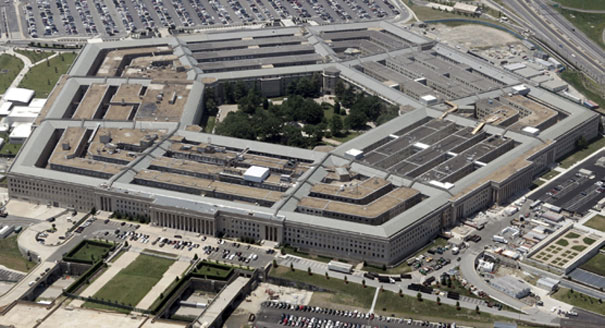
101222_pentagon_605_reuters
Can Trump tame the Pentagon?

W.J. Astore

Will Donald Trump keep his campaign promise to end America’s wasteful wars overseas?  Since he’s stated he knows more than America’s generals, will he rein them in?  Will he bring major reforms to the military-industrial complex, or will he be nothing but talk and tweets?

At Trump’s first news conference today as president-elect, he had little to say about the military, except once again to complain about the high cost of the F-35 jet fighter program.  The questions asked of him dealt mainly with Russia, hacking, potential conflicts of interest, and Obamacare.  These are important issues, but how Trump will handle the Pentagon and his responsibilities as commander-in-chief are arguably of even greater import.

Ironically, the last president who had some measure of control over the military-industrial complex was the retired general who coined the term: Dwight D. Eisenhower.  Another president – Jimmy Carter – attempted to exercise some control, e.g. he cancelled the B-1 bomber, a pet project of the U.S. Air Force, only to see it revived under Ronald Reagan.

Excepting Carter, U.S. presidents since Ike have issued blank checks to the military, the Pentagon, and its bewildering array of contractors.  Whether Democrats (JFK, LBJ, Clinton, Obama) or Republicans (Nixon, Ford, Reagan, the Bushes), rubber-stamping Pentagon priorities has been a common course of presidential action, aided by a willing Congress that supports military spending to “prime the economic pump” and create jobs.

Ike, of course, was hardly perfect, but he had the cred to command the military, to rein it in, perhaps as much as any one man could in the climate of fear generated by McCarthyism and the Cold War hysteria of the 1950s.  Hardly a pacifist, Ike nevertheless came to hate war.  Can we imagine any president nowadays writing these words?

Every gun that is made, every warship launched, every rocket fired signifies, in the final sense, a theft from those who hunger and are not fed, those who are cold and are not clothed. This world in arms is not spending money alone. It is spending the sweat of its laborers, the genius of its scientists, the hopes of its children… This is not a way of life at all, in any true sense. Under the cloud of threatening war, it is humanity hanging from a cross of iron.

Ike’s wisdom stemmed from his experience with the bloody awfulness of war. Recent presidents, by comparison, have been unstinting in their praise of the U.S. military.  Ronald Reagan, who had a cozy job in Hollywood during World War II, was a snappy saluter who oversaw a major military expansion.  More recently, Barack Obama, with no military experience, went out of his way to praise the U.S. military in hyperbolic terms as the “greatest” in human history.

Recent presidents have idolized the military, perhaps because they either never served in it or never really experienced its foibles and faults, its flaws and failings.  Perhaps as well they’ve celebrated the military because they saw it as a popular and easy form of patriotism.  But the Pentagon needs a commander-in-chief, not a cheerleader-in-chief.  It needs to be challenged, it needs a boot up its collective ass, if it’s ever going to reform its prodigal ways.

Trump has been critical of the military, an encouraging sign.  But his appointment of retired generals to key positions of power suggests conformity and business as usual.  Trump himself is a military poseur, a man impatient with facts, a man who didn’t know what the nuclear triad was even as he talked of (false) nuclear gaps vis-à-vis Russia.

Even as he talked of wasteful wars and clueless generals, Trump promised to use the U.S. military as a battering ram to smash America’s enemies.  He promised as well to rebuild the military, increasing the Pentagon budget while taking the fight to ISIS, words that suggest President Trump won’t often say “no” to the national security state.  Ike, however, could and did say “no.”  He had the toughness to weather the predictable Pentagon, Congressional, and military/corporate storms.  Will Trump?

Again, the last president to lead a novel initiative in national security was Jimmy Carter, with his focus on human rights.  Dismissed as naïve and pusillanimous, he became a one-term president.  Trump has promised to end wasteful wars, to re-prioritize federal spending to focus on internal “security” measures such as national infrastructure, and to make NATO and other U.S. allies pay their fair share of defense costs.

If he carries through on these promises, he’ll be the first president since Ike to make a measurable and significant course correction to America’s warship of state.  But first he needs to be held to account, most certainly at press conferences but elsewhere as well.  Endless war is a threat to democracy; so too are politicians who posture but do nothing to rein in militarism, imperialism, and authoritarianism.

If Trump combines the two, if he doubles down on incessant war and a cult of authority, American democracy may suffer a mortal blow.

At the Pentagon, Nothing Succeeds Like Failure

101222_pentagon_605_reuters
In the puzzle palace on the Potomac, nothing succeeds like failure

W.J. Astore

When it comes to the Pentagon, nothing succeeds like failure. That is the message of William Hartung’s latest article at TomDispatch.com. The Pentagon, Hartung notes, continues to receive massive funding from the American taxpayer, even as its various wars drag on, seemingly without end. Hartung, who wrote a book on Lockheed Martin and the military-industrial complex, has a knack for revealing the latest Pentagon follies. Even as you read his latest at TomDispatch.com, I’d like to add two more items to his list:

1. Washington Think Tanks: Perhaps you’ve heard of them, centers for thinking about national defense, hiring the best and the brightest to come up with disinterested recommendations to safeguard America. Ha!  A few days ago, The National Interest ran an article on what these think tanks were proposing, the “latest fashions in warfighting,” as the article’s title put it.  Please note there’s no “fashion” in peacemaking or war-ending.

Four out of the five think tanks featured in the article were in basic agreement. “Deterrence” had to be based on massive investments in offensive weaponry. There was much agreement as well on modernizing America’s nuclear arsenal, on the need to feature more drones and other unmanned platforms, on air power and power projection, as well as support for the wildly expensive F-35 jet fighter. In sum, more of the same at the Pentagon, only more.

One think tank, the Cato Institute, a Libertarian outfit, dared to depart from Pentagon orthodoxy. Cato called into question the Pentagon’s need for better nukes, prodigal jet fighters, and similar “sticker shock” items on the Pentagon’s wish list. This dissent drew a stinging rebuke from The National Interest, which suggested Cato had developed a defense plan for Canada rather than the great and powerful USA.

To that I say, tell me again what is wrong with Canada?

A question: If four out of five think tanks essentially agree with each other, are not at least three of them redundant?

2.  Forcing Soldiers to Pay Back Bonuses: Yes, you read that right. Even as the Pentagon spends nearly $750 billion a year, even as it avoids any semblance of an audit, U.S. troops who fought overseas are being forced to pay back bonuses that the Pentagon gave them, apparently by mistake (but also with some fraud involved on behalf of recruiters), at a time when the U.S. military was under duress to improve retention rates.

Let’s be clear: In accepting the bonuses, the individual troops were not at fault. They took the money in good faith from a military that patted them on the back for staying in. But now the military says, whoops, we were wrong, we want the money back.

In Pentagon terms, we’re not talking big money. We’re talking chump change.  It’s $15,000 here, $30,000 there. But of course it is big money to the troops and their families. Consider the stress of having government-sanctioned collection agencies on your tail. One soldier had to refinance his house to raise the money to repay an incentive bonus he’d accepted in good faith.

Here’s the kicker. In California, where these abuses and mistakes happened, the military “assigned 42 auditors to comb through paperwork for bonuses and other incentive payments given to 14,000 soldiers.”

Imagine that. The Pentagon can’t even hold an audit, let alone pass one, but it’s willing to hire a platoon of auditors to go after troops and their bonuses.

Here’s my recommendation: Let’s deploy an army of 42,000 auditors to comb through Pentagon paperwork for waste, fraud, and abuse. Let’s get our money back, America. And let’s stop thinking about “fashions” in “warfighting,” and instead dedicate ourselves to ending our wars — before they end us.

Greed-War: The Power and Danger of the Military-Industrial Complex

Ike
Ike in 1959: Too critical of the military to be elected today

W.J. Astore

President Dwight D. Eisenhower gave his most powerful speech as he left office in 1961.  He warned the American people about an emerging military-industrial complex, a complex that was already beginning to erode democratic rule in America.  Originally, Ike had Congress as a collaborator with and enabler of that Complex, but he deleted the reference in the final version, apparently deciding that by alienating Members of Congress, he’d only push them further into the Complex’s corner.

The military-industrial complex, the Complex for short, has only grown in power over the last half-century.  Today, more than half of Federal discretionary funding goes to it.  With the post-9/11 addition of Homeland Security and more and more intelligence agencies (seventeen of them at last count), the Complex continues to grow like Topsy.  It consumes roughly $750 billion each and every year, a sum likely to grow whether Trump or Clinton wins the presidency.  (Trump has promised to rebuild an allegedly shattered military; Clinton, meanwhile, is a steadfast supporter of the military as well as neo-con principles of aggressive foreign interventionism.)

In the U.S. today, the Complex is almost unchallengeable.  This is not only because of its size and power.  The Complex has worked to convince Americans that war is inevitable and therefore endless (it’s never the fault of the Complex, of course: it’s the terrorists, or the Russians, or the Chinese …), and also that military service (and spending) is virtuous and therefore a boon to democracy.

America’s founders like James Madison thought differently, knowing from bitter experience and deep learning that incessant wars and standing militaries are an insidious threat to democracy.  Nowadays, however, Americans say they trust their military more than any other societal institution, and mainstream society universally celebrates “our” troops as selfless heroes, the very best of America.  This moral, indeed metaphysical, elevation of the U.S. military serves to silence legitimate criticism of its failings as well as its corrosive effect on democratic principles and values.

All of these topics I’ve written about before, but I wish to cite them again by way of introducing an article by Maximilian C. Forte, an anthropologist who writes at Zero Anthropology (I first saw his work at Fabius Maximus).  The article Forte wrote is on Bernie Sanders and his limitations, but what struck me most was his reference to C. Wright Mills and his analysis of the nexus of interests and power between U.S. capitalism and militarism.

The following extended excerpt from Forte’s article shines much light into the darker corners of America’s corridors of power:

In The Power Elite (1956) and “The Structure of Power in American Society” (The British Journal of Sociology, March 1958), Mills’ explanations can look like an elaborated, in-depth version of what former president Dwight Eisenhower described as the military-industrial complex, but with a stronger focus on the role of private corporations and special interest lobbies. These approaches endure today — because the problem they describe and analyze continues — as shown in the work of anthropologists such as Wedel on Shadow Elite: How the World’s New Power Brokers Undermine Democracy, Government, and the Free Market[as well as works by other authors that showcase] the relationship between the stock market, multinational corporations and the US’ CIA-led coups against foreign governments …

For C. Wright Mills, the problem was not just “Wall St.,” nor the “Pentagon” alone — focusing on one over the other produces a half-headed understanding, with all of the political demerits that result. As he argued in his 1958 article, “the high military, the corporation executives, the political directorate have tended to come together to form the power elite of America” (pp. 32-33). The power elite is what he described as a “triangle of power,” linking corporations, executive government, and the military: “There is a political economy numerously linked with military order and decision. This triangle of power is now a structural fact, and it is the key to any understanding of the higher circles in America today” (Mills, 1958, p. 32).

Contrary to Bernie Sanders, Mills emphasizes the decisive influence of the military in the corporate oligarchic state (as Kapferer later called it):

“The military order, once a slim establishment in a context of civilian distrust, has become the largest and most expensive feature of government; behind smiling public relations, it has all the grim and clumsy efficiency of a great and sprawling bureaucracy. The high military have gained decisive political and economic relevance. The seemingly permanent military threat places a premium upon them and virtually all political and economic actions are now judged in terms of military definitions of reality: the higher military have ascended to a firm position within the power elite of our time”. (Mills, 1958, p. 33)

US politics are dominated, Mills argued, “by a few hundred corporations, administratively and politically interrelated, which together hold the keys to economic decision,” and the economy that results is “at once a permanent-war economy and a private-corporation economy”:

“The most important relations of the corporation to the state now rest on the coincidence between military and corporate interests, as defined by the military and the corporate rich, and accepted by politicians and public”. (Mills, 1958, p. 33)

Mills also pays attention to the history of this type of corporate-military state. The influence of private lobbies dates back deep into US political history, when the influence of railway tycoons, banana magnates, and tobacco barons was considerable at different times. From this Mills discerned the rise of what he called the “invisible government,” which existed starting from at least 50 years prior to his 1958 article…

“Fifty years ago many observers thought of the American state as a mask behind which an invisible government operated. But nowadays, much of what was called the old lobby, visible or invisible, is part of the quite visible government. The ‘governmentalization of the lobby’ has proceeded in both the legislative and the executive domain, as well as between them. The executive bureaucracy becomes not only the centre of decision but also the arena within which major conflicts of power are resolved or denied resolution. ‘Administration’ replaces electoral politics; the maneuvering of cliques (which include leading Senators as well as civil servants) replaces the open clash of parties”. (Mills, 1958, p. 38)

The corporate-military government is tied to US global dominance, and its power increased dramatically from 1939 onwards. As Mills noted, “the attention of the elite has shifted from domestic problems — centered in the ’thirties around slump — to international problems centered in the ’forties and ’fifties around war” (1958, p. 33). (As I argued elsewhere, this shift also registers in US anthropology, which moved from research at home, on domestic social problems, to fieldwork abroad as the dominant norm.)

Rather than challenge the arms industry, whose growing size and power stunned Eisenhower, Sanders would simply tax them more. It is open to debate whether Sanders is offering even half of a solution, and whether he sees even half of the bigger picture. Usually Sanders has voted in favour of military appropriations, supported the financing of wars in Iraq and Afghanistan, and has backed a range of regime change and “humanitarian interventionist” efforts, from NATO’s war in Kosovo, to support for the 1998 Iraq Liberation Act and for regime change in Libya (contrary to his false representations on the latter point). He is also an aggressive supporter of NATO and its anti-Russian posture. While he is not even half of anti-imperialist, some might argue that it is also too generous to see him as half of a socialist–either way, we need to do better than beat each other up with half-answers.

*** 

Forte’s criticism of Sanders is spot on.  My guess is that Sanders refused to take on the Complex precisely because of its financial, its political, and finally its cultural and societal clout.  There are only so many windmills you can tilt at, Sanders may have decided.  Yet, notwithstanding his willingness to appease the Complex, Sanders has been relegated to the sidelines by a corrupt Democratic establishment that did everything it could to ensure that one of its own, Complex-abettor Hillary Clinton, won the party nomination.

The fundamental problem for the U.S. today is as obvious as it appears insoluble.  The Complex has co-opted both political parties, Republican and Democratic.  It has at the same time redefined patriotism in militaristic terms, and loyalty in terms of unquestioning support of, even reverence for, American military adventurism and interventionism.  Candidates who have rival ideas, such as Libertarian Gary Johnson or Green Party candidate Jill Stein, are simply not allowed on the stage.  Their voices of dissent are suppressed.  They are never heard within the mainstream.

Johnson, for example, has suggested cuts to the Complex approaching 20%; Jill Stein has suggested cuts as deep as 50%.  Such suggestions, of course, are never seriously discussed in mainstream America.  Indeed, when they’re mentioned at all, they’re instantly dismissed by the “power elite” as the ravings of weak-kneed appeasers or unserious ignoramuses.  (Johnson, for example, is now depicted as an ignoramus by the mainstream media because he couldn’t place Aleppo or instantly name a foreign leader he adored.)

We have a new reality in U.S. government and society today: the Complex essentially rules unchallenged.  Back in the 1950s, Ike had the military and political authority to constrain it.  Today, well, no.  There are no restraints.  Just look at Hillary and Trump, both boasting of how many generals and admirals support them, as if they couldn’t run for office unless they’d been anointed by men in military uniforms wearing stars.

And America calls this democracy?

Democracy in America is dying.  It’s dying because it’s being strangled by winner-take-all capitalism and corrosive militarism.  Greed-war is consuming America’s resources.  Not just material, not just political, but mental and emotional resources as well.  The greed-war nexus as represented and nurtured by the Complex and its power elite is both narrowing and coloring the horizons of America.  Tortured by mindless fear and overwrought concerns about weakness and decline, Americans embrace the Complex ever tighter.

The result: America builds (and sells) more weapons, supports higher military spending, and wages more war.  Trump or Clinton, the war song remains the same.  It’s a narrowing of national horizons, a betrayal of American promise, that we will overcome only when we reject greed-war.

Afterword: The sad part is that Martin Luther King said it far better than I can fifty years ago in this speech on Vietnam.  Ike in 1961, MLK in 1967, both prophetic, both largely ignored today for their insights into the “spiritual death” represented by greed-war.  Even earlier, General Smedley Butler, twice awarded the Medal of Honor, argued in the 1930s that war is a racket and that it would end only when the profit motive was eliminated from it.

So, if I had one question for Hillary and Trump, this would be it: When it comes to your decision to enlarge the military-industrial complex, to feed it ever more money and resources, what makes your decision right and the warnings of Ike, MLK, and General Butler wrong?

Holding Military Boots to the Fire

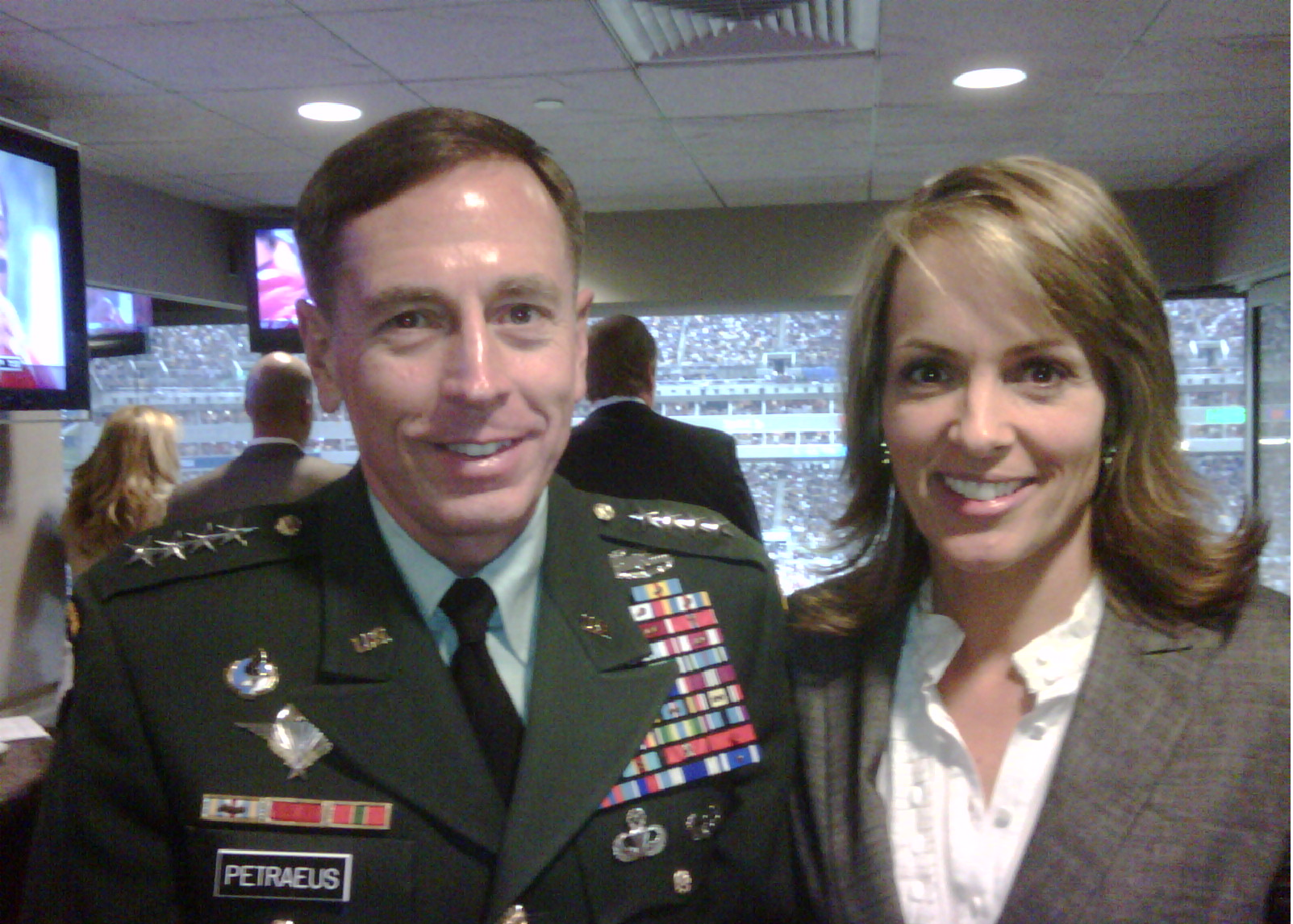
Petraeus with Broadwell
Petraeus: Lots of ribbon candy crowded on that uniform

W.J. Astore

I write a lot about the U.S. military, partly because I served in it for 20 years, partly because I’ve been reading about it since I could read, and partly because I have a lot of affection for colleagues, young and old, who still serve.  My articles tend to be critical because there’s much to criticize about our military.  I get interesting responses, like the one from a military man who said I wrote well and had a few interesting things to say, but why couldn’t I write more positive articles about the military?  Why couldn’t I just focus on “good news”?  I explained to him that the military has a small legion of public affairs officers and that sharing good news is their job, not mine.  He didn’t write back.

I have a few critical things to say in my latest article at TomDispatch: “Seventy Years of Military Mediocrity.”  You can read the entire article here; what follows is an excerpt on America’s most senior officers and some of their faults and failings.  As ever, I welcome your comments.

America’s Senior Officers: Lots of Ribbon Candy, No Sweetness of Victory

In my first article for TomDispatch back in 2007, I wrote about America’s senior military leaders, men like the celebrated David Petraeus. No matter how impressive, even kingly, they looked in their uniforms festooned with ribbons, badges, and medals of all sorts, colors, and sizes, their performance on the battlefield didn’t exactly bring to mind rainstorms of ribbon candy. So why, I wondered then, and wonder still, are America’s senior military officers so generally lauded and applauded? What have they done to deserve those chests full of honors and the endless praise in Washington and elsewhere in this country?

By giving our commanders so many pats on the back (and thanking the troops so effusively and repeatedly), it’s possible that we’ve prevented the development of an American-style stab-in-the-back theory — that hoary yet dangerous myth that a military only loses wars when the troops are betrayed by the homefront. In the process, however, we’ve written them what is essentially a blank check. We’ve given them authority without accountability. They wage “our” wars (remarkably unsuccessfully), but never have to take the blame for defeats.  Unlike President Harry Truman, famous for keeping a sign on his desk that read “the buck stops here,” the buck never stops with them.

Think about two of America’s most celebrated generals of the twenty-first century, Petraeus and Stanley McChrystal and how they fell publicly from grace.  Both were West Point grads, both were celebrated as “heroes,” despite the fact that their military “surges” in Iraq and Afghanistan proved fragile and reversible.  They fell only because Petraeus was caught with his pants down (in an extramarital affair with a fawning biographer), while McChrystal ran afoul of the president by tolerating an atmosphere that undermined his civilian chain of command.

And here, perhaps, is the strangest thing of all: even as America’s wars continue to go poorly by any reasonable measure, no prominent high-ranking officer has yet stepped forward either to take responsibility or in protest.  You have to look to the lower ranks, to lieutenant colonels and captains and specialists (and, in the case of Chelsea Manning, to lowly privates), for straight talk and the courage to buck the system.  Name one prominent general or admiral, fed up with the lamentable results of America’s wars, who has either taken responsibility for them or resigned for cause.  Yup — I can’t either.  (This is not to suggest that the military lacks senior officers of integrity.  Recall the way General Eric Shinseki broke ranks with the Bush administration in testimony before Congress about the size of a post-invasion force needed to secure Iraq, or General Antonio Taguba’s integrity in overseeing a thorough investigation of prisoner abuse at Abu Ghraib.  Their good deeds did not go unpunished.)

Authority without accountability means no one is responsible.  And if no one is responsible, the system can keep chugging along, course largely unaltered, no matter what happens.  This is exactly what it’s been doing for years now in Iraq, Afghanistan, and elsewhere.

Can we connect this behavior to the faults of the service academies?  Careerism.  Parochialism.  Technocratic tendencies.  Elitism.  A focus on image rather than on substance.  Lots of busywork and far too much praise for our ascetic warrior-heroes, results be damned.  A tendency to close ranks rather than take responsibility.  Buck-passing, not bucking the system.  The urge to get those golden slots on graduation and the desire for golden parachutes into a lucrative world of corporate boards and consultancies after “retirement,” not to speak of those glowing appearances as military experts on major TV and cable networks.

By failing to hold military boots to the fire, we’ve largely avoided unpleasantness between the military and its civilian leadership, not to speak of the American public. But — and here’s the rub — 70 years of mediocrity since World War II and 14 years of failure since 9/11 should have resulted in anti-war protests, Congressional hearings, and public controversy. It should have created public discord, as it did during the Vietnam War, when dissent was a sign of a healthy democracy and an engaged citizenry. Nowadays, in place of protest, we hear the praise, the applause, the thank-yous followed by yet another bombastic rendition of “God Bless America.” Let’s face it. Our military has failed us, but haven’t we failed it, too?

America’s Longest Wars

Just a few of the battles fought against Native Americans

W.J. Astore

A popular headline in the media is to describe the Afghan War as “America’s longest,” as in this brief summary today from Foreign Policy:

The war in Afghanistan, America’s longest, is now formally over. The 13-year war, which claimed more than 2,200 American lives and cost more than one trillion dollars, ended quietly at a ceremony in Kabul yesterday. U.S. President Barack Obama and other Western leaders promised their ongoing commitment under the rebranded Operation Resolute Support and insisted the war was a success. But the Taliban is poised for a comeback with a recent surge in violence in Kabul and around the country. There are concerns that Afghanistan’s military and fragile political institutions will crumble as the United States leaves.

There’s a big problem with this.  America’s longest war, by far, is not the recent Afghan War; it was its more or less continuous effort against Native Americans from the early 1600s to the late 1800s.  Americans like to forget that native peoples populated the land before European settlers began to arrive, and that these native peoples had to be killed, or corralled, or otherwise subjugated or shunted aside in the name of Manifest Destiny and in the pursuit of profit.

As historian John Grenier notes in The First Way of War: American War Making on the Frontier, 1607-1814,

For the first 200 years of our military heritage, then, Americans depended on arts of war … [that included] razing and destroying enemy villages and fields; killing enemy women and children; raiding settlements for captives; intimidating and brutalizing enemy noncombatants; and assassinating enemy leaders.

For Grenier, America’s “first way of war” relied on “extravagant violence” often aimed at “the complete destruction of the enemy,” in this case various Native American peoples.  This was indeed America’s longest war. Yet despite (or perhaps because of) its long duration and brutal violence, the war against indigenous peoples is rarely mentioned today, especially by those who seek to promote American exceptionalism.

Another longer war than the Afghan one, more recent in America’s memory, was the Cold War we fought against the Soviet Union and its allies from the close of World War II to the collapse of the Soviet Union in the early 1990s.  Lasting nearly half a century, this war ended in victory of a sort for the United States, even as its legacy continues to poison U.S. culture and foreign relations.  For the Cold War left us with an enormous military-industrial-Congressional complex, to include nuclear forces capable of destroying the planet, which the U.S. continues to feed and even to enlarge.  The result has been the growth of a second “shadow” government, a national security and surveillance state of enormous power, an apparatus with wide-reaching and unaccountable powers that is potentially a greater threat to American freedoms than the Soviet Union ever was.

When America forgets its longest wars, and especially when Americans forget the legacies of these wars, it’s more than history that suffers.

Update: Just after I wrote this, I came across this article on corporate “land grabs” that continue to bedevil Native Americans.  Some would argue that the long war against native peoples never really ended.  And to state a point that is perhaps obvious: the Afghan War grew out of the Cold War and U.S. efforts to embroil the Soviet Union in its own Vietnam in 1980.  U.S. efforts to support the Afghan “freedom fighters” against the Soviets contributed to the rise of Osama bin Laden, who would eventually turn against the U.S. in the 1990s.  America’s Afghan War, in other words, is not a 13-year war.  To understand it, one must look back to 1979-80 and the machinations of a U.S. foreign policy establishment that was much more concerned with hobbling the Soviets than with helping the Afghan people.

The Winners of Putin’s Aggression: The U.S. Military-Industrial Complex and Big Oil

There's a bear in the woods ...
There’s a bear in the woods …

W.J. Astore

There’s a new bear in the woods and his name is Vladimir Putin. Remember that Reagan campaign ad from 1984 that showed a menacing, obviously Soviet, bear patrolling the woods, with ominous music in the background? Fast-forward thirty years and a bare-chested Putin is that new bear, marauding in the Crimea and threatening Ukraine.

Our mainstream media has entered a time warp and we’re back to 1984.  No, not the 1984 of George Orwell and of constant monitoring by Big Brother – our media is not concerned by that.  Instead, they’re concerned with a revived Soviet Union, a new Cold War, and the notion that America is unprepared and weak.

The big winner of this collective (and selective) exercise in time travel is obvious: the U.S. Military-Industrial Complex as well as Big Oil and Gas.  We can’t make significant cuts to “defense” spending now that the Russian bear is on the loose again.  Right?  And the best way to neutralize the bear’s threats of cutting off gas shipments to Europe is by surging oil and gas drilling in the U.S., chiefly by hydro-fracturing or fracking.  Right?

Never mind concerns about rising CO2 levels and global warming.  It’s 1984 again, not 2014.  We need to corral that Russian bear before he emasculates us.  Deploy our military!  Drill baby drill!  Show the Russkies who’s boss!  Before they go all “Red Dawn” on us.

red_dawn

And when was the cheesy “Red Dawn” originally released? You guessed it: 1984.

The F-35 Fighter Program: America Going Down in Flames

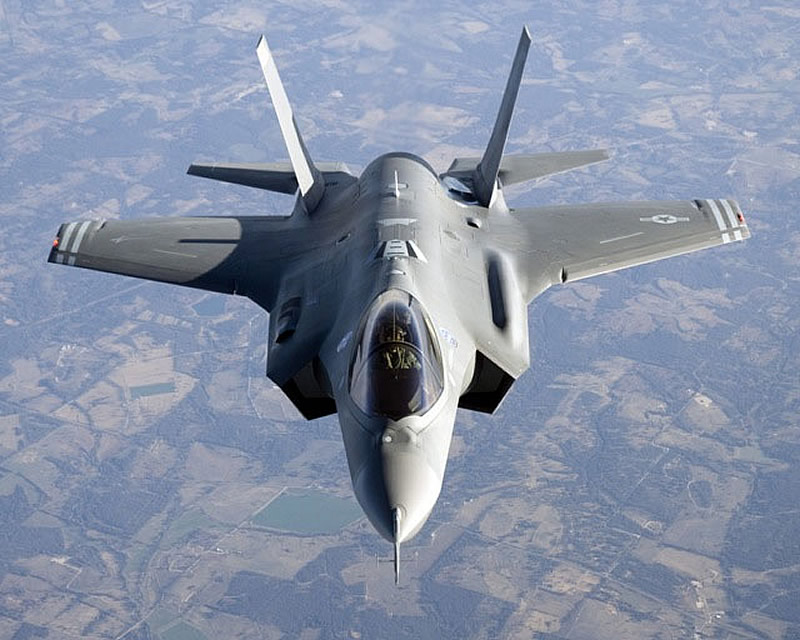
f35
W.J. Astore

This past weekend [February 2014], CBS 60 Minutes did a segment on the F-35 fighter program. The basic facts are these: the program is seven years behind schedule and $163 billion over budget. Yes, you read that right: Not $163 million, but $163 billion. The lead contractor, Lockheed Martin, is essentially unapologetic about the delays and cost overruns. Why should they be? The general in charge of the F-35 acquisition program said we’re going to buy thousands of the plane over the next two decades. Talk about rewarding failure!

If we continue like drunken sailors to throw money at the F-35, it’ll be an effective fighter jet. But the biggest issue is that we don’t need it. Predator and Reaper drones are just the beginning of a new generation of pilotless aircraft that promise to be more effective.  Why?  Because we need not risk pilots getting shot down.  Also, when you combine long loiter time over targets with super-sensitive sensors, drones reduce collateral damage while increasing the odds of “one shot, one kill.”

Proponents of the F-35 like to brag about its (costly) stealthy features, its (costly) cameras and sensors (especially the computer- and sensor-integrated helmet worn by each pilot, which creates a virtual reality and visual scape for that pilot), and its survivability vis-a-vis Russian and Chinese fighters (which are largely still on the drawing boards in those countries). But the truth is that an updated generation of F-15s, F-16s, F-18s, and F-22s are more than capable of defending America and projecting power.  (The Vietnam War proved that, in aerial combat, pilot training and skill matter more than technology. That’s why the U.S. military established realistic training at “Top Gun” schools.)

The F-35, given the amount of money thrown at it, doubtless has some improvements over planes such as the F-15 and F-18. But at a price tag of at least $400 billion to purchase the F-35, and $1.45 trillion over the life of the program to operate and maintain them, it has simply become far too prohibitive for the United States to afford, especially in a climate of fiscal austerity.

Based on its track record, it’s probably safe to say that the F-35 will soon be a decade behind schedule and $200 billion over budget, even as it’s increasingly rendered irrelevant by improvements in drone technologies. So why are we buying it? Simply because the program is too big to fail. The Air Force, Navy, and Marines are all counting on it.

Meanwhile, Lockheed Martin has distributed its subcontractors across the USA, making it exceedingly difficult for Congress to cut the program without hurting jobs in virtually every Congressional district. Indeed, in an awesome display of chutzpah, you can go to the Lockheed Martin website to see how much your state is involved in building the F-35. Clicking on the “economic impact map,” I see that for the State of Pennsylvania, for example, the F-35 creates 759 jobs and an economic impact of nearly $51 million.

For the DoD, the F-35 may have ridden off the rails, but for Lockheed Martin the F-35 will continue to soar into the stratosphere as a major money-maker for decades to come. In the battle between DoD program managers and Lockheed Martin, the winner and “top gun” is as obvious as it is depressing. Score another victory for Lockheed Martin!  But please avert your eyes as America itself goes down in flames.

Update 1: Another critical perspective from “War Is Boring” on the F-35 program that also takes “60 Minutes” to task for relying only on government sources for their (weak) critique. Here’s an excerpt:

“But where was the long list of design and quality-control issues with the aircraft, 12 years after development began? What about discussing the many alternatives to this under-performing machine, such as F-22s and drones plus rebuilt F-15s, F-16s and F/A-18s? Why not point out how many experts in the defense journalism and analysis worlds see the JSF program as detracting from America’s security rather than enhancing it?”

Those are very good questions.

Update 2: For military/contractor perspectives, check out this video, which includes testimony by test pilots that is generally favorable to the F-35 program (at least from a technical sense).

Update 3: Winslow Wheeler reveals the high cost and serious limitations of the F-35 here and here. Wheeler knows his stuff. He’s the Director of the Straus Military Reform Project of the Center for Defense Information, part of the Project on Government Oversight (POGO) in Washington, DC, and is the author of The Wastrels of Defense: How Congress Sabotages National Security (US Naval Institute Press) and Military Reform: An Uneven History and an Uncertain Future (Stanford University Press). Another critical article is by the legendary Chuck Spinney here with the telling title “F-35: Out of Altitude, Airspeed, and Ideas — But Never Money.”

Update 4: An excerpt from Franklin C. “Chuck” Spinney: “But the F-35 program is not at serious risk, despite all the hysterical hype in the trade press — not by a long shot. The F-35′s political safety net has been front-loaded and politically engineered (the general practices of the power games are explained here) with exquisite malice aforethought. Domestically, the F-35 employs 130,000 people and 1300 domestic suppliers in 47 states and Puerto Rico. The only states missing the gravy train are Hawaii, Wyoming, and North Dakota. Internationally, there are already cooperative development/production plans involving nine countries, and more are in the offing. Given the intensity of the geographic carpet-bombing of contracts around the globe, can there be any question why the Secretary of the Air Force said in September, ‘Simply put, there is no alternative to the F-35 program. It must succeed.’ If you think that is an accident, dear reader, I have a Brooklyn Bridge to sell you.”

Update 5: I’ve worked on two Air Force software programs.  Both were overly complex and plagued with coding problems that drove up costs and extended schedules while degrading performance.  The software on the F-35 is yet another example of this, as this report indicates.  The F-35 continues to slip in schedule as costs rise due to software flaws, even as reports emerge that the software is vulnerable to hacking.  In trying for leading edge abilities, the contractor has found the bleeding edge, as they say in the military, but what is being bled is the American taxpayer.

Update 6: More problems for the F-35, including oil leaks and one plane bursting into fire as it was taking off, are leading to more countries questioning their commitment to the plane.  For a program so deep into testing and initial production, such problems are worrisome indeed.

Update 7: The latest from Winslow Wheeler on the F-35 (July 11, 2014); see his article A Big Week for the F-35? (pasted below):

“Even if the mainstream U.S. media has been late in coming to the story, the largest defense program in U.S. history is facing two critical events this coming week.

“As major British media has been reporting for some time, the F-35 Joint Strike Fighter may be facing a major international marketing embarrassment: It has failed to show up for two of three scheduled (and much ballyhooed) public demonstrations in the United Kingdom. Now, it may miss the main event, a flying demonstration before the world’s aviation community at the Farnborough International Airshow, starting Monday. You see, the F-35 is grounded-again. An engine blew up on take-off at Eglin Air Force Base on June 23 and reportedly burned up much of the plane’s flammable, plastic composite rear fuselage and tail. No F-35s are flying until inspectors know what the problem is and can say it’s safe to fly-at least in the very limited regimes the F-35 has been cleared for. Moreover, even if the F-35 is released to participate at Farnborough, there may be a new problem: weather predictions for next week in England are not good, and the F-35 has real issues flying near thunder- and rainstorms; it even has problems with wet runways.

“Stuck at home or coddled in UK hangars, the timing could not be worse for F-35 advocates. This Tuesday, the Defense Subcommittee of the Senate Appropriations Committee (SAC-D) will mark up its 2015 Defense Appropriations bill, and more than the usual routine approval of the Pentagon’s F-35 budget request is at stake. As pointed out in two timely commentaries (one by the Center for International Policy’s William Hartung and a second by Taxpayers for Common Sense’s Ryan Alexander), the House Appropriations Committee larded onto the already gigantic $8.3 billion request by adding four unrequested F-35s, costing an extra $479 million.

“The four added planes are clearly at risk given the F-35’s self-embarrassment at Eglin, surely inspiring the F-35 talking points Lockheed is planting on the Members of the SAC-D well beyond their usual spinmeister fantasies on cost and performance. Worse, there could-at least theoretically-arise a critic of the F-35 in the membership of the SAC-D who might try to take real action on the F-35, beyond the rhetorical hyperbole that critics like Senator John McCain (R-AZ) have been hurling at the F-35. Imagine the shock and awe if some Member were to offer a meaningful amendment requiring the F-35 to be tested-actually imposing “fly-before-buy”-before a few hundred more mistake-laden jets are produced.

“Not to worry: the F-35 defenders are rushing to the rescue. Beyond whatever election year financing promises major F-35 contractors Lockheed-Martin, Northrop-Grumman, and Pratt & Whitney may be distributing to keep the program on track, Secretary of Defense Chuck Hagel has just completed a baby-kissing exercise for the airplane. Travelling to Eglin Air Force Base where that F-35 destroyed itself, Hagel declared“This aircraft is the future of fighter aircraft for all our services,”  thereby removing any notions that his junket might have some useful purpose other than showing fealty to the beleaguered F-35 program. Any expectation that he went to Eglin to exercise oversight of the F-35’s recurring embarrassments, as one might expect from a functioning Secretary of Defense, has been thoroughly excised. That leaves it up to the Defense Subcommittee of the Senate Appropriations Committee.

“The SAC-D has many important defense spending decisions to make. None will be a better test of whether the committee is willing to conform DOD program ambitions to Pentagon budget realities than this point in the endless F-35 drama. Of course, the easy road beckons; defense business-as-usual will be happy to shower the Members with handsome signs of approval, material and otherwise.

“Unfortunately, more of the same simply accelerates the decay of our defenses at ever-higher expense.

“All eyes are turning to the Senate Appropriations Committee’s Defense Subcommittee. Thus far, political support for the F-35 has rolled over every ground truth, but realities like multiple groundings occurring amidst a continuing torrent of technical failures and cost overruns have a relentlessness all their own. Perhaps the only real question is when, not if, the politicians in Congress and the Pentagon will succumb to the inevitable tide. If next week does not end up as a tipping point for the F-35, it will come. It will come. And, that will be long before we buy the 2,433 Lockheed and its other boosters dream of.”  [End of Wheeler’s article.]

Coddled indeed!

Update 8 (9/8/2014): Professor Mark Clodfelter in Air & Space Power Journal notes that the U.S. Air Force today is “purchasing far more remotely piloted than manned aircraft,” making it “remote” that the service will buy 1,763 F-35s at “flyaway costs of roughly $185 million each.”  Meanwhile, the Navy version of the F-35 now exceeds $200 million in “flyaway cost,” with the Marines’ short takeoff and vertical landing variant (the F-35B) approaching $300 million per plane.  And these per-unit costs are only due to rise as various countries buy fewer planes than currently projected.

I can still recall being on active duty twenty years ago when the Joint Strike Fighter, progenitor to the F-35, was sold as a “low-cost” (at about $35-50 million per plane) multi-role combat jet in the tradition of the F-16.  Since then, “low-cost” has become high-cost as the F-35 program spun wildly out of control.

Don’t take my word for it.  Listen to Lt Gen Christopher Bogdan, USAF, the F-35 program’s chief.  He admitted that “basically the (F-35) program ran itself off the rails.”

Yet despite the fact that the F-35 is the equivalent to a derailing and runaway train, the passengers on board remain captives to it, with some of them smiling all the while.

Update 9 (11/7/2014):  The AF is now claiming that A-10s need to be eliminated to free up maintenance staff for the F-35.  If the venerable A-10s are not mothballed, initial operational capability (IOC) for the F-35 will be delayed, according to Lt Gen Bogdan.

The AF has never liked the A-10, since it was designed to provide close air support for ground troops.  As Winslow Wheeler notes, “The simple truth is that the Air Force does not think the close support mission for troops in combat is a prime responsibility. It never wanted to buy and operate the A-10 in the first place, and it protests that other — unsuitable—aircraft are good enough for the job.”

The AF also knows that Congress as well as soldiers love the A-10.  Chances are that the A-10 will be preserved by Congress, which gives the AF the perfect excuse when IOC for the F-35 is delayed.  See, the AF will say — We told you we needed those A-10 maintainers for the F-35.  That’s the reason why the schedule has slipped yet again.  It’s your fault, not ours.

Perhaps the AF believes this is a clever gambit, but what’s being sacrificed (along with credibility) is combat effectiveness.  And that may prove a deadly price for our troops to pay.

Update 10 (3/17/2015):  In this video, Pierre Sprey, the designer of the F-16 Fighting Falcon, explains why the F-35 is such a “Kluge,” an inherently terrible airplane, as he puts it, an overpriced and ineffective multi-role fighter/bomber that neither fights well nor bombs well.

Update 11 (3/18/2015):  Is the F-35 FUBAR?  According to this article by AJ Vicens at Mother Jones, it is.  Here is the text:

Originally slated to cost $233 billion, the Pentagon’s F-35 Joint Strike Fighterprogram could end up being costing more than $1.5 trillion. Which might not be so bad if the super-sophisticated next-generation jet fighter lives up to its hype. Arecent report from the Defense Department’s Director of Operational Test and Evaluation paints a pretty damning picture of the plane’s already well documented problems. The report makes for some pretty dense reading, but the Project on Government Oversight, a watchdog group that’s long criticized the F-35 program, has boiled down the major issues.

Here are a few:

Teaching to the test: The blizzard of testing required on the plane’s equipment and parts isn’t exactly going well, so the program’s administrators are moving the goal posts. Test scores are improving because the stats are being “massaged” with tricks like not recounting repeated failures. Some required testing is being consolidated, eliminated, or postponed. “As a result,” POGO writes, “the squadron will be flying with an uncertified avionics system.”

Unsafe at any airspeed? The high-tech stuff that was supposed to make the F-35 among the most advanced war machines ever built pose serious safety risks. For example: The fuel tank system “is at significant risk of catastrophic fire and explosion in combat,” according to POGO. The plane isn’t adequately protected against lightning strikes (in the air or on the ground); it’s currently prohibited from flying within 25 miles of thunderstorms. That’s a major problem for a plane training program based in the Florida panhandle.

Flying blind: The F-35’s fancy helmet-mounted display system, which is supposed to show pilots an almost 360-degree view that includes panel controls and threat information, has “high false alarm rates and false target tracks.” Its unreliability, combined with the plane’s design, make it impossible for pilots to see anything behind or below the cockpit.

Wing drop: The DOD report points out an ongoing problem with “wing drop“: When maneuvering at high speeds, the F-35 may drop and roll to one side. This issue has been known to designers for years, and they’ve tried designing add-on parts to address the problem. The fixes, unfortunately, will “further decreas[e] maneuverability, acceleration, and range,” according to POGO.

Engine trouble: For years the F-35s engines have suffered design and performance problems, and these problems have never been fully solved. Last summer these problems resulted in one engine ripping itself apart and destroying one of the planes. At the time, officials said this was a one-time occurrence, but a permanent fix has yet to be determined and the plane may not be airworthy, according to Department of Defense regulations.

Software bugs: The plane’s software includes more than 30 million lines of code. Problems with the code are causing navigation system inaccuracies, false alarms from sensors, and false target tracks. The operating system is so cumbersome that it requires the “design and development of a whole new set of…computers.” The software glitches also affect the plane’s ability to “find targets, detect and survive enemy defenses, deliver weapons accurately, and avoid fratricide.”

More cost overruns: Due to all the testing delays, design problems, and maintenance issues, taxpayers could be on the hook for an additional $67 billion to deploy the F-35. That’s a lot of money. Even for the US military.”

Update 12 (4/28/15):  More trouble for the F-35, this time involving its engines. According to Reuters, “The Pentagon’s internal watchdog on Monday said it found 61 violations of quality management rules and policies during an inspection of Pratt & Whitney’s work on the F-35 fighter jet engine and warned the problems could lead to further cost increases and schedule delays on the biggest U.S. arms program.”  Further cost increases and schedule delays — where have we heard that before?

The report further added:

“Pratt and the Pentagon are still correcting a design problem with the high-performance F135 engine that grounded the F-35 fleet last year, but that was not due to manufacturing issues. However, quality issues have grounded the fleet in the past.

Earlier this month, the congressional Government Accountability Office also faulted the reliability of the F135 engine.”

Unreliable engines — nothing to worry about.  Right?

Update 13 (7/29/15):  Not surprisingly, given its design flaws, the F-35 is distinctly inferior to the F-15, F-16, and F-18 in dogfighting capability.  Even worse, its cockpit design seriously restricts a pilot’s ability to “Check Six” (to look behind, often the most likely sector from which an enemy plane will attack).  For more on this, check out this link: http://www.pogo.org/our-work/straus-military-reform-project/weapons/2015/leaked-f-35-report-confirms-deficiencies.html.

Given its design flaws, which stem from compromises made at the very beginning of the program, the F-35 is not a “next generation” fighter — it’s a lost generation, a step backwards, and a very expensive one at that.

Update 14 (9/25/15):  Satire is often good at revealing uncomfortable truths.  Here’s a golden example from Duffel Blog:

Pentagon Requests 500 Gold-Plated F-35s

The Pentagon released a report today requesting Congressional authorization for 500 gold-plated F-35 fighter planes.

The F-35 Lightning II is a fifth-generation multirole stealth fighter intended to replace numerous aging aircraft, including the A-10 Thunderbolt II and the F-16 Fighting Falcon. The F-35 program has been fraught with problems, including numerous delays, cost overruns, and failure to deliver on promised operational performance.

The new variant, dubbed the F-35G, is proposed as an upgrade over existing F-35 models. In addition to 24K gold plating encasing its exterior, its cockpit is trimmed with wood grain paneling harvested from the endangered African blackwood tree and leather upholstery from the hide of the northern white rhinoceros. Its GAU-12/A 25mm rotary cannon is able to fire solid platinum rounds at a rate of 3300 per minute. Each round is handcrafted by a Swiss jeweler.

“In an ever-evolving battlefield, it is imperative to have a military equipped with tactical vehicles that offer versatility, adaptability, and mother of pearl ice buckets to keep champagne bottles cold during missions,” reads the Pentagon report. “Our service men and women deserve to fly in only the finest combat aircraft.”

Each F-35G unit is projected to cost 8.2 billion dollars, approximately twice the average annual GDP of some of the countries it is expected to bomb. The total cost, including development, procurement, operation, and sustainment, will top $15 trillion over the life of the program.

While most on Capitol Hill are interested in fulfilling the Pentagon’s request, there is heated debate on how best to pay for it.

“This program can easily be funded by eliminating Medicare,” said Rep. Paul Ryan (R-WI), at a luncheon co-sponsored by Lockheed Martin and Newmont Mining Corp. “Eliminating Medicare will also have the second-order effect of slashing Social Security costs by culling the nation’s senior citizen population.”

The White House was quick to dismiss Ryan’s proposal.

“We’re not going to end anyone’s free lunch,” said White House Press Secretary Josh Earnest. “President Obama has instead proposed funding the program with a 5% tax hike on the wealthiest 1% of Americans.”

“Also, President Obama is not very good at math,” he added.

While most on Capitol Hill are supportive, some naysayers continue to offer criticism. Sen. John McCain (R-AZ) has remained vocal in his staunch opposition to the F-35 program.

“There is nothing a gold-plated F-35 can do in close air support that can’t be done better by a silver-plated A-10,” he opined.

It also remains to be seen if the F-35G’s combat performance will be able to deliver on the program’s promises. At present, the added weight from the gold plating has prevented the F-35G from achieving flight. Its first test was a disaster, as the prototype F-35G rolled straight through the end of the test runway and careened into oncoming traffic on a nearby highway, resulting in 12 fatalities.

“Slight tweaks to the design are still required, however it is clear that the F-35G is the future of United States combat aviation,” the report concluded.

Update 15 (1/27/18): The F-35 continues to suffer serious teething pains, notes this report at breakingdefense.com.  From the article:

Here’s what the new DOTE, Robert Behler, says about the F-35 Joint Strike fighter in his office’s latest annual report:

  • The operational suitability of the F-35 fleet remains below requirements and is dependent on work-arounds that would not meet Service expectations in combat situations (emphasis added). Over the previous year, most suitability metrics have remained nearly the same, or have moved only within narrow bands which are insufficient to characterize a change in performance.
  • Overall fleet-wide monthly availability rates remain around 50 percent, a condition that has existed with no significant improvement since October 2014, despite the increasing number of new aircraft. One notable trend is an increase in the percentage of the fleet that cannot fly while awaiting replacement parts – indicated by the Not Mission Capable due to Supply rate.

Update 16 (8/17/19): More teething pains for the F-35. notes Dan Grazier at The American Conservative.  Here’s the beginning of his report:

The fleet of F-35 Joint Strike Fighters flying in the critical operational testing phase is struggling to stay airborne, which could delay the troubled program’s great leap forward into mass production.

As I recently reported for the Project on Government Oversight (POGO), a document from the program’s test force shows that the fleet’s test aircraft, housed at California’s Edwards Air Force Base, have netted an average 11 percent “fully mission capable rate”—the key measure of how often an aircraft can perform all of its assigned missions—since the process began last December.

To put this into context, the Pentagon’s former operational testing director, Michael Gilmore, has said the fleet needs an 80 percent availability rate to successfully complete the combat-testing phase.

The F-35, by the way, is already the most expensive weapons system in history. As of March, its acquisition price tag was $400 billion. However, the cost of operating and maintaining the fleet over the next several decades stands at an estimated $1.45 trillion.

The 17-year-old program reached an important milestone when, after many delays, officials started the Initial Operational Test and Evaluation (IOT&E) process on December 5, 2018. This is the phase in which the completed product is put through its paces in realistic combat scenarios to determine whether it can fulfill its intended role and is suitable for pilots’ use.

This is supposed to take place after the former design phase. But because the F-35 program hasn’t actually finished the design process, the program effectively created extra obstacles to successful completion of this legally required testing phase. That the test fleet struggles even to get off the ground only compounds these challenges …

The USA Takes the Gold Medal in Threat Inflation

The USA Takes the Gold! (In Threat Inflation.)
The USA Takes the Gold! (In Threat Inflation)

W.J. Astore

Did you know an Iranian “fleet” is approaching American shores?  I’m talking about a destroyer and a supply ship.  Sound the alarm!  General quarters!

Juan Cole at Informed Comment has an amusing story on our media’s latest manifestation of what he terms Iranian “Derangement Syndrome.”  Two years ago, I wrote about our amazing capacity for threat inflation when it comes to Iran.

This is nothing new, of course.  Threat inflation is a perennial theme in American history.  Non-existent bomber gaps. Missile gaps.  A vast overestimation of the Soviet threat even as the Soviet Union was beginning to collapse.   All employed to sustain high “defense” spending for the military-industrial-Congressional complex.

Let’s face it: Citing the deployment of an Iranian “fleet” as a potential threat to the USA is like citing the Jamaican bobsled team as a threat to win all the gold medals at the Winter Olympics.

Once again, America is the odds-on favorite to win the gold medal in our favorite Olympian event of threat inflation.  USA!  USA!

War! What Is It Good For? Profit and Power

Boeing B-52 bomber over Vietnam

I started writing for TomDispatch, a remarkable contrarian site founded and edited by Tom Engelhardt, a fine editor/writer and even finer gentleman, in October 2007.  My first article was on the Petraeus surge and how President Bush and his administration were hiding behind the absurdly bemedaled and beribboned uniform of that general.

Tom Engelhardt’s generous and consistent support of my writing opened new possibilities for me.  More importantly, Tom helped me to think for myself.  I’ve also met some great people through my writing, including the co-founder of The Contrary Perspective, b. traven.

I’ve greatly enjoyed the six years I’ve written for TomDispatch.  What follows is my 33rd original article (or “Tomgram,” as we like to call them) — and yes, it’s hard for me to believe that number, since I really thought I’d write only one or two.  Thanks so much Tom, Nick, and all the other editors and writers at TomDispatch.  It’s been a fun and enlightening ride.

From TomDispatch this evening:  Winners and losers in the business of war American-style — William J. Astore, “The Business of America Is War, Disaster Capitalism on the Battlefield and in the Boardroom” http://www.tomdispatch.com/blog/175762/

The Business of America Is War
Disaster Capitalism on the Battlefield and in the Boardroom
By William J. Astore

There is a new normal in America: our government may shut down, but our wars continue.  Congress may not be able to pass a budget, but the U.S. military can still launch commando raids in Libya and Somalia, the Afghan War can still be prosecuted, Italy can be garrisoned by American troops (putting the “empire” back in Rome), Africa can be used as an imperial playground (as in the late nineteenth century “scramble for Africa,” but with the U.S. and China doing the scrambling this time around), and the military-industrial complex can still dominate the world’s arms trade.

In the halls of Congress and the Pentagon, it’s business as usual, if your definition of “business” is the power and profits you get from constantly preparing for and prosecuting wars around the world.  “War is a racket,” General Smedley Butler famously declared in 1935, and even now it’s hard to disagree with a man who had two Congressional Medals of Honor to his credit and was intimately familiar with American imperialism.

War Is Politics, Right?

Once upon a time, as a serving officer in the U.S. Air Force, I was taught that Carl von Clausewitz had defined war as a continuation of politics by other means.  This definition is, in fact, a simplification of his classic and complex book, On War, written after his experiences fighting Napoleon in the early nineteenth century.

The idea of war as a continuation of politics is both moderately interesting and dangerously misleading: interesting because it connects war to political processes and suggests that they should be fought for political goals; misleading because it suggests that war is essentially rational and so controllable.  The fault here is not Clausewitz’s, but the American military’s for misreading and oversimplifying him.

Perhaps another “Carl” might lend a hand when it comes to helping Americans understand what war is really all about.  I’m referring to Karl Marx, who admired Clausewitz, notably for his idea that combat is to war what a cash payment is to commerce.  However seldom combat (or such payments) may happen, they are the culmination and so the ultimate arbiters of the process.

War, in other words, is settled by killing, a bloody transaction that echoes the exploitative exchanges of capitalism.  Marx found this idea to be both suggestive and pregnant with meaning. So should we all.

Following Marx, Americans ought to think about war not just as an extreme exercise of politics, but also as a continuation of exploitative commerce by other means.  Combat as commerce: there’s more in that than simple alliteration.

In the history of war, such commercial transactions took many forms, whether as territory conquered, spoils carted away, raw materials appropriated, or market share gained.  Consider American wars.  The War of 1812 is sometimes portrayed as a minor dust-up with Britain, involving the temporary occupation and burning of our capital, but it really was about crushing Indians on the frontier and grabbing their land.  The Mexican-American War was another land grab, this time for the benefit of slaveholders.  The Spanish-American War was a land grab for those seeking an American empire overseas, while World War I was for making the world “safe for democracy” — and for American business interests globally.

Even World War II, a war necessary to stop Hitler and Imperial Japan, witnessed the emergence of the U.S. as the arsenal of democracy, the world’s dominant power, and the new imperial stand-in for a bankrupt British Empire.

Korea?  Vietnam?  Lots of profit for the military-industrial complex and plenty of power for the Pentagon establishment.  Iraq, the Middle East, current adventures in Africa?  Oil, markets, natural resources, global dominance.

In societal calamities like war, there will always be winners and losers.  But the clearest winners are often companies like Boeing and Dow Chemical, which provided B-52 bombers and Agent Orange, respectively, to the U.S. military in Vietnam.  Such “arms merchants” — an older, more honest term than today’s “defense contractor” — don’t have to pursue the hard sell, not when war and preparations for it have become so permanently, inseparably intertwined with the American economy, foreign policy, and our nation’s identity as a rugged land of “warriors” and “heroes” (more on that in a moment).

War as Disaster Capitalism

Consider one more definition of war: not as politics or even as commerce, but as societal catastrophe.  Thinking this way, we can apply Naomi Klein’s concepts of the “shock doctrine” and “disaster capitalism” to it.  When such disasters occur, there are always those who seek to turn a profit.

Most Americans are, however, discouraged from thinking about war this way thanks to the power of what we call “patriotism” or, at an extreme, “superpatriotism” when it applies to us, and the significantly more negative “nationalism” or “ultra-nationalism” when it appears in other countries.  During wars, we’re told to “support our troops,” to wave the flag, to put country first, to respect the patriotic ideal of selfless service and redemptive sacrifice (even if all but 1% of us are never expected to serve or sacrifice).

We’re discouraged from reflecting on the uncomfortable fact that, as “our” troops sacrifice and suffer, others in society are profiting big time.  Such thoughts are considered unseemly and unpatriotic.  Pay no attention to the war profiteers, who pass as perfectly respectable companies.  After all, any price is worth paying (or profits worth offering up) to contain the enemy — not so long ago, the red menace, but in the twenty-first century, the murderous terrorist.

Forever war is forever profitable.  Think of the Lockheed Martins of the world.  In their commerce with the Pentagon, as well as the militaries of other nations, they ultimately seek cash payment for their weapons and a world in which such weaponry will be eternally needed.  In the pursuit of security or victory, political leaders willingly pay their price.

Call it a Clausewitzian/Marxian feedback loop or the dialectic of Carl and Karl.  It also represents the eternal marriage of combat and commerce.  If it doesn’t catch all of what war is about, it should at least remind us of the degree to which war as disaster capitalism is driven by profit and power.

For a synthesis, we need only turn from Carl or Karl to Cal — President Calvin Coolidge, that is.  “The business of America is business,” he declared in the Roaring Twenties.  Almost a century later, the business of America is war, even if today’s presidents are too polite to mention that the business is booming.

America’s War Heroes as Commodities

Many young people today are, in fact, looking for a release from consumerism.  In seeking new identities, quite a few turn to the military.  And it provides.  Recruits are hailed as warriors and warfighters, as heroes, and not just within the military either, but by society at large.

Yet in joining the military and being celebrated for that act, our troops paradoxically become yet another commodity, another consumable of the state.  Indeed, they become consumed by war and its violence.  Their compensation?  To be packaged and marketed as the heroes of our militarized moment. Steven Gardiner, a cultural anthropologist and U.S. Army veteran, has written eloquently about what he calls the “heroic masochism” of militarized settings and their allure for America’s youth.  Put succinctly, in seeking to escape a consumerism that has lost its meaning and find a release from dead-end jobs, many volunteers are transformed into celebrants of violence, seekers and givers of pain, a harsh reality Americans ignore as long as that violence is acted out overseas against our enemies and local populations.

Such “heroic” identities, tied so closely to violence in war, often prove poorly suited to peacetime settings.  Frustration and demoralization devolve into domestic violence and suicide.  In an American society with ever fewer meaningful peacetime jobs, exhibiting greater and greater polarization of wealth and opportunity, the decisions of some veterans to turn to or return to mind-numbing drugs of various sorts and soul-stirring violence is tragically predictable.  That it stems from their exploitative commodification as so many heroic inflictors of violence in our name is a reality most Americans are content to forget.

You May Not Be Interested in War, but War Is Interested in You

As Russian revolutionary Leon Trotsky pithily observed, “You may not be interested in war, but war is interested in you.”  If war is combat and commerce, calamity and commodity, it cannot be left to our political leaders alone — and certainly not to our generals.  When it comes to war, however far from it we may seem to be, we’re all in our own ways customers and consumers.  Some pay a high price.  Many pay a little.  A few gain a lot.  Keep an eye on those few and you’ll end up with a keener appreciation of what war is actually all about.

No wonder our leaders tell us not to worry our little heads about our wars — just support those troops, go shopping, and keep waving that flag.  If patriotism is famously the last refuge of the scoundrel, it’s also the first recourse of those seeking to mobilize customers for the latest bloodletting exercise in combat as commerce.

Just remember: in the grand bargain that is war, it’s their product and their profit.  And that’s no bargain for America, or for that matter for the world.

William Astore, a TomDispatch regular, is a retired lieutenant colonel (USAF).  He edits the blog contraryperspective.com and may be reached at wjastore@gmail.com.

Follow TomDispatch on Twitter and join us on Facebook or Tumblr. Check out the newest Dispatch book, Nick Turse’s The Changing Face of Empire: Special Ops, Drones, Proxy Fighters, Secret Bases, and Cyberwarfare.

Copyright 2013 William J. Astore.