W.J. Astore
“It’s their [South Vietnam’s] war to win. We can help them … but in the final analysis, it’s their people and their government who have to win or lose this struggle.” President Kennedy in September 1963
“We are not about to send American boys nine or ten thousand miles from home [to fight in Vietnam] to do what Asian boys ought to be doing for themselves.” President Johnson in 1964
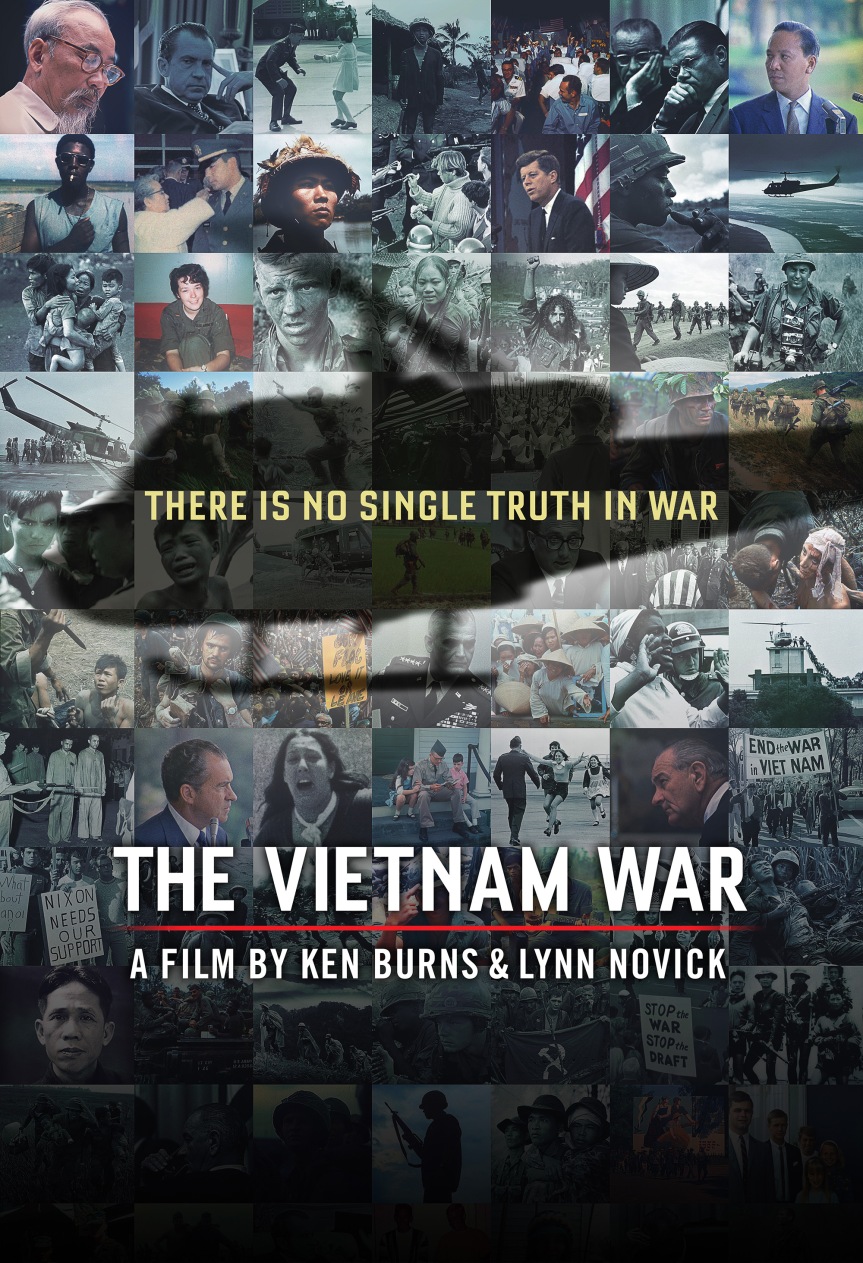
I’ve now watched all ten episodes of the Burns/Novick series on the Vietnam War. I’ve written about it twice already (here and here), and I won’t repeat those arguments. Critical reviews by Nick Turse, Peter Van Buren, Andrew Bacevich, and Thomas Bass are also well worth reading.
I now know the main message of the series: the Vietnam war was an “irredeemable tragedy,” with American suffering being featured in the foreground. The ending is revealing. Feel-good moments of reconciliation between U.S. veterans and their Vietnamese counterparts are juxtaposed with Tim O’Brien reading solemnly from his book on the things American troops carried in Vietnam. The Vietnamese death toll of three million people is briefly mentioned; so too are the bitter legacies of Agent Orange and unexploded ordnance; regional impacts of the war to Laos and Cambodia are briefly examined. But the lion’s share of the emphasis is on the American experience, with the last episode focusing on subjects like PTSD and the controversy surrounding the Vietnam War Memorial in Washington, D.C.
The series is well made and often powerful. Its fault is what’s missing. Little is said about the war being a crime, about the war being immoral and unjust; again, the war is presented as a tragedy, perhaps an avoidable one if only U.S. leaders had been wiser and better informed, or so the series suggests. No apologies are made for the war; indeed, the only apology featured is by an antiwar protester near the end (she’s sorry today for the harsh words she said decades ago to returning veterans).
The lack of apologies for wide-scale killing and wanton destruction, the lack of serious consideration of the war as a crime, as an immoral act, as unjust, reveals a peculiarly American bias about the war, which Burns/Novick only amplify. The series presents atrocities like My Lai as aberrations, even though Neil Sheehan is allowed a quick rejoinder about how, if you include massive civilian casualties from U.S. artillery and bombing strikes, My Lai was not aberrational at all. Not in the sense of killing large numbers of innocent civilians indiscriminately. Such killing was policy; it was routine. Sheehan’s powerful observation is not pursued, however.
What the Burns/Novick series truly needed was a two-hour segment devoted exclusively to the destruction inflicted on Southeast Asia and the suffering of Vietnamese, Laotian, and Cambodian peoples. Such a segment would have been truly eye-opening to Americans. Again, the series does mention napalm, Agent Orange, massive bombing, and the millions of innocents killed by the war. But images of civilian suffering are as fleeting as they are powerful. The emphasis is on getting to know the veterans, especially American ones, of that war. By comparison, the series neglects the profound suffering of Vietnamese, Laotians, and Cambodians.
In short, the series elides the atrocious nature of the war. This is not to say that atrocities aren’t mentioned. My Lai isn’t ignored. But it’s juxtaposed with communist atrocities, such as the massacre of approximately 2500 prisoners after the Battle of Hue during the Tet Offensive, a war crime committed by retreating North Vietnamese Army (NVA) and National Liberation Front (NLF) forces.
Yet in terms of scale and frequency the worst crimes were committed by U.S. forces, again because they relied so heavily on massive firepower and indiscriminate bombing. I’ve written about this before, citing Nick Turse’s book, Kill Anything That Moves, as well as the writings of Bernard Fall, who said that indiscriminate bombing attacks showed the U.S. was not “able to see the Vietnamese as people against whom crimes can be committed. This is the ultimate impersonalization of war.”
Why did many Americans come to kill “anything that moves” in Vietnam? Why, in the words of Fall, did U.S. officialdom fail to see the peoples of Southeast Asia as, well, people? Fellow human beings?
The Burns/Novick series itself provides evidence to tackle this question, as follows:
- At the ground level, U.S. troops couldn’t identify friend from foe, breeding confusion, frustration, and a desire for revenge after units took casualties. It’s said several times in the series that U.S. troops thought they were “chasing ghosts,” “phantoms,” a “shadowy” enemy that almost always had the initiative. In American eyes, it wasn’t a fair fight, so massive firepower became the equalizer for the U.S.—and a means to get even.
- Racism, depersonalization, and alienation. U.S. troops routinely referred to the enemy by various racist names: gooks, dinks, slopes, and so on. (Interestingly, communist forces seem to have referred to Americans as “bandits” or “criminals,” negative terms but not ones dripping with racism.) Many U.S. troops also came to hate the countryside (the “stinky” rice paddies, the alien jungle) as well. Racism, fear, and hatred bred atrocity.
- Body count: U.S. troops were pushed and rewarded for high body counts. A notorious example was U.S. Army Lieutenant General Julian Ewell. The commanding general of the 9th Infantry Division, Ewell became known as the “Butcher of the Delta.” Douglas Kinnard, an American general serving in Vietnam under Ewell, recounted his impressions of him (in “Adventures in Two Worlds: Vietnam General and Vermont Professor”). Ewell, recalled Kinnard, “constantly pressed his units to increase their ‘body count’ of enemy soldiers. This had become a way of measuring the success of a unit since Vietnam was [for the U.S. Army] a war of attrition, not a linear war with an advancing front line. In the 9th [infantry division] he had required all his commanders to carry 3” x 5” cards with body count tallies for their units by date, by week, and by month. Woe unto any commander who did not have a consistently high count.”
The Burns/Novick series covers General Ewell’s “Speedy Express” operation, in which U.S. forces claimed a kill ratio of 45:1 (45 Vietnamese enemy killed for each U.S. soldier lost). The series notes that an Army Inspector General investigation of “Speedy Express” concluded that at least 5000 innocent civilians were included as “enemy” in Ewell’s inflated body count—but no punishment was forthcoming. Indeed, Ewell was promoted.
Ewell was not the only U.S. leader who drove his troops to generate high body counts while punishing those “slackers” who didn’t kill enough of the enemy. Small wonder Vietnam became a breeding ground for atrocity.
- Helicopters. As one soldier put it, a helicopter gave you a god’s eye view of the battlefield. It gave you distance from the enemy, enabling easier kills (If farmers are running, they’re VC, it was assumed, so shoot to kill). Helicopters facilitated a war based on mobility, firepower, and kill ratios, rather than a war based on territorial acquisition and interaction with the people. In short, U.S. troops were often in and out, flitting about the Vietnamese countryside, isolated from the land and the people—while shooting lots and lots of ammo.
- What are we fighting for? For the grunt on the ground, the war made no sense. Bernard Fall noted that, after talking to many Americans in Vietnam, he hadn’t “found anyone who seems to have a clear idea of the end – of the ‘war aims’ – and if the end is not clearly defined, are we justified to use any means to attain it?”
The lack of clear and defensible war aims, aims that could have served to limit atrocities, is vitally important in understanding the Vietnam war. Consider the quotations from Presidents Kennedy and Johnson that lead this article. JFK claimed it wasn’t America’s war to win — it was South Vietnam’s. LBJ claimed he wasn’t going to send U.S. troops to Vietnam to fight; he was going to leave that to Asian boys. Yet JFK committed America to winning in South Vietnam, and LBJ sent more than half a million U.S. “boys” to wage and win that war.
Alienated as they were from the land and its peoples, U.S. troops were also alienated from their own leaders, who committed them to a war that, according to the proclamations of those same leaders, wasn’t theirs to win. They were then rewarded for producing high body counts. And when atrocities followed, massacres such as My Lai, U.S. leaders like Richard Nixon conspired to cover them up.
In short, atrocities were not aberrational. They were driven by the policy; they were a product of a war fought under false pretenses. This is not tragedy. It’s criminal.
Failing to face fully the horrific results of U.S. policy in Southeast Asia is the fatal flaw of the Burns/Novick series. To that I would add one other major flaw*: the failure to investigate war profiteering by the military-industrial complex, which President Eisenhower famously warned the American people about as he left office in 1961. Burns/Novick choose not to discuss which corporations profited from the war, even as they show how the U.S. created a massive “false” economy in Saigon, riven with corruption, crime, and profiteering.
As the U.S. pursued Vietnamization under Nixon, a policy known as “yellowing the bodies” by their French predecessors, the U.S. provided an enormous amount of weaponry to South Vietnam, including tanks, artillery pieces, APCs, and aircraft. Yet, as the series notes in passing, ARVN (the South Vietnamese army) didn’t have enough bullets and artillery shells to use their American-provided weaponry effectively, nor could they fly many of the planes provided by U.S. aid. Who profited from all these weapons deals? Burns/Novick remain silent on this question—and silent on the issue of war profiteering and the business side of war.
The Vietnam War, as Tim O’Brien notes in the series, was “senseless, purposeless, and without direction.” U.S. troops fought and died to take hills that were then quickly abandoned. They died in a war that JKF, Johnson, and Nixon admitted couldn’t be won. They were the losers, but they weren’t the biggest ones. Consider the words of North Vietnamese soldier, Bao Ninh, who says in the series that the real tragedy of the war was that the Vietnamese people killed each other. American intervention aggravated a brutal struggle for independence, one that could have been resolved way back in the 1950s after the French defeat at Dien Bien Phu.
But U.S. leaders chose to intervene, raining destruction on Southeast Asia for another twenty years, leading to a murderous death toll of at least three million. That was and is something more than a tragedy.
*A Note: Another failing of the Burns/Novick series is the lack of critical examination about why the war was fought and for what reasons, i.e. the series takes at face value the Cold War dynamic of falling dominoes, containment, and the like. It doesn’t examine radical critiques, such as Noam Chomsky’s point that the U.S. did achieve its aims in the war, which was the prevention of Vietnamese socialism/communism emerging as a viable and independent model for economic development in the 1950s and 1960s. In other words, a debilitating war that devastated Vietnam delayed by several decades that people’s emergence as an economic rival to the U.S., even as it sent a message to other, smaller, powers that the U.S. would take ruthless action to sustain its economic hegemony across the world. This line of reasoning demanded a hearing in the series, but it’s contrary to the war-as-tragedy narrative adopted by Burns/Novick.
For Chomsky, America didn’t accidentally or inadvertently or ham-fistedly destroy the Vietnamese village to save it; the village was destroyed precisely to destroy it, thereby strengthening capitalism and U.S. economic hegemony throughout the developing world. Accurate or not, this critique deserves consideration.