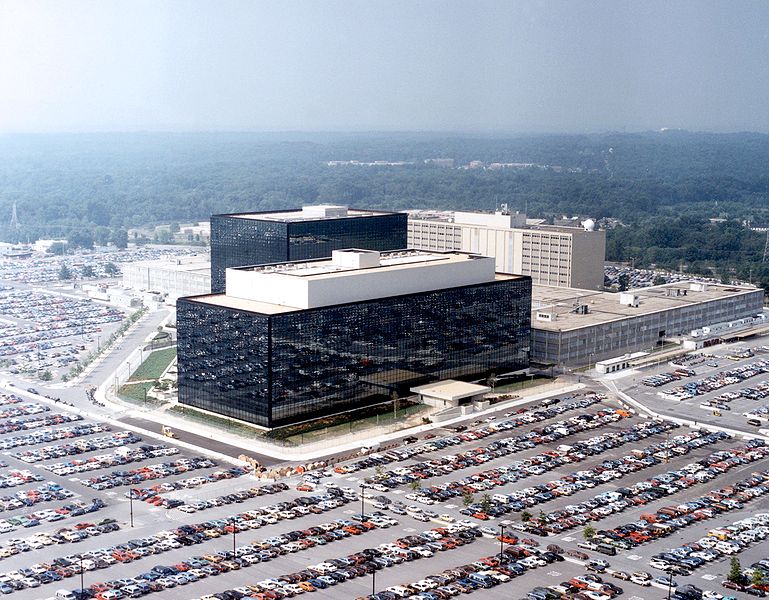
The National Security Agency, just one of seventeen agencies devoted to intelligence
W.J. Astore
A common belief shared by U.S. political pundits and a compliant and complicit U.S. media is that America never chooses its wars: it’s dragged into them. Last October, I read an article in the “liberal” New York Times that caught the mood perfectly. It worried the U.S. was being “sucked into” wars in the Middle East, drawn in, inexorably, by forces the world’s lone superpower couldn’t control. As if America’s leaders had no choice. As if they (and we) couldn’t walk away whenever we so chose.
What foolishness. By choice the U.S. has been meddling in the greater Middle East for decades (consider the CIA-orchestrated coup in Iran in 1953, to cite only one example). America is not being “sucked in” by uncontrollable forces. Our leaders choose to meddle – most often in extremely violent and prejudicial ways – in regions of the world they understand poorly, if at all
And poor understanding comes despite a massive intelligence complex featuring 17 agencies chewing through $70 billion a year. Indeed, according to a Washington Post study, the U.S. has nearly 1300 government organizations and nearly 2000 private companies devoted to counterterrorism, homeland security, and intelligence.
Let’s look at a tiny piece of that complex: the presence of 1500 intel operatives working daily to provide “actionable intelligence” for U.S. Central Command (CENTCOM) in Florida. Roughly the equivalent of a military regiment of high-priced intelligence operatives sits on its collective butt in Florida, gazing at computer screens, producing its own fog of war about the Middle East.
Indeed, much of war, American style has degenerated into watching people killed at a distance. Think of video footage from drone strikes that call to mind snuff films. Want explosive climaxes? As Peter Van Buren noted, they’ve got the war porn for you.
War, American style features lots of bragging about the military (We’re Number One!), lots of grinding in wars that last forever, but no satisfying climaxes, whether in Vietnam or Afghanistan or Iraq or Libya. Lots of steroidal militarism, but no clear military victories.
Donald Trump had a fleeting moment of sanity when he said in the last presidential debate that the U.S. after 9/11 wasted three or four trillion dollars on wars with nothing to show for it. That money should have been invested in America instead, he said, which caused Carly Fiorina to denounce him for sounding like Barack Obama! Yes, Obama the “feckless weakling,” according to that man-burger, Chris Christie.
Ergo I can suggest one safe bet for 2016: more war. At least we’re number one at something.
Update: I added this to the comments section below, but will also put it here for new readers.
Ten Features of War, American Style
1. Wars are no longer declared by Congress, and thus they are not waged in the name of the people.
2. Wars are now fought by “warriors” rather than by citizen-soldiers. Citizens are excluded from wars by choice and by design; they are reduced to cheerleaders and told to go shopping.
3. Wars no longer have a discernible end point. (How do you end a war on terror?)
4. Wars are supported by both parties and by the corporate-owned media as well. Dissenters to war are pushed to the margins and dismissed as unserious and/or misguided and/or unpatriotic.
5. War damage is confined largely to foreigners; American life continues on, undisturbed by war.
6. Major corporations continue to profit from war; similarly, the USA remains dominant in the world arms trade.
7. “Security” has become the byword of America, a security that is linked to a strong military presence overseas and a strong police presence at home. “Security” has become synonymous with guns and prisons in Lockdown USA. In other words, a war mentality has spread deeply into American consciousness, so much so that few people recognize its signs anymore. (Peace, love, understanding? Get thee behind me, Hippie!)
8. Related to (7): The celebration of all things military. Baseball uniforms with camouflage. Camouflage headsets for football coaches. Constant celebrations of military “heroes” in “private” venues, some of them paid for using public (taxpayers’) dollars.
9. No need for elites to risk their sons and daughters in war (no draft), thus apathy. When they do express some concern, they’re largely unable to critique war and U.S. foreign policy since they’ve been trained to defer to “experts.” Those experts? Mostly retired military officers, many with conflicts of interest, e.g. they work for defense contractors that profit from continuous war.
10. Fear. Fear is both a product of war and a generator of it. Fear is constantly stoked in the USA.
Chris Hedges, of course, is superb on this general question. Read his “War Is A Force that Gives Us Meaning.”
Back in January 2010, I wrote the following article for TomDispatch.com on the possibility of “a very American coup” occurring in conjunction with the presidential election of 2016. I make no claims to prescience: for example, the “great recession” I predicted didn’t come to pass, and there are as yet very few protesters in the streets, and no concerted movement rallying disaffected troops that I’m aware of. Nevertheless, I think there’s validity to some of my predictions in this article, and I encourage your comments in the section below on the path our country is treading as we head into 2016.
Here is the article, unchanged from when I wrote it nearly six years ago.
A Very American Coup Coming Soon to a Hometown Near You By William J. Astore
The wars in distant lands were always going to come home, but not this way.
It’s September 2016, year 15 of America’s “Long War” against terror. As weary troops return to the homeland, a bitter reality assails them: despite their sacrifices, America is losing.
Iraq is increasingly hostile to remaining occupation forces. Afghanistan is a riddle that remains unsolved: its army and police forces are untrustworthy, its government corrupt, and its tribal leaders unsympathetic to the vagaries of U.S. intervention. Since the Obama surge of 2010, a trillion more dollars have been devoted to Afghanistan, Iraq, Pakistan, and other countries in the vast shatter zone that is central Asia, without measurable returns; nothing, that is, except the prolongation of America’s Great Recession, now entering its tenth year without a sustained recovery in sight.
Disillusioned veterans are unable to find decent jobs in a crumbling economy. Scarred by the physical and psychological violence of war, fed up with the happy talk of duplicitous politicians who only speak of shared sacrifices, they begin to organize. Their motto: take America back.
Meanwhile, a lame duck presidency, choking on foreign policy failures, finds itself attacked even for its putative successes. Health-care reform is now seen to have combined the inefficiency and inconsistency of government with the naked greed and exploitative talents of corporations. Medical rationing is a fact of life confronting anyone on the high side of 50. Presidential rhetoric that offered hope and change has lost all resonance. Mainstream media outlets are discredited and disintegrating, resulting in new levels of information anarchy.
Protest, whether electronic or in the streets, has become more common — and the protestors in those streets increasingly carry guns, though as yet armed violence is minimal. A panicked administration responds with overlapping executive orders and legislation that is widely perceived as an attack on basic freedoms.
Tapping the frustration of protesters — including a renascent and mainstreamed “tea bag” movement — the former captains and sergeants, the ex-CIA operatives and out-of-work private mercenaries of the War on Terror take action. Conflict and confrontation they seek; laws and orders they increasingly ignore. As riot police are deployed in the streets, they face a grim choice: where to point their guns? Not at veterans, they decide, not at America’s erstwhile heroes.
A dwindling middle-class, still waving the flag and determined to keep its sliver-sized portion of the American dream, throws its support to the agitators. Wages shrinking, savings exhausted, bills rising, the sober middle can no longer hold. It vents its fear and rage by calling for a decisive leader and the overthrow of a can’t-do Congress.
Savvy members of traditional Washington elites are only too happy to oblige. They too crave order and can-do decisiveness — on their terms. Where better to find that than in the ranks of America’s most respected institution: the military?
A retired senior officer who led America’s heroes in central Asia is anointed. His creed: end public disorder, fight the War on Terror to a victorious finish, put America back on top. The United States, he says, is the land of winners, and winners accept no substitute for victory. Nominated on September 11, 2016, Patriot Day, he marches to an overwhelming victory that November, embraced in the streets by an American version of the post-World War I GermanFreikorps and the police who refuse to suppress them. A concerned minority is left to wonder (and tremble) at the de facto military coup that occurred so quickly, and yet so silently, in their midst.
It Can Happen Here, Unless We Act
Yes, it can happen here. In some ways, it’s already happening. But the key question is: at this late date, how can it be stopped? Here are some vectors for a change in course, and in mindset as well, if we are to avoid our own stealth coup:
1. Somehow, we need to begin to reverse the ongoing militarization of this country, especially our ever-rising “defense” budgets. The most recent of these, we’ve just learned, is a staggering $708 billion for fiscal year 2011 — and that doesn’t even include the $33 billion President Obama has requested for his latest surge in Afghanistan. We also need to get rid of the idea that anyone who suggests even minor cuts in defense spending is either hopelessly naïve or a terrorist sympathizer. It’s time as well to call a halt to the privatization of military activity and so halt the rise of security contractors like Xe (formerly Blackwater), thereby weakening the corporate profit motive that supports and underpins the American version of perpetual war. It’s time to begin feeling chastened, not proud, that we’re by far the number one country in the world in arms manufacturing and the global arms trade.
2. Let’s downsize our global mission rather than endlessly expanding our military footprint. It’s time to have a military capable of defending this country, not fighting endless wars in distant lands while garrisoning the globe.
3. Let’s stop paying attention to major TV and cable networks that rely onretired senior military officers, most of whom have ties both to the Pentagon and military contractors, for “unbiased” commentary on our wars. If we insist on fighting our perpetual “frontier” wars, let’s start insisting as well that they be covered in all their bitter reality: the death, the mayhem, the waste, the prisons, and the torture. Why is our war coverage invariably sanitized to “PG” or even “G,” when we can go to the movies anytime and see “R” rated, pornographically violent films? And by the way, it’s time to be more critical of the government’s and the media’s use of language and propaganda. Mindlessly parroting the Patriot Act doesn’t make you patriotic.
4. It’s time to elect a president who doesn’t surround himself with senior “civilian” advisors and ambassadors who are actually retired military generals and admirals, one who won’t accept a Nobel Peace Prize by defending war in theory and escalating it in practice.
5. Let’s toughen up. Let’s stop deferring to authority figures who promise to “protect” us while abridging our rights. Let’s stop bowing down before men and women in uniform, before they start thinking that it’s their right to be worshipped and act accordingly.
6. Let’s act now to relieve the sort of desperation bred by joblessness and hopelessness that could lead many — notably male workers suffering from the “He-Cession” — to see a militarized solution in “the homeland” as a credible last resort. It’s the economy, stupid, but with Main Street’s health, not Wall Street’s, in our focus.
7. Let’s take Sarah Palin and her followers seriously. They’re tapping into anger that’s real and spreading. Don’t let them become the voices of the angry working (and increasingly unemployed) classes.
8. Recognize that we face real enemies in our world, the most powerful of which aren’t in distant Afghanistan or Yemen but here at home. The essence of our struggle to sustain our faltering democracy should not be against “terrorists,” with their shoe and crotch bombs, but against various powerful, perfectly legal groups here whose interests lie in a Pentagon that only grows ever stronger.
9. Stop thinking the U.S. is uniquely privileged. Don’t take it on faith that God is on our side. Forget about God blessing America. If you believe in God, get out there and start trying to earn His blessing through deeds.
10. And, most important of all, remember that fear is the mind-killer that makes militarism possible. Ramping up “terror” is an amazingly effective way of shredding our Constitution. Putting our “safety” above all else is asking for trouble. The only way we’ll be completely safe from the big bad terrorists, after all, is when we’re all living in a maximum security state. Think of walking down the street while always being subject to a “full-body scan.”
That’s my top 10 things we need to do. It’s a daunting list and I’m sure you have a few ideas of your own. But have faith. Ultimately, it all boils down to Franklin Delano Roosevelt’s words to a nation suffering through the Great Depression: the only thing we have to fear is fear itself. These words came to mind recently as I read the following missive from a friend and World War II veteran who’s seen tough times:
“It’s very hard for me to accept how soft the American people have become. In 1941, with the western world under assault by powerful and deadly forces, and a large armada of ships and planes attacking us directly, I never heard a word of fear as we faced three powerful nations as enemies. Sixteen million of us went into the military with the very real possibility of death and I never once heard of fear, except from those exposed to danger. Now, our people let [their leaders] terrify them into accepting the destruction of our economy, our image in the world, and our democracy… All this over a small group of religious fanatics [mostly] from Saudi Arabia whom we kowtow to so we can drive 8-cylinder SUV’s. Pathetic!
“How many times have I stood in ‘security lines’ at airports and when I complained of the indignity of taking off shoes and not having water and the manhandling of passengers, have well educated people smugly said to me, ‘Well, they’re just keeping us safe.’ I look at the airport bullshit as a training ground to turn Americans into docile sheep in a totalitarian state.”
A public conditioned to act like sheep, to “support our troops” no matter what, to cower before the idea of terrorism, is a public ready to be herded. A military that’s being used to fight unwinnable wars is a military prone to return home disaffected and with scores to settle.
Angry and desperate veterans and mercenaries already conditioned to violence, merging with “tea baggers” and other alienated groups, could one day form our own Freikorps units, rioting for violent solutions to national decline. Recall that the Nazi movement ultimately succeeded in the early 1930s because so many middle-class Germans were scared as they saw their wealth, standard of living, and status all threatened by the Great Depression.
If our Great Recession continues, if decent jobs remain scarce, if the mainstream media continue to foster fear and hatred, if returning troops are disaffected and their leaders blame politicians for “not being tough enough,” if one or two more terrorist attacks succeed on U.S. soil, wouldn’t this country be well primed for a coup by any other name?
Don’t expect a “Seven Days in May” scenario. No American Caesar will return to Washington with his legions to decapitate governmental authority. Why not? Because he won’t have to.
As long as we continue to live in perpetual fear in an increasingly militarized state, we establish the preconditions under which Americans will be nailed to, and crucified on, a cross of iron.
Waving the flag and wielding a gun: Hey, it’s the USA!
W.J. Astore
A century ago, the USA was a dynamic, forward-looking, freedom-espousing country that was focused on science and technology and its practical applications, as represented by Thomas Edison and Henry Ford. We were about to reelect a president, Woodrow Wilson, precisely because he had kept the country out of World War I. With the exception of the Navy, the U.S. military was small, and few Americans (Teddy Roosevelt comes to mind) boasted about the “manly” virtues of military service and war.
Here we are, a century later, in a country that has taken up militarism, a country which is increasingly reactionary, authoritarian, and backward-leaning, a country that leads the world not in innovation for ordinary people as in the days of Edison and Ford, but in weapons exports to the world’s trouble spots.
Anyone with a sense of history — indeed, anyone with common sense — should recognize that militaries are antithetical to democracy. Indeed, most Americans recognized exactly that in 1915. A true democracy has a military as a reluctant and regrettable choice, driven by the need to defend itself in a hostile and violent world. But over the last century a regrettable choice has become, not only requisite, but celebratory in the USA. Like so many amped up Teddy Roosevelt’s, striving to prove our manhood, America now believes military service conveys nobility. Heroic meaning.
Yet celebrating the military, nobilizing the military experience, finding purpose and meaning in continuous war, is the very definition of militarism.
Admittedly, American militarism is a peculiar strain. It’s not the Germanic kind in which a conservative aristocracy found its reason for being and its privileged position in military service. There are no Prussian Junkers who willingly revel in a martial code of honor and duty in war. Indeed, America’s aristocracy of wealth reserves the right to exclude itself from military service even as it applauds the sons and daughters of the lower orders who enlist to fight (and sometimes to die).
Again, it’s a strange militarism, militarism USA, one in which military service is indeed one of the few avenues for America’s working classes to rise by merit (tightly defined within a hierarchical structure that breeds and rewards conformity), and where a few generals actually attain a measure of cult status, however temporary (recent examples include Colin Powell, Tommy Franks, and David Petraeus). Yet celebrated generals come and go, even as America’s wars are continuous.
Indeed, we’ve become so accustomed to living with the drumbeats of war that we no longer hear them. It reminds me of a lesson an officer taught on World War I at the Air Force Academy. He played sounds of an artillery barrage for the entire 50 minutes of the lesson. When you first walked in, the noise hit you. Then you sort of forgot about it as he taught the lesson. Just before the end, he turned off the noise, and the silence spoke. You realized, just a little, what it had been like for troops in the trenches in 1916 living under artillery bombardment. And you also realized how quickly we can all become more or less accustomed to the drumbeats of war.
We’re hearing them all the time today — it’s the background noise to our lives. For some, it’s even become sweet music. But war and militarism is never sweet music to a functioning democracy.
One final point: Some Americans react as if calling attention to the militarization of our society/culture is the same as being anti-military. Being against militarism and war is not being anti-military: more the reverse. There’s a strange conflation or confusion there — and this conflation/confusion is a sign of how far militarism has gotten under our collective skin and into the nation’s blood stream.
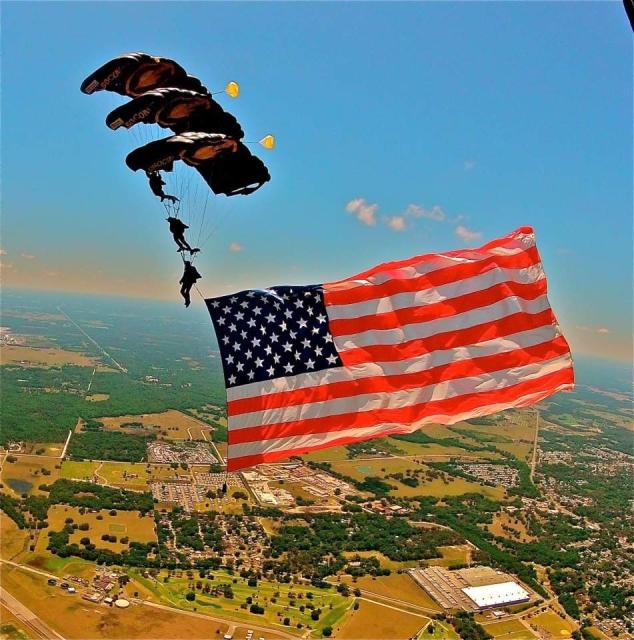
A Triple Stack of Special Ops with Flag — Hooah! (Photo Credit: SOCOM)
W.J. Astore
Nick Turse has a revealing new piece at TomDispatch.com on the rise of Special Forces and SOCOM (Special Ops Command) within the U.S. military. (For a telling critique of America’s excess of enthusiasm for Special Forces, see last year’s article here by Dan White for The Contrary Perspective.)
What are we to make of U.S. Special Forces being involved, in one way or another, in the affairs of 150 countries in the world over the last three years? And, as Turse points out, just 66 days into Fiscal Year 2015, U.S. Special Forces have already made their presence known in 105 countries, a presence that seems never to wane.
One historical analogy that occurs to me (which I’ve used before) is the rise of the Society of Jesus, the Jesuits, within an embattled Catholic Church during the Reformation. A besieged Church needed true believers to take the fight to heretical Protestants who were bent on the Church’s destruction. So along came Ignatius Loyola and his church militant of Jesuit priests, sworn to believe that black was white if the Holy Church deemed it so. Considered an elite within the Church, the Jesuits took the fight to the Protestants during the Catholic Counter Reformation in Europe and across the world. Jesuits were everywhere, from China in the Old World to nearly everywhere in the New World, crusading for the Church and against the incursions of Protestantism and its various sects.
So, how does the 16th century shed light on the 21st? America’s Vatican is obviously the Pentagon. Its primary methods are wars and weapons sales and military training. Its Loyola was until recently Admiral William McRaven, head of SOCOM. And its Jesuit priests are America’s Special Ops troops, true believers who are committed to defending the faith of America.
In the aftermath of 9/11, in a rare outburst of honesty, George W. Bush said America was on a crusade across the world. You might say against “protestants” and other heretics to the American way of life. And who are our crusaders? Who is being sent virtually everywhere (remember those 150 countries in three years?) on various “missions”?
Like it or not, America’s Special Forces are our lead missionaries, our Jesuits, our church militant.
The new head of SOCOM, General Joseph Votel III, West Point grad and Army Ranger, put it plainly back in August that America is witnessing “a golden age for special operations.” What a telling phrase. And indeed it’s getting increasingly difficult to recall “golden ages” in America’s past that weren’t linked to the military.
But that’s no accident when the national church is the Pentagon and its Special Ops troops are acclaimed as so many missionary heroes.
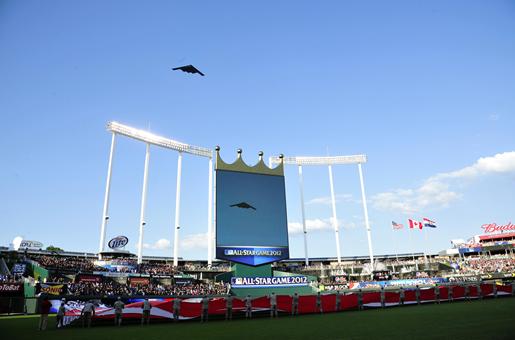
A nuclear-capable B-2 Stealth Bomber flies over a gigantic flag at the 2012 Baseball All-Star Game
W.J. Astore
As Veterans Day approaches, I thought I’d revive a column I wrote for TomDispatch.com back in 2009. I continue to marvel at the militarism of the USA, and the way in which the troops are defined as “warriors” and “warfighters” who increasingly see themselves as being divorced from, and superior to, “civilians” in the USA. Of course, there was a time in America when our troops were proud to define themselves as citizen-soldiers, with the emphasis on citizen. Not anymore. The ethos has changed, pushed toward a “professional” military that sees itself as a breed apart. And that’s not good for democracy.
I still recall the example set by Major Dick Winters, memorialized in the “Band of Brothers” series on HBO. Dick Winters swore that when the war was over against Nazi Germany and Imperial Japan, he’d return to his farm in Pennsylvania and leave soldiering and war behind. And that’s exactly what he did. No “warrior” nonsense for him.
Anyway, here’s the article I wrote five years ago. Sadly, its theme is more relevant today than it was in 2009.
What Ever Happened to Gary Cooper? A Seven-Step Program to Return America to a Quieter, Less Muscular, Patriotism By William Astore
I have a few confessions to make: After almost eight years of off-and-on war in Afghanistan and after more than six years of mayhem and death since “Mission Accomplished” was declared in Operation Iraqi Freedom, I’m tired of seeing simpleminded magnetic ribbons on vehicles telling me, a 20-year military veteran, to support or pray for our troops. As a Christian, I find it presumptuous to see ribbons shaped like fish, with an American flag as a tail, informing me that God blesses our troops. I’m underwhelmed by gigantic American flags — up to 100 feet by 300 feet — repeatedly being unfurled in our sports arenas, as if our love of country is greater when our flags are bigger. I’m disturbed by nuclear-strike bombers soaring over stadiums filled with children, as one did in July just as the National Anthem ended during this year’s Major League Baseball All Star game. Instead of oohing and aahing at our destructive might, I was quietly horrified at its looming presence during a family event.
We’ve recently come through the steroid era in baseball with all those muscled up players and jacked up stats. Now that players are tested randomly, home runs are down and muscles don’t stretch uniforms quite as tightly. Yet while ending the steroid era in baseball proved reasonably straightforward once the will to act was present, we as a country have yet to face, no less curtail, our ongoing steroidal celebrations of pumped-up patriotism.
It’s high time we ended the post-Vietnam obsession with Rambo’s rippling pecs as well as the jaw-dropping technological firepower of the recent cinematic version of G.I. Joe and return to the resolute, undemonstrative strength that Gary Cooper showed in movies like High Noon.
In the HBO series The Sopranos, Tony (played by James Gandolfini) struggles with his own vulnerability — panic attacks caused by stress that his Mafia rivals would interpret as fatal signs of weakness. Lamenting his emotional frailty, Tony asks, “What ever happened to Gary Cooper?” What ever happened, in other words, to quiet, unemotive Americans who went about their business without fanfare, without swagger, but with firmness and no lack of controlled anger at the right time?
Tony’s question is a good one, but I’d like to spin it differently: Why did we allow lanky American citizen-soldiers and true heroes like World War I Sergeant Alvin York (played, at York’s insistence, by Gary Cooper) and World War II Sergeant (later, first lieutenant) Audie Murphy (played in the film To Hell and Back, famously, by himself) to be replaced by all those post-Vietnam pumped up Hollywood “warriors,” with Sylvester Stallone and Arnold Schwarzenegger-style abs and egos to match?
And far more important than how we got here, how can we end our enduring fascination with a puffed up, comic-book-style militarism that seems to have stepped directly out of screen fantasy and into our all-too-real lives?
A Seven-Step Recovery Program
As a society, we’ve become so addicted to militarism that we don’t even notice the way it surrounds us or the spasms of societal ‘roid rage that go with it. The fact is, we need a detox program. At the risk of incurring some of that ‘roid rage myself, let me suggest a seven-step program that could help return us to the saner days of Gary Cooper:
1. Baseball players on steroids swing for the fences. So does a steroidal country. When you have an immense military establishment, your answer to trouble is likely to be overwhelming force, including sending troops into harm’s way. To rein in our steroidal version of militarism, we should stop bulking up our military ranks, as is now happening, and shrink them instead. Our military needs not more muscle supplements (or the budgetary version of the same), but far fewer.
2. It’s time to stop deferring to our generals, and even to their commander-in-chief. They’re ours, after all; we’re not theirs. When President Obama says Afghanistan is not a war of choice but of necessity, we shouldn’t hesitate to point out that the emperor has no clothes. Yet when it comes to tough questioning of the president’s generals, Congress now seems eternally supine. Senators and representatives are invariably too busy falling all over themselves praising our troops and their commanders, too worried that “tough” questioning will appear unpatriotic to the folks back home, or too connected to military contractors in their districts, or some combination of the three.
Here’s something we should all keep in mind: generals have no monopoly on military insight. What they have a monopoly on is a no-lose situation. If things go well, they get credit; if they go badly, we do. Retired five-star general Omar Bradley was typical when he visited Vietnam in 1967 and declared: “I am convinced that this is a war at the right place, at the right time and with the right enemy — the Communists.” North Vietnam’s only hope for victory, he insisted, was “to hang on in the expectation that the American public, inadequately informed about the true situation and sickened by the loss in lives and money, will force the United States to give up and pull out.”
There we have it: A classic statement of the belief that when our military loses a war, it’s always the fault of “we the people.” Paradoxically, such insidious myths gain credibility not because we the people are too forceful in our criticism of the military, but because we are too deferential.
3. It’s time to redefine what “support our troops” really means. We console ourselves with the belief that all our troops are volunteers, who freely signed on for repeated tours of duty in forever wars. But are our troops truly volunteers? Didn’t we recruit them using multi-million dollar ad campaigns and lures of every sort? Are we not, in effect, running a poverty and recession draft? Isolated in middle- or upper-class comfort, detached from our wars and their burdens, have we not, in a sense, recruited a “foreign legion” to do our bidding?
If you’re looking for a clear sign of a militarized society — which few Americans are — a good place to start is with troop veneration. The cult of the soldier often covers up a variety of sins. It helps, among other things, hide the true costs of, and often the futility of, the wars being fought. At an extreme, as the war began to turn dramatically against Nazi Germany in 1943, Germans who attempted to protest Hitler’s failed strategy and the catastrophic costs of his war were accused of (and usually executed for) betraying the troops at the front.
The United States is not a totalitarian state, so surely we can hazard criticisms of our wars and even occasionally of the behavior of some of our troops, without facing charges of stabbing our troops in the back and aiding the enemy. Or can we?
4. Let’s see the military for what it is: a blunt instrument of force. It’s neither surgical nor precise nor predictable. What Shakespeare wrote 400 years ago remains true: when wars start, havoc is unleashed, and the dogs of war run wild — in our case, not just the professional but the “mercenary” dogs of war, those private contractors to the Pentagon that thrive on the rich spoils of modern warfare in distant lands. It’s time to recognize that we rely ever more massively to prosecute our wars on companies that profit ever more handsomely the longer they last.
5. Let’s not blindly venerate the serving soldier, while forgetting our veterans when they doff their spiffy uniforms for the last time. It’s easy to celebrate our clean-cut men and women in uniform when they’re thousands of miles from home, far tougher to lend a hand to scruffier, embittered veterans suffering from the physical and emotional trauma of the battle zones to which they were consigned, usually for multiple tours of duty.
6. I like air shows, but how about — as a first tiny step toward demilitarizing civilian life — banning all flyovers of sporting events by modern combat aircraft? War is not a sport, and it shouldn’t be a thrill.
7. I love our flag. I keep my father’s casket flag in a special display case next to the very desk on which I’m writing this piece. It reminds me of his decades of service as a soldier and firefighter. But I don’t need humongous stadium flags or, for that matter, tiny flag lapel pins to prove my patriotism — and neither should you. In fact, doesn’t the endless post-9/11 public proliferation of flags in every size imaginable suggest a certain fanaticism bordering on desperation? If we saw such displays in other countries, our descriptions wouldn’t be kindly.
Of course, none of this is likely to be easy as long as this country garrisons the planet and fights open-ended wars on its global frontiers. The largest step, the eighth one, would be to begin seriously downsizing that mission. In the meantime, we shouldn’t need reminding that this country was originally founded as a civilian society, not a militarized one. Indeed, the revolt of the 13 colonies against the King of England was sparked, in part, by the perceived tyranny of forced quartering of British troops in colonial homes, the heavy hand of an “occupation” army, and taxation that we were told went for our own defense, whether we wanted to be defended or not.
If Americans are going to continue to hold so-called tea parties, shouldn’t some of them be directed against the militarization of our country and an enormous tax burden fed in part by our wasteful, trillion-dollar wars?
Modest as it may seem, my seven-step recovery program won’t be easy for many of us to follow. After all, let’s face it, we’ve come to enjoy our peculiar brand of muscular patriotism and the macho militarism that goes with it. In fact, we revel in it. Outwardly, the result is quite an impressive show. We look confident and ripped and strong. But it’s increasingly clear that our outward swagger conceals an inner desperation. If we’re so strong, one might ask, why do we need so much steroidal piety, so many in-your-face patriotic props, and so much parade-ground conformity?
Forget Rambo and action-picture G.I. Joes: Give me the steady hand, the undemonstrative strength, and the quiet humility of Alvin York, Audie Murphy — and Gary Cooper.
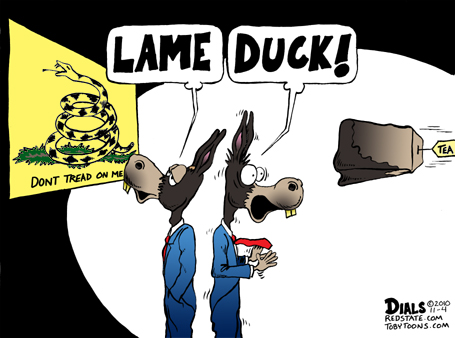
It’s not just the Tea Party that’s lame (Toby Toons)
W.J. Astore
The more the United States has come to talk about dominance, the less dominant we’ve become.
To compensate, we’ve become a steroidal nation, to include the violent side effects associated with steroid use (just look at the latest stories out of the NFL about spousal and child abuse, or our steroidal police forces, including MRAPs and M-16s for school police). If the story of the last fifty years is the gradual decline of the U.S., most notably in the economic and political realms, the story of today is how we’ve compensated with militarized Viagra. We’ve reached “the age of knowing” that we’ve lost much of our potency as our country. To compensate, we’re forever popping pills and flexing our muscles. (Just look at John McCain’s enthusiasm for bombing.)
It’s precisely those steroids that are weakening us as a country. As we’ve overcompensated with military weapons and bases, we’ve allowed our economy to slide. As we’ve sought domination overseas, we’ve weakened our country right here at home. We feverishly build and repair roads in Afghanistan but not here in the USA. Same with schools — we’d rather build prisons, to include Gitmo, than colleges (since 1984, California has built 21 prisons but only one university).
Consider our binary debates on foreign policy. It’s the hawks versus the doves, militarized “engagement” versus isolationist “appeasers,” the implication being that the latter is wrong — that minding one’s own business is not an option in a globalized world. But the world is not some “global village”: it’s a conglomeration of fragments. And U.S. efforts to dominate those fragments by military means are only accelerating that fragmentation. Just look at what our government did and is doing to Iraq and Afghanistan.
Fragmentation facilitates dominance by multinational corporations even as the U.S. military is misused and overextended. The result is more global instability and a retreat (or a return) to ideologies that promise coherence and order. Witness the rise of militant Islam and ISIS. By attacking it, the U.S. is acting as an accelerant to it.
As the U.S. weakens itself as a country, as it accumulates debt by constantly fighting wars while passing the costs along to future generations, large multinational corporations grow in power. They are today’s equivalent to the British East India Company, the Dutch East India Company, and similar entities of the past. Combine powerful multinationals with privatized mercenary outfits and you see echoes of the seventeenth century, to include wars over religion and resources. Three centuries ago, it was Catholics versus Protestants and wars over spices like pepper and nutmeg. Now it’s divisions within Islam and wars over oil.
We’re witnessing the decline of Enlightenment ideals and community-based Democracy, as seen by the way in which the U.S. government routinely betrays those ideals. Any sense of shared, community-based, obligation is tainted by “socialism,” meaning that a Darwinian capitalism based on selfish individualism is promoted instead, which only feeds the growth of multinationals competing to sell “product” to the masses.
Everything is becoming a consumable, including the most vital parts of life. As a consumable, it can be marketed, sold, and controlled by those same multinationals. Even education is now an ephemeral product, marketed and sold as a commodity.
Corporations think and act for short-term profit. But democracies are supposed to think strategically, over the long term. Now the quarterly business cycle controls all. Look at politics: A congressman is elected and instantly starts fund raising to win his next campaign. Obama wins a second term and is almost instantly branded a lame duck.
But it’s not Obama who is the lame duck – it’s America. And all the militarized steroids in the world won’t cure that lameness. Indeed, they just aggravate it.
The business of wars and weapons sales is booming, with the United States leading the pack as the world’s foremost “merchant of death,” as Michael Klare notes in this article on the global arms trade for TomDispatch.com.
But why should we be surprised? War has always been a racket. And if you don’t believe me that forever war is forever profitable – for some, I recommend that you read War Is A Racket (1935), a classic polemic written by U.S. Marine Corps General Smedley D. Butler. Twice awarded the Medal of Honor, Major General Butler turned against military adventurism in the 1930s as he saw how his efforts and those of his men were exploited by elites to expand corporate wealth and power, even as they exempted themselves from the hardships and dangers of combat.
Plaque in Philly in Honor of Smedley Butler. Photo by author.
As Butler put it in War Is A Racket:
“How many of the war millionaires shouldered a rifle [during World War I]? How many of them dug a trench? How many of them knew what it meant to go hungry in a rat-infested dug-out? How many of them spent sleepless, frightened nights, ducking shells and shrapnel and machine gun bullets? How many of them parried a bayonet thrust of an enemy? How many of them were wounded or killed in battle?”
Not many. Butler knew who really paid war’s high bills:
“Yes, the soldier pays the greater part of the bill. His family pays too. They pay it in the same heart-break that he does. As he suffers, they suffer. At nights, as he lay in the trenches and watched shrapnel burst about him, they lay home in their beds and tossed sleeplessly … And even now the families of the wounded men and of the mentally broken and those who never were able to readjust themselves are still suffering and still paying.”
And Butler knew how best to put an end to the racket of war. He was blunt – and right:
“We must take the profit out of war.”
“We must permit the youth of the land who would bear arms to decide whether or not there should be war.”
“We must limit our military forces to home defense purposes.”
Tragically, since the end of World War II Butler’s sage advice has been completely ignored. War is more profitable now than ever. We permit our youth to have no say in whether there should be a war. (Congress hasn’t issued a formal declaration of war since 1941.) And today as a country we equate “home defense” with the world’s strongest military, configured for global reach, global power, boasting of “full-spectrum dominance.”
Unless we heed Butler’s advice, debilitating wars will continue. They will continue because perpetual war is simply too profitable. In the racket of war, the chief racketeers are easy to identify. As Butler knew, just follow the money.




 Bracing Views