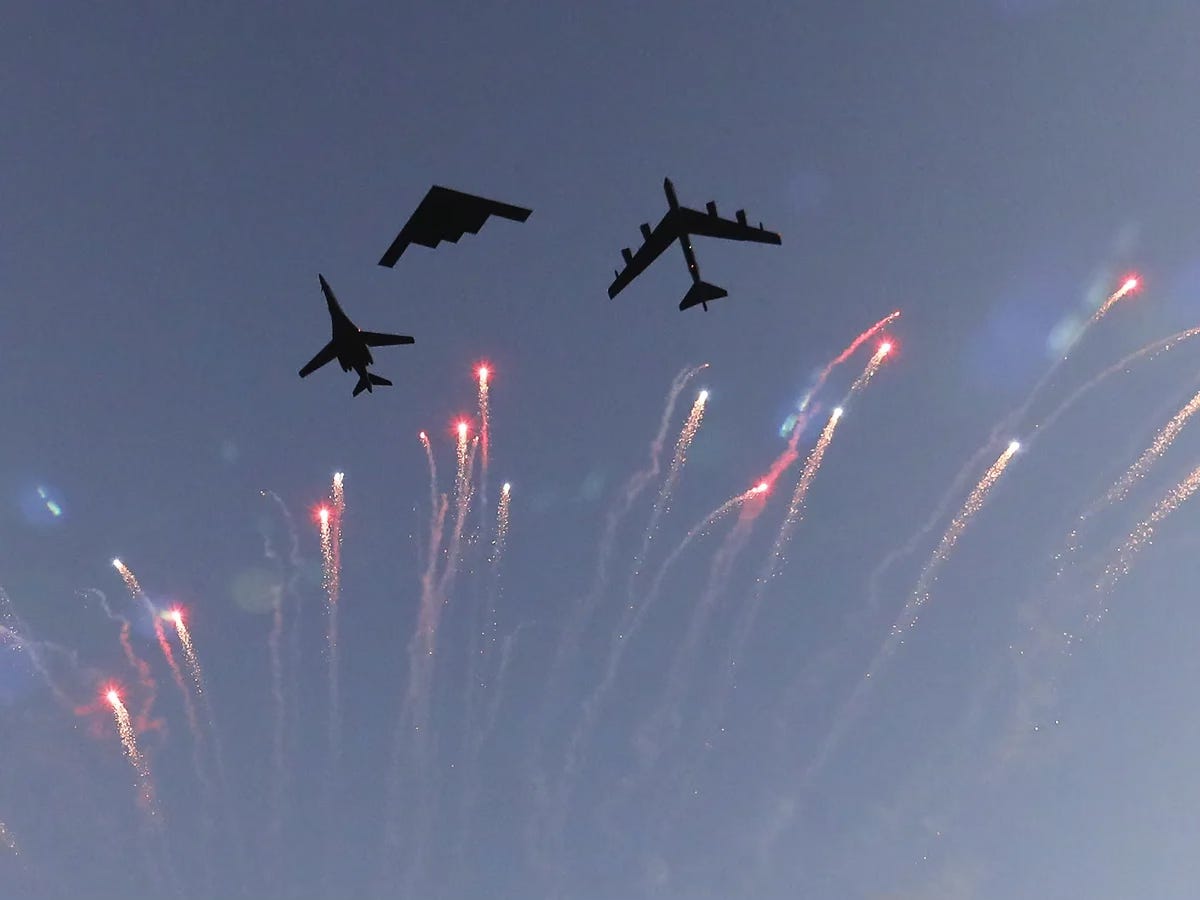
There’s a full slate of NFL football games today, meaning there’ll be a full slate of military flyovers and similar ceremonies to “support” our troops. The militarization of sports in America is something to behold, and a new report that tackles the issue is available from a series on “Consuming War” at Brown University. Here’s the link.
It put me to mind of an article I wrote for Huff Post back in 2011. Fourteen years later, the unholy alliance between sports and the military has only deepened.
Here’s what I wrote in 2011. What do you think, readers? Will we ever learn to play ball again without all the military trappings?
America!
The Militarization of Sports — And the Sportiness of Military Service
The co-joining of corporate-owned sports teams and events with the military strikes me as more than disturbing. We’ve created a dangerous dynamic in this country: one in which sporting events are exploited to sell military service for some while providing cheap grace for all.
Writer, History Professor, Retired Lieutenant Colonel (USAF)
Jul 28, 2011, 01:19 PM EDT
Updated Sep 27, 2011
Connecting sports to military service and vice versa has a venerable history. The Battle of Waterloo (1815) was won on the playing fields of Eton, Wellington allegedly said. Going over the top at the Battle of the Somme (1916), a few British soldiers kicked soccer balls in the general direction of the German lines. American service academies have historically placed a high value on sports (especially football) for their ability to generate and instill leadership, teamwork and toughness under pressure.
But in today’s America, we are witnessing an unprecedented militarization of sports, and a concomitant emphasis on the sportiness of military service. With respect to the latter, take a close look at recent Army recruitment ads (which I happen to see while watching baseball). These ads show soldiers lifting weights, playing volleyball, climbing mountains and similar sporty activities. The voice-over stresses that army service promotes teamwork and toughness (“There’s strong. Then there’s armystrong.”) There are, of course, no shots of soldiers under direct fire, of wounded soldiers crying for help, of disabled veterans. Army service in these ads is celebrated as (and reduced to) an action-filled sequence of sporting events.
Today’s militarization of sports is even more blatant. Consider this excellent article by U.S. Army Colonel (retired) Andrew Bacevich, which highlights the “cheap grace” available to crowds at major sporting events. For-profit sports corporations and the Pentagon join hands to orchestrate pageants that encourage (manipulate?) us to cheer and celebrate our flag, our troops and our sports and military heroes, as the obligatory fighter jets roar overhead.
Now, I’m sure there are well-meaning people who see such pageantry as an uncontroversial celebration of love of country, as well as a gesture of generosity and thanks to our military. And this retired veteran admits to feeling my heart swell when I see our flag flying proudly and our troops marching smartly. But the co-joining of corporate-owned sports teams and events (which are ultimately about entertainment and making a buck) with the military (which is ultimately in the deadly business of winning wars) strikes me as more than disturbing.
To cite only one example: The San Diego Padres baseball team takes “tremendous pride” in being “the first team in professional sports to have a dedicated military affairs department,” according to a team press release quoting Tom Garfinkel, the Padres president and chief operating officer. But is it truly “tremendous” for sports teams to be creating “military affairs” departments? As our sporting “heroes” celebrate our military ones, does not a dangerous blurring take place, especially in the minds of America’s youth?
War is not a sport; it’s not entertainment; it’s not fun. And blurring the lines between sport and war is not in the best interests of our youth, who should not be sold on military service based on stadium pageantry or team marketing, however well-intentioned it may be.
We’ve created a dangerous dynamic in this country: one in which sporting events are exploited to sell military service for some while providing cheap grace for all, even as military service is sold as providing the thrill of (sporting) victory while elevating our troops to the status of “heroes” (a status too often assigned by our society to well-paid professional athletes).
Which brings me to a humble request: At our sporting events, is it too much to ask that we simply “Play Ball?” In our appeals for military recruits, is it too much for us to tell them that war is not a sport?
Think of these questions the next time those military warplanes roar over the coliseum of your corporate-owned team.
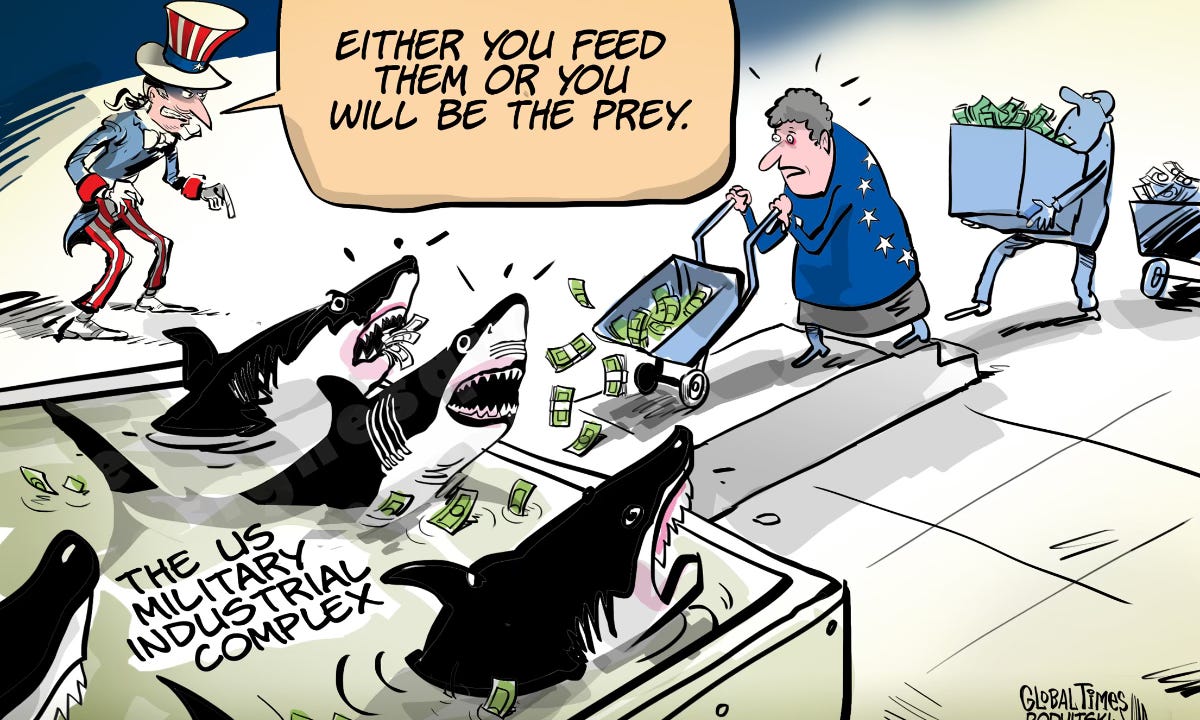
Hello Everyone: Here’s my latest article at TomDispatch.com. Whereas my articles for BV are usually 400-600 words, my articles for TomDispatch are usually just over 2000 words, which allows me to develop my points further, supported by plenty of links. Oh, and my wife and I really do use the expression, “But Bibi needs bombs,” whenever the government says it can’t fund something for the American people. It’s funny but I’ve never heard anyone in Congress ask: Bombs for Bibi—how are you going to pay for that? America’s bipartisan warmongers always find plenty of money for weapons and war, even as money for health care and other needs evaporates. It’s almost as if America has a powerful military-industrial complex combined with pushy lobbying groups like AIPAC.
*****
As a retired U.S. Air Force officer, I firmly believe in civilian control of our military. This country should be a nation of laws — not of special interests, oligarchs, or kings. Before committing our forces to battle, Congress should always declare war in the name of the people. Our military should indeed be a citizen-soldier force, not an isolated caste driven by a warrior ethos. And above all, the United States should be a republic ruled by law and shaped by sound moral values, not a greed-driven empire fueled by militarism.
Yet when I express such views, I feel like I’m clinging to a belief in the tooth fairy, the Easter Bunny, and Santa Claus. It feels idealistic, naïve, even painful to think that way. Yes, I served this country in uniform for 20 years, and now, in the age of Donald Trump, it has, as far as I can tell, thoroughly lost its way. The unraveling began so long ago — most obviously with the disastrous Vietnam War of the 1960s and 1970s, though in truth this country’s imperial desires predated even the Spanish-American War of 1898, stretching back to the wanton suppression of indigenous peoples as part of its founding and expansion.
A glance at U.S. history reveals major atrocities: the displacement and murder of Native Americans, slavery, and all too many imperial misadventures abroad. I knew of such realities when I joined the military in 1985, near the end of the Cold War. Despite its flaws, I believed then that this country was more committed to freedom than the Soviet Union. We could still claim some moral authority as the leader of what we then referred to as “the free world,” however compromised or imperfect our actions were.
That moral authority, however, is now gone. U.S. leaders fully support and unapologetically serve an ongoing genocide against the Palestinian people in Gaza. They sell weapons to nearly every regime imaginable, irrespective of human rights violations. They wage war without Congressional approval — the recent 12-day assault on Iran being just the latest example. (The second Trump administration has, in fact, launched almost as many air strikes, especially in Yemen and Somalia, in its first five months as the Biden administration did in four years.) Those same leaders have been doing a bang-up job dismantling the America I thought I was serving when I took that oath and put on second lieutenant’s bars four decades ago. That America — assuming it ever existed — may now be gone forever.
FUBAR: A Republic in Ruins
My fellow citizens, America is FUBAR (a term that dates from World War II). We are not faintly who we claim to be. Rather than a functioning republic, we are an ailing, flailing, perhaps even failing empire. We embrace war, glorify warriors, and profit mightily from the global arms trade, no matter the civilian toll, including tens of thousands of dead and wounded children in Gaza, among the latest victims of U.S.-made bombs, bullets, and missiles.
Signs of moral rot are everywhere. Our president, who would like to be known for his budget cuts, nonetheless giddily celebrates a record trillion-dollar war budget. Our secretary of defense gleefully promotes a warrior ethos. Congress almost unanimously supports or acquiesces in the destruction of Gaza. Images from the region resemble bombed-out Stalingrad in 1942 or Berlin in 1945. Meanwhile, for more than two decades now, America’s leaders have claimed to be waging a successful global “war on terror” even as they fuel terror across the globe. What do they think all those U.S. weapons are for — spreading peace?
My wife and I cope through dark humor. We see news on cuts to Medicaid, the mentally ill in the streets, and crumbling infrastructure, and quip: “But Bibi [Netanyahu] needs bombs. Or Ukraine does. Or the Pentagon needs more nukes.” That’s why Americans can’t have nice things like health care. That’s why all too many of us are unhoused, in debt, out of work, and desperate. In 1967 — yes, that’s almost 60 years ago! — Martin Luther King warned of exactly this: America’s approaching spiritual death through militarism (aggravated by extreme materialism and racism). That death is visibly here, now.
Washington is not even faintly committed to “peace through strength,” a vapid slogan touted by the Trump administration, and an unintentional echo of George Orwell’s dystopian “war is peace.” It is committed instead to what passes for dominance through colossal military spending and persistent war. And let’s face it, that warpath may well end in the death of the American experiment.
The Mediocrity of Our Generals
In this era of creeping authoritarianism and mass surveillance, perhaps the U.S. is lucky that its generals are, by and large, so utterly uninspired. Today’s American military isn’t open to the mercurial and meteoric talents of a Napoleon or a Caesar. Not in its upper ranks, at least.
One struggles to name a truly great American general or admiral since World War II. That war produced household names like George C. Marshall, Dwight D. Eisenhower, George S. Patton, and Chester W. Nimitz. In contrast, America’s recent generals — Norman Schwarzkopf and Colin Powell of Desert Storm fame, Tommy Franks in Iraq in 2003, David Petraeus and Stanley McChrystal of the “fragile” and “reversible” Iraq and Afghan “surges” — have left anything but a legacy of excellence or moral leadership, not to speak of decisive victory. At best, they were narrowly competent; at worst, morally compromised and dangerously deluded.
Mind you, this isn’t a criticism of this country’s rank-and-file troops. The young Americans I served with showed no lack of courage. It wasn’t their fault that the wars they found themselves in were misbegotten and mismanaged. Twenty years have passed since I served alongside those young troops, glowing with pride and purpose in their dedication, their idealism, their commitment to their oath of service. Many paid a high price in limbs, minds, or lives. Too often, they were lions led by donkeys, to borrow a phrase once used to describe the inept and callous British leadership during World War I at bloody battles like the Somme (1916) and Passchendaele (1917).
Today, I fear that America’s lions may, sooner or later, be led into even deeper catastrophe — this time possibly a war with China. Any conflict with China would likely rival, if not surpass, the disasters produced by World War I. The world’s best military, which U.S. presidents have been telling us we have since the 9/11 attacks of September 2001, stands all too close to being committed to just such a war in Asia by donkeys like Donald Trump and Secretary of Defense Pete Hegseth.
And for what? The island of Taiwan is often mentioned, but the actual reason would undoubtedly be to preserve imperial hegemony in the service of corporate interests. War, as General Smedley Butler wrote in 1935 after he retired from the military, is indeed a racket, one from which the rich exempt themselves (except when it comes to taking profits from the same).
A disastrous conflict with China, likely ending in a U.S. defeat (or a planetary one), could very well lead to a repeat of some even more extreme version of Trump’s Make America Great Again campaign, amplified and intensified by humiliation and resentment. From the ashes of that possible defeat, an American Napoleon or Caesar (or at least a wannabe imitator) could very well emerge to administer the coup de grace to what’s left of our democracy and freedom.
Avoiding a Colossal Act of Folly
War with China isn’t, of course, inevitable, but America’s current posture makes it more likely. Trump’s tariffs, his bombastic rhetoric, and this country’s extensive military exercises in the Pacific contribute to rising tensions, not de-escalation and rapprochement.
While this country invests in war and more war, China invests in infrastructure and trade, in the process becoming what the U.S. used to be: the world’s indispensable workhorse. As the 10 BRICS countries, including China, expand and global power becomes more multipolar, this country’s addiction to military dominance may drive it to lash out. With ever more invested in a massive military war hammer, impetuous leaders like Trump and Hegseth may see China as just another nail to be driven down. It would, of course, be a colossal act of folly, though anything but a first in history.
And speaking of folly, the U.S. military as it’s configured today is remarkably similar to the force I joined in 1985. The focus remains on ultra-expensive weapons systems, including the dodgy F-35 jet fighter, the unnecessary B-21 Raider bomber, the escalatory Sentinel Intercontinental Ballistic Missile, and Trump’s truly fantastical “Golden Dome” missile defense system (a ghostly rehash of President Ronald Reagan’s “Star Wars” proposal, vintage 1983). Other militaries, meanwhile, are improvising, notably in low-cost drone technology (also known as UAS, or uncrewed autonomous systems) as seen in the Russia-Ukraine War, a crucial new arena of war-making where the U.S. has fallen significantly behind China.
The Pentagon’s “solution” here is to continue the massive funding of Cold War-era weapons systems while posing as open to innovation, as an embarrassing video of Hegseth walking with drones suggests. America’s military is, in short, well-prepared to fight a major conventional war against an obliging enemy like Iraq in 1991, but such a scenario is unlikely to lie in our future.
With respect to drones or UAS, I can hear the wheels of the military-industrial complex grinding away. A decentralized, low-cost, flexible cottage industry will likely be transformed into a centralized, high-cost, inflexible cash cow for the merchants of death. When the Pentagon faces a perceived crisis or shortfall, the answer is always to throw more money at it. Ka-ching!
Indeed, the recent profit margins of major military contractors like Lockheed Martin, Boeing, and RTX (formerly Raytheon) have been astounding. Since 9/11, Boeing’s stock has risen more than 400%. RTX shares are up more than 600%. Lockheed Martin, maker of the faltering F-35, has seen its shares soar by nearly 1,000%. And Northrop Grumman, maker of the B-21 Raider bomber and Sentinel ICBM, two legs of America’s “modernized” nuclear triad, has seen its shares increase by more than 1,400%. Who says that war (even the threat of a global nuclear war) doesn’t pay?
Meanwhile, the Pentagon’s war budget, soaring to unprecedented levels, has been virtually immune to DOGE cuts. While Elon Musk and his whiz kids searched for a few billion in savings by gutting education or squelching funding for public media like PBS and NPR, the Pentagon emerged with about $160 billion in new spending authority. As President Biden once reminded us: Show me your budget and I’ll tell you what you value. Far too often, America’s leaders, whatever they’ve said in their election campaigns, have valued weapons and wars over almost anything else.
What Is To Be Done
I’ve written against warriors, warfighters, and U.S. militarism since 2007. And yes, it often feels futile, but silence means surrender to warmongering fools like Hegseth, Senator Tom Cotton, and the farrago of grifters, clowns, toadies, con men, and zealots who inhabit the Trump administration and much of Congress as well. The fight against them must go on.
All leaders, military and civilian, must remember their oath: loyalty to the Constitution, not to any man. Illegal orders must be resisted. Congress must impeach and remove a president who acts unlawfully. It must also reassert its distinctly lost authority to declare war. And it must stop taking “legal” bribes from the lobbyists/foot soldiers who flood the halls of Congress, peddling influence with campaign “contributions.”
For tyranny to be stopped, for a catastrophic war with China (and who knows what else) to be avoided, America must have profiles in courage, not cowardice. Yet even despair is being weaponized. As a retired colonel and friend of mine wrote to me recently: “I don’t even know where to start anymore, Bill. I have no hope for anything ever improving.”
And don’t think of that despair as incidental or accidental. It’s a distinct feature of the present system of government.
Trump and Hegseth are not faintly what the founders of this country envisioned when they placed the military under civilian control. Yet power ultimately resides in the people (if we remember our duties as citizens). Isn’t it high time that we Americans recover our ideals, as well as our guts?
After all, the few can do little without the consent of the many. It’s up to the many (that’s us!) to reclaim and restore America.
When I think of celebratory military parades with lots of heavy weaponry and the like, images of Nazi Germany and the Soviet Union come to mind. Authoritarian regimes, strongly militaristic, led by dictators.
When I think of U.S. military parades, featuring large numbers of troops, I think of victory parades after World War II that celebrated the defeat of Nazi Germany. Back then, the idea was to celebrate the triumph of the free world over darkness, not the triumph of Trump’s will over wokeness.
The naked celebration of military strength in Trump’s proposed parade is yet another example of American militarism on steroids. It marks the further erosion of democracy in America and a coarsening of the human spirit in America.
Trump’s parade, scheduled to coincide with his birthday on June 14th (Flag Day as well), may cost as much as $100 million. But that price tag is minuscule compared to the damage it does to America’s image.
For Trump, openly embracing the idea (and ideal) of America as a dominant empire built around a trillion-dollar-a-year military just seems commonsensical. An acknowledgement of the obvious and the irreversible.
Below is my latest article for TomDispatch.com. Why do I write these articles? I started in 2007, this is 2025, and after 112 articles, nearly all of them calling for America to walk a far less militaristic path, militarism and authoritarianism continue to sink their roots deeper into our culture. Talk about fighting a losing war!
I suppose I write them to preserve my sanity—they’re my effort to make sense of what’s happening around me. But I also write them in the hope that my words might matter, that they might, just might, make a small difference, shifting America away from incessant warfare and colossal military spending. I haven’t given up hope, even as military budgets soar to a trillion dollars and above.
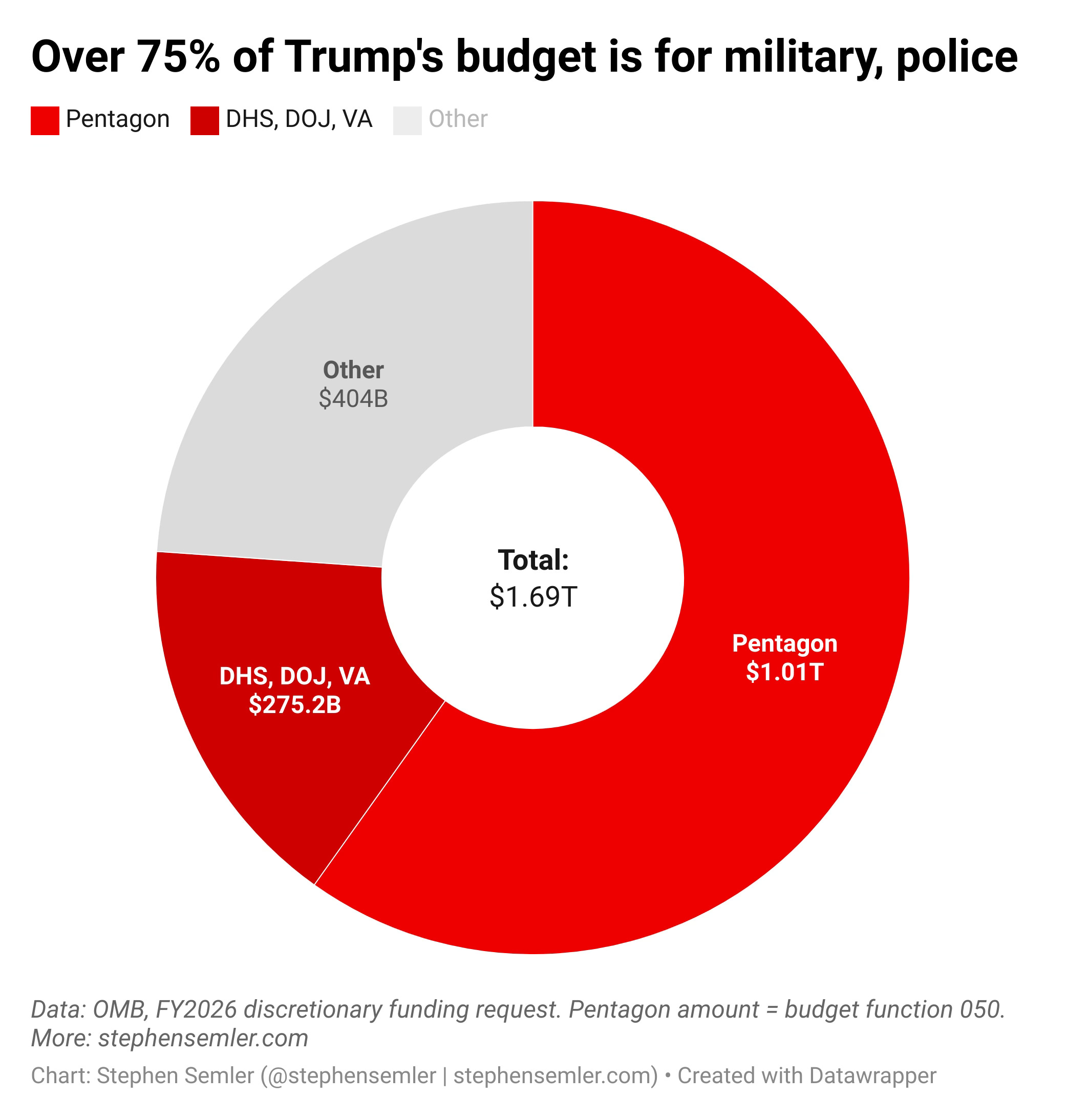
Speaking of which: Here’s an eye-opening chart from Stephen Semler on Trump’s FY2026 budget for America. Sure seems like we’re the Empire in “Star Wars,” doesn’t it?
Anyway, here’s my latest article for TomDispatch:
Forty years ago this month, I was commissioned a second lieutenant in the U.S. Air Force. I would be part of America’s all-volunteer force (AVF) for 20 years, hitting my marks and retiring as a lieutenant colonel in 2005. In my two decades of service, I met a lot of fine and dedicated officers, enlisted members, and civilians. I worked with the Army, Navy, and Marine Corps as well, and met officers and cadets from countries like Great Britain, Germany, Pakistan, Poland, and Saudi Arabia. I managed not to get shot at or kill anyone. Strangely enough, in other words, my military service was peaceful.
Don’t get me wrong: I was a card-carrying member of America’s military-industrial complex. I’m under no illusions about what a military exists for, nor should you be. As an historian, having read military history for 50 years of my life and having taught it as well at the Air Force Academy and the Naval Postgraduate School, I know something of what war is all about, even if I haven’t experienced the chaos, the mayhem, the violence, or the atrocity of war directly.
Military service is about being prepared to kill. I was neither a trigger-puller nor a bomb-dropper. Nonetheless, I was part of a service that paradoxically preaches peace through superior firepower. The U.S. military and, of course, our government leaders, have had a misplaced — indeed, irrational — faith in the power of bullets and bombs to solve or resolve the most intractable of problems. Vietnam is going communist in 1965? Bomb it to hell and back. Afghanistan supports terrorism in 2001? Bomb it wildly. Iraq has weapons of mass destruction in 2003? Bomb it, too (even though it had no WMD). The Houthis in Yemen have the temerity to protest and strike out in relation to Israel’s atrocities in Gaza in 2025? Bomb them to hell and back.
Sadly, “bomb it” is this country’s go-to option, the one that’s always on the table, the one our leaders often reach for first. America’s “best and brightest,” whether in the Vietnam era or now, have a powerful yen for destruction or, as the saying went in that long-gone era, “It became necessary to destroy the town to save it.” Judging them by their acts, our leaders indeed have long appeared to believe that all too many villages, towns, cities, and countries needed to be destroyed in order to save them.
My own Orwellian turn of phrase for such mania is: destruction is construction. In this country, an all-too-offensive military is sold as a defensive one, hence, of course, the rebranding of the Department of War as the Department of Defense. An imperial military is sold as so many freedom-fighters and -bringers. We have the mega-weapons and the urge to dominate of Darth Vader and yet, miraculously enough, we continue to believe that we’re Luke Skywalker.
This is just one of the many paradoxes and contradictions contained within the U.S. military and indeed my own life. Perhaps they’re worth teasing out and exploring, as I reminisce about being commissioned at the ripe old age of 22 in 1985 — a long time ago in a country far, far away.
The Evil Empire
When I went on active duty in 1985, the country that constituted the Evil Empire on this planet wasn’t in doubt. As President Ronald Reagan said then, it was the Soviet Union — authoritarian, militaristic, domineering, and decidedly untrustworthy. Forty years later, who, exactly, is the evil empire? Is it Vladimir Putin’s Russia with its invasion of Ukraine three years ago? The Biden administration surely thought so; the Trump administration isn’t so sure. Speaking of Trump (and how can I not?), isn’t it correct to say that the U.S. is increasingly authoritarian, domineering, militaristic, and decidedly untrustworthy? Which country has roughly 800 military bases globally? Which country’s leader openly boasts of trillion-dollar war budgets and dreams of the annexation of Canada and Greenland? It’s not Russia, of course, nor is it China.
Back when I first put on a uniform, there was thankfully no Department of Homeland Security, even as the Reagan administration began to trust (but verify!) the Soviets in negotiations to reduce our mutual nuclear stockpiles. Interestingly, 1985 witnessed an aging Republican president, Reagan, working with his Soviet peer, even as he dreamed of creating a “space shield” (SDI, the strategic defense initiative) to protect America from nuclear attack. In 2025, we have an aging Republican president, Donald Trump, negotiating with Putin even as he floats the idea of a “Golden Dome” to shield America from nukes. (Republicans in Congress already seek $27 billion for that “dome,” so that “golden” moniker is weirdly appropriate and, given the history of cost overruns on American weaponry, you know that would be just the starting point of its soaring projected cost.)
When the Soviet Union collapsed in 1991, fears of a third world war that would lead to a nuclear exchange (as caught in books of the time like Tom Clancy’s popular novel Red Storm Rising) abated. And for a brief shining moment, the U.S. military reigned supreme globally, pulverizing the junior varsity mirror image of the Soviet military in Iraq with Desert Storm in 1991. We had kicked the Vietnam Syndrome once and for all, President George H.W. Bush exulted. It was high time for some genuine peace dividends, or so it seemed.
The real problem was that that seemingly instantaneous success against Saddam Hussein’s much-overrated Iraqi military reignited the real Vietnam Syndrome, which was Washington’s overconfidence in military force as the way to secure dominance, while allegedly strengthening democracy not just here in America but globally. Hubris led to the expansion of NATO to Russia’s borders; hubris led to unipolar dreams of total dominance everywhere; hubris meant that America could somehow have the most moral as well as lethal military in the world; hubris meant that one need never concern oneself about potential blowback from allying with Osama bin Laden in Afghanistan or the risk of provoking Russian aggression as NATO floated Ukraine and Georgia as future members of an alliance designed to keep Russia down.
It was the end of history (so it was said) and American-style democracy had prevailed.
Even so, militarily, this country did anything but demobilize. Under President Bill Clinton in the 1990s, there was some budgetary trimming, but military Keynesianism remained a thing, as did the military-industrial-congressional complex. Clinton managed a rare balanced budget due to domestic spending cuts and welfare reform; his cuts to military spending, however, were modest indeed. Tragically, under him, America would not become “a normal country in normal times,” as former U.N. Ambassador Jeanne Kirkpatrick once dreamed. It would remain an empire — and an increasingly hungry one at that.
In that vein, senior civilians like Secretary of State Madeleine Albright began to wonder why this country had such a superb military if we weren’t prepared to use it to boss others around. Never mind concerns about the constitutionality of employing U.S. troops in conflicts without a congressional declaration of war. (How unnecessary! How old-fashioned!) It was time to unapologetically rule the world.
The calamitous events of 9/11 changed nothing except the impetus to punish those who’d challenged our illusions. Those same events also changed everything as America’s leaders decided it was then the moment to double down on empire, to become even more authoritarian (the Patriot Act, torture, and the like), to go openly to “the dark side,” to lash out in the only way they knew how — more bombing (Afghanistan, Iraq), followed by invasions and “surges” — then, wash, rinse, repeat.
So, had we really beaten the Vietnam Syndrome in the triumphant year of 1991? Of course not. A decade later, after 9/11, we met the enemy, and once again it was our unrepresentative government spoiling for war, no matter how ill-conceived and ill-advised — because war pays, because war is “presidential,” because America’s leaders believe that the true “power of its example” is example after example of its power, especially bombs bursting in air.
The “All-Volunteer” Force Isn’t What It Seems
Speaking as a veteran and a military historian, I believe America’s all-volunteer force has lost its way. Today’s military members — unlike those of the “greatest generation” of World War II fame — are no longer citizen-soldiers. Today’s “volunteers” have surrendered to the rhetoric of being “warriors” and “warfighters.” They take their identity from fighting wars or preparing for the same, putting aside their oath to support and defend the Constitution. They forget (or were never taught) that they must be citizens first, soldiers second. They have, in truth, come to embrace a warrior mystique that is far more consistent with authoritarian regimes. They’ve come to think of themselves — proudly so — as a breed apart.
Far too often in this America, an affinitive patriotism has been replaced by a rabid nationalism. Consider that Christocentric “America First” ideals are now openly promoted by the civilian commander-in-chief, no matter that they remain antithetical to the Constitution and corrosive to democracy. The new “affirmative action” openly affirms faith in Christ and trust in Trump (leavened with lots of bombs and missiles against nonbelievers).
Citizen-soldiers of my father’s generation, by way of contrast, thought for themselves. They chafed against military authority, confronting it when it seemed foolish, wasteful, or unlawful. They largely demobilized themselves in the aftermath of World War II. But warriors don’t think. They follow orders. They drop bombs on target. They make the war machine run on time.
Americans, when they’re not overwhelmed by their efforts to simply make ends meet, have largely washed their hands of whatever that warrior-military does in their name. They know little about wars fought supposedly to protect them and care even less. Why should they care? They’re not asked to weigh in. They’re not even asked to sacrifice (other than to pay taxes and keep their mouths shut).
Too many people in America, it seems to me, are now playing a perilous game of make-believe. We make-believe that America’s wars are authorized when they clearly are not. For example, who, other than Donald Trump (and Joe Biden before him), gave the U.S. military the right to bomb Yemen?
We make-believe all our troops are volunteers. We make-believe we care about those “volunteers.” Sometimes, some of us even make-believe we care about those wars being waged in places and countries most Americans would be hard-pressed to find on a map. How confident are you that all too many Americans could even point to the right hemisphere to find Syria or Yemen or past war zones like Vietnam, Afghanistan, and Iraq?
War isn’t even that good at teaching Americans geography anymore!
What Is To Be Done?
If you accept that there’s a kernel of truth to what I’ve written so far, and that there’s definitely something wrong that should be fixed, the question remains: What is to be done?
Some concrete actions immediately demand our attention.
*Any ongoing wars, including “overseas contingency operations” and the like, must be stopped immediately unless Congress formally issues a declaration of war as required by the Constitution. No more nonsense about MOOTW, or “military operations other than war.” There is war or there is peace. Period. Want to bomb Yemen? First, declare war on Yemen through Congress.
*Wars, assuming they are supported by Congressional declarations, must be paid for with taxes raised above all from those Americans who benefit most handsomely from fighting them. There shall be no deficit spending for war.
*Americans are used to “sin” taxes for purchases like tobacco and alcohol. So, isn’t it time for a new “sin” tax related to profiteering from war, especially by the corporations that make the distinctly overpriced weaponry without which such wars couldn’t be waged?
To end wars and weaken militarism in America, we must render it unprofitable. As long as powerful forces continue to profit so handsomely from going to war — even as “volunteer” troops are told to aspire to be “warriors,” born and trained to kill — this violent madness in America will persist, if not expand.
Look, the 22-year-old version of me thought he knew who the evil empire was. He thought he was one of the good guys. He thought his country and his military stood for something worthy, even for “greatness” of a sort. Sure, he was naïve. Perhaps he was just another wet-behind-the-ears factotum of empire. But he took his oath to the Constitution seriously and looked to a brighter day when that military would serve only as a deterrent in a world largely at peace.
The soon-to-be-62-year-old me is no longer so naïve and, these days, none too sure who’s evil and who isn’t. He knows his country is on the wrong path, that the bloody path of bullets and bombs (and profiting from the same) is always perilous for any freedom-loving people to travel on.
Somehow, America needs to be put back on the freedom trail that inspires and empowers citizens rather than wannabe warriors brandishing weapons galore. Somehow, we need to aspire again to be a nation of laws. (Can we agree that due process is better than no process?) Somehow, we need to dream of being a nation where right makes might, one that knows that destruction is not construction, one that exchanges bullets and bombs for ballots and beauty.
I recently checked in with HAL 9000, actually ChatGPT and DeepSeek, to see what AI says about my writing on military policy. I’ll let ChatGPT go first:
William Astore, a retired U.S. Air Force lieutenant colonel and historian, has emerged as a prominent voice critiquing America’s militaristic culture and its pervasive influence on domestic and foreign policy. Through his essays on platforms like TomDispatch and Truthdig, Astore offers a candid examination of how militarism has become deeply embedded in American society, often to its detriment.
The Militarization of American Society
Astore argues that the United States has transitioned from a nation with a military to a militarized nation. He contends that this shift is not marked by overt displays of military power but by a subtle, pervasive presence of militaristic values in everyday life. This includes the normalization of war, the glorification of military service, and the integration of military imagery into civilian spaces. He warns that such normalization desensitizes the public to the realities of war and erodes democratic values.
The Business of War
In his critique of the military-industrial complex, Astore highlights how war has become a profitable enterprise for a select few. He references General Smedley Butler’s assertion that “war is a racket,” emphasizing that the true beneficiaries of war are often corporations and political elites, rather than the general populace. Astore suggests that this profit-driven approach to war leads to prolonged conflicts with little regard for their human or financial costs.
The Disconnect Between Military and Society
Astore points out the growing divide between the military and civilian sectors. He notes that the all-volunteer force, while composed of individuals who choose to serve, often does so out of limited economic opportunities rather than a deep-seated desire to fight. This creates a situation where the broader public remains detached from the consequences of war, leading to a lack of accountability and understanding.
A Call for Reflection and Change
Throughout his writings, Astore advocates for a return to a more restrained and reflective approach to military engagement. He urges Americans to critically assess the true costs of war and to reconsider the glorification of militarism in public life. By fostering a more informed and engaged citizenry, Astore believes the U.S. can move towards a foreign policy that prioritizes diplomacy and peace over conflict.
Astore’s insights challenge readers to confront the complexities of American militarism and its implications for both domestic society and international relations. His work serves as a reminder of the importance of maintaining a vigilant and informed public to ensure that the nation’s military endeavors align with its democratic ideals.
*****
That’s a fair assessment, I’d say. I do believe America is too war- and profit-driven, too adulatory toward the military, and also too disconnected from the grim realities of war. And I have called for a recommitment to and renewal of diplomacy. A “vigilant and informed public” is exactly what Ike called for in 1961 when he said that only an alert and knowledgeable citizenry could keep the military-industrial-congressional complex in check. I suppose that’s why the MICC works to keep Americans isolated from and ignorant about war. The last thing the MICC wants is alert and knowledgeable citizens who challenge it.
HAL 9000 (from the movie “2001”)
Let’s turn to DeepSeek and its summary, which isn’t quite as comprehensive as ChatGPT:
William Astore, a retired U.S. Air Force lieutenant colonel and historian, is a vocal critic of U.S. military policy and militarism. His key arguments include:
Excessive Militarization. Astore argues that the U.S. has become overly reliant on military solutions to geopolitical problems, leading to endless wars and bloated defense budgets. He critiques the “military-industrial complex” (a term popularized by Eisenhower) for perpetuating this cycle.
Militarism in Society. He highlights how militarism has seeped into American culture, with the glorification of the military. pervasive defense contracting, and the influence of retired generals in media and politics.
Failed Wars & Lack of Accountability. Astore condemns U.S. interventions (e.g. Iraq, Afghanistan) as costly failures, driven by hubris and flawed assumptions, with little accountability for policymakers.
Erosion of Democracy. He warns that unchecked militarism undermines democratic values, as vast resources are diverted to the military while domestic needs (education, healthcare, infrastructure) are neglected.
Need for Reform. Astore advocates for a more restrained foreign policy, reduced defense spending, and greater public skepticism toward military leaders and war propaganda.
*****
Again, I think that’s a fair summary. I like the emphasis on lack of accountability. So-called experts are never called to account for advocating for disastrous wars; indeed, they’re usually promoted to higher positions. You can never go wrong by going “strong,” at least rhetorically. The worst thing in America is to argue for diplomacy and peace and being proven right, for you were right “for the wrong reasons,” i.e. sure, Iraq and Afghanistan were disastrous wars that killed, wounded, and displaced millions, but it would have been pusillanimous and “weak” of America not to slap around a few countries in the aftermath of 9/11. So put on your “big boy” warrior fatigues and start kicking ass, because that’s what real Americans do.
It’s interesting that AI programs probably wouldn’t write that last sentence but they can “write” sober and rational prose rather effectively.
ChatGPT and DeepSeek can be useful tools, I think, if used judiciously. I worry, however, about AI programs being used for decision-making, especially decisions related to life and death in war. So, for example, I’ve read about AI programs being used for target selection in places like Gaza. Just what we need—ever-more automated death.
I was going through old notes and came across emails written to me from 2009 in response to an article I wrote for TomDispatch about militarism in America and its many dangers. (When I tell readers that I often learn as much from them as they do from me, I mean it.)
Without further ado, four “letters” from readers, vintage 2009:
I enjoyed very much your article on patriots and the flag. Out here in Wyoming we get a real dose of it. It bothers me a great deal to see political candidates wrap themselves in the flag and even use the flag as advertising items. Many people have a flag on their driveway that hangs there until it falls apart and they are proclaiming they are patriots. I served in the army and the Wyoming National Guard and I feel that I do not need my motives scrutinized. I feel that my saying “bring the troops home” is supporting them and not wanting any other young people maimed or killed should speak for itself. Keep up the good work.
The next letter highlighted the “cult of hyper-patriotism” that Bush/Cheney in particular were cultivating:
Suffice it to say that you have touched on a number of issues that I strongly agree with. The cult of hyper-patriotism that seems to have sprung up since the early to mid 80s seems to sucking the marrow from America’s bones, rather than strengthening and replenishing it. Too many of our fellow citizens are only familiar with the first half of Carl Schurz’s quote: “My country, right or wrong; if right, to be kept right; and if wrong, to be set right.”
Another reader, an Army veteran, questioned all the “thank you for your service” hoopla:
I cannot say how we arrived at the point we are today, regarding some of the issues you raised, but we have reached a point that I think is not right. And, unfortunately, raising questions about this draws rapid condemnation.
The extra thing, that your article did not mention, which I find unsettling, is that we seem to have become a citizenry of gestures, rather than resolve (and Gary Cooper was all about being resolute). As if plastering the trunk lid of one’s car with yellow ribbon magnets and ‘Freedom isn’t free’ stickers is somehow just as valid as actually serving the country. As if the ostentatious example of thanking soldiers one coincidentally meets in the airport for their service makes up for staying home oneself. I volunteered and served my three years in the Army (and didn’t like military life at all, so left when my enlistment was up), but can’t imagine why anyone would thank me for simply doing my duty, and without knowing whether I did my duty well.
In one of my favorite letters, a reader noted the melding of sports and the military along with Hollywood’s predilection for big men with even bigger guns:
I just read your essay “What Happened to Gary Cooper” on Middle East Online and loved it. As a screenwriter in California, I’m often in meetings where some twenty something “exec” speaks lovingly about big men with big guns. I try to steer the discussion to a different kind of hero, the reluctant kind that solve their problems with keen insight instead of quick trigger fingers. I’m sure you can imagine how those suggestions are treated.
And also, as a former professional football player and lifelong sports fan, I’m also very interested in the melding of military and sports cultures. Watch an NFL game and it’s readily apparent. Pregame shows with military guards, monstrous flags, reverential tributes to the troops overseas, etc.
And always the flyovers! A few years back I was at an Angels World Series game with a friend. A stealth bomber thundered overhead right before the first pitch and the crowd went wild. My friend said he had tears in his eyes, and I said, just think how many tears are shed by the people whose countries those things flyover every single day. He thought I was joking. I wasn’t.
These reader comments from 2009 could have been made yesterday—or today. Steroidal displays of hyper-patriotism and exotic weaponry continue apace in allegedly peace-loving America as the president boasts of trillion-dollar war budgets.
A final comment from another reader:
I served in the US Coast Guard back when it wasn’t fashionable to be in the military. I remember having garbage thrown at me from passing cars when on liberty from the Academy. I don’t desire a return to those days but I firmly believe that the pendulum has gone too far the other way.
I love my country as much as anyone but I really wish that they’d stop singing ‘God Bless America’ during the 7th inning stretch and replace it with “America the Beautiful”, prefereably all verses but at least the first two. For the past 8 years, I’ve been moved to tears when singing te second verse as it ends,
“America! America! God mend thine ev’ry flaw;
Confirm thy soul in self control, thy liberty in law! “
We could use a bit more self control.
These comments come from men who at first glance might be seen as “conservative” or even as “deplorable” by some sectors of society. This is deeply unfortunate. I’m not sure how else to put this, so I’ll just say it: these men would not be out of step with the efforts of groups like Code Pink. We need to come together.
In America there is a “silent majority” who are tired of vapid patriotism, rabid nationalism, and endless wars. How we activate that silent majority—how we get them to stand up, to march, to declare “Enough is enough!” is a question for the ages.
I read the news today, oh boy. About a lucky man named Elon Musk. But he lost out on one thing: he didn’t get a top secret briefing on Pentagon war plans for China. And the news people breathed a sigh of relief.
With apologies to John Lennon and The Beatles, a day in the life is getting increasingly tough to take here in the land of the free. I’m meant to be reassured that Musk didn’t get to see America’s top-secret plans for — yes! — going to war with China, even as I’m meant to ignore the constant drumbeat of propaganda, the incessant military marches that form America’s background music, conveying the message that America must have war plans for China, that indeed war in or around China is possible, even probable, in the next decade. Maybe in 2027?
My fellow Americans, we should be far more alarmed by such secret U.S. war plans, along with those “pivots” to Asia and the Indo-Pacific, and the military base-building efforts in the Philippines, than reassured by the “good news” that Comrade Billionaire Musk was denied access to the war room, meaning (for Dr. Strangelove fans) he didn’t get to see “the big board.”
It’s war, war, everywhere in America. We do indeed have a strange love for it. I’ve been writing for TomDispatch for 18 years now — this is my 111th essay (the other 110 are in a new book of mine) — most of them focusing on militarism in this country, as well as our disastrous wars in Iraq, Afghanistan, and elsewhere, the ruinous weapons systems we continue to fund (including new apocalyptic nuclear weapons), and the war song that seems to remain ever the same.
A few recent examples of what I mean: President Trump has already bombed Yemen more than once. He’s already threatening Iran. He’s sending Israel all the explosives, all the weaponry it needs to annihilate the Palestinians in Gaza (so too, of course, did Joe Biden). He’s boasting of building new weapons systems like the Air Force’s much-hyped F-47 fighter jet, the “47” designation being an apparent homage by its builder, Boeing, to Trump himself, the 47th president. He and his “defense” secretary, Pete Hegseth, continually boast of “peace through strength,” an Orwellian construction that differs little from “war is peace.” And I could, of course, go on and on and on and on…
Occasionally, Trump sounds a different note. When Tulsi Gabbard became the director of national intelligence, he sang a dissonant note about a “warmongering military-industrial complex.” And however haphazardly, he does seem to be working for some form of peace with respect to the Russia-Ukraine War. He also talks about his fear of a cataclysmic nuclear war. Yet, if you judge him by deeds rather than words, he’s just another U.S. commander-in-chief enamored of the military and military force (whatever the cost, human or financial).
Consider here the much-hyped Department of Government Efficiency (DOGE) led by that lucky man Elon Musk. Even as it dismantles various government agencies like the Department of Education and USAID, it has — no surprise here! — barely touched the Pentagon and its vast, nearly trillion-dollar budget. In fact, if a Republican-controlled Congress has any say in the matter, the Pentagon budget will likely be boosted significantly for Fiscal Year 2026 and thereafter. As inefficient as the Pentagon may be (and we really don’t know just how inefficient it is, since the bean counters there keep failing audit after audit, seven yearsrunning), targeted DOGE Pentagon cuts have been tiny. That means there’s little incentive for the generals to change, streamline their operations, or even rethink in any significant fashion. It’s just spend, spend, spend until the money runs out, which I suppose it will eventually, as the national debt soars toward $37 trillion and climbing.
Even grimmer than that, possibly, is America’s state of mind, our collective zeitgeist, the spirit of this country. That spirit is one in which a constant state of war (and preparations for more of the same) is accepted as normal. War, to put it bluntly, is our default state. It’s been that way since 9/11, if not before then. As a military historian, I’m well aware that the United States is, in a sense, a country made by war. It’s just that today we seem even more accepting of that reality, or resigned to it, than we’ve ever been. What gives?
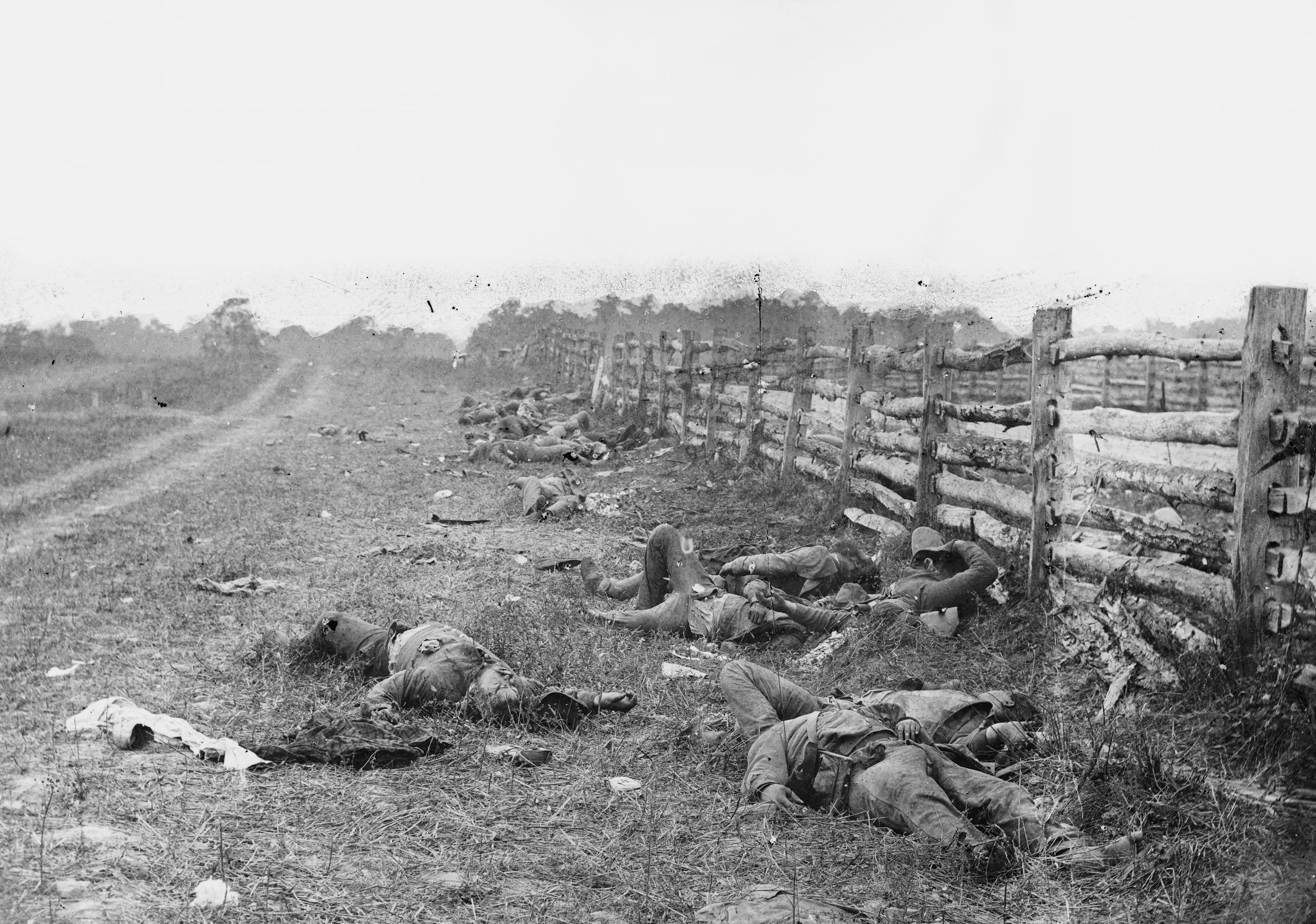
The Face of War: Confederate Dead at Antietam (Matthew Brady)
Remember when, in 1963, Alabama Governor George Wallace said, “Segregation now, segregation tomorrow, and segregation forever”? Fortunately, after much struggle and bloodshed, he was proven wrong. So, can we change the essential American refrain of war now, war tomorrow, and war forever? Can we render that obsolete? Or is that too much to hope for or ask of America’s “exceptional” democracy?
Taking on the MICIMATT(SH)
Former CIA analyst Ray McGovern did America a great service when he came up with the acronym MICIMATT, or the Military-Industrial-Congressional-Intelligence-Media-Academia-Think-Tank complex, an extension of President Dwight D. Eisenhower’s military-industrial complex, or MIC (from his farewell speech in 1961). Along with the military and industry (weapons makers like Boeing and Lockheed Martin), the MICIMATT adds Congress (which Eisenhower had in his original draft speech but deleted in the interest of comity), the intelligence “community” (18 different agencies), the media (generally highly supportive of wars and weapons spending), academia (which profits greatly from federal contracts, especially research and development efforts for yet more destructive weaponry), and think tanks (which happily lap up Pentagon dollars to tell us the “smart” position is always to prepare for yet more war).
You’ll note, however, that I’ve added a parenthetical SH to McGovern’s telling acronym. The S is for America’s sporting world, which eternally gushes about how it supports and honors America’s military, and Hollywood, which happily sells war as entertainment (perhaps the best known and most recent film being Tom Cruise’s Top Gun: Maverick, in which an unnamed country that everyone knows is Iran gets its nuclear ambitions spanked by a plucky team of U.S. Naval pilots). A macho catchphrase from the original Top Gun was “I feel the need — the need for speed!” It may as well have been: I feel the need — the need for pro-war propaganda!
Yes, MICIMATT(SH) is an awkward acronym, yet it has the virtue of capturing some of the still-growing power, reach, and cultural penetration of Ike’s old MIC. It should remind us that it’s not just the military and the weapons-makers who are deeply invested in war and — yes! — militarism. It’s Congress; the CIA; related intel “community” members; the mainstream media (which often relies on retired generals and admirals for “unbiased” pro-war commentary); academia (consider how quickly institutions like Columbia University have bent the knee to Trump); and think tanks — in fact, all those “best and brightest” who advocate for war with China, the never-ending war on terror, war everywhere.
But perhaps the “soft power” of the sporting world and Hollywood is even more effective at selling war than the hard power of bombs and bullets. National Football League coaches patrol the sidelines wearing camouflage, allegedly to salute the troops. Military flyovers at games celebrate America’s latest death-dealing machinery. Hollywood movies are made with U.S. military cooperation and that military often has veto power over scripts. To cite only one example, the war movie 12 Strong (2018) turned the disastrous Afghan War that lasted two horrendous decades into a stunningly quick American victory, all too literally won by U.S. troops riding horses. (If only the famed cowboy actor John Wayne had still been alive to star in it!)
The MICIMATT(SH), employing millions of Americans, consuming trillions of dollars, and churning through tens of thousands of body bags for U.S. troops over the years, while killing millions of people abroad, is an almost irresistible force. And right now, it seems like there’s no unmovable object to blunt it.
Believe me, I’ve tried. I’ve written dozens of “Tomgrams” suggesting steps America could take to reverse militarism and warmongering. As I look over those essays, I see what still seem to me sensible ideas, but they die quick deaths in the face of, if not withering fire from the MICIMATT(SH), then being completely ignored by those who matter.
And while this country has a department of war (disguised as a department of defense), it has no department of peace. There’s no budget anywhere for making peace, either. We do have a colossal Pentagon that houses 30,000 workers, feverishly making war plans they won’t let Elon Musk (or any of us) see. It’s for their eyes only, not yours, though they may well ask you or your kids to serve in the military, because the best-laid plans of those war-men do need lots of warm bodies, even if those very plans almost invariably (Vietnam, Afghanistan, Iraq, etc.) go astray.
So, to repeat myself, how do you take on the MICIMATT(SH)? The short answer: It’s not easy, but I know of a few people who had some inspirational ideas.
On Listening to Ike, JFK, MLK, and, Yes, Madison, Too
Militarism isn’t exactly a new problem in America. Consider Randolph Bourne’s 1918 critique of war as “the health of the state,” or General Smedley Butler’s confession in the 1930s that “war is a racket” run by the “gangsters of capitalism.” In fact, many Americans have, over the years, spoken out eloquently against war and militarism. Many beautiful and moving songs have asked us to smile on your brother and “love one another right now.” War, as Edwin Starr sang so powerfully once upon a time, is good for “absolutely nothin’,” though obviously a lot of people disagree and indeed are making a living by killing and preparing for yet more of it.
And that is indeed the problem. Too many people are making too much money off of war. As Smedley Butler wrote so long ago: “Capital won’t permit the taking of the profit out of war until the people — those who do the suffering and still pay the price — make up their minds that those they elect to office shall do their bidding, and not that of the profiteers.” Pretty simple, right? Until you realize that those whom we elect are largely obedient to the moneyed class because the highest court in our land has declared that money is speech. Again, I didn’t say it was going to be easy. Nor did Butler.
As a retired lieutenant colonel in the U.S. Air Force, I want to end my 111th piece at TomDispatch by focusing on the words of Ike, John F. Kennedy (JFK), Martin Luther King, Jr. (MLK), and James Madison. And I want to redefine what words like duty, honor, country, and patriotism should mean. Those powerful words and sentiments should be centered on peace, on the preservation and enrichment of life, on tapping “the better angels of our nature,” as Abraham Lincoln wrote so long ago in his First Inaugural Address.
Why do we serve? What does our oath of office really mean? For it’s not just military members who take that oath but also members of Congress and indeed the president himself. We raise our right hands and swear to support and defend the U.S. Constitution against all enemies, foreign and domestic, to bear true faith and allegiance to the same.
There’s nothing in that oath about warriors and warfighters, but there is a compelling call for all of us, as citizens, to be supporters and defenders of representative democracy, while promoting the general welfare (not warfare), and all the noble sentiments contained in that Constitution. If we’re not seeking a better and more peaceful future, one in which freedom may expand and thrive, we’re betraying our oath.
If so, we have met the enemy — and he is us.
Ike told us in 1953 that constant warfare is no way of life at all, that it is (as he put it), humanity crucifying itself on a cross of iron. In 1961, he told us democracy was threatened by an emerging military-industrial complex and that we, as citizens, had to be both alert and knowledgeable enough to bring it to heel. Two years later, JFK told us that peace — even at the height of the Cold War — was possible, not just peace in our time, but peace for all time. However, it would, he assured us, require sacrifice, wisdom, and commitment.
How, in fact, can I improve on these words that JFK uttered in 1963, just a few months before he was assassinated?
What kind of peace do we seek? Not a Pax Americana enforced on the world by American weapons of war. Not the peace of the grave or the security of the slave. I am talking about genuine peace, the kind of peace that makes life on earth worth living…
I speak of peace because of the new face of war. Total war makes no sense in an age… when the deadly poisons produced by a nuclear exchange would be carried by wind and water and soil and seed to the far corners of the globe and to generations yet unborn… surely the acquisition of such idle [nuclear] stockpiles — which can only destroy and never create — is not the only, much less the most efficient, means of assuring peace.
I speak of peace, therefore, as the necessary rational end of rational men. I realize that the pursuit of peace is not as dramatic as the pursuit of war — and frequently the words of the pursuer fall on deaf ears. But we have no more urgent task.
Are we ready to be urgently rational, America? Are we ready to be blessed as peacemakers? Or are we going to continue to suffer from what MLK described in 1967 as our very own “spiritual death” due to the embrace of militarism, war, empire, and racism?
Of course, MLK wasn’t perfect, nor for that matter was JFK, who was far too enamored of the Green Berets and too wedded to a new strategy of “flexible response” to make a clean break in Vietnam before he was killed. Yet those men bravely and outspokenly promoted peace, something uncommonly rare in their time — and even more so in ours.
More than 200 years ago, James Madison warned us that continual warfare is the single most corrosive force to the integrity of representative democracy. No other practice, no other societal force is more favorable to the rise of authoritarianism and the rule of tyrants than pernicious war. Wage war long and it’s likely you can kiss your democracy, your rights, and just maybe your ass goodbye.
America, from visionaries and prophets like MLK, we have our marching orders. They are not to invest yet more in preparations for war, whether with China or any other country. Rather, they are to gather in the streets and otherwise raise our voices against the scourge of war. If we are ever to beat our swords into plowshares and our spears into pruning hooks and make war no more, something must be done.
Let’s put an end to militarism in America. Let’s be urgently rational. To cite John Lennon yet again: You may say I’m a dreamer, but I’m not the only one. Together, let’s imagine and create a better world.
The so-called SignalGate scandal centered on the bombing of Yemen is highly revelatory. First, some resources. CNN has a useful annotated account of the chats exchanged at the highest levels of the Trump administration. At their respective Substacks, Lenny Broytman and Caitlin Johnstone have telling dissections of these chats as well. At Jacobin, Branko Marcetic has an important article that reminds us of the illegality of the attacks. As the article’s subheading puts it: The press [mainstream media] is mostly framing the Yemen group chat scandal as a story of incompetence. There’s little attention being paid to the deadliness, illegality, and ineffectiveness of the strikes themselves.
To me, among the most telling “chats” came from Secretary of Defense Pete Hegseth. It highlights the “exceptional” nature of America:
*****
Pete Hegseth to Vice President JD Vance: I fully share your loathing of European free-loading. It’s PATHETIC.
But Mike [Waltz, the National Security Adviser] is correct, we are the only ones on the planet (on our side of the ledger) who can do this. Nobody else even close. Question is timing…
*****
This is precisely the problem for America since the Vietnam War, if not before then. We’ve created a monster military, a “global strike” force, that is capable of destroying any target anywhere around the globe. “Nobody else even close,” SecDef Hegseth correctly says. And because we can do it, because we are exceptional in military force, our leaders believe we should do it, even if it’s only to send a “message” to the world how tough we are, how committed we are to killing others.
Other countries—like those “free-loading” European ones—are PATHETIC because they don’t have America’s military might. Only we can smite evildoers around the globe, only we can do so while also arming Israel to the teeth and covering its flanks while it continues its annihilation of Gaza, and this is something we are immensely proud of.
My fellow Americans, this is not something to be proud of. Consider if America’s military in the 1960s had lacked the ability to deploy over half a million troops to Vietnam while also facing down the Warsaw Pact in Europe. Consider if America’s military had lacked the ability to invade Iraq in 2003 while also waging war in Afghanistan and garrisoning the globe with roughly 800 military bases. Consider how much blood would not have been spilled, and treasure wasted, if the U.S. military was smaller, focused on defense, and led by people who didn’t put muscle and flame emojis in their chats to celebrate U.S. military prowess at killing people in Yemen.
That U.S. military forces are the only ones who can kill globally with such comparative ease, that “nobody else even close,” is exactly what is wrong with our government. We place far too much faith and pride in military prowess, so much so that the Pentagon becomes the Pentagod, something we worship, something we make immense sacrifices to, as in budgets that approach $1 trillion yearly.
Not for nothing did President Dwight D. Eisenhower say in 1953 that this is no way of life at all—that we are crucifying ourselves on a cross of iron. Tell me again, who are the pathetic ones?
We must end our intoxication with military power before it ends us.
Coming soon to a Kindle store near you: all my articles for TomDispatch, with a new introduction by me and a foreword by Tom Engelhardt. You can preorder it by clicking on this link. Thanks!
Speaking of American militarism on steroids:
It’s been called the “House of War” by esteemed author James Carroll. Within the military, it’s jokingly referred to as the five-sided puzzle palace on the Potomac. It’s a monetary black hole that consumes eagerly and without bounds (in light of seven failed audits in a row) roughly a trillion dollars in yearly military expenditures. It’s a place where full-bird colonels, who should be leading regiments in the field, become errand boys and girls to a grossly inflated number of generals. Yes, it’s America’s very own Pentagon, built in record time in the early months of World War II to manage that colossal war—and never shuttered since because perpetual global war is very much fundamental to the American way of life.
If there’s a symbol of America that captures current and past governmental budgetary priorities and foreign policy commitments, it’s the Pentagon. Forget the Statue of Liberty. Never mind Freedom Towers and national parks and bald eagles and the like. Increasingly, the Pentagon is America, a highly militarized version of our country, which is precisely why it needs to be closed down. Where’s Elon Musk and the DOGE wunderkinds when you need them?
Nearly 30,000 people work in the Pentagon on a daily basis. It makes for some crowded parking lots—and cramped offices even for those aforementioned bird colonels. It’s a hotbed of intrigue and competition among the services for money and resources. It’s depressingly short on natural light. It’s a repository for hidebound thinking, a place where good ideas go to die. A line from the original “Star Wars” has been used more than once to describe it: “You will never find a more wretched hive of scum and villainy.”
And (again) it’s time to shut it down.
Here’s an idea to make the U.S. military far more efficient. Empty the Pentagon of all its worker-bees and from them create infantry battalions. An average battalion consists of roughly 800 “effectives,” so demobbing the Pentagon work force and mobilizing them instead for action in the field would create roughly 35 battalions. Send these battalions to all combat zones where U.S. troops are deployed today. Does Ukraine need more troops at the front? Does Israel need more stormtroopers in Gaza? We’ve got some Pentagon legions for you, Bibi.
Of course, I jest. I want to close the Pentagon to weaken militarism, not to wage war and genocide. Nevertheless, I’m guessing putting the entire Pentagon workforce at the point of the spear might serve to dull it a bit. Perhaps war boosterism might decrease if the cheerleaders were sent directly into the trenches instead of remaining safely on the sidelines?
As a retired U.S. military officer, I’m appalled at the notion of “peace through strength.” You may as well say “war is peace.” Peace is achieved through dialogue. Diplomacy. Engagement. A spirit of good will. It isn’t achieved by brandishing weapons while selling the same around the globe. (The U.S. dominates the global arms trade, accounting for nearly half of it.)
I’m also outraged by the ongoing militarism of this moment, whether it’s Kamala Harris celebrating military lethality and embracing the Cheneys in 2024 or the Trump crowd that embraces “warriors” and “warfighters.” The solemn tradition of the citizen-soldier has long been abandoned in the U.S., replaced as it has been by a mercenary mindset that sees war as permanent and therefore “normal,” even admirable.
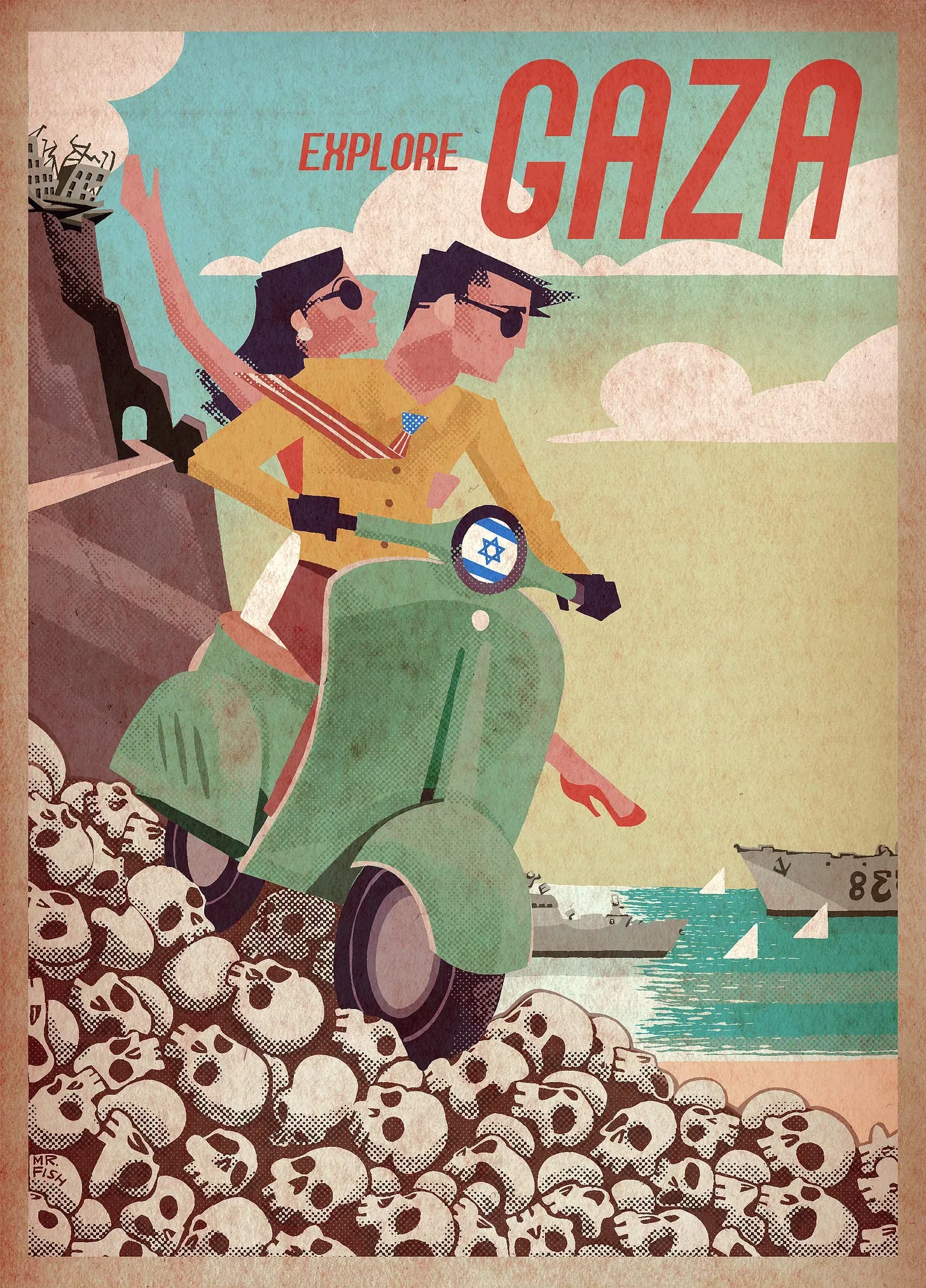
Even as we’re essentially being told and sold “war is peace,” we’re also being told and sold that ethnic cleansing in Gaza is urban renewal, a prelude to a new Riviera, a new playground for the rich, even if it’s erected on the bones of millions of Palestinians. Obviously, this cleansing of genocide using the imagery of crass and vulgar tourism must be condemned in no uncertain terms.
Put colloquially, I often wonder, Dude, where’s my country?
Explore Gaza, by Mr. Fish (at Chris Hedges’ Substack)











 Bracing Views