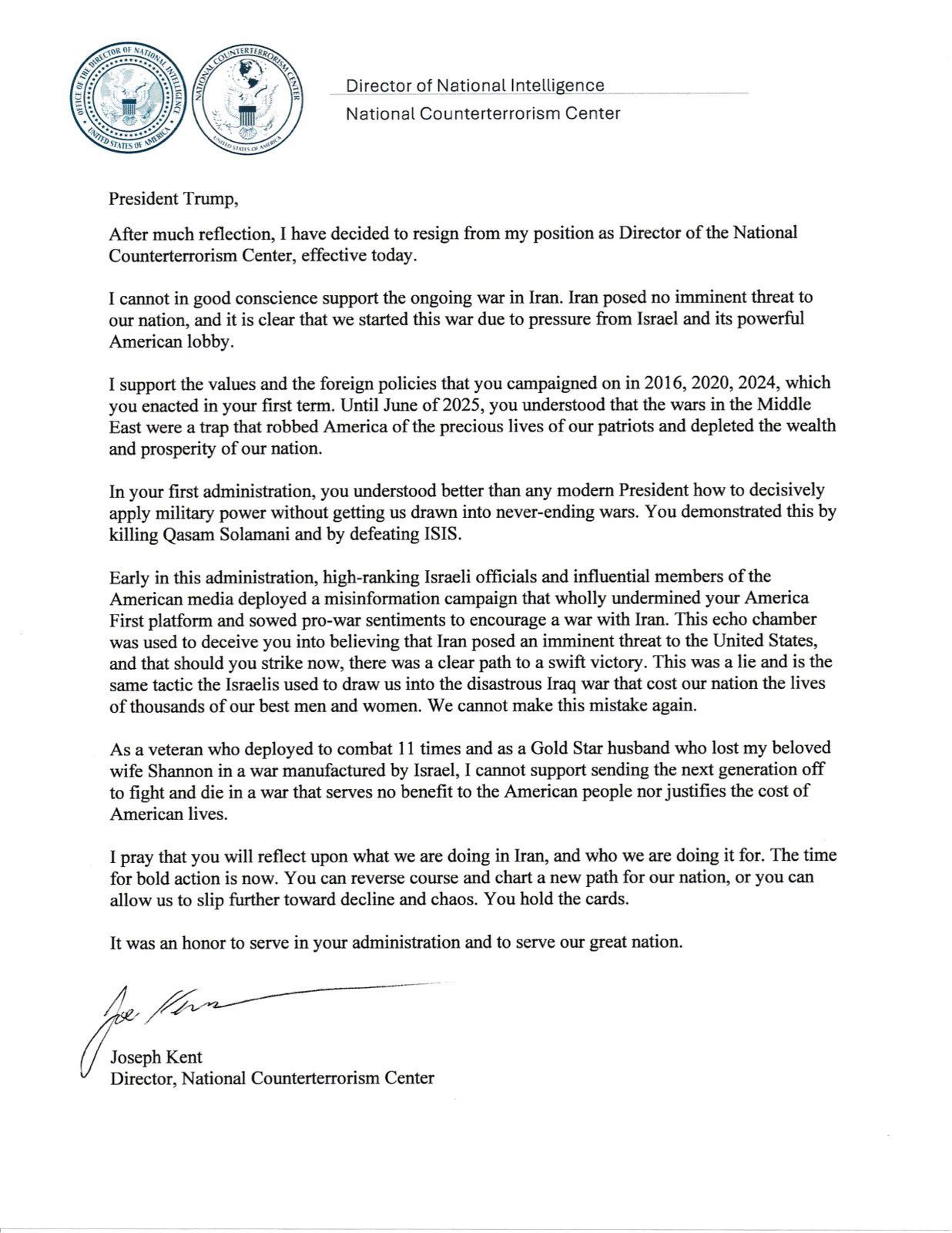
Joe Kent’s principled resignation letter, in which he calls out the influence of Israel and AIPAC on President Trump’s decision to go to war with Iran, illustrates the nature of power and dissent in government circles.
The main response is denunciation. Leading the way was Trump, whose response to the news was basically good riddance even as he claimed that Kent, a former Green Beret with extensive combat experience, was “weak on security.” Organizations like the Jewish Anti-Defamation League and AIPAC suggested that Kent was trafficking in age-old anti-semitic tropes (apparently it’s “anti-semitic” to suggest that Israel and AIPAC have influence over the President and Congress).
In the age of social media, denunciation is nearly instantaneous — and often unhinged. I’ve even seen calls to have Kent investigated under the espionage act!
The method to the madness is obvious: discredit Kent by smears, attack him as disloyal, even as such efforts are designed to intimidate others from airing their legitimate concerns.
Kent deserves a lot of credit for going on the record because he surely knew he’d be denounced.
Not quite denouncing him, but showing (so far) conformity that’s more than disappointing is Tulsi Gabbard, the Director of National Intelligence (DNI) and Kent’s former boss. Previously, Tulsi was on the record as being strongly against regime-change wars and especially against war with Iran. She’s often made speeches in the name of her “brothers and sisters in uniform.” Yet so far she has quietly abetted Trump’s policies and actions in his foolish and illegal war against Iran.
I fear Tulsi’s “brothers and sisters” will pay a high price for her complicity.
Here’s her message posted yesterday at X/Twitter:
Donald Trump was overwhelmingly elected by the American people to be our President and Commander in Chief. As our Commander in Chief, he is responsible for determining what is and is not an imminent threat, and whether or not to take action he deems necessary to protect the safety and security of our troops, the American people and our country.
The Office of the Director of National Intelligence is responsible for helping coordinate and integrate all intelligence to provide the President and Commander in Chief with the best information available to inform his decisions.
After carefully reviewing all the information before him, President Trump concluded that the terrorist Islamist regime in Iran posed an imminent threat and he took action based on that conclusion.
This is carefully-worded nonsense, designed to satisfy Trump and his handlers. I bolded a few obvious BS phrases. First, Trump wasn’t “overwhelmingly” elected president, though Trump loves to think he was. Second, anyone who knows how Trump operates can’t imagine him “carefully reviewing” all the intelligence, but perhaps Tulsi is being cute here, since she adds the intel “before him.” (I truly wonder how much of the DNI’s intel actually reached Trump, how much he truly read and reviewed; not much, I’d wager.)
Finally, there’s the notion of an “imminent threat,” which Iran truly didn’t pose to U.S. national security, not before the Israeli/U.S. attacks. And the usual dismissal of Iran as “terrorist Islamist,” i.e. “bad people” we don’t like.
I’ve been a Tulsi supporter for many years and I wrote that she’d make a fine DNI. Recent events are proving me wrong. Her message on X in response to Kent’s resignation was more than disappointing. I’m hoping she also resigns for cause, but perhaps she thinks she can do more as an insider to restrain the worst impulses of Trump, his toadies, and those who have always spoiled for a war against Iran. Her resignation, I think, would be more powerful than her restraining influence (assuming she has any influence).
Of course, if she does resign for cause, she will be smeared and denounced, and not for the first time.
Readers, what do you make of all this?
Addendum: Perhaps I should add that I don’t agree with everything in Kent’s resignation letter, nor would I be likely to vote for him, assuming he runs for office again. His resignation letter is useful exactly because he was a strong Trump loyalist whose military record earns him respect among those who are otherwise unlikely to question Trump and the official narrative. In short, for me this isn’t about Kent and his character, It’s about his recognition that there wasn’t an imminent threat from Iran and his willingness to highlight the roles played by Israel and AIPAC in U.S. politics and foreign policy. As a Trump insider, his words carry persuasive weight. They could also indicate a fracturing of support for Trump’s disastrous war with Iran.
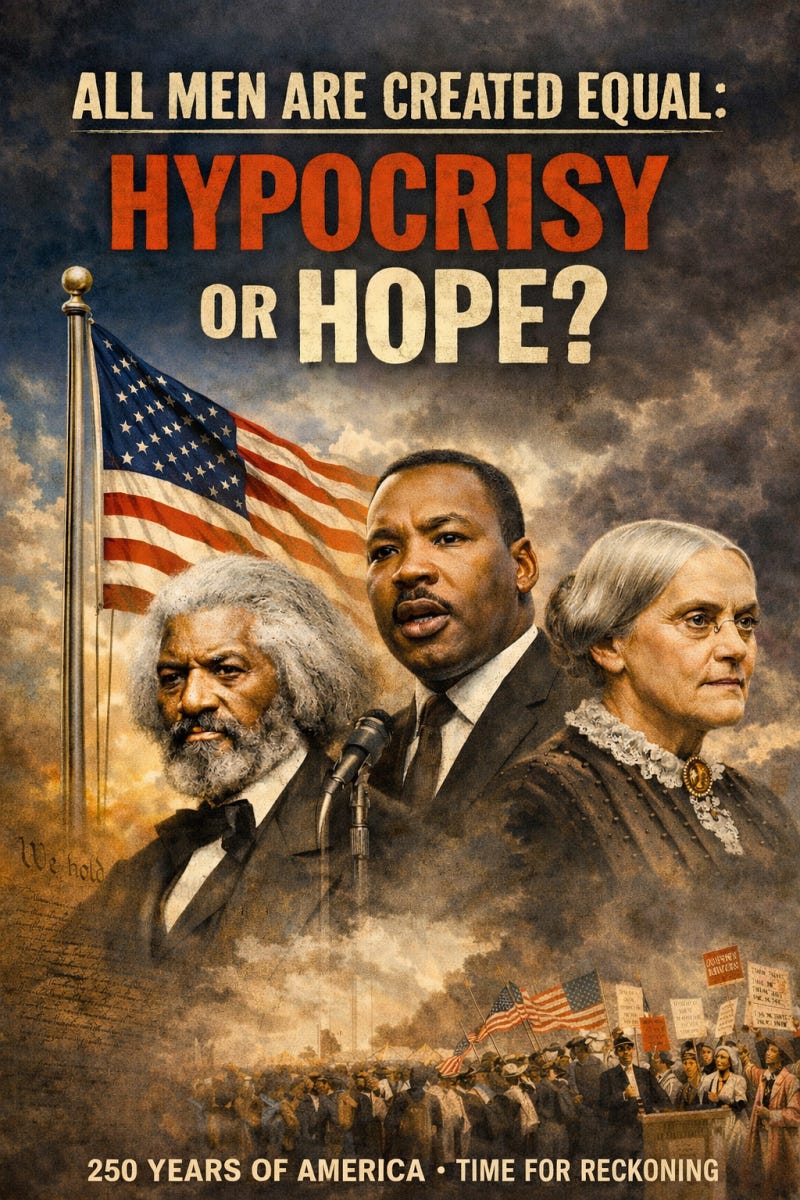
Note to Readers: Here’s an article I wrote for the LA Progressive as America marks the 250th anniversary of the Declaration of Independence.
When I look back at my old parchment from 1976, I see noble words written by courageous but deeply imperfect men. We remain imperfect as well.
This article is part of the series that addresses the question whether it was hypocrisy or hope when 250 years ago we stated in our Declaration of Independence that “All Men Are Created Equal.” Hypocrisy because more than half of the declaration signers were slaveholders. Plus, how about women, Native Americans, and the unpropertied? But also hopeful because sometime in the future those groups might (and would) be given the vote.
I was thirteen during our nation’s bicentennial in 1976. To celebrate, I had a parchment reproduction of the Declaration of Independence, something that meant a great deal to me at the time. I still remember John Hancock’s glorious signature—defiant, oversized, unmistakable. Take that, King George III.
Of course, declaring independence in 1776 didn’t make it so—history rarely bends simply because words demand it. The thirteen colonies had to fight a long, debilitating, and often brutal war for nearly six years. Even after Yorktown in 1781, George Washington and others struggled to keep the fragile new nation from collapsing into acrimonious division. True independence came only in 1783, when the British Empire formally recognized the former colonies through treaty. Even then, conflict lingered. The United States would fight Britain again in the War of 1812, a war that included the burning of Washington, D.C., underscoring how precarious American independence remained.
Rereading the Declaration later in life reminded me of the cleverness of its authors. They framed their cause in terms of noble ideals, which was smart, but they also personalized their grievances by casting blame on an allegedly tyrannical king, which was even smarter. By the standards of the eighteenth century, King George III was neither unusually cruel nor especially despotic. He expected obedience to the Crown, wanted the colonies to pay for their own defense, and sought order over disorder. If anything, he may not have been tyrannical enough to enforce compliance.
Still, the founders skillfully appealed to Parliament and to English citizens’ jealousy for their own rights—life, liberty, and property (or, as Thomas Jefferson famously revised it, the pursuit of happiness). This was the Age of Reason, after all, a time when the divine right of kings no longer went unquestioned. Even so, the Declaration often reads like a laundry list of complaints against the king—complaints that were not always fair or fully convincing.
Most colonists, at least early on, were not seeking a radical break with Britain. They wanted the traditional rights of Englishmen, especially as educated men who owned property. No matter how “enlightened” they considered themselves, these were men of their times: slaveholders like Jefferson, men who saw no reason to extend the right to vote to women, to enslaved Black people, or even to white men without property.
Yet embedded within the Declaration was a promise more radical than its authors likely intended. The assertion that all men are created equal and endowed with unalienable rights planted a seed that women, Black Americans, and other marginalized groups would later seize upon. Like the colonists themselves, these groups had to fight for those rights. Power, as the saying goes, concedes nothing without a demand—and rarely concedes much without sustained struggle.
The same remains true today. Declaring America to be a democracy where all are equally respected does not make it so. Our country is more oligarchy than democracy, a land divided between the haves—and the have-mores—and the have-nots, rather than a nation that shares equitably in its collective bounty. We may have won independence from Britain, but we did not win freedom from the forces of history or from the imperfections of human nature.
America remains a place of contention, where the meaning of the American Revolution is still argued over and fought about. Yet there is enduring, aspirational nobility in the idea that we are all in this together, still striving to form a more perfect union. That goal is not achieved through declarations alone, no matter how brave or eloquent. It must be pursued, defended, and renewed every day—against tyrants large and petty, foreign and domestic.
When I look back at my old parchment from 1976, I see noble words written by courageous but deeply imperfect men. We remain imperfect as well. The question is whether we can regain the courage, fortitude, and commitment of the founders—not to idolize them, but to continue the unfinished work they began. I believe we can. To believe otherwise is to abandon the very spirit of America’s declaration in 1776. Why not work to make it so?
My fellow Americans, it’s nice to think we have a semblance of a constitutional republic, but that warship has sailed. This time, to Iran.
*****
This AM, I read an interesting story on the Supreme Court’s repeal of Trump’s tariffs. Justice Neil Gorsuch made the point that his fellow justices’ interpretation of the law often changes based on whether the president is a Republican or Democrat. This, to state the obvious, is not how the law is supposed to work.
*****
Years ago, I spied a bumper sticker that read: “I’m already against the next war.” It’s on my mind again.
******
I’ll support a war when Hollywood celebrities and sports stars willingly enlist. And when the sons and daughters of presidents and senators and CEOs happily join them in the ranks.
*****
Do you think it’s a coincidence that Bibi Netanyahu keeps visiting the White House even as the Trump administration prepares for yet another war in the Middle East?
*****
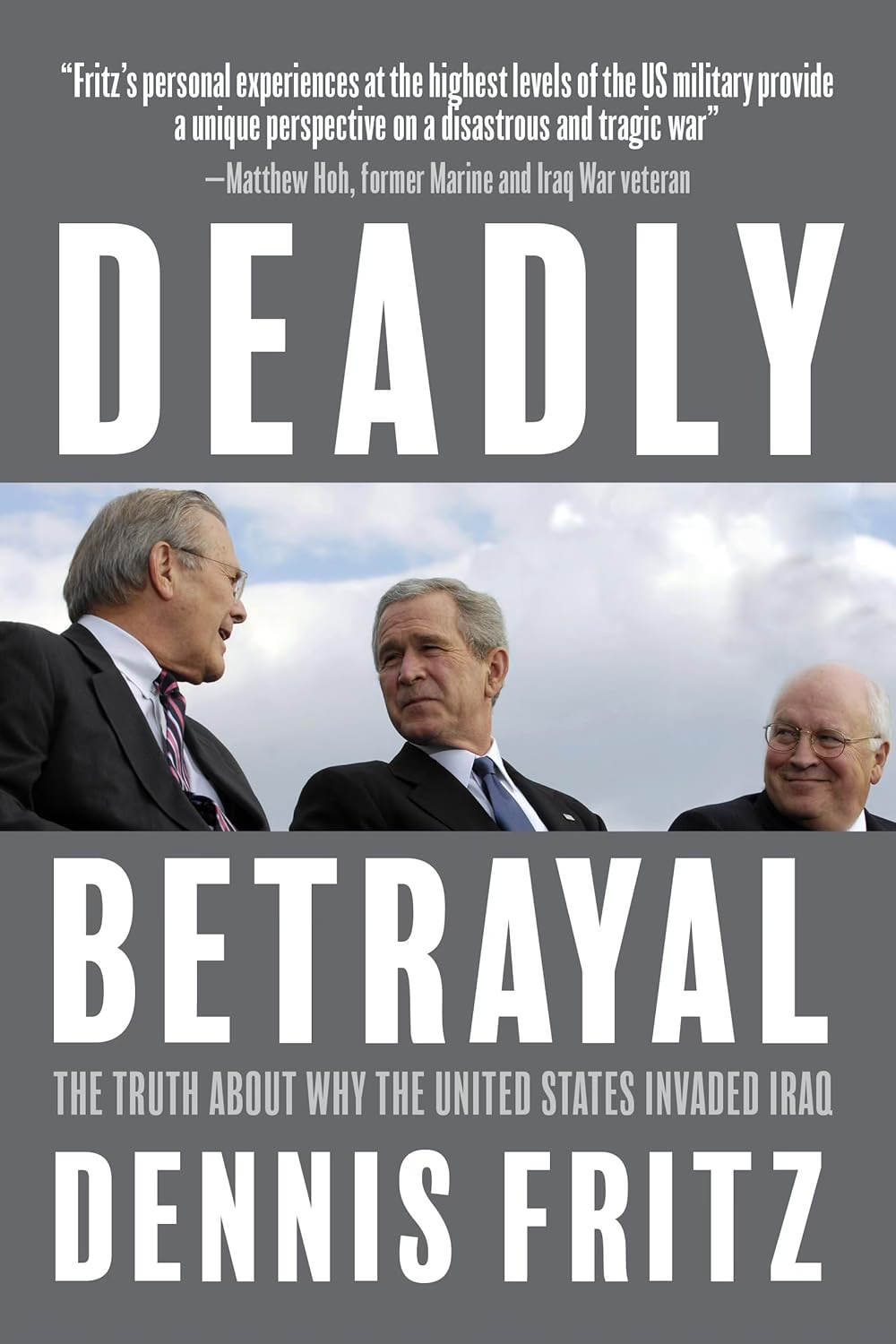
A great book for this moment is “Deadly Betrayal: The Truth About Why the United States Invaded Iraq” (2024) by Dennis Fritz. Fritz, a retired AF command chief master sergeant, was in the halls of power when the Bush/Cheney administration decided to invade Iraq in 2003. He identifies three main reasons for the Iraq War fiasco: U.S. leaders’ concerns about “credibility” and the perpetual fear of being perceived as “weak”; serving the security needs of Israel, especially by weakening Hamas and Hezbollah together with Iraq; and neocon fever dreams of imperial dominance in the Middle East connected to the control of oil.
In his conclusion, Fritz is scathingly blunt:
More than 4,500 [U.S. troops] made the ultimate sacrifice, and 100,000 have been wounded for life. There were no weapons of mass destruction in Iraq. Saddam Hussein posed no threat to our national security. The Iraq War wasn’t an honest mistake. It was a calculated lie—a deadly betrayal. Our service members were used as pawns by the government to fulfill an imperialist ideology. Their sacrifice had no basis in national defense. All Americans should be outraged, and we should never let this happen again. The troops didn’t even know why they were going to war.
It saddens me to think that Fritz may soon need to write “Deadly Betrayal II” about the forthcoming war with Iran.
Scrolling through old files today, I came across this paper that I prepared for a “Strategic Studies Seminar” at Oxford that I presented on 28 January 1993. Back then, I was a captain in the Air Force, and in the room were other serving and retired military officers. Anyhow, here’s what I read to my peers (and the two professors hosting the seminar) about the U.S. defeat in Vietnam. Again, this presentation is 33 years old, but I hope it’s still useful despite its age.
Insurgencies and America’s Defeat in Vietnam (1993)
A revolutionary war is a war within a state; the ultimate aim of the insurgents is political control of the state. Nowhere is Clausewitz’s dictum of war as a continuation of politics more true than in a revolutionary war. It typically takes the form of a protracted struggle, conducted patiently and inexorably, a variant of Chinese water torture. Educating or, more accurately, indoctrinating, the people – gaining their sympathy, cooperation, and assistance – is paramount. And all people have a role to play: men and women, young and old. After World War II, insurgencies have been guided by Mao Zedong’s concept of People’s War, and inspired by a complex combination of nationalism, anti-colonialism, and communism. They have bedeviled France, Great Britain, and the United States. This paper addresses the strategy of People’s War in terms of means, ends, and will, and details some of the reasons why the United States lost the Vietnam War.
The strategic end of People’s War is simple in its boldness: the overthrow of the existing government and its replacement with an insurgent-led government. The means are incredibly complex, encompassing social, economic, psychological, military, and political dimensions, but it must be remembered that all means are directed towards the political end. Strength of will usually favors the insurgents, partly because a major goal of People’s War is to mold the minds of its followers to convince them of the righteousness of their cause.
People’s War passes through three stages. At first the insurgents get to know the people as they spread propaganda and build a political infrastructure.
Every insurgent is an ambassador for the cause. They create safe havens while intimidating opponents and neutrals, and they commit terrorist acts to undermine the legitimacy of the government. They build their safe havens on the periphery of the state, usually in rural or impoverished areas where they can feed on the misery of the people. The more difficult the terrain, the better, whether it be the mountains of Spain and Afghanistan or the jungles of Malaya and Vietnam. They extend their control over the countryside and into the urban areas during the second stage of People’s War. They use guerrilla tactics and terrorism to further undermine the political legitimacy of the government. The main target is not the government’s troops but the will of its leaders. As they extend their physical control over the countryside, they install their own political structure to control the people. With the government’s will fatally weakened, the insurgents move to the final stage: a conventional military offensive to overthrow the government.
The three stages are not rigidly sequential, however. For example, while conducting guerrilla operations against the government, the insurgents continue to build their infrastructure, conduct terrorist acts, and spread propaganda. Even during the last stage — the general offensive — the insurgents continue stages one and two. This aspect of People’s War was well expressed by John M. Gates in the Journal of Military History in July 1990:
American conventional war doctrine does not anticipate reliance upon population within the enemy’s territory for logistical and combat support. It does not rely upon guerrilla units to fix the enemy, establish clear lines of communication, and maintain security in the rear. And it certainly does not expect enemy morale to be undermined by political cadres within the very heart of the enemy’s territory, cadres who will assume positions of political power as the offensive progresses. Yet all of these things happened in South Vietnam in 1975….
Flexibility, judgement, and comprehensiveness of methods are the keys to success. If the insurgents overestimate the weakness of the government and lose large-scale battles, they slip back into the earlier two phases and continue to work towards weakening the government for the next general offensive.
It bears repeating the primary goal of insurgents is political control. Military actions are only one tool for obtaining this control. As Mao cautions, guerrilla operations are just “one aspect of the revolutionary struggle.” The insurgent appeals to the hearts and minds of the people. He is, after all, one of them. Too much can be made of Mao’s “fish and sea” analogy. The insurgent is not just a fish that swims in the sea of the people: his purpose is to convert the sea to his purpose. He wants to walk on water. He employs any method to command the sea to his will. He would prefer ideological converts, true believers, but converts through terror are acceptable. Those who can’t be converted he ruthlessly kills. That his methods produce squeamishness among some in the West only accentuates their value to him.
As a strategy, People’s War is difficult but not impossible to counter. The United States defeated the Philippine insurrection in the first two decades of this century, and after World War II Great Britain put down a communist insurgency in Malaya. More famous, however, have been the stunning successes of People’s War: Mao’s victory over Japan and the Nationalists in the 1930s and ‘40s, and Ho Chi Minh’s victories over France and the United States in the 1950s, ‘60s, and ‘70s. Perhaps most unsettling was America’s defeat in Vietnam. How could the world’s foremost superpower lose to, in the words of General Richard G. Stilwell in 1980, a “fourth-rate half-country?”
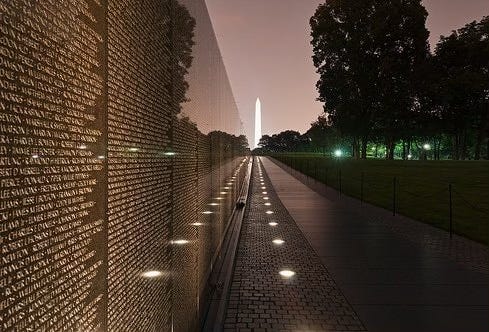
There are no simple answers to America’s defeat, although Hollywood tells us otherwise. A theory still believed by some in the US military is a variation of the German “stab-in-the-back” legend of the Great War. Our hands were tied by meddling civilians who didn’t let the military fight and win the war. One American soldier is the equal of hundreds of pajama-clad midgets, or so it appears in the Rambo flicks. A wretched, dishonorable government also abandoned our POWs to the godless communists, now rescued several times over by Stallone, Chuck Norris, and other martial arts experts. That such films make money is an affront to the genuine sacrifices of Americans represented so tragically by the Vietnam War memorial in Washington.
Perhaps such sentiments seem out of place in a paper devoted to a dispassionate strategic analysis of America’s role in Vietnam. Yet my feelings are perhaps typical of the emotionalism that still surrounds this topic among Americans. A dispassionate critique from an American, let alone an American service member, may still be impossible; nevertheless, I’ll give it a shot.
The United States lost the war for several related reasons. First, we fought the wrong kind of war. As the Navy and especially the Air Force built up their nuclear forces, the army chaffed against its “New Look” and diminished role in the 1950s. Under Kennedy and Johnson, the Army had a new doctrine – Flexible Response – and an opportunity – the Vietnam War – to prove its worth. Vietnam was to be the proving ground for a revitalized Army.
The opposite proved to be the case because the Army pursued the wrong strategy. From 1965-68, when we sent more than half a million troops to Vietnam, the US Army tried to fight a conventional war against the Viet Cong (VC) and North Vietnamese Army (NVA). As LTG Harry Kinnard, commander of the Army’s elite 1st Cavalry Division (Airmobile), put it, “I wanted to make them fight our kind of war. I wanted to turn it into a conventional war – boundaries – and here we go, and what are you going to do to stop us?” Obeying Mao’s teachings, the VC and NVA wisely avoided stand up fights. The Army responded with search-and-destroy operations to find, fix and kill the enemy. The goal was attrition through decisive battles, reflected by high body counts. Nothing illustrates the bankruptcy of American strategy better than the idea of body counts. In theory, a high body count means you’re killing the fish in the sea, without hurting the sea. In practice, a high body count is a measure of the success of the insurgents: they’re recruiting many fish to their cause. And in killing the fish, Americans poisoned the sea with defoliants, bomb craters, unexploded artillery shells, the list goes on. Americans were stuck in Catch-22 dilemmas: they had to destroy villages to save them, they had to destroy villagers’ crops while pursuing guerrilla bands. Such an approach flies in the face of Mao’s “Three Rules and Eight Remarks,” which exhibit a profound respect for the people and their property.
The Vietnam War Memorial in DC
After killing, or perhaps more often not killing, the guerrillas, the Army left, and the guerrillas regained control of the area. This did not disturb LTG Stanley Larson, who observed that if guerrillas returned, “we’ll go back in and kill more of the sons of bitches.” But the VC and NVA retained the initiative, had plenty of manpower, and time was on their side.
Why did the Army pursue such a faulty strategy? In part due to the legacy of World War II, particularly American experience in the Pacific. In island-hopping to Japan, Americans gained faith in massive firepower and lost interest in controlling land. The islands were a means to an end, not the end itself, and success could be measured in some sense by the number of Japanese casualties. Such was not the case in Vietnam, where control of the land was essential to winning the support of the people. Part of the Army’s problem was its lack of experience in counterinsurgency (or COIN) operations. Ronald Spector reports that in the 1950s, COIN operations were limited to four hours in most infantry training courses. What little was taught focused on preventing a conventional enemy from holding raids or infiltrating rear areas. But in the end, the Army fought the war it was trained to fight: a conventional war of maneuver and massive firepower. This worked well in Desert Storm, but failed in Vietnam.
In contrast to the Army, the Marines were far more aware of the nature of the war they were fighting, reports Andrew Krepinevich. They combined 15 marines and 34 Popular Force territorial troops (who lived in and provided security for a village or hamlet) into combat action platoons (CAPs). These CAPs sought to destroy insurgent infrastructure, protect the people and the government infrastructure, organize local intelligence networks, and train local paramilitary troops. In other words, they adopted traditional COIN tactics. But the Army ran the show in Vietnam, and its leaders rejected the Marines’ approach.
The Marines were not alone in their appreciation of the multidimensional aspects of COIN. Robert Komer’s Phoenix program also targeted the Viet Cong infrastructure, but the efforts of the CIA were not well coordinated with those of the military or the State Department, let alone the South Vietnamese. In fact Westmoreland refused to create a combined command to coordinate American actions with those of the South Vietnamese. The latter were an especially neglected resource. Admittedly, the Army of the Republic of Vietnam (ARVN) was corrupt and at times incompetent, but part of the problem was caused by American mistraining and the Army’s contempt. In the 1950s, American military advisors trained ARVN to repel a conventional invasion from the north, using North Korea as a model. From 1965-68, the US Army gave ARVN the static security mission, judged to be of low importance by the Army. US advisors assigned to help ARVN recognized their careers were endangered: they would advance far quicker if they had “true” combat assignments. After years of neglect, ARVN was built up with billions of US dollars during Nixon’s Vietnamization policy (and that’s exactly what it was – a policy, not a strategy), but by 1969 the rot had gone too far. ARVN lacked a unifying national spirit, VC agents had penetrated the ranks, and the officers were thoroughly politicized. Our ally always thought we’d be there if they ran into trouble, but they didn’t understand how American government worked. As Ambassador Bui Diem explained in 1990, “Our faith in America was total, and our ignorance was equally total.” South Vietnam paid the price in 1975.
Could the United States have won the Vietnam War if we had followed a proper strategy? This question may be unanswerable and ultimately moot, but it’s worth discussing. First, one must admit the war may not have been worth winning. Hannah Arendt has stated the Vietnam War was a case of excess means applied for minor aims in a region of marginal interest. In retrospect this seems irrefutable, but in the climate of the Cold War and Containment Vietnam seemed a critical theater in which communist aggression had to be stopped. Second, one must admit the United States was not protecting a viable government in South Vietnam: we were trying to create one. But we were creating one in our image. We ignored the Vietnamese culture and destroyed their economy with our hard currency. Rear area troops with money to spend spread prostitution and drugs in the streets of Saigon. In short, we alienated the people instead of winning them over to our cause. The few people we did win over were terrorized and often killed by the Viet Cong. Even following a proper COIN strategy, victory would have taken 5-10 more years at least. With weak support from the American people, (the “Silent Majority” was silent due to its ignorance and ambivalence), which waned dramatically after Tet, we never had a chance in Vietnam.
The one strategy that would have succeeded for the United States, I believe, is Mao’s People’s War. We must not deceive ourselves: if free elections had been held as promised in 1956, Ho Chi Minh would have won and unified the country. His was the legitimate government; we were trying to overthrow that government and replace it with almost any non-communist regime. In that effort, we should have formed an alliance of military, state department, intelligence, and academic resources to educate Americans in Vietnamese language and culture. These experts, with a suitable, politically-indoctrinated military force to protect them, would win the hearts of the people. Our main weapons would be our ideas and the ideological fervor of our troops, whether civilian or military. Diplomacy and military strikes would be used to cut-off the flow of arms to the VC and NVA from the Soviet Union. The political infrastructure of the enemy would be targeted, including Ho Chi Minh himself.
But this is ridiculous. Our very arrogance blinded us to the war’s complexities. We attacked the symptoms of the disease – the guerrillas and NVA – without examining what caused the disease in the body politic. Our can-do attitude was reinforced by our military traditions and our pride in our nation as being more moral than the rest of the world. We became our own worst enemy as we tried to manage the war. The commitment was there (at least among the soldiers), the energy was there, the money was there, the technology was there -the strategy, intelligence, and leadership wasn’t. People’s War proved superior to search-and-destroy, the VC and NVA intelligence proved superior to ARVN and ignorant Americans, the brilliant Giap out-thought the dedicated but shortsighted Westmoreland. The Vietnam War was ultimately unwinnable.
In the aftermath of the American-led victory over Iraq in Desert Storm, many Americans predicted the stigma of our defeat in Vietnam had finally been exorcised from our minds. Such was not the case, nor is such a result even desirable. The “dreaded V-word,” as the London Times recently described it, is being whispered again in the endless corridors of the Pentagon. If this breeds an aversion to the use of military force, harm may result; but if it leads to more thought and a more subtle study of the efficacy of military force as applied under different conditions, the dreaded V-word will have served a useful purpose, and those names engraved on the Wall in Washington will not have died in vain.
Last January, I published “My Father’s Journal,” which recounts my dad’s experience surviving the Great Depression, serving in the Civilian Conservation Corps in Oregon fighting forest fires, military service in the Army during World War II, and bringing up five children during the “Baby Boom” years of the 1950s and 1960s while serving as a city firefighter. If you’re interested, it’s available at Amazon for $10 for the paperback and $5 for the Kindle version. Follow this link, and thanks!
*****
I received two interesting queries this week, one on Blitzkrieg and the other on how much the U.S. spends on weapons and war. On the first subject, I was asked about the characteristics of Blitzkrieg, when the concept was developed and seen in battle, and for post-World War II examples. I was also asked about Russia-Ukraine and the recent U.S. attack on Venezuela. Here are my answers:
1. Speed, surprise, combined arms, and disruption are the main characteristics of Blitzkrieg. “Combined arms” refers to all combat arms working synergistically, i.e. infantry, armor, artillery, supported by air forces (nowadays, drones might be involved in large numbers). Special forces like airborne units may also be involved. Deception and misdirection are also aspects of Blitzkrieg. The fundamental idea is to move and maneuver so quickly that the enemy can’t keep pace–to disrupt the enemy’s cohesion. To place them in an untenable position where they have to withdraw or perhaps even surrender.
2. Blitzkrieg, though associated with Nazi Germany in World War II, is an old concept in warfare. Perhaps the best practitioners were the Mongols in the 13th century. The Western concept has its roots in World War I and the stalemate of trench warfare. Ideas associated with what became known as Blitzkrieg were tried on various World War I battlefields. The idea was to break the stalemate of fixed lines and fortifications without getting into costly battles of attrition. These ideas came to maturity in World War II.
3. Blitzkrieg, perhaps ironically, is sometimes attached to the Israeli Defense Forces, as in their attacks in 1967 in the Six Day War. You might say the USA used Blitzkrieg against Iraq in 1991. Russia’s initial attack on Ukraine in 2022 was not a Blitzkrieg–it was more of an uncoordinated show of force that backfired. The USA attack on Venezuela was a “snatch and grab” kidnapping, not a military campaign per se.
*****
The second query focused on how much the U.S. spends on weaponry and war and how we measure that as a percentage of the federal budget. Here’s my answer to that:
Yes, it’s a numbers game. If you include all federal spending (including non-discretionary spending like social security and Medicare/Medicaid), it’s a smaller percentage. Roughly 15% of the federal budget.
If you focus on discretionary spending, it’s more than 50%. It depends on how you count it. If you add Pentagon spending to Homeland Security, the VA, the DOE (nukes), and interest on the federal debt due to wars and military spending, the percentage is 60% or even higher.
When the warmongers really want to minimize war spending, they compare it to GDP.
*****
No matter how you measure it (or attempt to minimize it), a trillion dollars is a lot of money. Of course, the best way to think of “defense” spending is from President Dwight D. Eisenhower’s “Cross of Iron” speech in 1953:
Every gun that is made, every warship launched, every rocket fired signifies, in the final sense, a theft from those who hunger and are not fed, those who are cold and are not clothed. This world in arms is not spending money alone. It is spending the sweat of its laborers, the genius of its scientists, the hopes of its children… This is not a way of life at all, in any true sense. Under the cloud of threatening war, it is humanity hanging from a cross of iron.
That is the true cost of spending on weapons and war.
Hello Everyone: In 2007, I was fed up with the lies of the Bush/Cheney administration and the way civilian leadership was using the bemedaled chest of David Petraeus to deflect blame for that disastrous war. I knew then the “success” of the surge was an illusion, or, as Petraeus put it back then, “fragile” and “reversible” (and so it proved to be). I wrote an op-ed about how we the people had to save the military from itself and its own self-serving illusions. No one was interested in what I had to say; no one, that is, except Tom Engelhardt at TomDispatch. And so that led to my first “tomgram.”
Eighteen years later, I’ve reached the unlikely number of 115 essays for TomDispatch, something neither Tom nor I ever expected. And just about all those essays have been introduced by a mini-essay by Tom himself. It’s been a remarkable partnership—it’s what got my career as a writer and essayist (rather than a traditional historian) started.
This piece, my 115th, returns again to Cheyenne Mountain and nuclear war. I first wrote about my time “in the mountain” in 2008; seventeen years later, I’m even more dismayed at (and disgusted by) my country’s newfound enthusiasm for nuclear weapons and their “recapitalization.” Read on!
*****
It’s been 20 years since I retired from the Air Force and 40 years since I first entered Cheyenne Mountain, America’s nuclear redoubt at the southern end of the Front Range that includes Pikes Peak in Colorado. So it was with some nostalgia that I read a recent memo from General Kenneth Wilsbach, the new Chief of Staff of the Air Force (CSAF). Along with the usual warrior talk, the CSAF vowed to “relentlessly advocate” for the new Sentinel ICBM (intercontinental ballistic missile) and the B-21 Raider stealth bomber. While the Air Force often speaks of “investing” in new nukes, this time the CSAF opted for “recapitalization,” a remarkably bloodless term for the creation of a whole new generation of genocidal thermonuclear weapons and their delivery systems.
(Take a moment to think about that word, “creation,” applied to weapons of mass destruction. Raised Catholic, I learned that God created the universe out of nothing. By comparison, nuclear creators aren’t gods, they’re devils, for their “creation” may end with the destruction of everything. Small wonder J. Robert Oppenheimer musedthat he’d become death, the destroyer of worlds, after the first successful atomic blast in 1945.)
In my Cheyenne Mountain days, circa 1985, the new “must have” bomber was the B-1 Lancer and the new “must have” ICBM was the MX Peacekeeper. If you go back 20 to 30 years earlier than that, it was the B-52 and the Minuteman. And mind you, my old service “owns” two legs of America’s nuclear triad. (The Navy has the third with its nuclear submarines armed with Trident II missiles.) And count on one thing: it will never willingly give them up. It will always “relentlessly advocate” for the latest ICBM and nuclear-capable bomber, irrespective of need, price, strategy, or above all else their murderous, indeed apocalyptic, capabilities.
At this moment, Donald Trump’s America has more than 5,000 nuclear warheads and bombs of various sorts, while Vladimir Putin’s Russia has roughly 5,500 of the same. Together, they represent overkill of an enormity that should be considered essentially unfathomable. Any sane person would minimally argue for serious reductions in nuclear weaponry on this planet. The literal salvation of humanity may depend on it. But don’t tell that to the generals and admirals, or to the weapons-producing corporations that get rich building such weaponry, or to members of Congress who have factories producing such weaponry and bases housing them in their districts.
So, here we are in a world in which the Pentagon plans to spend another $1.7 trillion(and no, that is not a typo!) “recapitalizing” its nuclear triad, and so in a world that is guaranteed to remain haunted forever by a possible future doomsday, the specter of nuclear mushroom clouds, and a true “end-times” catastrophe.
I Join AF Space Command Only to Find Myself Under 2,000 Feet of Granite
My first military assignment in 1985 was at Peterson Air Force Base in Colorado with Air Force Space Command. That put me in America’s nuclear command post during the last few years of the Cold War. I also worked in the Space Surveillance Center and on a battle staff that brought me into the Missile Warning Center. So, I was exposed, in a relatively modest way (if anything having to do with nuclear weapons can ever be considered “modest”), to what nuclear war would actually be like and forced to think about it in a way most Americans don’t.
Each time I journeyed into Cheyenne Mountain, I walked or rode through a long tunnel carved out of granite. The buildings inside were mounted on gigantic springs (yes, springs!) that were supposed to absorb the shock of any nearby hydrogen bomb blast in a future war with the Soviet Union. Massive blast doors that looked like they belonged on the largest bank vault in the universe were supposed to keep us safe, though in a nuclear war they might only have ensured our entombment. They were mostly kept open, but every now and then they were closed for a military exercise.
The author (right) with Tom Engelhardt
I was a “space systems test analyst.” The Space Surveillance Center ran on a certain software program that needed periodic testing and evaluation and I helped test the computer software that kept track of all objects orbiting the Earth. Back then, there were just over 5,000 of them. (Now, that number’s more like 45,000 and space is a lot more crowded — perhaps too crowded.)
Anyhow, what I remember most vividly were military exercises where we’d run through different potentially world-ending scenarios. (Think of the movie War Gameswith Matthew Broderick.) One exercise simulated a nuclear attack on the United States. No, it wasn’t like some Hollywood production. We just had monochrome computer displays with primitive graphics, but you could certainly see missile tracks emerging from the Soviet Union, crossing the North Pole, and ending at American cities.
Even though there were no fancy (fake) explosions and no other special effects, simply realizing what was possible and how we would visualize it if it were actually to happen was, as I’m sure you can imagine, a distinctly sobering experience and not one I’ve ever forgotten.
That “war game” should have shaken me up more than it did, however. At the time, we had a certain amount of fatalism about the possibility of nuclear war, something captured in the posters of the era that told you what to do in case of a nuclear attack. The final step was basically to bend over and kiss your ass goodbye. That was indeed my attitude.
Rather than obsess about Armageddon, I submerged myself in routine. There was a certain job to be done, procedures to be carried out, discipline to adhere to. Remember, of course, that this was also the era of the rise of the nuclear freeze protest movement that was demanding the U.S. and the Soviet Union reach an agreement to halt further testing, production, and deployment of nuclear weapons. (If only, of course!) In addition, this was the time of the hit film The Day After, which tried to portray the aftermath of a nuclear war in the United States. In fact, on a midnight shift in Cheyenne Mountain, I even read Tom Clancy’s Red Storm Rising, which envisioned the Cold War gone hot, a Third World War gone nuclear.
Of course, if we had thought about nuclear war every minute of every day, we might indeed have been cowering under our sheets. Unfortunately, as a society, except in rare moments like the nuclear freeze movement one, we neither considered nor generally grasped what nuclear war was all about (even though nine countries now possess such weaponry and the likelihood of such a war only grows). Unfortunately, that lack of comprehension (and so protest) is one big reason why nuclear war remains so chillingly possible.
If anything, such a war has been eerily normalized in our collective consciousness and we’ve become remarkably numb to and fatalistic about it. One characteristic of that reality was the anesthetizing language that we used then (and still use) when it came to nuclear matters. We in the military spoke in acronyms or jargon about “flexible response,” “deterrence,” and what was then known as “mutually assured destruction” (or the wiping out of everything). In fact, we had a whole vocabulary of different words and euphemisms we could use so as not to think too deeply about the unthinkable or our possible role in making it happen.
My Date With Trinity
After leaving Cheyenne Mountain and getting a master’s degree, I co-taught a course on the making and use of the atomic bomb at the Air Force Academy. That was in 1992, and we actually took the cadets on a field trip to Los Alamos where the first nuclear weapon had largely been developed. Then we went on to the Trinity test sitein Alamogordo, New Mexico, where, of course, that first atomic device was tested and that, believe me, was an unforgettable experience. We walked around and saw what was left of the tower where Robert Oppenheimer and crew suspended the “gadget” (nice euphemism!) for testing that bomb on July 16, 1945, less than a month before two atomic bombs would be dropped on the Japanese cities of Hiroshima and Nagasaki, destroying both of them and killing perhaps 200,000 people. Basically (I’m sure you won’t be surprised to learn), nothing’s left of that tower except for its concrete base and a couple of twisted pieces of metal. It certainly does make you reflect on the sheer power of such weaponry. It was then and remains a distinctly haunted landscape and walking around it a truly sobering experience.
And when I toured the Los Alamos lab right after the collapse of the other great superpower of that moment, the Soviet Union, it was curious how glum the people I met there were. The mood of the scientists was like: hey, maybe I’m going to have to find another job because we’re not going to be building all these nuclear weapons anymore, not with the Soviet Union gone. It was so obviously time for America to cash in its “peace dividends” and the scientists’ mood reflected that.
Now, just imagine that 33 years after I took those cadets there, Los Alamos is once again going gangbusters, as our nation plans to “invest” another $1.7 trillion in a “modernized” nuclear triad (imagine what that means in terms of ultimate destruction!) that we (and the rest of the world) absolutely don’t need. To be blunt, today that outrages me. It angers me that all of us, whether those like me who served in uniform or your average American taxpayer, have sacrificed so much to create genocidal weaponry and a distinctly world-ending arsenal. Worse yet, when the Soviet Union collapsed in 1991, we didn’t even try to change course. And now the message is: Let’s spend staggering amounts of our tax dollars on even more apocalyptic weaponry. It’s insanity and, no question about it, it’s also morally obscene.
The Glitter of Nuclear Weapons
That ongoing obsession with total destruction, ultimate annihilation, reflects the fact that the United States is led by moral midgets. During the Vietnam War years, the infamous phrase of the time was that the U.S. military had to “destroy the town to save it” (from communism, of course). And for 70 years now, America’s leaders have tacitly threatened to order the destruction of the world to save it from a rival power like Russia or China. Indeed, nuclear war plans in the early 1960s already envisioned a massive strike against Russia and China, with estimates of the dead put at 600 million, or “100 Holocausts,” as Daniel Ellsberg of Vietnam War fame so memorably put it.
Take it from this retired officer: you simply can’t trust the U.S. military with that sort of destructive power. Indeed, you can’t trust anyone with that much power at their fingertips. Consider nuclear weapons akin to the One Ring of Power in J.R.R. Tolkien’sThe Lord of the Rings. Anyone who puts that ring on is inevitably twisted and corrupted.
Freeman Dyson, a physicist of considerable probity, put it well to documentarian Jon Else in his film The Day After Trinity. Dyson confessed to his own “ring of power” moment:
“I felt it myself. The glitter of nuclear weapons. It is irresistible if you come to them as a scientist. To feel it’s there in your hands, to release this energy that fuels the stars, to let it do your bidding. To perform these miracles, to lift a million tons of rock into the sky. It is something that gives people an illusion of illimitable power, and it is, in some ways, responsible for all our troubles — this, what you might call technical arrogance, that overcomes people when they see what they can do with their minds.”
I’ve felt something akin to that as well. When I wore a military uniform, I was in some sense a captive to power. The military both captures and captivates. There’s an allure of power in the military, since you have a lot of destructive power at your disposal.
Of course, I wasn’t a B-1 bomber pilot or a missile-launch officer for ICBMs, but even so, when you’re part of something that’s so immensely, even world-destructively powerful, believe me, it does have an allure to it. And I don’t think we’re usually fully aware of how captivating that can be and how much you can want to be a part of that.
Even after their service, many veterans still want to go up in a warplane again or take a tour of a submarine, a battleship, or an aircraft carrier for nostalgic reasons, of course, but also because you want to regain that captivating feeling of being so close to immense — even world-ending — power.
The saying that “power corrupts, and absolute power corrupts absolutely” may never be truer than when it comes to nuclear war. We even have expressions like “use them or lose them” to express how ICBMs should be “launched on warning” of a nuclear attack before they can be destroyed by an incoming enemy strike. So many years later, in other words, the world remains on even more of a nuclear hair-trigger, the pistol loaded and cocked to our collective heads, just waiting for news that will push us over the edge, that will make those trigger fingers of ours too itchy to resist the urge to put too much pressure on that nuclear trigger.
No matter how many bunkers we build, no matter that the world’s biggest bunker tunneled out of a mountain, the one I was once in, still exists, nothing will save us if we allow the glitter of nuclear weapons to flash into preternatural thermonuclear brightness.
Next year we celebrate the 250th anniversary of America’s founding. There’s going to be the usual fight over what that anniversary should mean to Americans, and what lessons we should draw. For example, the Ken Burns series on “The American Revolution” starts this Sunday night on PBS. I’ll be watching it. If it comes close to his series on the U.S. Civil War, it should be interesting and informative.
There are so many lessons we could take from the American revolution (or war of independence). Speaking as a retired military officer, I might stress the citizen-soldier tradition, the ideal of the Minuteman, the rejection of tyranny, the suspicion of large standing armies, the desire for independence and liberty, the courage to affix one’s name to a declaration that could end with your head swinging in the air.
I don’t know what lessons Trump & Crew will be selling, but something tells me they won’t be salutary. Lots of flag-waving, of course, along with American exceptionalism.
We know America was founded as an imperfect union. Life, liberty, and the pursuit of happiness wasn’t granted to slaves. Or indigenous peoples. Or women for that matter. (Let’s not forget women couldn’t vote for president until 1920.) The founders were mostly white men of property, with some holding “property” in slaves. For African-Americans, the “revolution of 1776” certainly didn’t prove revolutionary for them.
I would stress the idea of striving toward a more perfect union, recognizing the early republic was, in so many ways, imperfect. And that’s putting it gently. I’d stress as well what Benjamin Franklin said. As a form of government, a representative republic is better than most but also difficult to keep. And there’s the rub: today our representatives, our public servants, serve the owners and donors, the power brokers, rather than the people. A revival of the republic isn’t going to come from either major political party—they’re both beholden to money.
So how can we end this “tyranny” without a bloody revolution? Is a national revival possible without years and years of domestic conflict and strife? Meanwhile, can America reject its embrace of militarism and imperialism? Can it advance the rule of law as represented by the U.S. Constitution? Can we be touched, as Abraham Lincoln wrote, by the better angels of our nature?
1776-2026. 250 years of glorious imperfection. We can be better. We can do better. Let’s strive to live up to the promise of America.
Today is Veterans Day, though of course November 11th was originally Armistice Day to mark the end of World War I on the 11th hour of the 11th day in 1918. Back then, it was hoped that the World War would inaugurate an era of lasting peace. Tragically, instead it inaugurated a state of more or less permanent war.
When I think of Veterans Day, I recall a grizzled veteran who spoke to me and a group of other young men (we didn’t want to be called “boys”) at Boys State in Massachusetts in 1980. I told the story 16 years ago at Huff Post, and I think it bears repeating today in 2025.
One Grizzled Veteran’s Dream
On this Veterans Day [in 2009], what if we began to measure our national success and power not by our military arsenal or number of recruits, but rather by the very opposite of that?
Writer, History Professor, Retired Lieutenant Colonel (USAF)
Thirty years ago [Now, 45 years ago], I attended Boys State. Run by the American Legion, Boys State introduces high school students to civics and government in a climate that bears a passing resemblance to military basic training. Arranged in “companies,” we students did our share of hurrying up, lining up, and waiting (sound preparation, in fact, for my career in the military). I recall that one morning a “company” of students got to eat first because they launched into a lusty rendition of the Marine Corps hymn. I wasn’t angry at them: I was angry at myself for not thinking of the ruse first.
Today, most of my Boys State experience is a blur, but one event looms large: the remarks made by a grizzled veteran to us assembled boys. Standing humbly before us, he confessed that he hoped organizations like the American Legion and Veterans of Foreign Wars would soon wither away. And he said that he hoped none of us would ever become a member of his post.
At first, we didn’t get it. Didn’t he like us? Weren’t we tough enough? (Indeed, I recall that one of our adolescent complaints was that the name “Boys State” didn’t seem manly enough.)
Then it dawned on us what the withering away of organizations like the American Legion and the VFW would mean. That in our future young Americans would no longer be fighting and dying in foreign wars. That our world would be both saner and safer, and only members of an “old guard” like this unnamed veteran would be able to swap true war stories. Our role would simply be to listen with unmeasured awe and undisguised thanks, grateful that our own sons and daughters no longer had to risk life or limb to enemy bullets and bombs.
It pains me that we as a country have allowed this veteran’s dream to die. We as a country continue to enlarge our military, expand our foreign commitments, and fight seemingly endless wars, whether in Iraq, Afghanistan, or in other far-off realms of less-than-vital interest to us.
As a result of these wars, we continue to churn out so many new veterans, including so many wounded veterans, not forgetting those who never made it back.
Collectively, we Americans tend to suppress whatever doubts we have about the wisdom of our wars with unequivocal statements of support for our troops. And on days like Veterans Day, we honor those who served, and especially those who paid the ultimate price on the battlefield.
Yet, wouldn’t the best support for our troops be the achievement of the dream of that grizzled vet who cut through a young man’s fog thirty years ago? Shouldn’t we be working to achieve a new age in which the rosters of our local VFWs and Legion posts are no longer renewed with the broken bodies and shattered minds of American combat veterans?
Veteran’s grave, Williamsport, PA (Author’s photo)
Sadly, as we raise more troops and fight more wars, we seem committed to the opposite. Our military just enjoyed its best recruiting class in years. This “success” is not entirely surprising. It’s no longer that difficult to fill our military’s expanding ranks because many of our young men and women simply have little choice but to enlist, whether for economic opportunity, money for college, or benefits like free health care.
Many of course enlist for patriotic reasons as well. Yet the ease of expanding our military ranks during a shooting war is also a painful reminder of the impoverishment of opportunities for young, able-bodied Americans – the bitter fruit of manufacturing jobs sent overseas, of farming jobs eliminated by our own version of corporate collectivization, of a real national unemployment rate that is approaching twenty percent.
On this Veterans Day, what if we began to measure our national success and power, not by our military arsenal or by the number of new recruits in the ranks, but rather by the gradual shrinking of our military ranks, the decline of our spending on defense, perhaps even by the growing quiet of our legion posts and VFW halls?
Wouldn’t that be a truer measure of national success: fewer American combat veterans?
Wouldn’t that give us something to celebrate this Veterans Day?
I know one old grizzled veteran who would quietly nod his agreement.
War and rumors of war dominate the headlines. Venezuela. Nigeria. Iran. Somalia. A “new Cold War” involving Russia and China. What are we to believe?
The events of the 62 years of my short life (Vietnam, Afghanistan, Iraq, Libya, peace dividends that never arrive, military budgets that keep soaring, U.S. domination of the world’s weapons trade, the National Security State as America’s fourth and arguably most powerful branch of government, and on and on) make me highly suspect of official narratives about any war, especially as those same Pentagon budgets soar and those same arms exports keep flooding the world in the (false) name of democracy.
Nevertheless, warmongers in our country continue to shout and bray for more war. Those who make the most noise are typically the furthest from the fighting. Typically, the closer you are to the fighting, the more you want it to stop. Especially if you’re doing the fighting. Consider Erich Maria Remarque’s “All Quiet on the Western Front.” When the main character, Paul, a frontline grunt, goes home on leave, he realizes the blood-thirstiness of the REMFs is far different from the war he’s seeing at the front. (REMF, rear-echelon mother-fucker, is a colorful and meaningful military acronym.)
Often those who talk about war use the most bloodless expressions. So, for example, I’ve read that Ukrainians must “prosecute their war of defense,” helped by generous supplies of American-made weaponry. When I think of war, I think of the concrete. Blasted bodies, a poisoned environment, disease, dead animals, PTSD and TBI, moral injury, atrocities and war crimes (because wars always produce atrocity), and so on. Phrases like “help Ukraine prosecute their war of defense” strike me as Orwellian in the sense of his classic essay on politics and the English language. It sounds good and noble, but how ready are those who support Ukraine to join the cause in the trenches?
An American president now speaks of “the enemy within” and city streets as a training ground for U.S. military action. When everything is war, nothing is safe as the worst crimes and atrocities become possible.
As a young man, Cheney had “other priorities” than serving in the U.S. military. Later, the further he was from battle, the more hawkish he became.
Postscript: As I was writing this, I learned that Dick Cheney has died at the age of 84. NBC News described him as the “Iraq war architect,” as if he was a highly skilled and creative builder instead of a war criminal. A reader sent along a BBC headline that suggests there was “faulty” intelligence leading up to the Iraq war in 2003, as if Cheney had no hand in manufacturing a malicious and mendacious narrative of weapons of mass destruction in Iraq.
Even warmongers like Cheney, proud of their mailed fists, get treated and fitted with kid gloves by a fawning media. Of course, Cheney, when he had an opportunity to serve in Vietnam, famously said he had other priorities.
Maybe the American people, collectively, need to say we have other priorities than waging war around the globe.
America’s overseas wars, with all their capricious and vicious violence, have indeed come home. For decades, our leaders projected power abroad under the banner of fighting evil — whether Communism, terrorism, or tyranny. Yet in doing so, they helped cultivate an authoritarian mindset that has now turned inward. The “enemy” is no longer some distant foe in a foreign land; it is “the enemy within.” For Donald Trump, that means the mythical “radical left,” a variation of the 1950s fantasy that a Communist was hiding under every bed. The irony, of course, is that the real danger then, as now, comes not from a phantom leftist menace but from a radical right-wing movement willing to strip Americans of their rights in the false name of security, safety, and patriotism.
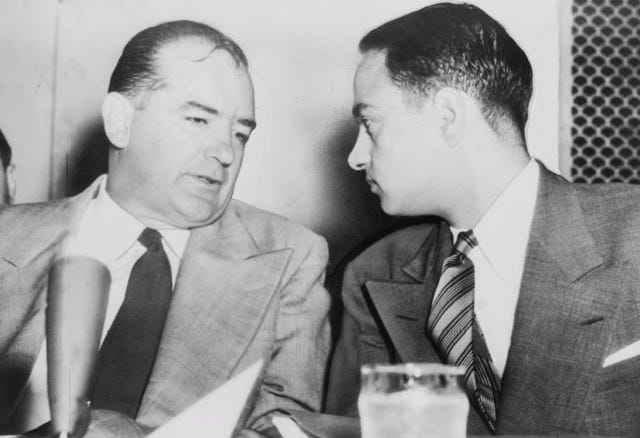
Joe McCarthy (L) with Roy Cohn
Today’s moment is more perilous than the McCarthy era. In the 1950s, Senator Joe McCarthy could destroy reputations and careers, but he was still just one senator. Today, we face a president who channels McCarthy’s demagoguery from the Oval Office, using the full power of the executive branch to punish dissent and reward loyalty. He is surrounded by a coterie of opportunists, lackeys, and lickspittles who feed his vanity, echo his grievances, and amplify his baseless conspiracy theories. The machinery of government — the same machinery once used to surveil and target foreign “enemies” — is now being aimed at our fellow citizens.
The global war on terror, it seems, has finally gone global in the truest sense — extending to America’s own streets, courthouses, and universities. Trump and his allies portray Democratic cities and progressive movements as breeding grounds of chaos and sedition. In his mind, anyone who resists his will — even through the most lawful and constitutional means — is an “insurrectionist.” He has long shown contempt for the Constitution he swore to uphold. Trump is often exactly what he appears to be: a dangerous blowhard with a vindictive streak, ignorant of the limits and responsibilities of his office. Yet others in his orbit, people like Stephen Miller, harbor more deliberate and insidious designs on American democracy.
What is to be done? Congress is paralyzed, fragmented, and largely disempowered. The Supreme Court is dominated by ideologues nursing grievances and eager to reshape the nation along reactionary lines. Who, then, will check a president determined to rule rather than govern?
The American experiment in self-government has endured many crises but rarely has it seemed so fragile. As journalist Nick Turse recently wrote in TomDispatch, the United States now stands on the precipice of authoritarian rule. Many Trump loyalists appear eager to leap — to wage an internal war against their fellow citizens under the guise of saving the nation.
Never has Dwight D. Eisenhower’s warning, “Only Americans can hurt America,” been more prescient or more tragic. The enemy within is not a phantom of the left or right — it is the creeping authoritarianism that grows when fear conquers freedom.
As Master Po reminded us in Kung Fu, “fear is the only darkness.” My fellow Americans, we are in a very dark place.







 Bracing Views