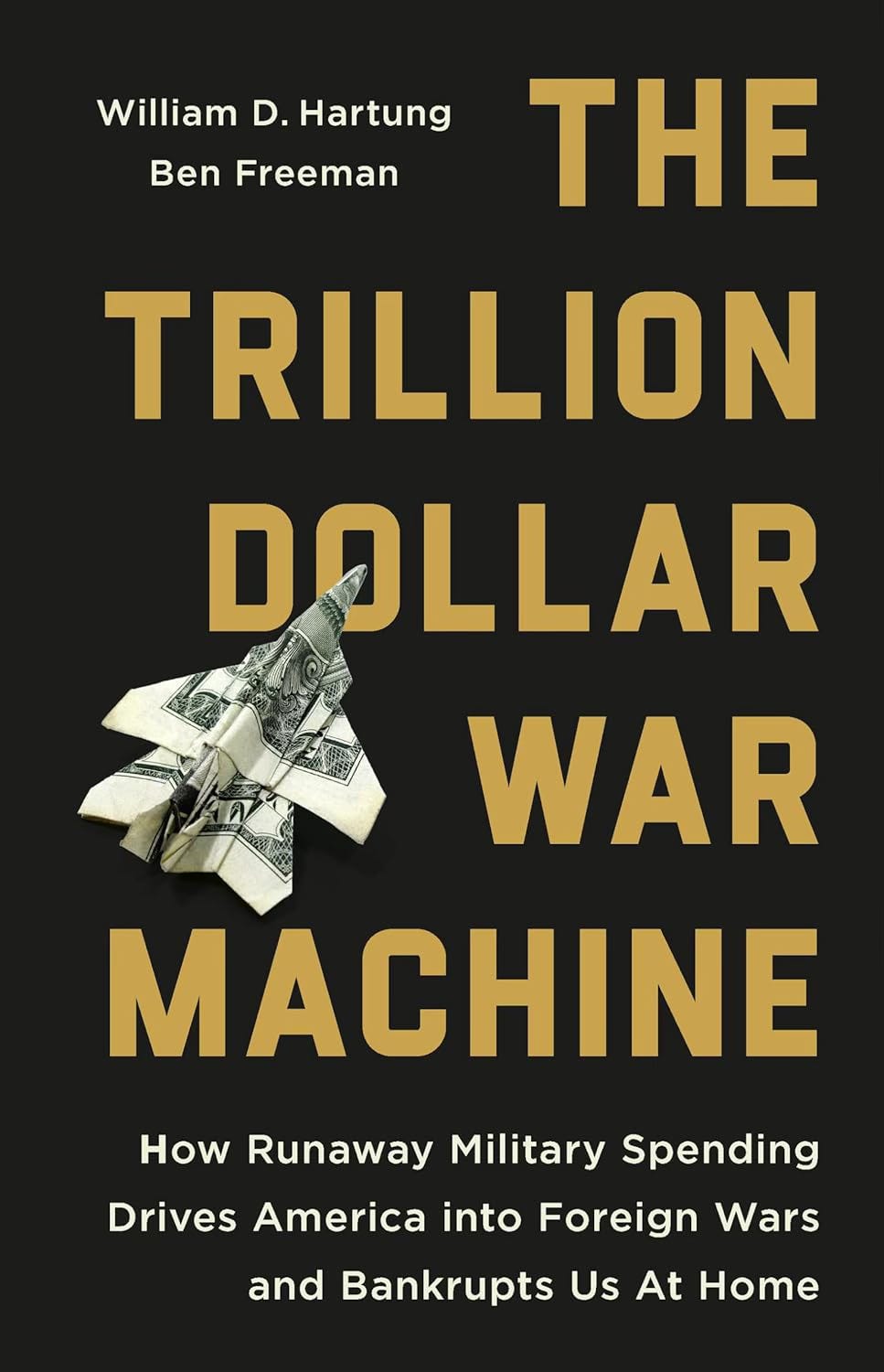
Wow. Just wow. That was my response after reading “The Trillion Dollar War Machine” by Bill Hartung and Ben Freeman. The book’s subtitle captures the “wow” part succinctly: “How runaway military spending drives America into foreign wars and bankrupts us at home.” And now, naturally, President Trump wants even more money for that runaway war machine: an almost unimaginable $500 billion more for FY2027. Egads! How did America’s so-called elites come to embrace war and weapons so wholeheartedly, so lustily, so greedily?
Many of the answers to that question are provided by Hartung and Freeman. They cite and explore President Dwight D. Eisenhower’s famous warning from 1961 about an emerging military-industrial complex. They explain how Congress is complicit in the growing power (and dangers) of the MIC, funding incessant warfare overseas and explosive spending on (often overpriced and largely ineffective) weaponry like the F-35 fighter and the Littoral Combat Ship (known colloquially as “little crappy ships”). Corruption, they show, is baked into the system: the corruption of the revolving door that spins so easily between the military, think tanks, the government, and weapons makers like Boeing and Lockheed Martin. It’s all thoroughly shocking as well as depressing.
Hartung and Freeman, both experienced researchers, know the MIC well. They also know it’s more than the MIC: it’s more like the MICIMATTSHG, or the military-industrial-congressional-intelligence-media-academe-think-tank-sports-Hollywood-gaming complex, so thoroughly has profiteering through militarism and war permeated American culture and society. Military and weapons funding is so colossal it’s seemingly everywhere even as it adds inexorably to the U.S. debt while contributing to military adventurism that further deepens that same debt. Small wonder that our national debt clock is fast approaching $39 trillion. It’s a golden dome of debt!
Reading this book made me think back to another classic account of the MIC and its many follies: James Fallows’s “National Defense.” That book came out in 1981, just as the “defense” buildup under President Ronald Reagan began. Timely as that book was, the Pentagon and its many camp followers were and are rarely forced to retreat when confronted by sensible and logical analysts. I fear this latest effort by Hartung and Freeman, much needed as it is, will similarly be ignored by a purblind Pentagon always in pursuit of power irrespective of the cost.
That would truly be a shame, not only for Americans in general but for the Pentagon as well. Hartung and Freeman aren’t anti-military: they’re pro-defense when defense is smart, effective, thrifty, and focused on upholding the U.S. Constitution. Everyone in uniform, indeed everyone without a uniform, should read this book. You really should know where so much of your taxpayer dollars go—and how much of that money is being wasted by a system that is not only burning your money but weakening America as a democracy. (Indeed, when it comes to money, the Pentagon may be the ultimate burn pit.)
Buy it, study it, absorb it. As Sun Tzu said, it’s smart to know your opponent. Far too often, the military-industrial complex is exactly that.
The so-called SignalGate scandal centered on the bombing of Yemen is highly revelatory. First, some resources. CNN has a useful annotated account of the chats exchanged at the highest levels of the Trump administration. At their respective Substacks, Lenny Broytman and Caitlin Johnstone have telling dissections of these chats as well. At Jacobin, Branko Marcetic has an important article that reminds us of the illegality of the attacks. As the article’s subheading puts it: The press [mainstream media] is mostly framing the Yemen group chat scandal as a story of incompetence. There’s little attention being paid to the deadliness, illegality, and ineffectiveness of the strikes themselves.
To me, among the most telling “chats” came from Secretary of Defense Pete Hegseth. It highlights the “exceptional” nature of America:
*****
Pete Hegseth to Vice President JD Vance: I fully share your loathing of European free-loading. It’s PATHETIC.
But Mike [Waltz, the National Security Adviser] is correct, we are the only ones on the planet (on our side of the ledger) who can do this. Nobody else even close. Question is timing…
*****
This is precisely the problem for America since the Vietnam War, if not before then. We’ve created a monster military, a “global strike” force, that is capable of destroying any target anywhere around the globe. “Nobody else even close,” SecDef Hegseth correctly says. And because we can do it, because we are exceptional in military force, our leaders believe we should do it, even if it’s only to send a “message” to the world how tough we are, how committed we are to killing others.
Other countries—like those “free-loading” European ones—are PATHETIC because they don’t have America’s military might. Only we can smite evildoers around the globe, only we can do so while also arming Israel to the teeth and covering its flanks while it continues its annihilation of Gaza, and this is something we are immensely proud of.
My fellow Americans, this is not something to be proud of. Consider if America’s military in the 1960s had lacked the ability to deploy over half a million troops to Vietnam while also facing down the Warsaw Pact in Europe. Consider if America’s military had lacked the ability to invade Iraq in 2003 while also waging war in Afghanistan and garrisoning the globe with roughly 800 military bases. Consider how much blood would not have been spilled, and treasure wasted, if the U.S. military was smaller, focused on defense, and led by people who didn’t put muscle and flame emojis in their chats to celebrate U.S. military prowess at killing people in Yemen.
That U.S. military forces are the only ones who can kill globally with such comparative ease, that “nobody else even close,” is exactly what is wrong with our government. We place far too much faith and pride in military prowess, so much so that the Pentagon becomes the Pentagod, something we worship, something we make immense sacrifices to, as in budgets that approach $1 trillion yearly.
Not for nothing did President Dwight D. Eisenhower say in 1953 that this is no way of life at all—that we are crucifying ourselves on a cross of iron. Tell me again, who are the pathetic ones?
We must end our intoxication with military power before it ends us.
American foreign policy remains in the grip of heretics. They believe that the Prince of Peace is actually a god of war. They believe America is strengthened by entangling alliances (think here of our so-called alliance with Israel). They believe in constant war as a recipe both for dominant power and greater freedom and democracy throughout the world. They believe that spending roughly a trillion dollars each year on weapons and war is a wise “investment.” And they believe they are the toughest and truest of patriots, the ones who see further, the ones with the guts to get things done, no matter how poorly America’s wars have gone from Korea and Vietnam through Afghanistan, Iraq, and today’s proxy wars.
There used to be a different America, a much less militaristic and bellicose one. The American tradition is rich and complex; it contains multitudes, as Walt Whitman might say. Why are we so stuck on warmongers, thieves, and vainglorious simps of empire?
As an American, I’m very much a part of my country’s complexity and richness. And the America that speaks to me contains elements and lessons such as these:
George Washington’s prescient warning about the dangers of entangling alliances with foreign powers.
James Madison’s warning that constant warfare is the direst of enemies of liberty, freedom, and democracy in America.
General Smedley Butler’s confession that “war is a racket” and that he had often served as a “gangster for capitalism.”
The Nye Commission in the U.S. Senate that investigated arms manufacturers and weapons makers as “Merchants of Death” that profited greatly from war.
President Dwight D. Eisenhower’s “cross of iron” speech and his warning about the growing power and insidious nature of the military-industrial complex.
President John F. Kennedy’s powerful peace speech in which he extended an olive branch to the Soviet Union.
Martin Luther King Jr.’s powerful speech against the Vietnam War and the perils of militarism, racism, and materialism in America.
Of course, America has always had its dark side, with slavery and the genocidal treatment of Native Americans being at the top of the list. Yet America also has had its triumphs of wisdom and goodness. That is the America we should be embracing and celebrating. I believe it’s captured in the words of Washington, Madison, JFK, MLK, and so many others who’ve fought for peace and sanity, people like Dorothy Day, the Catholic activist who fought against war and all its awful excesses.
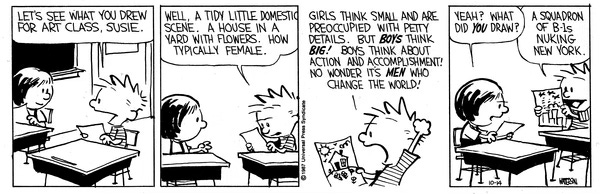
All that said, sometimes cartoons can express truths in ways that are as powerful as they are simple. In the cartoon below, the heretics of U.S. foreign policy are so many Calvins, spreading destruction and employing nukes in the name of manly seriousness. They are wrong. They are heretics. And if we continue to allow them to rule, they will surely lead America (as they already are in Gaza) to mass graves.
These are strange times in America. Today the New York Times is telling me there’s already a movement afoot to resist Donald Trump if he wins the election, in the cause of defending democracy, naturally. Here’s the blurb:
Now, as I’ve said on numerous occasions, I won’t be voting for Trump or Biden. I’m not a Trump supporter and I hope he loses. Yet, assuming the election isn’t “rigged,” as Trump likes to say whenever he loses, I’m prepared to accept the result as an expression of democracy, or at least as much “democracy” as the electoral college in America permits us to express.
I’m glad an “emerging coalition” is planning something, apparently, to curb the worst excesses of Trump and the Republicans. I hope this coalition will act to end Israel’s genocide in Gaza, pursue diplomacy to end the Russia-Ukraine War, pursue peace wherever and whenever possible, lower the threat of nuclear war on the planet, and cut the Pentagon budget while rebuilding America. How about fighting for America’s workers, raising the minimum wage, providing affordable health care for all that’s untied to employment, and similar steps that put the health and welfare of people first.
Or, is this “emerging coalition” motivated purely by animus against Trump and his followers? Is it still going to fully fund the Pentagon and wage war across the globe? In which case I’m not so excited.
Again, I come back to this question: If an “emerging coalition” is so worried about a Trump victory, why not put forward a candidate more fit to beat Trump than Joe Biden? Don’t “resist” Trump after he’s already won again—defeat him at the polls by putting forth a dynamic candidate with a populist worker-first platform.
I’m with James Madison that the biggest threat to liberty and freedom in America is perpetual war. War breeds authoritarianism and weapons built in the name of war represent, as Dwight D. Eisenhower famously said in 1953, a theft from the people. Weapons do not represent an “investment”; quite the reverse. And incessant preparations for war are not a recipe for peace.
If you truly want to defend democracy, resist war and the authoritarianism it breeds. Make major cuts to the Pentagon budget and invest in education and health rather than death and destruction. That’s the “emerging coalition” I’d like to see.
Even as the Military-Industrial Complex Becomes Ever Stronger and More Dangerous, We Must Keep Fighting Against It
In today’s article, I’d like to feature insights from friends and colleagues.
At TomDispatch, Tom Engelhardt takes on man’s seemingly endless addiction to war, an addiction most certainly manifested by the US of A, where bumper stickers tell me peace comes through superior firepower. Check out Tom’s article here. Not only do we wage war on each other, Tom notes, we wage war on the planet. In fact, few things degrade the environment more than war and all the destruction it brings with it.
John Rachel, a peace activist, has a telling theme: War is making us poor. He’s been making short punchy videos to hammer home the point. Check out his latest here:
Why are wars so persistent in the U.S., despite their stupidity, their destruction, their waste? One of my readers put it well in a comment to me:
The endless wars without a traditional definition of success have not been failures to those who have profited. For them, the only war that is lost, is the one that ends. God forbid one should be won under the standard definition and profits then ended.
Cynical? Not when you measure that statement against the U.S. experience of war since 1945.
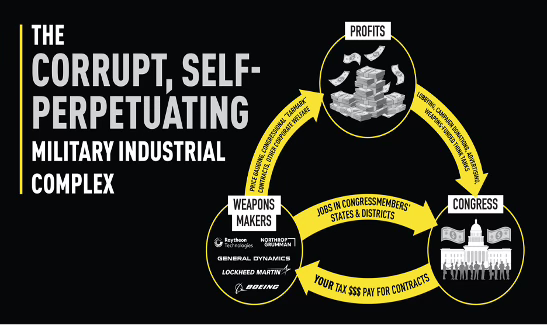
Finally, also at TomDispatch, David Vine and Theresa Arriola have an article: “The Military-Industrial Complex Is Killing Us All,” which is what Ike warned us about in 1961 if we refused to act as alert and knowledgeable citizens to keep that complex in check. Their article features clear and insightful charts on the basic features of the MIC and the dangers it poses. Here’s an example:
Vine and Arriola are part of an effort whose goal it is to dismantle, or very much to downsize, that complex. (I’ve been involved in their efforts.) Here’s the website:
Meanwhile, last week the “liberal” New York Times posted an article ostensibly written by Senator Roger Wicker calling for even more military spending by the U.S.
Here’s how The New York Times introduced Wicker’s op-ed on May 29th:
In a guest essay today, Senator Roger Wicker writes that we are approaching a version of that moment [a major war crisis] “faster than most Americans think.” Worse, he argues, the U.S. military is unprepared to meet the moment. After decades of underfunding, the American military lacks the strength or the equipment to deal with the wide range of new threats coming from our nation’s adversaries, including Iran, China, Russia and North Korea, he writes.
The answer to this problem, Wicker says, is a short-term “generational investment” in the U.S. military — and a national conversation on how to create a safer future for America. In a new white paper, he lays out a road map to “rebuild” the military, starting with an additional $55 billion in military spending in the 2025 fiscal year and an increase of annual military G.D.P. spending from its current projected level of around 3 percent to 5 percent over the next five to seven years.
That’s a serious amount of money that will inevitably raise big questions about where it will come from — and at the expense of what — at a moment when voices all along the political spectrum are questioning both U.S. military spending overseas and the role of the American military in the world today.
Wicker makes the case that the cost of a war with an increasingly powerful adversary like China would be far higher. “Regaining American strength will be expensive,” he writes. “But fighting a war — and worse, losing one — is far more costly.”
Readers, isn’t that inspiring? A “generational investment” in more guns, more bombs, and, as likely as not, more war? What a great idea!
Apparently, the only way to prevent a war is to prepare mightily for one, according to Senator Wicker. Wicker has apparently never heard, or read, or understood the words of Ike.
Senator Wicker is a shining example of the military-industrial-congressional complex that perpetuates war to the detriment of us all, indeed to all life on our planet. But it’s his words that are amplified by the “liberal” New York Times, not the wise words of my friends and colleagues here.
And so it goes, unless we act to put an end to it. We must be the alert and knowledgeable citizens that Ike implored us to be.
In an age when American presidents routinely boast of having the world’s finest military, where nearly trillion-dollar war budgets are now a new version of routine, let me bring up one vitally important but seldom mentioned fact: making major cuts to military spending would increase U.S. national security.
Why? Because real national security can neither be measured nor safeguarded solely by military power (especially the might of a military that hasn’t won a major war since 1945). Economic vitality matters so much more, as does the availability and affordability of health care, education, housing, and other crucial aspects of life unrelated to weaponry and war. Add to that the importance of a Congress responsive to the needs of the working poor, the hungry and the homeless among us. And don’t forget that the moral fabric of our nation should be based not on a military eternally ready to make war but on a determination to uphold international law and defend human rights. It’s high time for America to put aside its conveniently generic “rules-based order” anchored in imperial imperatives and face its real problems. A frank look in the mirror is what’s most needed here.
It should be simple really: national security is best advanced not by endlessly preparing for war, but by fostering peace. Yet, despite their all-too-louddisagreements, Washington’s politicians share a remarkably bipartisan consensus when it comes to genuflecting before and wildly overfunding the military-industrial complex. In truth, ever-rising military spending and yet more wars are a measure of how profoundly unhealthy our country actually is.
“The Scholarly Junior Senator from South Dakota”
Such insights are anything but new and, once upon a time, could even be heard in the halls of Congress. They were, in fact, being aired there within a month of my birth as, on August 2, 1963, Democratic Senator George McGovern of South Dakota — later a hero of mine — rose to address his fellow senators about “New Perspectives on American Security.”
George McGovern
Nine years later, he (and his vision of the military) would, of course, lose badly to Republican Richard Nixon in the 1972 presidential election. No matter that he had been the one who served in combat with distinction in World War II, piloting a B-24 bomber on 35 missions over enemy territory, even as Nixon, then a Navy officer, amassed a tidy sum playing poker. Somehow, McGovern, a decorated hero, became associated with “weakness” because he opposed this country’s disastrous Vietnam War, while Nixon manufactured a self-image as the staunchest Cold Warrior around, never missing a chance to pose as tough on communism (until, as president, he memorably visited Communist China, opening relations with that country).
But back to 1963, when McGovern gave that speech (which you can read in the onlineSenate Congressional Record, volume 109, pages 13,986-94). At that time, the government was already dedicating more than half of all federal discretionary spending to the Pentagon, roughly the same percentage as today. Yet was it spending all that money wisely? McGovern’s answer was a resounding no. Congress, he argued, could instantly cut 10% of the Pentagon budget without compromising national security one bit. Indeed, security would be enhanced by investing in this country instead of buying yet more overpriced weaponry. The senator and former bomber pilot was especially critical of the massive amounts then being spent on the U.S. nuclear arsenal and the absurd planetary “overkill” it represented vis-à-vis the Soviet Union, America’s main competitor in the nuclear arms race. As he put it then:
“What possible advantage [can be had] in appropriating additional billions of dollars to build more [nuclear] missiles and bombs when we already have excess capacity to destroy the potential enemy? How many times is it necessary to kill a man or kill a nation?”
How many, indeed? Think about that question as today’s Congress continues to ramp up spending, now estimated at nearly $2 trillion over the next 30 years, on — and yes, this really is the phrase — “modernizing” the country’s nuclear triad of intercontinental ballistic missiles (ICBMs), as well as its ultra-expensive nuclear-missile-firing submarines and stealth bombers. And keep in mind that the U.S. already has an arsenal quite capable of wiping out life on several Earth-sized planets.
What, according to McGovern, was this country sacrificing in its boundless pursuit of mass death? In arguments that should resonate strongly today, he noted that America’s manufacturing base was losing vigor and vitality compared to those of countries like Germany and Japan, while the economy was weakening, thanks to trade imbalances and the exploding costs of that nuclear arms race. Mind you, back then, this country was still on the gold standard and unburdened by an almost inconceivable national debt, 60 years later, of more than $34 trillion, significant parts of it thanks to this country’s failed “war on terror” in Iraq, Afghanistan, and elsewhere across all too much of the planet.
McGovern did recognize that, given how the economy was (and still is) organized, meaningful cuts to military spending could hurt in the short term. So, he suggested that Congress create an Economic Conversion Commission to ensure a smoother transition from guns to butter. His goal was simple: to make the economy “less dependent upon arms spending.” Excess military spending, he noted, was “wasting” this country’s human resources, while “restricting” its political leadership in the world.
In short, that distinguished veteran of World War II, then serving as “the scholarly junior Senator from South Dakota” (in the words of Senator Jennings Randolph of West Virginia), was anything but proud of America’s “arsenal of democracy.” He wasn’t, in fact, a fan of arsenals at all. Rather, he wanted to foster a democracy worthy of the American people, while freeing us as much as possible from the presence of just such an arsenal.
To that end, he explained what he meant by defending democracy:
“When a major percentage of the public resources of our society is devoted to the accumulation of devastating weapons of war, the spirit of democracy suffers. When our laboratories and our universities and our scientists and our youth are caught up in war preparations, the spirit of [freedom] is hampered.
“America must, of course, maintain a fully adequate military defense. But we have a rich heritage and a glorious future that are too precious to risk in an arms race that goes beyond any reasonable criteria of need.
“We need to remind ourselves that we have sources of strength, of prestige, and international leadership based on other than nuclear bombs.”
Imagine if his call had been heeded. This country might today be a far less militaristicplace.
Something was, in fact, afoot in the early 1960s in America. In 1962, despite the wishes of the Pentagon, President John F. Kennedy used diplomacy to get us out of the Cuban Missile Crisis with the Soviet Union and then, in June 1963, made a classic commencement addressabout peace at American University. Similarly, in support of his call for substantial reductions in military spending, McGovern cited the farewell address of President Dwight D. Eisenhower in 1961 during which he introduced the now-classic phrase “military-industrial complex,” warning that “we must never let the weight of this combination [of the military with industry, abetted by Congress] endanger our liberties or democratic processes.”
Echoing Ike’s warning in what truly seems like another age, McGovern earned the approbation of his Senate peers. His vision of a better, more just, more humane America seemed, however briefly, to resonate. He wanted to spend money not on more nuclear bombs and missiles but on “more classrooms, laboratories, libraries, and capable teachers.” On better hospitals and expanded nursing-home care. On a cleaner environment, with rivers and streams saved from pollution related to excessive military production. And he hoped as well that, as military bases were closed, they would be converted to vocational schools or healthcare centers.
McGovern’s vision, in other words, was aspirational and inspirational. He saw a future America increasingly at peace with the world, eschewing arms races for investments in our own country and each other. It was a vision of the future that went down fast in the Vietnam War era to come, yet one that’s even more needed today.
Praise from Senate Peers
Here’s another way in which times have changed: McGovern’s vision won high praise from his Senate peers in the Democratic Party. Jennings Randolph of West Virginia agreed that “unsurpassed military power in combination with areas of grave economic weakness is not a manifestation of sound security policy.” Like McGovern, he called for a reinvestment in America, especially in underdeveloped rural areas like those in his home state. Joseph Clark, Jr., of Pennsylvania, also a World War II veteran, “thoroughly” agreed that the Pentagon budget “needs most careful scrutiny on the floor of the Senate, and that in former years it has not received that scrutiny.” Stephen Young of Ohio, who served in both World War I and World War II, looked ahead toward an age of peace, expressing hope that “perhaps the necessity for these stupendous appropriations [for weaponry] will not be as real in the future.”
Possibly the strongest response came from Frank Church of Idaho, who reminded his fellow senators of their duty to the Constitution. That sacred document, he noted, “vests in Congress the power to determine the size of our military budget, and I feel we have tended too much to rubberstamp the recommendations that come to us from the Pentagon, without making the kind of critical analysis that the Senator from South Dakota has attempted… We cannot any longer shirk this responsibility.” Church saluted McGovern as someone who “dared to look a sacred cow [the Pentagon budget] in the teeth.”
A final word came from Wayne Morse of Oregon. Very much a gadfly, Morse shifted the topic to U.S. foreign aid, noting that too much of that aid was military-related, constituting a “shocking waste” to the taxpayer even as it proved detrimental to the development of democracy abroad, most notably in Latin America. “We should be spending the money for bread, rather than for military aid,” he concluded.
Imagine that! Bread instead of bullets and bombs for the world. Of course, even then, it didn’t happen, but in the 60 years since then, the rhetoric of the Senate has certainly changed. A McGovern-style speech today would undoubtedly be booed down on both sides of the aisle. Consider, for example, consistent presidential and Congressional clamoring now for more military aid to Israel during a genocide in Gaza. So far, U.S. government actions are more consistent with letting starving children in Gaza eat lead instead of bread.
Peace Must Be Our Profession
What was true then remains true today. Real national defense should not be synonymous with massive spending on wars and weaponry. Quite the reverse: whenever possible, wars should be avoided; whenever possible, weapons should be beaten into plowshares, and those plowshares used to improve the health and well-being of people everywhere.
Oh, and that Biblical reference of mine (swords into plowshares) is intentional. It’s meant to highlight the ancient roots of the wisdom of avoiding war, of converting weapons into useful tools to sustain and provide for the rest of us.
Yet America’s leaders on both sides of the aisle have long lost the vision of George McGovern, of John F. Kennedy, of Dwight D. Eisenhower. Today’s president and today’s Congress, Republicans and Democrats alike, boast of spending vast sums on weapons, not only to strengthen America’s imperial power but to defeat Russia and deter China, while bragging all the while of the “good” jobs they’re allegedly creatinghere in America in the process. (This country’s major weapons makers would agreewith them, of course!)
McGovern had a telling rejoinder to such thinking. “Building weapons,” he noted in 1963, “is a seriously limited device for building the economy,” while an “excessive reliance on arms,” as well as overly “rigid diplomacy,” serve only to torpedo promising opportunities for peace.
Back then, it seemed to politicians like McGovern, as well as President Kennedy, that clearing a path toward peace was not only possible but imperative, especially considering the previous year’s near-cataclysmic Cuban Missile Crisis. Yet just a few months after McGovern’s inspiring address in the Senate, Kennedy had been assassinated and his calls for peace put on ice as a new president, Lyndon B. Johnson, succumbed to pressure by escalating U.S. military involvement in what mushroomed into the catastrophic Vietnam War.
In today’s climate of perpetual war, the dream of peace continues to wither. Still, despite worsening odds, it’s important that it must not be allowed to die. The high ground must be wrested away from our self-styled “warriors,” who aim to keep the factories of death churning, no matter the cost to humanity and the planet.
My fellow Americans, we need to wake up from the nightmare of forever war. This country’s wars aren’t simply being fought “over there” in faraway and, at least to us, seemingly forgettable places like Syria and Somalia. In some grim fashion, our wars are already very much being fought right here in this deeply over-armed country of ours.
George McGovern, a bomber pilot from World War II, knew the harsh face of war and fought in the Senate for a more peaceful future, one no longer haunted by debilitating arms races and the prospect of a doomsday version of overkill. Joining him in that fight was John F. Kennedy, who, in 1963, suggested that “this generation of Americans has already had enough, more than enough, of war, and hate, and oppression.”
If only.
Today’s generation of “leaders” seems not yet to have had their fill of war, hate, and oppression. That tragic fact — not China, not Russia, not any foreign power — is now the greatest threat to this country’s “national security.” And it’s a threat only aggravated by ever more colossal Pentagon budgets still being rubberstamped by a spinelessly complicit Congress.
If Dwight Eisenhower could somehow give his 1953 “Cross of Iron” address and his 1961 warning about the military-industrial complex to the American people today, I truly believe he’d be dismissed by the mainstream media (MSM) as a Putin puppet and as repeating Kremlin talking points. Why? Because Ike advocated for negotiation and peace instead of war; he documented how spending on weapons was intrinsically wasteful and a bane to democratic society; and he challenged citizens to be alert and knowledgeable, ready to take action against the growing power of a corporate-military nexus supported and strengthened by Congress.
To mark Ike’s integrity and wisdom, and also to update his cost calculations from 1953 for the present day, I wrote this article, my latest for TomDispatch.com. Again, the words of Ike, focusing on peace, the preciousness and burdens of democracy, and the dangers of militarism, are rarely if ever heard in our government and in the MSM today. And that suggests we are in a dark place indeed in this country of ours.
In April 1953, newly elected President Dwight D. Eisenhower, a retired five-star Army general who had led the landings on D-Day in France in June 1944, gave his most powerful speech. It would become known as his “Cross of Iron” address. In it, Ike warned of the cost humanity would pay if Cold War competition led to a world dominated by wars and weaponry that couldn’t be reined in. In the immediate aftermath of the death of Soviet dictator Josef Stalin, Ike extended an olive branch to the new leaders of that empire. He sought, he said, to put America and the world on a “highway to peace.” It was, of course, never to be, as this country’s emergent military-industrial-congressional complex (MICC) chose instead to build a militarized (and highly profitable) highway to hell.
Eight years later, in his famous farewell address, a frustrated and alarmed president called out “the military-industrial complex,” prophetically warning of its anti-democratic nature and the disastrous rise of misplaced power that it represented. Only an alert and knowledgeable citizenry, fully engaged in corralling, containing, and constraining it, he concluded, could save democracy and bolster peaceful methods and goals.
The MICC’s response was, of course, to ignore his warning, while waging a savage war on communism in the name of containing it. In the process, atrocious conflicts would be launched in Vietnam, Laos, and Cambodia as the contagion of war spread. Threatened with the possibility of peace in the aftermath of the Soviet Union’s collapse in 1991, the MICC bided its time with operations in Iraq (Desert Storm), Bosnia, and elsewhere, along with the expansion of NATO, until it could launch an unconstrained Global War on Terror in the aftermath of the attacks of September 11, 2001. Those “good times” (filled with lost wars) lasted until 2021 and the chaotic U.S. withdrawal from Afghanistan.
Not to be deterred by the fizzling of the nightmarish war on terror, the MICC seized on a “new cold war” with China and Russia, which only surged when, in 2022, Vladimir Putin so disastrously invaded Ukraine (as the U.S. had once invaded Afghanistan and Iraq). Yet again, Americans were told that they faced implacable foes that could only be met with overwhelming military power and, of course, the funding that went with it — again in the name of deterrence and containment.
In a way, in 1953 and later in 1961, Ike, too, had been urging Americans to launch a war of containment, only against an internal foe: what he then labeled for the first time “the military-industrial complex.” For various reasons, we failed to heed his warnings. As a result, over the last 70 years, it has grown to dominate the federal government as well as American culture in a myriad of ways. Leaving aside fundingwhere it’s beyond dominant, try movies, TV shows, video games, education, sports, you name it. Today, the MICC is remarkably uncontained. Ike’s words weren’t enough and, sadly, his actions too often conflicted with his vision (as in the CIA’s involvement in a coup in Iran in 1953). So, his worst nightmare did indeed come to pass. In 2023, along with much of the world, America does indeed hang from a cross of iron, hovering closer to the brink of nuclear war than at any time since the Cuban Missile Crisis of 1962.
Updating Ike’s Cross of Iron Speech for Today
Perhaps the most quoted passage in that 1953 speech addressed the true cost of militarism, with Ike putting it in homespun, easily grasped, terms. He started by saying, “Every gun that is made, every warship launched, every rocket fired signifies, in the final sense, a theft from those who hunger and are not fed, those who are cold and are not clothed.” (An aside: Can you imagine Donald Trump, Joe Biden, or any other recent president challenging Pentagon spending and militarism so brazenly?)
Ike then added:
“This world in arms is not spending money alone. It is spending the sweat of its laborers, the genius of its scientists, the hopes of its children. The cost of one modern heavy bomber is this: a modern brick school in more than 30 cities. It is two electric power plants, each serving a town of 60,000 population. It is two fine, fully equipped hospitals. It is some fifty miles of concrete pavement. We pay for a single fighter plane with a half million bushels of wheat. We pay for a single destroyer with new homes that could have housed more than 8,000 people.”
He concluded with a harrowing image: “This is not a way of life at all, in any true sense. Under the cloud of threatening war, it is humanity hanging from a cross of iron.”
Ike’s cost breakdown of guns versus butter, weapons versus civilian goods, got me thinking recently: What would it look like if he could give that speech today? Are we getting more bang for the military megabucks we spend, or less? How much are Americans sacrificing to their wasteful and wanton god of war?
Let’s take a closer look. A conservative cost estimate for one of the Air Force’s new “heavy” strategic nuclear bombers, the B-21 Raider, is $750 million. A conservative estimate for a single new fighter plane, in this case the F-35 Lightning II, is $100 million. A single Navy destroyer, a Zumwalt-class ship, will be anywhere from $4 to $8 billion, but let’s just stick with the lower figure. Using those weapons, and some quick Internet sleuthing, here’s how Ike’s passage might read if he stood before us now:
“The cost of one modern heavy bomber is this: a modern brick-veneer and reinforced concrete school in 75 cities. It is five electric power plants, each serving a town with 60,000 inhabitants. It is five fine, fully equipped hospitals. It is some 150 miles of pavement. We pay for a single fighter plane with more than 12 million bushels of wheat. We pay for a single destroyer with new homes that could have housed more than 64,000 people.”
(Quick and dirty figures for the calculations above: $10 million per elementary school; $150 million per power plant [$5,000/kilowatt for 30,000 homes]; $150 million per hospital; $5 million per new mile of road; $8 per bushel of wheat; $250,000 per home for four people.)
Grim stats indeed! Admittedly, those are just ballpark figures, but taken together they show that the tradeoff between guns and butter — bombers and jet fighters on the one hand, schools and hospitals on the other — is considerably worse now than in Ike’s day. Yet Congress doesn’t seem to care, as Pentagon budgets continue to soar irrespective of huge cost overruns and failed audits (five in a row!), not to speak of failed wars.
Without irony, today’s MICC speaks of “investing” in weapons, yet, unlike Ike in 1953, today’s generals, the CEOs of the major weapons-making corporations, and members of Congress never bring up the lost opportunity costs of such “investments.” Imagine the better schools and hospitals this country could have today, the improved public transportation, more affordable housing, even bushels of wheat, for the cost of those prodigal weapons and the complex that goes with them. And perish the thought of acknowledging in any significant way how so many of those “investments” have failed spectacularly, including the Zumwalt-class destroyers and the Navy’s Freedom-class littoral combat ships that came to be known in the Pentagon as “little crappy ships.”
Speaking of wasteful warships, Ike was hardly the first person to notice how much they cost or what can be sacrificed in building them. In his prescient book The War in the Air, first published in 1907, H.G. Wells, the famed author who had envisioned an alien invasion of Earth in The War of the Worlds, denounced his own epoch’s obsession with ironclad battleships in a passage that eerily anticipated Ike’s powerful critique:
The cost of those battleships, Wells wrote, must be measured by:
“The lives of countless men… spent in their service, the splendid genius and patience of thousands of engineers and inventors, wealth and material beyond estimating; to their account we must put stunted and starved lives on land, millions of children sent to toil unduly, innumerable opportunities of fine living undeveloped and lost. Money had to be found for them at any cost—that was the law of a nation’s existence during that strange time. Surely they were the weirdest, most destructive and wasteful megatheria in the whole history of mechanical invention.”
Little could he imagine our own era’s “wasteful megatheria.” These days, substitute nuclear intercontinental ballistic missiles, strategic bombers, aircraft carriers, and similar “modern” weapons for the ironclads of his era and the sentiment rings at least as true as it did then. (Interestingly, all those highly touted ironclads did nothing to avert the disaster of World War I and had little impact on its murderous course or ponderous duration.)
Returning to 1953, Eisenhower didn’t mince words about what the world faced if the iron cross mentality won out: at worst, nuclear war; at best, “a life of perpetual fear and tension; a burden of arms draining the wealth and labor of all peoples; a wasting of strength that defies the American system, or the Soviet system, or any system to achieve true abundance and happiness for the peoples of this earth.”
Ike’s worst-case scenario grows ever more likely today. Recently, Russia suspended the START treaty, the final nuclear deal still in operation, that oversaw reductions in strategic nuclear weapons. Instead of reductions, Russia, China, and the United States are now pursuing staggering “modernization” programs for their nuclear arsenals, an effort that may cost the American taxpayer nearly $2 trillion over the coming decades (though even such a huge sum matters little if most of us are dead from nuclear war).
In any case, the United States in 2023 clearly reflects Ike’s “cross of iron” scenario. It’s a country that’s become thoroughly militarized and so is slowly wasting away, marked increasingly by fear, deprivation, and unhappiness.
It’s Never Too Late to Change Course
Only Americans, Ike once said, can truly hurt America. Meaning, to put the matter in a more positive context, only we can truly help save America. A vital first step is to put the word “peace” back in our national vocabulary.
“The peace we seek,” Ike explained 70 years ago, “founded upon a decent trust and cooperative effort among nations, can be fortified, not by weapons of war but by wheat and by cotton, by milk and by wool, by meat and timber and rice. These are words that translate into every language on earth. These are the needs that challenge this world in arms.”
The real needs of humanity haven’t changed since Ike’s time. Whether in 1953 or 2023, more guns won’t serve the cause of peace. They won’t provide succor. They’ll only stunt and starve us, to echo the words of H.G. Wells, while imperiling the lives and futures of our children.
This is no way of life at all, as Ike certainly would have noted, were he alive today.
Which is why the federal budget proposal released by President Biden for 2024 was both so painfully predictable and so immensely disappointing. Calamitously so. Biden’s proposal once again boosts spending on weaponry and war in a Pentagon budget now pegged at $886 billion. It will include yet more spending on nuclear weapons and envisions only further perpetual tensions with “near-peer” rivals China and Russia.
This past year, Congress added $45 billion more to that budget than even the president and the Pentagon requested, putting this country’s 2023 Pentagon budget at $858 billion. Clearly, a trillion-dollar Pentagon budget is in our collective future, perhaps as early as 2027. Perish the thought of how high it could soar, should the U.S. find itself in a shooting war with China or Russia (as the recent Russian downing of a U.S. drone in the Black Sea brought to mind). And if that war were to go nuclear…
The Pentagon’s soaring war budget broadcast a clear and shocking message to the world. In America’s creed, blessed are the warmakers and those martyrs crucified on its cross of iron.
This was hardly the message Ike sought to convey to the world 70 years ago this April. Yet it’s the message the MICC conveys with its grossly inflated military budgets and endless saber-rattling.
Yet one thing remains true today: it’s never too late to change course, to order an “about-face.” Sadly, lacking the wisdom of Dwight D. Eisenhower, such an order won’t come from Joe Biden or Donald Trump or Ron DeSantis or any other major candidate for president in 2024. It would have to come from us, collectively. It’s time to wise up, America. Together, it’s time to find an exit ramp from the highway to hell that we’ve been on since 1953 and look for the on-ramp to Ike’s highway to peace.
And once we’re on it, let’s push the pedal to the metal and never look back.
Since Ike’s warning more than 60 years ago, the MIC has only grown stronger and more anti-democratic
President Dwight D. Eisenhower (Ike) had it right. The military-industrial complex (MIC) is fundamentally anti-democratic. The national security state has become the fourth branch of government and arguably the most powerful one. It gets the most money, more than half of the federal discretionary budget, even as the military remains America’s most trusted institution, despite a woeful record in wars since 1945.
A colleague, Christian Sorensen, says that when we look closely at the MIC we see something akin to American fascism. As he put it to me: “Our fascism certainly doesn’t look like past European movements, but it is far more durable, has killed millions and millions (SE Asia, Indonesia, Central America, Middle East), and has manifold expressions: wars abroad, wars at home, surveillance state, digital border, militarized law enforcement, economic warfare in the form of sanctions, militarization of space.”
It’s hard not to agree with him, not in the sense of Hitler’s Germany or Mussolini’s Italy but in the sense of concentrated government/corporate power that draws sustenance from nationalism at home and imperialism abroad. It’s true that America doesn’t have goose-stepping soldiers in the street. There are no big military parades (though Donald Trump once wanted one). It still seems like we have contending political parties. But when we look deeper, a militant nationalism and aggressive imperialism powered by corporations and enforced by government, including notably the Supreme Court, is the salient feature of this American moment.
Consider the classic symbol of the fasces, from which the word fascism is drawn. It’s a bundle of rods bound tightly together — the idea being that while one rod may be bent or broken, a bundle of them becomes far more resistant to bending or breaking. For me, this image conjures the MICIMATT. Bundle the military with industry, add Congress, roughly 17 intelligence agencies, the media, academe, and various think tanks, then bind them with nearly a trillion dollars and enormous political and cultural authority and you create a structure that is far stronger, insidiously so, than the sum of its individual parts.
Fasces, or rods bundled and bound together, sometimes with an axe head. A decent symbol for the MICIMATT
This is exactly what the MICIMATT constitutes: an imperial bundling and binding of powerful interests that possesses and commands enormous resources, including most importantly mental and emotional ones, like appeals to patriotism and the flag. Consider the mainstream media (MSM), which nowadays is pro-war, pro-military, and therefore highly critical of anti-war protests. Indeed, the MSM today in the U.S. employs retired generals, admirals, and ex-CIA and ex-FBI officials to support the establishment and attack and dismiss critics of the same as naive (at best) or as dupes or puppets of various enemies (most often of Russia).
Consider, for example, the smear in 2020 of Democratic Congresswoman Tulsi Gabbard, a veteran of the Iraq War who continues to serve in the Army National Guard. NBC News, together with prominent establishment figures like Hillary Clinton, portrayed Gabbard as a potential Russian asset and the favorite candidate of the Kremlin. Gabbard’s “crime” was her criticism of disastrous regime-change wars (such as Iraq) that Clinton had enthusiastically supported, along with Gabbard’s statements that echoed Ike in their criticism of the MIC.
Influential critics of war and the MIC are neutralized. For its prescient criticism of the Iraq War, Phil Donahue’s show was cancelled. Reporter Ashleigh Banfield, who critiqued Iraq War coverage, was demoted. Former Governor Jesse Ventura was hired to a lucrative three-year contract, then put on ice when MSNBC discovered he was against the Iraq War. Worse is the punishment allotted to those who truly embarrass the MIC, such as Chelsea Manning and Daniel Hale. Both were imprisoned for showing the American people the ugly face of the MIC’s wars. Worst of all is the persecution of Julian Assange, an Australian citizen who the U.S. government is seeking to prosecute and jail under laws passed during World War I to deter internal dissent within America. Edward Snowden, meanwhile, remains exiled in Russia, perhaps permanently, since to allow him to return might inspire other patriotic whistleblowers to come forward—and we can’t have that in the land of the free.
But I can write my blog so I’m free, right? The MIC is not worried by my critique. If it can survive and flourish despite Ike’s warning, it can certainly ignore me. We the people have no real power unless we too can combine. Sadly, a weakness of antiwar forces in America is internal disagreements and bickering, as witnessed recently before the Rage Against the War Machine Rally in DC. The MIC, in contrast, is tightly bound by greed and power.
Bending or breaking the MICIMATT seems well-nigh impossible. It could be weakened by making substantial cuts to its budget, but Congress insists on feeding it more money, not less, despite enormous waste and five failed audits in a row for the Pentagon.
If bending and breaking it is impossible, can we light it on fire? To do that would require a powerful incendiary movement, a concentrated blast as if from a flamethrower, yet the MICIMATT is wrapped in a fire-resistant coating of patriotic cant, so even incendiary ideas and actions have their limits.
Returning to Ike, I continue to find it painfully ironic (and tragic) that his warning about the MIC has been buried even at the Eisenhower Memorial in Washington, D.C. Not only buried: Ike’s warning has been downgraded to a caution and interpreted by a narrator sponsored by Boeing, a leading merchant of death in the MIC.
So, despite an article I wrote ten years ago, critiquing the idea of American fascism, I find myself coming to accept it, especially as Democrats try to outdo Republicans in embracing war, militarism, and weapons sales as the health of the state. With so-called progressives voting for massive war budgets, where is the hope and change?
I know progressives make noises about cutting the war budget, thus Barbara Lee and Mark Pocan are yet again sponsoring legislation to cut that budget by $100 billion. It’s pretty much a scam, notes David Swanson. They are allowed to do this because the MIC knows their initiative stands no hope of passing. Meanwhile, Republicans like Matt Gaetz have their own effort to cut Ukraine war funding, an effort also doomed to fail. What America truly needs is a bipartisan effort against the war machine, but instead it’s the MIC that continues to enjoy strong bipartisan support. The MIC is bound together (thus its strength); its opponents are both too disputatious and too few.
Which brings me to a sentiment attributed to Sinclair Lewis (though he didn’t use these exact words): If fascism comes to America, it will be wrapped in the flag and carrying a cross. Certainly, the MIC is wrapped in the flag. Remarkable too is how U.S. militarism is embraced as a form of muscular Christianity, a sign of America’s righteousness, with might making right. Across Christianity in America today, one hears remarkably little criticism of war, killing, and genocidal nuclear weapons. The vision of Christ as a peacemaker was long ago replaced by “Peacekeeper” nuclear missiles. Meanwhile, new nuclear ICBMs, bombers, and submarines are under construction today, increasing the chances of apocalyptic war (while guaranteeing large profits for the MIC).
Again, Ike warned us that the MIC is fundamentally anti-democratic. And, whatever else it is, the MIC is certainly not communist or leftist. Is it America’s version of fascism? That conclusion may seem shrilly alarmist, but that is arguably what we need: a shrill alarm to awaken us from our slumber.
My name is Bill Astore and I’m a card-carrying member of the military-industrial complex (MIC).
Sure, I hung up my military uniform for the last time in 2005. Since 2007, I’ve been writing articles for TomDispatch focused largely on critiquing that same MIC and America’s permanent war economy. I’ve written against this country’s wasteful and unwise wars in Iraq and Afghanistan, its costly and disastrous weapons systems, and its undemocratic embrace of warriors and militarism. Nevertheless, I remain a lieutenant colonel, if a retired one. I still have my military ID card, if only to get on bases, and I still tend to say “we” when I talk about my fellow soldiers, Marines, sailors, and airmen (and our “guardians,” too, now that we have a Space Force).
So, when I talk to organizations that are antiwar, that seek to downsize, dismantle, or otherwise weaken the MIC, I’m upfront about my military biases even as I add my own voice to their critiques. Of course, you don’t have to be antiwar to be highly suspicious of the U.S. military. Senior leaders in “my” military have lied so often, whether in the Vietnam War era of the last century or in this one about “progress” in Iraq and Afghanistan, that you’d have to be asleep at the wheel or ignorant not to have suspected the official story.
Yet I also urge antiwar forces to see more than mendacity or malice in “our” military. It was retired general and then-President Dwight D. Eisenhower, after all, who first warned Americans of the profound dangers of the military-industrial complex in his 1961 farewell address. Not enough Americans heeded Ike’s warning then and, judging by our near-constant state of warfare since that time, not to speak of our ever-ballooning “defense” budgets, very few have heeded his warning to this day. How to explain that?
Ike’s warning about the military-industrial complex was also a call to arms to “an alert and knowledgeable citizenry” (Image: WhiteHouse.gov)
Well, give the MIC credit. Its tenacity has been amazing. You might compare it to an invasive weed, a parasitic cowbird (an image I’ve used before), or even a metastasizing cancer. As a weed, it’s choking democracy; as a cowbird, it’s gobbling up most of the “food” (at least half of the federal discretionary budget) with no end in sight; as a cancer, it continues to spread, weakening our individual freedoms and liberty.
Call it what you will. The question is: How do we stop it? I’ve offered suggestions in the past; so, too, have writers for TomDispatch like retired Army Colonel Andrew Bacevich and retired Army Major Danny Sjursen, as well as William Hartung, Julia Gledhill, and Alfred McCoy among others. Despite our critiques, the MIC grows ever stronger. If Ike’s warning wasn’t eye-opening enough, enhanced by an even more powerful speech, “Beyond Vietnam,” by Martin Luther King, Jr., in 1967, what could I and my fellow TomDispatch writers possibly say or do to make a difference?
Maybe nothing, but that won’t stop me from trying. Since I am the MIC, so to speak, maybe I can look within for a few lessons that came to me the hard way (in the sense that I had to live them). So, what have l learned of value?
War Racketeers Enjoy Their Racket
In the 1930s, Smedley Butler, a Marine general twice decorated with the Medal of Honor, wrote a book entitled War Is a Racket. He knew better than most since, as he confessed in that volume, when he wore a military uniform, he served as “a racketeer, a gangster for capitalism.” And the corporate-driven racket he helped enable almost a century ago by busting heads from the Caribbean to China was small-scale indeed compared to today’s thoroughly global one.
There’s an obvious lesson to be drawn from its striking endurance, never-ending enlargement, and distinct engorgement in our moment (even after all those lost wars it fought): the system will not reform itself. It will always demand and take more — more money, more authority, more power. It will never be geared for peace. By its nature, it’s authoritarian and distinctly less than honorable, replacing patriotism with service loyalty and victory with triumphant budgetary authority. And it always favors the darkest of scenarios, including at present a new cold war with China and Russia, because that’s the best and most expedient way for it to thrive.
Within the military-industrial complex, there are no incentives to do the right thing. Those few who have a conscience and speak out honorably are punished, including truth-tellers in the enlisted ranks like Chelsea Manning and Daniel Hale. Even being an officer doesn’t make you immune. For his temerity in resisting the Vietnam War, David M. Shoup, a retired Marine Corps general and Medal of Honor recipient, was typically dismissed by his peers as unbalanced and of questionable sanity.
For all the talk of “mavericks,” whether in Top Gun or elsewhere, we — there’s that “we” again (I can’t help myself!) — in the military are a hotbed of go-along-to-get-along conformity.
Recently, I was talking with a senior enlisted colleague about why so few top-ranking officers are willing to speak truth to the powerless (that’s you and me) even after they retire. He mentioned credibility. To question the system, to criticize it, to air dirty laundry in public is to risk losing credibility within the club and so to be rejected as a malcontent, disloyal, even “unbalanced.” Then, of course, that infamous revolving door between the military and giant weapons makers like Boeing and Raytheon simply won’t spin for you. Seven-figure compensation packages, like the one current Secretary of Defense Lloyd Austin gained from Raytheon after his retirement as an Army general, won’t be an option. And in America, who doesn’t want to cash in while gaining more power within the system?
Quite simply, it pays so much better to mouth untruths, or at least distinctly less-than-full-truths, in service to the powerful. And with that in mind, here, at least as I see it, are a few full truths about my old service, the Air Force, that I guarantee you I won’t be applauded for mentioning. How about this as a start: that the production of F-35s — an overpriced “Ferrari” of a fighter jet that’s both too complex and remarkably successful as an underperformer — should be canceled (savings: as much as $1 trillion over time); that the much-touted new B-21 nuclear bomber isn’t needed (savings: at least $200 billion) and neither is the new Sentinel Intercontinental Ballistic Missile(savings: another $200 billion and possibly the entire Earth from doomsday); that the KC-46 tanker is seriously flawed and should be canceled (savings: another $50 billion).
Now, tote it up. By canceling the F-35, the B-21, the Sentinel, and the KC-46, I singlehandedly saved the American taxpayer roughly $1.5 trillion without hurting America’s national defense in the least. But I’ve also just lost all credibility (assuming I had any left) with my old service.
Look, what matters to the military-industrial complex isn’t either the truth or saving your taxpayer dollars but keeping those weapons programs going and the money flowing. What matters, above all, is keeping America’s economy on a permanent wartime footing both by buying endless new (and old) weapons systems for the military and selling them globally in a bizarrely Orwellian pursuit of peace through war.
How are Americans, Ike’s “alert and knowledgeable citizenry,” supposed to end a racket like this? We certainly should know one thing by now: the MIC will never check itself and Congress, already part of it thanks to impressive campaign donations and the like by major weapons makers, won’t corral it either. Indeed, last year, Congress shoveled $45 billion more than the Biden administration requested (more even than the Pentagon asked for) to that complex, all ostensibly in your name. Who cares that it hasn’t won a war of the faintest significance since 1945. Even “victory” in the Cold War (after the Soviet Union imploded in 1991) was thrown away. And now the complex warns us of an onrushing “new cold war” to be waged, naturally, at tremendous cost to you, the American taxpayer.
As citizens, we must be informed, willing, and able to act. And that’s precisely why the complex seeks to deny you knowledge, precisely why it seeks to isolate you from its actions in this world. So, it’s up to you — to us! — to remain alert and involved. Most of all, each of us must struggle to keep our identity and autonomy as a citizen, a rank higher than that of any general or admiral, for, as we all need to be reminded, those wearing uniforms are supposed to serve you, not vice-versa.
I know you hear otherwise. You’ve been told repeatedly in these years that it’s your job to “support our troops.” Yet, in truth, those troops should only exist to support and defend you, and of course the Constitution, the compact that binds us all together as a nation.
When misguided citizens genuflect before those troops (and then ignore everything that’s done in their name), I’m reminded yet again of Ike’s sage warning that only Americans can truly hurt this country. Military service may be necessary, but it’s not necessarily ennobling. America’s founders were profoundly skeptical of large militaries, of entangling alliances with foreign powers, and of permanent wars and threats of the same. So should we all be.
Citizens United Is the Answer
No, not that “Citizens United,” not the case in which the Supreme Court decided corporations had the same free speech rights as you and me, allowing them to coopt the legislative process by drowning us out with massive amounts of “speech,” aka dark-money-driven propaganda. We need citizens united against America’s war machine.
Understanding how that machine works — not just its waste and corruption, but also its positive attributes — is the best way to wrestle it down, to make it submit to the people’s will. Yet activists are sometimes ignorant of the most basic facts about “their” military. So what? Does the difference between a sergeant major and a major, or a chief petty officer and the chief of naval operations matter? The answer is: yes.
An antimilitary approach anchored in ignorance won’t resonate with the American people. An antiwar message anchored in knowledge could, however. It’s important, that is, to hit the proverbial nail on the head. Look, for example, at the traction Donald Trump gained in the presidential race of 2015-2016 when he did something few other politicians then dared do: dismiss the Iraq War as wasteful and stupid. His election win in 2016 was not primarily about racism, nor the result of a nefarious Russian plot. Trump won, at least in part because, despite his ignorance on so many other things, he spoke a fundamental truth — that America’s wars of this century were horrendous blunders.
Trump, of course, was anything but antimilitary. He dreamed of military parades in Washington, D.C. But I (grudgingly) give him credit for boasting that he knew more than his generals and by that I mean many more Americans need to challenge those in authority, especially those in uniform.
Yet challenging them is just a start. The only real way to wrestle the military-industrial complex to the ground is to cut its funding in half, whether gradually over years or in one fell swoop. Yes, indeed, it’s the understatement of the century to note how much easier that’s said than done. It’s not like any of us could wave a military swagger stick like a magic wand and make half the Pentagon budget disappear. But consider this: If I could do so, that military budget would still be roughly $430 billion, easily more than China’s and Russia’s combined, and more than seven times what this country spends on the State Department. As usual, you get what you pay for, which for America has meant more weapons and disastrous wars.
Join me in imagining the (almost) inconceivable — a Pentagon budget cut in half. Yes, generals and admirals would scream and Congress would squeal. But it would truly matter because, as a retired Army major general once told me, major budget cuts would force the Pentagon to think — for once. With any luck, a few sane and patriotic officers would emerge to place the defense of America first, meaning that hubristic imperial designs and forever wars would truly be reined in because there’d simply be no more money for them.
Currently, Americans are giving the Pentagon all it wants — plus some. And how’s that been working out for the rest of us? Isn’t it finally time for us to exercise real oversight, as Ike challenged us to do in 1961? Isn’t it time to force the Pentagon to pass an audit each year — it’s failed the last five! — or else cut its budget even more deeply? Isn’t it time to hold Congress truly responsible for enabling ever more war by voting out military sycophants? Isn’t it time to recognize, as America’s founders did, that sustaining a vast military establishment constitutes the slow and certain death of democracy?
Just remember one thing: the military-industrial complex won’t reform itself. It just might have no choice, however, but to respond to our demands, if we as citizens remain alert, knowledgeable, determined, and united. And if it should refuse to, if the MIC can’t be tamed, whether because of its strength or our weakness, you will know beyond doubt that this country has truly lost its way.
Heroification of the military is a strange mindset for any self-avowed democracy
America is touched by a peculiar form of collective madness that sees military action as creative rather than destructive, desirable rather than deplorable, and constitutive to democracy rather than corrosive to it.
This madness, this hubris, this elevation or heroification of the military and war has to end, or it will most certainly end America, if not the world.
Related to this, America advances and sustains a historical narrative based on triumphalism, exceptionalism, and goodness. We Americans see total military dominance as something to crow about, even as we insist that it’s our birthright as “exceptional” Americans. This mindset, or Zeitgeist if you will, enables and empowers a national security state that easily consumes more than half of federal discretionary spending each year. As long as this mindset persists, the MICC or MICIMATT will persist and continue to grow in reach and power.
So that’s my first big step in taming the military-industrial-congressional-intelligence-media-academia-think-tank complex. America’s mindset, its culture, must change. Change the mindset and you begin to change the deference if not adulation granted to the MICIMATT.
Change the mindset, weaken the blob. That was what Dwight D. Eisenhower had in mind in his “Cross of Iron” speech in 1953.1 Our peculiar form of militarized madness is simply no way of life at all for democracy or for the planet.
It won’t be easy because we’re taught to salute the military and support “our” beloved troops. We’re taught that corporations like Boeing and Raytheon are job-creators, even citizens. We look to Congress to represent us, even as its members thrive on corporate campaign contributions (bribes) while genuflecting to the generals and admirals. We look to the media for news and information even as those outlets are fueled by advertising dollars from companies like Boeing, if not owned by them. We look to “liberal” academia for new ideas even as colleges and universities compete for Pentagon research and development dollars. We look to think tanks for fresh approaches even as they’re funded by weapons contractors.
Under these conditions, it’s not surprising that the U.S. no longer sees peace as possible or even as desirable. Peace is rarely mentioned by U.S. political candidates or by the mainstream media. War is simply taken for granted; even worse, it’s seen as the health of the state.
That war is now seen as the health of the state is indeed a peculiar form of American madness. As the Christmas season approaches, is it too much to ask for sanity as in peace on earth and good will toward all?
Ike’s “Cross of Iron” speech in 1953 was brilliant in its clarity and power. Can you imagine any U.S. politician saying these words today?
“Every gun that is made, every warship launched, every rocket fired signifies, in the final sense, a theft from those who hunger and are not fed, those who are cold and are not clothed.
This world in arms is not spending money alone. It is spending the sweat of its laborers, the genius of its scientists, the hopes of its children. The cost of one modern heavy bomber is this: a modern brick school in more than 30 cities. It is two electric power plants, each serving a town of 60,000 population. It is two fine, fully equipped hospitals. It is some fifty miles of concrete pavement. We pay for a single fighter plane with a half million bushels of wheat. We pay for a single destroyer with new homes that could have housed more than 8,000 people.
This is, I repeat, the best way of life to be found on the road the world has been taking. This is not a way of life at all, in any true sense. Under the cloud of threatening war, it is humanity hanging from a cross of iron.”








 Bracing Views