
How About A Winnable Nuclear Exchange, America?

W.J. Astore

Sure, we might get our hair mussed …

Like too many people, I sometimes make the mistake of talking about nuclear war, when it’s really annihilation and genocide we’re talking about.

Wars have winners and losers. In nuclear “war,” everyone loses. The planet loses. Life loses and death triumphs on a scale we simply can’t imagine.

Language is so important here. I grew up learning about nuclear exchanges. EXCHANGES! The U.S. military talks of nuclear modernization and “investing” in nukes when the only dividend of this “investment” is mass death.

One of the few honest acronyms is MAD, or mutually assured destruction. Lately, it’s an acronym that’s largely disappeared from American discourse.

More than anything, though, realistic images of a nuclear attack are perhaps the most compelling evidence against building more nukes, as in this powerful and unforgettable scene from Terminator 2:

To me, nothing beats that scene.  That is nuclear “war.”

The U.S. has over 5000 nuclear weapons; the Russians close to 6000. That’s more than enough to destroy the earth and a few other earth-sized planets. Imagine the scene above repeated eleven thousand times on our planet.

The insanity, the immorality of spending another $2 trillion on new nukes … well, it boggles my mind. We’ve become like the mutants in Beneath the Planet of the Apes, worshipping the bomb, acolytes of death and destruction.

If we all don’t end up killing ourselves and the planet in “an exchange,” we’ll likely degenerate into utter barbarism, as depicted in Cormac McCarthy’s The Road. And even that grim novel has a life-affirming ending that is most unlikely.

Amazingly, after I wrote the above passages about nuclear “war” and “exchanges,” I came across Admiral TR Buchanan’s recent keynote address at the Center for Strategic and International Studies (CSIS), where he uses the word “exchange” in a remarkably banal (and frightening!) way.

Here’s an excerpt from the transcript (available at https://www.stratcom.mil/Media/Speeches/Article/3976019/project-atom-2024-csis-poni-keynote/) with emphasis added.

BUCHANAN: Yeah, so it’s certainly complex because we go down a lot of different avenues to talk about what is the condition of the United States in a post-nuclear exchange environment. And that is a place that’s a place we’d like to avoid, right? And so when we talk about non-nuclear and nuclear capabilities, we certainly don’t want to have an exchange, right?

I think everybody would agree if we have to have an exchange, then we want to do it in terms that are most acceptable to the United States. So it’s terms that are most acceptable to the United States that puts us in a position to continue to lead the world, right? So we’re largely viewed as the world leader.

And do we lead the world in an area where we’ve considered loss? The answer is no, right? And so it would be to a point where we would maintain sufficient – we’d have to have sufficient capability.

We’d have to have reserve capacity. You wouldn’t expend all of your resources to gain winning, right? Because then you have nothing to deter from at that point.

So very complex problem, of course. And as I think many people understand, nuclear weapons are political weapons. I think Susan Rice said that at one point.

The motto of Admiral Buchanan might be: We had to destroy the world in order to lead it. Buchanan here is less sane than General Buck Turgidson in Dr. Strangelove.

This admiral thinks we might have to have “an exchange” with Russia, and that, if we do, we could do so “in terms that are most acceptable to the United States,” and that even after “an exchange,” the U.S. can still “continue to lead the world.”

Truly this is the banality of evil. I like how even after “the exchange,” we need to have a “reserve capacity” so that we can nuke the world again.

This is madness–sheer madness–but it’s received as probity and sane “strategic” thinking by the national security blob.

This guy was promoted to admiral precisely because he thinks this way. He thinks without thinking. With no humanity.

Well, as General Turgidson says in Dr. Strangelove, we might just get our hair mussed during a nuclear “exchange,” but does it really matter as long as we can kill more of them than us?
Embrace the “Nuance” of Nuclear Weapons

W.J. Astore

We must not allow a missing rung on America’s nuclear escalation ladder!

I get email notices for Aether, a professional journal for “strategic airpower & spacepower,” and the lead article on the cover caught my eye:

A Tactical Nuclear Mindset: Deterring with Conventional Apples and Nuclear Oranges

James R. McCue, Adam Lowther, and James Davis

Comparing and contrasting low-yield theater nuclear weapons with conventional precision strike weapons leads to a nuanced conclusion that both contribute to deterrence.

Imagine that! Both nuclear and conventional weapons “contribute to deterrence.” Even though they’re apparently apples and oranges. Well, there’s “nuance” for you.

Anybody want a tasty nuclear “orange”? Fresh and juicy, and with a low yield. It may very well deter you from eating citrus fruit for, well, forever.

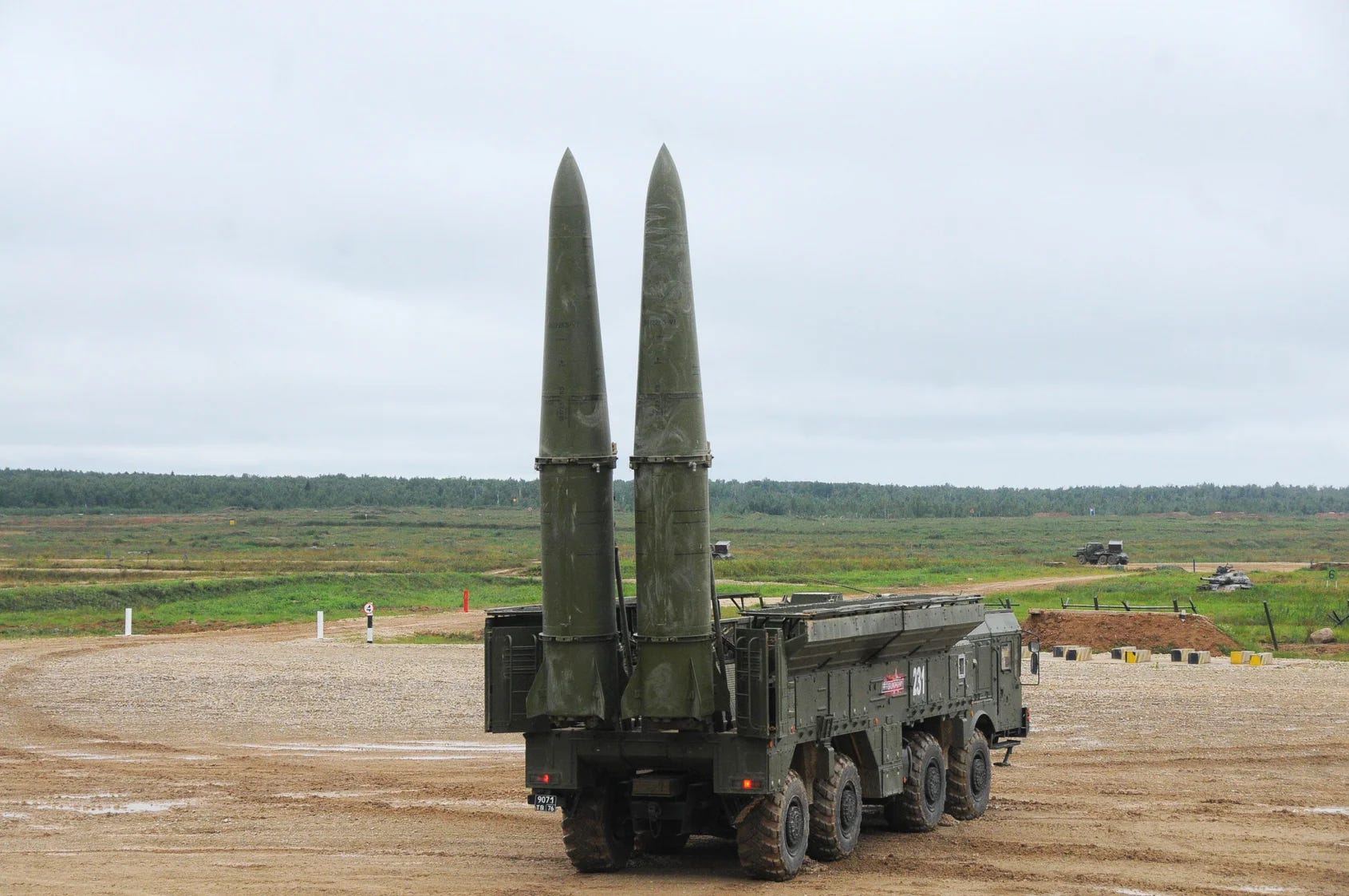
Potential delivery system for low-yield nukes. Think of them as juicy oranges

I’m not familiar with the authors of the piece. McCue is an Air Force lieutenant colonel with the Defense Threat Reduction Agency. I don’t know about you, but suggesting that low-yield nukes can be used in nuanced ways heightens my sense of threat. Lowther directs strategic deterrence programs at the National Strategic Research Institute, which makes me think anew about the meaning of “deterrence.” In this case, it seems to mean the willingness to use nuclear weapons against “bad actors” like China but especially Putin and Russia. And Davis is an Army major assigned to U.S. Central Command. It’s nice to know the Army, just like the Air Force, has a strange love for nukes.

In essence, the article’s argument is this: Russia, China, and North Korea are “investing” in low-yield nukes while the U.S. and other NATO allies have generally been reducing their arsenals of the same. To deter those three adversaries, the U.S. must make new “investments” in low-yield nukes, because you never know what those foreigners are up to.

Here’s how the authors put it in their conclusion: “In the right circumstances conventional weapons offer greater certainty of destruction than tactical nuclear weapons. The West must examine what this means for warfighting, as well as what adversaries are signaling by investing in low-yield nuclear weapons. The best solution may be the development of a state-of-the-art nuclear capability that ensures certain, prompt, proportionate, and in-kind response options. The perception of a missing rung on the American escalation ladder could prove alluring to Russia or China in a conflict.”

Mr. President, we must not allow a missing rung on America’s escalation ladder!

Even if that “missing rung” is only a “perception.”

Let’s keep that in mind if nuclear weapons start flying in Europe or Asia. We can console ourselves that at least we weren’t missing a rung in our escalatory ladder as millions get blasted, burnt, and irradiated.

Surprise! Weapons Sales Are Booming

Heck ya!  Send some B-52s to Israel (U.S. Air Force photo)
Heck ya! Send some B-52s to Israel (U.S. Air Force photo)

W.J. Astore

Any optimism that the Iran nuclear deal might slow the momentum of weapons sales to the Middle East has already been strangled in the cradle. Consider the following news item, courtesy of FP: Foreign Policy:

While U.S. Defense Department officials make promises to partner with Middle East allies nervous about the Iranian missile threat in their backyard, U.S. defense contractors are rushing in to ink multiple billion dollar deals to fill the gap. On Wednesday, the State Department announced a pending $5.4 billion deal with Saudi Arabia for a 600 new PAC-3 Patriot missile interceptors, which will bring the Saudi missiles up to date with the latest version of the Patriot.

The massive deal follows an April agreement with Riyadh for $2 billion worth of Patriots, and another $1.5 billion sale, announced this month, for Patriot interceptors in Qatar, United Arab Emirates, Taiwan, South Korea, and Saudi Arabia. Defense contractors Lockheed Martin and Raytheon will produce the missiles.

That’s $9 billion in Patriot surface-to-air missile (SAM) sales, a coup indeed for Lockheed Martin and Raytheon.

At least the Patriot SAM is largely defensive in nature.  One former Obama official has gone a quantum leap further in advocating that the U.S. supply B-52 bombers to Israel armed with special bunker-busting bombs.  Here’s the gist of the story, courtesy of Defense News:

A former top adviser to US President Barack Obama is calling on Washington to provide bunker-busting B-52 bombers to Israel as a means of bolstering Israeli deterrence and the credibility of its so-called military option should Iran opt out of commitments codified in Tuesday’s deal with world powers.

“To have a credible military option, it’s not enough to say all options are on the table. We have to be much more blunt,” said Ambassador Dennis Ross, a longtime diplomat and former special adviser to Obama on Iran.

In an interview Thursday, Ross said he favors the transfer of an unspecified quantity of B-52 Stratofortress bombers outfitted to deliver 30,000-pound GBU-57 Massive Ordnance Penetrators as one of the means of shoring up deterrence vis a vis Iran.

Sure: Just what the Israelis need: a huge long-range strategic bomber, originally built in the 1950s to deter, and if necessary to attack, the Soviet Union with nuclear weapons.  Perhaps an Israeli Major Kong can ride one of those bunker-busters right into the heartland of Iran.

https://www.youtube.com/watch?v=JlSQAZEp3PA

We do indeed have a strange love for weaponry.