The Deeply Disturbing Trump-Merkel Press Conference

merkel_trump_meeting
Trump, in his own militarized world

W.J. Astore

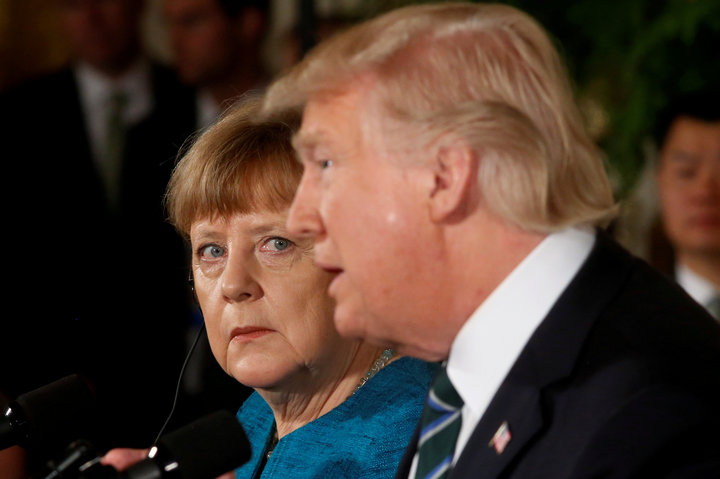
Yesterday’s Trump-Merkel Press Conference was disturbing on several levels.  Worst of all was the scene of a German Chancellor listening to an American president boast about how strong his military is, and how much stronger it soon will be. Not that long ago in historical terms, Germany was a country that stressed military dominance. Two lost world wars cured Germany of its militarism. American militarism has taken its place.

As Trump responded to questions, again and again he returned to the U.S. military, vowing that he’s going to strengthen it from its “depleted” condition, perhaps to a level of power that “we’ve never seen before.”

America as a country is “very strong, very strong,” said Trump, a “very powerful company/country,” and soon the U.S. military would be “stronger,” and “perhaps far stronger than ever before.”  Naturally, the president added that he hoped he wouldn’t have to use that “far stronger” military, even as the U.S. military garrisons the globe at more than 700 bases while launching ongoing attacks against “radical Islamic terrorism” (Trump loves enunciating those three words) in places like Yemen.

Merkel and Trump hold a joint news conference in the East Room of the White House in Washington
She’s right to be worried …

This coming year, Trump is enlarging the military with a fresh influx of $54 billion.  “My generals,” as Trump likes to refer to James Mattis and John Kelly and Company, support him in part because he’s boosting military spending.  But will they continue to support Trump and his advisers like Steve Bannon when the President uses that “much stronger” military in unwise ways?

When you forge a bigger hammer, you tend not to leave it unused in the tool shed.  No — you look for bigger nails to strike.  As Trump noted at the press conference, he’s not an isolationist.  “Fake news,” he said.

That Trump, with his “far stronger” military, is not an isolationist is disturbing “real” news indeed.  Small wonder that the German Chancellor looked discomfited; her country has seen it all before.

What price military dominance?  Perhaps Chancellor Merkel could explain that to President Trump, if only he’d listen.

Trump: Yet Another War President?

trump
Yet another war president?

W.J. Astore

Is Donald Trump going to be yet another American war president?  Come to think of it, is there any other kind?

This is no accident.  Tom Engelhardt has an insightful article at TomDispatch today about how Trump the blowhard is a product of blowback from America’s failed wars, notably Iraq.  There’s much truth in this insight, since it’s hard to imagine demagogue Trump’s rise to power in a pacific climate.  Trump arose in a climate of fear: fear of the Other, especially of the terrorist variety, but also of any group that can be marginalized and vilified.  Think of Mexicans and the infamous Wall, for example.

In a separate post, Engelhardt noted the recent death of Marilyn Young, an historian who found herself specializing in America’s wars, notably Vietnam.  He cited a New York Times obituary on Young that highlighted her attentiveness to America’s wars and their continuity.

Since her childhood, Young noted, America had been at war: “the wars were not really limited and were never cold and in many places have not ended — in Latin America, in Africa, in East, South and Southeast Asia.”

She confessed that:

“I find that I have spent most of my life as a teacher and scholar thinking and writing about war.  I moved from war to war, from the War of 1898 and U.S. participation in the Boxer Expedition and the Chinese civil war, to the Vietnam War, back to the Korean War, then further back to World War II and forward to the wars of the 20th and early 21st centuries.”

“Initially, I wrote about all these as if war and peace were discrete: prewar, war, peace or postwar,” she said. “Over time, this progression of wars has looked to me less like a progression than a continuation: as if between one war and the next, the country was on hold.”

As George Orwell wrote in 1984, all that matters is for a state of war to exist (whether declared or, nowadays in the USA, undeclared).  A war mentality is the driver for autocratic excesses of all sorts.  It serves to focus the attention of people to various perceived enemies, whether from without or from within.  It promotes simplified thinking and generates fear, and fear is the mind-killer.  “Us and Them,” as Pink Floyd sang.

Aggravating simplistic and hateful “us and them” thinking in the USA is the lack of a major political party dedicated to peace.  In the USA, we have two war parties.  Trump knew this and readily exploited (and continues to exploit) it.  He knows the modern Democratic Party won’t seriously challenge the war rhetoric that drove and drives America’s new militarized reality.

Why?  Because the Democrats nurtured it.  Recall that in 2004 John Kerry “reported for duty” by saluting the Democratic National Convention.  Barack Obama in 2008 quickly morphed from a “hope and change” liberal to a drone-wielding assassin-in-chief while pursuing his “good” war in Afghanistan.  Hillary Clinton in 2016 proudly embraced Henry Kissinger and projected a harsh exterior as a hardheaded hawk.  “We came, we saw, he died,” she famously chuckled about Libya and the death of Qaddafi.  Even Bernie Sanders, with all his dreams, said little about cutting the Pentagon’s budget.

You can go back further and tag other recent Democratic presidents, such as LBJ during the Vietnam War or JFK during the Cuban Missile Crisis.  Candidate Kennedy wantonly exaggerated the “missile gap” in nuclear capability between the US and USSR (JFK had it backwards; it was the US that had clear superiority).  Jimmy Carter took a different approach, but he too soon learned his lesson, ordering a huge military buildup (overseen by the Reagan Administration) and declaring the “Carter Doctrine” to safeguard Persian Gulf oil supplies as a vital US interest.  That policy contributed in its own way to America’s recent disasters in the Greater Middle East.

Did Jimmy Carter, then, lead to Donald Trump?  Indirectly, yes.  America’s insatiable hunger for global resources (especially oil) and its desire for global power bred the conditions under which blowback came to America’s shores.  Blowback helped to generate the fear and confused desires for revenge that Trump tapped with great success in his campaign.

Today, America’s state of incessant warfare is consuming its democracy, yet President Trump’s answer is to call for more military spending, more violent attacks overseas, and more walls at home, all in a vain quest to “win” again.  Small wonder then that he’s ramping up military spending while ordering more attacks.

Trump knows what got him to the Oval Office, and it wasn’t his keen intelligence or gentlemanly charm or skill at diplomacy.  Recall that his favorite generals, George Patton and Douglas MacArthur, were all about “winning” even as they both wanted to wage the wrong wars (Patton was ready to take on the Soviets in 1945; MacArthur wanted to cross the Yalu River and invade China during the Korean War).

Will Trump, like his favorite World War II generals, seek to wage the wrong wars?  Will he recognize that fighting the wrong war is a loss even when you “win”?  Does he want to be a “war president,” and, if so, who will stop him?

The Madness of King Trump I

trump
Mad King Trump, promising a new American Armada

W.J. Astore

At TomDispatch.com today, Rebecca Gordon writes about “American carnage” resulting from forever wars across the globe.  Her article references King George III, the “mad king” of Britain during the American Revolution, which raises an interesting point.  In Britain today, there’s a Royal Navy and a Royal Air Force, but there is no Royal Army.  That’s because the British acted to limit the authority of the monarchy, notably in the aftermath of the disastrous English Civil War and the rise of Cromwell in the 17th century.  Royal armies, the British learned, can be powerful forces for suppression of the rights of citizens.

In the 18th century, America’s founders tapped into a commonly held fear of royal armies to motivate fence-straddling colonists to rebel against King George III.  The colonists, as Gordon notes, accused the king in the Declaration of Independence of making “the Military independent of and superior to the Civil power.”

Thus it was when the colonists gained their independence, they acted to keep America’s standing army as small as possible while subjecting it firmly to civilian control.  America wanted no “royal” army, no class of aristocrats whose identity resided in that army, and certainly no leader who postured and posed as a military commander, as kings of that age typically did.

What America has witnessed since the end of World War II is the emergence of a large standing military that is increasingly identified with our president as a quasi-monarch “commander-in-chief.”  And like monarchs of the past, U.S. presidents now dress up in military uniforms, strutting about as if they literally are “the king” of their military.  (Trump, for example, talks of “my” generals.) Meanwhile, a U.S. president has, with the paramilitary CIA, his own private military augmented by a newly empowered military within the military, Special Operations Command, whose operations are often so highly classified as to be beyond effective civilian oversight.

America has regressed to the pre-revolutionary 17th century, when monarchs fought long wars against other monarchs, often in religious/confessional conflicts which were also motivated by money, power, resources, and similar concerns and which lasted for decades or even centuries.  These wars, often involving mercenaries and warrior-corporations, ran out of control and eventually came to bankrupt states, leading to an “enlightenment” witnessed at the creation of the United States, whose founders tried to rein in the tyranny of monarchs and their wasteful forever wars.

Sadly, America is no longer “enlightened.”  King Trump is a mix of Mad King George III and France’s imperious and vainglorious Louis XIV (“I am the state”), but without George’s or Louis’s interest in science and wider forms of knowledge.  And, much like royal courtiers of the past, King Trump’s courtiers are often “aristocratic” generals or slithering sycophants.

Consider a Trump courtier who’s been getting a lot of press lately: Sebastian Gorka.  He’s embraced the idea of a war against radical Islamic terrorism, tracing that war to jihadist flaws within Islam.  This virulent disease within Islam, Gorka and likeminded advisers to Trump argue, must and can be wiped out by American-led military action.  Much like Catholic King Philip II, who launched the Spanish Armada to extirpate the heresy of English Protestantism under Queen Elizabeth I, Trump and Gorka and Crew seek to unleash the American armada against the heresy of radical jihadist Islam.

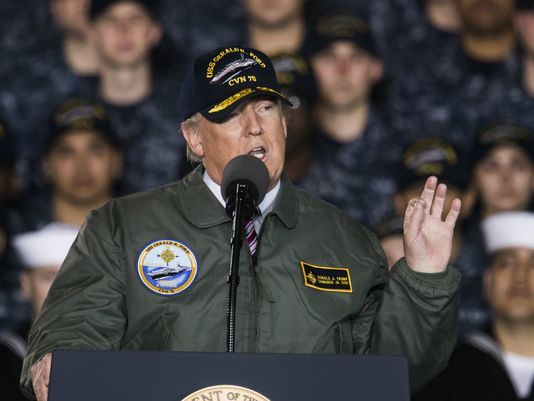
King Trump I is about to escalate what he and his courtiers see as a religious/civilizational war.  Donning a military cap and flight jacket, Trump promises quick victories against a dastardly enemy.  Even as he pursues his wars, the U.S. military will continue to expand, as will paramilitaries and warrior-corporations.  Even as victory proves as elusive as the fighting is enervating to domestic concerns, Mad King Trump will persist.  America must win.  For he is the state.

Under Trump, as with mad King George III, big changes are ahead.  Just not the ones these monarchs imagined for themselves and their empires.

Sun Tzu, Steve Bannon, and the Trump White House “Warriors”

steve-bannon-interview-on-donald-trump
Steve Bannon, self-professed student of the Art of War (Getty Images)

W.J. Astore

A favorite book of Steve Bannon’s is Sun Tzu’s The Art of War.  A classic of military strategy, The Art of War was compiled during the Warring States period (403-221 BCE) in ancient Chinese history.  It was a time of intense civil warfare in China, a time when a cessation in fighting was merely a pause between the next round of battles among warlords.  It’s still widely read today for its insights into war, its clever stratagems and tactics, and its lessons into human nature and behavior.

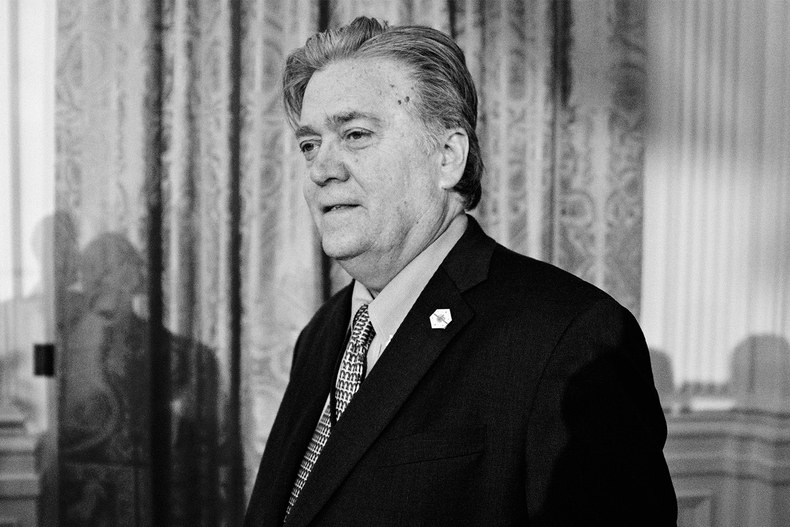
Bannon, who served in the U.S. Navy, is an armchair strategist with an affinity for military history books.  He appears to believe in inevitable conflict between the Judeo-Christian West, which he favors due to its “enlightened” values, and the World of Islam, which he sees as retrograde and barbaric when compared to the West.  He sees the world as already being in a “warring states” period writ large, a realm of conflict marked by “holy war” to be mastered by warrior/scholars like himself.

Joining him in this belief is Donald Trump, who took great pains to recite the phrase “radical Islamic terrorism” in his speech before Congress, as if using these words were a mark of personal courage on his part.  Trump has boasted about winning the “next” war, as if war during his presidency is inevitable.  And I suppose it is, with Trump at the helm and advisers like Bannon, Sebastian Gorka, and Stephen Miller pursuing a bellicose hardline against Islam.

Be careful what you wish for, Trump and cronies, and be especially careful about declaring victory in wars before you’ve even fought them.  Here Sun Tzu has much to teach our “warriors” in the White House.

For one thing, Sun Tzu writes that a battle is best won without fighting at all.  Said Sun Tzu: “Fighting and winning a hundred wars is not the greatest good.  Winning without having to fight is.”  In other words, you set the stage so carefully that the enemy must surrender or face obliteration before the curtain is even raised on war.

Secondly, Sun Tzu warns about the folly of protracted wars, how they deplete the national budget and weaken a state, especially when support among the people is tepid.  Warfare, notes Sun Tzu, must be treated with the greatest caution, even as it is waged with great cunning.  Best of all is to outsmart the enemy; next best is to form alliances, to build a much bigger army than the enemy, which may force them to capitulate.  Worst of all is to get bogged down in long wars, especially in cities, which require expensive sieges that wear on both sides (just ask the Germans at Stalingrad about this).

Ultimately, Sun Tzu writes that by understanding oneself and one’s enemy, a skilled leader can engage in a hundred battles without ever being in serious danger.  But an unskilled leader who does not truly know his own nature or that of his enemies is one who is fated always to lose.  Trump, who fancies himself a great leader and who is ignorant of foreign nations and peoples, does not inspire confidence here, even as he promises the American people that we’re going to win so much, we’ll get bored with winning.

Sun Tzu puts great emphasis on careful planning and sober deliberation before launching attacks.  If the recent Yemen raid is any indicator, Trump is neither a careful planner nor a sober deliberator.  Indeed, Trump’s personal qualities expose him to being manipulated by a cunning enemy.  In listing the personal traits that are dangerous in a commander, Sun Tzu mentions “quick to anger” as well as “self-consciousness” or vanity.  One who’s quick to anger can be goaded by insults into making poor decisions; one who’s vain and self-conscious can be humiliated or manipulated into rash action.

Trump promises an American military that is so big and so strong that no country will dare attack us.  Yet Trump himself, surrounded by his “warrior” advisers, isn’t content to build a huge military while not using it.  Indeed, Trump is already using it, notably in Yemen, pursuing policies that are fated to perpetuate warfare around the globe.  And it’s hardly encouraging that, after the failed Yemen raid, Trump shifted the blame to his generals rather than taking it himself.

Remember what Sun Tzu warned about vanity as well as perpetual warfare, especially when your own people are increasingly divided?  Something tells me this lesson is lost on Trump, Bannon, and crew.  Embracing the stratagems of The Art of War, its emphasis on surprise, subterfuge, deception, and quick strikes, is not enough.  You must seek the wisdom at its core, which is very much against war except as a last resort.

Know thyself, said Sun Tzu, echoing the Greek philosopher Socrates.  Face yourself squarely, recognize your flaws, your vanity (“All is vanity,” say the Christian Bible, a book Trump professes to treasure), and be careful indeed in unleashing war.

Do Trump, Bannon, and company know themselves, admit to their flaws and vanities, and recognize that war, in all its perils and costs, should be a course of last resort?  So far, evidence is wanting.

Update (8/12/17): Bannon has said his concern about a civilizational conflict with Islam dates from his time in the Navy and a visit to Pakistan.  Apparently, however, his ship visited Hong Kong rather than Pakistan.  Bannon also recalls specific details of Iran — its resemblance to a “primeval” wasteland — that he apparently was not privy to.  All this is revealed in an article at The Intercept.  Either Bannon’s memory is faulty or he is an esteemed member of the “alternative fact” club, where you just make things up to fit your preconceived notions.

As Peter Maass at The Intercept notes: “It turns out that Bannon, who has drawn a large amount of criticism for his exclusionary stances on race, religion, and immigration, has also inaccurately described his military service, simultaneously creating an erroneous narrative of how he came to an incendiary anti-Muslim worldview that helps shape White House policy.”

Splinterlands: A Dystopic Novel for Our Trumpian Age

splinter

W.J. Astore

Equal parts amusing and alarming, John Feffer’s dystopian novel, Splinterlands, begins with Hurricane Donald, which floods Washington DC only five years from now.  You may deny climate change, Feffer suggests, but Mother Nature will have the last word.  She will unleash catastrophes and chaos that, combined with political fragmentation driven by hyper-aggressive capitalism and myopic nationalism, lead to a truly New World (Dis)order, characterized by confessional wars, resource shortfalls, and, within two generations, the end of the world as we know it.

Can “prophets of disintegration” like Donald Trump, driven by “market authoritarianism” and their own hubris, remake the world in their own chaotic image?  Feffer makes a persuasive case that they can.  Instead of seeing “the end of history” as a triumph of liberal democracy and a beneficial global marketplace driven by efficiency and technology, Feffer sees the possibility of factionalism of all sorts, a rejection of tolerance and diversity and the embrace of intolerance, identity politics, and similar exclusionary constructs.

Coincidentally, a cautionary letter from the Oscar nominees for Best Foreign Film just crossed my desk; its words encapsulate what Feffer is warning us about.  The film directors denounced “the climate of fanaticism and nationalism we see today in the US and so many other countries.”  The letter goes on to say that:

“The fear generated by dividing us into genders, colors, religions and sexualities as a means to justify violence destroys the things that we depend on – not only as artists but as humans: the diversity of cultures, the chance to be enriched by something seemingly ‘foreign’ and the belief that human encounters can change us for the better. These divisive walls prevent people from experiencing something simple but fundamental: from discovering that we are all not so different.”

The problem, of course, is that many people prefer divisive walls, while finding meaning in fanaticism, nationalism, and the politics of difference.  We are now, Feffer writes, in a period of Great Polarization. His book is about what will happen if that polarization wins out.  He writes:

“The middle dropped out of the world.  Extremes of wealth and ideology flourished.  Political moderates became an endangered species and ‘compromise’ just another word for ‘appeasement.’  First came the disagreements over regulatory policy, then sharper political divides.  Finally, as the world quick-marched itself back through history, came the return of the war of all against all.  The EU, committed to the golden mean, had no way of surviving in such an environment without itself going to extremes.”

The result?  By the 2020s, the EU “evaporated like so much steam.” With Brexit ongoing, with the EU under increasing stress daily, Feffer’s scenario of an evaporating EU seems more than plausible.

Meanwhile, another breaking news item just crossed my desk: President Trump is seeking a $54 billion increase to America’s defense budget, to be funded by deep cuts to other federal agencies such as the EPA and Education.  Trump and his team see the world as a dangerous place, and the military as the best and only means to “protect” America, as in “America first.”  But by its nature the U.S. military is a global force, and more money for it means more military adventurism, driving further warfare, fragmentation, and chaos, consistent with Feffer’s vision of a future “splinterlands.”

As one of Feffer’s characters says, “There’s always been enormous profits in large-scale suffering.”  Feffer’s dystopic novel — like our real world today — features plenty of that. People suffer because of climate change.  Energy shortages.  Wars.  Water shortages.  Even technology serves to divide rather than to unite people, as many increasingly retreat into virtual “realities” that are far more pleasant than the real world that surrounds them.

Feffer’s book, in short, is provocative in the best sense.  But will it provoke us to make wiser, more inclusive, more compassionate, more humane choices?  That may be too much to ask of any book, but it’s not too much to ask of ourselves and our leaders.  The dystopic alternative, illustrated so powerfully in Feffer’s Splinterlands, provides us with powerful motivation to shape a better, less splintered, future.


Making America Divided Again

trump
Rise above the pettiness, don’t be the pettiness

W.J. Astore

Trump’s latest press conference is worrisome for so many reasons.  He seems to live in his own reality (e.g. his administration is “a fine-tuned machine“).  He’s still obsessed with Hillary Clinton and the margin of his victory.  He seems only recently to have learned how serious the prospects of a nuclear holocaust could and would be.  He continues to defend General Michael Flynn, saying that even though Flynn undermined the Obama administration and lied to Vice President Mike Pence, his rapprochement to Russia was laudable (with Trump suggesting that, even though he hadn’t approved Flynn’s actions, he might have).  He even tasked a Black reporter to set up a meeting with the Congressional Black Caucus for him!

What to make of The Donald?  Trump seems to thrive on creating animosity, then exploiting it.  Special targets for him include the U.S. intelligence community and the media, both of which he sees as implacable enemies.  But is animosity and chaos any way to run a country or to represent a people?

I can see how calling out your perceived enemies might work in business, especially a personal one, though Trump’s bankruptcies suggest otherwise.  But Trump is no longer a free-wheeling real estate tycoon.  He’s president now, a symbol (like it or not) of America. Generating animosity and discord as a public servant is divisive, fractious, selfish, and unwise.

A united America is much stronger than a disunited America, but since Trump thrives on division, his personal style is weakening our country. You might say he’s the opposite of Abraham Lincoln, who appealed to the better angels of our nature in a noble but ultimately failed attempt to unite a disunited country. Whatever else Trump is about, it’s not better angels.

Instead of making America great again, Trump is making it divided and uncivil again.

Mister President: Please stop blaming the media, or Hillary, or the intelligence community, or judges, or anyone else for that matter.  Get on with the job of being a public servant.  America needs inspired leadership, not self-serving rhetoric.  We need a uniter, not a divider.

Rise above the pettiness, Mister President.  For the nation’s sake, don’t be the pettiness.

Get Another Goat

Michael Murry

Democrats need an honest post-mortem – not dishonest scapegoating – in the aftermath of their devastating 2016 defeat.

Transferred nationalism, like the use of scapegoats, is a way of attaining salvation without altering one’s conduct. – George Orwell, “Notes on Nationalism” (London: Polemic, 1945)

Many have written about the recent Women’s March in Washington, D.C. — and in other cities across the United States – which occurred in response to President Donald Trump’s early executive orders, cabinet appointments, in-your-face culture-war media-baiting, and (of course) his signature late-night twitter trolling. Lots of things to legitimately oppose and protest, surely, but to my knowledge, few of these articles have analyzed the women-led protest marches from the standpoint of exculpatory political scapegoating, if not transferred nationalism, as George Orwell explained the meaning of that term in his famous essay. For my part, I would like to try and address this imbalance.

First off, several signs that I saw from the Women’s March addressed President Donald Trump personally in terms that I had difficulty connecting with Women’s Rights, such as I understand them. I don’t have a problem with either the imagery or the language, however crude or even profane, since Donald Trump himself seems to delight in offending as many persons, nations, and institutions as he possibly can if it serves his purposes. So, if he receives rough treatment, in picture or word, then he has it coming. He gets no sympathy from me. My problem with these signs stems not from their tone of deserved disrespect, but from their strange fixation on Russia and Russian President Vladimir Putin who – as far as I can tell – has no power to deny an American woman equal pay, access to a safe abortion, maternity leave, or quality public education for her children, among other issues that women – as women – typically consider important.

For example, take the following piece of work, a pointed paraphrase of an old children’s nursery rhyme:

tinkle

I saw other signs of a similar nature, another of which I will cite later as a further example. I cannot speak to the generality of such sentiments, and I would hope that only a few persons harbor them, but this unfortunate expression of malignant partisan irrelevancy immediately gets to the point raised by Robert Parry in an article he wrote for Consortium News (February 1, 2017): namely, “Dangers of Democratic Putin-Bashing – Exclusive: As national Democratic leaders continue to blame Russian President Putin for their 2016 defeat, they’re leading their party into a realignment with the neocons and other war hawks.”

While I concur with Mr. Parry’s article in the main, I have to disagree with his use of the present progressive tense and the word “realignment.” As a matter of fact, the alignment of the Democratic Party with “neocons and other war hawks” took place decades ago, with President Bill Clinton. President Barack Obama and the hapless Democrats in Congress, for their part, have only reinforced and strengthened this alignment.  To speak of this dreadful reality as if it exists only as a possible development in the future rather misstates the truly grim and long-established reality. Otherwise, and specifically as this article relates to the Women’s March, consider a comment I came across in response to Robert Parry’s article:

“evelync”
February 1, 2017 at 11:35 am

I have to admit that I was unable to drag myself to the women’s march because I was unsettled by the concern that it was being used, perhaps, to try to keep Hillary Clinton’s foot in the door.

Another commenter wrote:

“D5-5”
February 1, 2017 at 2:15 pm

I don’t know that having allowed themselves to sink into the behaviors employed to knock off [Senator Bernie] Sanders, then expanding these to Russia-bashing, as the Dems and Clinton did, will likely take them in the direction of an ‘oh, let’s get honest here and see why we lost the election, and straighten ourselves right out to become an actually decent alternative to offer to the American people.’

Two points here:

(1) Why not blame the Democratic Party and its deeply unpopular, demonstrably inept, largely unaccomplished, and repeatedly discredited candidate, You-Know-Her [Hillary Clinton], for losing instead of crediting the political rookie Donald Trump – and by extension, Russian President Vladimir Putin – for “winning”?

(2) Why not insist that the losing Democrats conduct a long-overdue autopsy, summarily purge their Wall-Street/Permanent-War “leadership” (the names Clinton and Obama come to mind here), and reform themselves into a truly working-class, anti-war party capable of winning back the loyalty of those impoverished Americans whom they have betrayed and abandoned for Ivy-League University degrees and swell vacations on Martha’s Vineyard with other newly rich members of their privileged “professional” class?

But attaining emotional salvation through scapegoating – so as not to require actually doing anything to cure the real political and economic disease of neoliberalism – does seem the order of the day among these marchers, most of whom one must suppose voted for You-Know-Her and the neoliberal status quo that downwardly dropping American workers hate with an abiding and vengeful passion. The Damsel of Distress has done it again, snatching defeat from the jaws of victory as only a “New Democrat” named Clinton could manage. How that must hurt!

Moving right along, I came across another image from the Women’s March that showed a man holding a mask of Vladimir Putin in front of his face while holding what looked like marionette strings from which dangled the image of Donald Trump as a puppet.

puppet

Now, I know You-Know-Her openly called Donald Trump a “puppet” of Vladimir Putin during one of the fall campaign debates, so it does not surprise me that some of her partisan supporters would credulously accept this gratuitous slur without bothering to think through the preposterous illogic behind it. For as those who have read the WikiLeaks documents have explained, the Clinton campaign tried everything they could to promote the candidacy of Donald Trump on the theory that he would make the weakest opponent, one whom You-Know-Her would have the least trouble vanquishing. Consider the following excerpt from the articleThey Always Wanted Trump: Inside Team Clinton’s year-long struggle to find a strategy against the opponent they were most eager to face”, by Gabriel Debenedetti, Politico (November 07, 2016):

Clinton’s team drew up a plan to pump Trump up. Shortly after her kickoff, top aides organized a strategy call, whose agenda included a memo to the Democratic National Committee: “This memo is intended to outline the strategy and goals a potential Hillary Clinton presidential campaign would have regarding the 2016 Republican presidential field,” it read.

“The variety of candidates is a positive here, and many of the lesser known can serve as a cudgel to move the more established candidates further to the right. In this scenario, we don’t want to marginalize the more extreme candidates, but make them more ‘Pied Piper’ candidates who actually represent the mainstream of the Republican Party,” read the memo.

“Pied Piper candidates include, but aren’t limited to: Ted Cruz, Donald Trump, Ben Carson

We need to be elevating the Pied Piper candidates so that they are leaders of the pack and tell the press to [take] them seriously.”

Now, aside from the arrogant (but not implausible) notion that You-Know-Her’s campaign could tell [as in, “command”] the press whom to take seriously, no one has ever questioned the accuracy of these memoranda from John Podesta to You-Know-Her’s campaign. But just consider what they tell us.

First, if Donald Trump owed his candidacy to You-Know-Her’s campaign to promote him as a Pied Piper over all the other Republican candidates, and if Russian President Vladimir Putin somehow contrived to make all this happen, then that would credit Vladimir Putin with first manipulating one puppet, You-Know-Her, to control Trump, another puppet. In the interest of metaphorical accuracy, then, the marching protester here should have worn a Putin mask while holding the strings to a puppet of You-Know-Her holding the strings to another puppet, All-About-Him [Trump].

Second, if President Putin had successfully pulled off this convoluted manipulation of both presidential candidates, then why would he possibly let that fact come to light in these WikiLeaks memos? Wouldn’t he want to keep his sinister Machiavellian machinations a secret, so as not – as America’s CIA spooks like to say – reveal his “sources and methods”? As a former KGB intelligence officer, surely he knows his espionage tradecraft better than that. So, logically, President Putin would have no interest in revealing his omnipotent control of America’s two hapless presidential candidates. It makes no sense that Russia would leak anything about this to WikiLeaks or any other journalistic source. That would only discredit Trump as a dupe of both You-Know-Her and Vladimir Putin.

Complete bullshit, either way. It would appear that – in truth – John Podesta and You-Know-Her got just the opponent they wanted to run against: Donald Trump. Then they lost to their own “Pied Piper” puppet. But still they want to scapegoat Russian President Vladimir Putin for their own manifest failure to recognize and respond to the seething desperation of America’s working class. The people want jobs and incomes, not more NAFTA or TPP trade deals. You-Know-Her promised more of the latter. Trump promised at least some of the former. Gee whiz. Who could have ever figured out which way that “choice” would go?

Not that Republican Donald Trump will necessarily deliver anything more than tax cuts and deregulation to the Corporate Oligarchy while shoveling loads of crappy culture war to the proles who voted for him, but sheer luck, some media-sense, and good timing have given him the chance. I seriously doubt that he has the knowledge and competence to pull off anything resembling PEACE, but he does now have that opportunity. Who knows if he has the wit to seize it?

At any rate, it appears as if the defeated Democrats have chosen Russian President Putin as an attractive scapegoat simply due to (1) his “foreignness” and (2) the nature of transferred nationalism. This psychological transference, Orwell wrote, “has an important function. … It makes it possible for [the nationalist] to be much more nationalistic – more vulgar, more silly, more malignant, more dishonest – than he [or she] could ever be on behalf of [their] native country, or any unit of which [they] had real knowledge.”

Americans know little, if anything, about the Russian Federation or its duly elected, competent, domestically popular, and internationally respected president. Creative costumes and too-clever-by-half slogans aside, it seems like a monumental waste of time, energy, and limited American attention span for the Democrats to scapegoat President Putin for their own stupidity, arrogance, and insensitivity to their party’s traditional base.

The Democrats had better look inward and get their own act together. Either that, or get another goat.

Michael Murry is a Vietnam Veteran, gargoyle sculptor, and poet.  A loyal correspondent to Bracing Views, he is also a contributor to The Contrary Perspective.

America: Submerged in a Violent Cesspool

the-dark-knight-rises-poster1
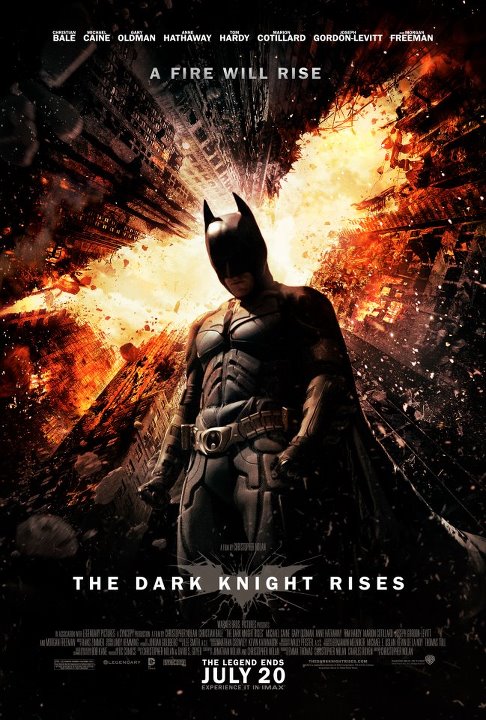
What kind of fire is rising in America today?

In a recent article for TomDispatch.com, I argued that Americans have embraced weapons and warriors, guns and gun exports, prisons and guards, all supported by a steady stream of fear.  The end result has been a cesspool of violence largely of our own making.  In such an environment, a man like Donald Trump, more opportunist than populist, more power-driven than public servant, more cynic than idealist, has ample opportunities to thrive. 

The complete article is here; in this excerpt, I focus on Trump’s rise as well as the rise of a uniquely American anti-hero, the vigilante Dark Knight, AKA Batman. 

Since the end of the Cold War, America has been exporting a mirror image of its domestic self — not the classic combo of democracy and freedom, but guns, prisons and security forces. Globally, the label “Made in the USA” has increasingly come to be associated with violence and war, as well, of course, as Hollywood action flicks sporting things that go boom in the night.

Such exports are now so commonplace that, in some cases, Washington has even ended up arming our enemies. Just consider the hundreds of thousands of small arms sent to Iraq and Afghanistan that were simply lost track of. Many of them evidently ended up on sale at local black markets.

Or consider the weapons and equipment Washington provided to Iraq’s security forces, only to see them abandoned on the battlefield and captured by the Islamic State.

Look as well at prisons like Gitmo — which Donald Trump has no intention of ever closing — and Abu Ghraib, and an unknown number of black sites that were in some of these years used for rendition, detention and torture, and gave the United States a reputation in the world that may prove indelible.

And, of course, American-made weaponry like tear gas canisters and bombs, including cluster munitions, that regularly finds its way onto foreign soil in places like Yemen and, in the case of the tear gas, Egypt, proudly sporting those “Made in the USA” labels.

Strangely, most Americans remain either willfully ignorant of, or indifferent to, what their country is becoming. That American-made weaponry is everywhere, that America’s warriors are all over the globe, that America’s domestic prisons are bursting with more than two million captives, is even taken by some as a point of pride…

Increasingly, Americans are submerged in a violent cesspool of our own making. As a man who knows how to stoke fear as well as exploit it, President Trump fits into such an atmosphere amazingly well. With a sense of how to belittle, insult and threaten, he has a knack for inflaming and exploiting America’s collective dark side.

But think of Trump as more symptom than cause, the outward manifestation of an inner spiritual disease that continues to eat away at the country’s societal matrix. A sign of this unease is America’s most popular superhero of the moment. He even has a new Lego movie coming. Yes, it’s Batman, the vigilante alter-ego of Bruce Wayne, ultra-rich philanthropist and CEO of Wayne Enterprises.

The popularity of Batman, Gotham City’s Dark Knight, reflects America’s fractured ethos of anger, pain, and violence. Americans find common cause in his tortured psyche, his need for vengeance, his extreme version of justice. But at least billionaire Bruce Wayne had some regard for the vulnerable and unfortunate.

America now has a darker knight than that in Donald J. Trump, a man who mocks and assaults those he sees as beneath him, a man whose utterances sound more like a Batman villain, a man who doesn’t believe in heroes — only in himself.

The Dark Knight may yet become, under Trump, a genuine dark night for America’s collective soul. Like Batman, Trump is a product of Gotham City. And if this country is increasingly Gotham City writ large, shining the Batman symbol worldwide and having billionaire Trump and his sidekick — Gen. Michael Flynn? — answer the beacon is a prospect that should be more than a little unnerving.

It wasn’t that long ago that another superhero represented America — Superman. Chivalrous, noble, compassionate, he fought without irony for truth, justice and the American way. And his alter ego, of course, was mild-mannered Clark Kent, a reporter no less.

In Trump’s America, imagine the likelihood of reporters being celebrated as freedom fighters as they struggle to hold the powerful accountable. Perhaps it’s more telling than its makers knew that in last year’s dreary slugfest of a movie, Batman v Superman: Dawn of Justice, the bat rode high while the son of Krypton ended up six feet under.

Let me, in this context, return to that moment when the Cold War ended.

Twenty-five years ago, I served as escort officer to Gen. Robinson Risner as he spoke to cadets at the U.S. Air Force Academy. Risner’s long and resolute endurance as a prisoner of war during the Vietnam War — captured in his memoir, The Passing of the Night — had made him something of a real-life superhero to us then.

He talked to the cadets about public service, love of country and faith in God — noble virtues, based on humility, grace and inner strength. As I look back to that night, as I remember how Gen. Risner spoke with quiet dignity of the virtues of service and sacrifice, I ask myself how America today could have become such a land of weapons and warriors, guns and gun exports, prisons and fear, led by a boastful and boorish bullyboy.

How did America’s ideals become so twisted? And how do we regain our nobility of purpose? One thing is certain — the current path, the one of ever greater military spending, of border walls and extreme vetting, of vilification of the Other, justified in terms of toughness and “winning,” will lead only to further violence and darker (k)nights.

Be sure to check out TomDispatch.com, a regular antidote to the mainstream media.

For Shame, Mr. Trump

29military-master768
Valor, Mr. President?  Where is yours?

W.J. Astore

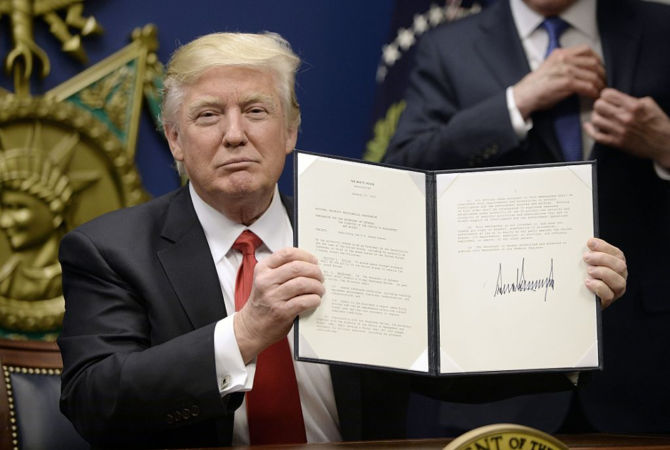
Trump has done it again.  At the Pentagon, before a backdrop that honors America’s highest award for valor, the Medal of Honor, Trump signed an Executive Order on immigration.  The backdrop seemed to suggest that Trump was doing something honorable and brave himself in signing yet another Executive Order.  This EO, as the New York Times reported, “suspended entry of all refugees to the United States for 120 days, barred Syrian refugees indefinitely and blocked entry for 90 days for citizens of seven predominantly Muslim countries. It also allows Christians to be granted priority over Muslims.”

Last week, Trump appeared at the CIA, before its wall of heroes, blustering again about grabbing Iraq’s oil and boasting of the number of times he’d appeared on Time magazine (more than Patriots quarterback Tom Brady, which seemed to please him to no end).

Perhaps Trump will next appear before Christ on the cross to complain about how he (Trump) is being crucified in the press.

You’ve got to hand it to Trump: the man simply has no shame.  And no taste either.

Trump’s pomposity was captured perfectly yesterday in a quip at my local bank.  I was asking the teller about dollar coins (yes, we still have those), and she showed me a couple. They looked too much like quarters so I passed on getting any.  The gent behind me quipped: “Just wait until Trump puts himself on the coin.”  As I laughed and said words to the effect of, I can see it happening, the gent then quipped, “Trump will be on both sides!”

That about sums it up.  Trump would indeed put his own mug on both sides of the coin.  It would be a clear case of “heads he wins, tails we lose.”

Trump, Time Magazine’s Narcissist of the Millennium

4000

W.J. Astore

Yesterday, I caught President Trump’s speech before the CIA.  As he stood before the wall of honor, surrounded by the stars on that wall that represent those who gave their lives for their country, Trump deviated from his prepared comments to boast about how many times he’d appeared on the cover of Time magazine.

Here’s what he said: I HAVE BEEN ON THEIR COVER ABOUT 14 OR 15 TIMES. I THINK WE HAVE THE ALL-TIME RECORD IN THE HISTORY OF TIME MAGAZINE — IF TOM BRADY IS ON THE COVER, IT’S ONE TIME. I’VE BEEN ON 15 TIMES. I THINK THAT’S A RECORD THAT COULD NEVER BE BROKEN.

Really, President Trump?  You’re giving a speech before members of the CIA, and what comes to mind is the number of times your own mug has appeared on a magazine cover? And you’re doing this in front of the CIA’s wall of honor, which, according to your own words, is “very special”?

Whatever one thinks of the CIA and its history, one thing is certain from this speech: America has elected an appallingly tone-deaf and callous narcissist as its 45th president.