Last January, I published “My Father’s Journal,” which recounts my dad’s experience surviving the Great Depression, serving in the Civilian Conservation Corps in Oregon fighting forest fires, military service in the Army during World War II, and bringing up five children during the “Baby Boom” years of the 1950s and 1960s while serving as a city firefighter. If you’re interested, it’s available at Amazon for $10 for the paperback and $5 for the Kindle version. Follow this link, and thanks!
*****
I received two interesting queries this week, one on Blitzkrieg and the other on how much the U.S. spends on weapons and war. On the first subject, I was asked about the characteristics of Blitzkrieg, when the concept was developed and seen in battle, and for post-World War II examples. I was also asked about Russia-Ukraine and the recent U.S. attack on Venezuela. Here are my answers:
1. Speed, surprise, combined arms, and disruption are the main characteristics of Blitzkrieg. “Combined arms” refers to all combat arms working synergistically, i.e. infantry, armor, artillery, supported by air forces (nowadays, drones might be involved in large numbers). Special forces like airborne units may also be involved. Deception and misdirection are also aspects of Blitzkrieg. The fundamental idea is to move and maneuver so quickly that the enemy can’t keep pace–to disrupt the enemy’s cohesion. To place them in an untenable position where they have to withdraw or perhaps even surrender.
2. Blitzkrieg, though associated with Nazi Germany in World War II, is an old concept in warfare. Perhaps the best practitioners were the Mongols in the 13th century. The Western concept has its roots in World War I and the stalemate of trench warfare. Ideas associated with what became known as Blitzkrieg were tried on various World War I battlefields. The idea was to break the stalemate of fixed lines and fortifications without getting into costly battles of attrition. These ideas came to maturity in World War II.
3. Blitzkrieg, perhaps ironically, is sometimes attached to the Israeli Defense Forces, as in their attacks in 1967 in the Six Day War. You might say the USA used Blitzkrieg against Iraq in 1991. Russia’s initial attack on Ukraine in 2022 was not a Blitzkrieg–it was more of an uncoordinated show of force that backfired. The USA attack on Venezuela was a “snatch and grab” kidnapping, not a military campaign per se.
*****
The second query focused on how much the U.S. spends on weaponry and war and how we measure that as a percentage of the federal budget. Here’s my answer to that:
Yes, it’s a numbers game. If you include all federal spending (including non-discretionary spending like social security and Medicare/Medicaid), it’s a smaller percentage. Roughly 15% of the federal budget.
If you focus on discretionary spending, it’s more than 50%. It depends on how you count it. If you add Pentagon spending to Homeland Security, the VA, the DOE (nukes), and interest on the federal debt due to wars and military spending, the percentage is 60% or even higher.
When the warmongers really want to minimize war spending, they compare it to GDP.
*****
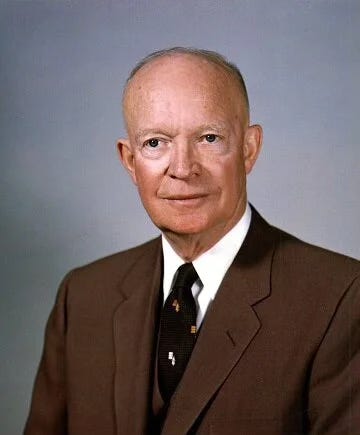
No matter how you measure it (or attempt to minimize it), a trillion dollars is a lot of money. Of course, the best way to think of “defense” spending is from President Dwight D. Eisenhower’s “Cross of Iron” speech in 1953:
Every gun that is made, every warship launched, every rocket fired signifies, in the final sense, a theft from those who hunger and are not fed, those who are cold and are not clothed. This world in arms is not spending money alone. It is spending the sweat of its laborers, the genius of its scientists, the hopes of its children… This is not a way of life at all, in any true sense. Under the cloud of threatening war, it is humanity hanging from a cross of iron.
That is the true cost of spending on weapons and war.
The real enemy of America isn’t Russia or China or Iran or any other country. It’s America’s own pursuit of persistent, pernicious, perpetual, and more or less permanent war or preparations for the same.
It’s undeniable. America’s war and weapons budget is a trillion dollars a year. And rising. There are no plans in the foreseeable future to reduce spending on wars and weapons. Predictably, Americans are told this colossal spending on wars and weapons is for “defense” and “national security.” This is a lie. This spending enriches the few at the expense of the many. It sustains imperialism at the expense of democracy. It serves the desires of Wall Street while ignoring the real needs of Main Street USA. And it is supported by a bipartisan majority in Congress as well as the Trump administration (and the Biden administration before it).
War and weapons are making the American people poorer and less free. Sure, some people are getting rich selling murderous weaponry around the globe, yet America itself is being hollowed out. The warmongers in charge tell us that we can’t have nice things because America, or Israel, or Ukraine, or all three need more weapons (never mind the price tag). Yet it’s our money—it’s our taxpayer dollars.
Ike knew the score
We can’t say we weren’t warned about this. President Dwight D. Eisenhower in 1953 told us that pursuing war and weapons would lead to our crucifixion on a “cross of iron.” Eight years later, Ike warned that a military-industrial complex already existed that was undermining American democracy and that we urgently needed to act to curb its power.
Sadly, what gives the military-industrial complex its unity is, among other things, greed and power. Congress is more than happy to serve it. So are America’s presidents. The last U.S. president to speak sincerely and powerfully about peace, John F. Kennedy, was assassinated just over six decades ago. There hasn’t been a peace president since then.
Meanwhile, since 9/11/2001, if not before then, the U.S. military has enthusiastically embraced a warrior ethos, abandoning its own citizen-soldier tradition. America, of course, is supposed to be a constitutional republic, not Sparta or Prussia. But instead of a nation of justice and the rule of law, we have an empire and culture in which wars and warriors rule.
War is not peace. Warriors don’t seek peace. War is war, and perpetual war will destroy both the U.S. empire and the kernel of democracy that remains (however weak or shrinking) at its core.
The choice is clear. We must seek peace. We must cut war and weapons spending dramatically—I’d suggest by 50%—and reinvest that money in Main Street USA. We can have nice things again, if we’re willing to stop empowering the warmongers among us.
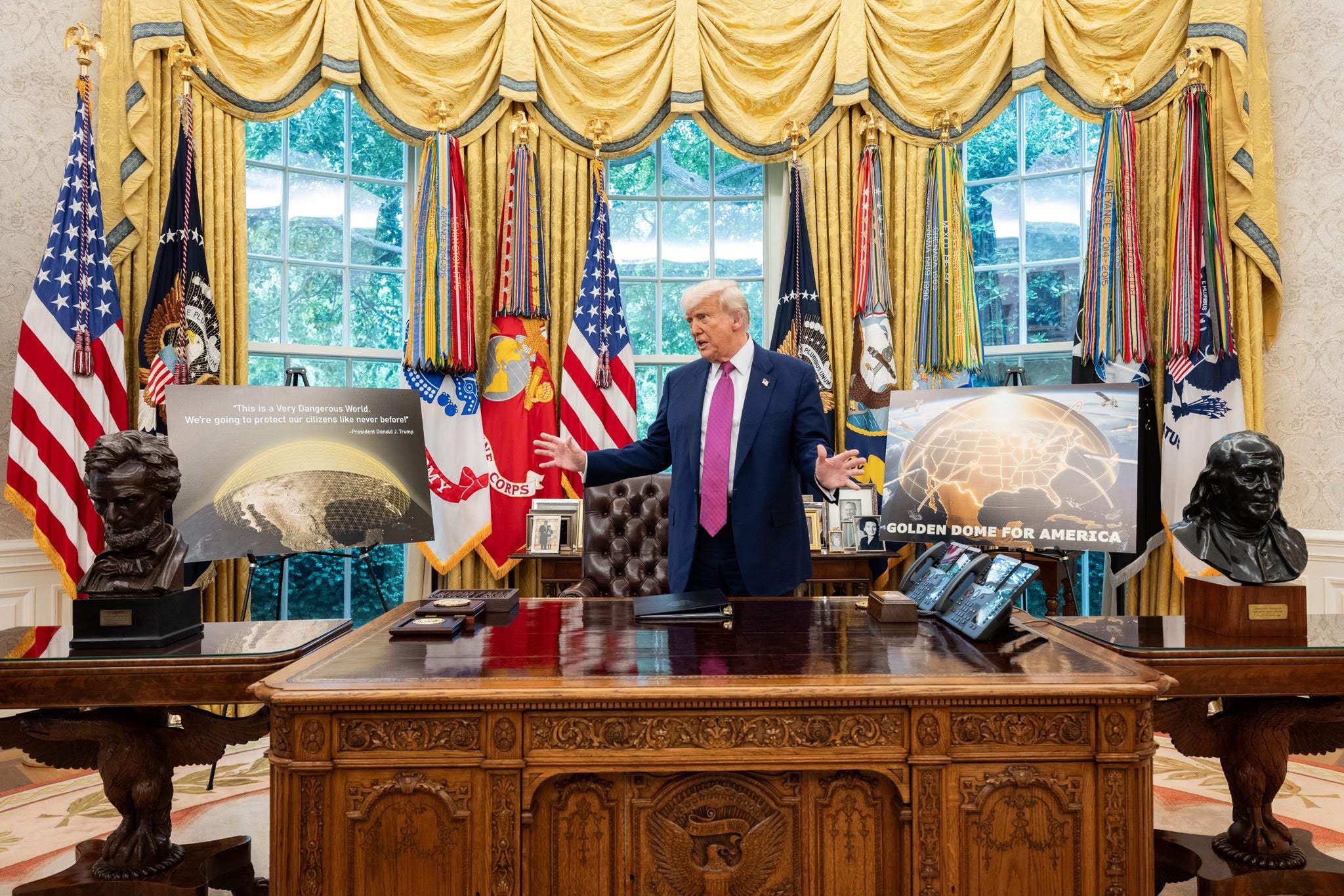
Donald Trump has a dream: a “golden dome” over America to defend the country against nuclear missiles. It’s a repeat of Ronald Reagan’s dream, the Strategic Defense Initiative, nicknamed “Star Wars” after the movie. The problem is that the dream represents a nightmare.
How so? Golden Dome would be dangerously escalatory, wildly expensive, and unlikely to work as a “shield” to America. It is worse than a mistake: it is a crime. It represents a massive theft from those who hunger and suffer in America. As Republican President Dwight D. Eisenhower said in 1953, wasting enormous resources on weapons systems is no way of life at all. It is humanity crucifying itself on a cross of iron. Crucifixion is not made more pleasant when the cross is golden.
A new golden idol occupies his mind
Put differently, the Golden Dome is a golden idol, a false god, one that by making a massive nuclear strike more likely endangers all of us and God’s creation.
Golden Dome is a grotesque example of makework militarism and warfare as welfare for weapons makers. Though it’s unlikely to work, if it did (partially) it would make a massive nuclear strike more likely, not less, endangering the world with the ecocidal terror of nuclear winter.
Golden Dome and the so-called investment in America’s nuclear triad are both examples of socio-technological madness–America’s leaders are like the mutants in “Beneath the Planet of the Apes,” worshipping the bombs that twisted them and which can only destroy what’s left of civilization.
Some Christians today await the apocalypse when Christ is supposed to return–but the most likely apocalypse features not the second coming of a God-man but a third world war featuring bomb-gods of thermonuclear destruction.
As Daniel Ellsberg once noted, U.S. nuclear attack plans in the early 1960s envisioned 600 million killed, or 100 Holocausts (before we knew such an attack would lead to nuclear winter). We’re lucky this insanity never came to pass. The only sane policy is to cancel Golden Dome and end “investment” in a new nuclear triad. Disarmament, not rearmament, is what’s needed.
*****
The Global Network Against Weapons & Nuclear Power in Space has released a statement against Golden Dome that you can read here. You can add your name to the statement, as I have. Here are some bullet points released along with the statement:
Golden Dome is financially reckless and unsustainable. Early cost estimates range from $550 billion to several trillion dollars over two decades. This dwarfs even the Pentagon’s annual budget and adds to the US’s $37 trillion national debt—a price tag that makes the project fiscally indefensible.
Experts overwhelmingly agree that 100% effective missile interception is a fantasy, especially against complex attacks involving decoys, hypersonic missiles, and maneuverable warheads. Even Israel’s Iron Dome has been bypassed by more rudimentary drone and missile attacks.
Golden Dome includes space-based interceptors—effectively weaponizing the Earth’s orbit and triggering an arms race. This violates the spirit of the Outer Space Treaty and pushes nations like China and Russia to accelerate space weapons development.
By giving the illusion of first-strike survivability, it runs counter to the Mutually Assured Destruction (MAD) doctrine that has prevented so far a nuclear holocaust and incentivizes other powers to retain or expand their nuclear arsenals, blocking disarmament efforts permanently.
Thousands of rocket launches for satellite interceptors would further damage the ozone layer, could generate dangerous orbital debris (Kessler Syndrome), and will harm our already fragile space environment.
The only guaranteed winners of Golden Dome are weapons giants like Lockheed Martin, Raytheon, and Palantir, which stand to profit enormously regardless of the system’s effectiveness or risks.
The trillions funneled into Golden Dome could be used for urgent domestic priorities—such as healthcare, infrastructure, climate action, and education, directly benefiting millions of Americans.
In short, Golden Dome is a massive, dangerous, and futile vanity project, cloaked in patriotism but driven by profit, politics, and illusion.
Language and repetition of the same is so important. We hear about the Department of Defense (DoD) and the Pentagon budget and we think little of it. The DoD, of course, used to be called the Department of War until 1947, a far more telling and accurate name, and there wasn’t a Pentagon until we built one during World War II. In the old days, the Army fought the Navy for which service would get more money in the War Budget, with the Navy usually winning as America sought to control the seas as a means of dominating trade and “intercourse” among nations.
Those were more honest times when retired generals like Smedley Butler wrote in the 1930s that he’d served as a “gangster” for capitalism. Butler was a Marine who was twice awarded the Medal of Honor, so it wasn’t easy for the imperialists to smear him, though they certainly tried (as they did to David M. Shoup, another Marine Corps general and Medal of Honor recipient who turned against the Vietnam War in the 1960s).
Anyhow, I just saw at Antiwar.com that President Trump is proposing a $1.01 trillion budget for the Pentagon for FY2026, a 13% increase in imperial spending. Trump, of course, is proud of reaching the Trillion Dollar threshold. Big numbers have always appealed to him.
It doesn’t seem to matter who is president, whether it’s Biden or Trump, Democrat or Republican, when it comes to the Department of Empire and its bloated imperial budget. For that is what it is, a budget that seeks to sustain and enlarge America’s imperial domain. If you add other costs related to imperial dominance, such as interest on the national debt due to war spending, VA costs, nuclear weapons, and the like, the true imperial budget soars toward $1.7 trillion yearly.
No matter. A trillion here, a trillion there, and pretty soon you’re talking real money.
The Pentagon tries to disguise the enormous waste of this imperial budget by speaking of it as an “investment,” but imagine an “investment” that you’re involved in which fails seven audits in a row. How likely would you be to see this as anything other than theft?
Dwight D. Eisenhower had it right in 1953 when he spoke of military spending as a theft from those who hunger. Ike’s words are almost never heard today inside the Washington Beltway. It’s worth reflecting upon them again as America’s leaders boast of trillion-dollar war budgets:
Every gun that is made, every warship launched, every rocket fired signifies, in the final sense, a theft from those who hunger and are not fed, those who are cold and are not clothed. This world in arms is not spending money alone. It is spending the sweat of its laborers, the genius of its scientists, the hopes of its children… This is not a way of life at all, in any true sense. Under the cloud of threatening war, it is humanity hanging from a cross of iron.
I read the news today, oh boy. About a lucky man named Elon Musk. But he lost out on one thing: he didn’t get a top secret briefing on Pentagon war plans for China. And the news people breathed a sigh of relief.
With apologies to John Lennon and The Beatles, a day in the life is getting increasingly tough to take here in the land of the free. I’m meant to be reassured that Musk didn’t get to see America’s top-secret plans for — yes! — going to war with China, even as I’m meant to ignore the constant drumbeat of propaganda, the incessant military marches that form America’s background music, conveying the message that America must have war plans for China, that indeed war in or around China is possible, even probable, in the next decade. Maybe in 2027?
My fellow Americans, we should be far more alarmed by such secret U.S. war plans, along with those “pivots” to Asia and the Indo-Pacific, and the military base-building efforts in the Philippines, than reassured by the “good news” that Comrade Billionaire Musk was denied access to the war room, meaning (for Dr. Strangelove fans) he didn’t get to see “the big board.”
It’s war, war, everywhere in America. We do indeed have a strange love for it. I’ve been writing for TomDispatch for 18 years now — this is my 111th essay (the other 110 are in a new book of mine) — most of them focusing on militarism in this country, as well as our disastrous wars in Iraq, Afghanistan, and elsewhere, the ruinous weapons systems we continue to fund (including new apocalyptic nuclear weapons), and the war song that seems to remain ever the same.
A few recent examples of what I mean: President Trump has already bombed Yemen more than once. He’s already threatening Iran. He’s sending Israel all the explosives, all the weaponry it needs to annihilate the Palestinians in Gaza (so too, of course, did Joe Biden). He’s boasting of building new weapons systems like the Air Force’s much-hyped F-47 fighter jet, the “47” designation being an apparent homage by its builder, Boeing, to Trump himself, the 47th president. He and his “defense” secretary, Pete Hegseth, continually boast of “peace through strength,” an Orwellian construction that differs little from “war is peace.” And I could, of course, go on and on and on and on…
Occasionally, Trump sounds a different note. When Tulsi Gabbard became the director of national intelligence, he sang a dissonant note about a “warmongering military-industrial complex.” And however haphazardly, he does seem to be working for some form of peace with respect to the Russia-Ukraine War. He also talks about his fear of a cataclysmic nuclear war. Yet, if you judge him by deeds rather than words, he’s just another U.S. commander-in-chief enamored of the military and military force (whatever the cost, human or financial).
Consider here the much-hyped Department of Government Efficiency (DOGE) led by that lucky man Elon Musk. Even as it dismantles various government agencies like the Department of Education and USAID, it has — no surprise here! — barely touched the Pentagon and its vast, nearly trillion-dollar budget. In fact, if a Republican-controlled Congress has any say in the matter, the Pentagon budget will likely be boosted significantly for Fiscal Year 2026 and thereafter. As inefficient as the Pentagon may be (and we really don’t know just how inefficient it is, since the bean counters there keep failing audit after audit, seven yearsrunning), targeted DOGE Pentagon cuts have been tiny. That means there’s little incentive for the generals to change, streamline their operations, or even rethink in any significant fashion. It’s just spend, spend, spend until the money runs out, which I suppose it will eventually, as the national debt soars toward $37 trillion and climbing.
Even grimmer than that, possibly, is America’s state of mind, our collective zeitgeist, the spirit of this country. That spirit is one in which a constant state of war (and preparations for more of the same) is accepted as normal. War, to put it bluntly, is our default state. It’s been that way since 9/11, if not before then. As a military historian, I’m well aware that the United States is, in a sense, a country made by war. It’s just that today we seem even more accepting of that reality, or resigned to it, than we’ve ever been. What gives?
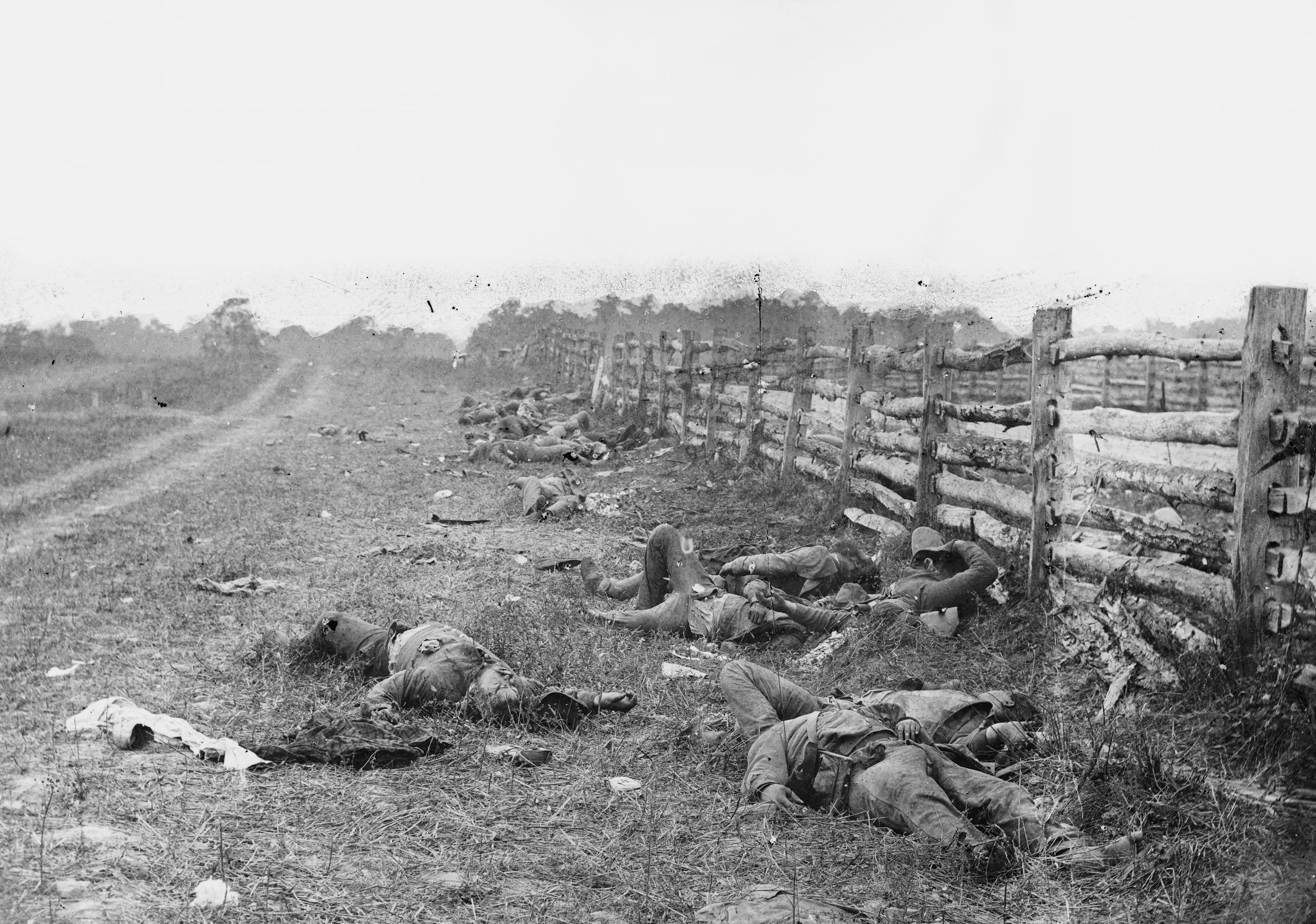
The Face of War: Confederate Dead at Antietam (Matthew Brady)
Remember when, in 1963, Alabama Governor George Wallace said, “Segregation now, segregation tomorrow, and segregation forever”? Fortunately, after much struggle and bloodshed, he was proven wrong. So, can we change the essential American refrain of war now, war tomorrow, and war forever? Can we render that obsolete? Or is that too much to hope for or ask of America’s “exceptional” democracy?
Taking on the MICIMATT(SH)
Former CIA analyst Ray McGovern did America a great service when he came up with the acronym MICIMATT, or the Military-Industrial-Congressional-Intelligence-Media-Academia-Think-Tank complex, an extension of President Dwight D. Eisenhower’s military-industrial complex, or MIC (from his farewell speech in 1961). Along with the military and industry (weapons makers like Boeing and Lockheed Martin), the MICIMATT adds Congress (which Eisenhower had in his original draft speech but deleted in the interest of comity), the intelligence “community” (18 different agencies), the media (generally highly supportive of wars and weapons spending), academia (which profits greatly from federal contracts, especially research and development efforts for yet more destructive weaponry), and think tanks (which happily lap up Pentagon dollars to tell us the “smart” position is always to prepare for yet more war).
You’ll note, however, that I’ve added a parenthetical SH to McGovern’s telling acronym. The S is for America’s sporting world, which eternally gushes about how it supports and honors America’s military, and Hollywood, which happily sells war as entertainment (perhaps the best known and most recent film being Tom Cruise’s Top Gun: Maverick, in which an unnamed country that everyone knows is Iran gets its nuclear ambitions spanked by a plucky team of U.S. Naval pilots). A macho catchphrase from the original Top Gun was “I feel the need — the need for speed!” It may as well have been: I feel the need — the need for pro-war propaganda!
Yes, MICIMATT(SH) is an awkward acronym, yet it has the virtue of capturing some of the still-growing power, reach, and cultural penetration of Ike’s old MIC. It should remind us that it’s not just the military and the weapons-makers who are deeply invested in war and — yes! — militarism. It’s Congress; the CIA; related intel “community” members; the mainstream media (which often relies on retired generals and admirals for “unbiased” pro-war commentary); academia (consider how quickly institutions like Columbia University have bent the knee to Trump); and think tanks — in fact, all those “best and brightest” who advocate for war with China, the never-ending war on terror, war everywhere.
But perhaps the “soft power” of the sporting world and Hollywood is even more effective at selling war than the hard power of bombs and bullets. National Football League coaches patrol the sidelines wearing camouflage, allegedly to salute the troops. Military flyovers at games celebrate America’s latest death-dealing machinery. Hollywood movies are made with U.S. military cooperation and that military often has veto power over scripts. To cite only one example, the war movie 12 Strong (2018) turned the disastrous Afghan War that lasted two horrendous decades into a stunningly quick American victory, all too literally won by U.S. troops riding horses. (If only the famed cowboy actor John Wayne had still been alive to star in it!)
The MICIMATT(SH), employing millions of Americans, consuming trillions of dollars, and churning through tens of thousands of body bags for U.S. troops over the years, while killing millions of people abroad, is an almost irresistible force. And right now, it seems like there’s no unmovable object to blunt it.
Believe me, I’ve tried. I’ve written dozens of “Tomgrams” suggesting steps America could take to reverse militarism and warmongering. As I look over those essays, I see what still seem to me sensible ideas, but they die quick deaths in the face of, if not withering fire from the MICIMATT(SH), then being completely ignored by those who matter.
And while this country has a department of war (disguised as a department of defense), it has no department of peace. There’s no budget anywhere for making peace, either. We do have a colossal Pentagon that houses 30,000 workers, feverishly making war plans they won’t let Elon Musk (or any of us) see. It’s for their eyes only, not yours, though they may well ask you or your kids to serve in the military, because the best-laid plans of those war-men do need lots of warm bodies, even if those very plans almost invariably (Vietnam, Afghanistan, Iraq, etc.) go astray.
So, to repeat myself, how do you take on the MICIMATT(SH)? The short answer: It’s not easy, but I know of a few people who had some inspirational ideas.
On Listening to Ike, JFK, MLK, and, Yes, Madison, Too
Militarism isn’t exactly a new problem in America. Consider Randolph Bourne’s 1918 critique of war as “the health of the state,” or General Smedley Butler’s confession in the 1930s that “war is a racket” run by the “gangsters of capitalism.” In fact, many Americans have, over the years, spoken out eloquently against war and militarism. Many beautiful and moving songs have asked us to smile on your brother and “love one another right now.” War, as Edwin Starr sang so powerfully once upon a time, is good for “absolutely nothin’,” though obviously a lot of people disagree and indeed are making a living by killing and preparing for yet more of it.
And that is indeed the problem. Too many people are making too much money off of war. As Smedley Butler wrote so long ago: “Capital won’t permit the taking of the profit out of war until the people — those who do the suffering and still pay the price — make up their minds that those they elect to office shall do their bidding, and not that of the profiteers.” Pretty simple, right? Until you realize that those whom we elect are largely obedient to the moneyed class because the highest court in our land has declared that money is speech. Again, I didn’t say it was going to be easy. Nor did Butler.
As a retired lieutenant colonel in the U.S. Air Force, I want to end my 111th piece at TomDispatch by focusing on the words of Ike, John F. Kennedy (JFK), Martin Luther King, Jr. (MLK), and James Madison. And I want to redefine what words like duty, honor, country, and patriotism should mean. Those powerful words and sentiments should be centered on peace, on the preservation and enrichment of life, on tapping “the better angels of our nature,” as Abraham Lincoln wrote so long ago in his First Inaugural Address.
Why do we serve? What does our oath of office really mean? For it’s not just military members who take that oath but also members of Congress and indeed the president himself. We raise our right hands and swear to support and defend the U.S. Constitution against all enemies, foreign and domestic, to bear true faith and allegiance to the same.
There’s nothing in that oath about warriors and warfighters, but there is a compelling call for all of us, as citizens, to be supporters and defenders of representative democracy, while promoting the general welfare (not warfare), and all the noble sentiments contained in that Constitution. If we’re not seeking a better and more peaceful future, one in which freedom may expand and thrive, we’re betraying our oath.
If so, we have met the enemy — and he is us.
Ike told us in 1953 that constant warfare is no way of life at all, that it is (as he put it), humanity crucifying itself on a cross of iron. In 1961, he told us democracy was threatened by an emerging military-industrial complex and that we, as citizens, had to be both alert and knowledgeable enough to bring it to heel. Two years later, JFK told us that peace — even at the height of the Cold War — was possible, not just peace in our time, but peace for all time. However, it would, he assured us, require sacrifice, wisdom, and commitment.
How, in fact, can I improve on these words that JFK uttered in 1963, just a few months before he was assassinated?
What kind of peace do we seek? Not a Pax Americana enforced on the world by American weapons of war. Not the peace of the grave or the security of the slave. I am talking about genuine peace, the kind of peace that makes life on earth worth living…
I speak of peace because of the new face of war. Total war makes no sense in an age… when the deadly poisons produced by a nuclear exchange would be carried by wind and water and soil and seed to the far corners of the globe and to generations yet unborn… surely the acquisition of such idle [nuclear] stockpiles — which can only destroy and never create — is not the only, much less the most efficient, means of assuring peace.
I speak of peace, therefore, as the necessary rational end of rational men. I realize that the pursuit of peace is not as dramatic as the pursuit of war — and frequently the words of the pursuer fall on deaf ears. But we have no more urgent task.
Are we ready to be urgently rational, America? Are we ready to be blessed as peacemakers? Or are we going to continue to suffer from what MLK described in 1967 as our very own “spiritual death” due to the embrace of militarism, war, empire, and racism?
Of course, MLK wasn’t perfect, nor for that matter was JFK, who was far too enamored of the Green Berets and too wedded to a new strategy of “flexible response” to make a clean break in Vietnam before he was killed. Yet those men bravely and outspokenly promoted peace, something uncommonly rare in their time — and even more so in ours.
More than 200 years ago, James Madison warned us that continual warfare is the single most corrosive force to the integrity of representative democracy. No other practice, no other societal force is more favorable to the rise of authoritarianism and the rule of tyrants than pernicious war. Wage war long and it’s likely you can kiss your democracy, your rights, and just maybe your ass goodbye.
America, from visionaries and prophets like MLK, we have our marching orders. They are not to invest yet more in preparations for war, whether with China or any other country. Rather, they are to gather in the streets and otherwise raise our voices against the scourge of war. If we are ever to beat our swords into plowshares and our spears into pruning hooks and make war no more, something must be done.
Let’s put an end to militarism in America. Let’s be urgently rational. To cite John Lennon yet again: You may say I’m a dreamer, but I’m not the only one. Together, let’s imagine and create a better world.
The so-called SignalGate scandal centered on the bombing of Yemen is highly revelatory. First, some resources. CNN has a useful annotated account of the chats exchanged at the highest levels of the Trump administration. At their respective Substacks, Lenny Broytman and Caitlin Johnstone have telling dissections of these chats as well. At Jacobin, Branko Marcetic has an important article that reminds us of the illegality of the attacks. As the article’s subheading puts it: The press [mainstream media] is mostly framing the Yemen group chat scandal as a story of incompetence. There’s little attention being paid to the deadliness, illegality, and ineffectiveness of the strikes themselves.
To me, among the most telling “chats” came from Secretary of Defense Pete Hegseth. It highlights the “exceptional” nature of America:
*****
Pete Hegseth to Vice President JD Vance: I fully share your loathing of European free-loading. It’s PATHETIC.
But Mike [Waltz, the National Security Adviser] is correct, we are the only ones on the planet (on our side of the ledger) who can do this. Nobody else even close. Question is timing…
*****
This is precisely the problem for America since the Vietnam War, if not before then. We’ve created a monster military, a “global strike” force, that is capable of destroying any target anywhere around the globe. “Nobody else even close,” SecDef Hegseth correctly says. And because we can do it, because we are exceptional in military force, our leaders believe we should do it, even if it’s only to send a “message” to the world how tough we are, how committed we are to killing others.
Other countries—like those “free-loading” European ones—are PATHETIC because they don’t have America’s military might. Only we can smite evildoers around the globe, only we can do so while also arming Israel to the teeth and covering its flanks while it continues its annihilation of Gaza, and this is something we are immensely proud of.
My fellow Americans, this is not something to be proud of. Consider if America’s military in the 1960s had lacked the ability to deploy over half a million troops to Vietnam while also facing down the Warsaw Pact in Europe. Consider if America’s military had lacked the ability to invade Iraq in 2003 while also waging war in Afghanistan and garrisoning the globe with roughly 800 military bases. Consider how much blood would not have been spilled, and treasure wasted, if the U.S. military was smaller, focused on defense, and led by people who didn’t put muscle and flame emojis in their chats to celebrate U.S. military prowess at killing people in Yemen.
That U.S. military forces are the only ones who can kill globally with such comparative ease, that “nobody else even close,” is exactly what is wrong with our government. We place far too much faith and pride in military prowess, so much so that the Pentagon becomes the Pentagod, something we worship, something we make immense sacrifices to, as in budgets that approach $1 trillion yearly.
Not for nothing did President Dwight D. Eisenhower say in 1953 that this is no way of life at all—that we are crucifying ourselves on a cross of iron. Tell me again, who are the pathetic ones?
We must end our intoxication with military power before it ends us.
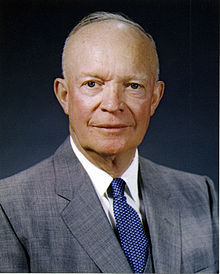
If Dwight Eisenhower could somehow give his 1953 “Cross of Iron” address and his 1961 warning about the military-industrial complex to the American people today, I truly believe he’d be dismissed by the mainstream media (MSM) as a Putin puppet and as repeating Kremlin talking points. Why? Because Ike advocated for negotiation and peace instead of war; he documented how spending on weapons was intrinsically wasteful and a bane to democratic society; and he challenged citizens to be alert and knowledgeable, ready to take action against the growing power of a corporate-military nexus supported and strengthened by Congress.
To mark Ike’s integrity and wisdom, and also to update his cost calculations from 1953 for the present day, I wrote this article, my latest for TomDispatch.com. Again, the words of Ike, focusing on peace, the preciousness and burdens of democracy, and the dangers of militarism, are rarely if ever heard in our government and in the MSM today. And that suggests we are in a dark place indeed in this country of ours.
In April 1953, newly elected President Dwight D. Eisenhower, a retired five-star Army general who had led the landings on D-Day in France in June 1944, gave his most powerful speech. It would become known as his “Cross of Iron” address. In it, Ike warned of the cost humanity would pay if Cold War competition led to a world dominated by wars and weaponry that couldn’t be reined in. In the immediate aftermath of the death of Soviet dictator Josef Stalin, Ike extended an olive branch to the new leaders of that empire. He sought, he said, to put America and the world on a “highway to peace.” It was, of course, never to be, as this country’s emergent military-industrial-congressional complex (MICC) chose instead to build a militarized (and highly profitable) highway to hell.
Eight years later, in his famous farewell address, a frustrated and alarmed president called out “the military-industrial complex,” prophetically warning of its anti-democratic nature and the disastrous rise of misplaced power that it represented. Only an alert and knowledgeable citizenry, fully engaged in corralling, containing, and constraining it, he concluded, could save democracy and bolster peaceful methods and goals.
The MICC’s response was, of course, to ignore his warning, while waging a savage war on communism in the name of containing it. In the process, atrocious conflicts would be launched in Vietnam, Laos, and Cambodia as the contagion of war spread. Threatened with the possibility of peace in the aftermath of the Soviet Union’s collapse in 1991, the MICC bided its time with operations in Iraq (Desert Storm), Bosnia, and elsewhere, along with the expansion of NATO, until it could launch an unconstrained Global War on Terror in the aftermath of the attacks of September 11, 2001. Those “good times” (filled with lost wars) lasted until 2021 and the chaotic U.S. withdrawal from Afghanistan.
Not to be deterred by the fizzling of the nightmarish war on terror, the MICC seized on a “new cold war” with China and Russia, which only surged when, in 2022, Vladimir Putin so disastrously invaded Ukraine (as the U.S. had once invaded Afghanistan and Iraq). Yet again, Americans were told that they faced implacable foes that could only be met with overwhelming military power and, of course, the funding that went with it — again in the name of deterrence and containment.
In a way, in 1953 and later in 1961, Ike, too, had been urging Americans to launch a war of containment, only against an internal foe: what he then labeled for the first time “the military-industrial complex.” For various reasons, we failed to heed his warnings. As a result, over the last 70 years, it has grown to dominate the federal government as well as American culture in a myriad of ways. Leaving aside fundingwhere it’s beyond dominant, try movies, TV shows, video games, education, sports, you name it. Today, the MICC is remarkably uncontained. Ike’s words weren’t enough and, sadly, his actions too often conflicted with his vision (as in the CIA’s involvement in a coup in Iran in 1953). So, his worst nightmare did indeed come to pass. In 2023, along with much of the world, America does indeed hang from a cross of iron, hovering closer to the brink of nuclear war than at any time since the Cuban Missile Crisis of 1962.
Updating Ike’s Cross of Iron Speech for Today
Perhaps the most quoted passage in that 1953 speech addressed the true cost of militarism, with Ike putting it in homespun, easily grasped, terms. He started by saying, “Every gun that is made, every warship launched, every rocket fired signifies, in the final sense, a theft from those who hunger and are not fed, those who are cold and are not clothed.” (An aside: Can you imagine Donald Trump, Joe Biden, or any other recent president challenging Pentagon spending and militarism so brazenly?)
Ike then added:
“This world in arms is not spending money alone. It is spending the sweat of its laborers, the genius of its scientists, the hopes of its children. The cost of one modern heavy bomber is this: a modern brick school in more than 30 cities. It is two electric power plants, each serving a town of 60,000 population. It is two fine, fully equipped hospitals. It is some fifty miles of concrete pavement. We pay for a single fighter plane with a half million bushels of wheat. We pay for a single destroyer with new homes that could have housed more than 8,000 people.”
He concluded with a harrowing image: “This is not a way of life at all, in any true sense. Under the cloud of threatening war, it is humanity hanging from a cross of iron.”
Ike’s cost breakdown of guns versus butter, weapons versus civilian goods, got me thinking recently: What would it look like if he could give that speech today? Are we getting more bang for the military megabucks we spend, or less? How much are Americans sacrificing to their wasteful and wanton god of war?
Let’s take a closer look. A conservative cost estimate for one of the Air Force’s new “heavy” strategic nuclear bombers, the B-21 Raider, is $750 million. A conservative estimate for a single new fighter plane, in this case the F-35 Lightning II, is $100 million. A single Navy destroyer, a Zumwalt-class ship, will be anywhere from $4 to $8 billion, but let’s just stick with the lower figure. Using those weapons, and some quick Internet sleuthing, here’s how Ike’s passage might read if he stood before us now:
“The cost of one modern heavy bomber is this: a modern brick-veneer and reinforced concrete school in 75 cities. It is five electric power plants, each serving a town with 60,000 inhabitants. It is five fine, fully equipped hospitals. It is some 150 miles of pavement. We pay for a single fighter plane with more than 12 million bushels of wheat. We pay for a single destroyer with new homes that could have housed more than 64,000 people.”
(Quick and dirty figures for the calculations above: $10 million per elementary school; $150 million per power plant [$5,000/kilowatt for 30,000 homes]; $150 million per hospital; $5 million per new mile of road; $8 per bushel of wheat; $250,000 per home for four people.)
Grim stats indeed! Admittedly, those are just ballpark figures, but taken together they show that the tradeoff between guns and butter — bombers and jet fighters on the one hand, schools and hospitals on the other — is considerably worse now than in Ike’s day. Yet Congress doesn’t seem to care, as Pentagon budgets continue to soar irrespective of huge cost overruns and failed audits (five in a row!), not to speak of failed wars.
Without irony, today’s MICC speaks of “investing” in weapons, yet, unlike Ike in 1953, today’s generals, the CEOs of the major weapons-making corporations, and members of Congress never bring up the lost opportunity costs of such “investments.” Imagine the better schools and hospitals this country could have today, the improved public transportation, more affordable housing, even bushels of wheat, for the cost of those prodigal weapons and the complex that goes with them. And perish the thought of acknowledging in any significant way how so many of those “investments” have failed spectacularly, including the Zumwalt-class destroyers and the Navy’s Freedom-class littoral combat ships that came to be known in the Pentagon as “little crappy ships.”
Speaking of wasteful warships, Ike was hardly the first person to notice how much they cost or what can be sacrificed in building them. In his prescient book The War in the Air, first published in 1907, H.G. Wells, the famed author who had envisioned an alien invasion of Earth in The War of the Worlds, denounced his own epoch’s obsession with ironclad battleships in a passage that eerily anticipated Ike’s powerful critique:
The cost of those battleships, Wells wrote, must be measured by:
“The lives of countless men… spent in their service, the splendid genius and patience of thousands of engineers and inventors, wealth and material beyond estimating; to their account we must put stunted and starved lives on land, millions of children sent to toil unduly, innumerable opportunities of fine living undeveloped and lost. Money had to be found for them at any cost—that was the law of a nation’s existence during that strange time. Surely they were the weirdest, most destructive and wasteful megatheria in the whole history of mechanical invention.”
Little could he imagine our own era’s “wasteful megatheria.” These days, substitute nuclear intercontinental ballistic missiles, strategic bombers, aircraft carriers, and similar “modern” weapons for the ironclads of his era and the sentiment rings at least as true as it did then. (Interestingly, all those highly touted ironclads did nothing to avert the disaster of World War I and had little impact on its murderous course or ponderous duration.)
Returning to 1953, Eisenhower didn’t mince words about what the world faced if the iron cross mentality won out: at worst, nuclear war; at best, “a life of perpetual fear and tension; a burden of arms draining the wealth and labor of all peoples; a wasting of strength that defies the American system, or the Soviet system, or any system to achieve true abundance and happiness for the peoples of this earth.”
Ike’s worst-case scenario grows ever more likely today. Recently, Russia suspended the START treaty, the final nuclear deal still in operation, that oversaw reductions in strategic nuclear weapons. Instead of reductions, Russia, China, and the United States are now pursuing staggering “modernization” programs for their nuclear arsenals, an effort that may cost the American taxpayer nearly $2 trillion over the coming decades (though even such a huge sum matters little if most of us are dead from nuclear war).
In any case, the United States in 2023 clearly reflects Ike’s “cross of iron” scenario. It’s a country that’s become thoroughly militarized and so is slowly wasting away, marked increasingly by fear, deprivation, and unhappiness.
It’s Never Too Late to Change Course
Only Americans, Ike once said, can truly hurt America. Meaning, to put the matter in a more positive context, only we can truly help save America. A vital first step is to put the word “peace” back in our national vocabulary.
“The peace we seek,” Ike explained 70 years ago, “founded upon a decent trust and cooperative effort among nations, can be fortified, not by weapons of war but by wheat and by cotton, by milk and by wool, by meat and timber and rice. These are words that translate into every language on earth. These are the needs that challenge this world in arms.”
The real needs of humanity haven’t changed since Ike’s time. Whether in 1953 or 2023, more guns won’t serve the cause of peace. They won’t provide succor. They’ll only stunt and starve us, to echo the words of H.G. Wells, while imperiling the lives and futures of our children.
This is no way of life at all, as Ike certainly would have noted, were he alive today.
Which is why the federal budget proposal released by President Biden for 2024 was both so painfully predictable and so immensely disappointing. Calamitously so. Biden’s proposal once again boosts spending on weaponry and war in a Pentagon budget now pegged at $886 billion. It will include yet more spending on nuclear weapons and envisions only further perpetual tensions with “near-peer” rivals China and Russia.
This past year, Congress added $45 billion more to that budget than even the president and the Pentagon requested, putting this country’s 2023 Pentagon budget at $858 billion. Clearly, a trillion-dollar Pentagon budget is in our collective future, perhaps as early as 2027. Perish the thought of how high it could soar, should the U.S. find itself in a shooting war with China or Russia (as the recent Russian downing of a U.S. drone in the Black Sea brought to mind). And if that war were to go nuclear…
The Pentagon’s soaring war budget broadcast a clear and shocking message to the world. In America’s creed, blessed are the warmakers and those martyrs crucified on its cross of iron.
This was hardly the message Ike sought to convey to the world 70 years ago this April. Yet it’s the message the MICC conveys with its grossly inflated military budgets and endless saber-rattling.
Yet one thing remains true today: it’s never too late to change course, to order an “about-face.” Sadly, lacking the wisdom of Dwight D. Eisenhower, such an order won’t come from Joe Biden or Donald Trump or Ron DeSantis or any other major candidate for president in 2024. It would have to come from us, collectively. It’s time to wise up, America. Together, it’s time to find an exit ramp from the highway to hell that we’ve been on since 1953 and look for the on-ramp to Ike’s highway to peace.
And once we’re on it, let’s push the pedal to the metal and never look back.
Heroification of the military is a strange mindset for any self-avowed democracy
America is touched by a peculiar form of collective madness that sees military action as creative rather than destructive, desirable rather than deplorable, and constitutive to democracy rather than corrosive to it.
This madness, this hubris, this elevation or heroification of the military and war has to end, or it will most certainly end America, if not the world.
Related to this, America advances and sustains a historical narrative based on triumphalism, exceptionalism, and goodness. We Americans see total military dominance as something to crow about, even as we insist that it’s our birthright as “exceptional” Americans. This mindset, or Zeitgeist if you will, enables and empowers a national security state that easily consumes more than half of federal discretionary spending each year. As long as this mindset persists, the MICC or MICIMATT will persist and continue to grow in reach and power.
So that’s my first big step in taming the military-industrial-congressional-intelligence-media-academia-think-tank complex. America’s mindset, its culture, must change. Change the mindset and you begin to change the deference if not adulation granted to the MICIMATT.
Change the mindset, weaken the blob. That was what Dwight D. Eisenhower had in mind in his “Cross of Iron” speech in 1953.1 Our peculiar form of militarized madness is simply no way of life at all for democracy or for the planet.
It won’t be easy because we’re taught to salute the military and support “our” beloved troops. We’re taught that corporations like Boeing and Raytheon are job-creators, even citizens. We look to Congress to represent us, even as its members thrive on corporate campaign contributions (bribes) while genuflecting to the generals and admirals. We look to the media for news and information even as those outlets are fueled by advertising dollars from companies like Boeing, if not owned by them. We look to “liberal” academia for new ideas even as colleges and universities compete for Pentagon research and development dollars. We look to think tanks for fresh approaches even as they’re funded by weapons contractors.
Under these conditions, it’s not surprising that the U.S. no longer sees peace as possible or even as desirable. Peace is rarely mentioned by U.S. political candidates or by the mainstream media. War is simply taken for granted; even worse, it’s seen as the health of the state.
That war is now seen as the health of the state is indeed a peculiar form of American madness. As the Christmas season approaches, is it too much to ask for sanity as in peace on earth and good will toward all?
Ike’s “Cross of Iron” speech in 1953 was brilliant in its clarity and power. Can you imagine any U.S. politician saying these words today?
“Every gun that is made, every warship launched, every rocket fired signifies, in the final sense, a theft from those who hunger and are not fed, those who are cold and are not clothed.
This world in arms is not spending money alone. It is spending the sweat of its laborers, the genius of its scientists, the hopes of its children. The cost of one modern heavy bomber is this: a modern brick school in more than 30 cities. It is two electric power plants, each serving a town of 60,000 population. It is two fine, fully equipped hospitals. It is some fifty miles of concrete pavement. We pay for a single fighter plane with a half million bushels of wheat. We pay for a single destroyer with new homes that could have housed more than 8,000 people.
This is, I repeat, the best way of life to be found on the road the world has been taking. This is not a way of life at all, in any true sense. Under the cloud of threatening war, it is humanity hanging from a cross of iron.”
Unless you’re working for Raytheon or some other weapons contractor, you’re being robbed whenever our government spends excessively on the military, which is always. $54 billion of your money was stolen from you and sent to Ukraine, with much of it going to Raytheon and similar merchants of death. More than $813 billion will be spent next year on the Pentagon, with roughly half of that being unnecessary for true national defense. Excessive military spending is a form of theft in which workers and the poor are the biggest victim.
My point here isn’t original. President Dwight D. Eisenhower said it nearly 70 years ago in 1953 in his brilliant “Cross of Iron” speech. In Ike’s words:
Every gun that is made, every warship launched, every rocket fired signifies, in the final sense, a theft from those who hunger and are not fed, those who are cold and are not clothed.
This world in arms is not spending money alone. It is spending the sweat of its laborers, the genius of its scientists, the hopes of its children. The cost of one modern heavy bomber is this: a modern brick school in more than 30 cities. It is two electric power plants, each serving a town of 60,000 population. It is two fine, fully equipped hospitals. It is some fifty miles of concrete pavement. We pay for a single fighter plane with a half million bushels of wheat. We pay for a single destroyer with new homes that could have housed more than 8,000 people.
This is, I repeat, the best way of life to be found on the road the world has been taking. This is not a way of life at all, in any true sense. Under the cloud of threatening war, it is humanity hanging from a cross of iron. These plain and cruel truths define the peril and point the hope that come with this spring of 1953.
Ike, a Republican, a retired five-star general, told it like it was, is, and remains. Excessive military spending isn’t a left-right issue. It isn’t a Democrat-Republican issue. It’s a class issue. It’s a moral issue. Ike knew this and was unafraid to say it.
Ike said we are crucifying ourselves with this militarized way of life. He chose this image deliberately for its Christian meaning and moral power. He spoke openly of “plain and cruel truths.” Ike, a true public servant, wanted to make a better America. He had no fear of the military-industrial-Congressional complex because he knew it so well and could resist its old siren song of perpetual war as being somehow in our national interest. I salute him for his honesty and his wisdom.
What do we need to do? We need to reject militarism, we need to reinvest in America, we need to reanimate our democracy, and we need to restore peace. We need more Americans to run and work on these 4 Rs. America needs a thoroughgoing reformation now or, mark my words, as my dad used to say, we will soon experience something far more disruptive and unpleasant.
Carl von Clausewitz. Postage stamp issued in 1981, 150 years after his death.
W.J. Astore
Tip O’Neill, Speaker of the House when Ronald Reagan was president in the 1980s, liked the saying, “All politics is local.”
Carl von Clausewitz, the famous Prussian theorist of war in the time of Napoleon, taught that war is the continuation of politics by other (violent) means.
Does it follow from this that all wars are, in a sense, local?
It doesn’t seem so at first glance. Americans tend to see wars like Iraq and Afghanistan as distant events that are disconnected from our daily lives. (Obviously, if a loved one is in the military and deployed overseas, concern and connection are greatly heightened.)
But when we begin to see the local costs of war, fully to see them, the way they poison lives, infect and erode democracy, and compromise the very climate we live in, we may finally act to put a stop to war.
No matter how distant and obscure America’s wars may be (and who among us really knows what’s happening this minute in Somalia, to cite one example), there are effects that are local. And until we calculate those costs, and confront the waste and inhumanity of them, we simply won’t work synergistically to end them.
What are some of these local costs? As President Eisenhower said in his famous “cross of iron” speech, every warship we build, every rocket we fire, every warplane we launch, represents a theft from those who hunger, a theft from projects such as building schools or repairing roads and bridges. Every dollar we spend on war is a dollar we don’t spend here in America on our own sustenance, our own health as a civil society. Meanwhile, the dreadful costs incurred by wasteful wars, which will eventually exceed $8 trillion for the Iraq and Afghan wars, drives up our national debt, which is then cited, rightly or wrongly, as a reason to curb domestic spending. Profligacy for war, austerity for ordinary Americans, seems to be the new American way. And it’s impoverishing our democracy and our civic culture.
Other effects of war would include the costs of aiding veterans who are wounded, whether in body or mind or both, in our local communities. It would include the militarization of local police forces with surplus military weaponry that is then used to suppress legitimate dissent. And, if you’ve lived on or near a military base, you’ve likely experienced noise pollution to go with environmental pollution and degradation, much of it kept classified or otherwise hidden from view.
America’s wars, in short, are never truly distant and disconnected from our lives. They are instead connected to us, shaping our vision of what’s possible and impossible, what’s inevitable and what’s preventable, what’s normal and what’s abnormal.
A state of permanent war is not normal, America. Its effects are all around us and they are not good. But the good news is that, just as the effects of war are local, so too can the fight against war be local. Raise your voice and take a stand against war. If all politics is local, the political fight against war can and should be local too.









 Bracing Views