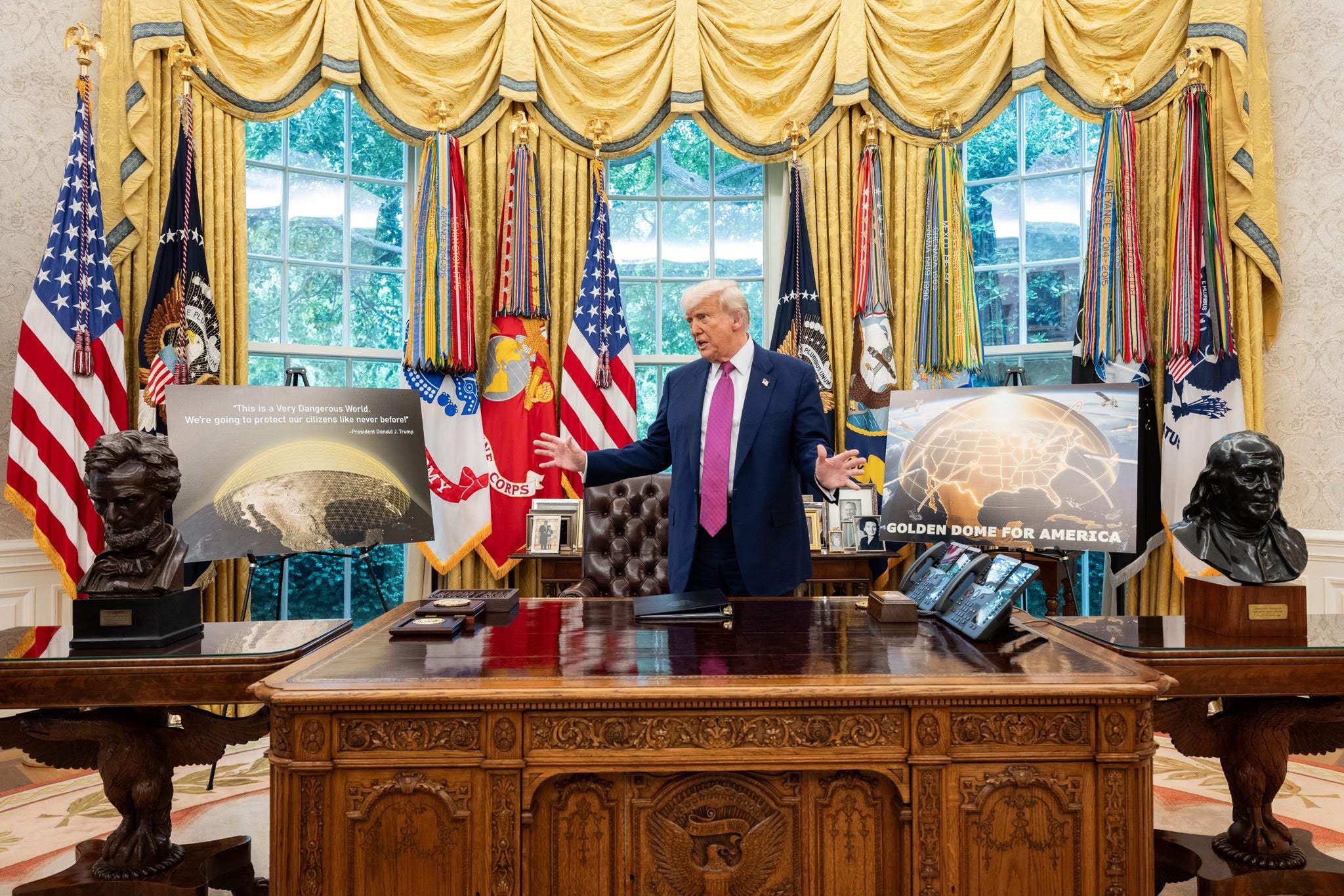
Donald Trump has a dream: a “golden dome” over America to defend the country against nuclear missiles. It’s a repeat of Ronald Reagan’s dream, the Strategic Defense Initiative, nicknamed “Star Wars” after the movie. The problem is that the dream represents a nightmare.
How so? Golden Dome would be dangerously escalatory, wildly expensive, and unlikely to work as a “shield” to America. It is worse than a mistake: it is a crime. It represents a massive theft from those who hunger and suffer in America. As Republican President Dwight D. Eisenhower said in 1953, wasting enormous resources on weapons systems is no way of life at all. It is humanity crucifying itself on a cross of iron. Crucifixion is not made more pleasant when the cross is golden.
A new golden idol occupies his mind
Put differently, the Golden Dome is a golden idol, a false god, one that by making a massive nuclear strike more likely endangers all of us and God’s creation.
Golden Dome is a grotesque example of makework militarism and warfare as welfare for weapons makers. Though it’s unlikely to work, if it did (partially) it would make a massive nuclear strike more likely, not less, endangering the world with the ecocidal terror of nuclear winter.
Golden Dome and the so-called investment in America’s nuclear triad are both examples of socio-technological madness–America’s leaders are like the mutants in “Beneath the Planet of the Apes,” worshipping the bombs that twisted them and which can only destroy what’s left of civilization.
Some Christians today await the apocalypse when Christ is supposed to return–but the most likely apocalypse features not the second coming of a God-man but a third world war featuring bomb-gods of thermonuclear destruction.
As Daniel Ellsberg once noted, U.S. nuclear attack plans in the early 1960s envisioned 600 million killed, or 100 Holocausts (before we knew such an attack would lead to nuclear winter). We’re lucky this insanity never came to pass. The only sane policy is to cancel Golden Dome and end “investment” in a new nuclear triad. Disarmament, not rearmament, is what’s needed.
*****
The Global Network Against Weapons & Nuclear Power in Space has released a statement against Golden Dome that you can read here. You can add your name to the statement, as I have. Here are some bullet points released along with the statement:
Golden Dome is financially reckless and unsustainable. Early cost estimates range from $550 billion to several trillion dollars over two decades. This dwarfs even the Pentagon’s annual budget and adds to the US’s $37 trillion national debt—a price tag that makes the project fiscally indefensible.
Experts overwhelmingly agree that 100% effective missile interception is a fantasy, especially against complex attacks involving decoys, hypersonic missiles, and maneuverable warheads. Even Israel’s Iron Dome has been bypassed by more rudimentary drone and missile attacks.
Golden Dome includes space-based interceptors—effectively weaponizing the Earth’s orbit and triggering an arms race. This violates the spirit of the Outer Space Treaty and pushes nations like China and Russia to accelerate space weapons development.
By giving the illusion of first-strike survivability, it runs counter to the Mutually Assured Destruction (MAD) doctrine that has prevented so far a nuclear holocaust and incentivizes other powers to retain or expand their nuclear arsenals, blocking disarmament efforts permanently.
Thousands of rocket launches for satellite interceptors would further damage the ozone layer, could generate dangerous orbital debris (Kessler Syndrome), and will harm our already fragile space environment.
The only guaranteed winners of Golden Dome are weapons giants like Lockheed Martin, Raytheon, and Palantir, which stand to profit enormously regardless of the system’s effectiveness or risks.
The trillions funneled into Golden Dome could be used for urgent domestic priorities—such as healthcare, infrastructure, climate action, and education, directly benefiting millions of Americans.
In short, Golden Dome is a massive, dangerous, and futile vanity project, cloaked in patriotism but driven by profit, politics, and illusion.
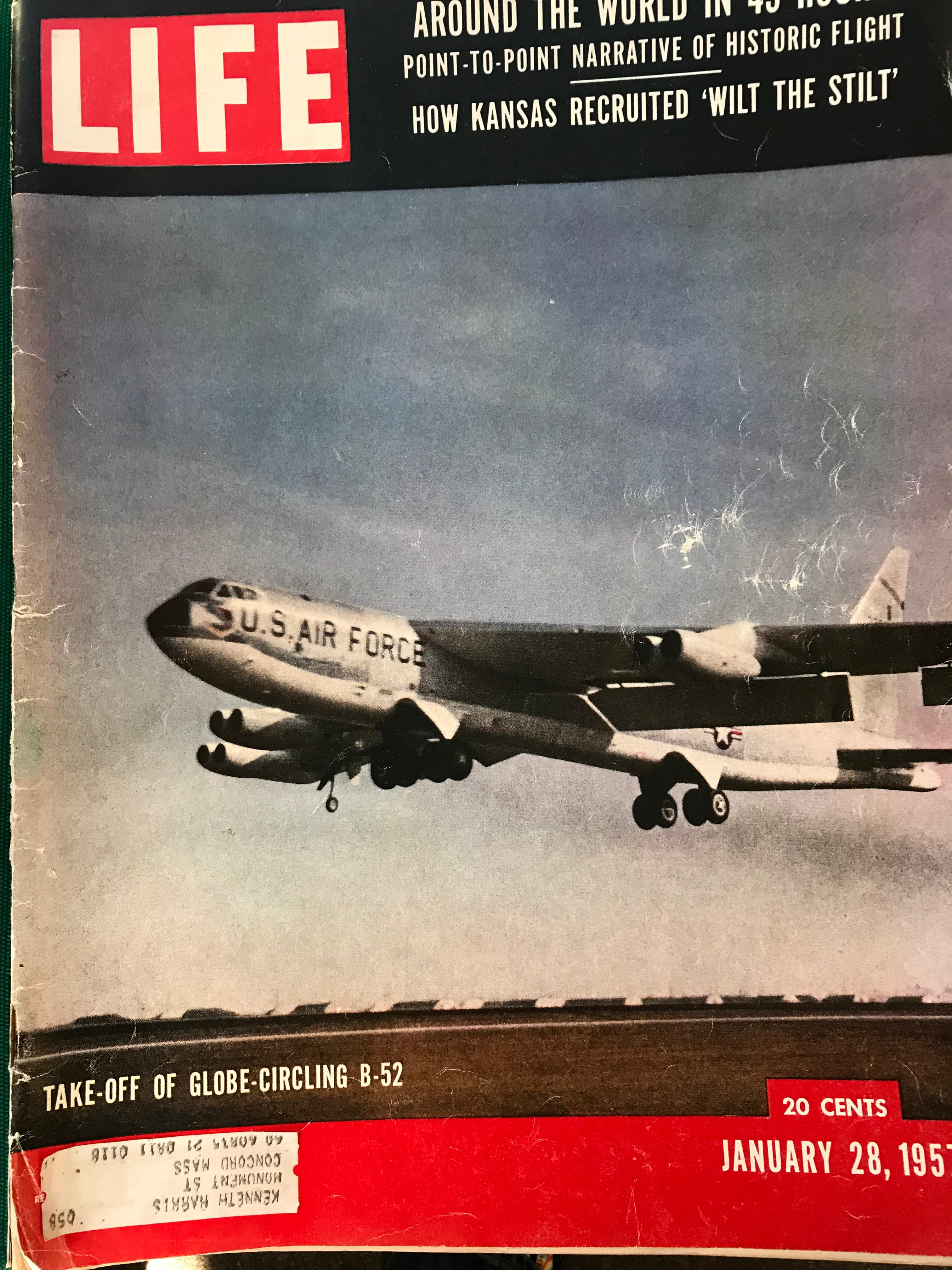
Yesterday at a local barber shop, I spied some old Life magazines from the 1940s, 1950s, and 1960s. Two covers caught my eye:
The first cover celebrated the newish B-52 nuclear bomber that circumnavigated the globe in record time (for the year 1957). Incredibly, the Air Force still relies on updated B-52s today for global bombing missions. Note how the cover mentions nothing about the B-52’s purpose, which was (and remains) to carry nuclear payloads with yields in the megatons of explosive force, anywhere on the globe.
The second cover celebrated fallout shelters. Check this out!
This gives new meaning to living under bridges in America. If only we had built all these fallout shelters—the homeless would have places to live in America today. It sure looks communal and fun in that cutaway view: women holding babies, people reading newspapers and books, even group discussions featuring people dressed like Ward and June Cleaver.
This, I submit to you, is propaganda, the intent of which was to normalize nuclear weapons, perhaps even nuclear war. (Just calmly walk or drive to the nearest shelter if our B-52s have to nuke Moscow.)
It persists today, of course. Now when the Pentagon speaks of nuclear weapons, they frame it as “investing” and “modernization.” Invest in ICBMs! Promised to soar upward like a rocket! Modernize your portfolio with some new B-21 Raider bombers—only $750 million per plane!
If the risk of nuclear war comes up, the suggestion is made that all these new nukes will serve to deter, even to prevent, nuclear Armageddon. Nothing deters war and killing like more genocidal weapons.
Those Life covers from 1957 and 1962 may look quaint—even silly—until you realize nothing really has changed in America in 70 years. We’re still normalizing nuclear weapons and even nuclear war itself. And there’s nothing quaint or silly about that.
As a late-stage baby boomer, a child of the 1960s, I grew up dreaming about America’s nuclear triad. You may remember that it consisted of strategic bombers like the B-52 Stratofortress, land-based intercontinental ballistic missiles (ICBMs) like the Minuteman, and submarine-launched ballistic missiles (SLBMs) like the Poseidon, all delivery systems for what we then called “the Bomb.” I took it for granted that we needed all three “legs” — yes, that was also the term of the time — of that triad to ward off the Soviet Union (aka the “evil empire”).
It took me some time to realize that the triad was anything but the trinity, that it was instead a product of historical contingency. Certainly, my mind was clouded because two legs of that triad were the prerogative of the U.S. Air Force, my chosen branch of service. When I was a teenager, the Air Force had 1,054 ICBMs (mainly Minutemen missiles) in silos in rural states like Montana, North Dakota, and Wyoming, along with hundreds of strategic bombers kept on constant alert against the Soviet menace. They represented enormous power not just in destructive force measured in megatonnage but in budgetary authority for the Air Force. The final leg of that triad, the most “survivable” one in case of a nuclear war, was (and remains) the Navy’s SLBMs on nuclear submarines. (Back in the day, the Army was so jealous that it, too, tried to go atomic, but its nuclear artillery shells and tactical missiles were child’s play compared to the potentially holocaust-producing arsenals of the Air Force and Navy.)
When I said that the triad wasn’t the trinity, what I meant (the obvious aside) was this: the U.S. military no longer needs nuclear strategic bombers and land-based ICBMs in order to threaten to destroy the planet. As a retired Air Force officer who worked in Cheyenne Mountain, America’s nuclear redoubt, during the tail end of the first Cold War, and as a historian who once upon a time taught courses on the atomic bomb at the Air Force Academy, I have some knowledge and experience here. Those two “legs” of the nuclear triad, bombers and ICBMs, have long been redundant, obsolete, a total waste of taxpayer money — leaving aside, of course, that they would prove genocidal in an unprecedented fashion were they ever to be used.
Nevertheless, such thoughts have no effect on our military. Instead, the Air Force is pushing ahead with plans to field — yes! — a new strategic bomber, the B-21 Raider, and — yes, again! — a new ICBM, the Sentinel, whose combined price tag will likely exceed $500 billion. The first thing any sane commander-in-chief with an urge to help this country would do is cancel those new nuclear delivery systems tomorrow. Instead of rearming, America should begin disarming, but don’t hold your breath on that one.
A Brief History of America’s Nuclear Triad
It all started with atomic bombs and bombers. In August 1945, the Japanese cities of Hiroshima and Nagasaki were obliterated by two atomic bombs carried by B-29 bombers, ending World War II. However, in the years that followed, as the Cold War with the Soviet Union heated up, the only “delivery system” the military had for its growing thermonuclear arsenal was the strategic bomber. Those were the glory days of the Strategic Air Command, or SAC, whose motto (believe it or not) was “Peace Is Our Profession” — the “peace” of a mass nuclear grave, had those hydrogen bombs ever been dropped on their intended targets in the Soviet Union and China.
However, as this country’s weapons makers produced ever more powerful hydrogen bombs and strategic bombers, a revolution was afoot in missile technology. By the late 1950s, missiles tipped with nuclear warheads became a practical reality. By the 1960s, the Air Force was already lobbying for 10,000 ICBMs, even if my old service had to settle for a mere thousand or so of them during the administration of President John F. Kennedy. Meanwhile, the Navy was maneuvering its way into the act by demonstrating that it was indeed possible for mobile, difficult-to-detect submarines to carry nuclear-tipped missiles.
By the late 1960s, that triad of potentially ultimate nuclear death had become so sacrosanct that it was untouchable. More than half a century later, America’s nuclear triad has endured and, all too sadly, is likely to do so far longer than you or me (if not, of course, used).
You might wonder why that should be so. It’s not for any sensible military or strategic reason. By the 1980s, if not before, bombers and ICBMs were obsolete. That was why President Jimmy Carter canceled the B-1 bomber in 1977 (though it would be revived under President Ronald Reagan, with the Air Force buying 100 of those expensive, essentially useless aircraft). That was why the Air Force developed the “peacekeeper” MX ICBM, which was supposed to be mobile (shuffled around by rail) or hidden via an elaborate shell game. Such notions were soon abandoned, though not the missiles themselves, which were stuffed for a time into fixed silos. The endurance of such weapons systems owes everything to Air Force stubbornness and the lobbying power of the industrial side of the military-industrial complex, as well as to members of Congress loath to give up ICBM and bomber bases in their districts, no matter how costly, unnecessary, and omnicidal they may be.
In that light, consider the Navy’s current force of highly capable Ohio-class nuclear submarines. There are 14 of them, each armed with up to 20 Trident II missiles, each with up to eight warheads. We’re talking, in other words, about at least 160 potentially devastating nuclear explosions, each roughly five to 20 times more powerful than the Hiroshima bomb, from a single sub. In fact, it’s possible that just one of those submarines has an arsenal with enough destructive power not just to kill millions of us humans, but to tip the earth into a nuclear winter in which billions more of us could starve to death. And America has 14 of them!
Why, then, does the Air Force argue that it, too, “needs” new strategic bombers and ICBMs? The traditional arguments go like this: bombers can be launched as a show of resolve and, unlike missiles, recalled. They are also allegedly more flexible. In Air Force jargon, they can be rerouted against “targets of opportunity” in a future nuclear war. Of course, generals can always produce a scenario, however world-ending, to justify any weapons system, based on what an enemy might or might not do or discover. Nonetheless, strategic bombers were already nearing obsolescence when Stanley Kubrick made his classic antinuclear satire, Dr. Strangelove (1964), so prominently featuring them.
And what about land-based ICBMs? Once the claim was that they had more “throw-weight” (bigger warheads) than SLBMs and were also more accurate (being launched from fixed silos rather than a mobile platform like a submarine). But with GPS and other advances in technology, submarine-launched missiles are now as accurate as land-based ones and “throw-weight” (sheer megatonnage) always mattered far less than accuracy.
Worse yet, land-based ICBMs in fixed silos are theoretically more vulnerable to an enemy “sneak” attack and so more escalatory in nature. The U.S. currently has 400 Minuteman III ICBMs sitting in silos. If possible incoming enemy nuclear missiles were detected, an American president might have less than 30 minutes — and possibly only 10 or so — to decide whether to launch this country’s ICBM force or risk losing it entirely.
That’s not much time to determine the all-too-literal fate of the planet, is it, especially given the risk that the enemy attack might prove to be a “false alarm“? Just before I arrived at Cheyenne Mountain, there were two such alarms (one stemming from a technical failure, the other from human error when a simulation tape was loaded into computers without any notification that it was just a “war game”). Until they were found to be false alarms, both led to elevated DEFCONs (defense readiness conditions) in preparation for possible nuclear war.
New ICBMs will only add “use them or lose them” pressure to the global situation. Mobile, elusive, and difficult to detect, the Navy’s submarine force is more than sufficient to deter any possible enemy from launching a nuclear attack on the United States. Strategic bombers and ICBMs add plenty of bang and bucks but only to the Air Force budget and the profits of the merchants of mass nuclear death who make them.
A Sane Path Forward for America’s Nuclear Force
I still remember the nuclear freeze movement, the stunningly popular antinuclear protest of the early 1980s. I also remember when President Reagan and Soviet leader Mikhail Gorbachev met in 1986 and seriously discussed total nuclear disarmament. I remember Barack Obama, as a 2008 presidential candidate, being joined by old Cold War stalwarts like Henry Kissinger and Sam Nunn in calling for the eventual elimination of nuclear weapons.
Today, we’re not supposed to recall any of that. Instead, we’re told to focus on the way a developing “new cold war” with Russia and China is driving a “requirement” for a “modernized” U.S. nuclear triad that could cost $2 trillion over the next 30 years. Meanwhile, we’re discouraged from thinking too much about the actual risks of nuclear war. The Biden administration, for example, professes little concern about the possibility that arming Ukraine with weaponry capable of hitting deep inside Russia could lead to destabilization and the possible use of nuclear weapons on the battlefield (something Vladimir Putin has threatened to do). Nor are we to fret about surrounding China with ever more U.S. military bases and sending ever more weaponry to Taiwan, while the Chinese are enlarging their own force of ICBMs; or, for that matter, about the fact that the last nuclear agreement limiting the size of the American and Russian arsenals will run out in less than 1,000 days.
To such issues, the only response America’s “best and brightest” ever have is this one: give us more/newer strategic bombers, more/newer ICBMs, and more/newer nuclear submarines (whatever the cost)! To those men, it’s as if nuclear war were a theoretical (and distinctly money-making) chess match — and yes, they are indeed still mostly men! — a challenging game whose only components are profits, jobs, money, and power. Yet when the only story to be told is one featuring more nuclear warheads and more delivery systems, it’s hard not to conclude that, in some horrific fashion, nuclear Armageddon is indeed us (or at least them).
And though few spend much time thinking about it anymore, that’s madness personified. What’s needed instead is a new conviction that a nuclear Armageddon must not be our fate and, to make that so, we must act to eliminate all ICBMs, cancel the B-21 bomber, retire the B-1s and B-2s, work on global nuclear disarmament, start thinking about how to get rid of those nuclear subs, and begin to imagine what it would be like to invest the money saved in rebuilding America. It sure beats destroying the world.
And again, in the most practical terms possible, if we’re set on preserving Armageddon, America’s existing force of Ohio-class nuclear submarines is more than enough both to do so and undoubtedly to “deter” any possible opponent.
There was a time, in the early stages of the first Cold War, when America’s leaders professed fears of “bomber” and “missile” gaps vis-à-vis the Soviet Union — gaps that existed only in their minds; or rather only in the reverse sense, since the U.S. was ahead of the Soviets in both technologies. Today, the bomber and missile “gaps” are, in fact, gaps in logic wielded by a Pentagon that insists strategic bombers and ICBMs remain a “must” for this country’s safety and security.
It’s all such nonsense and I’m disgusted by it. I want my personal thermonuclear odyssey to come to an end. As a kid in the 1970s, I built a model of the B-1 bomber. As a ROTC cadet in the early 1980s, I made a presentation on the U.S./Soviet nuclear balance. As a young Air Force officer, I hunkered down in Cheyenne Mountain, awaiting a nuclear attack that fortunately never came. When I visited Los Alamos and the Trinity Test Site at Alamogordo, New Mexico, in 1992, I saw what J. Robert Oppenheimer’s original atomic “gadget” had done to the tower from which it had been suspended. When the Soviet Union collapsed, I genuinely hoped that this country’s (and the world’s) long nuclear nightmare might finally be coming to an end.
Tragically, it was not to be. The gloomy Los Alamos of 1992, faced with serious cuts to its nuclear-weapons-producing budget, is once again an ebullient boom town. Lots of new plutonium pits are being dug. Lots more money is flooding in to give birth to a new generation of nuclear weapons. Of course, it’s madness, sheer madness, yet,this time, it’s all happening so quietly.
Even as the nuclear clock ticks ever closer to midnight, nobody is ducking and covering in America’s classrooms anymore (except against mass shooters). No one’s building a nuclear bomb shelter in their backyard (though doomsday shelters for the ultra-rich seem to have become status symbols). We’re all going about our business as if such a war were inconceivable and, in any case, akin to a natural disaster in being essentially out of our control.
And yet even as we live our lives, the possibility of a nuclear Armageddon remains somewhere in our deepest fears and fantasies. Worse yet, the more we suppress the thought of such horrors and the more we refuse even to think about acting to prevent them, the more likely it is that such an Armageddon will indeed come for all of us one day, and the “trinity” we’ll experience will be a horrific version of the blinding flash of light first seen by J. Robert Oppenheimer and crew at that remote desert site nearly 80 years ago.
Yesterday, I appeared on Podcast by George. George Clark and I discussed the Russia-Ukraine War, Gaza, and the military-industrial-congressional complex. Here’s the video:
As George and I discussed America’s constant state of (very expensive and deadly) war, it occurred to me, not for the first time, that my country lost the Cold War that we allegedly won in 1991.
How so? After that “victory,” America was supposed to cash in on its peace dividends, becoming a normal country in normal times, to cite Jeanne Kirkpatrick. Instead, America doubled down on empire and the idea of imperial dominance. Militarism, not democracy, became a leading feature of our society, especially after the trauma of the 9/11 attacks. The U.S. government today remains shrouded in secrecy; those who would expose imperial war crimes, like Julian Assange or Daniel Hale, are imprisoned, even tortured.
The national security state, the MICIMATT,* is a colossus, far more insidious and invasive than anything even President Dwight D. Eisenhower imagined in his farewell address against the military-industrial complex in 1961. “Peace” is a word rarely heard in Washington, and the State Department has become a tiny branch of the Pentagon, bragging about weapons sales and shipments overseas rather than embracing diplomatic solutions to increasingly deadly conflicts. Even genocide in Gaza is dismissed as the Biden administration embraces Israel’s right to defend itself—against women and children in Gaza.
Courtesy of John Whitbeck, here’s a handy (and devastating) chart showing the damage inflicted on Gaza:
Chart prepared by the Euro-Med Human Rights Monitor available at this link:
*MICIMATT: military industrial congressional intelligence media academe think tank complex. We might also add Hollywood and the sports world to the complex, since both are so eager to celebrate war and “our” troops.
Democracy doesn’t die in darkness. It dies from constant warfare, as James Madison warned us about. It’s worth repeating his words:
Of all the enemies of true liberty, war is, perhaps, the most to be dreaded, because it comprises and develops the germ of every other. War is the parent of armies; from these proceed debt and taxes; and armies, and debts, and taxes are the known instruments for bringing the many under the domination of the few. In war, too, the discretionary power of the Executive is extended; its influence in dealing out offices, honors and emoluments is multiplied; and all the means of seducing the minds, are added to those of subduing the force, of the people. The same malignant aspect in republicanism may be traced in the inequality of fortunes, and the opportunities of fraud, growing out of a state of war, and in the degeneracy of manner and of morals, engendered in both. No nation can preserve its freedom in the midst of continual warfare …
It began in August 1914, a war in Europe that was supposed to be over by Christmas of that year. But it exploded out of control, becoming the “Great War” or “The World War” or even “The War to End All Wars.” And when it finally ended on 11/11 in 1918, something like ten million troops were dead.
We know it as World War I or the First World War because we know what came after it: yet another calamitous world war, a sequel, one that was far worse than the original. And after that war finally ended in 1945, something like 75-80 million people were dead around the world, including 25 million in the Soviet Union, six million Jews in the Holocaust, and 250,000 at Hiroshima and Nagasaki.
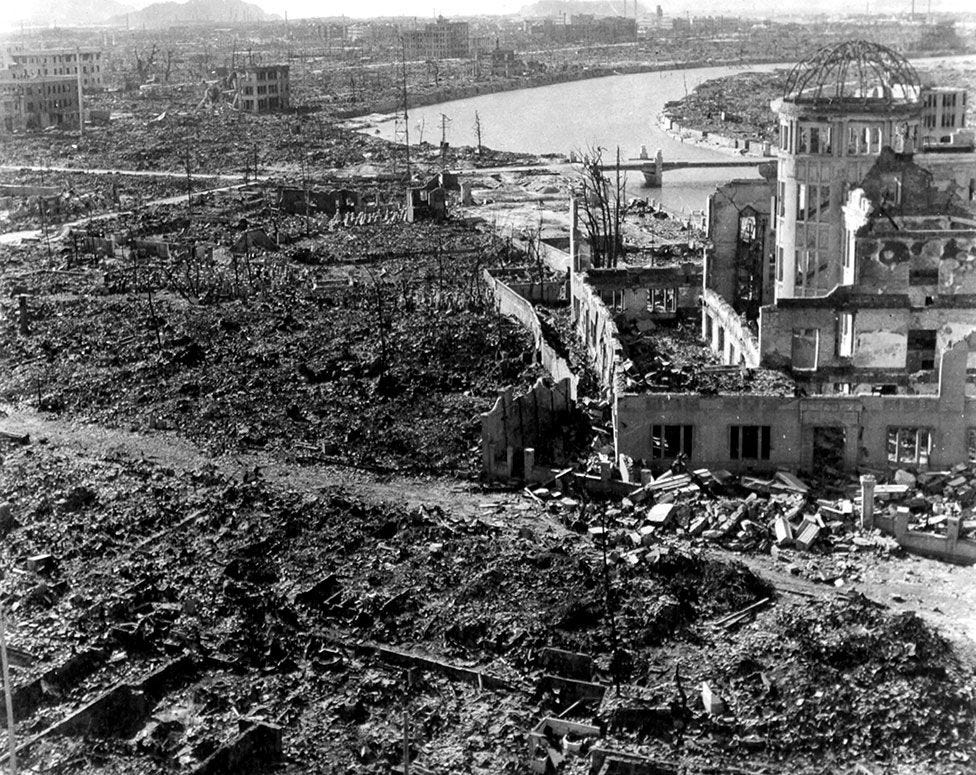
Hiroshima, 1945, after a “small” atomic bomb. Nuclear attacks in a “new” Cold War will be inconceivably worse
Of course, World War II also wasn’t the end of the killing. The so-called Iron Curtain descended in Europe, leading to the Cold War between the U.S. and the Soviet Union that almost ended with Armageddon in 1962 during the Cuban Missile Crisis. That Cold War came to an end in 1991 with the collapse of the Soviet Union. The U.S. celebrated its apparent victory, even calling briefly for “peace dividends” in the 1990s. It was not to be.
Thirty years after the (First) Cold War, we now hear of a “new Cold War.” We hear again that China and Russia are America’s enemies, a new “Axis of Evil,” notes Caitlin Johnstone. America is already engaged in a proxy war with Russia in Ukraine. Now America’s leaders are posturing over Taiwan and threatening war with China if the Chinese military makes aggressive moves against that country. (Of course, the Chinese consider Taiwan to be China, a “One China” policy the U.S. used to support.)
It does seem as if “my” Cold War, when I served in the U.S. military, may be remembered to history as the First Cold War, and that America has already begun a Second Cold War. And, just as World War II was far worse than World War I in casualties and destruction, Cold War II could conceivably be a LOT worse than Cold War I if we choose to continue to wage it.
Sequels, as a general rule, are usually worse, sometimes far worse, than the originals. We had better stop this nonsense of a new Cold War before we relearn this in the hardest way possible.
The Pentagon Budget Keeps Soaring Up, Up, and Away!
When the Soviet Union collapsed in 1991 and the Cold War ended, I heard a lot about peace dividends. It was time to become a normal country in normal (more peaceful) times, said Jeanne Kirkpatrick, an early neocon who served under Ronald Reagan. More than thirty years later, America still awaits its peace dividends from the Cold War.
When the Afghan War came to a sputtering and ignominious end in 2021, I didn’t hear much at all about peace dividends. Even though the Afghan War was costing the United States almost $50 billion a year before it crashed and burned, the Pentagon budget for 2022 went up by that amount rather than down. You’d think the end of wars would lead to a decrease in military spending, but not in America.
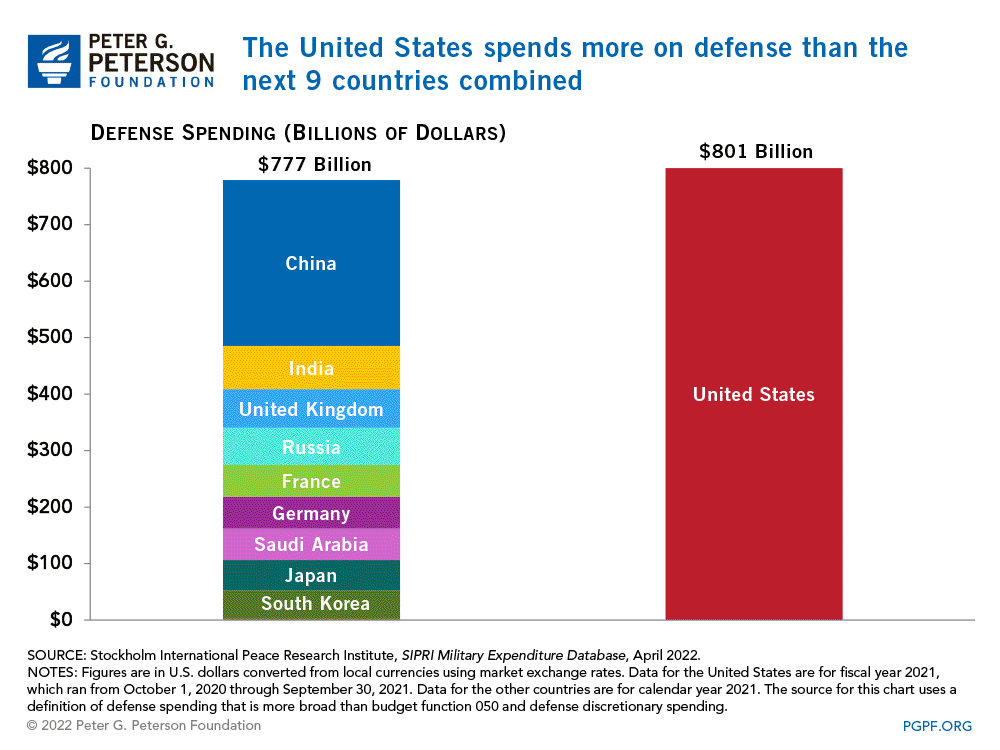
And so we come to today, when I learned that the Pentagon budget for 2023, which sat at $802 billion per the request of the Biden administration, has been boosted big time to $847 billion by the House and Senate Armed Services Committees. That’s $45 billion extra for more wars and weapons, a whopping sum of money that would likely end homelessness if it was invested in America.
One thing is certain: war dividends always come through. Peace dividends? Not so much.
How does the Washington Beltway crowd justify such enormous sums for “national defense”? Threat inflation, of course. Because of its debilitating war with Ukraine, Russia is weaker but somehow that means America must spend more because Putin or something. Chinese maneuvers near Taiwan are treated like direct incursions into U.S. coastal waters. A few North Korean missiles are enough to justify more than a trillion dollars for new or revamped nuclear forces over the next thirty years. And of course military Keynesianism is always a factor, as in Pentagon-related jobs spread as widely as possible through every Congressional district.
The Pentagon can’t even pass an audit (for the fifth year in a row!), yet it still gets more and more billions from you the taxpayer.
I took a quick look at NBC News online to see if there were any objections to this massive $847 billion budget for the Pentagon. The only story featured warned that “GOP senators threaten to delay military bill over vaccine mandate.” Yes, what’s truly worrisome is that a few troops might have to accept a COVID vaccine against their will. Geez, where were these senators when the military was jabbing me in the arm every year with a mandatory flu vaccine?
Trees are falling in the forest to print all the money the Pentagon wants (and then some), but few Americans hear a sound since the mainstream media refuses to cover wasteful military spending and disastrous American wars.
If you should want a sure bet in America, don’t toss money at your favorite sports team. Place your bet on America’s war horse. Whether it wins, places, or shows, or even comes up lame, it will always pay dividends.
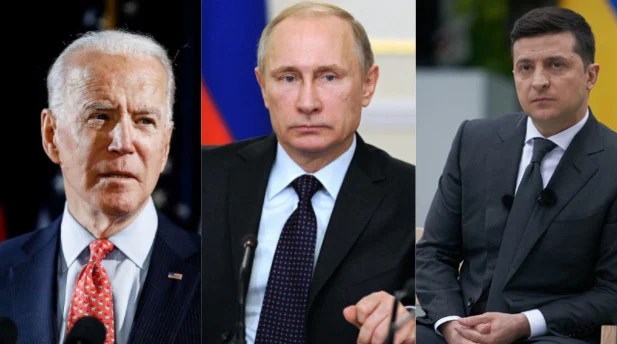
President Joe Biden turns 80 this year. If he chooses to run and is reelected in 2024, he’ll be 82 and will serve as president until he’s 86. His Republican rival, Donald Trump, will be 78 in 2024 and is overweight and perhaps obese. Biden, meanwhile, is moving more slowly and appears to be experiencing signs of age-related cognitive decline. Leaving aside their politics and policies and personalities, are either of these men truly fit to be president?
We all age differently, of course. But it used to be said that being POTUS was the toughest job in the world. Younger men like Jimmy Carter, Bill Clinton, and George W. Bush aged noticeably in office due to the strains of the job. Yet pointing out the rigors of the presidency, and raising questions about whether men in their 80s are truly capable of handling such rigors, exposes one to claims of bias based on age.
A lot of jobs have mandatory retirement ages. My dad was a firefighter and he had to retire at 65. While we don’t expect the POTUS to climb ladders or charge into burning buildings or carry bodies, there’s still something to be said for the difficulty of men in the twilight of their lives serving as the “leader of the free world.”
(I say men here because women live longer and often age more gracefully. But I think it’s also true in the U.S. that a woman “pushing 80” would be dismissed out of hand as too old for the presidency; societal bias against older women still exists, though of course older women can cling to power with the same tenacity as men: just look at House Speaker Nancy Pelosi.)
I remember the bad old days of the Cold War when Soviet leaders were mocked in the U.S. as a gerontocracy of sorts. So when Leonid Brezhnev died at the age of 75, he was briefly succeeded by Yuri Andropov (died at 69) and Konstantin Chernenko (died at 74 after serving for just over a year as General Secretary). Then the much younger Mikhail Gorbachev took over at age 54 and more than anyone helped to revolutionize U.S.-Soviet relations.
In a way, Joe Biden is the U.S. equivalent of Andropov and Chernenko, a time-server who was elevated by his party as a caretaker. “Nothing will fundamentally change,” Biden said of his administration, a promise he has indeed kept. Those same words could have come from Andropov and Chernenko.
The problem for the Democrats is that there’s no clear younger heir-apparent to Biden. Harris? Mayor Pete? Gavin Newsom? (Newsom, like Mitt Romney, has presidential hair but little else.) Where is the Democratic equivalent to Mikhail Gorbachev?
The Republicans have their own issues, the main one being the cult of personality surrounding Donald J. Trump. But what really empowers Trump, besides his own craftiness at cons and culture wars, is the weakness and hypocrisy of the Democrats. When your most likely opponent is a “no hope, no change” figurehead in his early 80s, even Trump appears by comparison to be a change agent of sorts.
America truly needs fundamental change, someone like Mikhail Gorbachev, a leader willing to face facts and tell harsh truths. Someone with a fresh perspective and the energy to convey it. Both Biden and Trump are too old, if not in their bodies, then in their thinking, to be the reformer America so desperately needs.
My esteemed colleague Davout and I have different ways of looking at the Russia-Ukraine War. We thought it would be a worthwhile exercise to share our differing perspectives here, allowing our readers to think over the merits of our approaches and the validity of our conclusions. Davout has framed the questions and made the initial response; I get the last word, so to speak, for each question. Our mutual intent is not to “win” a pseudo-debate but to pose questions and provide answers that inform and stimulate. To that end, here we go.
What caused the Russian invasion of Ukraine?
Davout: Putin’s desire to reestablish Russian hegemony over Eastern Europe and ensure the stability of his autocratic regime has been the main driver of the invasion. In 2005, Putin declared that the collapse of the Soviet Union was “the greatest geopolitical catastrophe of the century.” What was catastrophic about it for Putin? The eastern flank of the former Soviet Union, including Latvia, Lithuania, Estonia, Moldova, and Ukraine shifted from being an appendage of an authoritarian Soviet regime to being a collection of independent democracies or democracies-in-process. Membership in the European Union and in NATO has either been achieved (the Baltic states) or been pursued (Ukraine pursuing both, Moldova pursuing European Union membership only). None of these countries (not to mention the formerly occupied countries of Poland, Hungary, East Germany, Czechoslovakia) singly or together have the capacity or will to invade Russia or otherwise project military power across Russian borders. The real threat to which Putin is responding is the example set by the people of former Soviet territories opting for more democratic, less corrupt regimes and societies. That example endangers his own hold on power and pushes his own society toward historical irrelevance.
Astore: Putin was obviously the prime mover of the invasion. He chose the military option, and he surely believed it would strengthen his authority over a former Soviet republic that was tracking toward joining NATO.
When we speak of causes, however, it’s often wise to take a broad view over a breadth of time. When the Soviet Union collapsed in 1991, NATO’s reason for being ended with it. Nevertheless, NATO persisted, expanding to the very borders of Russia despite assurances to Russian leaders that the alliance would not expand eastwards beyond a newly unified Germany. Russian leaders, including Putin, had issued clear warnings that NATO expansion into Ukraine would constitute a “red line,” the crossing of which would likely lead to a military response. Putin’s decision to invade, therefore, was eminently predictable, thus it was also potentially preventable. The United States, which leads NATO, could have sent a clear signal to Russia that Ukraine should and would remain a neutral buffer state. The US chose not to do so.
One may question the premise of Ukraine as a “more democratic, less corrupt regime.” In Ukraine, corruption is endemic, exacerbated by extensive U.S. meddling, as in the notorious coup of 2014 orchestrated in part by Victoria Nuland, citing the support of then-Vice President Joe Biden. And while it’s important to recognize Russian regional hegemonic ambitions, one should never forget the global hegemonic ambitions of the U.S. empire. In sum, the US has not been an innocent bystander here.
US proxy war or Ukrainian war of independence?
Davout: A proxy war is a conflict instigated by a state in which it does not directly engage in hostilities. This war was a war of choice on the part of Putin. It has had the unintended result of inspiring patriotic resistance (even amongst Russian-speaking Ukrainians who were formerly pro-Russian like the mayor of Odessa). In the lead up to the invasion, the US and its NATO allies attempted to dissuade Putin from invading. In the invasion’s aftermath, they have provided critical arms and support to Ukraine and have sought economically to undermine Russia’s war-making capacities. While current official US policy may be the crippling of Russia’s capacity to engage in another such invasion in the near future, the US did not instigate this war in pursuit of this aim. While US and NATO armaments are a necessary factor in Ukraine’s continued defense against the Russian invasion, it is Ukrainian solidarity and resolve and Russian refusal to end its invasion that keep this war going.
Astore: Clearly, most Ukrainians believe they are fighting for their independence. Ukraine has no desire to become a Putin puppet state. Nor, however, do they wish to become a puppet state to the USA.
Lloyd Austin, the US Secretary of Defense, spoke clearly that weakening Russia was a key goal of this conflict. To that end, the US government, in a rare show of bipartisan unity, provided $54 billion in largely military aid to a Ukrainian military with a yearly budget of $6 billion. Such profligacy is not an example of generosity driven by disinterested ideals. Clearly, the US sees this war as the latest front in a new cold war, a way to stress Russia to the breaking point. As President Biden openly stated, that man (Putin) must go.
So, it’s worse than a proxy war: it’s yet another US regime-change war. The stated goal is to topple Putin and turn Russia into a divided and dysfunctional state, much like it was in the 1990s when Western corporations and financial institutions invaded Russia and exploited it in the name of capitalism and reform.
Are there any legitimate parallels to draw between Putin and Hitler?
Davout: Yes, though the parallels with Hitler are not the same parallels so often drawn to delegitimize non-interventionists as appeasers. Historian John Lukacs’s various histories of Hitler’s strategizing in that crucial period after the invasion of France to the start of the Battle of Britain paint a picture of Hitler less as the hubristic dictator irrationally striving for world conquest than as a canny but flawed geopolitical strategist, driven by geopolitical grievance and with a large capacity to hate those who opposed him. Lukacs argues that Hitler was prepared to cut a deal with Great Britain on terms that would allow Germany to exercise hegemonic powers on the continent. It was Churchill’s longstanding aversion to Hitler and Hitlerism and his ability to maintain British popular support for the war that blocked Hitler’s strategy to cut a deal. Once his overture was blocked by Churchill, Hitler underestimated British morale in the Battle of Britain. Then, in an effort to circumvent Britain’s resistance, Hitler gambled that he could cripple Stalin’s war making capacity and knock him out of the war and thereby present England with a fait accompli of German hegemony on the continent. The picture of Hitler Lukacs draws can plausibly be applied to Putin—a grievance-driven leader attempting to restore a lost geopolitical sphere of influence, who has miscalculated the resolve of democratic leaders and peoples and has doubled down on violence.
Astore: In a word, no.
Whenever American leaders want to justify military action and high spending on weaponry, they turn to Hitler and World War II. The claim is made that we must stop the “new” Hitler. We must not be appeasers. Saddam Hussein was allegedly the new Hitler in 2003; his WMD was supposed to be a mushroom cloud on our horizon. But there was no WMD and eliminating Saddam by invasion tipped Iraq into a disastrous civil war from which that country has yet to recover.
Putin isn’t the new Hitler, and his invasion of Ukraine doesn’t represent the kind of existential threat the Third Reich presented to democracies in 1938-39.
Hitler had the finest military machine of his day backed by the economic powerhouse that was Germany in the late 1930s. Putin’s military machine is mediocre at best, and Russia’s economy is smaller than that of California. Putin doesn’t appear to be seeking a huge empire or world domination, as Hitler was. And while Hitler may have temporarily played nice with Britain, that didn’t prevent the Nazis from hatching plans to invade and loot Britain and to massacre its Jews as well.
Of course, Putin was wrong to have invaded Ukraine, but George W. Bush was wrong to have invaded Iraq in 2003. Both these leaders have essentially nothing in common with Hitler, who was sui generis–a tyrannical dictator driven by genocidal fantasies of world dominance by a “master race.”
To what extent is US democracy hurt or helped by the Biden Administration’s policy of military support for Ukrainian resistance?
Davout: Seeing his country in hostile competition with western democracies, Putin has deployed various forms of soft power and hard power to undermine confidence in, and injure the working of, democratic regimes. Hackers and internet influencers employed by the Russian state have intervened in the elections of established democracies either to foster social distrust or to promote candidates (e.g., Trump) and policies (e.g., Brexit) that weaken adversary countries. Military interventions are carried out on Russia’s border to maintain regimes favorable to Putin (as was the case when a popular uprising against fraudulent elections in Belarus was put down with the help of Russian soldiers). Meanwhile, as was documented by the Panama and Pandora Papers, the huge amounts of money pilfered from the Russian people by oligarchs moves through the banking, legal, and commercial institutions of democratic countries (including South Dakota!) with corrupting effect on people and officials alike. To be sure, the US has corruption problems of its own. And US military support of Ukraine will have the unfortunate result of strengthening the position of defense contractors and their lobbyists, Pentagon brass, and congressional hawks. However, it would be worst for US democracy if Russian ambitions to occupy or dismember Ukraine succeed. This would undermine European democracies whose continued survival and flourishing provide democratic reformers in the US with critically important role models and partners.
Astore: US democracy hasn’t been hurt or helped by this war because the US is a democracy in name only.
In reality, the US is an oligarchy in which the rich and powerful rule at the expense of the many. The unofficial fourth branch of government is the US National Security State, a leviathan of enormous power. Its biggest component is what President Dwight D. Eisenhower in 1961 termed the military-industrial complex (to which he added Congress as well). This MICC is profiting greatly from this war, not only in the $54 billion in aid provided to Ukraine, but also in the ever-rising Pentagon budget for FY 2023, which will exceed $813 billion, a gargantuan sum justified in part by the Russia-Ukraine War.
The new cold war with Russia, and increasingly with China as well, is strengthening the state of permanent war in America. As James Madison warned, permanent warfare serves autocracy while insidiously destroying democracy. As militarism becomes more deeply entrenched in the US government, and as that same government continues to send more destructive weaponry to Ukraine such as artillery and missile systems, options for de-escalation narrow even as chances for a nightmarish escalation to nuclear war, whether by design or accident, increase.
What would truly strengthen democracy in America, assuming it could somehow be reanimated, is if the USA pressed ahead with all its strength to broker a peace treaty between Russia and Ukraine. Ukraine is getting wrecked by this war, and our aggressive actions, mainly in providing more and more lethal weaponry together with onerous sanctions, are guaranteed to shred more bodies and aggravate economic dislocation both here and in Europe.
Readers, what are your thoughts here?
Coda by M. Davout (6/6/22)
W. J. Astore has asked me to compose a “coda” of sorts, in which I might add some concluding reflections about the commentary provoked by our different views on the war in Ukraine.
Yes, there is a relevant pre-2022 history to the current conflict—decades old promises from US officials to Russian officials about not expanding NATO east of the Oder, a popular pro-West Ukrainian uprising (supported by Western intelligence agencies, some have plausibly argued) against a Ukrainian administration’s decision to reject closer ties with the European Union (as was the will of the Ukrainian parliament) in favor of the Ukrainian president’s decision to push the country toward closer ties with Russia, a counter-uprising in the Donbas that drew Russian political and military support, etc. But there is also the fact of a full-scale military invasion against a country that posed little if any military threat to Russian borders, a military invasion that has led to the needless deaths of tens of thousands of civilians and combatants and the uprooting of millions of Ukrainians.
It is undeniable that the invasion has promoted patriotic solidarity among different language speakers within Ukraine against the invasion, including Russian speaking Ukrainians whose rights Putin’s invasion was presumably intended to defend. It is also undeniable that voter support for Ukraine’s resistance to the invasion is very high in Eastern European countries. More noteworthy is the fact that in Western European countries, governments have been forced to respond to the pro-Ukrainian sentiments of their voters by sending arms to Ukraine and destroying longstanding economic relationships with Russia to the financial detriment of both European businesses and consumers.
So the situation is nowhere near as neat or clear as either my contributions or Astore’s contributions or the contributions of the majority of the commentators would have it be. In this regard, the comments of Denise Donaldson strike me as the most interesting. You can tell that she can see the issue from both sides and is struggling with that ambiguity.
That is the place to be on the Ukraine war, I think: struggling with ambiguity. There is no clearly right answer: the war is not solely a product of American empire, nor is it solely a product of Russian empire. And there are no good outcomes, only bad or worse outcomes.
But, in politics, one has to make choices and, for now, I choose align myself with current US and NATO policy. Not because I am a dupe of the mainstream media or a supporter of the Establishment or the MIC (my earlier posts on this website should put those notions to rest) but because I believe the expulsion of the Russian military from the Ukrainian lands it currently occupies (maybe including Crimea, maybe not) is both possible and more likely to lead to a lasting peace in eastern Europe. And my taking that position does not mean that I do not also see some merit in the points my esteemed colleague WJ Astore (and his many followers) make.
Response by Astore (6/6/22)
I would like to thank M. Davout for his reasoned response and for continuing this important discussion. One thing I can say with certainty: you won’t hear such a nuanced and broad debate in the mainstream media, which basically just sells U.S. weaponry while waving Ukrainian flags in our faces.
Davout suggests that Ukraine posed no threat to Russia. Alone, that is true. But Ukraine was planning to join NATO, a powerful alliance led by the world’s most hegemonic country. Surely, that combination was something for Russia to be wary of, and even to fear.
When Americans think of Russia, many negative images come to mind. The evils of communism. A charging and rampaging Russian bear. But Russia has had its share of devastation. Davout certainly knows the rampage of Napoleon’s empire in 1812. Russia and the Soviet Union were almost destroyed by World Wars I and II. Russian leaders have been reassured by Western leaders before that “we come in peace,” but surely 1812, 1914, and 1941 taught Russia much about trusting Western assurances.
Look at a map. From a Russian perspective, NATO surrounds them. Look at military budgets. The U.S. and NATO combined spend more than 20 times what Russia spends. If the roles were reversed and we were the Russians, might we see this differently?
My point is not to excuse Russia’s invasion but to offer a partial explanation.
I agree with Davout that by this point “there are no good outcomes, only bad or worse outcomes.” Therefore, I choose not to align myself with current US and NATO policy, since I see this as recklessly escalatory and focused primarily on providing more and more weaponry to kill more and more Russians (and Ukrainians too). I propose an immediate cease fire, the end of arms shipments to Ukraine, and negotiation that would end with some territory being ceded to Russia, a promise from NATO and Ukraine that the latter will remain neutral, and a promise from Russia that Ukraine will not be attacked again, and that its territorial integrity will be respected. I would also insist on Russia paying reparations dedicated to rebuilding Ukraine. Finally, the U.S. should end all sanctions on Russia and redirect its aid entirely to rebuilding Ukraine rather than to more weaponry.
I think this approach would save lives and restore equilibrium to Europe while avoiding dangerous escalation that could conceivably end in nuclear war. It’s time for statesmanship and compromise, rather than militaristic grandstanding and mendacious obstinacy.
Sadly, I see no one in the US government with the sagacity and cojones to join Putin and Zelensky in working to stop this war reasonably and quickly.
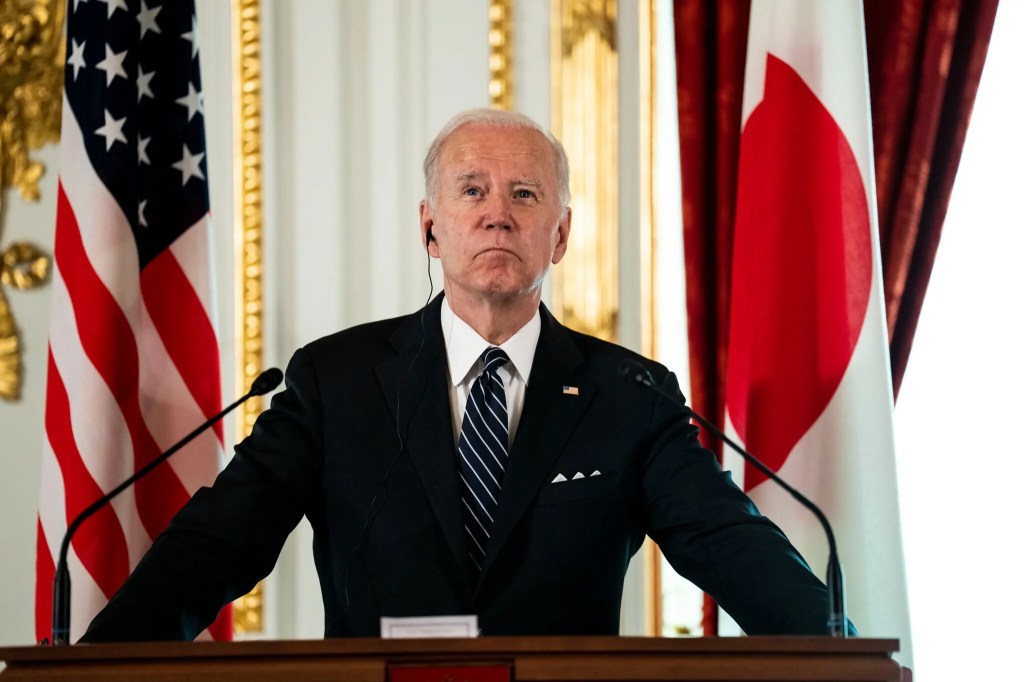
President Biden in Tokyo, sharing some “tough words” (NYT photo)
President Biden is at it again, and so is the New York Times. Abandoning the policy of “strategic ambiguity,” Biden vowed that America would militarily resist a Chinese invasion of Taiwan. The “liberal” New York Times did its part by describing (in its “Morning” daily newsletter) Biden’s vow as “tough words.” Who cares if Biden’s words unnecessarily aggravate tensions with China and contribute to a cold war running increasingly hot? After all, Biden sounded “tough,” and that’s all that really matters here.
Consider these “tough” words from the New York Times:
“The central problem for the U.S. is that it might not be able to stop Xi if he chose to attack. The American public is tired of faraway wars with uncertain connections to national security — an attitude that limits any U.S. president’s options. China’s leaders, on the other hand, would view a conflict in Taiwan as a vital domestic matter and devote vast resources to victory.
For these reasons, the surest way to protect Taiwan is to make China’s leaders believe that even if they could win a war, it would be costly enough to destabilize their regime.”
Remarkably, the Times makes it sound like the American public’s fatigue when it comes to disastrous foreign wars that are unconnected to our national security is a bad thing. Note how this “tired” feeling is allegedly an “attitude that limits any U.S. president’s options,” as if that’s a bad thing.
Did the Times forget that it’s Congress that’s supposed to declare war? That wars should be a last resort? Anyway, so far I haven’t noticed how the American public’s tiredness has stopped any recent war. Most Americans didn’t want to invade Iraq and quickly grew tired of that war, but as Vice President Dick Cheney famously said, “So?” So what if the people are “tired”? When it comes to war, men like Cheney, Obama, Trump, and Biden do what they want. If they listened to us, the Afghan War would have been over in two months instead of persisting for two decades.
“Tough words.” Please, God, save us all from such dangerous nonsense.
In my latest for TomDispatch.com, I tackle America’s disastrous 60-year war (1961-2021), which began with Ike’s warning of the pernicious threat to democracy of the military-industrial complex and ended with last year’s humiliating retreat from Afghanistan. Has America learned anything? Based on recent events with Russia and Ukraine, together with bellicose acts toward China, it doesn’t seem so.
Here’s an excerpt from my article; you can read it in its entirety at TomDispatch.com.
Three Generations of Conspicuous Destruction by the Military-Industrial Complex
In my lifetime of nearly 60 years, America has waged five major wars, winning one decisively, then throwing that victory away, while losing the other four disastrously. Vietnam, Afghanistan, and Iraq, as well as the Global War on Terror, were the losses, of course; the Cold War being the solitary win that must now be counted as a loss because its promise was so quickly discarded.
America’s war in Vietnam was waged during the Cold War in the context of what was then known as the domino theory and the idea of “containing” communism. Iraq and Afghanistan were part of the Global War on Terror, a post-Cold War event in which “radical Islamic terrorism” became the substitute for communism. Even so, those wars should be treated as a single strand of history, a 60-year war, if you will, for one reason alone: the explanatory power of such a concept.
For me, because of President Dwight D. Eisenhower’s farewell address to the nation in January 1961, that year is the obvious starting point for what retired Army colonel and historian Andrew Bacevich recently termed America’s Very Long War (VLW). In that televised speech, Ike warned of the emergence of a military-industrial complex of immense strength that could someday threaten American democracy itself. I’ve chosen 2021 as the VLW’s terminus point because of the disastrous end of this country’s Afghan War, which even in its last years cost $45 billion annually to prosecute, and because of one curious reality that goes with it. In the wake of the crashing and burning of that 20-year war effort, the Pentagon budget leaped even higher with the support of almost every congressional representative of both parties as Washington’s armed attention turned to China and Russia.
At the end of two decades of globally disastrous war-making, that funding increase should tell us just how right Eisenhower was about the perils of the military-industrial complex. By failing to heed him all these years, democracy may indeed be in the process of meeting its demise.
The Prosperity of Losing Wars
Several things define America’s disastrous 60-year war. These would include profligacy and ferocity in the use of weaponry against peoples who could not respond in kind; enormous profiteering by the military-industrial complex; incessant lying by the U.S. government (the evidence in the Pentagon Papers for Vietnam, the missing WMDfor the invasion of Iraq, and the recent Afghan War papers); accountability-free defeats, with prominent government or military officials essentially never held responsible; and the consistent practice of a militarized Keynesianism that provided jobs and wealth to a relative few at the expense of a great many. In sum, America’s 60-year war has featured conspicuous destruction globally, even as wartime production in the U.S. failed to better the lives of the working and middle classes as a whole.
Let’s take a closer look. Militarily speaking, throwing almost everything the U.S. military had (nuclear arms excepted) at opponents who had next to nothing should be considered the defining feature of the VLW. During those six decades of war-making, the U.S. military raged with white hot anger against enemies who refused to submit to its ever more powerful, technologically advanced, and destructive toys.






 Bracing Views