Wars Make the Rich Richer and the Poor Dead

W.J. Astore

On Ending Militarism in America

Also at TomDispatch.com

I read the news today, oh boy. About a lucky man named Elon Musk. But he lost out on one thing: he didn’t get a top secret briefing on Pentagon war plans for China. And the news people breathed a sigh of relief.

With apologies to John Lennon and The Beatles, a day in the life is getting increasingly tough to take here in the land of the free. I’m meant to be reassured that Musk didn’t get to see America’s top-secret plans for — yes! — going to war with China, even as I’m meant to ignore the constant drumbeat of propaganda, the incessant military marches that form America’s background music, conveying the message that America must have war plans for China, that indeed war in or around China is possible, even probable, in the next decade. Maybe in 2027?

My fellow Americans, we should be far more alarmed by such secret U.S. war plans, along with those “pivots” to Asia and the Indo-Pacific, and the military base-building efforts in the Philippines, than reassured by the “good news” that Comrade Billionaire Musk was denied access to the war room, meaning (for Dr. Strangelove fans) he didn’t get to see “the big board.”

It’s war, war, everywhere in America. We do indeed have a strange love for it. I’ve been writing for TomDispatch for 18 years now — this is my 111th essay (the other 110 are in a new book of mine) — most of them focusing on militarism in this country, as well as our disastrous wars in Iraq, Afghanistan, and elsewhere, the ruinous weapons systems we continue to fund (including new apocalyptic nuclear weapons), and the war song that seems to remain ever the same.

A few recent examples of what I mean: President Trump has already bombed Yemen more than once. He’s already threatening Iran. He’s sending Israel all the explosives, all the weaponry it needs to annihilate the Palestinians in Gaza (so too, of course, did Joe Biden). He’s boasting of building new weapons systems like the Air Force’s much-hyped F-47 fighter jet, the “47” designation being an apparent homage by its builder, Boeing, to Trump himself, the 47th president. He and his “defense” secretary, Pete Hegseth, continually boast of “peace through strength,” an Orwellian construction that differs little from “war is peace.” And I could, of course, go on and on and on and on

Buy the Book

Occasionally, Trump sounds a different note. When Tulsi Gabbard became the director of national intelligence, he sang a dissonant note about a “warmongering military-industrial complex.” And however haphazardly, he does seem to be working for some form of peace with respect to the Russia-Ukraine War. He also talks about his fear of a cataclysmic nuclear war. Yet, if you judge him by deeds rather than words, he’s just another U.S. commander-in-chief enamored of the military and military force (whatever the cost, human or financial).

Consider here the much-hyped Department of Government Efficiency (DOGE) led by that lucky man Elon Musk. Even as it dismantles various government agencies like the Department of Education and USAID, it has — no surprise here! — barely touched the Pentagon and its vast, nearly trillion-dollar budget. In fact, if a Republican-controlled Congress has any say in the matter, the Pentagon budget will likely be boosted significantly for Fiscal Year 2026 and thereafter. As inefficient as the Pentagon may be (and we really don’t know just how inefficient it is, since the bean counters there keep failing audit after audit, seven years running), targeted DOGE Pentagon cuts have been tiny. That means there’s little incentive for the generals to change, streamline their operations, or even rethink in any significant fashion. It’s just spend, spend, spend until the money runs out, which I suppose it will eventually, as the national debt soars toward $37 trillion and climbing.

Even grimmer than that, possibly, is America’s state of mind, our collective zeitgeist, the spirit of this country. That spirit is one in which a constant state of war (and preparations for more of the same) is accepted as normal. War, to put it bluntly, is our default state. It’s been that way since 9/11, if not before then. As a military historian, I’m well aware that the United States is, in a sense, a country made by war. It’s just that today we seem even more accepting of that reality, or resigned to it, than we’ve ever been. What gives?
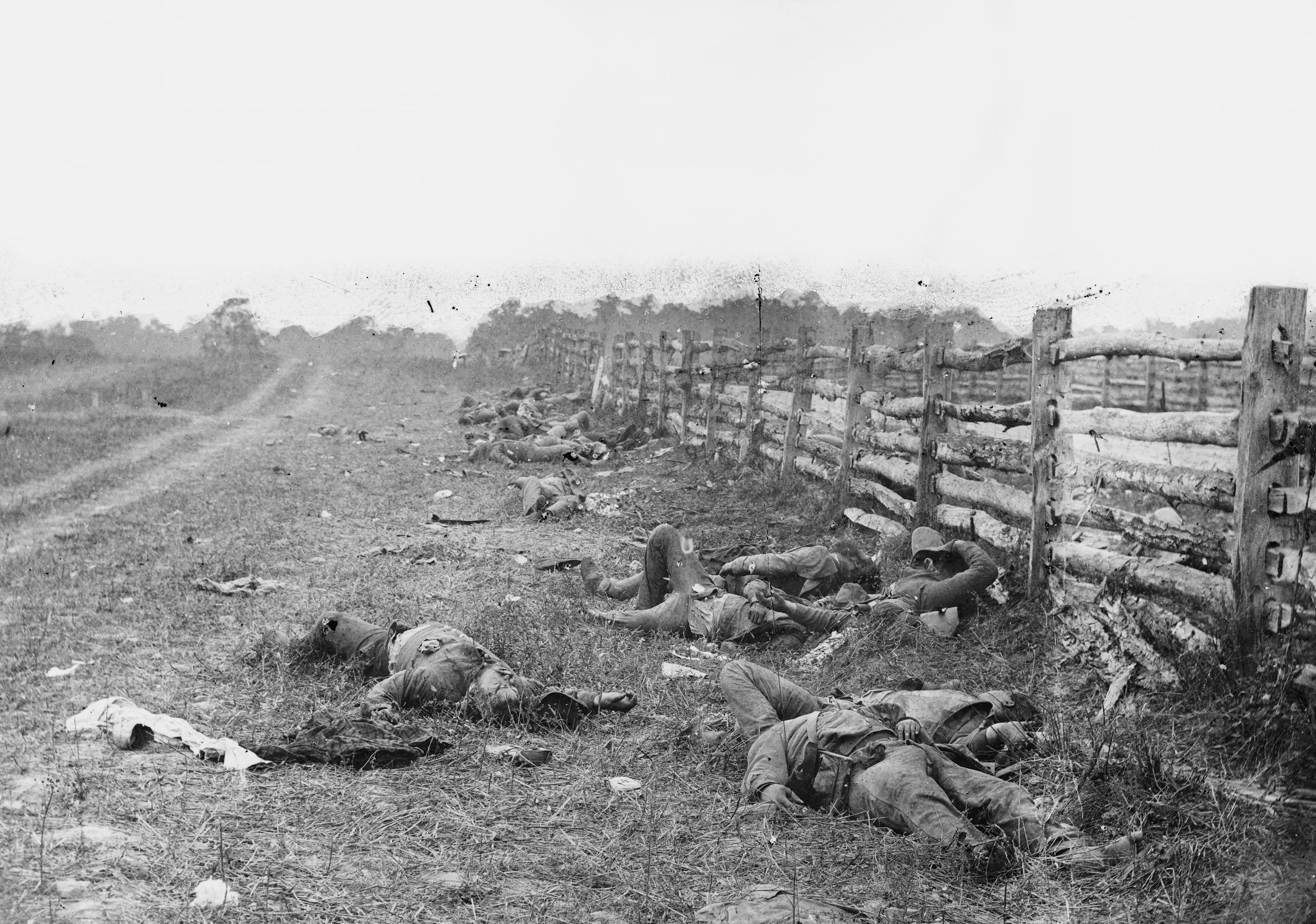
The Face of War: Confederate Dead at Antietam (Matthew Brady)

Remember when, in 1963, Alabama Governor George Wallace said, “Segregation now, segregation tomorrow, and segregation forever”? Fortunately, after much struggle and bloodshed, he was proven wrong. So, can we change the essential American refrain of war now, war tomorrow, and war forever? Can we render that obsolete? Or is that too much to hope for or ask of America’s “exceptional” democracy?

Taking on the MICIMATT(SH)

Former CIA analyst Ray McGovern did America a great service when he came up with the acronym MICIMATT, or the Military-Industrial-Congressional-Intelligence-Media-Academia-Think-Tank complex, an extension of President Dwight D. Eisenhower’s military-industrial complex, or MIC (from his farewell speech in 1961). Along with the military and industry (weapons makers like Boeing and Lockheed Martin), the MICIMATT adds Congress (which Eisenhower had in his original draft speech but deleted in the interest of comity), the intelligence “community” (18 different agencies), the media (generally highly supportive of wars and weapons spending), academia (which profits greatly from federal contracts, especially research and development efforts for yet more destructive weaponry), and think tanks (which happily lap up Pentagon dollars to tell us the “smart” position is always to prepare for yet more war).

You’ll note, however, that I’ve added a parenthetical SH to McGovern’s telling acronym. The S is for America’s sporting world, which eternally gushes about how it supports and honors America’s military, and Hollywood, which happily sells war as entertainment (perhaps the best known and most recent film being Tom Cruise’s Top Gun: Maverick, in which an unnamed country that everyone knows is Iran gets its nuclear ambitions spanked by a plucky team of U.S. Naval pilots). A macho catchphrase from the original Top Gun was “I feel the need — the need for speed!” It may as well have been: I feel the need — the need for pro-war propaganda!

Yes, MICIMATT(SH) is an awkward acronym, yet it has the virtue of capturing some of the still-growing power, reach, and cultural penetration of Ike’s old MIC. It should remind us that it’s not just the military and the weapons-makers who are deeply invested in war and — yes! — militarism. It’s Congress; the CIA; related intel “community” members; the mainstream media (which often relies on retired generals and admirals for “unbiased” pro-war commentary); academia (consider how quickly institutions like Columbia University have bent the knee to Trump); and think tanks — in fact, all those “best and brightest” who advocate for war with China, the never-ending war on terror, war everywhere.

But perhaps the “soft power” of the sporting world and Hollywood is even more effective at selling war than the hard power of bombs and bullets. National Football League coaches patrol the sidelines wearing camouflage, allegedly to salute the troops. Military flyovers at games celebrate America’s latest death-dealing machinery. Hollywood movies are made with U.S. military cooperation and that military often has veto power over scripts. To cite only one example, the war movie 12 Strong (2018) turned the disastrous Afghan War that lasted two horrendous decades into a stunningly quick American victory, all too literally won by U.S. troops riding horses. (If only the famed cowboy actor John Wayne had still been alive to star in it!)

The MICIMATT(SH), employing millions of Americans, consuming trillions of dollars, and churning through tens of thousands of body bags for U.S. troops over the years, while killing millions of people abroad, is an almost irresistible force. And right now, it seems like there’s no unmovable object to blunt it.

Believe me, I’ve tried. I’ve written dozens of “Tomgrams” suggesting steps America could take to reverse militarism and warmongering. As I look over those essays, I see what still seem to me sensible ideas, but they die quick deaths in the face of, if not withering fire from the MICIMATT(SH), then being completely ignored by those who matter.

And while this country has a department of war (disguised as a department of defense), it has no department of peace. There’s no budget anywhere for making peace, either. We do have a colossal Pentagon that houses 30,000 workers, feverishly making war plans they won’t let Elon Musk (or any of us) see. It’s for their eyes only, not yours, though they may well ask you or your kids to serve in the military, because the best-laid plans of those war-men do need lots of warm bodies, even if those very plans almost invariably (Vietnam, Afghanistan, Iraq, etc.) go astray.

So, to repeat myself, how do you take on the MICIMATT(SH)? The short answer: It’s not easy, but I know of a few people who had some inspirational ideas.

On Listening to Ike, JFK, MLK, and, Yes, Madison, Too

Militarism isn’t exactly a new problem in America. Consider Randolph Bourne’s 1918 critique of war as “the health of the state,” or General Smedley Butler’s confession in the 1930s that “war is a racket” run by the “gangsters of capitalism.” In fact, many Americans have, over the years, spoken out eloquently against war and militarism. Many beautiful and moving songs have asked us to smile on your brother and “love one another right now.” War, as Edwin Starr sang so powerfully once upon a time, is good for “absolutely nothin’,” though obviously a lot of people disagree and indeed are making a living by killing and preparing for yet more of it.

And that is indeed the problem. Too many people are making too much money off of war. As Smedley Butler wrote so long ago: “Capital won’t permit the taking of the profit out of war until the people — those who do the suffering and still pay the price — make up their minds that those they elect to office shall do their bidding, and not that of the profiteers.” Pretty simple, right? Until you realize that those whom we elect are largely obedient to the moneyed class because the highest court in our land has declared that money is speech. Again, I didn’t say it was going to be easy. Nor did Butler.

As a retired lieutenant colonel in the U.S. Air Force, I want to end my 111th piece at TomDispatch by focusing on the words of Ike, John F. Kennedy (JFK), Martin Luther King, Jr. (MLK), and James Madison. And I want to redefine what words like duty, honor, country, and patriotism should mean. Those powerful words and sentiments should be centered on peace, on the preservation and enrichment of life, on tapping “the better angels of our nature,” as Abraham Lincoln wrote so long ago in his First Inaugural Address.

Why do we serve? What does our oath of office really mean? For it’s not just military members who take that oath but also members of Congress and indeed the president himself. We raise our right hands and swear to support and defend the U.S. Constitution against all enemies, foreign and domestic, to bear true faith and allegiance to the same.

There’s nothing in that oath about warriors and warfighters, but there is a compelling call for all of us, as citizens, to be supporters and defenders of representative democracy, while promoting the general welfare (not warfare), and all the noble sentiments contained in that Constitution. If we’re not seeking a better and more peaceful future, one in which freedom may expand and thrive, we’re betraying our oath.

If so, we have met the enemy — and he is us.

Ike told us in 1953 that constant warfare is no way of life at all, that it is (as he put it), humanity crucifying itself on a cross of iron. In 1961, he told us democracy was threatened by an emerging military-industrial complex and that we, as citizens, had to be both alert and knowledgeable enough to bring it to heel. Two years later, JFK told us that peace — even at the height of the Cold War — was possible, not just peace in our time, but peace for all time. However, it would, he assured us, require sacrifice, wisdom, and commitment.

How, in fact, can I improve on these words that JFK uttered in 1963, just a few months before he was assassinated?

What kind of peace do we seek? Not a Pax Americana enforced on the world by American weapons of war. Not the peace of the grave or the security of the slave. I am talking about genuine peace, the kind of peace that makes life on earth worth living…

I speak of peace because of the new face of war. Total war makes no sense in an age… when the deadly poisons produced by a nuclear exchange would be carried by wind and water and soil and seed to the far corners of the globe and to generations yet unborn… surely the acquisition of such idle [nuclear] stockpiles — which can only destroy and never create — is not the only, much less the most efficient, means of assuring peace.

I speak of peace, therefore, as the necessary rational end of rational men. I realize that the pursuit of peace is not as dramatic as the pursuit of war — and frequently the words of the pursuer fall on deaf ears. But we have no more urgent task.

Are we ready to be urgently rational, America? Are we ready to be blessed as peacemakers? Or are we going to continue to suffer from what MLK described in 1967 as our very own “spiritual death” due to the embrace of militarism, war, empire, and racism?

Of course, MLK wasn’t perfect, nor for that matter was JFK, who was far too enamored of the Green Berets and too wedded to a new strategy of “flexible response” to make a clean break in Vietnam before he was killed. Yet those men bravely and outspokenly promoted peace, something uncommonly rare in their time — and even more so in ours.

More than 200 years ago, James Madison warned us that continual warfare is the single most corrosive force to the integrity of representative democracy. No other practice, no other societal force is more favorable to the rise of authoritarianism and the rule of tyrants than pernicious war. Wage war long and it’s likely you can kiss your democracy, your rights, and just maybe your ass goodbye.

America, from visionaries and prophets like MLK, we have our marching orders. They are not to invest yet more in preparations for war, whether with China or any other country. Rather, they are to gather in the streets and otherwise raise our voices against the scourge of war. If we are ever to beat our swords into plowshares and our spears into pruning hooks and make war no more, something must be done.

Let’s put an end to militarism in America. Let’s be urgently rational. To cite John Lennon yet again: You may say I’m a dreamer, but I’m not the only one. Together, let’s imagine and create a better world.

Copyright 2025 William J. Astore.

Is China Really America’s Enemy?

W.J. Astore

Diplomacy is better than a land war in Asia

A friend of mine sent along a typical militarized think-tank article and asked for my comments. Here’s the title, with a link: 

Moneyball Military: An Affordable, Achievable, and Capable Alternative to Deter China

It was published by the Hoover Institution out of “liberal” Stanford University. 

“Moneyball” is a baseball term, the idea being that smaller market (and budget) teams can compete with larger teams (like the LA Dodgers or NY Yankees) by being smarter, by using metrics and stats to identify “cheap” but good players as well as more effective tactics to win ballgames. Check out the movie with the same title starring Brad Pitt.

Brad Pitt in “Moneyball.” But war, especially a land war in Asia, isn’t a game.

The “Moneyball Military” article basically argues the U.S. military must become more innovative, more responsive, more nimble, more flexible, etc., to meet the challenge of China. What articles like this one never suggest is diplomacy and the pursuit of PEACE. They never suggest that major cuts can be made to the Pentagon budget because the U.S. is fundamentally safe from invasion. They usually argue instead for more Pentagon spending, only “smarter.”

Why does the U.S. “need” 800 military bases around the globe? Why does it “need” to dominate the global trade in arms? Why has the U.S. wasted $10 trillion on unwinnable wars and conflicts (Iraq, Afghanistan, the GWOT, et al.) since 9/11? Why is China, a major U.S. trading partner and holder of U.S. debt, seen as an “enemy”?

These are questions that aren’t raised in think-tank articles like this one.

If you believe the polls, the U.S. is allegedly a Christian nation. Is there a worse sin than killing other humans in massive numbers? How do we stop doing this? Didn’t Christ say “Blessed are the peacemakers”? Why is the U.S. ennobling and saluting the warmakers instead? Why are we always envisioning wars with other peoples?

Again, is China really America’s enemy? Is China really planning to invade Taiwan? If so, wouldn’t diplomacy be a far smarter way of addressing this rather than a land war in Asia?

When one encounters think-tank articles like this one, one would be wise to remember Ray McGovern’s acronym, MICIMATT, which rightly includes these think tanks among the powerful entities that form America’s military-industrial-congressional complex.

When it comes to a land war in Asia, there is no smart way to “moneyball” it. The smart thing to do is to not play “ball” at all.

War, after all, is not a game.

Ukraine, Gaza, and Elsewhere

W.J. Astore

There Will Be Wars and Rumors of Wars

Checking my daily email from Reuters this past Thursday revealed these two stories:

“Diplomacy falters” is one of the sub-headings, which is assuredly the case, assuming diplomacy was even tried.

The BLUF, or bottom-line upfront, to use an Army acronym, is more death, dying, and destruction in Ukraine and Gaza.

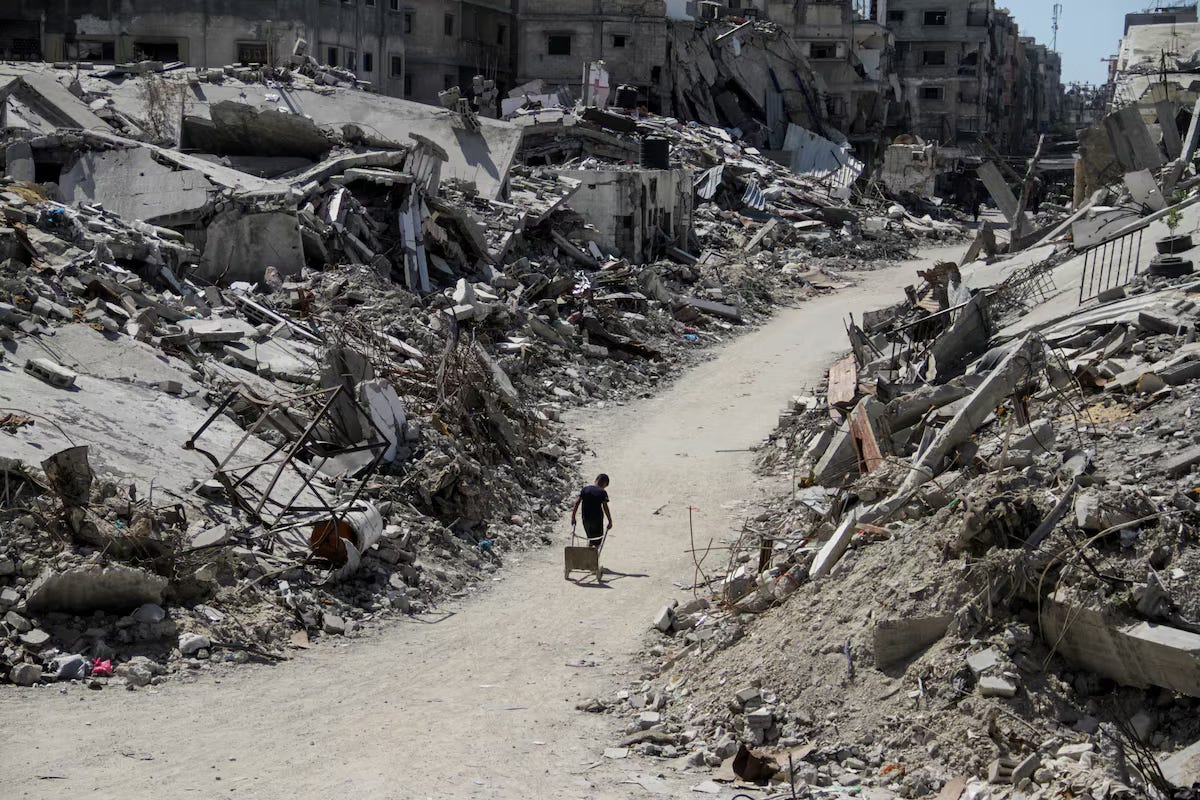
Reuters still refers to Israeli ethnic cleaning in Gaza as the “Gaza war,” but only one side has tanks, combat aircraft, 2000-pound bombs, heavy artillery, bulldozers, and even nuclear weapons. It’s not exactly a fair fight, is it? The Israeli government says it’s out to destroy Hamas, but what it’s really after is the destruction of Gaza and the forced relocation of Palestinians there, after which Gaza will be annexed and assimilated into Israel.

What Israel has done and is doing to Gaza

Turning to the Ukraine War, the longer it lasts, the greater the suffering, and the higher the risk of further escalation. Yet the focus is always on deterring Russia and defeating Putin, as if it’s 1938 yet again, with Putin as Hitler and Ukraine as Czechoslovakia. Any diplomatic settlement with Russia will be the equivalent of appeasement, another Munich Agreement, so the war must go on, I guess until one side or the other collapses from the strain. Perhaps 1918 and the chaotic end of World War I is a better year to think about than 1938.

Meanwhile, Reuters tells me there are “challenges” in Africa and that China must be corralled and contained. Poor Africa. European nations (and the United States) are always offering answers to Africa’s “challenges,” but those answers address the interests of the West, not of African peoples. The U.S. has a whole military command, AFRICOM, to address those “challenges,” mainly in the form of U.S. weapons sales and “security assistance.”

Finally, resurrecting the racist “yellow peril” trope with regards to China is only driving that country into closer contact with Russia, which has the added benefit of justifying immense Pentagon spending due to the dual threat of Russia-China. (Democrats tend to stress Russia as the big threat; Republicans prefer China.). Thus we hear of a new Cold War, which of course necessitates colossal military spending, because do you want China and Russia to rule the world?

There will be wars and rumors of wars: And so it goes with U.S. foreign relations, in perpetuity, seemingly.

The Madness of Threat Inflation

W.J. Astore

And the Insanity of Wanting to Rule the World

What will historians say decades or centuries from now when the U.S. empire collapses into ruin? How will they explain it?

Consider the United States in the big picture. I see a country with unique strengths. Two wide oceans protecting us. A long secure border with Canada. A securable border with Mexico, the current immigrant “crisis” be damned. Canada and Mexico aren’t our enemies. No invasion is coming from them. As a country, the USA occupies a geographical/global position that is uniquely safe and advantageous.

Why are we so fearful? Why do we spend a trillion dollars (or more) each year on national “defense”?

How incredibly lucky we are! (Credit: Tom Van Sant/Geosphere Project, Santa Monica/Science Photo Library)

Of course, I put “defense” in quotes because the USA is an empire with a military configured for offense. Global reach, global power, was the motto of my service, the U.S. Air Force. The U.S. military strives for full-spectrum dominance, meaning total control of the land, sea, air, space, and cyberspace, justified in the false name of “defense.” The cost of this febrile quest for dominance is, I believe, ultimately unbearable. Why do we persist in such folly?

What country would dare to attack the USA? Other than small terrorist networks like Al Qaeda, no country, no people, no leaders in their right mind would dare attack us, let alone invade us. They know they’d likely be obliterated if they did. Does anyone truly fear an attack on the USA from China? Russia? Iran? North Korea? Given America’s belligerence, evidence of our unbridled vengeance after Pearl Harbor and 9/11, and our vast arsenal of highly destructive weaponry, including thousands of nuclear warheads, anyone attacking the U.S. would be pursuing a death wish.

I am not afraid of Russia, a regional power that is stuck in a quagmire war against Ukraine. I am not afraid of China, a regional military power and economic superpower that is tied to us in global trade and has no intent, near as I can tell, to attack my country. I am not afraid of Iran, or North Korea, or similar “threats” of the moment. So why is my government constantly exaggerating these threats and telling me to be afraid?

Of course, I know all about Ike’s military-industrial-congressional complex. I write against it all the time. It’s not just the MICC and its pursuit of profits and power, however. It’s the corporate interests that say Taiwan must be “protected” for its microchips, the Middle East must be “protected” because of its oil, that Ukraine must be “protected” for its rich agricultural wealth (even as Russia’s gas pipelines to Germany are destroyed) and the riches to be had once the war is over and Ukraine is rebuilt. I know there’s nothing new about this; I’ve read my Smedley Butler.

When I first signed up for the U.S. military in 1981, and then went on active duty in 1985, I thought the U.S. did face a possible existential threat: the Soviet Union, the Warsaw Pact, and Communism. By 1991, that threat was largely gone. Even Cold War hawks like Jeanne Kirkpatrick wrote enthusiastically of the U.S. becoming a normal country in normal times. WTF happened? Why didn’t we?

Here we are, more than 30 years after the collapse of the Soviet Union, and the U.S. government is selling Putin’s Russia as a serious threat again. When we see clear evidence that Putin has more than enough to handle with Ukraine, we’re told to look toward China as the Next Big Threat. Meanwhile, irrational, indefensible, blank checks of support given to Israel in its murderous campaign of ethnic cleansing in Gaza threaten a wider war in the Middle East, a war some in our government seem to be spoiling to fight, knowing of course that they and theirs won’t be fighting it.

We Americans need to get a collective grip on ourselves and our own government. Stop feeding the Pentagon brass with money: it only encourages the bastards. Stop listening to the fear mongers. Turn off the mainstream media and ignore all the threat inflation. Look within yourself and control the fear and divisiveness they try to instill in you.

As Senator George McGovern, a war hero, said in 1972 when he won the Democratic nomination for the presidency: Come home, America. Close most of the military bases that America has overseas. Make deep cuts to the Pentagon war budget. Let other peoples settle their differences without our meddling, without our depleted uranium shells, without our cluster munitions, without our Hellfire missiles, without our mendacious rhetoric about a “rules-based order.”

Come home, America. We have a vast country with vast potential—and serious problems. Time to tackle them instead of seeking to dominate the world.

Or, as the Good Book says, “Why do you look at the speck of sawdust in your brother’s eye and pay no attention to the plank in your own eye?” (Matthew 7:3 NIV) Yes, indeed. Let’s remove the planks from our own eyes, which should keep us very busy for decades, rather than globetrotting to remove the sawdust from the eyes of other peoples who’d prefer us to stay home and leave them alone.

Come home, America. Let’s start removing those planks.

U.S. Power Sets All the Wrong Examples to the World

W.J. Astore

An Open Letter from the Eisenhower Media Network

I’m a member of the Eisenhower Media Network, or EMN. We’re a small network of retired military types and former U.S. government officials who are openly critical of the military-industrial-congressional complex, America’s open-ended forever wars (the global war on terror; the cold war against Russia and China), and rising militarism within and across our society.

Recently, EMN issued a new letter in opposition to the Washington bipartisan consensus for war and more war. I’m proud to say I had a hand in writing it, as did Matthew Hoh and other members of EMN. Here’s what we had to say:

Military and Foreign Policy Experts Open Letter on U.S. Diplomatic Malpractice

Does America inspire the world by the power of its example or the example of its power? Far too often, and despite President Joe Biden’s words during his inaugural address, America’s overmilitarized power and diplomatic malpractice are its examples to the world.

We must change that. To make America truly essential and indispensable, we must not remain the world’s leading arms maker and weapons exporter. We must instead become the world’s greatest and most committed peacemaker and diplomat.

The problem is that America continues to make war, continues being “essential” only as the world’s leading merchant of death, and continues seeking dominance through military supremacy that ends, in places like Afghanistan, Iraq, and earlier in Vietnam, in mass death and colossal folly.

In our first open letter last spring in The New York Times, we, the undersigned, argued that a thoroughly militarized U.S. foreign policy would generate ruinous and worsening consequences and increasingly limited options for the U.S. and the world. Recent events bear this out.

The results of U.S. diplomatic malpractice are cruelly displayed in Eastern Europe, the Middle East and the Indo-Pacific. Risks of further escalation and a world war are rising. Predictably, a militarized foreign policy characterized by rejecting or ignoring international laws and treaties and by disingenuous negotiations and talks has offered no solutions to volatile wars in Eastern Europe and the Middle East while making war more likely in the Indo-Pacific.

Militarized solutions breed and feed more war. Earnest and deliberate diplomacy is the best hope to bring peace, stability and reconciliation to the world.

We chose Ike as our inspiration because he warned Americans of the dangers of the military-industrial complex and because he rejected a world dedicated to manufacturing weapons to commit mass murder. 

War in Ukraine

The failure to pursue diplomacy in Eastern Europe, both before and after Russia’s invasion of Ukraine, has resulted in a costly and destructive stalemate for which there are two likely futures:

  1. The collapse of the Ukrainian state due to a deteriorating economic and military situation hastened by corruption.Here, Ukraine’s fragility resembles that of previous houses of cards built by the U.S. in Afghanistan, Iraq, and Vietnam.
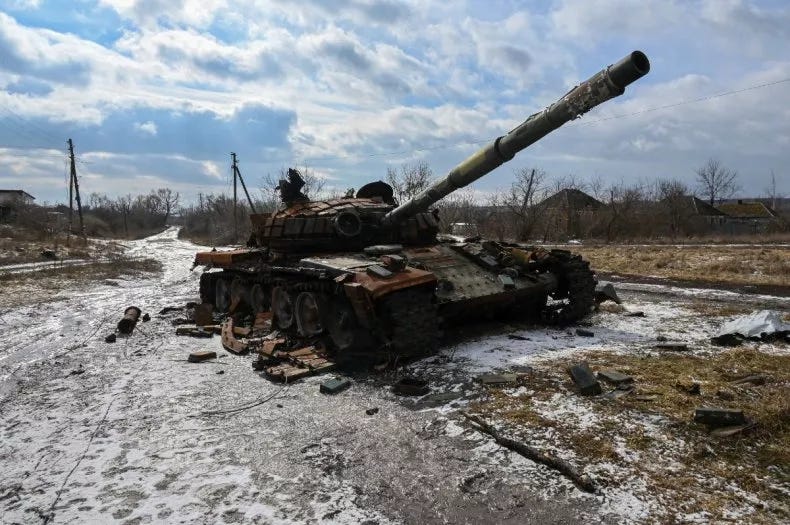
  2. A harrowing and bloody stalemate in Ukraine where firepower, made more lethal by technological advances, rules a battlefield where neither side can achieve decisive tactical or operational gains. The pursuit of ways out of this stalemate likely entails horizontal and vertical escalation, neither of which offers solace to those seeking an end to death and destruction in Ukraine and the establishment of peace and stability.

Horizontal escalation sees the war extending further to civilian population centers and infrastructure and includes the possibility of other nations joining the conflict. Vertical escalation sees the expansion of arsenals to weapons of greater range, lethality, and consequence, including nuclear weapons. These two forms of escalation may be intertwined and reinforcing. So, as the war may expand horizontally to resemble The War of Cities between Iran and Iraq in the 1980s, it may expand vertically as well with more powerful weapons being introduced by both sides. The use of nuclear weapons is increasingly conceivable under these conditions.

These two likely futures may intersect. For example, a Ukrainian collapse could see NATO forces, likely Polish and Romanian, marching into western and central Ukraine to counter a Russian push to fill a collapsing Ukrainian state. Such an event could lead to a war between NATO and Russia, a war that conceivably could go nuclear.

Hamas, Israel and the Middle East

The Russia-Ukraine War now rages concurrently with the war between Hamas and Israel. This war, too, is born of a U.S. refusal to foster diplomacy. Unlike the conventional war between Russia and Ukraine, we are witnessing an asymmetrical conflict more akin to the wars of insurgency many of us experienced in Vietnam, Afghanistan, and Iraq.

Worse, the Hamas/Israel bloodletting in Gaza is characterized by an ethnic cleansing campaign that would be impossible without U.S. diplomatic, economic, media, military and political support. We are disgusted by and find repugnant the brazen and bipartisan support by the U.S. government for rampant violations of international law by Israel. Ethnic cleansing in Gaza, long planned by senior members of the Israeli government and powerful elements of Israel’s reactionary right wing, follows in the ghastly wake of Hamas atrocities against civilians on October 7.

Here, the U.S. government isn’t just passively witnessing war crimes; it is enabling them. With the frightening possibility of escalation to a regional or even a world war, the violence in Gaza has fed and feasted upon decades of deliberate diplomatic malpractice in America. Decades of putting Israel first, second, and last while ignoring the plight and pleas of Palestinians have made political settlements to the blockade of Gaza and the occupation of East Jerusalem and the West Bank nearly impossible.

Whereas a month ago, we lived with the risk of nuclear war as an outcome of escalating conflict in Ukraine, we now face the elevated risk of a rightfully feared world war as a consequence of entangling alliances between nuclear-armed Moscow and Washington in the Middle East.

China and the Path Ahead

To this, we must add the dangers of war with China, something hyped by leading U.S. politicians; the still unpaid costs of the $8 trillion wars in Afghanistan and Iraq; a militarized federal budget for which 60% of discretionary spending goes to war and all its wounds; and a hollowed American economy.

Decades of reckless U.S. war-making, both direct and via proxies, while coddling corrupt, ruthless, and unjust foreign governments has, not surprisingly, made the world more dangerous and less stable. Failure to invest in and maintain our country has weakened and corroded America’s infrastructure, institutions, and industries. A hypocritical flaunting of international law and an espousal of an ethereal rules-based order, coupled with an arrogant disregard for past U.S. crimes and blunders, have caused dozens of nations to flock to competitors – a movement away from America that will undoubtedly accelerate if we remain on our current militaristic path.

Moreover, decades of colossal military spending have witnessed few strategic gains for the U.S. Our military, often saluted as the world’s greatest by politicians, hasn’t won a major war since World War II. That same military annually faces significant recruiting shortfalls that cast considerable doubt on the integrity and staying power of the All-Volunteer Force. America’s legacy of failed wars is not redeemed by ongoing displays of vacuous military boosterism. Feel-good patriotism can’t suppress the bitterness many of us military veterans feel toward the past, nor does it calm the worries we have about our nation’s future.

Pope Francis has spoken of a “famine of peace” that exists in the world today. In this spirit, we call for immediate ceasefires, without conditions, in Gaza and Ukraine.

The surest way to prevent wars from exploding into uncontainable wildfires is to starve them of fuel. To think or speak that these conflagrations can be managed, adjusted as if by damper or thermostat, is a fool’s conceit or a liar’s word. We have been burned too many times in our professional lives to believe hot wars can be “won” by throwing more gasoline on them, whether rhetorically or in the form of cluster munitions, depleted uranium shells, and similar forms of “aid.”

A better path ahead is clear. Peace, not war, must be fostered. In embracing peace through diplomacy conducted in good faith, America would indeed exhibit the power of its example, becoming essential to a world that cries out for liberty and justice for all.

When Is a Stalemate Not a Stalemate?

W.J. Astore

When Zelensky Says So

The Russia-Ukraine War is stalemated. Even Ukraine’s top commander concedes this point, as the New York Times reported here:

World

Ukraine’s Top Commander Says War Has Hit a ‘Stalemate’

Ukraine’s Top Commander Says War Has Hit a ‘Stalemate’

By Constant Méheut and Andrew E. Kramer

In a candid assessment, Gen. Valery Zaluzhny said no “beautiful breakthrough” was imminent and that breaking the deadlock could require advances in technological warfare.

*************

(As an aside, I should note that back in July we saw articles in the New York Times and Wall Street Journal using that dreaded word, “stalemate,” as I wrote about here:) 

The Russia-Ukraine War and the Management of Expectations

BILL ASTORE

JUL 25

The Russia-Ukraine War and the Management of Expectations

It can’t be coincidence. In the past few days, I’ve seen articles at mainstream media outlets like the New York Times and Wall Street Journal that the much-hyped and much-delayed Ukrainian “spring” counteroffensive has stalled, and at high cost to Ukrainian troops. Here’s a quick online headline from the NYT on Monday:

Read full story

Nice to know Ukrainian officials are finally being “candid.” Yet Zelensky is having none of it. In my CNN feed this morning, I saw this response from Ukraine’s leader: “People are tired. Everyone is tired … But this is not a stalemate.”

Truth is that Russia-Ukraine War will enter its third year in February of next year, even as the U.S. government has provided more than $130 billion in weaponry and other forms of aid to a Ukrainian government that’s known for its corruption. Meanwhile, the Biden administration wants to send another $60 billion in weaponry and aid to Ukraine. Many Republicans, notably new House Speaker Mike Johnson, are on record as being against scores of billions to perpetuate a stalemated war, though their motivation seems less “America first” than “Biden sucks.”

Things are so bad with the war that I now see articles at NBC News arguing for diplomacy! When NBC News, a reliable mouthpiece for Neo-con Democrats, suggests negotiations and the possibility of Ukraine making territorial concessions to end its war with Russia, you know the situation on the ground in Ukraine is likely worse than we’re being told.

Interestingly, this photo of a grim Zelensky accompanied the NBC article. No more hero-worship from the mainstream media? (Timothy Clary, AFP-Getty Images)

The U.S. government, obviously distracted by the crisis in Gaza and the potential for a much wider war in the Middle East, may be near the point of cutting its losses in Ukraine, though obviously the military-industry-congressional complex (MICC) wants to keep sending weaponry until the final bullet and cluster munition is fired. After which Ukraine will have to “rebuild” its military, so you can count on more military “aid” going to Kyiv.

Yet, for the MICC there are bigger fish to fry now. Republicans in particular are obsessed with China. Democrats and Republicans are obsessed with Israel. Ukraine has become something of a distraction. Sure, you may continue to fly blue-and-yellow Ukrainian flags, but it’s time to back Israel unconditionally while threatening Iran with the full might of the U.S. military. Looming in the background is the alleged threat of “near-peer” competitor, China. After all, you can’t justify a massive U.S. war budget that’s approaching $900 billion with a stalemated war in Ukraine.

If nothing else, perhaps the U.S. warmonger obsession with empowering Israel and encircling China may provide an opportunity for diplomacy between Ukraine and Russia. With Ukraine apparently no longer enjoying a blank check of support (that’s now reserved for Israel), a grim-faced Zelensky may come to conclude that jaw-jaw is better than war-war.

Another “Kill” for America!

W.J. Astore

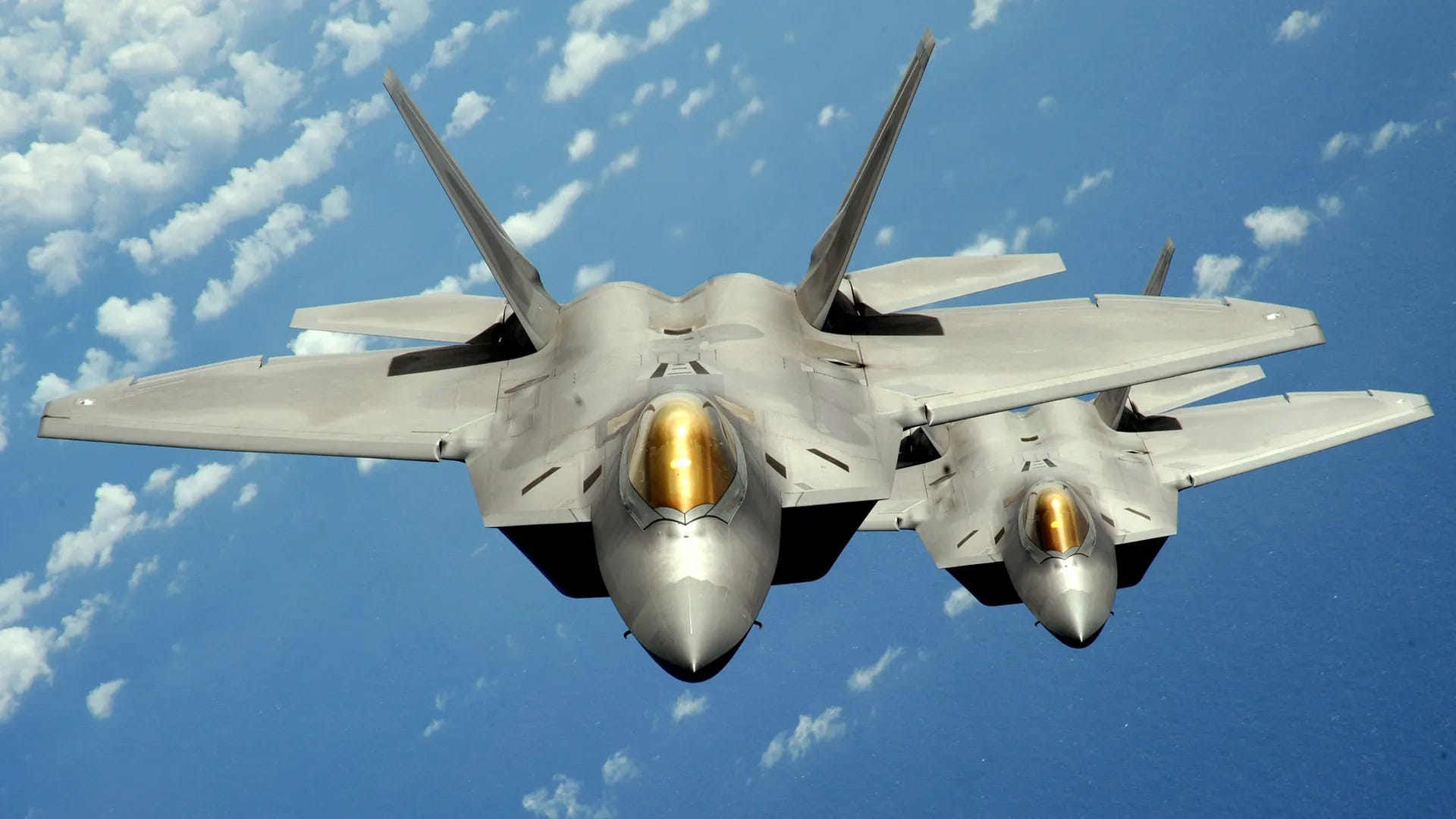
Paint two balloons under the cockpit of our F-22s

Send in the F-22s! Get those balloons! No mercy!

Good gawd, apparently another balloon fell victim to a missile launched from an F-22, this time over Alaska.

Look, up in the sky! It’s a bird! It’s a plane! No, it’s a Chinese war balloon!

Details are sketchy, but what’s clear is that the Biden administration is touting decisive action against what was apparently another balloon/surveillance instrument, most likely from China.

This is all about domestic politics.  About the Biden administration “looking strong” by shooting down Chinese balloons (assuming the latest UFO was indeed another balloon).

The question is: Have these balloons truly been threats to U.S. national security?  To my knowledge, they are not threats.

I’ve heard these balloons could be used for signals intelligence, but even if true, it seems a very crude method.  The U.S. military has far more sophisticated techniques for SIGINT.

(An aside: China could mass produce balloons, release them toward the U.S., then watch us exhaust our limited F-22 fleet and our air-to-air missiles.  Would we be that stupid?)

I never pictured America’s most sophisticated air superiority fighter, the F-22 Raptor, chasing and shooting down floating balloons in the sky, but here we are.

I love this quotation, courtesy of NBC News: “Do we have a plan for the next time that happens and how we’re going to deal with it?” Sen. Jon Tester, D-Mont., asked defense officials testifying Thursday on Capitol Hill about the alleged spy balloons. “Because, quite frankly, I’ll just tell you: I don’t want a damn balloon going across the United States.”

No more “damn” balloons floating over America! Mister President, we cannot allow a spy(?) balloon gap!

When you think about it, why is this even news?  This could easily have been kept quiet.

Again, I come back to domestic politics.  Biden was criticized for not acting fast enough on the previous balloon, so now we must shoot down all balloons as soon as they enter U.S. air space.  And we must announce it too, as if it’s a great achievement.  

Hooray, America!  Paint two balloons as “kills” on the side of our F-22s. Airpower!

The Pentagon’s National Defense Strategy

W.J. Astore

Bombs, Bullets, and Bellicosity Instead of Brains

In my latest article for TomDispatch.com, I parse the meaning of America’s latest National Defense Strategy. Hint: It’s not about defense.

More than two millennia ago, in the History of the Peloponnesian War, Thucydides recounted a disastrous conflict Athens waged against Sparta. A masterwork on strategy and war, the book is still taught at the U.S. Army War College and many other military institutions across the world. A passage from it describing an ultimatum Athens gave a weaker power has stayed with me all these years. And here it is, loosely translated from the Greek: “The strong do what they will and the weak suffer as they must.”

Recently, I read the latest National Defense Strategy, or NDS, issued in October 2022 by the Pentagon, and Thucydides’s ancient message, a warning as clear as it was undeniable, came to mind again. It summarized for me the true essence of that NDS: being strong, the United States does what it wants and weaker powers, of course, suffer as they must. Such a description runs contrary to the mythology of this country in which we invariably wage war not for our own imperial ends but to defend ourselves while advancing freedom and democracy. Recall that Athens, too, thought of itself as an enlightened democracy even as it waged its imperial war of dominance on the Peloponnesus. Athens lost that war, calamitously, but at least it did produce Thucydides, a military leader who became a historian and wrote all too bluntly about his country’s hubristic, ultimately fatal pursuit of hegemony.

Imperial military ambitions contributed disastrously to Athens’s exhaustion and ultimate collapse, a lesson completely foreign to U.S. strategists. Not surprisingly, then, you’ll find no such Thucydidean clarity in the latest NDS approved by Secretary of Defense Lloyd Austin. In place of that Greek historian’s probity and timeless lessons, the NDS represents an assault not just on the English language but on our very future. In it, a policy of failing imperial dominance is eternally disguised as democratic deterrence, while the greatest “strategic” effort of all goes (remarkably successfully) into justifying massive Pentagon budget increases. Given the sustained record of failures in this century for what still passes as the greatest military power on the planet — Afghanistan, Iraq, and Libya, of course, but don’t forget SomaliaSyriaYemen, and indeed the entire $8 trillion Global War on Terror in all its brutality — consider the NDS a rare recent “mission accomplished” moment. The 2023 baseline “defense” budget now sits at $858 billion, $45 billion more than even the Biden administration requested.

With that yearly budget climbing toward a trillion dollars (or more) annually, it’s easy to conclude that, at least when it comes to our military, nothing succeeds like failure. And, by the way, that not only applies to wars lost at a staggering cost but also financial audits blown without penalty. After all, the Pentagon only recently failed its fifth audit in a row. With money always overflowing, no matter how it may be spent, one thing seems guaranteed: some future American Thucydides will have the material to produce a volume or volumes beyond compare. Of course, whether this country goes the way of Athens — defeat driven by military exhaustion exacerbated by the betrayal of its supposedly deepest ideals leading to an ultimate collapse — remains to be seen. Still, given that America’s war colleges continue to assign Thucydides, no one can say that our military and future NDS writers didn’t get fair warning when it comes to what likely awaits them.

Bludgeoning America with Bureaucratese

If you can’t dazzle them with brilliance, baffle them with BS.

That’s a saying I learned early in my career as an Air Force officer, so I wasn’t exactly surprised to discover that it’s the NDS’s guiding philosophy. The document has an almost Alice in Wonderland-like quality to it as words and phrases take on new meanings. China, you won’t be surprised to learn, is a “pacing challenge” to U.S. security concerns; Russia, an “acute threat” to America due to its “unprovoked, unjust, and reckless invasion of Ukraine” and other forms of “irresponsible behavior”; and building “combat-credible forces” within a “defense ecosystem” is a major Pentagon goal, along with continuing “investments in mature, high-value assets” (like defective aircraft carriers, ultra-expensive bombers and fighter jets, and doomsday-promising new ICBMs).

Much talk is included about “leveraging” those “assets,” “risk mitigation,” and even “cost imposition,” a strange euphemism for bombing, killing, or otherwise inflicting pain on our enemies. Worse yet, there’s so much financial- and business-speak in the document that it’s hard not to wonder whether its authors don’t already have at least one foot in the revolving door that could, on their retirement from the military, swing them onto the corporate boards of major defense contractors like Boeing and Raytheon.

Perhaps my favorite redefined concept in that NDS lurks in the word “campaigning.” In the old days, armies fought campaigns in the field and generals like Frederick the Great or Napoleon truly came to know the price of them in blood and treasure. Unlike U.S. generals since 1945, they also knew the meaning of victory, as well as defeat. Perish the thought of that kind of campaigning now. The NDS redefines it, almost satirically, not to say incomprehensibly, as “the conduct and sequencing of logically-linked military initiatives aimed at advancing well-defined, strategy-aligned priorities over time.” Huh?

Campaigning, explains the cover letter signed by Secretary of Defense Austin (who won’t be mistaken for Frederick II in his bluntness or Napoleon in his military acuity), “is not business as usual — it is the deliberate effort to synchronize the [Defense] Department’s activities and investments to aggregate focus and resources to shift conditions in our favor.”

Got it? Good!

Of course, who knows what such impenetrable jargon really means to our military in 2023? This former military officer certainly prefers the plain and honest language of Thucydides. In his terms, America, the strong, intends to do what it will in the world to preserve and extend “conditions in our favor,” as the NDS puts it — a measure by which this country has failed dismally in this century. Weaker countries, especially those that are “irresponsible,” must simply suffer. If they resist, they must be prepared for some “cost imposition” events exercised by our “combat-credible forces.” Included in those are America’s “ultimate backstop” of cost imposition… gulp, its nuclear forces.

Again, the NDS is worthy of close reading (however pain-inducing that may be) precisely because the secretary of defense does claim that it’s his “preeminent guidance document.” I assume he’s not kidding about that, though I wish he were. To me, that document is to guidance as nuclear missiles are to “backstops.” If that last comparison is jarring, I challenge you to read it and then try to think or write clearly.

Bringing Clarity to America’s Military Strategy

To save you the trauma of even paging through the NDS, let me try to summarize it quickly in my version — if not the Pentagon’s — of English:

  1. China is the major threat to America on this planet.
  2. Russia, however, is a serious threat in Europe.
  3. The War on Terror continues to hum along successfully, even if at a significantly lower level.
  4. North Korea and Iran remain threats, mainly due to the first’s growing nuclear arsenal and the second’s supposed nuclear aspirations.
  5. Climate change, pandemics, and cyberwar must also be factored in as “transboundary challenges.”

“Deterrence” is frequently used as a cloak for the planetary dominance the Pentagon continues to dream of. Our military must remain beyond super-strong (and wildly overfunded) to deter nations and entities from striking “the homeland.” There’s also lots of talk about global challenges to be met, risks to be managed, “gray zone” methods to be employed, and references aplenty to “kinetic action” (combat, in case your translator isn’t working) and what’s known as “exploitable asymmetries.”

Count on one thing: whatever our disasters in the real world, nobody is going to beat America in the jargon war.

Missing in the NDS — and no surprise here — is any sense that war is humanity’s worst pastime. Even the mass murder implicit in nuclear weapons is glossed over. The harshest realities of conflict, nuclear war included, and the need to do anything in our power to prevent them, naturally go unmentioned. The very banality of the document serves to mask a key reality of our world: that Americans fund nothing as religiously as war, that most withering of evils.

Perhaps it’s not quite the banality of evil, to cite the telling phrase political philosopher Hannah Arendt used to describe the thoughts of the deskbound mass-murderers of the Holocaust, but it does have all of war’s brutality expunged from it. As we stare into the abyss, the NDS replies with mind-numbing phrases and terms that wouldn’t be out of place in a corporate report on rising profits and market dominance.

Yet as the military-industrial complex maneuvers and plots to become ever bigger, ever better funded, and ever more powerful, abetted by a Congress seemingly lustful for ever more military spending and weapons exports, hope for international cooperation, productive diplomacy, and democracy withers. Here, for instance, are a few of the things you’ll never see mentioned in this NDS:

  1. Any suggestion that the Pentagon budget might be reduced. Ever.
  2. Any suggestion that the U.S. military’s mission or “footprint” should be downsized in any way at all.
  3. Any acknowledgement that the U.S. and its allies spend far more on their militaries than “pacing challengers” like China or “acute threats” like Russia.
  4. Any acknowledgment that the Pentagon’s budget is based not on deterrence but on dominance.
  5. Any acknowledgement that the U.S. military has been far less than dominant despite endless decades of massive military spending that produced lost or stalemated wars from Korea and Vietnam to Afghanistan and Iraq.
  6. Any suggestion that skilled diplomacy and common security could lead to greater cooperation or decreased tensions.
  7. Any serious talk of peace.

In brief, in that document and thanks to the staggering congressional funding that goes with it, America is being eternally spun back into an age of great-power rivalry, with Xi Jinping’s China taking the place of the old Soviet Union and Vladimir Putin’s Russia that of Mao Zedong’s China. Consistent with that retro-vision is the true end goal of the NDS: to eternally maximize the Pentagon budget and so the power and authority of the military-industrial-congressional complex.

Basically, any power that seeks to push back against the Pentagon’s vision of security through dominance is defined as a threat to be “deterred,” often in the most “kinetic” way. And the greatest threat of all, requiring the most “deterrence,” is, of course, China.

In a textbook case of strategic mirror-imaging, the Pentagon’s NDS sees that country and its People’s Liberation Army (PLA) as acting almost exactly like the U.S. military. And that simply cannot be allowed.

Here’s the relevant NDS passage:

“In addition to expanding its conventional forces, the PLA is rapidly advancing and integrating its space, counterspace, cyber, electronic, and information warfare capabilities to support its holistic approach to joint warfare. The PLA seeks to target the ability of the [U.S.] Joint Force to project power to defend vital U.S. interests and aid our Allies in a crisis or conflict. The PRC [China] is also expanding the PLA’s global footprint and working to establish a more robust overseas and basing infrastructure to allow it to project military power at greater distances. In parallel, the PRC is accelerating the modernization and expansion of its nuclear capabilities.”

How dare China become more like the United States! Only this country is allowed to aspire to “full-spectrum dominance” and global power, as manifested by its 750 military bases scattered around the world and its second-to-none, blue-water navy. Get back to thy place, China! Only “a free people devoted to democracy and the rule of law” can “sustain and strengthen an international system under threat.” China, you’ve been warned. Better not dare to keep pace with the U.S. of A. (And heaven forfend that, in a world overheating in a devastating way, the planet’s two greatestgreenhouse gas emitters should work together to prevent true catastrophe!)

Revisiting the Oath of Office

Being a retired U.S. military officer, I always come back to the oath of office I once swore to uphold: “To support and defend the Constitution of the United States against all enemies, foreign and domestic.” Naturally, if China, Russia, or any other country or entity attacks or otherwise directly menaces the U.S., I expect our military to defend this country with all due vigor.

That said, I don’t see China, Russia, or weaker countries like Iran or North Korea risking attacks against America proper, despite breathless talk of world “flashpoints.” Why would they, when any such attack would incur a devastating counterattack, possibly including America’s trusty “backstop,” its nuclear weapons?

In truth, the NDS is all about the further expansion of the U.S. global military mission. Contraction is a concept never to be heard. Yet reducing our military’s presence abroad isn’t synonymous with isolationism, nor, as has become ever more obvious in recent years, is an expansive military structure a fail-safe guarantor of freedom and democracy at home. Quite the opposite, constant warfare and preparations for more of it overseas have led not only to costly defeats, most recently in Afghanistan, but also to the increasing militarization of our society, a phenomenon reflected, for instance, in the more heavily armed and armored police forces across America.

The Pentagon’s NDS is a classic case of threat inflation cloaked in bureaucratese where the “facts” are fixed around a policy that encourages the incessant and inflationary growth of the military-industrial complex. In turn, that complex empowers and drives a “rules-based international order” in which America, as hegemon, makes the rules. Again, as Thucydides put it, the strong do what they will and the weak suffer as they must.

Yet, to paraphrase another old book, what does it profit a people to gain the whole world yet lose their very soul?  Like Athens before it, America was once a flawed democracy that nevertheless served as an inspiration to many because militarism, authoritarianism, and imperial pretense didn’t drive it. Today, this country is much like Thucydides’s Athens, projecting power ever-outwards in a misbegotten exercise to attain mastery through military supremacy.

It didn’t end well for Athens, nor will it for the United States.

Why Did Nancy Pelosi Go to Taiwan?

W.J. Astore

House Speaker Nancy Pelosi’s trip to Taiwan was a disaster. It angered China, provoking a military response (missile firings and the like) that could escalate into something far worse. It interfered with cooperative efforts between China and the U.S. on vitally important fronts such as climate change. And it featured a startlingly incoherent speech by the Speaker in which she implied Benjamin Franklin was an early U.S. president as she proceeded to misquote and butcher his sentiment on liberty and security. Jimmy Dore does an excellent job here of allowing Pelosi to slay herself with her own words:

So, why did she go to Taiwan? Putting aside her own conceit and vainglory, she went for two reasons. The first was domestic politics. Just as the Democrats have (falsely) accused Trump and the Republicans of being soft on Russia, the Republicans have (falsely) accused Biden and the Democrats of being soft on China. Pelosi’s trip was meant to inoculate the Democrats against charges of “softness” vis-a-vis China. Meanwhile, as both major political parties accuse the other of being “soft” vis-a-vis regional powers (China, Russia), the military-industrial complex continues to cash in with record-setting “defense” budgets.

The second reason is connected to the first. Pelosi’s trip has generated the response the military-industrial complex was looking for from China. Thus on NBC News today, you see the following article that touts a resurgent Chinese military and how it constitutes a major threat to U.S. imperial dominance in the Pacific. The conclusion you’re supposed to draw from this is simple: China is a big-time threat to America, therefore we must spend even more money to “rebuild” America’s military to meet that threat.

There’s possibly a third reason, and that is the unreliability of Joe Biden and Kamala Harris as deliverers of a coherent message. Both Biden and Harris rely heavily on teleprompters; when they depart from the script, Biden is liable to blurt out inappropriate remarks that need to be “walked back” by aides, whereas Harris has a tendency to laugh inappropriately to cover her confusion. It’s doubly ironic that the Speaker of the House, sent to speak for America and the Democrats, spoke so poorly and confusingly.

This is no laughing matter, since diplomacy depends on clear communication. Certainly, the Chinese are speaking clearly with their military exercises and diplomatic warnings. That America’s leaders can’t speak clearly and exercise sound judgment is assuredly the clearest sign yet of U.S. decline, a decline that will not be arrested by throwing more money at the military.

Sound policy requires sound leaders. Whatever else one might say, the words of Biden, Harris, and Pelosi are unsound, marking them as not just ineffective leaders but dangerous ones.

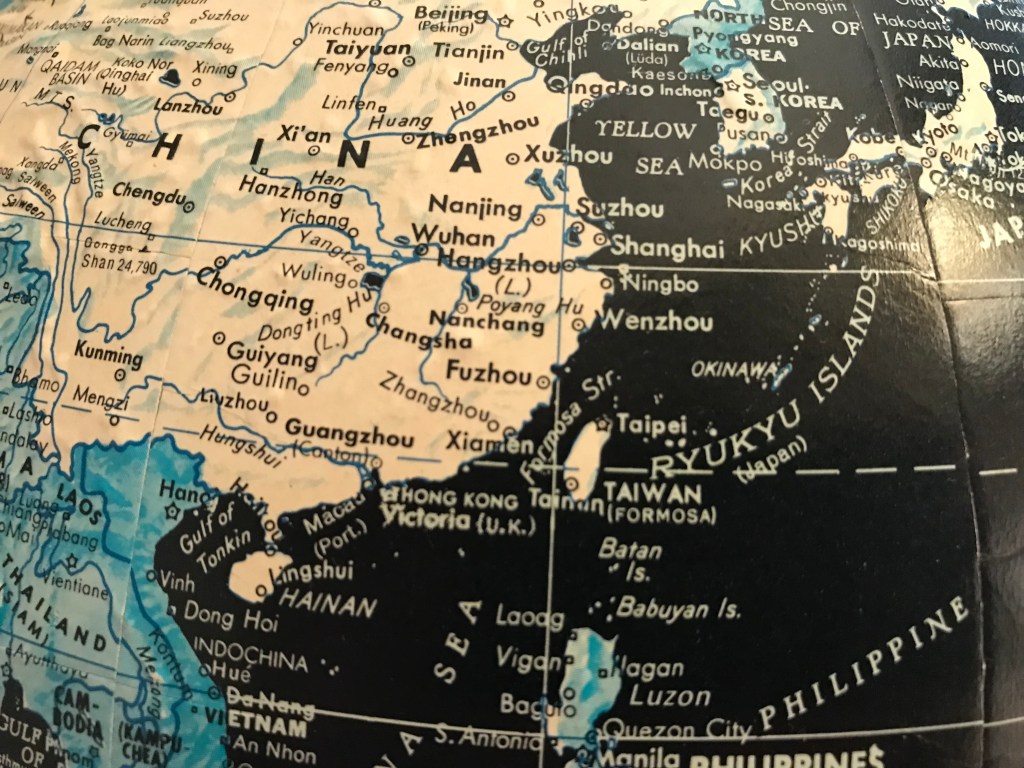
I keep this globe in my office. It comes in handy to remind me of America’s “global reach” and “global power.” You can see how close Taiwan is to mainland China, and also how far Taiwan is from the U.S. But of course U.S. hegemony has no geographical limits, hence the presence of roughly 750 U.S. military bases globally. The world is not enough, since the U.S. must dominate space and cyberspace as well. Perhaps Nancy Pelosi should give her next muddled speech from low Earth orbit. Or the Moon?

“Biden’s Tough Words”

W.J. Astore

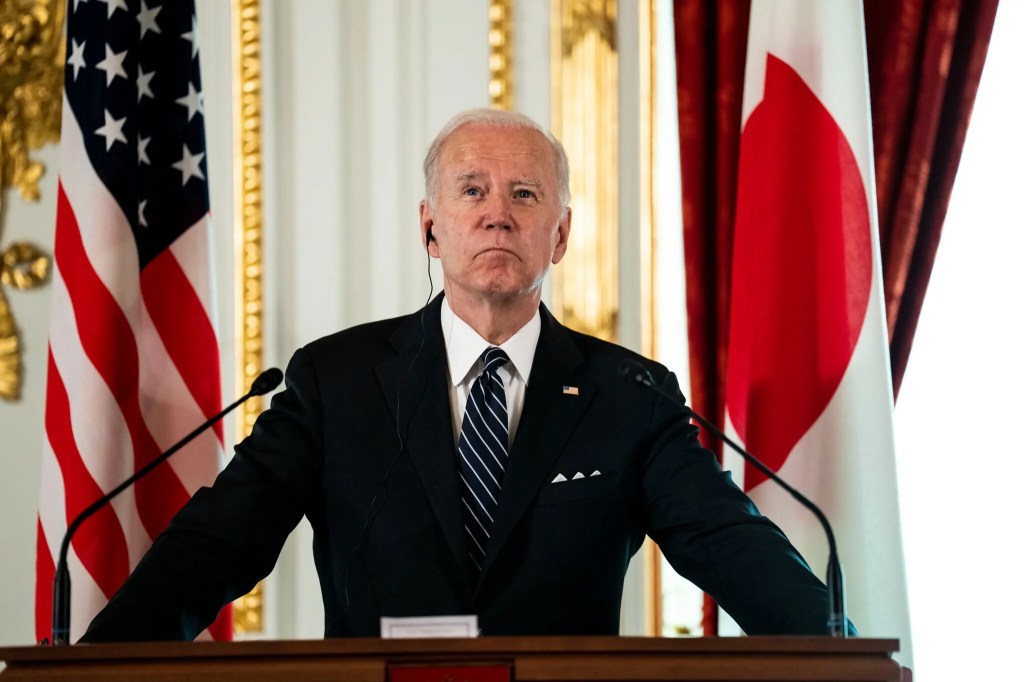
President Biden in Tokyo, sharing some “tough words” (NYT photo)

President Biden is at it again, and so is the New York Times. Abandoning the policy of “strategic ambiguity,” Biden vowed that America would militarily resist a Chinese invasion of Taiwan. The “liberal” New York Times did its part by describing (in its “Morning” daily newsletter) Biden’s vow as “tough words.” Who cares if Biden’s words unnecessarily aggravate tensions with China and contribute to a cold war running increasingly hot? After all, Biden sounded “tough,” and that’s all that really matters here.

Consider these “tough” words from the New York Times:

“The central problem for the U.S. is that it might not be able to stop Xi if he chose to attack. The American public is tired of faraway wars with uncertain connections to national security — an attitude that limits any U.S. president’s options. China’s leaders, on the other hand, would view a conflict in Taiwan as a vital domestic matter and devote vast resources to victory.
For these reasons, the surest way to protect Taiwan is to make China’s leaders believe that even if they could win a war, it would be costly enough to destabilize their regime.”

Remarkably, the Times makes it sound like the American public’s fatigue when it comes to disastrous foreign wars that are unconnected to our national security is a bad thing. Note how this “tired” feeling is allegedly an “attitude that limits any U.S. president’s options,” as if that’s a bad thing.

Did the Times forget that it’s Congress that’s supposed to declare war? That wars should be a last resort? Anyway, so far I haven’t noticed how the American public’s tiredness has stopped any recent war. Most Americans didn’t want to invade Iraq and quickly grew tired of that war, but as Vice President Dick Cheney famously said, “So?” So what if the people are “tired”? When it comes to war, men like Cheney, Obama, Trump, and Biden do what they want. If they listened to us, the Afghan War would have been over in two months instead of persisting for two decades.

“Tough words.” Please, God, save us all from such dangerous nonsense.