There’s a man who famously crowned himself emperor rather than submit to the otherworldly power of a pope. A new movie will soon be out on his “glories.” Napoleon Bonaparte, a military genius, embraced war and drove for total victory until his empire collapsed on him and the French people. Napoleon’s Waterloo came in 1815, a decade after perhaps his greatest victory at Austerlitz in 1805. Empires—they often seem to decline slowly before collapsing all at once, though the Napoleonic version flared so brightly that it burned out quickly.
I once studied the military glories of Napoleon, enthusiastically playing war-games like Waterloo and Empire in Arms, where this time maybe I could win a great victory for the emperor. More than a few books on my shelves cover the campaigns of Napoleon. But as my dad quipped to me, Napoleon wanted to give people liberty, equality, and fraternity at the point of his sword. And that, my dad would say, is an intolerable price to pay for one’s freedom.
Win one for the Emperor
Endless war is, as often as not, the final nail in an empire’s coffin. Early in 1943, after defeat at Stalingrad, which came as a profound shock to a German public sold on the idea it possessed the finest fighting force in history (such rhetoric should sound familiar to Americans today), Joseph Goebbels, the infamous Nazi propaganda minister, gave a fanatical speech calling for “total war” from the German people. Despite disaster at Stalingrad, despite visible and widening cracks in the alleged superiority of the Thousand Year Reich, the German people largely cheered or echoed the cry for more and more war. Two years later, they witnessed total defeat as Germany surrendered unconditionally in May 1945.
As led by Adolf Hitler and his henchmen, Nazi Germany wasn’t interested in peace. These men knew only the feverish pursuit of total victory until it ended in their deaths and total disaster for Germany. They were the original seekers of “full spectrum dominance” as they asserted Germany was the exceptional and essential nation.
We Americans were supposed to learn something from megalomaniacs like Napoleon and Hitler. Committed to democracy, we were supposed to reject war, to repudiate militarism and the warrior mystique, and to embrace instead diplomacy and the settlement of differences peacefully through international organizations like the United Nations.
America today, however, is busy beating plowshares into swords and sending them to global hotspots like Gaza and Ukraine. What gives?
Endless wars can exhaust even the richest and wisest of empires, and America isn’t as rich or wise as it used to be. Interestingly, ordinary Americans haven’t been overcome with bloodthirst. Roughly two-thirds of Americans, for example, support a ceasefire in Gaza. But they are a silent majority compared to the loud minority flowing through the halls of power in DC lobbying for war and more war.
The U.S., which largely created the UN in the immediate aftermath of World War II, now does everything it can to block UN calls for ceasefires, whether in Ukraine or Gaza. The U.S., while allegedly manifesting its allegiance to Judeo-Christian values, embraces war and distributes weaponry like the devil while rejecting calls for peace by church leaders such as Pope Francis.
The U.S. is an empire in serious decline because it devotes so much money to wars and more wars. Military budgets now approach $1 trillion yearly even as the Pentagon just announced it failed its sixth audit in a row. These repetitive failures provoke a bizarre response from Congress and the President: yet more money for war and dominance.
Whether measured in blood or treasure or both, seeking to dominate the world through military hegemony is a surefire recipe for imperial collapse. It’s a lesson taught by the fates of Napoleon and Hitler, one U.S. leaders have dismissed as they’ve been caught up in a belief one can be a superpower, a global hegemon, totally dominant, while remaining a beacon of freedom.
Like Napoleon, U.S. leaders sell the idea they’re giving people liberty at the point of a sword. My dad taught me something about the fallacy and folly of this.
All around us things are falling apart. Collectively, Americans are experiencing national and imperial decline. Can America save itself? Is this country, as presently constituted, even worth saving?
For me, that last question is radical indeed. From my early years, I believed deeply in the idea of America. I knew this country wasn’t perfect, of course, not even close. Long before the 1619 Project, I was aware of the “original sin” of slavery and how central it was to our history. I also knew about the genocide of Native Americans. (As a teenager, my favorite movie — and so it remains — was Little Big Man, which pulled no punches when it came to the white man and his insatiably murderous greed.)
Nevertheless, America still promised much, or so I believed in the 1970s and 1980s. Life here was simply better, hands down, than in places like the Soviet Union and Mao Zedong’s China. That’s why we had to “contain” communism — to keep themover there, so they could never invade our country and extinguish our lamp of liberty. And that’s why I joined America’s Cold War military, serving in the Air Force from the presidency of Ronald Reagan to that of George W. Bush and Dick Cheney. And believe me, it proved quite a ride. It taught this retired lieutenant colonel that the sky’s anything but the limit.
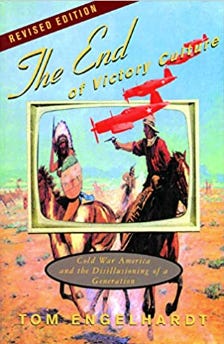
In the end, 20 years in the Air Force led me to turn away from empire, militarism, and nationalism. I found myself seeking instead some antidote to the mainstream media’s celebrations of American exceptionalism and the exaggerated version of victory culture that went with it (long after victory itself was in short supply). I started writingagainst the empire and its disastrous wars and found likeminded people at TomDispatch — former imperial operatives turned incisive critics like Chalmers Johnson and Andrew Bacevich, along with sharp-eyed journalist Nick Turse and, of course, the irreplaceable Tom Engelhardt, the founder of those “tomgrams” meant to alert America and the world to the dangerous folly of repeated U.S. global military interventions.
But this isn’t a plug for TomDispatch. It’s a plug for freeing your mind as much as possible from the thoroughly militarized matrix that pervades America. That matrix drives imperialism, waste, war, and global instability to the point where, in the context of the conflict in Ukraine, the risk of nuclear Armageddon could imaginably approach that of the 1962 Cuban Missile Crisis. As wars — proxy or otherwise — continue, America’s global network of 750-odd military bases never seems to decline. Despite upcoming cuts to domestic spending, just about no one in Washington imagines Pentagon budgets doing anything but growing, even soaring toward the trillion-dollar level, with militarized programs accounting for 62% of federal discretionary spending in 2023.
Indeed, an engorged Pentagon — its budget for 2024 is expected to rise to $886 billionin the bipartisan debt-ceiling deal reached by President Joe Biden and House Speaker Kevin McCarthy — guarantees one thing: a speedier fall for the American empire. Chalmers Johnson predicted it; Andrew Bacevich analyzed it. The biggest reason is simple enough: incessant, repetitive, disastrous wars and costly preparations for more of the same have been sapping America’s physical and mental reserves, as past wars did the reserves of previous empires throughout history. (Think of the short-lived Napoleonic empire, for example.)
Known as “the arsenal of democracy” during World War II, America has now simply become an arsenal, with a military-industrial-congressional complex intent on forging and feeding wars rather than seeking to starve and stop them. The result: a precipitous decline in the country’s standing globally, while at home Americans pay a steep price of accelerating violence (2023 will easily set a record for mass shootings) and “carnage” (Donald Trump’s word) in a once proud but now much-bloodied“homeland.”
Lessons from History on Imperial Decline
I’m a historian, so please allow me to share a few basic lessons I’ve learned. When I taught World War I to cadets at the Air Force Academy, I would explain how the horrific costs of that war contributed to the collapse of four empires: Czarist Russia, the German Second Reich, the Ottoman empire, and the Austro-Hungarian empire of the Habsburgs. Yet even the “winners,” like the French and British empires, were also weakened by the enormity of what was, above all, a brutal European civil war, even if it spilled over into Africa, Asia, and indeed the Americas.
And yet after that war ended in 1918, peace proved elusive indeed, despite the Treaty of Versailles, among other abortive agreements. There was too much unfinished business, too much belief in the power of militarism, especially in an emergent Third Reich in Germany and in Japan, which had embraced ruthless European military methods to create its own Asiatic sphere of dominance. Scores needed to be settled, so the Germans and Japanese believed, and military offensives were the way to do it.
As a result, civil war in Europe continued with World War II, even as Japan showed that Asiatic powers could similarly embrace and deploy the unwisdom of unchecked militarism and war. The result: 75 million dead and more empires shattered, including Mussolini’s “New Rome,” a “thousand-year” German Reich that barely lasted 12 of them before being utterly destroyed, and an Imperial Japan that was starved, burnt out, and finally nuked. China, devastated by war with Japan, also found itself ripped apart by internal struggles between nationalists and communists.
As with its prequel, even most of the “winners” of World War II emerged in a weakened state. In defeating Nazi Germany, the Soviet Union had lost 25 to 30 million people. Its response was to erect, in Winston Churchill’s phrase, an “Iron Curtain” behind which it could exploit the peoples of Eastern Europe in a militarized empire that ultimately collapsed due to its wars and its own internal divisions. Yet the USSR lasted longer than the post-war French and British empires. France, humiliated by its rapid capitulation to the Germans in 1940, fought to reclaim wealth and glory in “French” Indochina, only to be severely humbled at Dien Bien Phu. Great Britain, exhausted from its victory, quickly lost India, that “jewel” in its imperial crown, and then Egypt in the Suez debacle.
There was, in fact, only one country, one empire, that truly “won” World War II: the United States, which had been the least touched (Pearl Harbor aside) by war and all its horrors. That seemingly never-ending European civil war from 1914 to 1945, along with Japan’s immolation and China’s implosion, left the U.S. virtually unchallenged globally. America emerged from those wars as a superpower precisely because its government had astutely backed the winning side twice, tipping the scales in the process, while paying a relatively low price in blood and treasure compared to allies like the Soviet Union, France, and Britain.
History’s lesson for America’s leaders should have been all too clear: when you wage war long, especially when you devote significant parts of your resources — financial, material, and especially personal — to it, you wage it wrong. Not for nothing is war depicted in the Bible as one of the four horsemen of the apocalypse. France had lost its empire in World War II; it just took later military catastrophes in Algeria and Indochina to make it obvious. That was similarly true of Britain’s humiliations in India, Egypt, and elsewhere, while the Soviet Union, which had lost much of its imperial vigor in that war, would take decades of slow rot and overstretch in places like Afghanistan to implode.
Meanwhile, the United States hummed along, denying it was an empire at all, even as it adopted so many of the trappings of one. In fact, in the wake of the implosion of the Soviet Union in 1991, Washington’s leaders would declare America the exceptional “superpower,” a new and far more enlightened Rome and “the indispensable nation” on planet Earth. In the wake of the 9/11 attacks, its leaders would confidently launch what they termed a Global War on Terror and begin waging wars in Afghanistan, Iraq, and elsewhere, as in the previous century they had in Vietnam. (No learning curve there, it seems.) In the process, its leaders imagined a country that would remain untouched by war’s ravages, which was we now know — or do we? — the height of imperial hubris and folly.
For whether you call it fascism, as with Nazi Germany, communism, as with Stalin’s Soviet Union, or democracy, as with the United States, empires built on dominance achieved through a powerful, expansionist military necessarily become ever more authoritarian, corrupt, and dysfunctional. Ultimately, they are fated to fail. No surprise there, since whatever else such empires may serve, they don’t serve their own people. Their operatives protect themselves at any cost, while attacking efforts at retrenchment or demilitarization as dangerously misguided, if not seditiously disloyal.
That’s why those like Chelsea Manning, Edward Snowden, and Daniel Hale, who shined a light on the empire’s militarized crimes and corruption, found themselves imprisoned, forced into exile, or otherwise silenced. Even foreign journalists like Julian Assange can be caught up in the empire’s dragnet and imprisoned if they dare expose its war crimes. The empire knows how to strike back and will readily betray its own justice system (most notably in the case of Assange), including the hallowed principles of free speech and the press, to do so.
Perhaps he will eventually be freed, likely as not when the empire judges he’s approaching death’s door. His jailing and torture have already served their purpose. Journalists know that to expose America’s bloodied tools of empire brings only harsh punishment, not plush rewards. Best to look away or mince one’s words rather than risk prison — or worse.
Yet you can’t fully hide the reality that this country’s failed wars have added trillions of dollars to its national debt, even as military spending continues to explode in the most wasteful ways imaginable, while the social infrastructure crumbles.
Clinging Bitterly to Guns and Religion
Today, America clings ever more bitterly to guns and religion. If that phrase sounds familiar, it might be because Barack Obama used it in the 2008 presidential campaign to describe the reactionary conservatism of mostly rural voters in Pennsylvania. Disillusioned by politics, betrayed by their putative betters, those voters, claimed the then-presidential candidate, clung to their guns and religion for solace. I lived in rural Pennsylvania at the time and recall a response from a fellow resident who basically agreed with Obama, for what else was there left to cling to in an empire that had abandoned its own rural working-class citizens?
Something similar is true of America writ large today. As an imperial power, we cling bitterly to guns and religion. By “guns,” I mean all the weaponry America’s merchants of death sell to the Pentagon and across the world. Indeed, weaponry is perhaps this country’s most influential global export, devastatingly so. From 2018 to 2022, the U.S. alone accounted for 40% of global arms exports, a figure that’s only risen dramatically with military aid to Ukraine. And by “religion,” I mean a persistent belief in American exceptionalism (despite all evidence to the contrary), which increasingly draws sustenance from a militant Christianity that denies the very spirit of Christ and His teachings.
Yet history appears to confirm that empires, in their dying stages, do exactly that: they exalt violence, continue to pursue war, and insist on their own greatness until their fall can neither be denied nor reversed. It’s a tragic reality that the journalist Chris Hedges has written about with considerable urgency.
The problem suggests its own solution (not that any powerful figure in Washington is likely to pursue it). America must stop clinging bitterly to its guns — and here I don’t even mean the nearly 400 million weapons in private hands in this country, including all those AR-15 semi-automatic rifles. By “guns,” I mean all the militarized trappings of empire, including America’s vast structure of overseas military bases and its staggering commitments to weaponry of all sorts, including world-ending nuclearones. As for clinging bitterly to religion — and by “religion” I mean the belief in America’s own righteousness, regardless of the millions of people it’s killed globally from the Vietnam era to the present moment — that, too, would have to stop.
History’s lessons can be brutal. Empires rarely die well. After it became an empire, Rome never returned to being a republic and eventually fell to barbarian invasions. The collapse of Germany’s Second Reich bred a third one of greater virulence, even if it was of shorter duration. Only its utter defeat in 1945 finally convinced Germans that God didn’t march with their soldiers into battle.
What will it take to convince Americans to turn their backs on empire and war before it’s too late? When will we conclude that Christ wasn’t joking when He blessed the peacemakers rather than the warmongers?
As an iron curtain descends on a failing American imperial state, one thing we won’t be able to say is that we weren’t warned.
In my latest article for TomDispatch.com, I ask a simple question: What would real national defense look like? Here are some answers.
What would real national defense for this country look like? Rarely do any of us pose this question, no less examine what it might truly mean. Rarely do we think about all the changes we’d have to make as a nation and a people if we were to put defense first, second, and last, while leaving behind both our imperial wars and domestic militarism.
I know what it wouldn’t look like. It wouldn’t look like today’s grossly inflated military. A true Department of Defense wouldn’t need 800 foreign military bases, nor would the national security state need a budget that routinely exceeds a trillion dollars annually. We wouldn’t need a huge, mechanized army, a navy built around aircraft carriers, or an air force that boasts of its global reach and global power, all of it created not for defense but for offense — for destruction, anytime, anywhere.
As a country, we would need to imagine a new “people’s” military as a force that could truly defend the American republic. That would obviously mean one focused above all on supporting the Constitution and the rights we (at least theoretically) hold sacred like freedom of speech, the press, and assembly, the right to privacy and due process, and of course the right to justice for all, not just for the highest bidder or those with the deepest pockets.
What might such a new military look like? First, it would be much smaller. America’s current military, including troops on active duty, reservists, and members of the National Guard, consists of roughly 2.4 million men and women. Those numbers should gradually be cut at least in half. Second, its budget should similarly be dramatically cut, the end goal being to have it 50% lower than next year’s proposed budget of $715 billion. Third, it wouldn’t be based and deployed around the world. As a republican force (note the lower-case “r”), it would instead serve democratic ends rather than imperial ones. It would certainly need far fewer generals and admirals. Its mission wouldn’t involve “global reach,” but would be defensive, focused on our borders and this hemisphere.
A friend of mine, a Navy veteran of the Vietnam War, speaks of a military that would consist of a Coast Guard, “militias” (that is, the National Guard) for each of the fifty states, and little else. Yes, in this America, that sounds beyond extreme, but he has a point. Consider our unique advantages in terms of geography. Our continent is protected by two vast oceans. We share a long and peaceful border with Canada. While the border with Mexico is certainly troubled, we’re talking about unarmed, desperate migrants, not a military invasion flooding into Texas to retake the Alamo.
Here, then, are just 10 ways America’s military could change under a vision that would put the defense of America first and free up some genuine funds for domestic needs as well:
No more new nuclear weapons. It’s time to stop “modernizing” that arsenal to the tune of possibly $1.7 trillion over the next three decades. Land-based intercontinental ballistic missiles like the Ground Based Strategic Deterrent, expected to cost more than $264 billion during its lifetime, and “strategic” (nuclear) bombers like the Air Force’s proposed B-21 Raider should be eliminated. The Trident submarine force should also be made smaller, with limited modernization to improve its survivability.
All Army divisions should be reduced to cadres (smaller units capable of expansion in times of war), except the 82nd and 101st Airborne Divisions and the 10th Mountain Division.
The Navy should largely be redeployed to our hemisphere, while aircraft carriers and related major surface ships are significantly reduced in number.
The Air Force should be redesigned around the defense of America’s air space, rather than attacking others across the planet at any time. Meanwhile, costly offensive fighter-bombers like the F-35, itself a potential $1.7 trillion boondoggle, should simply be eliminated and the habit of committing drone assassinations across the planet ended. Similarly, the separate space force created by President Trump should be folded back into a much-reduced Air Force.
The training of foreign militaries and police forces in places like Iraq and Afghanistan should be stopped. The utter collapse of the U.S.-trained forces in Iraqin the face of the Islamic State in 2014 and the ongoing collapse of the U.S.-trained Afghan military today have made a mockery of this whole process.
Military missions launched by intelligence agencies like the CIA, including those drone assassination programs overseas, should be halted and the urge to intervene secretly in the political and military lives of so many other countries finally brought under some kind of control.
The “industrial” part of the military-industrial complex should also be brought under control, so that taxpayer dollars don’t go to fabulously expensive, largely useless weaponry. At the same time, the U.S. government should stop promoting the products of our major weapons makers around the planet.
Above all, in a democracy like ours, a future defensive military should only fight in a war when Congress, as the Constitution demands, formally declares one.
The military draft should be restored. With a far smaller force, such a draft should have a limited impact, but it would ensure that the working classes of America, which have historically shouldered a heavy burden in military service, will no longer do so alone. In the future America of my military dreams, a draft would take the eligible sons and daughters of our politicians first, followed by all eligible students enrolled in elite prep schools and private colleges and universities, beginning with the Ivy League. After all, America’s best and brightest will surely want to serve in a military devoted to defending their way of life.
Finally, there should be only one four-star general or admiral in each of the three services. Currently, believe it or not, there are an astonishing 44 four-star generals and admirals in America’s imperial forces. There are also hundreds of one-star, two-star, and three-star officers. This top-heavy structure inhibits reform even as the highest-ranking officers never take responsibility for America’s lost wars.
Pivoting to America
Perhaps you’ve heard of the “pivot to Asia” under the Obama administration — the idea of redeploying U.S. military forces from the Greater Middle East and elsewhere in response to perceived threats from China. As it happened, it took the new Biden administration to begin to pull off that particular pivot, but America’s imperial military regularly seems to be pivoting somewhere or other. It’s time to pivot to this country instead.
Echoing the words of George McGovern, a highly decorated World War II bomber pilot who unsuccessfully ran for president against Richard Nixon in 1972, “Come home, America.” Close all those foreign military bases. Redirect resources from wars and weapons to peace and prosperity. Focus on restoring the republic. That’s how Americans working together could truly defend ourselves, not only from our “enemies” overseas, almost always much exaggerated, but from ourselves, the military-industrial-congressional complex, and all our fears.
It’s time again to listen to the common sense of Thomas Paine
W.J. Astore
This past weekend, General Mark Milley, Chairman of the JCS, said U.S. troops would remain in Syria for another few years, ostensibly to prevent an ISIS resurgence, and that troops would also continue to fight the Afghan War for several years to come. This should have been been big news, but in an America now distracted by a public impeachment circus, endless wars are greeted with a collective shrug within the media.
Thomas Paine would not have been happy. Famously outspoken for writing “Common Sense” at the beginning of the American Revolutionary War, Paine had some choice words about war and empire that Americans would do well to read and heed today.
“If there is a sin superior to every other,” Paine wrote, “it is that of willful and offensive war … he who is the author of a war, lets loose the whole contagion of Hell, and opens a vein that bleeds a nation to death.”
Paine then wrote that “We leave it to England and Indians [allied with England] to boast of these honors; we feel no thirst for such savage glory; a nobler flame, a purer spirit animates America.”
Imagine an America today that felt no thirst for the savage glory of war!
Paine supported only defensive wars, for Freedom and against Tyranny, as he put it. Remind me how keeping troops in Syria to secure oil is a just war for freedom? Remind me how prolonging the Afghan War (now in its 18th year) by several more years is necessary for America’s defense and in the cause of freedom?
Paine further had choice words for empires that were foolish enough to wage ruinous wars far from home. Naturally, he had Britain most in mind:
“If ever a nation was mad and foolish, blind to its own interest and bent on its own destruction, it is Britain … Bless’d with all the commerce she could wish for, and furnished by a vast extension of dominion with the means of civilizing both the eastern and western world, she has made no other use of both than proudly to idolize her own ‘Thunder,’ and rip up the bowels of whole countries for what she could get; –like Alexander she has made war her sport, and inflicted misery for prodagality [sic] sake.”
Making war our sport while idolizing our “thunderous” military — isn’t that an apt description of much of U.S. foreign policy for the past few decades?
But Paine wasn’t finished. He made a dire prediction:
“All countries have sooner or later been called to their reckoning; the proudest empires have sunk when the balance was struck; and Britain, like an individual penitent, must undergo her day of sorrow, and the sooner it happens to her the better.”
No empire lasts forever — certainly not one that engages in endless and largely pointless wars. Paine warned Britain about the high costs of war with America and how British forces were fated to lose, and he was right.
In a country that supposedly respects and even worships its Founders, isn’t it time Americans listened to Thomas Paine on the horrors of war and the perils of empires blinded by power and greed?
End the wars, America. Bring our troops home. And restore freedom to our land.
(Quotations from Paine are from “The American Crisis” as published in Thomas Paine: Collected Writings, Library of America, pp. 108, 165-66, written originally in 1777 and 1778)
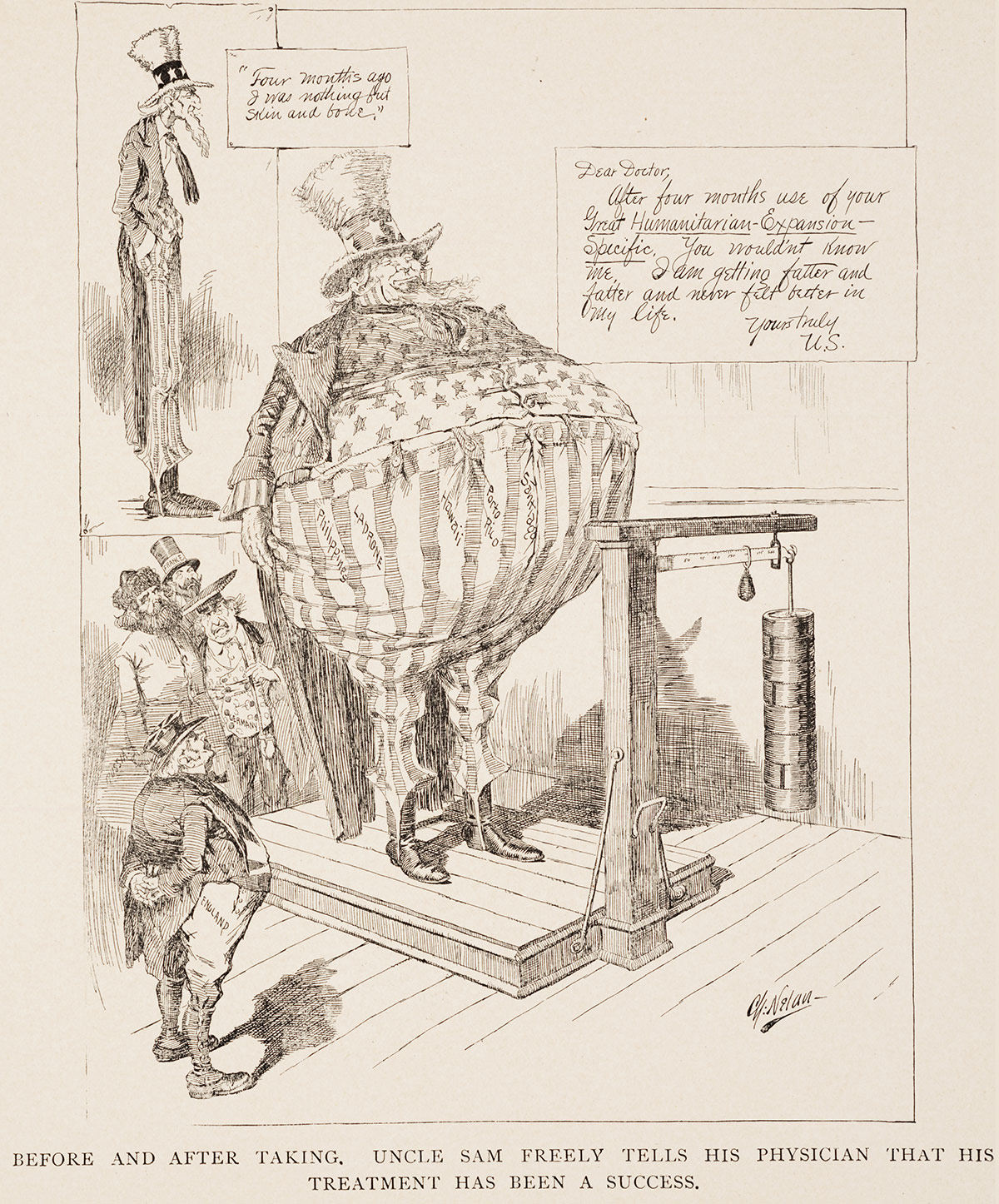
Uncle Sam: No stranger to imperialism (from the Spanish-American War of 1898)
W.J. Astore
Why do empires fall? Sometimes, it’s easy to identify a cause. Whether led by the Kaiser or by Hitler, Germany’s Second and Third Empires were destroyed by world wars. Germany’s ambition was simply too great, its militarism too dominant, its policies too harsh to win long-term converts, its leaders too blinded by the pursuit of power, its enemies too many to conquer or otherwise neutralize.
Other imperial falls are more complex. What caused Rome’s fall? (Leaving aside the eastern part of the empire, which persisted far longer as the Byzantine Empire.) Barbarians and their invasions, say some. The enervating message and spirit of Christianity, said the historian Edward Gibbon. Rome’s own corruption and tyranny, say others. Even lead in Roman water pipes has been suggested as a contributing cause to Rome’s decline and fall. Taking a longer view, some point to the rise of Islam in the 7th century and its rapid expansion into previously Roman territories as the event that administered the final coup de grâce to a dying empire.
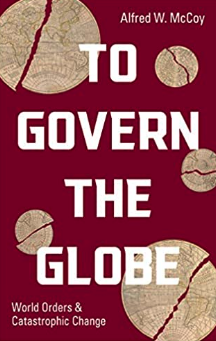
America’s empire, it is clear, is now in decline, and a key reason is imperial overstretch as manifested by endless wars and overspending on the military (with literally trillions of dollars being thrown away on fruitless wars). An especially fine summary is Alfred McCoy’s article this week at TomDispatch.com. As McCoy notes:
In effect, the president and his team, distracted by visions of shimmering ships and shiny planes (with their predictable staggering future cost overruns), are ready to ditch the basics of global dominion: the relentless scientific research that has long been the cutting edge of U.S. military supremacy. And by expanding the Pentagon while slashing the State Department, Trump is also destabilizing that delicate duality of U.S. power by skewing foreign policy ever more toward costly military solutions (that have proved anything but actual solutions) …
In just one extraordinary year, Trump has destabilized the delicate duality that has long been the foundation for U.S. foreign policy: favoring war over diplomacy, the Pentagon over the State Department, and narrow national interest over international leadership. But in a globalizing world interconnected by trade, the Internet, and the rapid proliferation of nuclear-armed missiles, walls won’t work. There can be no Fortress America.
In this passage, McCoy stresses the damage being done by the Trump administration. But Trump is just the culmination of certain trends, e.g. favoring the Pentagon over the State Department is nothing new, as I wrote about here in 2010. And America has been in love with shimmering ships and shiny planes for generations, with several administrations supporting the F-35 jet fighter, a program that may end up costing as much as $1.4 trillion. Plenty of money for weapons that kill; not so much for medicines that cure: that’s imperial America in a nutshell.
I would stress that America’s strength overseas was (and is) always based on its strength at home in areas such as science, education, infrastructure, medicine, manufacturing, and exports. But what we’ve witnessed over the last 40 years is an immense and wasteful “investment” in wars and weapons even as our country itself has hollowed out. Science is now marked by the denial of facts (such as global warming). Education is all about students as consumers, with an overall decline in standards and performance. Infrastructure is crumbling. Medicine is too expensive and America’s overall health and life expectancy are both in decline. Manufacturing and exports have withered (except for the production and export of weapons, naturally).
As a result of all this, America is running a national debt of roughly 20 trillion dollars. The future is being sacrificed for the present, a tragic reality reflected in the latest Republican tax cut, which benefits the richest Americans the most, along with big corporations, and which will likely add another trillion to the national debt.
In short, America’s foreign decline is mirrored (and driven) by its domestic decline as reflected by its choices. Looking at the USA today, you get the sense it’s the best of times for the richest few, and the worst of times for so many Americans struggling with health care debt, student loan debt, and the uncertainty of low-wage jobs that could be outsourced at any moment. At the same time, the American political scene is driven by fear: of immigrants, of a nuclear war with North Korea, of Russian meddling (real or imagined), of growing Chinese power, and of the perpetually-hyped threat of terrorist attacks on “the Homeland.”
Empires can fall very quickly, as the “thousand-year” Third Reich did, or they can fall ever so slowly, as the Roman Empire did. But fall they do. What is in the cards for the United States? Readers, fire away in the comments section.
Update (1/20/18): Secretary of Defense James Mattis now claims that China and Russia represent bigger threats than terrorism, along with Congress itself since it can’t pass an extended budget for the Pentagon. He also claimed the U.S. military’s “competitive edge” is eroding in “every domain of warfare,” despite a defense budget of $700 billion.
None of this is a surprise. Indeed, this is exactly what happens when you put a retired general and known war hawk in charge of the defense department. Generals will always want more: more troops, more money, more resources, more authority. And to support their demands, they will always find more enemies as well.
Here are two items this morning from FP: Foreign Policy (foreignpolicy.com), which provides a daily summary (Situation Report, or SITREP) of news items related to the U.S. military and foreign policy. Together, they represent the very definition of insanity.
Item 1: The Congressional Budget Office on Tuesday said U.S. taxpayers are on the hook for about $1.2 trillion over the next 30 years to modernize the country’s nuclear arsenal. That huge number takes into account the replacement of nuclear-capable submarines, ICBMs, and new aircraft for the Air Force.
The budget office warned that the projected costs would muscle out some conventional weapons programs in the coming years unless the Pentagon’s budget is increased substantially. The CBO identified some cost savings however, saying the Pentagon could save as much as $139 billion if it delayed production of a new ICBM, stalled a secretive new nuclear-capable bomber called the B-21, and reduced the number of ICBMs and missile-carrying nuclear submarines than planned.
All of those plans are carry-overs from the Obama administration, as the Trump team has yet to articulate a nuclear weapons strategy.
Item 2: War in Afghanistan, redacted. The Afghan government is losing control of more and more territory to the Taliban, according a grim new report from the congressionally-mandated Special Inspector General for Afghanistan Reconstruction. On the humanitarian side, civilian casualties from coalition and Afghan air strikes spiked by 52 percent in the first nine months of this year over last year, the report notes.
In response to those unfriendly stats, the U.S. military has started to withhold information from the American public, refusing to report figures related to the size and success of Afghan security forces — which the U.S. taxpayer has spent tens of billions to build and sustain.
“The Afghans know what’s going on; the Taliban knows what’s going on; the U.S. military knows what’s going on,” John F. Sopko, the special inspector general for Afghanistan, told the New York Times. “The only people who don’t know what’s going on are the people paying for it.”
In sum, the American people will possibly pay more than a trillion dollars in the next three decades for more nuclear weapons (when the stated goal of leaders like Obama had been to eliminate them), even as information about the never-ending war in Afghanistan is withheld from the American people (especially the jaw-dropping waste of billions of dollars on Afghan security forces that can’t or won’t fight).
Meanwhile, U.S. citizens in Puerto Rico languish in the dark, the victims of a U.S. government that seeks to punish the island for its debt to various financial institutes and power brokers.
Hail Trump? Includes wannabe American Emperor in Golf Cart.
W.J. Astore
President Donald Trump has a disturbing way of talking about the U.S. military. Consider the following Trump quotation about the recent attack on U.S. troops in Niger:
“I have generals that are great generals,” Trump said. “I gave them authority to do what’s right so that we win. My generals and my military, they have decision-making ability. As far as the incident that we’re talking about [in Niger], I’ve been seeing it just like you’ve been seeing it. I’ve been getting reports.” [emphasis added]
For Trump, it’s not the American people’s military, it’s “my” military. Generals are not Congressionally-appointed officers, they’re “my” generals. Trump has a fundamental misunderstanding of his role as commander-in-chief, as well as the role of the U.S. military. He sees himself as the big boss of “his” military, with generals as his personal employees whom he can order around and fire at will.
And by “order around,” I mean the issuance of orders regardless of their legality, a point Trump made back in March of 2016, in response to a debate question by Bret Baier:
BAIER: Mr. Trump, just yesterday, almost 100 foreign policy experts signed on to an open letter refusing to support you, saying your embracing expansive use of torture is inexcusable. General Michael Hayden, former CIA director, NSA director, and other experts have said that when you asked the U.S. military to carry out some of your campaign promises, specifically targeting terrorists’ families, and also the use of interrogation methods more extreme than waterboarding, the military will refuse because they’ve been trained to turn down and refuse illegal orders.
So what would you do, as commander-in-chief, if the U.S. military refused to carry out those orders?
TRUMP: They won’t refuse. They’re not going to refuse me. Believe me.
BAIER: But they’re illegal.
…
TRUMP: And — and — and — I’m a leader. I’m a leader. I’ve always been a leader. I’ve never had any problem leading people. If I say do it, they’re going to do it. That’s what leadership is all about.
As I wrote then, Trump’s fundamental misunderstanding of leadership, and especially his boasts about the military obeying his orders irrespective of their legality, disqualified him as a presidential candidate. Of course, Trump’s dictatorial statements didn’t deter his determined fans. Indeed, they elected him because they wanted a Strong Man, not because they feared one.
So here we are, with a dictator wannabe as president, treating the U.S. military as if it’s his personal Praetorian Guard. If the Republic isn’t dead, its heartbeat is fading fast. Meanwhile, the sordid and corrupt Empire of Trump – just by its endurance – grows ever stronger.
A common depiction of Russia as a hyper-aggressive bear. But what is the United States?
W.J. Astore
In a recent article at TomDispatch.com, I argued that the United States, after defeating the former Soviet Union in the Cold War, seized upon its moment of “victory” and, in a fit of hubris, embraced an increasingly imperial and authoritarian destiny that echoed in many ways the worst attributes of the USSR. You can read the entire article here. What follows is an excerpt that details some of the ways the U.S. has come to echo or mirror certain features associated with the USSR, the “Evil Empire” of the Reagan years.
Also, for a podcast in which I discuss my article with Burt Cohen, follow this link or this address: http://keepingdemocracyalive.com/just-hacking-weve-become-like-soviets/
When I was a young lieutenant in the Air Force, in 1986 if memory serves, I attended a secret briefing on the Soviet Union. Ronald Reagan was president, and we had no clue that we were living through the waning years of the Cold War. Back then, believing that I should know my enemy, I was reading a lot about the Soviets in “open sources,” you know, books, magazines and newspapers.
The “secret” briefing I attended revealed little that was new to me. (Classified information is often overhyped.) I certainly heard no audacious predictions of a Soviet collapse in five years, though the Soviet Union would indeed implode in 1991. Like nearly everyone at the time, the briefers assumed the USSR would be our arch enemy for decades to come and it went without saying that the Berlin Wall was a permanent fixture in a divided Europe, a forever symbol of ruthless communist oppression.
Little did we know that, three years later, the Soviet military would stand aside as East Germans tore down that wall. And who then would have believed that a man might be elected president of the United States a generation later on the promise of building a “big, fat, beautiful wall” on our shared border with Mexico?
I wasn’t allowed to take notes during that briefing, but I remember the impression I was left with—that the USSR was deeply authoritarian, a grim surveillance state with an economy dependent on global weapons sales; that it was intent on nuclear domination; that it was imperialist and expansionist; that it persecuted its critics and dissidents; and that it had serious internal problems carefully suppressed in the cause of world mastery, including rampant alcohol and drug abuse, bad health care and declining longevity (notably for men), a poisoned environment, and an extensive prison system featuring gulags.
All of this was exacerbated by festering sores overseas, especially a costly and stalemated war in Afghanistan and client-states that absorbed its resources (think: Cuba) while offering little in return.
This list of Soviet problems, vintage 1986, should have a familiar ring to it, since it sounds uncannily like a description of what’s wrong with the United States today.
In case you think that’s an over-the-top statement, let’s take that list from the briefing—eight points in all—one item at a time.
1. An authoritarian, surveillance state. The last time the U.S. Congress formally declared war was in 1941. Since then, American presidents have embarked on foreign wars and interventions ever more often with ever less oversight from Congress. Power continues to grow and coalesce in the executive branch, strengthening an imperial presidency enhanced by staggering technologies of surveillance, greatly expanded in the aftermath of the 9/11 terrorist attacks.
Indeed, America now has 17 intelligence agencies with a combined yearly budget of $80 billion. Unsurprisingly, Americans are surveilled more than ever, allegedly for our safety even if such a system breeds meekness and stifles dissent.
2. An economy dependent on global weapons sales. The United States continues to dominate the global arms trade in a striking fashion. It was no mistake that a centerpiece of Pres. Trump’s recent trip was a $110 billion arms deal with Saudi Arabia. On the same trip, he told the Emir of Qatar that he was in the Middle East to facilitate “the purchase of lots of beautiful military equipment.” Now more than ever, beautiful weaponry made in the U.S.A. is a significant driver of domestic economic growth as well as of the country’s foreign policy.
3. Bent on nuclear domination. Continuing the policies of Pres. Barack Obama, the Trump administration envisions a massive modernization of America’s nuclear arsenal, to the tune of at least a trillion dollars over the next generation. Much like an old-guard Soviet premier, Trump has boasted that America will always remain at “the top of the pack” when it comes to nuclear weapons.
4. Imperialist and expansionist. Historians speak of America’s “informal” empire, by which they mean the U.S. is less hands-on than past imperial powers like the Romans and the British. But there’s nothing informal or hands-off about America’s 800 overseas military bases or the fact that its Special Operations forces are being deployed in 130 or more countries yearly.
When the U.S. military speaks of global reach, global power, and full-spectrum dominance, this is traditional imperialism cloaked in banal catchphrases. Put differently, Soviet imperialism, which American leaders always professed to fear, never had a reach of this sort.
5. Persecutes critics and dissidents. Whether it’s been the use of the Patriot Act under George W. Bush’s presidency, the persecution of whistleblowers using the World War I-era Espionage Act under the Obama administration, or the vilification of the media by the new Trump administration, the United States is far less tolerant of dissent today than it was prior to the Soviet collapse.
As Homeland Security Secretary and retired four-star Marine Gen. John Kelly recently put it, speaking of news stories about the Trump administration based on anonymous intelligence sources, such leaks are “darn close to treason.” Add to such an atmosphere Trump’s attacks on the media as the “enemy” of the people and on critical news stories as “fake” and you have an environment ripe for the future suppression of dissent.
In the Soviet Union, political opponents were often threatened with jail or worse, and those threats were regularly enforced by men wearing military or secret police uniforms. In that context, let’s not forget the “lock her up!” chants led by retired Lt. Gen. Michael Flynn at the Republican National Convention and aimed at Donald Trump’s political opponent of that moment, Hillary Clinton.
6. Internal problems like drug abuse, inadequate health care and a poisoned environment. Alcoholism is still rife in Russia and environmental damage widespread, but consider the United States today. An opioid crisis is killing more than 30,000 people a year. Lead poisoning in places like Flint, Michigan, and New Orleans is causing irreparable harm to the young. The disposal of wastewater from fracking operations is generating earthquakes in Ohio and Oklahoma.
Even as environmental hazards proliferate, the Trump administration is gutting the Environmental Protection Agency. As health crises grow more serious, the Trump administration, abetted by a Republican-led Congress, is attempting to cut health-care coverage and benefits, as well as the funding that might protect Americans from deadly pathogens. Disturbingly, as with the Soviet Union in the era of its collapse, life expectancy among white men is declining, mainly due to drug abuse, suicide and other despair-driven problems.
7. Extensive prison systems. As a percentage of its population, no country imprisons more of its own people than the United States. While more than two million of their fellow citizens languish in prisons, Americans continue to see their nation as a beacon of freedom, ignoring Guantánamo Bay, Cuba. In addition, the country now has a president who believes in torture, who has called for the murder of terrorists’ families, and who wants to refill Guantánamo with prisoners. It also has an attorney general who wants to make prison terms for low-level drug offenders ever more draconian.
8. Stalemated wars. You have to hand it to the Soviets. They did at least exhibit a learning curve in their disastrous war in Afghanistan and so the Red Army finally left that country in 1989 after a decade of high casualties and frustration, even if its troops returned to a land on the verge of implosion. U.S. forces, on the other hand, have been in Afghanistan for 16 years, with the Taliban growing ever stronger, yet its military’s response has once again been to call for investing more money and sending in more troops to reverse the “stalemate” there.
Meanwhile, after 14 years, Iraq War 3.0 festers, bringing devastation to places like Mosul, even as its destabilizing results continue to manifest themselves in Syria and indeed throughout the greater Middle East. Despite or rather because of these disastrous results, U.S. leaders continue to over-deploy U.S. Special Operations forces, contributing to exhaustion and higher suicide rates in the ranks.
In light of these eight points, that lighthearted Beatles tune and relic of the Cold War, “Back in the USSR,” takes on a new, and far harsher, meaning.
To read the rest of this article, go to TomDispatch.com. Thank you.
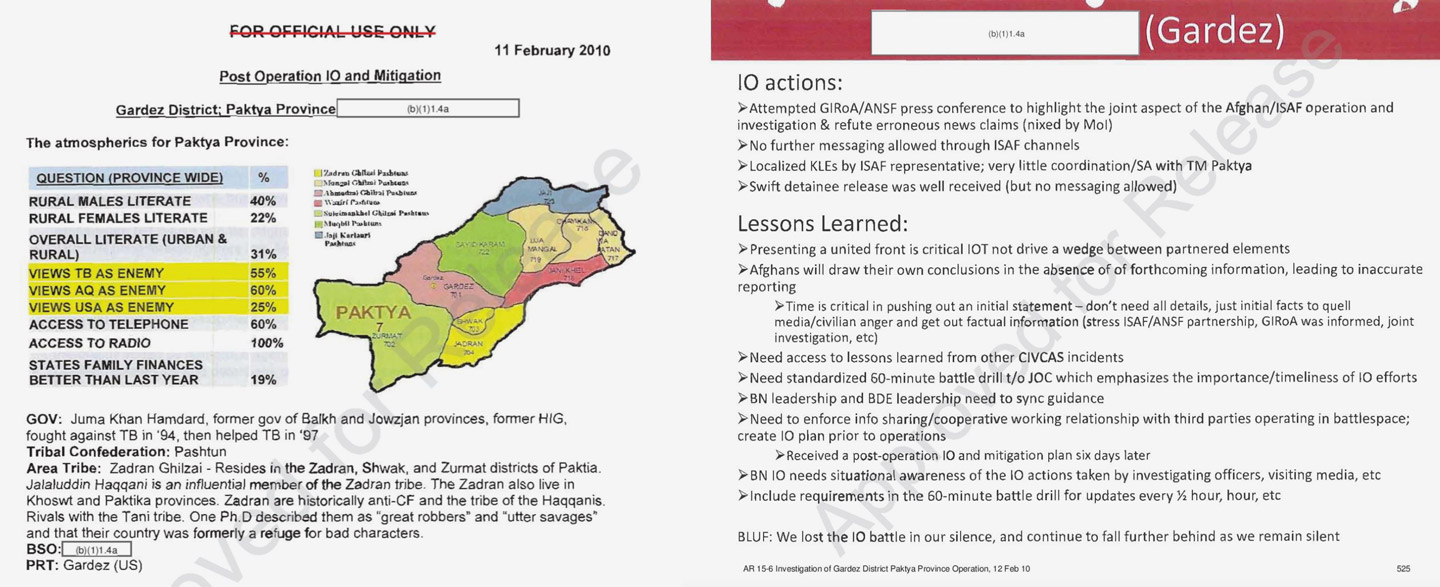
In a notorious night raid near Gardez in Afghanistan in February 2010, a US Special Ops team apparently hit the wrong suspect’s house, resulting in the deaths of innocents to include pregnant women. It was further alleged that US troops dug bullets out of the bodies of these women. Jeremy Scahill’s recent article at The Intercept reviews the US military’s investigation into these allegations, an investigation that cleared the troops involved of any wrongdoing. Scahill’s article is here and warrants careful reading.
I want to focus on a piece of evidence that Scahill obtained: the U.S. military’s evaluation of the Afghan province and its after-action report about the failure of its IO (information operations) “battle.” Here is the document in question:
First, I want to focus on the BLUF at the bottom right. In the Army, it stands for bottom line up front. Most senior commanders will read this first; in some cases, the BLUF will be all they read (and remember). What does the BLUF conclude?
It says the US military “lost the IO battle in our silence,” and that it’s only getting worse as the military remains silent. It sounds vaguely reassuring: at least the military realizes it bungled the “information operations” job. But it’s a bureaucratic message in bureaucratic language. It reduces the objective to winning the “information” war, which the military says it’s not winning because of poor coordination with Afghan and other forces, lack of responsiveness, and so on.
How about some honesty? Here’s my BLUF: The US military is losing because it often misidentifies the enemy and misunderstands the culture, leading to the deaths of innocents and the estrangement of even those Afghans who are initially open to American influence. And no matter how hard you try to spin those facts, you can’t hide that cold truth from the Afghan people. (You can hide it from the American people, but that’s another story.)
As General Stanley McChrystal himself said about Afghanistan in 2010: “We have shot an amazing number of [Afghan] people [often at checkpoints], but to my knowledge, none has ever proven to be a threat.”
Tell me again how you win “information operations” by shooting “an amazing number” of innocent people?
I want to focus on a second aspect of the US military’s document from Scahill’s article: the illusion of data substituting for real knowledge. Here’s the document again:
Look at the left column. It has “atmospherics” for the province, to include percentages for literacy, support for the Taliban and Al Qaeda (as if those are fixed in place), access to radio and telephone, and so on. Is this knowledge? Or a masquerade for it?
Interestingly, a quarter of the people are viewed as hostile to the USA. One assumes this percentage went up significantly after the raid in question.
My point is these maps and charts and slides give an illusion of data-driven competence, but when you read Scahill’s article, you realize American forces were totally ignorant of basic Afghan customs, such as rituals to prepare bodies for burial. That ignorance seems to have driven the initial confused and inaccurate account of honor killings of females, an account that was repeated widely (and wrongly) in the Western media.
Another minor yet telling point: An unnamed Ph.D. describes some of the Afghan peoples of the region as “great robbers” and “utter savages.” Think about how that description would color the attitudes of US troops assigned to the region. “Here we go, men. Time to kill us some robbers and savages.”
Scahill’s article and the document he provides is a microcosm of the wider failure of US operations in Afghanistan. The war, already in its 15th year, promises to be never-ending unless and until the US finally withdraws. In a profile not of courage but of pusillanimity, Obama has punted the decision to the next president, which doubtless means another 2-4 years of war, mistakes and misunderstandings and more deaths of innocents included.
The United States is addicted to war — and to war-spending. That’s the message of Bill Hartung’s latest article at TomDispatch.com. Hartung, the director of the Arms and Security Project at the Center for International Policy, writes:
The more that’s spent on “defense”… the less the Pentagon wants us to know about how those mountains of money are actually being used. As the only major federal agency that can’t pass an audit, the Department of Defense (DoD) is the poster child for irresponsible budgeting.
It’s not just that its books don’t add up, however. The DoD is taking active measures to disguise how it is spending the hundreds of billions of taxpayer dollars it receives every year — from using the separate “war budget” as a slush fund to pay for pet projects that have nothing to do with fighting wars to keeping the cost of its new nuclear bomber a secret. Add in dozens of other secret projects hidden in the department’s budget and the Pentagon’s poorly documented military aid programs, and it’s clear that the DoD believes it has something to hide.
Having served in the military and DoD for twenty years and having read about it for twenty more, none of this surprises me.
Here’s the thing: In the Pentagon and the wider military, there’s absolutely no incentive to save money. Indeed, the incentive is to spend as much as possible, because that is the best way to increase next year’s budgetary allotment. The military is filled with “Type A” officers whose job it is to spend, spend, spend, while fighting sister services for a bigger slice of the budgetary pie. The more money you get for your program and service, the more likely you’ll get pats on the back, a medal or two, and a glowing promotion recommendation.
Next, Members of Congress. Their incentive is also to spend — to bring home the pork to their districts. And the most lucrative source of pork is “defense” spending, which has the added benefit of being easily spun as “patriotic” and in “support” of the troops.
Finally, the President. His incentive is also to spend. That’s the best way to avoid being charged as being “weak” on defense. It’s also about the only leverage the US has left in foreign policy. Just look at President Obama’s recent trip to Vietnam. The headlines have focused on the US ending its 50-year arms embargo with Vietnam, as if that’s a wonderful thing for Americans and the Vietnamese. As Peter Van Buren noted, normalizing relations with Vietnam by selling them lethal weapons is truly an exercise in cynicism by a declining American empire.
Whether it’s the Pentagon, the Congress, or the president, the whole defense wars and weapons complex is structured to spend the maximum amount of money possible while engorging and enlarging itself. Small wonder it’s never passed an audit!
Making matters worse is how the Pentagon uses various shady practices (e.g. secret budgets) to hamstrung reformers seeking to corral the system’s excesses. After detailing the Byzantine complexity of the budgetary process, Hartung concludes that:
If your head is spinning after this brief tour of the Pentagon’s budget labyrinth, it should be. That’s just what the Pentagon wants its painfully complicated budget practices to do: leave Congress, any administration, and the public too confused and exhausted to actually hold it accountable for how our tax dollars are being spent. So far, they’re getting away with it.
Put succinctly, the US National Security State may be losing its overseas wars, yet losing equates to winning when it comes to increased budgetary authority abetted by a Congress that prefers enablement to oversight. And as any military officer knows, authority without responsibility is a recipe for serious abuse.







 Bracing Views