
W.J. Astore
Yesterday, I got out on the marsh during the snow. The landscape was much changed from the previous photos!






W.J. Astore
Yesterday, I got out on the marsh during the snow. The landscape was much changed from the previous photos!
W.J. Astore
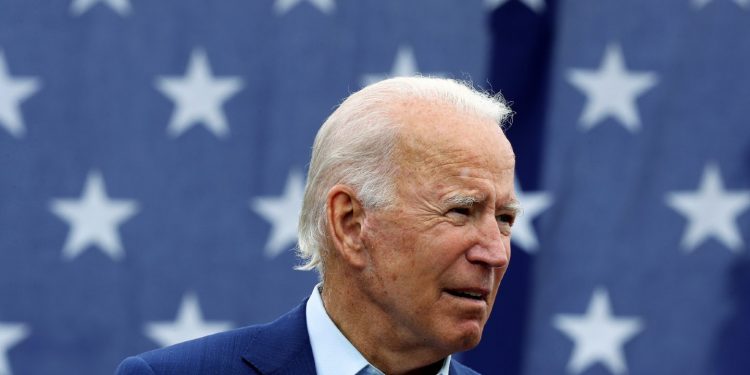
Yesterday, I went on Keeping Democracy Alive with Burt Cohen to discuss ways of ending America’s wars. Click on the link below for the podcast.
Can it Happen Now: Real National Security, an End to Endless Wars?
We discussed the Biden administration and its approach to foreign policy, the Afghan War, the legacy of the Vietnam War, the military-industrial-congressional complex, and similar subjects. That rare word, “peace,” and that rare politician, George McGovern, truly a man of vision and guts, also get a mention.
Ending war is all about getting the profit out of war. General Smedley Butler knew this — yet America’s generals today love their massive “defense” budgets, this year soaring to $740.5 billion.
Another point: Look at the ongoing crisis in Texas with its frozen and failing power grid, lack of potable water, and so on. Why is America building more nuclear weapons when it needs to be upgrading its power grids and related infrastructure?
I know: stop making sense!
W.J. Astore
I live near a salt marsh, and yesterday saw sunny skies and relatively dry air for these parts. Thus it was high time for a walk and a few photos:

People hunt out on the marsh. In this case, these Canadian geese had only to worry about a bad profile in my photo:

Even in February, there are hints of greener days ahead:

Some trees are portals to new places, if you dare:

Open wild spaces: we need them now more than ever

Breathe deep!

Hope you enjoyed these “bracing views”!

W.J. Astore
I’m a big sports fan. I grew up in the Boston area and loved my local teams. When I was a kid, I had two big posters of Bobby Orr, the famed defenseman of the Boston Bruins, on my wall. I had a Boston Red Sox uniform. When I threw a baseball around, I imagined I was Luis Tiant, the mercurial and entertaining pitcher for the Red Sox, or Dwight Evans, the team’s rocket-armed right fielder. I collected baseball cards and studied the stats on the back for hours on end.
But I was also a kid who kept a scrapbook on the Yom Kippur War of 1973. I was ten years old yet I was attracted to war and its nitty-gritty details as much as I was to the sporting world. Who knows why. Temperament, I suppose. As I grew older, I built lots of military models and read more and more books about the military even as I kept an interest in sports (more as a fan than a participant, since my talent level was modest at best).
This was on my mind this AM as I read a detailed article on Red Sox second baseman Dustin Pedroia, whose stellar career was cut short by injuries. The article focused on whether Pedroia deserved election to the Baseball Hall of Fame.* Highly detailed, well written, and showing an estimable command of statistics, the article impressed me even as it got me to thinking. What if Americans examined wars like they studied sports? What if Afghanistan was covered with the same detail as the forthcoming NFL draft? What if there was a channel like ESPN devoted to wars 24/7 rather than to sports? And what if the reporting was objective and honest?
You can’t fool a sophisticated sports fan with a bunch of home-team boosterism that’s disconnected from the facts on the ground (or on the baseball diamond, the football field, the ice hockey rink, etc.). Why are so many people so easily fooled about the need to continue the Afghan War, which is now in its 20th year and where the U.S.-led coalition is losing more than ever?
If the Afghan War were a U.S. sports team, it would be a team that spent more money than any other team even as it lost more games, cycling through a new losing coach every year and an unmemorable cast of players that changed each season. Despite the hiring of much-hyped “coaches” like David Petraeus and Stanley McChrystal, despite promises of pennant-winning “surges” by team presidents like Barack Obama, our imaginary Afghan War sports team was and remains a cellar dweller, forever mired in last place.
What red-blooded American sports fan would tolerate more of the same from such a loser team? What fan would keep cheering for such a team? What fan would say, “let’s stay the course,” even as more and more losses piled up?
Consider this article from yesterday’s New York Times:
*****
The Taliban Close In on Afghan Cities, Pushing the Country to the Brink
The Taliban have positioned themselves around several major population centers, including the capital of Kandahar Province, as the Biden administration weighs whether to withdraw or to stay.
*****
What should Team Biden do? “To stay” is to stay on the same losing course we’ve been on for 20 years. “To withdraw” is a new course that has the virtue of ending the bleeding (at least for the U.S.). Which action would you choose?
Any sports fan worth his or her salt would know the answer here. Call withdrawal a “rebuilding” year and most sports fans would accept it. It’s a far better choice than staying and losing with the same old tactics and cast of characters.
Just about every American sports fan has heard the saying: Winning isn’t everything–it’s the only thing. Well, we’re not winning in Afghanistan and we never will. So the only smart thing left to do is to leave.
*Pedroia gets my vote for the Hall of Fame. It’s not simply about stats. Pedey was a winner, a leader, a gutsy overachiever who played the game the right way. Rookie of the year, MVP, World Series winner, he gave it his all on every play. Sometimes, the so-called intangibles matter.
W.J. Astore
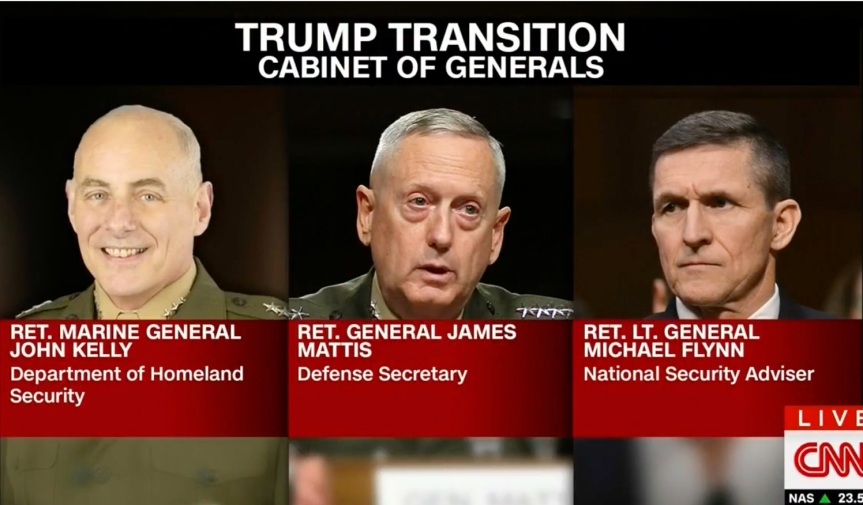
As the Senate prepares to acquit Donald Trump in his second impeachment trial, I thought it would be a good time for a quick look at his legacy on war and militarism. Trump’s fans like to say he started no new wars. But he was hardly a man of peace, and his legacy on war and militarism is almost entirely negative. Here, in no particular order, are my quick thoughts on this subject:
Off the top of my head, that’s my top twelve of Trump’s legacies in this arena. What do you think, readers? Can you think of others? And will any of this really change under Joe Biden?
W.J. Astore
Binary logic is common in America. Us versus them. Republican versus Democrat. BLM versus BLM (that’s Black lives versus blue lives). Love it or leave it.
I remember as a teenager reading a coda to that saying: Or change it. If you don’t “love” America, you shouldn’t have to leave it. Indeed, if you truly “love” America, you’d want to change it to make it even better.
This idea was on my mind as a I watched a couple of videos on YouTube by Americans who’ve been living overseas for many years, only to return recently and reflect on how life in America seemed to them after being away for so long. Here are a few notes I jotted down:
Features of America: Consumerism. Materialism. Advertising everywhere, especially for prescription drugs. Fast pace of life and a stress on competition. A mainstream media that’s propagandistic — and that pushes fear and outrage. Only two major political parties that stifle debate and change. Constant divisiveness.
Features of Americans: Stress on individualism and ethnocentrism. Empathy and our common humanity is downplayed. Sense of entitlement. Lack of curiosity about the wider world. A lack of purpose in the sense of living a life of meaning. Lack of integrity, especially at the higher levels of government and the corporate world.
These observations reminded me of Michael Moore’s “Where to Invade Next” (2015). Moore goes to various countries (Germany, France, Italy, and so on), looking for ideas Americans can steal as they “invade.” I recall German workers who only had to work one job to make ends meet (roughly 37 hours a week, if memory serves), and also German workers who served by law on the board of major companies like Mercedes; I recall school lunches made for French kids by chefs using local ingredients (the contrast with American school lunches was stomach-turning); I recall Italian workers with six weeks of paid vacation per year, as opposed to American workers who are lucky to get two weeks. Why can’t America change to be more worker- and kid-and family-friendly?
The female leaders of Iceland, if memory serves, put it well near the end of Moore’s excursions. They said America is a me-me-me society, whereas Iceland prefers “we” to “me.”
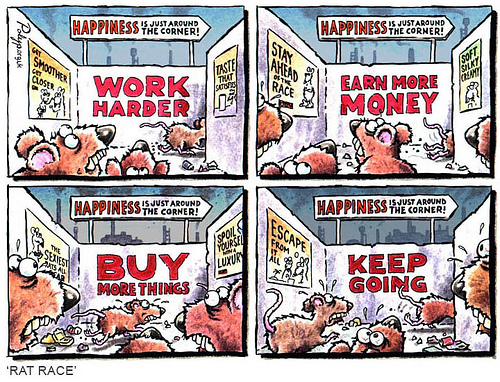
I’ve written before about how Americans are kept divided, distracted, and downtrodden as a way of preventing meaningful, organized, societal change. Another “d” word related to this is discontent. Americans are often discontented in ways that inhibit change. It’s something Tana French touched on in her novel, “The Likeness,” from 2008. Here’s an excerpt:
Our entire society’s based on discontent: people wanting more and more and more, being constantly dissatisfied with their homes, their bodies, their décor, their clothes, everything. Taking it for granted that that’s the whole point of life, never to be satisfied. If you’re perfectly happy with what you’ve got—specially if what you’ve got isn’t even all that spectacular—then you’re dangerous. You’re breaking all the rules, you’re undermining the sacred economy, you’re challenging every assumption that society’s built on. By being content, you become a subversive. A traitor.
To which another character replies: “I think you’ve got something there. Not jealousy, after all: fear… Throughout history—even a hundred years ago, even fifty—it was discontent that was considered the threat to society, the defiance of natural law, the danger that had to be exterminated at all costs. Now it’s contentment.”
There’s a potential paradox here. Won’t the discontented favor positive change, whereas the contented will favor the status quo?
But French’s insight suggests otherwise. The discontented are so busy trying to become contented, most often through a me-first consumerism and materialism, that they can’t come together and mobilize for change. Fear drives them to pursue what their “betters” have, and to admire those people as well. It’s the contented who are dangerous, the ones who’ve left consumerism and materialism behind, the ones with the confidence, time, and independence of thought to contemplate a changed world, a better world. Perhaps even a better America.
W.J. Astore
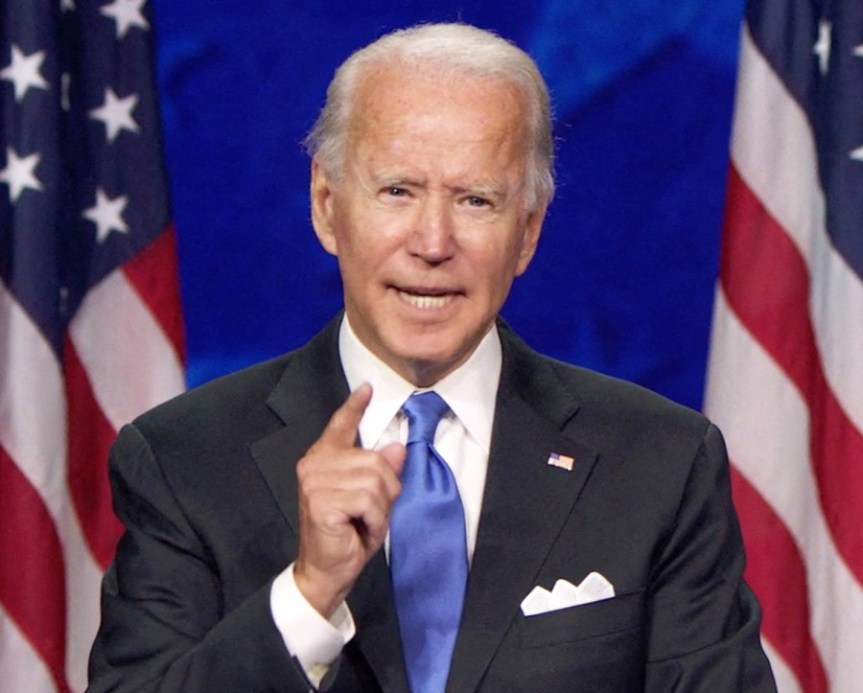
The Senate Trial of Donald Trump begins today, though the outcome seems clear: Trump will be exonerated for his alleged role in inciting the Capitol riot.
Democrats will do their best to put all the blame for this riot on Trump. They would be better advised to focus on why Americans stormed the Capitol to begin with, and why 74 million voters chose Trump — despite all his flaws — as their champion back in November.
Trump voters shouldn’t be shoved en masse into a basket of deplorables. Nor should they be dismissed as being beyond redemption, as Hillary Clinton did in 2016. That an incompetent buffoon like Trump could win so many votes says as much about the (lack of) appeal of the Democratic Party as it says about the grifter skills of Trump.
If Democrats want to continue winning elections while actually doing their jobs as public servants, they’d advance policies that would help ordinary Americans. So far, signs that the Democrats understand this are few. Joe Biden has already said the Covid relief package may not advance the policy of a $15 minimum wage. Covid relief checks, promised at $2000 and pronto, are already reduced and delayed until March at the earliest. Medicare for all is dead; so too is a single-payer option. Biden and Pelosi have promised only extra funds for people to buy high-priced private health care coverage in Obamacare markets.
Americans support Medicare for all. Americans support a higher minimum wage. Americans desperately need Covid relief now. And so far Biden and his establishment Democrats are failing on all of these. This isn’t a bug or glitch in the Democratic matrix, it’s a feature. “Nothing will fundamentally change,” Biden said before his election, and that’s the one promise he may well keep.
Joe Bageant knew the score. A self-confessed “Appalachian native who grew up dirt-eating poor,” Bageant explained how he’d “managed to live a couple of decades in the middle class as a news reporter, magazine editor, and publishing executive.” He also knew to keep his eyes and ears open, writing in September 2008 that “the liberal middle class is condescending to working-class redneck culture–which is insulting, but not a crime. The real crime is the way corporate conservatives lie to my people, screw us blind, kill us in wars, and keep us in economic serfdom.”
If you read “corporate conservatives” as Republicans, you’d be only half-right. As a term, “corporate conservatives” includes Joe Biden, Kamala Harris, and most of the people around them inside the Washington Beltway. That doesn’t bode well for “redneck culture”–and it most certainly doesn’t bode well for the country.
Americans are tired of being lied to and disrespected and mistreated. They are also in many cases desperate for help. Angry and desperate people do not make for normalcy. Nor are they an obliging audience for the tepid and often phony acts of corporate politicians, whether Democrat or Republican.
Reading an article by historian Dennis Showalter*, a friend and mentor, reminded me of how the Nazis mobilized “the petty spite and everyday resentment” of “frustrated little men and good Germans” of the early 1930s. About these people Showalter wrote: “They wanted help. They wanted to voice grievances. They wanted to be heard. They turned to the Nazis because the Nazis expressed sympathy for their problems and implied the possibility of solutions in the framework of a new order.”
Trump’s appeal, of course, was to an old order (Make America Great Again). But it wasn’t entirely retrograde or racist. Trump succeeded in showing sympathy for ordinary Americans, e.g. their loss of jobs due to trade deals that favored the richest of Americans, and he did promise solutions even as he failed to deliver on them. Even after all his debacles and disasters, 74 million Americans still voted for him instead of the Democrats.
A few days ago, I was watching an interview of Ralph Nader as he described the powerbrokers of the Democratic Party. A few of his choice words about them: arrogant, bureaucratic, decrepit, exclusive, and indentured (to corporations and special interests). I don’t think Nader is wrong here.
So, as the Democratic Party postures and sputters against Trump this week, they’d best remember that the real issue is helping ordinary Americans, including those in “redneck culture.” People want to be heard, and if Democrats are unwilling to hear them, others will.
* Showalter, “Letters to Der Sturmer: The Mobilization of Hostility in the Weimar Republic,” Modern Judaism, 3 (May 1983), 173-87.
P.S. If you liked this article, perhaps you’ll consider chipping in $12 as a donation. The PayPal button in the sidebar makes it easy. Thank you.
W.J. Astore
If Bruce Springsteen can make a commercial for Jeep aired during the Super Bowl, I can start accepting a few dollars for content at Bracing Views. (Donations are voluntary.)
Seriously, I’ve been running Bracing Views for five years, and before that I ran The Contrary Perspective, without ever asking for donations or bothering readers with ads.
But site costs are rising, and I suppose I should be open to earning some money for the site.
So I’ve added a PayPal button for $12.00 donations (a buck a month: what a deal!), but it’s purely voluntary. Many thanks if you choose to donate, but no worries if you don’t. These are tough times for many people.
Also, you may now see some ads when you visit the site.
Again, many thanks to all of you for following the site, and for reading and commenting as well.
P.S. I’m just another sellout like Bruce. 🙂
Update (3/29/21): The great donation/ad experiment is over. First, I’d like to thank everyone who chipped in $12.00. Enough people contributed to pay for my site fees and domain registration for the next two years. Hooray!
The ads are another story. Since my site is small, I was lucky to earn $10 a month from ads. And they’re annoying. So I got rid of them. I also removed the PayPal button. Feel free to reach out to me if you wish to contribute. I especially like gold and other precious metals, rare stamps, antique chess sets, fine watches, and bitcoin. Surely my writing is worth it? 🙂
W.J. Astore

It’s Super Bowl Sunday — time to gather together and party responsibly, i.e. don’t turn your party into a Covid super-spreader event.
You can always learn a lot about America by watching the Super Bowl — and I’m not talking about football. Pregame ceremonies are telling, as are the elaborate halftime shows. This year, I noted how the Air Force is selling the story of a female pilot, Captain Sarah Kociuba, who will pilot a B-2 stealth bomber to open the festivities. She’ll be joined by a B-1B Lancer and a B-52 Stratofortress. The message, of course, is “pride” in America.
And I thought only the quarterbacks would be throwing bombs.
Seriously, these bombers are all about mass destruction. Possibly even nuclear mass destruction. Why I should feel “pride” in weapons of mass destruction (WMD) is beyond me.
Look! Up in the sky! It’s American-made WMD. Led by a highly-qualified female pilot. Diversity! America!
Enjoy the game.

W.J. Astore
Today, I was reading some stats about guns in America in The Nation. Did you know gun sales went up 40% in 2020 when compared to 2019? Did you know 3.9 million guns were sold in America in a single month (June 2020), at the height of the BLM protests? Did you know that, according to the trade association for the U.S. firearms industry, Americans own roughly 434 million guns, including 20 million AR-15s and its variants? Did you know that roughly 43% of U.S. households have one or more guns, and that the U.S. has “the most heavily armed civilian population in the world”?
An old joke says that lots of guns make for a polite society, but I haven’t seen much politeness lately. I’ve seen plenty of guns, though.
Even as America dominates the world in gun ownership, we continue to have the world’s largest and potentially cataclysmic array of nuclear weapons. Nuclear deterrence allegedly requires more than five thousand (5000!) nuclear warheads in the U.S. military’s inventory. (It’s quite possible that a mere fifty nuclear explosions could be enough to trigger a global nuclear winter.)
America is indeed exceptional: exceptional in its pursuit of overkill.
I know some might ask: What do guns have to do with nuclear warheads? I’d say that the gun has become the nuclear option in the home. Dead men tell no tales, whether shot or nuked.
Why do Americans feel so safe with so many guns? Why do they feel so safe with so many nuclear warheads? Why do we continue to buy more and more?
It’s a uniquely American form of madness. Or MADness, as in mutually assured destruction.
Look, before the 2nd Amendment crowd comes, packing heat, I’ve owned guns myself and have no objection to anyone who’s a hunter, or anyone who truly needs a gun and gets properly trained in its use. But what we’ve witnessed with the proliferation of guns in America over the last two decades is inexplicable in terms of sport hunting or any real need.
It’s been said we can’t allow the smoking gun to become a mushroom cloud. What if there is, in essence, no difference? Dead is dead, whether shot or nuked, and 434 million guns have a “throw weight” and a “fallout” of their own.
Isn’t it time that Americans found a way to destroy their own weapons of mass destruction? At least we won’t have far to look for them.
 Bracing Views