The Second Cold War

W.J. Astore

Sequels Are Often Far Worse than the Originals

It began in August 1914, a war in Europe that was supposed to be over by Christmas of that year. But it exploded out of control, becoming the “Great War” or “The World War” or even “The War to End All Wars.” And when it finally ended on 11/11 in 1918, something like ten million troops were dead.

We know it as World War I or the First World War because we know what came after it: yet another calamitous world war, a sequel, one that was far worse than the original. And after that war finally ended in 1945, something like 75-80 million people were dead around the world, including 25 million in the Soviet Union, six million Jews in the Holocaust, and 250,000 at Hiroshima and Nagasaki.

Hiroshima, 1945, after a “small” atomic bomb. Nuclear attacks in a “new” Cold War will be inconceivably worse

Of course, World War II also wasn’t the end of the killing. The so-called Iron Curtain descended in Europe, leading to the Cold War between the U.S. and the Soviet Union that almost ended with Armageddon in 1962 during the Cuban Missile Crisis. That Cold War came to an end in 1991 with the collapse of the Soviet Union. The U.S. celebrated its apparent victory, even calling briefly for “peace dividends” in the 1990s. It was not to be.

Thirty years after the (First) Cold War, we now hear of a “new Cold War.” We hear again that China and Russia are America’s enemies, a new “Axis of Evil,” notes Caitlin Johnstone. America is already engaged in a proxy war with Russia in Ukraine. Now America’s leaders are posturing over Taiwan and threatening war with China if the Chinese military makes aggressive moves against that country. (Of course, the Chinese consider Taiwan to be China, a “One China” policy the U.S. used to support.) 

It does seem as if “my” Cold War, when I served in the U.S. military, may be remembered to history as the First Cold War, and that America has already begun a Second Cold War. And, just as World War II was far worse than World War I in casualties and destruction, Cold War II could conceivably be a LOT worse than Cold War I if we choose to continue to wage it.

Sequels, as a general rule, are usually worse, sometimes far worse, than the originals. We had better stop this nonsense of a new Cold War before we relearn this in the hardest way possible.

Meet the New Holocaust Missile and Armageddon Submarine

W.J. Astore

Names Like Minuteman, Peacekeeper, and Sentinel Are Diabolically Dishonest

Ever think about names of U.S. weapons of war? Rarely are those names honest. I do applaud the relative honesty of Predator and Reaper drones, because those names capture the often predatory nature of U.S. foreign policy and the grim reaperish means that are often employed in its execution. Most names are not so suggestive. For example, U.S. fighter planes carry noble names like Eagle, Fighting Falcon, or Raptor. Nuclear bombers are an interesting case since they can carry thermonuclear bombs and missiles to kill hundreds of thousands, possibly millions, of people. So we have the B-52 Stratofortress (a great 1950s-era name), the B-1 Lancer, the B-2 Spirit, and the new B-21 Raider (the name has historical echoes to the Doolittle Raid on Tokyo in 1942).

Reaping what we sow? Just reaping? Whatever the case, the U.S. way of war is grim

Shouldn’t these bombers carry names like Megadeath or Mass Murder?

Think too of nuclear missiles. The Air Force’s Intercontinental Ballistic Missiles (ICBMs) have had names like Titan, Minuteman, Peacekeeper, and now the new Sentinel. But since these missiles carry warheads that could easily kill millions, wouldn’t a more honest name be The Holocaust ICBM? For that’s what these missiles promise: a nuclear holocaust.

Consider too the Navy’s Ohio-class nuclear missile-firing submarines (SSBN) with their Trident missiles. (Trident—gotta hand it to the Navy.) Just one submarine can carry 20 Trident II missiles, each with up to eight warheads, each warhead being roughly equivalent to six Hiroshima bombs. Again, roughly speaking, each of these submarines carries an arsenal equivalent to one thousand Hiroshima bombs. And the U.S. has fourteen of these submarines.

Instead of the Ohio-class of submarines, shouldn’t they be called the Armageddon-class? Or the Apocalypse-class? The Genocide-class?

With a bit more honesty, perhaps it wouldn’t be so easy to sell these horrific weapons to Congress and the American people. Then again, when the bottom line is higher budgets for the Pentagon and more jobs for Congressional districts, I guess America will buy most anything. Even Holocaust missiles and Armageddon submarines. And for upwards of $2 trillion over the next 30 years as well.

If they don’t bust the budget, perhaps they’ll destroy the world.

Dwight Eisenhower on the Cost of Permanent War

W.J. Astore

Ike’s Cross of Iron Speech, 70 Years Later

If Dwight Eisenhower could somehow give his 1953 “Cross of Iron” address and his 1961 warning about the military-industrial complex to the American people today, I truly believe he’d be dismissed by the mainstream media (MSM) as a Putin puppet and as repeating Kremlin talking points. Why? Because Ike advocated for negotiation and peace instead of war; he documented how spending on weapons was intrinsically wasteful and a bane to democratic society; and he challenged citizens to be alert and knowledgeable, ready to take action against the growing power of a corporate-military nexus supported and strengthened by Congress.

To mark Ike’s integrity and wisdom, and also to update his cost calculations from 1953 for the present day, I wrote this article, my latest for TomDispatch.com. Again, the words of Ike, focusing on peace, the preciousness and burdens of democracy, and the dangers of militarism, are rarely if ever heard in our government and in the MSM today. And that suggests we are in a dark place indeed in this country of ours.

In April 1953, newly elected President Dwight D. Eisenhower, a retired five-star Army general who had led the landings on D-Day in France in June 1944, gave his most powerful speech. It would become known as his “Cross of Iron” address. In it, Ike warned of the cost humanity would pay if Cold War competition led to a world dominated by wars and weaponry that couldn’t be reined in. In the immediate aftermath of the death of Soviet dictator Josef Stalin, Ike extended an olive branch to the new leaders of that empire. He sought, he said, to put America and the world on a “highway to peace.” It was, of course, never to be, as this country’s emergent military-industrial-congressional complex (MICC) chose instead to build a militarized (and highly profitable) highway to hell.

Eight years later, in his famous farewell address, a frustrated and alarmed president called out “the military-industrial complex,” prophetically warning of its anti-democratic nature and the disastrous rise of misplaced power that it represented. Only an alert and knowledgeable citizenry, fully engaged in corralling, containing, and constraining it, he concluded, could save democracy and bolster peaceful methods and goals. 

The MICC’s response was, of course, to ignore his warning, while waging a savage war on communism in the name of containing it. In the process, atrocious conflicts would be launched in Vietnam, Laos, and Cambodia as the contagion of war spread. Threatened with the possibility of peace in the aftermath of the Soviet Union’s collapse in 1991, the MICC bided its time with operations in Iraq (Desert Storm), Bosnia, and elsewhere, along with the expansion of NATO, until it could launch an unconstrained Global War on Terror in the aftermath of the attacks of September 11, 2001.  Those “good times” (filled with lost wars) lasted until 2021 and the chaotic U.S. withdrawal from Afghanistan.

Not to be deterred by the fizzling of the nightmarish war on terror, the MICC seized on a “new cold war” with China and Russia, which only surged when, in 2022, Vladimir Putin so disastrously invaded Ukraine (as the U.S. had once invaded Afghanistan and Iraq). Yet again, Americans were told that they faced implacable foes that could only be met with overwhelming military power and, of course, the funding that went with it — again in the name of deterrence and containment. 

In a way, in 1953 and later in 1961, Ike, too, had been urging Americans to launch a war of containment, only against an internal foe: what he then labeled for the first time “the military-industrial complex.” For various reasons, we failed to heed his warnings. As a result, over the last 70 years, it has grown to dominate the federal government as well as American culture in a myriad of ways. Leaving aside fundingwhere it’s beyond dominant, try moviesTV showsvideo gameseducationsports, you name it. Today, the MICC is remarkably uncontained. Ike’s words weren’t enough and, sadly, his actions too often conflicted with his vision (as in the CIA’s involvement in a coup in Iran in 1953). So, his worst nightmare did indeed come to pass. In 2023, along with much of the world, America does indeed hang from a cross of iron, hovering closer to the brink of nuclear war than at any time since the Cuban Missile Crisis of 1962.

Updating Ike’s Cross of Iron Speech for Today

Perhaps the most quoted passage in that 1953 speech addressed the true cost of militarism, with Ike putting it in homespun, easily grasped, terms. He started by saying, “Every gun that is made, every warship launched, every rocket fired signifies, in the final sense, a theft from those who hunger and are not fed, those who are cold and are not clothed.” (An aside: Can you imagine Donald Trump, Joe Biden, or any other recent president challenging Pentagon spending and militarism so brazenly?)

Ike then added:

“This world in arms is not spending money alone. It is spending the sweat of its laborers, the genius of its scientists, the hopes of its children. The cost of one modern heavy bomber is this: a modern brick school in more than 30 cities. It is two electric power plants, each serving a town of 60,000 population. It is two fine, fully equipped hospitals. It is some fifty miles of concrete pavement. We pay for a single fighter plane with a half million bushels of wheat. We pay for a single destroyer with new homes that could have housed more than 8,000 people.”

He concluded with a harrowing image: “This is not a way of life at all, in any true sense. Under the cloud of threatening war, it is humanity hanging from a cross of iron.”

Ike’s cost breakdown of guns versus butter, weapons versus civilian goods, got me thinking recently: What would it look like if he could give that speech today? Are we getting more bang for the military megabucks we spend, or less?  How much are Americans sacrificing to their wasteful and wanton god of war?

Let’s take a closer look. A conservative cost estimate for one of the Air Force’s new “heavy” strategic nuclear bombers, the B-21 Raider, is $750 million. A conservative estimate for a single new fighter plane, in this case the F-35 Lightning II, is $100 million. A single Navy destroyer, a Zumwalt-class ship, will be anywhere from $4 to $8 billion, but let’s just stick with the lower figure. Using those weapons, and some quick Internet sleuthing, here’s how Ike’s passage might read if he stood before us now:

“The cost of one modern heavy bomber is this: a modern brick-veneer and reinforced concrete school in 75 cities.  It is five electric power plants, each serving a town with 60,000 inhabitants. It is five fine, fully equipped hospitals. It is some 150 miles of pavement. We pay for a single fighter plane with more than 12 million bushels of wheat. We pay for a single destroyer with new homes that could have housed more than 64,000 people.”

(Quick and dirty figures for the calculations above: $10 million per elementary school; $150 million per power plant [$5,000/kilowatt for 30,000 homes]; $150 million per hospital; $5 million per new mile of road; $8 per bushel of wheat; $250,000 per home for four people.)

Grim stats indeed! Admittedly, those are just ballpark figures, but taken together they show that the tradeoff between guns and butter — bombers and jet fighters on the one hand, schools and hospitals on the other — is considerably worse now than in Ike’s day. Yet Congress doesn’t seem to care, as Pentagon budgets continue to soar irrespective of huge cost overruns and failed audits (five in a row!), not to speak of failed wars.

Without irony, today’s MICC speaks of “investing” in weapons, yet, unlike Ike in 1953, today’s generals, the CEOs of the major weapons-making corporations, and members of Congress never bring up the lost opportunity costs of such “investments.” Imagine the better schools and hospitals this country could have today, the improved public transportation, more affordable housing, even bushels of wheat, for the cost of those prodigal weapons and the complex that goes with them. And perish the thought of acknowledging in any significant way how so many of those “investments” have failed spectacularly, including the Zumwalt-class destroyers and the Navy’s Freedom-class littoral combat ships that came to be known in the Pentagon as “little crappy ships.”

Speaking of wasteful warships, Ike was hardly the first person to notice how much they cost or what can be sacrificed in building them. In his prescient book The War in the Air, first published in 1907, H.G. Wells, the famed author who had envisioned an alien invasion of Earth in The War of the Worlds, denounced his own epoch’s obsession with ironclad battleships in a passage that eerily anticipated Ike’s powerful critique:

The cost of those battleships, Wells wrote, must be measured by:

“The lives of countless men… spent in their service, the splendid genius and patience of thousands of engineers and inventors, wealth and material beyond estimating; to their account we must put stunted and starved lives on land, millions of children sent to toil unduly, innumerable opportunities of fine living undeveloped and lost. Money had to be found for them at any cost—that was the law of a nation’s existence during that strange time.  Surely they were the weirdest, most destructive and wasteful megatheria in the whole history of mechanical invention.”

Little could he imagine our own era’s “wasteful megatheria.” These days, substitute nuclear intercontinental ballistic missiles, strategic bombers, aircraft carriers, and similar “modern” weapons for the ironclads of his era and the sentiment rings at least as true as it did then. (Interestingly, all those highly touted ironclads did nothing to avert the disaster of World War I and had little impact on its murderous course or ponderous duration.)

Returning to 1953, Eisenhower didn’t mince words about what the world faced if the iron cross mentality won out: at worst, nuclear war; at best, “a life of perpetual fear and tension; a burden of arms draining the wealth and labor of all peoples; a wasting of strength that defies the American system, or the Soviet system, or any system to achieve true abundance and happiness for the peoples of this earth.”

Ike’s worst-case scenario grows ever more likely today. Recently, Russia suspended the START treaty, the final nuclear deal still in operation, that oversaw reductions in strategic nuclear weapons.  Instead of reductions, Russia, China, and the United States are now pursuing staggering “modernization” programs for their nuclear arsenals, an effort that may cost the American taxpayer nearly $2 trillion over the coming decades (though even such a huge sum matters little if most of us are dead from nuclear war).

In any case, the United States in 2023 clearly reflects Ike’s “cross of iron” scenario. It’s a country that’s become thoroughly militarized and so is slowly wasting away, marked increasingly by feardeprivation, and unhappiness.

It’s Never Too Late to Change Course

Only Americans, Ike once said, can truly hurt America.  Meaning, to put the matter in a more positive context, only we can truly help save America. A vital first step is to put the word “peace” back in our national vocabulary.

“The peace we seek,” Ike explained 70 years ago, “founded upon a decent trust and cooperative effort among nations, can be fortified, not by weapons of war but by wheat and by cotton, by milk and by wool, by meat and timber and rice. These are words that translate into every language on earth. These are the needs that challenge this world in arms.”

The real needs of humanity haven’t changed since Ike’s time. Whether in 1953 or 2023, more guns won’t serve the cause of peace. They won’t provide succor. They’ll only stunt and starve us, to echo the words of H.G. Wells, while imperiling the lives and futures of our children.

This is no way of life at all, as Ike certainly would have noted, were he alive today.

Which is why the federal budget proposal released by President Biden for 2024 was both so painfully predictable and so immensely disappointing. Calamitously so. Biden’s proposal once again boosts spending on weaponry and war in a Pentagon budget now pegged at $886 billion. It will include yet more spending on nuclear weapons and envisions only further perpetual tensions with “near-peer” rivals China and Russia.

This past year, Congress added $45 billion more to that budget than even the president and the Pentagon requested, putting this country’s 2023 Pentagon budget at $858 billion. Clearly, a trillion-dollar Pentagon budget is in our collective future, perhaps as early as 2027. Perish the thought of how high it could soar, should the U.S. find itself in a shooting war with China or Russia (as the recent Russian downing of a U.S. drone in the Black Sea brought to mind).  And if that war were to go nuclear…

The Pentagon’s soaring war budget broadcast a clear and shocking message to the world. In America’s creed, blessed are the warmakers and those martyrs crucified on its cross of iron.

This was hardly the message Ike sought to convey to the world 70 years ago this April. Yet it’s the message the MICC conveys with its grossly inflated military budgets and endless saber-rattling.

Yet one thing remains true today: it’s never too late to change course, to order an “about-face.” Sadly, lacking the wisdom of Dwight D. Eisenhower, such an order won’t come from Joe Biden or Donald Trump or Ron DeSantis or any other major candidate for president in 2024. It would have to come from us, collectively. It’s time to wise up, America. Together, it’s time to find an exit ramp from the highway to hell that we’ve been on since 1953 and look for the on-ramp to Ike’s highway to peace.

And once we’re on it, let’s push the pedal to the metal and never look back.

Learning Little from the Iraq War

W.J. Astore

Military Invasions Don’t Produce Democracies

Military invasions don’t produce democracies—who knew? Whether in Afghanistan or Iraq, somehow the U.S. government worked to convince itself and the American people that democracy could be exported at rifle point. Not surprisingly, military invasions spread what they usually do: death, destruction and chaos while sowing seeds for further violence and conflict. Such is one of the many lessons of Bush/Cheney’s disastrous decision to invade Iraq 20 years ago this weekend.

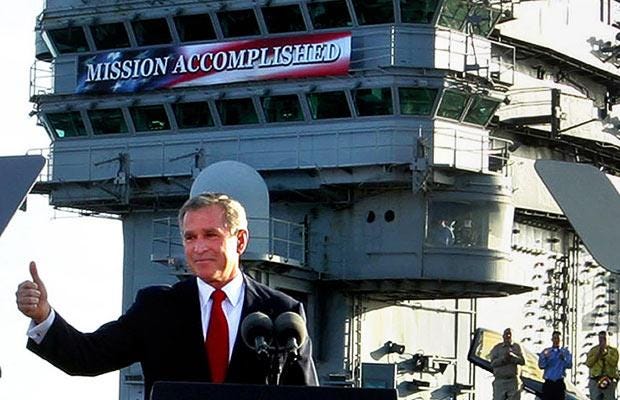
When the U.S. invaded Iraq in March of 2003, I was still on active duty in the military. I was a lieutenant colonel assigned to the Defense Language Institute Foreign Language Center in Monterey, California, or DLI for short. I can tell you this: the U.S. government expected a short and utterly victorious war, since there was no direction to us to expand foreign language training in Arabic. Only after Bush’s premature “Mission Accomplished” speech and the war’s subsequent degeneration into occupation, torture, battles of frustration like Fallujah, and subsequent quagmire did DLI finally get direction and more resources to expand training in Arabic.

Mission Accomplished! But the Iraq War had only just begun.

That led to my first and only interview as a military officer in May 2005, when a reporter for the CS Monitor asked me about the importance of language training for U.S. troops. Here was my glib reply:

“We are trying to win the peace, and it is very important for us to be able to communicate even at a basic level,” says Lt. Col. William Astore, dean of students at the DLI. “I would much rather have soldiers communicate using words rather than using a rifle butt.”

OK as far as it went, but by the middle of 2005 we had already lost the peace in Iraq and Afghanistan. For one thing, we simply had too few troops with language skills, and it took 16 months to train them to a decent level of competence in Arabic. So we resorted to those rifle butts—and worse.

Another minor controversy at the time was the loss of skilled linguists to the military’s “Don’t ask, don’t tell” policy. As soon as a soldier said he was gay, he was basically gone, regardless of his language proficiency. A few troops gamed the system, finishing the bulk of their language training then self-reporting they were gay. That was enough to get them discharged.

Along with that mess, I recall a friend of mine, an Army major, being sent to Iraq in 2004 and working for the CPA, the Coalition Provisional Authority. He said he and his colleagues at the CPA knew Iraq wasn’t ready for the transfer of power overseen by the hapless L. Paul Bremer, but it went ahead anyway for political reasons. 

He also told me how the military filled billets at the CPA and in the Green Zone of Baghdad. Basically, Big Army tasked unit commanders for bodies. The DLI Commandant sent one of his best officers, an experienced and skilled FAO (foreign area officer). But many other commanders took advantage of this “draft” by sending their worst officers to Iraq, the under-performers. At the same time, the Bush/Cheney administration was recruiting inexperienced civilians for Iraq and vetting them based on their views on abortion, capital punishment, and similar hot-button issues within the Republican Party. Combine less-than-competent officers with unprepared and largely clueless civilians and it’s not surprising the CPA performed poorly.

My experience with the chaos of Iraq was indirect and limited, but I well recall an urgent tasking to DLI to help with the translation of a Peter, Paul & Mary song to promote tolerance within Iraqi schools. No, I’m not kidding. Some American in Iraq decided a smart way of defusing ethnic and religious tensions in Iraq was to translate a song for kids. So we gathered some of our best Arabic instructors and quickly learned the song was more than problematic. It was about American kids making fun of other kids with braces and glasses, but any Iraqi kid with braces or glasses would be fortunate indeed. Other lines of the song mentioned gays, lesbians, and a teenage mother trying to overcome her past — not a place we wanted to go.

The song just didn’t translate, just like much of the American effort “to win the peace” and build a stable democratic Iraq didn’t translate (if you accept for the moment that that was the true mission). Too many Americans were prisoners of their own illusions in Iraq, or trying to make a fast buck, while troops at the front were simply fighting to survive a ghastly war, a war that was obviously far worse for the Iraqi people.

In the first few weeks of the Iraq invasion in 2003, the U.S. military did its job fairly well, and by that I mean the narrow mission of destroying Iraqi forces and overthrowing Saddam Hussein. After that, it was one disaster after another, one lie after another, because once Saddam was removed from power and the Iraqi military was disbanded, all hell broke loose. Civil war was the result, and, as I wrote in 2007, you can’t win someone else’s civil war. What we got in place of a “win” were the lies of Bush/Cheney and of General David Petraeus about “progress” in the Surge. But as the weasel Petraeus always said, his “gains” were fragile and reversible, and so they proved.

Of course, the Iraq War was based on alarmist lies (those WMD that weren’t there, those mushroom clouds in American skies). It was then preserved by lies until the lies could no longer be countenanced (or until they proved no longer profitable). Yet the liars were promoted (whether in the military or outside of it) and those who warned of the folly of war 20 years ago or those who tried to reveal the truth about war crimes or profiteering during the war were punished. 

Though Donald Rumsfeld lost his job as Defense Secretary, few in the hierarchy were ever called to account for their crimes and blunders, so little was learned and much was forgotten.

So, it’s on to the next war, this time with China or Russia or Iran or whomever, but not to worry, the experts that brought you Iraq and Afghanistan and all the rest will get it right. Just look at their track record and how much they’ve learned!

Daniel Ellsberg and the Madness of Nuclear Weapons

W.J. Astore

Honoring the wisdom of an anti-war hero

I woke this morning to the sad news that Daniel Ellsberg has pancreatic cancer and has been given only a few months to live. Ellsberg has lived a long and heroic life; he famously leaked the Pentagon papers, risking lifelong imprisonment to put a stop to America’s calamitous and atrocious war against Vietnam.

Five years ago, I read Ellsberg’s book on his years as a nuclear war theorist for the U.S. government. I was so impressed (and so alarmed) that I immediately wrote my own review of it, which I’m reposting today in Ellsberg’s honor.

Ellsberg is one of the giants of recent American history. He has lived a life of great value. Perhaps the best way to honor him is to read him, listen to him, and act to put a stop to our collective nuclear madness.

The Doomsday Machine: The Madness of America’s Nuclear Weapons

41zhRYUMyYL

(Originally posted 12/28/17)

I just finished Daniel Ellsberg’s new book, The Doomsday Machine: Confessions of a Nuclear War Planner.  Talk about hair-raising!  Ellsberg, of course, is famous for leaking the Pentagon papers, which helped to end the Vietnam war and the presidency of Richard Nixon as well.  But before Ellsberg worked as a senior adviser on the Vietnam war, he helped to formulate U.S. nuclear policy in the late 1950s and early 1960s.  His book is a shattering portrayal of the genocidal nature of U.S. nuclear planning during the Cold War — and that threat of worldwide genocide (or omnicide, a word Ellsberg uses to describe the death of nearly everything from a nuclear exchange that would generate disastrous cooling due to nuclear winter) persists to this day.

Rather than writing a traditional book review, I want to list some memorable facts and lessons I took from the book, lessons that should lead us to question the very sanity of America’s leaders.  To wit:

  1. U.S. nuclear war plans circa 1960 envisioned a simultaneous attack on the USSR and China that would generate 600 million deaths after six months.  As Ellsberg notes, that is 100 Holocausts.  This plan was to be used even if China hadn’t directly attacked the U.S., i.e. the USSR and China were lumped together as communist bad guys who had to be eliminated together in a general nuclear war.  Only one U.S. general present at the briefing objected to this idea: David M. Shoup, a Marine general and Medal of Honor winner, who also later objected to the Vietnam War.
  2. The U.S. military consistently overestimated the Soviet nuclear threat, envisioning missile and bomber gaps that didn’t exist.  In the nuclear arms race, the U.S. was often racing itself in the fielding of more and more nuclear weapons.
  3. General Curtis LeMay, the famous commander of Strategic Air Command (SAC) and later AF Chief of Staff, said that once war started, politicians like the president had no role to play in decision-making.
  4. When the atomic bomb was first tested in 1945, there were fears among the scientists involved that the atmosphere could be ignited, ending all life on earth.  The chance was considered remote (perhaps 3 in a million), so the scientists pressed ahead.
  5. The Cuban Missile Crisis of 1962 came much closer to nuclear war than most people recognize.  Soviet submarines in the area, attacked by mock U.S. depth charges, were prepared to launch nuclear torpedoes against U.S. ships.  Fidel Castro’s air defenses were also preparing to shoot down American planes, which may have ended in U.S. air attacks and an invasion in which Soviet troops on Cuba may have used nuclear weapons to defend themselves.
  6. The U.S. military was (and probably still is) extremely reluctant to reveal nuclear secrets to senior American civilian leaders, including even the President himself.  Ellsberg, possessing the highest security clearances and acting with presidential authority, had to pry answers from military officers who refused to provide detailed and complete information.
  7. The U.S. has always refused, and continues to refuse, to pledge to a “no first use” policy for nuclear weapons.
  8. The U.S. remains the only country to have used nuclear weapons (Hiroshima and Nagasaki).  Yet, as Ellsberg notes, the U.S. uses nuclear weapons all the time — by threatening their use, as President Eisenhower did during the Korean War, as President Nixon did during the Vietnam War, and as President Trump is doing today, promising “fire and fury” against North Korea.  The U.S. uses nuclear weapons like a loaded gun — holding it to an enemy’s head and threatening to pull the trigger, Ellsberg notes.  In short, there’s nothing exceptional about Trump and his nuclear threats.  All U.S. presidents have refused to take nuclear attacks “off the table” of options for U.S. action.
  9. Interservice rivalry has always been a driver of U.S. nuclear force structure and strategy.  The Navy (with its nuclear submarine programs, Polaris followed by Trident) and especially the Air Force (with its ICBMs and bombers) jealously guard their nuclear forces and the prestige/power/budgetary authority they convey.
  10. President Eisenhower’s emphasis on massive retaliation (as represented by SAC and its war plan, the SIOP) was a way for him to limit the power of the military-industrial complex (MIC).  But once Ike was gone, so too was the idea of using the nuclear deterrent as a way of restricting U.S. expenditures on conventional weaponry and U.S. adventurism in foreign wars, e.g. Vietnam.  (It should be said that Ike’s exercise at limiting the MIC in America held the world as a nuclear hostage.)
  11. Ellsberg shows convincingly that control over U.S. nuclear weapons was decentralized and delegated to much lower levels than most Americans know.  It’s not the case that only the president can launch a nuclear war.  Especially in the late 1950s and early 1960s, Ellsberg shows how it was possible that field-grade officers (majors and colonels) could have made decisions in the heat of battle to release nuclear weapons without direct orders from the president.
  12. Most Americans, Ellsberg notes, still don’t understand the huge quantitative and qualitative differences between atomic bombs and hydrogen (thermonuclear) weapons.  Hydrogen bombs are measured in megatons in equivalent TNT yield; atomic bombs are in kilotons.  In short, hydrogen bombs are a thousand times more destructive than atomic ones.  And this is just their explosive yield.  Radioactive fallout and massive fires are even bigger threats to life on earth.
  13. Most Americans still don’t understand that even a smallish nuclear exchange involving a few dozen hydrogen bombs could very well lead to nuclear winter and the deaths of billions of people on the earth (due to the widespread death of crops and resulting famine and disease).
  14. Despite the genocidal threat of nuclear weapons, the U.S. is persisting in plans to modernize its arsenal over the next 30 years at a cost of $1 trillion.

Ellsberg sees this all as a form of collective madness, and it’s hard to disagree.  He quotes Nietzsche to the effect that madness in individuals is rare, but that it’s common among bureaucracies and nations.  The tremendous overkill inherent to U.S. nuclear weapons — its threat of worldwide destruction — is truly a form of madness.  For how do you protect a nation or uphold its ideals by launching a nuclear war that would kill nearly everyone on earth?  How does that make any sense?  How is that not mad?

Ellsberg ends his “confessions” with many sane proposals for downsizing nuclear arsenals across the world.  But is anyone in power listening?  Certainly not U.S. presidents like Trump or Obama, who both signed on to that trillion dollar modernization program for U.S. nuclear weapons.

Ellsberg shows us there have been many chair-bound paper-pushers in the U.S. government who’ve drawn up plans to murder hundreds of millions of people — to unleash doomsday — all in the name of protecting America.  He also shows how close they’ve come to doing just that, especially during the Cuban Missile Crisis, but during other crises as well.

Nuclear brinksmanship, threats of nuclear war, and similar uses of nuclear weapons to intimidate hold the potential for catastrophe.  Miscalculations, mishaps, mistakes, are more than possible in an atmosphere of mistrust, when words and actions can be misinterpreted.

Ellsberg’s recommendations for changes point the way to a better world, a world where the threat of nuclear doomsday could be much reduced, perhaps eliminated completely.  The question remains: Is anyone in power listening?

The Military-Industrial Complex and American Fascism

W.J. Astore

Since Ike’s warning more than 60 years ago, the MIC has only grown stronger and more anti-democratic

President Dwight D. Eisenhower (Ike) had it right.  The military-industrial complex (MIC) is fundamentally anti-democratic.  The national security state has become the fourth branch of government and arguably the most powerful one.  It gets the most money, more than half of the federal discretionary budget, even as the military remains America’s most trusted institution, despite a woeful record in wars since 1945.

A colleague, Christian Sorensen, says that when we look closely at the MIC we see something akin to American fascism. As he put it to me: “Our fascism certainly doesn’t look like past European movements, but it is far more durable, has killed millions and millions (SE Asia, Indonesia, Central America, Middle East), and has manifold expressions: wars abroad, wars at home, surveillance state, digital border, militarized law enforcement, economic warfare in the form of sanctions, militarization of space.”

It’s hard not to agree with him, not in the sense of Hitler’s Germany or Mussolini’s Italy but in the sense of concentrated government/corporate power that draws sustenance from nationalism at home and imperialism abroad. It’s true that America doesn’t have goose-stepping soldiers in the street. There are no big military parades (though Donald Trump once wanted one). It still seems like we have contending political parties. But when we look deeper, a militant nationalism and aggressive imperialism powered by corporations and enforced by government, including notably the Supreme Court, is the salient feature of this American moment.

Consider the classic symbol of the fasces, from which the word fascism is drawn. It’s a bundle of rods bound tightly together — the idea being that while one rod may be bent or broken, a bundle of them becomes far more resistant to bending or breaking.  For me, this image conjures the MICIMATT.  Bundle the military with industry, add Congress, roughly 17 intelligence agencies, the media, academe, and various think tanks, then bind them with nearly a trillion dollars and enormous political and cultural authority and you create a structure that is far stronger, insidiously so, than the sum of its individual parts.

Fasces, or rods bundled and bound together, sometimes with an axe head. A decent symbol for the MICIMATT

This is exactly what the MICIMATT constitutes: an imperial bundling and binding of powerful interests that possesses and commands enormous resources, including most importantly mental and emotional ones, like appeals to patriotism and the flag. Consider the mainstream media (MSM), which nowadays is pro-war, pro-military, and therefore highly critical of anti-war protests. Indeed, the MSM today in the U.S. employs retired generals, admirals, and ex-CIA and ex-FBI officials to support the establishment and attack and dismiss critics of the same as naive (at best) or as dupes or puppets of various enemies (most often of Russia).

Consider, for example, the smear in 2020 of Democratic Congresswoman Tulsi Gabbard, a veteran of the Iraq War who continues to serve in the Army National Guard. NBC News, together with prominent establishment figures like Hillary Clinton, portrayed Gabbard as a potential Russian asset and the favorite candidate of the Kremlin. Gabbard’s “crime” was her criticism of disastrous regime-change wars (such as Iraq) that Clinton had enthusiastically supported, along with Gabbard’s statements that echoed Ike in their criticism of the MIC.

Influential critics of war and the MIC are neutralized. For its prescient criticism of the Iraq War, Phil Donahue’s show was cancelled. Reporter Ashleigh Banfield, who critiqued Iraq War coverage, was demoted. Former Governor Jesse Ventura was hired to a lucrative three-year contract, then put on ice when MSNBC discovered he was against the Iraq War. Worse is the punishment allotted to those who truly embarrass the MIC, such as Chelsea Manning and Daniel Hale. Both were imprisoned for showing the American people the ugly face of the MIC’s wars. Worst of all is the persecution of Julian Assange, an Australian citizen who the U.S. government is seeking to prosecute and jail under laws passed during World War I to deter internal dissent within America. Edward Snowden, meanwhile, remains exiled in Russia, perhaps permanently, since to allow him to return might inspire other patriotic whistleblowers to come forward—and we can’t have that in the land of the free. 

But I can write my blog so I’m free, right? The MIC is not worried by my critique. If it can survive and flourish despite Ike’s warning, it can certainly ignore me.  We the people have no real power unless we too can combine. Sadly, a weakness of antiwar forces in America is internal disagreements and bickering, as witnessed recently before the Rage Against the War Machine Rally in DC. The MIC, in contrast, is tightly bound by greed and power.

Bending or breaking the MICIMATT seems well-nigh impossible. It could be weakened by making substantial cuts to its budget, but Congress insists on feeding it more money, not less, despite enormous waste and five failed audits in a row for the Pentagon.

If bending and breaking it is impossible, can we light it on fire? To do that would require a powerful incendiary movement, a concentrated blast as if from a flamethrower, yet the MICIMATT is wrapped in a fire-resistant coating of patriotic cant, so even incendiary ideas and actions have their limits.

Returning to Ike, I continue to find it painfully ironic (and tragic) that his warning about the MIC has been buried even at the Eisenhower Memorial in Washington, D.C. Not only buried: Ike’s warning has been downgraded to a caution and interpreted by a narrator sponsored by Boeing, a leading merchant of death in the MIC.

So, despite an article I wrote ten years ago, critiquing the idea of American fascism, I find myself coming to accept it, especially as Democrats try to outdo Republicans in embracing war, militarism, and weapons sales as the health of the state. With so-called progressives voting for massive war budgets, where is the hope and change?

I know progressives make noises about cutting the war budget, thus Barbara Lee and Mark Pocan are yet again sponsoring legislation to cut that budget by $100 billion. It’s pretty much a scam, notes David Swanson. They are allowed to do this because the MIC knows their initiative stands no hope of passing. Meanwhile, Republicans like Matt Gaetz have their own effort to cut Ukraine war funding, an effort also doomed to fail. What America truly needs is a bipartisan effort against the war machine, but instead it’s the MIC that continues to enjoy strong bipartisan support. The MIC is bound together (thus its strength); its opponents are both too disputatious and too few.

Which brings me to a sentiment attributed to Sinclair Lewis (though he didn’t use these exact words): If fascism comes to America, it will be wrapped in the flag and carrying a cross. Certainly, the MIC is wrapped in the flag. Remarkable too is how U.S. militarism is embraced as a form of muscular Christianity, a sign of America’s righteousness, with might making right. Across Christianity in America today, one hears remarkably little criticism of war, killing, and genocidal nuclear weapons. The vision of Christ as a peacemaker was long ago replaced by “Peacekeeper” nuclear missiles. Meanwhile, new nuclear ICBMs, bombers, and submarines are under construction today, increasing the chances of apocalyptic war (while guaranteeing large profits for the MIC).

Again, Ike warned us that the MIC is fundamentally anti-democratic. And, whatever else it is, the MIC is certainly not communist or leftist. Is it America’s version of fascism? That conclusion may seem shrilly alarmist, but that is arguably what we need: a shrill alarm to awaken us from our slumber.

Magical Weapons for Ukraine

W.J. Astore

Lessons from World War I

If you read the mainstream media, it would seem the answer to the Russia-Ukraine War, now about to enter its second year of mass death and widespread destruction, is weapons of various sorts. Western tanks like the German Leopard and American Abrams. Fighter jets like the F-16 produced by Lockheed Martin. If only Ukraine had more tanks, more jets, and the like, they would be able decisively to defeat the Russian military, ejecting it from Ukrainian territory, even from the Crimea, so the argument goes.

As a historian of technology and warfare, I’ve studied this belief in magical weapons. History teaches us that weapons alone usually do not determine winners and losers in war. Weapons themselves are rarely decisive, especially when the sides engaged fight symmetrically. In such cases, new weaponry often increases the carnage.

Consider the events of World War I. Various weapons were tried in an attempt to win the war decisively through military action. These weapons included poison gas (of various types), tanks, flamethrowers, and submarines, among others. None of these weapons broke the stalemate on the Western Front. Countermeasures were found. And World War I dragged on for more than four long years, producing hecatombs of dead.

Image from “All Quiet on the Western Front,” 2022, Netflix

What did work? In a word, exhaustion. In the spring of 1918, Germany launched massive, last-ditch, offensives to win the war before U.S. troops arrived in Europe in large numbers. (The U.S. had entered the war in 1917 but was still mobilizing in 1918.) The Germans came close to winning, but when their offensives grounded to a halt, they had little left in the tank to endure Allied counterattacks. Yes, the Allies had more tanks than the Germans, and were learning to use them effectively with airpower in combined arms assaults. But what truly mattered was exhaustion within the German ranks, exacerbated by the Spanish flu, hunger, and demoralization.

No magical weapon won World War I. And no magical weapon is going to provide Ukraine a decisive edge in its struggle with Russia. Certainly not a hundred or so Western tanks or a few dozen fighter jets.

Indeed, looking at some of the media coverage of the Russia-Ukraine War in the West, you might be excused from mistaking it for advertising videos at a weapons trade show. Over the last year, we’ve learned a lot about Javelin and Stinger missiles, HIMARS rocket launchers, and of course various tanks, fighter jets, and the like. But we’ve seen very little coverage of the mass carnage on both sides. It’s been said the real costs of war will never get in the history books, for who wishes to confront fully the brutality and madness of industrialized warfare?

I’m in the middle of watching the new German version of “All Quiet on the Western Front,” a film deservedly nominated for an Oscar for best picture (available on Netflix). It’s one of the better war films I’ve seen in its depiction of the horrific and dehumanizing aspects of modern industrial warfare. Something like this movie is happening currently in Ukraine, but our leaders, supported by the media, think the answer to the carnage is to send even more destructive weaponry so that more troops (and civilians) can die.

Magical weapons are not the answer. For of course there’s nothing magical about weapons of mass destruction.

Enough Is Enough

W.J. Astore

My Speech for the Rage Against the War Machine Rally

February 19th is the Rage Against the War Machine rally in DC.  It just so happens to be my dad’s birthday as well.  He was born on that date in 1917, endured the Great Depression, worked in the Civilian Conservation Corps and in factories until being drafted in 1942, and after the war became a firefighter, serving for more than thirty years until retiring.  With my dad in mind, here’s the speech I’d give if I was invited on the stage.  (The rally already has 27 speakers, but hopefully I can add a bit of rage and inspiration of my own.)

[To be clear: this is an “imaginary” speech. I am not one of the 27 speakers.]

My dad in the Army during World War II

Hello everyone.  Today would have been my dad’s 106th birthday.  Happy Birthday, Dad!

In the late 1930s, when my dad was working hard for low pay in a factory, he tried to enlist in the U.S. Navy.  The Navy recruiter rejected him because he was roughly a half inch too short.  After Pearl Harbor, and remembering his rejection, my dad didn’t join the eager volunteers.  He waited to be drafted and reported to the Army.  He served in an armored headquarters group but never went overseas to fight.  That fact, and his earlier rejection by the Navy, is perhaps why I’m alive today to add my voice of rage against the military-industrial complex and America’s permanent state of undeclared war.

Dad and Mom raised me during the Cold War.  I was conceived around the time of the Cuban Missile Crisis and was in diapers when John F. Kennedy was shot and killed in Dallas.  As a boy, I embraced military things, played with toy soldiers, GI Joes, imitation M-16s, and similar toys of war.  I built model tanks, model warplanes, model warships.  I blew them up with firecrackers, imagining heroic battles. 

As a teenager in the 1970s, I believed the Soviet Union was an insidious threat to American democracy.  We faced the prospect of nuclear destruction.  My dad was philosophical about this.  Even if Americans and Russians killed each other in mutual assured destruction, known appropriately as MAD, a billion Chinese would survive to kickstart humanity, he quipped.

But there were two harsh realities my dad and I didn’t know back then.  Nuclear winter was one.  Any major exchange between nuclear powers, we now know, wouldn’t just kill the people in those countries.  The soot and ash thrown into the atmosphere from thermonuclear war would likely lead to mass starvation globally.  (Let’s not forget global radioactivity, sickness, and death as well.)  The second one was that America’s nuclear plans, known as the SIOPs, envisioned not just massive attacks on the USSR but China as well, even if China hadn’t attacked the United States. 

Sorry, Dad: In case of a major nuclear war, China’s goose was cooked, as was most other forms of life on our planet.

When I graduated from college in 1985, a brand-new 2nd lieutenant in the U.S. Air Force, my first assignment took me to Colorado Springs and Cheyenne Mountain, America’s very own Mount Doomsday.  Cheyenne Mountain was America’s nuclear command and control center, literally blasted and tunneled out of a mountain, protected by 2000 feet of solid granite above it.  Giant blast doors and buildings mounted on immense springs theoretically enabled us to ride out a nuclear war.  But we few under the mountain knew that if DEFCON 1 came to pass, we’d likely be among the first to die in a nuclear war, even with all that rock over our heads.

You might say I’ve been to the mountain, Cheyenne Mountain, that is, both inside and outside.  I much preferred the outside, hiking in the cool crisp Colorado air.

Once, when I was inside the mountain, the “battle staff” ran a wargame that ended with a nuclear attack on U.S. cities.  In a sense, then, I’ve seen the missiles fly, I’ve seen their tracks end at American cities, if only on a monochrome monitor.  Even that low-tech video screen convinced me that I never, ever, want to see the real thing.

A few years later, I walked the desert wilderness of Alamogordo, New Mexico, site of the first atomic blast in July of 1945, the Trinity test that preceded Hiroshima and Nagasaki.  I’ve seen what little remained from that test, a test that changed everything, after which the survival of humanity as a species became problematic, precarious, and uncertain, dependent on men and their control over their thermonuclear toys, the playthings of the demented.

I’ve been to doomsday mountain, I’ve walked in an atomic wilderness, and I’ve come here to say: enough is enough.

The Pentagon plans to spend as much as $2 trillion over the next 30 years on a refreshed nuclear triad.  Sentinel ICBMs.  B-21 stealth bombers.  Columbia-class nuclear subs.  When will the insanity end?

As the doomsday clock ticks ever closer to midnight, we must act to stop it, to turn it back.  We must act so that it never has the remotest chance of striking midnight.

We must walk – better yet, run – out of the dark and dank tunnel of doomsday mountain into the glorious light awaiting us.  We must relish the wondrous sights and sounds of life.  We must embrace each other, share the warmth of our common humanity as we seek a better, peaceful future for everyone everywhere.

Because mountains won’t protect us.  Missiles won’t save us.  Weapons won’t warm us, unless by warmth you mean death by nuclear fire.

Ending war will protect us.  Ending missiles will save us.  Compassion, tolerance, and love will warm us.

I know because I’ve been to doomsday mountain.  I’ve witnessed nuclear war, if only during an exercise.  I’ve walked in a desert where an atomic blast obliterated and irradiated most everything in its path.  And that’s not a future I want.  That’s not a future any sane person wants.  That way lies madness.

Come, take my hand.  Join me in leaving Cheyenne Mountain.  Let’s run like children, with joy, away from tunnels and blast doors, toward the light of peace.

And, once we’re out, let’s put the darkness of war and nuclear terror behind us and never look back.

Thank you.

The Militarized Super Bowl

W.J. Astore

The blurring and blending of sports and war

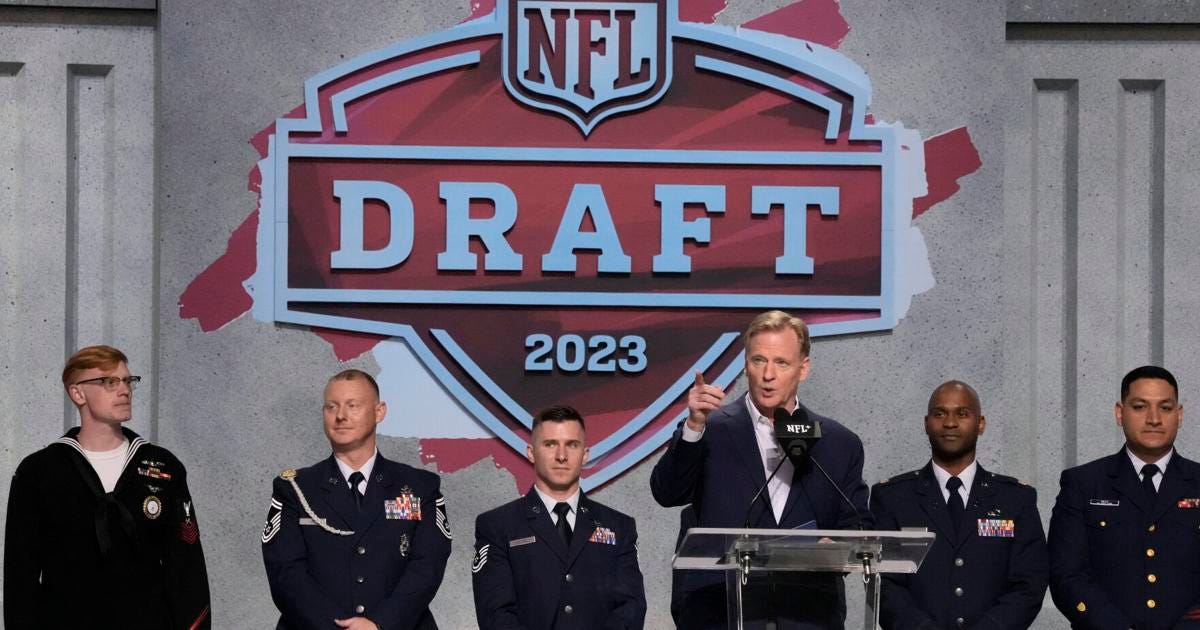
I never miss a Super Bowl, and this year’s game was close until its somewhat anti-climatic end. Of course, there’s always a winning team and a losing one, but perhaps the biggest winner remains the military-industrial complex, which is always featured and saluted in these games.

How so? The obligatory military flyover featured Navy jets flown by female pilots. Progress! The obligatory shot of an overseas (or on-the-sea) military unit featured the colorful crew of the USS Carl Vinson, an aircraft carrier. A Marine Corps color guard marched out the American flag along with the flags of each of the armed services. The announcers made a point to “honor those who fight for our nation.” All this is standard stuff, a repetitive ritual that turns the Super Bowl into Veterans Day, if only for a few minutes.

What was new about this year’s ceremony was the celebration of Pat Tillman’s life, the sole NFL player (and I think the only athlete in any of America’s “major” sports leagues) to give up his career and hefty paycheck to enlist in the U.S. military after 9/11. Yes, Pat Tillman deserves praise for that, and since the game was played in Arizona and Tillman had been with the Arizona Cardinals, honoring him was understandable. Yet, the network (in this case, Fox) quickly said he’d “lost his life in the line of duty.” No further details.

Pat Tillman’s glorious statue

Tillman was killed in a friendly-fire incident that was covered up by the U.S. military in a conspiracy that went at least as high as Secretary of Defense Donald Rumsfeld. The military told the Tillman family Pat had died heroically in combat with the enemy in Afghanistan and awarded him the Silver Star. The Tillman family eventually learned the truth, that Pat had been killed by accident in the chaos of war, a casualty of FUBAR, because troops in combat, hyped on adrenaline, confused and under stress, make deadly mistakes far more often than we’d like to admit.

What makes me sad more than angry is how Tillman’s legacy is being used to sell the military as a good and noble place, a path toward self-actualization. Tillman, a thoughtful person, a soldier who questioned the war he was in, is now being reduced to a simple heroic archetype, just another recruitment statue for the U.S. military.

His life was more meaningful than that. His lesson more profound. His was a cautionary tale of a life of service and sacrifice in a war gone wrong; his death and the military’s lies about the same are grim lessons about the waste of war, its lack of nobility, the sheer awfulness of it all.

Tillman’s statue captures the essence of a man full of life. His death by friendly fire in a misbegotten war, made worse by the lies told to the Tillman family by the U.S. military, reminds us that the essence of war is death.

That was obviously not the intended message of this Super Bowl tribute. That message was of military service as transformative, as full of grace, and I’m sorry but I just can’t stomach it because of what happened to Pat Tillman and how he was killed not only by friendly fire on the ground but how his life was then mutilated by those at the highest levels of the U.S. military.

Why I’m Pro-Russia

W.J. Astore

It was bound to happen

Comrades, it has finally happened: I’ve been accused of being pro-Russia.

I was accused because I advocate for diplomacy and a negotiated settlement to the Russia-Ukraine War. Generally, I’m pro-peace and anti-war, but that’s a bad thing to be in the Russia-Ukraine conflict.

Apparently, the only way to be pro-Ukraine is to advocate for and work toward a complete Ukrainian military victory over Russian forces, meaning that all Russian forces must be expelled from Ukraine, no matter the cost. That also means that Ukraine should get every weapon system they request from the U.S. and NATO, no matter the cost and no matter how many people are killed with these weapons. Putin is evil, Russians are bad, and the only thing “they” understand is maximum violence.

Of course it’s my favorite Bond film!

Comrades, I figure I should embrace my pro-Russia identity and really explain it. So here are the top ten reasons “From Russia With Love” is my byword:

  1. I want Ukraine to win the war and Russia to lose, and I accept that Putin’s invasion a year ago was both illegal and immoral. That makes me pro-Russia.
  2. While I want Ukraine to win, I don’t believe the best way to “win” is a long war fought on Ukrainian territory at immense cost to all involved. That makes me pro-Russia.
  3. I believe negotiations are possible between Russia and Ukraine and that an immediate cease fire will save countless Russian and Ukrainian lives. That makes me pro-Russia.
  4. I don’t believe Western military aid to Ukraine is disinterested or driven by a love of democracy. That makes me pro-Russia.
  5. I worry that a lengthy war as well as a more intense one could lead to dangerous escalation, perhaps even to nuclear war, a risk illustrated by the “doomsday clock” moving ever closer to midnight. That makes me pro-Russia.
  6. I worry that a war that ends with Putin being overthrown could lead to a destabilized Russia in which nuclear surety is compromised. That makes me pro-Russia.
  7. I believe that history began before Russia’s illegal invasion of Ukraine and that NATO expansion to Russia’s borders was unnecessary and unwise. That makes me pro-Russia.
  8. I note the enormous profits being made by U.S. fossil fuel companies, especially from LNG (natural gas) shipments, partly due to the destruction of Nord Stream 2, as well as the profiteering by arms merchants and a soaring Pentagon budget, and I question U.S. motivations in this war. That makes me pro-Russia.
  9. I note the mind numbing casualties already produced by this war (roughly 100,000 troops killed or wounded on each side), the millions of refugees, the untold billions in destruction inflicted on Ukraine, and I seek a way to say “no” to more killing, “no” to more war. That makes me pro-Russia.
  10. I call on all sides to show maturity, to seek another way beyond yet more violence and killing, a way that respects the security interests of all involved, a way that fosters peace and reconciliation. That makes me pro-Russia.

Comrades, there you have it. I think you’ll agree I am pro-Russia, an acolyte of Putin, a willing puppet or useful idiot of Russian imperialism. The clincher is that I haven’t added a tiny Ukrainian flag to my Facebook profile photo or to my Twitter feed, so, really, what more proof do you need?