Culture War!

W.J. Astore

I saw another article this weekend about culture war in America. Supposedly, America is deeply divided, and I’m not denying there are divisions. But when you ask Americans what they want, what’s surprising is how united we are, irrespective of party differences. For example, Americans favor a $15 minimum wage. We favor single-payer health care. We favor campaign finance reform that gets big money donors and corporations out of government. Yet our government, which is bought by those same donors, refuses to give Americans what we want. Division is what they give us instead, and even then it’s often a sham form of division.

What do I mean by “sham”? Well, our so-called divided government is strongly united in support of huge war budgets and endless war. Strongly united in support of Israel. Strongly in favor of, and obedient to, special interests and big money in politics. Strongly in favor of business as usual (with a stress on “business”), with sham elections every four years between the center-right Democrats and the increasingly unhinged-right Republicans. Sadly, when it comes to policy that impacts the working classes, there isn’t much difference between Nancy Pelosi and Mitch McConnell. They are unified in what they deny us.

It’s a war of the have-mores versus the haves and especially the have-nots, and the have-lots-more are winning. Why? Because they’ve bought the government too.

Of course, we do see examples of so-called culture war in the U.S. Consider in the realm of history the “battle” between the 1619 Project and the 1776ers. The 1619ers want to stress the many violent and tragic legacies of slavery to America’s history. (1619 was the first year an African slave was brought to the colonies.) The 1776ers want to stress the ideals of the American Revolution, the proud legacy of George Washington and other founders, the Declaration of Independence and the U.S. Constitution, and so on.

What’s the solution to this “culture war” between the 1619ers and the 1776ers? I’m a historian, and I’ve taught U.S. history. The solution is easy. You teach both. America is a land of contradictions. Any U.S. historian worth her salt is going to talk about genocide and the Native Americans; is going to talk about the violent and bitter legacies of slavery; and is also going to talk about the ideals and idealism of the founders, however imperfectly they put them into practice, and the promise of the Constitution and the spirit of liberty. To ignore slavery while singing the praises of the founders would be as flawed and one-sided as focusing entirely on slavery without ever mentioning the proud achievements of those same founders.

America is a complex and contradictory place — and any historian is going to address those complexities and contradictions because that’s precisely what makes history interesting, fascinating, enthralling. Few students want to be comforted by feel-good history or assaulted by feel-bad history. They want to know the good, the bad, and the ugly, and historians should be able to teach the same. There’s simply no need for a culture war here over the content of history.

I said there’s no need, but that doesn’t mean a culture war isn’t wanted. Polemicists love culture wars, and so too do the already privileged and the powerful. For if we’re fighting each other, if we perceive we’re divided and simply can’t find common ground, we’ll forget we have so much in common, like our desire for a living wage, affordable health care, and politicians who’d actually represent us instead of the special interests.

Forget culture war. Let’s make war on those who keep us apart and who refuse to work for those so desperately in need.

Readers, what do you think?

Diversity and Inclusion!

Hooray for diversity, the 1980s version

W.J. Astore

I got a circular from a university today boasting of their efforts to encourage diversity and inclusion. Good things for sure. Such circulars and brochures are all the rage. They typically feature lots of people of color and a few inspiring stories of grads who’ve beaten the demographic odds in their particular field. Sometimes it’s made obvious the grads are also part of the LGBTQ community, a double dip into political correctness. And I truly dislike that PC term.

Again, these efforts are commendable and necessary, but the self-promotional tenor of these marketing brochures gives me pause. They remind me of those old Benetton ads that assiduously promoted diversity as a way of moving product. It’s a fine thing to be diverse, inclusive, tolerant, and so on, but can we just do it and shut up about it?

Even the Army is getting into the act, promoting recruits who come from non-traditional families (two mothers, for example). America is so great that even our warriors are woke, which is truly upsetting to people like Senator Ted Cruz, who prefers old-fashioned tough-guy Russians in the ranks. Cruz fears our military is “emasculated,” but if I recall, he couldn’t handle a few cold days in Texas and bugged out to Cancun before he was called out for his hypocrisy. Please, Ted, bring your manliness back to us!

Having served in the military for twenty years, I met and served with plenty of “diverse” people, to use today’s terminology. I had a white guy evangelical boss and a Black woman colonel boss. I had plenty of colleagues who were Black and brown. I can’t say if they were LGBTQ since I served in the “Don’t ask, don’t tell” era, but I really don’t think I would have cared. I have male friends who live with their husband and female friends who live with their wife. The first time you see it (at least for this Catholic white boy), you’re a bit surprised just because of the novelty, then you get over it because love is love and who really cares anyway? We’ve got bigger fish to fry in America.

To repeat myself, I’m all for diversity and inclusion. Let’s do it. But can we also truly focus on health care for all, a living wage for all, a healthy environment for all? Can we stop our disastrous wars and stop building new nuclear weapons while destroying the ones we have?

Because I don’t feel better when America’s allegedly more diverse and inclusive military keeps having to fight the same old dumb wars overseas, where, sadly and with bitter irony, they kill a lot of people with Black and brown faces and with backgrounds that would register as “diverse” and “inclusive” and therefore worthy of being promoted and celebrated by those same glossy university brochures I receive.

Readers, what do you think?

More Thoughts (5/23/21)

To state the obvious, there’s nothing new about the push for diversity and inclusion. Reading a tribute to JFK from 1964, I saw this: “This is a time when we are struggling to guarantee that persons of all classes, creeds, and races may move into positions of economic and political leadership…”

Nowadays, class isn’t often mentioned, but race, gender, sexual orientation, and so on are. BIPOC, Black, Indigenous, people of color, is a common acronym. So too is LGBTQ.

Diversity and inclusion shows up in many places. Consider the first three “Dirty Harry” movies from the 1970s. Harry’s first partner was a Mexican-American. His second partner was Black. His third partner was a woman promoted by a quota system driven by diversity concerns. Harry comes to respect all these partners because they’re good, not because of BIPOC or gender.

Of course, we have a long way to go to be truly diverse and inclusive. But, and here’s the rub, if we see more women at work but they still make only 80% (or less) than men make for the same job, that’s not right. And it’s not solved simply by hiring more women.

And if “Black faces in high places” promote the same policies as the same old white establishment, is there truly progress here in policy? In fairness for people in the lower classes, i.e. for workers of all colors and orientations living paycheck to paycheck?

Biden has been touted as having a diverse cabinet, but when it comes to policies that would truly help the working classes, how diverse is it, really? For example, Biden has already essentially abandoned promises to support a $15 minimum wage and a public option for health care. Higher wages and cheaper health care would be a boon to BIPOC, LGBTQ, indeed everyone on the lower rungs of the economic ladder. The only problem is that corporations may see lower profits, including health insurance and drug companies. And guess who received lots of money from these corporations and companies? Joe Biden and his “diverse” cabinet.

I wonder why they won’t help diverse members of the working classes when they say they’re so committed to diversity?

Marxism in the Military!

W.J. Astore

A friend sent along an article on a certain lieutenant colonel in the U.S. Air Force who is being disciplined because he wrote a book warning about Marxism in the U.S. military. Apparently this officer is deeply concerned about “critical race theory,” which he connects to Marxism, and how the military is being contaminated by an emphasis on diversity and other “liberal” ideas. In short, by stressing inclusion, diversity, and tolerance, (neo)Marxism is unmaking the U.S. military, or perhaps remaking it in a revolutionary way that excludes conservative views espoused by white men like this Lt Col.

And I thought Marxism was about class conflict, about seizing the means of production from the rich capitalists and ensuring an equitable distribution of wealth to the workers. Marxism is supposed to witness a withering away of the state as societal hierarchies are flattened or leveled in the cause of creating a more equitable and just society. Nowadays, Marxism has become a bogeyman term of great elasticity, associated with anything somebody doesn’t like that can be further tarred with labels like “liberal” or “leftist.”

Too much diversity isn’t exactly the biggest problem facing the U.S. Air Force today. Consider the under-performing F-35 jet fighter that’s 10 years behind schedule and $200 billion over budget. Consider a new and unneeded B-21 stealth bomber that will cost at least $100 billion (I think you can double or triple that price, based on cost overruns for previous AF projects). Consider the plan to spend at least $100 billion on new land-based ICBMs, an obsolete concept that is also dangerously escalatory. Indeed, so-called nuclear modernization, meaning more megatons of explosives and deadly radiation with which we can destroy all life on planet earth, may cost more than a trillion dollars over the next 30 years. I’d say these issues are a bit more disconcerting than rumors of Marxism in the ranks.

Another concern this lieutenant colonel had was with the politicization of the military, which he associates with contamination by liberal agendas that are neo-Marxist. I think the good colonel should realize the U.S. military is already politicized, but not in the way he imagines. The brass may be willing to pay lip service to diversity and LGBTQ empowerment and so on, but what they really care about is budgetary authority, pure power and influence.

The U.S. military isn’t being undone by neo-Marxist agendas: it’s being undone by unwinnable wars and wasteful spending on unnecessary or ineffective weaponry.

Unwinnable (and unnecessary) wars have cost the American taxpayer more than $6 trillion since 9/11. We’ve lost thousands of troops killed with tens of thousands seriously injured. Profligate spending on prodigal weapon systems is further driving America into debt, even as more nuclear weapons threaten our planet with destruction.

The problem isn’t Karl Marx invading our military. The problem is greed and stupidity, threat inflation and dereliction of duty.

We really could use more diversity in the U.S. military, as in diversity of ideas, of strategy. How about some “diverse” leaders who have the courage to challenge and change the militaristic and imperial path we’re on?

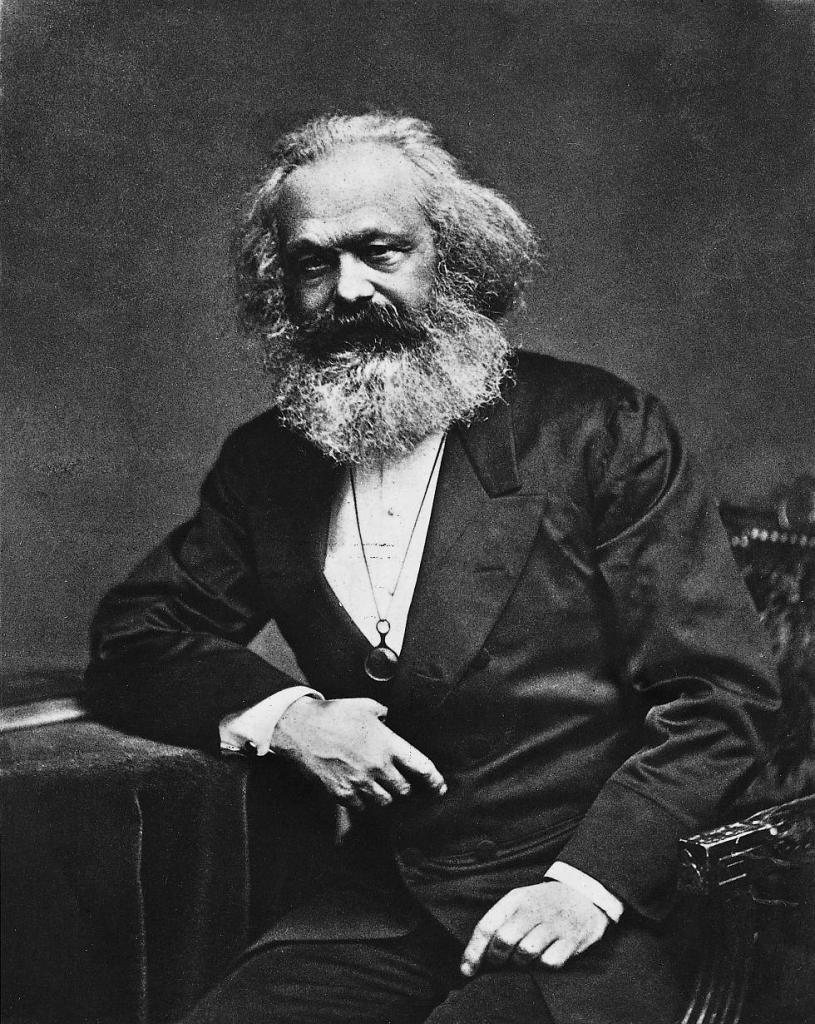
Karl Marx. No, he’s not a problem for the U.S. military, but unwinnable wars and more nuclear weapons are

America Is Programmed for War

W.J. Astore

In my latest article for TomDispatch, I write that America is programmed for war. It’s a feature of our polity and our politics and our culture, not a bug. In some sense, we are a country made by war, and that’s not a good feature for a self-avowed democracy to have. Here’s an excerpt:

Why don’t America’s wars ever end?

I know, I know: President Joe Biden has announced that our combat troops will be withdrawn from Afghanistan by 9/11 of this year, marking the 20th anniversary of the colossal failure of George W. Bush and Dick Cheney to defend America.

Of course, that other 9/11 in 2001 shocked us all. I was teaching history at the U.S. Air Force Academy and I still recall hushed discussions of whether the day’s body count would exceed that of the Battle of Antietam, the single bloodiest day of the Civil War. (Fortunately, bad as it was, it didn’t.)

Hijacked commercial airliners, turned into guided missiles by shadowy figures our panicky politicians didn’t understand, would have a profound impact on our collective psyche. Someone had to pay and among the first victims were Afghans in the opening salvo of the misbegotten Global War on Terror, which we in the military quickly began referring to as the GWOT. Little did I know then that such a war would still be going on 15 years after I retired from the Air Force in 2005 and 80 articles after I wrote my first for TomDispatch in 2007 arguing for an end to militarism and forever wars like the one still underway in Afghanistan.

Over those years, I’ve come to learn that, in my country, war always seems to find a way, even when it goes badly — very badly, in fact, as it did in Vietnam and, in these years, in Afghanistan and Iraq, indeed across much of the Greater Middle East and significant parts of Africa. Not coincidentally, those disastrous conflicts haven’t actually been waged in our name. No longer does Congress even bother with formal declarations of war. The last one came in 1941 after Pearl Harbor. During World War II, Americans united to fight for something like national security and a just cause. Today, however, perpetual American-style war simply is. Congress postures, but does nothing decisive to stop it. In computer-speak, endless war is a feature of our national programming, not a bug.

Two pro-war parties, Republicans and Democrats, have cooperated in these decades to ensure that such wars persist… and persist and persist. Still, they’re not the chief reason why America’s wars are so difficult to end. Let me list some of those reasons for you. First, such wars are beyond profitable, notably to weapons makers and related military contractors. Second, such wars are the Pentagon’s reason for being. Let’s not forget that, once upon a time, the present ill-named Department of Defense was so much more accurately and honestly called the Department of War. Third, if profit and power aren’t incentive enough, wars provide purpose and meaning even as they strengthen authoritarian structures in society and erode democratic ones. Sum it all up and war is what America now does, even if the reasons may be indefensible and the results so regularly abysmal.

Support Our Troops! (Who Are They, Again?)

The last truly American war was World War II. And when it ended in 1945, the citizen-soldiers within the U.S. military demanded rapid demobilization — and they got it. But then came the Iron Curtain, the Cold War, the Korean War, fears of nuclear Armageddon (that nearly came to fruition during the Cuban Missile Crisis in 1962), and finally, of course, Vietnam. Those wars were generally not supported — not with any fervor anyway — by the American people, hence the absence of congressional declarations. Instead, they mainly served the interests of the national security state, or, if you prefer, the military-industrial-congressional complex.

Ike knew the score

That’s precisely why President Dwight D. Eisenhower issued his grave warning about that Complex in his farewell address in 1961. No peacenik, Ike had overseen more than his share of military coups and interventions abroad while president, so much so that he came to see the faults of the system he was both upholding and seeking to restrain. That was also why President John F. Kennedy called for a more humble and pacific approach to the Cold War in 1963, even as he himself failed to halt the march toward a full-scale war in Southeast Asia. This is precisely why Martin Luther King, Jr., truly a prophet who favored the fierce urgency of peace, warned Americans about the evils of war and militarism (as well as racism and materialism) in 1967. In the context of the enormity of destruction America was then visiting on the peoples of Southeast Asia, not for nothing did he denounce this country as the world’s greatest purveyor of violence.

Collectively, Americans chose to ignore such warnings, our attention being directed instead toward spouting patriotic platitudes in support of “our” troops. Yet, if you think about it for a moment, you’ll realize those troops aren’t really ours. If they were, we wouldn’t need so many bumper stickers reminding us to support them.

With the military draft gone for the last half-century, most Americans have voted with their feet by not volunteering to become “boots on the ground” in the Pentagon’s various foreign escapades. Meanwhile, America’s commanders-in-chief have issued inspiring calls for their version of national service, as when, in the wake of 9/11, President George W. Bush urged Americans to go shopping and visit Disney World. In the end, Americans, lacking familiarity with combat boots, are generally apathetic, sensing that “our” wars have neither specific meaning to, nor any essential purpose in their lives.

As a former Air Force officer, even if now retired, I must admit that it took me too long to realize this country’s wars had remarkably little to do with me — or you, for that matter — because we simply have no say in them. That doesn’t mean our leaders don’t seek to wage them in our name. Even as they do so, however, they simultaneously absolve us of any need to serve or sacrifice. We’re essentially told to cheer “our” troops on, but otherwise look away and leave war to the professionals (even if, as it turns out, those professionals seem utterly incapable of winning a single one of them).

Please read the rest of my article here at TomDispatch.com.

Musings for Monday

W.J. Astore

A quick Google search reveals that, “According to the Department of Housing and Urban Development, it would cost $20 billion to end homelessness in the United States.” That’s roughly the cost of a few dozen ICBM interceptor missiles (estimated cost: $18 billion) that are unlikely to work and which may encourage potential adversaries to build more nuclear missiles to overcome them (assuming they do work, but hitting a bullet with a bullet is truly a long shot). Another cost comparison: ending homelessness in America could be done for the cost of roughly 150 F-35 jet fighters. Another: ending homelessness in America could be done for less than half the yearly cost of America’s Afghan War. Yet we’d rather build interceptors, fighter jets, and continue wars than house the homeless.

I’m seeing predictions by America’s generals that Afghan national forces will likely collapse if U.S. combat troops are withdrawn by 9/11. Yet the U.S. military has been training those same Afghan forces for nearly twenty years, all the while making “progress” according to those same generals. What gives? If after two decades Afghan forces don’t have the wherewithal to defend themselves despite untold billions in U.S. assistance and aid, isn’t it logical to assume they will never have the wherewithal?

Of course, it’s an effective strategy for U.S. generals to warn of an impending collapse after Biden’s troop withdrawal. For when it comes, they can say “we told you so” and shift the blame for the loss to Biden and the politicians. Sorry, folks, Afghanistan was never ours to win to begin with. It wasn’t even ours to lose, because we never “had” it. Never mind that: Whenever the U.S. military loses anywhere (including Vietnam), there is always someone else to blame.

The NFL draft concluded this past weekend, and once again I was astonished by the media coverage: the sheer amount of resources dedicated to it. Just go to ESPN, for example, which has “draft cards” on every player with all their vitals, including video highlights. If only the media devoted a tenth of the resources to covering America’s various wars across the globe! With verifiable metrics and video highlights (or lowlights). It’s good to know that sports are much more important to our nation than the military’s global presence and actions.

And now to return to the beginning: Why not act to end homelessness? WWJD: What would Jesus do? I always remember from Catholic mass how Jesus healed the sick, fed the hungry, and helped the poor. Where’s that Jesus nowadays? He seems to have been replaced, at least in America, by Prosperity Gospel Jesus, who shares good news and money only with the richest and most fortunate of Americans.

Can I please have “old” Jesus back? The one who helped lame people to walk and blind people to see?

Jesus healing a blind man. I like this Jesus.

Should God Protect Our Troops?

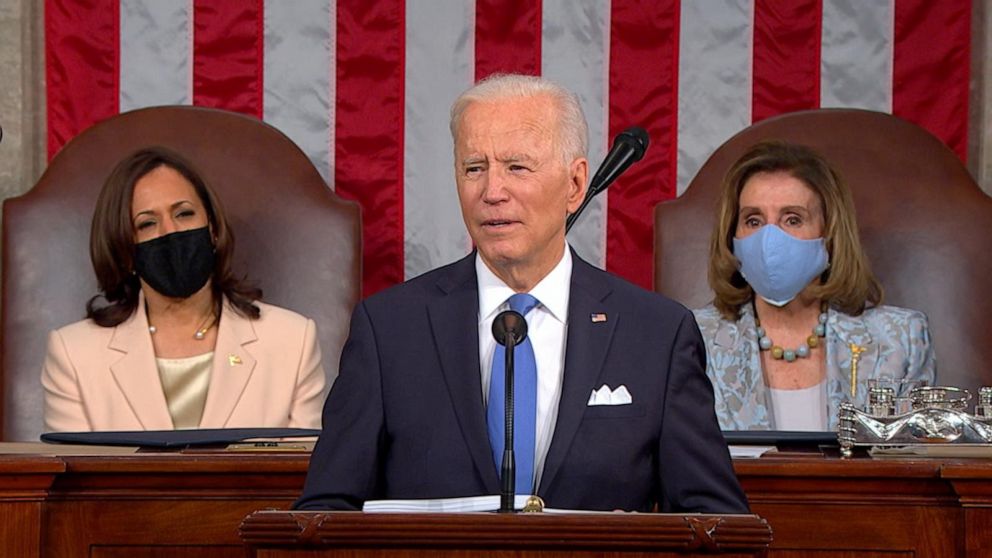
Biden addresses Congress, 4/28/2021. He ended his address by asking God to protect our troops.

W.J. Astore

President Joe Biden favors ending major speeches with an invitation or invocation to God to protect “our” troops, as he did last night in his address to Congress. I don’t doubt the sincerity of the sentiment, but would it not be far better for Biden himself to protect those same troops by ending all of America’s needless wars?

U.S. Presidents traditionally favor asking God (there’s a sense that God would never deny this ask) to bless America as a way of ending speeches. Biden’s new “ask” of God goes a big step further by specifically identifying troops for special protection.

As a friend of mine, a retired military officer, put it about Biden’s rhetoric:

“This is new programming and it hits me like a scratched record every time I hear it—even his most militant predecessors stopped at ‘God bless America.’   It’s unclear to me whether he’s signaling that we’re all in danger all the time and that the troops will always have to be out there or if he thinks it’s the shibboleth he needs to use to gain some support from unaware Midwesterners and Southerners.  Regardless, it engraves a new precedent into our political thought: a constant reinforcement that we are always in danger and you can watch your 70” TV only because the troops are out there.”

To be clear, my friend and I have nothing personal against the troops, seeing that we’re both career military. But why single out the troops for God’s protection? Why not ask God to protect the poor? The sick? The vulnerable and needy and suffering?

Most Americans know that Joe Biden lost a beloved son, Beau, to brain cancer, and that he’d served in Iraq, where he possibly contracted his illness due to exposure to toxic chemicals in burn pits there. One can understand a father’s grief for his son, and his desire for Beau’s fellow troops to be protected from harm.

As a human sentiment, it resonates with me. But I share my friend’s unease with those who would beseech God for special protection for troops whose reason for being is centered on the use of deadly force around the globe. Especially when the sentiment was used in a campaign ad to court voters.

Perhaps we should leave it up to God to decide whom He wishes to protect, and even which country or countries He wishes to bless.

Cancel the F-35, Fund Infrastructure Instead

W.J. Astore

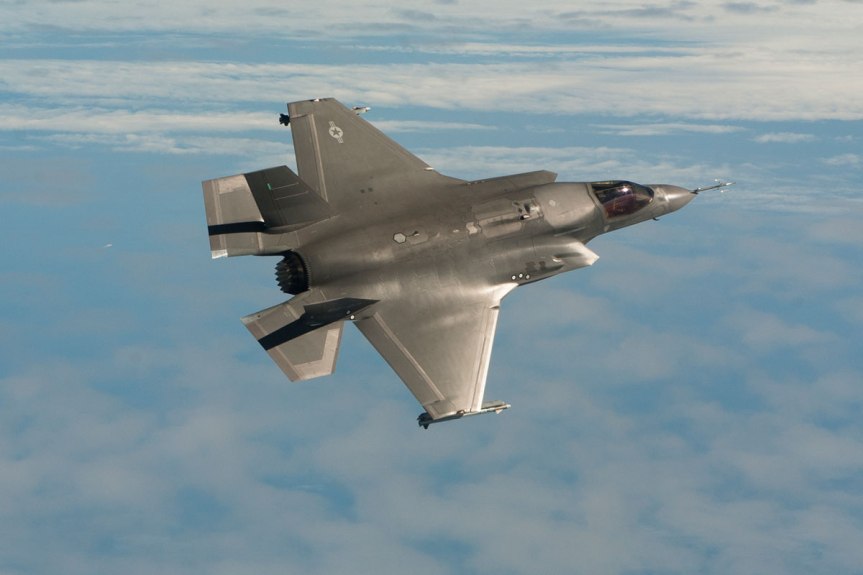
Imagine you’re President Joe Biden. You’re looking for nearly $2 trillion to fund vital repairs and improvements to America’s infrastructure. You learn of a warplane, the F-35 Lightning II, that may cost as much as $1.7 trillion to buy, field and maintain through the next half century. Also, you learn it’s roughly $200 billion over budget and more than a decade behind schedule. You learn it was supposed to be a low-cost, high-availability jet but that through time, it’s become a high-cost, low-availability one. Your senior Air Force general compares it to a Ferrari sports car and says we’ll “drive” it only on Sundays. What do you do?

Your first thought would probably be to cancel it, save more than a trillion dollars, and fund America’s infrastructure needs. Yet instead, the U.S. military is turning on the afterburners and going into full production. What gives?

When 60 Minutes reported on the F-35 in 2014, the plane was already seven years behind schedule and $163 billion over budget. Since then, it has weathered a series of setbacks and complications: Engines that are unreliable and in short supply. An ultra-expensive software system to maintain and repair the plane that doesn’t work. Higher operating costs — as much as 300% higher — compared to previous planes like the F-16 or the A-10. An overly loud engine that creates a noise nuisance to nearby population centers. The list goes on, yet so, too, does the F-35 program.

Why? Because of the power of the military-industrial-congressional complex. The F-35’s lead contractor, Lockheed Martin, used a tried-and-true formula to insulate the plane from political pressure, spreading jobs across 45 states and 307 congressional districts. In essence, the F-35 program has become “too big to fail.” At the Pentagon level, the plane is supposed to fulfill the needs of the Air Force, Navy and Marine Corps for a “fifth generation” stealthy fighter. There is no alternative, or so you’re told.

Yet, as America’s commander-in-chief, you must always remember there are alternatives. Think about it. Why buy a deeply troubled weapon system at inflated prices? Why reward a military contractor for woeful failures to deliver on time and within budget?

Congress rarely asks such questions because of the corrosive power of corporate lobbyists, the military’s insatiable demands for tech-heavy wonder weapons, and thinly-veiled threats that program cuts will cost jobs — meaning members of Congress might face electoral defeat if they fail to safeguard the F-35 pork apportioned to their districts.

But you’re the president — you should be above all that. You take a wider view like the one President Dwight D. Eisenhower took in 1953 in his “cross of iron” speech. Here Ike, a former five-star Army general, challenged Americans to prioritize instruments of peace over tools of war. Schools and hospitals, Ike wrote, were more vital to a democracy than destroyers and fighter jets. Ike was right then — and even more right today. He famously invested in an interstate highway system that served as an accelerant to the U.S. economy. He knew that warplanes, especially overly pricey and operationally dicey ones, were much less vital to the common good.

The Pentagon tells you it’s the F-35 or bust. But for you as president, it’s the F-35 and bust. You begin to realize that so many of the experts advising you to stay the course on the F-35 stand to profit if you do so.

And then you realize as America’s commander-in-chief that no weapon system should be too big to fail. You take heart from Sen. John McCain. In 2016, that ex-naval aviator declared the F-35 program was “both a scandal and a tragedy with respect to cost, schedule and performance.”

Why continue that scandal? Why not end that tragedy? You can decide to send the strongest and clearest message to the military-industrial-congressional complex by cancelling the F-35. You can vow to reform the flawed system that produced it. And you can fund your vital infrastructure programs with the savings.

William J. Astore is a retired Air Force lieutenant colonel and history professor. He is currently a senior fellow at the Eisenhower Media Network.

Up, up, and away, especially the costs

More Afghan War Lies

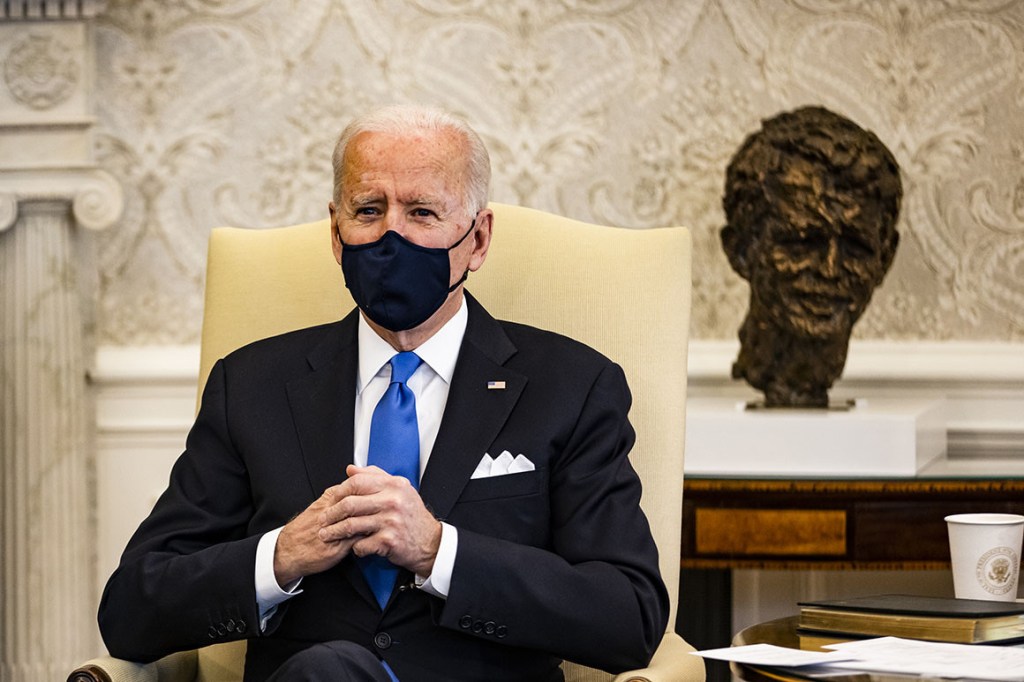
Like much of Biden’s face, America’s Afghan War is kept hidden behind a dark mask (Samuel Corum/Getty Images)

W.J. Astore

President Biden has announced that all U.S. military combat troops will be withdrawn from Afghanistan by 9/11/2021. That date was chosen deliberately and cynically. Recall that 15 of the 19 terrorist hijackers of 9/11 were Saudi. Recall that Osama bin Laden was Saudi. Recall that it was Al Qaeda, not the Taliban in Afghanistan, that was behind the 9/11 attacks on America. Yet America’s Afghan War has always been falsely advertised as both preemptive and preventative, i.e. America went to war to preempt another 9/11-style attack and has continued that war to prevent similar attacks coming from Afghanistan. It’s a false narrative that has largely worked to sustain the Afghan War for twenty years, and Biden is reinforcing it.

Another critical issue: What does it really mean when Biden says those combat troops will be withdrawn? What it doesn’t mean is that the war will end. Doubtless the CIA and similar intelligence operatives will remain behind, shrouded in secrecy. Doubtless some special forces units will stay. Doubtless private contractors, many of them ex-military, will stay. Doubtless America will reserve the “right” to continue to bomb Afghanistan and to conduct drone strikes from halfway across the world, ostensibly in support of the Afghan “national” government in Kabul. So is the war really ending?

Meanwhile, the Pentagon is getting what it wants: a boosted budget (even above what Trump requested) and a future defined by plans for war with China and Russia (and perhaps Iran as well). I’ve seen plenty of articles screaming that China is building a powerful navy, that China is building dangerous missiles, that China is building advanced fighter jets, and so on, which is exactly what the Pentagon wants: a “near-peer” rival to justify even more military spending, especially for big-ticket items like aircraft carriers, fighters, bombers, missile defense systems, and so on.

Biden’s linking of the failed Afghan War to 9/11 and its forthcoming 20th anniversary is yet another exercise in pernicious lying by America’s vast national security state. Once again, we’re reminded that the first casualty in war is truth. And perhaps the last casualty of the Afghan War (whenever it really ends, at least for America) will also be truth.

The Cold War, Rebooted and Rebranded

In my latest for TomDispatch.com, I tackle the Pentagon’s latest proclivity for “near-peer” conflicts, the near-peers being China and Russia, which conveniently serves to justify huge war budgets in perpetuity. It’s the Cold War, rebooted and rebranded, with a new generation of nuclear weapons thrown into the mix to make things even more interesting. As they say, what could possibly go wrong?

What follows is an excerpt that focuses on a “Star Trek” episode that has much to teach us:

In the 1970s, in fact, I avidly watched reruns of the original Star Trek. Lately, one episode, “A Taste of Armageddon,” has been on my mind. It featured two planets, Eminiar VII and Vendikar, at war with each other for 500 years. Here was the catch: those planets no longer used real weapons. Instead, they fought bloodlessly with computer-simulated attacks, even as citizens marked as “dead” had to report to disintegration chambers in a bizarre ritual meant to keep the peace through a computer-driven holocaust. The peoples of these two planets had become so accustomed to endless war that they couldn’t imagine an alternative, especially one that ended in a negotiated peace.

So many years later, I can’t help thinking that our country’s military establishment has something in common with the leaders of Eminiar VII and Vendikar. There’s so much repetition when it comes to America’s wars — with little hope of negotiated settlements, little talk of radically different approaches, and a remarkably blasé attitude toward death — especially when it’s largely the death of others; when foreign peoples, as if on another planet, are just “disintegrated,” whether by monster bombs like MOAB or more discrete Hellfire missile strikes via remotely piloted drones.

What gives? Right now, America’s military leaders are clearly turning back to the war they’d prefer to be fighting, the one they think they can win (or at least eternally not lose). A conventional warlike state vis-à-vis those near-peers seems to play to their skills. It’s also a form of “war” that makes loads of money for the military-industrial complex, driving lucrative acquisition decisions about weaponry in a remarkably predictable fashion.

Near-peer “war” remains largely a fantasy set of operations (though with all-too-real dangers of possible conflagrations to come, right up to nuclear disaster). In contrast, real war, as in this century’s terror wars, is a realm of chaos. So much the better to keep things as predictable as possible. Fresh and original ideas about war (and peace) are unlikely to prove profitable for the military-industrial complex. Worse yet, at an individual level, they could damage one’s chances for promotion or, on retirement, for future posts within the industrial part of that complex. It’s a lot healthier to salute smartly, keep planning for a near-peer future, and conform rather than fall on one’s sword for a dissenting idea (especially one related to peace and so to less money for the Pentagon).

Please read the article in its entirety here at TomDispatch.

On Eminiar VII, “casualties” of computer war willingly enter disintegration chambers to die as a way of keeping “peace”

The Depressing Reality of America’s Political Scene

W.J. Astore

America’s Democratic Party, as it stands today, is essentially a pro-business and pro-war party. On the political spectrum, it’s a center-right party, roughly equivalent to the Republican Party of the 1970s but probably more conservative. Joe Biden, for example, is against Medicare for All, and he’s abandoned all talk of a single-payer option. He’s refused to fight for a $15 federal minimum wage. He’s most likely extending the war in Afghanistan well past the troop pullout date of May 1st as negotiated by the Trump administration. He’s keeping military spending high and is pursuing a hardline foreign policy vis-à-vis Russia and China.

America’s Republican Party has become the party of Trump. It’s unapologetically far-right, evangelical, anti-immigrant, and openly contemptuous of Democratic calls for “diversity.” Like the Democratic Party, it’s militaristic, pro-business, and pro-war, but is even more in favor of blank checks for Wall Street and the major banks and corporations. Its strategy for future victories focuses on suppression of minority voters through various laws and restrictions (voter ID laws, closing polling places, restricting mail-in and early voting, and so on). The Republican Party’s version of “cancel culture” is canceling as much of the vote by minorities as it can.

You’ll notice what’s missing: any major political party that’s center-left or left; any party that has any allegiance to workers, i.e. most of America. There are new parties being created, like the People’s Party, that promise to fill a gaping hole on the left, but it may take decades before a new party can seriously challenge America’s two main parties.

What’s truly depressing is that the mainstream media, along with the Republicans, sell and support a narrative that the Democrats are radical leftists. That such a laughably false narrative is embraced by America’s talking heads on CNN, MSNBC, Fox News, and the other major networks highlights their complicity in ensuring the triumph of business and war imperatives in America.

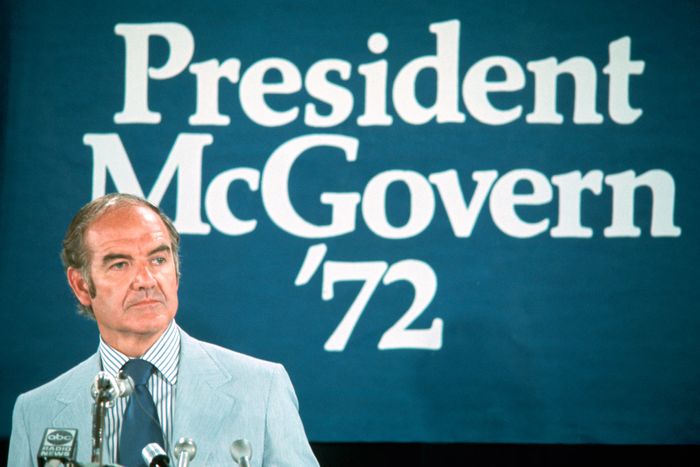
What this means for elections in 2022 and 2024 was brought home to me by Richard Dougherty’s book, “Goodbye, Mr. Christian: A Personal Account of McGovern’s Rise and Fall” published in 1973.  Dougherty nailed it back then when he talked about the baneful influence of the Republican Party as led by Richard Nixon and its reaction to attempts at real reform by George McGovern.  Here’s an excerpt:

“McGovern saw something new emerging in American politics and saw that it was ugly and frightening not only because of its burglars and saboteurs, its insensitivity to the delicate mechanisms of freedom, but for its profound deceptions of a troubled people which, if successful, would reduce and debase them as a people.  Nixon offered no improvement in the life of the people but only empty and ersatz satisfactions to their angers and bewilderments.  It cost the rich Nixonian oligarchs nothing, yet it gratified the lumpenbourgeoisie to tell the poor to go out and get jobs, the black children to stay off the buses, the young draft evaders to stay out of the country, to make noises about permissive judges rather than hire more policeman.

Let ‘em eat revenge.

That was the gimmick.  Was not this sleaziness, this moral midgetry, this menace to the American character, proper stuff for a presidential candidate [like McGovern] to raise as an issue?” (246-7)

If only …

I thought this passage captured what we’re likely to see in the next four years: more sleaziness, more deceptions, more divisiveness, even as the plight of ordinary Americans worsens.

But it’s worse now than in 1973 because the oligarchs now own both parties, the Democratic as well as the Republican.

The challenge for us all is to look past the sleaze, the deceptions, the divisiveness and to focus on bettering the plight of ordinary Americans.  To free ourselves from the oligarchs and the narrative control they exercise via the major media networks.  To recapture the reformist spirit of the 1960s and early 1970s as embodied by a leader like George McGovern.

Much hinges on whether America can do this.