My Daily Helping of Propaganda from the New York Times
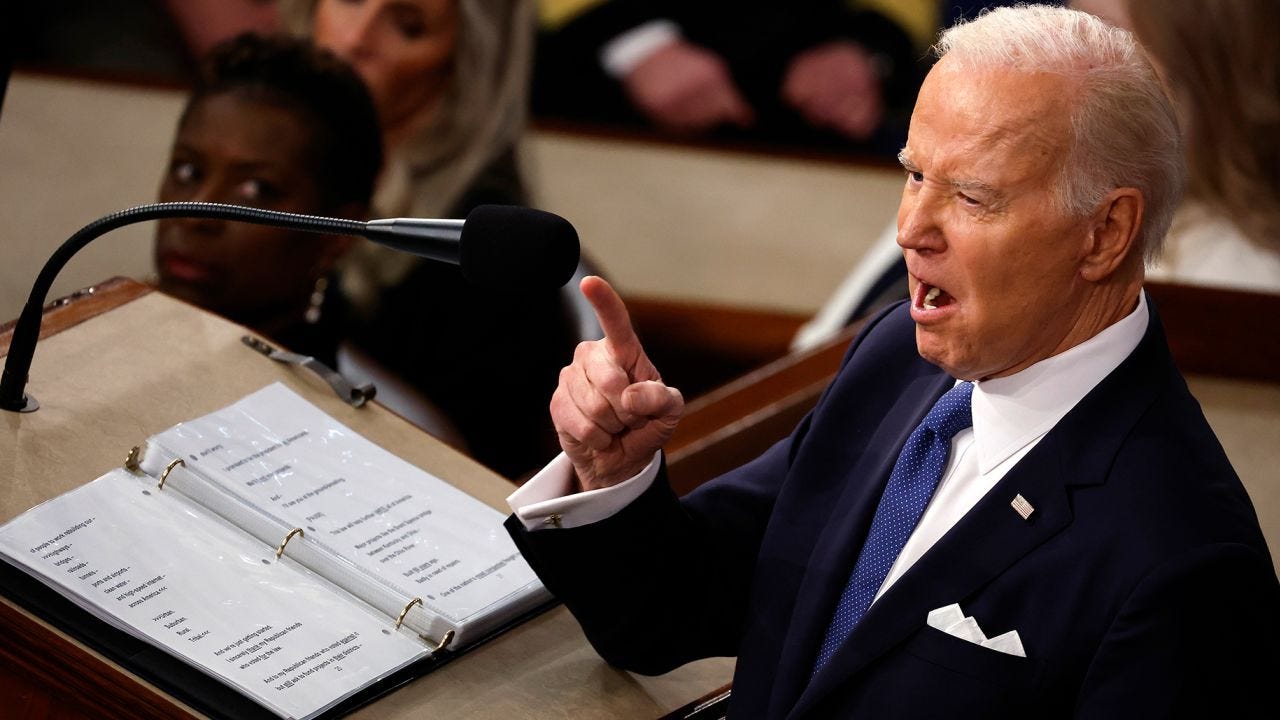
In this image, Joe Biden is “showing vigor,” according to CNN
This morning I read the New York Times’ coverage of Joe Biden’s “State of the Union” address and found this gem of a paragraph on the Russia-Ukraine War:
Ukraine has defied expectations so far, and could continue doing so. But if Ukraine falls, it would signal to the world that autocrats can get away with invading democratic countries. It would suggest the Western alliance isn’t as powerful as it once was — shifting global power away from democracies like the U.S. and members of the E.U. and toward authoritarian powers like Russia and China. And for Biden, it could damage his standing domestically and globally, much as America’s messy exit from Afghanistan did.
A few comments on this:
Note how negotiations aren’t mentioned. Cease fire? Forget about it.
If Ukraine were to fall, would that truly be a signal to autocrats everywhere that democratic countries were ripe for the plucking? Which autocrats and which democratic countries?
Was Ukraine a democracy? Is the USA a democracy?
What about invasions and occupations of Iraq, Afghanistan, and Libya by the US and its allies? Were those costly and disastrous wars OK because a so-called democratic entity invaded a more autocratic one?
Was Biden’s standing truly damaged by that messy exit from Afghanistan? Or was America’s standing truly damaged by persisting in an unwinnable war for 20 years?
If NATO suffers a blow to its prestige due to Ukraine’s fall, that will be the US and NATO’s fault. There was and remains no formal alliance between NATO and Ukraine. Recall that Ukraine was a Soviet republic and that Ukraine is far more closely linked to Russia historically than it is to Europe, let alone the USA.
To answer my own question at (3), the US is not a democracy. It’s an authoritarian oligarchy controlled by Wall Street, the military-industrial complex, and other big financial and corporate interests. Choosing between Corporate Stooge 1 (D) and Corporate Stooge 2 (R) every two or four years is not democracy.
I was further fascinated by how the NYT’s summary began:
President Biden used his State of the Union speech to portray the U.S. as a country in recovery, and he is right that there has been a lot of good news lately.
Price increases have slowed. Covid deaths are down about 80 percent compared with a year ago. Ukraine is holding off Russia’s invasion. Congress passed legislation addressing climate change, infrastructure and gun violence, and some of it was bipartisan.
That Ukraine “is holding off Russia’s invasion” is a sign of “recovery” for the United States! If that’s not a tacit admission of proxy war, I don’t know what is.
It’s nice to know Ukrainians are fighting and dying so that the NYT can brag of the US as being “in recovery.”
A nod of thanks to the NYT for my daily helping of propaganda.
(Also, please detail any important legislation that seriously addresses climate change and gun violence; climate change continues apace, as does gun violence in the US. Finally, Covid deaths are down mainly because of a less virulent strain and increased immunity due to infections, not because of any decisive action taken by the Biden administration.)
Why write so much about the military-industrial complex?
Loyal readers may recall that in June of 2022 M. Davout and I posted a debate between the two of us on the Russia-Ukraine War. This debate is still worth reading, I think.
The other day, my old friend Davout quipped that I had MIC on the brain. Of course, I had suggested that he had Putin on the brain because of his keen support of Ukraine’s war of national liberation, so it was a fair retort. It was also one that I embraced, for as I wrote back to him:
You’re right that I have MIC on the brain. MICIMATT is a useful acronym. The military industrial congressional intelligence media academia think tank complex. Awkward, but it captures some of the scope of the MIC.
There’s a reason Ike warned us about the MIC in 1961. It absorbs more than half of federal discretionary spending. This year Congress gave it $45 billion more than even Biden and the Pentagon wanted. And it just failed its fifth financial audit in a row.
Biden, back in the day, stated “show me your budget and I’ll tell you what you value.” Looking at the federal budget, we see what they value.
Back when I wrote that article (2010), the Pentagon Budget was 10 times as great as State. Now it’s 14 or 15 times as great. Progress!
So, yes, I have the MIC on my brain. All Americans should. That’s why Ike said “only an alert and knowledgeable citizenry” has any hope of keeping the MIC under control.
So far, we’ve failed, myself included.
Davout then made this reply:
What are the real problems with the MIC?
That it functions as a mini-welfare state for many Americans is not a big problem for me. That it supports weapons systems we do not need and in numbers we do not need is a big problem.
That it needlessly supports redundant bases across the country because of protection from members of congress worried about employment and small business in their congressional districts is not a big problem for me. That it provides military surplus to local police departments is a big problem.
The more crucial issue is to what extent and in which ways are military contractors like Boeing more corrupt, wasteful of US taxpayer dollars or endangering to the common good than Exxon Mobil or Philip Morris or Merck?
Haven’t you squeezed enough meaning out of Ike’s speech by now? Why not do a deep dive into the Pentagon budget and give like-minded people better arguments to make to their congressional reps than the top line DOD budget figure and Ike’s warning?
“Deep divers” already exist. I don’t need to duplicate their fine work.
I’m not sure of the relevance of comparing big oil or big tobacco to the MIC. My focus is on the MIC because that’s what I know best. Do I need to add nuance to my critique of the MIC by saying there are other bad corporate actors out there too?
You can see I was getting testy, but we’re old friends, so we don’t mince words.
Davout responded by saying:
The point I was making (inelegantly) about the one-sided focus on the MIC is that if one does not see it in the context of other factors, one might tend to deploy it as an explanation in cases where it doesn’t apply. (If one only has a hammer in one’s toolbox, then one might try to use it for tasks for which it is not fitted.)
For example, you have suggested the US MIC is a major factor explaining the transfer of weapons from western countries to Ukraine. While I think the US MIC does benefit from those transfers (though not so much as one might think, given that some of that weaponry is drawing on overstocks of weapons systems no longer in use), it is not driving this war. Russian aggression, Ukrainian resistance, and NATO countries’ concerns about future Russian aggression are the prime factors driving those weapons transfers.
To which I replied:
For a grimmer take on the Ukraine war and its implications for the US, consider this article by Chris Hedges:
And you’re wrong about the MIC and its profits here. For example, in the case of M-1 tanks, the 31 going to Ukraine will be newly built, despite the fact that we have thousands of Abrams tanks in Army inventory. Also, most of the weapons/ammo being sent from U.S. inventories have to be replaced. (Yes, a few weapons systems are obsolete, like MRAPs and M113 APCs, but most aren’t.). Assuming we send F-16s, again these will be new, and Lockheed Martin has already announced they’re willing and eager to produce more.
Don’t worry: the MIC is doing very well indeed [from the Russia-Ukraine War]. It has decades of practice at this.
That was the end of our exchange. I’d add that the MIC profits far more from the atmosphere of uncertainty and anxiety created by the Russia-Ukraine War than it does from the war itself. Even though Russia’s forces haven’t performed well in this war, even though Russia is arguably weaker today than it was before the invasion, the MIC and various preening politicians are exaggerating the Russian threat as a way of boosting military spending. And it’s working, hence the $45 billion extra given to the Pentagon by Congress in this year’s budget.
And so I will continue to have “MIC on the brain” because it continues to grow ever more powerful within our society, and ever more ambitious on the world stage. You might say it’s invaded my brain as well, though (so far) I haven’t sent it more than half of my discretionary income.
Davout and I don’t always agree, but we’re always willing to talk and to listen. We need more conversations among Americans about war and the MIC, for conversing leads to clarity and clarity can lead to a shared commitment to act.
Politicians are known liars; military officers are supposed to put integrity first
Newly elected Congressman George Santos of New York has become the butt of many jokes about his serial lying. Santos lied about pretty much everything: his education, his religion, his parents, his work background. It’s hard to say what he didn’t lie about. So far, he has survived because the Republican Party has stood behind him but also because Americans collectively expect politicians to lie. Another lying politician? Say it ain’t so, Joe!
George Santos is a symptom of a much larger disease: a lack of honor, a lack of shame, in America. Honor, truth, integrity, simply don’t seem to matter, or matter much, in America today. What matters is making money, getting ahead, gaining power, at any price. Rarely are liars called to account, especially in politics, where everything is spin.
But how do you have a democracy where there is no truth?
As much as George Santos has been lampooned (here in a funny segment by Bill Maher), as many times as he’s been called on to quit, one group of Americans is never called to account for their lies: U.S. military leaders.
George Santos is estranged from the truth—but he’s not the only one. He also makes dubious hand gestures, but that’s a story for another day
U.S. military leaders appeared before Congress to testify the Iraq War was being won. They appeared before Congress to testify the Afghan War was being won. They talked of “progress,” of corners being turned, of Iraqi and Afghan forces being successfully trained and ready to assume their duties as U.S. forces withdrew. As events showed, it was all spin. All lies.
Where is the accountability? The Congressional hearings? The calls for those military leaders to explain themselves?
Of course, it wasn’t just the U.S. military but other sectors of the U.S. government that lied. Peter Van Buren’s book, “We Meant Well,” documents the lies and exaggerated stories he was pressured to sell as a member of the State Department working with U.S. military units in Iraq. Going along with the lies got you promoted. Trying to tell the truth, as Van Buren did, earned him pariah status and got him forced into retirement at State after a tense fight with his superiors, up to and including Hillary Clinton.
The Afghan War papers, released by the Washington Post in 2019, revealed the systemic lying of U.S. military leaders about that war. Even as they spoke publicly of progress and corners being turned, these same leaders spoke privately of lack of progress and dead ends. It was exactly those “private” concerns that should have been made public.
As the Washington Post put it in 2019: A confidential trove of government documents obtained by The Washington Post reveals that senior U.S. officials failed to tell the truth about the war in Afghanistan throughout the 18-year campaign, making rosy pronouncements they knew to be false and hiding unmistakable evidence the war had become unwinnable.
Prolonging wars based on lies is far more serious than the headline-grabbing sins of Santos. U.S. troops paid for these lies with their lives, as did the peoples of Afghanistan, Iraq, and elsewhere. Again, where is the accountability in a U.S. military that allegedly prides itself on its integrity?
In fact, there were officers with integrity, like Matthew Hoh, who served in the Marine Corps before he joined the State Department. Hoh resigned from State in 2009 because he knew plans to “surge” in Afghanistan were wrongheaded and that reports of progress were false. Privately, his superiors agreed with most of his critique. Publicly, they continued to speak of victory being in sight, just as their predecessors had done during the Vietnam War.
Indeed, Hoh’s honesty and courage created a rare opportunity for then-President Barack Obama. Obama could have latched on to Hoh’s honest critique and used it to modify his own initial misreading of the Afghan War as the “good” war (as opposed to the “bad” Iraq War under Bush/Cheney). But Obama continued on course to military escalation in Afghanistan, a surge that produced nothing except more death and destruction. A dozen years later, U.S. forces finally withdrew from that country, chaotically and ignominiously.
Ironically, Members of Congress often know that senior military leaders are lying to them, but they refuse to act, notes Matt Hoh, mainly because they’re concerned to protect their political careers. In the case of the “surge” in Afghanistan, Democrats lined up to support Obama in part because they wanted no distractions as the president fought to get the Affordable Care Act passed into law.
So, the generals lie and Congress goes along with them, whether for profit, political expediency, and similar reasons, which only highlights further the rot throughout the military-industrial-congressional complex. In short, rather then challenging the lies, Congress is complicit in them.
Today, Republicans in the House want to investigate the 2021 withdrawal from Afghanistan, which is good, except their motivation is purely partisan. They want to attack the Biden administration, to paint it as weak and inept, when the real focus should be on all the lies, blunders, and profiteering by the military-industrial complex throughout the Afghan War.
A mendacious military is a very dangerous thing—far more dangerous than run-of-the-mill politicians like Santos with Pinocchio syndrome. Lies in military settings are matters of life and death. This is precisely why integrity is allegedly so highly valued, why honor is allegedly so highly esteemed, in the U.S. military.
It’s high time for real, honest, Congressional truth hearings on America’s disastrous wars. Just don’t appoint Santos and his ilk to serve on the committee.
My name is Bill Astore and I’m a card-carrying member of the military-industrial complex (MIC).
Sure, I hung up my military uniform for the last time in 2005. Since 2007, I’ve been writing articles for TomDispatch focused largely on critiquing that same MIC and America’s permanent war economy. I’ve written against this country’s wasteful and unwise wars in Iraq and Afghanistan, its costly and disastrous weapons systems, and its undemocratic embrace of warriors and militarism. Nevertheless, I remain a lieutenant colonel, if a retired one. I still have my military ID card, if only to get on bases, and I still tend to say “we” when I talk about my fellow soldiers, Marines, sailors, and airmen (and our “guardians,” too, now that we have a Space Force).
So, when I talk to organizations that are antiwar, that seek to downsize, dismantle, or otherwise weaken the MIC, I’m upfront about my military biases even as I add my own voice to their critiques. Of course, you don’t have to be antiwar to be highly suspicious of the U.S. military. Senior leaders in “my” military have lied so often, whether in the Vietnam War era of the last century or in this one about “progress” in Iraq and Afghanistan, that you’d have to be asleep at the wheel or ignorant not to have suspected the official story.
Yet I also urge antiwar forces to see more than mendacity or malice in “our” military. It was retired general and then-President Dwight D. Eisenhower, after all, who first warned Americans of the profound dangers of the military-industrial complex in his 1961 farewell address. Not enough Americans heeded Ike’s warning then and, judging by our near-constant state of warfare since that time, not to speak of our ever-ballooning “defense” budgets, very few have heeded his warning to this day. How to explain that?
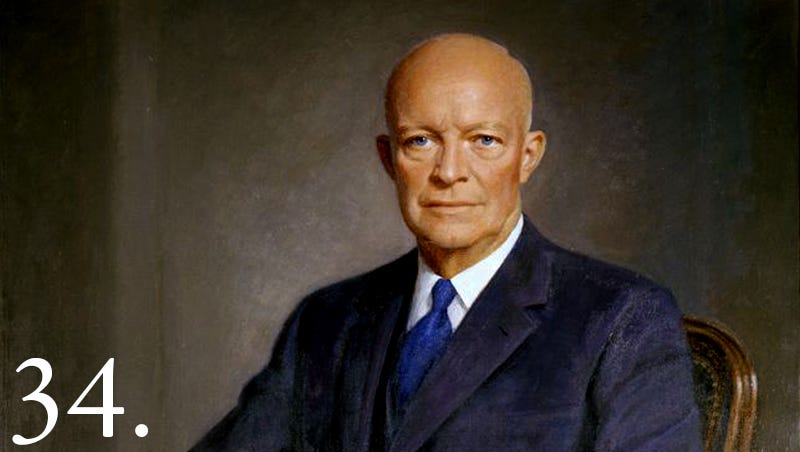
Ike’s warning about the military-industrial complex was also a call to arms to “an alert and knowledgeable citizenry” (Image: WhiteHouse.gov)
Well, give the MIC credit. Its tenacity has been amazing. You might compare it to an invasive weed, a parasitic cowbird (an image I’ve used before), or even a metastasizing cancer. As a weed, it’s choking democracy; as a cowbird, it’s gobbling up most of the “food” (at least half of the federal discretionary budget) with no end in sight; as a cancer, it continues to spread, weakening our individual freedoms and liberty.
Call it what you will. The question is: How do we stop it? I’ve offered suggestions in the past; so, too, have writers for TomDispatch like retired Army Colonel Andrew Bacevich and retired Army Major Danny Sjursen, as well as William Hartung, Julia Gledhill, and Alfred McCoy among others. Despite our critiques, the MIC grows ever stronger. If Ike’s warning wasn’t eye-opening enough, enhanced by an even more powerful speech, “Beyond Vietnam,” by Martin Luther King, Jr., in 1967, what could I and my fellow TomDispatch writers possibly say or do to make a difference?
Maybe nothing, but that won’t stop me from trying. Since I am the MIC, so to speak, maybe I can look within for a few lessons that came to me the hard way (in the sense that I had to live them). So, what have l learned of value?
War Racketeers Enjoy Their Racket
In the 1930s, Smedley Butler, a Marine general twice decorated with the Medal of Honor, wrote a book entitled War Is a Racket. He knew better than most since, as he confessed in that volume, when he wore a military uniform, he served as “a racketeer, a gangster for capitalism.” And the corporate-driven racket he helped enable almost a century ago by busting heads from the Caribbean to China was small-scale indeed compared to today’s thoroughly global one.
There’s an obvious lesson to be drawn from its striking endurance, never-ending enlargement, and distinct engorgement in our moment (even after all those lost wars it fought): the system will not reform itself. It will always demand and take more — more money, more authority, more power. It will never be geared for peace. By its nature, it’s authoritarian and distinctly less than honorable, replacing patriotism with service loyalty and victory with triumphant budgetary authority. And it always favors the darkest of scenarios, including at present a new cold war with China and Russia, because that’s the best and most expedient way for it to thrive.
Within the military-industrial complex, there are no incentives to do the right thing. Those few who have a conscience and speak out honorably are punished, including truth-tellers in the enlisted ranks like Chelsea Manning and Daniel Hale. Even being an officer doesn’t make you immune. For his temerity in resisting the Vietnam War, David M. Shoup, a retired Marine Corps general and Medal of Honor recipient, was typically dismissed by his peers as unbalanced and of questionable sanity.
For all the talk of “mavericks,” whether in Top Gun or elsewhere, we — there’s that “we” again (I can’t help myself!) — in the military are a hotbed of go-along-to-get-along conformity.
Recently, I was talking with a senior enlisted colleague about why so few top-ranking officers are willing to speak truth to the powerless (that’s you and me) even after they retire. He mentioned credibility. To question the system, to criticize it, to air dirty laundry in public is to risk losing credibility within the club and so to be rejected as a malcontent, disloyal, even “unbalanced.” Then, of course, that infamous revolving door between the military and giant weapons makers like Boeing and Raytheon simply won’t spin for you. Seven-figure compensation packages, like the one current Secretary of Defense Lloyd Austin gained from Raytheon after his retirement as an Army general, won’t be an option. And in America, who doesn’t want to cash in while gaining more power within the system?
Quite simply, it pays so much better to mouth untruths, or at least distinctly less-than-full-truths, in service to the powerful. And with that in mind, here, at least as I see it, are a few full truths about my old service, the Air Force, that I guarantee you I won’t be applauded for mentioning. How about this as a start: that the production of F-35s — an overpriced “Ferrari” of a fighter jet that’s both too complex and remarkably successful as an underperformer — should be canceled (savings: as much as $1 trillion over time); that the much-touted new B-21 nuclear bomber isn’t needed (savings: at least $200 billion) and neither is the new Sentinel Intercontinental Ballistic Missile(savings: another $200 billion and possibly the entire Earth from doomsday); that the KC-46 tanker is seriously flawed and should be canceled (savings: another $50 billion).
Now, tote it up. By canceling the F-35, the B-21, the Sentinel, and the KC-46, I singlehandedly saved the American taxpayer roughly $1.5 trillion without hurting America’s national defense in the least. But I’ve also just lost all credibility (assuming I had any left) with my old service.
Look, what matters to the military-industrial complex isn’t either the truth or saving your taxpayer dollars but keeping those weapons programs going and the money flowing. What matters, above all, is keeping America’s economy on a permanent wartime footing both by buying endless new (and old) weapons systems for the military and selling them globally in a bizarrely Orwellian pursuit of peace through war.
How are Americans, Ike’s “alert and knowledgeable citizenry,” supposed to end a racket like this? We certainly should know one thing by now: the MIC will never check itself and Congress, already part of it thanks to impressive campaign donations and the like by major weapons makers, won’t corral it either. Indeed, last year, Congress shoveled $45 billion more than the Biden administration requested (more even than the Pentagon asked for) to that complex, all ostensibly in your name. Who cares that it hasn’t won a war of the faintest significance since 1945. Even “victory” in the Cold War (after the Soviet Union imploded in 1991) was thrown away. And now the complex warns us of an onrushing “new cold war” to be waged, naturally, at tremendous cost to you, the American taxpayer.
As citizens, we must be informed, willing, and able to act. And that’s precisely why the complex seeks to deny you knowledge, precisely why it seeks to isolate you from its actions in this world. So, it’s up to you — to us! — to remain alert and involved. Most of all, each of us must struggle to keep our identity and autonomy as a citizen, a rank higher than that of any general or admiral, for, as we all need to be reminded, those wearing uniforms are supposed to serve you, not vice-versa.
I know you hear otherwise. You’ve been told repeatedly in these years that it’s your job to “support our troops.” Yet, in truth, those troops should only exist to support and defend you, and of course the Constitution, the compact that binds us all together as a nation.
When misguided citizens genuflect before those troops (and then ignore everything that’s done in their name), I’m reminded yet again of Ike’s sage warning that only Americans can truly hurt this country. Military service may be necessary, but it’s not necessarily ennobling. America’s founders were profoundly skeptical of large militaries, of entangling alliances with foreign powers, and of permanent wars and threats of the same. So should we all be.
Citizens United Is the Answer
No, not that “Citizens United,” not the case in which the Supreme Court decided corporations had the same free speech rights as you and me, allowing them to coopt the legislative process by drowning us out with massive amounts of “speech,” aka dark-money-driven propaganda. We need citizens united against America’s war machine.
Understanding how that machine works — not just its waste and corruption, but also its positive attributes — is the best way to wrestle it down, to make it submit to the people’s will. Yet activists are sometimes ignorant of the most basic facts about “their” military. So what? Does the difference between a sergeant major and a major, or a chief petty officer and the chief of naval operations matter? The answer is: yes.
An antimilitary approach anchored in ignorance won’t resonate with the American people. An antiwar message anchored in knowledge could, however. It’s important, that is, to hit the proverbial nail on the head. Look, for example, at the traction Donald Trump gained in the presidential race of 2015-2016 when he did something few other politicians then dared do: dismiss the Iraq War as wasteful and stupid. His election win in 2016 was not primarily about racism, nor the result of a nefarious Russian plot. Trump won, at least in part because, despite his ignorance on so many other things, he spoke a fundamental truth — that America’s wars of this century were horrendous blunders.
Trump, of course, was anything but antimilitary. He dreamed of military parades in Washington, D.C. But I (grudgingly) give him credit for boasting that he knew more than his generals and by that I mean many more Americans need to challenge those in authority, especially those in uniform.
Yet challenging them is just a start. The only real way to wrestle the military-industrial complex to the ground is to cut its funding in half, whether gradually over years or in one fell swoop. Yes, indeed, it’s the understatement of the century to note how much easier that’s said than done. It’s not like any of us could wave a military swagger stick like a magic wand and make half the Pentagon budget disappear. But consider this: If I could do so, that military budget would still be roughly $430 billion, easily more than China’s and Russia’s combined, and more than seven times what this country spends on the State Department. As usual, you get what you pay for, which for America has meant more weapons and disastrous wars.
Join me in imagining the (almost) inconceivable — a Pentagon budget cut in half. Yes, generals and admirals would scream and Congress would squeal. But it would truly matter because, as a retired Army major general once told me, major budget cuts would force the Pentagon to think — for once. With any luck, a few sane and patriotic officers would emerge to place the defense of America first, meaning that hubristic imperial designs and forever wars would truly be reined in because there’d simply be no more money for them.
Currently, Americans are giving the Pentagon all it wants — plus some. And how’s that been working out for the rest of us? Isn’t it finally time for us to exercise real oversight, as Ike challenged us to do in 1961? Isn’t it time to force the Pentagon to pass an audit each year — it’s failed the last five! — or else cut its budget even more deeply? Isn’t it time to hold Congress truly responsible for enabling ever more war by voting out military sycophants? Isn’t it time to recognize, as America’s founders did, that sustaining a vast military establishment constitutes the slow and certain death of democracy?
Just remember one thing: the military-industrial complex won’t reform itself. It just might have no choice, however, but to respond to our demands, if we as citizens remain alert, knowledgeable, determined, and united. And if it should refuse to, if the MIC can’t be tamed, whether because of its strength or our weakness, you will know beyond doubt that this country has truly lost its way.
“Honk if you like guns” is on a message board outside a local gun range. It’s a distinctly American sentiment. Since this country has over 400 million guns of various sorts and calibers in circulation, it’s a safe bet that America does indeed “like” guns. And that’s not a liking you’re encouraged to keep to yourself, hence the encouragement to “honk” as you drive past to advertise full throttle your affection for them.
Honk away, I guess (Mariusz Blach, Getty Images)
As I wrote a decade ago, “weapons ‘r’ us.” America, the so-called arsenal of democracy during World War II, is now often simply an arsenal. Guns are expensive and life is cheap. And we literally export that sentiment as America dominates the international trade in arms of all sorts, everything from F-35 jet fighters to M-1 tanks to the humblest of bullets. Indeed, we’re buying so many guns in America there’s even a shortage of those humble bullets.
Americans believe they are unsafe; Americans are also less than happy and are the world’s best customers for anti-depressants, and happiness is a warm gun, as John Lennon wrote.
There is considerable psychic distress in our country, and no wonder. The police video released yesterday of the beating of Tyre Nichols during a routine traffic stop is more than disturbing. A helpless man lies on the ground as police surround him, kicking and hitting him repeatedly. “Savage” is a good descriptor for the beating he took, after which it took nearly half an hour for an ambulance to arrive to render medical aid. Tyre Nichols died in a hospital three days later.
I know it’s an odd juxtaposition: the “honk if you like guns” sentiment and the (alleged) murder of Tyre Nichols by five (or more) police officers in Memphis. Maybe they have little in common, except, perhaps, a liking for violence and the potential of deadly force.
And so, to change the subject, I keep hearing the best way to help Ukraine is to send them more weapons so their armed forces can kill more Russians. It’s a war, after all, and tanks are needed more than talks. Putin only understands one language, the language of murderous violence, and he must be stopped so send Ukraine whatever its military officials request because we can trust them to know best.
And I begin to wonder, which country truly knows the language of murderous violence best? Which country has more mass shootings than any other? Which country spends more on wars and weaponry, has more of its citizens in prison, has more military bases, exports more weaponry around the world, than any other?
Honk if you like guns — it’s a sentiment that says much about our American moment.
Who determines U.S. foreign policy? The question seems simple enough. According to my go-to source, the AI chatbot ChatGPT,
U.S. foreign policy is made by the President, with the assistance and advice of the National Security Council and the State Department, and with the approval of Congress. The President has the power to negotiate treaties and executive agreements, and to appoint ambassadors, while Congress has the power to approve or reject treaties and executive agreements, and to confirm ambassadors. The National Security Council and the State Department are responsible for providing the President with advice and information on foreign policy issues.
That’s how many people see it. Except it doesn’t work that way. More than anything, America is an oligarchy rooted in capitalism and driven by greed and profit. Foreign policy, therefore, is most often driven by powerful corporate interests, especially those tied to the military, hence President Eisenhower’s military-industrial complex. When looking at foreign policy, one must always factor in the interests of Wall Street and its small army of lobbyists and especially powerful corporate interests in fossil fuels and similar trillion-dollar industries.
Again, when looking at U.S. foreign policy, its decisions and commitments, one should first ask, Cui bono? Who benefits the most from the decisions made? Second, one should keep in mind the golden rule, as in they who have the gold make the rules. Presidents, Secretaries of State, ambassadors, and the like come and go, but the moneyed interests remain. And with “dark money” now endemic in politics, it’s difficult to parse exactly who is giving what to whom.
I don’t mean this as a great revelation. In the 1950s C. Wright Mills wrote of the “power elite,” which I cited in an article on greed-war. This is what Mills had to say:
the high military, the corporation executives, the political directorate have tended to come together to form the power elite of America … a triangle of power [that is] the key to any understanding of the higher circles in America today.
C. Wright Mills knew the score
That power elite largely drives and determines U.S. foreign policy today. Recall as well that the Pentagon budget today (almost $860 billion) is 14 times greater than the State Department (roughly $60 billion). Basically, State is a tiny branch of the Pentagon. I wonder who calls the shots?
We’d like to think we the people have some say over foreign policy. Don’t we elect our members of Congress? Don’t we elect our president? But when both parties are thoroughly corporatized, when both respond to lobbyists and special interests while ignoring the rest of us, the truth is we essentially have no choice and no influence.
That truth can be hard to believe because we like to think we have some agency. But we have none. Even so, the power elite will pretend that our opinions matter, even as they resolutely ignore them. Consider the most important foreign policy decision any nation can make: whether war is to be declared and our troops are to be sent off to fight and die. We haven’t made that decision as a nation since December of 1941. Every war America has fought since World War II has been undeclared. That should tell us something about who’s in control. Hint: It’s not us.
The rich and powerful will tell you and sell you what “truth” to believe in. So, we’re told and sold the idea that Joe Biden is making vitally important decisions in the White House, even as Joe nowadays has trouble reading from a teleprompter. We’re told and sold the idea that Congress represents our interests when it most definitely doesn’t (as the Princeton Study proved). We’re told and sold the idea that America cares about fostering democracy in places like Afghanistan, Iraq, and Ukraine, but a bit of digging reveals the real forces and interests at play, such as oil, pipelines, strategic metals, market dominance, and the like.
Look, I’ve taken standard college courses on U.S. foreign policy. I learned a lot from them. But even in college I didn’t learn much about the colossal power of America’s military-industrial complex; the enormous influence of mega-corporations; the way in which foreign policy is shaped by economic profit and the pursuit of resources, some of which is captured in that old saw that “What’s good for General Motors is good for America.”
Well, GM may have waned in influence, but other industries and financial interests have taken its place. Again, if America’s foreign policy decisions confuse you, clarity should come when you ask yourself, who benefits (not you, of course), and when you remember the golden rule, as in they who have the gold make the rules.
Another mass shooting in America followed by more empty words by politicians.
What can we do? Even if we cut the number of guns in America in half, there’d still be 200 million guns on our soil. OK, let’s ban assault rifles. But there’s already more than 20 million AR-15-type rifles in circulation. Well then, how about more “good guys with guns” to catch the bad guys? If more guns and more police worked, why do mass shootings in America keep increasing?
We need to change our culture of violence while strengthening communal and family bonds. And we need to talk a lot less about “gun rights,” as if guns are people instead of tools that kill people, and much more about personal responsibility.
I’ve owned guns and I hope I acted responsibly as a gun-owner. Most gun-owners do. We know the rules of gun ownership. Always assume a gun is loaded. Never point a gun near anyone (unless you’re truly in a life-or-death situation). Don’t have a gun unless you’re trained on how to shoot it safely.
But our culture sends very different messages about guns. I can’t count the commercials I’ve seen for cop and military shows where the gun on the TV screen is pointed at me, the viewer (and you too, if you’re watching). I can’t count the shows that feature SWAT teams and lengthy shootouts. Far too often, guns and the violence they enable are depicted as cool, as sexy, as manly, as good.
With six-shooters we had the Wild West mystique of John Wayne, Gary Cooper, and the like; then in the 1970s came Clint Eastwood’s Dirty Harry and similar vigilante-cops. Only in the last three decades or so has military-style action exploded on our TV and Cable screens, featuring machine guns, .50 caliber sniper rifles, and a seemingly endless assortment of assault rifles in highly-stylized gun fights, usually depicted on Main Street USA.
Add all that on-screen violence to military-style shooter video games and you get a culture increasingly immersed in both virtual and actual gunplay. Meanwhile, our wider political culture is increasingly fractured, people are increasingly desperate as prices rise and jobs go away, and politicians, instead of doing something to help us, instead seek to divide us further by blaming the other party.
Politicians talk about red and blue America, but when we talk gun violence, we’re all red because we all bleed red. Guns don’t care about our petty partisan squabbles and our inability to change ourselves and our culture. Someone squeezes the trigger, some angry, some hateful, some violent, guy (it’s almost always a guy), and lots of people end up dead.
That nearly all mass shootings are done by men, often young men, should tell us something. That so many often favor “military-style” assault rifles should tell us something else. America is like one vast gated community, armed to the teeth against enemies from without even as the most dangerous enemies are those living within the gates, those who are locked, loaded, and ready to kill.
Young men need role models. They need a culture that teaches them killing isn’t cool. And the rest of us deserve communities where words and phrases like “lockdown,” “shelter in place,” and “active shooter” make no sense because there’s no need for them.
Privates should make more, generals should make less, in today’s military
My great nephew recently reported to the local MEPS (military entrance processing station) and took the oath of office. He’s enlisting in the Marine Corps and I wish him all the best.
In November 2021, with him in mind, I wrote an article, “Should you join the U.S. military?” For him, the answer was yes, and I respect his decision.
Enlisting in the U.S. military is a big step for any young adult. And there are certain benefits to it like health care, money for education, some kind of housing (or pay for housing), and of course job training and an identity, e.g “Once a Marine, always a Marine.”
There are many drawbacks as well, the biggest, of course, being death.
Death is a high price to earn a place on the “Gold Star” tree at the White House (Jonathan Ernst, Reuters)
One that we often don’t think of, though, is low pay, which is why Andrea Mazzarino’s article at TomDispatch is so telling. Mazzarino, a military spouse, reminds us that more than a few military members are “food insecure.” In other words, they often have to choose between paying their rent and other bills and going hungry, which is another way of saying that the military is a (distorted) reflection of American society.
Here’s an excerpt from Mazzarino’s article:
I recently interviewed Tech Sergeant Daniel Faust, a full-time Air Force reserve member responsible for training other airmen. He’s a married father of four who has found himself on the brink of homelessness four times between 2012 and 2019 because he had to choose between necessities like groceries and paying the rent. He managed to make ends meet by seeking assistance from local charities. And sadly enough, that airman has been in all-too-good company for a while now. In 2019, an estimated one in eight military families were considered food insecure. In 2020, at the height of the Covid-19 pandemic, that figure rose to nearly a quarter of them. More recently, one in six military families experienced food insecurity, according to the advocacy group Military Family Advisory Network.
You would think that a military with a colossal yearly budget of $858 billion would pay its troops enough so that they wouldn’t go hungry, but it simply isn’t so. Much of that colossal budget goes to the weapons makers (perhaps we should call them the wealth-takers?). Big companies like Lockheed Martin, Boeing, Raytheon, and Northrop Grumman. Meanwhile, Private Jones, or even Sergeant Smith, is left struggling to put food on the table.
This is a perennial problem. My dad told me how he made $30 a month in the CCC in 1937 even as Army privates were making $19 a month. Small wonder that so few young men leaving the CCC decided to enlist in the military, even after hearing rah-rah recruitment speeches, my dad noted wryly.
Contrast relatively low pay for enlisted troops with the high pay of general officers. The latter make six-figure salaries (with lots of perks) and retire with six-figure pensions. They also usually “sell” their military service to weapons makers after they spin through the revolving door of the military-industrial complex. Lloyd Austin is typical. After retiring as a general officer, he made roughly $1.4 million from 2016 to 2019 in executive compensation from Raytheon. That was, of course, in addition to a generous government pension that paid him another million or so.
No one expects now-Secretary of Defense Austin to have taken vows of poverty upon retirement, but he sure could pay closer attention to the needs of the troops under him. To put it simply, privates should make more and generals less in today’s military.
Young military members are much on my mind as my great nephew prepares for boot camp. Can’t we make sure that they have enough money so that they don’t have to choose between food and rent?
If only Progressive Democrats had fought at all when they had the chance in 2021
There is no Left in America, not in Congress, at least. Whenever the so-called Left, or Progressives, or the Squad have an opportunity to drive policy changes, they cave to the corporate centrists within the Democratic Party. Which is why I laugh, however ruefully, when Republicans warn about the “radical left” and how powerful it allegedly is in America. What “radical left”?
Two years ago, before Nancy Pelosi was yet again elected Speaker of the House, so called Progressives (perhaps we should call them PINOs, or progressives in name only) had a rare opportunity to drive change by withholding their votes for Pelosi as Speaker, just as Republicans are doing now for Kevin McCarthy as Speaker. Like today’s Republicans, the PINOs could have extracted concessions from Pelosi, including a House vote on Medicare for all, for a $15 federal minimum wage, and similar policies the PINOs claim are at the top of their agenda. They chose to do nothing. They got no concessions. They drove no change. And thus the centrist/corporate Democrats continue to ride roughshod over them.
Remember this, Democrats? Force the vote was a rare opportunity to drive change, but the PINOs caved to Pelosi and got nothing in return
Which is why I salute the Republicans who are holding up McCarthy’s appointment as Speaker. They have convictions and are willing to fight for them. They are extracting concessions from McCarthy. Meanwhile, all the PINOs are doing is posing for selfies while poking fun at alleged Republican disorder.
No, you PINOs. This is what true democracy looks like. It’s messy. It involves in-fighting. You have to be willing to get bloodied, at least figuratively speaking. And if you’re unwilling to fight, to “bring the ruckus” to your own party, as AOC claimed she wanted to do, party rulers like Pelosi and current House Minority Leader Hakeem Jeffries will diss, dominate, and demote you, as they did and do.
Let’s take a quick look at the new House Minority Leader. CNN praised Jeffries as “the first Black lawmaker to lead a party in Congress.” That’s truly what matters, right? Diversity. More Black faces in high places. Or more women at the top. Or more LGBTQ+ and so on.
But what if “diversity” results in no meaningful policy changes? What if diversity, as my wife puts it, is mainly an optical illusion?
Jeffries, as Sabby Sabs of RBN (the Revolutionary Blackout Network) notes here, is just another corporate Democrat who’s especially skilled at fundraising for the Party. He’s against Medicare for all, he despises the Squad, he’s a fervid supporter of Israel (the “sixth borough of New York City,” he quipped), and his resume includes Georgetown University and (of course) a law degree.
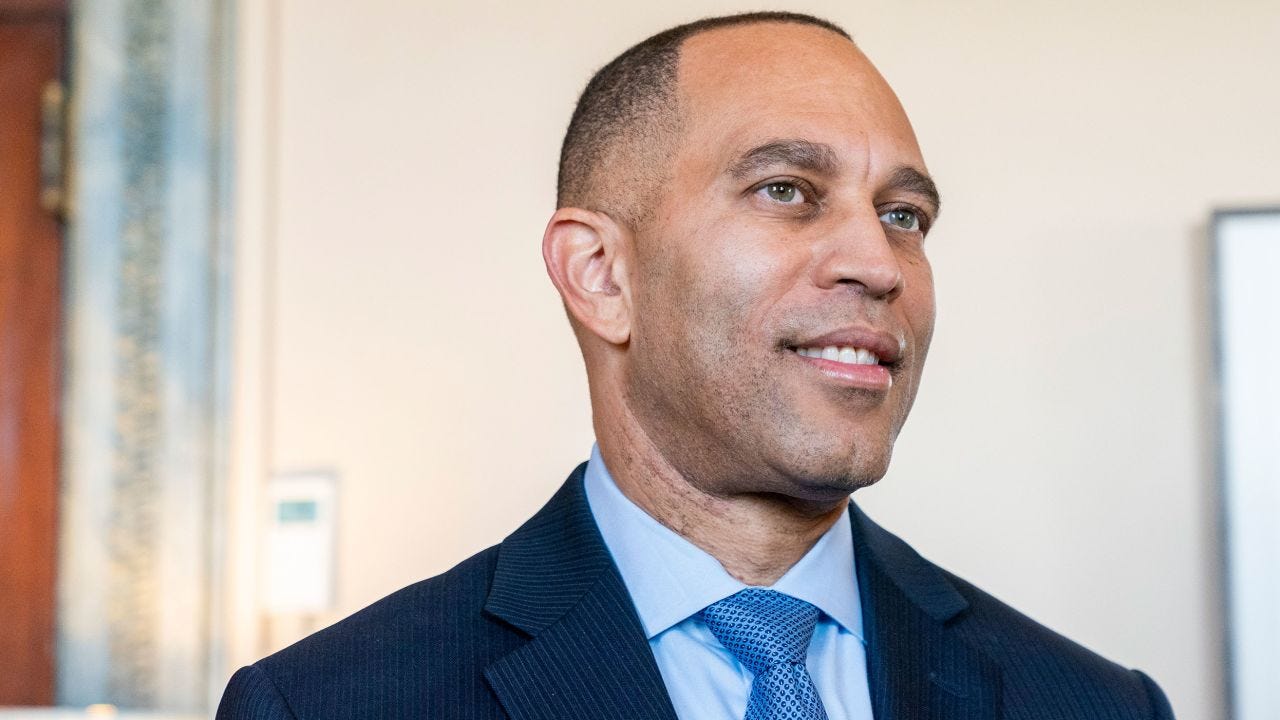
Hakeem Jeffries, House Minority Leader
Can we expect progressive policies from Jeffries? Is he a radical leftist? Of course not! He’s a younger version of Pelosi, a corporate shill who’s sold as a change agent because he’s the first Black party leader in Congress, just as Pelosi was praised for the “change” she represented as the first Madam Speaker.
Don’t get me wrong. It’s generally a good thing when more women, more BIPOC, and other traditionally underrepresented groups attain positions of power. But if their ideas, policies, commitments, and practices are basically the same as those old white fat tomcats who preceded them, where’s the progress? Where’s the change?
In so many ways, today’s Democrats are yesterday’s Republicans. They are pro-war, pro-military, pro-business, and thoroughly corporate. Their alleged diversity is mostly optical. Meanwhile, the Republicans, whatever else they may be, are showing true diversity of views, as manifested by Kevin McCarthy’s messy fight for votes from his own party.
All those corporate Democrats and PINOs in Congress should take a very long look in a truth-telling mirror before crowing about how dysfunctional the Republicans allegedly are. If dysfunction means fighting for change that’s consistent with your principles and campaign promises, the Democrats could truly use some of that “dysfunction.” So too could America.
In 2023, let’s embrace the Vulcan salute, not military ones
2022 has been the year of living dangerously. The Russia-Ukraine War escalated with no immediate end in sight. U.S. government officials, most notably the Democratic Party, have gotten behind Ukraine as if it’s the 51st American state. Aid to Ukraine, mainly in the form of weapons and other war materiel, has approached $100 billion in less than a year. Zelensky has been touted as a “wartime” leader akin to Winston Churchill and lionized before Congress. President Biden, meanwhile, has called for Putin to be removed from power, joined by Republican voices like Senator Lindsey Graham. Biden, with Armageddon on his mind, as in nuclear war, nevertheless persisted in rejecting calls for diplomatic efforts to end the war.
As we turn toward 2023, wars and rumors of war persist. Fear of possible Chinese moves against Taiwan helped drive a record Pentagon budget of $858 billion, $45 billion more than Joe “Armageddon” Biden requested. The Air Force requested 100 new B-21 nuclear bombers and hundreds of new Sentinel ICBMs at a projected cost of roughly $500 billion. That the Pentagon yet again failed an audit, its fifth failure in a row, is no reason to cut or even to control massive military spending, so Congress has collectively concluded.
The so-called leftist or liberal Democrats have emerged as America’s war party; Republicans, meanwhile, are torn between calling for yet higher military spending and trying to curtail military aid to Ukraine and runaway spending on “Ferrari” weapons systems like the F-35. No one of any prominence in either party is calling for peace and for serious reductions in spending on wars and weapons.
Show me your budget and I’ll tell you what you value, Biden once said. Obviously, the Washington elites value war and profits from the same. It’s an anti-democratic commitment that fosters greater authoritarianism and repression in the so-called homeland as well as abroad.
I wish I could say 2023 promises change. It doesn’t, at least not from our government and its leaders. The change will have to come from us.
I have an old polaroid from 1/1/1980. In that photo, I’m caught rendering the Vulcan gesture of welcome with a high school friend. Recently, I got together with another old friend and gave the same salute:
Your author, out in the wild
The message, of course, of the Vulcan salute is “Peace. Live long and prosper.” The Vulcans, those eminently logical aliens of “Star Trek” fame, did their best to change their warlike nature, adopting logic and emotional control in place of violence and mass murder. While I doubt America is prepared to adopt logic and emotional control en masse, surely we can find a way to cultivate peace. We have the means as well to “live long and prosper,” assuming we can ever stop wasting so much of our energy and efforts on war and weaponry.
There is much wisdom contained in the Vulcan salute. May we learn to embrace its message in 2023.








 Bracing Views