A friend of mine thinks Joe Biden has a strong chance of winning reelection in November. He thinks the economy will continue to get better and that Donald Trump may yet be convicted of, well, something. I am far more skeptical about Biden’s chances of victory this fall. Here’s what I wrote to him this morning:
You’re betting on an improving economy and the conviction of Trump as the catalysts for another Biden win. To me, economic growth is very uneven, with an “improving” economy measured mainly by the performance of Wall Street. Few benefits are trickling down to the working classes. Meanwhile, we don’t know if Trump will be convicted of anything; also, I don’t think a conviction that’s seen as politically motivated will hurt Trump. If anything, depending on the conviction and its seriousness, it could even help him.
The largest bloc of voters are those Americans who don’t vote. You have to give people a reason to get off their duffs and vote for you. For Obama, it was “hope” and “change” and idealism. Biden won in 2020 because of the pandemic and Trump’s incompetent leadership. In 2024, Biden is increasingly “Genocide Joe” for youth and progressives; he’s taking his own base for granted, thinking that people will opt for him over Trump because the latter is too divisive.
But what may happen is that Democrats and Independents just stay home, or vote third party, while Trump loyalists show up at the polls.
We can bookmark this conversation if you wish and come back to it this November. We are, after all, trying to predict the future. My guess is that Biden loses; you’re guessing he’s going to win. We’ll see.
I also believe that if Trump wins, the DNC will blame the voters rather than the weakness of the Biden/Harris ticket. I’m sure Putin will also be blamed, as will any 3rd-party candidates like Stein of RFK Jr. The DNC will then fundraise off of fear of Trump. No matter what, the DNC will win. What counts as a “loss” for the DNC is allowing a progressive to run.
It’s some “democracy” we live in when voters are shamed for voting for someone other than Joe Biden. (The Trumpers, of course, are universally dismissed as irredeemable deplorables.) So I know I will be shamed for not voting for Joe (or the Don) this November.
As Yoda the Jedi Master said: “Difficult to see. Always in motion the future.” I just don’t see a lot of enthusiasm for Biden. I see Biden as a figurehead of Neo-liberal economic policies at home and Neo-conservative war policies abroad. Otherwise known as Dickensian conditions for the working classes here and lots of bombs and artillery shells falling on “foreign” peoples of color.
Meanwhile, I doubt the DNC will allow Biden to appear in any presidential debates. Too risky. Biden will largely “campaign” by reading from teleprompters at carefully staged appearances.
The shadow of Trump looms again (photo from 2020)
Biden, to state the obvious, is not in his prime. If reelected, he’ll be 82 and will serve until he’s 86. Voters have legitimate concerns about his health and his endurance. Meanwhile, his vice president, Kamala Harris, isn’t popular and lends little credibility to the ticket. It doesn’t bode well.
I already had four years of Trump; they were more than enough for me. I’ve had three years of Biden and they’ve been more than enough. Yet the RNC and DNC want to offer me a Trump/Biden rematch, and I just can’t stomach it.
MLK recognized the evils of racism, extreme materialism, and militarism
Martin Luther King, Jr., hero for peace.
It’s sad that the word “hero” is so often modified by or married to “war” in history. He’s a war hero, we say, without giving it too much thought. As if wars are somehow ennobling and sublime.
Waging peace is far more noble than waging war. MLK Jr. recognized this in his famous speech against the Vietnam War on April 4, 1967. Back in 2015, I posted this article on MLK and his warning that America was close to suffering a spiritual death in its constant warmongering. Today, we see America enabling genocide by Israel in Gaza with nary a complaint from those in power. Spiritual death, indeed.
*****
On April 4, 1967, Martin Luther King Jr. gave a powerful speech (“Beyond Vietnam – A Time to Break Silence”) that condemned America’s war in Vietnam. Exactly one year later, he was assassinated in Memphis.
What follows are excerpts from MLK’s speech. I urge you to read it in its entirety, but I’d like to highlight this line:
A nation that continues year after year to spend more money on military defense than on programs of social uplift is approaching spiritual death.
MLK called for a revolution of values in America. In his address, he noted that:
There is nothing except a tragic death wish to prevent us from reordering our priorities so that the pursuit of peace will take precedence over the pursuit of war.
MLK didn’t just have a dream of racial equality. He had a dream for justice around the world, a dream of a world committed to peace, a world in which America would lead a reordering of values in the direction of universal brotherhood.
Both of MLK’s dreams remain elusive. Racial inequalities and biases remain, though America is better now than it was in the 1960s in regards to racial equity. And what of a commitment to peace? Sadly, America remains dedicated to war, spending nearly a trillion dollars yearly on defense, Homeland Security, nuclear weapons, and “overseas contingency operations,” i.e. wars.
America has failed to dream the dreams of Martin Luther King, Jr., and we are the worse for it. (Bolded passages below are my emphasis.)
Excerpts from MLK’s Speech on Vietnam, April 4, 1967
At this point I should make it clear that while I have tried in these last few minutes to give a voice to the voiceless in Vietnam and to understand the arguments of those who are called “enemy,” I am as deeply concerned about our own troops there as anything else. For it occurs to me that what we are submitting them to in Vietnam is not simply the brutalizing process that goes on in any war where armies face each other and seek to destroy. We are adding cynicism to the process of death, for they must know after a short period there that none of the things we claim to be fighting for are really involved. Before long they must know that their government has sent them into a struggle among Vietnamese, and the more sophisticated surely realize that we are on the side of the wealthy, and the secure, while we create a hell for the poor.
Somehow this madness must cease. We must stop now. I speak as a child of God and brother to the suffering poor of Vietnam. I speak for those whose land is being laid waste, whose homes are being destroyed, whose culture is being subverted. I speak of the — for the poor of America who are paying the double price of smashed hopes at home, and death and corruption in Vietnam. I speak as a citizen of the world, for the world as it stands aghast at the path we have taken. I speak as one who loves America, to the leaders of our own nation: The great initiative in this war is ours; the initiative to stop it must be ours…
If we continue, there will be no doubt in my mind and in the mind of the world that we have no honorable intentions in Vietnam. If we do not stop our war against the people of Vietnam immediately, the world will be left with no other alternative than to see this as some horrible, clumsy, and deadly game we have decided to play. The world now demands a maturity of America that we may not be able to achieve. It demands that we admit that we have been wrong from the beginning of our adventure in Vietnam, that we have been detrimental to the life of the Vietnamese people. The situation is one in which we must be ready to turn sharply from our present ways. In order to atone for our sins and errors in Vietnam, we should take the initiative in bringing a halt to this tragic war…
It is with such activity in mind that the words of the late John F. Kennedy come back to haunt us. Five years ago he said, “Those who make peaceful revolution impossible will make violent revolution inevitable.” Increasingly, by choice or by accident, this is the role our nation has taken, the role of those who make peaceful revolution impossible by refusing to give up the privileges and the pleasures that come from the immense profits of overseas investments. I am convinced that if we are to get on the right side of the world revolution, we as a nation must undergo a radical revolution of values. We must rapidly begin…we must rapidly begin the shift from a thing-oriented society to a person-oriented society. When machines and computers, profit motives and property rights, are considered more important than people, the giant triplets of racism, extreme materialism, and militarism are incapable of being conquered.
A true revolution of values will soon cause us to question the fairness and justice of many of our past and present policies. On the one hand, we are called to play the Good Samaritan on life’s roadside, but that will be only an initial act. One day we must come to see that the whole Jericho Road must be transformed so that men and women will not be constantly beaten and robbed as they make their journey on life’s highway. True compassion is more than flinging a coin to a beggar. It comes to see that an edifice which produces beggars needs restructuring.
A true revolution of values will soon look uneasily on the glaring contrast of poverty and wealth. With righteous indignation, it will look across the seas and see individual capitalists of the West investing huge sums of money in Asia, Africa, and South America, only to take the profits out with no concern for the social betterment of the countries, and say, “This is not just.” It will look at our alliance with the landed gentry of South America and say, “This is not just.” The Western arrogance of feeling that it has everything to teach others and nothing to learn from them is not just.
A true revolution of values will lay hand on the world order and say of war, “This way of settling differences is not just.” This business of burning human beings with napalm, of filling our nation’s homes with orphans and widows, of injecting poisonous drugs of hate into the veins of peoples normally humane, of sending men home from dark and bloody battlefields physically handicapped and psychologically deranged, cannot be reconciled with wisdom, justice, and love. A nation that continues year after year to spend more money on military defense than on programs of social uplift is approaching spiritual death.
America, the richest and most powerful nation in the world, can well lead the way in this revolution of values. There is nothing except a tragic death wish to prevent us from reordering our priorities so that the pursuit of peace will take precedence over the pursuit of war. There is nothing to keep us from molding a recalcitrant status quo with bruised hands until we have fashioned it into a brotherhood.
Perhaps it seemed in 1967, even to MLK Jr., with all his experience to the contrary, that America could lead the world in a revolution of values, a pursuit of peace. MLK’s dream of such a revolution is dead, drowned in the vast profits of the merchants of death.
The bizarre opening weeks of the Democratic primary season
Democracy, President Joe Biden has said, is on the ballot this year. But often his Democratic rivals won’t be on the ballot, nor is Biden himself officially on the ballot in New Hampshire in two weeks. (Indeed, the DNC refuses to sanction, i.e. support, the NH primary.) What gives?
Next week (1/15), the Iowa caucus for president is being held for Republicans and Democrats. Apparently, official results for Democrats won’t be available until March. Then there’s the famous New Hampshire primary, always the first in the country and this year on 1/23; Biden’s name isn’t even on the ballot for Democrats there.
The first Democratic primary that apparently counts for the DNC is in South Carolina on 2/3. Why is that?
You’ll recall that in 2020 Biden lost the Iowa caucuses to Bernie Sanders and Pete Buttigieg. In New Hampshire in 2020, Biden came in a distant fifth. But he was able to win in South Carolina with a big push from Barack Obama and Congressman James Clyburn, a major powerbroker in SC, even as other candidates like Buttigieg were pressured to drop out and throw their support to Joe. (Buttigieg’s reward was a cabinet post as Secretary of Transportation for which he is eminently unqualified.)
The fix is in for Biden in 2024, to state the obvious. Iowa and New Hampshire are both being sidelined because the DNC knows Biden is vulnerable in these states. But South Carolina, the DNC believes, can be controlled, can be counted on for a decent showing for Old Joe. Thus South Carolina was moved up in the 2024 primary calendar precisely to demonstrate allegedly strong support for Joe.
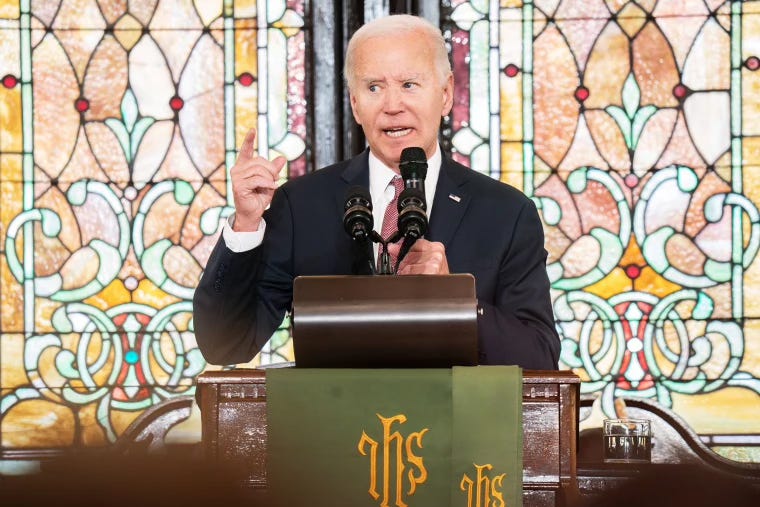
This weekend, Biden was in South Carolina, the only primary that seems to matter
I was listening to a podcast with Matt Taibbi and Walter Kirn as they discussed some of these Democratic (but not democratic) machinations:
Matt Taibbi: And by the way, not just with Trump, with people like Marianne Williamson and Dean Phillips. I mean, they just got wiped off the ballot in Florida, which seems crazy to me. Then there were these other machinations going on in the Democratic side with New Hampshire and Iowa. The Iowa caucus results. The Iowa caucus is the easiest thing in the world. It used to be the simplest, most beautiful, I think, expression of democracy in America. You could go to it. You could sit there and watch people argue and horse-trade and do all that stuff, and everybody would move to one side of the gym, and then there’d be other crowds in other places.
And then at the end of the night, they would call up one phone number and there would be a human being at the other end of the line who would tabulate a pretty small number of districts, and you would get a result. And there’s absolutely no reason why that should take a lot of time. Now, they’re announcing that they’re not even going to have results for the Iowa caucus until March 15th or some ridiculous thing.
Walter Kirn: Who announced that?
Matt Taibbi: Iowa.
I hadn’t heard that Biden’s two main Democratic challengers, Marianne Williamson and Dean Phillips, had been “wiped off the ballot in Florida.” But it’s true: Biden’s name was the only one submitted by party apparatchiks there.
Biden just might win the Democratic primary in Florida. Ah, sweet victory, and against such long odds!
As Biden claims “Democracy is on the ballot” in 2024, the DNC and establishment Democrats are doing everything in their power to deny democratic choices to their voters.
Are you confused? Deflated? Tired of the BS? Look over there: Trump! Bad! Vote for Joe: he’ll save “democracy” from Trump!
As my dad taught me, sometimes you have to laugh to hide the tears.
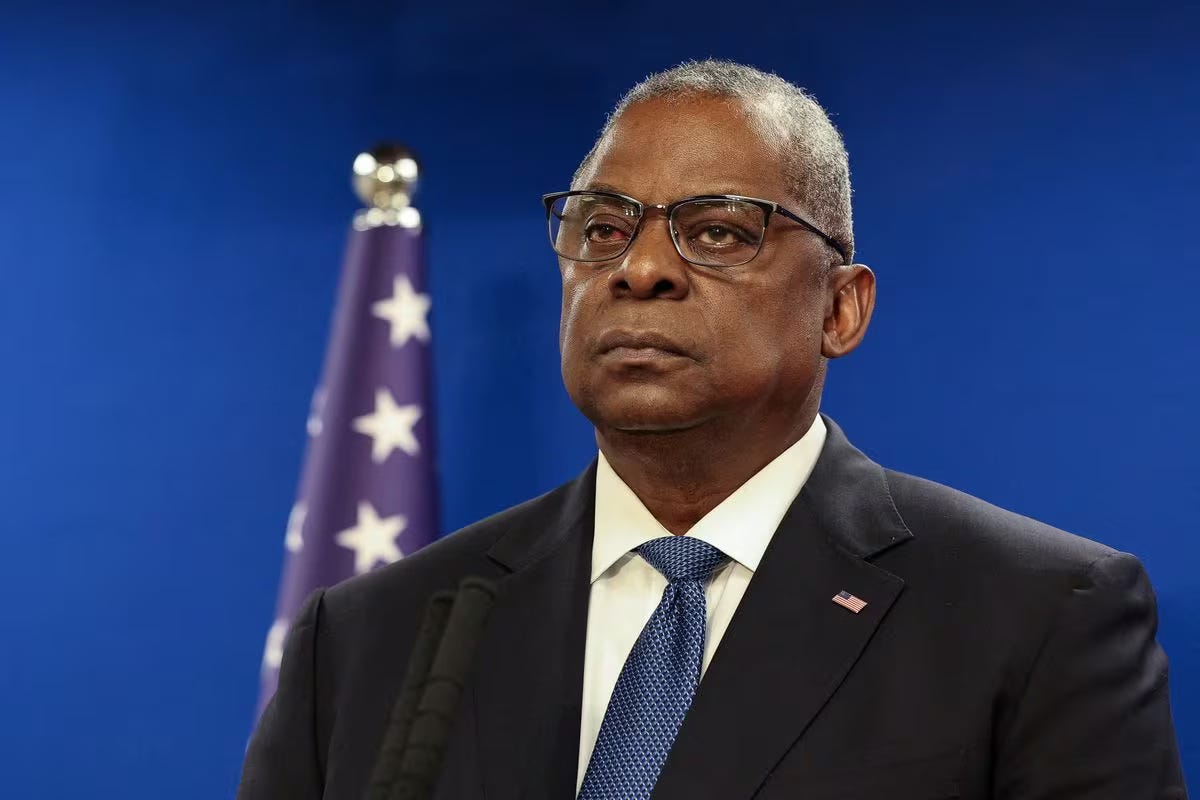
Secretary of Defense Lloyd Austin went into the hospital both before Christmas and on New Year’s Day, apparently not informing the White House and Congress on either occasion. Other than the president as commander-in-chief, SecDef Austin is the senior civilian in the U.S. military’s chain of command.
Secretary of Defense Lloyd Austin looks on during a joint press conference with Israeli Defense Minister Yoav Gallant at Israel’s Ministry of Defense in Tel Aviv, Israel December 18, 2023. REUTERS/Violeta Santos Moura/File Photo
Austin’s medical condition is serious, most recently requiring four days in an intensive care unit. A blindsided president has already declared he won’t fire Austin, nor will Austin resign. No big deal, then?
I’m amazed. One of the first and most valuable lessons I learned in the military was to keep your boss informed. Tell her if the project is behind schedule. Tell him if you’re missing critical spares that would hamper the combat performance of your unit. Don’t let your boss be blindsided. Most obviously, under combat conditions, failing to keep your boss informed of critical information is an almost certain way to get your people killed.
When I was a lieutenant, I served on the “battle staff” for exercises in Cheyenne Mountain. This was in 1986 at the tail end of the Cold War. During one exercise, a friend of mine, another LT, witnessed the commanding four-star general chewing out a colonel on his staff. The colonel had failed to tell the general that AWACS planes were unavailable during the exercise. (Remember, this was an exercise, i.e. “fake.”) My friend told me the general reamed the colonel a new one for failing to inform him of what in wartime would have been a critical piece of information.
Lloyd Austin, it seems, has been MIA for several days without keeping his immediate superior, Joe Biden, in the loop, potentially threatening the national security of our country. Yet Austin has no plans to resign and Biden has no plans to take action.
It’s a bad example to our military that something so critical as a failure to respect the chain of command is being dismissed as a trivial matter. A blindsided Biden should not turn a blind eye here. If Austin has honor, he should resign to avoid further embarrassment to his boss. If he doesn’t, Biden should fire him.
Incremental Genocide and Displacement and Replacement in Gaza
Courtesy of OpenSecrets.org, I saw a chart on AIPAC contributions to U.S. senators that showed that all 100 senators have taken AIPAC money. Leading the way are senate “giants” like Mitch McConnell (nearly two million dollars) and Chuck Schumer (roughly $1.7 million). Talk about bipartisanship! I’m sure it’s just a coincidence that the U.S. Senate is so strongly pro-Israel. It obviously has nothing to do with the power of AIPAC and all that money.
Bipartisanship and no divisiveness. Who says we have a dysfunctional and divided Congress? Nonsense!
Here’s how AIPAC (American Israel Public Affairs Committee) describes itself on its own web site:
The Largest Pro-Israel PAC in America
WE STAND with those who stand with Israel. The AIPAC PAC is a bipartisan, pro-Israel political action committee. It is the largest pro-Israel PAC in America and contributed more resources directly to candidates than any other PAC. 98% of AIPAC-backed candidates won their general election races in 2022.
That last sentence is a killer. AIPAC is reminding Members of Congress that if you want to be elected, or win reelection, you very much want AIPAC on your side. And if you don’t kowtow to their agenda, they will do everything in their power to defeat you.
Imagine if there was an American Palestine Public Affairs Committee, an APPAC, that contributed hundreds of thousands if not millions to every U.S. senator and that boasted of a 98% success rate in getting APPAC-anointed candidates elected or reelected. Do you think maybe the U.S. Senate would have a different position on Gaza and the West Bank?
Speaking of Gaza, I watched Chris Hedges interview Ilan Pappé, an Israeli historian. Pappé put it simply and clearly: Israel is engaged in “incremental genocide” against the Palestinian people, a genocide in slow motion, a strategy of “displacement and replacement.” The “displacement” of the Palestinians is done by mass bombing, mass destruction, mass death, and (hopefully for the Israelis) mass migration, and the “replacement” will come when Jewish settlers take possession of Gaza (after a lot of munitions cleanup and infrastructure redevelopment, I suppose, probably paid for by the U.S. taxpayer).
There’s an Orwellian term for this. For mass death followed by forced expulsion, Israel is using the term “voluntary migration” (or “voluntary” emigration). But of course there is nothing “voluntary” about any of this.
If U.S. government officials appear clueless about what’s happening in Gaza, they’re not. They’re just bought and paid for.
Yesterday, Joe Biden kicked off his reelection campaign by visiting Valley Forge and echoing the dark times of George Washington in 1777-78 during the American Revolutionary War. In a campaign speech that lasted about 30 minutes, Biden declared that “Democracy is on the ballot,” by which he meant Trump is on the ballot. Biden denounced Trump and his MAGA supporters for the “insurrection” they launched on January 6, 2021, when “hell was unleashed” at the Capitol. We nearly lost America on that date, Biden opined, due to the Trump-inspired “violent assault” on democracy.
As a teenager, I loved to collect stamps, just like FDR did
Going further, Biden described Trump as “sick” and “despicable” and noted how recent language about “vermin” and “poison” echoed that of Nazi Germany. Trump and MAGA, Biden said, seek to “bury history” (or “steal” it) and “ban books,” with Trump himself being a sore loser who refused to admit defeat. Biden reminded the audience that being president is about duty and service to your country, including the willingness to walk away peacefully, relinquishing power gracefully when you lose.
All in all, it was a coherent speech that Biden read competently from the teleprompter. He occasionally came across as angry, especially when shouting for emphasis, but overall Biden, though he looked his age, appeared to be committed and engaged.
To me, the main problem with Biden’s speech was that it focused almost entirely on Trump. The essence was “Trump bad,” therefore vote for me, Joe Biden, to secure America’s future, with that “future” left entirely unspecified. The Trump future would be violent, racist, and divisive, marked by vitriol and vengeance, so Biden claimed. A Biden future wouldn’t be that, apparently, but no other details were offered. Biden offered no positive vision.
Biden closed his speech with the usual boilerplate: that America is “the greatest nation on the face of the earth” and “the greatest nation in the history of the world.” Biden said “We know America is winning,” but what exactly we’re winning was left unspecified. Rhetorically, Biden asked “Who are we?” then enjoined us “Just remember who we are.” Huh? Then he said we’re the people who emerge stronger after every crisis. Does that mean we should wish for another Trump crisis so we can emerge stronger still?
Finally, Biden used a phrase that Hillary used to use for us commoners: “everyday people.” Remember when presidents used to say, my fellow Americans, when addressing us? Now we’re “everyday people” as opposed to what, exactly? Someday people? In Washington, I gather there are special people, the elites, the best and brightest, like Joe Biden, and then there are the masses, the everyday people, like you and me.
And I think that’s a big problem for the Beltway crowd: the “everyday people” might just prefer Trump and the chaos he represents. Come November, we’ll find out.
Another “emergency” shipment of arms to Israel: What a way to end the year! First, the Biden administration sent $106 million in tank shells to Israel without Congressional approval. Now, the government is sending $147.5 million in fuses, charges, etc. to Israel for 155mm artillery shells, also without Congressional approval. Mind you, Hamas doesn’t have tanks or heavy artillery, so these shipments aren’t for “defense.” Tank and artillery shells are really for one thing: urban destruction. Artillery is the very definition of an area weapon, i.e. imprecise. Yet, even as the Biden administration sends this weaponry to Israel, which will enable more killing on a mass scale, it expresses concern that Israel is ethnically cleansing too fast, killing too many innocent civilians too quickly.
Along with bombs, this is what tanks and artillery shells are good for
You can’t have it both ways, obviously. You can’t send heavy calibre weaponry to Israel and then complain when they use it. And to justify this aid as an “emergency” for America’s national defense interests! If democratic processes can be bypassed simply by declaring an emergency that clearly doesn’t exist, there is no democracy. Thanks for making that obvious, Joe Biden.
Meanwhile, Gaza continues to be pounded into rubble. Casualties there will soon exceed 100,000 as nearly half a million Palestinians begin to starve. The Israeli/US end game is clear: render Gaza uninhabitable, forcing the Palestinians to make a choice: leave or die.
The two self-declared democracies of Israel and the USA are combining to ethnically cleanse Gaza of Palestinians with the goal of incorporating its territory into Israel. Now I know why the world hates us: for our freedoms, right?
How can Israel commit such a crime? I suggest you watch the interview below with Gideon Levy, who explains it plainly and succinctly. As he notes:
Israeli Jews generally believe they are God’s Chosen People.
Israeli Jews generally believe they are the real victims here (the Holocaust; Hamas attacks).
Palestinians have been dehumanized as barbarians, as worse than animals.
The Chosen People, the eternal victims, are tired of the beasts in Gaza and are getting rid of them, one way or another.
“We [Israelis] live in denial,” Levy says. Ignorance is combined with nationalism. Most Israelis simply don’t want to know what their government is doing in their name. To that end, media coverage in Israel is entirely one sided; the suffering of Palestinians in Gaza is almost never shown. The only people who suffer are Jews.
To Israelis, life is precious and dear; but Israel acts to show Palestinians their lives are cheap. Gaza, Levy says, was a “cage” for the Palestinians living there; Israel has now decided to empty that cage.
Levy has no illusions about the nature of the Israeli government under Bibi Netanyahu, which he calls a brutal dictatorship. And, if we accept him at his word, for he is an Israeli Jew who knows his country, America is aiding a brutal dictatorship in its goal of clearing the Gaza ghetto irrespective of the cost in lives of innocents.
What does that make the Biden administration? What does that make us?
Note: the video link below contains a warning about graphic material. It’s apparently designed to discourage viewing. There is nothing “graphic” about this video except the truths that Levy speaks.
News that the Colorado Supreme Court has ruled that Trump is ineligible to be included on the presidential ballot due to his encouragement of and participation in “insurrection” during the January 6th Capitol riot is being greeted as tidings of comfort and joy in many quarters, especially among Democrats facing lengthening odds in the 2024 election. Is this the way to beat Trump: to bar him from the ballot due to his alleged crimes against the Constitution and the country?
Readers of Bracing Views know that I’m not a Trump supporter, nor for that matter do I support Joe Biden. Trump, I wrote back in March of 2016, disqualified himself from office when he boasted during a debate that U.S. troops would follow his orders irrespective of their legality. The man is most definitely an ignoramus and therefore is a menace to himself and to others.
That said, being an ignoramus is not disqualifying for the presidency.
After a swift appeal, I’d wager the U.S. Supreme Court will reverse the decision of the Colorado Court, putting Trump back on the ballot. What then?
I think it’s relatively easy to defeat Trump in November 2024: run a candidate whose views and deeds correspond to the views and desires and priorities of the vast majority of Americans. The working and middle classes.
Cartoons like this one are frankly unconvincing
If I were a candidate for the presidency, and wanted to maximize my vote vis-a-vis Trump, here are a few things I’d support:
Higher wages for American workers. A hike in the federal minimum wage to at least $15 an hour.
Health care for all. Use the common wealth for common health.
“Free” college education at state colleges and universities. (By “free,” I mean subsidized at a tolerable level for students, with tuition and fees capped at $2000 a year.)
Legalization of marijuana for personal use across the USA.
Criminal justice reform that would greatly reduce the number of non-violent offenders held in prison.
Major reductions in military spending and a commitment to peace and diplomacy.
With the hundreds of billions saved from reductions in war spending, a major commitment to rebuilding American infrastructure, including the creation of a new Civilian Conservation Corps (CCC) tied to alleviating damage due to climate change.
An end to divisive rhetoric and talk of “deplorables” and “blue and red” America. A national celebration of and renewed commitment to the U.S. Constitution.
The salute of brave people willing to inform Americans of crimes being committed in their name. The return of Edward Snowden to America and a celebration of his patriotism and service to America. The pardon and release of Daniel Hale from prison. The dropping of all charges against Julian Assange. A commitment to freedom of speech, the press, and indeed of all Constitutional rights.
Privacy for the people; transparency for the government.
That’s ten positions that I believe would garner the support of a majority of Americans in the 2024 election.
The problem is that the main rival to Trump in 2024, Joe Biden, is a “nothing will fundamentally change” guy who lacks the will, energy, and wherewithal to motivate and unify the American people behind these and similar popular positions.
What does Biden have going for him? Well, he’s not Trump. That’s seemingly the beginning and the end of Democratic messaging. And it’s not enough. Which is why Democrats are so excited about the Colorado Supreme Court’s ruling.
That court ruling isn’t going to stop Trump. What will stop Trump is a candidate of courage and conviction who truly wants to serve the people. All the people, equally. The obstacle to be overcome is a Washington establishment, including most especially the corporate owners and donors, the big money people, that is determined to block any candidate or any party that is truly dedicated to the Constitution and to the needs of the people writ large.
I’m a member of the Eisenhower Media Network, or EMN. We’re a small network of retired military types and former U.S. government officials who are openly critical of the military-industrial-congressional complex, America’s open-ended forever wars (the global war on terror; the cold war against Russia and China), and rising militarism within and across our society.
Recently, EMN issued a new letter in opposition to the Washington bipartisan consensus for war and more war. I’m proud to say I had a hand in writing it, as did Matthew Hoh and other members of EMN. Here’s what we had to say:
Military and Foreign Policy Experts Open Letter on U.S. Diplomatic Malpractice
Does America inspire the world by the power of its example or the example of its power? Far too often, and despite President Joe Biden’s words during his inaugural address, America’s overmilitarized power and diplomatic malpractice are its examples to the world.
We must change that. To make America truly essential and indispensable, we must not remain the world’s leading arms maker and weapons exporter. We must instead become the world’s greatest and most committed peacemaker and diplomat.
The problem is that America continues to make war, continues being “essential” only as the world’s leading merchant of death, and continues seeking dominance through military supremacy that ends, in places like Afghanistan, Iraq, and earlier in Vietnam, in mass death and colossal folly.
In our first open letter last spring in The New York Times, we, the undersigned, argued that a thoroughly militarized U.S. foreign policy would generate ruinous and worsening consequences and increasingly limited options for the U.S. and the world. Recent events bear this out.
The results of U.S. diplomatic malpractice are cruelly displayed in Eastern Europe, the Middle East and the Indo-Pacific. Risks of further escalation and a world war are rising. Predictably, a militarized foreign policy characterized by rejecting or ignoring international laws and treaties and by disingenuous negotiations and talks has offered no solutions to volatile wars in Eastern Europe and the Middle East while making war more likely in the Indo-Pacific.
Militarized solutions breed and feed more war. Earnest and deliberate diplomacy is the best hope to bring peace, stability and reconciliation to the world.
We chose Ike as our inspiration because he warned Americans of the dangers of the military-industrial complex and because he rejected a world dedicated to manufacturing weapons to commit mass murder.
War in Ukraine
The failure to pursue diplomacy in Eastern Europe, both before and after Russia’s invasion of Ukraine, has resulted in a costly and destructive stalemate for which there are two likely futures:
The collapse of the Ukrainian state due to a deteriorating economic and military situation hastened by corruption.Here, Ukraine’s fragility resembles that of previous houses of cards built by the U.S. in Afghanistan, Iraq, and Vietnam.
A harrowing and bloody stalemate in Ukraine where firepower, made more lethal by technological advances, rules a battlefield where neither side can achieve decisive tactical or operational gains. The pursuit of ways out of this stalemate likely entails horizontal and vertical escalation, neither of which offers solace to those seeking an end to death and destruction in Ukraine and the establishment of peace and stability.
Horizontal escalation sees the war extending further to civilian population centers and infrastructure and includes the possibility of other nations joining the conflict. Vertical escalation sees the expansion of arsenals to weapons of greater range, lethality, and consequence, including nuclear weapons. These two forms of escalation may be intertwined and reinforcing. So, as the war may expand horizontally to resemble The War of Cities between Iran and Iraq in the 1980s, it may expand vertically as well with more powerful weapons being introduced by both sides. The use of nuclear weapons is increasingly conceivable under these conditions.
These two likely futures may intersect. For example, a Ukrainian collapse could see NATO forces, likely Polish and Romanian, marching into western and central Ukraine to counter a Russian push to fill a collapsing Ukrainian state. Such an event could lead to a war between NATO and Russia, a war that conceivably could go nuclear.
Hamas, Israel and the Middle East
The Russia-Ukraine War now rages concurrently with the war between Hamas and Israel. This war, too, is born of a U.S. refusal to foster diplomacy. Unlike the conventional war between Russia and Ukraine, we are witnessing an asymmetrical conflict more akin to the wars of insurgency many of us experienced in Vietnam, Afghanistan, and Iraq.
Worse, the Hamas/Israel bloodletting in Gaza is characterized by an ethnic cleansing campaign that would be impossible without U.S. diplomatic, economic, media, military and political support. We are disgusted by and find repugnant the brazen and bipartisan support by the U.S. government for rampant violations of international law by Israel. Ethnic cleansing in Gaza, long planned by senior members of the Israeli government and powerful elements of Israel’s reactionary right wing, follows in the ghastly wake of Hamas atrocities against civilians on October 7.
Here, the U.S. government isn’t just passively witnessing war crimes; it is enabling them. With the frightening possibility of escalation to a regional or even a world war, the violence in Gaza has fed and feasted upon decades of deliberate diplomatic malpractice in America. Decades of putting Israel first, second, and last while ignoring the plight and pleas of Palestinians have made political settlements to the blockade of Gaza and the occupation of East Jerusalem and the West Bank nearly impossible.
Whereas a month ago, we lived with the risk of nuclear war as an outcome of escalating conflict in Ukraine, we now face the elevated risk of a rightfully feared world war as a consequence of entangling alliances between nuclear-armed Moscow and Washington in the Middle East.
China and the Path Ahead
To this, we must add the dangers of war with China, something hyped by leading U.S. politicians; the still unpaid costs of the $8 trillion wars in Afghanistan and Iraq; a militarized federal budget for which 60% of discretionary spending goes to war and all its wounds; and a hollowed American economy.
Decades of reckless U.S. war-making, both direct and via proxies, while coddling corrupt, ruthless, and unjust foreign governments has, not surprisingly, made the world more dangerous and less stable. Failure to invest in and maintain our country has weakened and corroded America’s infrastructure, institutions, and industries. A hypocritical flaunting of international law and an espousal of an ethereal rules-based order, coupled with an arrogant disregard for past U.S. crimes and blunders, have caused dozens of nations to flock to competitors – a movement away from America that will undoubtedly accelerate if we remain on our current militaristic path.
Moreover, decades of colossal military spending have witnessed few strategic gains for the U.S. Our military, often saluted as the world’s greatest by politicians, hasn’t won a major war since World War II. That same military annually faces significant recruiting shortfalls that cast considerable doubt on the integrity and staying power of the All-Volunteer Force. America’s legacy of failed wars is not redeemed by ongoing displays of vacuous military boosterism. Feel-good patriotism can’t suppress the bitterness many of us military veterans feel toward the past, nor does it calm the worries we have about our nation’s future.
Pope Francis has spoken of a “famine of peace” that exists in the world today. In this spirit, we call for immediate ceasefires, without conditions, in Gaza and Ukraine.
The surest way to prevent wars from exploding into uncontainable wildfires is to starve them of fuel. To think or speak that these conflagrations can be managed, adjusted as if by damper or thermostat, is a fool’s conceit or a liar’s word. We have been burned too many times in our professional lives to believe hot wars can be “won” by throwing more gasoline on them, whether rhetorically or in the form of cluster munitions, depleted uranium shells, and similar forms of “aid.”
A better path ahead is clear. Peace, not war, must be fostered. In embracing peace through diplomacy conducted in good faith, America would indeed exhibit the power of its example, becoming essential to a world that cries out for liberty and justice for all.
We are witnessing the obliteration of Gaza. The death toll has already surpassed 16,000 as Israel continues to pummel targets with American-made bombs and missiles. Even CNN is worried (from my email update this AM):
Top UN officials are warning of an “apocalyptic” situation in Gaza with “no place safe to go” for civilians as the deepening humanitarian crisis sparks international concern. Israel is expanding ground operations to the entire territory to “eliminate” Hamas and has told Palestinians to flee large swaths of southern Gaza, where many had previously sought refuge. But the war-torn region is in the midst of a near-total internet blackout as the last major telecommunications operator said services are completely cut off. This means many Palestinians are unable to communicate with one another or call for help while evacuating, and emergency workers can’t coordinate their responses.
Caitlin Johnstone has a telling article in which she states an important truth: Israel couldn’t be doing this without generous U.S. support. Israel is dropping the bombs, firing the missiles, and shooting the artillery rounds and bullets, but the U.S. is largely serving as the merchant of death for all this, though “merchant” is the wrong word. The U.S. is giving all this deadly weaponry to Israel as “aid,” even as there’s much rhetorical gnashing of teeth in Washington about Israel’s “indiscriminate” bombing and wanton killing of Palestinian innocents, including thousands of children. I say “rhetorical” because as Johnstone notes, the U.S. government could curtail Israeli military action by turning off the spigot of arms flowing from U.S. arsenals and warehouses to Israel.
But that’s not going to happen. AIPAC has a hammerlock on Congress; those few members of Congress who’ve called for a ceasefire in Gaza are already being targeted by the powerful pro-Israel lobby, with AIPAC promising to spend upwards of $100 million to unseat those politicians who aren’t consumed by bloodlust against Gaza. The power of AIPAC is reinforced here by the MICC, the military-industrial-congressional complex that Ike warned us about in 1961, which stands to profit immensely from more war in the Middle East as well as Ukraine. The combination of AIPAC with the MICC is akin to Mechagodzilla, an almost unstoppable monster of immense power.
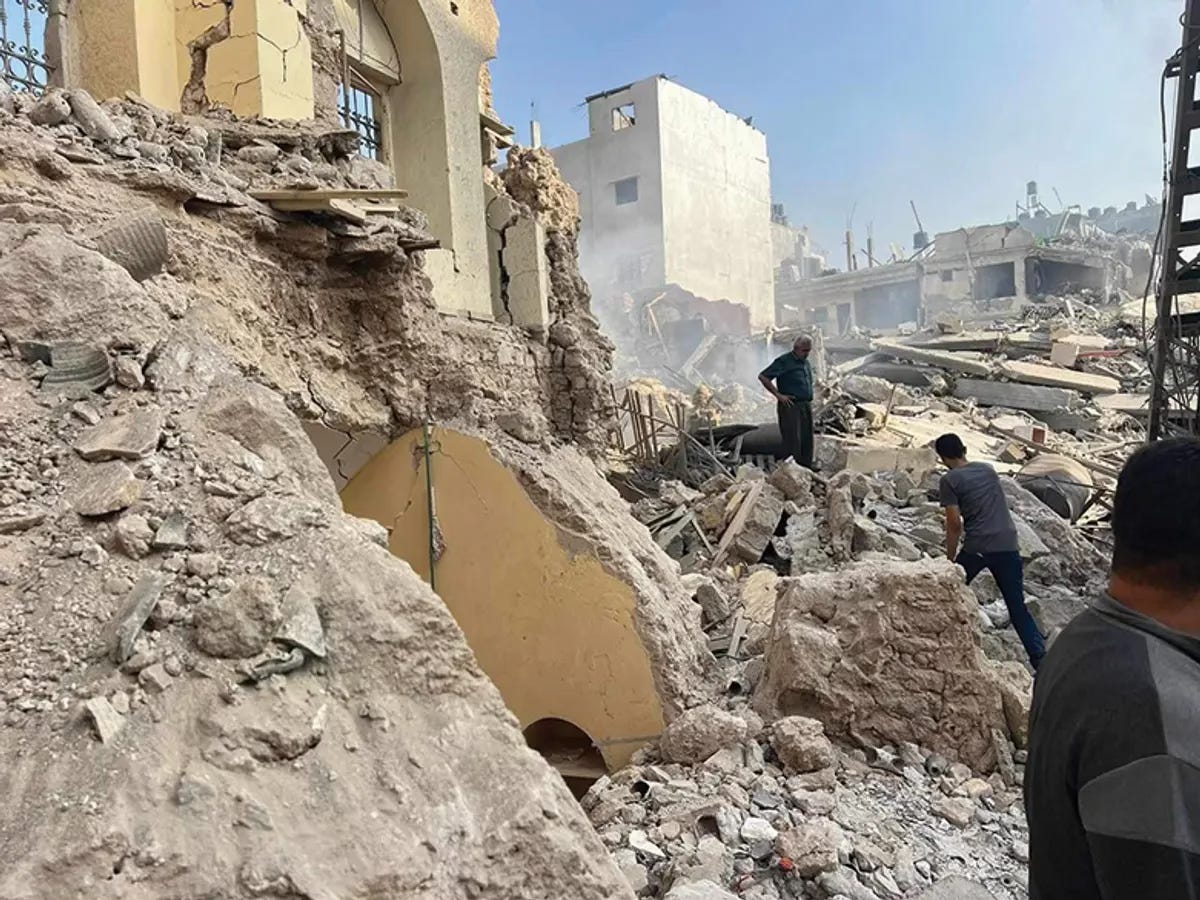
They create a desert and call it “peace”: Gaza turned to rubble
Godzilla in its various incarnations would be hard-pressed to duplicate the scenes of devastation we’re seeing in Gaza. Israel is practicing its own version of the infamous statement from America’s war against Vietnam: “It became necessary to destroy the town to save it.”
The Israeli version: We had to destroy Gaza to save it from Hamas.
It made no sense in Vietnam, and it makes no sense today in Gaza. But this is not about making sense: it’s about power and vengeance and profit.