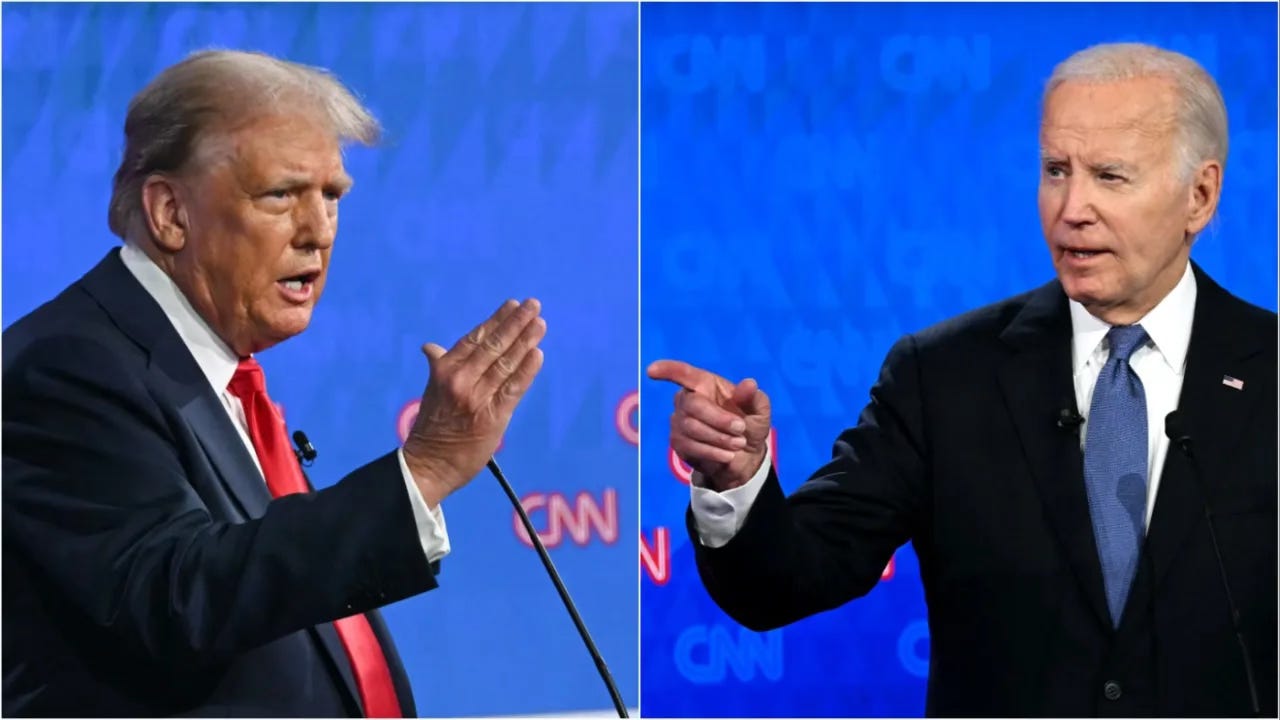
Joe Biden has become a major distraction. Much like Donald Trump, he’s demanding far too much attention.
As genocide continues in Gaza, as war continues to rage in Ukraine, as America continues to pursue militarism both at home and abroad, all the press can talk about is whether Biden should stay or go.
The answer is obvious: he should go.
Sure, Biden remains capable of having a “good” day in the sense of doing OK at a rally while reading prepared remarks from a teleprompter. Yet it’s impossible to ignore brain glitches where he introduces Zelensky of Ukraine as President Putin and suggests his vice president’s name is Trump instead of Harris.
America faces serious issues, especially working- and middle-class Americans who are struggling to make ends meet. Their stories are rarely told in the corporate-owned media as Biden’s flubs and stubbornness and Trump’s lies and showboating grab nearly all the attention.
A new (and desperate) ploy I’ve seen on Twitter/X is Biden supporters arguing that a failing older man is better than a lying one as president. That argument assumes Biden has a strong record as a truth-teller when it was gratuitous lies and flagrant plagiarism that ended his presidential campaign in 1988. Besides, is it really true that Biden, a man visibly in mental and physical decline, is the only choice Democrats can muster to defeat Trump in 2024?
Let’s look at one chart that shows Biden’s record. Since he became President, military spending has soared as social spending has dipped.
And this man, Democrats say in reverent tones, is the new FDR?
I suppose their counter would be: Trump will be worse! So, it’s the old “lesser of two evils” argument.
Biden and Harris continue to run a campaign devoid of any message other than vote for us because Trump will be worse. That empty message, and Biden’s visible decline, produce images like this:
Exactly. Which “job” is the Biden/Harris team so intent on finishing? No one knows since they’re not saying. Vague messaging and a confused candidate are almost certain to lead to a Trump victory in November.
And if that happens, those to blame will be clear, starting with Biden, the DNC, and all the scheming powerbrokers behind the scenes like the Obamas and the Clintons.
Why are progressives so powerless in America? Is there any hope for radical reforms here that favor the 99%? Stimulated by a question from Jeff Moebus, here’s some thoughts on this crucial issue, lightly edited from the comments section of a previous article:
As a kid, I loved to collect stamps, and I still have a small collection
I’m curious, Bill: What do you think the RNC’s Main Goal is?
In any event, given that that is the DNC’s Main Goal [suppressing progressive voices and power within the Democratic Party], why haven’t the Principled Progressives of America formed their own political party so as to give Americans that choice for Systemic Reform come election time?
Is at least part of the problem that a significant number of Americans disagree with and, in some cases, categorically reject the principles, policy proposals, and promises of Progressivism? Which may explain why there are no “Progressives” in Washington, eh?
Jeff, the RNC seems content to ride the Trump wave, knowing that Trump can be controlled and perhaps coopted as well.
Trump lacks core principles, so I think the RNC’s main goal is to shove Trump in directions that are consistent with RNC imperatives, such as lower taxes on corporations, financial deregulation, and the dismantling of the welfare state and anything that smacks of socialism.
I agree completely with your assessment of the RNC, Bill. Especially the part about Trump being controllable and cooptable. If he wasn’t, he would have never become a President who completed a full term in office.
In any event: Do you have any thoughts as to why the Principled Progressives of America have not formed their own political party so as to give Americans that choice for “Systemic Reform” come election time?
My guess: lack of money. Corporate cash isn’t flowing to progressives. Plus some progressives have been coerced, manipulated, or otherwise propagandized to believe they can “push” Biden (or Harris etc.) in progressive ways. Of course, it’s total BS.
Recognize as well that progressives were burned by both Obama and Bernie. Finally, progressive energy is sapped by “woke” cultural issues rather than focusing on class issues and an antiwar agenda that would also prove attractive to some on the Right as well.
That’s my quick take. Of course, the other part is the corporate media that smears progressives as “far left,” Putin puppets, and therefore untrustworthy and unelectable.
So the problem, basically, is that there are not enough Americans ~ especially those with money to spend on politics ~ who agree enough with the proposals of Progressivism to actively support it and actually work to make it happen.
Strangely, Jeff, I wrote a reply and it disappeared on my own site!
Here’s what I think I wrote: What we need, as Bernie said, is a political revolution, but then Bernie decided not to lead it.
How do you effect this “progressive” revolution? It’s extremely hard because so many powerful forces are arrayed against it:
1. Both major political parties in America are against progressive reforms.
2. Corporate elites are against them.
3. Corporate media is against them.
4. Coercive forces such as police forces of all stripes are against them.
What is required is a mass movement willing to be disobedient organized along class interests. A movement of left, right, and center. A movement of the 99% against the 1% (and the .1 -.01%).
Rich and powerful “citizens” (and recall that corporations are citizens now) will not simply hand over power. They will have to be persuaded, convinced, and possibly coerced.
Also, the rich and powerful know how to divide, distract, and demobilize the masses, while keeping the many as downtrodden and debilitated as possible. Hence all the “unhoused” people we see, all the immigrants, all the poor people suffering. Those poor unfortunate souls are partly there to scare the rest of us.
Thomas Jefferson famously opined that “The Tree of Liberty must be refreshed from time to time with the blood of patriots and tyrants.” (That’s from memory.) Who is willing to bleed, and how much blood must flow, and even then, will it get any better?
It’s easy to be cynical and pessimistic here, but those are paralyzing forces. Instead, we have to be optimistic or at least determined, else the USS America will continue to slip under the waves of mass corruption and bottomless bankruptcy. And by “bankruptcy” I mean spiritual and moral as much as financial.
What say you? Is there any hope for meaningful change in the USA, and how can that be implemented without violence?
******
Rather than putting the onus on Jeff Moebus, what about you, loyal readers? Can meaningful change be effected in America that actually helps the 99%? That moves the country into less militaristic waters? That restores liberty and power to the people? If so, how, and at what price?
One essential step: campaign finance reform. A country where money=speech is by definition a plutocracy. Another essential step: a radical downsizing of empire and a Pentagon budget reduced by 50%. But with a corrupt Congress that loves money and the military, how are these changes to be made?
All my life, the punditocracy has told me that being President of the United States (POTUS) is the world’s toughest job, making enormous demands on physical fitness and mental stamina. And now the Democrats are telling me that Joe Biden is and remains the fittest candidate to serve as POTUS for another four years.
Since Donald Trump emerged as a candidate in 2015, the punditocracy has told me he’s a menace to democracy. That he must be stopped at all costs, else America faces authoritarian fascism. And now the Democrats are telling me that Joe Biden is and remains the fittest candidate to stop Trump and the Republican march of fascism.
Well, I have some faith in my lying eyes, and based on them, I know Biden isn’t up to the challenge of being POTUS for another four years, nor is he the fittest man to stop Trump and “fascism.”
The Democrats’ decision to stick with Joe Biden suggests the person who serves as POTUS really doesn’t matter: a cardboard cutout would suffice. It also suggests Democratic powerbrokers really aren’t that worried about Trump being a fascistic dictator, nor will Rachel Maddow end up in a gulag for dissidents.
But let’s assume for the moment that Trump really represents fascism on the march in America. Who’s the best person to defeat him?
He’s ready! Clooney, I mean, shown on the left with then-VP Joe Biden
In what passes for politics in America today, why not a celebrity with name recognition and charisma? George Clooney, anyone? He’s handsome, a relatively young 63, and smarter than your average bear. He can act too, not a disqualification for the position of POTUS.
Alternatively, why not Dolly Parton? Or someone like her? Sadly, Dolly’s husband is suffering from Alzheimer’s and she’s curtailing her schedule to be with him, but she’s got the looks, the business savvy, and the sass to take on Trump.
Assuming Democrats smarten up and stop believing their own BS, they should seek unconventional candidates with the mettle to challenge Trump. Heck, why not Susan Sarandon? The Democrats blame her activism whenever they lose, as in 2016, so why not run her as a candidate? At least there’d be some validity to blaming her for Trump’s victory if he should win again in 2024.
What say you, readers? Who’s the unconventional Democratic candidate who might, just might, hand Trump his lunch while protecting what’s left of U.S. democracy?
(A mason’s assistant who was working on my chimney a few weeks ago suggested Keanu Reeves. If he saved humanity from Agent Smith and the machines in “The Matrix” trilogy, surely he can save America from Trump. Keanu seems like a good dude, but he’s Canadian, so he can’t run. Sigh.)
P.S. Just kidding. We all know Bibi Netanyahu is the best candidate. Talk about bipartisan Red and Blue love. No wonder Bibi wears the imperial purple!
President Biden had his big post-debate interview with ABC News during which he vowed to stay in the race unless he was sent a message from God.
“If the Lord Almighty came down and said, ‘Joe, get out of the race,’ I’d get out of the race, but the Lord Almighty’s not coming down.”
The Lord Almighty is apparently not coming down to speak to Joe Biden
Well, that settles that, America.
Like me, Biden is a Roman Catholic, though I must admit my faith in the church has lapsed. Still, I know something of theology, having studied the history of science and religion, and having done my share of research on Christianity. It’s strange indeed for a believer like Biden to suggest the Lord Almighty is not coming down to speak to him. Does Biden now know the will of God? Or perhaps he thinks the Lord Almighty isn’t “coming down” because he doesn’t truly believe in Him?
The Lord works in mysterious ways, and (assuming you’re a believer) no one truly knows His will. Biden, however, seems to think he does know His will, which is apparently to stand by His man, Joe Biden.
Of course, Biden was perhaps just being hyperbolic here with his claim about the Lord Almighty. Still, it’s such a strange thing for him to have said.
My wife put it best this AM: The real Lord Almighty, meaning Democratic mega-donors, may indeed come down from high places to tell Joe to get out of the race, and then Almighty Mammon will have spoken to Biden in a voice he can’t ignore.
Being President of the United States (POTUS) is not a part-time job.
Apologists for Joe Biden suggest that he’s capable of doing the job during normal office hours. Say roughly 10AM to 4PM. But sadly last week’s debate started at 9PM and Biden was tired, he had a cold, and he just couldn’t think and speak clearly and coherently.
So, let’s remind America’s rivals that if they are to launch any attack that might, just might, activate nuclear contingency plans in the Biden administration, they had best do it when the president is capable of clear thinking, which apparently means a six-hour window, Monday through Friday, 10AM-4PM EST.
Seriously, as an American, all my life I’ve been told that being POTUS is the toughest, most demanding, job in the world. That POTUS has in his charge the nuclear “football,” the codes that would unleash America’s awesome, possibly world-destroying, nuclear arsenal, and that therefore the president had to be a person of sound body and of soundest mind. And now I’m being told that Joe Biden, a man in obvious decline, is exactly that person of sound body and of soundest mind to serve another four years as president and commander-in-chief.
The nuclear “football” is actually a briefcase containing the codes needed to authorize and authenticate a nuclear attack
The nuclear football is not something to fumble. Once those missiles are unleashed, there will be no redo.
Joe Biden’s recent debate performance featured sustained moments where he stared blankly into space, where he was obviously confused, where he spoke nonsense. Put bluntly, there were times when he quite literally didn’t know what he was saying.
Sure, Biden isn’t always confused, muddled, or whatever term you care to use to describe obvious mental compromise. But no POTUS can afford to be mentally muddled or compromised because you never know when he or she may be needed to make a decision (under the severest pressure and in a matter of minutes) involving nuclear weapons. It’s an awesome, almost unimaginable responsibility that requires the most stringent vetting of America’s candidates for POTUS.
Today’s Joe Biden is not up to that responsibility. Anyone who says otherwise is denying the evidence of their own eyes and ears.
Standard Disclaimer: This is not in any way an argument for Trump. It’s an argument for a fitter president, right now, and for the Democrats to nominate someone other than Biden to run against Trump this November.
Last night’s political debate between Joe Biden and Donald Trump was a sad spectacle. Clearly, Biden performed poorly. Trump, I suppose, was Trump. The CNN post-debate commentators were universal in saying the Democratic Party is panicking after Biden’s appearance and performance, almost as if they were reading from the same script. It’s finally OK in the mainstream media to state what’s been obvious for years: that Biden is simply too old and infirm to serve as president for another four years. Look for Biden to be replaced as the Democratic candidate, though how gracefully remains to be seen.
Neither candidate did well in last night’s debate
Biden started poorly and never fully recovered. He walked out haltingly. His voice was raspy. He was arguably over-prepared, talking too fast, spouting too much detail, looking confused. A low point came when he lost his train of thought and then concluded by saying “We finally beat Medicare.” Trump pounced. If this had been a fight, the referee would have stopped it then and there.
There’s a catchphrase from a Clint Eastwood movie that “A man’s got to know his limitations.” Biden doesn’t know them, not anymore, and the people around him are doing him a grave disservice in continuing to push him forwards, in continuing to prop him up. It’s time for Biden to retire, to be a one-term president, which was initially the plan when he ran and won in 2020.
After the debate, Trump walked grumpily off the stage. Biden stood there, seemingly at a loss, until Jill Biden came and guided him carefully down a few steps to greet the moderators.
The debate itself was a charisma-free zone. Both men spent most of their time bashing the other. It was a house of frowns. As I watched and took notes, I wrote this: Biden and Trump trade insults while America burns.
In a rare burst of pseudo-agreement, Trump and Biden both said their opponent was the worst president in U.S. history. Both also had surprisingly weak and inept closing statements.
That being said, Biden and Trump did offer a sharp contrast. Biden continues to assert America is the envy of the world, the best country bar none, with the finest military in all of human history. For Trump, America is a failing state, a “sick” country, akin to a “rat’s nest,” overrun with illegal immigrants.
Turning to foreign affairs, both men eagerly supported Israel, with Trump going the extra mile in saying he wants Israel to finish the job in Gaza, the job being genocide of the Palestinians there. Interestingly, Dana Bash, the CNN moderator, said only that Israel’s massive offensive in Gaza had killed “thousands” of Palestinians. She, of course, said nothing of ethnic cleansing or genocide, and neither did the candidates. Pro-Palestinian protests went unmentioned.
“We’re a seriously failing nation,” Trump said, and he’s right about that. The problem is that Biden is too old to run again and Trump remains temperamentally unfit to serve as a public servant at any level. Both men toward the end got into an argument about their respective golf handicaps. It was really that bad—and that out of touch with the needs and concerns of workers and families across America.
Jack Gilroy has his day in court against the Merchants of Death
This afternoon at 2:00PM, 89-year-old Jack Gilroy has his day in court in Endicott Village, New York. His crime: trespassing. His real “crime”: protesting against genocide in Gaza and a murderous war in Ukraine and U.S. support of and profiteering from the same.
Believe me, this video is available, but YouTube prefers to dissuade you from watching it
Jack reached out to me a week ago. He’s a “Bracing Views” reader and asked if I might share his ideas and plight with all of you. Hell yes, I said, so here are some words from Jack Gilroy as he prepares for his day in court later this afternoon:
My reward [for peace activism] at St Francis Xavier Parish (Jesuit) in NYC was just last week when I was given a nice plaque for my peace and justice actions over the decades. It was the first recognition since I received Soldier of the Month in my Infantry Battalion in the Austrian Alps in June of 1955. I had just come back from Vienna and some face-to-face confrontation with Godless Communists. I saw just young people like me, and I was just turning 20 at the time. The good Catholic sisters (IHM) who taught me in Carbondale, Pa a little coal town, were the same ones that taught Joe Biden just a few miles away in Scranton and seven years younger than me. I woke up to the lie of militarism in 1955 but Joe is still trapped in the lies of the Cold War.
Today I will go on trial in a village court in Endicott NY for trespass on the property that I pay for with tax dollars, nearby BAE Systems. I was attempting to deliver a letter to warn management and workers that they are part of a series of criminal law-breaking as outlined in our Veterans For Peace Six Broken Laws Letter. I was arrested when BAE Security called the cops.
In my attempt to get folks to come to my trial, I note the trial is not about me, but the Merchants of Death, and BAE Systems is one of the largest.
We (VFP, Pax Christi and Peace Action members) started Tax Day 2024, April 15 at the 155mm shell factory of General Dynamics in Scranton (like BAE, General Dynamics makes a lot of dough from nuclear weapons but 155mm shells are the most desired ammo of both Israel and Ukraine). They would not take my letter so we left it for an armed soldier to maybe deliver it. He said he could not take letters. Our little cortege of vehicles drove north to nearby Archbald, PA, where Lockheed Martin makes Paveway I and Paveway II bombs to blow apart children and other living beings anywhere in the world, e.g. Gaza. A security guard took the letter and likely got his ass reamed out when he took it to a superior–the Chief of Police of Archbald was there (I called his office the day before) and he seemed surprised to learn we were opposing the company that has done so much for the depressed anthracite coal valley.
Then, back in our cars and on to Endicott NY where others met us and where I used the envelope in my attempt to deliver the letter.
We have videos of all that [see above video], and I will defend myself in court (my last time out was very expensive for attorney fees in Syracuse, where I refused to take a plea bargain like the other 31 who did outside the gate of the 174th Attack Wing of the NYS National Guard. My sentence was three months in the Jamesville Penitentiary and the biggest Community Service anyone had ever seen at 1500 hours.
This offense will not be like my other trespass times like the SOA and my trips to four federal prisons shortly after retiring as a high school Participation in Government Teacher. One U.S. Marshall said as he scanned my file, “Schoolteacher, eh. Well, we’re going to give you a lesson.” The lesson was called Diesel Therapy and I won’t get into it.
So, maybe you can squeeze in a column on this only trial that we know going on that challenges the Merchants of Death. I’ve been in contact with Josh Paul, who resigned his position as Director of the Department of State because he said laws were being broken and he didn’t want to be part of it.
Well, we put members of the Krupp family in prison following the Nuremberg Trials in 1945-47, so let’s start looking at CEOs and others from Lockheed Martin, General Dynamics, and my nearby BAE Systems, who most people around here think electric buses are their only product. (96 % of BAE contracts are military.)
Jack Gilroy then added a few more details about Congress and the military-industrial complex:
Dems and Repubs are always at the war factories when a new contract is announced. What nice smiles Senators Chuck Schumer and Kirsten Gillibrand have when the big bucks are announced. Schumer takes more money from the war merchants than any other U.S. politician.
And Senator Gillibrand married into a British family who are major stockholders in BAE Systems. Her in-laws sold their stock when she became a Senator (but funded her campaign with a half million bucks).
Readers, please keep Jack in your thoughts as he faces the judge today. And especially keep his words here in mind: “Nobody should profit from the slaughter of innocents. We must protest loudly and persistently, lest we ourselves become complicit in war crimes and genocide.”
Before my father became a firefighter, he was for many years a factory worker. He knew hard work, and he once told me that the harder he’d worked in his life, the more physical the labor, the less pay he’d received. He also reminded me near the end of his life that the rich had neither sympathy nor use for the poor.
Perhaps you’ve already seen the above video in which a working-class American, a painter who has his own small business, breaks down as he laments his inability to provide for his wife and daughter in these increasingly bleak economic times. His naked vulnerability, and his call for real change, will break your heart.
Have a heart if you’ve got a heart, my Polish mother-in-law would say, and she too knew the reality of factory work. Speaking of heart, she had a large and generous one. Why is it that those who have the least money while slogging the hardest for it often are the most generous?
Truly, you have to work so hard to be poor in America. Being poor comes at an enormous price in so many ways. Yet Americans are encouraged by our “betters” to focus on “lifestyles of the rich and famous” while disparaging and looking down on the working poor.
This country is seriously fucked, to use a technical term, and nothing is going to change until we listen to those who are calling for us to come together and make fundamental changes to a thoroughly corrupt and corrupting system of government/business that worships nothing but money as a measure of goodness and greatness.
American foreign policy remains in the grip of heretics. They believe that the Prince of Peace is actually a god of war. They believe America is strengthened by entangling alliances (think here of our so-called alliance with Israel). They believe in constant war as a recipe both for dominant power and greater freedom and democracy throughout the world. They believe that spending roughly a trillion dollars each year on weapons and war is a wise “investment.” And they believe they are the toughest and truest of patriots, the ones who see further, the ones with the guts to get things done, no matter how poorly America’s wars have gone from Korea and Vietnam through Afghanistan, Iraq, and today’s proxy wars.
There used to be a different America, a much less militaristic and bellicose one. The American tradition is rich and complex; it contains multitudes, as Walt Whitman might say. Why are we so stuck on warmongers, thieves, and vainglorious simps of empire?
As an American, I’m very much a part of my country’s complexity and richness. And the America that speaks to me contains elements and lessons such as these:
George Washington’s prescient warning about the dangers of entangling alliances with foreign powers.
James Madison’s warning that constant warfare is the direst of enemies of liberty, freedom, and democracy in America.
General Smedley Butler’s confession that “war is a racket” and that he had often served as a “gangster for capitalism.”
The Nye Commission in the U.S. Senate that investigated arms manufacturers and weapons makers as “Merchants of Death” that profited greatly from war.
President Dwight D. Eisenhower’s “cross of iron” speech and his warning about the growing power and insidious nature of the military-industrial complex.
President John F. Kennedy’s powerful peace speech in which he extended an olive branch to the Soviet Union.
Martin Luther King Jr.’s powerful speech against the Vietnam War and the perils of militarism, racism, and materialism in America.
Of course, America has always had its dark side, with slavery and the genocidal treatment of Native Americans being at the top of the list. Yet America also has had its triumphs of wisdom and goodness. That is the America we should be embracing and celebrating. I believe it’s captured in the words of Washington, Madison, JFK, MLK, and so many others who’ve fought for peace and sanity, people like Dorothy Day, the Catholic activist who fought against war and all its awful excesses.
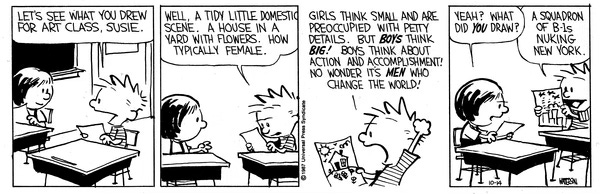
All that said, sometimes cartoons can express truths in ways that are as powerful as they are simple. In the cartoon below, the heretics of U.S. foreign policy are so many Calvins, spreading destruction and employing nukes in the name of manly seriousness. They are wrong. They are heretics. And if we continue to allow them to rule, they will surely lead America (as they already are in Gaza) to mass graves.
These are strange times in America. Today the New York Times is telling me there’s already a movement afoot to resist Donald Trump if he wins the election, in the cause of defending democracy, naturally. Here’s the blurb:
Now, as I’ve said on numerous occasions, I won’t be voting for Trump or Biden. I’m not a Trump supporter and I hope he loses. Yet, assuming the election isn’t “rigged,” as Trump likes to say whenever he loses, I’m prepared to accept the result as an expression of democracy, or at least as much “democracy” as the electoral college in America permits us to express.
I’m glad an “emerging coalition” is planning something, apparently, to curb the worst excesses of Trump and the Republicans. I hope this coalition will act to end Israel’s genocide in Gaza, pursue diplomacy to end the Russia-Ukraine War, pursue peace wherever and whenever possible, lower the threat of nuclear war on the planet, and cut the Pentagon budget while rebuilding America. How about fighting for America’s workers, raising the minimum wage, providing affordable health care for all that’s untied to employment, and similar steps that put the health and welfare of people first.
Or, is this “emerging coalition” motivated purely by animus against Trump and his followers? Is it still going to fully fund the Pentagon and wage war across the globe? In which case I’m not so excited.
Again, I come back to this question: If an “emerging coalition” is so worried about a Trump victory, why not put forward a candidate more fit to beat Trump than Joe Biden? Don’t “resist” Trump after he’s already won again—defeat him at the polls by putting forth a dynamic candidate with a populist worker-first platform.
I’m with James Madison that the biggest threat to liberty and freedom in America is perpetual war. War breeds authoritarianism and weapons built in the name of war represent, as Dwight D. Eisenhower famously said in 1953, a theft from the people. Weapons do not represent an “investment”; quite the reverse. And incessant preparations for war are not a recipe for peace.
If you truly want to defend democracy, resist war and the authoritarianism it breeds. Make major cuts to the Pentagon budget and invest in education and health rather than death and destruction. That’s the “emerging coalition” I’d like to see.