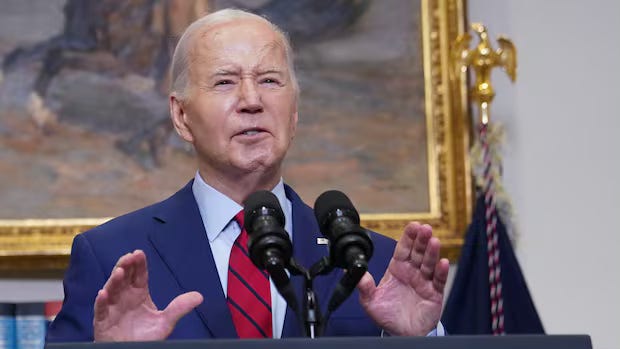
The latest fear-raising fundraising letter from President Biden
I got another fundraising letter from Joe Biden and it’s a doozy. The words “extreme” and “extremist” are used a dozen times to describe MAGA Republicans. Other words used to describe Trump and MAGA include dangerous, threats, vengeance, vindictiveness, trample (“the American way of life as we know it”), and smashed (as in a MAGA movement that allegedly seeks to smash and destroy democracy).
Now, I’m no fan of Trump. He’s a con man, not a public servant, and I won’t vote for him. Even so, this Biden fundraising letter is the equivalent of promising a bloodbath if Trump gets elected again later this year.
I can’t recall a presidential campaign like the Biden/Harris effort. Its message is almost entirely negative. It’s based on fear. Fear of Trump, fear of MAGA, fear of “extremism.” There’s almost no hope and no promise of substantive changes for the better. It’s a singular message: Vote for Joe because Trump and his followers are very very bad.
This latest fundraising letter embraces Hillary Clinton’s rhetoric that Trump’s followers are irredeemable deplorables. It encourages Americans to fear their neighbors if they happen to wear a MAGA cap and support Trump. It stokes division rather than encouraging unity. And I simply don’t think it’s effective politics.
Biden’s message is simple: Vote for me because the other guy is even worse. Now I’m seeing claims from the Democrats that Trump is even more physically enfeebled and mentally confused than Biden.
If Biden loses this November, surely it will be due to a campaign that has no compelling and positive message to motivate and inspire people to vote for him. It’s just not enough, I think, to run on a message of fear.
Courtesy of Stephen Semler, let’s take a look at the federal budget recently signed into law by President Biden:
The biggest boost in spending from 2023 to 2024 went to the Pentagon. Of course! Even though the Pentagon has yet to pass an audit. Throw money at it as a reward!
Let’s do some basic math. Add the Pentagon budget, Homeland Security, Military Construction and the VA, and State/Foreign Ops and you get $1.118 trillion. (Basically, the State Department is a tiny branch of the Pentagon.) But even that figure is low, since some Energy spending goes to nuclear weapons, and I can’t imagine that spending on science doesn’t have military applications.
Let’s go with the $1.118 trillion figure as a rough estimate of military spending. Adding up all the numbers of money spent produces a total of $1.627 trillion. That means the percentage of money spent on the Pentagon and related military matters amounts to 68.7% of federal discretionary spending.
Yes, the Pentagon ate our government.
Of course, not included in the figures above is mandatory federal spending on the rapidly escalating national debt, Medicare and Medicaid, and Social Security. Nevertheless, the rough figures here are a telling indicator of the dominance of militarism and military spending in our lives. When nearly seventy cents on the dollar goes to empire, internal security, wars, foreign military sales, and the like, there’s little money left for other concerns like better education and transportation or safer water and a cleaner environment.
Well, America gets what it pays for. More military bases, more wars, more weapons, and more bloodshed globally. Add in some apocalyptic nuclear weapons and now I’m really having a bad Monday.
Update: Courtesy of Stephen Semler once again, my guesstimates above were close to being spot on, as shown in his new post, which I’ll attach here:
Sixty-eight percent of the FY2024 discretionary budget is for military and law enforcement-related programs.
This $1.1 trillion total includes the Pentagon and Military Construction/VA spending bills and parts of four others:
Homeland Security: Title II — CBP, ICE, TSA, Coast Guard, Secret Service ($55 billion); Title III — State Homeland Security Grant Program, Urban Area Security Initiative, Nonprofit Security Grant Program, Public Transportation Security Assistance, Port Security Grants ($1.5 billion)
Commerce, Justice, Science: Title II — Marshals Service, National Security Division, Interagency Law Enforcement, FBI, DEA, ATF, Federal Prison System, State and Local Law Enforcement Activities ($32.3 billion)
Energy and Water: Atomic energy military activities ($32.8 billion)
Learning from Ashleigh Banfield’s Landon Lecture of April 2003
Early in 2003, Ashleigh Banfield was a star in the making. A rising journalist at MSNBC, she covered the opening stages of the Iraq War. Before that, she’d made a name for herself covering the 9/11 attacks and their aftermath. Smart, pretty, highly skilled, she was heading nowhere but up. Until she gave an honest lecture on her experiences in Iraq and the Middle East on April 24, 2003.
I’ve written before about Banfield’s honest and heartfelt critique of Iraq war coverage in the U.S. mainstream media, which won her no friends at NBC News. In fact, the NBC brass sidelined and essentially exiled her. I recently reread her Landon Lecture at Kansas State University and realized NBC wasn’t just angry about her critique of mainstream media war coverage: they were likely even more incensed at how she humanized and empathized with Palestinians and other Middle Eastern peoples and groups, including organizations like Hezbollah.
Here’s some of what she had to say back then in 2003:
But it’s interesting to be able to cover this [Israel and Palestine]. There’s nothing in the world like being able to cross a green line whenever you want and speak to both sides of a conflict. I can’t tell you how horrible and wonderful it is at the same time in the West Bank and Gaza and Israel. There are very few people in this world who can march right across guarded check points, closed military zones, and talk to Palestinians in the same day that they almost embedded with Israeli troops, and that’s something that we get to do on a regular basis.
And I just wish that the leadership of all these different entities, ours included, could do the same thing, because they would have an eye opening experience, horrible and wonderful, all at the same time, and it would give a lot of insight as to how messages are heard and how you can negotiate. Because you cannot negotiate when someone can’t hear you or refuses to hear you or can’t even understand your language, and that’s clearly what’s happening in a lot of places in the world right now, the West Bank, Gaza and Israel, not the least of which there’s very little listening and understanding going on. Our language is entirely different than theirs, and I don’t just mean the words. When you hear the word Hezbollah you probably think evil, danger, terror right away. If I could just see a show of hands. Who thinks that Hezbollah is a bad word? Show of hands. Usually connotes fear, terror, some kind of suicide bombing. If you live in the Arab world, Hezbollah means Shriner. Hezbollah means charity, Hezbollah means hospitals, Hezbollah means welfare and jobs.
These are not the same organizations we’re dealing with. How can you negotiate when you’ re talking about two entirely different meanings? And until we understand — we don’t have to like Hizbullah, we don’t have to like their militancy, we don’t have to like what they do on the side, but we have to understand that they like it, that they like the good things about Hizbullah, and that you can’t just paint it with a blanket statement that it’s a terrorist organization, because even when it comes to the militancy these people believe that militancy is simply freedom fighting and resistance. You can’t argue with that. You can try to negotiate, but you can’t say it’s wrong flat out.
And that’s some of the problems we have in dealing in this war in terror. As a journalist I’m often ostracized just for saying these messages, just for going on television and saying, “Here’s what the leaders of Hezbullah are telling me and here’s what the Lebanese are telling me and here’s what the Syrians have said about Hezbullah. Here’s what they have to say about the Golan Heights.” Like it or lump it, don’t shoot the messenger, but invariably the messenger gets shot.
We hired somebody on MSNBC recently named Michael Savage. Some of you may know his name already from his radio program. He was so taken aback by my dare to speak with Al-Aqsa Martyrs Brigade about why they do what they do, why they’re prepared to sacrifice themselves for what they call a freedom fight and we call terrorism. He was so taken aback that he chose to label me as a slut on the air. And that’s not all, as a porn star. And that’s not all, as an accomplice to the murder of Jewish children. So these are the ramifications for simply being the messenger in the Arab world.
Emphasis added. Original spelling retained. You can watch her speech here.
Banfield tried to be a real journalist for MSNBC. She tried to understand and report the Israeli perspective but also the perspectives of groups like Hezbollah, and for that she was severely punished.
For Hezbollah, you could say something similar of Hamas today. As Banfield says, you don’t have to praise groups like Hamas (or, for that matter, Israel). But what you should try to do as a journalist is to understand them and to report on them as clearly and honestly as possible. As she says, her reward was to be defamed and dismissed as a slut by a fellow reporter, even called an accomplice to murder, after which her bosses at NBC punished and demoted her!
It’s no wonder that mainstream media coverage by most reporters today is so slavishly pro-Israel. Who wants to be slut-shamed and demoted? Who wants their career ruined just because they sought to understand more than one side (the Israeli/U.S. one) of complex situations in the Middle East?
My brother once quipped: “We learn, good.” MSM reporters in America “learned good” that being rabidly pro-Israel (and, of course, pro-U.S. government and pro-war) is always the safest bet to accolades and promotions from their corporate overlords.
With admirable honesty, Banfield spoke of the horrific face of war at Kansas State Univ. in 2003. Soon after her speech, she was demoted (Image courtesy of KSU)
And, as I wrote in my previous piece on Banfield: Any young journalist with smarts recognizes the way to get ahead is to be a cheerleader for U.S. military action, a stenographer to the powerful. Being a critic leads to getting fired (like Phil Donahue); demoted and exiled (like Banfield); and, in Jesse Ventura’s case, if you can’t be fired or demoted or otherwise punished, you can simply be denied air time.
Banfield tried to tell us there’s a difference between journalism and coverage; that far too many voices of dissent had been silenced in America before and during the opening stages of the Iraq War; that war coverage was (and is) far too often both one-sided and sanitized.
Again, it’s worth a few minutes of your time to listen to her lecture and reflect on her honesty and integrity—and how she was punished for it.
After watching this, you’ll understand why the reporters you see today on U.S. TV and cable networks are nothing like Ashleigh Banfield.
“War is ugly and it’s dangerous” and it fuels hatred. Yes it is and yes it does, Ms. Banfield. Thank you for your honesty, your integrity, and your courage.
Israel Is the Tail Wagging the American Dog of War
The U.S. government is complicit in the ongoing genocide in Gaza.
Americans may think that “aid” to Israel is held up in Congress, more than $14 billion in death-dealing munitions and machinery of war, but in fact the U.S. has already provided massive amounts of bombs and targeting guidance to Israel, all with the tacit approval of Congress, and of course with the full-throated support of the Biden administration.
Israel is the tail wagging the American dog of war.
Guess who’s being invited to address (or, should I say, command) Congress again?
The best summary of this reality that I’ve seen came in a recent TomDispatch article written by Stan and Priti Gulati Cox. Here’s an extended excerpt:
Worse yet, the Biden administration has enabled that ongoing [Israeli] killing spree [in Gaza] by approving 100 separate military sales to Israel since the conflict began in October. As a former administration official told the Washington Post, “That’s an extraordinary number of sales over the course of a pretty short amount of time, which really strongly suggests that the Israeli campaign would not be sustainable without this level of U.S. support.”
In other words, the backbone of the war on Gaza comes with a label: “Made in USA.” In the decade leading up to October 7th, as the Stockholm International Peace Research Institute has reported, two-thirds of Israel’s arms imports came from the United States. (From 1950 to 2020, the U.S. share was a whopping 83%!)
In just the first couple of months of the war, the Biden administration sent 230 cargo planes and 20 ships full of military goods to Israel, a trove that included 100 BLU-109 bombs (2,000-pounders designed to penetrate hardened structures before exploding), 5,400 MK84 and 5,000 MK82 bunker-busters, 1,000 GBU-39 bombs, 3,000 JDAM bomb-guidance kits, and 200 “kamikaze drones.”
Such powerful bombs, reportedAl Jazeera, “have been used in some of the deadliest Israeli attacks on the Gaza Strip, including a strike that leveled an apartment block in the Jabalia refugee camp, killing more than 100 people.” And yes, such bunker-busters were widely used in the U.S. wars in Iraq and Afghanistan, but not in places as densely populated as Gaza’s cities. Israeli sources tried to justify that particular death toll by insisting it was necessary to kill one of Hamas’s leaders. If so, we’re talking about a 100-to-1 ratio, or a kind of collective punishment being supported by our tax dollars.
Worse yet, our military seems to have been participating directly in the IDF’s operations. According to the Intercept’s Ken Klippenstein and Matthew Petti, the Defense Department has been providing satellite intelligence and software to help the IDF find and hit targets in Gaza. An “Air Defense Liaison Team,” they report, even traveled to Israel in November to offer targeting help, adding that “for the first time in U.S. history, the Biden administration has been flying surveillance drone missions over Gaza.”
And even then, some members of Netanyahu’s government felt it wasn’t enough. Far right-wing Finance Minister Bezalel Smotrich put it this way when it came to President Biden’s warning not to send the IDF into the southern Gazan city of Rafah where hundreds of thousands of refugees were gathered: “American pressure or fear of harming civilians should not deter us from occupying Rafah and destroying Hamas.”
The Israeli hostages held by Hamas are the excuse for so much of this, but the way to free them would be to negotiate, as Israel did successfully last fall, not try to “wipe Hamas off the face of the earth.” The Israelis are mostly bombing civilian sites in that campaign, because they’re reluctant to fight their way through the vast fortified network of tunnels from which the military wing of Hamas, the Qassam Brigades, mounted a formidable resistance to the invasion, largely with weaponry they manufactured themselves, along with ammunition recycled from unexploded ordnance dropped in past Israeli attacks.
I sure wish the Biden administration and Congress could do something to stop the genocide in Gaza. Don’t you? But I guess they can’t control their own tails. Put differently, perhaps they simply can’t disobey their master’s commands.
Speaking of which, Republican House Speaker Mike Johnson is currently competing with Senate Leader Chuck Schumer to see which one of them can roll over and beg more quickly and obsequiously to their master, Bibi Netanyahu. Yes, Bibi is being invited once again to wag the Congressional dog and issue his commands to a slavishly obedient pack of Washington politicians.
There’s nothing like a foreign leader coming to Congress to bark out commands to make me proud to be an American.
In an age when American presidents routinely boast of having the world’s finest military, where nearly trillion-dollar war budgets are now a new version of routine, let me bring up one vitally important but seldom mentioned fact: making major cuts to military spending would increase U.S. national security.
Why? Because real national security can neither be measured nor safeguarded solely by military power (especially the might of a military that hasn’t won a major war since 1945). Economic vitality matters so much more, as does the availability and affordability of health care, education, housing, and other crucial aspects of life unrelated to weaponry and war. Add to that the importance of a Congress responsive to the needs of the working poor, the hungry and the homeless among us. And don’t forget that the moral fabric of our nation should be based not on a military eternally ready to make war but on a determination to uphold international law and defend human rights. It’s high time for America to put aside its conveniently generic “rules-based order” anchored in imperial imperatives and face its real problems. A frank look in the mirror is what’s most needed here.
It should be simple really: national security is best advanced not by endlessly preparing for war, but by fostering peace. Yet, despite their all-too-louddisagreements, Washington’s politicians share a remarkably bipartisan consensus when it comes to genuflecting before and wildly overfunding the military-industrial complex. In truth, ever-rising military spending and yet more wars are a measure of how profoundly unhealthy our country actually is.
“The Scholarly Junior Senator from South Dakota”
Such insights are anything but new and, once upon a time, could even be heard in the halls of Congress. They were, in fact, being aired there within a month of my birth as, on August 2, 1963, Democratic Senator George McGovern of South Dakota — later a hero of mine — rose to address his fellow senators about “New Perspectives on American Security.”
George McGovern
Nine years later, he (and his vision of the military) would, of course, lose badly to Republican Richard Nixon in the 1972 presidential election. No matter that he had been the one who served in combat with distinction in World War II, piloting a B-24 bomber on 35 missions over enemy territory, even as Nixon, then a Navy officer, amassed a tidy sum playing poker. Somehow, McGovern, a decorated hero, became associated with “weakness” because he opposed this country’s disastrous Vietnam War, while Nixon manufactured a self-image as the staunchest Cold Warrior around, never missing a chance to pose as tough on communism (until, as president, he memorably visited Communist China, opening relations with that country).
But back to 1963, when McGovern gave that speech (which you can read in the onlineSenate Congressional Record, volume 109, pages 13,986-94). At that time, the government was already dedicating more than half of all federal discretionary spending to the Pentagon, roughly the same percentage as today. Yet was it spending all that money wisely? McGovern’s answer was a resounding no. Congress, he argued, could instantly cut 10% of the Pentagon budget without compromising national security one bit. Indeed, security would be enhanced by investing in this country instead of buying yet more overpriced weaponry. The senator and former bomber pilot was especially critical of the massive amounts then being spent on the U.S. nuclear arsenal and the absurd planetary “overkill” it represented vis-à-vis the Soviet Union, America’s main competitor in the nuclear arms race. As he put it then:
“What possible advantage [can be had] in appropriating additional billions of dollars to build more [nuclear] missiles and bombs when we already have excess capacity to destroy the potential enemy? How many times is it necessary to kill a man or kill a nation?”
How many, indeed? Think about that question as today’s Congress continues to ramp up spending, now estimated at nearly $2 trillion over the next 30 years, on — and yes, this really is the phrase — “modernizing” the country’s nuclear triad of intercontinental ballistic missiles (ICBMs), as well as its ultra-expensive nuclear-missile-firing submarines and stealth bombers. And keep in mind that the U.S. already has an arsenal quite capable of wiping out life on several Earth-sized planets.
What, according to McGovern, was this country sacrificing in its boundless pursuit of mass death? In arguments that should resonate strongly today, he noted that America’s manufacturing base was losing vigor and vitality compared to those of countries like Germany and Japan, while the economy was weakening, thanks to trade imbalances and the exploding costs of that nuclear arms race. Mind you, back then, this country was still on the gold standard and unburdened by an almost inconceivable national debt, 60 years later, of more than $34 trillion, significant parts of it thanks to this country’s failed “war on terror” in Iraq, Afghanistan, and elsewhere across all too much of the planet.
McGovern did recognize that, given how the economy was (and still is) organized, meaningful cuts to military spending could hurt in the short term. So, he suggested that Congress create an Economic Conversion Commission to ensure a smoother transition from guns to butter. His goal was simple: to make the economy “less dependent upon arms spending.” Excess military spending, he noted, was “wasting” this country’s human resources, while “restricting” its political leadership in the world.
In short, that distinguished veteran of World War II, then serving as “the scholarly junior Senator from South Dakota” (in the words of Senator Jennings Randolph of West Virginia), was anything but proud of America’s “arsenal of democracy.” He wasn’t, in fact, a fan of arsenals at all. Rather, he wanted to foster a democracy worthy of the American people, while freeing us as much as possible from the presence of just such an arsenal.
To that end, he explained what he meant by defending democracy:
“When a major percentage of the public resources of our society is devoted to the accumulation of devastating weapons of war, the spirit of democracy suffers. When our laboratories and our universities and our scientists and our youth are caught up in war preparations, the spirit of [freedom] is hampered.
“America must, of course, maintain a fully adequate military defense. But we have a rich heritage and a glorious future that are too precious to risk in an arms race that goes beyond any reasonable criteria of need.
“We need to remind ourselves that we have sources of strength, of prestige, and international leadership based on other than nuclear bombs.”
Imagine if his call had been heeded. This country might today be a far less militaristicplace.
Something was, in fact, afoot in the early 1960s in America. In 1962, despite the wishes of the Pentagon, President John F. Kennedy used diplomacy to get us out of the Cuban Missile Crisis with the Soviet Union and then, in June 1963, made a classic commencement addressabout peace at American University. Similarly, in support of his call for substantial reductions in military spending, McGovern cited the farewell address of President Dwight D. Eisenhower in 1961 during which he introduced the now-classic phrase “military-industrial complex,” warning that “we must never let the weight of this combination [of the military with industry, abetted by Congress] endanger our liberties or democratic processes.”
Echoing Ike’s warning in what truly seems like another age, McGovern earned the approbation of his Senate peers. His vision of a better, more just, more humane America seemed, however briefly, to resonate. He wanted to spend money not on more nuclear bombs and missiles but on “more classrooms, laboratories, libraries, and capable teachers.” On better hospitals and expanded nursing-home care. On a cleaner environment, with rivers and streams saved from pollution related to excessive military production. And he hoped as well that, as military bases were closed, they would be converted to vocational schools or healthcare centers.
McGovern’s vision, in other words, was aspirational and inspirational. He saw a future America increasingly at peace with the world, eschewing arms races for investments in our own country and each other. It was a vision of the future that went down fast in the Vietnam War era to come, yet one that’s even more needed today.
Praise from Senate Peers
Here’s another way in which times have changed: McGovern’s vision won high praise from his Senate peers in the Democratic Party. Jennings Randolph of West Virginia agreed that “unsurpassed military power in combination with areas of grave economic weakness is not a manifestation of sound security policy.” Like McGovern, he called for a reinvestment in America, especially in underdeveloped rural areas like those in his home state. Joseph Clark, Jr., of Pennsylvania, also a World War II veteran, “thoroughly” agreed that the Pentagon budget “needs most careful scrutiny on the floor of the Senate, and that in former years it has not received that scrutiny.” Stephen Young of Ohio, who served in both World War I and World War II, looked ahead toward an age of peace, expressing hope that “perhaps the necessity for these stupendous appropriations [for weaponry] will not be as real in the future.”
Possibly the strongest response came from Frank Church of Idaho, who reminded his fellow senators of their duty to the Constitution. That sacred document, he noted, “vests in Congress the power to determine the size of our military budget, and I feel we have tended too much to rubberstamp the recommendations that come to us from the Pentagon, without making the kind of critical analysis that the Senator from South Dakota has attempted… We cannot any longer shirk this responsibility.” Church saluted McGovern as someone who “dared to look a sacred cow [the Pentagon budget] in the teeth.”
A final word came from Wayne Morse of Oregon. Very much a gadfly, Morse shifted the topic to U.S. foreign aid, noting that too much of that aid was military-related, constituting a “shocking waste” to the taxpayer even as it proved detrimental to the development of democracy abroad, most notably in Latin America. “We should be spending the money for bread, rather than for military aid,” he concluded.
Imagine that! Bread instead of bullets and bombs for the world. Of course, even then, it didn’t happen, but in the 60 years since then, the rhetoric of the Senate has certainly changed. A McGovern-style speech today would undoubtedly be booed down on both sides of the aisle. Consider, for example, consistent presidential and Congressional clamoring now for more military aid to Israel during a genocide in Gaza. So far, U.S. government actions are more consistent with letting starving children in Gaza eat lead instead of bread.
Peace Must Be Our Profession
What was true then remains true today. Real national defense should not be synonymous with massive spending on wars and weaponry. Quite the reverse: whenever possible, wars should be avoided; whenever possible, weapons should be beaten into plowshares, and those plowshares used to improve the health and well-being of people everywhere.
Oh, and that Biblical reference of mine (swords into plowshares) is intentional. It’s meant to highlight the ancient roots of the wisdom of avoiding war, of converting weapons into useful tools to sustain and provide for the rest of us.
Yet America’s leaders on both sides of the aisle have long lost the vision of George McGovern, of John F. Kennedy, of Dwight D. Eisenhower. Today’s president and today’s Congress, Republicans and Democrats alike, boast of spending vast sums on weapons, not only to strengthen America’s imperial power but to defeat Russia and deter China, while bragging all the while of the “good” jobs they’re allegedly creatinghere in America in the process. (This country’s major weapons makers would agreewith them, of course!)
McGovern had a telling rejoinder to such thinking. “Building weapons,” he noted in 1963, “is a seriously limited device for building the economy,” while an “excessive reliance on arms,” as well as overly “rigid diplomacy,” serve only to torpedo promising opportunities for peace.
Back then, it seemed to politicians like McGovern, as well as President Kennedy, that clearing a path toward peace was not only possible but imperative, especially considering the previous year’s near-cataclysmic Cuban Missile Crisis. Yet just a few months after McGovern’s inspiring address in the Senate, Kennedy had been assassinated and his calls for peace put on ice as a new president, Lyndon B. Johnson, succumbed to pressure by escalating U.S. military involvement in what mushroomed into the catastrophic Vietnam War.
In today’s climate of perpetual war, the dream of peace continues to wither. Still, despite worsening odds, it’s important that it must not be allowed to die. The high ground must be wrested away from our self-styled “warriors,” who aim to keep the factories of death churning, no matter the cost to humanity and the planet.
My fellow Americans, we need to wake up from the nightmare of forever war. This country’s wars aren’t simply being fought “over there” in faraway and, at least to us, seemingly forgettable places like Syria and Somalia. In some grim fashion, our wars are already very much being fought right here in this deeply over-armed country of ours.
George McGovern, a bomber pilot from World War II, knew the harsh face of war and fought in the Senate for a more peaceful future, one no longer haunted by debilitating arms races and the prospect of a doomsday version of overkill. Joining him in that fight was John F. Kennedy, who, in 1963, suggested that “this generation of Americans has already had enough, more than enough, of war, and hate, and oppression.”
If only.
Today’s generation of “leaders” seems not yet to have had their fill of war, hate, and oppression. That tragic fact — not China, not Russia, not any foreign power — is now the greatest threat to this country’s “national security.” And it’s a threat only aggravated by ever more colossal Pentagon budgets still being rubberstamped by a spinelessly complicit Congress.
Joe Biden versus Donald Trump, again. That’s America’s choice in 2024.
Biden is mainly running to “save democracy” from Trump as well as on abortion rights. Trump is running on a MAGA platform that includes stopping the flow of “illegals” into America. You’re going to hear a lot about Biden’s age and Trump’s alleged designs for a dictatorship.
It’s Biden versus Trump again!
The presence of third-party candidates might enliven the race. Jill Stein is running again for the Green Party. She has good ideas but virtually no chance. Robert Kennedy Jr. may cause some excitement. especially if he chooses former governor Jesse Ventura as his running mate. Americans, unexcited by the Biden/Trump repeat, could conceivably vote in large numbers for RFK Jr.
As grim as the Biden/Trump repeat is, it does capture the end of the American empire. I’ve been reading an interesting book: “The Leading Man: Hollywood and the Presidential Image,” by Burton Peretti. Image may not be everything for a U.S. president, but it surely is vitally important. Biden and Trump capture something of the essence of America today. Biden, obviously in decline, is thoroughly obedient to corporate and banking entities, special interests like AIPAC, and the military-industrial complex. He is the “nothing will fundamentally change” guy.
If Biden were a dinosaur, he’d be a steady, stolid, past-his-prime triceratops.
Trump, with all his bluster, his boasting, his bragging, his bullying, is the image of a swaggering imperium that refuses to recognize its time has come and gone. Self-involved, bent on vengeance, spoiling for a fight against his enemies, real and perceived, he is the image of an angry America blinded by perceived slights and grievances, always demanding respect rather than earning it.
If Trump were a dinosaur, he’d be a predatory, angry, carnage-seeking T-rex.
Trump and Biden frame the other as a danger to democracy when it’s the both of them who demonstrate democracy is just a sham. More than half of Americans said in 2021 they didn’t want to see a Biden/Trump rematch in 2024, but here we are. The DNC acted to ensure Biden had no real challenger and the RNC sold its soul to Trump, who has an ability to connect with people because he occasionally blurts out an uncomfortable truth, even as he’s spinning his usual con.
One thing is certain: It’s very difficult to reform entrenched power bureaucracies, especially when we’re given an illusion of “choice,” Biden or Trump. And when we’re so heavily propagandized to believe that we still have a democracy and that the biggest threats come from Russia and China.
As Yoda the Jedi Master once said, “You must unlearn what you have learned.” America needs to unlearn the idea that we’re a democracy, that we have choice, and it needs to learn the biggest threat to America is from within, partly our largely unaccountable government and partly a system that places nearly all the power in the hands of those with the most money.
How to effect a democratic awakening, without shedding barrels of blood, is a question for the ages. One thing is certain: no awakening is coming from either Biden or Trump. Both will ensure the further decline of the American empire; the problem is that, as empires decline, they tend to lash out militarily, in desperation, mistaking military action for a resurgence in strength and vitality.
Biden or Trump: Neither man has what it takes to manage the decline of the U.S. imperium. Neither man has the wisdom, the vision, the fortitude, to imagine a new path forward for America. Both men, in their own way, are dinosaurs.
It’s Triceratops Biden versus T-rex Trump. What drama! But both men are fossils—dinosaurs, after all, are extinct, much like democracy in America.
Biden, Shouting, Looks Good Compared to Cringe-inducing Republican Overacting
Let’s face it, the state of the union is scary. So should be the conclusion from last night’s disingenuous exercises in reading off teleprompters.
First, President Joe Biden. If the main qualification to be president is to walk without tripping, to stand for over an hour without falling, while reading somewhat fluidly from a teleprompter, I guess Biden is still qualified. I found this summary from Biden-friendly NBC News to be revealing:
Biden flubbed a few prepared lines and stumbled a bit during ad-libs — notably when he said drug prices in Moscow are lower than in the U.S. — but he belied the GOP caricature of him as an enfeebled old man who needs to retire.
“No one’s going to talk about cognitive memory now,” Rep. Jerry Nadler, D-N.Y., told the president after he finished the speech and made his way out of the House chamber.
That was, of course, the idea when Biden’s speechwriters worked on the draft. The prepared text included 80 exclamation points — cuing Biden to when he needed to raise his voice and project strength. By contrast, there were no exclamation points in last year’s text.
Can somebody please tell me how cognitive memory is tested by reading from a prepared script? Also, can you imagine reading a speech with 80 (!) exclamation points embedded in it? No wonder Biden was shouting.
Incredibly, the Republican response was worse. Far worse! (Exclamation points are a virus.) Alabama Senator Katie Britt gave the response from a kitchen, but she couldn’t stand the heat of the moment. The speech was a master class in bad acting. It was so bad that it exceeded by light years the worst hamming of William Shatner in “Star Trek.” Judge for yourself:
If Katie Britt had spoken informally from her kitchen set about the rising cost of food, the difficulties of making ends meet, due to so-called Bidenomics, maybe she could have been effective. But this self-own was truly cringe-worthy.
Turning to content, Biden’s speech was replete with lies, half-truths, and misleading claims. Surprise! He’s a politician, after all. Lisa Savage does a great job of highlighting many of them here.
When all is read and done, America heard an experienced and angry old man competing with an amateurish younger woman over which one of them could mislead (certainly not lead) the American people best.
Oh for the days of JFK, Reagan, even Obama. At least they could deliver a speech. And without 80 exclamation points!
Today is Super Tuesday in America, where sixteen states go to the polls, including mine. At the presidential level, the expected winners are Joe Biden and Donald Trump, setting up a grim rematch of their 2020 contest, won by Biden, who campaigned mostly in Covid lockdown from his basement.
Down in the basement, we hear the sound of machines …
The revolution America needs, of course, isn’t going to take place at the ballot box. The big money and powerbrokers make sure of that. The DNC has acted to ensure a one-horse race for Biden, as Marianne Williamson has noted. Biden should perhaps be put out to pasture, if not sent to the glue factory, but the horse is not dead yet. Even if it stumbles to the finish line in November, losing to Trump, that’s still a win for the DNC, whose main job it is to ensure no progressive Democrat ever wins the nomination. No matter who wins in November, with Biden the DNC has already won.
On the Republican side, Trump should win easily over Nikki Haley, who’s basically a younger female version of Biden when it comes to fighting wars, kowtowing to Israel, and serving Wall Street and big finance. A conundrum in American politics is that a Con Man is the most genuine mainstream “big party” candidate, the one most likely to blurt out uncomfortable truths.
Speaking of Con Man Trump, he said something the other day that was so outrageously Trump that I had to laugh. Naturally, it was about immigrants (recall in 2015 how Trump said Mexico was sending drugs, crime, even rapists, to America, but “some I assume are good people”). This time he hit a Trumpian home run describingthe languages young immigrants speak in New York schools:
“Pupils [come] from foreign countries,” Trump explained, “from countries where they don’t even know what the language is. We have nobody that even teaches it. These are languages that nobody ever heard of.”
Something about “languages that nobody ever heard of” tickled my funny bone. OK, maybe if these young people were from previously uncontacted tribes deep in the Amazon rain forest, or perhaps from the lost island of Atlantis…
I know, maybe it’s not that funny, but if I couldn’t laugh I’d go insane, to quote the late great Jimmy Buffett.
Secretary of Defense Lloyd Austin Gives Israel a Blank Check to Kill
I was watching Congressman Ro Khanna question Secretary of Defense Lloyd Austin on 2/29 about Israel’s demolition of Gaza when Austin uttered a humdinger about trusting Israel to “utilize weapons that we provide them in a responsible way.” He said that after noting that Israel has already killed more than 25,000 women and children in Gaza.
What “responsible” looks like
U.S. weapons shipments and transfers to Israel are couched as “security assistance,” and these weapons are often paid for by the American taxpayer, or put on the national credit card for future generations to pay. When Americans get antsy about being complicit in Israel’s ongoing genocide in Gaza, the Biden administration, supported by many Republicans, remind them that allegedly these weapons for Israel create jobs in the USA.
“Genocide creates jobs” is not exactly a healthy slogan.
Of course, Lloyd Austin alone isn’t the problem here. The entire Biden administration supinely supports Israel and Bibi Netanyahu. Donald Trump, Biden’s most likely opponent this fall, is even more slavishly pro-Israel.
And so the nightmare in Gaza continues as Israel utilizes its “Made in USA” bombs and missiles “in a responsible way.” Responsible in this case meaning the killing and injuring of more than 100,000 Palestinians and the destruction of Gaza’s ability to sustain human life for the remaining two million Palestinians there.
Disgust is the word today that captures my feelings about the actions of “my” government. Disgust at facilitating and defending the Israeli genocide in Gaza, as casualties among Palestinians soar above 100,000. Disgust that Congress only clamors for more billions for Israel ($14 billion in the Biden administrations’s bill; $17 billion in the alternate bill from the House Speaker) to enable more killing. Disgust at the strenuous efforts being exerted to get $61 billion in more weapons and aid to Ukraine while denying any oversight over or insight into how that money is spent. Disgust at the government seeking more billions to arm Taiwan, possibly stirring up a hornet’s nest of trouble with China. Disgust at constant fear-mongering about Russia hacking the 2024 presidential election, as if that “threat,” such as it is, can’t be countered and contained. Disgust.
My parents must have loved me …
To think that as a boy I stuck American flag stickers all over the house, including on the entry door and the washing machine, which must have just thrilled my parents, though I can’t recall them punishing me for it. To think that I saluted the flag innumerable times while standing at attention in uniform while serving in the military for twenty years.
Here’s the thing. I’m not disgusted at America. I’m not disgusted with Americans. I meet people every day who are kind, helpful, and generous, from the nurse who took my blood pressure this morning to the postman who delivered my mail and waved to me this afternoon since I happened to be outside when he came. Americans, generally speaking, are decent people. But there’s something seriously wrong with the U.S. government and its owners and donors, who are basically unaccountable to the rest of us.
Disgust is my prevailing emotion. So I write about it, I speak about it. I could do more, much more, but I suppose I am too risk-averse, too reluctant to act in a disobedient way to prevailing authority. So, in a way, I am part of the problem as well.
I am perplexed at how my fellow Americans can keep voting for men like Biden and Trump. Or any of the “usual suspects” who occupy Congress. Nothing will change for the better if we keep electing the same corrupt no-accounts. Why do we persist in such folly?
I suppose Senor Airman Aaron Bushnell couldn’t take it anymore. He was so disgusted, so demoralized, so damaged, by what he was witnessing in Gaza that he burnt himself alive in front of the Israeli embassy, crying out against genocide and for a free Palestine. When not ignoring his sacrifice, the mainstream media has been busy dismissing him as a radical anarchist raised within a religious cult. He was no “radical.” His “cult” was a devoted Christian community.
Aaron Bushnell, a brave and principled young man, sacrificed himself to draw attention to an ongoing crime against humanity. And so I feel more disgust when I see how his sacrifice is being twisted, when it’s addressed at all, by media sites in America.
Disgust. It’s not enough, I know. But I think when we open our eyes and truly seek hard truths, and truly see them for what they are, maybe then we can begin to move the needle in a better direction.
As a reader here says, hope is not a plan. But hope can sustain us as we come together to make a plan. A plan for a better America, one that isn’t constantly fear-mongering and warmongering, whether here or abroad.
A new America that might make me proud to slap a sticker of the flag on my door, as I did with such innocence a half-century ago on a door now long gone …