So far, 2021 is looking much like 2020. Nancy Pelosi is once again Speaker of the House, with progressive leaders like AOC extracting no meaningful concessions for their votes. Jimmy Dore had suggested progressives could use their leverage over Pelosi to force a vote in the House on Medicare for All, but of course the progressives caved and cravenly supported Pelosi, who like Joe Biden is against Medicare for All.
America, you will never get a single-payer, publicly-funded, health care system. If you can’t even get a vote on one during a pandemic that will soon kill 400,000 Americans, you will never get a vote. America’s health care system is a wealth-extraction system that profits off the sick and dying. That system simply will not change because politicians like Pelosi and Biden are bought and paid for. Short of a revolution or a truly progressive third party, Americans will continue to suffer bankruptcy and death due to our for-profit wealth-care system that puts profit before patients.
Trump, meanwhile, is conspiring along with a dozen or so sycophantic senators to contest the election he lost. Trump, who has the virtue of saying the quiet part out loud, pressured the Georgia secretary of state to “find” about 12,000 votes for him so that he could be declared the winner. This circus is the lead story in U.S. media today, as if Trump has finally put his foot in it. But he’ll soon pardon himself, I’d wager, and even if he doesn’t the incoming Biden administration won’t do anything to prosecute him on any charge.
In other news, Americans will have to be satisfied with means-tested $600 checks (don’t spend that all in one place), instead of the $2000 checks that Trump advocated for. Interesting, that princess of virtue, Nancy Pelosi, was perfectly satisfied with $600 checks until Trump demanded $2000. Only then did Pelosi mount a weak effort for the higher figure, which was quickly killed by Scrooge himself, Mitch McConnell. Suck on that, America.
Speaking of Trump failures and revealing moments in Congress, Trump’s veto of the NDAA (the Pentagon budget) was easily overturned, as America’s representatives professed their bipartisan support of “our” troops. I’ll believe in that “support” when Congress finally acts to end America’s disastrous wars overseas. Perhaps on the twelfth of never?
Finally, it was good to hear that Julian Assange will not be extradited to the U.S., though the judge’s ruling in the UK was made on the narrow grounds that the U.S. prison system is so oppressive that Assange would likely commit suicide here, given his current mental state. Of course, the U.S. government doesn’t care that much about prosecuting and imprisoning Assange. Assange, like Chelsea Manning, Reality Winner, and other whistleblowers, has been made an example of. This is all about intimidation of journalists and other potential whistleblowers, and it’s working.
Readers, what’s caught your eye in the opening week of 2021?
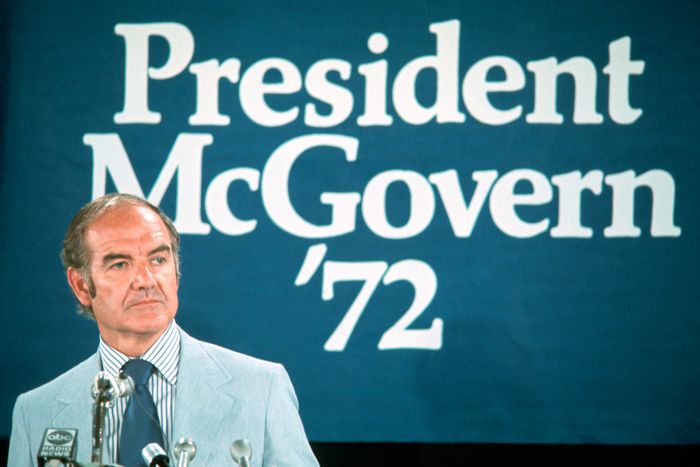
We need McGovern-size cuts to America’s bloated war budget
W.J. Astore
This week, Congress will attempt to override President Trump’s veto of the NDAA, the national defense authorization act, which in 2021 provides $740 billion to the Pentagon and its wars. As usual, there is strong bipartisan support for this massive war budget. Democrats will join Republicans in bowing and scraping before the military-industrial complex, even as they frame it in terms of “supporting” the troops and defending America. In short, Trump’s veto will not stand.
I’m so fed up with Democrats serving the war party, denying health care to all Americans, and so on that I finally changed my political party designation in my home state. I am now a no-party independent instead of a registered Democrat. (My wife joined me as she’s no fan of “handsy” Joe Biden and the refusal of “centrist” Democrats to help people in meaningful ways.)
Perhaps that’s what we all need to do. Reject the Republican and Democratic parties and fight for a political establishment that would put people first rather than billionaires and corporations. Short of revolution, I don’t see other options that promise meaningful change.
To my knowledge, the last major party presidential candidate who called for meaningful reductions in war spending was George McGovern. For example, McGovern called for a defense budget in 1975 of $54.8 billion, roughly $32 billion less than what the Nixon administration had proposed. McGovern, of course, had to couch this in terms of America still being a superpower with a nuclear arsenal that would be second to none, but at least he had the courage to talk of peace and of new approaches to foreign policy that would put diplomacy first instead of weaponry and war. What a loser he was, right?
If we applied a McGovern-size cut to today’s NDAA, we’d be talking about a “defense” budget of roughly $470 billion a year, still plenty of money, one would think, for the Pentagon to defend America. The $270 billion in savings could and should be applied to stimulus checks for Americans desperate for help in these Covid-disturbed times.
Imagine Americans getting a check from the government — a rebate of sorts — as a peace dividend! What would Americans rather have: a bunch of expensive F-35 jet fighters; ultra-expensive newer nuclear weapons on top of the ultra-expensive older ones; or some cash in pocket to buy groceries and pay their rent? I don’t know about you, but more F-35s and more nuclear bombers and missiles are not helping my bottom line.
To return to my changed political party affiliation: When a Democratic president-elect nominates a retired general and board member of Raytheon as the best person to exercise civilian oversight over the Pentagon, you know the Democratic party is a toady to the military-industrial complex and devoid of integrity as well as fresh ideas.
War? What is it good for? Absolutely nothing. Time for some peace dividends, America.
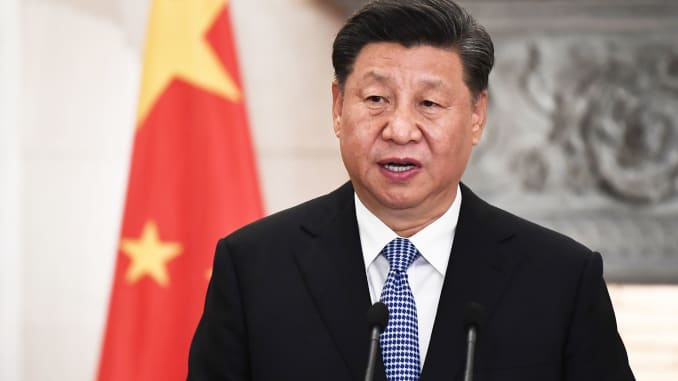
Why will this man be happy when Trump vetoes the NDAA?
W.J. Astore
President Trump says he will veto the NDAA that funds the Pentagon at $740 billion for FY 2021. Congress appears to have the votes to override his veto.
What caught my eye was part of Trump’s rationale for the veto: China. China will apparently be outraged when Trump vetoes the bill. Here’s the report (from the Guardian):
Trump says he will veto defense bill
Donald Trump once again said he intends to veto the annual defense authorization bill, setting up a potential veto override by Congress.
“I will Veto the Defense Bill, which will make China very unhappy,” the president said in a tweet. “They love it. Must have Section 230 termination, protect our National Monuments and allow for removal of military from far away, and very unappreciative, lands. Thank you!”
We just witnessed four years of red-baiting by the Democrats against the Republicans and Trump (“Moscow Mitch”?) with Russia as the Bad Red Guy. Prepare for four years of red-baiting by Republicans against the Democrats and Biden (“Hunter, Made in China”?) with China as the Bad Red Guy. The winner: the military-industrial complex. The loser: the American people, and perhaps the world.
Actually, Trump has a point about the NDAA inhibiting his ability to pull troops out of Iraq and Afghanistan. It’s too bad he didn’t focus on that and the issue of bipartisan support of endless wars.
But he had to hit the China gong, and it will resound loudly in the coming years. You know what they say about payback, Democrats …
Does the Pentagon and its contractors need a stimulus more than the American people?
W.J. Astore
At the American Conservative, I discuss the War on Terror, the nomination of General (retired) Lloyd Austin as Secretary of Defense, the lack of an American anti-war movement, and why we never see a “peace dividend” in the USA. My discussion begins at the 16-minute point.
Also, articles by Matt Taibbi and David Sirota suggest that the biggest winner of the latest Covid-relief stimulus talks in Congress is, believe it or not, the military-industrial complex. Right now there are no plans to send money to the American people, even as nearly 15 million have lost their employer-sponsored health care and millions more face eviction or foreclosure in the new year.
“Amazing” Hypocrisy: Democrats Make Wreck of Covid-19 Relief Negotiations Democrats stonewalled all year on a new pandemic relief package. Now they’re proposing a new plan that undercuts even Republican proposals, and screws everyone but – get this – defense contractors, by Matt Taibbi at https://taibbi.substack.com/p/amazing-hypocrisy-democrats-make
Taibbi quotes one aide as saying: “There are no direct payments for regular working people, people living off tips. But they made sure there’s a provision in there to help defense contractors who aren’t working right now. They get what they’re looking for.”
In short, the military-industrial complex wins again. The American people? They lose again.
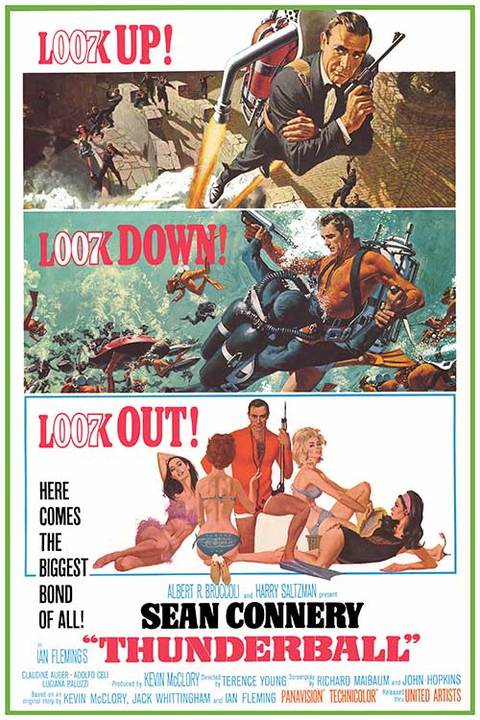
Growing up, I watched a lot of James Bond movies. That super-tough, super-sexy, British secret agent, played with such brilliance by Sean Connery, always seemed to have great fun as he saved the world from various dictators, terrorists, and megalomaniacs. I wanted an Aston Martin like Bond had in “Goldfinger,” tricked out with all the latest gizmos and gadgets provided by Q Branch. But more than anything I wanted Bond’s competence, his swagger, his ability to win the day while getting the girl as well. Such movies are harmless male fantasy flicks — or are they harmless?
While Ian Fleming was writing his “Bond” books and Sean Connery was breathing life and fire into the character, another sort of male fantasy was being promulgated and promoted in men’s adventure magazines with titles like “Stag” and “Man’s Life” and “Man’s World.” These pulp magazines appeared at a time when men’s masculinity was threatened (then again, when hasn’t masculinity been under threat?), in the 1950s and 1960s, a new nuclear age in which America seemed stuck behind the Soviet space program and stuck fighting wars (Korea, Vietnam) that ultimately proved unheroic and unwinnable.
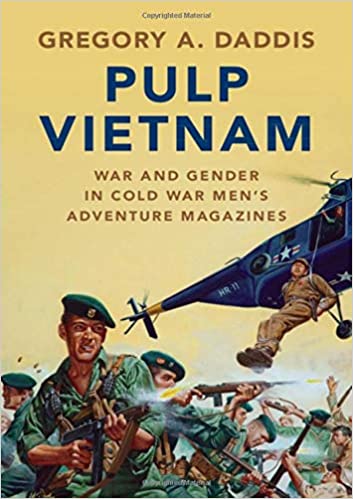
It’s easy to dismiss such men’s magazines as a simplistic variety of pulp fiction, but we’d be wrong to do so, argues historian Greg Daddis in his new book, Pulp Vietnam: War and Gender in Cold War Men’s Adventure Magazines. Daddis is quite convincing in showing how this pulp fiction advanced a view of Western, and specifically American, chauvinism in which war served as an adventure, an opportunity to demonstrate the innate superiority of the American male over various foreign, often Asiatic, opponents, while getting the girl, of course, with the girl usually scantily clad and stereotyped as vulnerable and/or duplicitous and/or sexually available.
Daddis is careful to say that such magazines, with their often violent and sexist fantasies, didn’t drive or determine U.S. behavior in places like Vietnam. But they most certainly reflected and reinforced the idea of American martial superiority and the notion that foreigners, and specifically foreign women, were both inferior and exploitable. The book is well-produced and well-illustrated, including color plates of a representative sample of these magazines. “I’m not afraid of World War III,” “Castration of the American Male,” and “Beat it Sister, I’ve Got a War to Fight!” are a few of the article titles that caught my eye from these pulp covers.
For me, Daddis hits a homerun as he compares the harsh realities of the Vietnam War to the bizarre fantasies of these adventure magazines. If there were U.S. troops expecting lots of easy victories and easier women in ‘Nam, they quickly learned that pulp fiction had nothing to do with hard reality. In Daddis’ words:
In the macho pulps, brave warriors had fought for honor, for their comrades, for a sense of triumph. In Vietnam, GIs simply wanted to leave the fighting behind … The gaps between truth and fiction seemed insurmountable.
The undiscovered adventure thus generated a lingering sense of anxiety that Vietnam might not be the man-making experience as publicized in the macho pulps. The modern battlefield engendered a sense of helplessness, not heroism …
[M]ore than a few discouraged American soldiers in Vietnam took advantage of wartime opportunities to behave aggressively toward the very people they were there to protect … the pulps played an outsized role in contributing to a portrait of a manly warrior, conquering enemy forces in alien, savage lands, and, frequently, the women who resided there as well. For the men who were schooled by the Cold War pulps, actual experiences in Vietnam proved nothing like what they expected from stories of adventure and domination … [A] climate of deep frustration … might have contributed to violence against Vietnamese people in general and women in particular. After all, had not the macho pulps for years been promising them the sexual rewards of an exotic Orient?
Daddis, pp. 172-73
I’d wager that most men recognized the fantastic elements of the pulps — even laughing at some of the more outrageous stories and exaggerated illustrations. But on some level fantasy has a way of informing the reality that we construct out of the cultural material that surrounds us. Sure, I know I’m not James Bond, and I know that real spy work isn’t an adventure-filled romp as in a Bond flick like “Thunderball.” But I still prefer a martini that’s been shaken, not stirred.
The fiction sold by these men’s adventure magazines glorified war and the warrior even as it marginalized and stereotyped and demeaned foreigners of various sorts. Read enough of this stuff (or watch enough Bond flicks) and you’re bound to be influenced by them. Daddis is to be congratulated for writing a highly original study that sheds new light on why Americans fight the way they do, and for what reasons, fictions, and compulsions.
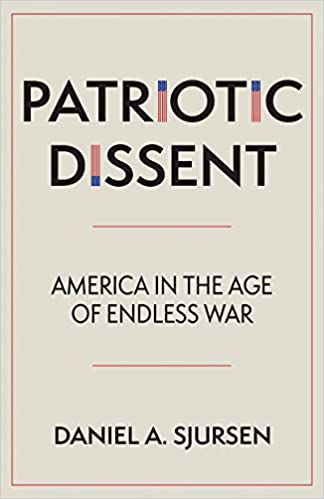
Recently, I had a long conversation with Major (retired) Danny Sjursen on our responses to the Iraq and Afghan Wars. The entire conversation is at TomDispatch.com; what follows is an excerpt.
Bill (that’s me!): In the summer of 2007, I was increasingly disgusted by the way the administration of President George W. Bush and Vice President Dick Cheney was hiding behind the bemedaled chest of Iraq commander General David Petraeus. Our civilian commander-in-chief, George W., was avoiding responsibility for the disastrous Iraq War by sending Petraeus, then known as the “surge” general, before Congress to testify that some sort of victory was still possible, even as he hedged his talk of progress with words like “fragile” and “reversible.”
So I got off my butt and wrote an article that argued we needed to end the Iraq War and our folly of “spilling blood and treasure with such reckless abandon.” I submitted it to newspapers like the New York Times with no success. Fortunately, a friend told me about TomDispatch, where Tom Engelhardt had been publishing critical articles by retired Colonel Andrew Bacevich. Luckily for me, Tom liked my piece and published it as “Saving the Military from Itself” in October of that same year.
That article put me on the path of dissent from America’s forever wars, even if I wasn’t so much antiwar as anti-dumb-war then. As I asked at the time, how do you win someone else’s civil war? Being a Star Trek fan, I referred to the Kobayashi Maru, a “no-win” scenario introduced in the second Star Trek movie. I saw our troops, young lieutenants like yourself in Iraq, being stuck in a no-win situation and I was already convinced that, no matter how much Petraeus talked about “metrics” and “progress,” it wasn’t going to happen, that “winning” really meant leaving, and we haven’t won yet since, god help us, we’re still there.
Of course, the so-called surge in Iraq back then did what it was actually meant to do. It provided an illusion of progress and stability even while proving just as fragile and reversible as the weaselly Petraeus said it would be. Worse yet, the myth of that Iraqi surge would lead disastrously to the Afghan version of the same under Barack Obama and — yet again — Petraeus who would prove to be a general for all presidents.
Lucky you! You were on the ground in both surges, weren’t you?
Danny: I sure was! Believe it or not, a colonel once told me I was lucky to have done “line duty” in both of them — platoon and company command, Iraq and Afghanistan, Baghdad and Kandahar. To be honest, Bill, I knew something was fishy even before you retired or I graduated from West Point and headed for those wars.
In fact, it’s funny that you should mention Bacevich. I was first introduced to his work in the winter of 2004 as a West Point senior by then-Lieutenant Colonel Ty Seidule. Back then, for a guy like me, Bacevich had what could only be called bracing antiwar views (a wink-nod to your Bracing Views blog, Bill) for a classroom of burgeoning neocons just about certain to head for Iraq. Frankly, most of us couldn’t wait to go.
And we wouldn’t have that long to wait either. The first of our classmates to die, Emily Perez, was killed in Iraq by a roadside bomb in September 2006 within 18 months of graduation (and five more were to die in the years to come). I took a scout platoon to southeast Baghdad a month later and we didn’t leave — most of us, that is — for 15 months.
My partly Bacevich-bred sneaking suspicions about America’s no-longer distant wars were, of course, all confirmed. It turned out that policing an ethno-religious-sectarian conflict, mostly of our own country’s making, while dodging counter-counterinsurgent attacks aimed at expelling us occupiers from that country was as tough as stateside invasion opponents had predicted.
On lonely outpost mornings, I had a nasty daily habit of reading the names of our announced dead. Midway through my tour, one of those countless attacks killed 1st Lt. Andrew J. Bacevich. When I saw that name, I realized instantly that he must be the son of the man whose book I had read two years earlier, the man who is now our colleague. The moment remains painfully crystal clear in my memory.
By the way, Bill, your Iraq War take was dead on. During my own tour there, I came to the same realization. Embarrassingly enough, though, it took me seven years to say the same things publicly in my first book, fittingly subtitled “The Myth of the Surge.” By then, of course, ISIS — the Frankenstein’s monster of America’s misadventure — was already streaming across Syria’s synthetic borders and conquering swaths of northern and western Iraq, which made an anti-Iraq War screed seem quaint indeed, at least in establishment circles.
But Bill, do go on.
Bill: It was also back in 2007 when something John McCain said on PBS really ticked me off. In essence, he warned that if the U.S. military lost in Iraq, it wouldn’t be the generals’ fault. No, it would be ours, those of us who had questioned the war and its conduct and so had broken faith with that very military. In response, I wrote a piece at TomDispatch with the sarcastic title, “If We Lose Iraq, You’re to Blame,” because I already found such “stab-in-the-back” lies pernicious beyond words. As Andy Bacevich noted recently when it came to such lies about an earlier American military disaster: we didn’t lose the Vietnam War in 1975 when Saigon fell, we lost it in 1965 when President Johnson committed American troops to winning a civil war that South Vietnam had already lost.
Something similar is true for the Iraq and Afghan wars today. We won’t lose those conflicts when we finally pull all U.S. troops out and the situation goes south (as it most likely will). No, we lost the Afghan War in 2002 when we decided to turn a strike against the Taliban and al-Qaeda into an occupation of that country; and we lost the Iraq War the moment we invaded in 2003 and found none of the weapons of mass destruction that Bush and his top officials had sworn were there. Those were wars of choice, not of necessity, and we could only “win” them by finally choosing to end them. We lose them — and maybe our democracy as well — by choosing to keep on waging them in the false cause of “stability” or “counterterrorism,” or you-name-it.
Early in 2009, I had an epiphany of sorts while walking around a cemetery. With those constant deployments to Iraq, Afghanistan, and dozens of other countries globally, the U.S. military, I thought, was becoming a foreign legion, almost like the quintessential French version of the same, increasingly separated from the people, and increasingly recruited from “foreign” elements, including recent immigrants to this country looking for a fast-track to citizenship.
Danny: Bill, one of my own soldiers fit the mold you just mentioned. Private First Class Gustavo Rios-Ordonez, a married father of two and a Colombian national. Partly seeking citizenship through service, he was the last trooper to join my command just before we shipped out and the first killed when, on June 20, 2011, he stepped on an improvised explosive device within sight of the Afghan outpost I then commanded. Typing this now, I stare at a framed dusty unit guidon, the pennant that once flew over that isolated sandbagged base of ours and was gifted to me by my soldiers.
Sorry, Bill, last interruption… scout’s honor!
Surges to Nowhere
Bill: So I wrote an article that asked if our military was morphing into an imperial police force. As I put it then: “Foreign as in being constantly deployed overseas on imperial errands; foreign as in being ever more reliant on private military contractors; foreign as in being increasingly segregated from the elites that profit most from its actions, yet serve the least in its ranks.” And I added, “Now would be a good time to ask exactly why, and for whom, our troops are currently fighting and dying in the urban jungles of Iraq and the hostile hills of Afghanistan.”
A few people torched me for writing that. They thought I was saying that the troops themselves were somehow foreign, that I was attacking the rank-and-file, but my intent was to attack those who were misusing the military for their own purposes and agendas and all the other Americans who were acquiescing in the misuse of our troops. It’s a strange dynamic in this country, the way we’re cajoled into supporting our troops without ourselves having to serve or even pay attention to what they’re doing.
Indeed, under George W. Bush, we were even discouraged from commemorating the honored dead, denied seeing footage of returning flag-draped caskets. We were to celebrate our troops, while they (especially the dead and wounded) were kept out of sight — literally behind curtains, by Bush administration order — and so mostly out of mind.
I was against the Afghan surge, Danny, because I knew it would be both futile and unsustainable. In arguing that case, I reached back to the writings of two outspoken opponents of the Vietnam War, Norman Mailer and Mary McCarthy. As President Obama deliberated on whether to surge or not, I suggested that he should confer with broadminded critics outside the government, tough-minded freethinkers cut from the cloth of Mailer and McCarthy.
Mailer, for example, had argued that the Vietnamese were “faceless” to Americans (just as the Iraqis and Afghans have been all these years), that we knew little about them as a people and cared even less. He saw American intervention in “heart of darkness” terms. McCarthy was even blunter, condemning as “wicked” the government’s technocentric and hegemonic form of warfare with its “absolute indifference to the cost in human lives.” Predictably, Obama listened to conventional wisdom and surged again, first under General Stanley McChrystal and then, of course, under Petraeus.
Danny: Well, Bill, paltry as it may now sound, I truly thank you for your post-service service to sensibility and decency — even if those efforts didn’t quite spare me the displeasure of a second stint in a second theater with Petraeus as my supreme commander for a second time.
By the way, I ran into King David (as he came to be known) last year in a long line for the urinals at Newark airport. Like you, I’ve been tearing the guy’s philosophy and policies up for years. Still, I decided decorum mattered, so I introduced myself and mentioned that we’d met once at a Baghdad base in 2007. But before I could even kid him about how his staff had insisted that we stock ample kiwi slices because he loved to devour them, Petraeus suddenly walked off without even making it to the stall! I found it confusing behavior until I glimpsed myself in the mirror and remembered that I was wearing an “Iraq Veterans Against the War” t-shirt.
Okay, here’s a more instructive anecdote: Have I ever mentioned to you that my Afghan outpost, “Pashmul South” as it was then known, featured prominently in the late journalist Michael Hasting’s classic book, The Operators (which inspired the Netflix original movie War Machine)? At one point, Hastings describes how Petraeus’s predecessor in Afghanistan, Stanley McChrystal, visited an isolated base full of war-weary and war-exasperated infantrymen. In one of the resident platoons, all but seven of its 25 original members had “been killed, wounded, or lost their minds.” And yes, that was the “palace” I took over a couple of years later, an outpost the Taliban was then attacking almost daily.
By the time I took up the cause of “Enduring Freedom” (as the Afghan operation had been dubbed by the Pentagon), I had already resigned myself to being one of those foreign legionnaires you’ve talked about, if not an outright mercenary. During the Afghan surge, I fought for pay, healthcare, a future West Point faculty slot, and lack of a better alternative (or alternate identity). My principles then were simple enough: patrol as little as possible, kill as few locals as you can, and make sure that one day you’ll walk (as many of my scouts literally did) out of that valley called Arghandab.
I was in a dark headspace then. I didn’t believe a damn thing my own side said, held out not an ounce of hope for victory, and couldn’t even be bothered to hate my “enemy.” On the 10th anniversary of the 9/11 attacks, staff officers at brigade headquarters sent a Reuters reporter deep into the boonies to profile the only commander around from the New York City area and I told him just what I thought, or close enough in any case. Suffice it to say that my colonels were less than pleased when Captain Sjursen was quoted as saying that “the war was anything but personal” and that he never “thought about 9/11 at all” or when he described the Taliban this way: “It’s farm-boys picking up guns. How do you hate that?”
Rereading that article now, I feel a certain sadness for that long-gone self of mine, so lost in fatalism, hopelessness, and near-nihilism. Then I catch myself and think: imagine how the Afghans felt, especially since they didn’t have a distant home to scurry off to sooner or later.
Anyway, I never forgot that it was Obama — from whom I’d sought Iraq War salvation — who ordered my troops on that even more absurd Afghan surge to nowhere (and I’m not sure I’ve forgiven him either). Still, if there was a silver lining in all that senselessness, perhaps it was that such a bipartisan betrayal widened both the breadth and depth of my future dissent.
Please read the rest of our conversation here, and our conclusion that, when it comes to resisting America’s disastrous wars, our motto has to be: No retreat, no surrender.
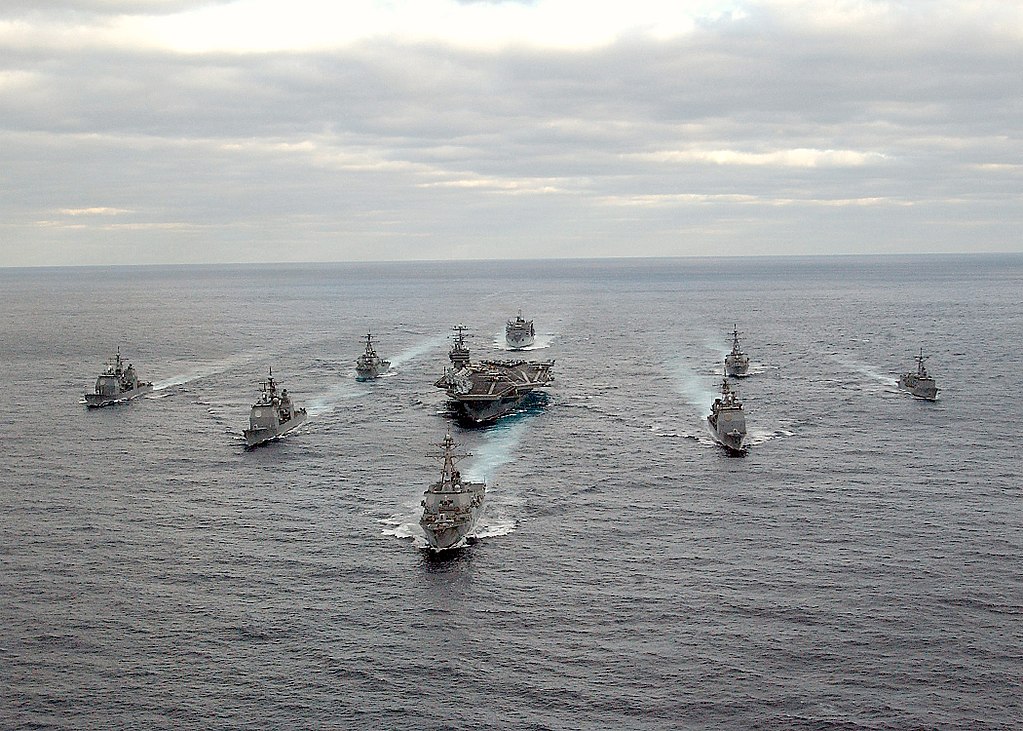
We’re witnessing the return of the Great White Fleet
W.J. Astore
At TomDispatch.com, Michael Klare has a fine article on the U.S. military’s “all-domain” warfare plans, including nuclear exchanges and big fleet carrier operations against China, among other hair-raising plans of “defense.” I had two thoughts while reading his article:
Remember how, according to the Downing Street Memo, the intelligence was fixed around the policy, thereby justifying the Iraq War that Bush/Cheney wanted? It seems today that U.S. military strategy is being fixed around the weaponry that most profits the MICC (military-industrial-Congressional complex). Of course, strategy is supposed to drive choices in weaponry, but it seems the opposite is true today for the U.S. military. Put differently, the U.S. military is so awash with money, and so enamored with “all-domain” dominance, that virtually any weapons system can be justified in any realm of warfare. Cyber, COIN, fleet operations, nuclear, space, counter-terror, anywhere and everywhere.
Is there such a thing as a true American isolationist? Even in Trumpland? Advocating for a reduction in the U.S. military’s imperial profile doesn’t (or shouldn’t) make you an isolationist. Saying you only want 400, or even 200, overseas bases instead of the 800 the U.S. military has doesn’t (or shouldn’t) make you a crank. Saying you want to wage no unnecessary wars doesn’t (or shouldn’t) make you an isolationist.
There are very few U.S. politicians today who advocate for significant reductions to the U.S. war/imperial budget. It is arguably the new “third rail” of American politics. Consider again the case of Tulsi Gabbard, a U.S. Congresswoman who enlisted in her state’s national guard unit, then became an officer, and currently serves as a major who deployed to the Iraq War. Merely for suggesting an end to disastrous regime-change wars in Afghanistan and Iraq, she was smeared by the mainstream media and by Hillary Clinton as a tool of Russia.
As Tom Engelhardt has noted, the U.S. National Security State, with all its branches and services and agencies, represents a “shadow government.” How could it not be so, when more than half of the federal government’s discretionary spending goes to that military/intelligence establishment? And when that “shadow government” feels threatened or challenged, it is more than ready to defend its prerogatives and perks.
Update: I should have mentioned that Congress just approved a “Defense” budget for 2021 of $740 billion. No problem with bipartisan support of nearly three quarters of a trillion dollars for wars and weapons! Speaking of weapons, for FY2020 the U.S. has generated $175 billion in authorized arms exports. Yes, the USA remains solidly #1 in both war spending and weapons exports!
Now, what about our response to Covid-19? The USA ranks #18 in that. Wouldn’t it be far better if we ranked #1 in responding to a deadly pandemic?
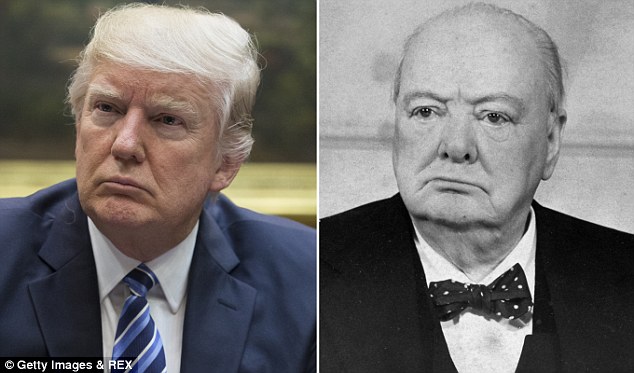
For all his tough-guy posturing and his attempts to pose like Winston Churchill, President Trump has largely been an appeaser to the military-industrial complex and its insatiable appetite for wars and weapons sales.
Trump, frowning (he thinks) like Churchill
Yes, it’s good news that Trump is withdrawing troops from Afghanistan and Iraq, though roughly 2500 troops will remain in each country when Joe Biden takes office in January. In short, Trump isn’t ending these wars; he’s merely reducing the number of boots on the ground. His Acting Defense Secretary, Chris Miller, described it as a “repositioning of forces from those two countries.”
Repositioning! Perish the thought that the U.S. military might retreat or even withdraw. The answer is to “reposition” those deck chairs on the USS Titanic and its imperial wars, never mind the sinking feeling you may be experiencing.
Meanwhile, Trump recently announced more weapons sales to the United Arab Emirates, including F-35 fighter-bombers and Reaper drones, worth $23 billion to U.S. weapons manufacturers. When it comes to empowering merchants of death, the United States is indeed number one.
Throughout his four years of office, Trump courted the Pentagon and the Complex by throwing money at it. He hired Complex functionaries like General (retired) James Mattis and General H.R. McMaster and Raytheon lobbyist Mark Esper to run things for him. The result was predictable: more of the same, such that Trump never kept his campaign promise to end America’s wasteful wars in Afghanistan, Iraq, and elsewhere.
Perhaps this was because Trump didn’t want to be blamed if things went south (as they probably will) if he’d ordered all U.S. troops out of these countries. Trump, like most Americans, hates to be labeled a loser. But what he needed to be reminded of was that these countries were never ours to win to begin with. The answer to “Who lost Afghanistan?” is not the president who finally “repositions” all U.S. troops from that country. The answer is Bush/Cheney, Obama/Biden, Trump/Pence, and, assuming they keep the war going in Afghanistan (and elsewhere), Biden/Harris.
Fighting needless and wasteful wars on the periphery of empire makes sense only to weapons makers and warmongers. Ditto making massive weapons sales, especially to unstable areas. The “Made in America” label used to be seen proudly on everything from clothing and shoes to engines and steel; now it’s affixed mainly to weapons and wars.
Before he took office, Trump promised a new approach, an America First approach, that would end the folly of perpetual wars that cost trillions of dollars. In this he failed. Because when it came to the Pentagon and to weapons makers, Trump chose appeasement rather than confrontation.
William Astore, a retired lieutenant colonel (USAF) and history professor, is a senior fellow at the Eisenhower Media Network (EMN), an organization of critical veteran military and national security professionals.
Jeh Johnson with Biden and Obama, 2013 (White House photo)
W.J. Astore
Jeh Johnson, formerly homeland security secretary under President Obama, showed how a typical Democratic official approaches the Pentagon and war as he spoke on ABC’s This Week on Sunday (11/15). For Johnson, the Pentagon “is typically an island of stability” in the U.S. government, but President Trump was destabilizing that island because of recent changes to Pentagon personnel. Trump’s changes could be driven by his desire to get U.S. troops out of Afghanistan, speculated Johnson, which was not a good thing:
“If he [Trump] wants troops out of Afghanistan, as I know most Americans do, we have to do it in a way that makes sense, in an orderly manner, and that comports with battlefield reality … in trying to strike a deal, you don’t unilaterally surrender your greatest point of leverage by unilaterally withdrawing troops before the Afghan government and the Taliban have stuck a deal. So this is very concerning and if I were in the Biden transition team right now, I’d be very focused … on restoring stability in our national security.”
We can’t surrender our “leverage,” those thousands of U.S. troops that remain in harm’s way in an unnecessary war that was won and then lost almost two decades ago, because it’s that “leverage” that will compel the Taliban, who have already won the war, to strike a deal with an Afghan government that exists mainly because the U.S. government props it up. Makes sense to me.
By the way, only “most Americans” want our troops to come home? Where are all the other Americans who want them to stay there indefinitely? Within the Washington Beltway, I’d wager.
The Afghan war has always struck me as nonsensical. Yes, some kind of response to the 9/11 attacks was needed, and initial U.S. military strikes in 2001-02 succeeded in toppling the Taliban, in the sense they saw no reason to stand and fight against withering fire. At that moment, the U.S. military should have declared victory and left. Instead, the Bush/Cheney administration decided on its own disastrous occupation, extended another eight years by Obama/Biden, even though we knew full well the extent of the Soviet disaster in Afghanistan in the 1980s.
The Afghan war has lasted so long that I’ve been writing articles against it for more than a decade. You’d think any sensible and sane Democrat would love to see U.S. troops withdrawn and the war finally come to an end. Not so. The war must continue in the name of “leverage” and “stability.”
I like Johnson’s truly absurdist reference to “battlefield reality,” which, if we’re being real for a moment, reflects a Taliban victory. Unless the U.S. wants to occupy Afghanistan forever, with hundreds of thousands of troops, that victory is not about to be reversed. And what kind of “victory” would that be?
“Stability” is not preserved by fighting unwinnable wars on the imperial periphery, unless you’re talking about the stability of Pentagon finances and corporate profits. Johnson’s wiki bio does mention he’s on the boards of Lockheed Martin Corporation and U.S. Steel, which certainly hints at a conflict of interest when it comes to offering advice on ending wars.
In the meantime, we probably shouldn’t tell our troops, whom we’re supposed to love and support, that we’re keeping them in Afghanistan for “leverage” until the “battlefield reality” is more in our favor. That’s truly a recipe for endless war in a place that well deserves its reputation as the graveyard of empires.
Finally, a reminder to Democrats: your Pentagon is an island of stability, and your troops are creating the leverage that allows democracy to flourish everywhere. If this makes sense to you, and if this is the guiding philosophy of Joe Biden’s national security team, we’re truly in deep trouble.
Bonus Lesson: The Pentagon is an “island” of government only if that island is roughly the size of Pangaea.
William Astore, a retired lieutenant colonel (USAF) and history professor, is a senior fellow at the Eisenhower Media Network (EMN), an organization of critical veteran military and national security professionals.
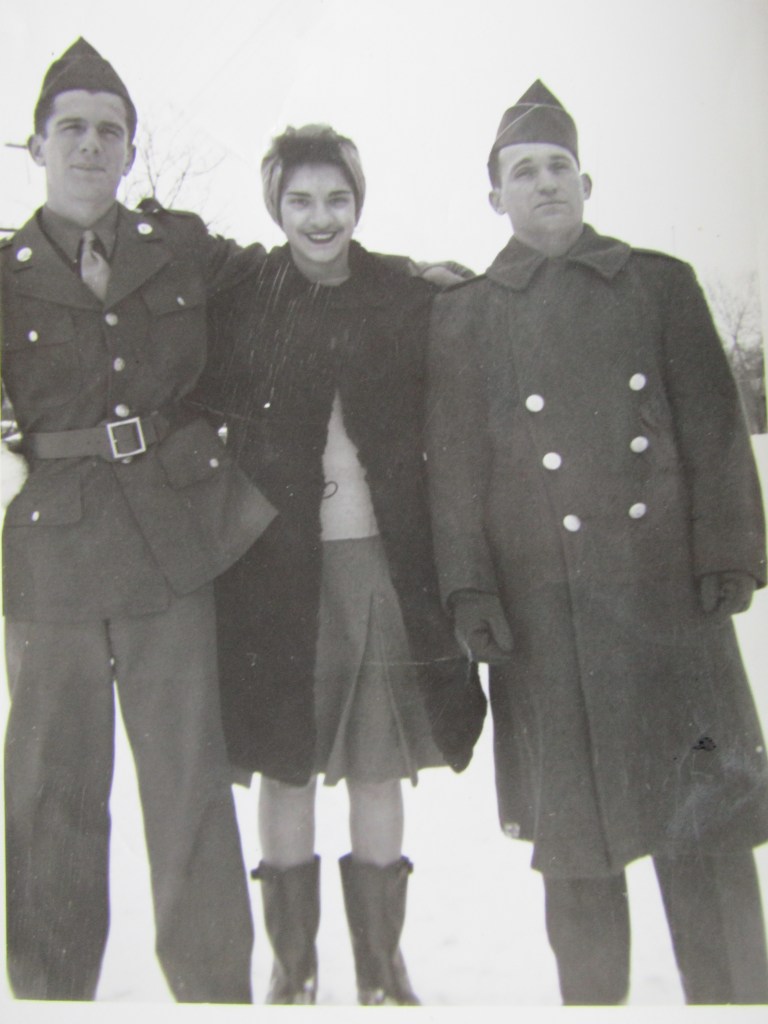
My dad (R) home on leave with his brother Gino, c. 1944
W.J. Astore
I come from a family of veterans. My father and his two brothers served in the military during World War II. My mother’s brother fought at Guadalcanal against the Japanese and was awarded the Bronze Star. Later, my eldest brother enlisted in the Air Force at the tail end of the Vietnam War, which my brother-in-law had fought in as a radio operator attached to the artillery. Their service helped to inspire my decision to become an officer in the U.S. Air Force.
Military service is honorable, not because of wars waged or lives taken, but because of its purpose: to support and defend the Constitution of the United States. And this should be the purpose of Veterans Day: to take note of our veterans and their service in upholding the ideals of our Constitution, including freedom of speech and assembly, freedom of the press, a right to privacy, and most of all a government that is responsive to our needs and accountable to our oversight.
Yet since World War II America has fought wars without formal Congressional declarations. The Korean War, the Vietnam War, wars in Afghanistan and Iraq and elsewhere, have lacked the wholehearted support of the American people. They were arguably unnecessary wars in the sense these countries and peoples posed no direct threat to America and our Constitution. Indeed, prosecuting these wars often posed more of a threat to that very Constitution.
Naturally, America associates veterans with wars and combat, and we say the dead made “the ultimate sacrifice,” which indeed they did. But for what purpose, and to what end? We owe it to veterans to ask these questions: for what purposes are we risking their lives, and to what end are these wars being waged? If we can’t answer these simple questions, in terms intimately associated with our Constitution and the true needs of national defense, we should end these wars immediately.
Unending wars are the worst enemy of freedom and liberty. This isn’t just my sentiment. As James Madison put it, “Of all the enemies of true liberty, war is, perhaps, the most to be dreaded … No nation can preserve its freedom in the midst of continual warfare.” America once knew this; we were once a nation that was slow to anger and with little taste for large military establishments.
A few years ago, I stumbled across old sheet music in a bookstore. Catching my eye was the title of the song: “I Didn’t Raise My Boy to be a Soldier,” respectfully dedicated to “Every Mother – Everywhere.” From 1915, this popular song captured American resistance to the calamitous “Great War” that we now call World War I. Anti-war sentiment was strong that year in America, and indeed Woodrow Wilson would be reelected president in 1916 in large part because he had kept Americans out of the war. The lyrics put it plainly: a mother who’d brought her son up “to be my pride and joy” didn’t want to see that same son having “to shoot some other mother’s darling boy.”
The contrast in these lyrics to recent U.S. military recruitment commercials couldn’t be starker. In a new Department of Defense advertising campaign, featuring the catchphrase “Their success tomorrow begins with your support today,” mothers are shown incongruously in military settings asking their sons why they wanted to sign up. Weapons are featured prominently in these ads, but no combat. There’s much talk of teamwork and being part of something larger than yourself but no talk of the U.S. Constitution. At the end of these spots, the young men depicted have convinced their mothers that it’s desirable indeed to have your boy become a soldier.
Recruitment ads, of course, have never been at pains to show the true costs of war. When I was a teen, the Army’s motto was “Be all that you can be.” For the Navy, service was about “adventure.” For the Air Force, it was about “a great way of life.” These ads, by ignoring or eliding war’s costs, have contributed to America’s tighter embrace of war on the world stage and its severe impact, not only on our veterans but on our democracy. America’s strategy of “global reach, global power” has embroiled us in wars of choice that we increasingly choose not to end. Surely, it’s time to chart a more pacific path.
Sometimes the best offense is a good defense. On this Veterans Day, let’s remind ourselves that veterans exist to defend our Constitution and our country, but that endless warfare, and intensifying militarism, are in fact among the most pressing dangers to our democracy.
William Astore, a retired lieutenant colonel (USAF) and history professor, is a senior fellow at the Eisenhower Media Network (EMN), an organization of critical veteran military and national security professionals.





 Bracing Views