Bully Boys with Bull Bars

W.J. Astore

Even as gas and diesel prices soar along with global temperatures, American vehicles continue to get bigger. In my first Air Force job in 1985, I had a friend who drove a classic Ford Bronco. It was a little bigger than a jeep and truly meant for off-road adventures in Colorado where four-wheel drive is a necessity. Nowadays, Ford trucks and SUVs are much more likely to resemble military vehicles like Humvees or even MRAPs. Bigger is better, especially for the truck makers and fossil fuel companies, who profit much more by selling and fueling steroidal trucks than Ford Escorts or hybrids.

But there’s a darker side to these steroidal, quasi-military vehicles on America’s roads, notes Stan Cox today at TomDispatch.com. They’re being used to intimidate, to bully, even to injure and kill people that the drivers of these vehicles don’t like. Typical targets are protesters for the BLM movement or women trying to protect abortion rights. When Dodge named their Ram pickup, I really don’t think they meant you should use it as a battering ram, but that seems to be crude animus motivating more than a few white male drivers today.

This phenomenon isn’t just limited to flyover states like Kansas, where Stan Cox lives. Here in Blue Massachusetts, I recently saw a pickup that was proudly flying a “Fuck Joe Biden” flag, modeled after Trump MAGA flags. Heck, I don’t much like Joe Biden, but I don’t feel the need to mount a giant flag on my vehicle to that effect. I guess I’m just too humble or shy — or sane.

Steroidal trucks are nothing new in America, and I’ve seen plenty with stickers that say “No Fear” or even “Fear This.” (You learn quickly to give these idiots on wheels a wide berth.) But using these trucks to hurt people is truly cowardly. What kind of young men are we producing?

The wars are coming home again, America. Just look around at all the mini-tanks in America’s parking lots and driveways.

A final caution: Beware of bully boys with bull bars, coming soon (though I hope not) to a protest near you. If you stand your ground, they might just run you over — and in some states you’ll be to blame for blocking their way.

So use common sense and get out of their way. You’re not the coward: they are.

Fear this!

Of Products and Assets and Families

W.J. Astore

When I was a college professor, whether civilian or military, I was told unironically that I was part of a “family.” I had an Air Force “family.” I had a Penn College “family.” But when these institutions wanted me to do something, often something I really didn’t want to do, the “family” talk went out the window and I was reminded I was an “employee” in the civilian world and “just another f*cking officer” in the military world. None of this surprised me because I never bought any of that “family” crap. I only have one family, thank you very much, and they are related to me by blood or by marriage. My “family” is not my boss, not my employer.

Management loves to talk about employees as if they’re “family” when they really think of us as “assets” or “products” or even simply “the cost of doing business” (and the quickest way to reduce cost is often to get rid of “family” members).

It’s especially telling to hear corporate/management talk in the sports world. Sam Kennedy, who’s the president of the Red Sox, talks openly about putting the best “product” on the baseball diamond. He doesn’t see his players as people, he reduces them to “assets” that are basically interchangeable. Winning only matters in the sense that it produces profit while elevating the value of the “product.”

Of course, this is nothing new. In Slap Shot (1977), an amusingly vulgar and perceptive movie about a minor-league hockey team starring Paul Newman as an aging player, we learn that the team is owned by a wealthy woman who decides to liquidate the team rather than sell it because it’s more valuable that way as a tax write-off. The players, the fans, all the employees, mean nothing to this absentee owner. All that matters is money.

Paul Newman as player-coach Reg Dunlop in “Slap Shot,” one of the finest movies about sports in America

And of course any Red Sox fan can cite “the curse of the Bambino,” when a century ago the owner of the Red Sox sold Babe Ruth to the New York Yankees to raise money (for a theater production, if memory serves).

Capitalism reduces everything to products, assets, profit margins, and the like. I don’t know about you, but this is not how I think of my real family.

American Exceptionalism

W.J. Astore

Two images of American exceptionalism to mull over today. The first shows how exceptional the U.S. is with its military spending:

Of course, U.S. military spending is projected to rise in FY 2023 to $840 billion or so. Note how most of the countries that spend significant sums on their military are U.S. allies, such as Germany, the U.K., Japan, and South Korea. Russia is weakening due to its war with Ukraine, yet U.S. military spending continues to soar because of alleged threats from Russia and China.

The second image is a spoof sent by a friend, but it wouldn’t entirely surprise me if it did become the official seal of the Department of Education:

Jesus riding a dinosaur: Why not? We have serious museums for creationists in the U.S., where dinosaurs wear saddles and Adam and Eve are depicted as cavorting with creatures dating to the Jurassic and Cretaceous eras. I’m not sure how they all fit on Noah’s ark, but the Lord does work in mysterious ways.

Given the emphasis on gun rights, babies, and Jesus in America, perhaps the bald eagle isn’t our best national symbol. Perhaps it should be the Baby Jesus holding an assault rifle. It certainly would give new meaning to “love God” and “love thy neighbor.”

Destroying the Village in Vietnam

It seems the Vietnam War may as well be the Punic Wars for most Americans, i.e. ancient history. Yet it was a scant 50 years ago that America finally pulled out of that disastrous war, leaving a horrific legacy of towns and villages bombed, burned, and poisoned.

High explosive, napalm, Agent Orange, and other ordnance was dropped in massive quantities by U.S. warplanes, yet North Vietnam remained unbowed. The self-serving lesson the U.S. military took from this was twofold. First, it obviously couldn’t be the military’s fault.  Blame was most often pinned on alleged civilian micro-management; more bombing, with fewer limits, would have worked, so airpower enthusiasts argued. The second lesson was to hide or otherwise obscure or deny civilian casualties in future wars, a cynical approach lacking in integrity but one we’ve seen used with considerable success in Iraq and Afghanistan, among other places.

These were not the lessons that leaders with integrity would have drawn. But they are the lessons that a system designed to protect itself did draw.

U.S. leaders refuse to consider the costs of war, not only on foreign peoples but also on ourselves. The words of James Hildreth remind us of the costs of war as well as the seductiveness of destruction and of lies.

It’s a lesson to bear in mind, whether with the Russia-Ukraine War or possible future wars, e.g. current talk of a possible war with Iran.

wjastore's avatarBracing Views

W.J. Astore

One day, a village of roughly 1200 people in South Vietnam ceased to exist. The U.S. Air Force destroyed it, and the report read “Target 100% destroyed, body-count 1200 KBA (killed by air) confirmed.”

It wasn’t an “enemy” village. It was a village that had failed to pay its taxes to a South Vietnamese provincial commander, a lieutenant colonel and ostensibly a U.S. ally. He wanted the village destroyed to set an example to other recalcitrant villages, and the U.S. Air Force did what it does: It put bombs and napalm on target.

At Seventh Air Force headquarters, the brass knew this village’s “crime.” As a brigadier general said to then-Lieutenant Colonel James Robert “Cotton” Hildreth, “Damn, Cotton, don’t you know what’s going on? That village didn’t pay their taxes. That [South Vietnamese] lieutenant colonel … is teaching them a lesson.”

It’s a “lesson” that made Cotton Hildreth…

View original post 646 more words

The Giant War Robot that Rules America

Not exactly the “Great Society” envisioned by LBJ in the 1960s. How long before war becomes both programmed and automated into our society as an unstoppable force?

W.J. Astore

Readers, I admit to you I’m demoralized after seeing this news a couple of days ago:

The House on Thursday passed, 329-101, its version of the fiscal 2023 National Defense Authorization Act, which would authorize $840.2 billion in national defense spending.

I’ve been writing against massive and unnecessary spending on wars and weapons since the early 1980s, when I did a college project that was highly critical of the Reagan “Defense Buildup” under then-Secretary of Defense Caspar Weinberger. Those were the days when there was a real movement against Reagan’s pursuit of the MX “Peacekeeper” ICBM and the deployment of nuclear-tipped Pershing II and GLCMs (ground-launched cruise missiles, or “glick-ems”) to Europe. The Nuclear Freeze Movement helped to stimulate talks between Reagan and Gorbachev that led to the elimination of weapons like the Pershing II, the GLCMs, and Soviet SS-20s, introducing a small sliver of (temporary) sanity to U.S.-Soviet relations.

Then came the collapse of the Soviet Union in 1991 and America’s unipolar moment of triumph. Who knew that 30 years later, America would be vigorously advancing and inflating a new Russian threat that would then be used to “justify” renewed spending on all sorts of esoteric, exorbitant, and wildly unnecessary weaponry to feed the never-satiated military-industrial-congressional complex (MICC). I didn’t predict it, that’s for sure.

For the last 15 years, I’ve been writing for TomDispatch.com, averaging six articles a year whose main theme has been the often colossal failures of the MICC and the total lack of accountability for the same. Never has failure bred so much success for an institution. And the institution itself, I truly hesitate to write, is woefully lacking in integrity. Whether it was the Pentagon Papers in Vietnam, the Afghan War Papers, the lies about WMD in Iraq that precipitated the disastrous Iraq War in 2003, or that hoary chestnut about babies being ripped from incubators in Kuwait that helped to justify Desert Shield/Storm in 1991-92, the American people have been told so many lies about war by “their” MICC that it boggles the mind.

And don’t even get me started about how the military lied about Pat Tillman’s death, tarnishing the legacy of a brave soldier inspired by service and idealism.

People with integrity who try to tell us the truth about America’s wars, like Chelsea Manning and Daniel Hale, end up in jail. The liars and the ones who always get it wrong end up being richly rewarded and often promoted to the highest levels.

This has to end, or America itself will come to an end. And it’s so frustrating because, again, I’ve been writing about this, off and on, for forty years, and steadily over the last 15 years. But nothing I say or write, or other critics like Andrew Bacevich and William Hartung say or write, makes any difference, so it seems, as the MICC continues to become the giant war robot that rules America.

Democrats, Republicans, and the Need for Alternatives

W.J. Astore

The last real Democratic President was Jimmy Carter. The last U.S. election offering a real alternative vision was George McGovern versus Richard Nixon in 1972.

Since then, Democratic Presidents like Clinton, Obama, and Biden have been DINOs, or Democrats in name only. In a rare moment of honesty, Obama admitted his administration had echoed the policies of “moderate” Republicans. Friendly to Wall Street, banking interests, corporations, the military-industrial complex, and the usual assortment of oligarchs. Obama’s health care plan was a corporate-friendly sellout that echoed the plan put together by Republicans like Mitt Romney. The DINOs fully support forever war and huge military budgets; Obama was quite happy to admit America had “tortured some folks” and that he’d gotten very good at ordering people to be killed, mainly via assassination by drone. It’s a far cry from Jimmy Carter trying to put human rights at the center of his foreign policy in the late 1970s.

Democrats began to move rightwards after McGovern’s resounding defeat in 1972. They haven’t stopped this rightward drift; indeed, it’s accelerated. The Republicans responded by embracing men like Trump as they found plenty of room even further to the right of the DINOs. America, Gore Vidal once said, basically has one property party with two right wings, and that’s only become truer and more obvious over the last fifty years.

What is to be done? We need viable alternatives, but of course the game is rigged, as Matthew Hoh, principled candidate for the Senate in North Carolina, discovered as Democrats conspired to keep him off the ballot, even though his efforts with the Green Party were more than sufficient to earn him a place on that ballot. Both parties, Democrat and Republican, will do anything to keep their duopoly while also endlessly punching each other. Neither party serves the interests of the people.

Perhaps Caitlin Johnstone can offer some hope, or at least a diagnosis for the right path ahead. Here’s what she had to say in her latest post about how the political system in America is structured and manipulated for the benefits of the powerful:

1. Use narrative manipulation to divide the population into a roughly 50/50 ideological split.

2. Ensure you control both of those factions.

3. Convince everyone that the only reason nothing changes is because their half of the population doesn’t win enough elections.

Everyone’s pulling on a rope that doesn’t lead anywhere and doesn’t do anything, convinced by powerful manipulators that they’re engaged in a life-or-death tug o’ war match of existential importance. Meanwhile the powerful just do as they like, completely indifferent to that spectacle and its back-and-forth exchanges.

A group is artificially split into two sides and told to pull a rope in opposite directions while someone else stands back and shoots them all with a BB gun. When they complain about the welts, they’re told it’s happening because their side isn’t pulling hard enough. But really they’d be getting shot no matter what they did.

This doesn’t mean give up, it just means give up on the fake tug o’ war game. If you’re playing tug o’ war while someone rummages through your handbag looking for cash, the first step to stopping them is putting down the rope and going after them. It’s like if everyone was pushing on a fake fire escape in a burning building: the first step to getting them out of there is showing them that the door is just painted on the wall and doesn’t lead anywhere. That’s not telling them to give up hope, it’s just telling them to give up on an ineffective strategy.

Perhaps Johnstone didn’t go far enough here. Americans go in for assault rifles, not BB guns. But she’s surely right that you’re not going to reform this system from within, i.e. from pulling harder on the Democrat or Republican rope. You need to stop playing an unwinnable game.

Organize. Vote third party when a sane candidate is available. Stop donating to DINOs and their even more dubious Republican cousins. Protest. Tell others. You never know what will be the spark that ignites true and meaningful change.

A Modest Plea for a Sane Defense Budget

The Pentagon will never be forced to make choices if Congress keeps shoveling money its way

W.J. Astore

In the tradition of the U.S. Army, which talks about BLUF, or bottom line up front, here’s what I consider to be a sane defense budget for the United States: $333 billion.

I arrived at this figure by complex math. The U.S. population currently sits at just under 333 million. A reasonable figure to spend per person on national defense is $1000. Hence my figure for a sane defense budget.

How does this immense sum compare to other countries’ budgets? Russia’s defense budget (before its war with Ukraine) hovered around $70 billion a year. China’s defense budget hovered around $245 billion. So my “sane” defense budget easily surpasses the combined budgets of Russia and China, America’s main rivals, or so our military experts say.

Other countries that spend impressively on defense include Germany, France, and the U.K. But note that these are American allies; their spending should serve to lessen the need for our own.

Now, I wish to stress my budget is about defense, as in defending the U.S. against all enemies, foreign and domestic. My budget is not about projecting imperial power around the globe; it’s not about full-spectrum dominance; it’s not about spending more than a trillion dollars over the next thirty years on unneeded nuclear weapons, or more than a trillion to buy and maintain more underperforming F-35 jet fighters.

Again, my sane budget is not a war budget, an imperial budget, or a budget to enrich U.S. weapons makers. It’s a budget intended to DEFEND our country.

So, let’s now compare my sane budget to the actual “defense” budget planned for FY2023. It appears that budget will likely exceed $833 billion, more than half a trillion higher than mine!

What could America do with half a trillion dollars? Think of how many good-paying jobs we could create, how much better our country could be, with safer roads and bridges, more alternative sources of energy, improved schools and hospitals, a cleaner environment. How about drinking water without lead in it? The list is long because we have so many needs as a country.

It wasn’t that long ago that $300 billion was considered more than enough for national defense. But since 9/11 the budget has spiraled upwards as the U.S. government pursued forever wars like Iraq and Afghanistan that ended disastrously. Things are now so bad that the Pentagon can’t even begin to pass a basic audit. Send a small army of accountants to the Pentagon and the brass surrenders instantly.

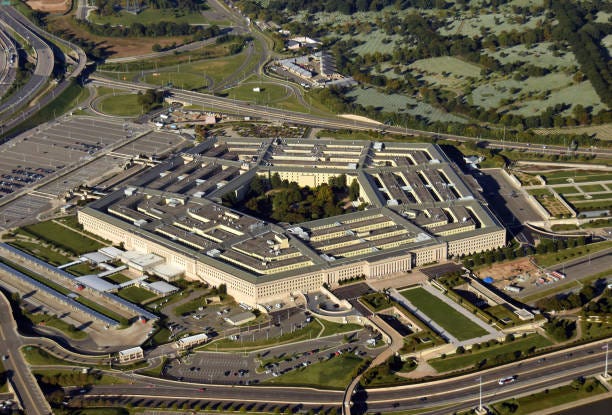
$333 billion is still an enormous sum of money, yet there will be many who’ll suggest this figure isn’t close to being enough for the brass, all those wearing stars who call the shots. My response: try it. If it doesn’t work, you can always boost the budget. But if you really want the Pentagon to think creatively, cut the budget to $333 billion and watch the real wars begin within the five-sided puzzle palace on the Potomac.

The Pentagon Cowbird

W.J. Astore

Three years ago, nature provided me a lesson in bird parasitism and its repercussions. Unbeknownst to me and especially to the yellow warblers I was watching, a cowbird snuck an egg into the warbler nest. The result is what you see in this photo I took:

Guess which one is the cowbird hatchling?

Cowbird chicks generally hatch quicker, and of course they’re bigger and can fight harder for food. What generally happens is what happened to the nest I was watching. The yellow warbler chicks died as the cowbird chick ate just about all the food provided by its warbler “parents.” All that was left in the end was a rather surly-looking cowbird chick that was incongruously bigger than the warbler “parents” that fed it. Nature can be cruel.

And, as I wrote about here, that cowbird chick made me think of a certain entity in Washington DC that always clamors for money, and which in its sheer bellicosity and bottomless appetite always dominates the nest and crowds out and kills its weaker yet more deserving rivals for sustenance. Yes, you guessed it: the Pentagon and the National Security State.

There’s something about the gaping mouth of that cowbird that says it all. For example, the Biden administration was planning on spending $813 billion on the Pentagon in FY2023, an already enormous sum, only for it to be revealed this week that a bipartisan effort in the Senate is seeking to increase this by $45 billion. That’s on top of the $55 billion or so provided to Ukraine, roughly half of which is going directly to America’s merchants of death.

As Jimmy Dore points out in this segment, at the same time as the Pentagon cowbird cries for and consumes all the money, smaller, vulnerable programs (our yellow warbler chicks) like money for free school lunches for 10 million needy kids are allowed to wither and die.

Dore’s segment here is excellent: https://www.youtube.com/watch?v=crNrmEP2lt8

Imagine allowing kids in schools to go hungry because of alleged lack of funds but then funneling nearly a trillion dollars yearly to the parasitic Pentagon cowbird in our midst.

Nature can be cruel. So too is America’s political process.

The War in Yemen

Map of Yemen from 2017 that shows the site of the botched SEAL Team raid at Yakla

W.J. Astore

I haven’t followed the Saudi war in Yemen that closely. But I’d wager most Americans know far less about it than I do. I know the U.S. has been supporting Saudi Arabia in its bloody repression of Iranian-backed Yemeni forces (the Houthis), providing critical resources such as aerial refueling, intelligence sharing, and, most importantly, an endless supply of weaponry. I know this support has been couched as consistent with a “war on terror,” when it’s driven much more by the U.S. need to appease Saudi rulers for economic reasons (primarily the petrodollar and oil exports). I know the Yemeni people have suffered greatly due to famine and diseases exacerbated by constant warfare and economic blockades. I know Joe Biden campaigned against the war and criticized Saudi officials but as president has done nothing to stop it. And I know a bipartisan force in Congress is trying to take steps to end America’s involvement in what essentially constitutes a genocide against the Yemeni people.

Occasionally, Yemen has appeared in my articles here, as with the SEAL Team fiasco launched by President Trump in late January 2017. (One Navy SEAL died in the raid; his father later accused the Trump administration of hiding behind the death of his son instead of admitting the raid had been a murderous failure.) In passing, I’ve mentioned Yemen in a few articles like this one, but again it’s not something I’ve written about in detail. I’ve been focused on the Afghan war, the military-industrial complex, the new Cold War, plans to build a new generation of nuclear weapons, and on and on.

Fortunately, a freelance journalist based in Yemen, Naseh Shaker, contacted me with a few questions that got me thinking a bit more about Yemen and the U.S. government’s role there. His article addresses whether Congress has any chance of invoking the War Powers Act to limit or end America’s involvement in this brutal war, given the reality that President Biden is once again courting and kowtowing to the Saudis. You can read his article here, which includes a few comments by me, but it may be useful to include his original questions to me, and my responses to them. He asked me to keep my responses short, 2-3 sentences, which I did:

Questions by Naseh Shaker

1- Why the US is sanctioning Russia for invading Ukraine but when it comes to the Saudi invasion of Yemen, the US is providing the Saudis with all logistics and weapons as if it is the American war, not the Saudi war?

2- Why Biden doesn’t fulfill his promise to end the war in Yemen?

3- Is invoking the War Powers Resolution (WPR) an attempt from Democrats to cover Biden’s scandal of not ending the war in Yemen as he promised?

4- If WPR is passed, does it mean the US is responsible for Saudi war crimes in Yemen given that it is providing the coalition “intelligence sharing” and “logistical support for offensive Saudi-led coalition strikes”? 

Answers by William Astore

Question 1: The US sees Russia as a rival and an enemy.  The US sees Saudi Arabia as an ally and a friend.  Put differently, the US economy owes much to the petrodollar and the Saudi appetite for expensive American-made weaponry.

Question 2: Because he doesn’t really care about the Yemeni people.  He cares about maintaining good relations with the Saudis.

Question 3: Unclear.  But I don’t think Democrats consider it a “scandal” that Biden failed to keep his promise.  There are many other promises Biden failed to keep, such as a $15 federal minimum wage for Americans, and these failed promises are not treated as “scandals.”

Question 4: The US government refuses to take responsibility for its own war crimes, so it certainly isn’t going to admit to responsibility or culpability for Saudi crimes.

Ignorance is a major enemy in the USA. We owe it to ourselves as citizens (and to what’s left of our democracy) to inform ourselves about what our government is up to, especially when what it’s up to is killing, whether directly or indirectly, untold numbers of people around the world.

The war in Yemen has killed at least 377,000 people. To what end? For what purpose? How is aiding the Saudis in this war remotely related to the defense of our country?

End the killing. End the wars. Let’s do something right for a change.

My Graduation Speech to the Air Force Academy

With great power comes great responsibility

W.J. Astore

Twenty years ago, I left the Air Force Academy in Colorado Springs for my next assignment. I haven’t been back since, but today I travel there (if only in my imagination) to give my graduation address to the class of 2022. So, won’t you take a few minutes and join me, as well as the corps of cadets, in Falcon Stadium?

Congratulations to all you newly minted second lieutenants! As a former military professor who, for six years, taught cadets very much like you at the Academy, I salute you and your accomplishments. You’ve weathered a demanding curriculum, far too many room and uniform inspections, parades, restrictions, and everything else associated with a military that thrives on busywork and enforced conformity. You’ve emerged from all of that today as America’s newest officers, part of what recent commanders-in-chief like to call “the finest fighting force” in human history. Merely for the act of donning a uniform and taking the oath of office, many of your fellow Americans already think of you as heroes deserving of a hearty “thank you for your service” and unqualified expressions of “support.”

And I must say you do exude health, youth, and enthusiasm, as well as a feeling that you’re about to graduate to better things, like pilot training or intelligence school, among so many other Air Force specialties. Some of you will even join America’s newest service, the Space Force, which resonates with me, as my first assignment in 1985 was to Air Force Space Command.

In my initial three years in the service, I tested the computer software the Air Force used back then to keep track of all objects in earth orbit, an inglorious but necessary task. I also worked on war games in Cheyenne Mountain, America’s ultimate command center for its nuclear defense. You could say I was paid to think about the unthinkable, the end of civilization as we know it due to nuclear Armageddon. That was near the tail end of the Cold War with the Soviet Union. So much has changed since I wore gold bars like you and yet, somehow, we find ourselves once again in another “cold war” with Russia, this time centered on an all-too-hot war in Ukraine, a former Soviet republic, instead of, as in 1962, a country in our immediate neighborhood, Cuba. Still, that distant conflict is only raising fresh fears of a nuclear nightmare that could well destroy us all.

What does this old light colonel, who’s been retired for almost as long as he wore the uniform, have to teach you cadets so many years later? What can I tell you that you haven’t heard before in all the classes you’ve attended and all the lectures you’ve endured?

How about this: You’ve been lied to big time while you’ve been here at the Academy.

Ah, I see I have your attention now. More than a few of you are smiling. I used to joke with cadets about how four years at a military school were designed to smother idealism and encourage cynicism, or so it sometimes seemed. Yes, our lead core value may still be “integrity first,” but the brass, the senior leadership, often convinces itself that what really comes first is the Air Force itself, an ideal of “service” that, I think you’ll agree, is far from selfless.

What do I mean when I say you’ve been lied to while being taught the glorious history of the U.S. Air Force? Since World War II began, the air forces of the United States have killed millions of people around the world. And yet here’s the strange thing: we can’t even say that we’ve clearly won a war since the “Greatest Generation” earned its wings in the 1930s and 1940s. In short, boasts to the contrary, airpower has proven to be neither cheap, surgical, nor decisive. You see what I mean about lies now, I hope.

I know, I know. You’re not supposed to think this way. You eat in Mitchell Hall, named after General Billy Mitchell, that airpower martyr who fought so hard after World War I for an independent air service. (His and our collective dream, long delayed, finally came to fruition in 1947.) You celebrate the Doolittle Raiders, those intrepid aviators who flew off an aircraft carrier in 1942, launching a daring and dangerous surprise attack on Tokyo, a raid that helped restore America’s sagging morale after Pearl Harbor. You mark the courage of the Tuskegee Airmen, those African American pilots who broke racial barriers, while proving their mettle in the skies over Nazi Germany. They are indeed worthy heroes to celebrate.

And yet shouldn’t we airmen also reflect on the bombing of Germany during World War II that killed roughly 600,000 civilians but didn’t prove crucial to the defeat of Adolf Hitler? (In fact, Soviet troops deserve the lion’s share of the credit there.) We should reflect on the firebombing of Tokyo that killed more than 100,000 people, among 60 other sites firebombed, and the atomic bombing of Hiroshima and Nagasaki that, both instantly and over time, killed an estimated 220,000 Japanese. During the Korean War, our air forces leveled North Korea and yet that war ended in a stalemate that persists to this day. During Vietnam, our air power pummeled Vietnam, Laos, and Cambodia, unleashing high explosives, napalm, and poisons like Agent Orange against so many innocent people caught up in American rhetoric that the only good Communist was a dead one. Yet the Vietnamese version of Communism prevailed, even as the peoples of Southeast Asia still suffer and die from the torrent of destruction we rained down on them half a century ago.

Turning to more recent events, the U.S. military enjoyed total air supremacy in Afghanistan, Iraq, and other battlefields of the war on terror, yet that supremacy led to little but munitions expended, civilians killed, and wars lost. It led to tens of thousands of deaths by airpower, because, sadly, there are no such things as freedom bombs or liberty missiles.

If you haven’t thought about such matters already (though I’ll bet you have, at least a little), consider this: You are potentially a death-dealer. Indeed, if you become a nuclear launch officer in a silo in Wyoming or North Dakota, you may yet become a death-dealer of an almost unimaginable sort. Even if you “fly” a drone while sitting in a trailer thousands of miles from your target, you remain a death-dealer. Recall that the very last drone attack the U.S. launched in Afghanistan in 2021 killed 10 civilians, including seven children, and that no one in the chain of command was held accountable. There’s a very good reason, after all, why those drones, or, as we prefer to call them, remotely piloted aircraft, have over the years been given names like Predator and Reaper. Consider that a rare but refreshing burst of honesty.

I remember how “doolies,” or new cadets, had to memorize “knowledge” and recite it on command to upper-class cadets. Assuming that’s still a thing, here’s a phrase I’d like you to memorize and recite: Destroying the town is not saving it. The opposite sentiment emerged as an iconic and ironic catchphrase of the Vietnam War, after journalist Peter Arnett reported a U.S. major saying of devastated Ben Tre, “It became necessary to destroy the town to save it.” Incredibly, the U.S. military came to believe, or at least to assert, that destroying such a town was a form of salvation from the alleged ideological evil of communism. But whether by bombs or bullets or fire, destruction is destruction. It should never be confused with salvation.

Will you have the moral courage, when it’s not strictly in defense of the U.S. Constitution to which you, once again, swore an oath today, to refuse to become a destroyer?

Two Unsung Heroes of the U.S. Air Force

In your four years here, you’ve learned a lot about heroes like Billy Mitchell and Lance Sijan, an Academy grad and Medal of Honor recipient who demonstrated enormous toughness and resilience after being shot down and captured in Vietnam. We like to showcase airmen like these, the true believers, the ones prepared to sacrifice everything, even their own lives, to advance what we hold dear. And they are indeed easy to respect.

I have two more courageous and sacrificial role models to introduce to you today. One you may have heard of; one you almost certainly haven’t. Let’s start with the latter. His name was James Robert “Cotton” Hildreth and he rose to the rank of major general in our service. As a lieutenant colonel in Vietnam, Cotton Hildreth and his wingman, flying A-1 Skyraiders, were given an order to drop napalm on a village that allegedly harbored enemy Viet Cong soldiers. Hildreth disobeyed that order, dropping his napalm outside the target area and saving (alas, only temporarily) the lives of 1,200 innocent villagers.

How could Hildreth have possibly disobeyed his “destroy the town” order? The answer: because he and his wingman took the time to look at the villagers they were assigned to kill. In their Skyraiders, they flew low and slow. Seeing nothing but apparently friendly people waving up at them, including children, they sensed that something was amiss. It turns out that they were oh-so-right. The man who wanted the village destroyed was ostensibly an American ally, a high-ranking South Vietnamese official. The village hadn’t paid its taxes to him, so he was using American airpower to exact his revenge and set an example for other villages that dared to deny his demands. By refusing to bomb and kill innocents, Hildreth passed his “gut check,” if you will, and his career doesn’t appear to have suffered for it.

But he himself did suffer. He spoke about his Vietnam experiences in an oral interview after he’d retired, saying they’d left him “really sick” and “very bitter.” In a melancholy, almost haunted, tone, he added, “I don’t talk about this [the war] very much,” and one can understand why.

So, what happened to the village that Hildreth and his wingman had spared from execution by napalm? Several days later, it was obliterated by U.S. pilots flying high and fast in F-105s, rather than low and slow as Hildreth had flown in his A-1. The South Vietnamese provincial official had gotten his way and Hildreth’s chain of command was complicit in the destruction of 1,200 people whose only crime was fighting a tax levy.

My second hero is not a general, not even an officer. He’s a former airman who’s currently behind bars, serving a 45-month sentence because he leaked the so-called drone papers, which revealed that our military’s drone strikes killed far more innocent civilians than enemy combatants in the war on terror. His name is Daniel Hale, and you should all know about him and reflect on his integrity and honorable service to our country.

What was his “crime”? He wanted the American people to know about their military and the innocent people being killed in our name. He felt the burden of the lies he was forced to shoulder, the civilians he watched dying on video monitors due to drone strikes. He wanted us to know, too, because he thought that if enough Americans knew, truly knew, we’d come together and put a stop to such atrocities. That was his crime.

Daniel Hale was an airman of tremendous moral courage. Before he was sentenced to prison, he wrote an eloquent and searing letter about what had moved him to share information that, in my view, was classified mainly to cover up murderous levels of incompetence. I urge you to read Hale’s letter in which he graphically describes the deaths of children and the trauma he experienced in coming to grips with what he termed “the undeniable cruelties that I perpetuated” while serving as an Air Force intelligence analyst.

It’s sobering stuff, but we airmen, you graduates in particular, deserve just such sobering information, because you’re going to be potential death-dealers. Yet it’s important that you not become indiscriminate murderers, even if you never see the people being vaporized by the bombs you drop and missiles you’ll launch with such profligacy.

In closing, do me one small favor before you throw your caps in the air, before the Thunderbirds roar overhead, before you clap yourselves on the back, before you head off to graduation parties and the congratulations of your friends and family. Think about a saying I learned from Spider-Man. Yes, I really do mean the comic-book hero. “With great power comes great responsibility.”

Like so many airmen before you, you may soon find yourself in possession of great power over life and death in wars and other conflicts that, at least so far in this century, have been all too grim. Are you really prepared for such a burden? Because power and authority, unchecked by morality and integrity, will lead you and our country down a very dark path indeed.

Always remember your oath, always aim high, the high of Hildreth and Hale, the high of those who remember that they are citizen-airmen in service to a nation founded on lofty ideals. Listen to your conscience, do the right thing, and you may yet earn the right to the thanks that so many Americans will so readily grant you just by virtue of wearing the uniform.

And if you’ll allow this aging airman one final wish: I wish you a world where the bombs stay in their aircraft, the missiles in their silos, the bullets in their guns, a world, dare I say it, where America is finally at peace.

Copyright 2022 William J. Astore. Originally at TomDispatch.com. Please read TomDispatch.com, a regular antidote to the mainstream media. Thank you!