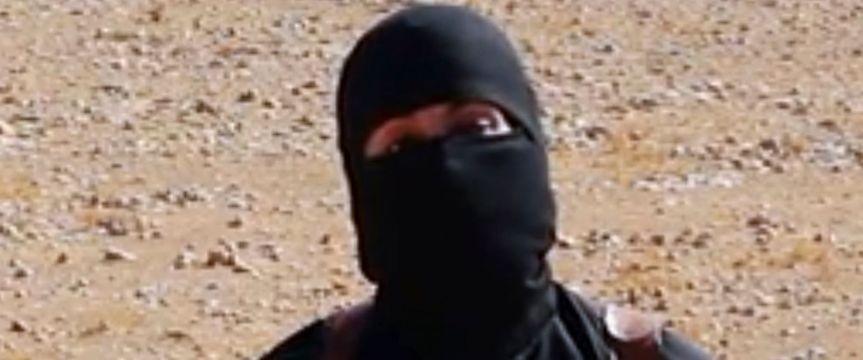
Image showing Jihadi John. Apparently killed, then quickly replaced by a new “Jihadi John” — a visual metaphor of “progress” in the war on ISIS (AP photo)
W.J. Astore
An overarching strategy for defeating ISIS is simple enough to state: A concerted effort by regional power brokers to tamp down Islamic extremism while reducing the violent and chaotic conditions in which it thrives. Regional power brokers include the Israelis, the Saudis, the Iranians, and the Turks, joined by the United States and Russia. They should work, more or less cooperatively, to eliminate ISIS.
Why? Because you never know when a spark generated by extremists will ignite an inferno, especially in a tinderbox (a fair description of the Middle East). We know this from history. Consider the events of the summer of 1914. A Serbian “Black Hand” extremist assassinates an archduke of the Austro-Hungarian Empire in the Balkans (that era’s tinderbox of extremism). Most of Europe yawned, at least initially. A small brush fire between the Serbs and the Empire, easily containable, people said. Yet within weeks European troops were marching in the millions to their deaths in what became World War I.
In today’s Middle East, we’ve been lucky (so far) to avoid the kind of provocation and miscalculation that led to World War I. But consider the actions of a new president, say a Chris Christie. During a presidential debate, Christie promised to declare a no-fly zone over Syria and to shoot down any Russian plane that violated it. It’s the kind of ultimatum that very well could lead to another world war.
Provocations and ultimatums can rapidly spiral among nations that lack uniformity of purpose. For many of the power brokers engaged in the Middle East, defeating ISIS is either not the goal, or it’s not the primary one. Put differently, there are too many forces involved, working to discordant ends. Their actions, often at cross-purposes, ensure that entities like ISIS survive.
Let’s take the United States, for example. Every American politician says he (or she) wants to destroy ISIS. Yet in spite of this nation’s enormous military strength, we seem to be too weak, psychologically as well as culturally, to deal with Russia, Iran, et al. as diplomatic equals. The “exceptional” country thinks it must “lead,” and that means with bombing, drone strikes, troops on the ground, and similar “kinetic” actions. Rather than dousing the flames, such actions fuel the fire of Islamic extremism.
Consider America’s domestic political scene as well. ISIS is incessantly touted as a bogeyman to fear, most notably by Republican presidential candidates seeking to draw a contrast between themselves and Barack Obama, the “feckless weakling” in the words of Chris Christie. But the Republican “alternative” is simply more bombing and more U.S. troops. Making the sand glow is no strategy, Ted Cruz.
Strategy is a synthesis of means, ends, and will. Currently, the means is military force, with a choice of more (from Obama) or even more (from Republicans). Our leaders have no idea of the ends at all, other than vague talk of “destroying” ISIS. The will they exhibit is mostly bombast and fustian.
A nation lacking will, with no clear vision of means and ends, is a nation without a strategy. And a nation without a strategy is one that’s fated to fail.
One of the first acronyms I learned in the military was KISS. No, not the heavy metal band. No, nothing romantic either. It stands for “keep it simple, stupid.” The lesson: don’t think too much. That leads to “analysis paralysis.” Be decisive! Act, if need be, with extreme prejudice, a preference expressed vulgarly as “Kill ’em all and let God sort ’em out.”
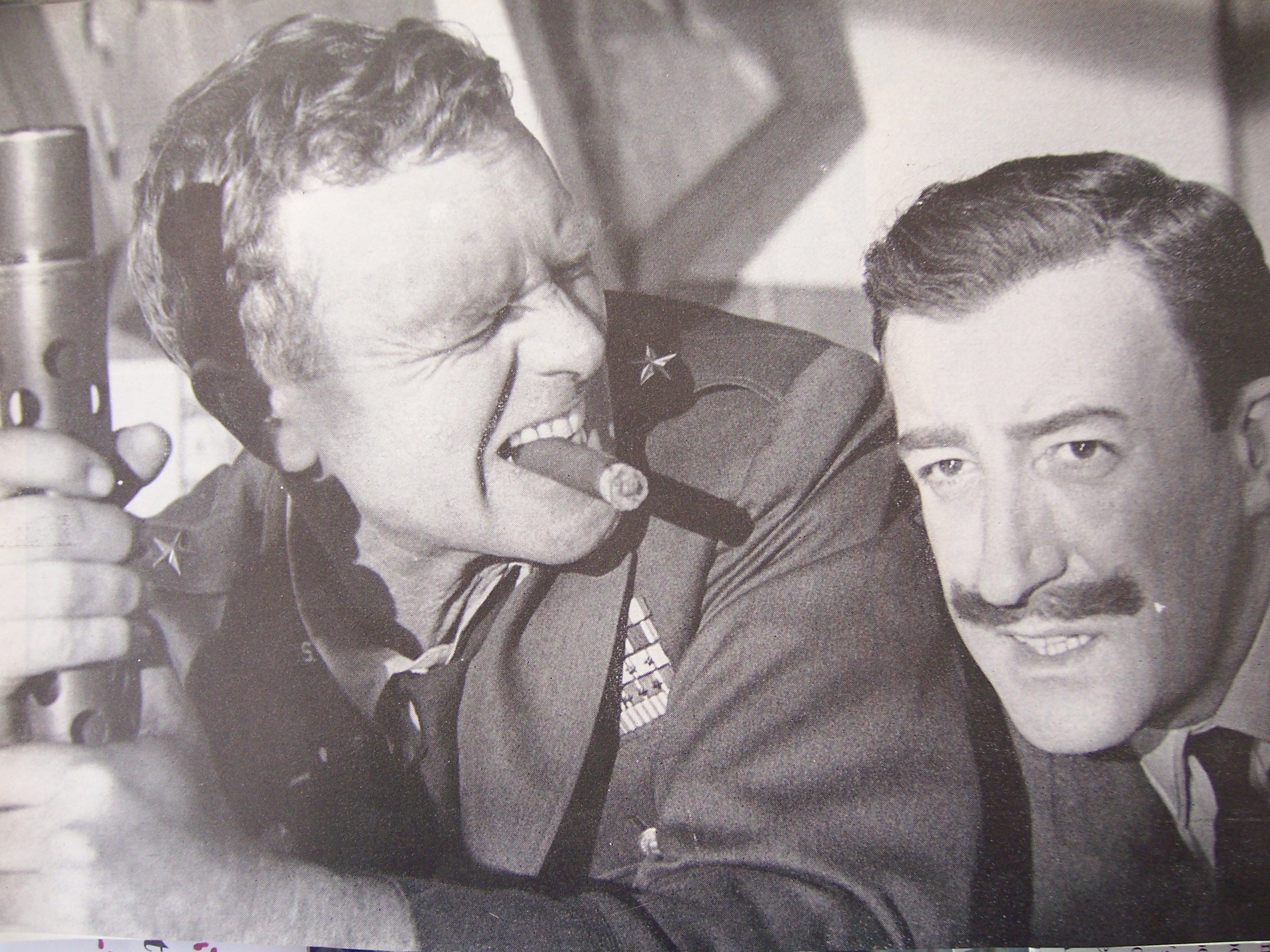
It’s a preference readily expressed by the current crop of political candidates for commander-in-chief. With the possible exceptions of Rand Paul and Bernie Sanders, all are slavering for a chance to bomb the bastards back to the Stone Age. Like the young macho fools in the movie “Boiler Room,” they all want to wield their (fantasy) big swinging dicks. They’re all budding Curtis LeMays, cigar-chomping bulls in a china shop.
Indeed, the bull rather than the eagle should be the symbol of American foreign policy. Always charging off to foreign lands, always striving to gore anyone within reach of its horns, all in the name of being decisive, of showing that “America means business” (and not just on Wall Street).
To this season’s peculiar electoral crop of presidential candidates, it looks remarkably easy to win wars. Just bomb the bastards! Teach them not to mess with Team USA. Heck, I’m sure it looked easy to the political hacks of London in 1775 as they faced a perceived terrorist threat in a faraway land. Just send some “special ops” Redcoats supported by Hessian mercenaries (boots on the ground!) to teach those New England terrorists a lesson. Use superior technology (in this case, gunboats) to bombard their rebellious cities (like Boston). Never mind civilian casualties – a show of force will show the bastards who’s boss.
At least the British had enough sense to cut their losses after six years of bungling that ended at Yorktown (1781). The U.S. today just keeps sending more troops and more money and more bombs overseas, each time expecting victory instead of the destruction and chaos that characterized previous misadventures (Vietnam, Lebanon, Somalia, Iraq, Afghanistan, Libya, Syria …).
American foreign policy: It’s become like a bull in the ring, snorting, pawing at the ground, racing madly at red capes. Each time it thinks it’s going to get that cape – until it ends up impaled on the toreador’s sword.
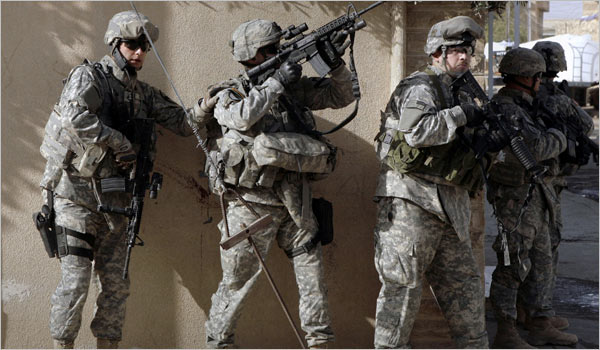
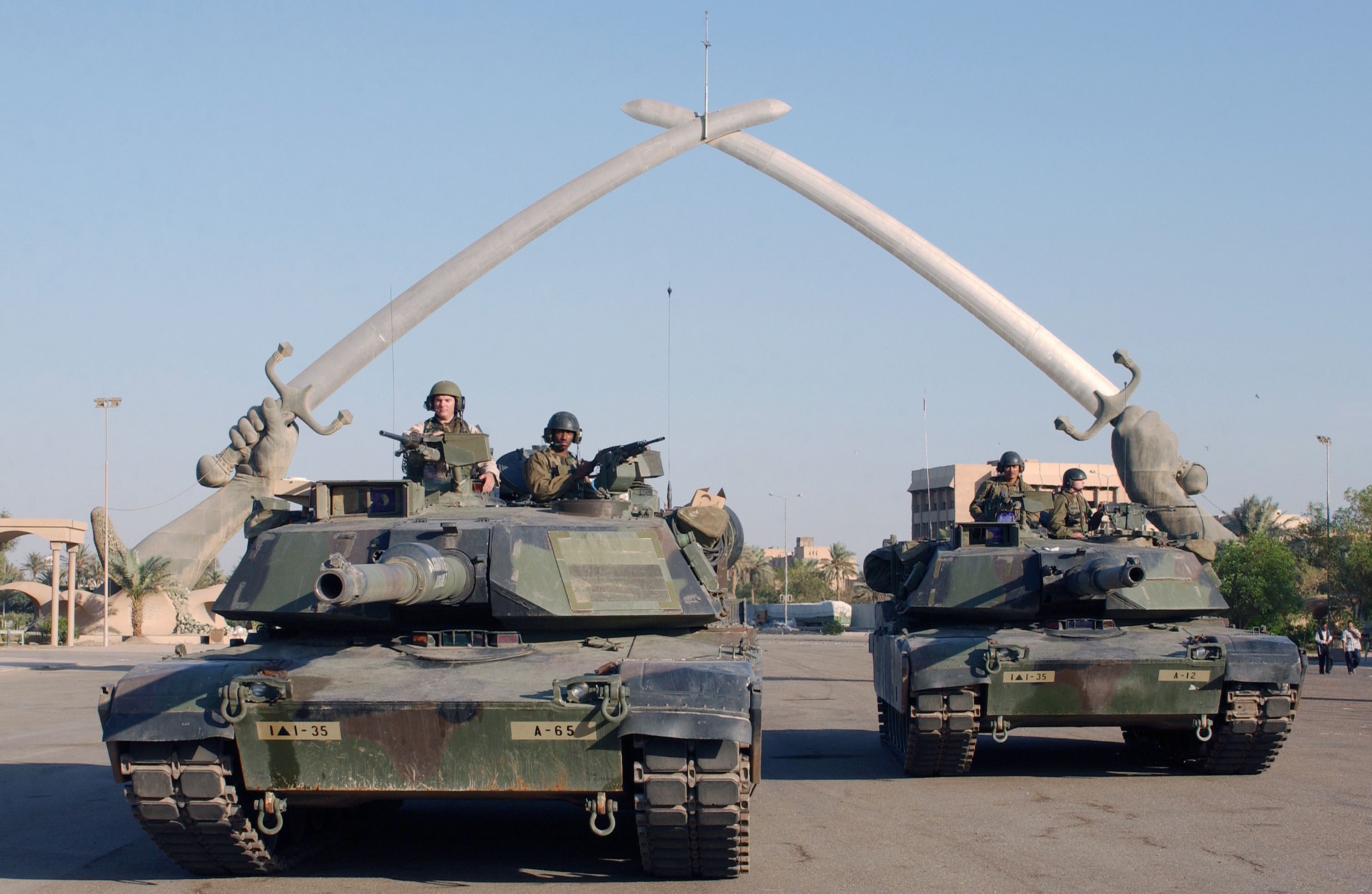
U.S. troops in Mosul, Iraq in 2007. A foreign presence to Iraqis
W.J. Astore
I’m a retired U.S. military officer. When I think of U.S. troops, naturally I see them as my gals and guys. I identify with them. And I know enough of them to know that their intent is usually good — at least in the sense that they seek to do their duty.
But I’m also an historian with a modicum of empathy. I know that foreigners don’t see the U.S. military as I see it. Nor do they experience it the way I experienced it. To cite just one anecdote: I recall a story in the New York Times in which U.S. troops in Iraq ask an Iraqi farmer if he’s seen any foreign fighters around. The Iraqi has a simple answer: “Yes. You.”
Six years ago, I wrote an article for Huffington Post on “Catch-22 in Afghanistan.” I argued that the more the U.S. military intervened in the affairs of Afghanistan, the less likely it was that a permanent, and suitably Afghan, solution would be found to the problems confronting that country. Not much has changed in those six years, except that today the Taliban controls even more territory, the drug trade is even more pervasive, and corruption is even more endemic.
We need to learn (or re-learn) a basic lesson: The more the U.S. intervenes in conflicts within other countries, the less likely it is that a favorable outcome will result (favorable for the U.S., that is), simply because U.S. forces are viewed as a foreign contagion. And indeed we are that.
Ignoring its Afghan failures, the U.S. government now seeks to widen its military commitment to the most hotly contested areas of the Middle East. Our leaders act as if the way to end civil wars driven in part by radical Islam is violent intervention led by American troops.
But American troops (and drones and bombs and all the rest) are not the answer. Indeed, their actions spread the contagion further.
The other day, I was reading about “super-bugs,” those bacterial infections that have become highly resistant to traditional antibiotics due to misuse and overuse of the same. In seeking to “destroy” ISIL and similar “infections,” the American government instead often feeds them. Indeed, I was surprised to learn that in medicine there are super-bugs that literally feed on traditional antibiotics. They gain strength from being attacked. Such is often the case for “bugs” like ISIL, which feed off of heavy-handed U.S. military actions.
This is not an argument for the U.S. military to do nothing. Rather, it’s a reminder of the limits of power and the complexity of life. It’s a reminder too that to foreigners the U.S. military is the foreign presence, the contagion. Even when it seeks to act as a “cure,” it may in fact be feeding the disease.
How about a contrary perspective on the Middle East, courtesy of my old globe? It dates from the early 1920s, just after World War I but before Russia became the Soviet Union. Taking a close look at the Middle East (a geographic term that I use loosely), you’ll notice more than a few differences from today’s maps and globes:
Iraq and Syria don’t exist. Neither does Israel. Today’s Iran is yesterday’s Persia, of course.
Instead of Iraq and Syria, we have Mesopotamia, a name that resonates history, part of the Fertile Crescent that encompassed the Tigris and Euphrates Rivers as well as the Nile in Egypt. Six thousand years ago, the cradle of human civilization, and now more often the scene of devastation caused mainly by endless war.
Ah, Kurdistan! The Kurds today in northern Iraq and southern Turkey would love to have their own homeland. Naturally, the Arabs and Turks, along with the Persians, feel differently.
Look closely and you’ll see “Br. Mand.” and “Fr. Mand.” With the collapse of the Ottoman Empire (roughly a larger version of modern-day Turkey) at the end of World War I, the British gained a mandate over Palestine and Mesopotamia and the French gained one over territory that would become Lebanon and Syria. The British made conflicting promises to Jews and Arabs over who would control Palestine while scheming to protect their own control over the Suez Canal. A large portion of Palestine, of course, was given to Jews after the Holocaust of World War II, marking the creation of Israel and setting off several Arab-Israeli Wars(1948-73) and the ongoing low-level war between Israel and the Palestinians, most bitterly over the status of the “Occupied Territories”: land captured by the Israelis during these wars, i.e. the West Bank (of the Jordan River) and the Gaza Strip (both not labeled on my outdated globe).
Improvisation marked the creation of states such as Lebanon, Syria, and Iraq. Borders encapsulated diverse peoples with differing goals. Western powers like Britain and France cared little for tribal allegiances or Sunni/Shia sensitivities or political leanings, favoring autocratic rulers who could keep the diverse peoples who lived there in line.
Historically powerful peoples with long memories border the Middle East. The Turks and the Persians (Iranians), of course, with Russians hovering in the near distance. They all remain players with conflicting goals in the latest civil war in Syria and the struggle against ISIS/ISIL.
Three of the world’s “great” religions originated from a relatively tiny area of our globe: Judaism, Christianity, and Islam. Talk about a fertile crescent! Sadly, close proximity and shared roots did not foster tolerance: quite the reverse.
Remember when Saudi Arabia was just Arabia? Ah, those were the good old days, Lawrence.
Nobody talks much about Jordan, an oasis of relative calm in the area (not shown on my old globe). Lucky Jordan.
The presence of Armenia in Turkey on my old globe raises all kinds of historical ghosts, to include the Armenian genocide of World War I. Today, Turkey continues to deny that the word “genocide” is appropriate to the mass death of Armenians during World War I.
My fellow Americans, one statement: The idea that America “must lead” in this area of the world speaks to our hubris and ignorance. We are obviously not seen as impartial. Our “leadership” is mainly expressed by violent military action.
But we just can’t help ourselves. The idea of “global reach, global power” is too intoxicating. We see the globe as ours to spin. Ours to control.
Perhaps old globes can teach us the transitory nature of power. After all, those British and French mandates are gone. European powers, however grudgingly, learned to retrench. (Of course, the British and French, together with the Germans, are now bombing and blasting old mandates in the name of combating terrorism.)
I wonder how a globe made in 2115 will depict this area of the world. Will it look like today’s globe, or more like my globe from c.1920, or something entirely different? Will it show a new regional empire or more fragmentation? An empire based on Islam or a shattered and blasted infertile crescent ravaged by war and an inhospitable climate driven by global warming?
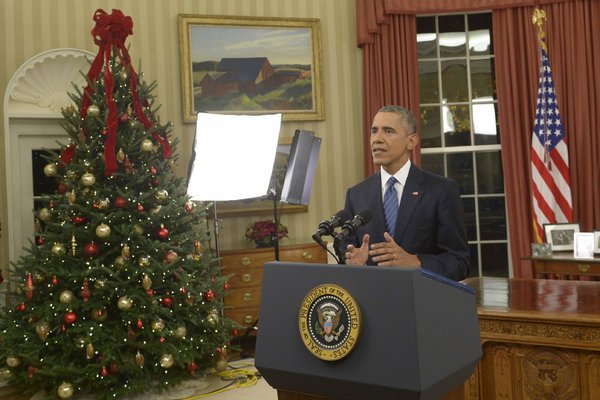
My wife and I watched the president’s speech last night. Overall, it was a solid, even praiseworthy, performance. First, we had to get past the NBC pre-speech fear-mongering. Lester Holt and Chuck Todd, the NBC commentators, were talking about how afraid Americans were, hinting that we all feared our holiday parties would be invaded by active shooters bent on murder. My wife and I looked at each other. Are you fearful, honey? Neither am I.
President Obama himself made many good points. Yes, we shouldn’t vilify Muslim-Americans or condemn all of Islam. Yes, we shouldn’t commit major ground forces to the Middle East to chase ISIL terrorists. Yes, we need sane gun control measures in the USA. Nobody needs an AK-47 or AR-15 (these are not hunting guns: they are military assault rifles designed to kill people). And nobody needs the right to buy a gun if they’re on a “no fly” list as a possible terror threat.
These were “common sense” points, and it pains me to think the president has to belabor what should be obvious. But he does. Because the National Rifle Association wants no restrictions on gun ownership, and the radical right does want to vilify Muslims, commit large numbers of U.S. ground troops to the Middle East, and extend a regimen of militarized surveillance and security at home that will make us even less safe.
Where President Obama consistently disappoints is what he leaves unsaid. That the U.S. invasion and occupation of Iraq essentially created ISIL; and that his policy of overthrowing the Syrian government by arming indigenous Arab forces contributed to it (according to Lieutenant General Michael Flynn, formerly head of the Defense Intelligence Agency). That his strategy of drone assassination (so-called signature strikes that are often based on faulty intelligence) is creating more terrorists than it kills, as several military drone operators have recently argued.
Defenders of the U.S. drone assassination program argue that it’s not the intent of the U.S. government to kill innocents, therefore the U.S. is free from blame. Try telling that to those who have lost loved ones to drones. (So sorry: We didn’t mean to kill your mother/brother/loved one. Wrong place/wrong time: an explanation as infuriating as it is unconvincing.)
President Obama concluded by arguing that he needed even more of a blank check (in the form of a Congressional authorization) to prosecute the war on terror. All in the name of keeping Americans safe, naturally. But he has it exactly backwards. Congress needs to exercise more oversight, not less. Imagine giving President Donald Trump a Congressional blank check to exercise the war on terror. Not such a good idea, right?
Finally, and disappointingly, Obama misunderstands the solemn duty of his office. As commander in chief, Obama believes his first duty is to keep Americans safe and secure. Wrong. His first duty is to “preserve, protect and defend” the U.S. Constitution and the rights, freedoms, and responsibilities defined within. Put bluntly, you can’t keep Americans safe and secure by abridging their rights to freedom of speech or to privacy or to dissent. “Safety” and “security” were not the bywords of America’s founders. Liberty was. And liberty entails risks.
A saying popular on the right is Thomas Jefferson’s “The tree of liberty must be refreshed from time to time with the blood of patriots and tyrants.” In the USA today, “tyranny” is most likely to come in the form of a leader who promises to keep us safe and secure at any cost. (Just look at the Republican candidates for president with their calls for Muslim detention camps, mass expulsion of immigrants, the shuttering of houses of worship, and similar measures of repression.)
The president was right to argue that we must not betray our values. He was right to talk about human dignity. He was right to say that freedom is more powerful than fear. Now we as Americans need to live up to those words. And so does he.
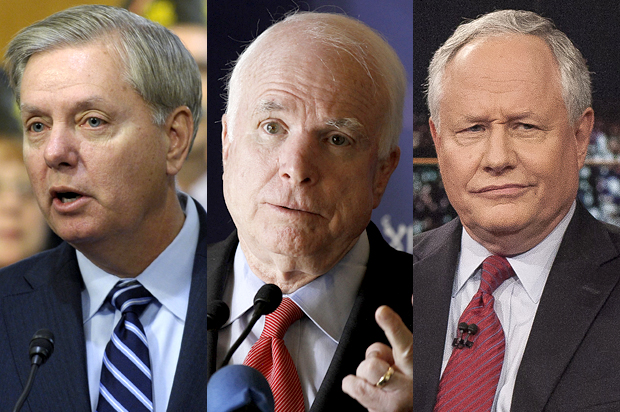
John McCain (middle) bookended by “warriors” Lindsey Graham (left) and Bill Kristol (right)
W.J. Astore
In his latest introduction at TomDispatch.com, Tom Engelhardt reveals a remarkable double standard — perhaps craziness is a better term — in the U.S. approach to terrorism in the wake of the Paris attacks. Prominent “conservative” leaders are calling for a major U.S. military invasion of territory controlled by ISIS, even though they know that ISIS has the “home field advantage.” They know, in short, that such an invasion will be both risky and costly, spreading chaos even further in the region, but they just can’t help themselves: they must “do something,” and the “something” in this case is sending other people’s sons and daughters into harm’s way.
But when it comes to incurring any risk, no matter how remote, to the American “homeland” from allowing refugees fleeing the chaos of the Middle East (chaos partly made by the USA and its previous military interventions, of course) to enter, these same conservative leaders cower. We can’t let “them” in. Too dangerous!
So, where the U.S. has an overwhelming “home field” advantage, these self-styled warriors retreat into paralyzing timidity. “Not in my backyard,” they say. But we sure as hell will send “our” troops into their backyards. See how brave we are in taking the fight to ISIS?
Here is Engelhardt’s introduction that so clearly highlights this tension:
In Washington, voices are rising fast and furiously. “Freedom fries” are a thing of the past and everyone agrees on the need to support France (and on more or less nothing else). Now, disagreements are sharpening over whether to only incrementally “intensify” the use of U.S. military power in Syria and Iraq or go to “war” big time and send in the troops. The editor of the right-wing Weekly Standard, Bill Kristol, is already calling for 50,000 American troops to take the Islamic State’s “capital,” Raqqa. Republican presidential candidate Senator Lindsey Graham, who has been urging that another 20,000 troops be dispatched to the region for months, offers this illuminating analogy to sports: “I’m looking for an away game when it comes to ISIL, not a home game. I want to fight them in their backyard.”
And don’t forget that increasingly angry sideline discussion about the Obama administration’s plan to let 10,000 Syrian refugees, carefully vetted for up to two years, trickle into the country. Alternatives proposed include setting up even harsher, more time-consuming vetting processes to insure that few of them can make it, allowing only certified, God-fearing Christian Syrians in while — give a rousing cheer for the “clash of civilizations” — leaving Muslims to rot in hell, or just blocking the whole damn lot of them.
I’m all for Bill Kristol and Lindsey Graham’s warrior fervor. I wish them every success as they deploy to Raqqa in their “away game” against ISIS.
Greg Grandin has a new book on Henry Kissinger and a new article at TomDispatch.com. Kissinger, writes Grandin, had an affinity (or perhaps an avidity) for power, especially air power, as a way of demonstrating his (and America’s) resolve.
Notes Grandin:
Henry Kissinger is, of course, not singularly responsible for the evolution of the U.S. national security state into a monstrosity. That state has had many administrators. But his example — especially his steadfast support for bombing as an instrument of “diplomacy” and his militarization of the Persian Gulf — has coursed through the decades, shedding a spectral light on the road that has brought us to a state of eternal war …
Kissinger was very hands-on. “Strike here in this area,” Sitton recalled Kissinger telling him, “or strike here in that area.” The bombing galvanized the national security adviser. The first raid occurred on March 18, 1969. “K really excited,” Bob Haldeman, Nixon’s chief of staff, wrote in his diary. “He came beaming in [to the Oval Office] with the report.”
In fact, he would supervise every aspect of the bombing. As journalist Seymour Hersh later wrote, “When the military men presented a proposed bombing list, Kissinger would redesign the missions, shifting a dozen planes, perhaps, from one area to another, and altering the timing of the bombing runs… [He] seemed to enjoy playing the bombardier.” (That joy wouldn’t be limited to Cambodia. According to Washington Post reporters Bob Woodward and Carl Bernstein, when the bombing of North Vietnam finally started up again, Kissinger “expressed enthusiasm at the size of the bomb craters.”) A Pentagon report released in 1973 stated that “Henry A. Kissinger approved each of the 3,875 Cambodia bombing raids in 1969 and 1970” — the most secretive phase of the bombing — “as well as the methods for keeping them out of the newspapers.”
All told, between 1969 and 1973, the U.S. dropped half-a-million tons of bombs on Cambodia alone, killing at least 100,000 civilians. And don’t forgetLaos and both North and South Vietnam. “It’s wave after wave of planes. You see, they can’t see the B-52 and they dropped a million pounds of bombs,” Kissinger told Nixon after the April 1972 bombing of North Vietnam’s port city of Haiphong, as he tried to reassure the president that the strategy was working: “I bet you we will have had more planes over there in one day than Johnson had in a month… Each plane can carry about 10 times the load [a] World War II plane could carry.”
As the months passed, however, the bombing did nothing to force Hanoi to the bargaining table. It did, on the other hand, help Kissinger in his interoffice rivalries. His sole source of power was Nixon, who was a bombing advocate. So Kissinger embraced his role as First Bombardier to show the tough-guy militarists the president had surrounded himself with that he was the “hawk of hawks.” And yet, in the end, even Nixon came to see that the bombing campaigns were a dead end. “K. We have had 10 years of total control of the air in Laos and V.Nam,” Nixon wrote him over a top-secret report on the efficacy of bombing, “The result = Zilch.” (This was in January 1972, three months before Kissinger assured Nixon that “wave after wave” of bombers would do the trick).
During those four-and a half years when the U.S. military dropped more than 6,000,000 tons of bombs on Southeast Asia, Kissinger revealed himself to be not a supreme political realist, but the planet’s supreme idealist. He refused to quit when it came to a policy meant to bring about a world he believed heought to live in, one where he could, by the force of the material power of the U.S. military, bend poor peasant countries like Cambodia, Laos, and North Vietnam to his will — as opposed to the one he did live in, where bomb as he might he couldn’t force Hanoi to submit. As he put it at the time, “I refuse to believe that a little fourth-rate power like North Vietnam does not have a breaking point.”
In fact, that bombing campaign did have one striking effect: it destabilized Cambodia, provoking a 1970 coup that, in turn, provoked a 1970 American invasion, which only broadened the social base of the insurgency growing in the countryside, leading to escalating U.S. bombing runs that spread to nearly the whole country, devastating it and creating the conditions for the rise to power of the genocidal Khmer Rouge…
Bombing for Kissinger was a way to show he was tough within an inner circle around Nixon that put a premium on toughness. It was also a way to minimize casualties to Americans while demonstrating a total disregard for casualties among the peoples of Southeast Asia.
Kissinger the bombardier was seduced by the seemingly god-like potential of air power — the ability to strike from on high, to smite evil-doers and those who would thwart Kissinger’s designs. Best of all, Kissinger never had to bloody his own hands. (Can you imagine Kissinger in a knife fight? Of course not. But you can imagine him gleefully gushing over bombing reports and bomb craters as bomber jets knifed through the sky.)
There’s a “Star Trek” episode in which Captain Kirk says, “Above all else, a god needs compassion.” Kissinger the “air power god” had no compassion. It was all about power. The little people who refused to kowtow to him — the Vietnamese, the Cambodians, the Chileans, and so on — these people were simply abstractions for Kissinger. Put differently, they were pawns on the geopolitical chessboard, to be sacrificed at will by self-styled grandmasters like Kissinger.
In his book “Secrets,” Daniel Ellsberg captured Kissinger’s blithe disregard for the lives of others in a probing question about Vietnamization. Was it moral, Ellsberg asked, to turn the war over to the South Vietnamese, knowing they were going to incur high casualties while fighting North Vietnam, even as American troops withdrew? Kissinger had no answer, one senses because the morality of his policies didn’t much matter to him. The goal was to save America’s “face” in Vietnam; for Kissinger the fates of the peoples of Southeast Asia paled in comparison to the importance of American prestige.
In his deliberately ponderous Germanic accent, Kissinger spoke softly as he wielded the big stick of American bombing. It didn’t work then, nor is it working today for those who still worship at the altar of Kissinger’s Realpolitik.
“The president announced last week that American troops will remain in Afghanistan beyond the planned withdrawal at the end of 2016. This is a devastating blow. We’ve already spent $716 billion and counting on the war in Afghanistan alone, plus countless lives lost and derailed.”
Of course, not the same American troops will “remain” in Afghanistan until 2017 (or 2024, or who knows what year). U.S. troops, intelligence operatives, privatized paramilitaries, and assorted imperial straphangers are constantly rotating in and out of war zones around the world, sometimes on yearly tours, often on much shorter ones. This reality got me to thinking about American imperialism as a peculiar form of global tourism. All those repetitive, fairly short-term, “tours” to foreign countries, followed by new American tour groups (fresh deployments of new combat units). The result is needless repetition, endless waste, and flat learning curves for Americans. For the locals who have to endure America’s “tours,” the results are often far worse — and unlike Americans they usually can’t get on a boat or helicopter or jet and leave.
I was stimulated to write this new article on America’s “tourists of empire,” which appears at TomDispatch.com today. You can read it in full here. I’ve included some excerpts below. I hope this article provides a contrary perspective on U.S. military efforts around the world.
Tourists of Empire: America’s Peculiar Brand of Global Imperialism
The United States is a peculiar sort of empire. As a start, Americans have been in what might be called imperial denial since the Spanish-American War of 1898, if not before. Empire — us? We denied its existence even while our soldiers were administering “water cures” (aka waterboarding) to recalcitrant Filipinos more than a century ago. Heck, we even told ourselves we were liberating those same Filipinos, which leads to a second point: the U.S. not only denies its imperial ambitions, but shrouds them in a curiously American brand of Christianized liberation theology. In it, American troops are never seen as conquerors or oppressors, always as liberators and freedom-bringers, or at least helpers and trainers. There’s just enough substance to this myth (World War II and the Marshall Plan, for example) to hide uglier imperial realities.
Denying that we’re an empire while cloaking its ugly side in missionary-speak are two enduring aspects of the American brand of imperialism, and there’s a third as well, even if it’s seldom noted. As the U.S. military garrisons the planet and its special operations forces alone visit more than 140 countries a year, American troops have effectively become the imperial equivalent of globetrotting tourists. Overloaded with technical gear and gadgets (deadly weapons, intrusive sensors), largely ignorant of foreign cultures, they arrive eager to help and spoiling for action, but never (individually) staying long…
Call it Imperial Tourist Syndrome, a bizarre American affliction that creates its own self-sustaining dynamic. To a local, it might look something like this: U.S. forces come to your country, shoot some stuff up (liberation!), take some selfies, and then, if you’re lucky, leave (at least for a while). If you’re unlucky, they overstay their “welcome,” surge around a bit and generate chaos until, sooner or later (in places like Iraq and Afghanistan, much, much later), they exit, not always gracefully (witness Saigon 1975 or Iraq 2011).
And here’s the weirdest thing about this distinctly American version of the imperial: a persistent short-time mentality seems only to feed its opposite, wars that persist without end. In those wars, many of the country’s heavily armed imperial tourists find themselves sent back again and again for one abbreviated tour of duty after another, until it seems less like an adventure and more like a jail sentence.
The paradox of short-timers prosecuting such long-term wars is irresolvable because, as has been repeatedly demonstrated in the twenty-first century, those wars can’t be won. Military experts criticize the Obama administration for lacking an overall strategy, whether in Syria, Iraq, Afghanistan, or elsewhere. They miss the point. Imperial tourists don’t have a strategy: they have an itinerary. If it’s Tuesday, this must be Yemen; if it’s Wednesday, Libya; if it’s Thursday, Iraq …
It was a dynamic already obvious five decades ago in Vietnam: a ticket-punching mentality that involved the constant rotation of units and commanders; a process of needless reinvention of the most basic knowledge as units deployed, bugged out, and were then replaced by new units; and the use of all kinds of grim, newfangled weapons and sensors, everything from Agent Orange and napalm to the electronic battlefield and the latest fighter planes and bombers — all for naught. Under such conditions, even the U.S. superpower lacked staying power, precisely because it never intended to stay. The “staying” aspect of the Vietnam War was often referred to in the U.S. as a “quagmire.” For the Vietnamese, of course, their country was no “big muddy” that sucked you down. It was home. They had little choice in the matter; they stayed — and fought.
Combine a military with a tourist-like itinerary and a mentality to match, a high command that in its own rotating responsibilities lacks all accountability for mistakes, and a byzantine, top-heavy bureaucracy, and you turn out to have a surefire recipe for defeat. And once again, in the twenty-first century, whether among the rank and file or at the very top, there’s little continuity or accountability involved in America’s military presence in foreign lands. Commanders are constantly rotated in and out of war zones. There’s often a new one every year. (I count 17 commanders for the International Security Assistance Force for Afghanistan, the U.S.-led military coalition, since December 2001.) U.S. troops may serve multiple overseas tours, yet they are rarely sent back to the same area. Tours are sequential, not cumulative, and so the learning curve exhibited is flat…
At some level, the U.S. military knows it’s screwed. That’s why its commanders tinker so much with weapons and training and technology and tactics. It’s the stuff they can control, the stuff that seems real in a way that foreign peoples aren’t (at least to us). Let’s face it: past as well as current events suggest that guns and how to use them are what Americans know best.
But foreign lands and peoples? We can’t control them. We don’t understand them. We can’t count on them. They’re just part of the landscape we’re eternally passing through — sometimes as people to help and places to rebuild, other times as people to kill and places to destroy. What they aren’t is truly real. They are the tourist attractions of American war making, sometimes exotic, sometimes deadly, but (for us) strangely lacking in substance.
I read the news today, oh boy. President Obama has decided to keep thousands of U.S. troops in Afghanistan until 2017, effectively kicking the war to the next president. According to the New York Times, “The Obama administration sees the choice to slow down the United States’ Afghan exit as the best of bad options.” Not to be cynical, but the decision to keep U.S. troops in Afghanistan until 2017 is obviously intended to prevent an Iraq-like collapse in 2016, a collapse that Republicans would seize upon in next year’s election cycle to portray democrats as weak and feckless. All politics is local, as Tip O’Neill said.
Afghanistan is known as the graveyard of empires, but the United States believes if we whistle loud enough past it, no harm will come to us. In other words, we refuse to learn anything from history, the theme of an article I wrote back in 2009 for TomDispatch on the lessons of Vietnam for Obama, recently anointed as presidential savior. Sections (2) and especially (4) below seem especially germane to today’s news of yet another extension to America’s troop commitment to Afghanistan.
Mary McCarthy in Vietnam, Barack Obama in Afghanistan
Seven Lessons and Many Questions for the President
By William Astore (written in 2009)
In 1967, outraged by the course of the Vietnam War, as well as her country’s role in prolonging and worsening it, Mary McCarthy, novelist, memoirist, and author of the bestseller The Group, went to Saigon, then the capital of South Vietnam, to judge the situation for herself. The next year, she went to the North Vietnamese capital, Hanoi. She wrote accounts of both journeys, published originally in pamphlet format as Vietnam (1967) and Hanoi (1968), and later gathered with her other writings on Vietnam as a book, The Seventeenth Degree (1974). As pamphlets, McCarthy’s accounts sold poorly and passed into obscurity; deservedly so, some would say.
Those who’d say this, however, would be wrong. McCarthy brought a novelist’s keen eye to America’s activities and its rhetoric in Vietnam. By no means a military expert, not even an expert on Vietnam — she only made a conscious decision to study the war in Vietnam after she returned from her trip to Saigon — her impressionistic writings were nevertheless insightful precisely because she had long been a critical thinker beholden to no authority.
Her insights into our approach to war-fighting and to foreign cultures are as telling today as they were 40 years ago, so much so that President Obama and his advisors might do well to add her unconventional lessons to their all-too-conventional thinking on our spreading war in Afghanistan and Pakistan.
What were those lessons? Here are seven of them, each followed by questions that, four decades later, someone at President Obama’s next press conference should consider asking him:
1. McCarthy’s most fundamental objection was to the way, in Vietnam, the U.S. government decided to apply “technology and a superior power to a political situation that will not yield to this.” At the very least, the United States was guilty of folly, but McCarthy went further. She condemned our technocentric and hegemonic form of warfare as “wicked” because of its “absolute indifference to the cost in human lives” to the Vietnamese people.
Even in 1967, the widespread, at times indiscriminate, nature of American killing was well known. For example, U.S. planes dropped roughly 7 million tons of bombs on Vietnam and parts of Laos and Cambodia during the war, nearly five times the tonnage used against Germany during World War II. The U.S. even waged war on the Vietnamese jungle and forest, which so effectively hid Vietnamese guerrilla forces, spraying roughly 20 million gallons of toxic herbicides (including the dioxin-contaminated Agent Orange) on it.
In her outrage, McCarthy dared to compare the seeming indifference of many of her fellow citizens toward the blunt-edged sword of technological destruction we had loosed on Vietnam to the moral obtuseness of ordinary Germans under Adolf Hitler.
Questions for President Obama: Aren’t we once again relying on the destructive power of technology to “solve” complex political and religious struggles? Aren’t we yet again showing indifference to the human costs of war, especially when borne by non-Americans? Even though we’re using far fewer bombs in the Af-Pak highlands than we did in Vietnam, aren’t we still morally culpable when these “precision-guided munitions” miss their targets and instead claim innocents, or hit suspected “terrorists” who suddenly morph into wedding parties? In those cases, do we not seek false comfort in the phrase, C’est la guerre, or at least that modern equivalent: unavoidable collateral damage?
2. As Richard Nixon campaigned for the presidency in 1968 by calling for “peace with honor” in Vietnam, McCarthy offered her own warning about the dangers that arose when the office of the presidency collided with an American desire never to be labeled a loser: “The American so-called free-enterprise system, highly competitive, investment-conscious, expansionist, repels a loser policy by instinctive defense movements centering in the ganglia of the presidency. No matter what direction the incumbent, as candidate, was pointing in, he slowly pivots once he assumes office.”
Questions for President Obama: Have you, like Vietnam-era presidents, pivoted toward yet another surge simply to avoid the label of “loser” in Afghanistan? And if the cost of victory (however defined) is hundreds, or even thousands, more American military casualties, hundreds of billions of additional dollars spent, and extensive collateral damage and blowback, will this “victory” not be a pyrrhic one, achieved at a price so dear as to be indistinguishable from defeat?
3. Though critical of the U.S. military in Vietnam, McCarthy was even more critical of American civilian officials there. “On the whole,” she wrote, they “behaved like a team of promoters with a dubious ‘growth’ stock they were brokering.” At least military men were often more forthright than the civilians, if not necessarily more self-aware, McCarthy noted, because they were part of the war — the product, so to speak — not its salesmen.
Questions for President Obama: In promising to send a new “surge” of State Department personnel and other civilians into Afghanistan, are you prepared as well to parse their words? Are you braced in case they sell you a false bill of goods, even if the sellers themselves, in their eagerness to speak fairy tales to power, continually ignore the Fantasyland nature of their tale?
4.Well before Bush administration officials boasted about creating their own reality and new “facts on the ground” in Iraq, Mary McCarthy recognized the danger of another type of “fact”: “The more troops and matériel committed to Vietnam, the more retreat appears to be cut off — not by an enemy, but by our own numbers. To call for withdrawal in the face of that commitment… is to seem to argue not against a policy, but against facts, which by their very nature are unanswerable.”
Questions for President Obama: If your surge in Afghanistan fails, will you be able to de-escalate as quickly as you escalated? Or will the fact that you’ve put more troops in harm’s way (with all their equipment and all the money that will go into new base and airfield and road construction), and committed more of your prestige to prevailing, make it even harder to consider leaving?
5.A cursory reading of The Pentagon Papers, the famously secret government documents on Vietnam leaked to the New York Times by Daniel Ellsberg, reveals how skeptical America’s top officials were, early on, in pursuing a military solution to the situation in South Vietnam. Nevertheless, knowing better, the “best and brightest,” as journalist David Halberstam termed them in his famous, ironic book title, still talked themselves into it; and they did so, as McCarthy noted, because they set seemingly meaningful goals (“metrics” or “benchmarks,” we’d say today), which they then convinced themselves they were actually achieving. When you trick yourself into believing that you’re meeting your goals, as Halberstam noted, there’s no reason to reexamine your course of action.
Questions for President Obama: Much has been written about an internal struggle within your administration over the wisdom of surging in Afghanistan. Now, you, too, have called for the setting of “benchmarks”for your new strategy’s success. Are you wise enough to set them to capture the complexities of political realities on the ground rather than playing to American strengths? Are you capable of re-examining them, even when your advisors assure you that they are being achieved?
6.In her day, Mary McCarthy recognized the inequities of burden-sharing at home when it came to the war in Vietnam: “Casualty figures, still low [in 1967], seldom strike home outside rural and low-income groups — the silent part of society. The absence of sacrifices [among the privileged classes] has had its effect on the opposition [to the war], which feels no need, on the whole, to turn away from its habitual standards and practices — what for? We have not withdrawn our sympathy from American power and from the way of life that is tied to it — a connection that is more evident to a low-grade G.I. in Vietnam than to most American intellectuals.”
Questions for President Obama: Are you willing to listen to the common G.I. as well as to the generals who have your ear? Are you willing to insist on greater equity in burden-sharing, since once again most of the burden of Iraq and Afghanistan has fallen on “the silent part of society”? Are you able to recognize that the “best and brightest” in the corridors of power may not be the wisest exactly because they have so little to lose (and perhaps much to gain) from our “overseas contingency operations”?
7.McCarthy was remarkably perceptive when it came to the seductiveness of American technological prowess. Our technological superiority, she wrote, was a large part of “our willingness to get into Vietnam and stay there… The technological gap between us and the North Vietnamese constituted, we thought, an advantage which obliged us not to quit.”
Questions for President Obama: Rather than providing us with a war-winning edge, might our robot drones, satellite imagery, and all our other gadgetry of war seduce us into believing that we can “prevail” at a reasonable and sustainable cost? Indeed, do we think we should prevail precisely because our high-tech military brags of “full spectrum dominance”?
One bonus lesson from Mary McCarthy before we take our leave of her: Even now, we speak too often of “Bush’s war” or, more recently, “Obama’s war.” Before we start chattering mindlessly about Iraq and Afghanistan as American tragedies, we would do well to recall what McCarthy had to say about the war in Vietnam: “There is something distasteful,” she wrote, “in the very notion of approaching [Vietnam] as an American tragedy, whose protagonist is a great suffering Texan [President Lyndon Baines Johnson].”
Yes, there is something distasteful about a media that blithely refers to Bush’s or Obama’s war as hundreds of thousands of Iraqis and Afghans suffer. For American troops, after all, are not the only ones paying the ultimate price when the U.S. fights foreign wars for ill-considered reasons and misguided goals.
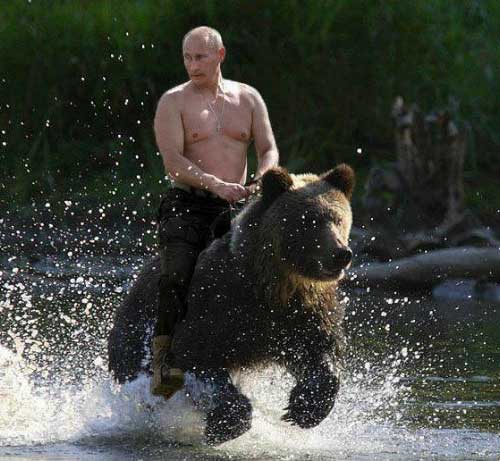
A Barechested Putin Riding Bareback on a Bear: The Ideal Republican Candidate for President!
W.J. Astore
At the New York Times, Robert Draper had a fascinating article last month on how Republican candidates for president are positioning themselves on foreign policy. Rand Paul excepted, all of the Republican candidates are calling for a more “aggressive” U.S. foreign policy, one that promises more military interventions and higher military spending. The goal is apparently to show more muscle than President Obama, who has been “weak,” according to these same Republicans.
The language here fascinates me. Again and again in Draper’s article, you see references to “a more muscular foreign policy.” Showcasing muscles appears to be a favorite trope of Republican advisers, as is the need to be more “aggressive” overseas (Obama, of course, is viewed as being passive and timid). Republicans according to Draper favor the “aggressive promotion of American values” (whatever those are), an aggression that will somehow avoid recklessness (good luck with that). So, ISIS will be aggressively “destroyed,” even as the Middle East is stabilized by infusing it with “American values” (freedom? democracy? human rights?) promulgated by (as near as I can tell) American military muscle.
To cite just one example, consider this political ad featuring Senator Lindsey Graham, seen in his Air Force reserve uniform, highlighting his promise to “destroy” ISIS.
A muscular and aggressive foreign policy to destroy America’s enemies: If that excites you, vote Republican. But consider the cost of this love affair with muscles and aggression. And then ask yourself: Are they not the real “American values”?
All this talk of bulging military muscles and coldly calculated aggression: the ideal candidate for gung ho Republicans is not the reincarnation of Ronald Reagan. It’s an American Vladimir Putin.


 U.S. troops in Mosul, Iraq in 2007. A foreign presence to Iraqis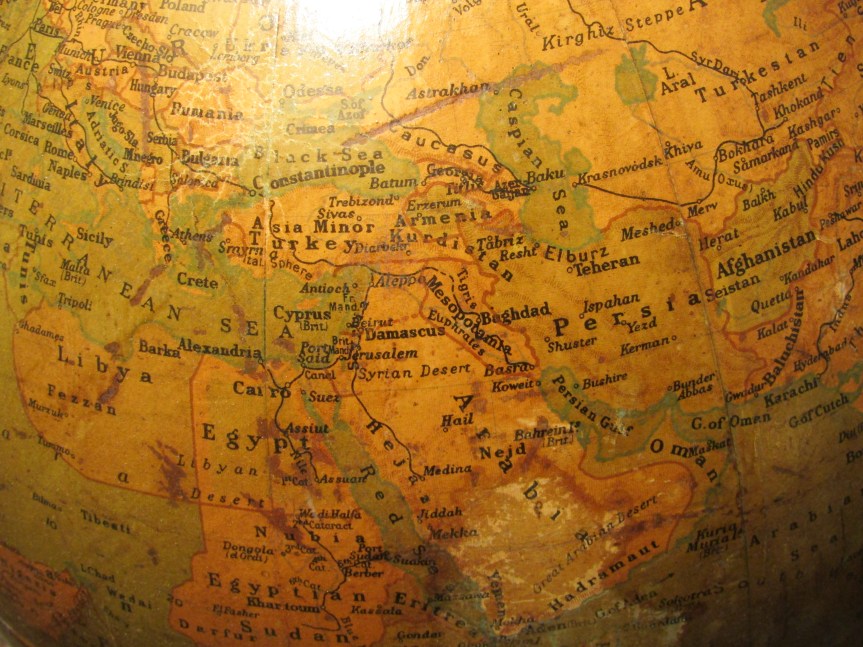

 Bracing Views