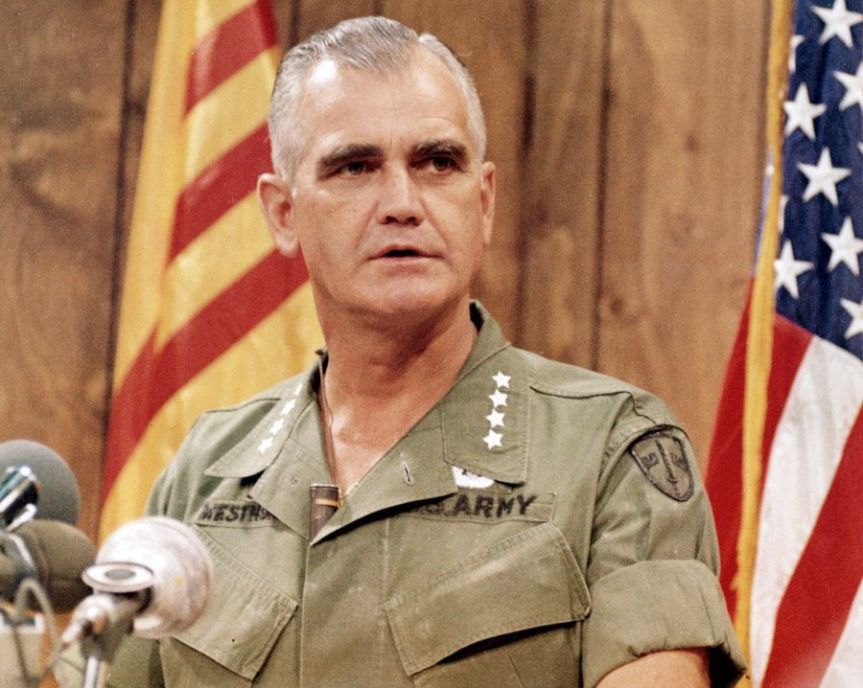
General William Westmoreland in 1968 (Stars and Stripes)
W.J. Astore
Fear of defeat drives military men to folly. Early in 1968, General William Westmoreland, America’s commanding general in Vietnam, feared that communist forces might overrun U.S. military positions at Khe Sanh. His response, according to recently declassified cables as reported in the New York Times today, was to seek authorization to move nuclear weapons into Vietnam. He planned to use tactical nuclear weapons against concentrations of North Vietnamese Army (NVA) troops. President Lyndon Johnson cancelled Westmoreland’s plans and ordered that discussions about using nuclear weapons be kept secret (i.e. hidden from the American people), which for the last fifty years they have been.
Westmoreland and the U.S. military/government had already been lying to the American people about progress in the war. Khe Sanh as well as the Tet Offensive of 1968 were illustrations that there was no light in sight at the end of the tunnel — no victory loomed by force of arms. Thus the call for nuclear weapons to be deployed to Vietnam, a call that President Johnson wisely refused to countenance.
Westmoreland’s recourse to nuclear weapons would have made a limited war (“limited” for U.S. forces, not for the Vietnamese on the receiving end of U.S. firepower) unlimited. A nuclear attack in Vietnam likely would have been catastrophic to world order, perhaps leading to a much wider war in Asia that could have led to world-ending nuclear exchanges. But Westmoreland seems to have had only Khe Sanh in his sights: only the staving off of defeat in a position that American forces quickly abandoned after they had “won” the battle.
War, as French leader Georges Clemenceau famously said, is too important to be left to generals. Generals often see the battlefield in narrow terms, seeking victory at any price, if only to avoid the stain of defeat.
But what price victory if the world ends as a result?
As a kid, I was a big admirer of Israel.* I kept a scrapbook on the Yom Kippur War in 1973. Back then, Israel was America’s plucky ally, David against Goliath, helping to keep the Soviet bear at bay, or so it seemed to me.
Through a kid’s eyes, Israel in 1973 was an island seemingly surrounded by a sea of well-armed enemies: Egypt, Syria, Iraq, Jordan, Saudi Arabia. Outnumbered and outgunned. And now look at today’s reality: Egypt and Iraq have been neutralized. Syria is devastated. Jordan is wisely (sort of) neutral. The Saudis are a quasi-ally. Outside of the more-or-less manageable threat of terrorism (Hamas and Hezbollah), Israel’s chief enemy today appears to be itself.
What I mean by that is this: Israel, which over the last 70 years has fought several wars for its survival, is now a regional superpower. Yet the mindset of David versus Goliath persists, even though Goliath is hobbled and defeated. Meanwhile, as Israel combats terrorism and the legacies of West Bank occupation and isolation of the Gaza Strip, the government prosecutes policies that are considered illiberal and dangerous by many Jewish critics within Israel itself.
A similar David-Goliath mindset exists in the USA, but with far less cause. Bizarrely, the world’s military superpower envisions itself as being surrounded by enemies. Its response is something like Israel’s, as if the USA is Israel writ large. Both countries seek total military dominance over their perceived enemies and rivals; both are led by strong men dogged by claims of corruption; both glorify their militaries; both appear to be spoiling for war with Iran.
Interestingly, both are also obsessed with demographic “enemies within”: many Israelis fear growing Arab/Muslim influence within; many Americans fear minorities will soon constitute the majority (estimates say non-whites will outnumber whites in the year 2045, but some Americans – like Laura Ingraham on Fox News – feel it’s already happened). The result: the ruling administrations of both countries have doubled down on security and identity politics. Israel has made Arabs second-class citizens, a form of apartheid; Trump & Co. has vilified immigrants (especially Mexicans) as rapists and murderers. Both are building walls to keep the “enemy” without. Both see massive military spending (and nuclear weapons) as the ultimate guarantors of peace.
Israel is little Prussia; the USA is big Prussia. And like Prussia (and Germany) of the past, they pose as the aggrieved party, surrounded by enemies, hemmed in and oppressed. It’s never wrong to be strong – that’s their guiding motto. And by strength they mean hardness: military strength, police strength, the strength of superior weapons technology, embraced by leaders willing to kill or torture or imprison others in the name of preserving a “democratic” way of life.
It’s a mindset conducive to authoritarianism, to militarism, to nationalism, even to kleptocracy disguised as essential spending on national security. At its root is fear, which generates a “no compromise” attitude toward the Other (whether Palestinian “terrorists” or immigrant “killers” and “animals”). As the Palestinian activist Bassam Aramin put it in an interview in The Sun (October 2016):
“I think our main enemy is the Israelis’ fear. It’s part of their consciousness. When they talk about security, the Holocaust is always in the background. If I throw a stone at an armored tank, they interpret it as the beginning of a new Holocaust.”
Fear is the mind-killer. It enables perpetual warfare and a police state – and lots of profit and power to those who facilitate the same.
The original Prussia became consumed by militarism and nationalism and collapsed after two devastating world wars. What will happen to today’s Big and Little Prussia? Perhaps a war against Iran, timed to coincide with the 2020 presidential campaign season in the USA? Such an unnecessary and likely disastrous war can’t be ruled out.
Consider the dynamic between the current leaders of the USA and Israel, each egging the other one on to be tougher, less compromising, more Prussian. A pacific future is not in the cards for these military “superpowers.” Not when they’re so busy emulating Prussia.
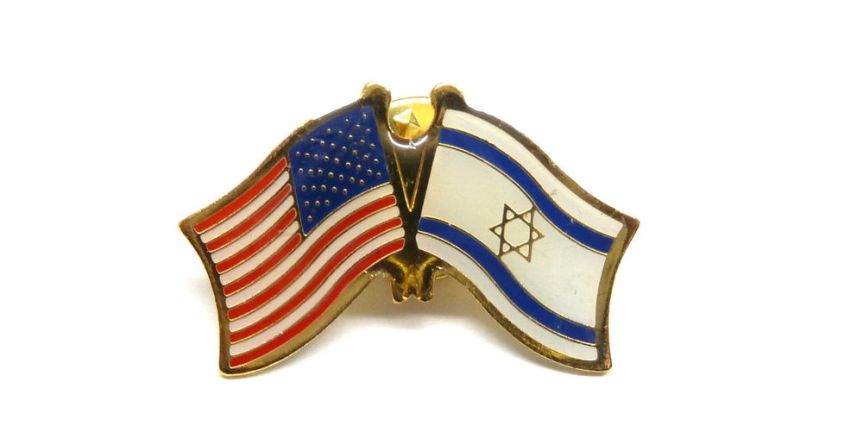
*Why are Americans, generally speaking, supporters and admirers of Israel? So much so that politicians ostentatiously wear co-joined US/Israel flag lapel pins? For several reasons:
1. The US media is generally pro-Israel. Meanwhile, the Arab world is often synonymous with terrorism in our media.
2. Israelis seem more like Americans. What I mean is this: Israeli spokespeople wear western dress and speak English with a faint accent. Until recently, Arab spokespeople on TV looked and dressed “foreign” and spoke English with a heavier accent.
3. The power of pro-Israeli political lobbies such as AIPAC and fear among politicians that criticism of Israel will be construed (and demonized) as anti-Semitism.
4. The Holocaust.
5. The Evangelical Context: I remember listening to a talk show on the radio, soon after the Yom Kippur War, in the mid-1970s. The speaker predicted the Second Coming was near. That got my attention! Why was that? Because, this person said, Israel had gained control over Jerusalem in apparent fulfillment of Biblical prophecy. Fast forward forty years to today and you hear basically the same evangelical predictions about the Second Coming of Christ being imminent as Israel expands its hegemony over the “holy land” in Palestine.
One cannot underrate the importance of (selective) Biblical prophecy as advanced by fundamentalist Christians nestled within today’s Republican Party. These evangelicals couldn’t care less about Trump’s sins and transgressions. Their eyes are on the prize: Armageddon and Christ’s return, which they link to Israel’s domination of the region – which will lead to more wars, a brutal future seen as inevitable, even desirable.
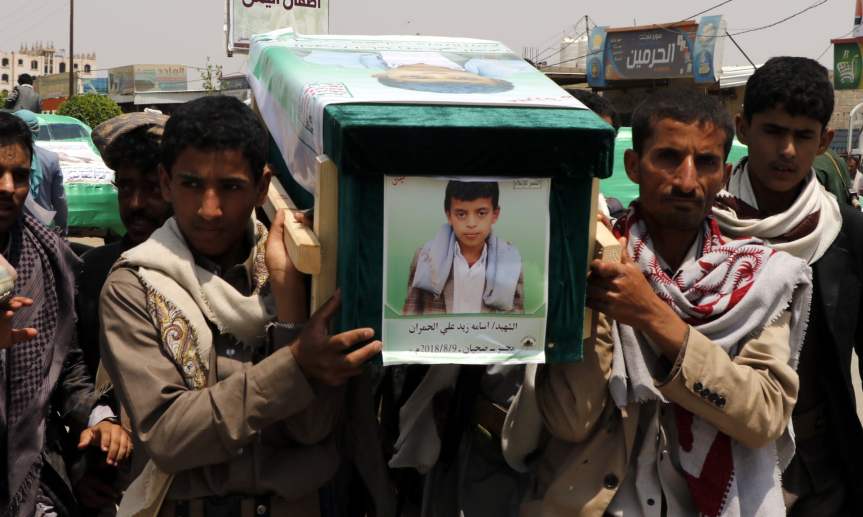
Just another civilian casualty incident? Original caption: Mourners carry the coffin of a child at the funeral procession for those killed in an airstrike on a bus in Yemen. Photograph: Mohammed Hamoud/Getty Images
W.J. Astore
Last night, as I was watching the PBS News Hour, I snapped to attention as I heard a new euphemism for murdered innocents from bombing: “civilian casualty incidents.”
A PBS reporter used it, unthinkingly I believe, repeating bureaucratic jargon about all the innocents in Yemen smashed to bits or shredded by “dumb” bombs, cluster munitions, and even “smart” bombs that are really only as smart as the pilots launching them (and the often imperfect “actionable intelligence” gathered to sanction them).
The overall tone of the PBS report was reassuring. General Mattis appeared to comfort Americans that the Saudis are doing better with bombing accuracy, and that America’s role in helping the Saudis is limited to aerial refueling and intelligence gathering about what not to hit. Of course, the Saudis can’t bomb without fuel, so the U.S. could easily stop aerial massacres if we wanted to, but the Saudis are our allies and they buy weapons in massive quantities from us, so forget about any real criticism here.
I’ve written about Orwellian euphemisms for murderous death before: “collateral damage” is often the go-to term for aerial attacks gone murderously wrong. To repeat myself: George Orwell famously noted the political uses of language and the insidiousness of euphemisms. Words about war matter. Dishonest words contribute to dishonest wars. They lead to death, dismemberment, and devastation. That’s not “collateral” — nor is it merely a “civilian casualty incident” — that’s a defining and terrifying reality.
What if innocent Americans were being killed? Would they be classified and covered as regrettable if inevitable “civilian casualty incidents”?
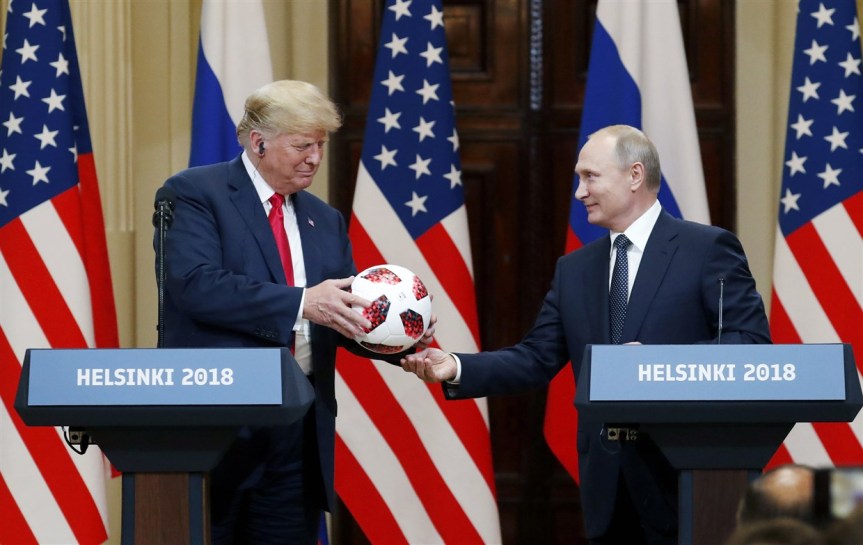
America’s MAGA President, Donald Trump, has generated enormous criticism for his news conference with Vladimir Putin. Typical of this is James Fallows at The Atlantic, who wrote that “Never before have I seen an American president consistently, repeatedly, publicly, and shockingly advance the interests of another country over those of his own government and people.” A “national nightmare,” opined The Washington Post. A “train wreck,” said NBC News, that made Russians “gleeful.”
Is Trump advancing the interests of Russia? Is this an example of high crimes and misdemeanors, perhaps even rising to treason?
Methinks not. Trump, if he is advancing Russian interests, is doing so indirectly. Because only one thing matters to Trump: his own interests. With Trump, it really is all about him.
Consider the accusations of Russian meddling in the 2016 presidential election. Trump is never going to side with his intelligence agencies on this issue. He thinks that, by doing so, he’d be admitting that maybe he didn’t win fair and square over “Crooked Hillary.” He refuses to countenance Russian meddling, not because he’s a Putin stooge, but rather because he’s an egomaniac. He’ll admit to nothing that diminishes, however slightly, his victory — and his ego.
Russia doesn’t matter to Trump. Indeed, America doesn’t matter to Trump. With Trump, it’s really all about him. Recall how he visited the CIA and boasted about himself while standing before the wall that commemorates fallen CIA officers. Recall how he declared the military would follow his orders regardless of their legality. He rashly accuses Democrats of not caring about the troops or border security whenever they oppose his policies. He does best with foreign leaders, like the Saudis and Israelis, who are at pains to flatter him. He apparently can’t stand Angela Merkel because she doesn’t play the flattery game.
Trump lives in his own reality, a narcissistic swirl of fabrications, falsehoods, and lies. He’s happiest when he’s commanding the scene, when people are kowtowing to him, when he can boast about himself and advertise his businesses (during this latest trip, he went to a Trump golf course in Scotland and waxed about its “magical” qualities).
In short, Trump is not treasonous. He simply has no concept of public service. He has no capacity to serve any cause other than himself.
Readers, what do you think of the treason accusations against Trump?
Weekends are a good time to sit back, reflect, and think. Here are a few ideas I’ve been thinking about:
1. Remember 9/11/2001? Of course you do. Almost everyone back then seemed to compare it to Pearl Harbor, another date that would live in infamy — and that was a big mistake. In 1941, the USA was attacked by another sovereign nation. In 2001, we were attacked by a small group of terrorists. But international terrorism was nothing new, and indeed the U.S. was already actively combating Al Qaeda. The only new thing was the shock and awe of the 9/11 attacks — especially the images of the Twin Towers collapsing.
By adopting the Pearl Harbor image, our response was predetermined, i.e. the deployment of the U.S. military to wage war. Even that wasn’t necessarily a fatal mistake, if we’d stopped with Afghanistan and overthrowing the Taliban. But, as Henry Kissinger said, Afghanistan wasn’t enough. Someone else had to pay, in this case the unlucky Iraqis. And then the U.S. military was stuck with two occupations that it was fated to lose. And millions of Afghan and Iraqi people suffered for our leaders’ mistakes.
But perhaps the most remarkable aspect of 9/11 was how no one in Washington took the blame for it. I don’t recall any high-level firings. The buck stopped nowhere. Same with torture. The buck stopped nowhere. Officialdom looked the other way, including the next administration under the “change” candidate, Barack Obama. He changed nothing in this area. His mantra about “looking forward” meant learning nothing from history.
It’s this lack of accountability, perhaps, that made Trump possible. He lies constantly and blunders and blusters, yet (so far) there’s no accountability for that either. People just expect our government to be composed of con men and serial liars, so why not just elect one as president?
No accountability after 9/11 and torture led to “no accountability” Trump.
2. Another thought on 9/11: The 9/11 war-driven response was part of American exceptionalism. What I mean is this: America is not supposed to be on the receiving end of “shock and awe.” We are supposed to be the givers of it. As Americans, we were totally unprepared, psychologically, for such a blow. (A Soviet nuclear attack, a million times more devastating, would have made more “sense” in that the danger was drummed into us.) An attack by hijacked airliners, a mutant form of airpower? Well, America is supposed to rule the skies. We bomb others; they don’t bomb us. Right?
It was all so shocking and destabilizing, hence the “rally around the flag” effect and the blank check issued by Congress to Bush/Cheney for what has proved to be a forever war on terror — or something. And now, with Trump and crew, is the new “something” Iran?
3. In our military-first culture, projects like the B-21 stealth bomber are just accepted as business as usual — the cost of keeping America “safe.” We had more debate about weapons systems during the Cold War, when we truly faced an existential threat. Now, weapons ‘r’ us. It’s a peculiar moment in American history, a sort of cult of the gun, whether that “gun” is a bomber, missile, aircraft carrier, etc.
Put differently, our personal insecurities (due to debt, health care, jobs, weather catastrophes, fear of immigrants, etc.) have driven a cult of security in which guns and related military technologies have been offered as a palliative or even a panacea. Feel secure — buy a gun. Feel secure — build a new stealth bomber. Stand your ground — global strike. The personal is the political is the military.
4. If Reagan’s motto was “trust — but verify” with the Soviet Union, Trump’s motto with North Korea is simply “trust.” Yes — it’s a good thing that Trump is no longer threatening to bring nuclear fire and fury to the North Koreans, but his recent meeting with Kim Jong-un, large in image, was short on substance. Will those verification details be worked out in the future? Do the North Koreans have any intent to give up their nuclear weapons? Both are doubtful. So, does Trump deserve a Nobel peace prize? About as much as Obama did.
5. I’ve never witnessed a man destroy a political party like Trump has taken apart the Republicans. It’s a remarkable achievement, actually. And I don’t mean that as a compliment. I was once a Gerald Ford supporter in the 1976 election, and I voted for Ronald Reagan in 1984. (We make mistakes when we’re young; that said, Walter Mondale was an uninspiring Democratic candidate.) I thought the Republican Party had principles; I think it did in the 1970s and 1980s. Now, the only “principles” are money and power, as in getting more of both. If that means kowtowing to Trump, so be it. Kneel before Zod, Republicans!
That’s enough for my Saturday afternoon. Fire away in the comments section, readers!
Can we get 10-20 million Americans to settle here?
W.J. Astore
I was jesting with a friend the other day about how the U.S. could win the Afghan War. There were two ways, I suggested. The first is to relocate about 10 or 20 million Americans to Afghanistan and declare it the 51st state. Then wait a generation or two. The second was to withdraw all American forces and declare “mission accomplished.” Half-measures that fall in between these options are doomed to fail, which is what we’ve been witnessing since the fall of 2001.
In Afghanistan today, the Taliban controls more territory than ever, the drug trade is flourishing, government corruption is endemic, yet the U.S. military/government continues to speak of progress. This “spin it to win it” approach to the Afghan War is nothing new, of course, which is why the following article that I wrote in 2010 is still relevant.
President Trump had a sound instinct in seeking to end the Afghan War. He was talked out of it by the military. For all his faults, Trump knows a loser policy when he sees it. Will he have the moxie to withdraw U.S. forces from Afghanistan?
No More Afghanistans (originally posted in 2010)
In grappling with Afghanistan, President Obama and his team of national security advisors reveal a tendency all too common within the Washington beltway: privileging fleeting and reversible signs of local success while downplaying endemic difficulties and larger patterns of strategic failure. Our latest intelligence estimates, we are told, show signs of progress. But of what sort? The Taliban appears to be extending its hold in the countryside, corruption continues to spread in the Karzai government, and the Afghan National Army remains unreliable, all despite (or rather because of) prodigious infusions of cash courtesy of the American taxpayer.
The president and his advisors would do well to toss aside the latest “feel good” intel and pick up a good book on war. I’d recommend Summons of the Trumpet: U.S.-Vietnam in Perspective, by Colonel (later, Lieutenant General) Dave Richard Palmer. “One of the essential ingredients of [national] preparedness,” wrote then-Colonel Palmer in 1978, “is a diligent and honest study of the past, an intellectual examination of historical successes and failures.” True to his word, Palmer quoted Major G.P. Baldwin, who wrote in 1928 of the Russo-Japanese War that:
The [Russian] government, the press, and the people as a whole had no enthusiasm for the war, indeed failed to understand what the nation was fighting about … Such support is necessary in any war … Unless the people are enthusiastic about war, unless they have a strong will to win it, they will become discouraged by repeated [setbacks] … no government can go to war with hope of success unless it is assured that the people as a whole know what the war is about, that they believe in their cause, are enthusiastic for it, and possess a determination to win. If these conditions are not present the government should take steps to create them or keep the peace.
Palmer cited these words at the end of his probing account of America’s defeat in Vietnam. Though I don’t agree with all of Palmer’s conclusions, his book is stimulating, incisive, and compelling in its concluding vow: “There must be no more Vietnams.”
Let’s consider the points that Baldwin and Palmer raise in light of today’s situation in Afghanistan. Are the American people enthusiastic for this war? Do they have a strong will to win it (assuming the war is winnable on terms consistent with our interests)? Do they know what the war is about (this seems unlikely, since nine out of ten Americans can’t seem to locate Afghanistan on a map)?
If the answer to these fundamental questions is “no,” and I believe it is, shouldn’t our government and our troops be withdrawing now? Because I don’t see that our government will seek to mobilize the people, mobilize our national will, tell us clearly what our cause is and why it is just, and persist in that cause until it is either won or lost. And if I’m right about this, our government had best work to “keep the peace.”
Some of the reasons Palmer cites for why Vietnam was such an “incomprehensible war” for the United States bear careful consideration for President Obama’s policy review. These reasons include that few Americans knew exactly why we were fighting in Vietnam; that it was a “limited war” during which most Americans “sensed no feeling of immediate danger and certainly no spirit of total involvement”; that no “unifying element” was at work to suppress internal doubt and dissent, common elements in all wars; that the struggle was not only (or even primarily) a military one but one in which economic, political, and psychological factors often intruded; and that a cultural gap of great perplexity separated us from both our in-country allies and our enemy, a gap that “foment[ed] mistrust and misunderstanding.”
In light of these points, Afghanistan may qualify as a new “incomprehensible war.” Let’s not be distracted by the minutia of the latest intelligence reports and their uncertain metrics of “success.” Unless we can give convincing answers to General Palmer’s questions and points – and unless we can wage a war that doesn’t entail destroying the Afghan village in order to save it – our only sound course is expedient withdrawal, followed by a renewed vow: There must be no more Vietnams – or Afghanistans.
Beware the tunnels you choose to go down (Wikimedia)
W.J. Astore
You can’t win wars that should never have been fought. The U.S. should never have fought the Iraq and Afghan wars, nor should we have fought the Vietnam War.
It’s not that we need to know and master the foreign enemy. We need to know and master the enemy within. The domestic enemy. For the U.S. is defeating only itself in fighting these wars. Yet “experts” in the military and government focus on how to prosecute war more effectively; rarely do they think seriously about ending or, even better, avoiding wars.
Part of this is cultural. Americans are obsessed with the idea of winning, defined in terms of dominance, specifically military/physical dominance, taking the fight to the enemy and never backing down. The best defense is a good offense, as they say in the NFL. Winning is the only thing, as Vince Lombardi said. While those maxims may apply to football, they don’t apply to wars that should never have been fought.
Turning from football to tunnels, how about that image made popular during the Vietnam War that “We can see the light at the end of the tunnel”? Victory, in other words, is in sight and can be reached if we “stay the course” until the tunnel’s end. Few ask why we’re in the tunnel to begin with. Why not just avoid the tunnel (of Vietnam, of Iraq, of Afghanistan) and bask in the light of liberty here in the USA? Indeed, why not brighten liberty’s torch so that others can see and enjoy it? But instead U.S. military forces are forever plunging into foreign tunnels, groping in the dark for the elusive light of victory, a light that ultimately is illusory.
Another point is that the Pentagon is often not about winning wars without; it’s about winning wars within, specifically budgetary wars. Here the Pentagon has been amazingly successful, especially in the aftermath of the Cold War, which should have generated a major reduction in U.S. military spending (and overseas military deployments). The other “war” the Pentagon has won is the struggle for cultural authority/hegemony in the USA. Here again, the Pentagon has won this war, as represented by presidents from Bush to Obama to Trump boasting of the 4F military (the finest fighting force since forever), and as represented by the fact that the military remains the most trusted governmental institution in America. Indeed, most Americans don’t even think of “our” military as being part of the federal government. They think of it as something special, even as they profess to distrust Congress and hate “big government.” Yet nothing screams “big” like our steroidal federal military, and few entities are more wasteful.
My point is that many military commentators and critics frame the problem wrongly. It’s not about reforming the U.S. military so that it can win wars. Americans must reform our culture and our government so that we can avoid wars, even as we end the ones we’re in. For constant warfare is the enemy of democracy and the scourge of freedom.
A final point about winning that’s rarely acknowledged: America’s wars overseas are not all about us. Winning (whatever that might mean) should be unconscionable when it comes at the price of hundreds of thousands of dead, millions of refugees, and regions blasted and destabilized.
My dad left me two silver dollars. They’re worth much in sentimental value (I’ll explain in a moment), but they also teach us something about how America has changed.
Here’s a photo of them. Lady Liberty is on the front, an eagle is on the back.
These were “peace” dollars issued in the aftermath of World War I. (Note the word “peace” under the eagle.) Imagine that: a coin issued by the USA dedicated to and celebrating peace! It’s truly hard to imagine such a coin being issued today, and not only because our currency is now made only with base metal (a debased currency?).
In keeping with U.S. foreign policy today, an equivalent 2018 (faux silver) dollar would doubtless feature the god of war on the front with a menacing eagle clutching missiles, drones, and bombs on the back.
Anyway, I promised a story about my dad’s silver dollars, and I’m going to let him tell it:
“I have a silver dollar in my coin collection. Helen and I were courting at the time. At Nantasket beach [in Massachusetts] there was a glass container with prizes, candy, coins, etc. Also a crank on the unit which when turned controlled a flexible scoop. The idea was to work the scoop to pick up something of value. Well, I took a chance. It was like magic; the scoop just went down and picked up the silver dollar. I gave it to Ma as a remembrance. We’ve had it ever since.”
“The other silver dollar has a story also. A buddy in the service [Army] gave it to me for a birthday present [during World War II].”
After my dad died, these coins passed to me. One is from 1922, the other from 1924. I love the “peace” eagle they feature, though we know peace was not in the cards for long after the Great War. And of course I love my dad’s stories of how he came to possess them.
When will America’s coinage next feature a tribute to the end of war and the promise of peace?
Within the U.S. “defense” establishment there’s an eagerness to refight the Cold War with Russia and China, notes Michael Klare at TomDispatch.com. The “long war” on terror, although still festering, is not enough to justify enormous defense budgets and traditional weapon systems like aircraft carriers, bomber and fighter jets, and tanks and artillery. But hyping the Russian and Chinese threats, as Defense Secretary James Mattis is doing, is a proven method of ensuring future military growth along well-trodden avenues.
Hence an article at Fox News that I saw this morning. Its title: “Here’s why Russia would lose a second Cold War — and would be unwise to start one.” The article happily predicts the demise of Russia if that country dares to challenge the U.S. in a Cold War-like binge of military spending. Bring it on, Russia and China, our defense hawks are effectively saying. But recall what happened when George W. Bush said “Bring it on” in the context of the Iraq insurgency.
Our military leaders envision Russian and Chinese threats that directly challenge America’s conventional and nuclear supremacy. They then hype these alleged threats in the toughest war of all: budgetary battles at the Pentagon and in Congress. The Navy wants more ships, the Air Force wants more planes, the Army wants more soldiers and more weapons — and all of these are more easily justified when you face “peer” enemies instead of guerrillas and terrorists whose heaviest weapons are usually RPGs and IEDs.
Yet Russia and China aren’t stupid. Why should they challenge the U.S. in hyper-expensive areas like aircraft-carrier-building or ultra-modern “stealth” bombers when they can easily assert influence in unconventional and asymmetric ways? The Russians, for example, have proven adept at exploiting social media to exacerbate political divisions within the U.S., and the Chinese too are quite skilled at cyberwar. More than anything, however, the Chinese can exploit their financial and economic clout, their growing dominance of manufacturing and trade, as the U.S. continues to hollow itself out financially in a race for conventional and nuclear dominance in which its main rival is its own distorted reflection.
In essence, then, America’s “new” National Defense Strategy under Trump is a return to the Reagan era, circa 1980, with its much-hyped military buildup. Yet again the U.S. is investing in military hardware, but China and Russia are investing more in software, so to speak. It makes me think of the days of IBM versus Bill Gates. Bill Gates’ genius was recognizing the future was in the software, the operating systems, not in the hardware as IBM believed.
But the U.S. is being led by hardware guys. A hardware guy all the way, Donald Trump is all about bigger missiles and massive bombs. Indeed, later this year he wants a parade of military hardware down Pennsylvania Avenue. It’s as if we’re living in 1975 — time to review the troops, comrade general.
Who knew the triumphant “new world order” of 1991 would become a quarter-century later a sad and tragic quest by the USA to refight the very Cold War we claimed back then to have won? Isn’t it easy to envision Trump boasting like an old-style Soviet leader of how, under his “very stable genius” leadership, “America is turning out missiles like sausages”?
The Tough Terrain of Afghanistan (Photo by Anna M.)
W.J. Astore
Back in 2009, as the Obama administration was ramping up its ill-fated surge in Afghanistan, I wrote the following article on the contradictions of U.S. military strategy in that country. Like the British in the 19th century and the Soviets in the 20th century, both defeated by the Afghan people as well as the harsh environment, the Americans in the 21st century are a foreign and invasive presence in Afghanistan that will ultimately be fought off and ejected. (Interestingly, the U.S. military has it exactly backwards, seeing itself as antibodies to a foreign terrorist threat in Afghanistan.) Despite the weight of history and the lack of U.S. progress in Afghanistan over the last two decades, the U.S. government in 2018 refuses to withdraw, wasting an additional $45 billion a year on a trillion-dollar campaign that’s gone nowhere.
Little did I know in 2009 that, nearly a decade later, the U.S. military would still be mired in that country, yet still be talking about some kind of victory in a war that retired General David Petraeus says will last for “generations.” The British and Soviets learned their lesson and withdrew; when will the U.S. learn the lesson of Afghanistan and withdraw?
Why is the U.S. military still there? If it’s to suppress terrorism or the Taliban, the exact opposite has happened: terrorism has spread and the Taliban has grown stronger. The heroin trade has also accelerated. Is it about gas pipelines? Strategic minerals? Bases from which Iran can be attacked? Maintaining American “credibility”? All of the above? I would guess most Americans have no clue why the U.S. military is still in Afghanistan, other than some vague notion of fighting a war on terror. And in war vague notions are a poor substitute for sound strategy and communal will.
Here’s my article from 2009:
In the U.S. debate on Afghanistan, virtually all experts agree that it’s not within the power of the American military alone to win the war. For that, Afghanistan needs its own military and police force, one that is truly representative of the people, and one that is not hopelessly corrupted by drug money and the selfish concerns of the Karzai government [now gone] in Kabul.
The conundrum is that any Afghan military created by outsiders — and America, despite our image of ourselves, is naturally seen by most Afghans as a self-interested outsider — is apt to be viewed as compromised and illegitimate.
Committing more American troops and advisors only exacerbates this problem. The more U.S. troops we send, the more we’re “in the face” of the Afghan people, jabbering at them in a language they don’t understand. The more troops we send, moreover, the more likely it is that our troops will take the war’s burdens on themselves. If history is any guide, we’ll tend to push aside the “incompetent” and “unreliable” Afghan military that we’re so at pains to create and celebrate.
We have a classic Catch-22. As we send more troops to stiffen Afghan government forces and to stabilize the state, their high-profile presence will serve to demoralize Afghan troops and ultimately to destabilize the state. The more the U.S. military takes the fight to the enemy, the less likely it is that our Afghan army-in-perpetual-reequipping-and-training will do so.
How to escape this Catch-22? The only answer that offers hope is that America must not be seen as an imperial master in Afghanistan. If we wish to prevail, we must downsize our commitment of troops; we must minimize our presence.
But if we insist on pulling the strings, we’ll likely as not perform our own dance of death in this “graveyard of empires.”
A little history. Some two centuries ago, and much like us, the globe-spanning British Empire attempted to extend its mastery over Afghanistan. It did not go well. The British diplomat in charge, Montstuart Elphinstone, noted in his book on “Caubool” the warning of an Afghan tribal elder he encountered: “We are content with discord, we are content with alarms, we are content with blood; but we will never be content with a master.”
As imperial masters, British attitudes toward Afghans were perhaps best summed up in the Encyclopaedia Britannica, Ninth Edition (1875). The Afghans, according to the Britannica, “are familiar with death, and are audacious in attack, but easily discouraged by failure; excessively turbulent and unsubmissive to law or discipline; apparently frank and affable in manner, especially when they hope to gain some object, but capable of the grossest brutality when that hope ceases. They are unscrupulous in perjury, treacherous, vain, and insatiable in vindictiveness, which they will satisfy at the cost of their own lives and in the most cruel manner …. the higher classes are too often stained with deep and degrading debauchery.”
One wonders what the Afghans had to say about the British.
The accuracy of this British depiction is not important; indeed, it says more about imperial British attitudes than it does Afghan culture. What it highlights is a tendency toward sneering superiority exercised by the occupier, whether that occupier is a British officer in the 1840s or an American advisor today. In the British case, greater familiarity only bred greater contempt, as the words of one British noteworthy, Sir Herbert Edwardes, illustrate. Rejecting Elphinstone’s somewhat favorable estimate of their character, Edwardes dismissively noted that with Afghans, “Nothing is finer than their physique, or worse than their morale.”
We should ponder this statement, for it could have come yesterday from an American advisor. If the words of British “masters” from 150 years ago teach us anything, it’s that Afghanistan will never be ours to win. Nor is an Afghan army ours to create. Like the British, we might fine-tune Afghan physiques, but we won’t be able to instill high morale and staying power.
And if we can’t create an Afghan army that’s willing to fight and die for Karzai or some other government we consider worthy of our support, we must face facts: There’s no chance of winning at any remotely sustainable or sensible cost to the United States.
Nevertheless, we seem eager to persist in our very own Catch-22. We may yet overcome it, but only by courting a singularly dangerous paradox. In Vietnam, our military spoke of destroying villages in order to save them. Will we have to destroy the American military in order to save Afghanistan?
For that may be the ultimate price of “victory” in Afghanistan.
An Addendum (2018): This year, the Trump administration’s Afghan “strategy” seems to be to pressure the Pakistanis by withholding foreign aid, to bomb and drone and kill as many “terrorists” as possible without committing large numbers of American troops, and to “brown the bodies,” i.e. to fight to the last Afghan government soldier. That’s apparently what the U.S. military learned from its failed Afghan surge of 2009-10: minimize U.S. casualties while continuing the fight, irrespective of the costs (especially to Afghanistan) and lack of progress. So I was wrong in 2009: Unlike the Vietnam War, in which the U.S. military came close to destroying itself in a vain pursuit of victory, the Afghan War has been tamped down to a manageable level of effort, or so Washington and the Pentagon seem to think.
What Washington experts will never seriously consider, apparently, is withdrawal from a war that they already lost more than a decade ago. Thus they commit an especially egregious error in military strategy: they persist in reinforcing failure.
Update (4/2/18): Just after I wrote this, I saw this update at FP: Foreign Policy:
“This is not another year of the same thing we’ve been doing [in Afghanistan] for 17 years,” Gen. Joseph Dunford , chairman of the Joint Chiefs of Staff, told the Washington Post. “This is a fundamentally different approach.”
That notes of optimism comes as the Taliban have made significant territorial gains, with the group now openly active in 70 percent Afghanistan’s territory. Afghan military forces, meanwhile, are taking casualties at a record level. Afghan President Ashraf Ghani continues to drum up support for a peace initiative that would bring the Taliban to the negotiating table, but so far a a breakthrough appears far off.






 Bracing Views