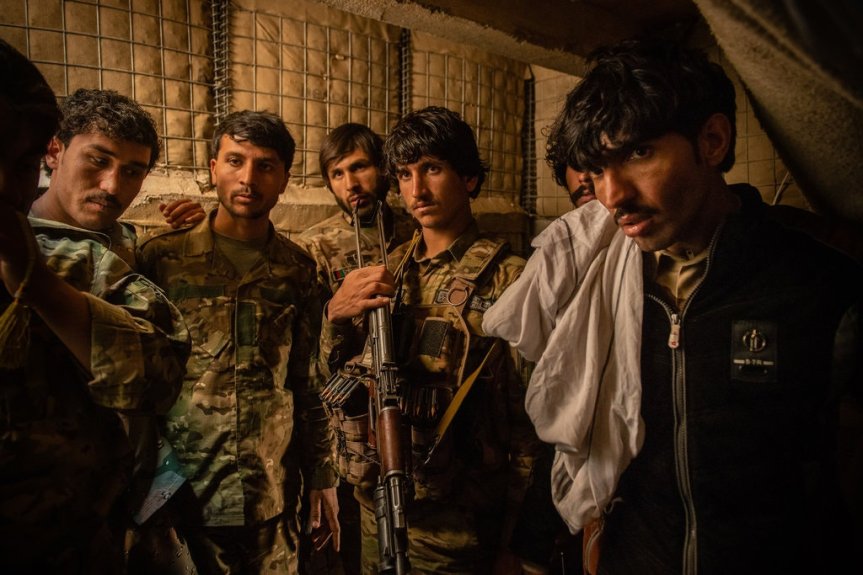
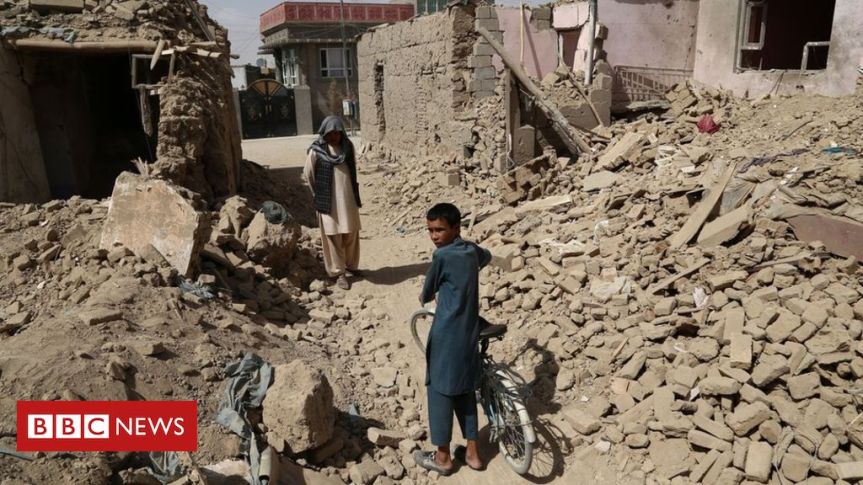
The face of the Afghan War is an unfamiliar one to Americans
W.J. Astore
In my latest article for TomDispatch.com, I detail America’s lack of an antiwar movement — which is partly due to war being literally out of sight for us. Who knows, for example, of extensive U.S. bombing in Somalia and the innocents killed in that bombing? Nick Turse has a powerful article on that here. Wars are rarely covered critically in the mainstream media, and the Trump administration, even more so than previous administrations, has essentially issued blackout orders on information pertaining to U.S. wars and casualty figures.
One piece of encouraging news comes from Afghanistan, where a truce with the Taliban offers hope of an end to that disastrous war. Yet, as the New York Times reports, the reconciliation process won’t be easy:
In the second decade of this conflict, begun as an act of vengeance by the United States in 2001 and at its peak involving a force of more than 100,000 American troops, the war has increasingly fallen on the backs of young Afghans.
Over the past five years alone, about 50,000 Afghan police officers and soldiers have died fighting. The number for the Taliban is estimated to be the same if not more. The fighting has been brutal, intimate, the same forces on each side often battling each other in familiar localities over long stretches of time.
It’s relatively straightforward for U.S. troops to withdraw from Afghanistan. But what about the Afghan peoples themselves and their struggles with the legacy of this brutal war?
Here’s the beginning of my article:
There is no significant anti-war movement in America because there’s no war to protest. Let me explain. In February 2003, millions of people took to the streets around the world to protest America’s march to war against Iraq. That mass movement failed. The administration of George W. Bush and Dick Cheney had a radical plan for reshaping the Middle East and no protesters, no matter how principled or sensible or determined, were going to stop them in their march of folly. The Iraq War soon joined the Afghan invasion of 2001 as a quagmire and disaster, yet the antiwar movement died down as U.S. leaders worked to isolate Americans from news about the casualties, costs, calamities, and crimes of what was by then called “the war on terror.”
And in that they succeeded. Even though the U.S. now lives in a state of perpetual war, for most Americans it’s a peculiar form of non-war. Most of the time, those overseas conflicts are literally out of sight (and largely out of mind). Meanwhile, whatever administration is in power assures us that our attention isn’t required, nor is our approval asked for, so we carry on with our lives as if no one is being murdered in our name.
War without dire consequences poses a conundrum. In a representative democracy, waging war should require the people’s informed consent as well as their concerted mobilization. But consent is something that America’s leaders no longer want or need and, with an all-volunteer military, there’s no need to mobilize the rest of us.
Back in 2009, I argued that our military was, in fact, becoming a quasi-foreign legion, detached from the people and ready to be dispatched globally on imperial escapades that meant little to ordinary Americans. That remains true today in a country most of whose citizens have been at pains to divorce themselves and their families from military service — and who can blame them, given the atrocious results of those wars in Afghanistan, Iraq, Somalia, and elsewhere across the Greater Middle East and Africa?
Yet that divorce has come at a considerable cost. It’s left our society in a state of low-grade war fever, while accelerating an everyday version of militarism that Americans now accept as normal. A striking illustration of this: President Trump’s recent State of the Union address, which was filled with bellicose boasts about spending trillions of dollars on wars and weaponry, assassinating foreign leaders, and embracing dubious political figures to mount illegal coups (in this case in Venezuela) in the name of oil and other resources. The response: not opposition or even skepticism from the people’s representatives, but rare rapturous applause by members of both political parties, even as yet more troops were being deployed to the Middle East.
Please read the rest of my article here. Let’s do our best to stamp out war.
Just before Tulsi Gabbard announced her candidacy for the presidency as a Democrat, NBC ran a smear piece that suggested Vladimir Putin and the Russians loved her. This smear was then repeated and amplified by Hillary Clinton, who suggested Gabbard was being groomed by the Kremlin to run as a third-party candidate, thereby ensuring Trump’s reelection in 2020. There was no evidence for any of these claims — none. Yet Gabbard was put on the defensive and her campaign (still ongoing) has been essentially redlined by the mainstream media.
Now it’s Bernie Sanders’s turn. Bernie is much better known than Tulsi with a much larger movement behind him, so the DNC and the mainstream media have a modified tactic: rather than smearing Bernie as a Putin puppet, they’re suggesting the Russians are boosting his candidacy without his knowledge — the end game, naturally, is Trump’s reelection. This was reported yesterday by the Washington Post and echoed today by the New York Times and other media outlets. Here’s how NBC News put it today:
Sen. Bernie Sanders, I-Vt., excoriated Russia on Friday after being briefed that the Kremlin is attempting to help his presidential campaign as part of an effort to interfere with the Democratic primary and the 2020 election.
“The intelligence community has been very clear about it — whether Trump recognizes it not, or acknowledges it or not, they did interfere in 2016,” Sanders told reporters. “The intelligence community is telling us they are interfering in this campaign right now in 2020. What I say to Mr. Putin: If elected president, trust me, you will not be interfering in American elections.”
The Washington Post reported on Friday U.S officials have briefed President Trump, other lawmakers on Capitol Hill and Sanders, who has recently become the frontrunner in the Democratic contest, that Russians are helping his campaign. The Post cited people familiar with the matter who spoke on the condition of anonymity.
When you look further into these claims, the so-called Intelligence Community (IC) is not telling us specifically how the Russians are allegedly helping Bernie. They just are.
This puts Bernie on the defensive. Already known as a “socialist” who, we’re told, visited Moscow on his honeymoon, Bernie is being forced to issue denials as well as statements against Putin. And this pleases the IC and the DNC to no end. Get Bernie talking about Russia and Putin! Force him to disavow Russian “support,” no matter how nebulous or false that support is. Associate his name with the “bad guys,” the communists, just as Mayor Bloomberg linked Bernie to communism during the last debate. “Cheap shot,” Bernie replied, but the cheap people are desperate and will do anything to win.
To the DNC, IC, and MSM, it doesn’t matter if these accusations of Russian interference are believed. What matters is shifting the narrative and thereby weakening the credibility of candidates like Tulsi Gabbard and Bernie Sanders.
Anyone who criticizes or threatens the power and privileges of the military-industrial complex, the IC, and the MSM must be attacked and defeated. There are literally trillions of dollars at stake here. This is why other candidates issue no criticisms of these powerful entities. Can you recall Mayor Pete, or Joe Biden, or Amy Klobuchar, or even Elizabeth Warren saying anything truly critical about the MIC, the IC, and MSM? For the acronym-wary, that’s the military-industrial complex, the intelligence community, and the mainstream media.
Again, judge the candidates by the enemies they make. The more the powerful smear Tulsi and Bernie, the more you know they are the candidates with principles and integrity.
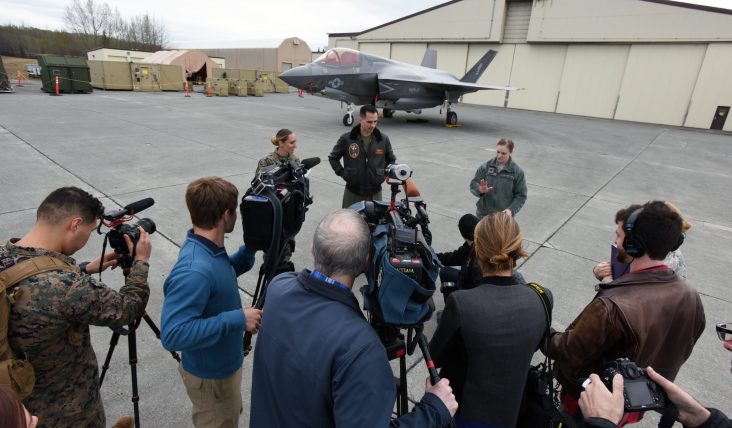
One of the pilots who flew at the Super Bowl in his F-35 gets a little media love
W.J. Astore
In my latest article for TomDispatch.com, I tackle the U.S. military and its self-defeating nature when it comes to wars overseas. But there is a “war” that the military-industrial complex truly is winning handily, even overwhelmingly, and that’s the one for money and power within and across American society. Put differently, when it comes to winning hearts and minds, the military fails spectacularly overseas but succeeds brilliantly here in the “homeland.”
Consider only one example: America’s major sporting events. Each one has now become a military celebration. At the Super Bowl this past weekend, four 100-year-old military veterans from World War II were the centerpiece of this year’s opening ceremonies (ostensibly to mark the 75th anniversary of the ending of that war in 1945, as well as the 100th year of the NFL), and of course no event is complete without military colorguards, saluting troops, and a loud flyover by combat jets at the close of the national anthem. This is all accepted as “normal” and patriotic, the very mundanity of which illustrates the triumph of the military-industrial complex in our lives.
What follows is an excerpt from my article from TomDispatch:
The Future Is What It Used to Be
Long ago, New York Yankee catcher and later manager Yogi Berra summed up what was to come this way: “The future ain’t what it used to be.” And it wasn’t. We used to dream, for example, of flying cars, personal jetpacks, liberating robots, and oodles of leisure time. We even dreamed of mind-bending trips to Jupiter, as in Stanley Kubrick’s epic film2001: A Space Odyssey. Like so much else we imagined, those dreams haven’t exactly panned out.
Yet here’s an exception to Berra’s wisdom: strangely enough, for the U.S. military, the future is predictably just what it used to be. After all, the latest futuristic vision of America’s military leaders is — hold onto your Kevlar helmets — a “new” cold war with its former communist rivals Russia and China. And let’s add in one other aspect of that military’s future vision: wars, as they see it, are going to be fought and settled with modernized (and ever more expensive) versions of the same old weapons systems that carried us through much of the mid-twentieth century: ever more pricey aircraft carriers, tanks, and top of the line jet fighters and bombers with — hey! — maybe a few thoroughly destabilizing tactical nukes thrown in, along with plenty of updated missiles carried by planes of an ever more “stealthy” and far more expensive variety. Think: the F-35 fighter, the most expensive weapons system in history (so far) and the B-21 bomber.
For such a future, of course, today’s military hardly needs to change at all, or so our generals and admirals argue. For example, yet more ships will, of course, be needed. The Navy high command is already clamoring for 355 of them, while complaining that the record-setting $738 billion Pentagon budget for 2020 is too “tight” to support such a fleet.
Not to be outdone when it comes to complaints about “tight” budgets, the Air Force is arguing vociferously that it needs yet more billions to build a “fleet” of planes that can wage two major wars at once. Meanwhile, the Army is typically lobbying for a new armored personnel carrier (to replace the M2 Bradley) that’s so esoteric insiders joke it will have to be made of “unobtainium.”
In short, no matter how much money the Trump administration and Congress throw at the Pentagon, it’s a guarantee that the military high command will only complain that more is needed, including for nuclear weapons to the tune of possibly $1.7 trillion over 30 years. But doubling down on more of the same, after a record 75 years of non-victories (not to speak of outright losses), is more than stubbornness, more than grift. It’s obdurate stupidity.
Why, then, does it persist? The answer would have to be because this country doesn’t hold its failing military leaders accountable. Instead, it applauds them and promotes them, rewarding them when they retire with six-figure pensions, often augmented by cushy jobs with major defense contractors. Given such a system, why should America’s generals and admirals speak truth to power? They are power and they’ll keep harsh and unflattering truths to themselves, thank you very much, unless they’re leaked by heroes like Daniel Ellsberg during the Vietnam War and Chelsea Manning during the Iraq War, or pried from them via a lawsuit like the one by the Washington Post that recently led to those Afghanistan Papers.
My Polish mother-in-law taught me a phrase that translates as, “Don’t say nothin’ to nobody.” When it comes to America’s wars and their true progress and prospects, consider that the official dictum of Pentagon spokespeople. Yet even as America’s wars sink into Vietnam-style quagmires, the money keeps flowing, especially to high-cost weapons programs.
Consider my old service, the Air Force. As one defense news site put it, “Congressional appropriators gave the Air Force [and Lockheed Martin] a holiday gift in the 2019 spending agreement… $1.87 billion for 20 additional F-35s and associated spare parts.” The new total just for 2020 is “98 aircraft — 62 F-35As, 16 F-35Bs, and 20 F-35Cs — at the whopping cost of $9.3 billion, crowning the F-35 as the biggest Pentagon procurement program ever.” And that’s not all. The Air Force (and Northrop Grumman) got another gift as well: $3 billion more to be put into its new, redundant, B-21 stealth bomber. Even much-beleaguered Boeing, responsible for the disastrous 737 MAX program, got a gift: nearly a billion dollars for the revamped F-15EX fighter, a much-modified version of a plane that first flew in the early 1970s. Yet, despite those gifts, Air Force officials continue to claim with straight faces that the service is getting the “short straw” in today’s budgetary battles in the Pentagon.
What does this all mean? One obvious answer would be: the only truly winning battles for the Pentagon are the ones for our taxpayer dollars.
They’re so proud of Trump’s wall, though new sections proved surprisingly easy to cut through
W.J. Astore
I caught this snippet via the New York Times today:
“Border wall funding: President Trump plans to divert $7.2 billion from the military for the construction of a wall on the southern border, two people familiar with the plans told The Times. Congress set aside $1.375 billion for it last month.”
Diverting money that’s been appropriated by Congress is an impeachable offense, but the Democrats will do little since they know Trump will spin their opposition as being pro-immigrant and anti-American, irrespective of the lies contained in that spin.
Trump was elected in part through his fear-mongering about immigrants (he spoke of murderers, rapists, gang members, even Muslim terrorists hidden within the “caravans” approaching America’s southern border). “Build the wall” is a popular chant at his rallies, and Trump knows the issue still stirs up his base.
What’s it all about? Recently I was reading “Shadow of the Silk Road,” by Colin Thubron. This is what Thubron had to say about the Great Wall of China:
As a true bulwark the Wall was senseless. Huns, Mongols, Manchus overswept it almost at will. The Sinologist Owen Lattimore proposed that it was built to keep the Chinese in rather than the nomads out. Perhaps, unwittingly, it was less a physical defence than a monstrous definition. It separated civilisation from barbarism, light from darkness. It was an act of shuddering denial: over there is not what we are. And it was steeped in fear. [Emphasis in original.]
“Over there is not what we are”: Trump recognizes how “his” wall serves as a dividing line between the “good” people (Americans) versus the “bad hombres” (his term) seeking to “invade” America. And it is, as Thubron says, both a monstrous definition and an act of shuddering denial.
Of course, the wall already exists, as Greg Grandin notes in his book, “The End of the Myth: From the Frontier to the Border Wall in the Mind of America.” Trump merely wants to lengthen it, mostly in areas where a wall is redundant due to already forbidding terrain.
But the wall is not about protecting America from “hordes” of “invaders.” It’s about defining America in retrograde ways, contrasting the alleged barbarism of brown-skinned people with the civilization of (mostly) White America.
Walls demarcate and divide. They are also a denial of common humanity. They pit us against them in battles over turf. In short, they’re a perfect symbol for Trump’s vision of greatness.
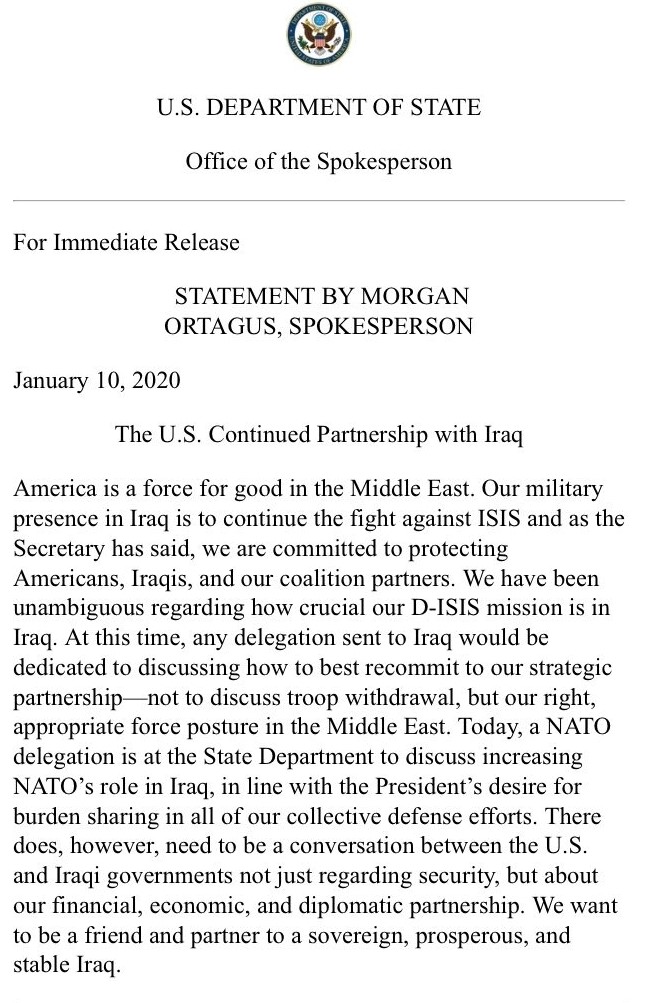
A friend sent along the following statement from the U.S. State Department:
My Commentary:
Sovereignty is just fine, Iraqi people — as long as you do exactly what America says. By the way, I thought ISIS was 100% eliminated, according to President Trump.
I’m sure the Iraqi government can’t wait to have this “conversation” with the U.S. government. Note, however, that any “conversation” about withdrawing U.S. troops from Iraq is already forbidden. So much for sovereignty!
Remember when those who advocated for peace were dismissed as “dreamers”? The great John Lennon imagined a world where peace could reign, and he wasn’t afraid of the dreamer label, because he knew it could be more than a dream. Peace is often presented as a fantasy embraced by soft-hearted people. War, by comparison, is a harsh reality embraced by hard-headed realists, or so we’re told.
What if it’s the opposite? What if peace is really based on pragmatism, and war on fantasy? What if the hard-headed realists are really those who advocate for peace via dialog, diplomacy, treaties, and the like? And it’s the warmongers who are truly the soft-headed dreamers?
Consider the results of recent American wars. The wars in Southeast Asia (Vietnam, Laos, Cambodia) were total disasters. Ditto interventions in Iraq and Libya. The Afghan War approaches its third decade with no end in sight. How are these wars pragmatic or preemptive or necessary or productive? They’ve been based on fears and fantasies. They’ve been colossal mistakes based on lies and fantasies of power.
Indeed, it’s the neocons who have been America’s leading fantasists, starting disastrous wars driven by an ideology of American exceptionalism and warrior masculinity in which they believe they can create and control their own reality irrespective of history and the facts. These men can’t imagine peace. All they can imagine is a world in which American military power creates a world “safe for democracy,” which means safe for their own greed and power and profit, including profit from more and more weapons sales.
We see this fantasy at work today. Somehow, starting wars is sold as a way to prevent them. Killing a senior Iranian general in a foreign country without the approval of that country or Congress for that matter is sold as preventing war. The president commits an act of war in the name of peace.
To believe this, you must be a fantasist in the extreme. We need to denounce these pro-war fantasists for what they are. They may fancy themselves as hard-headed men of action, but they’re really thick-headed sociopaths guided by delusional fantasies.
Update (1/5): Speaking of pro-war fantasists, I just saw this Trump tweet, which is what happens when you elect and empower a bully-boy as president:
“The United States just spent Two Trillion Dollars on Military Equipment. We are the biggest and by far the BEST in the World! If Iran attacks an American Base, or any American, we will be sending some of that brand new beautiful equipment their way…and without hesitation!”
You know an American war is going poorly when the lies come swiftly, as with the Afghan War, or when it’s hidden under a cloak of secrecy, which is also increasingly true of the Afghan War.
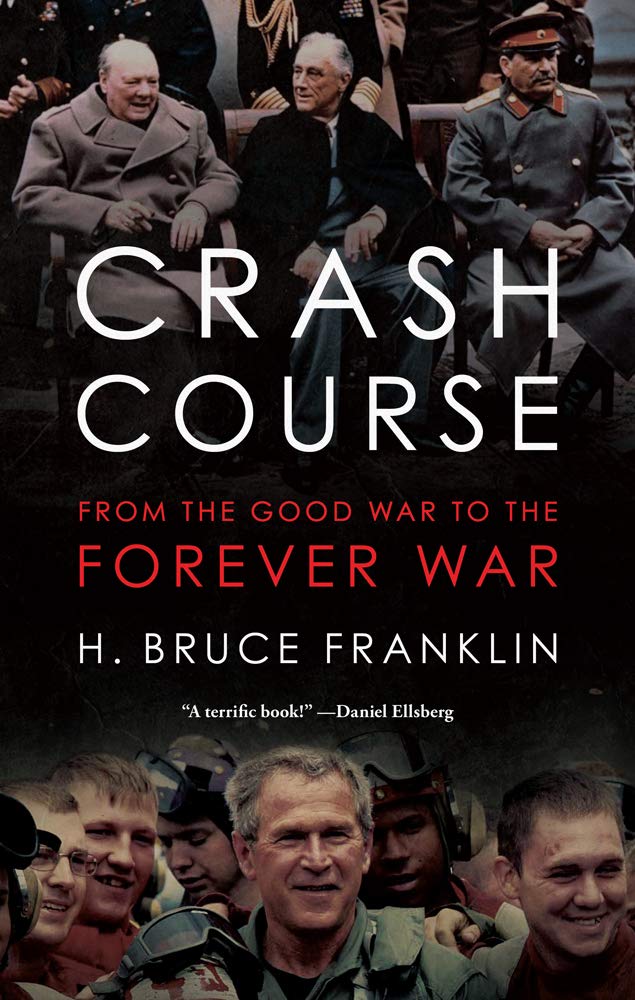
This is nothing new, of course. Perhaps the best book I read in 2019 is H. Bruce Franklin’s Crash Course: From the Good War to the Forever War. Franklin, who served in the U.S. Air Force in the 1950s before becoming an English professor, cultural historian, and an outspoken opponent of the Vietnam War, is devastating in his critique of the military-industrial complex in this memoir. I recommend it highly to all Americans who want to wrestle with tough truths.
Let’s consider one example: Franklin’s dismissal of the “stab-in-the-back” myth (or Rambo myth) that came out of the Vietnam War. This was the idea the U.S. military could have won in Vietnam, and was indeed close to winning, only to be betrayed by weak-kneed politicians and the anti-war movement.
Franklin demolishes this argument in a paragraph that is worth reading again and again:
One widespread cultural fantasy about the Vietnam War blames the antiwar movement for forcing the military to “fight with one arm tied behind its back.” But this belief stands reality on its head. The American people, disgusted and angry about the Korean War, were in no mood to support a war in Vietnam. Staunch domestic opposition kept Washington from going in overtly. So it went covertly. It thereby committed itself to a policy based on deception, sneaking around, and hiding its actions from the American people. The U.S. government thus created the internal nemesis of its own war: the antiwar movement. That movement was inspired and empowered not just by our outrage against the war [but] also by the lies about the war, lies necessitated by the war, coming from our government and propagated by the media. Although it was the Vietnamese who defeated the United States, ultimately it was the antiwar movement, especially within the armed forces, that finally in 1973 forced Washington to accept, at long last, the terms of the 1954 Geneva Accords, and to sign a peace treaty that included, word for word, every major demand made by the National Liberation Front (the so-called Viet Cong) back in 1969…
The truth was that for three decades our nation had sponsored and then waged a genocidal war against a people and a nation that had never done anything to us except ask for our friendship and support [during and after World War II].
This is well and strongly put. The American people had no interest in intervening in Vietnam in the 1950s; the Korean debacle had been enough. But the U.S. government intervened anyway, lying about its involvement until it could no longer lie. Then a bigger lie was concocted, the Gulf of Tonkin incident, to justify a larger commitment of troops in the mid-1960s, which led to near-genocidal destruction in Vietnam.
Wars built on lies are rarely won, especially in a democracy. But even as they are lost (Vietnam in the 1960s, and now Afghanistan), there are always “winners.” Weapons contractors and other war profiteers. The Pentagon, which from war gains more money and more power. And authoritarian elements within society itself, which are reinforced by war.
If we wish to take our democracy back, a powerful first step is to end all American wars overseas. This would not be isolationism; this would be sanity.
Wars, secrecy, and lies are three big enemies of democracy. Maybe the big three. War suppresses thought and supports authoritarianism. Secrecy prevents accountability. Lies mislead the people. And that’s what we have today. Constant warfare. Secrecy, e.g. reports on “progress” in the Afghan War are now classified and no longer shared. Lies are rampant; indeed, lies are policy. Just look at the Afghan Papers.
Yet wars, secrecy, and lies have been incredibly successful. The Pentagon budget is booming! Weapons sales are exploding! No one is being held accountable for failures or war crimes. Indeed, convicted war criminals are absolved and touted as heroes by the president.
The solution is as obvious as it will be painful. We need peace, transparency, and truth. End the wars, declassify all those “secrets” we the people should know about our military and wars, and reward truth-tellers instead of punishing them.
What happened to Afghanistan and all that lying about progress?
W.J. Astore
According to FP: Foreign Policy, these are the top five stories in U.S. foreign policy in 2019. I’ve inserted quick comments at the end in bold:
1. U.S. and Turkey Lock Horns Over Syria.
“U.S. support to the Syrian Democratic Forces has long angered Turkey, a NATO ally which views the Kurdish-led group as a terrorist threat … But in a fateful October phone call, Turkish President Recep Tayyip Erdogan repeated his longtime threat to launch a cross-border invasion. This time Trump capitulated, moving a handful of U.S. troops so the Turks could begin the assault against the Kurds … Hundreds have been killed and roughly 200,000 people were displaced.”
Comment: Syria is not a vital U.S. interest. U.S. forces shouldn’t be there. And who are these “democratic forces” of Syria?
2. Trump Impeached Over Ukraine Scandal.
“Trump’s efforts to pressure Ukraine into investigating a Democratic rival this year led to the third impeachment of a U.S. president in history, thrusting Washington’s national security apparatus into the spotlight.”
Comment: The U.S. shouldn’t be meddling in Ukraine. And we shouldn’t be sending more weapons there. I sure as hell don’t want my taxpayer dollars going to weapons for Ukraine.
3. North Korea Talks Sputter and Stall.
“The historic nuclear talks between Trump and North Korean Supreme Leader Kim Jong Un in 2018 offered hope that the two countries could de-escalate tensions and prevent a nuclear confrontation. Talks stalled after the Singapore Summit in June 2018. While both sides made significant verbal commitments in 2019, the year saw a gradual deterioration of bilateral relations.”
Comment: North Korea isn’t giving up its nuclear weapons. The North Koreans saw what happened to Gaddafi in Libya when he gave up his WMD. Plus nuclear weapons and missiles are a prestige project for Kim Jong-un, who’s played Trump like a fiddle.
4. Iran Strikes Back.
“Tensions between Iran and the United States skyrocketed in 2019, as the U.S. maximum pressure campaign took effect and Tehran lashed out against harsh U.S. sanctions. (Trump withdrew from the 2015 nuclear deal in 2018.) … Attacks have ceased in recent weeks as Tehran launched a brutal crackdown on the worst political unrest the country has seen since the Islamic Revolution 40 years ago. But U.S. officials are bracing for another devastating strike in the region, this time perhaps targeting the region’s critical sources of drinking water.”
Comment: Harsh U.S. sanctions are an act of war — or at least we’d see them that way if the roles were reversed. And why is Iran always seen as the aggressor capable of launching “devastating” strikes?
5. Venezuela Crisis Simmers.
“Venezuela’s Russia-backed leader Nicolás Maduro clung to power this year despite an economic collapse, nationwide blackouts and fierce opposition from Juan Guaidó, who declared himself Venezuela’s interim president in January with support from the West. Tensions threatened to boil over in May, when Guaidó tried and failed to ignite an uprising. The attempted coup was seen as an embarrassing failure by the United States and particularly National Security Advisor John Bolton, reportedly the architect of multiple attempts to unseat Maduro. In addition to harsh sanctions, the United States went so far as to draw up military options, but never took any action.”
Comment: Looks like Bolton takes the fall for inept U.S. meddling in Venezuela. Guess what? It’s all about the oil — and the money.
Of course, FP: Foreign Policy missed the biggest story of 2019: Consistent, extensive, and persistent lying by U.S. leaders about the course of the Afghan War, as revealed by the “Afghan Papers” published by the Washington Post.
Readers — what do you think about this list? In the holiday spirit, I see much naughtiness here, and no niceness. Santa won’t be pleased.
Photo that allegedly persuaded Trump that Afghanistan wasn’t a lost cause
W.J. Astore
Trump was elected president in 2016 partly because he railed against America’s wasteful wars. So, what did his advisers talk him into? A mini-surge of troops to Afghanistan. I still recall the odd news of Trump being shown photos of Afghan women in skirts (vintage 1972) to convince him that westernization and modernization of Afghanistan was possible.
Several thousand additional U.S. troops were sent to Afghanistan in 2017, predictably achieving nothing of note. A little more than two years later, we have another item of “big” news today, according to CNN:
The Trump Administration is preparing to announce a long-awaited reduction of US troops in Afghanistan, a senior administration official confirmed to CNN. There are between 12,000 and 13,000 US troops in the country right now, and the US has maintained a solid presence throughout the 18-year war in the area. This drawdown would remove up to 4,000 troops, with more possible reductions in the future, the official said. That matches the claim Trump made on Fox News Radio in August that his administration would take the number “down to 8,600.” The reduction comes at the same time the US is restarting peace talks with the Taliban, and some worry the troop drawdown could be seen as a concession to the terrorist group.
Where to begin with this CNN snippet?
The “reduction” is not a reduction but a return to previous troop levels at the end of the Obama administration.
The U.S. “has maintained a solid presence”? Good god. You’d never know about all the bombing, droning, and killing the U.S. has done over the last 18+ years. Or is that the “solid presence” we’ve been maintaining?
The troop “drawdown” as a “concession” to the Taliban? Guess what: The Taliban aren’t going anywhere, and they’re winning. A few thousand U.S. troops, either as a “plus-up” or “drawdown,” have had and will have no impact on the reality on the ground.
Sometimes I don’t know whether to laugh, cry, or do both. Perhaps my dad put it best: “We laugh to hide the tears.”
Update (12/17): Speaking of laughing to hide the tears, the Pentagon has responded to the systematic lying revealed by the so-called Afghan Papers. It won’t surprise you the response consists of three artless dodges:
President Obama with General Stanley McChrystal in the days of the ill-fated Afghan Surge
W.J. Astore
Ten years ago, President Barack Obama decided to “surge” in the Afghan War. The previous year he had run for the presidency on the idea of Iraq being the “bad” war but Afghanistan as the “good” war. Good as in “winnable” and as countering terrorism. But Obama’s surge in Afghanistan was a flop, even as American leaders tried to sell it as buying breathing space for the evolution of freer, more stable, Afghan government.
This sell/spin process was all lies, as the Washington Postrevealed yesterday:
A confidential trove of government documents obtained by The Washington Post reveals that senior U.S. officials failed to tell the truth about the war in Afghanistan throughout the 18-year campaign, making rosy pronouncements they knew to be false and hiding unmistakable evidence the war had become unwinnable.
Surprise, surprise! Sadly, the lies were obvious a decade ago, as I wrote about at TomDispatch.com in April of 2009. Here’s my article from that time. Remarkably, despite or rather because of all the lies, the war continues still, with no end in sight.
Mary McCarthy in Vietnam, Barack Obama in Afghanistan
Seven Lessons and Many Questions for the President
By William Astore (April 2009)
In 1967, outraged by the course of the Vietnam War, as well as her country’s role in prolonging and worsening it, Mary McCarthy, novelist, memoirist, and author of the bestseller The Group, went to Saigon, then the capital of South Vietnam, to judge the situation for herself. The next year, she went to the North Vietnamese capital, Hanoi. She wrote accounts of both journeys, published originally in pamphlet format as Vietnam (1967) and Hanoi (1968), and later gathered with her other writings on Vietnam as a book, The Seventeenth Degree (1974). As pamphlets, McCarthy’s accounts sold poorly and passed into obscurity; deservedly so, some would say.
Those who’d say this, however, would be wrong. McCarthy brought a novelist’s keen eye to America’s activities and its rhetoric in Vietnam. By no means a military expert, not even an expert on Vietnam — she only made a conscious decision to study the war in Vietnam after she returned from her trip to Saigon — her impressionistic writings were nevertheless insightful precisely because she had long been a critical thinker beholden to no authority.
Her insights into our approach to war-fighting and to foreign cultures are as telling today as they were 40 years ago, so much so that President Obama and his advisors might do well to add her unconventional lessons to their all-too-conventional thinking on our spreading war in Afghanistan and Pakistan.
What were those lessons? Here are seven of them, each followed by questions that, four decades later, someone at President Obama’s next press conference should consider asking him:
1. McCarthy’s most fundamental objection was to the way, in Vietnam, the U.S. government decided to apply “technology and a superior power to a political situation that will not yield to this.” At the very least, the United States was guilty of folly, but McCarthy went further. She condemned our technocentric and hegemonic form of warfare as “wicked” because of its “absolute indifference to the cost in human lives” to the Vietnamese people.
Even in 1967, the widespread, at times indiscriminate, nature of American killing was well known. For example, U.S. planes dropped roughly 7 million tons of bombs on Vietnam and parts of Laos and Cambodia during the war, nearly five times the tonnage used against Germany during World War II. The U.S. even waged war on the Vietnamese jungle and forest, which so effectively hid Vietnamese guerrilla forces, spraying roughly 20 million gallons of toxic herbicides (including the dioxin-contaminated Agent Orange) on it.
In her outrage, McCarthy dared to compare the seeming indifference of many of her fellow citizens toward the blunt-edged sword of technological destruction we had loosed on Vietnam to the moral obtuseness of ordinary Germans under Adolf Hitler.
Questions for President Obama: Aren’t we once again relying on the destructive power of technology to “solve” complex political and religious struggles? Aren’t we yet again showing indifference to the human costs of war, especially when borne by non-Americans? Even though we’re using far fewer bombs in the Af-Pak highlands than we did in Vietnam, aren’t we still morally culpable when these “precision-guided munitions” miss their targets and instead claim innocents, or hit suspected “terrorists” who suddenly morph into wedding parties? In those cases, do we not seek false comfort in the phrase, C’est la guerre, or at least that modern equivalent: unavoidable collateral damage?
2. As Richard Nixon campaigned for the presidency in 1968 by calling for “peace with honor” in Vietnam, McCarthy offered her own warning about the dangers that arose when the office of the presidency collided with an American desire never to be labeled a loser: “The American so-called free-enterprise system, highly competitive, investment-conscious, expansionist, repels a loser policy by instinctive defense movements centering in the ganglia of the presidency. No matter what direction the incumbent, as candidate, was pointing in, he slowly pivots once he assumes office.”
Questions for President Obama: Have you, like Vietnam-era presidents, pivoted toward yet another surge simply to avoid the label of “loser” in Afghanistan? And if the cost of victory (however defined) is hundreds, or even thousands, more American military casualties, hundreds of billions of additional dollars spent, and extensive collateral damage and blowback, will this “victory” not be a pyrrhic one, achieved at a price so dear as to be indistinguishable from defeat?
3. Though critical of the U.S. military in Vietnam, McCarthy was even more critical of American civilian officials there. “On the whole,” she wrote, they “behaved like a team of promoters with a dubious ‘growth’ stock they were brokering.” At least military men were often more forthright than the civilians, if not necessarily more self-aware, McCarthy noted, because they were part of the war — the product, so to speak — not its salesmen.
Questions for President Obama: In promising to send a new “surge” of State Department personnel and other civilians into Afghanistan, are you prepared as well to parse their words? Are you braced in case they sell you a false bill of goods, even if the sellers themselves, in their eagerness to speak fairy tales to power, continually ignore the Fantasyland nature of their tale?
4. Well before Bush administration officials boasted about creating their own reality and new “facts on the ground” in Iraq, Mary McCarthy recognized the danger of another type of “fact”: “The more troops and matériel committed to Vietnam, the more retreat appears to be cut off — not by an enemy, but by our own numbers. To call for withdrawal in the face of that commitment… is to seem to argue not against a policy, but against facts, which by their very nature are unanswerable.”
Questions for President Obama: If your surge in Afghanistan fails, will you be able to de-escalate as quickly as you escalated? Or will the fact that you’ve put more troops in harm’s way (with all their equipment and all the money that will go into new base and airfield and road construction), and committed more of your prestige to prevailing, make it even harder to consider leaving?
5. A cursory reading of The Pentagon Papers, the famously secret government documents on Vietnam leaked to the New York Times by Daniel Ellsberg, reveals how skeptical America’s top officials were, early on, in pursuing a military solution to the situation in South Vietnam. Nevertheless, knowing better, the “best and brightest,” as journalist David Halberstam termed them in his famous, ironic book title, still talked themselves into it; and they did so, as McCarthy noted, because they set seemingly meaningful goals (“metrics” or “benchmarks,” we’d say today), which they then convinced themselves they were actually achieving. When you trick yourself into believing that you’re meeting your goals, as Halberstam noted, there’s no reason to reexamine your course of action.
Questions for President Obama: Much has been written about an internal struggle within your administration over the wisdom of surging in Afghanistan. Now, you, too, have called for the setting of “benchmarks” for your new strategy’s success. Are you wise enough to set them to capture the complexities of political realities on the ground rather than playing to American strengths? Are you capable of re-examining them, even when your advisors assure you that they are being achieved?
6. In her day, Mary McCarthy recognized the inequities of burden-sharing at home when it came to the war in Vietnam: “Casualty figures, still low [in 1967], seldom strike home outside rural and low-income groups — the silent part of society. The absence of sacrifices [among the privileged classes] has had its effect on the opposition [to the war], which feels no need, on the whole, to turn away from its habitual standards and practices — what for? We have not withdrawn our sympathy from American power and from the way of life that is tied to it — a connection that is more evident to a low-grade G.I. in Vietnam than to most American intellectuals.”
Questions for President Obama: Are you willing to listen to the common G.I. as well as to the generals who have your ear? Are you willing to insist on greater equity in burden-sharing, since once again most of the burden of Iraq and Afghanistan has fallen on “the silent part of society”? Are you able to recognize that the “best and brightest” in the corridors of power may not be the wisest exactly because they have so little to lose (and perhaps much to gain) from our “overseas contingency operations”?
7. McCarthy was remarkably perceptive when it came to the seductiveness of American technological prowess. Our technological superiority, she wrote, was a large part of “our willingness to get into Vietnam and stay there… The technological gap between us and the North Vietnamese constituted, we thought, an advantage which obliged us not to quit.”
Questions for President Obama: Rather than providing us with a war-winning edge, might our robot drones, satellite imagery, and all our other gadgetry of war seduce us into believing that we can “prevail” at a reasonable and sustainable cost? Indeed, do we think we should prevail precisely because our high-tech military brags of “full spectrum dominance”?
One bonus lesson from Mary McCarthy before we take our leave of her: Even now, we speak too often of “Bush’s war” or, more recently, “Obama’s war.” Before we start chattering mindlessly about Iraq and Afghanistan as American tragedies, we would do well to recall what McCarthy had to say about the war in Vietnam: “There is something distasteful,” she wrote, “in the very notion of approaching [Vietnam] as an American tragedy, whose protagonist is a great suffering Texan [President Lyndon Baines Johnson].”
Yes, there is something distasteful about a media that blithely refers to Bush’s or Obama’s war as hundreds of thousands of Iraqis and Afghans suffer. For American troops, after all, are not the only ones paying the ultimate price when the U.S. fights foreign wars for ill-considered reasons and misguided goals.
Update: A cartoon panel by Matt Bors that sums it up:







 Bracing Views