The U.S. and NATO have apparently decided that the world is better (for them) if Russia is weak and chaotic instead of being comparatively strong and orderly.
Something tells me a strong and orderly Russia might be better. A weak and chaotic Russia, with nuclear weapons, is likely to be far less predictable. For example, who or what comes after Vladimir Putin if he’s overthrown? Is the West sure that a divided or disorganized Russia is a “better” one?
As Margaret Thatcher said of Mikhail Gorbachev, we can do business with him. Putin is a rational actor. Who or what follows him in Russia may be much more vengeful than rational — and vengeance and nukes are a potent, perhaps genocidal, mix.
Recently, I was thinking about the difference between the end stages of the Cold War, when I entered the Air Force in the 1980s, and the current crisis with Russia. To me, one big thing stands out. In the 1980s, the U.S. was willing to negotiate on equal terms with the USSR. Reagan and Gorbachev, despite their differences, talked to each other with respect. Today, Joe Biden refers to Putin and the Russians with disdain. Biden seems to see Putin as little more than a thug, someone not worth talking to. As Biden himself said, “For God’s sake, this man cannot remain in power.”
The U.S. has been a dominant superpower for so long that its leaders simply take it for granted and have little (if any) empathy for others. Weakening Russia is not a sign of American cleverness or strength but rather of shortsightedness.
In the 1980s, Reagan and Gorbachev talked sincerely of nuclear arms reductions, even of their eventual elimination. Nothing like this exists today. Indeed, the U.S. now speaks of “investing” in a new generation of nuclear weapons at a cost of a trillion dollars (or more). Basically, the U.S. is in a nuclear arms race with itself, even as Russia and China are trotted out as the looming nuclear threats.
In demonizing Putin and Russia, the U.S. is closing doors to negotiation and potentially opening missile silo doors to obliteration. By not bargaining at all, Biden and company are not being resolute, they’re being pigheaded.
As Winston Churchill famously said, “Meeting jaw to jaw is better than war.” Politics and war are not and should not be antithetical to each other. A negotiated settlement is better than more dead Ukrainians, more dead Russians, more blasted terrain, and even higher risks of nuclear escalation.
Haven’t we heard enough already about nuclear red lines and dirty bombs? Stability is what’s needed today based on some measure of respect, however grudgingly given. If avowed Cold War warriors like Reagan and Thatcher in the 1980s could do business with Gorbachev and the Soviet Union, America’s leaders today, from a much stronger position, should be able and willing to do business with Putin.
This is not about appeasing or rewarding Putin for his invasion. It’s about stopping a war before it potentially grows wider — and far more deadly.
Note for readers: If you care to comment on this post, please go to Bracing Views on Substack. Thanks.
It seems strange to me how America’s leadership is spoiling for a new world war. Most Americans wanted revenge against Japan after Pearl Harbor in 1941 and understood the dangers of Nazism and Germany’s quest for world dominance, but why is risking a world war necessary in defense of Ukraine or Taiwan?
Here’s my take: Let Ukraine and Russia settle their differences. Let China and Taiwan settle their differences. The fate of Ukraine or Taiwan has almost nothing to do with U.S. national security.
No other nation on the planet defines the entire world as its sphere of influence. Only in America is the fate of faraway countries like Ukraine or Taiwan tied directly to our fate. It’s like Russia being worried about the U.S./Mexican border or China taking a direct hand in defending Cuba against America.
Maybe what we need is a new Monroe Doctrine. Instead of warning others to stay out of “our” hemisphere, Americans need to vow that we remain in “our” hemisphere, because what happens in Taiwan largely stays in Taiwan, and what happens in Ukraine largely stays in Ukraine. Neither fundamentally compromises our national security and neither directly threatens our Constitution and way of life.
But we must stand up to Putin! We must stand up to Xi! If we don’t stop them over there, we’ll have to stop them here! To that I say, let’s wait and see. Any country foolish enough to invade America will face a heavily armed and inflamed people who are ready to rumble.
It’s time to stop spoiling for a new world war. Sadly, at least three big problems constrain Americans in plotting a saner course:
Wars and preparations for war are immensely profitable for weapons makers.
Domestic politics, as both parties accuse the other of being weak on China or Russia or both, driving both parties into the arms of hawks.
The mainstream media, which never met a war it didn’t like, as long as ratings are high.
How do we fix this? Levy a war tax on the richest Americans for all the weaponry and other aid being sent to Ukraine and Taiwan and elsewhere. Stop voting for candidates who always vote for more and more war. Stop listening to the mainstream media and their warmongering.
One thing is certain: war is too important to be left to the generals, the Beltway bandits, and the usual neocon suspects who posture about putting on big boy pants while sitting safely in corner offices.
I haven’t written much about the progress of the Russia-Ukraine War. I have no special insight into what’s going on in Ukraine, or in Putin’s head, but I think I know something about the USA and its leadership.
The war itself: Russia and Ukraine are both losing. Russia is losing men and materiel; Ukraine is losing land and suffering all the destruction of a war fought on their turf. Many Americans seem to be cheering Ukraine and its resolute resistance, but at what cost, and for what purpose?
Historical analogies: American commentators like to refer to 1938 and Munich. Putin, naturally, is Hitler, and the world must stand up to him since Ukraine is only the first country on his list of potential conquests. If Putin wins in Ukraine, Poland would be next. Or the Baltic States. Because Putin wants to re-create the Soviet empire. Or the Russia of the Tsars.
But I think it’s much more like 1914. A regional conflict that may spin wildly out of control as more and more countries get swept into its escalatory spiral. Russian threats and nuclear red lines are more than worrisome. After all, wars are inherently chaotic and unpredictable, often creating their own bizarre logic of what’s right and wrong, what’s rational and irrational. Anyone who thinks they know how this war is going to end is overestimating the predictability of war. We’re all engaged in guess-work, and where nuclear threats are involved, guess-work is less than reassuring.
The Russia-Ukraine War could escalate to a world war: Already we’ve seen major economic sanctions involving the US, NATO countries, and Russia. Already we’ve seen Russia working with China and other countries to sell its fuel and other products as it seeks to evade those sanctions. Already we’ve seen inflation and recession in the US economy that can be tied back to those sanctions. Meanwhile, the US and NATO have sent tens of billions in weaponry to Ukraine to wage its war, which, to be blunt, is a form of proxy war for the US and NATO. The US president has called for regime change in Russia, declaring that Putin must go. Both Nord Stream pipelines have been attacked. This is not a simple regional war between Russia and Ukraine. It’s already a war with global implications openly funded by the US with the explicit goal of weakening Russia and removing Putin from power.
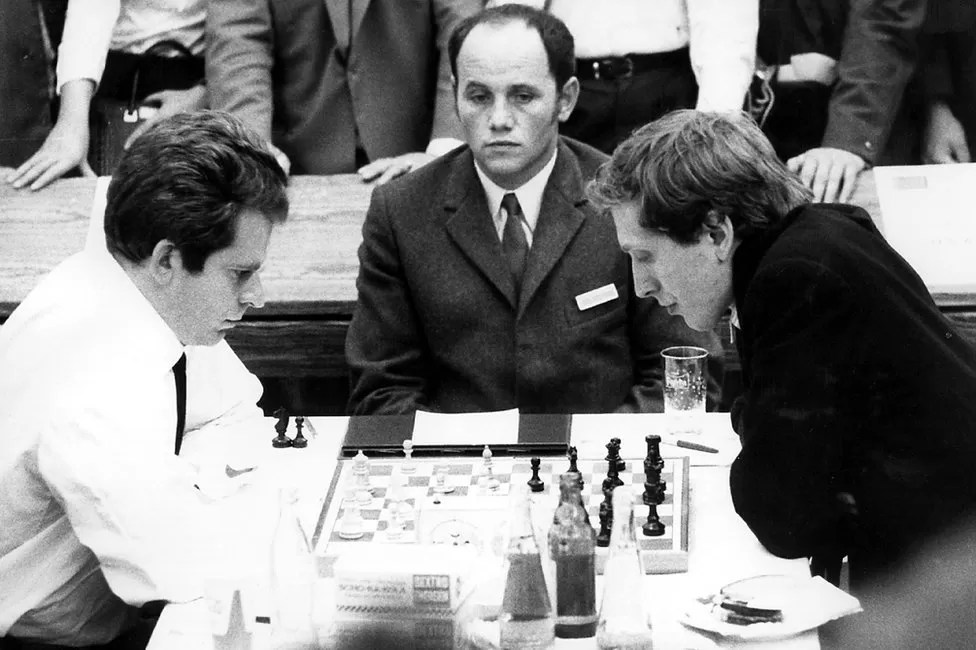
Boris Spassky versus Bobby Fischer: the good old days
To use chess terminology, the war still appears to be in its opening stages. Perhaps the middle game has begun; what’s certain is the end game is nowhere in sight. As Matt Taibbi recently noted, the Washington Post observed that “recent events have only added to the sense that the war will be a long slog,” and “all of this adds up to a war that looks increasingly open-ended.” Even worse, the paper noted:
Privately, U.S. officials say neither Russia nor Ukraine is capable of winning the war outright, but they have ruled out the idea of pushing or even nudging Ukraine to the negotiating table. They say they do not know what the end of the war looks like, or how it might end or when, insisting that is up to Kyiv.
Taibbi’s response is telling: “What??? If the White House doesn’t think the war can be won, but also refuses to negotiate itself, or ‘nudge’ others to do it for them, what exactly is its end strategy? Waiting for things to get worse and then reassessing?”
To return to chess: In games involving highly skilled players, often draws are agreed upon early in the middle game, as both players realize they have no prospects for victory and that further play will merely prolong the inevitable. It’s time for the major players in this conflict to agree to some version of a draw, a negotiated settlement, an end to conflict. Chess, after all, is just a game. The players don’t have to worry about dying in a nuclear cataclysm. We do.
Winning a war based on lies is truly a fool’s errand, which is why the U.S. military’s record since World War II is so poor. Yet no one is ever held responsible for these lies, which suggests something worse than a losing military: one that is without honor, especially among the brass. That’s the theme of my latest article for TomDispatch, which is appended below in its entirety.
As a military professor for six years at the U.S. Air Force Academy in the 1990s, I often walked past the honor code prominently displayed for all cadets to see. Its message was simple and clear: they were not to tolerate lying, cheating, stealing, or similar dishonorable acts. Yet that’s exactly what the U.S. military and many of America’s senior civilian leaders have been doing from the Vietnam War era to this very day: lying and cooking the books, while cheating and stealing from the American people. And yet the most remarkable thing may be that no honor code turns out to apply to them, so they’ve suffered no consequences for their mendacity and malfeasance.
Where’s the “honor” in that?
It may surprise you to learn that “integrity first” is the primary core value of my former service, the U.S. Air Force. Considering the revelations of the Pentagon Papers, leaked by Daniel Ellsberg in 1971; the Afghan War papers, first revealed by the Washington Post in 2019; and the lack of weapons of mass destruction in Iraq, among other evidence of the lying and deception that led to the invasion and occupation of that country, you’ll excuse me for assuming that, for decades now when it comes to war, “integrity optional” has been the true core value of our senior military leaders and top government officials.
As a retired Air Force officer, let me tell you this: honor code or not, you can’t win a war with lies — America proved that in Vietnam, Afghanistan, and Iraq — nor can you build an honorable military with them. How could our high command not have reached such a conclusion themselves after all this time?
So Many Defeats, So Little Honesty
Like many other institutions, the U.S. military carries with it the seeds of its own destruction. After all, despite being funded in a fashion beyond compare and spreading its peculiar brand of destruction around the globe, its system of war hasn’t triumphed in a significant conflict since World War II (with the war in Korea remaining, almost three-quarters of a century later, in a painful and festering stalemate). Even the ending of the Cold War, allegedly won when the Soviet Union collapsed in 1991, only led to further wanton military adventurism and, finally, defeat at an unsustainable cost — more than $8 trillion — in Washington’s ill-fated Global War on Terror. And yet, years later, that military still has a stranglehold on the national budget.
So many defeats, so little honesty: that’s the catchphrase I’d use to characterize this country’s military record since 1945. Keeping the money flowing and the wars going proved far more important than integrity or, certainly, the truth. Yet when you sacrifice integrity and the truth in the cause of concealing defeat, you lose much more than a war or two. You lose honor — in the long run, an unsustainable price for any military to pay.
Or rather it should be unsustainable, yet the American people have continued to “support” their military, both by funding it astronomically and expressing seemingly eternal confidence in it — though, after all these years, trust in the military has dipped somewhat recently. Still, in all this time, no one in the senior ranks, civilian or military, has ever truly been called to account for losing wars prolonged by self-serving lies. In fact, too many of our losing generals have gone right through that infamous “revolving door” into the industrial part of the military-industrial complex — only to sometimes return to take top government positions.
Our military has, in fact, developed a narrative that’s proven remarkably effective in insulating it from accountability. It goes something like this: U.S. troops fought hard in [put the name of the country here], so don’t blame us. Indeed, you must support us, especially given all the casualties of our wars. They and the generals did their best, under the usual political constraints. On occasion, mistakes were made, but the military and the government had good and honorable intentions in Vietnam, Afghanistan, Iraq, and elsewhere.
Besides, were you there, Charlie? If you weren’t, then STFU, as the acronym goes, and be grateful for the security you take for granted, earned by America’s heroes while you were sitting on your fat ass safe at home.
It’s a narrative I’ve heard time and time again and it’s proven persuasive, partially because it requires the rest of us, in a conscription-free country, to do nothing and think nothing about that. Ignorance is strength, after all.
War Is Brutal
The reality of it all, however, is so much harsher than that. Senior military leaders have performed poorly. War crimes have been covered up. Wars fought in the name of helping others have produced horrendous civilian casualties and stunning numbers of refugees. Even as those wars were being lost, what President Dwight D. Eisenhowerfirst labeled the military-industrial complex has enjoyed windfall profits and expanding power. Again, there’s been no accountability for failure. In fact, only whistleblowing truth-tellers like Chelsea Manning and Daniel Hale have been punished and jailed.
Ready for an even harsher reality? America is a nation being unmade by war, the very opposite of what most Americans are taught. Allow me to explain. As a country, we typically celebrate the lofty ideals and brave citizen-soldiers of the American Revolution. We similarly celebrate the Second American Revolution, otherwise known as the Civil War, for the elimination of slavery and reunification of the country; after which, we celebrate World War II, including the rise of the Greatest Generation, America as the arsenal of democracy, and our emergence as the global superpower.
By celebrating those three wars and essentially ignoring much of the rest of our history, we tend to view war itself as a positive and creative act. We see it as making America, as part of our unique exceptionalism. Not surprisingly, then, militarism in this country is impossible to imagine. We tend to see ourselves, in fact, as uniquely immune to it, even as war and military expenditures have come to dominate our foreign policy, bleeding into domestic policy as well.
If we as Americans continue to imagine war as a creative, positive, essential part of who we are, we’ll also continue to pursue it. Or rather, if we continue to lie to ourselves about war, it will persist.
It’s time for us to begin seeing it not as our making but our unmaking, potentially even our breaking — as democracy’s undoing as well as the brutal thing it truly is.
A retired U.S. military officer, educated by the system, I freely admit to having shared some of its flaws. When I was an Air Force engineer, for instance, I focused more on analysis and quantification than on synthesis and qualification. Reducing everything to numbers, I realize now, helps provide an illusion of clarity, even mastery. It becomes another form of lying, encouraging us to meddle in things we don’t understand.
This was certainly true of Secretary of Defense Robert McNamara, his “whiz kids,” and General William Westmoreland during the Vietnam War; nor had much changed when it came to Secretary of Defense Donald Rumsfeld and General David Petraeus, among others, in the Afghan and Iraq War years. In both eras, our military leaders wielded metrics and swore they were winning even as those wars circled the drain.
And worse yet, they were never held accountable for those disasters or the blunders and lies that went with them (though the antiwar movement of the Vietnam era certainly tried). All these years later, with the Pentagon still ascendant in Washington, it should be obvious that something has truly gone rotten in our system.
Here’s the rub: as the military and one administration after another lied to the American people about those wars, they also lied to themselves, even though such conflicts produced plenty of internal “papers” that raised serious concerns about lack of progress. Robert McNamara typically knew that the situation in Vietnam was dire and the war essentially unwinnable. Yet he continued to issue rosy public reports of progress, while calling for more troops to pursue that illusive “light at the end of the tunnel.” Similarly, the Afghan War papers released by the Washington Post show that senior military and civilian leaders realized that war, too, was going poorly almost from the beginning, yet they reported the very opposite to the American people. So many corners were being “turned,” so much “progress” being made in official reports even as the military was building its own rhetorical coffin in that Afghan graveyard of empires.
Too bad wars aren’t won by “spin.” If they were, the U.S. military would be undefeated.
Two Books to Help Us See the Lies
Two recent books help us see that spin for what it was. In Because Our Fathers Lied, Craig McNamara, Robert’s son, reflects on his father’s dishonesty about the Vietnam War and the reasons for it. Loyalty was perhaps the lead one, he writes. McNamara suppressed his own serious misgivings out of misplaced loyalty to two presidents, John F. Kennedy and Lyndon B. Johnson, while simultaneously preserving his own position of power in the government.
Robert McNamara would, in fact, later pen his own mea culpa, admitting how “terribly wrong” he’d been in urging the prosecution of that war. Yet Craig finds his father’s late confession of regret significantly less than forthright and fully honest. Robert McNamara fell back on historical ignorance about Vietnam as the key contributing factor in his unwise decision-making, but his son is blunt in accusing his dad of unalloyed dishonesty. Hence the title of his book, citing Rudyard Kipling’s pained confession of his own complicity in sending his son to die in the trenches of World War I: “If any question why we died/Tell them, because our fathers lied.”
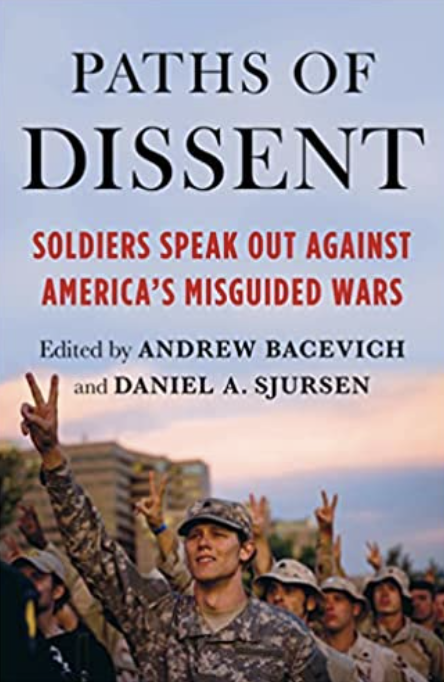
The second book is Paths of Dissent: Soldiers Speak Out Against America’s Misguided Wars, edited by Andrew Bacevich and Danny Sjursen. In my view, the word “misguided” doesn’t quite capture the book’s powerful essence, since it gathers 15 remarkable essays by Americans who served in Afghanistan and Iraq and witnessed the patent dishonesty and folly of those wars. None dare speak of failure might be a subtheme of these essays, as initially highly motivated and well-trained troops became disillusioned by wars that went nowhere, even as their comrades often paid the ultimate price, being horribly wounded or dying in those conflicts driven by lies.
This is more than a work of dissent by disillusioned troops, however. It’s a call for the rest of us to act. Dissent, as West Point graduate and Army Captain Erik Edstrom reminds us, “is nothing short of a moral obligation” when immoral wars are driven by systemic dishonesty. Army Lieutenant Colonel Daniel Davis, who blew an early whistle on how poorly the Afghan War was going, writes of his “seething” anger “at the absurdity and unconcern for the lives of my fellow soldiers displayed by so many” of the Army’s senior leaders.
Former Marine Matthew Hoh, who resigned from the State Department in opposition to the Afghan “surge” ordered by President Barack Obama, speaks movingly of his own “guilt, regret, and shame” at having served in Afghanistan as a troop commander and wonders whether he can ever atone for it. Like Craig McNamara, Hoh warns of the dangers of misplaced loyalty. He remembers telling himself that he was best suited to lead his fellow Marines in war, no matter how misbegotten and dishonorable that conflict was. Yet he confesses that falling back on duty and being loyal to “his” Marines, while suppressing the infamies of the war itself, became “a washing of the hands, a self-absolution that ignores one’s complicity” in furthering a brutal conflict fed by lies.
As I read those essays, I came to see anew how this country’s senior leaders, military and civilian, consistently underestimated the brutalizing impact of war, which, in turn, leads me to the ultimate lie of war: that it is somehow good, or at least necessary — making all the lying (and killing) worth it, whether in the name of a victory to come or of duty, honor, and country. Yet there is no honor in lying, in keeping the truth hidden from the American people. Indeed, there is something distinctly dishonorable about waging wars kept viable only by lies, obfuscation, and propaganda.
An Epigram from Goethe
John Keegan, the esteemed military historian, cites an epigram from Johann Wolfgang von Goethe as being essential to thinking about militaries and their wars. “Goods gone, something gone; honor gone, much gone; courage gone, all gone.”
The U.S. military has no shortage of goods, given its whopping expenditures on weaponry and equipment of all sorts; among the troops, it doesn’t lack for courage or fighting spirit, not yet, anyway. But it does lack honor, especially at the top. Much is gone when a military ceases to tell the truth to itself and especially to the people from whom its forces are drawn. And courage is wasted when in the service of lies.
Courage wasted: Is there a worst fate for a military establishment that prides itself on its members being all volunteers and is now having trouble filling its ranks?
A colleague who teaches at one of America’s many war schools tells me that great power competition is trendy again, the U.S., it goes without saying, being the greatest power of all, and China and Russia being the main “near-peer” rivals to greatness. The competition, of course, is defined primarily in military terms and is measured, at least at the Pentagon, by the amount of money Congress allocates to each year’s defense budget. Thus the U.S. military, in (falsely) arguing that it’s falling behind the Chinese navy in ships, for example, establishes the quick-fix solution as lots more money for the U.S. Navy to build more ships. Similarly, the Air Force wants more F-35 jet fighters, B-21 nuclear bombers, and new land-based ICBMs, also measures of “greatness,” and the Army wants 500,000 troops on active duty, presumably because it’s a nice round number, even as it’s failing miserably to meet yearly recruiting goals, forcing it to settle on a force of roughly 450,000 (more or less) effectives.
Naturally, the solution is never to downsize the mission given a somewhat smaller force; it’s to do whatever is possible to expand the pool of recruits, even if that means “fat camps” and remedial teaching to help potential soldiers reach weight goals and test scores so that they qualify for basic training. Too fat or too dumb? Join the pre-Army! Lose weight fast and get smart quick so that you too can eventually enlist and be sent to foreign lands to kill people.
Recruitment shortfalls is a micro issue garnering attention in Congress even as the macro issue of China and Russia as great power competitors serves as a welcome change of subject from colossal military failures in Iraq and Afghanistan. And there’s the rub: the U.S. military has learned nothing from those failures except, as Barack Obama might say, to look forward, not backward, and to inflate China and Russia from regional powers to near-pears or even to peers. As my war school colleague put it to me, somewhat ambiguously, “they” have big battalions and lots of nukes and have shown the will to use them, so America must be ready to respond in kind. Yet the only country to have used nukes against cities is the United States at Hiroshima and Nagasaki, and the U.S. continues to outspend China on weapons and war roughly by a factor of three and Russia by a factor of ten.
So, which country is really driving all this militarized “competition” among the so-called great powers?
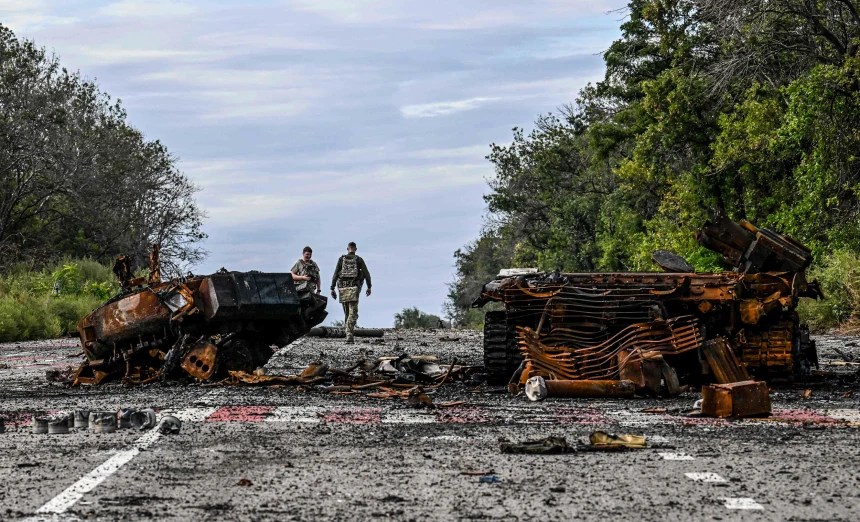
The detritus of war, but it’s Ukraine that’s bearing the brunt of war damage
W.J. Astore
At NBC News today, I saw this headline: “Ukraine’s offensive in the east surprised Russia — and it may be a turning point in the war.” Russian forces are retreating, but whether this represents a decisive turning point remains to be seen. Still, Ukraine resistance seems steady, and Russian will unsteady, at this moment in the war.
Surely, this is good news — or is it? With all the fighting taking place in Ukraine, the longer the war lasts, the worst it will likely turn out for Ukrainians. Turning points often are illusory: just ask all those U.S. generals who spoke of turning points in Afghanistan and Iraq over the last two decades. The best case scenario here is for Ukraine to use its military advantage and push for a favorable diplomatic settlement. I would hope Vladimir Putin might also see the wisdom of ending a war that has cost him more than he likely imagined when he started it earlier this year (as Andrew Bacevich explains at TomDispatch).
Too many Americans, it seems to me, are determined to see Russia suffer as much as possible. With Russia, the Pentagon’s argument goes something like this: Putin is a malevolent and irredentist dictator. Without NATO expansion, the Baltic States would already have been reabsorbed by Russia, with Poland and other (former) eastern bloc nations next on Putin’s target list. Putin, a “clear and present danger,” is only kept in line by U.S. and NATO military power, because his goal is a new Russian empire with borders much like those that Russia had in 1914 or, if that proves overly ambitious, 1989 before the Soviet collapse. Only a resolute America (and now Ukraine) stands in his way, but that requires massive military spending in a renewed effort at containment, together with yet more spending on America’s nuclear triad. “Containment” and “deterrence,” once again, are the neutral-sounding words that enable open-ended U.S. military spending against Russia (and of course Red China as well).
Truly what we don’t need is Cold War 2.0. The world barely survived the first one, and that was before climate change emerged as the serious threat that it is today.
In the 1990s, the U.S. and NATO rejected the idea that Russia maybe, just maybe, could be incorporated into the European Community in a security architecture respectful of Russian history and goals while also securing nascent democracies in former Warsaw Pact countries. Today, that rejection is complete, as Russia and Putin are dismissed as irredeemable deplorables, to borrow a phrase from Hillary Clinton.
Yet I wouldn’t underestimate Russian resilience. Just ask Hitler, Napoleon, or Charles XII about that. They all invaded Russia and got spanked. The time has come not to continue the vilification of Russia but to reach accords that Russians, Ukrainians, and other Europeans can all live with.
You wage war long, you wage it wrong, especially when it’s being waged on your turf. Short of total capitulation by either side, which is unlikely, let’s hope Zelensky and Putin can find a way to resolve their differences Let’s hope as well that the U.S. sees the wisdom of facilitating a diplomatic settlement that ends the killing.
Though President Biden previously has suggested Putin must go, I’d be very careful what he wishes for. Russia under new leaders may prove even more volatile and vengeful than U.S. leaders think it’s been under Putin.
You’d think watching the U.S. Open finals in tennis would constitute a break from incessant propaganda about war, but you’d be wrong to do so.
I’m a tennis fan so I watched this weekend’s finals with interest. A Pole defeated a Tunisian in the women’s final and a Spaniard defeated a Norwegian in the men’s final, which is a fair representation of the international flavor of the field. At both trophy ceremonies, what did the U.S. Tennis Association choose to highlight? The USTA boasted of raising $2 million for Ukraine war relief while describing the Russian invasion of Ukraine as “unprovoked.”
First of all, why is Russia’s war with Ukraine being mentioned at both trophy ceremonies? What has this got to do with tennis?
Second, why is the USTA raising money for Ukraine war relief? Shouldn’t it be raising money for, well, tennis? Perhaps for scholarships for underprivileged kids around the world to play tennis? After all, the U.S. taxpayer is already on the hook for nearly $70 billion in aid to Ukraine, roughly half of it in the form of arms and armaments. Compared to this sum, $2 million is a drop in the bucket.
Third, why is Russia’s invasion always described as “unprovoked,” as if Putin and Russia simply woke up one day and decided to invade a former Soviet republic?
Let’s think back to America’s invasion of Iraq in 2003. Was that also “unprovoked”? (After all, Saddam Hussein had no WMD and nothing to do with the 9/11 attacks.) Did the USTA raise money to help Iraqi civilians recover from U.S. war damage and crimes? Not that I recall.
Earlier this year, at Wimbledon, players from Russia and Belarus were banned from the tournament. (I guess because they were waging war with their tennis rackets for Putin?) At the U.S. Open, they were allowed to play but not under the flags of their countries. Do you recall U.S. tennis players being banned because of the “unprovoked” Iraq War? Neither do I.
The U.S. mainstream managers — even tennis officials! — are so concerned to describe the Russian attack as “unprovoked” that you know that they know it wasprovoked — and they’re at pains to deny it, even during tennis tournaments.
The heavy hand of U.S. propaganda only gets heavier when it intrudes on what should have been an apolitical and celebratory trophy ceremony for international athletes.
Note: I am, of course, against Russia’s invasion of Ukraine. What I would like to see is the U.S. supporting diplomatic efforts to end the war as quickly as possible. Currently, we hear much of Ukrainian victories, but it’s possible the war will only grow longer and more deadly as a result of these “victories.”
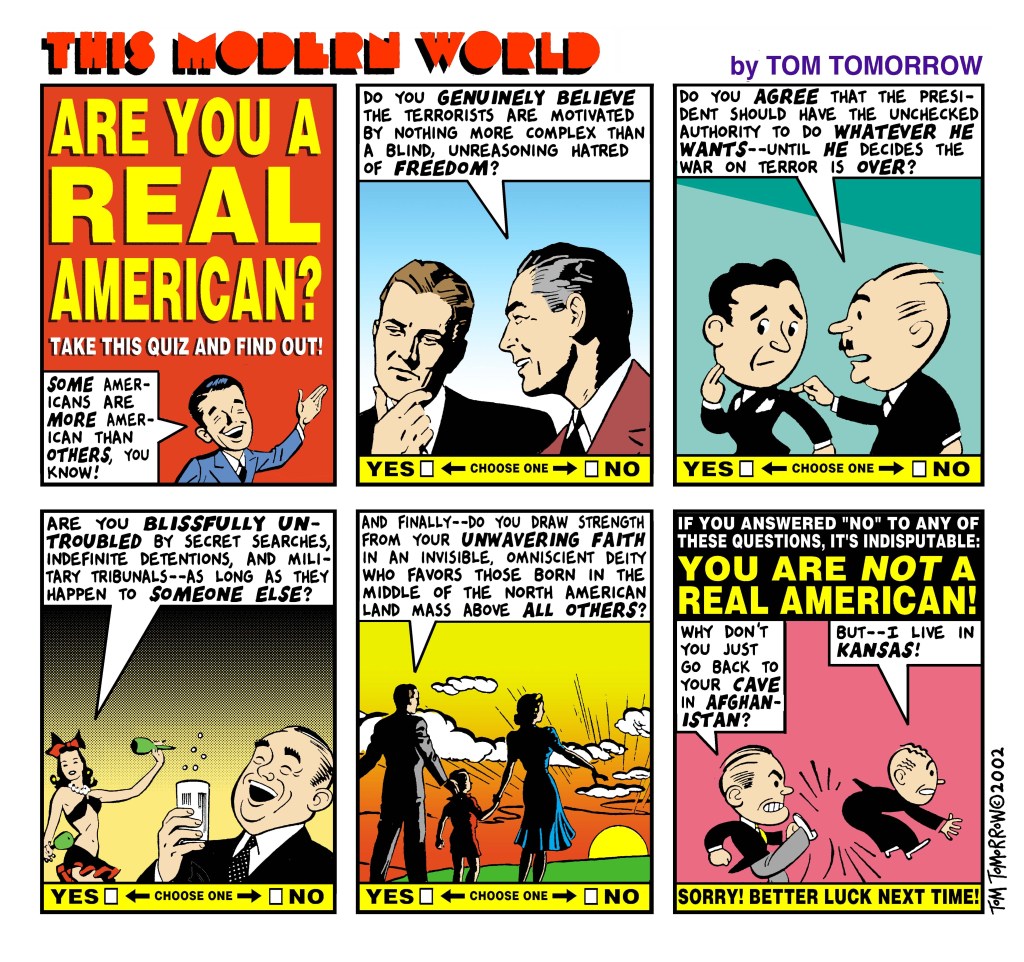
A classic “Tom Tomorrow” cartoon from 2002. Now, of course, “real Americans” must believe Russia’s invasion of Ukraine was completely unprovoked, that Ukraine deserves a blank check in U.S. taxpayer funds, and that Russian athletes should be ashamed of their own flag
Back on June 1st, I noted that Ukraine couldn’t possibly absorb more than $54 billion in U.S. aid, most of it related to weaponry and munitions, given the country’s lack of infrastructure as well as the chaos inherent to a shooting war.
As I wrote back then:
The entire defense budget of Ukraine before the war was just under $6 billion. How can Ukraine possibly absorb (mostly) military “aid” that represents NINE TIMES their annual defense budget? It simply can’t be done…
From a military perspective, the gusher of money and equipment being sent to Ukraine makes little sense because there’s no way Ukraine has the infrastructure to absorb it and use it effectively. The U.S. approach seems to be to flood the zone with weaponry and assorted equipment of all sorts, irrespective of how it might be used or where it might ultimately end up. I can’t see how all this lethal “aid” will stay in the hands of troops and out of the hands of various criminal networks and black markets.
And so it goes. Recent reports suggest that only 30-40% of U.S. military aid is actually reaching Ukrainian troops. The rest is being siphoned off, lost, stolen, what-have-you. The response in U.S. media is to suppress this truth, per dictates from Ukraine!
Caitlin Johnstone does an excellent job of summarizing the case, and since she generously encourages her readers to share her posts, I thought I’d avail myself of her generosity. Without further ado:
Caitlin Johnstone, CBS Tries Critical Journalism; Stops After Ukraine Objects
Following objections from the Ukrainian government, CBS News has removed a short documentary which had reported concerns from numerous sources that a large amount of the supplies being sent to Ukraine aren’t making it to the front lines.
The Ukrainian government has listed its objections to the report on a government website, naming Ukrainian officials who objected to it and explaining why each of the CBS news sources it dislikes should be discounted. After the report was taken down and the Twitter post about it removed, Ukrainian Foreign Minister Dmytro Kuleba said this was a good start but still not enough.
“Welcome first step, but it is not enough,” Kuleba tweeted. “You have misled a huge audience by sharing unsubstantiated claims and damaging trust in supplies of vital military aid to a nation resisting aggression and genocide. There should be an internal investigation into who enabled this and why.”
“This article has been updated to reflect changes since the CBS Reports documentary ‘Arming Ukraine’ was filmed, and the documentary is also being updated. Jonas Ohman says the delivery has significantly improved since filming with CBS in late April. The government of Ukraine notes that U.S. defense attaché Brigadier General Garrick M. Harmon arrived in Kyiv in August 2022 for arms control and monitoring.”
CBS News does not say why it has taken so long for this report to come out, why it didn’t check to see if anything had changed in the last few months during a rapidly unfolding war before releasing its report, or why it felt its claims were good enough to air before Kyiv raised its objections but not after.
Someone uploaded the old version of the documentary on YouTube here, or you can watch it on Bitchute here if that one gets taken down. It was supportive of Ukraine and very oppositional to Russia, and simply featured a number of sources saying they had reason to believe a lot of the military supplies being sent to Ukraine aren’t getting where they’re supposed to go.
The original article quotes the aforementioned Jonas Ohman as follows:
“All of this stuff goes across the border, and then something happens, kind of like 30% of it reaches its final destination,” said Jonas Ohman, founder and CEO of Blue-Yellow, a Lithuania-based organization that has been meeting with and supplying frontline units with military aid in Ukraine since the start of the conflict with Russia-backed separatists in 2014.
“30-40%, that’s my estimation,” he said in April of this year.
“The US has sent tens of thousands of anti-aircraft and anti-armor systems, artillery rounds, hundreds of artillery systems, Switchblade armored drones, and tens of millions of rounds of small arms ammunition,” CBS’s Adam Yamaguchi tells us at 14:15 of the documentary. “But in a conflict where frontlines are scattered and conditions change without warning, not all of those supplies reach their destination. Some also reported weapons are being hoarded, or worse fear that they are disappearing into the black market, an industry that has thrived under corruption in post-Soviet Ukraine.”
“I can tell you unarguably that on the frontline units these things are not getting there,” the Mozart Group‘s Andy Milburn tells Yamaguchi at 17:40. “Drones, Switchblades, IFAKs. They’re not, alright. Body armor, helmets, you name it.”
“Is it safe to characterize this as a little bit of a black hole?” Yamaguchi asked him, perhaps in reference to an April report from CNN whose source said the equipment that’s being sent “drops into a big black hole, and you have almost no sense of it at all after a short period of time.”
“I suppose if you don’t have visibility of where this stuff is going, and if you’re asking that question, then it would appear that it’s a black hole, yeah,” Milburn replied.
“We don’t know,” Amnesty International’s Donatella Rovera tells Yamaguchi at 18:45 when asked if it’s known where the weapons being sent to Ukraine are going.
“There is really no information as to where they’re going at all,” Rovera says. “What is more worrying is that at least some of the countries that are sending weapons do not seem to think that it is their responsibility to put in place a very robust oversight mechanism to ensure that they know how they’re being used today, but also how they might and will be used tomorrow.”
A news outlet pulling a report because their own government didn’t like it would be a scandalous breach of journalistic ethics. A news outlet pulling a report because a foreign government didn’t like it is even more so.
We’ve already seen that the western media will uncritically report literally any claim made by the government of Ukraine in bizarre instances like the recent report that Russia was firing rockets at a nuclear power plant it had already captured, or its regurgitation of claims that Russians are raping babies to death from a Ukrainian official who ended up getting fired for promoting unevidenced claims about rape. Now not only will western media outlets uncritically report any claim the Ukrainian government makes, they will also retract claims of their own when the Ukrainian government tells them to.
It’s not just commentators like me who see the western press as propagandists: that’s how they see themselves. If you think it’s your job to always report information that helps one side of a war and always omit any information which might hinder it, then you have given yourself the role of propagandist. You might not call yourself that, but that’s what you are by any reasonable definition of that word.
And a great many western Zelenskyites honestly see this as the media’s role as well. They’ll angrily condemn anyone who inserts skepticism of the US empire’s narratives about Ukraine into mainstream consciousness, but then they’ll also yell at you if you say we’re not being told the truth about Ukraine. They demand to be lied to, and call you a liar if you say that means we’re being lied to.
You can’t have it both ways. Either you want the mass media to serve as war propagandists or you want them to tell the truth. You cannot hold both of those positions simultaneously. They are mutually exclusive. And many actually want the former.
House Speaker Nancy Pelosi’s trip to Taiwan was a disaster. It angered China, provoking a military response (missile firings and the like) that could escalate into something far worse. It interfered with cooperative efforts between China and the U.S. on vitally important fronts such as climate change. And it featured a startlingly incoherent speech by the Speaker in which she implied Benjamin Franklin was an early U.S. president as she proceeded to misquote and butcher his sentiment on liberty and security. Jimmy Dore does an excellent job here of allowing Pelosi to slay herself with her own words:
So, why did she go to Taiwan? Putting aside her own conceit and vainglory, she went for two reasons. The first was domestic politics. Just as the Democrats have (falsely) accused Trump and the Republicans of being soft on Russia, the Republicans have (falsely) accused Biden and the Democrats of being soft on China. Pelosi’s trip was meant to inoculate the Democrats against charges of “softness” vis-a-vis China. Meanwhile, as both major political parties accuse the other of being “soft” vis-a-vis regional powers (China, Russia), the military-industrial complex continues to cash in with record-setting “defense” budgets.
The second reason is connected to the first. Pelosi’s trip has generated the response the military-industrial complex was looking for from China. Thus on NBC News today, you see the following article that touts a resurgent Chinese military and how it constitutes a major threat to U.S. imperial dominance in the Pacific. The conclusion you’re supposed to draw from this is simple: China is a big-time threat to America, therefore we must spend even more money to “rebuild” America’s military to meet that threat.
There’s possibly a third reason, and that is the unreliability of Joe Biden and Kamala Harris as deliverers of a coherent message. Both Biden and Harris rely heavily on teleprompters; when they depart from the script, Biden is liable to blurt out inappropriate remarks that need to be “walked back” by aides, whereas Harris has a tendency to laugh inappropriately to cover her confusion. It’s doubly ironic that the Speaker of the House, sent to speak for America and the Democrats, spoke so poorly and confusingly.
This is no laughing matter, since diplomacy depends on clear communication. Certainly, the Chinese are speaking clearly with their military exercises and diplomatic warnings. That America’s leaders can’t speak clearly and exercise sound judgment is assuredly the clearest sign yet of U.S. decline, a decline that will not be arrested by throwing more money at the military.
Sound policy requires sound leaders. Whatever else one might say, the words of Biden, Harris, and Pelosi are unsound, marking them as not just ineffective leaders but dangerous ones.
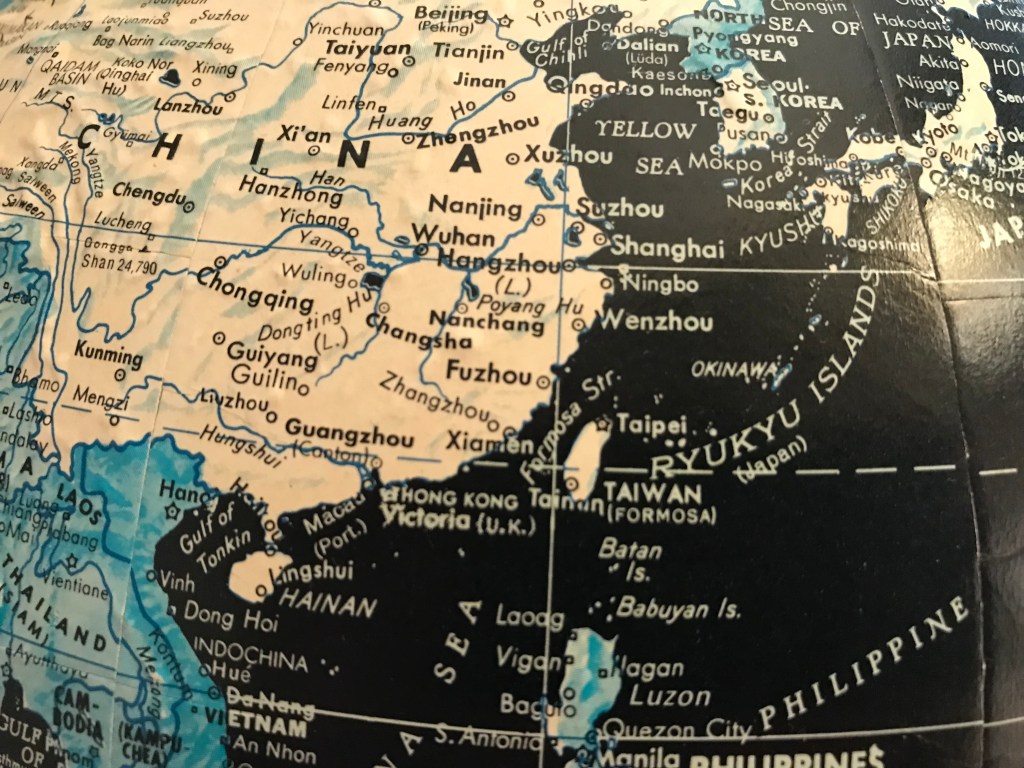
I keep this globe in my office. It comes in handy to remind me of America’s “global reach” and “global power.” You can see how close Taiwan is to mainland China, and also how far Taiwan is from the U.S. But of course U.S. hegemony has no geographical limits, hence the presence of roughly 750 U.S. military bases globally. The world is not enough, since the U.S. must dominate space and cyberspace as well. Perhaps Nancy Pelosi should give her next muddled speech from low Earth orbit. Or the Moon?
The first presidential election in which I voted was 1984 and Ronald Reagan got my nod. Back then, I was a Cold War officer-to-be and I wasn’t convinced that Walter Mondale and the Democrats had a handle on anything. Today, I’d be more likely to vote for Mondale, I think, but I still have some affection for Reagan, who dreamed big.
Reagan’s biggest dream was eliminating nuclear weapons, which he came close to doing with Mikhail Gorbachev. Apparently, the sticking point was Reagan’s enthusiasm for the Strategic Defense Initiative, or “Star Wars,” his misbegotten scheme to defend America against nuclear attack. It’s truly a shame that these two leaders didn’t fulfill a shared dream of making the world safer through nuclear disarmament.
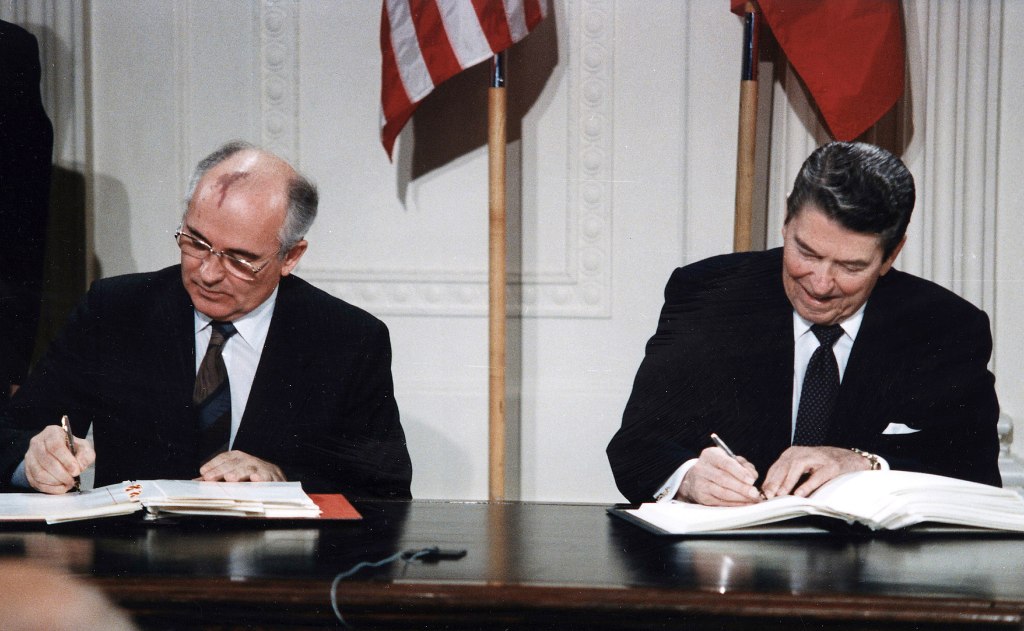
Still, Reagan and Gorbachev did eliminate an entire class of nuclear weapons via the intermediate range nuclear forces (INF) treaty, as represented by the American Pershing II and Soviet SS-20 missiles as well as ground-launched nuclear cruise missiles. Sadly, I recall talking to a senior colleague in the early 1990s who relayed an anecdote that he (or someone he knew, I can’t quite recall) had talked to Reagan and praised the ex-president for that achievement, only to be met with a vague look because Reagan apparently couldn’t remember by that point. It appears Reagan did start to suffer from memory loss in his second term in office, and by the early 1990s it wouldn’t surprise me if he couldn’t recall details of nuclear treaties.
Reagan and Gorbachev sign the INF Treaty, which eliminated an entire class of nuclear weapons
Even so, Reagan, despite all his flaws, had a bold vision motivated by human decency. He was something more than a bumbler, and indeed his energy and eloquence were leagues ahead of what Joe Biden exhibits today.
Which put me to mind of this classic “Saturday Night Live” of Reagan in action. Of course, it’s a spoof, but it’s well done and funny while capturing something of Reagan’s own sense of humor:
Please, dear readers, don’t tell me all the crimes of Reagan in the comments section. Nor do I want anyone to whitewash the man. Today, I just wanted to capture Reagan’s abhorrence of nuclear war, which got him to dream of SDI (“Star Wars”) and which almost produced a major breakthrough in total nuclear disarmament.
How shameful is it that Reagan could dream big with Gorbachev but that Biden can’t speak at all to Vladimir Putin?



 Bracing Views