Guns are the only innocents in America. To be clear, I’m being sarcastic.
Whenever there’s a school shooting, you can count on the shooter being denounced as evil, as monstrous, as out of his mind. But the guns the shooter uses? There are always people who tell us not to blame the guns. Guns aren’t evil. Guns aren’t monstrous. Guns are, in a word, innocent.
It’s all very strange. I think of the children killed in Texas, along with their teachers, as being innocent. I wish we’d have kept them safe. I wish their rights to life, liberty, and the pursuit of happiness hadn’t been cut down by bullets. But wish in one hand …
We hear a lot of talk about gun rights and gun safety, almost as if guns indeed had rights, almost as if America’s true goal was to keep guns safe.
America is indeed a country where guns are safe, secure, and free to roam. We have more than 400 million of them, including more than 20 million military-style assault weapons. Congress is not seriously acting to put meaningful restrictions on guns. We’re lucky if we’ll see a “red-flag” law (allowing the confiscation of guns from a person who makes deadly threats before he decides to go on a murderous rampage), or possibly universal background checks. Of course, neither of these will curtail gun purchases and availability, and neither would have stopped the latest shooter in Texas, who purchased his guns legally and apparently showed no clear “red flag” before he attacked a school and killed 19 innocent children.
And there’s that word again. Innocent. We need to focus on child rights and child safety, not gun rights and gun safety. Don’t you think?
I’ve been a gun owner and have shot everything from a pellet rifle and .22 pistol to a .44 magnum Model 29 Smith & Wesson, made famous by Clint Eastwood in “Dirty Harry.”
Model 29 Smith & Wesson .44 Magnum.
I’ve felt the powerful allure of guns. I also have no problem with hunters, target shooters, and all the responsible gun owners we have in America. But when guns are responsible for 45,000 deaths a year in America (data from 2020), and when mass shootings become almost forgettable in their repetition (except in the most heinous cases, like the latest mass murder event in Texas), it’s time to admit that guns are not the innocents here. They are part of the problem, and restrictions to their ownership is part of the solution.
“My body, my choice” is a common refrain for women in the pro-choice movement. I happen to agree with it. What women choose to do when they get pregnant is truly none of my business.
Photo by Alex Brandon, AP
Yet the abortion debate swirls and twists and roars as if men played absolutely no role in getting women pregnant. As if all pregnancies were some kind of immaculate conceptions.
Our society and culture puts almost all the onus and responsibility (and, often enough, blame) on women for getting pregnant. For pro-lifers, a woman, once pregnant, is then obligated to have a baby and care for it until adulthood, else put it up for adoption.
But what about the father’s obligation? After all, unless we’re talking the Virgin Mary here, she didn’t get pregnant alone. (And even the Virgin Mary had help of a godly kind.)
I’d have a bit more tolerance for pro-lifers if they’d agreed to these rules:
The biological father is also responsible, financially and legally and otherwise, for raising the baby until adulthood.
If the father isn’t married to the mother in question, and the mother keeps the child, he is legally obligated to pay for child support. For argument’s sake, let’s say he’s obligated to contribute 20% of his pay until the child reaches the age of eighteen.
If men were held legally and morally responsible for all the children they fathered, and this was strictly enforced by society and the state, with deadbeat dads becoming society’s new outcasts, I wonder how long it would take for abortion to be made legal and universally available in America?
Today as I was checking out at Job Lots, the cashier asked me if I wanted to donate money for Ukrainian refugee relief. I thought quickly of the $33 billion Biden already wants from us for Ukraine and politely said “no thanks.”
Then I read Todd Miller’s new article at TomDispatch.com on the security-industrial complex along the U.S. border with Mexico and reflected on all those people risking their lives to cross the border into America, most of them refugees from wars and climate change and violence and the like. I’ve never been asked by a company or a cashier for that matter to contribute to their relief. Indeed, when the issue of refugees comes up along the Southern border, it’s always about more money for Homeland Security and more border control agents and surveillance technology (including drones and robotic dogs, as Miller notes), all to keep the “bad” people out of America, all those “illegals” who allegedly want to take American jobs while doing violence to vulnerable Americans.
Remarkably, Miller notes in his article how the Biden administration is following basically the same approach to border security as the Trump administration. The only real difference is that Biden is relying less on physical walls and more on “virtual” ones (towers, sensors, cameras, drones, etc.). This is hardly surprising when you consider Kamala Harris went south of the border to deliver a singular message to would-be asylum seekers. Her message to them: Do not come.
Land of the free, home of the brave?
As Miller notes in his article, you can count on one thing: America’s border with Mexico will never be secure, no matter how much we spend, because insecurity and overhyped “threats” sell very well indeed.
Is America really the home of the brave, given our fears of invasions, whether from “dangerous” brown- and black-skinned people coming up from the south or all those gangster Russians and sneaky Chinese allegedly scheming against us?
If we want to help refugees facing violence and starvation, we don’t have to look as far as Ukraine. Depending on where you live in America, you might only have to look just beyond the wall or fence or surveillance tower in front of you. As you do, you might ponder why we’re not sending $33 billion to help them survive. Is it because they’re not killing Russians with American-made weaponry?
The best way to combat disinformation is with more and better information. Censorship isn’t the answer.
The Biden administration has reached a different conclusion, creating a “Disinformation Governance Board” under the Department of Homeland Security. This “board” is headed by Nina Jankowicz, an unelected official and an apparent partisan hack. One example: she dismissed the infamous Hunter Biden laptop story as a “fairy tale” involving a “laptop repair shop”; it’s now been confirmed that Hunter’s laptop was real, and so too was that repair shop.
Democrats, of course, don’t have exclusive rights to censorship. Republicans always seem to be calling for books to be banned or education to be policed. But the real problem is much larger than partisan hackery and bickering. Efforts at censorship are all around us, couched as a way of protecting us from harmful lies and other forms of disinformation. Yet, as the comedian Jimmy Dore points out, the government isn’t that concerned about protecting you from lies; it is, however, deeply concerned with denying you access to certain truths, truths that undermine governmental authority and the dominant narrative.
As a retired U.S. military officer and as a historian, the most insidious lies and disinformation I’ve encountered have come from the government. Consider the lies revealed by Daniel Ellsberg and his leak of the Pentagon Papers. Consider the war crimes revealed by Chelsea Manning, aided by Julian Assange and Wikileaks. Consider the lies revealed in the recent Afghan War Papers. Consider the lies about the presence of WMD in Iraq, lies that were used to justify the disastrous Iraq War. The government, in short, is a center of lies and disinformation, which is precisely why we need an adversarial media, one that is willing to ferret out truth. Instead, we’re being offered a governmental Ministry of Truth in the form of a “Disinformation Governance Board.”
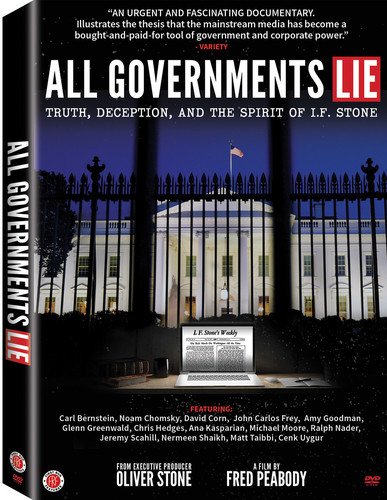
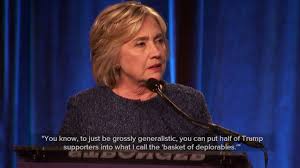
All things being equal, a democratic society thrives best when speech is as free as possible, trusting in the people to sort fact from fiction, and sound theories from blatant propaganda. And there’s the rub: trusting in the people. Because the government doesn’t trust us (remember Hillary Clinton’s comment about all those irredeemable deplorables), even as the government is often at pains to mislead and misinform us. As maverick journalist I.F. “Izzy” Stone said, all governments lie. It’s truly nonsensical, then, to allow the government to police what is true and what is “disinformation.”
But don’t we need some censorship in the name of safety or security or mental health or whatever? Sorry: censorship is rarely about safety, and it most certainly doesn’t serve the needs of the vulnerable. Instead, it serves the needs of the powerful, those who already possess the loudest megaphones in the public square.
But doesn’t someone like Donald Trump deserve to be censored because he spreads disinformation? Which is the bigger problem: Trump or censorship? I happen to think Trump is a divisive con man, but it was a bad precedent for Twitter to have banned him from tweeting. The bigger problem wasn’t Trump’s tweets but the media’s obsessive coverage of them in pursuit of ratings. The way to combat a blowhard like Trump is to ignore him, and to correct him when needed. To combat his lies with the truth. We don’t need a governmental Ministry of Truth to police the tweets of a former president. Not when the government is often the biggest liar.
The solution isn’t censorship but an active, engaged, and informed citizenry, assisted by a fourth estate, the press, that is truly independent and adversarial to power. But the weakening of education in America, combined with a fourth estate that is deeply compromised by the powerful and often in bed with the government, means that these democratic checks on power are less and less effective. Hence calls for quick yet dangerous “solutions” like censorship, where the censors (governmental boards, private corporations) are opaque and almost completely unaccountable to the people.
Unless your goal is to give the already powerful a monopoly on speech, censorship is not the answer.
On his new show at The Real News, Chris Hedges recently spoke with Cornel West on the state of America. It’s not easy listening, nor should it be. Brother Chris and Brother Cornel didn’t mince words as they deplored the commodification of American life, the militarism of American society, and the imperialism of the U.S. empire. Here’s the link to their interview:
I jotted down key phrases as I listened to both men. Phrases like spiritual decadence, bootlickers for war, mass incarceration, self-glorification and self-indulgence, the Neo-fascism of Trump followers versus the Neo-liberalism of Democrats, and that the American empire has no moral authority, given its “vicious atrocities” in Iraq, Yemen, and elsewhere.
Brother Cornel was especially strong on the seductive dangers of nationalism, the grotesque wealth inequality here at home, and a U.S. political system deeply compromised by legalized bribery and normalized corruption. Reality is defined by a corporatized state in which profit maximization is pursued at any cost, including impending ecological catastrophe, where education is reduced to indoctrination, vocations are reduced to professions, and callings reduced to careers.
Sure, it’s grim stuff, but the truth is often grim. Nor are these two men irredeemably grim. Both spoke of the need to be faithful unto death, to resist the paralysis that comes from despair. Both are fighters and truth-tellers; both are men of faith and men of action; both are humanistic. And both are most assuredly worth listening to.
Brother Cornel’s message is ultimately one of love. Of joy-sharing. Of thinking for yourself. Of becoming a force for good and beauty and justice in the world. Of empowering others through an expansive and inclusive humanism. His is the perfect message for this Easter season, a season of rebirth and hope, of salvation through sacrifice and love.
America’s “leaders” believe they are in-the-know, and the rest of us are know-nothings who can be pushed around or ignored.
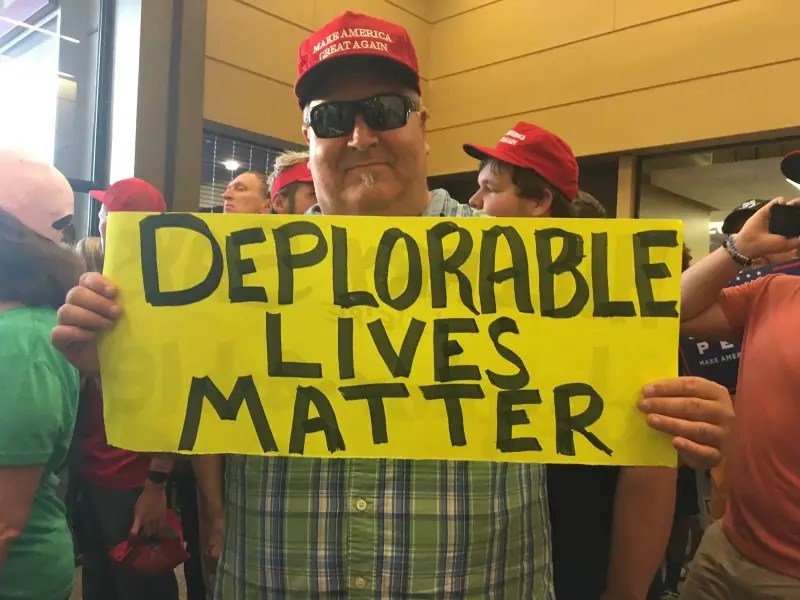
Perhaps the most honest thing Hillary Clinton ever did was to speak of her “basket of deplorables” after which she dismissed them as “irredeemable.” This is exactly how Hillary and most of our “leaders” think. Anyone who’s skeptical of them, anyone who asks for proof, anyone who’s willing to resist, is thrown into a “deplorable” basket and dismissed.
It will work until it doesn’t; indeed, it’s already not working. But the system is not about to give in. At the presidential level, America’s likely candidates for “leader of the free world” in 2024 are Joe Biden and Donald Trump, or, as my wife likes to joke, ODR versus ODR. Old Demented Rotter versus Old Divisive Rotter.
Let’s take the “old” part first, since ageism is an instant rejoinder. It used to be said that being President of the U.S. was the toughest, most demanding, job in the world, making enormous demands on physical stamina and mental acuity. Eisenhower was considered old when he left the presidency at the age of 70, replaced by John F. Kennedy at the age of 43. If Biden is reelected in 2024, he will be 82 that November, and Trump will be 78. Both men are well past their prime. Are they truly ready for the rigors of the office? Do we trust either man to be able to complete another four-year term in office?
Now, let’s take the “D” part. Many observers have noted Biden’s mental decline; it was readily noticeable in 2020 when he ran as a candidate in the primaries. Sadly, mental decline often accelerates with age, sometimes unpredictably. Reelecting Joe Biden in 2024, assuming he runs again, will likely lead to his vice president taking over for him during his second term of office. Trump, meanwhile, is a divisive leader whose personal motto might be “divide and rule.” A leader should bring people together for their mutual advantage, not tear them apart for his own advantage.
And now the “R” part, the “rotter.” Neither Trump nor Biden is a champion of workers, of the poor, of the vulnerable. Neither has much empathy. Both are deeply compromised. It’s a common failing of “big fish” politicians to have so little regard for the commoners that they rule, but surely we can find candidates that are, dare I say, less rotten?
“Leaders” like Hillary Clinton are fond of denouncing large swaths of the American public as “deplorable.” Is this not a classic case both of projection and of profound narcissism? How do we move beyond ODR versus ODR in 2024?
I finally watched the Oscars last night. Of course, I’d heard about Will Smith slapping comedian Chris Rock because of a joke Smith’s wife didn’t like. It was an ugly incident, but fortunately Chris Rock kept his cool. Hollywood loves itself, much like America loves itself, and an A-list actor like Will Smith can pretty much get away with anything, including assaulting one of the hosts for a joke that, though apparently well-intended, obviously miscarried. Smith never apologized during the show, though he finally issued a pro forma apology yesterday once he figured out that public opinion was against him.
I’m a movie buff, and I’ve always enjoyed watching the Oscars, but each year the shows get tackier, sleazier, and more morally repugnant. As my wife said this morning, you see a lot of sick people at the Oscars with no morals and apparently no souls.
I did want to mention one oversight at the Oscars. Now, I have to admit I didn’t listen to every word of every acceptance speech, but those I did hear all had one glaring omission: None of the Oscar winners thanked the fans, the movie-goers, the ones who truly pay them and support them. Instead, the winners thanked the usual suspects: agents, mentors, producers, big companies like Apple and Disney and Netflix, with occasional references to parents and to God. After slapping Chris Rock, Will Smith blubbered on about how he was all about serving God and love, apparently seeing no contradiction between his words and his deeds.
Of course, the Oscars are always a self-indulgent spectacle, always an exercise in narcissism and self-promotion. But would it really hurt the Oscar winners to take a few moments to thank their fans and movie-goers, especially when going to the movies was a bit risky given the Covid-19 pandemic? Instead, I heard talk of how brave they all were for continuing to make movies during the pandemic.
Again, I’m a big movie fan, and I don’t dismiss their artistry and often their cultural significance. At their best, movies can truly inspire us; they can help to open doors to new worlds; they are truly part of the human experience. What’s truly sad is how the Oscars and Hollywood’s yearly celebration of itself actually diminishes the movies rather than showcasing and enhancing them.
The Oscars should go the way of the Emmy Awards — they should simply disappear, having outlived their usefulness and having become something of an embarrassment.
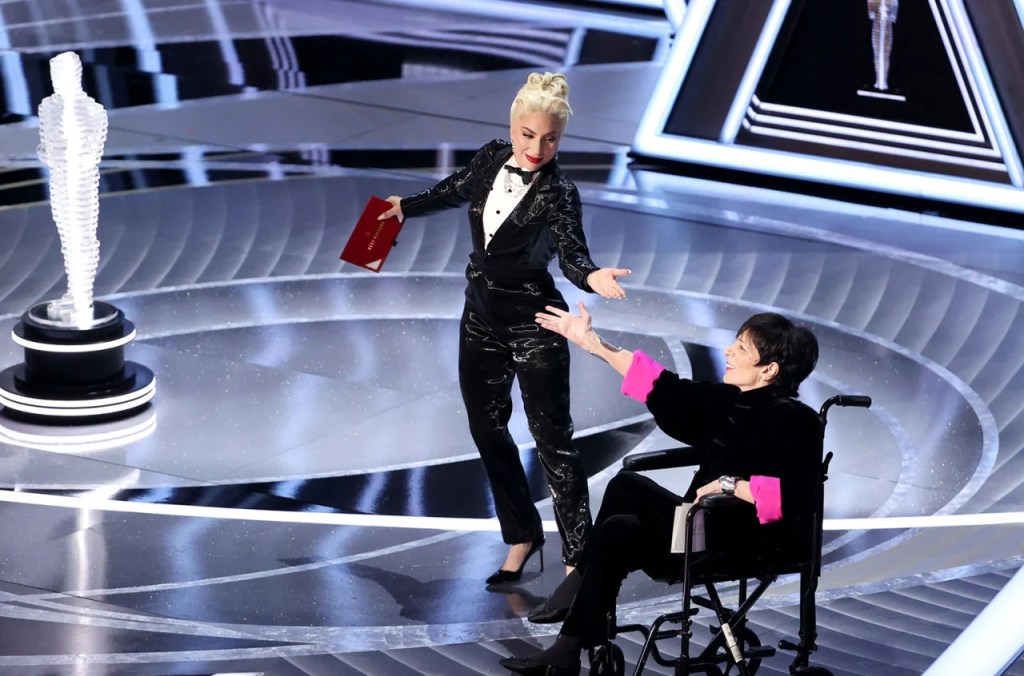
A rare moment of grace at the Oscars, as Lady Gaga helps Liza Minnelli announce the award for best picture (Photo by Christopher Polk)
Perhaps the most powerful antiwar film that I’ve seen is “Testament of Youth” (2014), based on Vera Brittain’s memoir of the same title. I watched it soon after it first came out, and I rewatched it this past week after Russia invaded Ukraine. The film rips your heart out with its depiction of the costs of war: battered and bloodied bodies, blasted and shattered nature. It’s set during World War I and recounts Brittain’s heartrending loss of her fiancé, her brother, and other close friends. Brittain is played brilliantly by Alicia Vikander, who pours her heart and soul into every scene.
Especially powerful is the scene near the end, where Brittain passionately denounces war and the way it demonizes and dehumanizes the enemy, even as “patriots” (including her younger self) send young men off to fight and die in the name of honor. Even if you haven’t seen all that leads up to this scene, it retains its power (you may need to click and watch on YouTube):
“No to killing. No to war.”
Near the end of Brittain’s memoir, she passionately asks us to find another way, a better way, than the murderous one of war. She seeks to “rescue mankind from that domination by the irrational which leads to war,” to lead an “exultant fight” against war that would enlarge the soul of humanity.
Earlier in her memoir, she quoted from the war diary she kept that “It is impossible to find any satisfaction in the thought of 25,000 slaughtered Germans, left to mutilation and decay; the destruction of men as though beasts, whether they be English, French, German or anything else, seems a crime to the whole march of civilization.” How right she was, and remains.
One aspect of this film I truly appreciate is that it shows the costs of war without glorifying battle. In fact, there are no spectacular battle scenes; no rousing music; nothing to distract us from war’s many horrors. The movie does not romanticize war in any way, which makes it that much more effective.
I’m astonished this movie isn’t better known. It is worth 100 “Avatars” and “Titanics” and Marvel/DC superhero movies. Then again, I suppose I shouldn’t be shocked; antiwar films are rarely that popular, no matter how powerful, no matter how well-crafted, no matter how true.
If you haven’t seen it, watch it. Think about its message. We need to ask ourselves, again and again, why we as humans simply can’t say no to war.
Alicia Vikander as Vera Brittain in “Testament of Youth”
Agency and autonomy are fundamental to democracy. Panic is fundamental to fear and chaos. Preserving personal agency while avoiding panicked reactions is one of the great challenges ahead of us. While the Covid pandemic will burn itself out, America’s pandemic of panic–manifested in the rise of wild and often evidence-free conspiracies–continues to accelerate. How much misinformation and mistrust can America tolerate before democracy itself crashes around us? Our very own M. Davout, who teaches political science, introduces the concept of “agency panic” and challenges us to take the red pill of uncomfortable truths. W.J. Astore
America’s Twin Pandemics of Covid and Agency Panic
M. Davout
America is awash in conspiracy thinking and it is doing terrible damage to the country. However, the solution is not to dismiss conspiracy thinking altogether but to distinguish fake conspiracies from real ones.
Consider the many theories afloat about Covid-19. Scrolling through the Facebook posts of anti-maskers and anti-vaxxers curated on the Herman Cain Award subreddit, one is struck by the sheer quantity of conspiratorial memes circulating among networks of likeminded Facebook friends. The Covid pandemic is variously presented as the product of a nefarious plot enacted by the Chinese government or by the US government or by the Centers for Disease Control or…the list goes on. Public health measures that have been recommended or mandated at the federal, state or local levels such as quarantining, masking, and vaccinating are similarly condemned as elements of the conspiratorial machinations of Anthony Fauci or Bill Gates (or both of them working in cahoots), of profiteering Big Pharma, of collectivizing communists, of Medicare-For-All socialists, and so on.
As Richard Hofstadter demonstrated in his famous essay, “The Paranoid Style in American Politics,” the United States has from very early in its history provided fertile ground for the organized circulation of political rhetoric warning in shrill tones about the impending takeover of the political system. Alleged nefarious groups named in these conspiracy theories included the Illuminati, the Freemasons, papists, Jesuits, anarchists, Jews, international financiers, and communists.
While the anti-mask and anti-vax conspiracies circulating on Facebook today manifest the characteristics of “heated exaggeration, suspiciousness, and conspiratorial fantasy” which Hofstadter identified as typical of the paranoid style, the sense of what is at stake has changed. It is no longer just constitutional government that seems to be at risk. When you read the conspiratorial warnings available across the ideological spectrum—from QAnon enthusiasts or Trumpist dead-enders or health purists or anti-corporate populists, among others—you get the sense that people feel their very identities to be under threat. Has a threshold been passed that separates the conspiracy-mongers of today from their anti-papist, anti-Masonic forebearers?
In his book, Empire of Conspiracy: The Culture of Paranoia in Postwar America (2000), Timothy Melley argued that conspiracy thinking fundamentally changed after World War II with the rise of the “information age.” Consumers of electronic mass media became susceptible to what he characterized as a state of “agency panic,” an “intense anxiety about an apparent loss of autonomy or self-control” in the face of pernicious systems of social control acting with a singular will. Notions of secret plots hatched by bands of conspirators aiming at the conquest of political power were increasingly replaced by visions of “whole populations being openly manipulated without their knowledge” through the effects of advertising, schooling, fluoridation, and so on. The USA was ground zero for this new form of conspiratorial thinking because the American embrace of the idea of rugged individualism was so at odds with the reality of an increasingly interdependent society in which self-sufficient farmers were a dying breed.
Empire of Conspiracy was published at the dawn of the surveillance economy ushered in by Google and Facebook. This economy has at the same time systematically perfected the relentless tracking of individual activities and facilitated the exchange of conspiratorial memes and messages lamenting the threats to individual integrity and freedom. Paranoid messages that are likely to attract eyes are moved algorithmically to the top of search results or share lists. The Covid pandemic has only supercharged these developments by boosting mass dependence on the internet and amplifying mass grievance against infringements on individual freedoms.
The easy response to this internet-fueled conspiratorial dynamic would be to dismiss conspiracy thinking as the paranoid raving of the uneducated and ignorant if it weren’t for the fact that real conspiracies are continually afoot in our political system. One has only to take note of the ever-accelerating revolving door between public officialdom and the lobbying-industrial complex or to monitor the ever-greater lobbying and campaign expenditures of major industries such as Big Pharma or Big Coal or Big Tech to know that well-paid influencers are working diligently with corrupted politicians to poach the common good.
Yet the rising tide of agency panic-driven conspiratorial thinking continually diverts Americans from the true causes of their collective misery into attacks on those few public measures that are in our collective interest.
It truly is a choice between taking the red pill or the blue pill, as The Matrix meme circulated by so many of the Covid conspiracy Facebook posters suggests. But, against their expectation, taking the red pill would lead to a clear-eyed understanding of how corporate influence peddling diminishes our lives rather than to a revelation that supposed college roommates Bill Gates and Anthony Fauci hatched a conspiracy against our freedoms fifty years ago.
M. Davout, an occasional contributor to Bracing Views, teaches political science at the collegiate level.
I recently rewatched “Three Days of the Condor” (1975) featuring Robert Redford and Faye Dunaway. It’s a smart and understated spy thriller that takes on the Central Intelligence Agency (CIA) and the deadly games the agency plays in its pursuit of global dominance. In the aftermath of the Vietnam War and the backlash from Richard Nixon and Watergate, not to mention America’s role in overthrowing the Allende government in Chile in 1973, it became acceptable in Hollywood to make films that portrayed the U.S. government as sometimes less than noble in all its pursuits. Condor, the codename for Redford’s character, stumbles across a plot within the CIA to overthrow governments in the Middle East so that U.S. corporations could dominate the oil market, and for that he and his colleagues in the special branch where he works must die. The movie follows his efforts to stay alive among people who will execute their own for the greater good of The Company (the CIA).
At the end (spoiler alert), Redford goes to the New York Times as a whistleblower in an effort both to stay alive and to reveal the nefarious machinations of the CIA. A CIA senior official, played by Cliff Robertson, confronts Redford and asks him a question that is deadly in its implications: Will they print it? Redford is confident the newspaper will, but Robertson, in asking Redford how he can be sure that they will, reminds us that there’s no certainty the “liberal” New York Times will go against the wishes of the CIA.
Robert Redford and Cliff Robertson in “Three Days of the Condor”
This was on my mind today as news broke once again that the CIA is collecting “bulk data” on Americans without Congressional authorization and outside of normal oversight. Well, as some of my students used to say, if you’ve done nothing wrong, you have nothing to fear from the diligent and honest agents of the CIA, right?
There’s a little scene in the movie where Condor laughs at the conceit of the CIA in referring to themselves as the intelligence “community.” A community of powerful and ultra-secretive intelligence agencies — I’m sure we have nothing to fear from such an Orwellian concoction.
Anyway, if you haven’t seen “Three Days of the Condor,” I recommend it. As a bonus, it has one of the most powerful yet understated romantic relationships caught on film, with Redford and Dunaway both superb in portraying two people on the edge who are desperately looking for connection.