This Memorial Day, let’s remember and learn from our heroes who are gone from us. For me, my heroes are my parents, both of whom grew up in single-parent families during the Great Depression. Let’s start with my Mom. Our concept of “hero” today often works against moms; our culture tends to glorify our troops and other people of action: police, firefighters, and other risk-takers who help others. But to me my Mom was a hero. As a young woman, she worked long hours in a factory to help support her mother. She married at twenty-seven and quickly had four children in five years (I came along a few years later, the beneficiary of the “rhythm method” of Catholic birth control). As a full-time homemaker, she raised five children in a working-class neighborhood while struggling with intense family issues (an older son, my brother, struggled with schizophrenia, a mental disease little understood in the early 1970s).
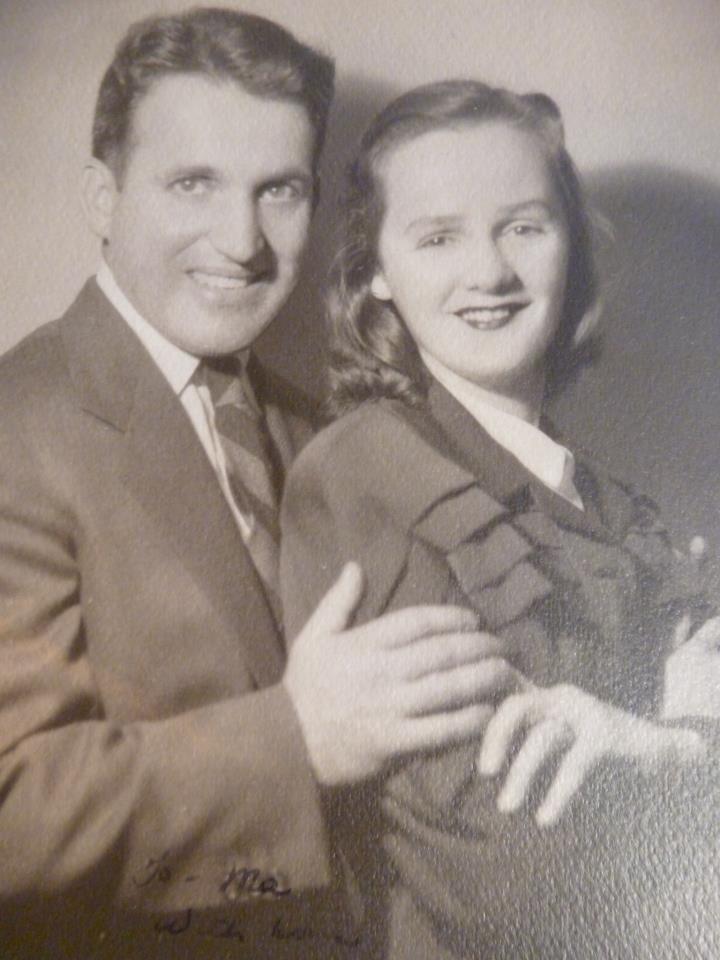
My parents on their honeymoon
Despite these burdens and more, my Mom was always upbeat and giving: traits that didn’t change even when she was diagnosed with cancer. She struggled against the ravages of that disease for five long years before succumbing to it in 1980. Cancer took her life but not her spirit. I never heard her once complain about the painful chemotherapy and cobalt treatments she endured.
My father too had a difficult life. He had to quit high school after the tenth grade and find a paying job to support the family. At the age of eighteen, he entered the Civilian Conservation Corps and fought forest fires in Oregon; factory work followed (where he met my Mom) until that was interrupted by the draft and service in the Army during World War II. After more factory work in the latter half of the 1940s, my Dad got on the local firefighting force, serving with distinction for more than thirty years until his retirement. He died in 2003 after a heart attack and surgery, from which he never fully recovered.
America’s heroes are women and men like my Mom and Dad: the factory workers, the homemakers, the blue-collar doers and givers. And as I think about my Mom and Dad, I recall both their loving natures and their toughness. They had few illusions, and they knew how to get a tough job done, without complaint.
There’s so much we can learn from women and men like them. Personally, I’m so sick of our media and our government telling us how scared we should be — whether of violent crime or violent tornadoes or bogeyman terrorists overseas. My parents recognized the hard-won wisdom of Franklin Delano Roosevelt: the only thing we have to fear is fear itself.
But today our government prefers to abridge our rights (see the latest extension of the so-called Patriot Act) in the name of keeping us safe and less fearful, a bargain for those who exercise power, but not for tough-minded people working hard to scrape a living for their children (thanks again, Mom and Dad).
My parents weren’t worried about threats emerging from left field. They had real — and much more immediate — challenges to deal with right at home. In this spirit, I still recall my Dad talking somewhat heretically about the Cold War and the Soviet threat. His opinion: if the Americans and Soviets are stupid enough to nuke one another, a billion Chinese will pick up the slack of human civilization. No bomb shelters or ducking and covering for him. It was back to work to support the family by putting out fires in our neck of the woods.
An old polaroid of me and my dad, circa 1980
And that’s what we need to do today as a country. We need to put fear aside and band together to put out fires in our neck of the woods. Together we can make a better country. In so doing, we’ll honor the heroic sacrifices of our families and ancestors: people like my Mom and Dad.
God bless you, Mom, Dad, and all the other quiet and unsung heroes of America.
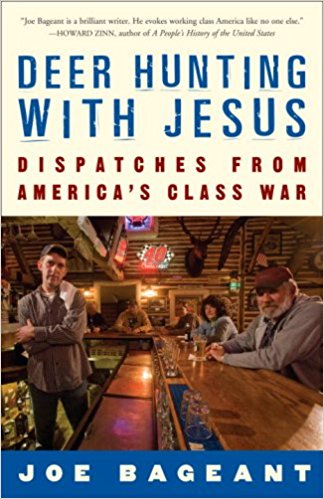
Joe Bageant was a remarkable writer, the author of “Deer Hunting with Jesus” as well as “Rainbow Pie.” A self-confessed “redneck,” he worked his way into the middle class as an editor, but he never forgot his roots in Appalachia and the subsistence farming of his Scots-Irish family. Bageant had a brutally honest and unadorned way of speaking and writing, and also a great affection and deep respect for traditional communal values in America.
The other day, I was reading an old essay Bageant wrote, “Live from Planet Norte” (June 2010), long before Donald Trump was even remotely considered to be presidential material. As usual, Joe nailed it:
[I]n the process of building our own gilded rat-cage, we have proven that old saw about democracy eventually leading to mediocrity to be true. Especially if you keep dumbing down all the rats. After all, Dan Quayle, Donald Trump and George W. Bush hold advanced degrees from top universities in law, finance and business.
The head rats, our “leaders” (if it is even possible to lead anybody anywhere inside a cage), have proven to be as mediocre and clueless as anyone else. Which is sort of proof we are a democracy, if we want to look at it that way. While it is a myth that virtually anybody can grow up to be president, we have demonstrated that nitwits have more than a fighting chance. During my 40 years writing media ass-wipe for the public, I have interviewed many of “the best of my generation,” and, believe me, most of them were not much.
Naturally, they believe they are far superior by virtue of having made it to an elevated point in the gilded cage, closer to the feed, water and sex. Because they believe it, and the media–sycophants waiting for quotes–echoes their belief, discussing their every brain fart, we tend to believe it, too. Nothing shakes our belief, not even staring directly into the face of a congenital liar and nitwit like Sarah Palin, or a careening set of brainless balls like Donald Trump or a retarded jackal like George W. Bush.
Americans are unable to explain why such people “rise to the top” in our country. We just accept that they do, and assume that America’s process of natural selection – the survival of the wealthiest – is at work. These people are rich; therefore, they should run the country. God said so. It’s a uniquely American principal of governance, which in itself, makes the case for our stupidity.
Donald Trump is best at selling a certain image of himself: the self-made billionaire, the savvy deal-maker, the populist patriot who sides with the little guy. But Joe Bageant had him pegged: a careening set of brainless balls is maybe the best, and certainly the most colorful, descriptor I’ve come across for Trump.
Bageant’s larger question is clear: How did Americans come to value such nitwits, halfwits, and dimwits? Just because they have money? Just because they have a veneer of “success” about them, when this “success” is evidenced by nothing more than money or fame and the sly charm of grifters?
Americans, who worship at the altar of success as measured by the almighty dollar, are kneeling to pray before the empty suits of men like Donald Trump. Bageant knew better than to join that mindless cult; so should we all.
A good friend sent me Miya Tokumitsu’s recent article, “The United States of Work: Employers exercise vast control over our lives, even when we’re not on the job. How did our bosses gain power that the government itself doesn’t hold?” One answer: Americans have been sold on the idea of work as fulfilling and even ennobling, and indeed the more work the better. Yet if work is so wonderful, why do we pay some people only $7.25 an hour (the minimum wage)? That’s less than $15K a year if you work 40 hours a week for 50 weeks. Try living on that. Work is so “great” in America that some people work two or even three jobs to make ends meet, leaving little time for leisure or for family.
I remember when the “future” (which is now) was sold as a time when mechanization and robots and efficiency would grant us much more leisure time. The idea was that new machinery and methods would curtail work. That most people would work 25-30 hours a week at better jobs involving less drudgery, leaving them lots of time to raise families and otherwise to enjoy life away from the tedium and regimentation of the workplace.
It’s not so easy keeping up with our machine-driven mania for work
But the future isn’t what it used to be. There are many reasons for this. Americans often consume too much, i.e. they keep working to keep up with the Joneses. Companies want higher and higher profits, driving them to squeeze more and more out of fewer and fewer workers. And work in the USA isn’t just about work. It’s often directly connected to health care, life insurance, and other benefits. If you choose (or are told) to work part-time, you may lose your employer-provided health insurance. If you’re fired, you lose your health benefits along with your salary and perhaps as well your sense of worth.
So much of our lives, especially in the USA, is tied to work. After “What’s your name,” the next question most commonly asked of new acquaintances is, “What do you do? Where do you work?” People’s sense of identity, their sense of worth, is often tied to their job, another big reason why losing one’s job is among the most stressful events in a person’s life.
And now work in America is often 24/7/365 since nearly everyone has electronic leashes, the Smart phones and so on, meaning the boss can always contact you. And if you choose to unplug, maybe the boss will find someone else to take your place. France recently passed a law to protect employees who choose to “unplug” after work and on weekends. No such law in the USA, of course.
From my days in the military, I recall how so many officers put on a great show of looking busy. “I have 276 emails to answer.” “I’m wrestling alligators.” “So busy — need to come up for air.” When did being swamped by work become a sign of success? In my view, the more efficient you are, the less grinding work you should need to do. (Of course, many jobs are all about grinding work: as my dad used to say, the more physically grueling the job, the less he usually got paid.)
Work mania has many pitfalls. Exhaustion leads to mistakes. Broken health, either physical or mental. Estrangement from family and the natural world. I wonder, for example, whether people are dismissive of global warming and other environmental issues simply because they spend no time outdoors. They’re always working, or going to and from work.
I used to commute 60+ miles to and from work. I’d get up about 5:30AM, leave about 6:15AM, get to work by 7:30AM, work until about 4:30PM, then get home about 5:30PM (on a good day). After that, I was tired. And I didn’t come home to screaming kids with school and sporting events and so on. Are we so busy and distracted that we hardly recognize that we live in an ecosystem of great fragility? In fact, all our commuting, all our busyness, all our consumption, only broadens our carbon footprint.
This is not a rant against work, or a cry to get ourselves back to the garden. But surely there’s a better way of striking a balance between work and everything else. I recall watching Michael Moore’s documentary, “Where to Invade Next.” The segments on Italy and Germany are telling here. In Italy, workers get much more vacation time than their U.S. counterparts, roughly five weeks plus 12 national holidays (watch this segment). U.S. workers by comparison are lucky to get two weeks’ paid vacation. In Germany, Moore asks a bunch of German workers if they have second jobs. They look at him like he’s crazy. One job is enough, they say, at which they work about 36-38 hours a week. What do you do with all the “extra” time, Moore asks. Hang out at a café, read, and otherwise decompress, they answer.
I recall that Italian workers often get a long break so they can go home and prepare lunch for the family. U.S. workers may be lucky to get 30 minutes (often unpaid), or even 15 minutes, for lunch, during which they’re fortunate to be able to bolt down some (probably unhealthy) fast food.
Some things in life shouldn’t be “fast,” like food. And some things shouldn’t dominate our lives, like work. Sure, some people work long hours at jobs they love, and if that’s the case, go for it. But America’s work mania has its costs, including an estrangement from ourselves as well as the living world around us.
Linda with her hat and the note that accompanied it
Linda Roller
Editor’s Intro: Linda Roller is a good friend who owns one of those used bookstores that bibliophiles dream about, complete with cats and books and ephemera and located in an old church in the middle of rural Pennsylvania. It’s an area that went for Trump in last year’s election; it’s not an area associated with political activism for progressive causes. Yet Linda’s community filled three buses of concerned citizens, all willing to sacrifice their time to make a statement in a March on Washington that was, in a word common to last year’s election, huge. Can the momentum for a true people’s movement be sustained? With powerful women like Linda on the march, I am hopeful. W.J. Astore
Check out Linda’s bookstore at this link. She has a great selection of used books at low prices.
I Went Down to The Demonstration…
The March on Washington can be seen — six hours of it — on You Tube. I almost tuned in the other day, but I resisted until I had a chance to write down what I saw there. For I never saw the speeches, heard the words. I never saw the jumbotrons. And I never got to the elliptical. But that’s okay. That was recorded, and what I saw was the stuff that is not covered by any media, but was important to me and will be with me forever.
Waiting on the World to Change…
Perhaps the first inkling that this was going to be far more than “a bus ride and a demonstration” was the early morning in a Sears parking lot in Muncy, Pennsylvania. A sea of cars was there, just waiting for the three buses from our rural, conservative, suspicious of outsiders (both people and ideas) area. It wasn’t just the people who demonstrate here, and who identify themselves as “true Progressives.” Frankly, that group wouldn’t fill a bus. It was really a diverse lot of folks, and although there were many older, white women, there were African-American women from Williamsport, and even a good percentage of people under 40. The women who organized this trip were not the “usual suspects,” which may account for the different people on the buses.
The trip started with a glitch. Two of the three buses were late — the buses organized through the national group. This could have led to defections, but … people waited. The local bus left to collect the women from down the Susquehanna valley. The other arrived an hour later.
The chief organizer here is a woman who owns her own little yarn and knitting shop, and has never done anything like this before. But the knitting connection was the catalyst for all members who wanted to get a “pussy hat.” She had hats from around the globe, the last shipment being from Australia. Mine was knitted by Lori in Indianapolis, and it warmed me to know that another woman from a conservative state felt strongly enough to knit for others. Both buses stopped at a rather small service station, with a small women’s restroom. We discovered that the men’s room was even smaller, as we commandeered it for the over 75 women who had to use it in less than 30 minutes. One guy tried to assert his rights, and we were apologetic but firm.
Normally, leaving from here at 5:20am on a weekend morning would get you to DC by 9:30 or so on a charter bus. But traffic was amazingly heavy, and we got in a little late. The bus captains went over safety tips, non-confrontation issues, how not to be arrested—and that the buses were leaving at 6:30pm, with or without us. And then we got off the bus.
Fired Up! — Ready to Go!!
Off the bus in an ocean of buses…from everywhere! The first woman I met was from San Francisco, visiting family in Delaware and marching. We had been told that the metro was too full, even though the Mayor of DC had brought all lines up to rush hour levels to accommodate the march. I saw an older woman in a walker headed to the metro stop at RFK stadium from the buses, with the kind of determination that moves mountains. And with that, our group of four headed to the National Mall, a little over two miles away. Although our group were the only people that I could locate from the bus at that moment, we were hardly alone. We were simply part of a river streaming ahead, north and west to the center. And we were not invisible. We were met early by DC traffic safety, who reminded us to mind the roads near RFK, to block some roads, and with a smile welcoming us to DC. “We’re glad you’re here!”
Indeed, it seemed as though all the good citizens of the District were out to welcome the marchers, as we blocked their streets and removed any way for these folks to move cars and go about a normal Saturday. They waved, said “Thank you for coming!” Members of Capitol Hill Seventh Day Adventist Church stood on the steps and chanted, and the minister came down and shook marchers’ hands, as we disrupted their day of worship. About halfway to the National Mall, the signs with quotes from Martin Luther King popped up everywhere, for MLK day was less than a week ago. Music poured out of windows for the marchers — “Girls Just Wanna Have Fun”… (as in Fundamental Rights).
And with that it began to feel like something even bigger—it all began to take on echoes of other marches, other days, other people. By now, we were chanting, and really marching. Five blocks out, and we were already there, doing the work we came to DC to do. And then we got to the US Capitol Building, and the enormity of it all washed over our group of marchers. Before us, there was an ocean of people—people who were deeply concerned, and here to stand. To stand for Women’s Equality, for immigrants who feel threatened, for people of every race, creed, religion, sexual orientation, and for a sense of justice. And yes, to show concern and anger at President Trump’s statements and actions. But the overall feeling was that we stood in solidarity with one another, even if we did not totally agree on all the issues.
Before I left, I did a small piece on Facebook about why I marched, and one of the things that I said was that I marched for those who could not. Time and time again, people talked about a mother, a sister, a friend that was symbolically with the marcher. One woman I saw had a placard on her back with over 50 names of women she marched for. It was simply staggering.
Standing on the Side of Love
Like I said, I never saw the stage, or heard the addresses of the day. There was no chance that I could get there. I never saw the jumbotrons where proceedings were broadcast. That’s okay. I saw and talked to people just like me from all over the country, and people just like me but different. They had different clothes, different hair, different skin, different religion, different age—but the same heartfelt wishes, the same fears for the future, the same willingness to stand and be here today.
And those of us who made a march were kind to each other — all our Mommas had made polite people on this day. And that was tested—as there were few places to sit, no places to get a bite to eat or drink, and in many places on the National Mall, no place even to stand. At one point, the four of us were crushed against a barrier, and could not move. A woman in the crowd began to have a claustrophobic reaction, and the people made a tunnel for her and her people to get out of there, even when so many others would have liked to move. We apologized for stepping on toes, we allowed people in and around, and most importantly, we talked to each other, asked where we were from, and regarded each other as people. And at noon, a group of Muslim women unfolded blankets and prayed, while others gave them space and peace.
Sure, I saw some great signs. One person knitted a 4-5 foot uterus as a sign. That’s dedication. A group walked about with a 10-12 foot globe and chanted. That’s heavy lifting. Lots of humorous signs, signs of exasperation. Organized signs. Disorganized signs. Signs made by people for weeks, signs made by people after they got there, on scraps of cardboard. And the “official” signs were incredibly artistic and you could download them for free and print them.
There was some “cosplay” too. I marched beside Wonder Woman for about 3 minutes. WW must have been cold in the outfit, and I have no idea who it was. I saw a few Superwoman socks – the ones with the capes on them. Since most of us marched around 10 miles if we walked from RFK, I think we all were worthy of a set of those. I saw some Power Rangers get photographed, and on the top of pallet stacks, people climbed and tried to help the rest of us see where people were needed. People on lampposts tried to give directions, but that was mostly futile.
Tell Me What Democracy Looks Like…This is What Democracy Looks Like!!!
In some sense, the wheels had fallen off this wagon. The planned speeches and march were simply dwarfed by the numbers of people. We couldn’t march the planned route. It was full, as were many other streets. We couldn’t get to the Washington Monument. The way there was full of people – and in that sense, it was a complete, perpetual march around everything by all of us.
The most common chant was “This is what democracy looks like.” Indeed. It is the look of citizens– concerned, aroused citizens. It was a whole lot of a gentle, angry people. Some more gentle, some more angry—and all of them chanting for a country they all deeply believe in. That this march was so large had an impact that transcended the original plans. And while we marched, information about all the other marches all over the world swirled through the National Mall to waves of cheers.
Finally, it was the witching hour – the time to go back to the bus. We worked our way out of the mall and began the slog up to RFK. We were so hungry, with sore feet. A beer in a pub would have been heaven, but heaven was already claimed by others, and the wait was too long for us to meet the bus. We eventually found a coffee shop. Nancy got us a chai latte, and nothing ever tasted so good or felt so warm. I sat on the curb outside, just for a chance to sit. And I sat with others from the march, and we talked, waited for a little bit of food, took the chance to relax, and talked about the march – but not in a “processed” sort of way.
It was as if the event was too big to be contained inside us. Cars going by honked and waved. On the way to try for a beer, we crossed in front of a car, filled with people we did not know. But the windows rolled down, and we talked to each other. They were not even involved in the march, just locals. But the signs and buttons made us approachable, and the day of talking to so many people in the march had our skills oiled up, too. At the coffee shop, we all decided that if we could get a cab or uber, we would take a ride for the 2 miles. It wasn’t long before we had that cab, and then got up to RFK. And that move allowed some shirt buying, a round of great hot dogs, and then the ½ mile from the actual stadium to the bus.
Laura and Nancy had a much better idea of where our bus was than I did and there we were—near the back of the lot. All the people on our bus made it back by 6:30, but we waited for a couple people in the second bus, who ended up taking a taxi back. On the road by 7PM. Nancy organized a better bus stop at a different location, where there were two large gas/convenience store/restrooms. We talked a bit, but surprisingly we slept, even though we thought we were too excited to do that.
The days since have been “processing days”—time to think about what happened and time to begin the plan beyond the march. The march was a mountaintop moment. It was a place and time, a gathering of like-minded people, a time to feel connected, and a time to feel the power of the people. Now the hard work of creating and recreating the vision continues.
I have not been an activist for many years. I feel that demonstrations are performance art. I am more at home in the life of the mind. But as the sign says,
“Thank you, President Trump.
You have created an activist in me.”
Linda Roller is a writer and owner of a used bookstore in Avis, PA. Be sure to visit her shop (link here) and browse her selection of used books at great prices.
But America has been edging toward post-truth for a long time — even at its founding, skeptics might say. The “City on a Hill,” forged on an image of Christian rectitude, witnessed the genocide of Native Americans (“savages”) and the embrace of slavery based on specious theories of racial inferiority, even as the Bible taught the love of neighbor and the equality of all before God.
More recently, America has witnessed the triumph of post-truth in the aftermath of 9/11. Recall how the attacks on 9/11 were falsely connected to Iraq, which was then connected to false claims of Iraq having active programs of WMD development, including “yellowcake” uranium as well as chemical and biological agents spread by aerial drones. All proven false, but all used to justify the invasion of Iraq in 2003.
Indeed, many Americans continue to believe that Saddam Hussein planned the 9/11 attacks (in league with Osama Bin Laden). Recall here the rare honesty of Britain’s Downing Street Memo of 2002, which asserted that the “facts” being offered by the Bush/Cheney administration were being manufactured (“fixed”) around a pre-determined policy of invasion. The result? Iraq was yet another un-democratic war, based in part on lies. Indeed, it’s no accident that Congress hasn’t issued a formal declaration of war since 1941. (Another war based on lies: the Vietnam War, e.g. recall the false reports of attacks at Tonkin Gulf.)
Another example of post-truth was the Surge of 2007, advertised as a “win” for America even as General David Petraeus warned that progress in Iraq was both “fragile” and “reversible.” So it has proved, for here we are, a decade later, trying to recapture territory (such as Mosul) that had allegedly been pacified under Petraeus.
America’s post-truth crew has now been captured by a shameless con man, the Tweeter-in-chief, Donald Trump. Recall a saying often attributed to P.T. Barnum that “a sucker is born every minute.” Trump knows this — and will exploit it to the hilt, if the American people let him.
As January 20th approaches, Americans need to prepare themselves for a post-truth presidency. As my dad used to say to me: “Don’t believe anything that you read and only half of what you see.” Wise words for the days and years to come, but they come with a major problem. Some sense of truth, of consensus based on acknowledged facts and a rigorous and fair-minded process of reasoning, is needed for a democracy to function.
Without integrity, which is based on facts and honesty and a willingness to reason together in good will and with honorable intentions, democracy simply cannot function. Put simply, a post-truth America is an anti-democratic America. For without truth, without some consensus based on facts, all you have is lies, misinformation, and spin: a foundation of sand upon which nothing of worth can be built.
In the crusade against Communism, otherwise known as the Cold War, the U.S. saw “freedom” as its core strength. Our liberties were contrasted with the repression of our chief rival, the USSR. We drew strength from the idea that our system of government, which empowered people whose individualism was guided by ethics based on shared values, would ultimately prevail over godless centralism and state-enforced conformity. An important sign of this was our belief in citizen-soldiers rather than warriors, and a military controlled by democratically-elected civilians rather than by dictators and strong men.
Of course, U.S. foreign policy during the Cold War could be amoral or immoral, and ethics were often shunted aside in the name of Realpolitik. Even so, morality was nevertheless treated as important, and so too were ethics. They weren’t dismissed out of hand.
Fast forward to today. We no longer see “freedom” as a core U.S. strength. Instead, too many of us see freedom as a weakness. In the name of defeating radical Islamic terrorism, we’ve become more repressive, even within the USA itself. Obedience and conformity are embraced instead of individualism and liberty. In place of citizen-soldiers, professional warriors are now celebrated and the military is given the lion’s share of federal resources without debate. Trump, a CEO rather than a statesman, exacerbates this trend as he surrounds himself with generals while promising to obliterate enemies and to revive torture.
In short, we’ve increasingly come to see a core national strength (liberty, individualism, openness to others) as a weakness. Thus, America’s new crusades no longer have the ethical underpinnings (however fragile they often proved) of the Cold War. Yes, the Cold War was often unethical, but as Tom Engelhardt notes at TomDispatch.com today, the dirty work was largely covert, i.e. we were in some sense embarrassed by it. Contrast this to today, where the new ethos is that America needs to go hard, to embrace the dark side, to torture and kill, all done more or less openly and proudly.
Along with this open and proud embrace of the dark side, America has come increasingly to reject science. During the Cold War, science and democracy advanced together. Indeed, the superior record of American science vis-à-vis that of the Soviet Union was considered proof of the strength and value of democracy. Today, that is no longer the case in America. Science is increasingly questioned; evidence is dismissed as if it’s irrelevant. “Inconvenient truths” are no longer recognized as inconvenient — they’re simply rejected as untrue. Consider the astonishing fact that we have a president-elect who’s suggested climate change is a hoax perpetrated by China.
Yesterday, I saw the following comment online, a comment that summed up the new American ethos: “Evidence and facts are for losers.” After all, President-elect Trump promised America we’d win again. Let’s not let facts get in the way of “victory.”
That’s what a close-minded crusader says. That the truth doesn’t matter. All that matters is belief and faith. Obey or suffer the consequences.
Where liberty is eroded and scientific evidence is denied, you don’t have democracy. You have something meaner. And dumber. Something like autocracy, kleptocracy, idiocracy. And tyranny.
Two weeks ago, I did an interview with TheoFantastique on the military in science fiction. I’d like to thank John Morehead, the site’s creator, for inviting me to answer a few questions on a subject near and dear to my heart.
TheoFantastique: Bill, thanks for making a little time to respond to a few questions related to the subject matter of your article. What are some general observations you have made about the shift in science fiction film depictions of the American military from the post-World War II period to the present?
Bill Astore: Thanks for inviting me, John. I grew up in the late 1960s and 1970s, in the immediate aftermath of the Vietnam War and Watergate. Films of that era were generally critical of the establishment, including sci-fi films. I fondly recall Planet of the Apes with its anti-nuclear message. Also Soylent Green with its warning about over-population, but even more dire was the way in which the authorities hid from the people the true nature of their new food source. Think also of Capricorn One, hardly a great film, but one which exposed a government conspiracy at the heart of the first manned mission to Mars. And Silent Running with Bruce Dern. The basic message was how humans were destroying planet earth, often due to nuclear war or environmental destruction, or both. Finally, Logan’s Run was a favorite of mine, but again the message was how the government of that world hid from the people the true nature of life outside of the bubble.
I remember seeing Alien in the theater and being blown away by the alien “birth” scene. But again the theme of that film was you can’t trust the authorities, who wanted the “alien” at any cost, i.e. the crew was expendable. Think of Outland as well with Sean Connery: yet more corruption among the establishment, this time involving drugs and production quotas in space mining. Here the workers were expendable.
I know I’m digressing from your question, but my general point is this: Sci-Fi films (and stories) are generally questioning (or questing, perhaps). They are usually not pro-military or pro-authority. Put differently, for every Starship Troopers there’s a Bill the Galactic Hero as a counterweight.
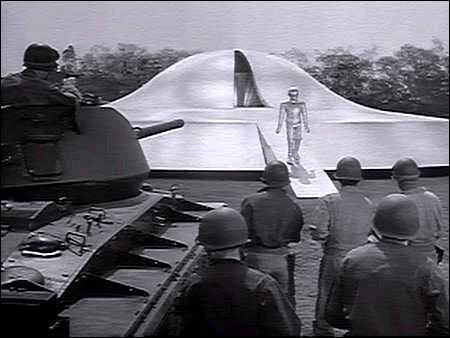
Think of one of my all-time favorite films, The Day the Earth Stood Still. The military is completely ineffectual in that film. Worse: the military contributes to the problem. Similarly, in the 1950s lots of films were made about the dangers of nuclear war and radiation. The military usually didn’t emerge in a favorable light in those films, if I recall correctly.
I think this began to change with films like Star Wars and Close Encounters of the Third Kind. Star Wars could be read as apolitical (“a long time ago, in a galaxy far, far away”), even if that wasn’t George Lucas’s intent. In Close Encounters, a terrific film that I saw in the theater, the authorities actually know what they’re doing. They greet the alien mothership peacefully, and communicate with music and light instead of guns and nukes. Again, I don’t think Spielberg was making a pro-authority or pro-military film, but I believe he didn’t want to make a political film, a film like The Day the Earth Stood Still.
After these two films, Hollywood embraced space operas and feel-good movies. There were exceptions, of course. One of my favorite movies is Starman with Jeff Bridges. Again, the authorities only want the alien for the powers he brings with him. Think too of The Man Who Fell to Earth and the way in which his life is corrupted by human excess. Doesn’t he get addicted to television?
The movie that really changed it all was Independence Day, a perfect film in the aftermath of Desert Storm (the expulsion of Iraq from Kuwait). Here, of course, the militaries of various countries come together to defeat the aliens, led by an American president who climbs into the cockpit to lead the charge himself. This proved so popular that it’s no surprise George W. Bush tried to replicate the scene in the aftermath of the U.S. invasion of Iraq in 2003 (his infamous landing on an aircraft carrier, followed by his “Mission Accomplished” victory speech).
TheoFantastique: What represents much of the portrayal of the U.S. and its military, and what does this say back to us by way of reflection on American militarism around the world?
Bill Astore: I think many, if not most, Americans now want to see the U.S. military portrayed in a positive light in films. Since the 1980s, and especially since the 1990s, Americans have been told to “support our troops.” After 9/11, ordinary Americans were taught and told we live in a dangerous world filled with “alien” terrorists, and that we had to submit to authority to combat and defeat those “aliens.”
Some recent sci-fi films, I believe, have come to celebrate the military, its weaponry, and its can-do spirit of “warriors.” They’ve played it safe, in other words. In some cases, film makers may have curried favor with the Pentagon as a way of securing military cooperation in filming. For example, to secure access to bases, to advanced technologies such as the F-22 and F-35 jet fighters, and so on. It makes their films “sexier” to have such access.
I’m sure some would say, So what? What’s wrong with a summer blockbuster that portrays military action in a favorable light? To that I’d say: reel war is nothing like real war. The best science fiction films — or the memorable ones — inspire us to dream of bettering ourselves as individuals and as a species. And I think the best films still seek to challenge us to be more noble, more benevolent, more compassionate.
TheoFantastique: How do you feel as a retired Air Force officer about current science fiction’s perspective on the U.S. military?
Bill Astore: I have mixed feelings. On the one hand, I’m glad that films are not universally anti-military. On the other hand, I’m upset that many films tend to glorify battle and war. War often looks very sexy and exciting in today’s crop of sci-fi action flicks. We need to remember that war is bloody awful, and that lasers and light sabers would not make it any less awful.
Check out TheoFantastisque, a meeting place for myth, imagination, and mystery in pop culture.
It’s Trump coronation week. My wife and I were out with friends last night, sitting in a bar, watching a muted screen that featured Melania Trump giving her (plagiarized?) speech at the convention. A muted screen was perfect to focus on what really matters at this convention – the optics. The screen behind Melania was a fetching color of patriotic red. Shots of the audience showed a mostly clean-cut crowd of predominantly White people, politely applauding, sprinkled with occasional shouts (which happily I couldn’t hear).
As I watched the spectacle, I turned to my friend, another historian. We both waxed nostalgic for political conventions that featured real news rather than manufactured drama. For example, I vividly recall the Republican Convention of 1980, when it seemed for a fleeting moment former President Gerald R. Ford was joining Ronald Reagan on a “unity” ticket. (It was not to be, which is sad. Such a ticket may have saved us from the rise of the Bushes.) Nowadays, barring a major gaffe (plagiarism again?) or perhaps a violent protest, nothing much of consequence happens at these conventions.
Of course, readers of this blog know that I reject Trump, and all his works, and all his empty promises. But that doesn’t mean I won’t give the devil his due. Trump is a deceiver, a con man par excellence, and many Americans are desperate to believe the con.
An example from my local paper. A reader wrote: “Without Trump’s help, we’re all going down,” following that with “We are on the Titanic, and it is going down. Hillary is snug in a lifeboat. The rest of us are in steerage. I don’t care what his hair looks like; we need to be rescued.”
What can one say to that? As I recall, once it struck the iceberg, the Titanic was a doomed ship. Putting Trump at the helm would only help it to slip under the waves faster, perhaps a mercy for those fated to die, but certainly no salvation for ship, crew, and passengers. But if it sped up the Titanic movie and Leonardo DiCaprio’s death scene, that at least would have been a cinematic mercy.
In all seriousness, this reader’s letter moved me. Not for its logic, but for its desperation. Yes, for many people these are desperate times in America. They know the ship of state is sinking. They know they’re stuck in steerage. And they know they’re fated to suffer the consequences, even as Hillary Clinton and crew have ready escapes.
But, and it’s a big “but,” America: Putting a con man at the helm of a foundering ship is not exactly the wisest course of action.
There are alternatives to Captain Trump and Lifeboat Hillary. Seek them out. Get involved. Leonardo DiCaprio’s character found his way out of steerage. Yes, a bit of Hollywood fantasy, but remember the Unsinkable Molly Brown? She was real.
Give me the generosity of Molly Brown over the narcissism of Trump any day — or any year.
(Dedicated to Paul and Mo, my friends at the bar.)
I’m a fan of books and book sales. A few weeks ago, I came across a vintage copy of Hugh Prather’s “Notes to Myself.” Published in 1970, it caught the Zeitgeist of the “Age of Aquarius” and became a surprise best seller. Its considerable influence is shown by the fact it was lampooned on “Saturday Night Live” as part of the “Deep Thoughts” series.
Some of Prather’s “notes” are solipsistic and more than a little pretentious, a fact he himself recognized, but some of them also have considerable depth of meaning.
Consider this one:
When I see I am doing it wrong there is
a part of me that wants to keep on doing
it the same way anyway and even starts
looking for reasons to justify the continuation.
When I read this, I instantly thought of U.S. strategy when it comes to the Middle East. I recently read Colonel (ret.) Andrew Bacevich’s new book, “America’s War for the Greater Middle East,” and Prather’s note could serve as an epigraph to the book, and an epitaph to U.S. wars and policy in the Middle East.
Despite a painfully expensive and tragically wasteful record of militarized interventions in Iraq, Afghanistan, Lebanon, Iran, Somalia, Libya, and many other countries throughout the greater Middle East, the U.S. military and foreign policy establishment persists in staying its presence course. Sure, the tactics have changed slightly over the years. Obama is less enamored of committing big battalions of ground troops than Bush/Cheney were, yet his administration is nevertheless committed to constant military interventions, misguided and one-sided relationships with Israel and Saudi Arabia, and unwavering optimism that this time, maybe this time, we’ll finally build effective Iraqi (or Afghan) security forces while simultaneously encouraging liberty in the region by sending more U.S. troops and selling more weaponry (together with bombing and killing, of course).
As Bacevich notes in his book (you should beg, borrow, or otherwise acquire a copy), experience has not taught the U.S. national security state much of anything. Whether that state is led by a Clinton or a Bush or an Obama matters little. The U.S. can’t help but meddle, using its powerful military as a more or less blunt instrument, at incredible expense to our country, and at a staggering cost in foreign lives lost or damaged by incessant warfare. And no matter how catastrophic the results, that national security state can’t help but find reasons, no matter how discredited by events, to “stay the course.”
Consistent with what Prather says, it looks “for reasons to justify the continuation” of present policy, even when it knows things are going wrong in a very bad way.
Perhaps the U.S. national security state needs to make some “notes to itself.” Consider it a personal audit of sorts, since the Pentagon can’t pass a financial one. If it ever does, Prather’s “note” above would be a good place to start.
Donald Trump says he wants to make America great again. What does this mean, exactly?
Think about it. As American workers, how desperate are we to “hire” a man as president whose signature line to wannabe entrepreneurs is, “You’re fired”? We’re a bit like abused spouses who, despite being bruised and bloodied, still decide to stand by a bully.
Americans sense that our nation is in decline; indeed, that’s the implicit meaning (as noted in this article by Tom Engelhardt) of Trump’s slogan: he wants to make America great again. As in, we’re not great now, but we have been in the past, and under Trump we will be again. But how? Is Trump just going to fire all the “losers” in America?
Many abused workers have placed their faith in Trump to revive America. Yet the irony is that Trump himself has precipitated America’s decline, what with his tacky casinos, his off-shoring of jobs, his shady business deals that seek to maximize profits while minimizing pay to workers.
So much of our economic health today, such as it is, consists of massive spending tied to a sprawling national security state, which fosters military adventurism and interventionism as well as weapons exports, amplified by casino capitalism (literally “casino,” as in my old hometown, which desperately seeks a casino as a jobs producer).
Back in the day, the city of my birth was proud to manufacture shoes and to ship them around the world. Now, my city puts it faith in casinos and gambling. If that’s not a clear sign of economic decline, what is?
Again, consider the irony of placing faith in Trump to reverse this trend. Nearly 30 years ago, in the song “Gimme What You Got,” Don Henley captured the hollowness of “promoter Trump” with the following lines:
Now it’s take and take and takeover, takeover
It’s all take and never give
All these trumped up towers
They’re just golden showers
Where are people supposed to live?
Trumped up towers – more true today than when Henley penned that song (along with Stan Lynch and John Corey) back in 1988.
How have so many come to place their faith in America’s resurgence in the trumped up BS of Donald Trump? Again, someone whose signature line as a boorish and preening boss is, “You’re Fired”?
Let’s make America great again. Come this fall, let’s not hire Donald Trump as our new boss.












 Bracing Views