More than 100 people are already dead from catastrophic flooding in Texas. The “blame game” has started, with the Trump administration taking heat for flash flood warnings that came too late to save those in the path of surging rivers fed by thunderstorms dumping too much rain in too short a time.
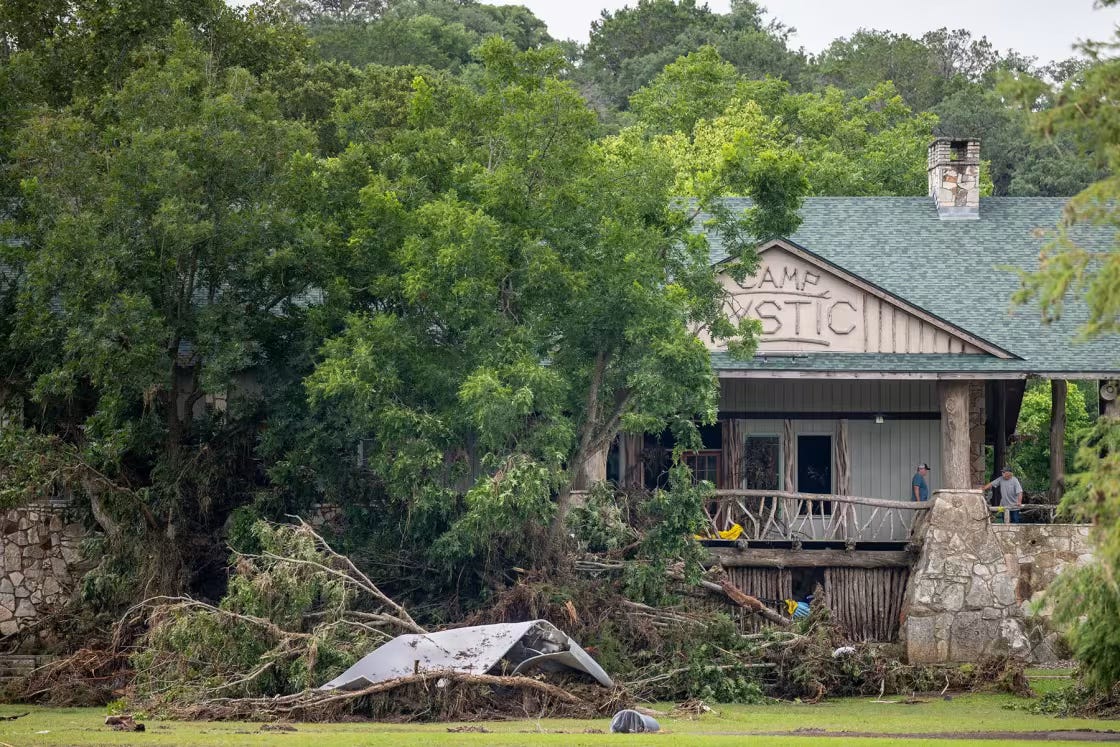
Camp Mystic in Texas was especially hard hit by flooding, losing 27 children and camp counselors
The White House, naturally, says it’s not their fault. If you want to blame someone, blame God. A quick summary from NBC:
White House Press Secretary Karoline Leavitt pushed back against questions as to why flood alerts were issued “while people were likely sleeping” and what the administration is doing to ensure alerts go out earlier.
Leavitt noted that the National Weather Service issued escalating warnings Thursday regarding the weather forecasts as information came in. She said there were “timely flash flood alerts” including a flood watch in the afternoon, evening, and “timely flash flood alerts” at night.
“So people were sleeping in the middle of the night when this flood came — that was an act of God,” Leavitt said. “It’s not the administration’s fault that the flood hit when it did, but there were early and consistent warnings.”
“An act of God” — Divine wrath? Judgment? What, exactly?
Why do we use this expression, “an act of God,” as if God or gods are just waiting to smite people with hurricanes, floods, locusts, tornados, and (Lord?) knows what else.
Wasn’t it really an act of nature? Too much heat, too much humidity, and wind patterns combining somewhat predictably to cause dangerous flash flooding. An act of nature we can guard against. An act of God implies caprice, violence, and forces that can neither be predicted nor prevented.
We know about acts of nature. That’s why we have science and scientists, or in this case meteorologists, radar, supercomputers, and the like. We fund a national weather service of experts so that we can predict and perhaps ameliorate some of these acts of nature.
But we know as well nature is becoming more extreme. Nature’s acts are becoming more violent as the earth slowly warms and as climate patterns become more violent and hence often less predictable—as well as more punishing.
Let’s not talk about acts of God, whether as a way to shift blame or even as a form of comfort. (Speaking for myself, I wouldn’t be comforted if someone told me God had swept my loved one away in a flash flood He sent.) Let’s talk about acts of nature, and how they’re growing more violent, and the steps we can take to understand them, predict them better, and lessen their impact.
Again, “act of God” gets us nowhere. But I know man is acting, with drill, baby, drill consistency, and man’s acts are something we do have control over.
With sympathy to all those who’ve lost loved ones in the terrifying flash flooding in Texas. Nature can be brutal—it’s why we must respect it, study it, and understand it.
Hi Everyone: If you’d like to support this site but don’t want to subscribe and pay a yearly fee, perhaps you’d consider my new book, My Father’s Journal, available through Amazon for $10 (paperback) or $5 (Kindle). Just click on that link and order away. Order five copies for your dad! (Yes, that’s reference to a song lyric, “Gonna buy five copies for my mother.”)
Anyhow, here’s an except from the book, which details my father’s efforts to fight raging forest fires on the West Coast in Oregon and California during the 1930s. His account will likely remind you of the recent fires in LA.
A big “thank you” to those who order the book—I hope you enjoy it.
*****
It is surprising how many forest fires our crew fought and other groups that we assisted in the two summers I was in Oregon.
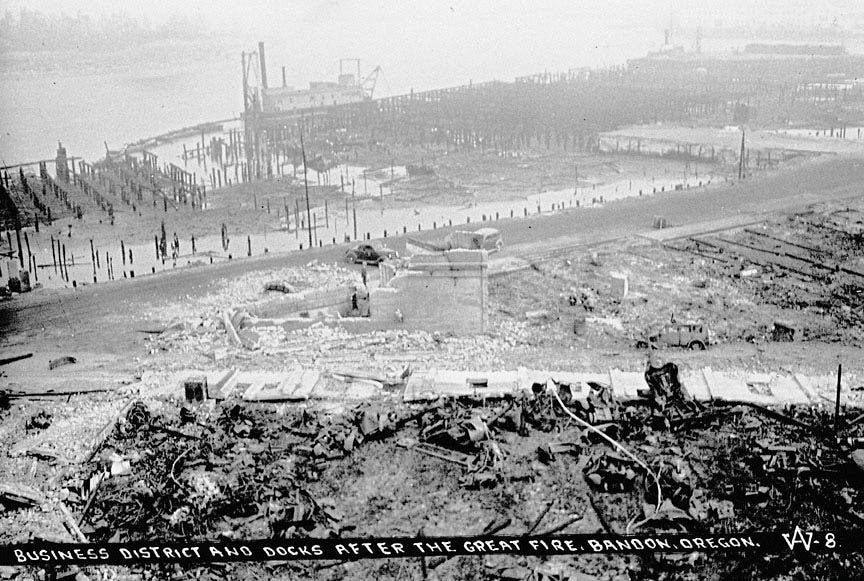
The main and largest fire we fought was in the fall of 1936. A very dry summer and fall added to the fire danger. We were in Enterprise, Oregon when we got our call to go to Bandon “By the Sea” Oregon. Enterprise is in the northeast corner of the state. The day before, Bandon had been swept by the forest fire. Twelve people lost their lives. It could have been much worse but all inhabitants fled to the ocean beaches. One pregnant lady gave birth to a baby on the beach.
Fifty of the men in our camp, using 2.5-ton trucks, traveled across the state (guessing approximately 300 miles). The areas were involved in hundreds of fires that covered an area greater than the state of Massachusetts.
We were on the fire lines for over five weeks. At times we were put on reserve where we could shower and shave. We had about 5000 men, woodsmen, rangers, and CCC boys fighting this fire.
We were at Gold Beach, Oregon and we could look into California at the Siskiyou Mt. Range. There was a rumor we were going to fight a fire in the redwoods of California. But the call never came. We drove through Bandon; there were rows and rows of dwellings, gas stations and buildings burned to the ground. Quite a few chimneys were still standing. Every once in a while you’d see a dwelling or building spared by the fire. Just a whim of fate.
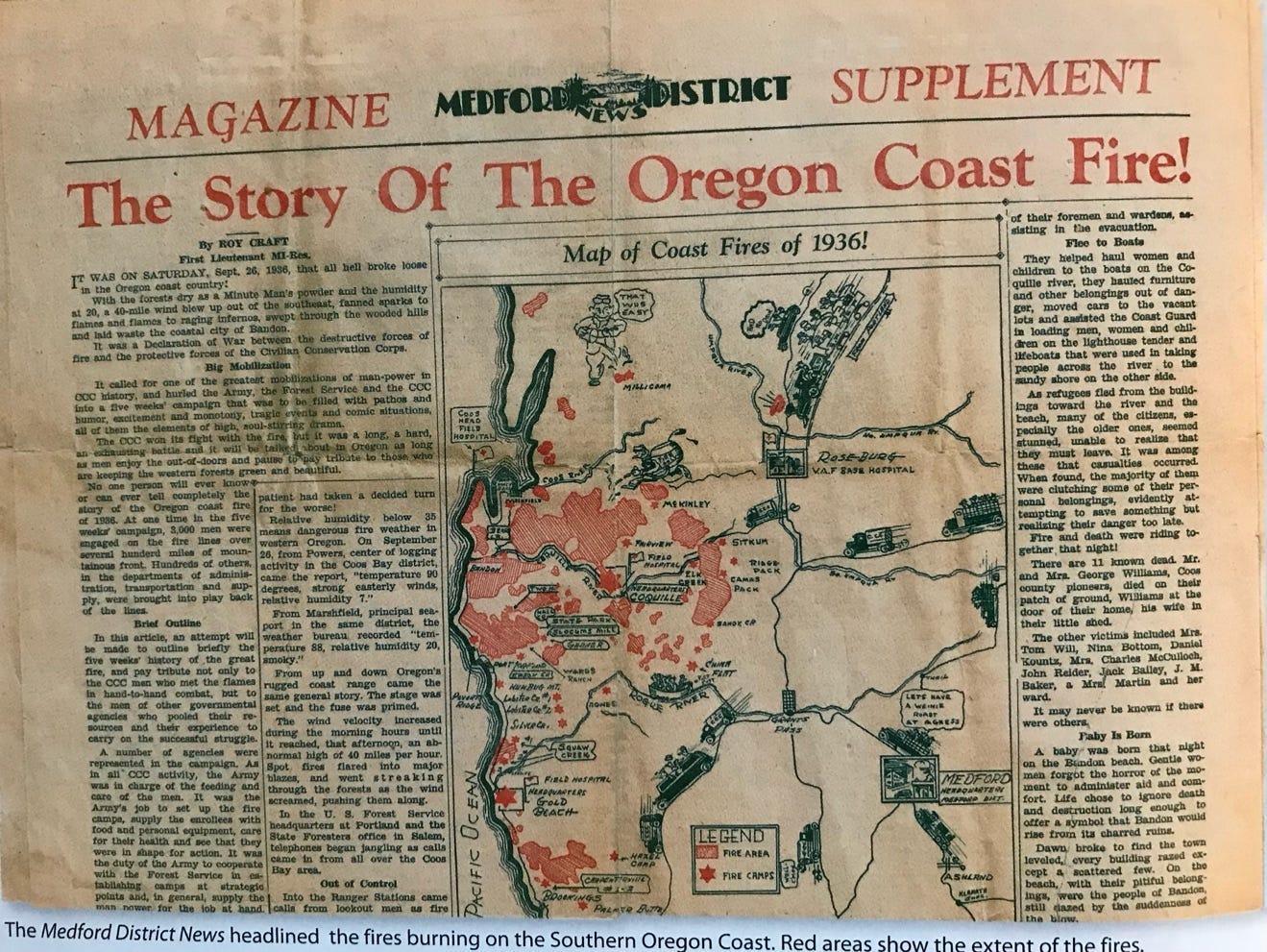
My father was a great saver of documents, including in this case The Medford District News, a local newspaper in Oregon that devoted two full pages to the five-week campaign to contain the Bandon Fires of 1936.[i] Written by Roy Craft, a first lieutenant, the story is worth quoting at length:
It was on Saturday, Sept. 26, 1936, that all hell broke loose in the Oregon coast country! With the forests dry as a Minute Man’s powder and the humidity at 20%, a 40-mile wind blew up out of the southeast, swept through the wooded hills and laid waste the coastal city of Bandon. It was a Declaration of War between the destructive forces of fire and the protective forces of the Civilian Conservation Corps….
As in all CCC activity, the Army oversaw the feeding and care of the men. It was the Army’s job to set up the fire camps, supply the enrollees with food and personal equipment, care for their health and see that they were in shape for action….
[Later that night] the fire had swept up to the very edge of the city. Then, borne on the shoulders of the 40-mile wind, the flames rode into Bandon. The Bandon fire department and the CCC men made a desperate stand but normal fire equipment was no match for the blaze.
As the fire approached the town, many residents were still unaware of the impending tragedy and had gone to the local theatre to see the feature picture, “Thirty-Six Hours to Live.” The film didn’t last that long, for in the middle of the show the film was stopped and a call was made for volunteer fire fighters.
As the fire poured into Bandon, building after building went up in flames. The residents literally “ran for their lives,” with men of the CCC … assisting in the evacuation.
Many people escaped in boats across the Coquille River, but the fire claimed at least eleven lives. As my father mentioned, a baby was indeed born that very night on the beach, which was taken as a “symbol that Bandon would rise from it charred ruins,” according to a somewhat fanciful newspaper account.
More than 100,000 acres burned over a period of five weeks until the November rains came to extinguish the flames for good. (Dad penned a quick postcard, dated 10/26/36, to tell the family he was fine and that he’d “been out fighting forest fires for over a month now.”)
As LT Craft put it in his newspaper account,
Anybody can play at being a hero for a couple of hours, or face trying and dangerous situations when the stimulus of excitement makes them glamorous and daring. But it takes guts to put out day after day on the fire line! Nothing tests a man’s mettle like a five weeks’ siege with fire, when it’s drudgery to put in a day and a night on the line, sleep a few hours on the hard ground, and then crawl out again and go back to pitch in with shovel, hazel hoe and back pump.
The Bandon Fire was the largest that my father faced, and he spoke of it often.
(If you’d like to order the book, here’s that link again. Thanks!)
Except a Nuclear Apocalypse Would Be Unimaginably Worse
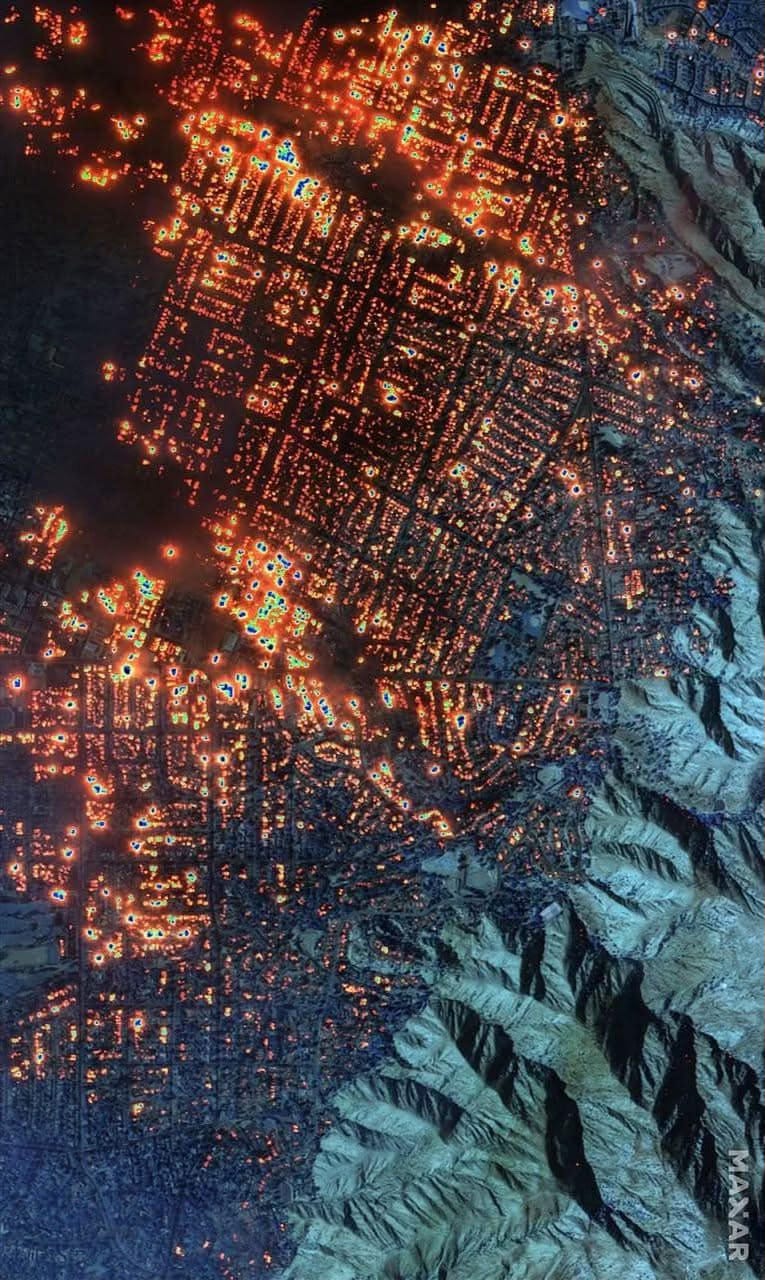
The wildfires in LA are horrific. People are losing everything. Thousands of structures have been consumed by flames. Ash, soot, smoke, poison the air. It’s devastating. Just look at this photo taken from space.
It looks like a nuclear apocalypse. Yet as devastating as the LA fires have been, a nuclear apocalypse would be unimaginably worse. A thousand times worse. A million times worse.
We see something like the wildfires in LA—as bad as they are, they remain on a scale that is comprehensible. We can fathom them. They will eventually be contained.
One atomic bomb like the one used at Hiroshima would be a thousand times worse (and don’t forget the blast wave and radiation as well as the fires). A thermonuclear weapon, a hydrogen bomb or warhead, would be one hundred thousand times worse. Unimaginable. Unfathomable. Unsurvivable.
There’s much to be learned from these wildfires in LA. Much more action needs to be taken to prepare for similar events in the future. Perhaps they might serve as a reminder as well of how much worse the fires could and would be from a man-made inferno in a nuclear war.
America, it’s high time we stopped building more nuclear weapons and started investing in improvements to our infrastructure, to disaster preparedness, to meet the climate-driven catastrophes that we know are coming.
America needs more fire trucks, more fire crews, even something seemingly as simple as more water. We don’t need more infernal (and inferno-producing) nuclear weapons.
When I was in the U.S. military, I learned a saying (often wrongly attributed to the Greek philosopher Plato) that only the dead have seen the end of war. Its persistence through history to this very moment should indeed be sobering. What would it take for us humans to stop killing each other with such vigor and in such numbers?
Song lyrics tell me to be proud to be an American, yet war and profligate preparations for more of the same are omnipresent here. My government spends more on its military than the next 10 countries combined (and most of them are allies). In this century, our leaders have twice warned of an “axis of evil” intent on harming us, whether the fantasy troika of Iraq, Iran, and North Korea cited by President George W. Bush early in 2002 or a new one — China, Russia, and North Korea — in the Indo-Pacific today. Predictably given that sort of threat inflation, this country is now closing in on a trillion dollars a year in “defense spending,” or close to two-thirds of federal discretionary spending, in the name of having a military machine capable of defeating “evil” troikas (as well as combatting global terrorism). A significant part of that huge sum is reserved for producing a new generation of nuclear weapons that will be quite capable of destroying this planet with missiles and warheads to spare.
My country, to be blunt, has long been addicted to war, killing, violence, and massive preparations for more of the same. We need an intervention. We need to confront our addiction. Yet when it comes to war and preparations for future conflicts, our leaders aren’t even close to hitting rock bottom. They remain in remarkable denial and see no reason to change their ways.
To cite two recent examples: Just before Easter weekend this year, President Biden swore he was personally devastated by Palestinian suffering in Gaza. At the same time, his administration insisted that a United Nations Security Council resolution for a ceasefire in Gaza that it allowed to pass was “non-binding” and, perhaps to make that very point, reportedly shipped 1,800 MK84 2,000-pound bombs and 500 MK82 500-pound bombs off to Israel, assumedly to be used in — yes! — Gaza.
The Biden administration refuses to see the slightest contradiction in such a stance. Men like Joe Biden and his chief diplomat Antony Blinken confess to being disturbed, even shocked, by the devastation our bombs deliver. Who knew Israel would use them to kill or wound more than 100,000 Palestinians? Who knew that they’d reduce significant parts of Gaza to rubble? Who knew that a blank check of support for Israel would enable that country to — it’s hard not to use the phrase — offer a final solution to the Gaza question?
Not to be outdone by the Democrats, Republican Congressman Tim Walberg of Michigan recently cited the examples of Hiroshima and Nagasaki in seeking a “quick” end to the conflict in Gaza (before walking his comments back somewhat). For him, Israel remains America’s greatest ally, whatever its actions, even as he argues that Palestinians in Gaza merit no humanitarian aid from the United States whatsoever.
With that horrifying spectacle — and given the TV news and social media, it truly has been a spectacle! — of genocide in Gaza, America’s leaders have embraced the very worst of Machiavelli, preferring to be feared rather than loved, while putting power first and principle last. Former National Security Adviser and Secretary of State Henry Kissinger, recently deceased, rightly vilified for pursuing a Bismarckian Realpolitik, and deeply involved in the devastation of Vietnam, Cambodia, and Laos, might even have blanched at the full-throttled support for war (and weapons sales) now being pursued by this country’s leaders. Dividing the world into armed camps based on fear seems basic to our foreign policy, a reality now echoed in domestic politics as well, as the Democratic blue team and the MAGA Republican red team attack each other as “fascistic” or worse. In this all-American world of ours, all is conflict, all is war.
When asked about such an addiction to war, your average government official will likely claim it’s not our fault. “Freedom isn’t free,” so the bumper sticker says, meaning in practice that this country stands prepared to kill others without mercy to ensure its “way of life,” which also in practice means unbridled consumption by an ever-shrinking portion of Americans and unapologetic profiteering by the richest and greediest of us. Call it the “moderate” bipartisan consensus within the Washington Beltway. Only an “extremist” would dare call for restraint, tolerance, diplomacy, and peace.
A Common Cause to Unify Humanity
Short of an attack on Earth by aliens, it’s hard to imagine the U.S. today making common cause with “enemies” like China, Iran, North Korea, or Russia. What gives? Isn’t there a better way and, if so, how would we get there?
In fact, there is a common foe — or perhaps a common cause — that should unite us all as humans. That cause is Earth, the health of our planet and all the life forms on it. And that foe, to state the obvious (even if it regularly goes unsaid), is war, which is unhealthy in the extreme not just for us but for our planet, too.
War turns people into killers — of our fellow humans, of course, but also of all forms of life within our (often very large) blast radii. In addition, war is a mass distraction from what should truly matter to us: the sacredness of life and the continued viability of our planet and its ecology. Call it a cliché but there’s no way to deny it: there is indeed only one Spaceship Earth. As far as we know now, our planet is the sole body in the universe teeming with life. Of course, the universe is incomprehensibly vast and there could well be other forms of life out there, but we don’t know that, not with certainty anyway.
Imagine, in a dystopic future, America’s “best and brightest” (or the “best and brightest” of another country) acting in a nuclear fury, employing the very weaponry that continues to proliferate but hasn’t been used since the destruction of two Japanese cities on August 6 and 9, 1945, and so crippling Spaceship Earth. Imagine also that our planet is truly the universe’s one magnificent and magical spot of life. Wouldn’t it be hard then to imagine a worse crime, not just against humanity, but life itself cosmically? There would be no recompense, no forgiveness, no redemption — and possibly no recovery either.
Of course, I don’t know if God (or gods) exists. Though I was raised a Catholic, I find myself essentially an agnostic today. Yet I do believe in the sacredness of life in all its diversity. And as tenacious as life may be, given our constant pursuit of war, I fear the worst.
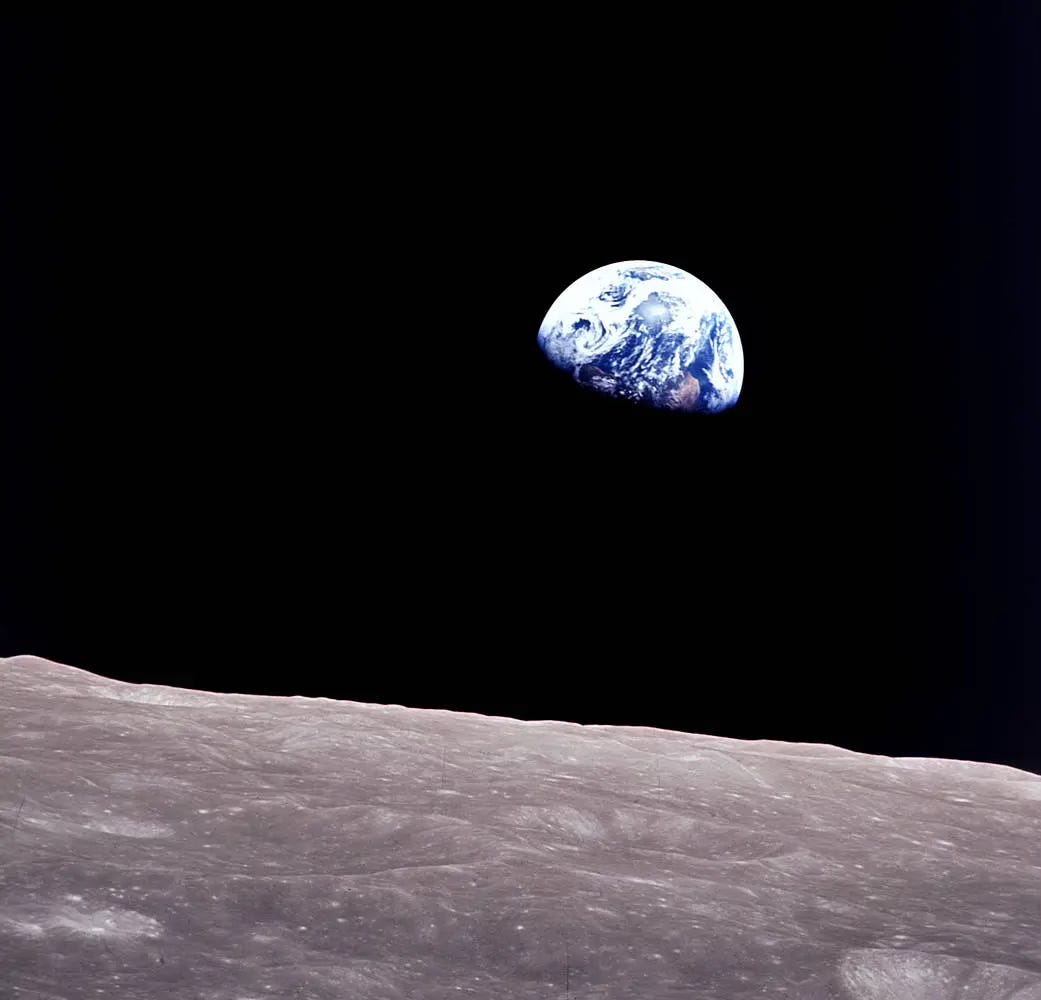
Earthrise from the Apollo 8 mission
If you’re of a certain age, you may recall when the astronauts on Apollo 8 witnessed earthrise as their spaceship orbited the moon in 1968. The crew read from Genesis, though in truth it could have been from any creation story we humans have ever imagined to account for how we and our world came to be. Specific religions or creeds didn’t truly matter at that moment, nor should they now. What mattered was the sense of awe we felt as we first viewed the Earth from space in its full glory but also all its fragility.
For make no mistake, this planet is fragile. Its ecosystems can be destroyed. Not for nothing did the inventor of the atomic bomb, J. Robert Oppenheimer, turn to the Hindu scriptures to intone, “Now I am become death, the destroyer of worlds,” when he saw the first atomic device explode and expand into a mushroom cloud during the Trinity test in New Mexico in July 1945.
In the febrile postwar climate of anti-communism that would all too soon follow, America’s leaders would decide that atomic bombs weren’t faintly destructive enough. What they needed were thermonuclear bombs, 1,000 times more destructive, to fight World War III against the “big fat commie rat.” Now nine (9!) nations have nuclear weapons, with more undoubtedly hankering to join the club. So how long before mushroom clouds soar toward the stratosphere again? How long before we experience some version of planetary ecocide via a nuclear exchange and the nuclear winter that could follow it?
Genocide and Ecocide on a Planetary Scale
The genocide happening in Gaza today may foreshadow one possible future for this planet. The world’s lone superpower, its self-styled beacon of freedom, now dismisses U.N. Security Council resolutions to stop the killing as “non-binding.” Meanwhile, Israel, whose founding was a response to a Holocaust inflicted during World War II and whose people collectively said Never Again, is now killing, starving, and displacing hundreds of thousands of Palestinians in the name of righteous vengeance for Hamas’s October 7th attack.
If the U.S. and Israel can spin mass murder in Palestine as not just defensible, but even positive (“defeating Hamas terrorists”), what hope do we have as a species? Is this the future we have to look forward to, an endless echoing of our murderous past?
I refuse to believe it. It truly should be possible to imagine and work toward something better. Yet, in all honesty, it’s hard to imagine new paths being blazed by such fossilized thinkers as Joe Biden and Donald Trump.
“Don’t trust anyone over thirty” was a telling catchphrase of the 1960s. Now, we’re being told as Americans that we’ll have to place our trust in one of two men almost at or exceeding 80 years of age. Entrusting and empowering political dinosaurs, however, represents an almost surefire path toward future extinction-level events.
Let me turn instead to a 25-year-old who did imagine a better future, even as he protested in the most extreme way imaginable the genocide in Gaza. This February, fellow airman Aaron Bushnell lit himself on fire outside the Israeli embassy in Washington, D.C. He sacrificed his life in a most public way to challenge us to do something, anything, to stop genocide. America’s “leaders” answered him by ignoring his sacrifice and sending more bombs, thousands of them, to Israel.
Aaron Bushnell did, however, imagine a better world. As he explained last year in a private post:
“I’ve realized that a lot of the difference between me and my less radical friends is that they are less capable of imagining a better world than I am. I follow YouTubers like Andrewism that fill my head with concrete images of free, post-scarcity communities and it makes me so much more prepared to reject things about the current world, because I’ve imagined how things could be and that helps me see how extremely bullshit things are right now.
“What I’m trying to say is, it’s so important to imagine a better world. Let your thoughts run wild with idealistic dreams of what the world should look like and let the pain and anger at how it’s not that way flow through you. Let it free your mind and fuel your rage against the machine.
“It’s not too late for you or anyone. We can have the world of our dreams tomorrow, but we have to be willing to fight today.”
His all-too-public suicide was a fiery cry of despair, but also a plea for a better future, one free of mass murder.
Earlier this week, millions of people across America witnessed a total eclipse of the sun. It’s awe-inspiring, even a bit alarming, to see the sun disappear in the middle of the day. Those watching took comfort in knowing that it would reappear from behind the moon in a matter of seconds or minutes and so gloried in that fleeting moment of preternatural darkness.
But imagine if the moon and sun were somehow to become permanently stuck in place. Imagine that darkness was our future — our only future. Sadly enough, however, it’s not the moon but we humans who can potentially cast the Earth into lasting darkness. Via the nuclear winter that could result from a nuclear conflict on this planet, we could indeed cast a shadow between the sun and life itself, a power of destruction that, tragically, may far exceed our current level of wisdom.
We know from history that it’s far easier to destroy than to create, far easier to kill than to preserve. Yet when countries make genocide or ecocide (from nuclear winter) possible and defensible (as a sign of uncompromising “toughness” and perhaps the defense of “freedom”), you know that their leaders are, in some sense, morally obtuse monsters. And who or what are we if we choose to follow such monsters?
As human populations rise, as vital resources like water, food, and fuel shrink, as this planet grows ever hotter thanks to our intervention and our excesses, we’ll need to cooperate more than ever to ensure our mutual survival. Far too often, however, America’s strategic thinkers dismiss cooperation through diplomacy or otherwise as naïve, unreliable, and impractical. “Competition” through zero-sum games, war, or other hyperviolent urges seems so much more “reasonable,” so much more “human.”
To the victor goes the spoils, so it’s said. But a planet despoiled by thermonuclear war, cast into darkness, ravaged by radiation, disease, and death, would, of course, offer no victory to anyone. Unless we put our efforts into ending war, rather than continuing to war on one another, such conflicts will, sooner or later, undoubtedly put an end to us.
In reality, our worst enemy isn’t some “axis” or other combination of imagined foes from without, it’s within. We remain the world’s most dangerous species, the one capable of wiping out most or all of the rest, not to speak of ourselves, with our folly. So, as Aaron Bushnell wrote, free your mind. Collectively, there must be a better way for all creatures, great and small, on this fragile spaceship of ours.
When Trump Shows More Empathy, You Know You’re In Trouble
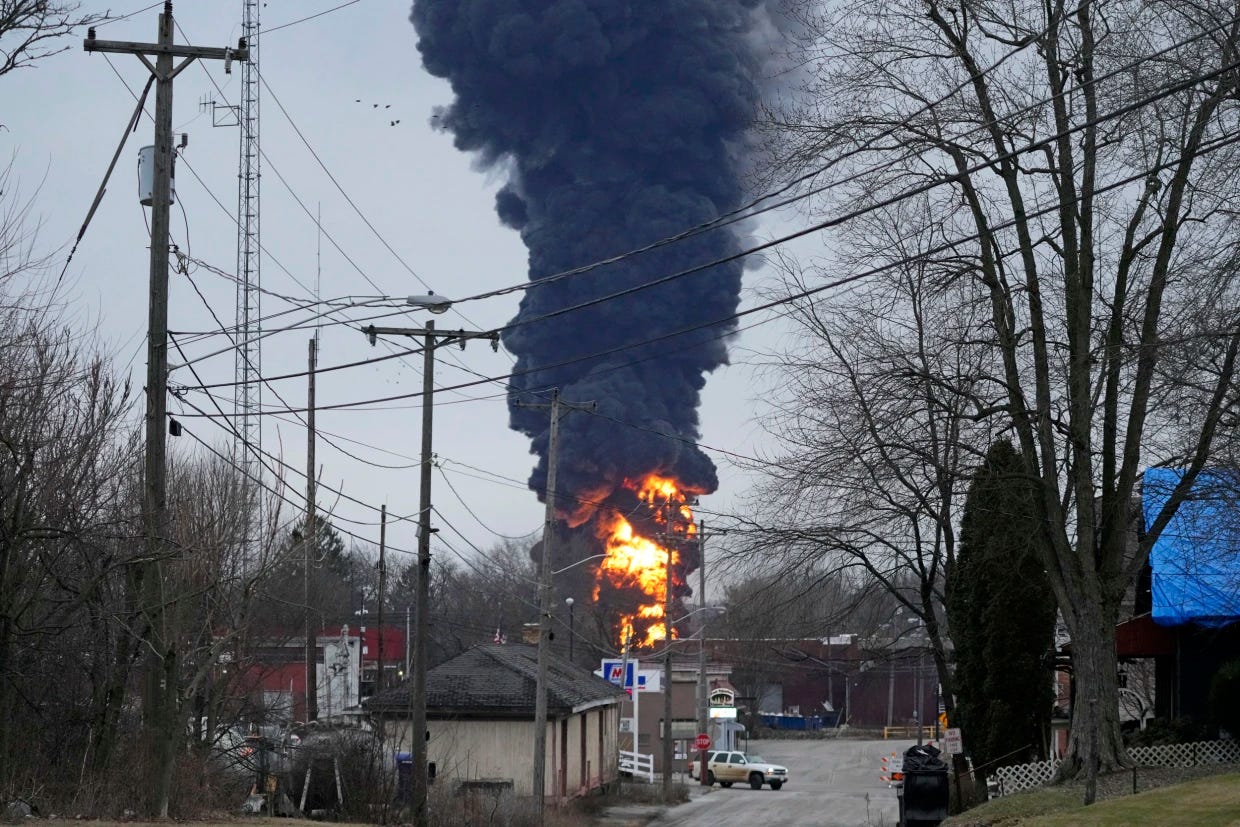
The train derailment in East Palestine, Ohio on February 3rd that led to a “controlled” explosion of toxic chemicals that’s now causing sickness among residents there was preventable. Both the Obama and Trump administrations made compromises driven by rail industry lobbyists that contributed to the disaster, which isn’t surprising, given the corporate capture of the U.S. government. The disaster represents a bipartisan failure, yet somehow it’s the Democrats who’ve emerged as the party most out of touch with the suffering of the people of East Palestine.
Nothing to see here, no reason to visit. A “controlled” chemical explosion after the derailment in East Palestine, Ohio
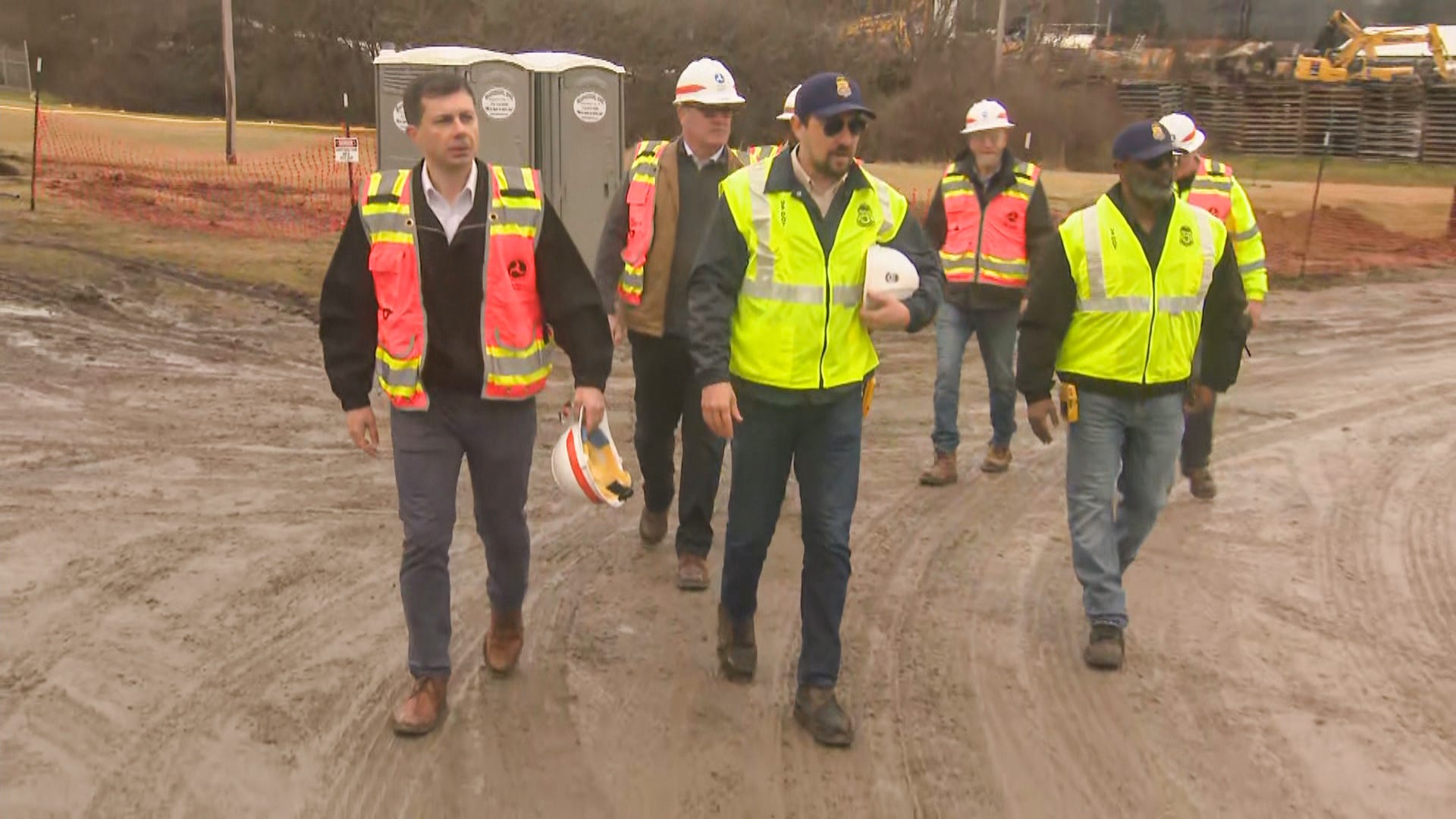
This week, former President Donald Trump visited East Palestine, handing out water bottles emblazoned with the Trump name, looking like a natural as he visited the local fire department and McDonald’s. Alleged billionaire Donald Trump: man of the people! Meanwhile, President Joe Biden announced he has no plans to visit East Palestine. Instead, after Trump had already stolen the spotlight, Pete Buttigieg, Secretary of Transportation, was sent in the next day, robotically trying to show concern when it was obvious he had little to show.
Trump visits East Palestine. Senator J.D. Vance stands to Trump’s right and Trent Conaway, mayor of East Palestine (purple shirt) stands to Trump’s left
It’s been a corporate-made disaster for East Palestine residents who have to live with the aftermath of this toxic chemical spill and explosion: let’s not lose sight of that. But it’s also been a total public relations disaster for Joe Biden, “Mayor Pete,” and the Democratic Party, showcasing an obtuseness that borders on obliviousness.
What should have happened? Buttigieg, as Transportation Secretary, should have been on the ground in Ohio within days of the accident. The government should have clearly announced that the rail company would be held responsible, that government aid would be provided, and that Ohioans would be given all the help they need to recover from this disaster. If Biden was unavailable, Kamala Harris should have joined Buttigieg, because that’s what Vice Presidents are for.
Buttigieg and Harris could have seized control of the narrative. They could have admitted that members of both parties, Democrats and Republicans, were responsible, but that the Trump administration was arguably most responsible in its relaxation of rules regarding safety brakes. They could have admitted as well that Ohioans had legitimate concerns about the safety of their air and water, and that the federal government would do everything in its power to assist state government authorities with the cleanup and the investigation.
Pete Buttigieg (far left) finally visits East Palestine. He looks more than a little out of place
Instead, the Democrats have allowed Trump and the Republicans to appear to be more concerned about, more in touch with, the plight of ordinary Americans.
Recently, Trump has released videos in which he’s warned of World War III, advocated for peace and a negotiated end to the Russia-Ukraine War, while promoting the idea (yet again) of putting Americans first. If he stays with this message, and if Democrats allow Trump to pose as the champion of peace as well as the champion of regular guys and gals (and all gender pronouns in between), there’s a good chance we’ll be looking at four more years of Trump beginning in 2025.
If so, Trump’s victory will be the ultimate proof of how oblivious Democrats have become.
Three years ago, nature provided me a lesson in bird parasitism and its repercussions. Unbeknownst to me and especially to the yellow warblers I was watching, a cowbird snuck an egg into the warbler nest. The result is what you see in this photo I took:
Guess which one is the cowbird hatchling?
Cowbird chicks generally hatch quicker, and of course they’re bigger and can fight harder for food. What generally happens is what happened to the nest I was watching. The yellow warbler chicks died as the cowbird chick ate just about all the food provided by its warbler “parents.” All that was left in the end was a rather surly-looking cowbird chick that was incongruously bigger than the warbler “parents” that fed it. Nature can be cruel.
And, as I wrote about here, that cowbird chick made me think of a certain entity in Washington DC that always clamors for money, and which in its sheer bellicosity and bottomless appetite always dominates the nest and crowds out and kills its weaker yet more deserving rivals for sustenance. Yes, you guessed it: the Pentagon and the National Security State.
There’s something about the gaping mouth of that cowbird that says it all. For example, the Biden administration was planning on spending $813 billion on the Pentagon in FY2023, an already enormous sum, only for it to be revealed this week that a bipartisan effort in the Senate is seeking to increase this by $45 billion. That’s on top of the $55 billion or so provided to Ukraine, roughly half of which is going directly to America’s merchants of death.
As Jimmy Dore points out in this segment, at the same time as the Pentagon cowbird cries for and consumes all the money, smaller, vulnerable programs (our yellow warbler chicks) like money for free school lunches for 10 million needy kids are allowed to wither and die.
Imagine allowing kids in schools to go hungry because of alleged lack of funds but then funneling nearly a trillion dollars yearly to the parasitic Pentagon cowbird in our midst.
Nature can be cruel. So too is America’s political process.
The U.S. government continues to denounce Putin for “genocidal” war crimes yet continues to persecute journalist Julian Assange for revealing war crimes. Contradiction?
Julian Assange’s persecution really isn’t about Assange anymore. It’s about intimidating other journalists and whistleblowers who’d dare to reveal the crimes of empire committed by the United States.
If I suggest that NATO expansion to the borders of Russia was a provocative move that was almost guaranteed to provoke hostility with Russia, as prominent experts like George Kennan and Henry Kissinger warned us about in the 1990s, does that make me a Putin puppet? Are Kennan and Kissinger retroactive puppets?
If I suggest that sending billions of dollars in weaponry to Ukraine is not in the cause of peace, that more people will die as a result, Ukrainian and Russian, does that make me a Putin puppet?
They say that bipartisanship is dead in Washington, yet why are both parties boosting Pentagon spending and competing with one another on how much weaponry can be sent to Ukraine without provoking nuclear Armageddon? That last part — do we trust the geniuses in Washington to walk that nuclear tightrope?
The Saudis recently made a major $2 billion investment in Jared Kushner, Trump’s son-in-law. Looks like they’re betting on a Trump victory in 2024. Speaking of Kushner, he gained admittance to Harvard only after his father made a mega-donation to the school. Or maybe it was a MAGA-donation?
I was asked what I thought of Russia’s new offensive in eastern Ukraine. Here was my response:
The short answer is war is war and it’s going to be ugly, especially in cities and other built-up areas.
Of course, there’s new technology like drones and guided missiles, e.g. Javelin and Stinger. Those missiles will make it more difficult for Russia to prevail. I’m guessing the Russians will use more artillery as a way of neutralizing Stinger and Javelin operators. What that means is more destruction, more “collateral damage.” More blood and guts.
I expect the Russians will lean on “combined arms” operations, meaning closer coordination among infantry, tanks, artillery, and airpower. If you just send in tanks without cover, they’re going to get knocked out, which we’ve seen in videos.
What we could see is guerrilla warfare by Ukrainian forces in smashed cities, which is truly terrible for the people of Ukraine.
Meanwhile, the U.S. keeps sending weapons in the name of peace …
I also got asked whether Putin would resort to nuclear weapons if the war in Ukraine went poorly for him. Here was my response to that:
Putin won’t use nuclear weapons against Ukraine. He’d have nothing to gain here.
The danger of nuclear weapons arises if the war were to widen outside of Ukraine. For example, if NATO enforced a no-fly zone and started shooting down Russian planes, I could see Putin responding with a tactical nuclear strike against a NATO airbase. That would risk a wider nuclear war, truly a horrifying scenario, which is why those who are calling for NATO escalation and direct involvement in the war are being irresponsible.
Of course, “irresponsible” is putting it mildly. “Batshit crazy” is more like it.
If more of America’s politicians were historians, or indeed almost any profession other than “lawyer,” would we see a bit more care and humility in their words and deeds? Sophistry, cleverness with words, fancy rhetoric, and blatant hypocrisy may play well in court when it’s all backed up by money, and lots of it, but it doesn’t necessarily play well on the battlefield. If lawyer-speak and lies won wars, America would be undefeated. (With apologies to principled lawyers everywhere who know the value of personal integrity and who fight for justice.)
“Dream it true” is a slogan I see in ads today in America. MLK had a dream, but he sure worked hard to put it in motion, and for all his work he paid for it with his life. Meanwhile, the dream still isn’t true, which isn’t the fault of MLK, who gave his life for his dream of a better America.
People may think Greta Thunberg is being overly dramatic here in her speech about climate change and the empty words of elite powerbrokers, but I think these are the sanest words I’ve ever heard.
Did you know the USA plans to “invest” $2 trillion in new nuclear weapons over the next 30-50 years? Imagine what $2 trillion could do if focused on green energy and a greener, cleaner environment. More nukes, or cleaner water and air: which should we be investing in? Hmm … I wonder.
More sweltering heat, wildfires, and other extreme weather and weather-related events remind us that global warming and climate change are here to stay. When I taught about global warming a decade ago, most scientists were predicting harsh events in 2030 or 2040. Yet here it is, the year 2021, and we’re already seeing the implacable face of Mother Nature, shaking her head at our naughtiness and thoughtlessness vis-a-vis her planet. She won’t be appeased by our excuse-making or our lying or our attempts to pass the buck. As we bicker, she acts.
Mother Nature: Implacable (Josh Addessi at Blogspot.com)
Climate change is here to stay with a take no prisoners vibe, notes Tom Engelhardt in his latest post at TomDispatch.com. Tom’s message is clear: we’re reaping or about to reap what our “leaders” and corporate elites have sown for us, a much hotter, much less hospitable, planet. As Tom puts it, we’re about to witness, and indeed are already witnessing, a climate Armageddon in slow motion. Check out his article for all the grim details.
Here’s the thing. A half-century ago, America’s wonderful fossil-fuel companies knew all about this threat. More than 40 years ago, President Jimmy Carter tried to persuade America to conserve fuel and live thriftier, more meaningful, lives. But America rejected Carter’s hard facts for Reagan’s sunny optimism (or, put bluntly, his lies) and so here we are.
After Carter, the Democrats swiftly moved to the right and embraced those same fossil-fuel companies. Democrats may have made fun of Sarah Palin and her “drill, baby, drill” message, but that is exactly what Presidents Obama and Biden decided to do: drill, baby, drill. A recent article puts it well from The Guardian: Joe Biden has approved two thousand (!) drilling and fracking permits. Not exactly a green new deal, is it?
President Obama was even worse, notes David Sirota at The Guardian. He loved to boast of how he made America the world’s number one oil producer. He even asked Americans to thank him for it! Remind me again how the Democrats are so much different on this issue than the big bad Republicans?
Here’s the kicker. Even as America’s leaders acted to accelerate fossil fuel production, despite all the warnings about climate change, they squandered $6 trillion on the Iraq and Afghan wars, money that would have made a dramatic difference in preparing America for climate change while also facilitating alternative energy sources, which also would have created millions of “green” jobs in America.
I think a key inflection point for America came in the immediate aftermath of the collapse of the Soviet Union three decades ago. If America had invested its peace dividend into creating a cleaner, safer, better world, perhaps by leading the way, as Carter had suggested, in solar energy and in efforts at conservation, we truly could have been a shining city on a hill, a beacon of sanity. But we chose more weapons and more war. We chose more fossil fuel consumption. Indeed, we chose more consumption (and more guns) in general.
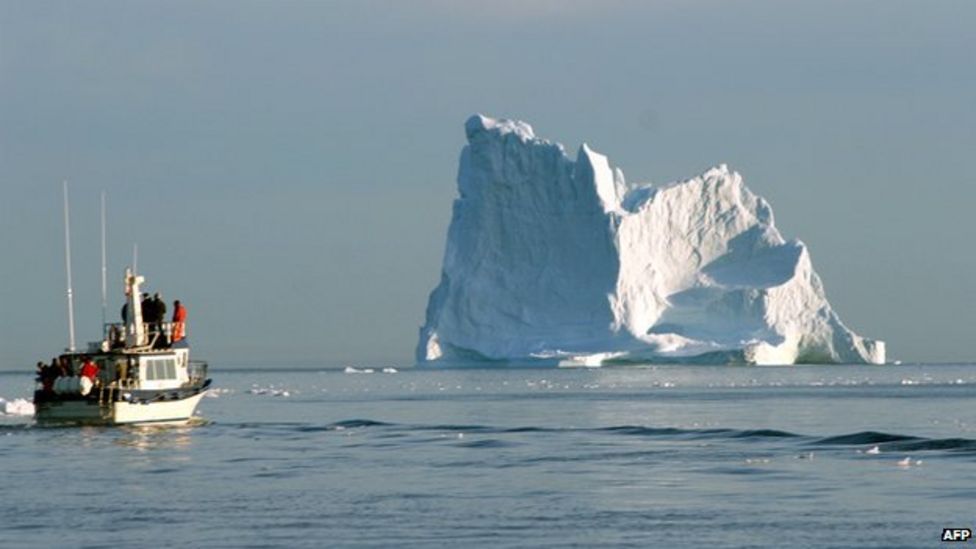
And thus we are where we are today, caught on a sinking warship on a rapidly melting iceberg. OK, perhaps it’s not the most clever metaphor, but you try coming up with a better one when you’re typing in a room at 87 degrees with 73% humidity. Must keep that image of an iceberg in my head …
We lose a lot of imagination as we become adults. We become limited. I remember playing make-believe as a kid, when the only limits were those of my imagination. As adults, we’re supposed to be hardheaded and realistic, perhaps even cold-hearted. The world’s tough; don’t be a dreamy fool. But what if we used a bit more imagination in America? What if we returned to the days of make-believe?
Here’s a few aspects of my make-believe America:
* All workers make a living wage with raises pegged to the rate of inflation and cost of living.
* Everyone has “free” health care as a human right.
* Everyone has a home of some sort, i.e. there are no homeless or “unhoused” people living in the streets.
* Prison populations are small, with only the most violent offenders locked away for long terms.
* Climate change, recognized as a problem in the 1980s, is being controlled with massive investments in renewable energy sources.
* Nuclear disarmament, begun with the collapse of the Soviet Union in 1991, will be complete in 2021 after thirty years of dedicated effort.
* No one leaves school with massive amounts of student debt.
* Corporations are not citizens, money is not speech, and all political campaigns are publicly funded.
* Wars are universally reviled and are only fought for defensive purposes via a Congressional declaration. Thus America hasn’t fought a shooting war since 1945.
* The U.S. political scene has a range of “major” parties and a wealth of choices, including a socialist or people’s party and a Green party, along with Libertarians and Populists and Progressives.
* The top priority for most Americans is sustainability and the environment: preserving the planet for future generations.
* There is no such thing as a billionaire, since a progressive tax code ensures an equitable distribution of resources.
* People are respected for who they are and what they do, meaning that racism, sexism, ageism, and other forms of discrimination are largely unknown.
* “Hero” is a term used to describe peacemakers and helpers, the most compassionate and giving among us, the ones fighting hardest for equal rights, fairness, and justice.
* Government is completely transparent to the people. Meanwhile, people have privacy and autonomy.
* Most drugs are legal, and essential medicines like insulin are affordable for all.
Well, I did say this was the land of make-believe. What do you say, readers? What’s in your land of make-believe?











 Bracing Views