Bombing Kills Lots of Innocents: Who Knew?

W.J. Astore

Extensive U.S. bombing overseas kills lots of innocent people: who knew?

So this blinding statement of the obvious popped up in my email today from the New York Times:

A five-year Times investigation found that the U.S. air wars in Iraq, Syria and Afghanistan led to thousands of civilian deaths.
Hidden Pentagon records show a pattern of failures in U.S. airstrikes — a sharp contrast to the American government’s image of war waged by all-seeing drones and precision bombs.
The military’s own confidential assessments of over 1,300 reports of civilian casualties since 2014, obtained by The Times, lays bare how the air war has been marked by deeply flawed intelligence, rushed and often imprecise targeting and the deaths of thousands of civilians, many of them children. None of these failures resulted in a finding of wrongdoing. We are making these Pentagon records public.
This is the first of a two-part investigation. Here are the key takeaways.

Finally, at the end of 2021, the Times is willing to speak up against America’s murderous regimen of bombing overseas. I wrote about this myself at this site in 2016 and 2017, and I’m hardly the only person to have pointed this out. At TomDispatch.com, Tom Engelhardt has been reporting for years and years on wedding parties being wiped out by U.S. bombing missions based on “faulty intelligence.” The mainstream media have largely played down these atrocities until now, when the war in Afghanistan is finally (mostly) over, at least for the U.S.

As I wrote in 2013 for TomDispatch.com, airpower is neither cheap nor surgical nor decisive. Indeed, because it provides an illusion of effectiveness, and because America dominates the “high ground” of the air, all of this “precision” bombing serves to keep America in wars for far longer than is tenable on tactical grounds. Imagine how long the Iraq and Afghan wars would have lasted if America didn’t dominate the air, if the U.S. military had to rely exclusively on ground troops, and thus had suffered much higher casualties in ground combat. My guess is that these wars would have ended earlier, but “progress” could always be faked with all those statistics of bombs dropped and alleged “high value targets” eliminated.

I suppose it’s good to see the “liberal” New York Times cover this issue of murderous bombing after 20 years of the global war on terror. The question remains: why did it take them two decades to cover this issue in depth?
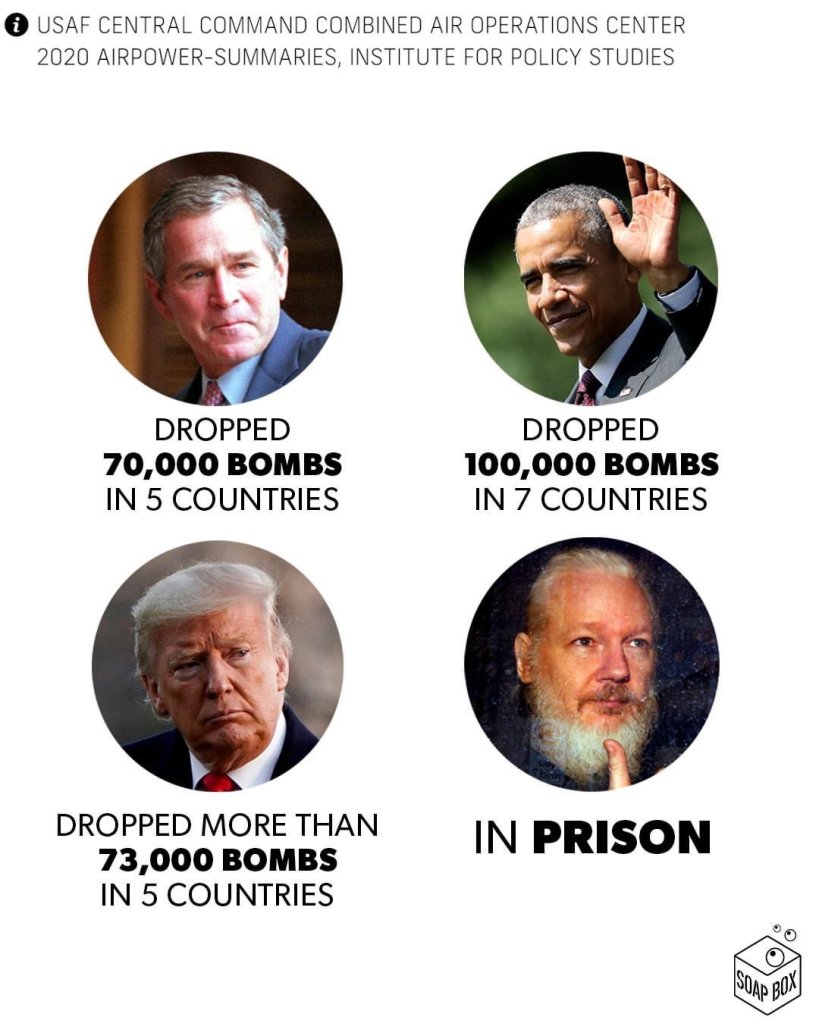
Presidents become “presidential” when they bomb other countries. Meanwhile, Julian Assange rots in prison. Maybe he needs to bomb a few countries?

Update (12/21/21)

More notes on U.S. bombing and the Times report, courtesy of ReThink Round Up:

“Not a single file [from the military about the bombings] includes a finding of wrongdoing. An effort within the military to find lessons learned to prevent future civilian harm was suppressed. An analyst who captures strike imagery even told the Times that superior officers would often “tell the cameras to look somewhere else” because “they knew if they’d just hit a bad target.”

Responding to the report, a Pentagon spokesperson acknowledged that preventing civilian deaths is not just a “moral imperative” but a strategic issue because civilian casualties can fuel recruiting for extremist groups. [New York Times/ Azmat Khan]”

*****

Again, to state the obvious here:

1. There’s no accountability in the system. Murderous mistakes are covered up and no one is held responsible (“tell the cameras to look somewhere else”).

2. The bombing attacks were counterproductive. Guess what? Killing innocents creates more “terrorists.” Who knew?

Murderous inaccuracy, making matters worse, with no accountability: WTF? So much for America’s “awesome” military, as Andrew Bacevich writes about today at TomDispatch.com.

How Awesome Is “Awesome”?
Curbing the Military-Industrial Complex

W.J. Astore

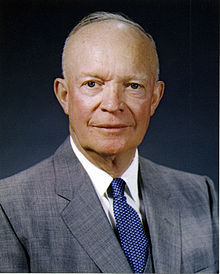
The American people have failed Dwight D. Eisenhower.

Sixty years ago, President Eisenhower warned us about the military-industrial complex. He told us it was sapping our resources and livelihood. He said its total influence — economic, political, and spiritual — was warping the very structure of our society. Its growing power, Ike warned, posed a grave danger to our liberties and our democratic processes. We heard his words, but we failed to act on them.

Ike didn’t just issue a warning in his farewell address in 1961. He gave us a mission. He literally put us on guard duty, as he said we must guard against the growing power of the Complex. He challenged us to be an alert and knowledgeable citizenry. Notice those three words: alert, knowledgeable, citizenry. Ike told us to get smart, to be vigilant, to be fully informed and involved citizens. Not citizen-soldiers for war, but citizen-guards against the growing power of the U.S. military and its weapons makers within a democracy that was increasingly compromised by militarism and imperialism.

Collectively, we have failed to heed Ike’s warning. We have failed to curb the military-industrial complex. And thus it has become a leviathan within our society and our culture. It has, as Ike warned, come to dominate our economics, our politics, even our spiritual lives.

Ike had a different vision. He knew war and hated it. So he asked Americans to work for world peace and for human betterment. Yes, of course he was worried about communism in the climate of the Cold War. Of course he was in favor of negotiating from a position of strength. But Ike was in favor of the kind of strength that feels free and confident to extend the open hand of friendship rather than the mailed fist of war.

The latest Pentagon budget is all about the mailed fist of war. It undermines world peace and human betterment. It is a betrayal of Ike’s vision and a failure of democracy.

The American Republic is dead. The American Empire, consumed by militarism and powered by threat inflation and greed, is visibly in decline even as it consumes the lion’s share of federal discretionary spending. What is needed is a spiritual rebirth of America, a turning away from greed-war, a collective reawakening to the idea that strength is not measured by nuclear missiles or tanks or fighter jets, but by the health of our society, especially our commitment to human rights, to maximizing our human potential while protecting our environment and our planet.

America desperately needs a new vision of the good life, one that abjures war and rejects weaponry. War and weaponry are not the health of society; quite the opposite. Ike saw this; he challenged us to see it as well, and to act to ensure our democracy wouldn’t be destroyed by a permanent military establishment of vast proportions.

And we the people have failed him — and ourselves.

What is to be done? We need to reject fear. We need to cut military spending. We need to dismantle the empire. And we need to see these acts for what they are: the acts of a strong people, confident that right makes might, committed to avoiding the utter waste of war and the depravity of building an economy based on weapons production and arms exports.

Nobody said it would be easy. Ike knew it wouldn’t be. It’s why he put us on guard duty. He told us to be alert, to get smart, and to act.

Ike gave us a mission, not just a warning. Are you ready to enlist and fight against weapons and war?

The Herman Cain Award Subreddit and What It Says about America’s Political Crisis

Deaths from Covid-19 in the U.S. recently passed 800,000 with no signs of abating. The blame game is also not abating. Are corrupt elites exacerbating and exploiting a crisis for their own interests? Are “irrational” elements at lower levels exhibiting mass resentments at being bossed around? Why does everything seem polarized in America, even “common sense” steps to save lives during a raging pandemic? M. Davout uses the lens of the “Herman Cain Award” to take a closer look at America’s Covid dilemma. He reaches a conclusion that will challenge many. W.J. Astore

Learning from the Herman Cain Award

M. Davout

As America undergoes a series of overlapping domestic political crises—notably among them, determined attacks on democratic election processes, fierce resistance to public health responses during a deadly pandemic, reckless brinkmanship over federal government budgeting and debt payment—commentators often resort to the notion of political polarization as an explanation of our problems. A recent case in point is the disapproving mainstream media response to the Herman Cain Award (HCA) subreddit, which is devoted to showcasing the social media posts of anti-maskers and anti-vaxxers who get sick with Covid-19 and end up in hospital ICUs in need of breathing assistance.

Herman Cain, you might remember, was a failed candidate for the 2012 GOP presidential nomination.  He attended a Trump reelection campaign rally in Tulsa, posted a photo of himself and his entourage at the rally unmasked while belittling concerns about Covid, and then died of the disease six weeks later.

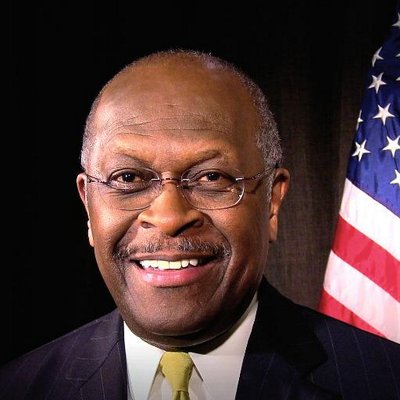
Herman Cain

For any given recipient of the Herman Cain Award, the presentation of captured social media posts follows a typical arc. The early posts feature memes and images disparaging Fauci, Biden, the medical establishment, mRNA vaccines, and masked and vaccinated Americans (“sheep”), intermixed with memes and images exalting Trump, the healing powers of Jesus, the adequacy of their own unvaccinated immune systems, and their independent and courageous selves (“lions”). Then comes a series of posts notifying followers of their falling ill with Covid and their shock at the severity of the symptoms, their eventual hospitalization and need for prayers. Finally, posting duties fall to a relative or friend of the afflicted, who reports on the increasingly more radical medical procedures undergone, the almost inevitable decline in organ health, and eventual death. GoFundMe appeals for donations to cover the obscenely high medical expenses round out many of the HCA posts.

Many of the comment threads for each post could fairly be characterized as largely (though not exclusively) being exercises in schadenfreude. Some posters belittle the pleas for aid from “prayer warriors” and the all-caps invocations of divine intervention to heal failing organs. Self-proclaimed liberal commentators sarcastically express their “dismay” at being “owned” by conservatives who have scored ideological points at the cost of their lives. Accusations are often lodged against rightwing media celebrities and GOP politicians who amplify the conspiratorial memes which appear again and again on the social media accounts of the HCA recipients.

Occasional critical reference is made to the facilitating roles played by foreign disinformation campaigns in broadcasting lies and to Big Tech in channeling lies to those most susceptible to believing them. But, by and large, the commentators are unrelentingly hostile to the HCA recipients themselves for “shitposting” the lies to their family, friends, and other social media followers, and leaving family members bereft and financially devastated when they die.  

In a recent New York Times article, an academic psychologist is paraphrased as arguing that “these websites are an outgrowth of the nation’s extreme polarization.”

To my mind, application of the notion of polarization to a political crisis or conflict encourages one to withhold judgment about the truth claims and reasonability of each of the two sides to a dispute. Particularly in the case of the HCA, polarization is too simplistic a way of understanding the fierceness of the social media pushback against vaccine denial and the avoidable deaths such denial causes. For me, the HCA posts are better understood in the context of a perennial question in my academic field about political dysfunction: is political crisis more a product of the pursuit of unaccountable power by corrupt elites or is it more a product of mass resentments which often find expression in campaigns of scapegoating and demonizing people?

Political theorist Michael Rogin usefully framed this issue within a longstanding debate between “realist” scholars who frame historical episodes of political dysfunction (e.g., McCarthyism) as products of elite-driven programs of political repression serving the interests of capitalism, the state apparatus or other powerful institutions, and “symbolist” scholars, who emphasize the dangers of popular indulgence in conspiratorial thinking and paranoid fears of racial, ethnic, religious or cultural “others.”

In response to the needless prolongation of the Covid pandemic, many of the HCA commentators seem to have taken the symbolist position, blaming rightwing members of the polity for indulging and promoting paranoia (e.g., drawing parallels between public health measures against Covid and Nazi genocide) and conspiratorial thinking (e.g., the offer of free vaccines as a Trojan horse for socialized medicine). To be sure, there are voices among them that take the realist position of blaming rightwing political and media elites for instrumentalizing populist anxieties for their own power interests.

So rather than characterize HCA commentary simply as “cruel sentiment,” I see much of that commentary as lodging symbolist (and, in some cases, realist) critiques of a deadly form of political dysfunction afflicting our public life, namely the perverse resistance of an irrational minority to reasonable and time-tested public health measures aimed at protecting all of us from exposure to a disease that kills far too many and disables many more.

M. Davout is a professor of political science and an occasional contributor to Bracing Views.

Major Cuts in Military Spending Are the Best Way to Revive Our Democracy

W.J. Astore

In my latest article for TomDispatch.com, I argue for major cuts in military spending.

This year’s Pentagon budget is a staggering $778 billion, a sum that’s virtually unimaginable. That said, the real budget for “defense,” or, as we should say, the budget for wars and weapons, is well over a trillion dollars. This is madness. No self-avowed democracy can survive such a misappropriation of resources for domination and destruction. But of course America is not a democracy, it’s an empire, with a figurehead for a president and a Congress that acts as a rubber stamp for the generals and their weapons makers.

The military-industrial complex has become America’s fourth branch of government, eclipsing the roles and powers of the other three branches (executive, legislative, judicial). The only way to rein it in, I believe, is to cut its budget. In my article, I propose cutting that budget by $50 billion a year for the next seven years. Thus by Fiscal Year 2029, the Pentagon budget should be no more than $400 billion, still a vast sum, but roughly half of what we’re paying for war and weaponry today. Such cuts can be made sensibly and without harming America’s true defense needs. Indeed, a smaller U.S. military establishment will reduce adventurism and increase our security and safety.

Here’s the conclusion to my piece at TomDispatch.com. Please read the rest of it at the site. And I urge you as well to read Tom Engelhardt’s introduction, which provides stunning details about how America’s generals profit from endless wars and weapons production, so much so that “In wars and weapons we trust” could very well serve as America’s truest national motto.

Of Smoking Guns and Mushroom Clouds

What would real oversight look like when it comes to the defense budget? Again, glad you asked!

It would focus on actual defense, on preventing wars, and above all, on scaling down our gigantic military. It would involve cutting that budget roughly in half over the next few years and so forcing our generals and admirals to engage in that rarest of acts for them: making some tough choices. Maybe then they’d see the folly of spending $1.7 trillion on the next generation of world-ending weaponry, or maintaining all those military bases globally, or maybe even the blazing stupidity of backing China into a corner in the name of “deterrence.”

Here’s a radical thought for Congress: Americans, especially the working class, are constantly being advised to do more with less. Come on, you workers out there, pull yourself up by your bootstraps and put your noses to those grindstones!

To so many of our elected representatives (often sheltered in grotesquely gerrymandered districts), less money and fewer benefits for workers are seldom seen as problems, just challenges. Quit your whining, apply some elbow grease, and “git-r-done!”

The U.S. military, still proud of its “can-do” spirit in a warfighting age of can’t-do-ism, should have plenty of smarts to draw on. Just consider all those Washington “think tanks” it can call on! Isn’t it high time, then, for Congress to challenge the military-industrial complex to focus on how to do so much less (as in less warfighting) with so much less (as in lower budgets for prodigal weaponry and calamitous wars)?

For this and future Pentagon budgets, Congress should send the strongest of messages by cutting at least $50 billion a year for the next seven years. Force the guys (and few gals) wearing the stars to set priorities and emphasize the actual defense of this country and its Constitution, which, believe me, would be a unique experience for us all.

Every year or so, I listen again to Eisenhower’s military-industrial complex speech. In those final moments of his presidency, Ike warned Americans of the “grave implications” of the rise of an “immense military establishment” and “a permanent armaments industry of vast proportions,” the combination of which would constitute a “disastrous rise of misplaced power.” This country is today suffering from just such a rise to levels that have warped the very structure of our society. Ike also spoke then of pursuing disarmament as a continuous imperative and of the vital importance of seeking peace through diplomacy.

In his spirit, we should all call on Congress to stop the madness of ever-mushrooming war budgets and substitute for them the pursuit of peace through wisdom and restraint. This time, we truly can’t allow America’s numerous smoking guns to turn into so many mushroom clouds above our beleaguered planet.

Link to the entire article here.

It’s all so saddening and maddening

W.J. Astore

Remember Tass, the state news agency for the former Soviet Union? I was thinking of it as I watched PBS on Friday. Two commentators, David Brooks and Jonathan Capehart, respectively with the New York Times and the Washington Post, covered the leading news items of the week. Of course, there was nothing said about the colossal war budget passed by the House ($778 billion, which is actually an undercount); there was nothing said about the continued persecution of Julian Assange by the U.S. government; and indeed there was nothing said about the sham democracy summit overseen by Joe Biden.

The topics covered were Bob Dole’s death and the good old days of compromise in Washington, a general condemnation of Trump and polarization, and some concern about inflation, which was dismissed as evidence of an expanding economy.

PBS used to be a halfway decent news source; now it relies far too heavily on corporate funding and is afraid of losing its government funding as well. So it’s become a state propaganda network, much like Tass was in the USSR.

With respect to the commentators, David Brooks is the reasonable Republican who speaks calmly about achieving incremental change through the system; Jonathan Capehart is the reasonable Democrat who also speaks calmly about pretty much the same; he adds “diversity” in the sense he’s Black and gay, yet his political views vary little from those of Brooks. Mark Shields, the previous voice opposite Brooks, was occasionally somewhat outspoken and even mentioned unions and workers; he’d worked for Senator William Proxmire and had enlisted in the U.S. Marines. I always sensed Shields hadn’t forgotten his roots, but of course he’s now 84 years old and semi-retired.

The previous week, I listened to Capehart as he talked about the Supreme Court and abortion. He seemed most concerned about the potential for a conservative court to overturn the legitimacy of gay marriage. I understand the personal angle, but I was hoping for a stronger statement in favor of a women’s right to choose — to control her own body and her own life.

To be honest, I don’t watch mainstream media reports that often, but when I do, it’s all so saddening and maddening.

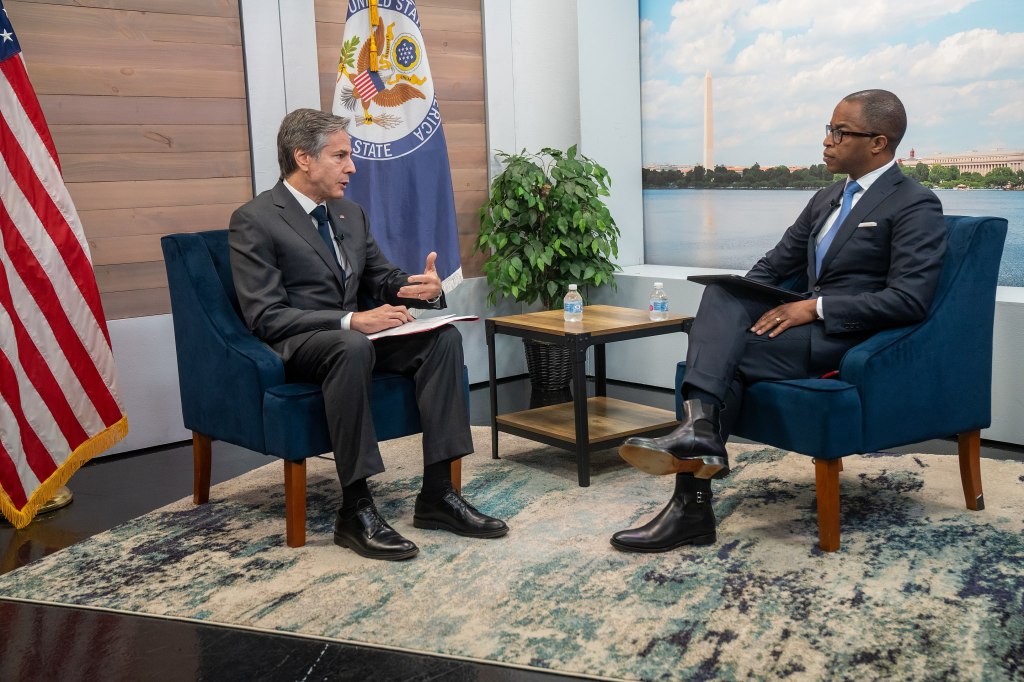
Jonathan Capehart (right) speaks to Secretary of State Antony Blinken. They both know their roles.

Fox News and The New York Times Agree: America is Weak!

W.J. Astore

Did you know that the world’s lone surviving military superpower, the one that spends more than a trillion dollars yearly on all things military, is weak?

Fox News would have you think that. And so too would the New York Times (NYT).

Over at Fox News, the headline suggests Biden’s weakness is inviting “the next Pearl Harbor,” even as the article focuses mainly on alleged weakness vis-a-vis Russia-Ukraine and China-Taiwan. Meanwhile, my daily summary from the NYT agrees that “U.S. weakness emboldens Moscow and Beijing.” So what does the NYT suggest America should do to show strength?

With respect to Russia and Ukraine, this is the sage advice of the New York Times:

On its own, Ukraine’s military seems outmatched by Russia’s. And a full-scale U.S. military response seems doubtful, given a weariness of foreign wars that Biden and many American voters share.
But Biden still has options. The U.S. can increase its military support to Ukraine, which could make a potential invasion look bloodier and more costly for Russia. (The U.S. is pursuing a related strategy in Taiwan.)
Biden can also threaten sanctions on Russia, as he did on the call with Putin yesterday, according to Jake Sullivan, the president’s national security adviser. “He told President Putin directly that if Russia further invades Ukraine, the United States and our European allies would respond with strong economic measures,” Sullivan told reporters. If Russia does attack Ukraine, Biden said that the U.S. would react more strongly than it did to the 2014 takeover of the Crimean Peninsula.
But sanctions might not be enough to deter Putin.

In sum, here’s the tough-minded advice of the “liberal” New York Times: Sell more expensive weaponry to Ukraine (as well as Taiwan). Threaten the most violent economic warfare possible. And, since sanctions “might not be enough” to deter Russia or China, there’s more than a hint that America may need to go to war, despite “weariness” of wars allegedly shared by Biden and “many American voters.”

A show of hands here: How many Americans think it’s wise to risk nuclear war if Russia attacks Ukraine or China attacks Taiwan?

Even if the risk of nuclear war is discounted (which it shouldn’t be), how many Americans think it’s wise for the U.S. military to get involved in a land war in Asia or against Russia in Ukraine?

Maybe patient diplomacy is the answer here? After all, what does the “defense” of Ukraine or Taiwan by U.S. forces have to do with defending our country and our constitution?

America doesn’t lack toughness — it lacks smarts. Selling more weapons to Ukraine or Taiwan isn’t the answer. Nor are constant threats.

Sun Tzu taught that the best way to win is when you can achieve your objectives without even having to fight. Guile is not weakness, nor is restraint. But Fox News, joined by the New York Times, would have us think that toughness is mostly about weaponry and a willingness to wage war. Because, you know, it’s worked so well for America in Vietnam, Afghanistan, Iraq, and so many other places around the globe.

Abortion in America

W.J. Astore

I truly believe that if men got pregnant, abortion would be free, legal, and readily available across the United States.

But men don’t get pregnant, so the idea of carrying an unwanted baby to term is mainly theoretical for them. How easy it is, then, to outlaw abortion while claiming to be pro-life.

Having been raised Catholic, I was taught abortion is murder. It’s that blunt. As the Church was teaching me that, it was allowing predatory priests to molest children. There was even a predatory priest assigned to my parish when I was young. So I’m not too keen on the moral authority and teachings of the Church here. Again, if priests got pregnant, I truly believe abortion would be accepted within the Church. Perhaps it would be justified by arguing that priests, first and foremost, have to serve God and the Church and therefore shouldn’t be encumbered by children.

The U.S. Supreme Court seems ready to overturn Roe v Wade by next summer, which is not surprising. So much for respecting judicial precedent. Even as it does so, we’ll hear arguments about how the Court isn’t partisan or political or influenced by religious beliefs, which is absurd. So-called pro-life Republicans have won the battle of placing partisan justices on the Court, and soon they’ll reap their reward.

Establishment Democrats are not as unhappy as you might think. I’ve already received urgent requests to donate money in the cause of abortion rights. Abortion is a “hot-button” issue and a real money-maker for partisans on both sides. Sorry, Democrats, this is your mess too, and you won’t see a penny from me.

Why do I claim Democrats are responsible too? President Obama could have appointed a justice to the Supreme Court when Mitch McConnell refused to do his job. It may have touched off a Constitutional crisis, but it was a fight worth having. But Obama figured Hillary Clinton couldn’t lose to Trump, so he did nothing. Meanwhile, Hillary ran a horrible campaign and lost to a failed casino owner and C-list celebrity apprentice. Because of that, we got three new justices who were all picked in large part because of their opposition to Roe v Wade. (That, and the fact they’re all pro-business.)

We will soon take a giant step backwards in America. Roughly half of American states will outlaw abortion; the other half will likely allow it under various conditions. Of course, as Ruth Bader Ginsburg noted, rich women, no matter where they live, will be able to get abortions. Women of lesser means will struggle and suffer. The pro-life movement will applaud that there are fewer abortions even as they cut benefits to the mothers who are forced to have these babies. They will do this with no pangs of conscience and in the name of loving the unborn — until they’re born to the “wrong” kind of mother.

And so it goes in America.

Being “pro-life” shouldn’t end when the baby is born. Jesus helped the poor, the lame, and the sick. He didn’t tell them to get a job while cutting their benefits. Image from a prayer card sent to me by my local bishop.

A Coda (12/5/21)

I welcome all comments on this difficult issue.

Instead of Cui bono, or who benefits, I think of who suffers if Roe v Wade is overturned. Not men. Not women of means, who will find a way to secure a safe abortion irrespective of the law in their particular state. It will be poor and desperate women who suffer, especially those who’ve been raped or who’ve been the victims of incest. Imagine being raped and then being forced to carry the fetus to term — it’s unimaginable to me.

I should note as well the burden placed on women — always women. What about the man who got her pregnant? Why may a woman be forced to give birth to an unwanted child while the father walks away freely in virtually all cases? People often discuss abortion as if women got pregnant by immaculate conception. As if men hold no responsibility whatsoever. Believe me, if men got pregnant too, abortion would be freely available.

So it’s likely that next summer, five men and one very conservative woman aligned with a fringe group in the Catholic Church will rule to compromise the bodily autonomy of women across the country; they’ll be opposed by two women and one man who seek to uphold a less-than-perfect precedent but one that has served to reduce state and patriarchal domination in the US of A for half a century.

Meanwhile, the Supreme Court will obviously be revealed for what it is: a partisan hack shop in which the law is for sale or otherwise open to manipulation by the well-connected for unsavory purposes.

Tell me how this is a good thing.

Coda 2 (12/6/21)

As a (lapsed) Catholic, I realize people have religious reasons why they oppose abortion.

To these people I say: If you’re opposed to abortion, don’t have one. But don’t seek to impose your religious beliefs on everyone else.

A decision on abortion should be between a woman and her doctor. It’s a private decision. You have no say. Your religious beliefs don’t matter.

Against abortion? Don’t have one — simple as that. And MYOB.

Should You Join the U.S. Military?

W.J. Astore

When I was eighteen, the U.S. Army promised I could “be all that you can be.” The Navy said “It’s not just a job, it’s an adventure.” The Marines were all about “The few — the proud — the Marines.” And the Air Force promised “a great way of life.” I guess I wanted a great way of life, so I joined the Air Force.

Seriously, I never thought I’d serve for twenty years in uniform. My career was relatively easy in the sense that no one ever shot at me, nor did I ever have to take a life. I got an excellent education, met good people, went to interesting places, and got to teach a subject I loved for six years.

Recently, I learned that a member of my family is thinking of joining the military after high school. He hasn’t asked for my advice, but his interest in wearing the uniform made me think about the advice I’d give him if he did ask. What can you say to young men and women that can help them to make an informed decision — the best possible one for them?

It’s easy to be gung-ho about the military. It’s also easy, I think, to dismiss military service with extreme prejudice. The best advice is honest, balanced, and attuned to the person seeking it. In this spirit, what would I say to a young person contemplating enlisting in the military?

Let’s tackle the disadvantages first, the downside and drawbacks to military service, the aspects of military life that potential recruits rarely think about. Here are a few of them:

  1. You could die or be seriously wounded in the military. Think of PTSD, TBI (traumatic brain injury), and similar “hidden” wounds of war. America is incessantly at war, somewhere, and there’s always a chance you could die. But of course young people think they’re immortal and may even crave danger, so this reality rarely deters them.
  2. You may have to kill other people. Perhaps even innocent people, because war is extremely messy and chaotic. Such acts of violence against humanity may lead to moral injury that will haunt your conscience. Are you prepared to kill? Truly?
  3. You sacrifice personal autonomy and some of your rights when you join the military. You have to be willing to follow orders. You can’t just quit and walk away. The military insists on obedience and discipline. Are you prepared to do as you’re told?
  4. If you think you’re important, you’re not: and the military will remind you of this. You’re a pawn in a vast bureaucracy; you’re at the mercy of a system that is often capricious and treats you as a number. You’ll quickly learn the wisdom of acronyms like SNAFU (situation normal, all fucked up) and FUBAR (fucked up beyond all recognition). They may sound funny, until they come to describe your life and career in the military.
  5. You may wish to ask yourself when was the last “good” or necessary war that America has fought for the purpose of true national defense. You may discover that recent wars in Afghanistan, Iraq, and elsewhere were not “good” wars in service of your Oath of Office to the U.S. Constitution. If this gives you pause, if this troubles you, I suggest you don’t enlist.
  6. Take the time to read about veterans who are against war. Consider this letter written by Daniel Hale, who is currently serving prison time for his courageous stance against the murderously imprecise nature of drone warfare. Read about Pat Tillman, the NFL player who enlisted in the Army and who was killed by friendly fire, then used as a propaganda prop by the U.S. military. Don’t think something similar can’t happen to you.

I could mention other disadvantages, such as frequent moves, nonsensical jobs, bad bosses, etc., but many civilian jobs share these. Work isn’t easy; it’s why it’s called “work.”

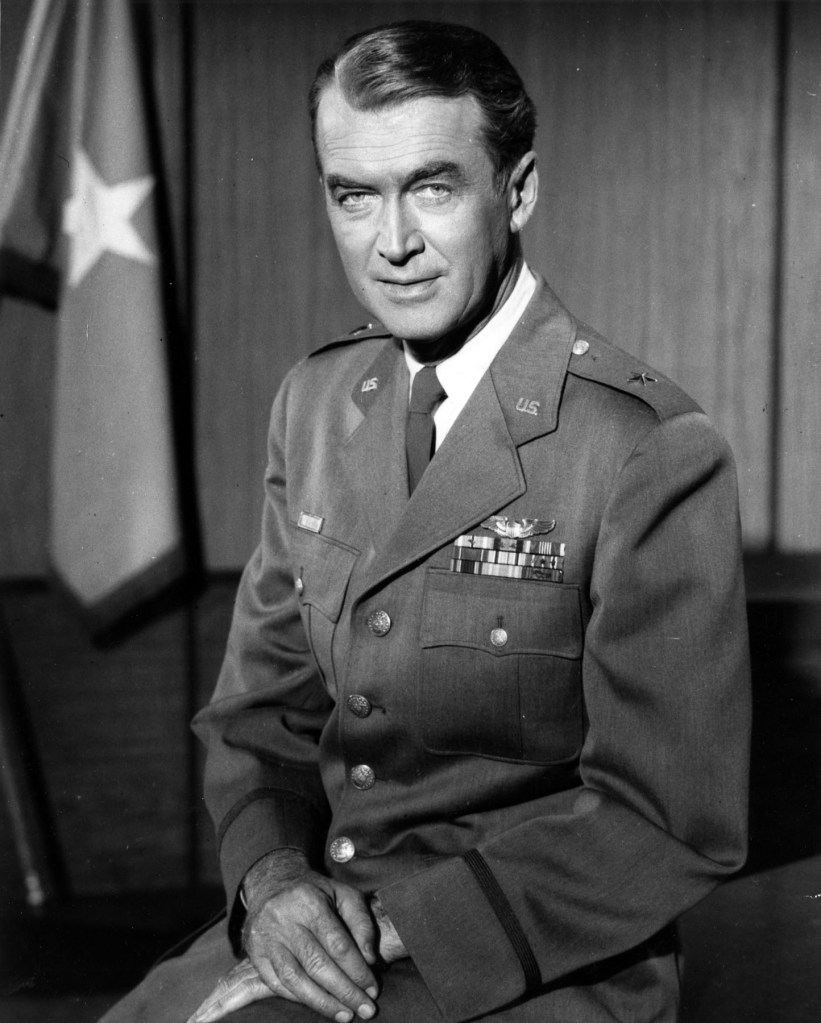
Brigadier General Jimmy Stewart. A bomber pilot during World War II, Stewart suffered from what we today call PTSD. A heroic man, but he’d be the first man to deny that he was a hero. Put differently, Stewart didn’t need war to make him great.

Now, how about the advantages to military service. I know that some of my readers will challenge these, and rightly so, but here are a few “positive waves” about enlisting and taking the oath:

  1. Tradition. For some enlistees, it’s about family tradition. I wasn’t from a strong military family, but my father and his two brothers served in World War II; so did my mother’s brother; and, more recently, my older brother enlisted at the tail end of the Vietnam War and three brothers-in-law also served, one in Vietnam during that horrendous war.
  2. Opportunity. The military today is respected within our society, even venerated. Serving in the military may provide you with unique opportunities both during and after your service.
  3. Teamwork. In a selfish “you can have it all” society, the military reminds us of the importance of teamwork.
  4. Idealism. Taking the Oath of Office should mean something to you. If it doesn’t, don’t enlist.
  5. Purpose, discipline, responsibility, maturity. The military isn’t the only way to live a life of purpose, a disciplined life, a life of responsibility, a life centered on growth and maturation. But, for more than a few people, the military has provided a path forward, a sense of pride and clarity, though that can come at tremendous cost, as explained above.
  6. And, of course, the normal reasons people join: pay, benefits, an opportunity to travel, to start life over, perhaps to escape a bad situation, and so on.

Enlistment, in sum, is a personal decision that must be weighed carefully. What I would say is this: remember the words of Yoda the Jedi Master. “Wars not make one great.” If you’re thinking of enlisting with a hero complex in mind, don’t do it. You’re too immature and you’re misguided to boot. Military service should be about service; it’s also about sacrifice. And you must always remember you may have to make the “ultimate” sacrifice, which is a euphemism for getting killed.

As the Outlaw Josey Wales said: Dyin’ ain’t much of a living, boy.

You’re your own person: Do you what you think is right, and good luck.

Update (11/30/21):

This photo by Jonathan Ernst of Reuters shows the “Gold Star” tree at the White House. It’s a tribute to “the fallen” in recent wars. That expression, “the fallen,” is truly a lamentable euphemism. Of course, we should remember the dead, for which we have Memorial Day and “gardens of stone,” i.e. cemeteries. Should we also remember the dead as ornaments on a Christmas tree? I have my doubts here.

Are We the New Martians?

Heat rays don’t always carry the day. (I used to own this double album, narrated by the great Richard Burton)

W.J. Astore

A few years ago, I picked up H.G. Wells’s classic novel, “War of the Worlds,” and read it in full. I had seen the movies based on it and had also dipped into the book, but I finally read the whole thing, marveling at the suspense Wells created in his classic account of Martians invading our planet, stomping us with their superior technology, only to be overcome by microbes to which they had no resistance.

As I read the book, I asked myself: Are we Americans becoming the new Martians? Warlike ways, superior technology, a predilection to invade and dominate for resources, with no regard for the “primitives” we stomp on or push out of the way in our quest for full-spectrum dominance?

I’m not the only one with questions along these lines. At TomDispatch today, Tom Engelhardt recounts his own affection for “War of the Worlds,” which he avidly read as a boy, and which he recently turned to again in our era of dangerous microbes, incessant war, and a changing climate that is threatening life as we know it on this planet.

Wells, of course, intended his story partly as a critique of the British and Western imperialism of his day, which is why it remains relevant to our imperial world today.

Think about it. America’s leaders, and especially the military-industrial-congressional complex, are in many ways the new Martians. Their god seems to be Mars, the god of war, and the planet they’re remaking is increasingly red, barren, and inhospitable. They’re doing a fair job of emulating those Martians as well, leaving Planet America to attack other lands for their resources, banking on superior technology and “heat rays” (Hellfire missiles!) to win the day.

Yet, like those very same Martians in “War of the Worlds,” Planet America loses its wars to “inferior” peoples, betrayed by “primitive” and hostile environments (the sweltering jungles of Vietnam, the urban jungle and heat of Iraq, the rugged mountains and omnipresent dust of Afghanistan). But do America’s Martians ever quit? Of course not! They keep building new war machines, they keep “investing” in new technologies, they keep advocating dominance through invasion and killing, much like those desperate Martians in Wells’s book, who, faced with a dying planet, decided their only course of action was to invade a different planet and steal its resources for themselves.

In Wells’s book, the Martians reveled in war, shouting “Ulla! Ulla!” as they fired their death rays. Our leaders are doing something similar while many of us shout “USA! USA!” mindlessly.

Wells sought to teach us that war and technology and destruction are just as likely to lead to our demise as to our triumph. The more we make war on ourselves and our planet, the more likely it is that Earth will come to resemble Mars, an inhospitable place for a dying species. Yet, unlike the imaginary Martians of Wells’s book, there’s no other hospitable planet in the neighborhood for us to invade.

Bonus: Here’s an excerpt from Jeff Wayne’s musical version of “War of the Worlds,” featuring Justin Hayward on vocals and Richard Burton as narrator. “The massacre of mankind”: No one says it quite like Burton.

Disagreeing Without Being Disagreeable: The Kyle Rittenhouse Verdict

W.J. Astore

Disagreements are part of life. And indeed my friends, and readers of this blog, have been known to disagree with me. And thank goodness for that! Who’d want obsequious toadies for friends? And, if I’m writing articles that are truly “bracing,” obviously I should expect disagreements. And I do, which is one of the best aspects of this site. We learn from people who disagree with us, that is, when they have reasons well supported by facts, or wisdom learned from their own life experiences, and so on.

America is highly polarized today, and it seems as if people can no longer disagree without being disagreeable. Discussions quickly become arguments, which turn into shouting matches, with lots of name-calling and attacks on people and their alleged motives and leanings.

There’s nothing wrong with impassioned disagreement. But too many people start from there and quickly descend to being disagreeable, even violently so. The end result is that no common ground is discovered, nothing is learned, and any kind of concerted action to effect meaningful change is sabotaged.

Take the case of Kyle Rittenhouse. He was recently acquitted of murder after shooting three people during a Black Lives Matter protest in Kenosha, Wisconsin, that turned violent. The jury found that there wasn’t enough evidence to convict him beyond a reasonable doubt. I’ve watched video from the protests, and it appears to me that Rittenhouse acted in self-defense. Other people may watch this video evidence and watch the trial and reach a different conclusion, and that’s OK. We should be able to discuss this reasonably and rationally, while putting some faith in the verdict reached by the jury.

Kyle Rittenhouse (SEAN KRAJACIC/PHOTOGRAPHER: SEAN KRAJACIC /GET)

Scanning my Facebook feed, however, I see polarization and vituperation about the verdict. It seems like if you agree with the verdict of “not guilty,” you’re obviously a white supremacist, a gun enthusiast, and a Trump supporter. On the other hand, if you disagree with the verdict, you’re obviously a libtard who hates guns and wants to defund the police. It’s a disagreeable mess with no common ground except mutual suspicion, even hate.

Even as I wrote those words, I got an email with an article on the verdict:

Kyle Rittenhouse, white supremacy, and the privilege of self-defense

Rittenhouse has the benefit of boyhood — white boyhood

By Jeneé Osterheldt

In this article, Osterheldt writes that the three white victims of Rittenhouse were “perceived to be fighting for Black lives to matter,” so their lives were “also up for grabs.” But Rittenhouse, also white, was supported by the system because he “believ[ed] in the authority of whiteness.” His life was apparently never “up for grabs.”

This author then authoritatively declares that: “Had he [Rittenhouse] been white and protecting Black lives in Kenosha instead of purportedly protecting cars, he’d be in prison. Or maybe cops would have pepper-sprayed him instead of giving him gratitude and water. Rittenhouse has the privilege of white power.”

Again, based on the video evidence and the trial, I don’t see this verdict as being driven by “white power” and privilege. Rittenhouse’s first victim was a man who chased him, threatened him, and tried to take his gun from him. The second victim was beating Rittenhouse with a skateboard. The third victim (wounded in the arm) was pointing a gun at Rittenhouse, as he himself admitted during the trial. The jury watched the videos, heard the testimony, and decided Rittenhouse’s actions did not constitute murder or attempted murder. From what I’ve seen and heard, I agree with the jury.

Now, it shouldn’t matter, but all three of Rittenhouse’s victims were white. Two of the three were attacking him before they were shot (the two he killed), and the other pointed a handgun at him (the one he wounded). The first man he shot was mentally unbalanced; video at the scene shows him shouting racial obscenities, including the N-word, at Blacks, daring them to shoot him.

So, I disagree that Rittenhouse’s acquittal is an example of white privilege and power. I shouldn’t have to say this, but I’ll add that I support the Black Lives Matter movement, that I’m not a “gun enthusiast,” and that I’ve never voted for Trump and never will. (I’m not a fan of Biden either.)

We can disagree based on evidence, reason, facts. We can disagree without being disagreeable. Can’t we?