Creator of Bracing Views. Contributor to TomDispatch, Truthout, HNN, Alternet, Huffington Post, Antiwar, and other sites. Retired AF lieutenant colonel and professor of history. Senior fellow, Eisenhower Media Network
A popular song of defiance that came soon after the Pearl Harbor attack on December 7, 1941 was “Praise the Lord and Pass the Ammunition.” Today, that song title must be amended: Praise the Lord and pass the cluster munitions.
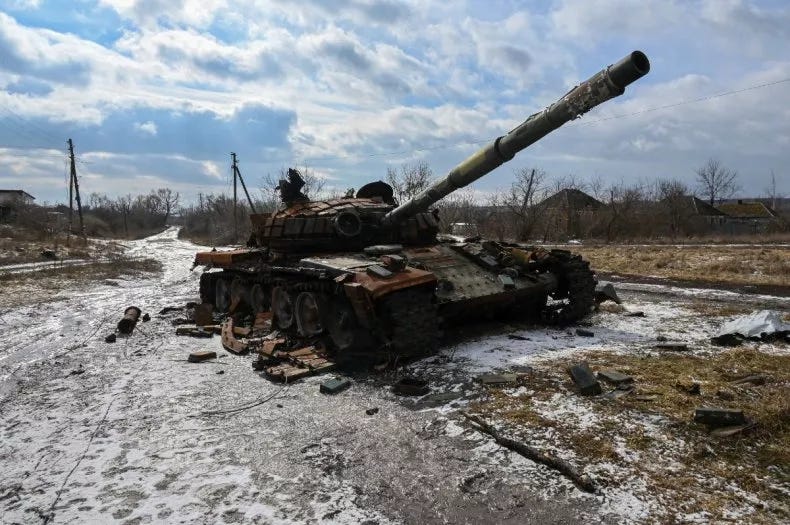
From its stockpiles, the U.S. is providing cluster munitions to Ukraine, munitions that have been banned by more than 100 countries. It appears that Russia has already used cluster munitions in the war, which Biden administration spokesperson Jen Psaki denounced as a potential war crime. Ukraine, of course, will only use cluster munitions in a godly way, so no worries there. It’s a crime when Russia does it but they are freedom munitions when Ukraine uses them.
They’ll free you of your legs, your arms, and maybe your life
Naturally, Putin and the Russians have promised to respond with more of their own cluster munitions, assuming Ukraine uses its American-made bombs and bomblets. Basically, the Biden administration is sending cluster munitions as a stopgap since the U.S./NATO is running short of conventional high explosive (HE) artillery shells. HE shells are more effective against fixed fortifications and trenches than cluster shells (the latter is a higher-tech variant of shrapnel shells). But in the absence of HE shells, cluster munitions will have to do, even though the “dud” bomblets will persist in the environment for years, if not decades, killing and maiming anyone unlucky enough to come across them.
Supporters of sending cluster munitions to Ukraine, including most members of Congress, are essentially saying that just about any weapon of any brutality is OK if it theoretically helps Ukraine. Short of poison gas and nuclear weapons, I’m not sure there are any weapons they wouldn’t send to Ukraine in the name of “democracy.”
With respect to progress in this war, I’ve read conflicting reports that say that Russia is winning by grinding up Ukrainian forces and vice-versa. I’ve read where Ukraine will soon reach a “tipping point” and breakthrough Russian defense lines, driving toward Crimea, but such optimism isn’t shared by some U.S. experts. For example, John Kirchhofer of the U.S. Defense Intelligence Agency recently said the war is “at a bit of a stalemate” and that “magical” weapons like Leopard and Challenger tanks are not “the holy grail that Ukraine is looking for” and that a breakthrough in the near-term is unlikely.
So, “praise the Lord and pass the cluster munitions” is likely to be a very long funereal dirge rather than an exultant victory anthem.
Four days ago, I got a story in my New York Times email feed on “A Turning Point in Military Spending.” The article celebrated the greater willingness of NATO members as well as countries like Japan to spend more on military weaponry, which, according to the “liberal” NYT, will help to preserve democracy. Interestingly, even as NATO members have started to spend more, the Pentagon is still demanding yet higher budgets, abetted by Congress. I thought if NATO spent more, the USA could finally spend less?
No matter. Russia’s invasion of Ukraine, as well as the hyping of what used to be called the “Yellow Peril,” today read “China,” is ensuring record military spending in the USA as yearly Pentagon budgets approach $900 billion. That figure does not include the roughly $120 billion or more in aid already provided to Ukraine in its war with Russia. And since the Biden administration’s commitment to Ukraine remains open-ended, you can add scores of billion more to that sum if the war persists into the fall and winter.
Here’s an excerpt from the New York Times piece that I found especially humorous in a grim way:
[Admittedly,] The additional money that countries spend on defense is money they cannot spend on roads, child care, cancer research, refugee resettlement, public parks or clean energy, my colleague Patricia points out. One reason Macron has insisted on raising France’s retirement age despite widespread protests, analysts believe, is a need to leave more money for the military.
But the situation [in Europe of spending more on butter than guns] over the past few decades feels unsustainable. Some of the world’s richest countries were able to spend so much on social programs partly because another country — the U.S. — was paying for their defense. Those other countries, sensing a more threatening world, are now once again promising to pull their weight. They still need to demonstrate that they’ll follow through this time.
Yes, Europe could continue to invest in better roads, cleaner energy, and the like, but now it’s time to buckle down and build more weapons. Stop freeloading, Europe! Dammit, “pull your weight”! You’ve had better and cheaper health care than Americans, stellar educational systems, child care benefits galore, all sorts of social programs we Americans can only dream of, but that’s because we’ve been paying for it! Captain America’s shield has been protecting you on the cheap! Time to pay up, you Germans, you French, you Italians, and especially you cheap Spaniards.
Look at all those cheap Spaniards. They have good stuff because of Captain America. Freeloaders! (NYT Chart, 7/12/23)
As the NYT article says: NATO allies need to “follow through this time” on strengthening their militaries. Because strong militaries produce democracy. And European “investments” in arms will ensure more equitable burden sharing in funding stronger cages and higher barriers to deter a rampaging Russian bear.
Again, you Americans out there, that doesn’t mean we can spend less on “defense.” What it means is that the U.S. can “pivot to Asia” and spend more on weaponry to “deter” China. Because as many neocons say, the real threat is Xi, not Putin.
We have met the enemy, and he is us. That’s an old saying you won’t see in the “liberal” NYT.
I’m still waiting for the blockbuster Hollywood production that celebrates peace
Last year, “Top Gun: Maverick” was all the rage. It was a silly war flick with a plot ripped from the original “Star Wars” movie featuring plenty of bloodless, high octane action sequences. I enjoyed it in the way I occasionally indulge in unhealthy fast food. The movie was instantly forgettable except for one scene where hotshot pilot Maverick, played of course by Tom Cruise, meets his old rival Iceman, played by Val Kilmer. In real life, Kilmer suffers from throat cancer, and his condition is not hidden in the movie, where Kilmer is now an admiral who still believes in his old friend, Captain Pete “Maverick” Mitchell.
Naturally, Maverick saves the day, pummeling a nameless enemy (most likely Iran) with bombs because that country is developing nuclear weapons. Nothing, of course, is said of the thousands of nuclear warheads and bombs in America’s arsenal, or that the USA is the only country to have used atomic bombs in war (Hiroshima, Nagasaki). But I digress.
Hollywood loves war movies. They sell well. Yet I still await “Top Dove: Peacenik,” in which an intrepid, brave, determined, and charismatic person stops a war without bombing or killing anyone. What a breath of fresh air that would be!
Exactly ten years ago, I posted the article below at Bracing Views. We need peacemakers now more than ever. Sadly, they are still very much forgotten, or ignored, or dismissed as unserious or even delusional.
Forgotten Are the Peacemakers (2013)
Monument to Elihu Burritt in New Marlboro, Mass. (author’s photo)The Plaque in Honor of Burritt (author’s photo)
Being Catholic, I’m a big fan of the Sermon on the Mount and Christ’s teaching that “blessed are the peacemakers.” Yet in American history it seems that “forgotten are the peacemakers” would be a more accurate lesson. We’re much more likely to remember “great” generals, even vainglorious ones like George S. Patton or Douglas MacArthur, than to recognize those who’ve fought hard against long odds for peace.
Elihu Burritt was one such peacemaker. Known in his day as “The Learned Blacksmith,” Burritt fought for peace and against slavery in the decades before the Civil War in the United States. He rose from humble roots to international significance, presiding over The League of Universal Brotherhood in the 1840s and 1850s while authoring many books on humanitarian subjects.
Interestingly, peacemakers like Burritt were often motivated by evangelical Christianity. They saw murder as a sin and murderous warfare as an especially grievous manifestation of man’s sinfulness. Many evangelicals of his day were also inspired by their religious beliefs to oppose slavery as a vile and reprehensible practice.
Christian peacemakers like Burritt may not have had much success, but they deserve to be remembered and honored as much as our nation’s most accomplished generals. That we neglect to honor men and women like Burritt says much about America’s character.
For if we truly are a peace-loving people, why do we fail to honor our most accomplished advocates for peace?
News that the Biden administration is sending cluster munitions to Ukraine highlights the dangerous escalatory nature of wars. These are special bombs and artillery shells with hundreds of “bomblets” that disperse to kill or maim as many people as possible. They persist in the environment; children have been known to pick them up and to be killed or grievously wounded as a result.
The apparent rationale behind this decision is that cluster munitions will help Ukraine in its counteroffensive against Russia. While these munitions will certainly increase the body count, probably on both sides, they are unlikely to be militarily decisive.
There are other issues as well, notes Daniel Larison at Eunomia:
The decision also opens the U.S. up to obvious charges of hypocrisy. U.S. officials have condemned the Russian use of these weapons and said that they have no place on the battlefield, but now the administration is saying that they do have a place. Providing cluster munitions to Ukraine makes a mockery of the administration’s earlier statements and creates more political problems for its effort to rally support for Ukraine. Many states in Latin America, Africa, and Asia are parties to the treaty banning the use, transfer, and stockpiling of cluster munitions, and now they will have one more reason to dismiss U.S. appeals to defending the “rules-based order” as so much hot air. The decision will probably embarrass and antagonize some of our allies in Europe, as most members of NATO are also parties to the treaty.
It’s rather amazing to think about the incredible variety of weaponry being sent to Ukraine in the name of “victory.” At first, the Biden administration spoke only of providing defensive weaponry. Biden himself declared that sending main battle tanks, jet fighters, and the like was tantamount to provoking World War III. More than a year later, the U.S. has committed to sending Abrams tanks, F-16 fighter jets, and offensive weapons of considerable potency like depleted uranium shells and now cluster munitions. And always with the same justification: the new weapons will help break the stalemate and lead to total victory for Ukraine.
John Singer Sargent, “Gassed” (1919). Gas in World War I produced a million casualties—only aggravating the horrors of trench warfare
This is nothing new, of course, in military history. Think of World War I. Poison gas was introduced in 1915 in an attempt to break the stalemate of trench warfare. It didn’t. But it did stimulate the production of all sorts of dangerous chemical munitions and agents such as chlorine gas, phosgene, and mustard. Tanks were first introduced in 1916. Stalemate persisted. Flamethrowers were introduced. Other ideas to break the stalemate included massive artillery barrages along with “creeping” barrages timed to the advancing troops.
But there was no wonder weapon that broke the stalemate of World War I. After four years of sustained warfare, the German military finally started to falter in the summer of 1918. The Spanish Flu, the contagion of communism from Russia, and an effective allied blockade also served to weaken German resolve. The guns finally fell silent on November 11, 1918, a calm that wasn’t produced by magical weapons.
I wonder which weapon will next be hailed as crucial to Ukrainian victory? Who knows, maybe even tactical nukes might be on the minds of a few of the madmen advising Biden.
Too many Americans see war as a positive force as they applaud Ukraine’s ongoing resistance to Russian aggression; along with seeing war as admirable, they see it as predictable and controllable. Of course, it’s easy to cheer Ukraine on from thousands of miles away, celebrating their surprising victories over Russia, even as both sides suffer tens of thousands killed, many more injured, and many more forced from their homes.
When Americans think about war, there’s a tendency to focus on favorable outcomes while eliding war’s worst aspects. So, for example, the American Revolutionary War is celebrated for enabling U.S. independence. The U.S. Civil War freed the slaves. World War II liberated the world from the twin threats of Nazi fascism and Imperial Japan’s militarism. Other wars that are far less easy to simplify and spin as positive, such as the Vietnam War or recents wars in Afghanistan and Iraq, are dismissed or forgotten, to say nothing of open land grabs as in the Mexican-American War and the Spanish-American War. Let’s not even talk about the wanton brutality of various wars against Native American peoples glorified in so many westerns of my youth.
Looking at America’s history, Christ, the Prince of Peace, is clearly not America’s favored god. America’s god is a warrior one, like Ares for the Greeks and Mars for the Romans. “Blessed are the war makers” could be a guiding tenet of American life, especially considering how much money is made and power wielded by those who embrace war.
The Greeks had wisdom in seeing war as akin to a god, a powerful force, capricious, unpredictable, intoxicating, and uncontrollable. War can consume a person, a people, a nation. It appeals to our irrational nature, our darkest passions. “War fever” is thus an accurate descriptive phrase. We can be seized by it, deluded by it, consumed by it.
I’ve never run across “peace fever” as a phrase or descriptor of American behavior.
A young Tom Cruise loving his machine gun in “Taps”
“[W]ar is a distressing, ghastly, harrowing, horrific, fearsome and deplorable business. How can its actual awfulness be described to anyone?” Stuart Hills, By Tank Into Normandy, p. 244
“[E]very generation is doomed to fight its war, to endure the same old experiences, suffer the loss of the same old illusions, and learn the same old lessons on its own.” Philip Caputo, A Rumor of War, p. 81
The persistence of war is a remarkable thing. Two of the better books about war and its persistence are J. Glenn Gray’s “The Warriors” and Chris Hedges “War Is a Force that Gives Us Meaning.” Hedges, for example, writes about “the plague of nationalism,” our willingness to subsume our own identities in the service of an abstract “state” as well as our eagerness to serve that state by killing “them,” some “other” group that the state has vilified.
In warning us about the perils of nationalism, Hedges quotes Primo Levi’s words: “I cannot tolerate the fact that a man should be judged not for what he is but because of the group to which he belongs.” Levi’s lack of tolerance stems from the hardest of personal experiences: surviving Auschwitz as an Italian Jew during the Holocaust.
Gray takes this analysis in a different direction when he notes that those who most eagerly and bloodthirstily denounce “them,” the enemy, are typically far behind the battle lines or even safely at home. The troops who fight on the front lines more commonly feel a sort of grudging respect for the enemy, even a sense of kinship that comes with sharing danger in common.
Part of the persistence of war, in other words, stems from the ignorant passions of those who most eagerly seek it and trumpet its heroic wonders even as they stand (and strive to remain) safely on the sidelines.
Both Hedges and Gray also speak to the dangerous allure of war, its spectacle, its excitement, its awesomeness. Even the most visceral and “realistic” war films, like the first thirty minutes of “Saving Private Ryan,” represent war as a dramatic spectacle. War films tend to glamorize combat (think of “Apocalypse Now,” for example), which is why they do so little to put an end to war.
One of the best films to capture the dangerous allure of war to youth is “Taps.” I recall seeing it in 1981 at the impressionable age of eighteen. There’s a tiny gem of a scenenear the end of the film when the gung ho honor guard commander, played by Tom Cruise before he was TOM CRUISE, mans a machine gun. He’s firing against American troops sent to put down a revolt at a military academy, but Cruise’s character doesn’t care who he’s firing at. He’s caught in the rapture of destruction.
He shouts, “It’s beautiful, man. Beautiful.” And then he himself is shot dead.
This small scene with Cruise going wild with the machine gun captures the adrenaline rush, that berserker capacity latent in us, which acts as an accelerant to the flames of war.
War continues to fascinate us, excite us. It taps primal roots of power and fear and ecstasy all balled together. It masters us, hence its persistence.
If and when we master ourselves, perhaps then we’ll finally put an end to war.
There’s an important point about America’s Global War on Terrorism (GWOT) that people often miss.
When the Bush/Cheney administration announced the GWOT after 9/11, I think nearly all Americans assumed that “global” meant everywhere but the “good” countries. That global meant the axis of evil (Iraq, Iran, North Korea) and similar so-called bad actors, but that it didn’t mean countries like Canada — and certainly not the U.S. homeland.
But global really did mean everywhere on earth as we’ve watched the war on terror escalate domestically. The U.S. government/security state has built the foundation and superstructure for a permanent war on terror, and it simply isn’t going to go away. The Iraq and Afghan wars are essentially over (both lost), and fears of North Korea have subsided as the military-industrial-congressional complex focuses on Ukraine, Russia, and China, but the GWOT continues. It’s now turned inwards, within and along our own borders, and those techniques that were practiced (if not perfected) in Iraq, Afghanistan, and elsewhere are now being used and inflicted upon ordinary Americans who are attempting to resist state-corporate authoritarianism.
The GWOT has come home — but perhaps it’s always been here. What’s changed is how state-corporate entities can define almost any form of determined protest—even civil and nonviolent ones—as “terror.” Labeling someone a “domestic terrorist” gives state-corporate actors a whole host of powerful ways to punish activists, notes by Michael Gould-Wartofsky at TomDispatch.com.
At the same time, America has witnessed the “rise of the warrior-cop,” as Radley Balko noted in his book by that title.
Three years ago, I wrote about the militarization of police forces at TomDispatch. This is what I wrote then:
America’s violent overseas wars, thriving for almost two decades despite their emptiness, their lack of meaning, have finally and truly come home. An impoverished empire, in which violence and disease are endemic, is collapsing before our eyes. “When the looting starts, the shooting starts,” America’s self-styled wartime president [Donald Trump] promised, channeling a racist Miami police chief from 1967. It was a declaration meant to turn any American who happened to be near a protest into a potential victim
As such demonstrations proliferate, Americans now face a grim prospect: the chance to be wounded or killed, then dismissed as “collateral damage.” In these years, that tried-and-false military euphemism has been applied so thoughtlessly to innumerable innocents who have suffered grievously from our unending foreign wars and now it’s coming home.
A few days ago, The Onion, a satirical news site, compared America’s obedience and passivity to power to the current situation in France. Here’s how they put it:
In an ongoing struggle against ruling-class oppression, the people of France again protested in a way that Americans are welcome to at any time, sources confirmed Thursday. According to reports, French citizens across the country were spotted hitting the streets en masse as a unified front against the institutional bondage that seeks to subjugate them while never failing to apply forceful pressure every time injustice strikes, which Americans can and should feel free to do whenever they so choose.
Yes, but are Americans truly “welcome” to protest “whenever they so choose”? We’d like to think so, especially as July 4th approaches (America! Land of the Free!), but who wants to be detained and thrown in jail for domestic terrorism? Anyone in America hankering to be labeled as a terrorist by the state, whether on the right or left of the political spectrum, even if the charge is eventually dismissed?
Searing photo of state violence at Kent State in 1970. The dead student’s name was Jeffrey Miller. The young woman crouched in shock and horror was Mary Ann Vecchio. Richard Nixon called the protesters “bums.” What would the state call them today—domestic terrorists?
Remember those innocent days of the 1960s when for some the police were “pigs” and the protesters were “bums” (Richard Nixon’s word for the students killed at Kent State)? Now those protesters could be charged with domestic terrorism even as various heavily armed enforcers of the law would likely be celebrated (consider all those “blue lives matter” flags, for example).
Remember when “defund the police” was briefly a thing? By which people meant less funding for militarized police forces and more for mental health services and the like. President Joe Biden and the Democrats realized any serious effort to restrain police power would leave them open to charges of being soft on crime, so Biden and the party simply declared: Fund the police. (Republicans concur, of course, even as they still accuse Biden and the Dems of being soft on crime.)
And there you have it. Fund the police at all levels, local, state, and federal, and grant them the kind of powers given to America’s “warriors” in the GWOT. Set them loose on all of America’s domestic “terrorists.” After all, the GWOT went so well in Iraq, Afghanistan, Libya, Yemen, and elsewhere. Surely it will go equally well in the Homeland. Right?
Addendum: In writing this, I came across a superb article by Patricia McCormick at the Washington Post on Mary Ann Vecchio, “the girl in the Kent State photo.” She was just 14 when the above photo was taken. She paid a high price, as the article recounts. Letters to her family accused her of being a “drug addict,” a “tramp,” or a “communist.” The then-governor of Florida suggested she was a “professional agitator” and therefore responsible for the students’ deaths. A Gallup poll back then, cited by McCormick, said that 58% of Americans blamed the students at Kent State and only 11% blamed the National Guardsmen who opened fire and killed the four students.
“Professional agitator” sounds much like today’s domestic terrorist. And let’s reflect on those 58% of Americans who believed the students at Kent State were responsible for their own deaths. How dare they block the free flight of “Made in USA” bullets with their young bodies? The “bums”! (“Domestic terrorists.”)
Comparing and contrasting low-yield theater nuclear weapons with conventional precision strike weapons leads to a nuanced conclusion that both contribute to deterrence.
Imagine that! Both nuclear and conventional weapons “contribute to deterrence.” Even though they’re apparently apples and oranges. Well, there’s “nuance” for you.
Anybody want a tasty nuclear “orange”? Fresh and juicy, and with a low yield. It may very well deter you from eating citrus fruit for, well, forever.
Potential delivery system for low-yield nukes. Think of them as juicy oranges
I’m not familiar with the authors of the piece. McCue is an Air Force lieutenant colonel with the Defense Threat Reduction Agency. I don’t know about you, but suggesting that low-yield nukes can be used in nuanced ways heightens my sense of threat. Lowther directs strategic deterrence programs at the National Strategic Research Institute, which makes me think anew about the meaning of “deterrence.” In this case, it seems to mean the willingness to use nuclear weapons against “bad actors” like China but especially Putin and Russia. And Davis is an Army major assigned to U.S. Central Command. It’s nice to know the Army, just like the Air Force, has a strange love for nukes.
In essence, the article’s argument is this: Russia, China, and North Korea are “investing” in low-yield nukes while the U.S. and other NATO allies have generally been reducing their arsenals of the same. To deter those three adversaries, the U.S. must make new “investments” in low-yield nukes, because you never know what those foreigners are up to.
Here’s how the authors put it in their conclusion: “In the right circumstances conventional weapons offer greater certainty of destruction than tactical nuclear weapons. The West must examine what this means for warfighting, as well as what adversaries are signaling by investing in low-yield nuclear weapons. The best solution may be the development of a state-of-the-art nuclear capability that ensures certain, prompt, proportionate, and in-kind response options. The perception of a missing rung on the American escalation ladder could prove alluring to Russia or China in a conflict.”
Mr. President, we must not allow a missing rung on America’s escalation ladder!
Even if that “missing rung” is only a “perception.”
Let’s keep that in mind if nuclear weapons start flying in Europe or Asia. We can console ourselves that at least we weren’t missing a rung in our escalatory ladder as millions get blasted, burnt, and irradiated.
A friend of mine is calling out his progressive friends for saying they’ll vote third party in the 2024 presidential election. Basically, his argument is this. We know Biden isn’t perfect. He leaves much to be desired, notably in obvious signs of his mental and physical decline. But we also know Trump is a monster. And, since Trump and Biden are currently running neck and neck, at least in the polls, your only real “choice” is to vote for Joe against the monster.
In sum, a vote for a third-party candidate of deep integrity and strong character like Cornel West is really a vote for Monster Trump.
A vote for Cornel West is a vote for Trump?
As I told my friend, telling people they’re making a big mistake by voting for a candidate like Cornel West is not the most effective way to win their hearts and minds. Telling them they’re throwing away their vote or that they’re really voting for Trump is hardly persuasive. In fact, it’s alienating and insulting.
If Joe Biden and the DNC want to win my vote, I want to see promises kept, progressive policies enacted, and corruption stymied and reversed. I want to see concrete results. I want changes in policy. I don’t want what Biden promised CEOs when he decided to run in 2020: that “nothing will fundamentally change.”
On so many issues, Biden has reneged on promises or otherwise failed to deliver for the working classes. He’s not a pro-union president. He hasn’t raised the federal minimum wage. He’s failed to deliver on student debt relief. There is no public optionfor health care. He’s approved oil and gas drilling in the most sensitive areas. Meanwhile, military budgets continue to soar as the Biden administration postures for a new Cold War with Russia and China. And I’m simply supposed to ignore this woeful record and vote for Joe because Trump is allegedly worse.
My friends tell me I expect too much from Biden and the Democrats. That they’re hamstrung by the Republicans. That Joe is doing the best he can. That I need to give Joe more chances. And so on.
But Joe Biden and the Democrats couldn’t even protect abortion rights. Barack Obama promised to codify Roe vs. Wade into law as his “top priority” but then abandoned his promise once he took office in 2009. Biden, of course, was his VP and has a long record of being critical of abortion rights. Again, however, we are told that Biden is the best hope for restoring rights that he’s never been keen on supporting, let alone protecting and extending.
If Biden loses in 2024, let’s be clear. It won’t be because some progressives voted third party. And it won’t be because of Putin or Russia or rigged voting machines or what-have-you. It will be because Biden simply couldn’t win enough votes in the right places. Because not enough voters believed in him. That’s not on people like me. That’s on Biden and the DNC.
News of the rebellion of the Wagner mercenary group in Russia and the exile of its leader have led to confident announcements of Vladimir Putin’s weakening grip on power. Secretary of State Antony Blinken said the rebellion was “the latest failure” in Putin’s war against Ukraine, and NBC News declared “Putin’s rule is now more uncertain than ever.”
Vladimir Putin and the leader of the Wagner group, Yevgeny Prigozhin
Perhaps so. Wars often act as an accelerant to change, generating political chaos in their wake. The results of chaos, obviously, don’t lend themselves to predictability. Who knew in 1914, when the guns of August sounded, that four years later four empires would have collapsed under the strain of war (the Russian Empire, the Austro-Hungarian Empire, the Ottoman Empire, and the German Second Reich).
President Joe Biden was unusually frank in March of 2022 when he declared that Putin “cannot remain in power” due to his decision to invade Ukraine. Be careful what you wish for, Mr. President. Is overthrowing Putin truly a wise goal for global stability?
I honestly don’t know. A weaker, possibly fragmented Russia could increase the chances of nuclear war. A struggle for power within Russia could lead to the emergence of hardline leader who might make the West nostalgic for the relative predictability of Putin.
Most of us have heard the saying: better the devil you know than the one you don’t know. (This isn’t to suggest Putin is diabolical, of course.) In World War I, many of the allies professed to hate the Kaiser; his eventual successor as leader of the German people was Adolf Hitler. Again, wars may unleash elemental and fundamental changes, and change isn’t always for the better.
So, my position on the Russia-Ukraine War remains unchanged. Negotiate a truce. Use diplomacy to put a permanent end to this war. If Putin is truly weakened, this might be the best of times to seek a diplomatic settlement. After all, if Putin is truly worried about his grip on power within Russia, he might be open to ending the war largely on Ukraine’s terms so he can redirect his attention to consolidating his power base.
War has been given plenty of chances. Why not give peace a chance?
Robert F. Kennedy Jr. Echoes JFK’s Peace Speech of June 1963
Robert F. Kennedy Jr. is running against the Democratic establishment’s position on the Russia-Ukraine War and for the presidential nomination of the party in 2024. He recently gave a peace speech in New Hampshire that echoed the sentiments of the peace speech given by his uncle, President John F. Kennedy, in 1963.
In New Hampshire, RFK Jr. speaks for the possibility of peace and against the MICC and its forever war
In his speech, RFK Jr. stated that Russia has legitimate security concerns, that NATO expansion to Russia’s border was a betrayal of promises made to leaders like Mikhail Gorbachev, and that America’s military-industrial-congressional complex (MICC) is enabling forever war rather than actively seeking an end to war. He was also careful to say he abhorred Vladimir Putin’s decision to invade Ukraine.
I’ve already heard RFK Jr. being called a “Putin enabler,” if not a Putin puppet, for suggesting that Russian concerns about Ukraine’s inclusion in NATO are in any sense legitimate. Doesn’t he know, one reader asked, that Putin rejects Ukrainian identity as a country and a people? Doesn’t he know Russia is killing civilians in terror bombings? Why is he acting as an apologist for Putin’s many war crimes?
Obviously I can’t speak for RFK Jr., but I think his message is plain: a state of permanent war is causing deep harm to American democracy, what’s left of it, and any sustainable U.S. recovery must start with a rejection of war and massive military spending, including the more than $100 billion already devoted to what has become a proxy war in Ukraine. That war has greatly contributed to the rhetoric, and increasingly the reality, of a new Cold War with Russia (and China too), strengthening the MICC’s call for even vaster sums for wars and weapons in the cause of maintaining U.S. full-spectrum dominance around the globe.
Like his uncle, President Kennedy, RFK Jr. fears a world-ending nuclear cataclysm, an event that becomes more imaginable as the Russia-Ukraine War continues to escalate. Again, at no time did I hear RFK Jr. express support of the Russian invasion or its brutal methods; what he did express support for is diplomacy as a way of ending the bloodshed while reducing the risk of nuclear Armageddon.
Any reasonable diplomatic effort would have to recognize the legitimate security concerns of Russia, just as that same effort would have to recognize those of Ukraine as well.
Those who advocate for peace often face the charge of being puppets, enablers, or apologists for enemies who are usually presented as monstrous. All credit to RFK Jr. for departing from standard neocon rhetoric and practices and for extending an olive branch to Russia.
Arguing for more war is easy. It even wins salutes (and money) within today’s Democratic establishment. Striving for peace is far harder, and like his uncle, RFK Jr. has decided to take the harder path. More of us should join him.