Sports, War, Fairness, and Fate: Lessons from My Dad

Spunk visit 005
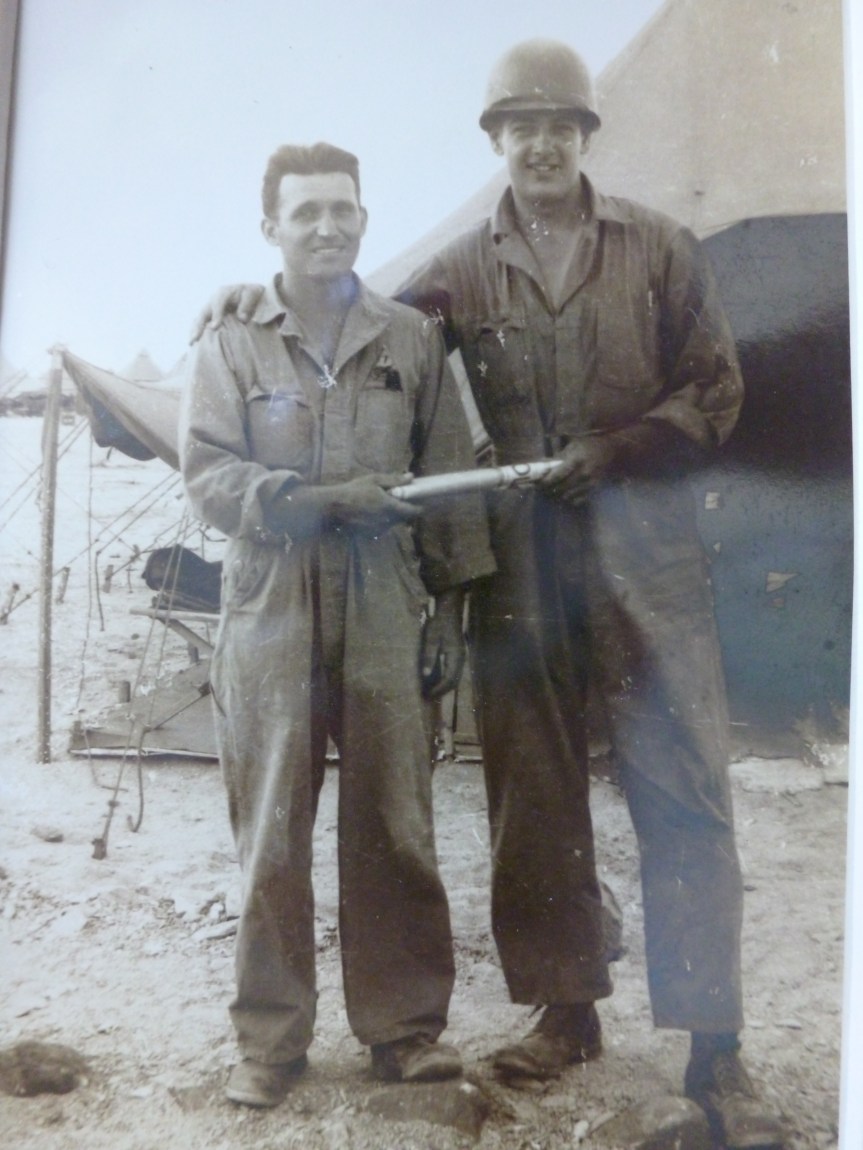
My dad (left) during armored desert maneuvers in California

W.J. Astore

Life isn’t fair: that’s a lesson my dad learned growing up during the Great Depression and working hard in the Civilian Conservation Corps and local factories in the 1930s.  He also learned it during World War II, when he was drafted and eventually assigned to an armored headquarters company at Fort Jackson, South Carolina.  In fact, before World War II, my dad tried to enlist in the Navy, only to discover he was too short to make the grade (he was just under 64″, the Navy minimum, and recruiters were picky before Pearl Harbor).  A half-inch or so probably saved my dad’s life.  After that experience, my dad vowed he wouldn’t volunteer for war; he’d wait until he was drafted, which he was in 1942 by the Army.

My dad was on track to be a surgical technician for the 7th Armored Division; he would have gone overseas and faced combat.  But another soldier on the dental technician track talked my dad into switching positions with him.  My dad agreed, only to learn a dental technician was limited to a corporal technician’s rating, whereas a surgical tech could become a sergeant with higher pay.  My dad was also “excess” on the table of organization when he finished training, so he was reassigned from the 7th Armored to the 15th Armored Group.

My dad had to transfer and got less pay, but he got lucky: his new unit didn’t go overseas, whereas the 7th Armored did.  A guy he knew, Danny Costellani, was transferred from medical battalion to armored infantry while in France and was killed in action.  My dad knew this could have been him.

While my dad was assigned to Fort Jackson, South Carolina, late in 1944, there was a frantic call for more soldiers to be sent overseas in response to high losses during the Battle of the Bulge, the last major German offensive of World War II.  Many “green” recruits were rushed through basic training and shipped overseas to fight the Germans.  But a few local Southerners noticed that highly qualified soldier-athletes at Fort Jackson weren’t being sent anywhere.  They just seemed to stay in place while playing baseball, football, tennis, and other sports.  I’ll let my dad take the story from here:

During the Battle of the Bulge some Southern civilians were wondering why their sons, after Basic Training were shipped overseas as replacements.  While the Post Commander had on station complement a group of about fifty soldiers who played sports for the Ft Jackson baseball, basketball, football and even tennis teams.  Well the general got an order from higher echelons to put all able bodied troops into a combat outfit.  Well fifty of our soldiers were shipped overseas and fifty of the general’s athletes were put into our company.  When that happened the rest of our company figured we would never go overseas.  As time showed 99% stayed state side.  The 15th Armored Group took all the athletic honors.  Very seldom did our sports teams lose.

My dad saved newspaper clippings that celebrated the athletic achievements of the 15th Armored Group.  One photo showed the 15th Headquarters and Headquarters Company orientation room, which included a prominent section on “The World of Sports” and a table showcasing all individual and team trophies.

My dad may have owed his life to a picky Navy recruiter and a fellow soldier who wanted sergeant’s stripes.  These athletes at Fort Jackson may have owed their lives to a post commander who preferred winning at sports to shipping the most able-bodied troops overseas to fight the enemy.

Yes, life isn’t fair.  And fate sure does have an odd sense of humor.

Debunking Spectator Sports: Confessions of an Anti-Sports Fan

download
Are you not entertained?

Richard Sahn

I’ve never gotten excited about or interested in a particular sports team, whether professional or amateur. I don’t care whether a particular team wins or loses and I go out of my way not to watch games on TV or listen to a radio broadcast.

Prior to this year’s Super Bowl game, I listened to people chant, on the phone or in person, “Go Patriots” or “Go Eagles.” Even a Catholic priest at the end of a mass I attended recently couldn’t leave the altar before letting the parishioners know he was a Patriots fan.

Spectator sports have always been a secular religion in most developed countries but with no promise of any form of salvation, afterlife, or reincarnation. The most you can really expect from your team is winning a bet on the game. But  spectator sports  is a distraction with negative consequences, ultimately, to society and the individual sports fan—such as having no understanding of the actions of political parties.

And because each season of the year has its athletic contests there is no letup. A fan is deluged all year round with games as well as incessant commentaries on athletes and the points they score or might score.  Athletic contests and players, even on the high school level, are  a major topic of conversation, especially among adult males  I view such conversations as not only boring but irrelevant to my own life, to what I  would call meaningful concerns.

In fact, I would argue spectator sports discussions have no lasting therapeutic value in dealing with the real “slings and arrows of outrageous fortune.” Political philosopher Noam Chomsky recently said, probably somewhat sarcastically, that if as much mental energy was expended in solving the social and economic problems of the world as is expended in trying to explain why a given team wins or loses a game, much socially and politically induced suffering and death could be eliminated.

Eavesdrop on virtually any conversation, especially at World Series, Super Bowl, or NBA playoff times, and you’ll hear conversations that would make you believe you were in a think-tank rivaling the Institute for Advanced Study at Princeton.

Now, as a sociologist, I realize the important function of sports in society. That function, of course, is a distraction from life’s existential problems and dilemmas. Death, loss of loved ones, nuclear war, global warming are certainly among those problems. And, most assuredly, being a spectator sports fanatic is a far better alternative than being a drug addict or engaging in anti-social behavior.  I also admit spectator sports have a limited psycho-therapeutic effect on some people.

My quarrel is with the level of energy spent watching and then discussing sports events. Even expressing one’s preference for one team or another I find disturbing, mainly because I feel there are more worthwhile causes to champion. Agonizing, so it seems, over the prowess of individual players and their team’s chances of winning playoffs or championships is a waste of time and energy. Simply put, I cannot empathize in the slightest with the sports fan. In that respect I guess I’m a type of sociopath since sociopaths can’t empathize with other human beings in general.

Arguably, spectator sports also contribute to the “us” versus “them” perspective toward social life, the belief that life is not interesting or worthwhile unless “us” is always trying to  defeat “them,” whether “them” be a rival team or country–in other words, not “us.”

The great (former) coach of the Green Bay Packers, Vince Lombardi once proclaimed, “Winning isn’t everything; it’s the only thing.” Could Lombardi’s philosophy be applied to our current president who is also an ardent sports fan?  Could Donald Trump’s insistence on America becoming “great again,” with all the dire consequences to minority groups and the underclass, not to mention the world in general, be the by-product of his obsessive interest in spectator sports? At one time our president wanted to be owner of an NFL team. What does that tell us?

Two psychological processes seem to account for the prevalence of the typical sports fan. These are vicarious identification and reification. Vicarious identification is thinking that one “IS” actually the team he or she is watching.  The team’s victory or defeat is his/her victory or defeat.  Being able to enjoy plays, movies, and novels entails the same process; for the moment, one is a character in a work of fiction. The ability of consciousness (mind, soul, brain, spirit, if you prefer) to immerse itself in a story or situation that is fictitious is, for sure, one of the great joys of life. From time to time I’ve watched certain films or videos multiple times and can still fool myself into thinking that I don’t really know the outcome.  Perhaps spectator sports allow male fans in particular to be the macho male, the alpha male they’re not in everyday life, without having to perform in any way. No need to resort to violent behavior if one vicariously identifies with a football team or professional wrestlers.

Reification is psychologically treating an abstract concept or mental construct as if it were real, as if it were empirical or tangible reality.  Semanticists will say “the word is not the thing” or “the map is not the territory.”  Nations, states, cities do not exist as realities (sui generis); they are only abstract concepts, in other words, words.  People exist, athletes exist, and games are played, but the sports fan wants his/her “team” to win because the name of the team itself is regarded as if it were a live person or group of people.

It doesn’t matter, usually, who the real life players are or even if there are any real life players. It’s the “team” itself—the word is the thing.  I once asked my students who were fans of the Pittsburgh Steelers whether they would still want the Steelers to defeat the Dallas Cowboys if the teams’ executives exchanged players and coaches. The Steelers fans said they would still support or root for the Steelers over the Cowboys. I tried to point out the error in their thinking, that there is no such reality as the “Steelers” or the “Cowboys,” that only players and their coaches exist. No, the Steelers fans would remain Steelers fans and want the team to win because they are “The Steelers.”

Existence precedes essence, say the existentialists.  Existence is what is tangibly real, for example, what could physically maim, hurt, kill. Essence refers to words, ideas, concepts. (For example, essence would be the “thoughts and prayers” for gun victims–what we hear so much these days from our politicians in the wake of shooting violence.) Scoring a touchdown is “existence.” The team that fans roots for is “essence,” in other words, nothing but an idea with no more substance than the number “5.” When one regards spectator sports existentially it becomes difficult to be a fan, although one may enjoy viewing brilliantly executed plays on the field or in the arena.

My argument here, then, is that the serious spectator sports fan is likely to be distracted from engaging in philosophical, political, aesthetic, critical thinking or reflection.  Now, I have no doubt that one could be a sports fan, even a fanatical sports fan, and be a social activist, an artist, a scholar, a reflective person capable of deep meditation.  I just see spectator sports as tending to obstruct or preclude intellectual and aesthetic development in the general population of a given country.

Professional and collegiate athletic events do benefit our economic system by creating all kinds of jobs and careers, and not just for the players. But spectator sports may also stand in the way of the fan being exposed to and contemplating the vital social and political issues of the times. It is reasonable to ask whether being a serious sports fan erodes participation in the democratic process. Why are most universities known for their teams and not for what their faculties teach? What’s the first thing an American thinks of when he or she thinks of “Ohio State” or “Notre Dame” or “Penn State”?  Is it higher learning?  Or football?

Richard Sahn teaches sociology at a college in Pennsylvania.

Frederick Douglass on Patriotism and Taking A Knee

taking a knee
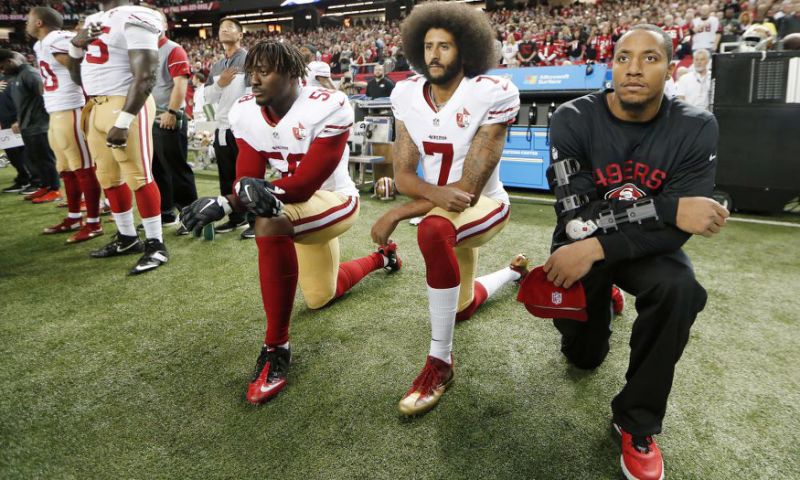
Colin Kaepernick (#7) takes a knee

M. Davout

A week after Super Bowl Sunday, I was reading Frederick Douglass’s “Fourth of July Address,” given by the intrepid abolitionist and eminent public intellectual on July 5, 1852 to several hundred spectators in Rochester, New York. It struck me then how contemporary Douglass’s antebellum insights into the nature of patriotism in America seemed, especially in the wake of an NFL season steeped in controversy over football players (mostly African-American) taking a knee during the national anthem.  Their symbolic protest, dismissed by some, notably including a tweeting president, as unpatriotic, was intended to highlight how police encounters with people of color in this country all too often and disproportionately end in unjustified uses of deadly force.

800px-Frederick_Douglass_by_Samuel_J_Miller,_1847-52
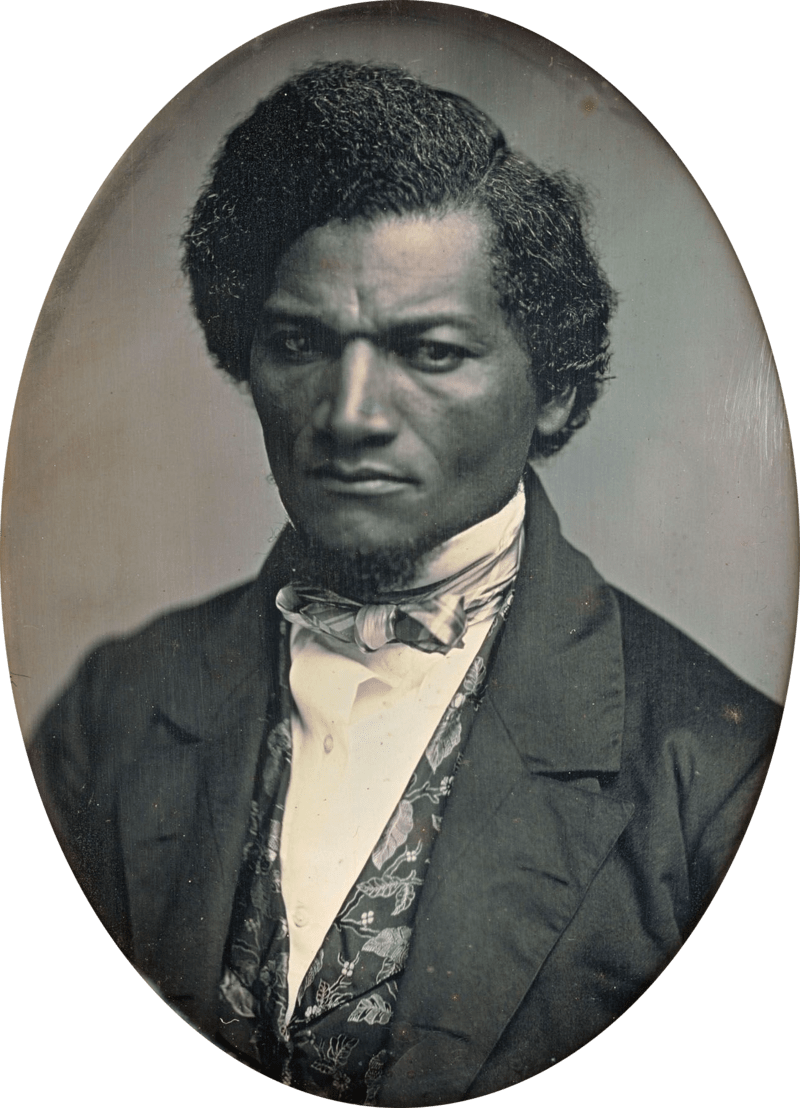
Frederick Douglass near the time of the Rochester Speech, given on the 5th of July 1852

At the time of his Fourth of July Address, Douglass was about fifteen years removed from a state of enslavement he managed, against steep odds, to escape and had become an orator of note in abolitionist circles. Attesting to a sense of trepidation in accepting an invitation to speak before such a large audience on their august day of national celebration, Douglass praised the generation of 1776 (“your fathers,” he calls them) for “lov[ing] their country better than their own private interests” and for their “solid manhood” in “preferr[ing] revolution to peaceful submission to bondage.”

Douglass then reminded his audience that, while it is easy in present times to celebrate the founders for resisting British oppression, “to pronounce against England, and in favor of the cause of the colonies” in the 1770s meant being pilloried and browbeaten as “plotters of mischief, agitators and rebels, dangerous men.”  Moving beyond this critique of the easy and self-congratulatory patriotism of his contemporaries, Douglass raised the prospect that the founders’ great deeds might even be evoked by men of tyrannical intent: “The cause of liberty may be stabbed by the men who glory in the deeds of your fathers.”

Douglass went on to warn his listeners, and free citizens of the American republic generally, against shirking their own responsibility for carrying on the emancipatory tradition celebrated each Fourth of July–“You have no right to wear out and waste the hard-earned fame of your fathers to cover your indolence.”

While there is much more to Douglass’s powerful address, his opening discourse on the patriotic meaning of the Fourth of July provides a way of dousing the “fire and fury” that has been generated by the right-wing media around the symbolic protest started by Colin Kaepernick in 2016 and seeing the significance of that protest with a quiet clarity.

Douglass’s Fourth of July Address warns against the self-serving belief that routinized, programmed patriotic gesture is equivalent to a true love of liberty.  He daringly calls out those who would abuse patriotic gesture in order to control others. His words remind us that the struggle for freedom is always a work in progress and that it is too easy to celebrate its provisional achievement after the hard and risk-laden work is done by others.

Douglass’s speech is part of a tradition of exposing empty patriotic gesture and challenging citizens to live up to the emancipatory demands of true patriotism, a tradition which Colin Kaepernick and his emulators can be seen as stalwartly embracing.  His speech serves as a powerful rejoinder to those who would, like Donald J. Trump, attempt to shame NFL player-protesters into anthem-standing conformity with transparently cynical references to the sacrifices of US veterans and members of the armed forces.

M. Davout (pseudonym) is a professor of political science who teaches in the Deep South.

Wrapping Oneself in the Flag

W.J. Astore

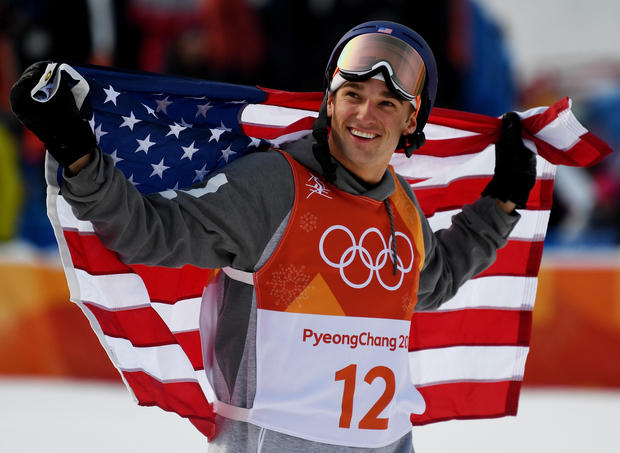
As soon as American athletes win an Olympic medal, it’s seemingly obligatory for someone to give them a flag so they can wrap themselves in it.  Here’s Nick Goepper, who won a silver medal in skiing:

Freestyle Skiing - Winter Olympics Day 9

I’ve seen athletes from a few other countries do this, but not with the uniformity and urgency of U.S. athletes.  Maybe American athletes just love their country more?

I vaguely recall “wrapping oneself in the flag” moments from previous Olympics that seemed spontaneous.  What gets me today is how routine these moments have become.  The American snowboarder Shaun White, for example, wrapped himself in the flag for his photo op, after which he dragged it on the snowy ground as he walked away, a transgression for which he apologized afterwards.

I understand athletes are proud to represent their countries, and understandably pumped after winning a medal.  But do all U.S. medal-winners now have to pose with a flag draped about them?

The official medal ceremony features the flags of the medal winners, with the national anthem being played for the winner of the gold.  I always thought that ceremony was more than sufficient as a patriotic display, and more consistent with the idea of the Olympics as an international event of diverse athletes.

What would happen if athletes, after winning their respective medals, wrapped themselves not in the flag of their respective countries, but in the Olympic flag showing the five interlocked rings?  Would heads explode?

800px-Olympic-flag-Victoria

U.S. and Coalition Aid to Iraq Is Ungenerous and Self-Interested

anna cartoon

By Pamela

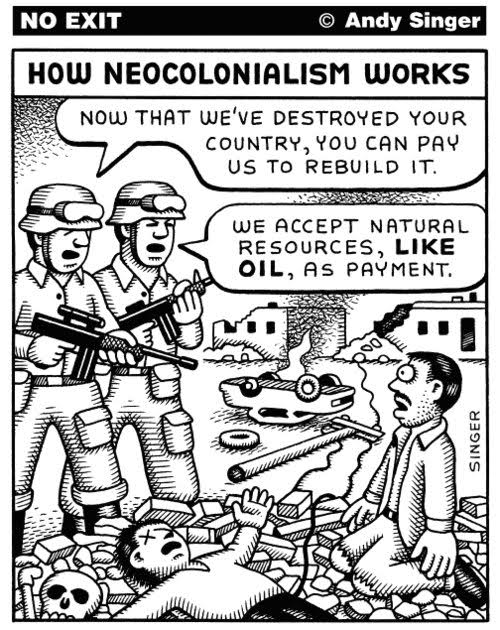
At the donor conference for the “post-ISIL reconstruction” of Iraq which just ended in Kuwait, U.S. Secretary of State Rex Tillerson talked about Iraqi corruption and insecurity, which he claimed had to be tackled for rebuilding investments to be feasible.  He said nothing about donations or reparations for the immeasurable damage the U.S. inflicted on Iraq since the first Gulf war in 1991, let alone since the invasion in 2003.  I do not recall reading that Iraq had been successfully rebuilt before ISIL struck in 2014.  And let’s recall that ISIL was largely the result of L. Paul Bremer and assorted US generals’ disastrous policies.

The US “aid” offered by Tillerson is a financial package from the U.S. Export-Import Bank in the amount of $3 billion in loans, loan guarantees, and insurance funds to American firms investing in Iraq.  Compare that paltry sum to the post-WWII Marshall Plan to Western Europe — including defeated enemy Germany and its allies — which amounted to about $140 billion in today’s dollars. Without going into the increasingly disputed purpose and even effectiveness of that aid, it amounted to more than the totality of Iraq’s needs as estimated at this moment.  And only some 10-15% of it were loans; the rest were grants, even if most of these had to finance goods imported from the U.S.

After Saddam’s capture in 2003, the U.S. apparently promised some $20 billion in reconstruction money in the form of credit against Iraq’s future oil revenues.  Whether this ever materialized I do not know, and there may well have been similar pledges, but there is no reason to assume that any of it was a grant without major strings attached.

The U.S. government is not the only hypocrite in this matter.  The overwhelming majority of the $30 billion in reconstruction pledges concerns credit and investments.  Is this simply donor fatigue?  How come the U.S.-led coalition had no trouble spending untold billions on the destruction of Iraq and its people, but cannot afford to help them rebuild their country?

The only governmental exception seems to be the nearly half a billion in donations from the European Union, but I wonder how much of this is dedicated to purchases from the EU.

I doubt my own government [Poland] will contribute anything but a token investment — if anything — while it enthusiastically joined the unholy coalition in 2003 for three candidly stated reasons: gain more importance in NATO, train its military in field conditions (!), and benefit from economic off-sets.  We do not even have the vibrant veterans-against-war associations which in the U.S. fight to prevent more of such wars from happening.  One such admirable initiative is We Are Not Your Soldiers, with veterans visiting high schools to harness kids against the propaganda of military recruiters, by explaining what war really looks like and what damage it inflicts on both victims and perpetrators.

In sum, American “Shock & Awe” doctrine destroyed Iraq, initial reconstruction efforts were haphazard and insufficient, and now in 2018 Iraq is sure to end up with a debt noose around its neck and ever greater dependence on the whims of foreign investors.

With respect to foreign investors, consider this quotation: “Iraq also is Opec’s second-largest crude producer and home to the world’s fifth-largest known reserves, though it has struggled to pay international firms running them.”

As for the Iraqi government, this is how it was described by New York-based Iraqi poet and long-term exile Sinan Antoon:  “The Iraqi government and the entire political class are beneficiaries of the U.S. and its wars. They recognize and commemorate the crimes of Saddam Hussein and the Baath regime and now ISIL and exploit them for their narrow and sectarian political purposes.”

Antoon’s critique of the Iraqi government should be kept in mind when reading Prime Minister’s Haider al-Abadi’s glowing appreciation of our “generous aid.”

Pamela, a former aid worker with a decade’s worth of on-the-ground experience in Afghanistan, worked with the Afghan people in relationships characterized by trust and friendship.

David Petraeus: A Gold Medal Winner in Spin

Petraeus mufti

W.J. Astore

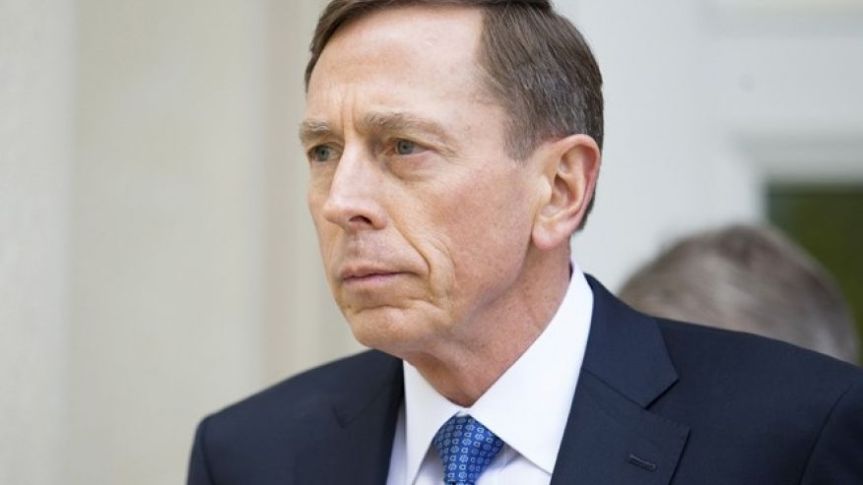
I’ve been watching the Winter Olympics on TV, and the color commentators for NBC are typically athletes who’ve earned gold medals in the past, like Tara Lipinski in figure skating or Bode Miller in skiing.  Why is it, then, when NBC and other networks seek expert “color” commentary on America’s wars, they turn to retired generals like David Petraeus, who’ve won nothing?

I’m not dissing Petraeus here.  He himself admitted his “gains” in Iraq as well as Afghanistan were both “fragile and reversible.”  And so they proved.  The U.S. fought in Iraq and Afghanistan and lost thousands of troops and trillions of dollars for gains that truly were ephemeral.  Despite this disastrous and tragic reality, Petraeus remains the sage on the stage, the go-to guy for analysis of our never-ending wars on PBS, Fox News, and elsewhere.

But then I got to thinking.  Sure, Petraeus hasn’t won any wars.  But he’s earned a gold medal in public relations.  In spin.  In 2007 he spun the Surge as a major U.S. victory in Iraq.  (Temporary stability, bought at such a high price, did indeed prove fragile and reversible.)  A later surge in Afghanistan didn’t prove as spinnable, but in a strange way his adulterous affair, a personal failure, came to obscure his military one.  Now he regularly appears as a pundit, the voice of reason and experience, spinning the Afghan war, for example, as winnable as long as Americans continue to give the Pentagon a blank check to wage generational war.

In facilitating the growth of the national security state and ensuring it never takes the blame for its military defeats, Petraeus has indeed excelled in the eyes of those who matter in Washington.  He’s no Tara Lipinski on ice or Bode Miller on snow, but when it comes to spinning wars and gliding over the facts, he takes the gold.

A Curious Aspect of Air Power

Crash Site
Crash site of Israeli F-16 Fighter Jet

W.J. Astore

Over the past several days, Russia and Israel have lost fighter jets over Syria.  This shouldn’t come as a surprise to those countries.  When jets attack people on the ground, those people tend to fire back (if they have weapons at hand), and sometimes they even hit their targets.

What is interesting is the Russian and Israeli reaction, which was in essence identical: immediate escalation.  More air attacks.  More bombs.  All justified as “reprisal” raids that are couched in terms of self-defense.

The mentality goes something like this: How dare you little people on the ground have the temerity to fire back at us and actually hit our planes?  For that you must be punished with more air attacks and more bombs until you stop firing at and hitting our planes.

I think this reaction is linked to the imagery of jet aircraft as a symbol of technological superiority, a marker of power, potency, and prowess.  Losing a jet over Syrian lands isn’t just seen as a mundane loss of military equipment in combat: it’s seen as a loss of potency by the attacker.  This “loss” necessitates a bigger show of force so as to punish the enemy while regaining that sense of inviolate power from the skies that advanced countries like Russia, Israel, and the USA believe they are entitled to, simply by being “advanced” countries, as measured by military hardware like sophisticated jets.

Air power is a tricky thing.  Students of the American involvement in the Vietnam War may recall that in 1965 U.S. Marine units were initially sent in to guard air bases from attack.  Of course, their mission quickly escalated from static defense to “active” defense to “taking the fight to the enemy,” i.e. full-scale, offensive, military operations.

Today, U.S. ground troops are similarly involved in places like the Middle East and Africa, helping to establish and protect air and drone bases.  Yet, as history teaches us, those missions often expand quickly to aggressive military operations on the ground, often in the name of “securing” those very air bases.  Air attacks may lead to ground operations, which lead to more air attacks in support of the ground ops, which lead to air planes being shot down and then reprisal attacks …

Air power, as I’ve written before, is neither cheap nor surgical nor decisive.  It also often creates its own escalatory dynamic, which is what we’re witnessing now in the skies over Syria.  Israeli jets, Russian jets, American jets, all attempting through force to alter the facts on the ground, but all instead creating conditions that are likely to generate more violence, more instability, and more war.

Curious indeed.

Ike’s Military-Industrial-Congressional Complex Is Alive and Very Well

250 000 dollar - 50
Look, Ma: More Money!  Don’t Worry: We’ll Spend It Wisely

W.J. Astore

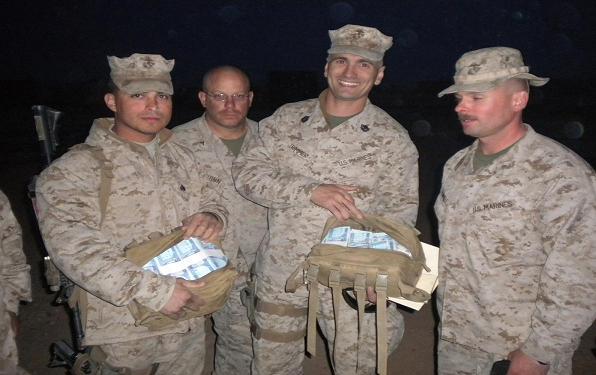
The new Congressional budget boosts military spending in a big way.  Last night’s PBS News report documented how military spending is projected to increase by $160 billion over two years, but that doesn’t include “overseas contingency funding” for wars, which is another $160 billion over two years.  Meanwhile, spending for the opioid crisis, which is killing roughly 60,000 Americans a year (more Americans than were killed in the Vietnam War), is set at a paltry $6 billion ($25 billion was requested).

One thing is certain: Ike was right about the undue influence of the military-industrial-Congressional complex.

The military talks about needing all these scores of billions to “rebuild.”  And, sure, there are ships that need to be refitted, planes in need of repairs, equipment that needs to be restocked, and veterans who need to be cared for.  But a massive increase in military and war spending, perhaps as high as $320 billion over two years, is a recipe for excessive waste and even more disastrous military adventurism.

Even if you’re a supporter of big military budgets, this massive boost in military spending is bad news.  Why?  It doesn’t force the military to think.  To set priorities.  To define limits.  To be creative.

Perhaps you’ve heard of the expression, “Spending money like drunken sailors on shore leave.”  Our military has been drunk with money since 9/11.  Is it really wise to give those “sailors” an enormous boost in the loose change they’re carrying, trusting them to spend it wisely?

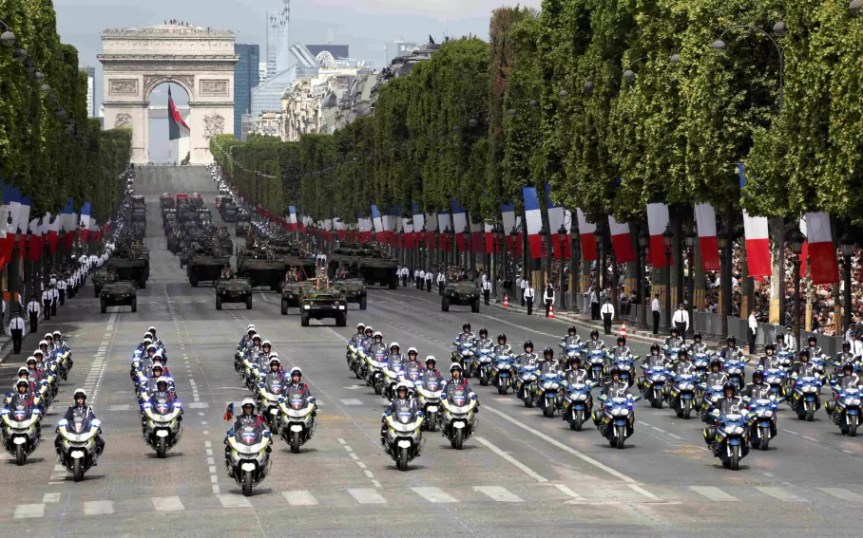
Of Military Parades and Super Bowls

2015-07-14T115355Z_01_SAA67_RTRIDSP_3_FRANCE-BASTILLEDAY
Trump, inspired by the French, wants his own military parade

W.J. Astore

News that President Trump favors a military parade in Washington D.C., perhaps to coincide with Veterans Day in November, has drawn criticism, and rightly so.  The president has a juvenile fascination with parades and other forms of pomp and circumstance, but more than anything I’m guessing he relishes the thought of posing as “The Leader,” reviewing and saluting “his” troops and generals as they pass in review.  If only “Cadet Bone Spurs,” the telling nickname that Tammy Duckworth has pegged him with, could don a military uniform for the occasion — his fantasy would be complete.

The idea of a military parade down Pennsylvania Avenue, complete with tanks and jets (and maybe some big missiles and bombs too?), sounds radical.  But is it really that different from other militarized celebrations that America has been witnessing and applauding since 9/11?

Consider this year’s Super Bowl.  It was played in a domed stadium, yet there was the obligatory military flyover (featuring A-10 attack planes, which the Air Force ironically wants to get rid of).  Fifteen Medal of Honor recipients were celebrated on the field, with one (a Marine) performing the coin toss for the game.  A video link showed U.S. troops watching from overseas.  In past years, troops featured were usually in combat zones like Iraq and Afghanistan.  This year the troops were in South Korea, perhaps because NBC wanted a link to the forthcoming Olympic games, hopefully not because the Trump administration is foreshadowing a “bloody nose” strike against North Korea that would turn that region into a combat zone.

Such patriotic (read: militarized) hoopla has become standard, not just at the Super Bowl and other NFL events, but at many other sporting events.  At last year’s U.S. Open tennis tournament in New York, prior to the men’s final played on 9/10, there was a ceremony to mark the 9/11 attacks, complete with the usual jumbo-sized U.S. flag, with uniformed troops joined by officer cadets from West Point, climaxed by a military flyover.  The ceremony was timed for maximum TV exposure.

As a retired military officer, I can’t tell you how many times I’ve saluted the colors and sung the National Anthem.  I have no objection to military color guards and proud renditions of our anthem.  It’s all the other hoopla — the flyovers, the video links, the gigantic flags, the increasing size of military contingents on playing fields and tennis courts and elsewhere — that I find so exaggerated.  It’s as if I sat down to watch a football game or a tennis match and a military parade broke out instead.

Give President Trump his due: he knows his audience.  His supporters will revel in a military parade in Washington.  So too will Trump.  The rest of us?  Why should we complain: we’ve been watching over-the-top military celebrations for nearly two decades.  A big parade down Pennsylvania Avenue is the logical culmination of all this, especially with Trump in charge.

Like many other aspects of American culture, Trump is just bringing our love of the military into higher relief.  Don’t blame him (or only him) if you don’t like what you see.

Our Enemy, Ourselves

W.J. Astore

In my latest article for TomDispatch.com, I suggest how America can pursue a wiser, more peaceful, course.  This is exactly what our leaders are not doing (and haven’t been doing for decades), as I document in the first half of my article, which I’m sharing here.  Bottom line: perpetual war doesn’t produce perpetual peace.  Nor does it make us safer.

Whether the rationale is the need to wage a war on terror involving 76 countries or renewed preparations for a struggle against peer competitors Russia and China (as Defense Secretary James Mattis suggested recently while introducing America’s new National Defense Strategy), the U.S. military is engaged globally.  A network of 800 military bases spread across 172 countries helps enable its wars and interventions.  By the count of the Pentagon, at the end of the last fiscal year about 291,000 personnel (including reserves and Department of Defense civilians) were deployed in 183 countries worldwide, which is the functional definition of a military uncontained.  Lady Liberty may temporarily close when the U.S. government grinds to a halt, but the country’s foreign military commitments, especially its wars, just keep humming along.

As a student of history, I was warned to avoid the notion of inevitability.  Still, given such data points and others like them, is there anything more predictable in this country’s future than incessant warfare without a true victory in sight?  Indeed, the last clear-cut American victory, the last true “mission accomplished” moment in a war of any significance, came in 1945 with the end of World War II.

Yet the lack of clear victories since then seems to faze no one in Washington.  In this century, presidents have regularly boasted that the U.S. military is the finest fighting force in human history, while no less regularly demanding that the most powerful military in today’s world be “rebuilt” and funded at ever more staggering levels.  Indeed, while on the campaign trail, Donald Trump promised he’d invest so much in the military that it would become “so big and so strong and so great, and it will be so powerful that I don’t think we’re ever going to have to use it.”

As soon as he took office, however, he promptly appointed a set of generals to key positions in his government, stored the mothballs, and went back to war.  Here, then, is a brief rundown of the first year of his presidency in war terms.

In 2017, Afghanistan saw a mini-surge of roughly 4,000 additional U.S. troops (with more to come), a major spike in air strikes, and an onslaught of munitions of all sorts, including MOAB (the mother of all bombs), the never-before-used largest non-nuclear bomb in the U.S. arsenal, as well as precision weapons fired by B-52s against suspected Taliban drug laboratories.  By the Air Force’s own count, 4,361 weapons were “released” in Afghanistan in 2017 compared to 1,337 in 2016.  Despite this commitment of warriors and weapons, the Afghan war remains — according to American commanders putting the best possible light on the situation — “stalemated,” with that country’s capital Kabul currently under siege.

How about Operation Inherent Resolve against the Islamic State?  U.S.-led coalition forces have launched more than 10,000 airstrikes in Iraq and Syria since Donald Trump became president, unleashing 39,577 weapons in 2017. (The figure for 2016 was 30,743.)  The “caliphate” is now gone and ISIS deflated but not defeated, since you can’t extinguish an ideology solely with bombs.  Meanwhile, along the Syrian-Turkish border a new conflict seems to be heating up between American-backed Kurdish forces and NATO ally Turkey.

Yet another strife-riven country, Yemen, witnessed a sixfold increase in U.S. airstrikes against al-Qaeda on the Arabian Peninsula (from 21 in 2016 to more than 131 in 2017).  In Somalia, which has also seen a rise in such strikes against al-Shabaab militants, U.S. forces on the ground have reached numbers not seen since the Black Hawk Down incident of 1993.  In each of these countries, there are yet more ruins, yet more civilian casualties, and yet more displaced people.

Finally, we come to North Korea.  Though no real shots have yet been fired, rhetorical shots by two less-than-stable leaders, “Little Rocket Man” Kim Jong-un and “dotard” Donald Trump, raise the possibility of a regional bloodbath.  Trump, seemingly favoring military solutions to North Korea’s nuclear program even as his administration touts a new generation of more usable nuclear warheads, has been remarkably successful in moving the world’s doomsday clock ever closer to midnight.

Clearly, his “great” and “powerful” military has hardly been standing idly on the sidelines looking “big” and “strong.”  More than ever, in fact, it seems to be lashing out across the Greater Middle East and Africa.  Seventeen years after the 9/11 attacks began the Global War on Terror, all of this represents an eerily familiar attempt by the U.S. military to kill its way to victory, whether against the Taliban, ISIS, or other terrorist organizations.

This kinetic reality should surprise no one.  Once you invest so much in your military — not just financially but also culturally (by continually celebrating it in a fashion which has come to seem like a quasi-faith) — it’s natural to want to put it to use.  This has been true of all recent administrations, Democratic and Republican alike, as reflected in the infamous question Madeleine Albright posed to Chairman of the Joint Chiefs Colin Powell in 1992: “What’s the point of having this superb military you’re always talking about if we can’t use it?”

With the very word “peace” rarely in Washington’s political vocabulary, America’s never-ending version of war seems as inevitable as anything is likely to be in history.  Significant contingents of U.S. troops and contractors remain an enduring presence in Iraq and there are now 2,000 U.S. Special Operations forces and other personnel in Syria for the long haul.  They are ostensibly engaged in training and stability operations.  In Washington, however, the urge for regime change in both Syria and Iran remains strong — in the case of Iran implacably so.  If past is prologue, then considering previous regime-change operations in Afghanistan, Iraq, and Libya, the future looks grim indeed.

Despite the dismal record of the last decade and a half, our civilian leaders continue to insist that this country must have a military not only second to none but globally dominant.  And few here wonder what such a quest for total dominance, the desire for absolute power, could do to this country.  Two centuries ago, however, writing to Thomas Jefferson, John Adams couldn’t have been clearer on the subject.  Power, he said, “must never be trusted without a check.”

The question today for the American people: How is the dominant military power of which U.S. leaders so casually boast to be checked? How is the country’s almost total reliance on the military in foreign affairs to be reined in? How can the plans of the profiteers and arms makers to keep the good times rolling be brought under control?

As a start, consider one of Donald Trump’s favorite generals, Douglas MacArthur, speaking to the Sperry Rand Corporation in 1957:

“Our swollen budgets constantly have been misrepresented to the public. Our government has kept us in a perpetual state of fear — kept us in a continuous stampede of patriotic fervor — with the cry of grave national emergency. Always there has been some terrible evil at home or some monstrous foreign power that was going to gobble us up if we did not blindly rally behind it by furnishing the exorbitant funds demanded. Yet, in retrospect, these disasters seem never to have happened, seem never to have been quite real.”

No peacenik MacArthur.  Other famed generals like Smedley Butler and Dwight D. Eisenhower spoke out with far more vigor against the corruptions of war and the perils to a democracy of an ever more powerful military, though such sentiments are seldom heard in this country today.  Instead, America’s leaders insist that other people judge us by our words, our stated good intentions, not our murderous deeds and their results.

For ten suggestions (plus a bonus) on how the U.S. can pursue a wiser, and far less bellicose, course, please read the rest of my article here at TomDispatch.com.