Americans Place Too Much Faith in War

W.J. Astore

Beware worshipping the god of war

Too many Americans see war as a positive force as they applaud Ukraine’s ongoing resistance to Russian aggression; along with seeing war as admirable, they see it as predictable and controllable.  Of course, it’s easy to cheer Ukraine on from thousands of miles away, celebrating their surprising victories over Russia, even as both sides suffer tens of thousands killed, many more injured, and many more forced from their homes.

When Americans think about war, there’s a tendency to focus on favorable outcomes while eliding war’s worst aspects. So, for example, the American Revolutionary War is celebrated for enabling U.S. independence. The U.S. Civil War freed the slaves. World War II liberated the world from the twin threats of Nazi fascism and Imperial Japan’s militarism. Other wars that are far less easy to simplify and spin as positive, such as the Vietnam War or recents wars in Afghanistan and Iraq, are dismissed or forgotten, to say nothing of open land grabs as in the Mexican-American War and the Spanish-American War. Let’s not even talk about the wanton brutality of various wars against Native American peoples glorified in so many westerns of my youth.

Looking at America’s history, Christ, the Prince of Peace, is clearly not America’s favored god. America’s god is a warrior one, like Ares for the Greeks and Mars for the Romans. “Blessed are the war makers” could be a guiding tenet of American life, especially considering how much money is made and power wielded by those who embrace war.

The Greeks had wisdom in seeing war as akin to a god, a powerful force, capricious, unpredictable, intoxicating, and uncontrollable. War can consume a person, a people, a nation. It appeals to our irrational nature, our darkest passions. “War fever” is thus an accurate descriptive phrase. We can be seized by it, deluded by it, consumed by it. 

I’ve never run across “peace fever” as a phrase or descriptor of American behavior.

This being said, here’s an article I wrote a decade ago about the persistence of war. When will we learn that wars not make one great?

The Persistence of War (2013)

A young Tom Cruise loving his machine gun in "Taps"
A young Tom Cruise loving his machine gun in “Taps”

“[W]ar is a distressing, ghastly, harrowing, horrific, fearsome and deplorable business.  How can its actual awfulness be described to anyone?”  Stuart Hills, By Tank Into Normandy, p. 244

“[E]very generation is doomed to fight its war, to endure the same old experiences, suffer the loss of the same old illusions, and learn the same old lessons on its own.”  Philip Caputo, A Rumor of War, p. 81

The persistence of war is a remarkable thing.  Two of the better books about war and its persistence are J. Glenn Gray’s “The Warriors” and Chris Hedges “War Is a Force that Gives Us Meaning.”   Hedges, for example, writes about “the plague of nationalism,” our willingness to subsume our own identities in the service of an abstract “state” as well as our eagerness to serve that state by killing “them,” some “other” group that the state has vilified.

In warning us about the perils of nationalism, Hedges quotes Primo Levi’s words: “I cannot tolerate the fact that a man should be judged not for what he is but because of the group to which he belongs.”  Levi’s lack of tolerance stems from the hardest of personal experiences: surviving Auschwitz as an Italian Jew during the Holocaust.

Gray takes this analysis in a different direction when he notes that those who most eagerly and bloodthirstily denounce “them,” the enemy, are typically far behind the battle lines or even safely at home.  The troops who fight on the front lines more commonly feel a sort of grudging respect for the enemy, even a sense of kinship that comes with sharing danger in common.

Part of the persistence of war, in other words, stems from the ignorant passions of those who most eagerly seek it and trumpet its heroic wonders even as they stand (and strive to remain) safely on the sidelines.

Both Hedges and Gray also speak to the dangerous allure of war, its spectacle, its excitement, its awesomeness.  Even the most visceral and “realistic” war films, like the first thirty minutes of “Saving Private Ryan,” represent war as a dramatic spectacle. War films tend to glamorize combat (think of “Apocalypse Now,” for example), which is why they do so little to put an end to war.

One of the best films to capture the dangerous allure of war to youth is “Taps.”  I recall seeing it in 1981 at the impressionable age of eighteen.  There’s a tiny gem of a scenenear the end of the film when the gung ho honor guard commander, played by Tom Cruise before he was TOM CRUISE, mans a machine gun.  He’s firing against American troops sent to put down a revolt at a military academy, but Cruise’s character doesn’t care who he’s firing at.  He’s caught in the rapture of destruction.

He shouts, “It’s beautiful, man.  Beautiful.”  And then he himself is shot dead.

This small scene with Cruise going wild with the machine gun captures the adrenaline rush, that berserker capacity latent in us, which acts as an accelerant to the flames of war.

War continues to fascinate us, excite us.  It taps primal roots of power and fear and ecstasy all balled together.  It masters us, hence its persistence.

If and when we master ourselves, perhaps then we’ll finally put an end to war.
The Global War on Terrorism

W.J. Astore 

“Global” includes the “homeland” here in America

There’s an important point about America’s Global War on Terrorism (GWOT) that people often miss.

When the Bush/Cheney administration announced the GWOT after 9/11, I think nearly all Americans assumed that “global” meant everywhere but the “good” countries.  That global meant the axis of evil (Iraq, Iran, North Korea) and similar so-called bad actors, but that it didn’t mean countries like Canada — and certainly not the U.S. homeland.

But global really did mean everywhere on earth as we’ve watched the war on terror escalate domestically.  The U.S. government/security state has built the foundation and superstructure for a permanent war on terror, and it simply isn’t going to go away. The Iraq and Afghan wars are essentially over (both lost), and fears of North Korea have subsided as the military-industrial-congressional complex focuses on Ukraine, Russia, and China, but the GWOT continues. It’s now turned inwards, within and along our own borders, and those techniques that were practiced (if not perfected) in Iraq, Afghanistan, and elsewhere are now being used and inflicted upon ordinary Americans who are attempting to resist state-corporate authoritarianism.

The GWOT has come home — but perhaps it’s always been here.  What’s changed is how state-corporate entities can define almost any form of determined protest—even civil and nonviolent ones—as “terror.” Labeling someone a “domestic terrorist” gives state-corporate actors a whole host of powerful ways to punish activists, notes by Michael Gould-Wartofsky at TomDispatch.com.

At the same time, America has witnessed the “rise of the warrior-cop,” as Radley Balko noted in his book by that title. 

Three years ago, I wrote about the militarization of police forces at TomDispatch. This is what I wrote then:

America’s violent overseas wars, thriving for almost two decades despite their emptiness, their lack of meaning, have finally and truly come home. An impoverished empire, in which violence and disease are endemic, is collapsing before our eyes. “When the looting starts, the shooting starts,” America’s self-styled wartime president [Donald Trump] promised, channeling a racist Miami police chief from 1967. It was a declaration meant to turn any American who happened to be near a protest into a potential victim 

As such demonstrations proliferate, Americans now face a grim prospect: the chance to be wounded or killed, then dismissed as “collateral damage.” In these years, that tried-and-false military euphemism has been applied so thoughtlessly to innumerable innocents who have suffered grievously from our unending foreign wars and now it’s coming home.

A few days ago, The Onion, a satirical news site, compared America’s obedience and passivity to power to the current situation in France. Here’s how they put it:

In an ongoing struggle against ruling-class oppression, the people of France again protested in a way that Americans are welcome to at any time, sources confirmed Thursday. According to reports, French citizens across the country were spotted hitting the streets en masse as a unified front against the institutional bondage that seeks to subjugate them while never failing to apply forceful pressure every time injustice strikes, which Americans can and should feel free to do whenever they so choose.

Yes, but are Americans truly “welcome” to protest “whenever they so choose”? We’d like to think so, especially as July 4th approaches (America! Land of the Free!), but who wants to be detained and thrown in jail for domestic terrorism? Anyone in America hankering to be labeled as a terrorist by the state, whether on the right or left of the political spectrum, even if the charge is eventually dismissed?

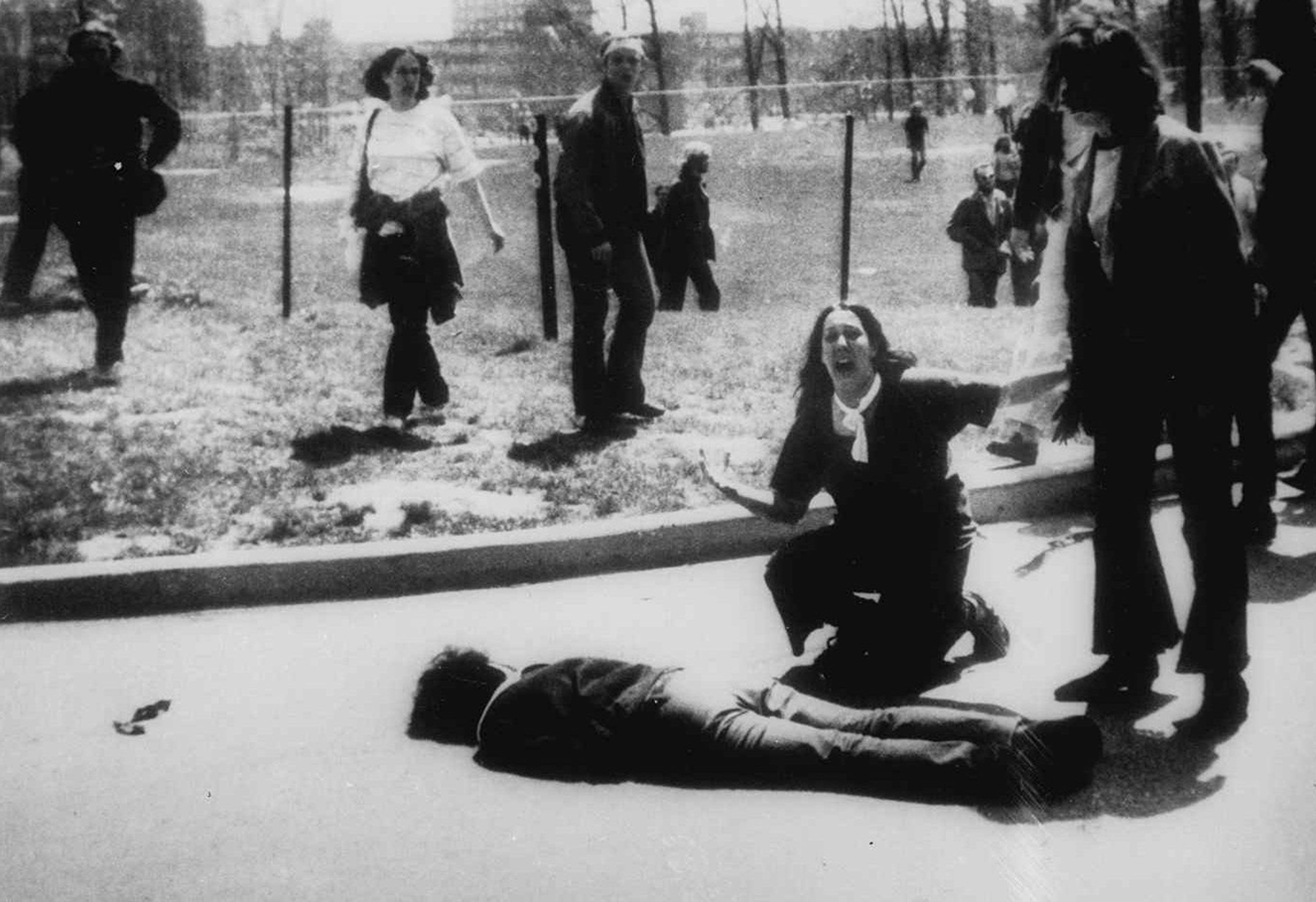
Searing photo of state violence at Kent State in 1970. The dead student’s name was Jeffrey Miller. The young woman crouched in shock and horror was Mary Ann Vecchio. Richard Nixon called the protesters “bums.” What would the state call them today—domestic terrorists?

Remember those innocent days of the 1960s when for some the police were “pigs” and the protesters were “bums” (Richard Nixon’s word for the students killed at Kent State)? Now those protesters could be charged with domestic terrorism even as various heavily armed enforcers of the law would likely be celebrated (consider all those “blue lives matter” flags, for example).

Remember when “defund the police” was briefly a thing? By which people meant less funding for militarized police forces and more for mental health services and the like. President Joe Biden and the Democrats realized any serious effort to restrain police power would leave them open to charges of being soft on crime, so Biden and the party simply declared: Fund the police. (Republicans concur, of course, even as they still accuse Biden and the Dems of being soft on crime.)

And there you have it. Fund the police at all levels, local, state, and federal, and grant them the kind of powers given to America’s “warriors” in the GWOT. Set them loose on all of America’s domestic “terrorists.” After all, the GWOT went so well in Iraq, Afghanistan, Libya, Yemen, and elsewhere. Surely it will go equally well in the Homeland. Right?

Addendum: In writing this, I came across a superb article by Patricia McCormick at the Washington Post on Mary Ann Vecchio, “the girl in the Kent State photo.” She was just 14 when the above photo was taken. She paid a high price, as the article recounts. Letters to her family accused her of being a “drug addict,” a “tramp,” or a “communist.” The then-governor of Florida suggested she was a “professional agitator” and therefore responsible for the students’ deaths. A Gallup poll back then, cited by McCormick, said that 58% of Americans blamed the students at Kent State and only 11% blamed the National Guardsmen who opened fire and killed the four students.

“Professional agitator” sounds much like today’s domestic terrorist. And let’s reflect on those 58% of Americans who believed the students at Kent State were responsible for their own deaths. How dare they block the free flight of “Made in USA” bullets with their young bodies? The “bums”! (“Domestic terrorists.”)

Embrace the “Nuance” of Nuclear Weapons

W.J. Astore

We must not allow a missing rung on America’s nuclear escalation ladder!

I get email notices for Aether, a professional journal for “strategic airpower & spacepower,” and the lead article on the cover caught my eye:

A Tactical Nuclear Mindset: Deterring with Conventional Apples and Nuclear Oranges

James R. McCue, Adam Lowther, and James Davis

Comparing and contrasting low-yield theater nuclear weapons with conventional precision strike weapons leads to a nuanced conclusion that both contribute to deterrence.

Imagine that! Both nuclear and conventional weapons “contribute to deterrence.” Even though they’re apparently apples and oranges. Well, there’s “nuance” for you.

Anybody want a tasty nuclear “orange”? Fresh and juicy, and with a low yield. It may very well deter you from eating citrus fruit for, well, forever.

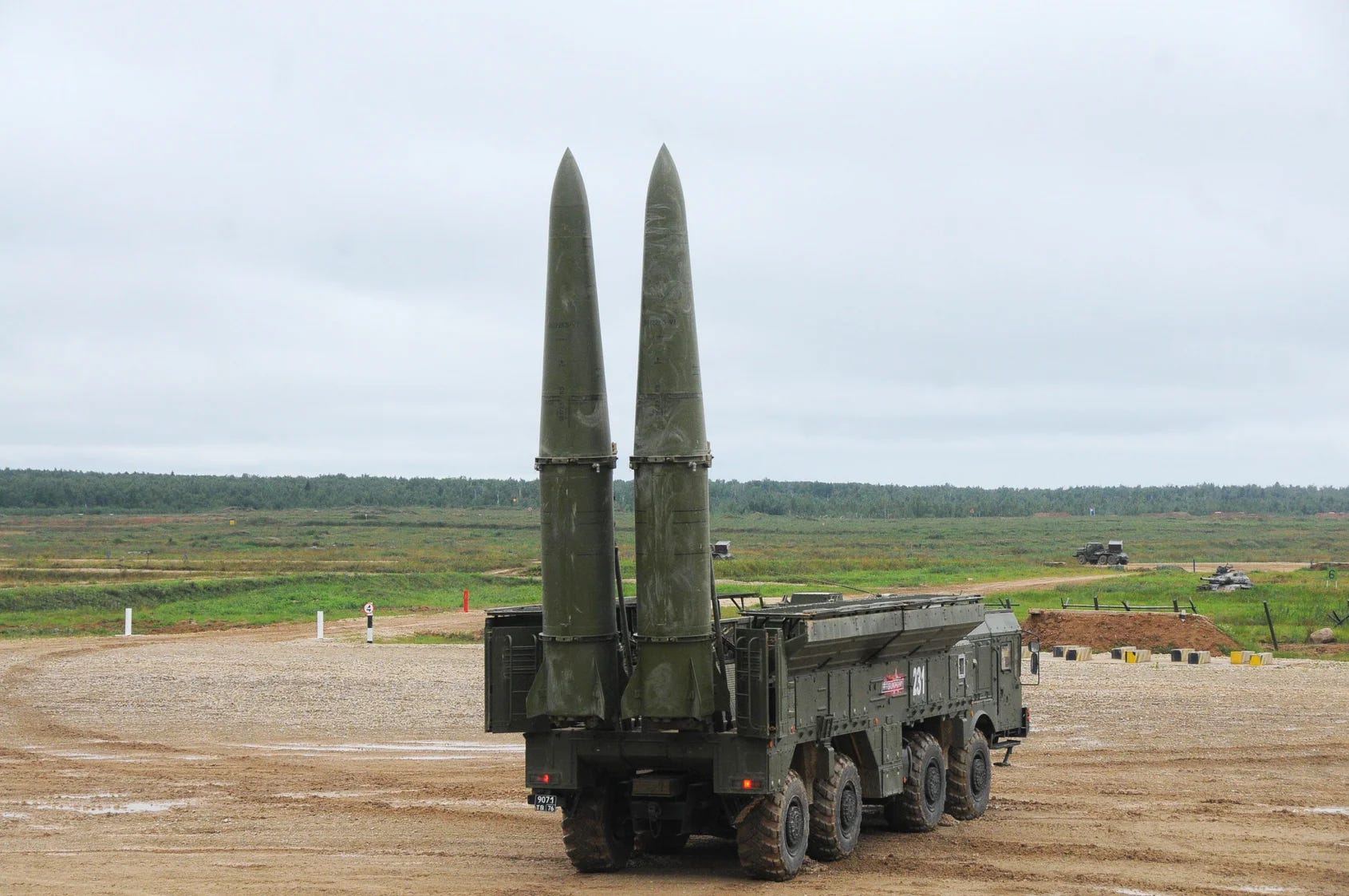
Potential delivery system for low-yield nukes. Think of them as juicy oranges

I’m not familiar with the authors of the piece. McCue is an Air Force lieutenant colonel with the Defense Threat Reduction Agency. I don’t know about you, but suggesting that low-yield nukes can be used in nuanced ways heightens my sense of threat. Lowther directs strategic deterrence programs at the National Strategic Research Institute, which makes me think anew about the meaning of “deterrence.” In this case, it seems to mean the willingness to use nuclear weapons against “bad actors” like China but especially Putin and Russia. And Davis is an Army major assigned to U.S. Central Command. It’s nice to know the Army, just like the Air Force, has a strange love for nukes.

In essence, the article’s argument is this: Russia, China, and North Korea are “investing” in low-yield nukes while the U.S. and other NATO allies have generally been reducing their arsenals of the same. To deter those three adversaries, the U.S. must make new “investments” in low-yield nukes, because you never know what those foreigners are up to.

Here’s how the authors put it in their conclusion: “In the right circumstances conventional weapons offer greater certainty of destruction than tactical nuclear weapons. The West must examine what this means for warfighting, as well as what adversaries are signaling by investing in low-yield nuclear weapons. The best solution may be the development of a state-of-the-art nuclear capability that ensures certain, prompt, proportionate, and in-kind response options. The perception of a missing rung on the American escalation ladder could prove alluring to Russia or China in a conflict.”

Mr. President, we must not allow a missing rung on America’s escalation ladder!

Even if that “missing rung” is only a “perception.”

Let’s keep that in mind if nuclear weapons start flying in Europe or Asia. We can console ourselves that at least we weren’t missing a rung in our escalatory ladder as millions get blasted, burnt, and irradiated.