Only We Can Bomb It

W.J. Astore

The U.S. Empire, Thrashing and Lashing Out as It Declines

President Donald Trump has promised to bomb Yemen for a “long time.” Trump is a real president now. Presidents become “real” when they bomb something. Remember how Trump was praised by the U.S. mainstream media when he launched missiles against Syria in 2017?

Back in 2017, I wrote thisThe launch of 59 expensive cruise missiles against a Syrian airfield did little to change the actions of the Assad government. Nor did it knockout the airfield. Yet it was spun by Trump as a remarkable victory. In his words, “We’ve just fired 59 missiles, all of which hit, by the way, unbelievable, from, you know, hundreds of miles away, all of which hit, amazing. It’s so incredible. It’s brilliant. It’s genius. Our technology, our equipment, is better than anybody by a factor of five. I mean look, we have, in terms of technology, nobody can even come close to competing.”

“Only we can bomb it” should replace “In God we trust” as the U.S. national motto.

America’s best and brightest (who were never quite that) have become the worst and dimmest. And that’s true whether the president is blue or red, Biden or Trump. The problem is our “leaders” have no moral principles. No integrity. No sense of right and wrong. They’re all about power and sending “messages” through bombing. Or sending tons and tons of bombs to Israel so that the Zionists can send “messages” to the Palestinians. The main message: begone or be dead.

Even as our “leaders” do this, they seek to solidify a mythic history of the U.S. (see video above) where America is exceptional in its rightness and where they (the leaders) are the ones who grant us our rights (such as freedom of speech) when these rights are inalienable. Indeed, rather than protecting our rights, they want to control them, limit them, and make them obedient and subservient to power.

Rulers’ ideas rule. And our rulers’ ideas are increasingly toxic.

With democracy already deeply compromised in America, we’re witnessing and experiencing the thrashing and lashing out of a declining American empire, not only externally but in the “homeland.” 

Readers, what do you make of all this?

“War are the only ones … who can do this”

W.J. Astore

American exceptionalism in action in Yemen

The so-called SignalGate scandal centered on the bombing of Yemen is highly revelatory. First, some resources. CNN has a useful annotated account of the chats exchanged at the highest levels of the Trump administration. At their respective Substacks, Lenny Broytman and Caitlin Johnstone have telling dissections of these chats as well. At Jacobin, Branko Marcetic has an important article that reminds us of the illegality of the attacks. As the article’s subheading puts it: The press [mainstream media] is mostly framing the Yemen group chat scandal as a story of incompetence. There’s little attention being paid to the deadliness, illegality, and ineffectiveness of the strikes themselves.

To me, among the most telling “chats” came from Secretary of Defense Pete Hegseth. It highlights the “exceptional” nature of America:

*****

Pete Hegseth to Vice President JD Vance: I fully share your loathing of European free-loading. It’s PATHETIC.

But Mike [Waltz, the National Security Adviser] is correct, we are the only ones on the planet (on our side of the ledger) who can do this. Nobody else even close. Question is timing…

*****

This is precisely the problem for America since the Vietnam War, if not before then. We’ve created a monster military, a “global strike” force, that is capable of destroying any target anywhere around the globe. “Nobody else even close,” SecDef Hegseth correctly says. And because we can do it, because we are exceptional in military force, our leaders believe we should do it, even if it’s only to send a “message” to the world how tough we are, how committed we are to killing others.

Other countries—like those “free-loading” European ones—are PATHETIC because they don’t have America’s military might. Only we can smite evildoers around the globe, only we can do so while also arming Israel to the teeth and covering its flanks while it continues its annihilation of Gaza, and this is something we are immensely proud of.

My fellow Americans, this is not something to be proud of. Consider if America’s military in the 1960s had lacked the ability to deploy over half a million troops to Vietnam while also facing down the Warsaw Pact in Europe. Consider if America’s military had lacked the ability to invade Iraq in 2003 while also waging war in Afghanistan and garrisoning the globe with roughly 800 military bases. Consider how much blood would not have been spilled, and treasure wasted, if the U.S. military was smaller, focused on defense, and led by people who didn’t put muscle and flame emojis in their chats to celebrate U.S. military prowess at killing people in Yemen.

That U.S. military forces are the only ones who can kill globally with such comparative ease, that “nobody else even close,” is exactly what is wrong with our government. We place far too much faith and pride in military prowess, so much so that the Pentagon becomes the Pentagod, something we worship, something we make immense sacrifices to, as in budgets that approach $1 trillion yearly.

Not for nothing did President Dwight D. Eisenhower say in 1953 that this is no way of life at all—that we are crucifying ourselves on a cross of iron. Tell me again, who are the pathetic ones?

We must end our intoxication with military power before it ends us.

Available on Kindle at Amazon

Department of Offense

W.J. Astore

The U.S. Military Is a Global Strike Force

Officially, the U.S. has the DOD, the department of defense. But when was the last time the U.S. military was primarily oriented toward defense of the CONUS? (CONUS is a military acronym for continental United States.)

My old service, the U.S. Air Force, is far more open about its true aims. It boasts assertively of “global reach, global power” and notably of “global strike.” Not to be outdone, the U.S. Navy has “carrier strike groups,” what used to be termed carrier task forces when they fought real battles in World War II.

Here’s a recent official description: “A Carrier Strike Group (CSG) is a highly powerful, self-contained naval force, capable of projecting power globally, with an aircraft carrier as its core, supported by cruisers, destroyers, submarines, and an air wing, making it a formidable force capable of striking targets 1,000 miles away.”

Doesn’t sound defensive, does it? And of course the U.S. Marines are defined as “expeditionary” forces that are “forward-deployed” for all sorts of expected “contingencies” overseas.

The U.S. military is not about defense. It’s about “full-spectrum dominance.” That means dominance of the land, sea, air, space, cyber, information in all its forms, indeed just about any realm you can think of. No other military, moreover, divides the world into global commands (CENTCOM, AFRICOM, etc.) for the application of U.S. military power. This is not about defending America. It’s about dominating the world. Such a grandiose vision of defense dominance is partly what drives colossal Pentagon budgets that are climbing toward a trillion dollars a year.

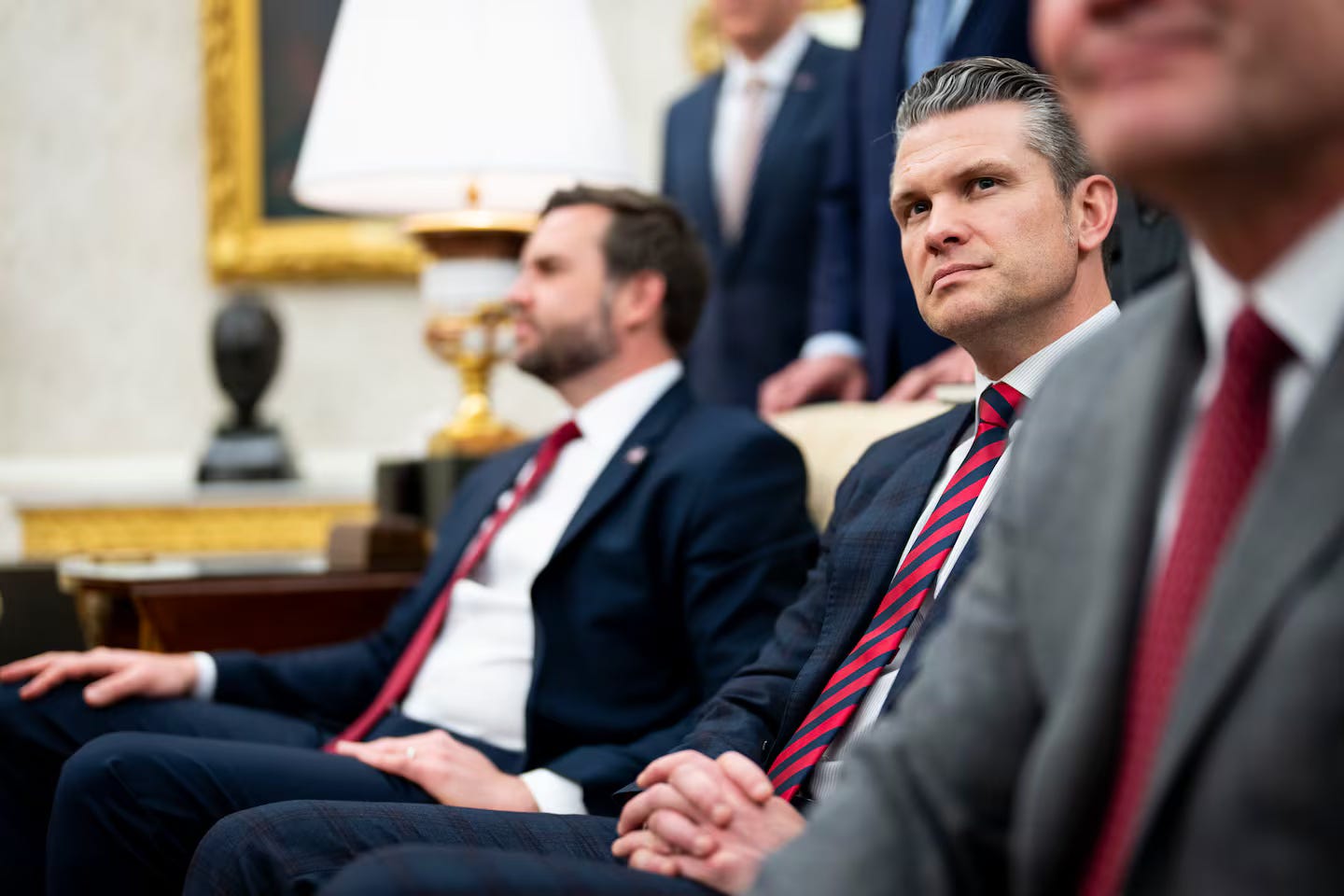
SecDef Pete Hegseth, always talking warrior-tough (Doug Mills/NYT)

Consider here the recent kerfuffle about leaked U.S. strike plans for Yemen, which were inadvertently shared with the editor-in-chief at The Atlantic. Here’s an excerpt from those plans:

From Secretary of Defense Offense Pete Hegseth

  • “1215et: F-18s LAUNCH (1st strike package)”
  • “1345: ‘Trigger Based’ F-18 1st Strike Window Starts (Target Terrorist is @ his Known Location so SHOULD BE ON TIME – also, Strike Drones Launch (MQ-9s)”
  • “1410: More F-18s LAUNCH (2nd strike package)”
  • “1415: Strike Drones on Target (THIS IS WHEN THE FIRST BOMBS WILL DEFINITELY DROP, pending earlier ‘Trigger Based’ targets)”
  • “1536 F-18 2nd Strike Starts – also, first sea-based Tomahawks launched.”
  • “MORE TO FOLLOW (per timeline)”
  • “We are currently clean on OPSEC.”
  • “Godspeed to our Warriors.”

Note the repetition of the word “strike” and the closing prayer to America’s “warriors.” And ask yourself: Is this truly what national defense should look like? Prayerful appeals to “warriors” as they strike weak and poor countries thousands of miles away in undeclared (and therefore unconstitutional) wars?

Going Full Orwell

W.J. Astore

War Is Peace!

Yesterday, I awoke to grim news that Israel is bombing Gaza yet again, killing a few hundred people, even as the U.S. targets Yemen with “precision” bombs and strikes, apparently to intimidate Iran as well—and perhaps to provoke a war, as Israeli jets escort U.S. B-52 bombers in “exercises.”

War is in the news, incessantly, with Congress sidelined and feckless as usual.

The constant drumbeat of war—the never-ending concussion of bombs in the Middle East—put me to mind of Orwell’s 1984. Nothing favors authoritarian states more than a constant state of war. If you truly want to weaken the Trump administration, reject their “warrior” and “war fighting” rhetoric and their selling of “peace through strength,” by which they mean peace through bombing and killing. Some “peace,” right? They may as well go full Orwell and declare that “war is peace” while making the Pentagon the “Ministry of Peace.”

Speaking of Orwell, and needing a break from death and mayhem, I remembered this piece that I wrote in 2018. Citizens, you had best police not only your words and actions, but the faces you make as well, especially when our Dear Leader is talking.

Written in September 2018

Facecrime!

plaidshirtguy

W.J. Astore

We’re truly living in Orwellian times. A 17-year-old high school student, now known as #plaidshirtguy due to his choice of wardrobe, was removed from a Trump rally in Montana because of the faces he was making as Trump spoke. You can read all about here, and watch an interview with him at CNN.

Not surprisingly, people who stand behind Trump are selected ahead of time and told to clap and cheer. This young man did that, but he also chose to look quizzical, skeptical, and bemused at times. This is not allowed! A Trump staffer eventually intervened to remove him from the audience due to his “face crime.” To make matters worse, he was then held by the Secret Service for ten minutes, after which he was asked to leave the event.

Leave the event? For making skeptical and quizzical facial expressions?

You may recall from George Orwell’s “1984” that “Facecrime” existed. Anyone making skeptical or otherwise unacceptable faces when the Party announced bogus victories, production figures, and so forth opened himself or herself up to serious punishment.

Thanks to plaid shirt guy, we now know that facecrime has come to America. Just remember, fellow citizens, always to smile and cheer in the presence of Our Dear Leader. Unless you want to be detained and sent away — perhaps next time to the cornfield.

*From my copy of “1984”: “In any case, to wear an improper expression on your face (to look incredulous when a victory was announced, for example) was itself a punishable offense. There was even a word for it in Newspeak: facecrime, it was called.” (From the end of Chapter 5.)

Bombing Another Country for Peace

W.J. Astore

Yemen, Israel, Ukraine, and the U.S. Embrace of War Everywhere

Last night, the U.S. bombed another country, Yemen, in the name of the “rules-based order.” Yemen has been striking shipping as a form of protest against the ongoing Israeli genocide-in-slow-motion in Gaza. It always looks good when the U.S. uses its military to enable mass murder elsewhere. I’m sure the “peace bombs” we dropped will bring stability to the region.

The U.S. military bombs and launches Tomahawk missiles as its answer to everything. Meanwhile, our dynamic commander in chief, Joe Biden, launched a new front in this war of terror without Congressional authorization, an impeachable offense. But of course most in Congress will salute him for taking “decisive” action by bombing yet another poor country with brown-skinned Muslim people living in it. Perhaps Biden is counting on being a “wartime president” as a way to eke out a narrow victory in November.

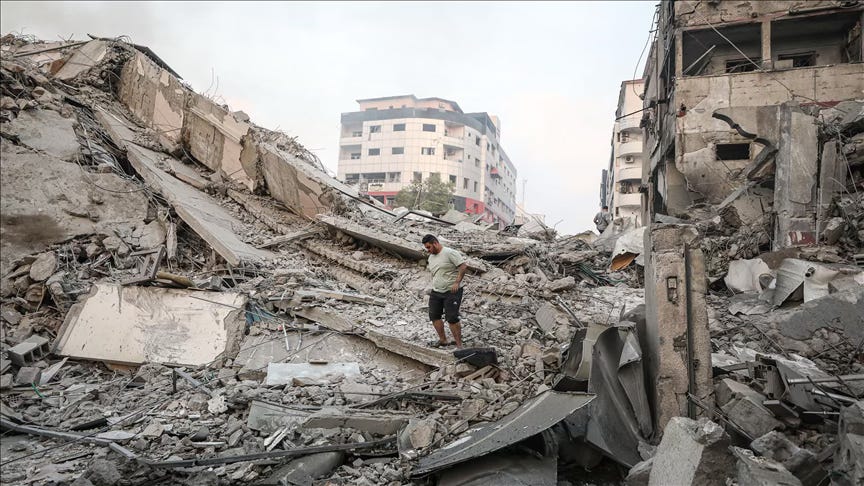
In Gaza, incremental genocide continues with at least 23,000 Palestinians dead and another 60,000 wounded, the majority being women and children. The Israeli government is poisoning the land and water of Gaza, blasting buildings into rubble, and starving the Palestinians while still claiming to be the victims of the war. Antony Blinken, America’s diplomat-in-chief, says the war will end when Hamas offers its unconditional surrender. After which, what, exactly? Israel will rebuild Gaza and embrace Palestinians as brothers and sisters?

Israel is going to rebuild all this for the Palestinians in Gaza?

In Ukraine, the war continues to be stalemated as Ukraine waits for another $65 billion or so in aid from the Biden administration. Which brings me to this story from The Boston Globe this morning:

More than $1 billion worth of shoulder-fired missiles, drones, and night-vision goggles that the United States has sent to Ukraine have not been properly tracked by US officials, a new Pentagon report concluded, raising concerns they could be stolen or smuggled at a time when Congress is debating whether to send more military aid to Ukraine. 

Over the last two years, the U.S. has flooded Ukraine with weaponry, producing a stalemated war and a healthy black market in stolen arms. The next step should be obvious: persist in the same folly by sending Ukraine even more weapons. Again, the argument is made that it’s all Russia’s fault and that, if Putin wants the war to end, he should basically surrender by withdrawing all Russian troops from the territory he has seized.

There you have it. The annihilation of Gaza will stop when Hamas totally surrenders and the war in Ukraine will stop when Russia totally surrenders, otherwise the U.S. must keep sending more than $100 billion in weaponry and aid to the “democracies” of Israel and Ukraine in their righteous battles against evil. Yes, that really is the position of Biden and Blinken.

Finally, a reader sent along this important article on how the U.S. is funding these wars and in fact the entire war on terror: by deficit spending. Call it “the ghost budget.” America’s national debt has ballooned to $34 trillion mainly due to the disastrous war on terror (roughly $8 trillion), colossal Pentagon budgets, and gargantuan bailouts of banks and corporations due to financial and Covid crises, real or constructed. Vast wealth continues to flow upwards in America as Biden’s “everyday people” struggle. Whether for Biden or Trump, the answer to the debt is always more tax breaks for the rich in the name of “stimulating” growth. Those tax breaks, of course, only drive the national debt up further, but never mind that.

What’s coming is a concerted attack on social security and Medicare/Medicaid in the name of fiscal responsibility. As the comedian George Carlin predicted: They’re coming for your social security. And they’ll get it, he added. Which is consistent with what Joe Biden has said in the past about the need to cut social security as well as health and veterans’ benefits.

Happy Friday, everyone.

The War in Yemen

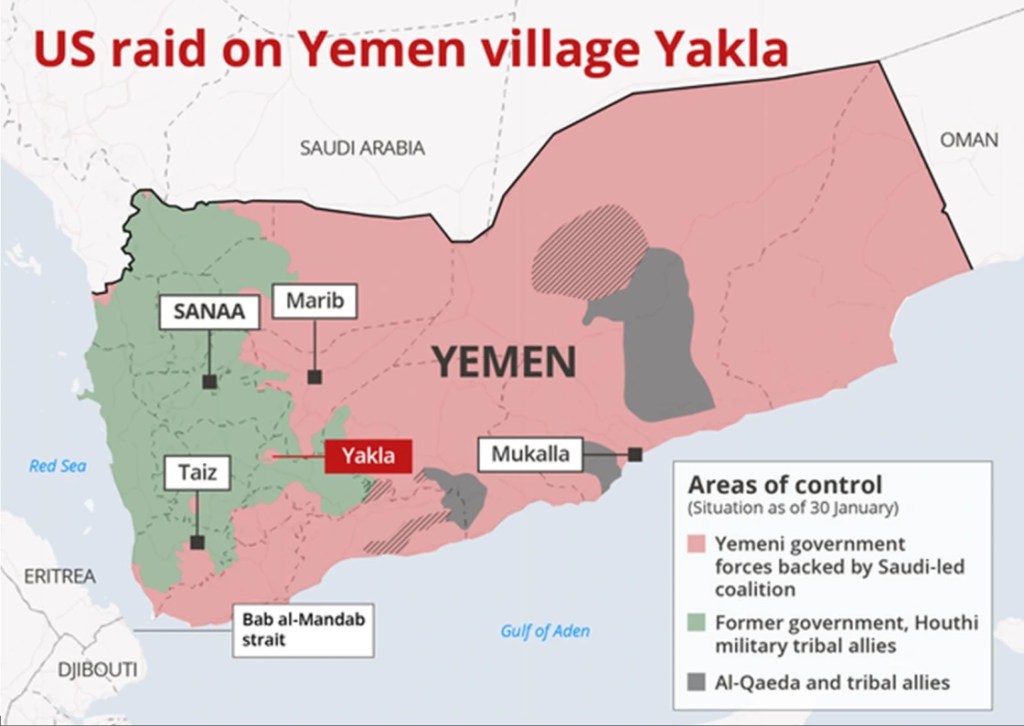
Map of Yemen from 2017 that shows the site of the botched SEAL Team raid at Yakla

W.J. Astore

I haven’t followed the Saudi war in Yemen that closely. But I’d wager most Americans know far less about it than I do. I know the U.S. has been supporting Saudi Arabia in its bloody repression of Iranian-backed Yemeni forces (the Houthis), providing critical resources such as aerial refueling, intelligence sharing, and, most importantly, an endless supply of weaponry. I know this support has been couched as consistent with a “war on terror,” when it’s driven much more by the U.S. need to appease Saudi rulers for economic reasons (primarily the petrodollar and oil exports). I know the Yemeni people have suffered greatly due to famine and diseases exacerbated by constant warfare and economic blockades. I know Joe Biden campaigned against the war and criticized Saudi officials but as president has done nothing to stop it. And I know a bipartisan force in Congress is trying to take steps to end America’s involvement in what essentially constitutes a genocide against the Yemeni people.

Occasionally, Yemen has appeared in my articles here, as with the SEAL Team fiasco launched by President Trump in late January 2017. (One Navy SEAL died in the raid; his father later accused the Trump administration of hiding behind the death of his son instead of admitting the raid had been a murderous failure.) In passing, I’ve mentioned Yemen in a few articles like this one, but again it’s not something I’ve written about in detail. I’ve been focused on the Afghan war, the military-industrial complex, the new Cold War, plans to build a new generation of nuclear weapons, and on and on.

Fortunately, a freelance journalist based in Yemen, Naseh Shaker, contacted me with a few questions that got me thinking a bit more about Yemen and the U.S. government’s role there. His article addresses whether Congress has any chance of invoking the War Powers Act to limit or end America’s involvement in this brutal war, given the reality that President Biden is once again courting and kowtowing to the Saudis. You can read his article here, which includes a few comments by me, but it may be useful to include his original questions to me, and my responses to them. He asked me to keep my responses short, 2-3 sentences, which I did:

Questions by Naseh Shaker

1- Why the US is sanctioning Russia for invading Ukraine but when it comes to the Saudi invasion of Yemen, the US is providing the Saudis with all logistics and weapons as if it is the American war, not the Saudi war?

2- Why Biden doesn’t fulfill his promise to end the war in Yemen?

3- Is invoking the War Powers Resolution (WPR) an attempt from Democrats to cover Biden’s scandal of not ending the war in Yemen as he promised?

4- If WPR is passed, does it mean the US is responsible for Saudi war crimes in Yemen given that it is providing the coalition “intelligence sharing” and “logistical support for offensive Saudi-led coalition strikes”? 

Answers by William Astore

Question 1: The US sees Russia as a rival and an enemy.  The US sees Saudi Arabia as an ally and a friend.  Put differently, the US economy owes much to the petrodollar and the Saudi appetite for expensive American-made weaponry.

Question 2: Because he doesn’t really care about the Yemeni people.  He cares about maintaining good relations with the Saudis.

Question 3: Unclear.  But I don’t think Democrats consider it a “scandal” that Biden failed to keep his promise.  There are many other promises Biden failed to keep, such as a $15 federal minimum wage for Americans, and these failed promises are not treated as “scandals.”

Question 4: The US government refuses to take responsibility for its own war crimes, so it certainly isn’t going to admit to responsibility or culpability for Saudi crimes.

Ignorance is a major enemy in the USA. We owe it to ourselves as citizens (and to what’s left of our democracy) to inform ourselves about what our government is up to, especially when what it’s up to is killing, whether directly or indirectly, untold numbers of people around the world.

The war in Yemen has killed at least 377,000 people. To what end? For what purpose? How is aiding the Saudis in this war remotely related to the defense of our country?

End the killing. End the wars. Let’s do something right for a change.

A Surprise Winner in the Democratic Presidential Debates for 2020

ticket
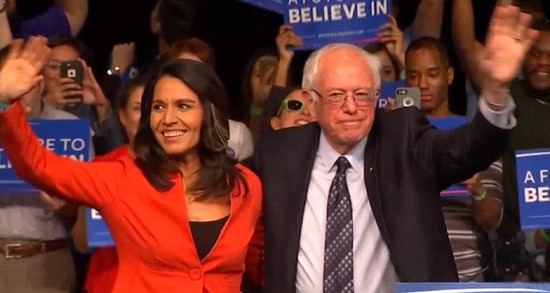
Bernie and Tulsi: the only candidates willing to call out the military-industrial complex

W.J. Astore

I watched the two Democratic debates this week.  Media outlets treat them as a horse race, announcing winners and losers.  So perhaps you heard Kamala Harris scored big-time against Joe Biden.  Or perhaps you heard Elizabeth Warren did well, or that Tulsi Gabbard generated lots of post-debate interest (Google searches and the like).  I will say that Beto O’Rourke was clearly unprepared (or over-prepared) and unable to speak clearly and meaningfully, so count him as a “loser.”

All that said, the clear winner wasn’t on the stage; it wasn’t even among the 20 debate participants.  The name of that clear winner: America’s military-industrial complex and its perpetual wars.

Sure, there was some criticism of the Afghan and Iraq wars, especially by candidates like Bernie Sanders and Tulsi Gabbard.  But there was no criticism of enormous “defense” budgets ($750 billion and rising, with true outlays exceeding a trillion a year), and virtually no mention of Saudi Arabia and the war in Yemen.  (Tulsi briefly mentioned the Saudis and was shut down; Bernie mentioned the war in Yemen and was ignored.)

The only direct mention of the military-industrial complex that I recall hearing was by Bernie Sanders.  Otherwise, the tacit assumption was that soaring defense budgets are appropriate and, at least in these debates, unassailable.

Bernie and Tulsi also mentioned the threat of nuclear war, with Bernie making a passing reference to the estimated cost of nuclear forces modernization (possibly as high as $1.7 trillion).  Again, he had no time to follow up on this point.

NBC’s talking heads asked the questions, so blame them in part for no questions on the MI Complex and the enormous costs of building world-ending nuclear weapons.  Indeed, the talking heads were much more concerned with “gotcha” questions against Bernie, which attempted to paint him as a tax-and-spend socialist who doesn’t care about diversity.  Yes, that really was NBC’s agenda.

Always, Democrats are asked, “How will you pay for that?”  You know: “extravagances” like more affordable education, better health care, a tax cut that helps workers, or investments in job training programs and infrastructure.  But when it comes to wars and weapons, there are never any questions about money.  The sky’s the limit.

A reminder to Democrats: Donald Trump won in 2016 in part because he was willing to denounce America’s wasteful wars and to challenge defense spending (even though he’s done nothing as president to back up his campaign critique).  We need true Peace Democrats with spine, so I remain bullish on candidates like Bernie Sanders and Tulsi Gabbard.

Hopefully, in future debates Bernie, Tulsi, and others will call for major reforms of our military and major cuts to our bloated Pentagon budget.  But don’t count on that issue being raised by the mainstream media’s talking heads.

Bonus Winner: I can’t recall a single mention of Israel and the Palestinians, not even in the context of framing a peace plan.  No mention of America’s role in Venezuela either.  The imperial and aggressive neo-con agenda on foreign policy went almost unchallenged, but kudos to Tulsi Gabbard for calling out the “chickenhawks” (her word, and the right one) in the Trump administration.

“Civilian Casualty Incidents”

3450
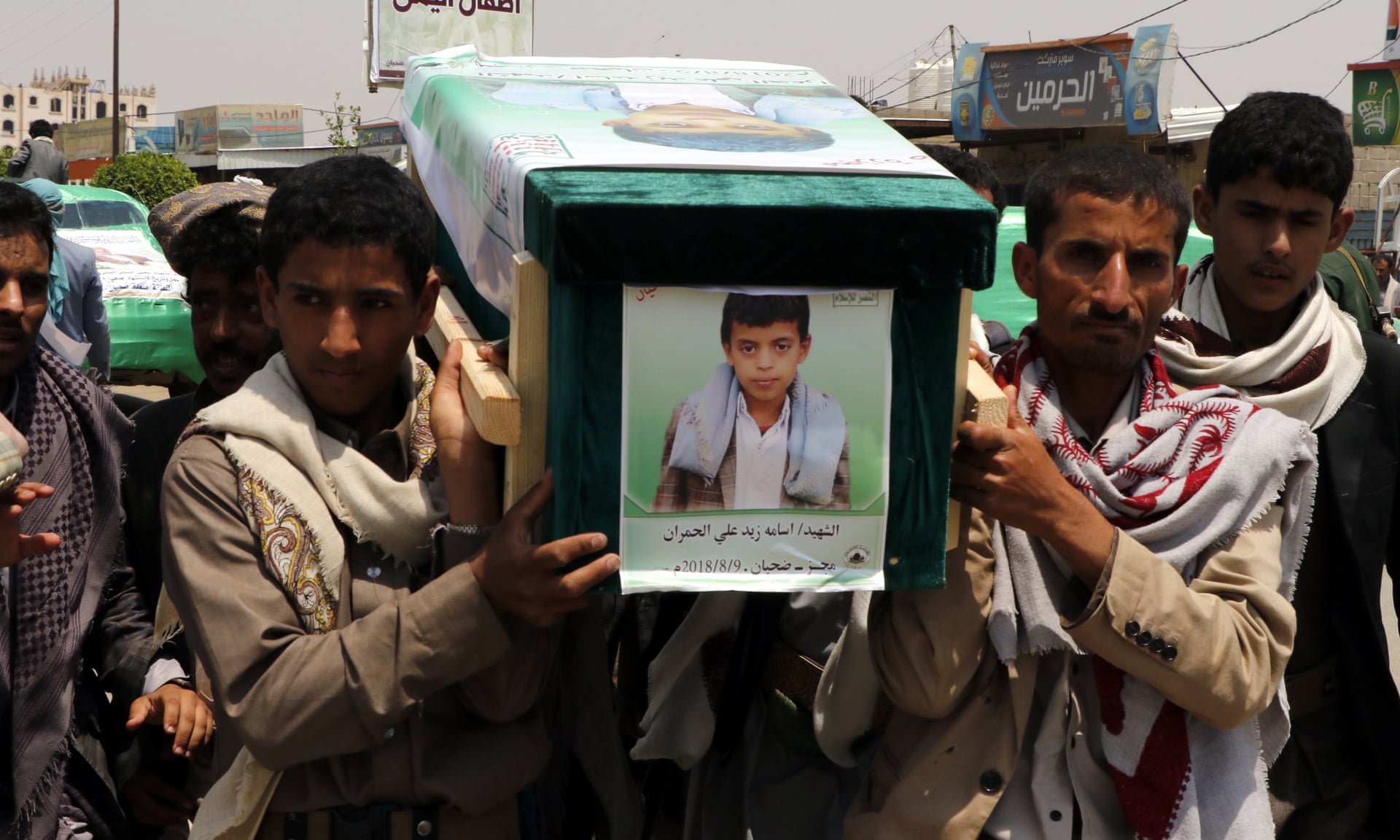
Just another civilian casualty incident?  Original caption: Mourners carry the coffin of a child at the funeral procession for those killed in an airstrike on a bus in Yemen. Photograph: Mohammed Hamoud/Getty Images

W.J. Astore

Last night, as I was watching the PBS News Hour, I snapped to attention as I heard a new euphemism for murdered innocents from bombing: “civilian casualty incidents.”

A PBS reporter used it, unthinkingly I believe, repeating bureaucratic jargon about all the innocents in Yemen smashed to bits or shredded by “dumb” bombs, cluster munitions, and even “smart” bombs that are really only as smart as the pilots launching them (and the often imperfect “actionable intelligence” gathered to sanction them).

The overall tone of the PBS report was reassuring.  General Mattis appeared to comfort Americans that the Saudis are doing better with bombing accuracy, and that America’s role in helping the Saudis is limited to aerial refueling and intelligence gathering about what not to hit.  Of course, the Saudis can’t bomb without fuel, so the U.S. could easily stop aerial massacres if we wanted to, but the Saudis are our allies and they buy weapons in massive quantities from us, so forget about any real criticism here.

I’ve written about Orwellian euphemisms for murderous death before: “collateral damage” is often the go-to term for aerial attacks gone murderously wrong.  To repeat myself: George Orwell famously noted the political uses of language and the insidiousness of euphemisms.  Words about war matter.  Dishonest words contribute to dishonest wars.  They lead to death, dismemberment, and devastation. That’s not “collateral” — nor is it merely a “civilian casualty incident” — that’s a defining and terrifying reality.

What if innocent Americans were being killed?  Would they be classified and covered as regrettable if inevitable “civilian casualty incidents”?

Our Enemy, Ourselves

W.J. Astore

In my latest article for TomDispatch.com, I suggest how America can pursue a wiser, more peaceful, course.  This is exactly what our leaders are not doing (and haven’t been doing for decades), as I document in the first half of my article, which I’m sharing here.  Bottom line: perpetual war doesn’t produce perpetual peace.  Nor does it make us safer.

Whether the rationale is the need to wage a war on terror involving 76 countries or renewed preparations for a struggle against peer competitors Russia and China (as Defense Secretary James Mattis suggested recently while introducing America’s new National Defense Strategy), the U.S. military is engaged globally.  A network of 800 military bases spread across 172 countries helps enable its wars and interventions.  By the count of the Pentagon, at the end of the last fiscal year about 291,000 personnel (including reserves and Department of Defense civilians) were deployed in 183 countries worldwide, which is the functional definition of a military uncontained.  Lady Liberty may temporarily close when the U.S. government grinds to a halt, but the country’s foreign military commitments, especially its wars, just keep humming along.

As a student of history, I was warned to avoid the notion of inevitability.  Still, given such data points and others like them, is there anything more predictable in this country’s future than incessant warfare without a true victory in sight?  Indeed, the last clear-cut American victory, the last true “mission accomplished” moment in a war of any significance, came in 1945 with the end of World War II.

Yet the lack of clear victories since then seems to faze no one in Washington.  In this century, presidents have regularly boasted that the U.S. military is the finest fighting force in human history, while no less regularly demanding that the most powerful military in today’s world be “rebuilt” and funded at ever more staggering levels.  Indeed, while on the campaign trail, Donald Trump promised he’d invest so much in the military that it would become “so big and so strong and so great, and it will be so powerful that I don’t think we’re ever going to have to use it.”

As soon as he took office, however, he promptly appointed a set of generals to key positions in his government, stored the mothballs, and went back to war.  Here, then, is a brief rundown of the first year of his presidency in war terms.

In 2017, Afghanistan saw a mini-surge of roughly 4,000 additional U.S. troops (with more to come), a major spike in air strikes, and an onslaught of munitions of all sorts, including MOAB (the mother of all bombs), the never-before-used largest non-nuclear bomb in the U.S. arsenal, as well as precision weapons fired by B-52s against suspected Taliban drug laboratories.  By the Air Force’s own count, 4,361 weapons were “released” in Afghanistan in 2017 compared to 1,337 in 2016.  Despite this commitment of warriors and weapons, the Afghan war remains — according to American commanders putting the best possible light on the situation — “stalemated,” with that country’s capital Kabul currently under siege.

How about Operation Inherent Resolve against the Islamic State?  U.S.-led coalition forces have launched more than 10,000 airstrikes in Iraq and Syria since Donald Trump became president, unleashing 39,577 weapons in 2017. (The figure for 2016 was 30,743.)  The “caliphate” is now gone and ISIS deflated but not defeated, since you can’t extinguish an ideology solely with bombs.  Meanwhile, along the Syrian-Turkish border a new conflict seems to be heating up between American-backed Kurdish forces and NATO ally Turkey.

Yet another strife-riven country, Yemen, witnessed a sixfold increase in U.S. airstrikes against al-Qaeda on the Arabian Peninsula (from 21 in 2016 to more than 131 in 2017).  In Somalia, which has also seen a rise in such strikes against al-Shabaab militants, U.S. forces on the ground have reached numbers not seen since the Black Hawk Down incident of 1993.  In each of these countries, there are yet more ruins, yet more civilian casualties, and yet more displaced people.

Finally, we come to North Korea.  Though no real shots have yet been fired, rhetorical shots by two less-than-stable leaders, “Little Rocket Man” Kim Jong-un and “dotard” Donald Trump, raise the possibility of a regional bloodbath.  Trump, seemingly favoring military solutions to North Korea’s nuclear program even as his administration touts a new generation of more usable nuclear warheads, has been remarkably successful in moving the world’s doomsday clock ever closer to midnight.

Clearly, his “great” and “powerful” military has hardly been standing idly on the sidelines looking “big” and “strong.”  More than ever, in fact, it seems to be lashing out across the Greater Middle East and Africa.  Seventeen years after the 9/11 attacks began the Global War on Terror, all of this represents an eerily familiar attempt by the U.S. military to kill its way to victory, whether against the Taliban, ISIS, or other terrorist organizations.

This kinetic reality should surprise no one.  Once you invest so much in your military — not just financially but also culturally (by continually celebrating it in a fashion which has come to seem like a quasi-faith) — it’s natural to want to put it to use.  This has been true of all recent administrations, Democratic and Republican alike, as reflected in the infamous question Madeleine Albright posed to Chairman of the Joint Chiefs Colin Powell in 1992: “What’s the point of having this superb military you’re always talking about if we can’t use it?”

With the very word “peace” rarely in Washington’s political vocabulary, America’s never-ending version of war seems as inevitable as anything is likely to be in history.  Significant contingents of U.S. troops and contractors remain an enduring presence in Iraq and there are now 2,000 U.S. Special Operations forces and other personnel in Syria for the long haul.  They are ostensibly engaged in training and stability operations.  In Washington, however, the urge for regime change in both Syria and Iran remains strong — in the case of Iran implacably so.  If past is prologue, then considering previous regime-change operations in Afghanistan, Iraq, and Libya, the future looks grim indeed.

Despite the dismal record of the last decade and a half, our civilian leaders continue to insist that this country must have a military not only second to none but globally dominant.  And few here wonder what such a quest for total dominance, the desire for absolute power, could do to this country.  Two centuries ago, however, writing to Thomas Jefferson, John Adams couldn’t have been clearer on the subject.  Power, he said, “must never be trusted without a check.”

The question today for the American people: How is the dominant military power of which U.S. leaders so casually boast to be checked? How is the country’s almost total reliance on the military in foreign affairs to be reined in? How can the plans of the profiteers and arms makers to keep the good times rolling be brought under control?

As a start, consider one of Donald Trump’s favorite generals, Douglas MacArthur, speaking to the Sperry Rand Corporation in 1957:

“Our swollen budgets constantly have been misrepresented to the public. Our government has kept us in a perpetual state of fear — kept us in a continuous stampede of patriotic fervor — with the cry of grave national emergency. Always there has been some terrible evil at home or some monstrous foreign power that was going to gobble us up if we did not blindly rally behind it by furnishing the exorbitant funds demanded. Yet, in retrospect, these disasters seem never to have happened, seem never to have been quite real.”

No peacenik MacArthur.  Other famed generals like Smedley Butler and Dwight D. Eisenhower spoke out with far more vigor against the corruptions of war and the perils to a democracy of an ever more powerful military, though such sentiments are seldom heard in this country today.  Instead, America’s leaders insist that other people judge us by our words, our stated good intentions, not our murderous deeds and their results.

For ten suggestions (plus a bonus) on how the U.S. can pursue a wiser, and far less bellicose, course, please read the rest of my article here at TomDispatch.com. 

Sun Tzu, Steve Bannon, and the Trump White House “Warriors”

steve-bannon-interview-on-donald-trump
Steve Bannon, self-professed student of the Art of War (Getty Images)

W.J. Astore

A favorite book of Steve Bannon’s is Sun Tzu’s The Art of War.  A classic of military strategy, The Art of War was compiled during the Warring States period (403-221 BCE) in ancient Chinese history.  It was a time of intense civil warfare in China, a time when a cessation in fighting was merely a pause between the next round of battles among warlords.  It’s still widely read today for its insights into war, its clever stratagems and tactics, and its lessons into human nature and behavior.

Bannon, who served in the U.S. Navy, is an armchair strategist with an affinity for military history books.  He appears to believe in inevitable conflict between the Judeo-Christian West, which he favors due to its “enlightened” values, and the World of Islam, which he sees as retrograde and barbaric when compared to the West.  He sees the world as already being in a “warring states” period writ large, a realm of conflict marked by “holy war” to be mastered by warrior/scholars like himself.

Joining him in this belief is Donald Trump, who took great pains to recite the phrase “radical Islamic terrorism” in his speech before Congress, as if using these words were a mark of personal courage on his part.  Trump has boasted about winning the “next” war, as if war during his presidency is inevitable.  And I suppose it is, with Trump at the helm and advisers like Bannon, Sebastian Gorka, and Stephen Miller pursuing a bellicose hardline against Islam.

Be careful what you wish for, Trump and cronies, and be especially careful about declaring victory in wars before you’ve even fought them.  Here Sun Tzu has much to teach our “warriors” in the White House.

For one thing, Sun Tzu writes that a battle is best won without fighting at all.  Said Sun Tzu: “Fighting and winning a hundred wars is not the greatest good.  Winning without having to fight is.”  In other words, you set the stage so carefully that the enemy must surrender or face obliteration before the curtain is even raised on war.

Secondly, Sun Tzu warns about the folly of protracted wars, how they deplete the national budget and weaken a state, especially when support among the people is tepid.  Warfare, notes Sun Tzu, must be treated with the greatest caution, even as it is waged with great cunning.  Best of all is to outsmart the enemy; next best is to form alliances, to build a much bigger army than the enemy, which may force them to capitulate.  Worst of all is to get bogged down in long wars, especially in cities, which require expensive sieges that wear on both sides (just ask the Germans at Stalingrad about this).

Ultimately, Sun Tzu writes that by understanding oneself and one’s enemy, a skilled leader can engage in a hundred battles without ever being in serious danger.  But an unskilled leader who does not truly know his own nature or that of his enemies is one who is fated always to lose.  Trump, who fancies himself a great leader and who is ignorant of foreign nations and peoples, does not inspire confidence here, even as he promises the American people that we’re going to win so much, we’ll get bored with winning.

Sun Tzu puts great emphasis on careful planning and sober deliberation before launching attacks.  If the recent Yemen raid is any indicator, Trump is neither a careful planner nor a sober deliberator.  Indeed, Trump’s personal qualities expose him to being manipulated by a cunning enemy.  In listing the personal traits that are dangerous in a commander, Sun Tzu mentions “quick to anger” as well as “self-consciousness” or vanity.  One who’s quick to anger can be goaded by insults into making poor decisions; one who’s vain and self-conscious can be humiliated or manipulated into rash action.

Trump promises an American military that is so big and so strong that no country will dare attack us.  Yet Trump himself, surrounded by his “warrior” advisers, isn’t content to build a huge military while not using it.  Indeed, Trump is already using it, notably in Yemen, pursuing policies that are fated to perpetuate warfare around the globe.  And it’s hardly encouraging that, after the failed Yemen raid, Trump shifted the blame to his generals rather than taking it himself.

Remember what Sun Tzu warned about vanity as well as perpetual warfare, especially when your own people are increasingly divided?  Something tells me this lesson is lost on Trump, Bannon, and crew.  Embracing the stratagems of The Art of War, its emphasis on surprise, subterfuge, deception, and quick strikes, is not enough.  You must seek the wisdom at its core, which is very much against war except as a last resort.

Know thyself, said Sun Tzu, echoing the Greek philosopher Socrates.  Face yourself squarely, recognize your flaws, your vanity (“All is vanity,” say the Christian Bible, a book Trump professes to treasure), and be careful indeed in unleashing war.

Do Trump, Bannon, and company know themselves, admit to their flaws and vanities, and recognize that war, in all its perils and costs, should be a course of last resort?  So far, evidence is wanting.

Update (8/12/17): Bannon has said his concern about a civilizational conflict with Islam dates from his time in the Navy and a visit to Pakistan.  Apparently, however, his ship visited Hong Kong rather than Pakistan.  Bannon also recalls specific details of Iran — its resemblance to a “primeval” wasteland — that he apparently was not privy to.  All this is revealed in an article at The Intercept.  Either Bannon’s memory is faulty or he is an esteemed member of the “alternative fact” club, where you just make things up to fit your preconceived notions.

As Peter Maass at The Intercept notes: “It turns out that Bannon, who has drawn a large amount of criticism for his exclusionary stances on race, religion, and immigration, has also inaccurately described his military service, simultaneously creating an erroneous narrative of how he came to an incendiary anti-Muslim worldview that helps shape White House policy.”