I recently read the book, “Generals Die in Bed,” a classic account of World War I. In terms of combat between Ukraine and Russia, there are serious echoes of WW1 with trench warfare and needless death on a massive scale.
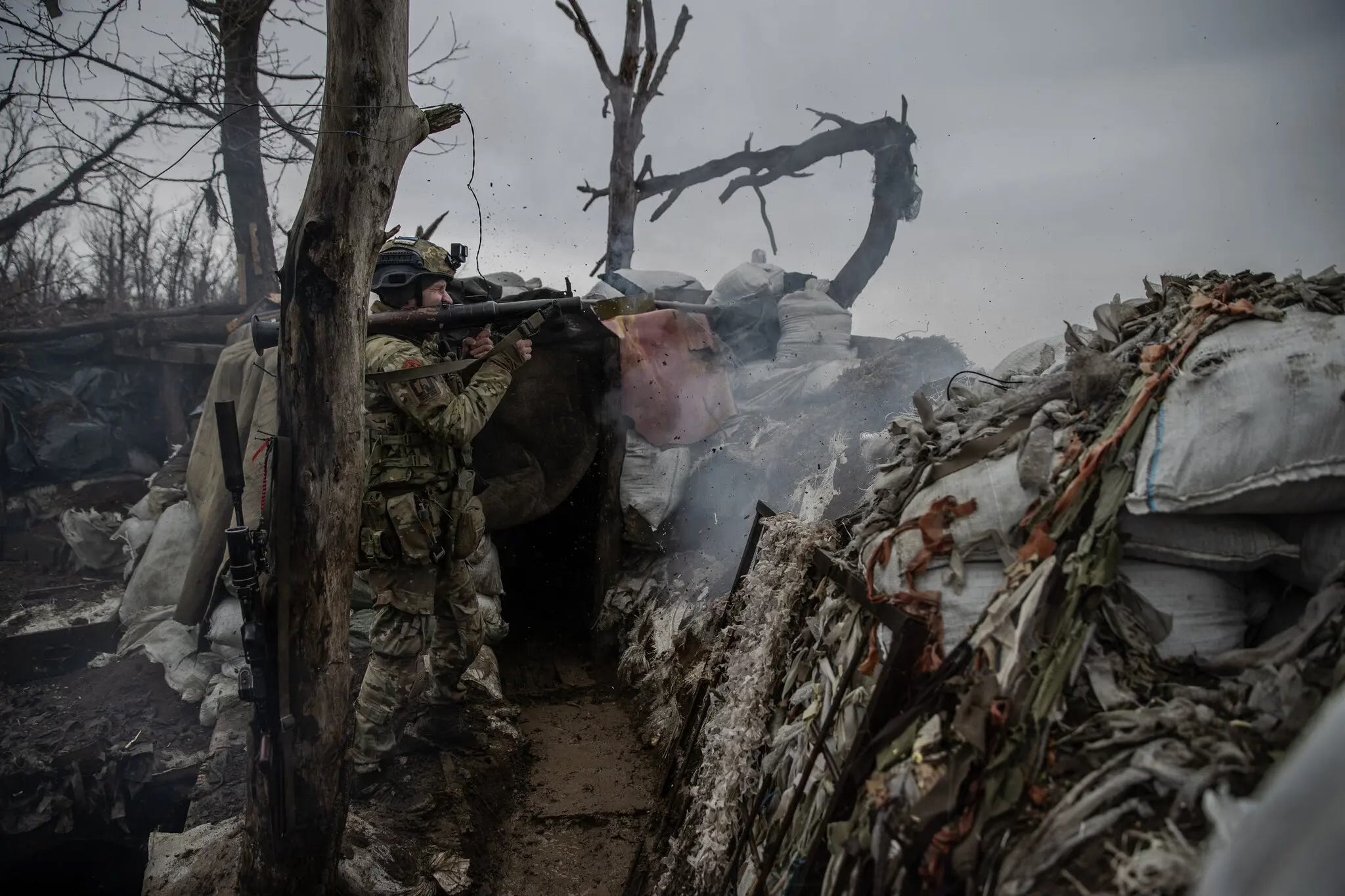
There are few things dumber and more wasteful than trench warfare (Ukraine, from the New York Times)
Far too often, war is glorified when it is really colossal waste. As Dwight D. Eisenhower said, war is to be hated. So, short of abject capitulation to a tyrant, I support efforts to end wars. Stop the waste. Stop the hate. Find a way to live together in peace. The alternative, perpetual war, is too terrible to contemplate.
Diplomacy can be pursued without abandoning Ukraine or betraying NATO. Certainly, Ukraine should be a party to the negotiations. The war is being fought on their turf. They have bled, as has Russia.
But: All wars must end. The trick is ending them in a way that doesn’t generate future wars. That was the greatest tragedy of World War I: that its ending and the botched settlement led almost inexorably to World War II and an even greater bloodletting.
Here’s the rub: Ever since 9/11, indeed ever since World War II, almost without exception, America has ALWAYS been at war. And it hasn’t gone well, has it? (Except for the arms makers and the Cheney neocon crowd.) Isn’t it time we worked for peace?
Far too often, America’s worst enemy hasn’t been Putin or China or some other bogeyman. It’s been the enemy within. And I don’t mean the “red menace” or the “woke” crowd. I mean the enemy that is threat inflation. The enemy that is incessant warfare in unnecessary wars of choice, which drives deficit spending, and which is reinforced by lies.
How many times have we heard of bomber gaps, missile gaps, falling dominoes in Asia, WMD in Iraq, etc., that turned out not to be true, but which were used to justify massive military spending and (especially in Southeast Asia) drove horrendous casualties? Yes, the MICIMATT is powerful, but why are Americans so easy to scare? Why are we so fearful when this country’s geographic position is so enviably strong and defensible? It’s not like Putin’s on our northern border: friendly Canadians are there! (Even if they boo our National Anthem at hockey games.)
The world is becoming multipolar again, which doesn’t mean it has to be a scarier place. A multipolar world could be a more stable one if U.S. leaders could just back off on their goal of dominating everything everywhere all at once.
The idea of full-spectrum dominance and America as a global hegemon at any price must give way to an irenic and ecumenical view of the world. The American religion of violent militarism and prideful exceptionalism is simply too expensive to sustain.
When the ship of state is slowly slipping under the waves, it’s not wise to steer closer to more icebergs. Let’s work to save our ship of state first.
I started blogging in 2007 for TomDispatch.com. Tom Engelhardt, the mastermind of that indispensable site, saw something in an article I sent him on saving the U.S. military from itself. That is, from its own vainglory, its own global ambitions for power and dominance, its own illusions of being number one, both the world’s toughest military and also the world’s freedom-bringers. Certainly, the megalomania and Messiah-like fantasies weren’t a military mindset alone; it was even more pronounced among the neocons who orbited the Bush/Cheney administration and who still largely define U.S. foreign policy in the Biden/Harris administration. Things are so bad that some (wrongly) believe Trump/Vance offer a more moderate, far less warlike, alternative, when Trump’s record suggests little of the sort.
Anyhow, this is my 108th article for TomDispatch in the 17 years I’ve been writing for the site, a mark of persistence that suggests a certain folly on my part, and considerable patience on Tom’s part.
During World War II, American leaders proudly proclaimed this country the “arsenal of democracy,” supplying weapons and related materiel to allies like Great Britain and the Soviet Union. To cite just one example, I recall reading about Soviet armored units equipped with U.S. Sherman tanks, though the Soviets had an even better tank of their own in the T-34 and its many variants. However, recent news that the United States is providing yet more massive arms deliveries to Israel (worth $20 billion) for 2026 and thereafter caught me off guard. Israel quite plainly is engaged in the near-total destruction of Gaza and the massacre of Palestinians there. So, tell me, how over all these years did the self-styled arsenal of democracy become an arsenal of genocide?
Israel, after all, couldn’t demolish Gaza, killing at least 40,000 Palestinians in a population of only 2.1 million, including thousands of babies and infants, without massive infusions of U.S. weaponry. Often, the U.S. doesn’t even sell the weaponry to Israel, a rich country that can pay its own bills. Congress just freely gifts body- and baby-shredding bombs in the name of defending Israel from Hamas. Obviously, by hook or crook, or rather by shells, bombs, and missiles, Israel is intent on rendering Gaza Palestinian-free and granting Israelis more living space there (and on the West Bank). That’s not “defense” — it’s the 2024 equivalent of Old Testament-style vengeance by annihilation.
As Tacitus said of the rampaging Romans two millennia ago, so it can now be said of Israel: they create a desert — a black hole of death in Gaza — and call it “peace.” And the U.S. government enables it or, in the case of Congress, cheers on its ringleader, Israeli Prime Minister Bibi Netanyahu.
Of course, anyone who knows a little American history should have some knowledge of genocide. In the seventeenth century, Native Americans were often “satanized” by early colonial settlers. (In 1994, a friend of mine, the historian David Lovejoy, wrote a superband all-too-aptly titled article on exactly that topic: “Satanizing the American Indian.”) Associating Indians with the devil made it all the easier for the white man to mistreat them, push them off their lands, and subjugate or eradicate them. When you satanize an enemy, turning them into something irredeemably evil, all crimes become defensible, rational, even justifiable. For how can you even consider negotiating or compromising with the minions of Satan?
Growing up, I was a strong supporter of Israel, seeing that state as an embattled David fighting against a Goliath, most notably during the Yom Kippur War of 1973. Forty years later, I wrote an article suggesting that Israel was now the Goliath in the region with Palestinians in Gaza playing the role of a very much outgunned and persecuted David. An American-Jewish friend told me I just didn’t get it. The Palestinians in Gaza were all terrorists, latent or incipient ones in the case of the infants and babies there. At the time, I found this attitude uncommon and extreme, but events have proven it to be far too common (though it certainly remains extreme). Obviously, on some level, the U.S. government agrees that extremism in the pursuit of Israeli hegemony is no vice and so has provided Israel with the weaponry and military cover it needs to “exterminate all the brutes.” Thus, in 2024, the U.S. “cradle of democracy” reveals its very own heart of darkness.
Looking Again at the World Wars That Made America “Great”
When considering World Wars I and II, we tend to see them as discrete events rather than intimately connected. One was fought from 1914 to 1918, the other from 1939 to 1945. Americans are far more familiar with the Second World War than the First. From both wars this country emerged remarkably unscathed compared to places like France, Germany, Russia, the United Kingdom, China, and Japan. Add to that the comforting myth that America’s “greatest generation” pretty much won World War II, thereby saving democracy (and “Saving Private Ryan” as well).
Perhaps, however, we should imagine those years of conflict, 1914-1945, as a European civil war (with an Asian wing thrown in the second time around), a new Thirty Years’ War played out on a world stage that led to the demise of Europe’s imperial powers and their Asian equivalent and the rise of the American empire as their replacement. Germanic militarism and nationalism were defeated but at an enormous cost, especially to Russia in World War I and the Soviet Union in World War II. Meanwhile, the American empire, unlike Germany’s Second and Third Reichs or Japan’s imperial power, truly became for a time an untrammeled world militarist hegemon with the inevitable corruption inherent in the urge for near-absolute power.
Vast levels of destruction visited upon this planet by two world wars left an opening for Washington to attempt to dominate everywhere. Hence, the roughly 750 overseas bases its military set up to ensure its ultimate global reach, not to speak of the powerful navy it created, centered on aircraft carriers for power projection and nuclear submarines for possible global Armageddon, and an air force that saw open skies as an excuse for its own exercises in naked power projection. To this you could add, for a time, U.S. global economic and financial power, enhanced by a cultural dominance achieved through Hollywood, sports, music, and the like.
Not, of course, that the United States emerged utterly unchallenged from World War II. Communism was the specter that haunted its leaders, whether in the Soviet Union, China, or Southeast Asia (where, in the 1960s and early 1970s, it would fight a disastrous losing war, the first of many to come, in Vietnam, Laos, and Cambodia). Here, there, and everywhere, even under the very beds of Americans, there was a fear of the “commie rat.” And for a while, communism, in its Soviet form, did indeed threaten capitalism’s unbridled pursuit of profits, helping American officials to create a permanent domestic war state in the name of containing and rolling back that threat. The collapse of the Soviet Union in 1991 erased that fear, but not the permanent war state that went with it, as Washington sought new enemies to justify a Pentagon budget that today is still rising toward the trillion-dollar mark. Naturally (and remarkably disastrously), it found them, whether in Afghanistan, Iraq, or so many other places in the case of the costly and ultimately futile Global War on Terror in the aftermath of the 9/11 attacks.
And eternally losing (or at least not winning) its wars raised the question: What will replace it? What will happen as imperial America continues to decline, burdened by colossal debt and strategic overreach, and crippled from within by a rapacious class of oligarchs who fancy themselves as a new all-American aristocracy. Will that decline lead to collapse or can its officials orchestrate a soft landing? In World Wars I and II, Europeans fought bitterly for world dominance, powered by militarism, nationalism, racism, and greed. They suffered accordingly and yet did recover even if as far less powerful nations. Can the U.S. manage to curb its own militarism, nationalism, racism, and greed in time and so recover similarly? And by “racism,” I mean, for example, reviving the idea (however put) of China as a “yellow peril,” or the tendency to see the darker-skinned peoples of the Middle East as violent “terrorists” and the latest minions of Satan.
And then, of course, there’s always the fear that, in the future, a world war could once again break out, raising the possibility of the use of nuclear weapons from global arsenals that are always being “modernized” and the possible end of most life on Earth. It’s an issue worth highlighting, since the U.S. continues to “invest” significant sums in producing yet more nuclear weapons, even as it ratchets up tensions with nuclear powers like Russia and China. Though a winnable nuclear war among the great powers on this planet is inconceivable, that hasn’t stopped my country from pushing for a version of nuclear superiority (disguised, of course, as “deterrence”).
Making America Sane Again
The world wars of the previous century facilitated America’s global dominance in virtually all its dimensions. That, in fact, was their legacy. No other nation in history had, without irony or humility, divided the globe into military combatant commandslike AFRICOM for Africa, CENTCOM for the Middle East, and NORTHCOM here at home. There are also “global” commands for strategic nuclear weapons, cyber dominance, and even the dominance of space. It seemed that the only way America could be “safe” was by dominating everything everywhere all at once. That insane ambition, that vainglory, was truly what made the U.S. the “exceptional” nation on the world stage.
Such a boundless pursuit of dominance, absurdly disguised as benefiting democracy, is now visibly fraying at the seams and may soon come apart entirely. In 2024, it’s beyond obvious that the United States no longer dominates the world, even if its military-industrial-congressional complex (MICC) does indeed dominate its national (in)security state and so increasingly the country. What an irony, in fact, that defeating European militarism in two world wars only accelerated the growth of American militarism and nationalism, making the world’s lone superpower for so many decades the scariest country for all too many peoples outside its borders.
Think, in fact, of the U.S. emerging from World War II with what might be thought of as victory disease. The last nearly 80 years of its foreign policy witnessed the remarkable progression of that “disease,” despite a lack of actual victories (unless you count minor escapades like the invasion of Grenada). Put differently, the U.S. emerged from World War II so singularly an economic, financial, and cultural juggernaut that subsequent military defeats almost didn’t seem to matter.
Even as America’s economic, financial, and cultural power has waned in this century, along with its moral position (consider President Obama’s curt “We tortured some folks” admission, along with support for Israel’s ongoing genocide), the government does continue to double-down on military spending. Pentagon budgets and related “national security” costs now significantly exceed $1 trillion annually even as arms shipments and sales continue to surge. War, in other words, has become big business in America or, as General Smedley Butler so memorably put it 90 years ago, a first-class “racket.”
Worse yet, war, however prolonged and even celebrated, may be the very definition of insanity, a deadly poison to democracy. Don’t tell that to the MICC and all its straphangers and camp followers, though.
Ironically, the two countries, Germany and Japan, that the U.S. took credit for utterly defeating in World War II, forcing their unconditional surrender, have over time emerged in far better shape. Neither of them is perfect, mind you, but they largely have been able to avoid the militarism, nationalism, and constant warmongering that so infects and weakens American-style democracy today. Whatever else you can say about Germany and Japan in 2024, neither of them is bent in any fashion on either regional or global domination, nor are their leaders bragging of having the finest military in all human history. American presidents from George W. Bush to Barack Obama have indeed bragged about having a matchless, peerless, “finest” military. The Germans and Japanese, having known the bitter price of such boasts, have kept their mouths shut.
My brother Stevie once memorably said: “No brag, just facts.”
My brother has a saying: no brag, just facts. And when we look at facts, the pursuit of global dominance has been driving the American empire toward an early grave. The “finest” military lost disastrously, of course, in Vietnam in the last century, and in Afghanistan and Iraq in this one. It functionally lost its self-proclaimed Global War on Terror and it keeps losing in its febrile quest for superiority everywhere.
If we met a person dressed in a military uniform who insisted he was Napoleon, boasted that his Imperial Guard was the world’s best, and that he could rule the world, we would, of course, question his sanity. Why are we not questioning the collective sanity of America’s military and foreign-policy elites?
This country doesn’t need to be made great again, it needs to be made sane again by the rejection of wars and the weaponry that goes with them. For if we continue to follow our present pathway, MADness could truly lie in wait for us, as in the classic nuclear weapons phrase, mutually assured destruction (MAD).
Another form of madness is having a president routinely implore God — yes, no one else! — to protect our troops. This is not a knock on Joe Biden alone. He’s just professing a nationalist piety that’s designed to win applause and votes. Assuming Biden has the Christian God in mind, consider the irony, not to say heresy, of functionally begging Christ, the Prince of Peace, to protect those who are already armed to the teeth. It’s also an abdication of the commander-in-chief’s responsibility to support and defend the U.S. Constitution while protecting those troops himself. Who has the biggest impact, God or the president, when it comes to ensuring that troops aren’t sent into harm’s way without a justifiable cause supported by the American people through a Congressional declaration of war?
Consider the repeated act of looking skyward to God to support military actions as a major league cop-out. But that’s what U.S. presidents routinely do now. Such is the pernicious price of pursuing a vision that insists on global reach, global power, and global dominance. America’s leaders have, in essence, elevated themselves to a god-like position, a distinctly angry, jealous, and capricious one, far more like Zeus or Ares than Jesus. Speaking of Jesus, he is alleged to have said, “Suffer the children to come unto me.” The militarized American god, however, says: suffer the children of Gaza to die courtesy of bombs and shells made here in the U.S.A. and shipped off to Israel at a remarkably modest price (given the destruction they cause).
To echo a popular ad campaign, Jesus may “get” us, but our leaders (self-avowed Christians, all) sure as hell don’t get him. I may be a lapsed Catholic, not a practicing one like Joe Biden, but even I remember my catechism and a certain commandment that Thou shalt not kill.
News that the Biden administration is sending cluster munitions to Ukraine highlights the dangerous escalatory nature of wars. These are special bombs and artillery shells with hundreds of “bomblets” that disperse to kill or maim as many people as possible. They persist in the environment; children have been known to pick them up and to be killed or grievously wounded as a result.
The apparent rationale behind this decision is that cluster munitions will help Ukraine in its counteroffensive against Russia. While these munitions will certainly increase the body count, probably on both sides, they are unlikely to be militarily decisive.
There are other issues as well, notes Daniel Larison at Eunomia:
The decision also opens the U.S. up to obvious charges of hypocrisy. U.S. officials have condemned the Russian use of these weapons and said that they have no place on the battlefield, but now the administration is saying that they do have a place. Providing cluster munitions to Ukraine makes a mockery of the administration’s earlier statements and creates more political problems for its effort to rally support for Ukraine. Many states in Latin America, Africa, and Asia are parties to the treaty banning the use, transfer, and stockpiling of cluster munitions, and now they will have one more reason to dismiss U.S. appeals to defending the “rules-based order” as so much hot air. The decision will probably embarrass and antagonize some of our allies in Europe, as most members of NATO are also parties to the treaty.
It’s rather amazing to think about the incredible variety of weaponry being sent to Ukraine in the name of “victory.” At first, the Biden administration spoke only of providing defensive weaponry. Biden himself declared that sending main battle tanks, jet fighters, and the like was tantamount to provoking World War III. More than a year later, the U.S. has committed to sending Abrams tanks, F-16 fighter jets, and offensive weapons of considerable potency like depleted uranium shells and now cluster munitions. And always with the same justification: the new weapons will help break the stalemate and lead to total victory for Ukraine.
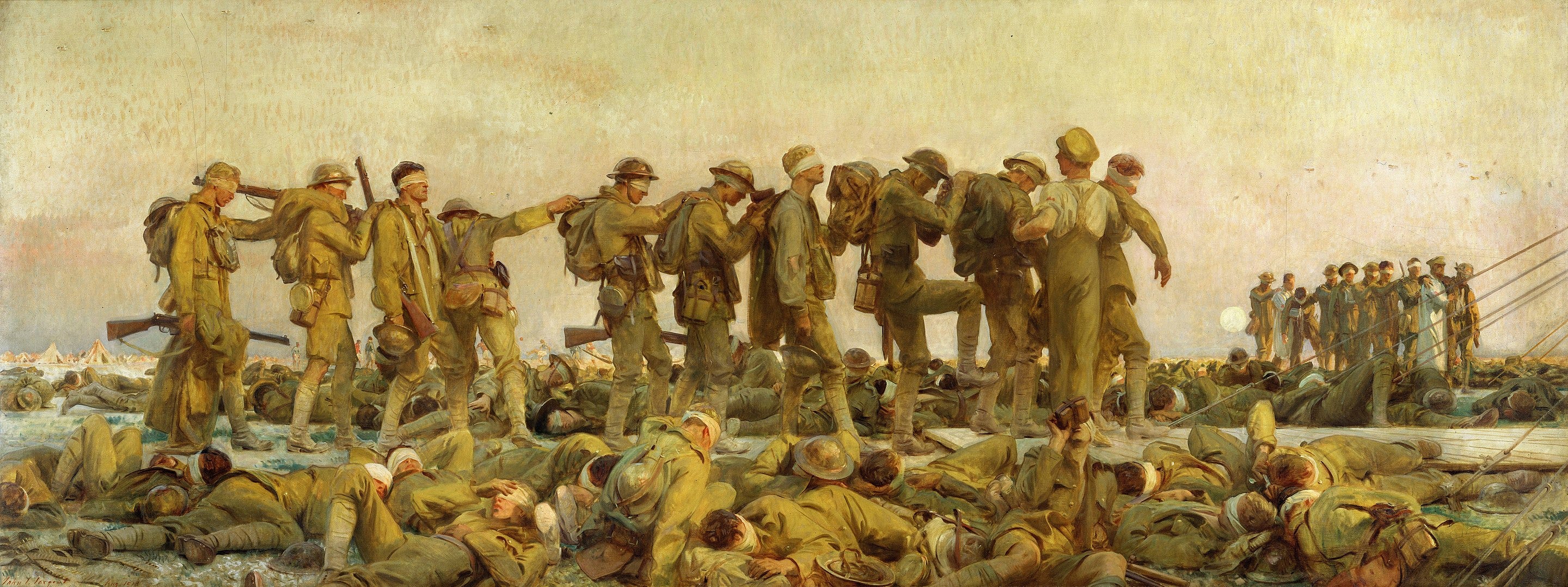
John Singer Sargent, “Gassed” (1919). Gas in World War I produced a million casualties—only aggravating the horrors of trench warfare
This is nothing new, of course, in military history. Think of World War I. Poison gas was introduced in 1915 in an attempt to break the stalemate of trench warfare. It didn’t. But it did stimulate the production of all sorts of dangerous chemical munitions and agents such as chlorine gas, phosgene, and mustard. Tanks were first introduced in 1916. Stalemate persisted. Flamethrowers were introduced. Other ideas to break the stalemate included massive artillery barrages along with “creeping” barrages timed to the advancing troops.
But there was no wonder weapon that broke the stalemate of World War I. After four years of sustained warfare, the German military finally started to falter in the summer of 1918. The Spanish Flu, the contagion of communism from Russia, and an effective allied blockade also served to weaken German resolve. The guns finally fell silent on November 11, 1918, a calm that wasn’t produced by magical weapons.
I wonder which weapon will next be hailed as crucial to Ukrainian victory? Who knows, maybe even tactical nukes might be on the minds of a few of the madmen advising Biden.
All around us things are falling apart. Collectively, Americans are experiencing national and imperial decline. Can America save itself? Is this country, as presently constituted, even worth saving?
For me, that last question is radical indeed. From my early years, I believed deeply in the idea of America. I knew this country wasn’t perfect, of course, not even close. Long before the 1619 Project, I was aware of the “original sin” of slavery and how central it was to our history. I also knew about the genocide of Native Americans. (As a teenager, my favorite movie — and so it remains — was Little Big Man, which pulled no punches when it came to the white man and his insatiably murderous greed.)
Nevertheless, America still promised much, or so I believed in the 1970s and 1980s. Life here was simply better, hands down, than in places like the Soviet Union and Mao Zedong’s China. That’s why we had to “contain” communism — to keep themover there, so they could never invade our country and extinguish our lamp of liberty. And that’s why I joined America’s Cold War military, serving in the Air Force from the presidency of Ronald Reagan to that of George W. Bush and Dick Cheney. And believe me, it proved quite a ride. It taught this retired lieutenant colonel that the sky’s anything but the limit.
In the end, 20 years in the Air Force led me to turn away from empire, militarism, and nationalism. I found myself seeking instead some antidote to the mainstream media’s celebrations of American exceptionalism and the exaggerated version of victory culture that went with it (long after victory itself was in short supply). I started writingagainst the empire and its disastrous wars and found likeminded people at TomDispatch — former imperial operatives turned incisive critics like Chalmers Johnson and Andrew Bacevich, along with sharp-eyed journalist Nick Turse and, of course, the irreplaceable Tom Engelhardt, the founder of those “tomgrams” meant to alert America and the world to the dangerous folly of repeated U.S. global military interventions.
But this isn’t a plug for TomDispatch. It’s a plug for freeing your mind as much as possible from the thoroughly militarized matrix that pervades America. That matrix drives imperialism, waste, war, and global instability to the point where, in the context of the conflict in Ukraine, the risk of nuclear Armageddon could imaginably approach that of the 1962 Cuban Missile Crisis. As wars — proxy or otherwise — continue, America’s global network of 750-odd military bases never seems to decline. Despite upcoming cuts to domestic spending, just about no one in Washington imagines Pentagon budgets doing anything but growing, even soaring toward the trillion-dollar level, with militarized programs accounting for 62% of federal discretionary spending in 2023.
Indeed, an engorged Pentagon — its budget for 2024 is expected to rise to $886 billionin the bipartisan debt-ceiling deal reached by President Joe Biden and House Speaker Kevin McCarthy — guarantees one thing: a speedier fall for the American empire. Chalmers Johnson predicted it; Andrew Bacevich analyzed it. The biggest reason is simple enough: incessant, repetitive, disastrous wars and costly preparations for more of the same have been sapping America’s physical and mental reserves, as past wars did the reserves of previous empires throughout history. (Think of the short-lived Napoleonic empire, for example.)
Known as “the arsenal of democracy” during World War II, America has now simply become an arsenal, with a military-industrial-congressional complex intent on forging and feeding wars rather than seeking to starve and stop them. The result: a precipitous decline in the country’s standing globally, while at home Americans pay a steep price of accelerating violence (2023 will easily set a record for mass shootings) and “carnage” (Donald Trump’s word) in a once proud but now much-bloodied“homeland.”
Lessons from History on Imperial Decline
I’m a historian, so please allow me to share a few basic lessons I’ve learned. When I taught World War I to cadets at the Air Force Academy, I would explain how the horrific costs of that war contributed to the collapse of four empires: Czarist Russia, the German Second Reich, the Ottoman empire, and the Austro-Hungarian empire of the Habsburgs. Yet even the “winners,” like the French and British empires, were also weakened by the enormity of what was, above all, a brutal European civil war, even if it spilled over into Africa, Asia, and indeed the Americas.
And yet after that war ended in 1918, peace proved elusive indeed, despite the Treaty of Versailles, among other abortive agreements. There was too much unfinished business, too much belief in the power of militarism, especially in an emergent Third Reich in Germany and in Japan, which had embraced ruthless European military methods to create its own Asiatic sphere of dominance. Scores needed to be settled, so the Germans and Japanese believed, and military offensives were the way to do it.
As a result, civil war in Europe continued with World War II, even as Japan showed that Asiatic powers could similarly embrace and deploy the unwisdom of unchecked militarism and war. The result: 75 million dead and more empires shattered, including Mussolini’s “New Rome,” a “thousand-year” German Reich that barely lasted 12 of them before being utterly destroyed, and an Imperial Japan that was starved, burnt out, and finally nuked. China, devastated by war with Japan, also found itself ripped apart by internal struggles between nationalists and communists.
As with its prequel, even most of the “winners” of World War II emerged in a weakened state. In defeating Nazi Germany, the Soviet Union had lost 25 to 30 million people. Its response was to erect, in Winston Churchill’s phrase, an “Iron Curtain” behind which it could exploit the peoples of Eastern Europe in a militarized empire that ultimately collapsed due to its wars and its own internal divisions. Yet the USSR lasted longer than the post-war French and British empires. France, humiliated by its rapid capitulation to the Germans in 1940, fought to reclaim wealth and glory in “French” Indochina, only to be severely humbled at Dien Bien Phu. Great Britain, exhausted from its victory, quickly lost India, that “jewel” in its imperial crown, and then Egypt in the Suez debacle.
There was, in fact, only one country, one empire, that truly “won” World War II: the United States, which had been the least touched (Pearl Harbor aside) by war and all its horrors. That seemingly never-ending European civil war from 1914 to 1945, along with Japan’s immolation and China’s implosion, left the U.S. virtually unchallenged globally. America emerged from those wars as a superpower precisely because its government had astutely backed the winning side twice, tipping the scales in the process, while paying a relatively low price in blood and treasure compared to allies like the Soviet Union, France, and Britain.
History’s lesson for America’s leaders should have been all too clear: when you wage war long, especially when you devote significant parts of your resources — financial, material, and especially personal — to it, you wage it wrong. Not for nothing is war depicted in the Bible as one of the four horsemen of the apocalypse. France had lost its empire in World War II; it just took later military catastrophes in Algeria and Indochina to make it obvious. That was similarly true of Britain’s humiliations in India, Egypt, and elsewhere, while the Soviet Union, which had lost much of its imperial vigor in that war, would take decades of slow rot and overstretch in places like Afghanistan to implode.
Meanwhile, the United States hummed along, denying it was an empire at all, even as it adopted so many of the trappings of one. In fact, in the wake of the implosion of the Soviet Union in 1991, Washington’s leaders would declare America the exceptional “superpower,” a new and far more enlightened Rome and “the indispensable nation” on planet Earth. In the wake of the 9/11 attacks, its leaders would confidently launch what they termed a Global War on Terror and begin waging wars in Afghanistan, Iraq, and elsewhere, as in the previous century they had in Vietnam. (No learning curve there, it seems.) In the process, its leaders imagined a country that would remain untouched by war’s ravages, which was we now know — or do we? — the height of imperial hubris and folly.
For whether you call it fascism, as with Nazi Germany, communism, as with Stalin’s Soviet Union, or democracy, as with the United States, empires built on dominance achieved through a powerful, expansionist military necessarily become ever more authoritarian, corrupt, and dysfunctional. Ultimately, they are fated to fail. No surprise there, since whatever else such empires may serve, they don’t serve their own people. Their operatives protect themselves at any cost, while attacking efforts at retrenchment or demilitarization as dangerously misguided, if not seditiously disloyal.
That’s why those like Chelsea Manning, Edward Snowden, and Daniel Hale, who shined a light on the empire’s militarized crimes and corruption, found themselves imprisoned, forced into exile, or otherwise silenced. Even foreign journalists like Julian Assange can be caught up in the empire’s dragnet and imprisoned if they dare expose its war crimes. The empire knows how to strike back and will readily betray its own justice system (most notably in the case of Assange), including the hallowed principles of free speech and the press, to do so.
Perhaps he will eventually be freed, likely as not when the empire judges he’s approaching death’s door. His jailing and torture have already served their purpose. Journalists know that to expose America’s bloodied tools of empire brings only harsh punishment, not plush rewards. Best to look away or mince one’s words rather than risk prison — or worse.
Yet you can’t fully hide the reality that this country’s failed wars have added trillions of dollars to its national debt, even as military spending continues to explode in the most wasteful ways imaginable, while the social infrastructure crumbles.
Clinging Bitterly to Guns and Religion
Today, America clings ever more bitterly to guns and religion. If that phrase sounds familiar, it might be because Barack Obama used it in the 2008 presidential campaign to describe the reactionary conservatism of mostly rural voters in Pennsylvania. Disillusioned by politics, betrayed by their putative betters, those voters, claimed the then-presidential candidate, clung to their guns and religion for solace. I lived in rural Pennsylvania at the time and recall a response from a fellow resident who basically agreed with Obama, for what else was there left to cling to in an empire that had abandoned its own rural working-class citizens?
Something similar is true of America writ large today. As an imperial power, we cling bitterly to guns and religion. By “guns,” I mean all the weaponry America’s merchants of death sell to the Pentagon and across the world. Indeed, weaponry is perhaps this country’s most influential global export, devastatingly so. From 2018 to 2022, the U.S. alone accounted for 40% of global arms exports, a figure that’s only risen dramatically with military aid to Ukraine. And by “religion,” I mean a persistent belief in American exceptionalism (despite all evidence to the contrary), which increasingly draws sustenance from a militant Christianity that denies the very spirit of Christ and His teachings.
Yet history appears to confirm that empires, in their dying stages, do exactly that: they exalt violence, continue to pursue war, and insist on their own greatness until their fall can neither be denied nor reversed. It’s a tragic reality that the journalist Chris Hedges has written about with considerable urgency.
The problem suggests its own solution (not that any powerful figure in Washington is likely to pursue it). America must stop clinging bitterly to its guns — and here I don’t even mean the nearly 400 million weapons in private hands in this country, including all those AR-15 semi-automatic rifles. By “guns,” I mean all the militarized trappings of empire, including America’s vast structure of overseas military bases and its staggering commitments to weaponry of all sorts, including world-ending nuclearones. As for clinging bitterly to religion — and by “religion” I mean the belief in America’s own righteousness, regardless of the millions of people it’s killed globally from the Vietnam era to the present moment — that, too, would have to stop.
History’s lessons can be brutal. Empires rarely die well. After it became an empire, Rome never returned to being a republic and eventually fell to barbarian invasions. The collapse of Germany’s Second Reich bred a third one of greater virulence, even if it was of shorter duration. Only its utter defeat in 1945 finally convinced Germans that God didn’t march with their soldiers into battle.
What will it take to convince Americans to turn their backs on empire and war before it’s too late? When will we conclude that Christ wasn’t joking when He blessed the peacemakers rather than the warmongers?
As an iron curtain descends on a failing American imperial state, one thing we won’t be able to say is that we weren’t warned.
It began in August 1914, a war in Europe that was supposed to be over by Christmas of that year. But it exploded out of control, becoming the “Great War” or “The World War” or even “The War to End All Wars.” And when it finally ended on 11/11 in 1918, something like ten million troops were dead.
We know it as World War I or the First World War because we know what came after it: yet another calamitous world war, a sequel, one that was far worse than the original. And after that war finally ended in 1945, something like 75-80 million people were dead around the world, including 25 million in the Soviet Union, six million Jews in the Holocaust, and 250,000 at Hiroshima and Nagasaki.
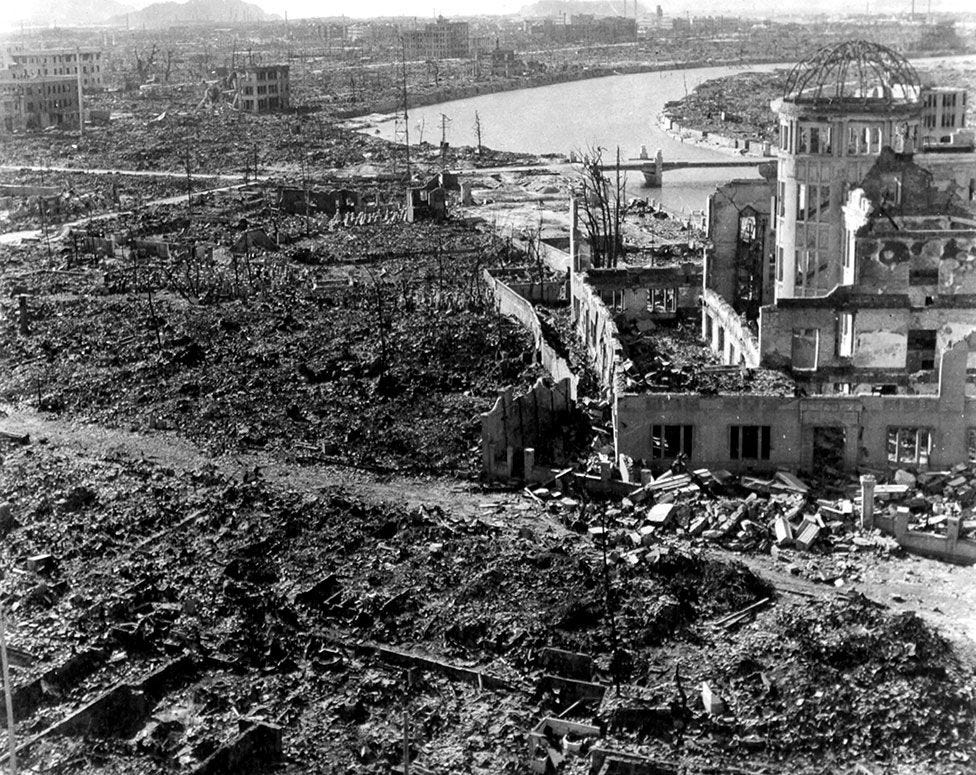
Hiroshima, 1945, after a “small” atomic bomb. Nuclear attacks in a “new” Cold War will be inconceivably worse
Of course, World War II also wasn’t the end of the killing. The so-called Iron Curtain descended in Europe, leading to the Cold War between the U.S. and the Soviet Union that almost ended with Armageddon in 1962 during the Cuban Missile Crisis. That Cold War came to an end in 1991 with the collapse of the Soviet Union. The U.S. celebrated its apparent victory, even calling briefly for “peace dividends” in the 1990s. It was not to be.
Thirty years after the (First) Cold War, we now hear of a “new Cold War.” We hear again that China and Russia are America’s enemies, a new “Axis of Evil,” notes Caitlin Johnstone. America is already engaged in a proxy war with Russia in Ukraine. Now America’s leaders are posturing over Taiwan and threatening war with China if the Chinese military makes aggressive moves against that country. (Of course, the Chinese consider Taiwan to be China, a “One China” policy the U.S. used to support.)
It does seem as if “my” Cold War, when I served in the U.S. military, may be remembered to history as the First Cold War, and that America has already begun a Second Cold War. And, just as World War II was far worse than World War I in casualties and destruction, Cold War II could conceivably be a LOT worse than Cold War I if we choose to continue to wage it.
Sequels, as a general rule, are usually worse, sometimes far worse, than the originals. We had better stop this nonsense of a new Cold War before we relearn this in the hardest way possible.
If you read the mainstream media, it would seem the answer to the Russia-Ukraine War, now about to enter its second year of mass death and widespread destruction, is weapons of various sorts. Western tanks like the German Leopard and American Abrams. Fighter jets like the F-16 produced by Lockheed Martin. If only Ukraine had more tanks, more jets, and the like, they would be able decisively to defeat the Russian military, ejecting it from Ukrainian territory, even from the Crimea, so the argument goes.
As a historian of technology and warfare, I’ve studied this belief in magical weapons. History teaches us that weapons alone usually do not determine winners and losers in war. Weapons themselves are rarely decisive, especially when the sides engaged fight symmetrically. In such cases, new weaponry often increases the carnage.
Consider the events of World War I. Various weapons were tried in an attempt to win the war decisively through military action. These weapons included poison gas (of various types), tanks, flamethrowers, and submarines, among others. None of these weapons broke the stalemate on the Western Front. Countermeasures were found. And World War I dragged on for more than four long years, producing hecatombs of dead.
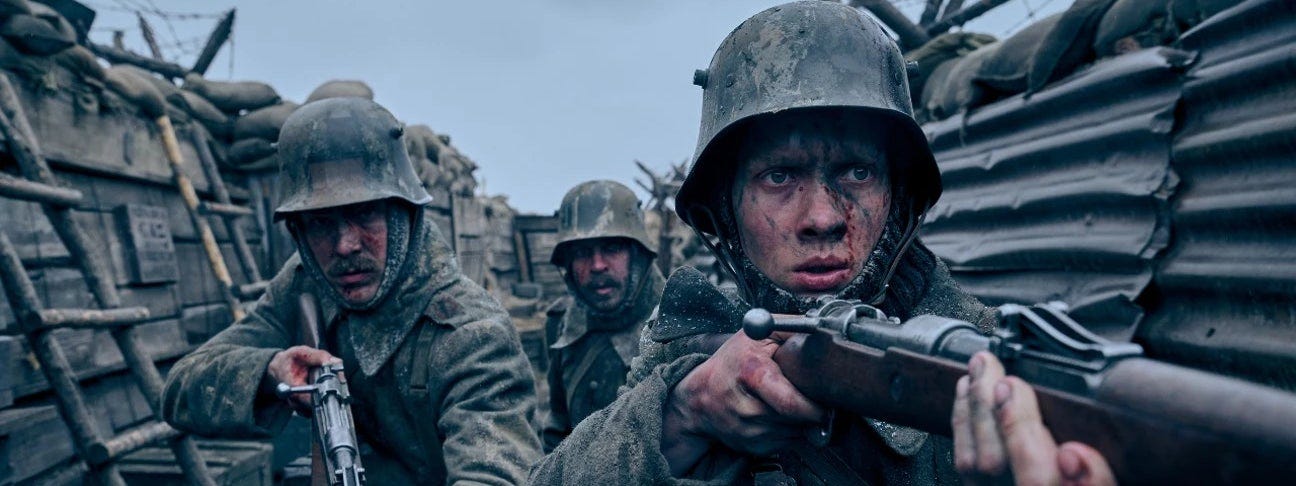
Image from “All Quiet on the Western Front,” 2022, Netflix
What did work? In a word, exhaustion. In the spring of 1918, Germany launched massive, last-ditch, offensives to win the war before U.S. troops arrived in Europe in large numbers. (The U.S. had entered the war in 1917 but was still mobilizing in 1918.) The Germans came close to winning, but when their offensives grounded to a halt, they had little left in the tank to endure Allied counterattacks. Yes, the Allies had more tanks than the Germans, and were learning to use them effectively with airpower in combined arms assaults. But what truly mattered was exhaustion within the German ranks, exacerbated by the Spanish flu, hunger, and demoralization.
No magical weapon won World War I. And no magical weapon is going to provide Ukraine a decisive edge in its struggle with Russia. Certainly not a hundred or so Western tanks or a few dozen fighter jets.
Indeed, looking at some of the media coverage of the Russia-Ukraine War in the West, you might be excused from mistaking it for advertising videos at a weapons trade show. Over the last year, we’ve learned a lot about Javelin and Stinger missiles, HIMARS rocket launchers, and of course various tanks, fighter jets, and the like. But we’ve seen very little coverage of the mass carnage on both sides. It’s been said the real costs of war will never get in the history books, for who wishes to confront fully the brutality and madness of industrialized warfare?
I’m in the middle of watching the new German version of “All Quiet on the Western Front,” a film deservedly nominated for an Oscar for best picture (available on Netflix). It’s one of the better war films I’ve seen in its depiction of the horrific and dehumanizing aspects of modern industrial warfare. Something like this movie is happening currently in Ukraine, but our leaders, supported by the media, think the answer to the carnage is to send even more destructive weaponry so that more troops (and civilians) can die.
Magical weapons are not the answer. For of course there’s nothing magical about weapons of mass destruction.
Perhaps the most powerful antiwar film that I’ve seen is “Testament of Youth” (2014), based on Vera Brittain’s memoir of the same title. I watched it soon after it first came out, and I rewatched it this past week after Russia invaded Ukraine. The film rips your heart out with its depiction of the costs of war: battered and bloodied bodies, blasted and shattered nature. It’s set during World War I and recounts Brittain’s heartrending loss of her fiancé, her brother, and other close friends. Brittain is played brilliantly by Alicia Vikander, who pours her heart and soul into every scene.
Especially powerful is the scene near the end, where Brittain passionately denounces war and the way it demonizes and dehumanizes the enemy, even as “patriots” (including her younger self) send young men off to fight and die in the name of honor. Even if you haven’t seen all that leads up to this scene, it retains its power (you may need to click and watch on YouTube):
“No to killing. No to war.”
Near the end of Brittain’s memoir, she passionately asks us to find another way, a better way, than the murderous one of war. She seeks to “rescue mankind from that domination by the irrational which leads to war,” to lead an “exultant fight” against war that would enlarge the soul of humanity.
Earlier in her memoir, she quoted from the war diary she kept that “It is impossible to find any satisfaction in the thought of 25,000 slaughtered Germans, left to mutilation and decay; the destruction of men as though beasts, whether they be English, French, German or anything else, seems a crime to the whole march of civilization.” How right she was, and remains.
One aspect of this film I truly appreciate is that it shows the costs of war without glorifying battle. In fact, there are no spectacular battle scenes; no rousing music; nothing to distract us from war’s many horrors. The movie does not romanticize war in any way, which makes it that much more effective.
I’m astonished this movie isn’t better known. It is worth 100 “Avatars” and “Titanics” and Marvel/DC superhero movies. Then again, I suppose I shouldn’t be shocked; antiwar films are rarely that popular, no matter how powerful, no matter how well-crafted, no matter how true.
If you haven’t seen it, watch it. Think about its message. We need to ask ourselves, again and again, why we as humans simply can’t say no to war.
Alicia Vikander as Vera Brittain in “Testament of Youth”
In the early 1990s, my wife and I had the pleasure of visiting friends in a newly unified Berlin, where we were introduced to the work of Käthe Kollwitz (1867-1945). Kollwitz lost a beloved son, Peter, in World War I and turned against war in her art. We visited the museum dedicated to her work, which reflected the causes that moved her. She was for people, for workers, for equity, for equality, for mothers and fathers and their children, and she was very much against war.
Here’s one of her powerful images with the theme of No More War:
“Never again war” was a common sentiment across the world in 1924, in the aftermath of the death and devastation of World War I. Yet that sentiment didn’t last, and in the chaos of the Great Depression the Nazis soon gained power and then ruthlessly acted to consolidate it. So much for “never again war.”
The Neue Wache: here Kollwitz has a sculpture of mother and her dead son, based on the Christian imagery of Mary cradling Jesus after his death by crucifixion. Why do we crucify so many of our young via endless war?
Kollwitz was haunted by the death of her son, Peter, in World War I. The burden of pain she carried is captured in this moving and powerful sculpture. There is no glory here. Only grief and suffering and love of the most painful kind.
It’s well worth watching this brief and moving ceremony:
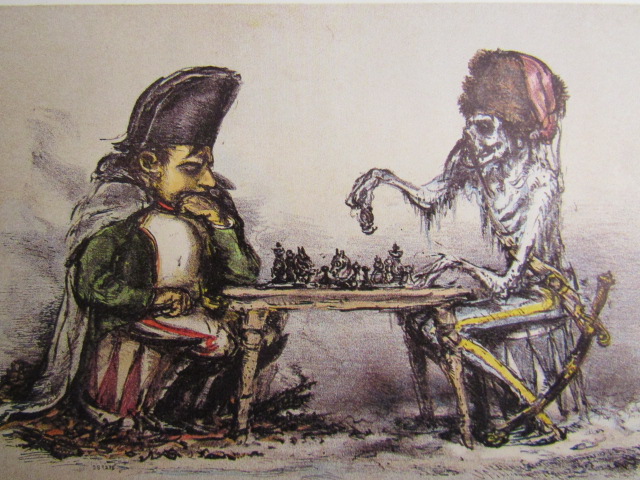
For far too many, war is something like a game, as shown in this telling image of Napoleon playing chess against the Russian Winter (Andreas Paul Weber). So many of us are only pawns in the “game” of war. Where is the glory here, emperor?
Kollwitz knew the pain and loss of war, and she knew how to share that pain and loss with the world. If you should find yourself in Berlin, I urge you to visit her museum and also to visit the Neue Wache memorial to the victims of war and dictatorship.
British machine gun unit in World War I: repetitive mass shootings
W.J. Astore
Back in 1992, when I was thinking about what to write my dissertation on, I put together a statement of intent and a bibliography. My statement was titled, “Economic Mobilization and National Strategies in Great Britain and France during the Great War.” As it turns out, I decided not to pursue a military subject, turning instead to science and religion, an area I examined when I pursued my master’s degree. I was reminded of all this as I looked through old documents this weekend in pursuit of references for a friend.
Anyway, here’s my statement from 1992 about World War I as a killing machine:
The Great War was a struggle waged by modern industrial juggernauts. The Western Front witnessed organized destruction on a scale heretofore thought impossible. Staggered by the costs of modern war, all combatants mobilized their economies, with varying degrees of success.
All countries in 1914 expected a short war and lacked plans for economic mobilization. Confronted by a stalemate on the Western Front which owed everything to modern industrialism, Britain and France drastically modified their economies. In Britain, the “Shells Scandal” provoked a cabinet crisis and the establishment of a new ministry of munitions, headed by David Lloyd George. Riding roughshod over the army’s traditional procurement practices, Lloyd George worked production miracles. Fed by massive imports of coal and metal from England, France embarked on an industrial program characterized by massive improvisation. Together, Britain and France formed an industrial alliance that proved to be a war-winning “arsenal of democracy”.
My dissertation will examine the efforts of Britain and France to gear their economies for war. I will focus on cooperation between the two countries. Since the Great War was primarily an industrial war, events in the economic sphere largely determined national strategies. My dissertation will also examine how economic concerns drove military strategy and operations on the Western Front.
As a preliminary thesis, I hold that the “industrial miracle” of Britain and France led to an overvaluing of machines at the soldiers’ expense. For Field Marshal Sir Douglas Haig and others like him, the new artillery with its massive stockpile of shells was a deus ex machina, a winning god of war. In his hands, soldiers became little more than power units, trained automatons who at the Somme in 1916 only needed to walk across no-man’s land and occupy the enemy’s trenches.
Overwhelmed by the conditions of modern warfare, British and French commanders placed too much faith in machines. Far from underestimating the impact of technology on the battlefield, they saw it as a panacea. Triumphs of production were frittered away in battle due to inadequate training and insufficient attention to tactical performance. Worst of all, as commanders consumed vast quantities of munitions, they seemed to become hardened to an expenditure of lives on a similar, but infinitely more horrendous, scale.
Furthermore, as economic means were mobilized, sacrifices incurred by destructive industrialism drove nations to inflate strategic ends and incite national will. Total economic warfare led to heightened political demands, eliminating chances for compromise; an incited populace could only be calmed by total victory. War was not politics by other means; it was industrial production by any means. This was not at the bequest of a “merchants of death” cartel; it was the natural outcome of a crisis which turned nations into machines for war.
In a sense, modern war became equivalent to modern industrialism, and vice-versa. Lewis Mumford suggests that “The army is in fact the ideal form toward which a purely mechanical system of industry must tend.” The individual soldier was reduced to a power unit and trained to be an automaton. Mass production and mass conscription had much in common, Mumford notes. “Quantity production must rely for its success upon quantity consumption; and nothing ensures replacement like organized destruction.”
The Great War witnessed a crisis of morale, and at the root of this crisis was the realization that military power had grown uncontrollable, and this was directly attributable to weapons technology. What disturbed so many was the futility of their efforts: the decidedly unheroic deaths awaiting them. As historian Paul Kennedy observed, victory went to the side whose combination of both military-naval and financial-industrial-technological resources was the greatest.
Extreme military effort drove countries to pursue extreme political gains. Nations became machines for war and little else.
Looking back, I can see why I didn’t pursue this. I wasn’t interested in economic mobilization; what really interested me was how warfare had changed, how nations became war machines, how it altered the politics of nations and the mindset of peoples. In a way, fascism in Italy, Germany, and elsewhere in the 1920s and 1930s was the logical outcome of near-total war mobilization in World War I.
Consider the United States today. The U.S. dominates the world’s trade in weaponry. The U.S. spends enormous sums of money on its military. The U.S. is devoted to the machinery of warfare, celebrating its weapons of mass destruction at various sporting events. The U.S. is even planning on revamping its world-destroying nuclear arsenal at a cost of $1.7 trillion over the next 30 years. All of this is considered “normal” in what Americans still consider as the world’s leading democracy.
Yet, how can a machine for war be consistent with democracy? How did we come to see more and more weapons — even WMD — as the guarantor of peace and freedom? How did the machinery of war become synonymous with the health of the state? What does it say about us as a nation?
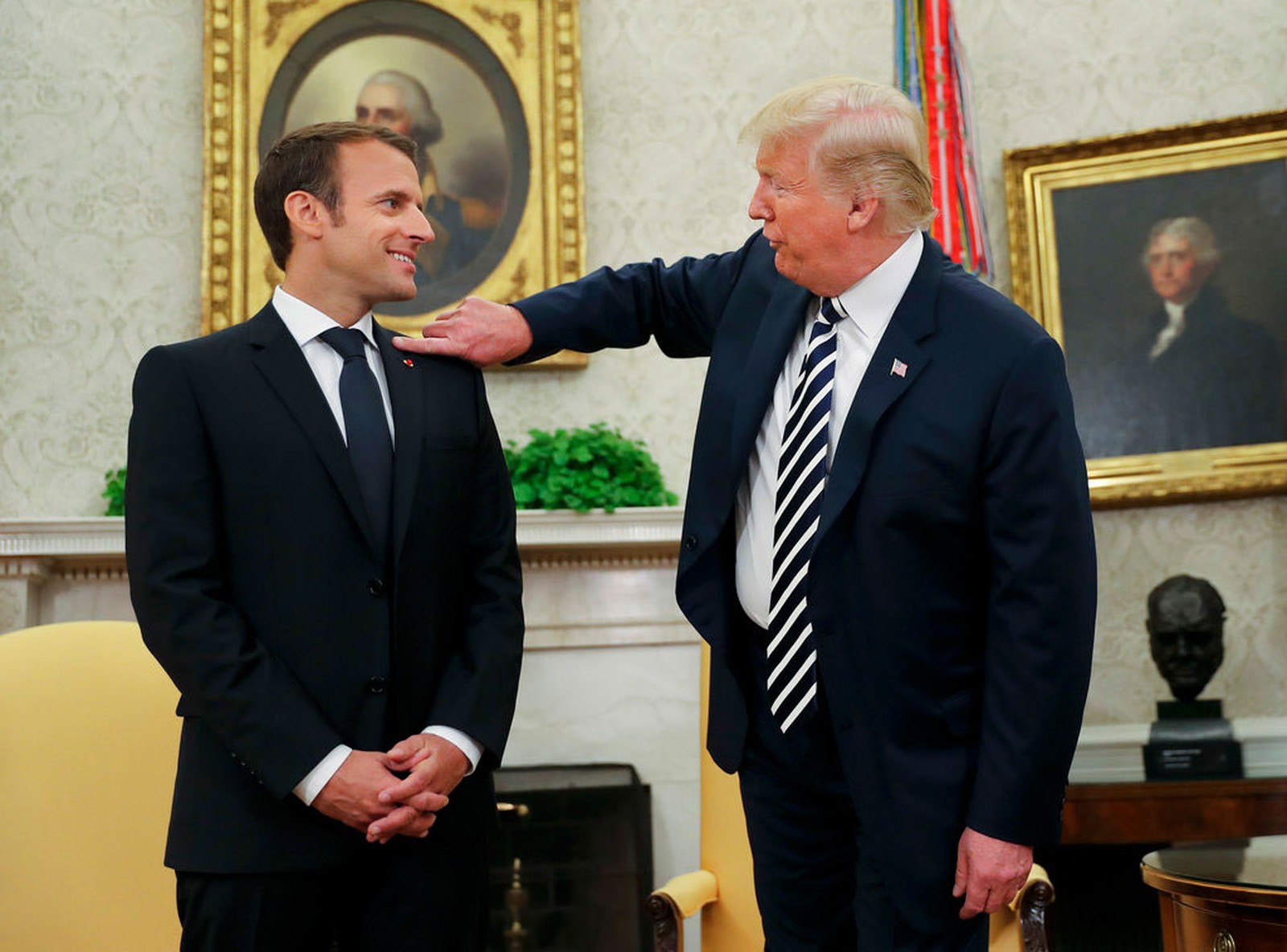
There he goes again. Donald Trump has insulted our French allies, apparently in retaliation for Emmanuel Macron’s sensible speech this past weekend that assailed nationalism as divisive and dangerous to world peace. In his retaliatory tweet today, the Trumpet had the following to say about France and its war effort in World Wars I and II:
Emmanuel Macron suggests building its own army to protect Europe against the U.S., China and Russia. But it was Germany in World Wars One & Two – How did that work out for France? They were starting to learn German in Paris before the U.S. came along. Pay for NATO or not!
Suggesting the French were learning German because they couldn’t or wouldn’t fight is more than insulting: it reveals Donald Trump’s utter ignorance of history.
First, consider World War I. The French lost roughly 1.4 million men in that war. More than any other country, France should be credited for defeating German militarism. Indeed, France served as America’s “arsenal of democracy” in that war, supplying U.S. troops with weaponry and helping to train them for war as well. The French, after all, had fought the war for nearly four years before American troops showed up in large numbers. Yes, the U.S. military helped to stiffen French and British resistance in 1918 and contributed to turning the tide toward victory, but overall France deserves tremendous credit and deep respect both for its victory and for the enormity of its sacrifice.
Now, let’s turn to World War II. It was the devastation of France in World War I (along with interwar political divisions and an overly defensive mentality) that contributed to its relatively quick defeat in World War II. Because of this defeat, France paid a high price indeed under German occupation. Some French people collaborated; many more resisted and paid for that resistance with their lives.
Trump insults the memory of millions of French men and women who died resisting German militarism in both world wars, and to what end? Just so he can score cheap points with his base by tweeting ignorant insults against an ally that fought side-by-side with Americans in both world wars?
The French, of course, helped to secure American independence in the 18th century, a favor you could say we repaid during the closing stages of World War I. And while World War II was a disaster for French arms, there was no lack of fighting spirit among major sectors of the French populace.
Suggesting the French were studying German because they were militarily inept until Americans rode to the rescue does more than a grave disservice to history. It gravely insults the French people. Such is the idiocy of Donald Trump.








 Bracing Views