What is the point of playing Russian roulette—with Russia?
As the Biden administration fades into oblivion, among its last decisions has been to allow Ukraine to strike deep into Russia with U.S.-made ATACMS, a missile with a range of 300 kilometers (190 miles). Ukraine’s recent use of these missiles brought a worrisome response from Russia: hypersonic intermediate-range missiles. If Ukraine persists in striking deeper into Russia with U.S., British, and French missiles, the Russian response will be proportionately greater, and possibly escalatory against NATO.
Here’s the thing: These missiles are too few in number to have a decisive impact on the course of the war. Ukraine isn’t going to “win” by launching ATACMS and similar tactical missiles. Yes, they can inflict more pain on Russia, hitting targets like ammunition dumps, military bases, and the like. But nobody is pretending these are war-winning weapons. All they promise is more dead bodies on both sides.
In World War I, new weapons were often introduced because it was believed they would prove decisive on the battlefield, weapons such as poison gas (1915) and tanks (1916). Of course, the other side adapted fairly quickly and the war dragged on, but at least there was a sincere belief that new weapons might break the awful stalemate of trench warfare.
There is no such sincere belief today. The main objective seems to be to complicate matters for the incoming Trump administration and its stated goal to end the Russia-Ukraine War. To that end, the Biden administration is using all means at its disposal to send the remaining $6 billion or so in weapons and related aid to Ukraine before Trump’s inauguration in January. Even anti-personnel mines are included in the mix.
Here’s how Antony Blinken put it:
President Biden is committed to making sure that every dollar we have at our disposal will be pushed out the door between now and January 20.
We’re making sure that Ukraine has the air defenses it needs, that it has the artillery it needs, that it has the armored vehicles it needs.
If only the Biden administration had been so committed to helping Americans in need.
In playing Russian roulette with Russia, Biden and Blinken have demonstrated unconscionable levels of recklessness and stupidity.
President Joe Biden has authorized Ukraine to use powerful long-range US weapons deep inside Russia.
Why now? Biden is a lame duck president, shuffling out the door, and now he decides to allow Ukraine to use American ATACMS missiles, with a range of roughly 190 miles, inside Russia. It’s also expected that these and similar longer-range missiles provided by the French and British will have no decisive impact on the war. They may kill and wound more Russians and inspire responses in kind by Russia against Ukraine, but their use won’t contribute to “victory” for Ukraine. So what’s the point?
My wife put it well when she learned of the decision: “stupid” and “ridiculous” were her words of choice. It’s amazing how well our “experts” feed the obscenity of war.
How dare you handcuff our missiles!
I take my title from a comment made by President-elect Trump’s nominee for National Security Adviser, Mike Waltz, who said we should take the handcuffs off of U.S. missiles in Ukraine, as if those missiles were people being held prisoner.
Whether in the Biden or Trump administrations, the advisers at the top are moral midgets, murderously so. I wonder how they’d feel being targeted by ATACMS. Hey, we just took the handcuffs off, Mr. Waltz. Enjoy your time being bombarded by these liberated missiles.
At the end of September, I noted how Vladimir Putin had redefined Russian nuclear policy to include a possible nuclear response to the use of “tactical” missiles like ATACMS. Here’s what I wrote then:
Vladimir Putin is redefining Russian policy for the use of nuclear weapons. He’s sending a clear warning that Ukraine’s use of U.S. and Franco-British missiles like ATACMS and Storm Shadow deep within Russia could draw a nuclear response. To my knowledge, the U.S. has not yet approved of the use of ATACMS deep within Russia, though Ukraine is pushing for it.
It seems many brain-dead, zombie-like advisers and “experts” insist that Russia is bluffing. They’re willing to bet the health and safety of the world that Russia won’t respond with nuclear weapons. And for what? ATACMS and Storm Shadow missiles aren’t war-winning weapons. The Russia-Ukraine War is a slog, an attritional struggle, featuring trenches and artillery and high casualties, a situation akin to World War I. It’s not going to be won by conventional tactical missile strikes.
Yet certain “experts” seemingly want it to escalate to World War III with nukes.
Just about 80 years ago, we humans entered the atomic age at the Trinity test site in July of 1945. We still haven’t come to grips with how the world changed when the first atomic “gadget” exploded in the desert in New Mexico. We had better hurry up and grow up before we all burn.
So, Putin has warned that deep strikes within Russia could draw a nuclear response, and Biden has now approved said strikes just before he leaves the White House. “Stupid” and “ridiculous” are indeed good descriptors here.
The obscenity of war knows no handcuffs in America.
With apologies to Elton John and Bernie Taupin, “peace” seems to be the hardest word, for both Democrats and Republicans.
This is hardly surprising. The National Security State is the unofficial fourth branch of government and arguably the most powerful. Presidents and Congress serve it, and the SCOTUS carves out special exceptions for it. Back in the days of a bit more honesty, it was called the Department of War. And so it remains.
Let’s say you’re like me and you see war as humanity’s greatest failing. We kill and maim each other, we scorch and kill every living thing in the path of our weapons, we destroy the environment, we even have the capacity to destroy life on earth via nuclear weapons. War—it really is good for absolutely nothin’, unless, of course, you profit from it.
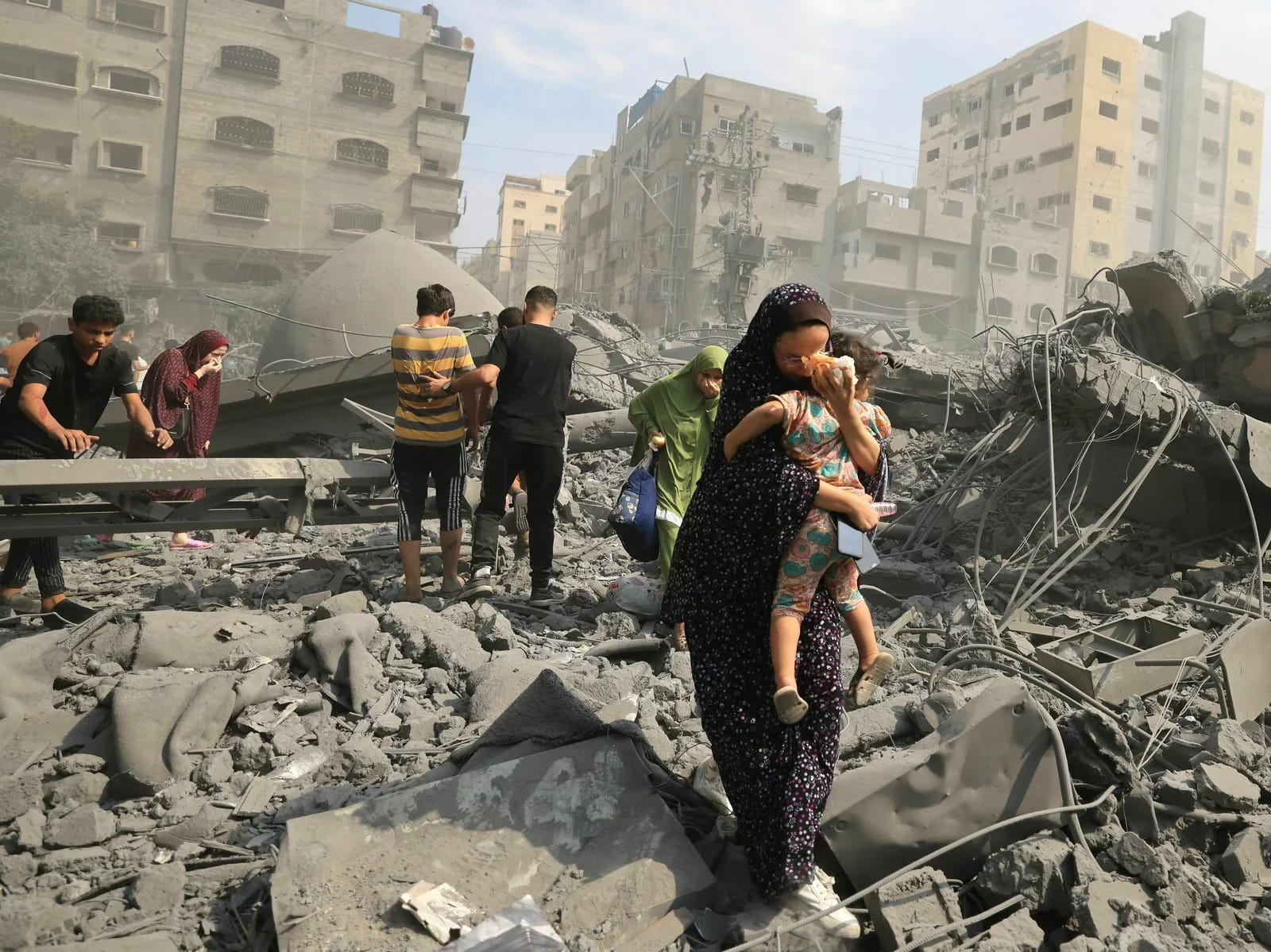
Gaza after an Israeli bombing attack. Anyone want more war?
So, who are you going to vote for in America who sees the awfulness of war and who’s willing to pursue diplomacy and peace instead? Democrats? Republicans?
Generally speaking, Democrats are fixated on war with Russia. They support massive aid to Ukraine and are against negotiations. They also support massive aid to Israel in its ongoing genocide against Palestinians in Gaza. And they fully support the military-industrial-congressional complex (MICC) and soaring spending on weapons and war, including “investing” in new nuclear weapons.
Republicans are much the same, except they tend to see China rather than Russia as the main threat, e.g. Donald Trump and J.D. Vance are willing to negotiate an end to the Russia-Ukraine War. But, in the main, Republicans fervently support Israel in its genocide, are outspoken critics of Iran (Got to punch them hard, Vance recently said), are willing enablers of the MICC, and also vote for massive spending on weaponry and war, including nuclear weapons.
Neither major U.S. political party, the red or blue teams, is pro-peace. Both are pro-aggression and pro-empire. They just occasionally choose different targets for their ire, even as they accuse the other team of “weakness,” of being “Putin puppets” or “Manchurian candidates.”
As I’ve said before, the only word or sentiment apparently forbidden among the red and blue teams is “peace.” If you want an antiwar candidate in America, you have to go outside the two main parties to the Greens or similar fringe parties.
In America, “antiwar” is defined by America’s propaganda machine, otherwise known as the corporate media, as weak and unAmerican, because “the health of the state” is war. Every election, whether the red or blue team prevails, the National Security State, the old War Department, wins. And humanity loses.
The last mainstream candidate for the presidency who spoke consistently of peace was George McGovern in 1972. Unless we the people demand peace, we will continue to get war. In fact, in a bizarrely Orwellian way, colossal military spending and incessant wars are sold to us as keeping America safe. “War is peace” is quite literally the message of the National Security State and its Ministry of Truth, the corporate-owned media.
What is the solution? Here’s one possible approach: Whenever America deploys troops overseas, those troops most immediately in harm’s way must be drawn from the ranks of America’s most privileged and their children. So, corporate CEOs, Members of Congress, lawyers at White Shoe firms, private equity billionaires and millionaires and their progeny, Hollywood celebrities and America’s best-known sports stars: those Americans who prosper and profit the most from empire should be the first to serve it. And that service must be made mandatory, no exceptions, no way to buy your way out or plead that you have “higher” priorities.
Those who want war should serve in war, leaving the rest of us alone. This rule, more than any other, might just keep the chickenhawks from screeching for more war with Russia, or China, or Iran, or North Korea, or Syria, or somebody. A few minutes at the front, facing bullets and shells and cluster munitions while hearing the screams of the dying, might just cure these wannabe “warriors” of their fever.
Want a war? Go to war. And leave the rest of us in peace.
It’s Independence Day in America, so it seems like a good day to declare our independence from the insanity of war.
Sadly, since the presidency of George W. Bush if not before, it’s become routine for U.S. commanders-in-chief to boast of having the world’s finest military in all of history. Obama did it routinely, and Biden recently said the same during his disastrous debate with Trump. Few Americans stop to think about the implications of boasting about having the world’s greatest military—is such a boast truly consistent with democracy, liberty, and freedom?
Certainly, empires rely on strong militaries. Think of the Roman Empire or the Mongol Empire, or the Third Reich (Empire) of Nazi Germany. Do we want to be like them?
Those empires lived by the sword (quite literally so with the Roman Empire) and died by it as well. Their militaries, I would argue, were also more effective than the U.S. one, which hasn’t won a major war since 1945, the latter with a lot of help from our “friends” like the Soviet Union. The Roman, Mongol, and German empires are no more, worn down in part through the constant costs and demands of war. We need to learn more from history than the “fact” that America’s military is supposedly the world’s best since forever and a day ago.
I’ve been reading Oriana Fallaci’s “Nothing, and So Be It,” in which she recounted her time reporting on the Vietnam War. Two conversations with U.S. troops in Vietnam caught my attention. On pages 22-23, she recounts a conversation with Army Captain Scher, during which Scher confesses his disgust with war:
God, how disgusting war is. Let me say it—I’m a soldier. People who enjoy making war, who find it glorious and exciting, must have twisted minds. There’s nothing glorious, nothing exciting; it’s just a filthy tragedy you can only cry over. You cry for the man you refused a cigarette to and who didn’t come back with the patrol. You cry for the man you bawled out and who is blown to pieces in front of you. You cry for the man who killed your friends …
Later in the book, she interviews a Marine Lieutenant whose surname is Teanek (pages 174-75). Here’s what he had to say:
Teanek: “Men have been saying that [we should abolish war] for thousands of years, and with the justification that they’re abolishing war, they’ve soaked the greatest periods of their civilization in blood.”
Fallaci: “That’s no good reason to keep on doing it.”
Teanek: “Theoretically, you’re right, but in practice what you’re saying is very silly. It’s like convincing yourself—as I bet you do—that when you describe people dying in war you’re helping to abolish war. On the contrary. The more you see people who’ve been killed in war, the more you want to go on fighting wars: it’s a mystery of the human soul.”
It is indeed “a mystery of the human soul” why we humans persist in killing each other in such vast numbers through war. Of course, it’s partly because we glorify it, when we should recognize, as Fallaci does on page 187, that “War is a madhouse.”
I am sane!
One of my favorite scenes in any war film came in “The Big Red One,” a World War II movie by Samuel Fuller starring Lee Marvin as a grizzled Army sergeant of the 1st Infantry Division. It’s a scene in which U.S. troops liberate an insane asylum.
The unforgettable part of this scene for me is when one of the madhouse residents picks up a submachine gun and starts blasting away, crying “I am one of you. I am sane!”
American foreign policy remains in the grip of heretics. They believe that the Prince of Peace is actually a god of war. They believe America is strengthened by entangling alliances (think here of our so-called alliance with Israel). They believe in constant war as a recipe both for dominant power and greater freedom and democracy throughout the world. They believe that spending roughly a trillion dollars each year on weapons and war is a wise “investment.” And they believe they are the toughest and truest of patriots, the ones who see further, the ones with the guts to get things done, no matter how poorly America’s wars have gone from Korea and Vietnam through Afghanistan, Iraq, and today’s proxy wars.
There used to be a different America, a much less militaristic and bellicose one. The American tradition is rich and complex; it contains multitudes, as Walt Whitman might say. Why are we so stuck on warmongers, thieves, and vainglorious simps of empire?
As an American, I’m very much a part of my country’s complexity and richness. And the America that speaks to me contains elements and lessons such as these:
George Washington’s prescient warning about the dangers of entangling alliances with foreign powers.
James Madison’s warning that constant warfare is the direst of enemies of liberty, freedom, and democracy in America.
General Smedley Butler’s confession that “war is a racket” and that he had often served as a “gangster for capitalism.”
The Nye Commission in the U.S. Senate that investigated arms manufacturers and weapons makers as “Merchants of Death” that profited greatly from war.
President Dwight D. Eisenhower’s “cross of iron” speech and his warning about the growing power and insidious nature of the military-industrial complex.
President John F. Kennedy’s powerful peace speech in which he extended an olive branch to the Soviet Union.
Martin Luther King Jr.’s powerful speech against the Vietnam War and the perils of militarism, racism, and materialism in America.
Of course, America has always had its dark side, with slavery and the genocidal treatment of Native Americans being at the top of the list. Yet America also has had its triumphs of wisdom and goodness. That is the America we should be embracing and celebrating. I believe it’s captured in the words of Washington, Madison, JFK, MLK, and so many others who’ve fought for peace and sanity, people like Dorothy Day, the Catholic activist who fought against war and all its awful excesses.
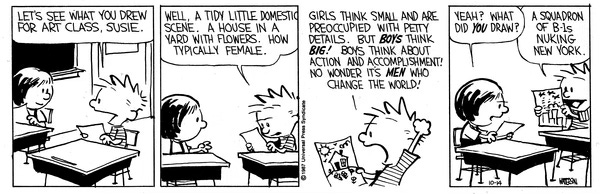
All that said, sometimes cartoons can express truths in ways that are as powerful as they are simple. In the cartoon below, the heretics of U.S. foreign policy are so many Calvins, spreading destruction and employing nukes in the name of manly seriousness. They are wrong. They are heretics. And if we continue to allow them to rule, they will surely lead America (as they already are in Gaza) to mass graves.
When Barack Obama took over as president in 2009, the global war on terror, or GWOT, just didn’t seem to fit the tenor of his “hope” and “change” message. So wars in Iraq and Afghanistan were rebranded as “overseas contingency operations.” Talk about the banality of evil! Even Orwell’s Big Brother might be impressed by OCOs as a substitute for invasion and war.
A euphemistic word Obama didn’t banish was “surge.” The “surge” in Iraq allegedly had worked under General David Petraeus, even though its gains proved as “fragile” and “reversible” as Petraeus hinted they would be. So Obama conducted his own surge in Afghanistan, the so-called good or smart war after the Bush/Cheney disaster in Iraq. And of course the “gains” in Afghanistan also proved both fragile and reversible, though no one was held to account for the miserable failure of the Afghan War. Whoops. I mean the Afghan contingency operation for democracy and enduring freedom.
Showing that he too could learn from America’s folly, Vladimir Putin termed his invasion of Ukraine a “special military operation.” U.S. leaders laughed at this, criticizing Putin for his propagandistic euphemism, even as they persisted in using terms like “overseas contingency operation” for America’s “kinetic” military actions. The eye of the beholder, I guess.
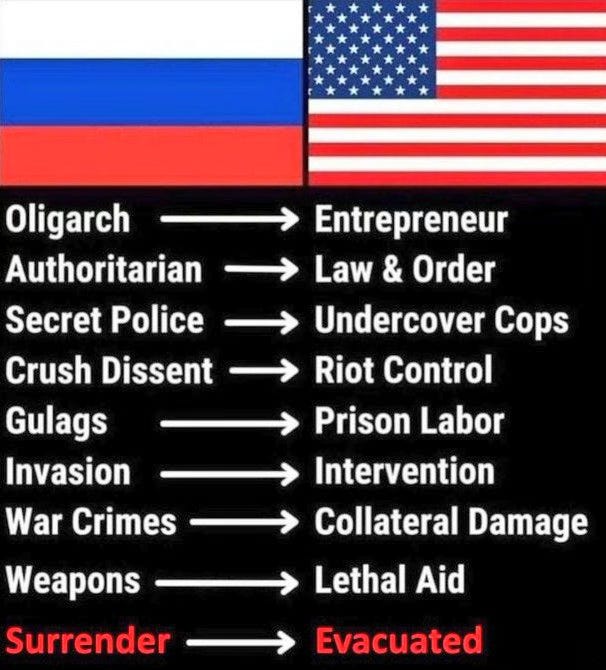
These thoughts came to mind as I perused my Twitter/X feed yesterday and spied this illustration posted by Chay Bowes:
Though the Russian flag is on the left, it could be the flag of China, Iran, North Korea, or any other alleged evildoer. The Russians invade, we intervene (for the sake of democracy, naturally). The Russians commit war crimes, we have unfortunate instances of collateral damage. In the war of the words, the U.S. military is clearly rather clever in a self-aggrandizing and self-exculpatory way.
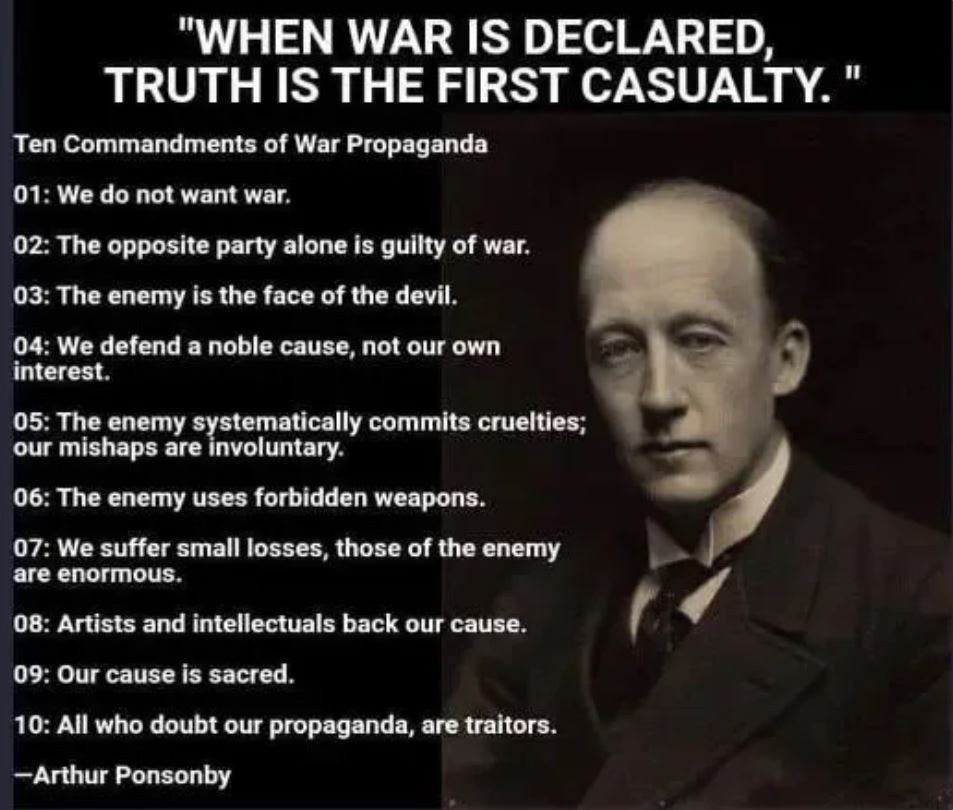
Looking at comments from this Twitter feed, I came across another useful illustration of manipulating language and information in the cause of war. Take a gander:
I confess I’d never heard of Arthur Ponsonby and his book, Falsehood in War-Time. I need to check it out.
This may prove a handy list to keep around as America’s national (in)security state acts to gin up the next war.
In 2002-03, before the U.S. invasion of Iraq, there was great optimism within the U.S. government that Baghdad was only the first stop on the worldwide victory tour of “the finest fighting force” in human history. The saying back then was: “Everyone wants to go to Baghdad. Real men want to go to Tehran.” Baghdad, of course, didn’t turn out quite as well as Bush/Cheney expected. The “real men” never did quite make it to Tehran.
With the deaths of three U.S. troops reported yesterday in Jordan near the Syrian border, those “real men” may start dreaming again of going to Tehran. The Biden administration has been quick to blame “radicals” backed by Iran for those deaths. Iran is also being blamed for its support of Houthis in their attacks on shipping as a protest against Israel’s ongoing war of annihilation against Gaza.
How long before the “real men” in Biden’s administration decide that strikes against Iran are justified as reprisals for U.S. troop casualties in Jordan? How long before wars in the Middle East escalate and perhaps spiral out of control?
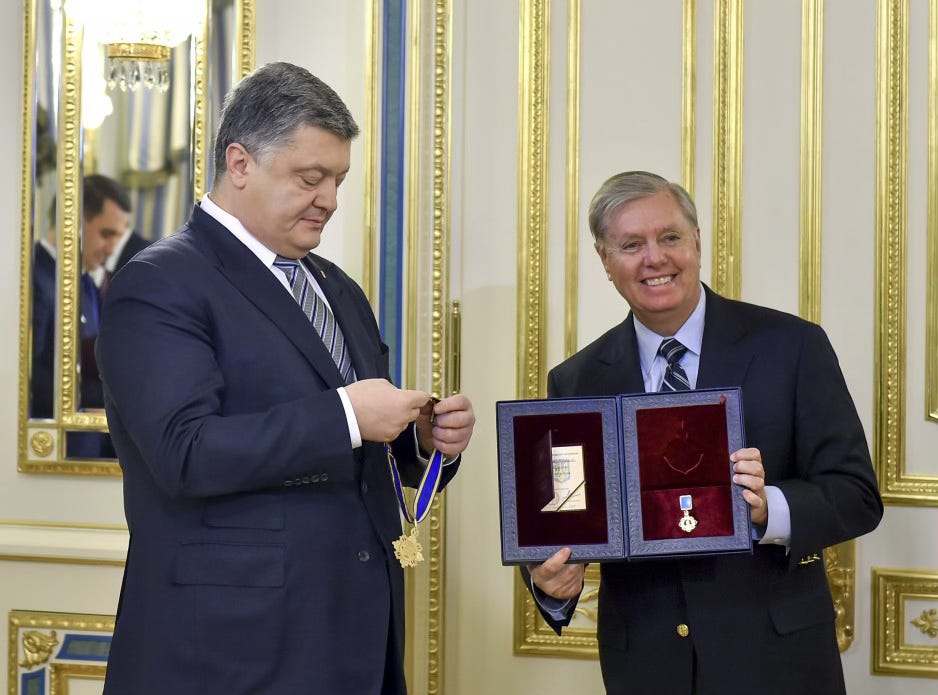
Only the “real men” of Washington, I suppose, have the answers here. One of those self-styled “real men,” Senator Lindsey Graham of South Carolina, had this to say via a manly tweet: “Hit Iran now. Hit them hard.” His “hard man” service in the U.S. Air Force was as a lawyer.
Lindsey Graham, on the right, decorated by Ukraine. He’s a “hard” hitter!
Update (1/29/24): It remains unclear (at least to me) whether the attack occurred in Jordan or Syria. Here’s an excerpt from Reuters:
Sunday’s attack on a remote outpost known as Tower 22 near Jordan’s northeastern border with Syria, the strikes had not killed U.S. troops nor wounded so many. That allowed Biden the political space to mete out U.S. retaliation, inflicting costs on Iran-backed forces without risking a direct war with Tehran.
Biden said the United States would respond, without giving any more details.
Republicans accused Biden of letting American forces become sitting ducks, waiting for the day when a drone or missile would evade base defenses. They say that day came on Sunday, when a single one-way attack drone struck near base barracks early in the morning.
In response, they say Biden must strike Iran.
“He left our troops as sitting ducks,” said Republican U.S. Senator Tom Cotton. “The only answer to these attacks must be devastating military retaliation against Iran’s terrorist forces, both in Iran and across the Middle East.”
The Republican who leads the U.S. military oversight committee in the House of Representatives, Representative Mike Rogers, also called for action against Tehran.
“It’s long past time for President Biden to finally hold the terrorist Iranian regime and their extremist proxies accountable for the attacks they’ve carried out,” Rogers said.
Former President Donald Trump, who hopes to face off against Biden in this year’s presidential election, portrayed the attack as a “consequence of Joe Biden’s weakness and surrender.”
Note the usual partisan criticism of whichever party is in power in Washington about its alleged “weakness” and “surrender” policies. Few in Congress question the need for U.S. troops operating in Syria in an apparently open-ended commitment.
The death of these troops should not be used as a cause for more war. If anything, they should lead to the withdrawal of U.S. troops from an area and country where they shouldn’t be based.
The ancients were wise to make war a god. Violent, unpredictable, destructive, seductive, brutal, and capricious. And of course very, very powerful in its hold on the human mind.
Ares, the Greek god of war
I trained as a historian, where an understanding of facts, context, and other forms of evidence is all-important. War destroys history. War creates its own “facts.” Who needs context when you hear the cry: “We’re at war!”
Consider the Russia-Ukraine War. Americans are encouraged to believe the war began with Putin’s invasion in February 2022. All you need to know is that Putin is evil and that he wants to conquer and subjugate Ukraine. A bit of history is introduced by equating Putin with Hitler; sometimes you see claims that Putin is “worse than Hitler.” But that’s about all the “history” you’re encouraged to know.
To follow the war, you might go to the Guardian, which tells me this is Day 596 of Putin’s invasion. Again, it’s implied that what came before Putin’s decision to invade simply doesn’t matter. NATO expansion to Russia’s borders, for example, is dismissed as irrelevant. Russia shouldn’t have felt threatened by benevolent, peace-loving NATO. Nor do you need to know anything about U.S. meddling in Ukrainian politics. Focus on the war, cheer on the Ukrainians, and see all Russians as guilty, more or less, even Russian opera singers and tennis players.
Consider as well the war between Israel and Hamas in the Gaza Strip. Again, Americans are encouraged to believe the war began with terrorist attacks by Hamas. All you need to know is that Hamas is engaged in “pure, unadulterated evil” (President Biden) and that Israel must defend itself however it deems fit. Hamas is evil, Israel is good, end of story.
Americans saw this with 9/11 and the Bush/Cheney response to it. President Bush encouraged us to believe that Al Qaeda attacked the U.S. because they hated us for our freedoms. They hate us because they ain’t us, simple as that. Meanwhile, Bush told the world you’re either for us or you’re for the terrorists.
War is the great and terrifying simplifier. We go to war shouting “Remember the Alamo!” or “Remember the Maine; to hell with Spain!” or “Remember Pearl Harbor!” with vengeance on our minds. There’s no need to think. There no need to seek any understanding. Who cares about history and context? It’s time to kill-kill-kill. That’s the only language *they* understand, because they’re pure evil even as we represent pure goodness. Our wrath is righteous and measured; their wrath is unbounded and insane, evil, the work of “human animals.”
Recall what Congresswoman Barbara Lee said when she cast the lone vote of dissentafter 9/11. Instead of authorizing a blank check of support for Bush/Cheney and U.S. military action everywhere, Lee advised restraint and asked a nation in mourning to pause. Citing a clergy member, she memorably cautioned that “as we act, let us not become the evil that we deplore.” Her speech was a profile in courage for which she was widely attacked and condemned.
What followed 9/11 was an orgy of violence by the U.S., a global war on terror akin to a jihad, producing the Afghan War, the Iraq War, Libya’s collapse into chaos, Gitmo, Abu Ghraib, the collateral murder video, torture, and so many other deplorable acts. Yet we as Americans are told by our leaders and the mainstream media to forget these “excesses,” these “mistakes,” because we meant well and we had no choice but to respond to evil terrorists with massive military might.
And so now Israel, aided by the U.S., faces the same choice: how best to respond to a terrorist attack. And it appears their response will be an exercise in massive military might. Because history doesn’t matter. The god of war has taken over. And that god demands vengeance. Violence. Blood sacrifice.
Yet there is wisdom in the Bible when it says (Romans 12:19-21):
Dearly beloved, avenge not yourselves, but rather give place unto wrath: for it is written, Vengeance is mine; I will repay, saith the Lord. Therefore if thine enemy hunger, feed him; if he thirst, give him drink: for in so doing thou shalt heap coals of fire on his head. Be not overcome of evil, but overcome evil with good.
The U.S. Mainstream Media Is Almost Always Pro-War
In the “liberal” New York Times today, I saw an article on “Putin’s forever war” that has the following short synopsis: “Vladimir Putin wants to lead Russians into a civilizational conflict with the West far larger than Ukraine. Will they follow him?”
Is this true? Does Putin truly seek a “civilizational conflict” with the West? One that’s “far larger” than the Ukraine war? It doesn’t seem likely. Russian forces have struggled in Ukraine. Already embroiled in a destructive regional war that’s become somewhat of a quagmire, why would Putin seek to widen it? Is Putin always the aggressor, the bad guy, and the West always the aggrieved party, the good guys, holding back a “red storm rising”? I thought the West won the Cold War more than 30 years ago.
It’s remarkable how easy it is to get alarmist articles about Russia or China published in the U.S. mainstream media (MSM). Wars and rumors of war dominate. The West is always portrayed as the defender of democracy; other countries such as China and Russia are portrayed as threats to civilization and its “rules-based order.” Strictly speaking, this is simplistic, one-sided, propaganda.
Back in 2017, I wrote about how difficult it is in the MSM to read honest accounts of war. In the runup to the Iraq War in 2003, critical voices were actively suppressed and punished. Back then, I focused my article on MSNBC, which like the New York Times is allegedly “liberal.” At “liberal” newspapers and networks, shouldn’t America expect at least a few critical critiques of war narratives? The answer here is “no,” as I wrote here:
Jesse Ventura, former governor of Minnesota (1999-2003), was a hot media commodity as the Bush/Cheney administration was preparing for its invasion of Iraq in 2003. Ventura, a U.S. Navy veteran who gained notoriety as a professional wrestler before he entered politics, was both popular and outspoken. MSNBC won the bidding war for his services in 2003, signing him to a lucrative three-year contract to create his own show – until, that is, the network learned he was against the Iraq war. Ventura’s show quickly went away, even as the network paid him for three years to do nothing.
I heard this revealing story from a new podcast, the TARFU Report, hosted by Matt Taibbi and Alex Pareene. By his own account, Jesse Ventura was bought off by the network, which back then was owned by General Electric, a major defense contractor that was due to make billions of dollars off the war.
Of course, Ventura was hardly the only war critic to run afoul of GE/NBC. Phil Donahue, the famous talk show host, saw his highly rated show cancelled when he gave dissenters and anti-war voices a fair hearing. Ashleigh Banfield, a reporter who covered the Iraq war, gave a speech in late April 2003 that criticized the antiseptic coverage of the war (extracts to follow below). For her perceptiveness and her honesty, she was reassigned and marginalized, demoted and silenced.
So much for freedom of speech, as well as the press.
As Phil Donahue said, his show “wasn’t good for business.” NBC didn’t want to lose ratings by being associated with “unpatriotic” elements when the other networks were waving the flag in support of the Iraq war. In sidelining Ventura and Donahue, NBC acted to squelch any serious dissent from the push for war, and punished Ashleigh Banfield in the immediate aftermath of the war for her honesty in criticizing the coverage shown (and constructed) by the mainstream media, coverage that was facilitated by the U.S. military and rubber-stamped by corporate ownership.
Speaking of Banfield’s critique, here are some excerpts from her speech on Iraq war coverage in April 2003. Note that her critique remains telling for all U.S. media war coverage since then:
That said, what didn’t you see [in U.S. media coverage of the Iraq war]? You didn’t see where those bullets landed. You didn’t see what happened when the mortar landed. A puff of smoke is not what a mortar looks like when it explodes, believe me. There are horrors that were completely left out of this war. So was this journalism or was this coverage? There is a grand difference between journalism and coverage, and getting access does not mean you’re getting the story, it just means you’re getting one more arm or leg of the story. And that’s what we got, and it was a glorious, wonderful picture that had a lot of people watching and a lot of advertisers excited about cable news. But it wasn’t journalism, because I’m not so sure that we in America are hesitant to do this again, to fight another war, because it looked like a glorious and courageous and so successful terrific endeavor, and we got rid of a horrible leader: We got rid of a dictator, we got rid of a monster, but we didn’t see what it took to do that.
With admirable honesty, Banfield spoke of the horrific face of war at Kansas State Univ. in 2003. Soon after her speech, she was demoted (Image courtesy of KSU)
I can’t tell you how bad the civilian casualties were. I saw a couple of pictures. I saw French television pictures, I saw a few things here and there, but to truly understand what war is all about you’ve got to be on both sides…
Some of the soldiers, according to our embeds had never seen a dead body throughout the entire three-week campaign. It was like Game Boy. I think that’s amazing in two different ways. It makes you a far more successful warrior because you can just barrel right along but it takes away a lot of what war is all about, which is what I mentioned earlier. The TV technology took that away too. We couldn’t see where the bullets landed. Nobody could see the horrors of this so that we seriously revisit the concept of warfare the next time we have to deal with it.
I think there were a lot of dissenting voices before this war about the horrors of war, but I’m very concerned about this three-week TV show and how it may have changed people’s opinions. It was very sanitized.
This TV show [Iraq invasion coverage] that we just gave you was extraordinarily entertaining, and I really hope that the legacy that it leaves behind is not one that shows war as glorious, because there’s nothing more dangerous than a democracy that thinks this is a glorious thing to do.
War is ugly and it’s dangerous, and in this world the way we are discussed on the Arab street, it feeds and fuels their hatred and their desire to kill themselves to take out Americans. It’s a dangerous thing to propagate…
I’m hoping that I will have a future in news in cable, but not the way some cable news operators wrap themselves in the American flag and patriotism and go after a certain target demographic, which is very lucrative. You can already see the effects, you can already see the big hires on other networks, right wing hires to chase after this effect, and you can already see that flag waving in the corners of those cable news stations where they have exciting American music to go along with their war coverage.
Nothing has changed since Banfield’s powerful critique. Indeed, the networks have only hired more retired generals and admirals to give “unbiased” coverage of America’s military actions. And reporters and “journalists” like Brian Williams have learned too. Recall how Williams cheered the “beautiful” U.S. Tomahawk cruise missiles as they were launched against Syria earlier this year [2017].
It’s not just that U.S. media coverage actively suppresses dissent of America’s wars: it passively does so as well, which is arguably more insidious. Any young journalist with smarts recognizes the way to get ahead is to be a cheerleader for U.S. military action, a stenographer to the powerful. Being a critic leads to getting fired (like Donahue); demoted and exiled (like Banfield); and, in Ventura’s case, if you can’t be fired or demoted or otherwise punished, you can simply be denied air time.
When you consider that billions and billions of dollars are at stake, whether in weapons sales or in advertising revenue tied to ratings, none of this is that surprising. What’s surprising is that so few Americans know about how pro-authority and uncritical U.S. media coverage of war and its makers is. If anything, the narrative is often that the U.S. media is too critical of the military to the detriment of the generals. Talk about false narratives and alternative facts!
America’s greed-wars persist for many reasons, but certainly a big one is the lack of critical voices in the mainstream media. Today’s journalists, thinking about their career prospects and their salaries (and who is ultimately their boss at corporate HQ), learn to censor themselves, assuming they have any radical thoughts to begin with. Some, like Brian Williams, even learn how to stop worrying and love the beautiful bombs.
[After I wrote this in 2017, I added this comment at the site.]
One thing that troubles me is the mindset that criticism of America’s wars undermines the troops. That it could even be a form of betrayal. This mindset is very dangerous. It not only protects the decisions and actions of those at the highest levels of the military and government. It acts to prolong wars and to endanger the lives of the troops (and of their “enemies” as well).
During the Iraq war, I recall instances of U.S. troops speaking clearly and frankly against the war. Their voices were heard, yet their advice was not taken. Instead, generals like David Petraeus were trotted out to assure the American people that the war was being won, even if the gains were characterized by weasel words like “fragile” and “reversible.” And so those gains have proved — even so, Petraeus remains in demand, and is still trotted out, now in mufti, to explain how we must stay the course and continue to defer to the military.
There’s a powerful book to be written here, and it should focus in part on the silencing or marginalization of anti-war voices (even those that wear or wore the uniform), even as pro-war elements are given the main stage as the voices of probity and sanity.
War is the business of the state. That can be read in more than one way. Back in the 17th and 18th centuries, many wars were the work of mercenaries and mercenary-captains, often serving, more or less, nobility who thought they could supplant the king or queen, or expand their own turf and power, pursuing plunder all the while. People gave their support to strong leaders and nation-states partly because they were tired of constant warfare and being the victims of mercenaries. In the 18th century, war was said to be “enlightened” because it largely didn’t impact the people directly; warfare was “limited” to otherwise under-employed nobility and the so-called dregs of society. And nation-states profited from being able to control warfare.
The French Revolution and Napoleon unleashed a new phase of increasingly unlimited war inspired by ideology (Liberty! Fraternity! Equality!). Nationalism was heavily tapped. Soldiers were told it was an honor to die for the nation-state rather than for plunder or in the service of some minor nobleman. Sweet and fitting it seemed to die for one’s country, so soldiers were told — and are still told to this day.
Nowadays, war is the business of the state may be taken literally with war as business. The U.S. federal government spends more than half of its discretionary budget on the military, weaponry, and war, though it’s disguised as a “defense” budget. As long as war remains a business for the U.S., and as long as people are profiting from it, not just in monetary terms but in terms of power, war will remain supreme in U.S. foreign policy.
I remember reading a newspaper from the 1930s that stated clearly that the way to end war was to remove the profit motive. That same decade, the U.S. Senate held hearings to expose the “merchants of death,” the military contractors that had profited so greatly from wholesale death and destruction during World War I. Since the U.S. in those days didn’t have a large standing military and a vast array of private military contractors, those hearings could go ahead in a nation that sought to avoid another world war, especially yet another one in Europe.
Today, the U.S. routinely wages war couched as ever in terms of peace or, if not peace, then security for America. How America is made more secure by troops in Syria helping to facilitate the seizing of oil, or troops in Africa engaging in the latest scramble for that continent’s natural resources, is left undefined. Or perhaps there is a tacit definition: if war is business, America needs (and deserves) access to the best markets, to vital natural resources, to oil and lithium and similar strategic materials, and the way to secure those is militarily, using force.
One thing that amazes me, though it shouldn’t, is the almost complete lack of emphasis in the U.S. on conservation, on limiting resource extraction by cutting demand. Oil companies are bragging how they’re boosting fossil fuel production in the U.S. The message is clear: keep consuming! No need to cut back on your use of fossil fuels. Your overlords will secure — and sell at inflated prices — the fuel you need and want. Just don’t ask any uncomfortable questions.
I suppose it’s all quite simple (and depressing) in its obviousness:
War is the business of the state.
The business of America is business.
The business of America is war.
The nation-state was supposed to corral war, to control it, to “enlighten” it by keeping it limited, a sideshow. Yet war in America has become unlimited, the main show, and very much unenlightened as well. Corralling and controlling it is out of favor. Planning for the next big war is all the rage, perhaps most clearly with China, though Russia factors in as well. A new cold war wins nods of approval from America’s national security state because it most certainly means job security and more power for those who are part of that state.
What is to be done? America needs to remember that war is not the health of any democracy, and that no democracy can survive when it’s constantly engaged in war and preparations for the same. Yet we know America isn’t a democracy, so that argument is effectively moot. Perhaps homespun wisdom can help: those who live by the sword (or the gun) die by the same, though the American response would seem to be: I’ll just buy more swords (or guns), so take that. Or maybe an appeal to Christianity and how blessed the peacemakers are, and how Christ was the prince of peace, except Americans prefer a warrior-Christ who favors his chosen with lawyers, guns, and money.