Inserting American Bodies in Iraqi and Afghan Dikes

Image is everything
Bush rebranded as a war president: Mission Accomplished!

W.J. Astore

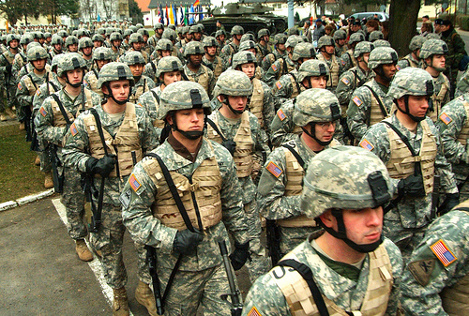
The United States continues to insert the bodies of its troops into leaky Iraqi and Afghan dikes.  That’s the image that came to mind with the recent news from Iraq and Afghanistan.  More American “advisers” and weapons being sent to Iraq.  The revival of night raids by U.S. Special Forces in Afghanistan.  No matter the piss-poor results in Iraq or Afghanistan, the U.S. continues to double down on losing hands.

Why is there no learning curve in Washington?  A big reason is that President Obama’s decisions have been, are, and will be driven by domestic politics.  The Democrats don’t dare withdraw from either war since ISIS or the Taliban would grow in strength (at least in the short-term), and the Republicans would eagerly blame the Democrats for “losing” wars that George W. Bush and General David Petraeus and U.S. troops had allegedly won.

The cynical Democratic solution to this dilemma is to plug the Iraqi and Afghan dikes with more U.S. troops (and, most likely, more casualties) until after the election of 2016.

Domestic political advantage is often the major reason for continued folly in lost wars.  We saw it in Vietnam: neither LBJ nor Nixon wanted to be seen as having “lost” Vietnam.  Nixon in particular had his eye on the election of 1972 as well as on posterity as he made decisions about the war.

America’s wars overseas are far too often driven by public relations for domestic consumption.  Consider the invasion of Iraq in 2003 and the Bush Administration’s announcement of “Mission Accomplished,” a staged Hollywood photo op meant to cement Bush’s status domestically as a war leader.  Far better it was to have an image of co-pilot Bush landing in a flight suit on an aircraft carrier than one of a befuddled Bush reading about pet goats to schoolchildren on the morning of 9/11.  Obama is hardly guiltless here.  Even as he questioned the Iraq war, he ran in 2008 on the idea of Afghanistan being the necessary war, thus immunizing himself from charges of being “soft” on defense.  Afghanistan is no closer to being “won” for the U.S. today than it was six years ago, yet Obama’s folly continues, aggravated by recent orders to return American troops to Iraq.

Internationally, it’s strategic folly for the U.S. to persist in these wars.  But domestically, endless wars act as a coat of armor to deflect charges of being a wimp (for Obama) or of being incompetent (for Bush after 9/11).  With his drone strikes, Obama has become the assassin-in-chief, even as Bush with the invasions of Afghanistan and Iraq became the “war president” (at least in his own mind, together with the minds of a subservient and fawning media).

Christ said, “Blessed are the peacemakers,” but America has no time for peace.  Not when “peace” leaves one open to political charges of being an un-American wimp and loser.

Want to help change this?  At the very least, vote for the candidate in 2016 who vows to end America’s wars in Iraq and Afghanistan.  Vote for the candidate who vows to end the practice of stuffing American bodies into so many of the world’s leaky dikes.  Vote for the candidate who stands for peace rather than for war.  Regardless of the election results, that candidate won’t be a “loser.”  For in America today, in a land tortured by gusty winds of war, it’s far gutsier to stand for peace.

Would a better prepared U.S. have used torture?

tmw2014-08-13colorlarge

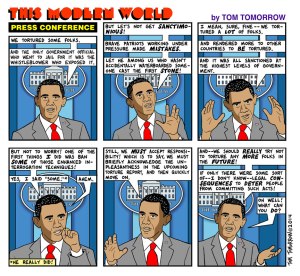
The so-called Senate CIA Torture Report is supposed to be released today.  Five years ago, I wrote an article for Nieman Watchdog on the Bush Administration’s decision to resort to “enhanced interrogation techniques,” or torture in plain speak.  Torture, I wrote back then, was the refuge of the impatient and incompetent, an approach that abrogated America’s fidelity to international treaties even as it became habit-forming.  In other words, the resort to torture simply begat more torture, irrespective of results.  As President Obama said, “We tortured some folks.”  And so on.  W.J. Astore

COMMENTARY | May 18, 2009

Did a lack of trained interrogators with appropriate language proficiency lead Bush administration officials to embrace torture as a ‘short cut’? A former dean at the Defense Language Institute writes that America was unprepared to wage a patient and savvy war of counterintelligence against Al Qaeda – which may have made less humane and less effective methods seem like an attractive option. Seventh in a series of articles calling attention to the things we still need to know about torture and other abuses committed by the Bush administration after 9/11.

By William J. Astore

In a letter dated May 10, 2007, General David H. Petraeus wrote to American troops serving in the Multi-National Force in Iraq:

Some may argue that we would be more effective if we sanctioned torture or other expedient methods to obtain information from the enemy.  They would be wrong.  Beyond the basic fact that such actions are illegal, history shows that they also are frequently neither useful nor necessary.  Certainly, extreme physical action can make someone “talk;” however, what the individual says may be of questionable value.

Petraeus’s directive to the troops was unequivocal: Besides being illegal, torture is counterproductive, unnecessary, and generates “intelligence” of dubious reliability.

Evidence suggests the U.S. military was telling the Bush Administration these cold, hard facts all along.  Why then did George Bush and Dick Cheney approve torture under the guise of “enhanced interrogation techniques”?

To answer this question, I think we need to remember not only the immense pressure the Bush Administration was under in 2002 (the events of 9/11, after all, occurred on their watch), not only their idée fixe for a settling of accounts with Saddam Hussein and Iraq, but also America’s lack of preparedness to wage a patient and savvy war of counterintelligence against Al Qaeda.

I witnessed this indirectly at the Defense Language Institute Foreign Language Center (DLIFLC), where I served as the Associate Provost/Dean of Students from 2002 to 2005.  Clearly, the U.S. lacked translators, interpreters, and especially trained military interrogators.  I recall interrogators being pulled from assignments at DLIFLC and reassigned to operational tours in the Middle East and Central Asia; the problem was that their language proficiency was often in Chinese or Korean or a Romance language – not, as one might expect, in Arabic, Pashto or Dari.

Few people understand how long it takes to produce a skilled military interrogator.  Attaining basic language proficiency in Arabic takes nearly 18 months of constant training at DLIFLC.  But attaining mastery of the language and the culture – the acuity and sensitivity to interrogate a suspect who’s deliberately trying to mislead you – takes years and even decades of study and practice.  From 2002 to 2005, it may be that our country simply didn’t have enough skilled and disciplined interrogators to take the indirect approach.

Torture, I’m suggesting, wasn’t used because of a simple Machiavellian calculus of “the ends justify the means.”  Rather, we lacked the most humane and most effective means to attain the ends that the Bush Administration so desperately wanted – “actionable intelligence” that could prevent yet another 9/11 from occurring on their watch.  So they deployed “enhanced interrogation techniques,” which carried with them not merely the risk but the certainty of excesses and mistakes.

As investigators look more closely at America’s resort to torture, they should ask if we decided to go rough because we couldn’t go smooth.  Because we lacked the language and cultural skills to play good cop, we played bad cop as a short cut.  The problem, of course, is that short cuts are habit-forming.  And in the name of results, they often sacrifice the essential for the expedient.  In the case of the Bush Administration, not only did torture apparently provide unreliable intelligence: It also abrogated America’s fidelity to international treaties that forbade torture, and compromised our own ethos of truth, justice, and the American way.

Here, the lessons of the French in Algiers continue to resonate.  Think back to the revelations of General Paul Aussaresses in 2001, which scandalized France.  Aussaresses unrepentantly confessed that, in attempting to suppress terrorism in Algeria in the 1950s, detainee abuse, torture, even murder became routine, first-choice, approaches.  The resort to torture simply begat more torture.

Investigators should look at whether this dynamic also applied to America in Afghanistan and Iraq.  How many of our counterterrorist experts became like General Aussaresses: Self-perceived patriots who believed torture and even murder were justified in the name of protecting the state?  After all, if the state’s essential purpose is to protect its citizens, and you’re dealing with an enemy that’s malevolently contumacious, as Al Qaeda appeared to be, what’s to stop avowed “patriots” from torturing suspects, especially when the state’s leaders have authorized harsh techniques and are pressing you for results?

Patriotism, it’s been said, is the last refuge of the scoundrel.  Is torture the last refuge of the impatient and the incompetent?  If so, how do we instill patience and competence?  Of the hundreds of billions we spend on national defense each year, surely we should dedicate more funding to training and retaining skilled and disciplined military interrogators.  Counterterrorism succeeds or fails based on human intelligence (HUMINT).  But to get the most reliable HUMINT, we have to be able to outsmart our foes.  And the best way to do this is to treat them as humans, not as vessels to be beaten until they voice the echoes of our worst fears.

Updated (12/9/2014, 11:50AM EST): The Executive Summary to the “Torture Report” has been released.  I’ve scanned the first 40 pages.  One remarkable data point is that supposedly the CIA did not brief the President on the full extent of the “enhanced interrogation techniques” until April 8, 2006.  In short, the CIA and its hired contractors used certain torture techniques on their own authority for four years.  Here’s an excerpt from the report:

On August 1, 2002, based on comments from White House Counsel Alberto Gonzales, the talking points were revised to eliminate references to the waterboard.  CIA records indicate, however, that the talking points were not used to brief the president. On August 2, 2002, the National Security Council legal advisor informed the DCI’s chief of staff that “Dr. Rice had been informed that there would be no briefing of the President on this matter, but that the DCI had policy approval to employ the CIA’s enhanced interrogation techniques.”

Records state that prior to the use of the CIA’s enhanced interrogation techniques on Abu Zubaydah in 2002, the CIA did not brief Secretary of State Colin Powell or Secretary of Defense Donald Rumsfeld, two members of the National Security Council, on the techniques. The Committee, including the chairman and vice chairman, was also not briefed on the CIA’s enhanced interrogation techniques prior to their use.

It seems like the CIA is shouldering all of the blame here.  The failure (if it was that) to brief the president, the secretary of state, the secretary of defense, as well as the Senate Intelligence Committee, constitutes a fundamental breakdown in Constitutional safeguards.  (Unless, of course, the “failure” to brief senior civilian leaders was all about protecting them and maintaining “plausible deniability.”)

Whatever else the report reveals, this violation of the Constitution is especially egregious.  If true, it would suggest that the CIA should be severely disciplined or even disbanded.

But I truly doubt whether the buck stops with rogue elements in the CIA …

Update (12/10/14): Eric Fair was a contract interrogator for the Army in 2004.  In an Op-Ed for the New York Times today, he writes:

I was an interrogator at Abu Ghraib. I tortured.

Today, the Senate released its torture report. Many people were surprised by what it contained: accounts of waterboardings far more frequent than what had previously been reported, weeklong sleep deprivation, a horrific and humiliating procedure called “rectal rehydration.” I’m not surprised. I assure you there is more; much remains redacted.

Most Americans haven’t read the report. Most never will. But it stands as a permanent reminder of the country we once were.


The Worst Cancer of All

Deploy them only when needed, and in wars only when approved by a formal Congressional declaration

W.J. Astore

Also at Huffington Post.

President Obama’s decision to deploy 3,000 troops to Liberia in Africa to assist in efforts to contain Ebola got me to thinking about the military as white blood cells. As a military officer, I took an oath to defend the Constitution against all enemies, foreign and domestic. In a sense, I was vowing to defend the collective body politic just as white blood cells defend our individual bodies against “enemy” invaders.

But when was the last time the United States faced invaders who posed a virulent and direct threat to our existence? Invaders who directly attacked (or planned to attack) and utterly defeat our body politic? You’d have to go back to World War II and Japan’s attack at Pearl Harbor; similarly, Nazi Germany did have plans (that were never implemented) to take its world war to U.S. shores once the Soviet Union and Britain were defeated. Fortunately, our body mobilized its “white blood cells” and defeated (with lots of help from our allies) these enemies before they could afflict our vitals here at home.

Jump ahead to 2001 and the al Qaeda attacks on the Twin Towers and the Pentagon. Yes, they were serious and shocking and traumatic. But compared to the Nazis and the Japanese in World War II (true cancers), al Qaeda was the equivalent to a 24-hour “bug,” violent in the extreme, but ultimately not a serious long-term threat to the health of America.

By calling 9/11 a “bug,” I don’t mean to diminish the tragedy of 9/11 for those who lost loved ones. It’s just that repeats of 9/11-like attacks were not possible: al Qaeda simply lacked the resources to sustain them. There was no “cancer” that could metastasize. So there was no need to deploy our white blood cells (our troops) in extended wars, whether in Afghanistan or Iraq, the latter country of which had nothing whatsoever to do with 9/11.

Now we have the President referring to the Islamic State (ISIS/ISIL) as a “cancer” that must be eradicated, even though that “cancer” has no means of attacking the body that is our country. Despite this fact, the U.S. is deploying its white blood cells yet again to quash a threat that for our nation simply doesn’t exist.

From medicine, we know that overactive white blood cells can be as dangerous as underactive ones. White blood cells are part of our immune systems; when these systems are overactive, they convert non-threats into threats. Sometimes that results in violent allergic reactions that can lead to death. Other times, one’s own immune system turns on healthy tissue within one’s body. The immune system itself becomes a cancer, eating away at the body in misdirected attempts to defend it.

Whenever the U.S. faces a “threat” nowadays, our leaders treat it aggressively as a “cancer” even when the threat poses no direct peril to us. American presidents, whether they’re named Bush or Obama, eagerly deploy America’s antibodies — the military — to search and destroy bad terrorist cells. But the USA is like a patient whose antibodies have run wild, a patient whose antibodies have turned on external threats even when they’re not threats, a patient whose antibodies are now attacking healthy tissue within the American body politic.

Consider the fact that U.S. presidents commit the troops — our nation’s antibodies — to wars against “cancers” without formal declarations of war by Congress. In the name of protecting America, they violate the Constitution that our troops are sworn to uphold. They fail to recognize it’s their actions that pose the true threat to the Constitution. It’s their actions that constitute the cancer.

The invasive “cure” of continuous military action without oversight exercised by the people is truly worse than the disease, for it’s a “cure” that violates our Constitution and weakens our body politic.

And that is indeed the worst cancer of all.

A retired lieutenant colonel (USAF) and professor of history, William Astore edits the blog The Contrary Perspective.

“Doin’ Right Ain’t Got No End”

Bill McKinney as Captain Terrill in "The Outlaw Josey Wales"
Bill McKinney as Captain Terrill in “The Outlaw Josey Wales”

W.J. Astore

President Obama’s recent ten-year commitment to Afghanistan (until 2024 and beyond) put me to mind of a line from The Outlaw Josey Wales (1976), the classic Western starring Clint Eastwood.  Eastwood plays the “outlaw” who just wants to be left alone in the aftermath of a brutal civil war.  But another character, the vicious Captain Terrill, wants to pursue and kill all the Confederate irregulars who had fought against the Union.  In hot pursuit of Eastwood and a wounded confederate, Terrill rejects the idea that the killing will stop once the final two “outlaws” are dead.

“Doin’ right ain’t got no end,” Terrill coldly says.

That’s our government’s attitude in a nutshell: “Doin’ right ain’t got no end,” especially when the “right” involves killing outlaws.  No matter how many we kill, there’ll always be more to find. And in the brutally imprecise process of rooting them out and killing them, we’ll make many mistakes and harm many innocents, thereby creating many new enemies — and many more men like Captain Terrill.

Like Terrill, our government’s actions and attitudes have conspired to create a forever war, a score-settling exercise against outlaws that serves to perpetuate terror. We’re trapped in a cycle of violence that’s very much of our own making. We believe we inhabit an implacably hostile realm that supposedly hates us and our freedoms too, and by believing it, we make it so.

This neurotic state recalls a science fiction novel, Deathworld (1960), which I read as a teenager. Its author, Harry Harrison, imagined a world where the flora and fauna are relentlessly hostile to a certain band of can-do colonists, who reply in kind with Spartan-like warrior intensity and murderous brutality.

As impressive as these warriors and their death-dealing technology are, their actions merely beget more violence. Until an outsider visits and sees the situation for what it truly is, the colonists cannot perceive that it’s their own fear and violent natures which are driving their enemies to attack. Unless they change their implacably hostile mindset, their ultimate defeat is inevitable because their actions spawn new enemies and endless violence everywhere.

As the United States exercises its global power in the name of winning a war on terror, we are creating a death world of our own making. As long as we continue to believe we’re “doin’ right” in fighting an open-ended (and seemingly endless) war, Captain Terrill’s words will continue to render a harsh and endless judgment.

“Doin’ right ain’t got no end” – a tragic meme for a death world of our own making.

War Is Becoming Obsolete — In 1884

At least coins were more attractive in 1884 (Morgan silver dollar)

W.J. Astore

One of the occupational hazards of being a historian is reading old books.  The one in front of me is John Fiske’s The Destiny of Man (1884).  Fiske was an American philosopher and popular writer on Darwinism, Spencerism, and many other representative isms of his day.  Like many thinkers of the late 19th century, he believed in inevitable progress as well as the inherent superiority of men like himself.

From the vantage point of 2013, what is perhaps most striking about Fiske was his optimism that war was coming to an end.  In his words:

The nineteenth century, which has witnessed an unprecedented development of industrial civilization, with its attendant arts and sciences, has also witnessed an unprecedented diminution of the primeval spirit of militancy.  It is not that we have got rid of great wars, but that the relative proportion of human strength which has been employed in warfare has been remarkably less than in any previous age … In almost every case [of war since the Revolutionary War and Napoleon] the result has been to strengthen the pacific tendencies of modern society …[War] has now become narrowly confined in time and space, it no longer comes home to everybody’s door, and, in so far as it is still tolerated…it has become quite ancillary to the paramount needs of industrial civilization …the final extinction of warfare is only a question of time.

War was coming to an end, to be replaced by the reign of law, Fiske predicted in 1884.  Thirty years later, the horrors of World War I came to visit (in one way or another) almost everyone’s door, with World War II proving an even more persistent caller.  Today, the United States finds itself in a self-defined, and apparently endless, “war on terror.”  What happened to Fiske’s pacific progress?

We all have blind spots.  For Fiske one of those was the European imperialism of his day, which he didn’t treat as war since inferior brutes needed civilizing by Whites.  Another was his belief in inevitable progress and the perfectibility of man, as shown by “the pacific principle of federalism” and the “due process of law,” which he believed would settle future disputes without war.

Rather than bashing Fiske, it’s perhaps more useful to ask what our blind spots might be.  American exceptionalism is certainly one.  Just as Fiske believed that the White man was inherently superior – the culmination and fruition of evolution and civilization – many Americans seem to believe that the United States is the best nation in the world, the most technologically advanced, the most favored by God.  This belief that “When America does it, it’s OK; when another country does it, it’s wrong” is one that’s opened many a Pandora’s Box.  A second blind spot is our belief that more and better technology will solve the most intractable problems.  Consider global warming.  It’s most definitely happening, driven in part by unbridled consumption of goods and fossil fuels.  Our solution?  Deny the problem exists, or avoid responsibility even as our country goes whole hog into boosting production of new (and dirtier) sources of fossil fuels via hydraulic fracturing (fracking).

Like Fiske, Americans by nature believe in their own exceptionalism.  Like Fiske, Americans by nature are generally optimistic.  But Fiske dismissed the horrors of imperialism even as he missed the looming disaster of mass industrialized killing in two world wars.

What are we dismissing?  What are we missing?  I’ve suggested we’re dismissing the blowback produced by our own exceptionalism even as we’re missing the peril we pose to the health of our planet.  I encourage you to add your thoughts below.

Too Many Troops Have Died in the Name of Big Boy Pants

Too many troops have died in the name of big boy pants

W.J. Astore

Jeremy Scahill is a reporter for whom the word “intrepid” may have been invented. He’s been remarkably bold in covering the creation of private mercenary forces in the United States (as documented in his bestseller, Blackwater) as well as America’s “turn to the dark side” after 9/11/2001, which led to “wars of choice” in Iraq and Afghanistan, together with interventions in Somalia, Yemen, and across the world in the name of combating terrorism. Indeed, the subtitle of Scahill’s new book is “The World Is A Battlefield.” And since there’s always a terrorist organization at large somewhere in the world, we are ensured of a forever war, a grim prospect on this Veterans Day.

I’ve written an extended review of Scahill’s Dirty Wars at Michigan War Studies Review, edited by the incomparable Jim Holoka.  An aspect of this review I’d like to focus on is the use of macho language by Bush Administration operatives soon after 9/11.  A strength of Scahill’s account is his ear for the tough talk of civilians within the administration, most of whom had no military experience.

In the days and weeks following 9/11, L. Paul Bremer, later to become the head of the Coalition Provisional Authority in Iraq, wrote of the Clinton’s Administration’s “limp-wristed” approach to terrorism.  Cofer Black, Bush’s head of counter-terrorism, talked of “taking the gloves off” as well as of “unleashing the junkyard dog” of CIA and special operations forces against terrorist networks.  Perhaps the most telling attempt at tough-talk came from the lips of Jose Rodriguez, Director of Operations at the CIA, who said it was time for “everybody in the government to put their big boy pants on and provide the authorities what we [the CIA] needed [to take action].” [Emphasis added.]

The worst fear of these men seems to have been of appearing weak. They didn’t want to be caught wearing little boy pants; they didn’t want to fight with gloves on; and they certainly didn’t want to appear to be limp-wristed. No — these were REAL men. They wanted to put on big boy pants; they were ready for bare-knuckle brawls; no limp-wristed wimps need apply.

Here Scahill quotes Malcolm Nance, a career counterterrorist expert for the U.S. Navy, as describing Cofer Black and his fellow tough-guys as “civilian ideologues” who embraced “Tom Clancy Combat Concepts” that consisted of “going hard, … popping people on the streets, … dagger and intrigue all the time.”  Tom Clancy might make for decent Hollywood action movies, but it’s never a good idea to confuse fantasy with reality.

There’s much more to Scahill’s book (and the documentary that accompanies it, also named “Dirty Wars”) than this, and I urge you to read it.  Its major theme is the abuse of power by the U.S. government and the erosion of Constitutional safeguards and freedoms, all justified in the name of “keeping us safe.”  But one of its minor themes is the macho posturing of men with little or no experience in the military who were all too willing to order others to fight in their name.

Yes, they all put on the “big boy pants” — figuratively speaking. They sat in offices and ordered young troops into battle.  And I’m sure they signed those orders with bare knuckles and firm wrists.  In so doing they risked nothing and gained, at least in their own minds, a reputation for toughness.

Far too often in the history of war have old men believed that, by sending others off to fight and die, they were putting on the big boy pants. The costs of such macho posturing have been, and continue to be, far too high.

No Nation Can Preserve Its Freedom in the Midst of Continual Warfare

US Postage issue, 1894, $2
US Postage issue, 1894, $2 (Photo credit: Wikipedia)

Today’s title is from James Madison, architect of our Constitution.  Madison famously wrote against the perils of forever war.  In other words, he wrote about the perils we face today in our ongoing, seemingly unending, war on terror.

Here is what Madison warned us about:

Of all the enemies of true liberty, war is, perhaps, the most to be dreaded, because it comprises and develops the germ of every other.  War is the parent of armies; from these proceed debt and taxes; and armies, and debts, and taxes are the known instruments for bringing the many under the domination of the few.  In war, too, the discretionary power of the Executive is extended; its influence in dealing out offices, honors and emoluments is multiplied; and all the means of seducing the minds, are added to those of subduing the force, of the people.  The same malignant aspect in republicanism may be traced in the inequality of fortunes, and the opportunities of fraud, growing out of a state of war, and in the degeneracy of manner and of morals, engendered in both.  No nation can preserve its freedom in the midst of continual warfare …

Strong words — and words to ponder as we continue to maintain an enormous defense and homeland security complex with bases and commitments around the world.

How, indeed, do you maintain personal liberties and individual freedoms in a garrison state?  The short answer: you can’t.  Just read Madison.

W.J. Astore