Afghan carpenters: the peaceful, “normal,” Afghanistan that Americans rarely see, because “Afghan” and “War” are always co-joined in our minds (Photo by Anna M.)
W.J. Astore
According to General Joseph Votel, Commander of U.S. Central Command, several thousand more U.S. troops will likely be sent to Afghanistan in an attempt to stabilize Afghan governmental forces and to halt, and eventually reverse, recent Taliban gains.
Basically, the U.S. is rewarding Afghan governmental forces for failure. The more they fail, the more aid the U.S. sends in the form of money, weaponry, and troops. Naturally, warrior-corporations (among others) profit from this, so even though the Afghan war itself is unwinnable (you can’t win someone else’s civil war), someone always wins in the sense of making loads of money.
The motto for the U.S. war in Afghanistan might go something like this: If at first you succeed (in defeating the Taliban in 2001), fail and fail again by overstaying your welcome and flailing around in a country that has a well-deserved reputation as “the graveyard of empires.”
There are several reasons why U.S. folly in Afghanistan persists. First, there’s our national conviction that all wars must be won, else American credibility will be irreparably damaged. We’d rather persist in a losing cause than to admit defeat and withdraw. Smart, right?
Second is the domestic political scene. Afghanistan is already being advertised (by the New York Times, no less) as “Trump’s war.” Do you think “winner” Trump wants to be seen as backing away from a fight?
Third is the men in charge of the fight and how they see the war. Trump’s generals and top civilian advisers don’t see the Afghan war in terms of Afghanistan; they see it in terms of themselves and their global war on radical Islamic terrorism. They can’t be seen as “losing” in that global war, nor can they see themselves as lacking in toughness (especially when compared to the Obama administration), so queue up more troop deployments and future mission creep.
Parallels to Vietnam in the 1960s are immediate and telling. The refusal to admit defeat. Domestic politics. War in the name of containing a global enemy, whether it’s called communism or terrorism. Nowadays, since there’s no military draft and relatively few U.S. troops are being killed and wounded, there’s little opposition to the Afghan war in the U.S. Lacking an opposition movement like the one the U.S. experienced during the Vietnam War, the Afghan war may well continue for generations, sold as it has been as a critical “platform” in the war on terror.
Two comments. First, we’ll never win the war in Afghanistan because that’s the only way we understand the country and its peoples: as a war. Second, as the saying goes in Afghanistan, the U.S. has the watches, but the Taliban has the time. Sure, we have all the fancy technology, all the force multipliers, but all the Taliban (and other “insurgent” forces) has to do is to survive, biding its time (for generations, if necessary) until Americans finally see the light at the end of their own tunnel and leave.
Update (3/11/17): I wrote the following to a reader:
Most of what I read or see about Afghanistan is filtered through the U.S. military, or journalists embedded with the U.S. military. Rarely do we see in the USA the “real” Afghanistan, the one that’s not synonymous with war or terrorism or corruption or violence or drugs.
Afghan Chick Pea Vendor (Anna M.)
That’s a BIG problem for our understanding of Afghanistan. We see what we want to see, which is mainly (to repeat myself) terrorism, violence, IEDs, and heroin.
Back in 2008 or thereabouts, I had a student who’d been in the Army and deployed to Afghanistan. I asked him what he remembered: he said “dirt” and primitiveness. That it made him think of Biblical times. So I think Americans see Afghanistan as “primitive” and “dirty” and benighted. Again, how can we “win” there, with that attitude?
Last week, I wrote an article for TomDispatch.com on the Afghan war. You can read the entire article here, but I wanted to share some excerpts and some afterthoughts.
Some Excerpts
America’s war in Afghanistan is now in its 16th year, the longest foreign war in our history. The phrase “no end in sight” barely covers the situation. Prospects of victory — if victory is defined as eliminating that country as a haven for Islamist terrorists while creating a representative government in Kabul — are arguably more tenuous today than at any point since the U.S. military invaded in 2001 and routed the Taliban. Such “progress” has, over the years, invariably proven “fragile” and “reversible,” to use the weasel words of General David Petraeus who oversaw the Afghan “surge” of 2010-2011 under President Obama. To cite just one recent data point: the Taliban now controls 15% more territory than it did in 2015…
Afghanistan, U.S. military theorists claim, is a different kind of war, a fourth-generation war fought in a “gray zone”; a mish-mash, that is, of low-intensity and asymmetric conflicts, involving non-state actors, worsened by the meddling of foreign powers like Pakistan, Iran, and Russia — all mentioned in General Nicholson’s [recent] testimony [before the Senate Armed Services Committee]. (It goes without saying that the U.S. doesn’t see its military presence there as foreign.) A skeptic might be excused for concluding that, to the U.S. military, fourth-generation warfare really means a conflict that will last four generations…
Asked by Senator Lindsey Graham whether he could do the job in Afghanistan with 50,000 troops, which would quadruple coalition forces there, [General] Nicholson answered with a “yes”; when asked about 30,000 U.S. and other NATO troops, he was less sure. With that 50,000 number now out there in Washington, does anyone doubt that Nicholson or his successor(s) will sooner or later press the president to launch the next Afghan surge? How else to counter all those terrorist strands in that petri dish? (This, of course, represents déjà vu all over again, given the Obama surge [in 2009-10] that added 30,000 troops to 70,000 already in Afghanistan and yet failed to yield sustainable results.)
That a few thousand [additional] troops [requested by General Nicholson, the overall commander in Afghanistan] could somehow reverse the present situation and ensure progress toward victory is obviously a fantasy of the first order, one that barely papers over the reality of these last years: that Washington has been losing the war in Afghanistan and will continue to do so, no matter how it fiddles with troop levels.
Whether Soviet or American, whether touting communism or democracy, outside troops to Afghan eyes are certainly just that: outsiders, foreigners. They represent an invasive presence. For many Afghans, the “terrorist strands” in the petri dish [a metaphor General Nicholson used to describe the AfPak theater] are not only the Taliban or other Islamist sects; they are us. We are among those who must be avoided or placated in the struggle to stay alive — along with government forces, seen by some Afghans as collaborators to the occupiers (that’s us again). In short, we and our putative Afghan allies are in that same petri dish, thrashing about and causing harm, driving the very convergence of terrorist forces we say we are seeking to avoid.
In sum, I argued that the biggest foe the U.S. faces in Afghanistan is our own self-deception. Rarely do we see ourselves as foreigners, and rarely do we perceive how pushy we are, even as we remain stubbornly ignorant or highly myopic when it comes to Afghan culture and priorities.
After I wrote my article for TomDispatch, I jotted down the following, somewhat disorganized, thoughts about ourselves and our wars.
Some Afterthoughts
There’s a form of war fatigue, a lack of interest, in the U.S. We treat our wars as if they’re happening off stage, or even in another universe. And I suppose for most Americans this is indeed the case. The wars matter little to us. Why? Because they are largely invisible and without effect (until blowback).
There’s no narrative thread to our wars (Afghan/Iraq), unless it’s “déjà vu all over again.” Lines don’t move on maps. Enemies aren’t truly defeated. Meanwhile, a war on terror is a contradiction in terms, because war is terror. So you have “terror on terror,” which can only propagate more war. And with President Trump throwing more money at the Pentagon, and hiring more generals and bellicose civilians, the dynamic created is as predictable as it is unstoppable: more and more war.
Trump seems to think that expanding the military will make us so strong that no one will dare attack us. But that just raises the stakes for the underdogs. More than ever, they’ll want to humble Goliath.
Here’s the thing. I’m not an expert on Afghanistan. I’ve never been there. I’ve talked to soldiers and others who’ve been there, I’ve read lots of articles and books, but Afghanistan remains an intellectual/historical construct to me. My own conceit that I can write about it with authority is my country’s conceit. Afghanistan would be better without my advice, and without our country’s military intervention.
What I do know is my own country and my own military. I know our forms of deception, our apologetics, our ways of thinking reductively about other peoples as problems to be solved with a judicious application of money or “surgical” military power.
As I write about Afghanistan, I’m really writing about my country and how it views Afghanistan. We Americans see Afghanistan through a glass darkly; even worse, U.S. generals see it through a glass bloody — forever bloodstained and blackened by war.
America’s wars overseas are solipsistic wars. When we do think about them, they’re all about us. They’re not about Afghans or Iraqis or whomever. They are mirrors in which we see favorable reflections of ourselves, flat surfaces that flatter us. We prefer that to portals or revolving doors that we (and especially they) could walk through, that would expose us to hazards as well as to harsh truths.
Concluding Thought
Afghanistan is not a war for us to win, nor is it a country for us to make in our image. It’s a very different culture, a very different world, one that will resist American (and other foreign) efforts to remake it, as it has for centuries and centuries.
Isn’t it time to let Afghanistan be Afghanistan? To let its peoples find their own path?
Last week, Army General Raymond “Tony” Thomas, head of U.S. Special Operations Command (SOCOM), expressed his dismay about the Trump administration. “Our government continues to be in unbelievable turmoil,” Thomas opined. “I hope they sort it out soon because we’re a nation at war.”
What does that mean, we’re a nation at war? Many will think that a dumb question, but is it? Sure, we have roughly 10,000 troops in Afghanistan, and that war isn’t over. Sure, the U.S. is still helping Iraqi forces (notably in Mosul) against ISIS and related terrorist groups. Yes, the U.S. and NATO (joined by Russia?) are seeking to corral and eventually to end ISIS and “radical Islamic extremism/terrorism.” But do these efforts constitute a world war, like World Wars I and II?
It doesn’t feel like a war — not in the USA, at least. Congress has made no formal declaration of war. Few Americans are sacrificing (of course, the troops in harm’s way are). There’s no rationing. No tax increases to pay for the war. No national mobilization of resources. No draft. No change in lifestyles or priorities. Nothing. Most Americans go about their lives oblivious to the “war” and its progress (or lack thereof).
Here’s my point. Terrorism, whether radical Islamist or White supremacist or whatever variety, will always be with us. Yes, it must be fought, and in a variety of ways. Police action is one of them. Political and social changes, i.e. reforms, are another. Intelligence gathering. Occasionally, military action is warranted. But to elevate terrorism to an existential threat is to feed the terrorists. “War” is what they want; they feed on that rhetoric of violence, a rhetoric that elevates their (self)-importance. Why feed them?
Another aspect of this: a war on terrorism is essentially a permanent war, since you’ll never get rid of all terrorists. And permanent war is perhaps the greatest enemy of democracy — and a powerful enabler of autocrats. James Madison saw this as clearly as anyone:
Of all the enemies of true liberty, war is, perhaps, the most to be dreaded, because it comprises and develops the germ of every other. War is the parent of armies; from these proceed debt and taxes; and armies, and debts, and taxes are the known instruments for bringing the many under the domination of the few. In war, too, the discretionary power of the Executive is extended; its influence in dealing out offices, honors and emoluments is multiplied; and all the means of seducing the minds, are added to those of subduing the force, of the people. The same malignant aspect in republicanism may be traced in the inequality of fortunes, and the opportunities of fraud, growing out of a state of war, and in the degeneracy of manner and of morals, engendered in both. No nation can preserve its freedom in the midst of continual warfare …
After reading Madison, does anyone dedicated to democracy really want to be “at war” for, well, generations? Forever?
Of course, there’s another aspect to General Thomas’s critique that must be mentioned, and that’s his audacity in criticizing the government (and, by extension, his commander-in-chief) for not having its act together in “the war.” Generals are supposed to fight wars, not critique in public the government they serve.
War rhetoric doesn’t just inspire terrorists and empower autocrats while weakening democracy: It also emboldens generals. They begin to think that, if the nation is at war, they should have a powerful role in making sure it runs well, until the state becomes an apparatus of the military (as it did in Germany during World War I, when Field Marshal Hindenburg and General Ludendorff ran Germany from 1916 to its collapse in November 1918). The Trump administration has already put (long-serving and recently retired) generals at the helm of defense, homeland security, and the National Security Council. Remember the days when civilians filled these positions?
One more point: If the U.S. is now “a nation at war,” when, do tell, will we return to being a nation at peace? If the answer is, “When the last terrorist is eliminated,” say goodbye right now to what’s left of American democracy.
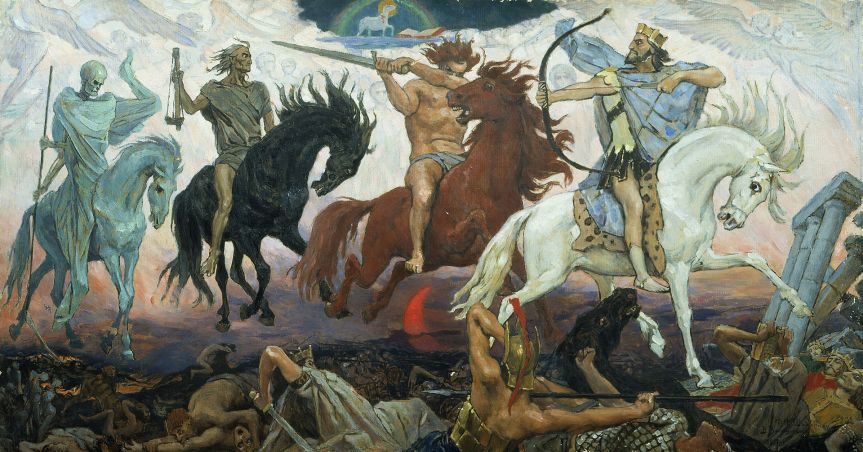
The Four Horsemen of the Apocalypse (Viktor Vasnetsov)
W.J. Astore
On this 15th anniversary of the 9/11 attacks in 2001, we should ask ourselves what those attacks inaugurated. In a word, calamity. The wildly successful actions of Al Qaeda, combined with the wild overreactions of the Bush/Cheney administration, marked the 21st century as one that will likely become known to future historians as calamitous.
In thinking about the 9/11 attacks, as an Air Force officer, what struck me then, and still does now, is the psychological blow. We Americans like to think we invented flight (not just that the Wright Brothers succeeded in the first powered flight that was both sustained and controlled). We like to think that airpower is uniquely American. We take great pride that many airliners are still “Made in the USA,” unlike most other manufactured goods nowadays.
To see our airliners turned into precision missiles against our skyscrapers, another potent image of American power, by a terrorist foe (that was once an ally against Soviet forces in Afghanistan) staggered our collective psyche. That’s what I mean when I say Al Qaeda’s attacks were “successful.” They created an enormous shock from which our nation has yet to recover.
This shock produced, as Tom Engelhardt notes in his latest article at TomDispatch.com, a form of government psychosis for vengeance via airpower. The problem, of course, is that the terrorist enemy (first Al Qaeda, then the Taliban, now ISIS) simply doesn’t offer big targets like skyscrapers or the Pentagon. The best the U.S. can do via airpower is to strike at training camps or small teams or even individuals, all of which matter little in the big scheme of things. Meanwhile, U.S. air strikes (and subsequent land invasions by ground troops) arguably strengthen the enemy strategically. Why? Because they lend credence to the enemy’s propaganda that the USA is launching jihad against the Muslim world.
The wild overreactions of the Bush/Cheney administration, essentially continued by Obama and the present national security state, have played into the hands of those seeking a crusade/jihad in the Greater Middle East. What we have now, so the experts say, is a generational or long war, with no foreseeable end point. Its product, however, is obvious: chaos, whether in Iraq or Libya or Yemen or Syria. And this chaos is likely to be aggravated by critical resource shortages (oil, water, food) as global warming accelerates in the next few decades.
We are in the early throes of the calamitous 21st century, and it all began fifteen years ago on 9/11/2001.
Someday, someone will write a history of the U.S. national security state in the twenty-first century and, if the first decade and a half are any yardstick, it will be called something like State of Failure. After all, almost 15 years after the U.S. invaded the Taliban’s Afghanistan, launching the second American Afghan War of the past half-century, U.S. troops are still there, their “withdrawal” halted, their rules of engagement once again widened to allow American troops and air power to accompany allied Afghan forces into battle, and the Taliban on the rise, having taken more territory (and briefly one northern provincial capital) than at any time since that movement was crushed in the invasion of 2001.
Thirteen years after George W. Bush and his top officials, dreaming of controlling the oil heartlands, launched the invasion of Saddam Hussein’s Iraq (the second Iraq War of our era), Washington is now in the third iteration of the same, with 6,000 troops (and thousands of private contractors) back in that country and a vast air campaign underway to destroy the Islamic State. With modest numbers of special operations troops on the ground and another major air campaign, Washington is also now enmeshed in a complex and so far disastrous war in Syria. And if you haven’t been counting, that’s three wars gone wrong.
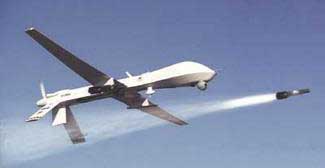
Then, of course, there was the American (and NATO) intervention in Libya in 2011, which cracked that autocratic country open and made way for the rise of Islamic extremist movements there, as well as the most powerful Islamic State franchise outside Syria and Iraq. Today, plans are evidently being drawn up for yet more air strikes, special operations raids, and the like there. Toss in as well Washington’s never-ending drone war in Pakistan’s tribal borderlands, its disastrous attempt to corral al-Qaeda in the Arabian Peninsula in Yemen (leading to a grim and horrifying Saudi-led, American-supported internecine conflict in that country), and the unending attempt to destroy al-Shabaab in Somalia, and you have at least seven wars and conflicts in the Greater Middle East, all about to be handed on by President Obama to the next president with no end in sight, no real successes, nothing. In these same years Islamic terror movements have only spread and grown stronger under the pressure of the American war machine.
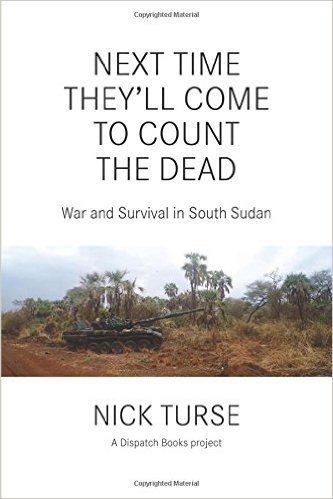
It’s not as if Washington doesn’t know this. It’s quite obvious and, as TomDispatch Managing Editor Nick Turse, author of the highly praisedNext Time They’ll Come to Count the Dead, points out today in his latest report on the U.S. military’s pivot to Africa, the pattern is only intensifying, something clearly recognized by key American commanders. What’s strange, however, is that none of this seems to have caused anyone in the national security state or the military to reconsider the last 15 years of military-first policies, of bombs dropped, troops dispatched, drones sent in, and what the results were across the Greater Middle East and now Africa. There is no serious recalibration, no real rethinking. The response to 15 years of striking failure in a vast region remains more of the same. State of failure indeed!
Be sure to read Nick Turse on how U.S. military efforts in Africa show more regress than progress.
In President Obama’s drone wars, how many innocent civilians have been killed? An official U.S. government report will suggest that roughly 100 civilians have been killed since 2009 in drone strikes, a surprisingly small number. According to NBC News:
The Long War Journal, a project of the right-leaning Foundation for Defense of Democracies think tank whose numbers tend to be the most favorable for U.S. policy-makers, tallied 207 civilian casualties since 2009 in 492 strikes in Pakistan and Yemen. That does not include strikes in Somalia and Libya, which the Obama administration includes in its count of around 100 [civilians killed].
New America, a left-leaning Washington think tank, counted between 244 and 294 civilians killed in 547 attacks in Pakistan, Yemen and Somalia.
The Bureau of Investigative Journalism estimates that as many as 1068 civilians were killed in Pakistan, Yemen and Somalia, the vast majority since 2009.
So it’s unclear whether the Obama administration’s drone strikes have killed 100 innocents, 300 innocents, or over 1000 innocents. Part of the discrepancy involves who is a “militant” and who is an innocent civilian. The U.S. government tends to count all military-age males killed in drone strikes as “militants,” effectively changing the meaning of civilian to “women and children.”
In one respect, this body count doesn’t matter. Dead is dead, whether you’re talking about 100 people or 1000. And isn’t the death of 100 innocents enough to provoke protest if not outrage? Think of the reaction in the U.S. to the killing of 49 innocent civilians in Orlando. Better yet, think if a foreign government was flying drones over our skies, taking out American “terrorists” while killing a few innocent civilians now and again. Would we dismiss 100 dead American civilians as “collateral damage,” regrettable but necessary in this foreign power’s war on terror?
Of course not. Americans would memorialize the dead, honor them, and make them a cause for vengeance.
For all the people the U.S. government is killing overseas in hundreds of deadly drone strikes, it’s not obvious that any progress is being made in the war on terror. The wars continue, with the Taliban gaining strength in Afghanistan. ISIS is on the wane, until it rebounds or morphs into another form. What is essentially terror bombing as a weapon against terror has little chance of ending a war on terror. Meanwhile, hammer blows from the sky against fractured societies only serve to propagate the fractures, creating new fault lines and divisions that are exploitable by the determined and the fanatical.
Indeed, we really have no clear idea whether these multi-billion dollar air campaigns are making any progress in war. Much of the data and results of these campaigns are both classified and open to bias, with reports of casualties being manipulated or “spun” by all sides. All we really know is that innocents are killed (whether 100 or 1000) as the wars persist with no end in sight.
Meanwhile, American exceptionalism rules. As Tom Engelhardt noted back in May of 2015:
In his public apology for deaths [of innocents by drones] that were clearly embarrassing to him, President Obama managed to fall back on a trope that has become ever more politically commonplace in these years. Even in the context of a situation in which two innocent hostages had been killed, he congratulated himself and all Americans for the exceptional nature of this country. “It is a cruel and bitter truth,” he said, “that in the fog of war generally and our fight against terrorists specifically, mistakes — sometimes deadly mistakes — can occur. But one of the things that sets America apart from many other nations, one of the things that makes us exceptional is our willingness to confront squarely our imperfections and to learn from our mistakes.”
Whatever our missteps, in other words, we Americans are exceptional killers in a world of ordinary ones. This attitude has infused Obama’s global assassination program and the White House “kill list” that goes with it and that the president has personally overseen.
Drone strikes are a method of war, but they’ve become the American strategy. The strategy, so it seems, is to keep killing bad guys until the rest give up and go home. But the deaths of innocents, whether 100 or 1000, serve to perpetuate cycles of violence and revenge.
We have, in essence, created a perpetual killing machine.
Update (7/2/2016): Well, the Obama administration has done it again, releasing its report on drone casualties on the afternoon of Friday, July 1st, just before the long Independence Day weekend, ensuring minimal media coverage. The report excludes “active” war zones such as Iraq, Afghanistan, and Syria, a convenient definition that serves to lower the death toll.
According to the report, U.S. drone strikes in places like Yemen, Libya, tribal Pakistan, and Somalia have accounted for about 2500 “terrorists” while killing 64 to 116 civilian bystanders. The tacit message: We’re killing 25 times (or perhaps 40 times) as many “terrorists” as we are innocent civilians, a very effective (even humane?) kill ratio.
Talk about an exercise in cynical bookkeeping! One can guess what happened here. Someone high up in the government began with the civilian body count judged acceptable: I’m guessing that figure was roughly 100. Then, they worked backwards from that. How do we get 100? Well, if we exclude “active” war zones such as Iraq, Afghanistan, and Syria, and if we squint sideways …
Well, you probably know the saying: the very first casualty in war is truth. Followed by an honest accounting of civilian casualties, as this latest report from the Obama administration shows.
This weekend, I watched a few minutes of NFL draft coverage on ESPN. If you’re not familiar with NFL football or ESPN coverage of the same in the USA, you should be, because it says much about the American moment. The first round of the draft kicks off on Thursday night in prime time, followed by the second and third rounds on Friday night in prime time. The draft concludes on Saturday with rounds four through seven, roughly 250 total picks if you include “supplemental” picks.
Yet this quick summary vastly understates the coverage devoted to the draft. From the end of the Super Bowl early in February to the draft itself at the end of April, coverage of the draft on ESPN is virtually non-stop, with innumerable “mock” drafts for each team and a parade of “experts” speculating about the prospects of each player and team. Exhaustive (and exhausting) is the word to describe this coverage. Interminable is another one.
When Round One finally kicks off, it’s essentially a parade of soon-to-be millionaires. These players, selected from various college football teams, can count on multi-year contracts and signing bonuses in the millions of dollars. ESPN and the NFL stage manages the selection process, turning it into an extravaganza complete with musicians, cheering (or booing) fans, and plenty of past NFL greats, along with the draftees and their families and friends. Coverage also includes shots of the “war rooms” of the various NFL teams as they decide which players to pick, which draft picks to trade, and so on. The war room — isn’t that a telling phrase?
Indeed, let’s push that further. Most red-blooded NFL fans would be hard-pressed to find Iraq or Afghanistan on a map, but they can tell you all about their team’s draft picks, rattling off statistics such as times in the 40-yard dash, vertical leap, even the size of a player’s hands (considered especially pertinent if he’s a quarterback or wide receiver). What always astonishes me is the sheer wealth of detail gathered about each player, the human intelligence (or HUMINT in military terms). Players, especially those projected to go in the first few rounds, are scrutinized from every angle: physical, mental, emotional, you name it.
With millions of dollars at stake, such an exhaustive approach is not terribly surprising. Yet even with a wealth of data, each year there are major draft busts (e.g. Ryan Leaf, selected #2 overall in the first round and a flop) and major surprises (e.g. Tom Brady, selected late in the 6th round as the 199th pick, meaning that not much was expected from him, after which he won four Super Bowls). Results from the NFL draft should teach us something about the limits of data-driven “intelligence” in “wars,” yet our various military intelligence agencies continue to believe they can quantify, predict, and control events.
But again what wows me is the extent as well as the slickness of ESPN’s coverage of the draft. As soon as a player is selected, ESPN instantly has video of that player’s college highlights, together with his vital statistics (height, weight, performance at the draft combine in various drills, and so on). Video and stats are backed up by interviews with a draftee’s previous coaches, who extol his virtues, along with interviews with those “war rooms” again as to why they decided to draft that particular player and not another. Once the draft is completed, teams are then awarded “grades” by various commentators, even though these players have yet to play a snap in the NFL. (Imagine if your kid received an instant grade in college — before he attended a single class or completed a single assignment — based upon his performance in high school.)
But you have to hand it to ESPN: their coverage of the draft is an exercise in total information awareness. It’s blanket coverage, an exercise in full-spectrum dominance. It’s slick, professional, and driven by a relentless pursuit of victory by each team (and a relentless pursuit of ratings by ESPN).
So, a modest proposal: To win the war on terror, let’s put ESPN in charge of intelligence gathering and coverage. Just imagine if your average red-blooded American devoted as much attention to foreign wars as they do to their favorite NFL team! Just imagine if America’s leaders were held accountable for poor results as NFL coaches and staffs are! America still might not win its wars, but at least we’d squarely face the fact that we’re continuing to lose at incredibly high cost. Indeed, someone high-up in the government might actually be held accountable for these losses.
I know: It’s a frivolous suggestion to treat war like a sport. But is it? After all, America currently treats the NFL draft with all the seriousness of a life-and-death struggle, even as it treats wars with comparative frivolity.
Our wars are games and our games are wars. Small wonder America continues to lose its wars while fielding some winning NFL teams.
Over at TomDispatch.com, retired Army Colonel Andrew Bacevich asks a telling question: Why does Washington continue to rely on policy “experts,” the “best and brightest” as they were called during the Vietnam War, even when events prove their advice to be consistently wrong?
As Bacevich puts it (with considerable relish):
“Policy intellectuals — eggheads presuming to instruct the mere mortals who actually run for office — are a blight on the republic. Like some invasive species, they infest present-day Washington, where their presence strangles common sense and has brought to the verge of extinction the simple ability to perceive reality. A benign appearance — well-dressed types testifying before Congress, pontificating in print and on TV, or even filling key positions in the executive branch — belies a malign impact. They are like Asian carp let loose in the Great Lakes.”
One of the big drawbacks of a Hillary Clinton vs. Jeb Bush joust in 2016 is that both candidates will be relying on the same neocon “experts” who got us into Afghanistan and Iraq and the ongoing, seemingly endless, war on terror. What Washington needs most of all is fresh blood and fresher thinking; what 2016 promises is retread candidates and recycled pundits.
The problem is that these pundits rarely admit that they’re wrong. Even when they do, their admissions run false. They say things like: “We were wrong for the right reason [about Iraq and WMD],” a sentiment echoed by George W. Bush in his memoir that “There are things we got wrong in Iraq, but the cause is eternally right.” So, as long as your cause is “eternally right” (fighting against Communism in Vietnam; against terror in the Middle East), it doesn’t matter how many things you get wrong (such as how many innocents you end up killing, especially if they’re foreigners).
Their mantra is something like this: Never admit your wrong. And never apologize. Instead, double down on talking tough and committing troops.
As Bacevich notes:
The present-day successors to Bundy, Rostow, and Huntington subscribe to their own reigning verities. Chief among them is this: that a phenomenon called terrorism or Islamic radicalism, inspired by a small group of fanatic ideologues hidden away in various quarters of the Greater Middle East, poses an existential threat not simply to America and its allies, but — yes, it’s still with us — to the very idea of freedom itself. That assertion comes with an essential corollary dusted off and imported from the Cold War: the only hope of avoiding this cataclysmic outcome is for the United States to vigorously resist the terrorist/Islamist threat wherever it rears its ugly head….
The fact that the enterprise itself has become utterly amorphous may actually facilitate such efforts. Once widely known as the Global War on Terror, or GWOT, it has been transformed into the War with No Name. A little bit like the famous Supreme Court opinion on pornography: we can’t define it, we just know it when we see it, with ISIS the latest manifestation to capture Washington’s attention.
All that we can say for sure about this nameless undertaking is that it continues with no end in sight. It has become a sort of slow-motion Vietnam, stimulating remarkably little honest reflection regarding its course thus far or prospects for the future. If there is an actual Brains Trust at work in Washington, it operates on autopilot. Today, the second- and third-generation bastard offspring of RAND that clutter northwest Washington — the Center for this, the Institute for that — spin their wheels debating latter day equivalents of Strategic Hamlets, with nary a thought given to more fundamental concerns.”
Tough talk by “experts” with no skin in the game has proved to be a recipe for disaster in slow-motion. The best and the brightest have become the venal and the vacuous. Bacevich is right: We can do better, America.
In America’s war on terror, the groundhog always sees its own shadow, meaning six (or more) years of additional war. War is indeed the new normal in America, as I argue in this article today for TomDispatch.com.
War Is the New Normal Seven Deadly Reasons Why America’s Wars Persist
By William J. Astore
It was launched immediately after the 9/11 attacks, when I was still in the military, and almost immediately became known as the Global War on Terror, or GWOT. Pentagon insiders called it “the long war,” an open-ended, perhaps unending, conflict against nations and terror networks mainly of a radical Islamist bent. It saw the revival of counterinsurgency doctrine, buried in the aftermath of defeat in Vietnam, and a reinterpretation of that disaster as well. Over the years, its chief characteristic became ever clearer: a “Groundhog Day” kind of repetition. Just when you thought it was over (Iraq, Afghanistan), just after victory (of a sort) was declared, it began again.
Now, as we find ourselves enmeshed in Iraq War 3.0, what better way to memorialize the post-9/11 American way of war than through repetition. Back in July 2010, I wrote an article for TomDispatch on the seven reasonswhy America can’t stop making war. More than four years later, with the war on terror still ongoing, with the mission eternally unaccomplished, here’s a fresh take on the top seven reasons why never-ending war is the new normal in America. In this sequel, I make only one promise: no declarations of victory (and mark it on your calendars, I’m planning to be back with seven new reasons in 2019).
1. The privatization of war: The U.S. military’s recourse to private contractors has strengthened the profit motive for war-making and prolonged wars as well. Unlike the citizen-soldiers of past eras, the mobilized warrior corporations of America’s new mercenary moment — the Halliburton/KBRs (nearly $40 billion in contracts for the Iraq War alone), the DynCorps ($4.1 billion to train 150,000 Iraqi police), and the Blackwater/Xe/Academis ($1.3 billion in Iraq, along with boatloads of controversy) — have no incentive to demobilize. Like most corporations, their business model is based on profit through growth, and growth is most rapid when wars and preparations for more of them are the favored options in Washington.
“Freedom isn’t free,” as a popular conservative bumper sticker puts it, and neither is war. My father liked the saying, “He who pays the piper calls the tune,” and today’s mercenary corporations have been calling for a lot of military marches piping in $138 billion in contracts for Iraq alone, according to the Financial Times. And if you think that the privatization of war must at least reduce government waste, think again: the Commission on Wartime Contracting in Iraq and Afghanistan estimated in 2011 that fraud, waste, and abuse accounted for up to $60 billion of the money spent in Iraq alone.
To corral American-style war, the mercenaries must be defanged or deflated. European rulers learned this the hard way during the Thirty Years’ War of the seventeenth century. At that time, powerful mercenary captains like Albrecht von Wallenstein ran amok. Only Wallenstein’s assassination and the assertion of near absolutist powers by monarchs bent on curbing war before they went bankrupt finally brought the mercenaries to heel, a victory as hard won as it was essential to Europe’s survival and eventual expansion. (Europeans then exported their wars to foreign shores, but that’s another story.)
2. The embrace of the national security state by both major parties:Jimmy Carter was the last president to attempt to exercise any kind of control over the national security state. A former Navy nuclear engineer who had served under the demanding Admiral Hyman Rickover, Carter cancelled the B-1 bomber and fought for a U.S. foreign policy based on human rights. Widely pilloried for talking about nuclear war with his young daughter Amy, Carter was further attacked for being “weak” on defense. His defeat by Ronald Reagan in 1980 inaugurated 12 years of dominance by Republican presidents that opened the financial floodgates for the Department of Defense. That taught Bill Clinton and the Democratic Leadership Council a lesson when it came to the wisdom of wrapping the national security state in a welcoming embrace, which they did, however uncomfortably. This expedient turn to the right by the Democrats in the Clinton years served as a temporary booster shot when it came to charges of being “soft” on defense — until Republicans upped the ante by going “all-in” on military crusades in the aftermath of 9/11.
Since his election in 2008, Barack Obama has done little to alter the course set by his predecessors. He, too, has chosen not to challenge Washington’s prevailing catechism of war. Republicans have responded, however, not by muting their criticism, but by upping the ante yet again. How else to explain House Speaker John Boehner’s invitation to Israeli Prime Minister Benjamin Netanyahu to address a joint session of Congress in March? That address promises to be a pep talk for the Republicans, as well as a smack down of the Obama administration and its “appeasenik” policies toward Iran and Islamic radicalism.
Serious oversight, let alone opposition to the national security state by Congress or a mainstream political party, has been missing in action for years and must now, in the wake of the Senate Torture Report fiasco (from which the CIAemerged stronger, not weaker), be presumed dead. The recent midterm election triumph of Republican war hawks and the prospective lineup of candidates for president in 2016 does not bode well when it comes to reining in the national security state in any foreseeable future.
3. “Support Our Troops” as a substitute for thought. You’ve seen them everywhere: “Support Our Troops” stickers. In fact, the “support” in that slogan generally means acquiescence when it comes to American-style war. The truth is that we’ve turned the all-volunteer military into something like aforeign legion, deploying it again and again to our distant battle zones and driving it into the ground in wars that amount to strategic folly. Instead of admitting their mistakes, America’s leaders have worked to obscure them by endlessly overpraising our “warriors” as so many universal heroes. This may salve our collective national conscience, but it’s a form of cheap grace that saves no lives — and wins no wars.
Instead, this country needs to listen more carefully to its troops, especially the war critics who have risked their lives while fighting overseas. Organizations like Iraq Veterans Against the War and Veterans for Peace are good places to start.
4. Fighting a redacted war. War, like the recent Senate torture report, is redacted in America. Its horrors and mistakes are suppressed, its patriotic whistleblowers punished, even as the American people are kept in a demobilized state. The act of going to war no longer represents the will of the people, as represented by formal Congressional declarations of war as the U.S. Constitution demands. Instead, in these years, Americans were told togo to Disney World (as George W. Bush suggested in the wake of 9/11) and keep shopping. They’re encouraged not to pay too much attention to war’s casualties and costs, especially when those costs involve foreigners with funny-sounding names (after all, they are, as American sniper Chris Kyle so indelicately put it in his book, just “savages”).
Redacted war hides the true cost of a permanent state of killing from the American people, if not from foreign observers. Ignorance and apathy reign, even as a national security state that is essentially a shadow governmentequates its growth with your safety.
5. Threat inflation: There’s nothing new about threat inflation. We saw plenty of it during the Cold War (nonexistent missile and bomber gaps, for example). Fear sells and we’ve had quite a dose of it in the twenty-first century, from ISIS to Ebola. But a more important truth is that fear is a mind-killer, a debate-stifler.
Back in September, for example, Senator Lindsey Graham warned that ISIS and its radical Islamic army was coming to America to kill us all. ISIS, of course, is a regional power with no ability to mount significant operations against the United States. But fear is so commonplace, so effectively stoked in this country that Americans routinely and wildly exaggerate the threat posed by al-Qaeda or ISIS or the bogeyman du jour.
Decades ago, as a young lieutenant in the Air Force, I was hunkered down inCheyenne Mountain during the Cold War. It was the ultimate citadel-cum-bomb-shelter, and those in it were believed to have a 70% likelihood of surviving a five-megaton nuclear blast. There, not surprisingly, I found myself contemplating the very real possibility of a thermonuclear exchange with the Soviet Union, a war that would have annihilated life as we knew it, indeed much of life on our planet thanks to the phenomenon of nuclear winter. You’ll excuse me for not shaking in my boots at the threat of ISIS coming to get me. Or of Sharia Law coming to my local town hall. With respect to such fears, America needs, as Hillary Clinton said in an admittedly different context, to “grow a pair.”
6. Defining the world as a global battlefield: In fortress America, all realms have by now become battle spheres. Not only much of the planet, the seas, air, and space, as well as the country’s borders and its increasingly up-armored police forces, but the world of thought, the insides of our minds. Think of the 17 intertwined intelligence outfits in “the U.S. Intelligence Community” and their ongoing “surge” for information dominance across every mode of human communication, as well as the surveillance of everything. And don’t forget the national security state’s leading role in making cyberwar a reality. (Indeed, Washington launched the first cyberwar in history by deploying the Stuxnet computer worm against Iran.)
Think of all this as a global matrix that rests on war, empowering disaster capitalism and the corporate complexes that have formed around the Pentagon, the Department of Homeland Security, and that intelligence community. A militarized matrix doesn’t blink at $1.45 trillion dollars devoted to the F-35, a single under-performing jet fighter, nor at projections of $355 billion over the next decade for “modernizing” the U.S. nuclear arsenal, weapons that Barack Obama vowed to abolish in 2009.
7. The new “normal” in America is war: The 9/11 attacks happened more than 13 years ago, which means that no teenagers in America can truly remember a time when the country was at peace. “War time” is their normal; peace, a fairy tale.
What’s truly “exceptional” in twenty-first-century America is any articulated vision of what a land at peace with itself and other nations might be like. Instead, war, backed by a diet of fear, is the backdrop against which the young have grown to adulthood. It’s the background noise of their world, so much a part of their lives that they hardly recognize it for what it is. And that’s the most insidious danger of them all.
How do we inoculate our children against such a permanent state of war and the war state itself? I have one simple suggestion: just stop it. All of it. Stop making war a never-ending part of our lives and stop celebrating it, too. War should be the realm of the extreme, of the abnormal. It should be the death of normalcy, not the dreary norm.
It’s never too soon, America, to enlist in that good fight!
William J. Astore, a retired lieutenant colonel (USAF), is a TomDispatch regular. His D.Phil. is in Modern History from the University of Oxford. He’s just plain tired of war and would like to see the next politician braying for it be deployed with a rifle to the front lines of battle. He edits the blog The Contrary Perspective.
Is the U.S. military doomed? I’d say yes. But it’s not because our troops are uncommitted, our weapons are bad, and our tactics are flawed. Rather it’s because of the conventional wisdom in Washington and the Pentagon that continues to commit our troops to unnecessary and unwinnable wars.
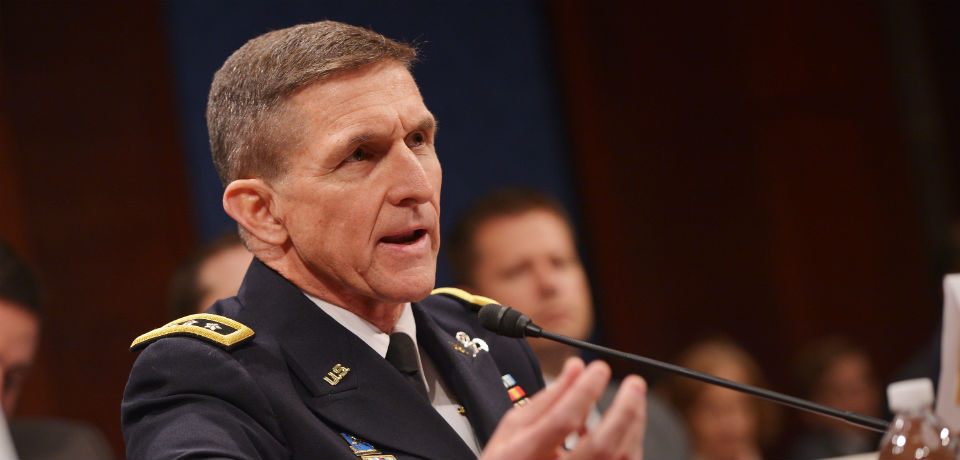
This conventional wisdom is perhaps best summed up in a speech by retired Lieutenant General Michael T. Flynn, the ex-chief of the Defense Intelligence Agency (DIA). It’s worth reading the speech in full, not because it’s especially original or insightful, but because it’s so unreflective and representative of Washington’s collective wisdom.
Here are General Flynn’s main points as I see them:
1. The American public must be committed to an open-ended ideological war “for decades.”
2. That war is against “grotesque” Islamic extremists who “hate our ideals” and who are “committed to the destruction of freedom and the American way of life.”
3. To win the war, America must be ready to use “overwhelming power” to defeat or deter the enemy, even if the U.S. must act alone.
4. Special Operations Forces (SOF) must be “well resourced” for this war, meaning they must be expanded even further and given even more money and latitude.
5. The model for this ideological war against extremist Islam is Ronald Reagan’s war against communism.
That is General Flynn’s strategic vision. It’s a vision widely shared within the Pentagon. And it’s a vision that dooms America to defeat.
Why? Mainly because radical Islam is a political/religious/social phenomenon. It is not amenable to military solutions. Indeed, the more America makes it into THE enemy, the more legitimacy organizations like ISIS gain within their communities and across the Muslim World.
Military force is a blunt instrument, even when it’s applied by the Special Ops community. Expanding the American SOF presence throughout the world is a recipe for more blowback, not more victories. Consider how well we’ve done so far in Afghanistan or Libya or Yemen. Or for that matter Iraq. Can anyone say that U.S. military intervention has produced stability in these countries? Has it contributed to the defeat of radical Islam? Indeed, in destabilizing Iraq and Libya and Yemen, has the U.S. not contributed to the spread of Islamic extremism?
Military professionals like General Flynn really know only one solution: “overwhelming power” applied “for decades.” And if you don’t accept their solution, they dismiss you as misguided (at best) or as arguing for “Retreat, retrenchment, and disarmament,” which “are historically a recipe for disaster,” according to General Flynn.
Well, I’m not aware of anyone seriously arguing for disarmament (fat chance of that happening in the USA!). I’m not aware of anyone arguing for “retreat,” as if this was the Chosin Reservoir in the Korean War. I’m not aware of anyone seriously working toward “retrenchment”; indeed, the SOF community keeps expanding, already mounting operations in 105 countries around the world in FY2015 (i.e., since October 2014). It’s easy to bayonet a straw man, general.
I have a few words for the general: Committing the American military to an ideological war “for decades” against radical Islam is pure folly. Chances are you won’t hammer it into non-existence: your blows will just spread it further, while wasting the energies of America and the lives of its troops.
Stop looking to Reagan and the collapse of communism for lessons and start looking at the actual results over the last 20-30 years of American meddling in Afghanistan, Iraq, Libya, and Yemen. And tell me: Is this what “victory” looks like? You want to double down on “overwhelming power” applied “for decades” as defending American “ideals” and “way of life”?
Which “ideals” are those, exactly? A permanent state of war in which military men are deferred to as the heroes and sages of the moment?








 Bracing Views