Back in 2008, I wrote an article for Neiman Watchdog calling for war salesmen and cheerleaders on the mainstream media to be replaced. Of course, nothing of the sort happened, and today I saw a new article by Ken Klippenstein: “The TV Generals Have Something to Sell You About Iran,” and that something is war and more war (and weapons too).
You can trust him — he’s a general!
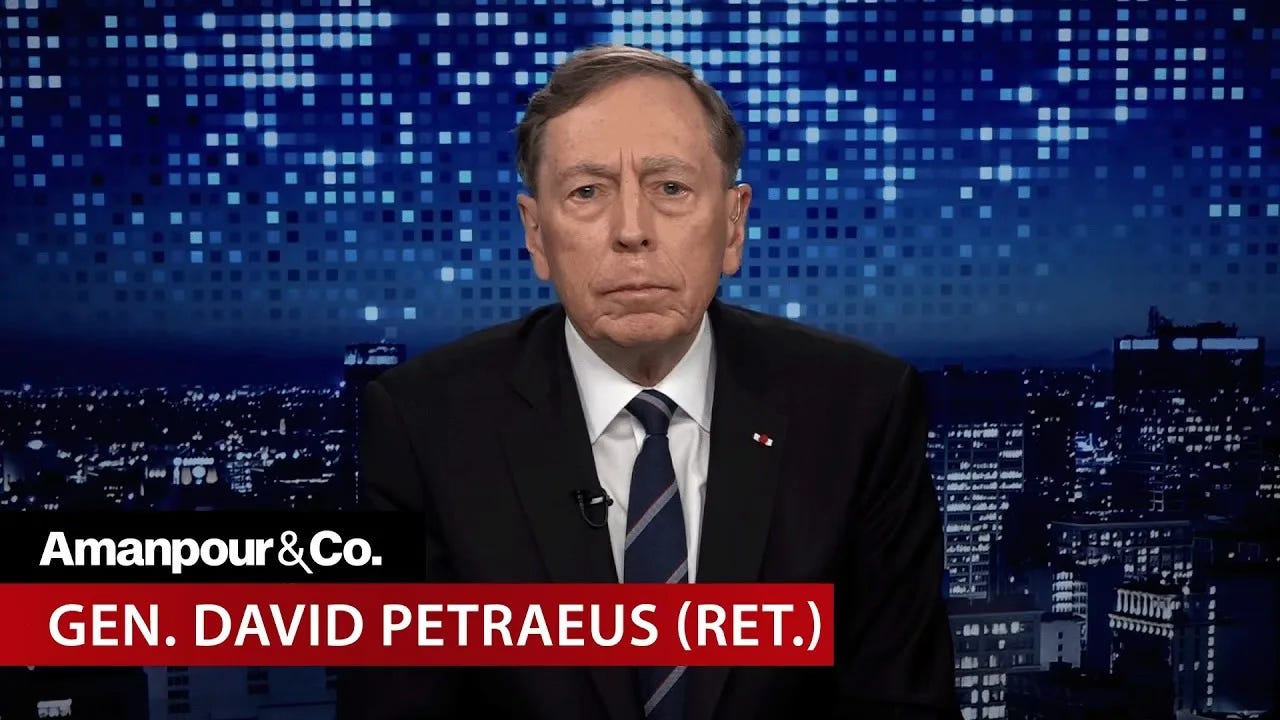
In the article, Klippenstein has a great line about retired general David Petraeus: “Can anyone fit more stars up their asses?” Clearly not.
Anyhow, here’s my article from 2008, unchanged because the dynamic of TV and cable networks using retired senior military officers to sell wars and weapons also remains unchanged.
Networks should replace Pentagon cheerleaders with independent military analysts
COMMENTARY| December 04, 2008
Even without special Pentagon briefings and corrupting financial relationships, former top military brass simply are too conflicted to be relied upon for tough-minded analysis, writes a former Air Force officer.
By William J. Astore
Media outlets must develop their own, independent, military analysts, ones not beholden to the military-industrial complex, ones whose very sense of self is not defined, nourished, and sustained by the U.S. military.
In separate exposés in The New York Times (April 20 and November 30), David Barstow showed how major media outlets came to rely on retired generals like Barry McCaffrey for analysis. Predictably, many of these men (they were all men) continued as paid advisors to defense contractors even as they appeared on TV. They also often accepted favors from the Pentagon, to include special, often classified, briefings; overseas junkets; and, most valuable of all, access to the Office of the Secretary of Defense.
But such influence-peddling and collusion are hardly surprising. Relying on high-ranking, retired military officers to serve as frank and disinterested critics is a bit like inviting Paul von Hindenburg, ex-Field Marshal of the German Army, to testify in 1919 on why his army lost World War I. You’ll get some interesting testimony — just don’t expect it to be critical or for that matter even true.
So why did the networks hire so many retired colonels and generals? Perhaps they followed a rationale analogous to that used in hiring retired professional athletes to cover sports — to provide hard-earned, technical commentary, leavened with occasional anecdotes.
But in the “forever war” in which we became engaged, these retired military officers soon provided not just the color commentary but the play-by-play. And network anchors, lacking first-hand military experience, were reduced to bobble-heads, nodding in respectful agreement.
But war is not a sport. Nor should we cover it as such. We need tough-minded military analysts, not “Team America” boosters and Pentagon spin-meisters.
Why Relying on Senior Military Officers Is Wrongheaded
Our media’s concept of relying on retired senior colonels and generals for frank and unbiased analysis was deeply flawed from the beginning. Let’s consider five facets to the problem:
Despite their civilian coat-and-tie camouflage, these officers are not ex-generals and ex-colonels: they are retired generals and colonels. They still carry their rank; they still wear the uniform at military functions; they’re still deferentially called “sir” by the rank-and-file. They enjoy constant reminders of their privileged military status. It’s not that these men over-identify with the U.S. military — they are the military.
The senior colonels and generals I’ve known despise Monday-morning quarterbacks. Loath to criticize commanders in the field, they tend to defer to the commander-in-chief. Putting on mufti doesn’t change this mindset. Rather than airing their most critical thoughts, they tend to keep them private, especially in cases where service loyalty is perceived to be involved.
Military officers are especially averse to airing criticism if they perceive it might undermine troop morale in the field. Related to this is the belief that “negative” media criticism led to America’s defeat in Vietnam, the hoary but nevertheless powerful “stab-in-the-back” myth. Thus, these men see Pentagon boosterism as a service to the nation — one that they believe is desperately needed to redress the balance of negatively-charged, “liberal,” anti-war coverage.
Paradoxically, that the “War on Terror” has gone badly is a reason why some retired military officers believe we can’tafford serious criticism. If you believe the war can and must be won, as most of them do, you may suppress your own doubts, fearing that, if you air them, you’ll be responsible for tipping the balance in favor of the enemy.
The fifth, perhaps most telling, reason why networks should not rely on retired colonels and generals is that it’s extremely difficult for anyone, let alone a die-hard military man, to criticize our military because such criticism is taken so personally by so many Americans. When you criticize the military, even abstractly, people hear you attacking Johnny or Suzy — their son or daughter, or the boy or girl next door, who selflessly enlisted to defend America. Who wants to hear that Johnny or Suzy may possibly be fighting (even dying) for a mistake? And, assuming he believed it, what senior military man wants to appear on TV to pass along thatmessage to America’s mothers and fathers?
The Next Step
It’s not that retired colonels and generals lack integrity [well, some do, I’d add in 2026], but they are often deeply conflicted and lacking in self-awareness. And you certainly can’t profess to be an objective media analyst while representing contractors vying for funding from the Pentagon.
So what should the media do? Since it will take time for networks to develop their own corps of independent military analysts, they should consider hiring junior officers and NCOs, with recent combat experience, who have left the military after a few years of honorable service. Civilian military historians could also provide critical commentary. Even foreign military officers might be queried; at least they need not worry about their patriotism being impugned each time they hazard a criticism of the Pentagon.
French premier Georges Clemenceau famously noted that “War is too important to be left to generals.” So too is the TV and cable networks’ analysis of our wars.
*****
Quick comment in 2026: I wasn’t critical enough in 2008. Some of these “cheerleaders” are shameless sales- and pitchmen who are profiting from war.
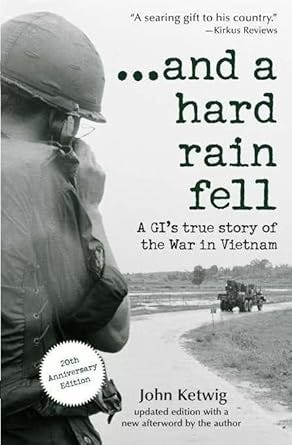
I’ve been reading John Ketwig’s memoir “…and a hard rain fell: A GI’s true story of the War in Vietnam,” and it’s reminding me just how plain dumb, destructive, and duplicitous America’s wars have been since World War II.
America’s wars are always dressed up with a necessary, even allegedly noble, cause. In Vietnam, we had to stop communism and all those dominoes from falling. In Iraq, it was about WMD and stopping Saddam Hussein, “the next Hitler.” In Afghanistan, it was about vengeance for 9/11, then creating democracy and even helping women. (How about helping women in America? Never mind.)
Vietnam is nominally communist today—and a big trading partner of the U.S. and an ally of sorts against China. No dominoes fell. Iraq didn’t have WMD and Saddam wasn’t the next Hitler; he was merely a regional strongman and a former U.S. ally who got a little too big for his britches, especially for Israel. Afghanistan was a war in search of a clear mission and attainable goals. After twenty years of effort and roughly $2 trillion in expenditures, the U.S. replaced the Taliban with—the Taliban. (I heard Norman Finkelstein say this first.)
We’re always told versions of the same lie: We need to fight them over there so that we don’t have to fight them here. Communism had to be rolled back in Vietnam else commies would be landing in Manhattan. Iraq had to be pummeled and Saddam overthrown before WMD landed in Boston. Afghanistan had to be pacified and modernized before the Taliban enforced conservative Sharia law in Biloxi.
None of this was true. The United States would have been perfectly safe without committing any troops to Vietnam, Iraq, and Afghanistan. In fact, the U.S. would have been far better off if those wars had never been fought. Certainly Vietnam, Iraq, and Afghanistan would have been far better off if they’d never become free-fire zones for American munitions (including the poisonous Agent Orange in Vietnam and, more recently, depleted uranium and other poisons in Iraq and Afghanistan).
Now we’re hearing about a possible U.S. war with Iran, allegedly to stop that country from acquiring an atomic bomb. It’s OK for the U.S. to have more than 5000 nuclear warheads and for Israel to have 200 or so, but it’s not OK for Iran to have even one, because reasons.
The U.S. military, vast as it is, with a vision of global dominance, always needs enemies. Of course, it’s not simply the military but the whole military-industrial complex, the MICIMATT,* which needs war and conflict to sustain itself.
I recently read “American War,” a powerful novel by Omar El Akkad. It imagines a second U.S. civil war starting roughly 50 years from now. It’s a fascinating book, well worth reading because it captures the horror of war, with all its atrocities, its massacres, its war crimes, and the deep wounds war leaves behind even among the most resolute survivors. John Ketwig’s book does the same as he recounts the fears and horrors of his year in Vietnam and the personal struggles he endured in coming to terms with what he’d seen and endured.
So, count me among those who are already against the next war, whether against Iran, China, or for that matter any other country. Sure, I think America needs to defend itself; I don’t think peace is going to break out spontaneously around the world; but I know for a fact that fighting constant wars is not a way toward greater peace and prosperity. Quite the opposite.
If you want to know what desperate and profoundly wounded war survivors are capable of, read “American War.” If you want to know what desperate and profoundly confused troops are capable of, read “…and a hard rain fell.” And ponder the continued propaganda here of the “good war,” the wonders of warriors and warfighters, and the repetition of slogans like “peace through strength,” a specific form of strength measured in kilotons and megatons of explosives, in massive body counts and military production figures.
Ask yourself: Is that “strength”? Are constant wars truly the path toward peace? How can we possibly be so dumb as to believe this?
MICIMATT: military-industrial-congressional-intelligence-media-academe-think-tank complex. It employs millions of people and spends more than a trillion dollars a year. It’s not easily confronted. Nor is it easily contained, let alone curtailed.
When Barack Obama took over as president in 2009, the global war on terror, or GWOT, just didn’t seem to fit the tenor of his “hope” and “change” message. So wars in Iraq and Afghanistan were rebranded as “overseas contingency operations.” Talk about the banality of evil! Even Orwell’s Big Brother might be impressed by OCOs as a substitute for invasion and war.
A euphemistic word Obama didn’t banish was “surge.” The “surge” in Iraq allegedly had worked under General David Petraeus, even though its gains proved as “fragile” and “reversible” as Petraeus hinted they would be. So Obama conducted his own surge in Afghanistan, the so-called good or smart war after the Bush/Cheney disaster in Iraq. And of course the “gains” in Afghanistan also proved both fragile and reversible, though no one was held to account for the miserable failure of the Afghan War. Whoops. I mean the Afghan contingency operation for democracy and enduring freedom.
Showing that he too could learn from America’s folly, Vladimir Putin termed his invasion of Ukraine a “special military operation.” U.S. leaders laughed at this, criticizing Putin for his propagandistic euphemism, even as they persisted in using terms like “overseas contingency operation” for America’s “kinetic” military actions. The eye of the beholder, I guess.
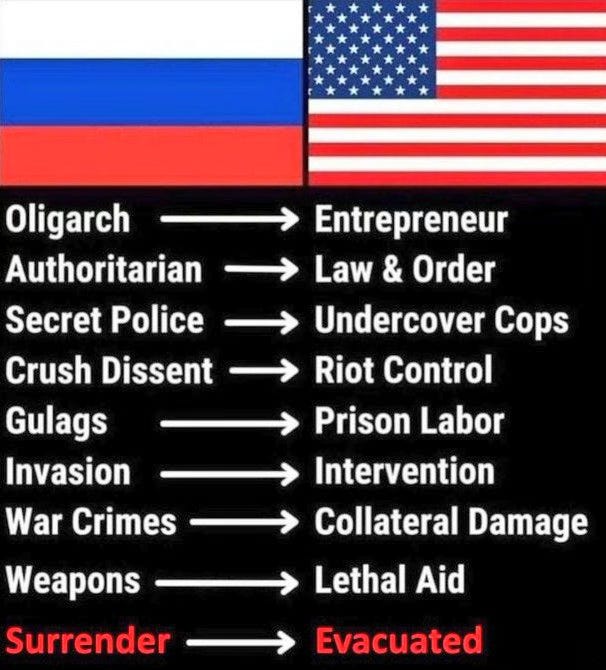
These thoughts came to mind as I perused my Twitter/X feed yesterday and spied this illustration posted by Chay Bowes:
Though the Russian flag is on the left, it could be the flag of China, Iran, North Korea, or any other alleged evildoer. The Russians invade, we intervene (for the sake of democracy, naturally). The Russians commit war crimes, we have unfortunate instances of collateral damage. In the war of the words, the U.S. military is clearly rather clever in a self-aggrandizing and self-exculpatory way.
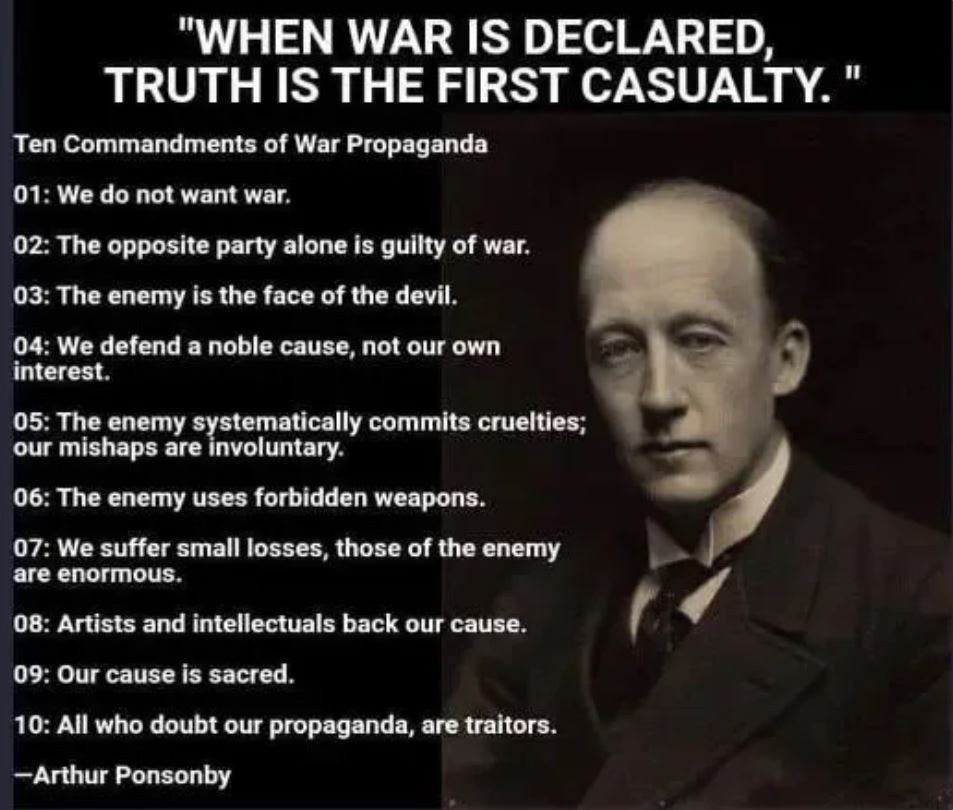
Looking at comments from this Twitter feed, I came across another useful illustration of manipulating language and information in the cause of war. Take a gander:
I confess I’d never heard of Arthur Ponsonby and his book, Falsehood in War-Time. I need to check it out.
This may prove a handy list to keep around as America’s national (in)security state acts to gin up the next war.
Winning a war based on lies is truly a fool’s errand, which is why the U.S. military’s record since World War II is so poor. Yet no one is ever held responsible for these lies, which suggests something worse than a losing military: one that is without honor, especially among the brass. That’s the theme of my latest article for TomDispatch, which is appended below in its entirety.
As a military professor for six years at the U.S. Air Force Academy in the 1990s, I often walked past the honor code prominently displayed for all cadets to see. Its message was simple and clear: they were not to tolerate lying, cheating, stealing, or similar dishonorable acts. Yet that’s exactly what the U.S. military and many of America’s senior civilian leaders have been doing from the Vietnam War era to this very day: lying and cooking the books, while cheating and stealing from the American people. And yet the most remarkable thing may be that no honor code turns out to apply to them, so they’ve suffered no consequences for their mendacity and malfeasance.
Where’s the “honor” in that?
It may surprise you to learn that “integrity first” is the primary core value of my former service, the U.S. Air Force. Considering the revelations of the Pentagon Papers, leaked by Daniel Ellsberg in 1971; the Afghan War papers, first revealed by the Washington Post in 2019; and the lack of weapons of mass destruction in Iraq, among other evidence of the lying and deception that led to the invasion and occupation of that country, you’ll excuse me for assuming that, for decades now when it comes to war, “integrity optional” has been the true core value of our senior military leaders and top government officials.
As a retired Air Force officer, let me tell you this: honor code or not, you can’t win a war with lies — America proved that in Vietnam, Afghanistan, and Iraq — nor can you build an honorable military with them. How could our high command not have reached such a conclusion themselves after all this time?
So Many Defeats, So Little Honesty
Like many other institutions, the U.S. military carries with it the seeds of its own destruction. After all, despite being funded in a fashion beyond compare and spreading its peculiar brand of destruction around the globe, its system of war hasn’t triumphed in a significant conflict since World War II (with the war in Korea remaining, almost three-quarters of a century later, in a painful and festering stalemate). Even the ending of the Cold War, allegedly won when the Soviet Union collapsed in 1991, only led to further wanton military adventurism and, finally, defeat at an unsustainable cost — more than $8 trillion — in Washington’s ill-fated Global War on Terror. And yet, years later, that military still has a stranglehold on the national budget.
So many defeats, so little honesty: that’s the catchphrase I’d use to characterize this country’s military record since 1945. Keeping the money flowing and the wars going proved far more important than integrity or, certainly, the truth. Yet when you sacrifice integrity and the truth in the cause of concealing defeat, you lose much more than a war or two. You lose honor — in the long run, an unsustainable price for any military to pay.
Or rather it should be unsustainable, yet the American people have continued to “support” their military, both by funding it astronomically and expressing seemingly eternal confidence in it — though, after all these years, trust in the military has dipped somewhat recently. Still, in all this time, no one in the senior ranks, civilian or military, has ever truly been called to account for losing wars prolonged by self-serving lies. In fact, too many of our losing generals have gone right through that infamous “revolving door” into the industrial part of the military-industrial complex — only to sometimes return to take top government positions.
Our military has, in fact, developed a narrative that’s proven remarkably effective in insulating it from accountability. It goes something like this: U.S. troops fought hard in [put the name of the country here], so don’t blame us. Indeed, you must support us, especially given all the casualties of our wars. They and the generals did their best, under the usual political constraints. On occasion, mistakes were made, but the military and the government had good and honorable intentions in Vietnam, Afghanistan, Iraq, and elsewhere.
Besides, were you there, Charlie? If you weren’t, then STFU, as the acronym goes, and be grateful for the security you take for granted, earned by America’s heroes while you were sitting on your fat ass safe at home.
It’s a narrative I’ve heard time and time again and it’s proven persuasive, partially because it requires the rest of us, in a conscription-free country, to do nothing and think nothing about that. Ignorance is strength, after all.
War Is Brutal
The reality of it all, however, is so much harsher than that. Senior military leaders have performed poorly. War crimes have been covered up. Wars fought in the name of helping others have produced horrendous civilian casualties and stunning numbers of refugees. Even as those wars were being lost, what President Dwight D. Eisenhowerfirst labeled the military-industrial complex has enjoyed windfall profits and expanding power. Again, there’s been no accountability for failure. In fact, only whistleblowing truth-tellers like Chelsea Manning and Daniel Hale have been punished and jailed.
Ready for an even harsher reality? America is a nation being unmade by war, the very opposite of what most Americans are taught. Allow me to explain. As a country, we typically celebrate the lofty ideals and brave citizen-soldiers of the American Revolution. We similarly celebrate the Second American Revolution, otherwise known as the Civil War, for the elimination of slavery and reunification of the country; after which, we celebrate World War II, including the rise of the Greatest Generation, America as the arsenal of democracy, and our emergence as the global superpower.
By celebrating those three wars and essentially ignoring much of the rest of our history, we tend to view war itself as a positive and creative act. We see it as making America, as part of our unique exceptionalism. Not surprisingly, then, militarism in this country is impossible to imagine. We tend to see ourselves, in fact, as uniquely immune to it, even as war and military expenditures have come to dominate our foreign policy, bleeding into domestic policy as well.
If we as Americans continue to imagine war as a creative, positive, essential part of who we are, we’ll also continue to pursue it. Or rather, if we continue to lie to ourselves about war, it will persist.
It’s time for us to begin seeing it not as our making but our unmaking, potentially even our breaking — as democracy’s undoing as well as the brutal thing it truly is.
A retired U.S. military officer, educated by the system, I freely admit to having shared some of its flaws. When I was an Air Force engineer, for instance, I focused more on analysis and quantification than on synthesis and qualification. Reducing everything to numbers, I realize now, helps provide an illusion of clarity, even mastery. It becomes another form of lying, encouraging us to meddle in things we don’t understand.
This was certainly true of Secretary of Defense Robert McNamara, his “whiz kids,” and General William Westmoreland during the Vietnam War; nor had much changed when it came to Secretary of Defense Donald Rumsfeld and General David Petraeus, among others, in the Afghan and Iraq War years. In both eras, our military leaders wielded metrics and swore they were winning even as those wars circled the drain.
And worse yet, they were never held accountable for those disasters or the blunders and lies that went with them (though the antiwar movement of the Vietnam era certainly tried). All these years later, with the Pentagon still ascendant in Washington, it should be obvious that something has truly gone rotten in our system.
Here’s the rub: as the military and one administration after another lied to the American people about those wars, they also lied to themselves, even though such conflicts produced plenty of internal “papers” that raised serious concerns about lack of progress. Robert McNamara typically knew that the situation in Vietnam was dire and the war essentially unwinnable. Yet he continued to issue rosy public reports of progress, while calling for more troops to pursue that illusive “light at the end of the tunnel.” Similarly, the Afghan War papers released by the Washington Post show that senior military and civilian leaders realized that war, too, was going poorly almost from the beginning, yet they reported the very opposite to the American people. So many corners were being “turned,” so much “progress” being made in official reports even as the military was building its own rhetorical coffin in that Afghan graveyard of empires.
Too bad wars aren’t won by “spin.” If they were, the U.S. military would be undefeated.
Two Books to Help Us See the Lies
Two recent books help us see that spin for what it was. In Because Our Fathers Lied, Craig McNamara, Robert’s son, reflects on his father’s dishonesty about the Vietnam War and the reasons for it. Loyalty was perhaps the lead one, he writes. McNamara suppressed his own serious misgivings out of misplaced loyalty to two presidents, John F. Kennedy and Lyndon B. Johnson, while simultaneously preserving his own position of power in the government.
Robert McNamara would, in fact, later pen his own mea culpa, admitting how “terribly wrong” he’d been in urging the prosecution of that war. Yet Craig finds his father’s late confession of regret significantly less than forthright and fully honest. Robert McNamara fell back on historical ignorance about Vietnam as the key contributing factor in his unwise decision-making, but his son is blunt in accusing his dad of unalloyed dishonesty. Hence the title of his book, citing Rudyard Kipling’s pained confession of his own complicity in sending his son to die in the trenches of World War I: “If any question why we died/Tell them, because our fathers lied.”
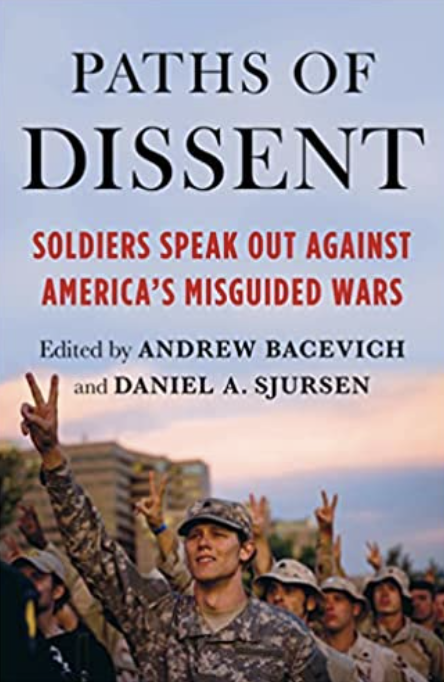
The second book is Paths of Dissent: Soldiers Speak Out Against America’s Misguided Wars, edited by Andrew Bacevich and Danny Sjursen. In my view, the word “misguided” doesn’t quite capture the book’s powerful essence, since it gathers 15 remarkable essays by Americans who served in Afghanistan and Iraq and witnessed the patent dishonesty and folly of those wars. None dare speak of failure might be a subtheme of these essays, as initially highly motivated and well-trained troops became disillusioned by wars that went nowhere, even as their comrades often paid the ultimate price, being horribly wounded or dying in those conflicts driven by lies.
This is more than a work of dissent by disillusioned troops, however. It’s a call for the rest of us to act. Dissent, as West Point graduate and Army Captain Erik Edstrom reminds us, “is nothing short of a moral obligation” when immoral wars are driven by systemic dishonesty. Army Lieutenant Colonel Daniel Davis, who blew an early whistle on how poorly the Afghan War was going, writes of his “seething” anger “at the absurdity and unconcern for the lives of my fellow soldiers displayed by so many” of the Army’s senior leaders.
Former Marine Matthew Hoh, who resigned from the State Department in opposition to the Afghan “surge” ordered by President Barack Obama, speaks movingly of his own “guilt, regret, and shame” at having served in Afghanistan as a troop commander and wonders whether he can ever atone for it. Like Craig McNamara, Hoh warns of the dangers of misplaced loyalty. He remembers telling himself that he was best suited to lead his fellow Marines in war, no matter how misbegotten and dishonorable that conflict was. Yet he confesses that falling back on duty and being loyal to “his” Marines, while suppressing the infamies of the war itself, became “a washing of the hands, a self-absolution that ignores one’s complicity” in furthering a brutal conflict fed by lies.
As I read those essays, I came to see anew how this country’s senior leaders, military and civilian, consistently underestimated the brutalizing impact of war, which, in turn, leads me to the ultimate lie of war: that it is somehow good, or at least necessary — making all the lying (and killing) worth it, whether in the name of a victory to come or of duty, honor, and country. Yet there is no honor in lying, in keeping the truth hidden from the American people. Indeed, there is something distinctly dishonorable about waging wars kept viable only by lies, obfuscation, and propaganda.
An Epigram from Goethe
John Keegan, the esteemed military historian, cites an epigram from Johann Wolfgang von Goethe as being essential to thinking about militaries and their wars. “Goods gone, something gone; honor gone, much gone; courage gone, all gone.”
The U.S. military has no shortage of goods, given its whopping expenditures on weaponry and equipment of all sorts; among the troops, it doesn’t lack for courage or fighting spirit, not yet, anyway. But it does lack honor, especially at the top. Much is gone when a military ceases to tell the truth to itself and especially to the people from whom its forces are drawn. And courage is wasted when in the service of lies.
Courage wasted: Is there a worst fate for a military establishment that prides itself on its members being all volunteers and is now having trouble filling its ranks?


 Bracing Views