Yesterday, I talked to Dick Price, a Vietnam War veteran, at the LA Progressive about the U.S. military, the Vietnam War, the all-volunteer military, media coverage, and why America just can’t stop making war.
When no one is held accountable for failure, when lies are used as the basis for killing, when war produces colossal profits for a select few, when Congress refuses to take responsibility for oversight, when war budgets keep climbing to the trillion dollar mark, it isn’t all that surprising that wars prove essentially endless as democracy withers.
When I was a kid, at the height of the U.S. space program and the Apollo missions to the moon, I was an avid consumer of space food sticks and Tang. They were “cool,” or so it seemed to me, because the astronauts (and product advertisers) said so. Of course, space food sticks tasted something like cardboard and Tang was a poor imitation of orange juice, but the power of image and advertising sold them to me, at least for a time. Then I smartened up and returned to Charleston Chews and real OJ. Breakfast of champions!
It’s truly amazing what the powers that be can sell to Americans. Lately, we’ve been sold a series of wars based on lies, most recently Iraq and Afghanistan and Ukraine. We’ve even been sold a genocide in Gaza, billed as a defensive operation for America’s guiltless and democratic ally, Israel, which only wants to assert its “right to exist.” Whether we’ll ever smarten up about these “products” we’re being sold remains to be seen.
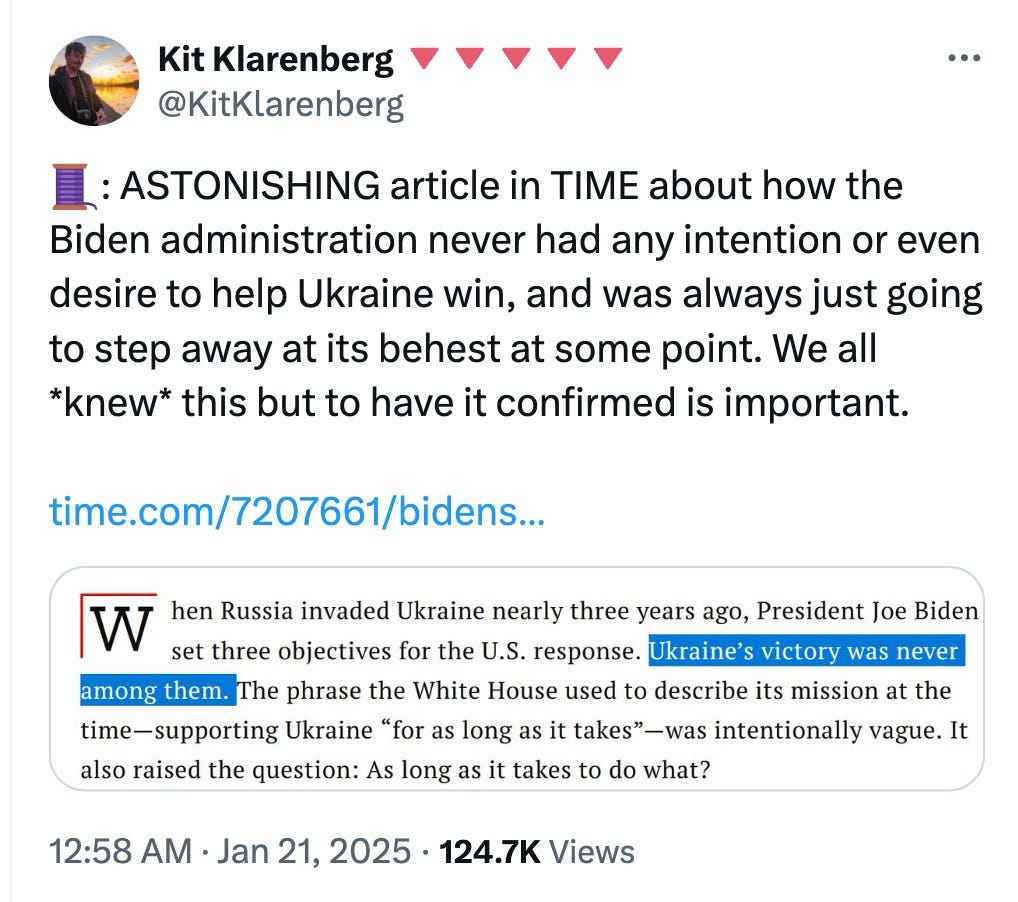
These thoughts were on my mind as I read Caitlin Johnstone’s recent article where she mentions the Russia-Ukraine War. She references Time Magazine, the mainstream media in a nutshell, and a telling admission that U.S. support of Ukraine has been all about weakening Russia and Putin, with no thought given to military victory or the cost of that war to Ukraine.
Not that there haven’t been plenty of mask-off moments during the dementia-muddled chaos of the Biden administration as well. A new article in Time titled “Why Biden’s Ukraine Win Was Zelensky’s Loss” is a good example of this; the report cites a former member of Biden’s National Security Council saying that victory for Ukraine was never part of the Biden administration’s plan.
The opening paragraph reads as follows:
“When Russia invaded Ukraine nearly three years ago, President Joe Biden set three objectives for the U.S. response. Ukraine’s victory was never among them. The phrase the White House used to describe its mission at the time — supporting Ukraine ‘for as long as it takes’ — was intentionally vague. It also raised the question: As long as it takes to do what?”
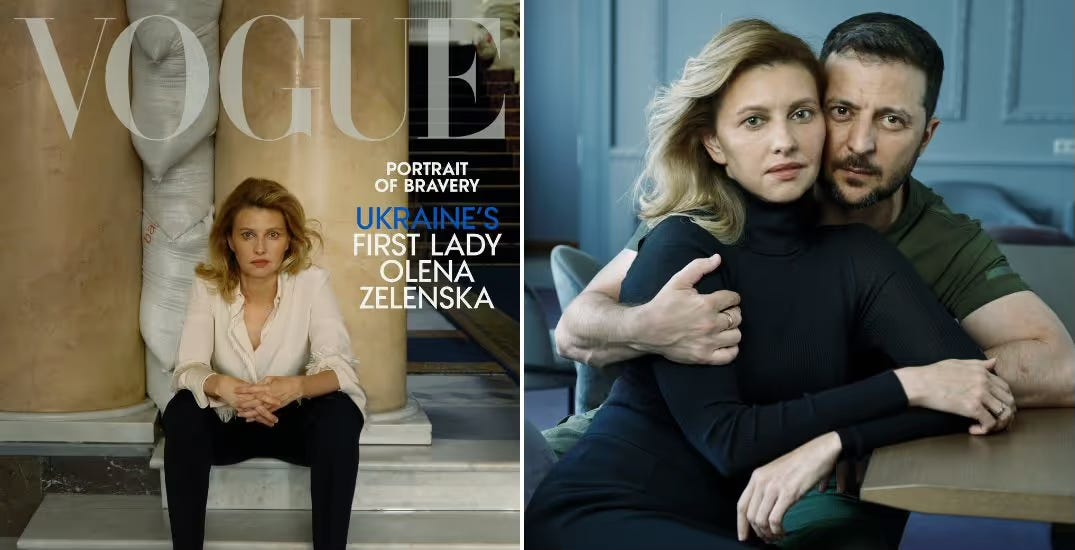
Well, at least Zelensky and his wife enjoyed the Vogue treatment:
America, a good motto to keep in mind is this one:
I’m Already Against the Next War
Don’t let them sell a new war to you, no matter how many crummy commercials they use to convince you that space food sticks, Tang—heck, even genocide and war—are great.
When Barack Obama took over as president in 2009, the global war on terror, or GWOT, just didn’t seem to fit the tenor of his “hope” and “change” message. So wars in Iraq and Afghanistan were rebranded as “overseas contingency operations.” Talk about the banality of evil! Even Orwell’s Big Brother might be impressed by OCOs as a substitute for invasion and war.
A euphemistic word Obama didn’t banish was “surge.” The “surge” in Iraq allegedly had worked under General David Petraeus, even though its gains proved as “fragile” and “reversible” as Petraeus hinted they would be. So Obama conducted his own surge in Afghanistan, the so-called good or smart war after the Bush/Cheney disaster in Iraq. And of course the “gains” in Afghanistan also proved both fragile and reversible, though no one was held to account for the miserable failure of the Afghan War. Whoops. I mean the Afghan contingency operation for democracy and enduring freedom.
Showing that he too could learn from America’s folly, Vladimir Putin termed his invasion of Ukraine a “special military operation.” U.S. leaders laughed at this, criticizing Putin for his propagandistic euphemism, even as they persisted in using terms like “overseas contingency operation” for America’s “kinetic” military actions. The eye of the beholder, I guess.
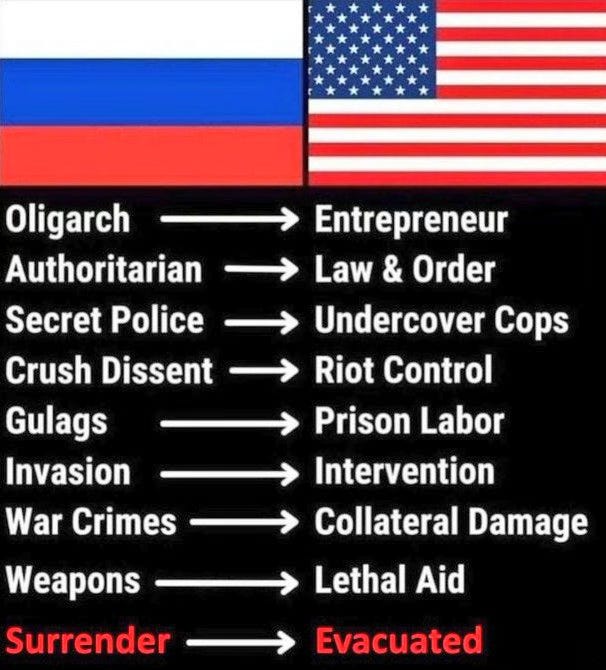
These thoughts came to mind as I perused my Twitter/X feed yesterday and spied this illustration posted by Chay Bowes:
Though the Russian flag is on the left, it could be the flag of China, Iran, North Korea, or any other alleged evildoer. The Russians invade, we intervene (for the sake of democracy, naturally). The Russians commit war crimes, we have unfortunate instances of collateral damage. In the war of the words, the U.S. military is clearly rather clever in a self-aggrandizing and self-exculpatory way.
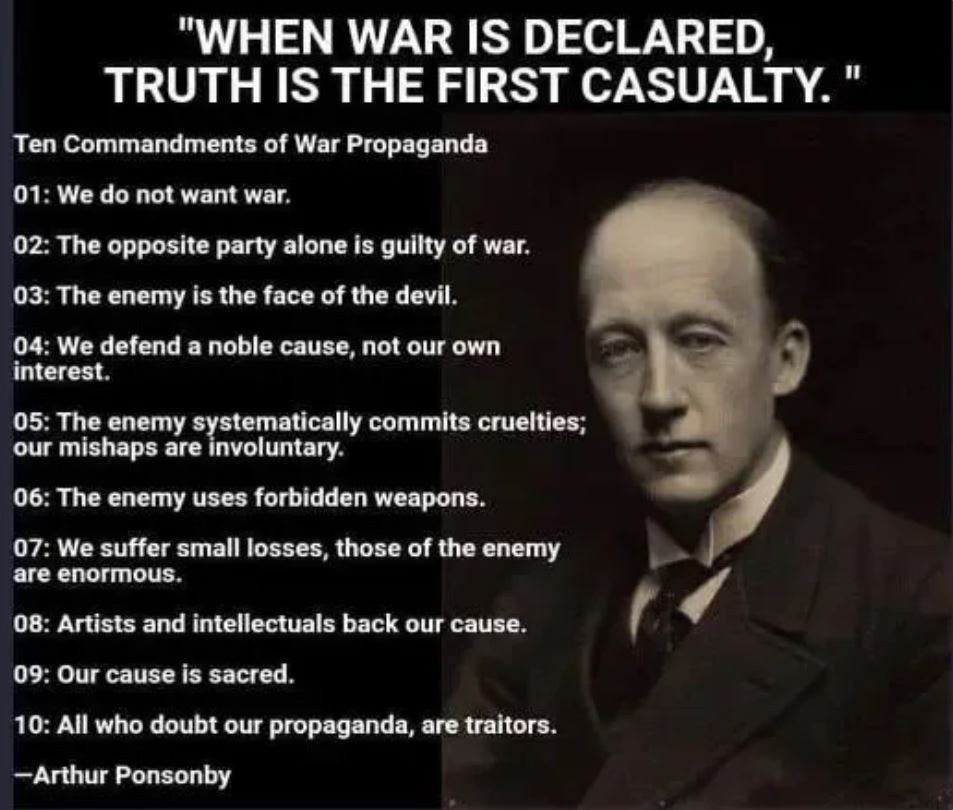
Looking at comments from this Twitter feed, I came across another useful illustration of manipulating language and information in the cause of war. Take a gander:
I confess I’d never heard of Arthur Ponsonby and his book, Falsehood in War-Time. I need to check it out.
This may prove a handy list to keep around as America’s national (in)security state acts to gin up the next war.
Mobsters are known for breaking kneecaps to bend people to their will. Marketers break into heads with repetitive and manipulative advertising, images, and narratives. Mobsters of the mind, they are.
I thought of this after watching all those repetitive (and largely interchangeable) ads for “legal” prescription drugs. Rarely do they show the often serious conditions they allegedly treat. Instead it’s image after image of people enjoying life, whether at amusement parks, the beach, dancing, or what-have-you. It’s as if drug companies are selling happiness pills whose only side effect is experiencing the best day of your life. Meanwhile, as images spill into your head of eternal bliss, a narrator quietly intones about potential serious side effects, even possible death in the case of one drug I’ve seen advertised.
Excuse me while I pop a few pills and denounce Russia—or China
Drug ads are the worst. People wonder why Americans take so many illegal drugs and why we have so many drug addictions — well, just look at all the ads for legal drugs, and how they’re advertised as making people incandescently happy. It’s all about the messaging: the repetition of powerful feel-good imagery, with drugs as panaceas.
Speaking of repetition, something similar is true of political manipulation. To cite one example: Russia. Has there ever been a worse “drug” with more serious side effects than Russia? Russia keeps hacking our elections! Russia is led by war criminals! Russia is raping Ukraine! Over and over again, the mainstream media encourages us to hate Russia and Vladimir Putin. Is this truly all we need to know about Russia? As Sting sang, don’t the Russians love their children too? (Back in the 1980s, the media didn’t go easy on Sting for his alleged naïveté and pro-Russian sentiments.)
Whether it’s drug advertisers, the mainstream media, or the U.S. government for that matter, America is infested with various “ministries of truth” that are driven by a mobster-like mentality. They may not break your kneecaps, but they nevertheless find ways to break into your mind.
Now you’ll excuse me while I pop a few pills while denouncing Russia. And China too, perhaps?
You’d think watching the U.S. Open finals in tennis would constitute a break from incessant propaganda about war, but you’d be wrong to do so.
I’m a tennis fan so I watched this weekend’s finals with interest. A Pole defeated a Tunisian in the women’s final and a Spaniard defeated a Norwegian in the men’s final, which is a fair representation of the international flavor of the field. At both trophy ceremonies, what did the U.S. Tennis Association choose to highlight? The USTA boasted of raising $2 million for Ukraine war relief while describing the Russian invasion of Ukraine as “unprovoked.”
First of all, why is Russia’s war with Ukraine being mentioned at both trophy ceremonies? What has this got to do with tennis?
Second, why is the USTA raising money for Ukraine war relief? Shouldn’t it be raising money for, well, tennis? Perhaps for scholarships for underprivileged kids around the world to play tennis? After all, the U.S. taxpayer is already on the hook for nearly $70 billion in aid to Ukraine, roughly half of it in the form of arms and armaments. Compared to this sum, $2 million is a drop in the bucket.
Third, why is Russia’s invasion always described as “unprovoked,” as if Putin and Russia simply woke up one day and decided to invade a former Soviet republic?
Let’s think back to America’s invasion of Iraq in 2003. Was that also “unprovoked”? (After all, Saddam Hussein had no WMD and nothing to do with the 9/11 attacks.) Did the USTA raise money to help Iraqi civilians recover from U.S. war damage and crimes? Not that I recall.
Earlier this year, at Wimbledon, players from Russia and Belarus were banned from the tournament. (I guess because they were waging war with their tennis rackets for Putin?) At the U.S. Open, they were allowed to play but not under the flags of their countries. Do you recall U.S. tennis players being banned because of the “unprovoked” Iraq War? Neither do I.
The U.S. mainstream managers — even tennis officials! — are so concerned to describe the Russian attack as “unprovoked” that you know that they know it wasprovoked — and they’re at pains to deny it, even during tennis tournaments.
The heavy hand of U.S. propaganda only gets heavier when it intrudes on what should have been an apolitical and celebratory trophy ceremony for international athletes.
Note: I am, of course, against Russia’s invasion of Ukraine. What I would like to see is the U.S. supporting diplomatic efforts to end the war as quickly as possible. Currently, we hear much of Ukrainian victories, but it’s possible the war will only grow longer and more deadly as a result of these “victories.”
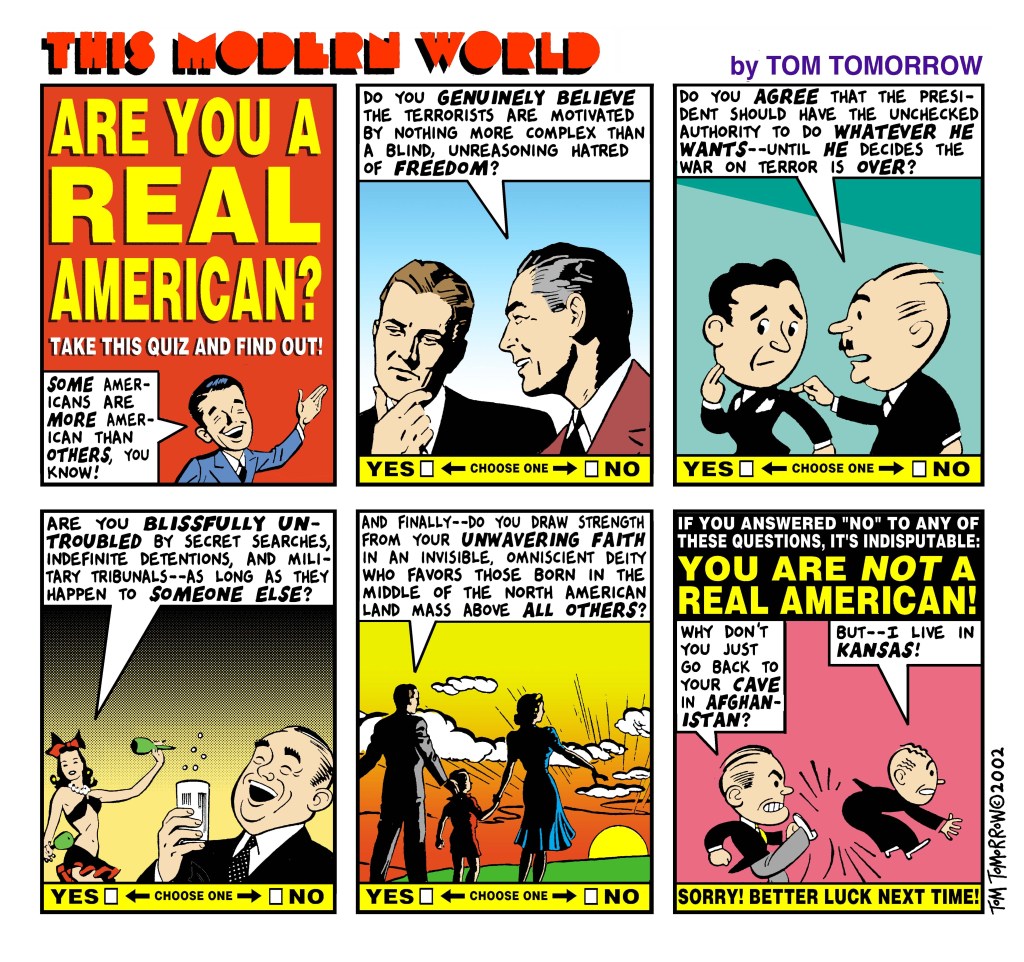
A classic “Tom Tomorrow” cartoon from 2002. Now, of course, “real Americans” must believe Russia’s invasion of Ukraine was completely unprovoked, that Ukraine deserves a blank check in U.S. taxpayer funds, and that Russian athletes should be ashamed of their own flag
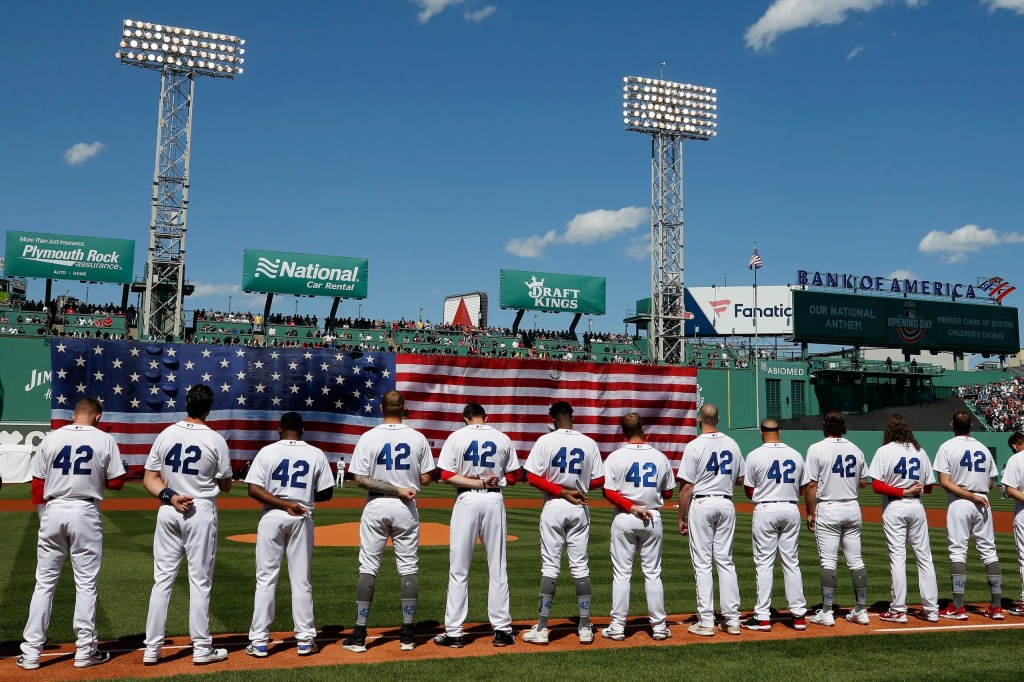
Yesterday was opening day for the Boston Red Sox, my hometown team, with lots of hoopla, a gigantic American flag, the National Anthem and God Bless America, all the trappings of feel-good patriotism. Nothing unusual here. Except there were two ceremonies in honor of the brave defenders of Ukraine, with cameras cutting to Ukrainian flags in the crowd. Two months ago, most Americans couldn’t have cared less about Ukraine, if they’d even heard of it or could place it on a map. Now we’re all on the same team, rooting for them to win, as if they’re all-Americans in war.
The first ceremony was a moment of silence for those suffering from the Ukraine war. Ukrainians were mentioned; Russians weren’t. (I guess Russians aren’t suffering from the war.) The second ceremony marked a long trip to America for a Ukrainian refugee, a celebration, I suppose, of America’s willingness to let in a few refugees from that war. There’s nothing wrong with this, but what does it have to do with baseball? Why is it being celebrated on opening day at Fenway Park?
There is no place for such brazenly political ceremonies at a baseball game. It’s all emotional manipulation and state propaganda. We are all supposed to love plucky Ukraine now and hate perfidious Russia. Even Russians who run longstanding restaurants in Boston have had to explain that they don’t support Putin and his war. If they stay silent, they run the risk of being boycotted because they obviously must be Putin puppets.
Meanwhile, the U.S. government continues to send more and more weaponry to Ukraine, even as we’re encouraged to say silent prayers for that war-torn country. Weapons as peacemakers: it’s a uniquely American sport, the winners being companies like Raytheon and Lockheed Martin, providers of missiles to the world.
You know that old song, “Take me out to the ball game”? When did Ukraine become the home team, and why am I being so manipulated to root for them? Can’t I just forget about war for a few hours and root for the Red Sox?
Even on Jackie Robinson Day in Boston, the war in Ukraine intruded on the Opening Day ceremonies (Jackie wore #42, which is why all players are wearing that number)
Remember Tass, the state news agency for the former Soviet Union? I was thinking of it as I watched PBS on Friday. Two commentators, David Brooks and Jonathan Capehart, respectively with the New York Times and the Washington Post, covered the leading news items of the week. Of course, there was nothing said about the colossal war budget passed by the House ($778 billion, which is actually an undercount); there was nothing said about the continued persecution of Julian Assange by the U.S. government; and indeed there was nothing said about the sham democracy summit overseen by Joe Biden.
The topics covered were Bob Dole’s death and the good old days of compromise in Washington, a general condemnation of Trump and polarization, and some concern about inflation, which was dismissed as evidence of an expanding economy.
PBS used to be a halfway decent news source; now it relies far too heavily on corporate funding and is afraid of losing its government funding as well. So it’s become a state propaganda network, much like Tass was in the USSR.
With respect to the commentators, David Brooks is the reasonable Republican who speaks calmly about achieving incremental change through the system; Jonathan Capehart is the reasonable Democrat who also speaks calmly about pretty much the same; he adds “diversity” in the sense he’s Black and gay, yet his political views vary little from those of Brooks. Mark Shields, the previous voice opposite Brooks, was occasionally somewhat outspoken and even mentioned unions and workers; he’d worked for Senator William Proxmire and had enlisted in the U.S. Marines. I always sensed Shields hadn’t forgotten his roots, but of course he’s now 84 years old and semi-retired.
The previous week, I listened to Capehart as he talked about the Supreme Court and abortion. He seemed most concerned about the potential for a conservative court to overturn the legitimacy of gay marriage. I understand the personal angle, but I was hoping for a stronger statement in favor of a women’s right to choose — to control her own body and her own life.
To be honest, I don’t watch mainstream media reports that often, but when I do, it’s all so saddening and maddening.
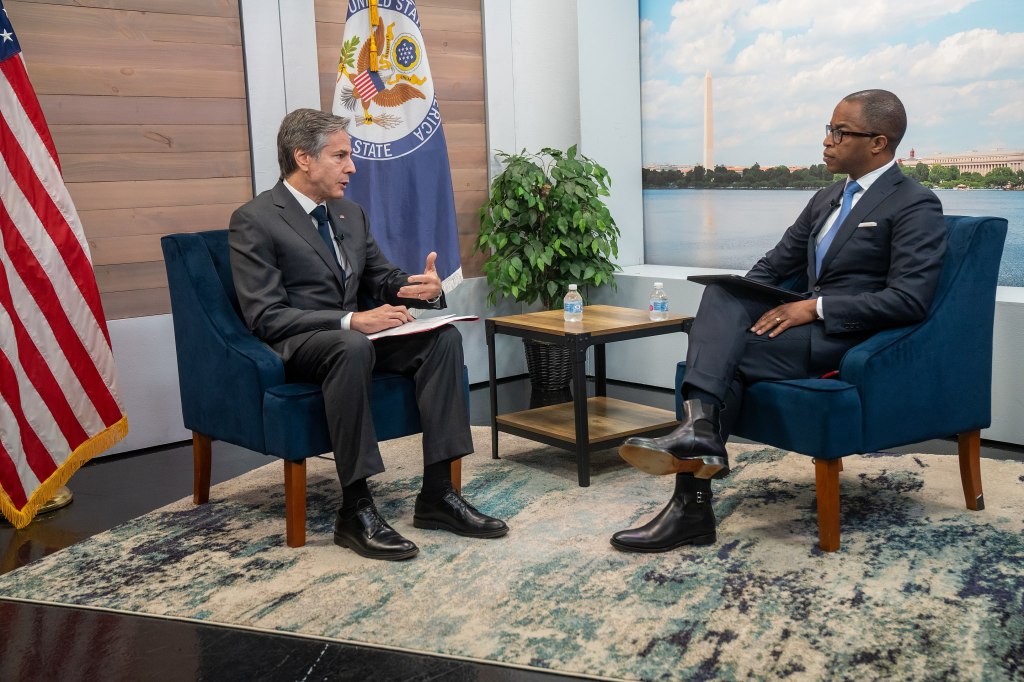
Jonathan Capehart (right) speaks to Secretary of State Antony Blinken. They both know their roles.
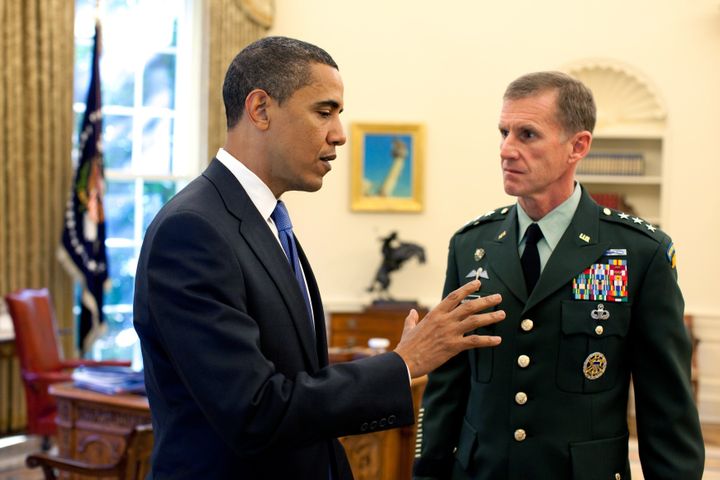
President Obama with General Stanley McChrystal in the days of the ill-fated Afghan Surge
W.J. Astore
Ten years ago, President Barack Obama decided to “surge” in the Afghan War. The previous year he had run for the presidency on the idea of Iraq being the “bad” war but Afghanistan as the “good” war. Good as in “winnable” and as countering terrorism. But Obama’s surge in Afghanistan was a flop, even as American leaders tried to sell it as buying breathing space for the evolution of freer, more stable, Afghan government.
This sell/spin process was all lies, as the Washington Postrevealed yesterday:
A confidential trove of government documents obtained by The Washington Post reveals that senior U.S. officials failed to tell the truth about the war in Afghanistan throughout the 18-year campaign, making rosy pronouncements they knew to be false and hiding unmistakable evidence the war had become unwinnable.
Surprise, surprise! Sadly, the lies were obvious a decade ago, as I wrote about at TomDispatch.com in April of 2009. Here’s my article from that time. Remarkably, despite or rather because of all the lies, the war continues still, with no end in sight.
Mary McCarthy in Vietnam, Barack Obama in Afghanistan
Seven Lessons and Many Questions for the President
By William Astore (April 2009)
In 1967, outraged by the course of the Vietnam War, as well as her country’s role in prolonging and worsening it, Mary McCarthy, novelist, memoirist, and author of the bestseller The Group, went to Saigon, then the capital of South Vietnam, to judge the situation for herself. The next year, she went to the North Vietnamese capital, Hanoi. She wrote accounts of both journeys, published originally in pamphlet format as Vietnam (1967) and Hanoi (1968), and later gathered with her other writings on Vietnam as a book, The Seventeenth Degree (1974). As pamphlets, McCarthy’s accounts sold poorly and passed into obscurity; deservedly so, some would say.
Those who’d say this, however, would be wrong. McCarthy brought a novelist’s keen eye to America’s activities and its rhetoric in Vietnam. By no means a military expert, not even an expert on Vietnam — she only made a conscious decision to study the war in Vietnam after she returned from her trip to Saigon — her impressionistic writings were nevertheless insightful precisely because she had long been a critical thinker beholden to no authority.
Her insights into our approach to war-fighting and to foreign cultures are as telling today as they were 40 years ago, so much so that President Obama and his advisors might do well to add her unconventional lessons to their all-too-conventional thinking on our spreading war in Afghanistan and Pakistan.
What were those lessons? Here are seven of them, each followed by questions that, four decades later, someone at President Obama’s next press conference should consider asking him:
1. McCarthy’s most fundamental objection was to the way, in Vietnam, the U.S. government decided to apply “technology and a superior power to a political situation that will not yield to this.” At the very least, the United States was guilty of folly, but McCarthy went further. She condemned our technocentric and hegemonic form of warfare as “wicked” because of its “absolute indifference to the cost in human lives” to the Vietnamese people.
Even in 1967, the widespread, at times indiscriminate, nature of American killing was well known. For example, U.S. planes dropped roughly 7 million tons of bombs on Vietnam and parts of Laos and Cambodia during the war, nearly five times the tonnage used against Germany during World War II. The U.S. even waged war on the Vietnamese jungle and forest, which so effectively hid Vietnamese guerrilla forces, spraying roughly 20 million gallons of toxic herbicides (including the dioxin-contaminated Agent Orange) on it.
In her outrage, McCarthy dared to compare the seeming indifference of many of her fellow citizens toward the blunt-edged sword of technological destruction we had loosed on Vietnam to the moral obtuseness of ordinary Germans under Adolf Hitler.
Questions for President Obama: Aren’t we once again relying on the destructive power of technology to “solve” complex political and religious struggles? Aren’t we yet again showing indifference to the human costs of war, especially when borne by non-Americans? Even though we’re using far fewer bombs in the Af-Pak highlands than we did in Vietnam, aren’t we still morally culpable when these “precision-guided munitions” miss their targets and instead claim innocents, or hit suspected “terrorists” who suddenly morph into wedding parties? In those cases, do we not seek false comfort in the phrase, C’est la guerre, or at least that modern equivalent: unavoidable collateral damage?
2. As Richard Nixon campaigned for the presidency in 1968 by calling for “peace with honor” in Vietnam, McCarthy offered her own warning about the dangers that arose when the office of the presidency collided with an American desire never to be labeled a loser: “The American so-called free-enterprise system, highly competitive, investment-conscious, expansionist, repels a loser policy by instinctive defense movements centering in the ganglia of the presidency. No matter what direction the incumbent, as candidate, was pointing in, he slowly pivots once he assumes office.”
Questions for President Obama: Have you, like Vietnam-era presidents, pivoted toward yet another surge simply to avoid the label of “loser” in Afghanistan? And if the cost of victory (however defined) is hundreds, or even thousands, more American military casualties, hundreds of billions of additional dollars spent, and extensive collateral damage and blowback, will this “victory” not be a pyrrhic one, achieved at a price so dear as to be indistinguishable from defeat?
3. Though critical of the U.S. military in Vietnam, McCarthy was even more critical of American civilian officials there. “On the whole,” she wrote, they “behaved like a team of promoters with a dubious ‘growth’ stock they were brokering.” At least military men were often more forthright than the civilians, if not necessarily more self-aware, McCarthy noted, because they were part of the war — the product, so to speak — not its salesmen.
Questions for President Obama: In promising to send a new “surge” of State Department personnel and other civilians into Afghanistan, are you prepared as well to parse their words? Are you braced in case they sell you a false bill of goods, even if the sellers themselves, in their eagerness to speak fairy tales to power, continually ignore the Fantasyland nature of their tale?
4. Well before Bush administration officials boasted about creating their own reality and new “facts on the ground” in Iraq, Mary McCarthy recognized the danger of another type of “fact”: “The more troops and matériel committed to Vietnam, the more retreat appears to be cut off — not by an enemy, but by our own numbers. To call for withdrawal in the face of that commitment… is to seem to argue not against a policy, but against facts, which by their very nature are unanswerable.”
Questions for President Obama: If your surge in Afghanistan fails, will you be able to de-escalate as quickly as you escalated? Or will the fact that you’ve put more troops in harm’s way (with all their equipment and all the money that will go into new base and airfield and road construction), and committed more of your prestige to prevailing, make it even harder to consider leaving?
5. A cursory reading of The Pentagon Papers, the famously secret government documents on Vietnam leaked to the New York Times by Daniel Ellsberg, reveals how skeptical America’s top officials were, early on, in pursuing a military solution to the situation in South Vietnam. Nevertheless, knowing better, the “best and brightest,” as journalist David Halberstam termed them in his famous, ironic book title, still talked themselves into it; and they did so, as McCarthy noted, because they set seemingly meaningful goals (“metrics” or “benchmarks,” we’d say today), which they then convinced themselves they were actually achieving. When you trick yourself into believing that you’re meeting your goals, as Halberstam noted, there’s no reason to reexamine your course of action.
Questions for President Obama: Much has been written about an internal struggle within your administration over the wisdom of surging in Afghanistan. Now, you, too, have called for the setting of “benchmarks” for your new strategy’s success. Are you wise enough to set them to capture the complexities of political realities on the ground rather than playing to American strengths? Are you capable of re-examining them, even when your advisors assure you that they are being achieved?
6. In her day, Mary McCarthy recognized the inequities of burden-sharing at home when it came to the war in Vietnam: “Casualty figures, still low [in 1967], seldom strike home outside rural and low-income groups — the silent part of society. The absence of sacrifices [among the privileged classes] has had its effect on the opposition [to the war], which feels no need, on the whole, to turn away from its habitual standards and practices — what for? We have not withdrawn our sympathy from American power and from the way of life that is tied to it — a connection that is more evident to a low-grade G.I. in Vietnam than to most American intellectuals.”
Questions for President Obama: Are you willing to listen to the common G.I. as well as to the generals who have your ear? Are you willing to insist on greater equity in burden-sharing, since once again most of the burden of Iraq and Afghanistan has fallen on “the silent part of society”? Are you able to recognize that the “best and brightest” in the corridors of power may not be the wisest exactly because they have so little to lose (and perhaps much to gain) from our “overseas contingency operations”?
7. McCarthy was remarkably perceptive when it came to the seductiveness of American technological prowess. Our technological superiority, she wrote, was a large part of “our willingness to get into Vietnam and stay there… The technological gap between us and the North Vietnamese constituted, we thought, an advantage which obliged us not to quit.”
Questions for President Obama: Rather than providing us with a war-winning edge, might our robot drones, satellite imagery, and all our other gadgetry of war seduce us into believing that we can “prevail” at a reasonable and sustainable cost? Indeed, do we think we should prevail precisely because our high-tech military brags of “full spectrum dominance”?
One bonus lesson from Mary McCarthy before we take our leave of her: Even now, we speak too often of “Bush’s war” or, more recently, “Obama’s war.” Before we start chattering mindlessly about Iraq and Afghanistan as American tragedies, we would do well to recall what McCarthy had to say about the war in Vietnam: “There is something distasteful,” she wrote, “in the very notion of approaching [Vietnam] as an American tragedy, whose protagonist is a great suffering Texan [President Lyndon Baines Johnson].”
Yes, there is something distasteful about a media that blithely refers to Bush’s or Obama’s war as hundreds of thousands of Iraqis and Afghans suffer. For American troops, after all, are not the only ones paying the ultimate price when the U.S. fights foreign wars for ill-considered reasons and misguided goals.
Update: A cartoon panel by Matt Bors that sums it up:
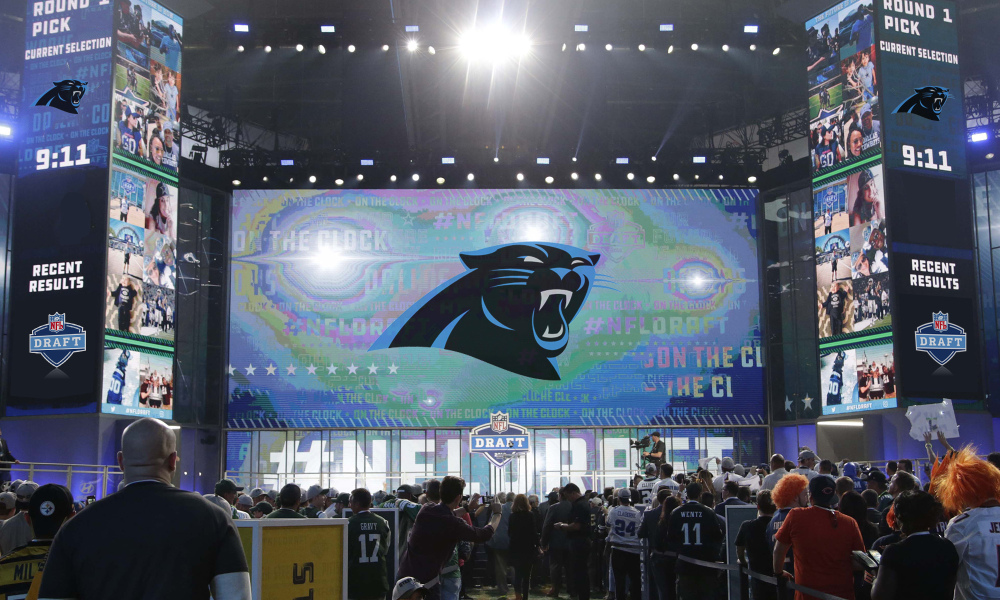
Every year, I watch a little of the NFL draft, one of America’s most revealing cultural displays. This year the draft was held in Nashville over two nights and one day. The NFL claimed 200,000 people showed up in Nashville for the draft, and indeed the outdoor audience resembled a mass political rally. Video boards and celebrities were everywhere. Last year, I wrote about the draft here, and so I won’t repeat those arguments. Suffice to say the draft is a massive commercial for the NFL and a massive exercise in nationalism.
Of course, the NFL is at pains to celebrate the military, and the military is at pains to boost recruitment, which lately has been disappointing. So predictably there was a prominent pro-military display during the draft. Early in the third round of the draft, there was a pause in the “auctioneering” of the athletes. Nine troops walked out in dress uniform: three Marines, two soldiers, two sailors, and two airmen. They stood at attention as the rally members chanted “USA! USA!” Then Lee Greenwood’s anthem came on: “God Bless the USA.” And the assembled masses sang along.
It was an exercise in pure, unadulterated, propaganda. “Proud to be an American,” indeed!
Last August, I wrote about sports and the military for TomDispatch.com, where I quoted this telling observation by Norman Mailer, which he made prior to the Iraq War in 2003:
“The dire prospect that opens, therefore, is that America is going to become a mega-banana republic where the army will have more and more importance in Americans’ lives… [D]emocracy is the special condition — a condition we will be called upon to defend in the coming years. That will be enormously difficult because the combination of the corporation, the military, and the complete investiture of the flag with mass spectator sports has set up a pre-fascistic atmosphere in America already.”
A pre-fascistic atmosphere: a mass rally of 200,000 fans (fanatics?), applauding troops in uniform and singing about how proud they are to be Americans, where at least they know they’re free, as college athletes get auctioned off to NFL mega-millionaire and billionaire owners, all captured on gigantic video boards on prime-time television. Talk about making America great again!
Speaking of the Donald, Trump naturally had to get involved with the draft. One pro-Trump player who was drafted (Nick Bosa) had criticized ex-NFL quarterback Colin Kaepernick, who had taken a knee at several games to raise consciousness of violence against blacks. Bosa had tweeted various insults against Kaepernick, calling him “Crappernick” and “a clown.” Trump, showing his usual leadership skills, urged Bosa in a tweet to “always stay true to yourself,” concluding “MAKE AMERICA GREAT AGAIN!”
Ah, “greatness” has so many different meanings, does it not? But something tells me America’s founders didn’t think “greatness” resided in the conjunction of sports, the military, corporations, and jingoistic shouts of “USA! USA!”
Nora al-Awlaki, 8 years old, killed in the Yemen raid
W.J. Astore
The Trump administration’s first “kinetic” military action, last weekend’s raid on Yemen that killed a Navy SEAL as well as fifteen women and children, was an operational failure. Aggravating that failure has been the aggressive propaganda spin applied by the White House. According to White House spokesman Sean Spicer, the operation was a major success:
“Knowing that we killed an estimated 14 AQAP [Al Qaeda in the Arabian Peninsula] members and that we gathered an unbelievable amount of intelligence that will prevent the potential deaths or attacks on American soil – is something that I think most service members understand, that that’s why they joined the service.”
Later, Spicer doubled down, accusing Senator John McCain (and other critics of the raid) of defaming the dead Navy SEAL when he suggested the raid had been something less than a towering success. McCain, Spicer said, owed the dead SEAL an apology.
Trump himself then joined the fray, accusing John McCain in a tweet of emboldening the enemy and suggesting he’d “been losing so long he doesn’t know how to win anymore.”
Yet, by Spicer’s logic, President Trump himself owes an apology to all U.S. troops killed in the Iraq and Afghan wars, since Trump has criticized these wars as either unnecessary or botched in execution. Recall here that Trump said he was against the Iraq invasion in 2003, but once the U.S. invaded, he said the U.S. government botched it by not taking Iraq’s oil, which, he claimed, would have prevented the rise of ISIS.
The Iraq war, Trump has said, was a mistake, a failure, a loss. He promised to show America how to “win” again. Is the recent Yemen raid what he meant by a “win”?
Nearly everything went wrong in the Yemen raid. Surprise wasn’t achieved. U.S. troops were killed and wounded. Far too many non-combatants (innocent civilians) were killed, including an eight-year-old girl. A $75 million Osprey malfunctioned and had to be destroyed.
To hazard a guess, this raid probably cost the U.S. in the neighborhood of $250 million while failing to achieve its main objective. Meanwhile, the enemy put up fierce resistance with weaponry, mainly small arms and explosives, that probably cost less than $100,000.
In brief, the U.S. raid on Yemen was prodigal in cost, profligate in resources, and unproductive in results.
Of course, I can’t say for certain that the raid didn’t secure vital intelligence. According to Spicer, an “unbelievable” amount of intelligence was seized. But early signs are unpromising. The U.S. military chose to share, in the immediate aftermath of the raid, a video of bomb-making training by al-Qaeda (apparently from a seized laptop), only to remove it when they learned the training video was a decade old and readily available on YouTube. Some intelligence coup!
The Trump administration is promising to launch more raids, featuring an “easier approval cycle” than witnessed under President Obama. Indeed, some reports suggest President Trump was goaded into approving the Yemen raid by being told his predecessor wouldn’t have approved it.
If the Yemen raid is the new face of “winning” under Trump, America may yet long for the days of “losing” under previous presidents.







 Bracing Views