I was reading an article today about Pete Hegseth, self-styled Secretary of War, and his decision to remove four officers from the Brigadier General-select list. Turns out the four officers were either Black or female, but I’m sure that was a coincidence.
Anyhow, the article referenced this pearl of wisdom from Hegseth from last September:
“The leaders who created the woke department have already driven out too many hard chargers. We reverse that trend right now.”
For those of you who don’t know military jargon, “hard charger” is a term of approval. And that’s been Trump and Hegseth’s approach to war with Iran. Call it the bull in the china shop approach. Charge in hard, kill people, break things. Drop enough bombs, kill enough people, and obviously victory must follow.
Hard chargers are what we want in this man’s military, so might Pete Hegseth say. I’ve heard Hegseth’s nickname at the Pentagon is “Dumb McNamara,” apparently for his slicked-back hair together with his, well, lack of intelligence. (Robert McNamara was Secretary of Defense during the disastrous Vietnam War.)
Of course, the military needs its share of Type A, Can-do, mission-driven, hard charging men and women. It also needs its share of skilled, knowledgeable, and smart people as well. And there’s nothing that says that a “hard charger” can’t also be a thinker, especially as that can-do type learns from experience that not every problem can be solved with bullets and bombs.
Deep thinkers are especially needed at strategic levels, else wars go nowhere and are quickly lost. One thing is certain: the so-called Department of War isn’t being led by a deep thinker.
Hegseth, surely a leading member of the kakistocracy, prefers pushups to planning and bombs to diplomacy. He’ll keep charging hard, or, more accurately, he’ll order others to charge hard into harm’s way, all in a quest to drive out “wokeness” and win wars through maximum violence and minimal thought.
Charge harder!
Any enemy wanting to fool Pete Hegseth should invest in a red cape and start waving it smartly.
Reading NBC News this morning, I saw where the U.S. “is winning decisively, devastatingly and without mercy,” so claimed self-styled Secretary of War Pete Hegseth. “We are only four days in,” he added, and the U.S. “will take all the time we need” to prevail. He further added “We are punching them while they’re down, which is exactly how it should be.” (There’s nothing more honorable than punching someone when they’re down, right?)
“They [the Iranians] are toast, and they know it, or at least, soon enough, they will know it. And we have only just begun, to hunt, dismantle, demoralize, destroy and defeat their capabilities,” Hegseth boasted. As far as how long the war will last, he equivocated. Three weeks? Eight weeks? Who knows? Hegseth doesn’t.
Hegseth also doesn’t know something fundamental: You can’t do a wrong thing the right way.
The Iran War is wrong. It’s illegal, unconstitutional, immoral, and also extremely dangerous. There’s no way to prevail in a war fought for the wrong reasons, a war fought without clear goals, a war that is already beginning to spiral out of control. But Hegseth thinks if the U.S. launches enough missiles, drops enough bombs, and torpedoes enough ships, somehow the U.S. will “win.”
Congratulations, U.S. and Israel: You made him a martyr
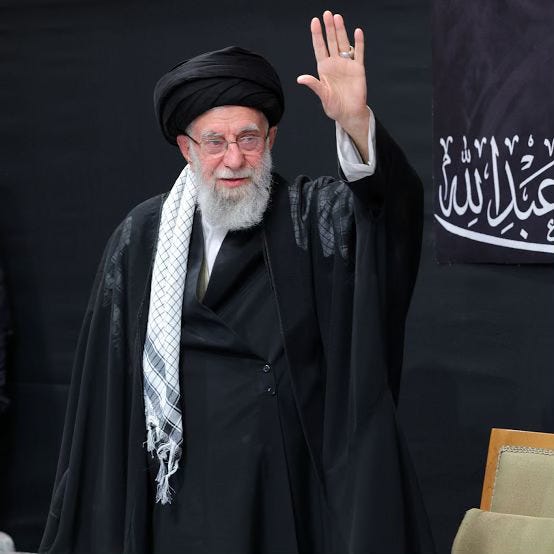
In so many ways, the U.S. has already lost. The Ayatollah Khamenei is now a martyr. Iran is now more likely to pursue a nuclear weapon. Even more so than usual, Israel is now in the driver’s seat, calling America’s shots in the Middle East. This has all the makings of a major catastrophe for U.S. forces, but all Hegseth can see is the promise of punching a man when he’s down.
Clearly, Hegseth is intoxicated with winning “without mercy.” Think about that for a moment—war without mercy. Only the most barbaric or fanatical person would boast about waging war without mercy.
With the Iran War, the Trump administration is marching down the most perilous of paths, blinded by illusions of total victory.
A warning: More than anything, America must not allow this to become a religious war, a crusade, between a Judeo-Christian force and a Shia-Islamic force. We’re already seeing a lot of talk within the U.S. military of a God-driven mission against Iran, with (positive!) references to Armageddon. Such rhetoric is incredibly dangerous and inflammatory. (In this context, that crusader cross tattoo on Hegseth’s chest is more than alarming.)
If anything, the best outcome for the U.S. would be an immediate ceasefire before more U.S. troops are killed and wounded. But how is such a ceasefire to be negotiated? U.S. diplomacy has no credibility. None.
Among the worst outcomes would be the commitment of U.S. troops to Iran, so-called boots on the ground, which would likely create a massive Bay of Pigs-style fiasco. America can ill afford yet another land war quagmire in the Middle East. There is already talk, however, of committing U.S. Special Forces to Iran, perhaps to organize Kurdish and Iranian dissidents against the legitimate Iranian government. Such folly must be prevented.
Any commitment of U.S. troops to Iran would further accelerate escalation. If you begin to hear rumblings about Selective Service and a return to a military draft, you’ll know the Trump administration has become completely unhinged (if it isn’t already).
In just a few days of “major combat operations,” the Trump administration already has more than enough innocent Iranian blood on its hands. That toll in blood is only going to increase, as will the risk of blowback on the “homeland.”
The smartest course for America at this moment is to declare “victory” and leave. Since it’s unlikely Trump and Hegseth will see the light, Congress should immediately cut war funding. Sadly, a weak-willed Congress seems far more likely to pass supplemental funding bills to give Trump and Hegseth a blank check to wage a Judeo-Christian crusade.
We don’t live in interesting times: we live in unhinged times. Perilous times. We must find a way to seek a merciful peace. The alternative just might be World War III.
Should senior military officers consider resigning?
The short answer is yes—if they believe the orders they are given violate their oath to the U.S. Constitution.
In practice, however, resigning for cause is exceedingly rare. The military is a culture of conformity and hierarchy, where resignation is often seen as an act of rebellion—a threat to cohesion and discipline. Officers are taught to work quietly within the system, to suppress doubts, and to remain “loyal” to superiors and to the institution itself. Few are willing to resign openly on moral or legal grounds.
For senior officers, the decision to resign in protest is especially difficult. Colonel David Hackworth, one of the most decorated soldiers of the Vietnam era, resigned after concluding the war was unwinnable—not because he viewed it as unconstitutional. Earlier, General Harold K. Johnson, the Army Chief of Staff under President Lyndon Johnson, considered resigning in protest of the administration’s Vietnam policies but ultimately stayed, hoping to influence policy from within. He later regretted that decision, admitting he had lacked the moral courage to resign.
Both Hackworth and Johnson objected to how the war was fought, not to whether it was lawful. That distinction is crucial.
Senior officers today may likewise convince themselves that remaining in uniform allows them to do the most good—to temper reckless orders from within the system. Resignation, after all, feels like quitting. And there’s an unspoken incentive to stay: the lucrative post-retirement opportunities awaiting those who keep faith with the military-industrial complex.
Given the recent clownish and dangerous behavior of Trump and his defense war secretary, Pete Hegseth, one hopes that senior military leaders are at least preparing for the possibility of resignation—keeping their powder dry until a clear line is crossed. Arguably, that line may already have been crossed.
One resignation might not change much. But several coordinated resignations—anchored in principle—could. The question is whether today’s generals and admirals have the moral courage to do so when the moment arrives.
Trump and Hegseth appear to have neutralized much of the brass by flooding the Pentagon with money. But will those same leaders, drunk on budgets and contracts, have the courage to resist illegal orders and yet another series of wars launched on dubious grounds?
Already, Trump and Hegseth have issued extrajudicial orders—such as the recent killings of suspected smugglers on three speedboats in the Caribbean, ostensibly part of the “war on drugs.” They have deployed active-duty troops to U.S. cities under partisan pretexts that appear to violate the spirit, if not the letter, of the Posse Comitatus Act of 1878. And more attacks on Iran—without any declaration of war—may be imminent.
Given all this, there is ample reason for senior officers to consider coordinated resignations in protest. The question is whether they will summon the moral courage to do what is right—to uphold their oath by walking away.
Perhaps they could call it Operation Just Cause—an operation without bombs or killing, requiring that rarest of things: moral courage.
The military historian Dennis Showalter once told me that he didn’t care about the amount of fat around a general’s belly—he cared about the fat between a general’s ears. It was a telling quip, and one that highlights the shortsighted nature of Pete Hegseth’s emphasis on fitness and military bearing to the generals and admirals he assembled yesterday.
(By the way, what about Trump as commander-in-chief. Is he going to exercise and lose weight? Good luck with that one, Pomade Pete.)
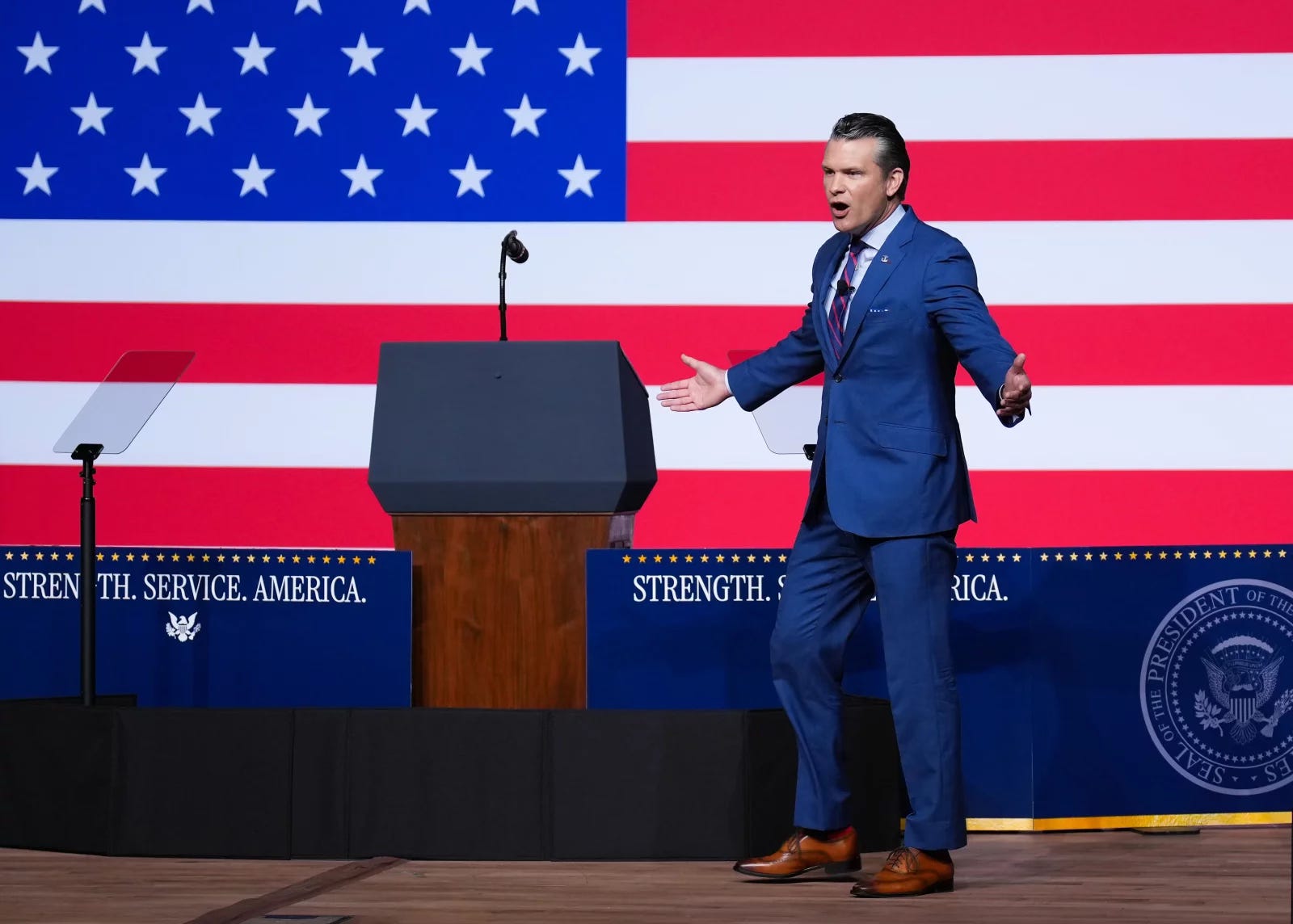
Pomade Pete Hegseth, Self-declared Secretary of War
Of course, physical fitness is important in military settings, especially if you’re at the pointy end of the spear, as they say in the military. But America’s senior leaders today are not “boy generals” like George Armstrong Custer in the U.S. Civil War. They are men and women in their fifties and early sixties, presumably promoted for their integrity, knowledge, insight, skill, and experience, not because they can still run sub-six minute miles or perform 100 pushups.
(Aside: It might be time to buy stock in Ozempic and similar drugs used for weight loss.)
Recall all the media praise showered on William Westmoreland, David Petraeus, and Stanley McChrystal. These three generals were lauded for their physical fitness and military bearing, their “spartan” qualities as warriors. And they all demonstrated strategic mediocrity in fighting and losing the Vietnam, Afghan, and Iraq Wars. They may not have had flabby bellies, but they had flabby minds.
Hegseth is all about “warrior” image over substance. Don’t get me wrong: I think everyone should exercise if they can, and being substantially overweight isn’t healthy. When I was in my early forties and a lieutenant colonel, I ran with the troops and did pushups and sit ups. But there’s a lot more to military effectiveness than being “a lean mean fighting machine.”
But I’ll admit I’m burying the lede here. Trump and Hegseth’s message to senior leaders was far more disturbing than complaints about a fat and woke military. Here’s what I sent to a friend about this:
The “national security” state has kept our country in a state of permanent war since 1947. Trump and Hegseth are just ripping the facade of “security” away and replacing it with “war.”
“Peace” is the word that dare not speak its name. And “war,” of course, has come to the streets of America, with troops deployed to Portland next. Add that to the many police who got their initial training in the military and the rapid expansion of ICE along with detention centers and it’s obvious how the war on terror has truly become global since now the focus is on terror in America.
We are reaping what we sowed …
I was then asked for a more formal comment and came up with this:
The statements of Trump and Hegseth show that the “global” war on terror was and is truly global (as well as permanent) because that war has now come home to America’s cities. Now places like LA and Portland are to be pacified by American “warriors” and warfighters, with detention centers (concentration camps) for those who resist. President Dwight D. Eisenhower was never more right or prescient when he noted, “Only Americans can hurt America.”
Trump and Hegseth see America’s streets as a battleground for the U.S. military against “the enemy within.” The real enemy to democracy, of course, is the very deployment of troops to the streets. American colonists launched a revolution 250 years ago partly because they didn’t want the king’s troops among them as enforcers.
Anyone who doesn’t see the fundamental dangers of Trump and Hegseth’s actions to democracy and our Constitutional rights truly has some flab between their ears.
If there’s one thing we’ve learned (or re-learned, again and again) from the Pentagon it’s that all governments lie and that the first casualty of war is truth. From the Pentagon Papers in the Vietnam War to the Afghan War Papers and the lies about WMD in Iraq, the American people have been deliberately and maliciously lied to about America’s wars and their true causes and purposes. And you can go back further to the infamous “Remember the Maine!” cry that touched off the Spanish-American War of 1898. When it comes to war, America’s leaders have always been economical with the truth.
At the Pentagon, Pomade Pete Strikes Again!
But wait, today’s Pentagon is about to outdo that! As usual with nefarious government decisions, it was announced on Friday when people are most distracted. A short summary from NBC News:
Journalists who cover the Defense Department at the Pentagon can no longer gather or report information, even if it is unclassified, unless it’s been authorized for release by the government, defense officials announced Friday. Reporters who don’t sign a statement agreeing to the new rules will have their press credentials revoked, officials said.
Multiple press associations quickly condemned the new rules and said they will fundamentally change journalists’ ability to cover the Pentagon and the U.S. military. They called for the Trump administration to rescind the new requirements, arguing they inhibit transparency to the American people.
The National Press Club denounced the requirement as “a direct assault on independent journalism at the very place where independent scrutiny matters most: the U.S. military.”
Remember that old saw that, “If you’ve done nothing wrong, you have nothing to hide” from your friendly government surveillance program? Looks like the Pentagon has decided it’s got plenty to hide, meaning it’s done and is planning to do a lot of wrong, and thus only government-approved information will be allowed to be released.
Any journalist worth her or his salt will never agree to this. Journalists who do agree, who sign the Pentagon statement, should just become paid spokespeople for the U.S. military (as indeed many of them already essentially are).
We’ve created a monstrous military, America, one that believes it should be completely unaccountable to us even as we feed it over a trillion dollars a year.
America, there’s only one way to rein in the military: cut the Pentagon budget in half. Show them who’s boss. Of course, Congress controls the purse strings, and Congress, as Ike noted, is intimately intertwined with the military-industrial complex, so it’s not going to be easy to do it.
But no one ever said it’ll be easy: it’s just necessary for the survival of our country as a quasi-democracy.
The so-called SignalGate scandal centered on the bombing of Yemen is highly revelatory. First, some resources. CNN has a useful annotated account of the chats exchanged at the highest levels of the Trump administration. At their respective Substacks, Lenny Broytman and Caitlin Johnstone have telling dissections of these chats as well. At Jacobin, Branko Marcetic has an important article that reminds us of the illegality of the attacks. As the article’s subheading puts it: The press [mainstream media] is mostly framing the Yemen group chat scandal as a story of incompetence. There’s little attention being paid to the deadliness, illegality, and ineffectiveness of the strikes themselves.
To me, among the most telling “chats” came from Secretary of Defense Pete Hegseth. It highlights the “exceptional” nature of America:
*****
Pete Hegseth to Vice President JD Vance: I fully share your loathing of European free-loading. It’s PATHETIC.
But Mike [Waltz, the National Security Adviser] is correct, we are the only ones on the planet (on our side of the ledger) who can do this. Nobody else even close. Question is timing…
*****
This is precisely the problem for America since the Vietnam War, if not before then. We’ve created a monster military, a “global strike” force, that is capable of destroying any target anywhere around the globe. “Nobody else even close,” SecDef Hegseth correctly says. And because we can do it, because we are exceptional in military force, our leaders believe we should do it, even if it’s only to send a “message” to the world how tough we are, how committed we are to killing others.
Other countries—like those “free-loading” European ones—are PATHETIC because they don’t have America’s military might. Only we can smite evildoers around the globe, only we can do so while also arming Israel to the teeth and covering its flanks while it continues its annihilation of Gaza, and this is something we are immensely proud of.
My fellow Americans, this is not something to be proud of. Consider if America’s military in the 1960s had lacked the ability to deploy over half a million troops to Vietnam while also facing down the Warsaw Pact in Europe. Consider if America’s military had lacked the ability to invade Iraq in 2003 while also waging war in Afghanistan and garrisoning the globe with roughly 800 military bases. Consider how much blood would not have been spilled, and treasure wasted, if the U.S. military was smaller, focused on defense, and led by people who didn’t put muscle and flame emojis in their chats to celebrate U.S. military prowess at killing people in Yemen.
That U.S. military forces are the only ones who can kill globally with such comparative ease, that “nobody else even close,” is exactly what is wrong with our government. We place far too much faith and pride in military prowess, so much so that the Pentagon becomes the Pentagod, something we worship, something we make immense sacrifices to, as in budgets that approach $1 trillion yearly.
Not for nothing did President Dwight D. Eisenhower say in 1953 that this is no way of life at all—that we are crucifying ourselves on a cross of iron. Tell me again, who are the pathetic ones?
We must end our intoxication with military power before it ends us.
Officially, the U.S. has the DOD, the department of defense. But when was the last time the U.S. military was primarily oriented toward defense of the CONUS? (CONUS is a military acronym for continental United States.)
My old service, the U.S. Air Force, is far more open about its true aims. It boasts assertively of “global reach, global power” and notably of “global strike.” Not to be outdone, the U.S. Navy has “carrier strike groups,” what used to be termed carrier task forces when they fought real battles in World War II.
Here’s a recent official description: “A Carrier Strike Group (CSG) is a highly powerful, self-contained naval force, capable of projecting power globally, with an aircraft carrier as its core, supported by cruisers, destroyers, submarines, and an air wing, making it a formidable force capable of striking targets 1,000 miles away.”
Doesn’t sound defensive, does it? And of course the U.S. Marines are defined as “expeditionary” forces that are “forward-deployed” for all sorts of expected “contingencies” overseas.
The U.S. military is not about defense. It’s about “full-spectrum dominance.” That means dominance of the land, sea, air, space, cyber, information in all its forms, indeed just about any realm you can think of. No other military, moreover, divides the world into global commands (CENTCOM, AFRICOM, etc.) for the application of U.S. military power. This is not about defending America. It’s about dominating the world. Such a grandiose vision of defense dominance is partly what drives colossal Pentagon budgets that are climbing toward a trillion dollars a year.
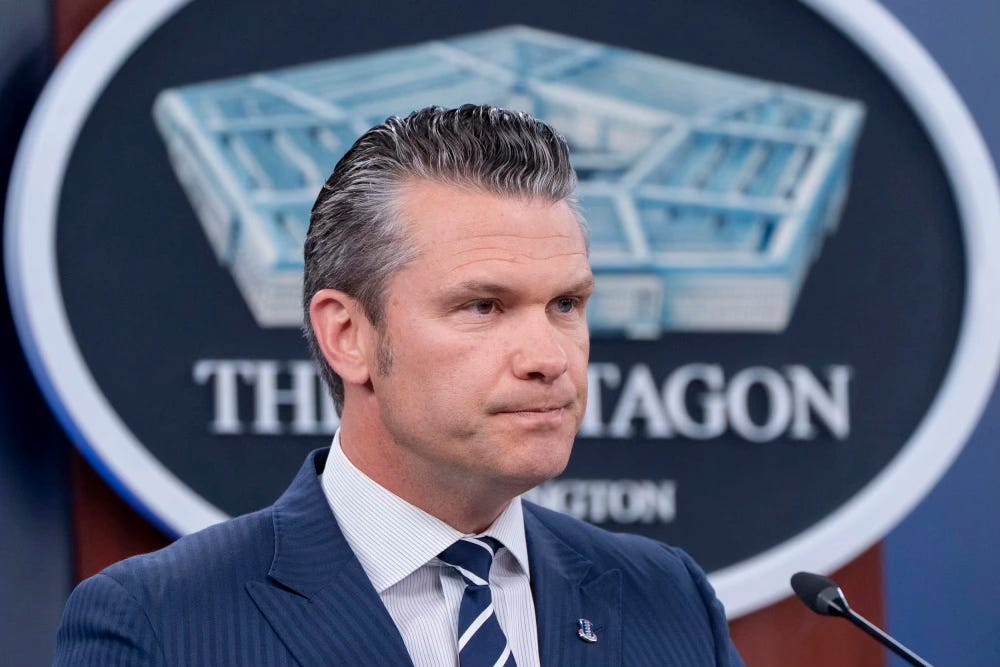
SecDef Pete Hegseth, always talking warrior-tough (Doug Mills/NYT)
Consider here the recent kerfuffle about leaked U.S. strike plans for Yemen, which were inadvertently shared with the editor-in-chief at The Atlantic. Here’s an excerpt from those plans:
From Secretary of Defense Offense Pete Hegseth
“1215et: F-18s LAUNCH (1st strike package)”
“1345: ‘Trigger Based’ F-18 1st Strike Window Starts (Target Terrorist is @ his Known Location so SHOULD BE ON TIME – also, Strike Drones Launch (MQ-9s)”
“1410: More F-18s LAUNCH (2nd strike package)”
“1415: Strike Drones on Target (THIS IS WHEN THE FIRST BOMBS WILL DEFINITELY DROP, pending earlier ‘Trigger Based’ targets)”
Note the repetition of the word “strike” and the closing prayer to America’s “warriors.” And ask yourself: Is this truly what national defense should look like? Prayerful appeals to “warriors” as they strike weak and poor countries thousands of miles away in undeclared (and therefore unconstitutional) wars?
Today, I learned the Trump administration is proposing 8% cuts in Pentagon spending each year for the next five years. This is indeed a welcome—and long overdue—initiative.
Here’s the report from the Guardian:
*****
The US defense secretary, Pete Hegseth has ordered senior leaders at the Pentagon and throughout the US military to develop plans for cutting 8% from the defense budget in each of the next five years, according to a memo obtained by the Washington Post.
Pete Hegseth ordered the proposed cuts to be drawn up by 24 February, according to the memo. Photograph: Ron Sachs/EPA
Hegseth ordered the proposed cuts to be drawn up by 24 February, according to the memo, which includes a list of 17 categories that the Trump administration wants exempted. Among them: operations at the southern US border, modernization of nuclear weapons and missile defense and acquisition of one-way attack drones and other munitions. If adopted in full, the proposed cuts would include tens of billions of dollars in each of the next five years.
*****
Just over two years ago, I called for a 50% reduction in Pentagon spending in an article for TomDispatch. I’m reposting the article below, in full. Maybe SecDef Hegseth can mine some ideas from it. 🙂
Can the Military-Industrial Complex Be Tamed?
Cutting the Pentagon Budget in Half Would Finally Force the Generals to Think
My name is Bill Astore and I’m a card-carrying member of the military-industrial complex (MIC).
Sure, I hung up my military uniform for the last time in 2005. Since 2007, I’ve been writing articles for TomDispatch focused largely on critiquing that same MIC and America’s permanent war economy. I’ve written against this country’s wasteful and unwise wars in Iraq and Afghanistan, its costly and disastrous weapons systems, and its undemocratic embrace of warriors and militarism. Nevertheless, I remain a lieutenant colonel, if a retired one. I still have my military ID card, if only to get on bases, and I still tend to say “we” when I talk about my fellow soldiers, Marines, sailors, and airmen (and our “guardians,” too, now that we have a Space Force).
So, when I talk to organizations that are antiwar, that seek to downsize, dismantle, or otherwise weaken the MIC, I’m upfront about my military biases even as I add my own voice to their critiques. Of course, you don’t have to be antiwar to be highly suspicious of the U.S. military. Senior leaders in “my” military have lied so often, whether in the Vietnam War era of the last century or in this one about “progress” in Iraq and Afghanistan, that you’d have to be asleep at the wheel or ignorant not to have suspected the official story.
Yet I also urge antiwar forces to see more than mendacity or malice in “our” military. It was retired general and then-President Dwight D. Eisenhower, after all, who first warned Americans of the profound dangers of the military-industrial complex in his 1961 farewell address. Not enough Americans heeded Ike’s warning then and, judging by our near-constant state of warfare since that time, not to speak of our ever-ballooning “defense” budgets, very few have heeded his warning to this day. How to explain that?
Well, give the MIC credit. Its tenacity has been amazing. You might compare it to an invasive weed, a parasitic cowbird (an image I’ve used before), or even a metastasizing cancer. As a weed, it’s choking democracy; as a cowbird, it’s gobbling up most of the “food” (at least half of the federal discretionary budget) with no end in sight; as a cancer, it continues to spread, weakening our individual freedoms and liberty.
Call it what you will. The question is: How do we stop it? I’ve offered suggestions in the past; so, too, have writers for TomDispatch like retired Army Colonel Andrew Bacevich and retired Army Major Danny Sjursen, as well as William Hartung, Julia Gledhill, and Alfred McCoy among others. Despite our critiques, the MIC grows ever stronger. If Ike’s warning wasn’t eye-opening enough, enhanced by an even more powerful speech, “Beyond Vietnam,” by Martin Luther King, Jr., in 1967, what could I and my fellow TomDispatch writers possibly say or do to make a difference?
Maybe nothing, but that won’t stop me from trying. Since I am the MIC, so to speak, maybe I can look within for a few lessons that came to me the hard way (in the sense that I had to live them). So, what have l learned of value?
War Racketeers Enjoy Their Racket
In the 1930s, Smedley Butler, a Marine general twice decorated with the Medal of Honor, wrote a book entitled War Is a Racket. He knew better than most since, as he confessed in that volume, when he wore a military uniform, he served as “a racketeer, a gangster for capitalism.” And the corporate-driven racket he helped enable almost a century ago by busting heads from the Caribbean to China was small-scale indeed compared to today’s thoroughly global one.
There’s an obvious lesson to be drawn from its striking endurance, never-ending enlargement, and distinct engorgement in our moment (even after all those lost wars it fought): the system will not reform itself. It will always demand and take more — more money, more authority, more power. It will never be geared for peace. By its nature, it’s authoritarian and distinctly less than honorable, replacing patriotism with service loyalty and victory with triumphant budgetary authority. And it always favors the darkest of scenarios, including at present a new cold war with China and Russia, because that’s the best and most expedient way for it to thrive.
Within the military-industrial complex, there are no incentives to do the right thing. Those few who have a conscience and speak out honorably are punished, including truth-tellers in the enlisted ranks like Chelsea Manning and Daniel Hale. Even being an officer doesn’t make you immune. For his temerity in resisting the Vietnam War, David M. Shoup, a retired Marine Corps general and Medal of Honor recipient, was typically dismissed by his peers as unbalanced and of questionable sanity.
For all the talk of “mavericks,” whether in Top Gun or elsewhere, we — there’s that “we” again (I can’t help myself!) — in the military are a hotbed of go-along-to-get-along conformity.
Recently, I was talking with a senior enlisted colleague about why so few top-ranking officers are willing to speak truth to the powerless (that’s you and me) even after they retire. He mentioned credibility. To question the system, to criticize it, to air dirty laundry in public is to risk losing credibility within the club and so to be rejected as a malcontent, disloyal, even “unbalanced.” Then, of course, that infamous revolving doorbetween the military and giant weapons makers like Boeing and Raytheon simply won’t spin for you. Seven-figure compensation packages, like the one current Secretary of Defense Lloyd Austin gained from Raytheon after his retirement as an Army general, won’t be an option. And in America, who doesn’t want to cash in while gaining more power within the system?
Quite simply, it pays so much better to mouth untruths, or at least distinctly less-than-full-truths, in service to the powerful. And with that in mind, here, at least as I see it, are a few full truths about my old service, the Air Force, that I guarantee you I won’t be applauded for mentioning. How about this as a start: that the production of F-35s — an overpriced “Ferrari” of a fighter jet that’s both too complex and remarkably successful as an underperformer — should be canceled (savings: as much as $1 trillion over time); that the much-touted new B-21 nuclear bomber isn’t needed (savings: at least $200 billion) and neither is the new Sentinel Intercontinental Ballistic Missile(savings: another $200 billion and possibly the entire Earth from doomsday); that the KC-46 tanker is seriously flawed and should be canceled (savings: another $50 billion).
Now, tote it up. By canceling the F-35, the B-21, the Sentinel, and the KC-46, I singlehandedly saved the American taxpayer roughly $1.5 trillion without hurting America’s national defense in the least. But I’ve also just lost all credibility (assuming I had any left) with my old service.
Look, what matters to the military-industrial complex isn’t either the truth or saving your taxpayer dollars but keeping those weapons programs going and the money flowing. What matters, above all, is keeping America’s economy on a permanent wartime footing both by buying endless new (and old) weapons systems for the military and selling them globally in a bizarrely Orwellian pursuit of peace through war.
How are Americans, Ike’s “alert and knowledgeable citizenry,” supposed to end a racket like this? We certainly should know one thing by now: the MIC will never check itself and Congress, already part of it thanks to impressive campaign donations and the like by major weapons makers, won’t corral it either. Indeed, last year, Congress shoveled $45 billion more than the Biden administration requested (more even than the Pentagon asked for) to that complex, all ostensibly in your name. Who cares that it hasn’t won a war of the faintest significance since 1945. Even “victory” in the Cold War (after the Soviet Union imploded in 1991) was thrown away. And now the complex warns us of an onrushing “new cold war” to be waged, naturally, at tremendous cost to you, the American taxpayer.
As citizens, we must be informed, willing, and able to act. And that’s precisely why the complex seeks to deny you knowledge, precisely why it seeks to isolate you from its actions in this world. So, it’s up to you — to us! — to remain alert and involved. Most of all, each of us must struggle to keep our identity and autonomy as a citizen, a rank higher than that of any general or admiral, for, as we all need to be reminded, those wearing uniforms are supposed to serve you, not vice-versa.
I know you hear otherwise. You’ve been told repeatedly in these years that it’s your job to “support our troops.” Yet, in truth, those troops should only exist to support and defend you, and of course the Constitution, the compact that binds us all together as a nation.
When misguided citizens genuflect before those troops (and then ignore everything that’s done in their name), I’m reminded yet again of Ike’s sage warning that only Americans can truly hurt this country. Military service may be necessary, but it’s not necessarily ennobling. America’s founders were profoundly skeptical of large militaries, of entangling alliances with foreign powers, and of permanent wars and threats of the same. So should we all be.
Citizens United Is the Answer
No, not that “Citizens United,” not the case in which the Supreme Court decided corporations had the same free speech rights as you and me, allowing them to coopt the legislative process by drowning us out with massive amounts of “speech,” aka dark-money-driven propaganda. We need citizens united against America’s war machine.
Understanding how that machine works — not just its waste and corruption, but also its positive attributes — is the best way to wrestle it down, to make it submit to the people’s will. Yet activists are sometimes ignorant of the most basic facts about “their” military. So what? Does the difference between a sergeant major and a major, or a chief petty officer and the chief of naval operations matter? The answer is: yes.
An antimilitary approach anchored in ignorance won’t resonate with the American people. An antiwar message anchored in knowledge could, however. It’s important, that is, to hit the proverbial nail on the head. Look, for example, at the traction Donald Trump gained in the presidential race of 2015-2016 when he did something few other politicians then dared do: dismiss the Iraq War as wasteful and stupid. His election win in 2016 was not primarily about racism, nor the result of a nefarious Russian plot. Trump won, at least in part because, despite his ignorance on so many other things, he spoke a fundamental truth — that America’s wars of this century were horrendous blunders.
Trump, of course, was anything but antimilitary. He dreamed of military parades in Washington, D.C. But I (grudgingly) give him credit for boasting that he knew morethan his generals and by that I mean many more Americans need to challenge those in authority, especially those in uniform.
Yet challenging them is just a start. The only real way to wrestle the military-industrial complex to the ground is to cut its funding in half, whether gradually over years or in one fell swoop. Yes, indeed, it’s the understatement of the century to note how much easier that’s said than done. It’s not like any of us could wave a military swagger stick like a magic wand and make half the Pentagon budget disappear. But consider this: If I could do so, that military budget would still be roughly $430 billion, easily more than China’s and Russia’s combined, and more than seven times what this country spends on the State Department. As usual, you get what you pay for, which for America has meant more weapons and disastrous wars.
Join me in imagining the (almost) inconceivable — a Pentagon budget cut in half. Yes, generals and admirals would scream and Congress would squeal. But it would truly matter because, as a retired Army major general once told me, major budget cuts would force the Pentagon to think — for once. With any luck, a few sane and patriotic officers would emerge to place the defense of America first, meaning that hubristic imperial designs and forever wars would truly be reined in because there’d simply be no more money for them.
Currently, Americans are giving the Pentagon all it wants — plus some. And how’s that been working out for the rest of us? Isn’t it finally time for us to exercise real oversight, as Ike challenged us to do in 1961? Isn’t it time to force the Pentagon to pass an audit each year — it’s failed the last five! — or else cut its budget even more deeply? Isn’t it time to hold Congress truly responsible for enabling ever more war by voting out military sycophants? Isn’t it time to recognize, as America’s founders did, that sustaining a vast military establishment constitutes the slow and certain death of democracy?
Just remember one thing: the military-industrial complex won’t reform itself. It just might have no choice, however, but to respond to our demands, if we as citizens remain alert, knowledgeable, determined, and united. And if it should refuse to, if the MIC can’t be tamed, whether because of its strength or our weakness, you will know beyond doubt that this country has truly lost its way.
P.S. Since I wrote this early in 2023, the Pentagon has failed two more audits as its budget has soared toward $900 billion and above. Yes: It’s high time for major cuts to the Pentagon war budget. Make it so!





 Bracing Views