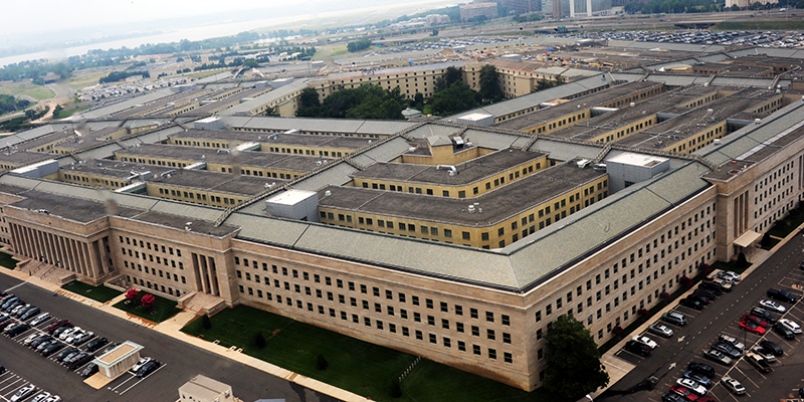
Monday Military Musings

Ford
The USS Gerald R. Ford: Giving new meaning to “teething pains”

W.J. Astore

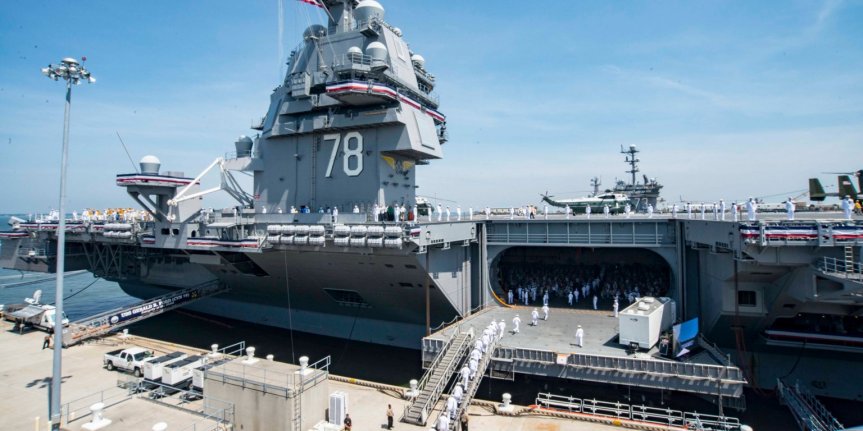
Three news items caught my eye, courtesy of FP: Foreign Policy.  The first involves the U.S. Navy, which has “inked a $14.9 billion contract for two Ford-class aircraft carriers, according to Defense News. The service claims the purchase of two carriers at once will save $4 billion.”

All credit to the Navy: As the Trump administration throws money at the Pentagon, to the tune of $750 billion next year, the Navy is moving at flank speed to order two new aircraft carriers of the Ford class.  The problem is that first Ford-class carrier, which has been a $13 billion disaster: three years behind schedule, billions over budget, with catapults that don’t work, among other serious problems.  But no matter.  Let’s build another two of these mammoth ships while “saving” $4 billion in the process.

Three Ford-class carriers will cost at least $43 billion (despite the $4 billion “savings”), but you hear few dissenting voices in Congress.  Anchors Aweigh, my boys!

The Navy says it needs at least twelve large carriers to perform its mission, but no rival navy has more than one.  Carriers are all about imperial power projection across the globe; does the USA really need more of this for national “defense”?

The second news item comes from America’s endless Afghan war, in which the USA continues to throw billions of dollars at Afghan government security forces despite the always-disappointing results, as documented by the Special Inspector General for Afghanistan Reconstruction (SIGAR):

“The size of Afghanistan’s armed forces is shrinking even as its military faces a sustained challenge from Taliban insurgents. The [SIGAR] report finds that ‘the [Afghan] army and police are at a combined total of just over 308,000, down from 312,000 a year earlier and nearly 316,000 in 2016,’ the AP reports. ‘The cost of arming, training, paying and sustaining those forces falls largely to the U.S. government at more than $4 billion a year.’”

To compensate for the poor performance of Afghan government security forces, the U.S. “has stepped up airstrikes and special operations raids in the country to the highest levels since 2014 in what Defense Department officials described as a coordinated series of attacks on Taliban leaders and fighters.  The surge, which began during the fall, is intended to give American negotiators leverage in ongoing peace talks with the Taliban, The New York Times reports.”

Just what we need: another American “surge” in Afghanistan.  This time, it’s not to win the war; it’s all about gaining “leverage” in ongoing peace talks with the Taliban.  This calls to mind all the bombing the Nixon administration did during its peace talks with North Vietnam in the early 1970s, also in the name of “leverage.”  Look at how well that worked out.

Finally, the third item mentions America’s ongoing and undeclared drone war in Somalia.  Citing a Nation report, FP: Foreign Policy notes that

Since Donald Trump took office, the U.S. military has approximately tripled the number of strikes that it conducts each year in Somalia, according to figures confirmed by the Pentagon, while such actions—and the reasons behind them—have become increasingly opaque.”

“An investigation by the magazine ‘identified strikes that went unreported until they were raised with AFRICOM, but also others that AFRICOM could not confirm—which suggests that another US agency may also be launching air attacks in the region. The investigation also tracked down evidence that AFRICOM’s claim of zero civilian casualties is almost certainly incorrect. And it found that the United States lacks a clear definition of terrorist, with neither AFRICOM, the Pentagon, nor the National Security Council willing to clarify the policies that underpin these strikes.’”

In other words, a war is being waged with no accountability to the American people.  One has to admire the chutzpah of the Pentagon, however, in declaring these drone attacks have only killed “terrorists,” even if that term hasn’t even been defined clearly.

Well, there you have it: Overpriced ships that enable imperialism, overpriced foreign militaries that require more U.S. bombing and special ops raids as a prop “for peace,” and finally a wider, undeclared, war in Africa.  Just another manic Monday in Empire America.

The U.S. Military: Overfunded, Overhyped, and Always Over There

shutterstock_496597759
Don’t blame “our” troops (Shutterstock image)

W.J. Astore

In my latest article for TomDispatch.com, I discuss how and why the U.S. military has a sustained record of turning victory (however fleeting) into defeat.  What follows is an excerpt from my article.

A Sustained Record of Losing

During World War II, British civilians called the “Yanks” who would form the backbone of the Normandy invasion in June 1944 (the one that contributed to Nazi Germany’s unconditional surrender less than a year later) “overpaid, oversexed, and over here.” What can be said of today’s Yanks? Perhaps that they’re overfunded, overhyped, and always over there — “there” being unpromising places like Iraq, Syria, Afghanistan, and Somalia.

Let’s start with always over there. As Nick Turse recently reported for TomDispatch, U.S. forces remain deployed on approximately 800 foreign bases across the globe. (No one knows the exact number, Turse notes, possibly not even the Pentagon.)  The cost: somewhere to the north of $100 billion a year simply to sustain that global “footprint.” At the same time, U.S. forces are engaged in an open-ended war on terror in 80 countries, a sprawling commitment that has cost nearly $6 trillion since the 9/11 attacks (as documented by the Costs of War Project at Brown University). This prodigious and prodigal global presence has not been lost on America’s Tweeter-in-Chief, who opined that the country’s military “cannot continue to be the policeman of the world.” Showing his usual sensitivity to others, he noted as well that “we are in countries most people haven’t even heard about. Frankly, it’s ridiculous.”

Yet Trump’s inconsistent calls to downsize Washington’s foreign commitments, including vows to withdraw all U.S. troops from Syria and halve the number in Afghanistan, have encountered serious pushback from Washington’s bevy of war hawks like Republican Senator Lindsey Graham and his own national security advisor, John Bolton. Contrary to the president’s tweets, U.S. troops in Syria are now destined to remain there for at least months, if not years, according to Bolton. Meanwhile, Trump-promised troop withdrawals from Afghanistan may be delayed considerably in the (lost) cause of keeping the Taliban — clearly winning and having nothing but time — off-balance. What matters most, as retired General David Petraeus argued in 2017, is showing resolve, no matter how disappointing the results. For him, as for so many in the Pentagon high command, it’s perfectly acceptable for Americans to face a “generational struggle” in Afghanistan (and elsewhere) that could, he hinted, persist for as long as America’s ongoing commitment to South Korea — that is, almost 70 years.

Turning to overfunded, the unofficial motto of the Pentagon budgetary process might be “aim high” and in this they have succeeded admirably. For example, President Trump denounced a proposed Pentagon budget of $733 billion for fiscal year 2020 as “crazy” high. Then he demonstrated his art-of-the-deal skills by suggesting a modest cut to $700 billion, only to compromise with his national security chiefs on a new figure: $750 billion. That eternal flood of money into the Pentagon’s coffers — no matter the political party in power — ensures one thing: that no one in that five-sided building needs to think hard about the disastrous direction of U.S. strategy or the grim results of its wars. The only hard thinking is devoted to how to spend the gigabucks pouring in (and keep more coming).

Instead of getting the most bang for the buck, the Pentagon now gets the most bucks for the least bang. To justify them, America’s defense experts are placing their bets not only on their failing generational war on terror, but also on a revived cold war (now uncapitalized) with China and Russia. Such rivals are no longer simply to be “deterred,” to use a commonplace word from the old (capitalized) Cold War; they must now be “overmatched,” a new Pentagon buzzword that translates into unquestionable military superiority (including newly “usable” nuclear weapons) that may well bring the world closer to annihilation.

Finally, there’s overhyped. Washington leaders of all stripes love to boast of a military that’s “second to none,” of a fighting force that’s the “finest” in history. Recently, Vice President Mike Pence reminded the troops that they are “the best of us.” Indeed you could argue that “support our troops” has become a new American mantra, a national motto as ubiquitous as (and synonymous with) “In God we trust.” But if America’s military truly is the finest fighting force since forever, someone should explain just why it’s failed to produce clear and enduring victories of any significance since World War II.

Despite endless deployments, bottomless funding, and breathless hype, the U.S. military loses — it’s politely called a “stalemate” — with remarkable consistency. America’s privates and lieutenants, the grunts at the bottom, are hardly to blame. The fish, as they say, rots from the head, which in this case means America’s most senior officers. Yet, according to them, often in testimony before Congress, whether in Iraq, Afghanistan, or elsewhere, that military is always making progress. Victory, so they claim, is invariably around the next corner, which they’re constantly turning or getting ready to turn.

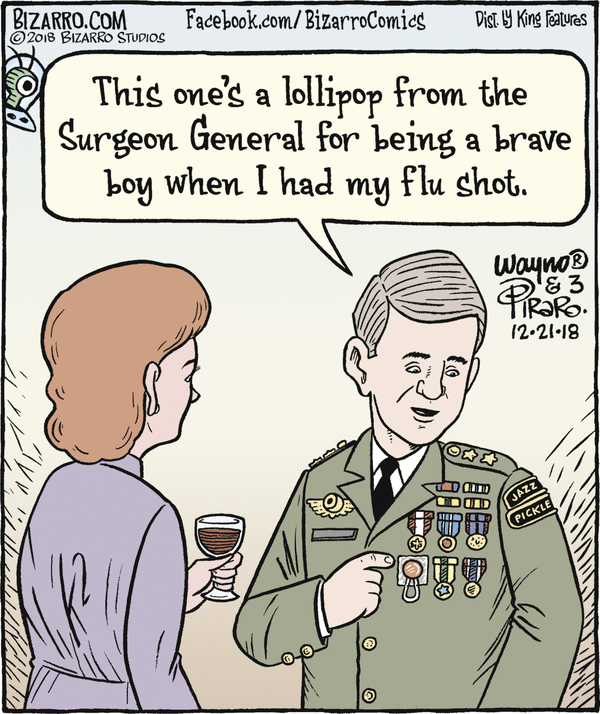
America’s post-9/11 crop of generals like Mattis, H.R. McMasterJohn Kelly, and especially Stanley McChrystal and David Petraeus have been much celebrated here in the mainstream media. And in their dress uniforms shimmering with colorful ribbons, badges, and medals, they certainly looked the part of victors.

Indeed, when three of them were still in Donald Trump’s administration, the pro-war mainstream media unabashedly saluted them as the “adults in the room,” allegedly curbing the worst of the president’s mad impulses. Yet consider the withering critique of veteran reporter William Arkin who recently resigned from NBC News to protest the media’s reflexive support of America’s wars and the warriors who have overseen them. “I find it disheartening,” he wrote, “that we do not report the failures of the generals and national security leaders. I find it shocking that we essentially condone continued American bumbling in the Middle East and now Africa through our ho-hum reporting.” NBC News, he concluded in his letter of resignation, has been “emulating the national security state itself — busy and profitable. No wars won but the ball is kept in play.”

Arkin couldn’t be more on target. Moreover, self-styled triumphalist warriors and a cheeringly complicit media are hardly the ideal tools with which to fix a tottering republic, one allegedly founded on the principle of rule by informed citizens, not the national security state.

For the rest of my article, please visit TomDispatch.com.

The Bankruptcy of Conventional Wisdom at the Pentagon

IMG_0351
A fair depiction of General Petraeus and the busy uniforms of America’s generals

W.J. Astore

Perhaps the most blatant example of the bankruptcy of conventional wisdom at the Pentagon came from retired General David Petraeus in an interview with PBS reporter Judy Woodruff in June of 2017.  Petraeus spoke of a “sustainable, sustained commitment” to Afghanistan and the need for a “generational struggle” with Islamic terrorists who are located there.  Comparing Afghanistan to the U.S. commitment to South Korea, he hinted U.S. troops might be there for 60 or more years (though he backtracked on the 60-year figure when challenged by Woodruff).

Here’s a telling excerpt from his interview:

We need to recognize that we went there [Afghanistan] for a reason and we stayed for a reason, to ensure that Afghanistan is not once again a sanctuary for al-Qaida or other transnational extremists, the way it was when the 9/11 attacks were planned there.

That’s why we need to stay. We also have a very useful platform there for the regional counterterrorist effort. And, of course, we have greatly reduced the capabilities of al-Qaida’s senior leaders in that region, including, of course, taking out Osama bin Laden.

But this is a generational struggle. This is not something that is going to be won in a few years. We’re not going to take a hill, plant a flag, go home to a victory parade. And we need to be there for the long haul, but in a way that is, again, sustainable.

These statements are so wrongheaded it’s hard to know where to begin to correct them:

  1. The U.S. military went into Afghanistan to punish the Taliban after 9/11.  Punishment was administered and the Taliban overthrown in 2001, after which the U.S. military should have left.  The decision to stay was foolish and disastrous.  Extending a disastrous occupation is only aggravating the folly.
  2. “Transnational extremists”: According to the U.S. military, the Af-Pak region has exploded with terrorist elements, and indeed Petraeus and his fellow generals count twenty or more factions in Afghanistan.  In sum, rather than weakening Islamic extremism in the area, U.S. military action has served to strengthen it.
  3. “A very useful platform”: The U.S. has spent roughly a trillion dollars on its eighteen-year-old war in the Af-Pak region.  The results?  The Taliban has increased its hold over Afghan territory and Islamic extremism has flourished.  How is this “very useful” to the United States?
  4. A “long haul” that’s “sustainable”: What exactly is “sustainable” about a war you’ve been fighting — and losing — for nearly two decades?  Leaving aside the dead and maimed troops, how is a trillion dollars a “sustainable” price for a lost war?
  5. No “victory parade.”  At least Petraeus is right here, though I wouldn’t put it past Trump to have a military parade to celebrate some sort of “victory” somewhere.

It appears President Trump is finally fed up, suggesting a withdrawal of troops from Syria as well as a force drawdown in Afghanistan.  But it appears Trump is already caving to pressure from the Pentagon and the usual neo-con suspects, e.g. National Security Adviser John Bolton suggests U.S. troops won’t withdraw from Syria without a guarantee from Turkey not to attack America’s Kurdish allies, which, according to the New York Times, may extend America’s troop commitment by “months or years.”

Trump needs to realize that, if it were up to the Pentagon, America today would still be fighting the Vietnam War, rather than working closely with Vietnam as a partner in efforts to counterbalance China.

The Pentagon’s conventional wisdom is that U.S. troops, once committed, must never leave a region.  Victory or defeat doesn’t matter.  What matters is “sustaining” a “sustainable” commitment.  Hence troops are still in Iraq, still in Afghanistan, still in Syria, still in 800+ bases around the world, because any withdrawal is couched as surrender, a display of weakness, so says America’s military “experts.”

The U.S. doesn’t need a “sustainable, sustained commitment” to the Middle East or Central Asia or anywhere else for that matter, other than right here in the USA.  We need a sustainable, sustained commitment to a better health care system.  To better roads, bridges, airports. To affordable education.  To tax cuts that actually help the middle class.

When it comes to “generational struggles,” David Petraeus, let’s fight for a better America, not for sustaining troops in lost causes around the world.

The Pentagon Budget: Aim High!

HMS_Dreadnought
Those old Dreadnought battleships were expensive.  Let’s build more!

W.J. Astore

As a candidate, Donald Trump occasionally tossed a few rhetorical grenades in the Pentagon’s general direction.  He said America’s wars wasted trillions of dollars.  He said he was smarter than the generals on ISIS (“Believe me!”).  He said the F-35 jet fighter cost way too much, along with a planned replacement for Air Force One.  He said he’d be much tougher on companies like Lockheed Martin, Boeing, and other major defense contractors.

Instead of toughness, Trump as president has proven to be the Pentagon’s lackey.  Recently, he opined the Pentagon’s budget was out of control (“crazy”), and he suggested a 5% cut in fiscal year (FY) 2020.  That trial balloon was shot down quickly as Trump directed Secretary of Defense Mattis to submit a record-setting $750 billion budget for FY 2020.  This is roughly $50 billion more than the FY 2018 budget for “defense.”

Trump’s big boost in spending put me to mind of a famous quip by Winston Churchill in the days of “Dreadnought” battleships.  Prior to World War I, Britain was squabbling over how many of these very expensive battleships needed to be built to deter Germany and to keep command of the seas.  Churchill’s famous quip:

“The Admiralty had demanded six ships; the economists offered four; and we finally compromised on eight.”

In this case, the Pentagon had postured they needed roughly $733 billion in FY 2020, Trump had suggested $700 billion, and they compromised on $750 billion.

Once again, Trump proves his mastery of “the art of the deal.”  Not.

The Pentagon’s $733 Billion “Floor”

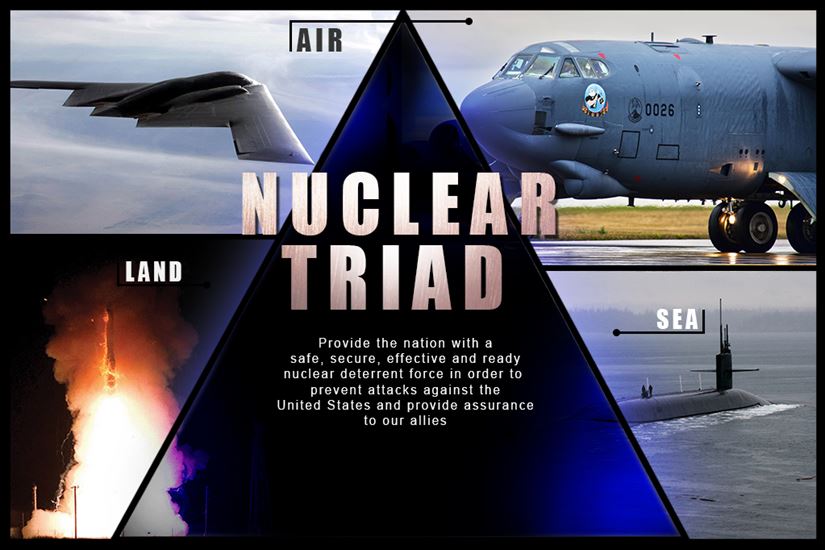
$1.6 trillion to “modernize” this triad?  Doesn’t sound like a “peace dividend” or “new world order” to me

W.J. Astore

In testimony last week before the Senate Armed Services Committee, “longtime diplomat Eric Edelman and retired Admiral Gary Roughead said a $733-billion defense budget was ‘a baseline’ or a ‘floor’ – not the ideal goal – to maintain readiness and modernize conventional and nuclear forces,” reported USNI News.

Which leads to a question: How much money will satisfy America’s military-industrial complex? If $733 billion is a “floor,” or a bare minimum for national defense spending each year, how high is the ceiling?

Part of this huge sum of money is driven by plans to “modernize” America’s nuclear triad at an estimated cost of $1.6 trillion over 30 years.  America’s defense experts seek to modernize the triad when we should be working to get rid of it.  Perhaps they think that in the future nuclear winter will cancel out global warming?

Also last week, Senator Elizabeth Warren gave a foreign policy speech that  addressed military spending in critical terms.  Here’s an excerpt:

The United States will spend more than $700 billion on defense this year alone. That is more than President Ronald Reagan spent during the Cold War. It’s more than the federal government spends on education, medical research, border security, housing, the FBI, disaster relief, the State Department, foreign aid-everything else in the discretionary budget put together. This is unsustainable. If more money for the Pentagon could solve our security challenges, we would have solved them by now.

How do we responsibly cut back? We can start by ending the stranglehold of defense contractors on our military policy. It’s clear that the Pentagon is captured by the so-called “Big Five” defense contractors-and taxpayers are picking up the bill.

If you’re skeptical that this a problem, consider this: the President of the United States has refused to halt arms sales to Saudi Arabia in part because he is more interested in appeasing U.S. defense contractors than holding the Saudis accountable for the murder of a Washington Post journalist or for the thousands of Yemeni civilians killed by those weapons.

The defense industry will inevitably have a seat at the table-but they shouldn’t get to own the table.

These are sensible words from the senator, yet her speech was short on specifics when it came to cutting the Pentagon’s bloated budget.  It’s likely the senator’s cuts would be minor ones, since she embraces the conventional view that China and Russia are “peer” threats that must be deterred and contained by massive military force.

Which brings me to this week and the plaudits being awarded to President George H.W. Bush before his funeral and burial.  I respect Bush’s service in the Navy in World War II, during which he was shot down and nearly killed, and as president his rhetoric was more inclusive and less inflammatory than that used by President Trump.

But let’s remember a crucial point about President Bush’s foreign and defense policies: With the collapse of the Soviet Union, Bush could have charted a far more pacific course forward for America.  Under Bush, there could have been a true “peace dividend,” a truly “new world order.” Instead, Bush oversaw Desert Shield/Storm in 1990-91 and boasted America had kicked its “Vietnam Syndrome” once and for all (meaning the U.S. military could be unleashed yet again for more global military “interventions”).

Bush’s “new world order” was simply an expansion of the American empire to replace the Soviet one.  He threw away a unique opportunity to redefine American foreign policy as less bellicose, less expansionist, less interventionist, choosing instead to empower America’s military-industrial complex.  Once again, military action became America’s go-to methodology for reshaping the world, a method his son George W. Bush would disastrously embrace in Afghanistan and Iraq, two wars that proved a “Vietnam syndrome” remained very much alive.

In sum, defense experts now argue with straight faces that Trump’s major increases in defense spending constitute a new minimum, Democrats like Elizabeth Warren are content with tinkering around the edges of these massive budgets, and the mainstream media embraces George H.W. Bush as a visionary for peace who brought the Cold War to a soft landing.  And so it goes.

Note: for truly innovatory ideas to change America’s “defense” policies, consider these words of Daniel Ellsberg.  As he puts it:

“neither [political] party has promised any departure from our reliance on the military-industrial complex. Since [George] McGovern [in 1972], in effect. And he was the only one, I think, who—and his defeat taught many Democratic politicians they could not run for office with that kind of burden of dispossessing, even temporarily, the workers of Grumman, Northrup and General Dynamics and Lockheed, and the shipbuilders in Connecticut, and so forth.”

Monday Military Musings

W.J. Astore

A few items I’ve been saving up for quick comments:

Remember when civilians were supposed to control the military?  Not in Trump’s White House.  Besides putting retired generals in charge (e.g. Defense Secretary James Mattis), Trump is throwing money at the Pentagon while empowering “his” generals to do what they wish.  As FP:Foreign Policy put it today:  

Frustrated by lack of influence and disheartened by U.S. President Donald Trump’s rhetoric, Department of Defense civilians are heading for the door, leaving key positions unfilled in a Pentagon increasingly run by active-duty or retired military officers, Foreign Policy’s Lara Seligman writes.

Described in interviews with a dozen former and current DOD officials, the exodus has insiders and observers worried that civilian control of the military is being undercut.

“The Joint Staff and the [combatant commanders] are having a field day,” said one Pentagon official, who spoke on condition of anonymity. “They don’t answer any requests, they feel emboldened, and Policy is really struggling.”

As commander-in-chief, Trump has largely been AWOL.  When things go bad (like the Yemen raid early in 2017), he blames his generals.  Instead of “The buck stops here,” the motto of Harry S Truman, who knew how to serve as commander-in-chief, Trump’s motto is “The buck never stops here — unless it’s a literal buck I can add to the Trump empire’s balance sheet.”  

The U.S. military’s commander-in-chief has deserted his post, but the Pentagon doesn’t seem to mind.

Meanwhile, even with roughly $700 billion in yearly budgetary authority, with more billions on the way, the Pentagon is warning it may not be able to win a war against China or Russia unless it gets even more money!  Here’s a quick report from CNN:

Could the US lose a war against China or Russia? It might, according to a new report from a bipartisan panel of military experts. The report warns that the Trump administration’s new National Defense Strategy doesn’t have enough resources, which puts the country at greater risk of losing a military conflict with the Chinese or the Russians.  

I’m shocked, shocked, the U.S. might lose a war against China or Russia!  When the U.S. can’t even win a war against the lowly Taliban in Afghanistan after 17+ years. 

The “solution” is always more money and resources for the Pentagon. How about this instead: Don’t fight a war against China or Russia … period.  Or for that matter against any other country that doesn’t pose a real and pressing threat to the United States.

You have to hand it to the Pentagon: the generals know how to launch preemptive attacks.  Not against foreign armies, mind you, but against what is perceived as “the enemy within.”  The military-industrial complex knows the Pentagon budget could conceivably shrink in 2020, so they’re already claiming “the world’s finest military” is in danger of slipping a notch … unless it gets more money.

The only “war” the Pentagon is clearly winning is the war for money and influence in the American “Homeland.”

Finally, there’s the grim news the Trump administration is pulling out of the INF Treaty with Russia that eliminated intermediate range nuclear weapons in 1987.  That treaty was a remarkable achievement by the Reagan administration: it got rid of nuclear weapons such as the SS-20 on the Soviet side and the Pershing II and ground-launched cruise missiles (GLCMs) on the American side, weapons which were considered “first-strike” and therefore destabilizing to nuclear deterrence.  The Trump administration wants to “invest” in more nukes, including intermediate-range ones, supposedly to deter the Russians, who can already be destroyed dozens of times over by America’s current crop of nuclear weapons.

Cost of nuclear modernization to the U.S.?  At least $1.2 trillion (yes–trillion) over the next thirty years.  Weapons that, if they’re used, will only make the radioactive rubble bounce a little bit higher.  More MADness indeed.

An unchecked Pentagon promises ill not just for America but for the world.  Ike knew this.  So did many other U.S. presidents.  Trump is too busy tweeting and making a buck to care.

The Pentagon as a Herd of Elephants

Now this makes me proud to be an American.  “Salute to service” during Ravens-Steelers game.

W.J. Astore

A few months ago, I was talking to a researcher about the Pentagon, the military-industrial complex, and America’s fourth (and most powerful?) branch of government: the national security state.  After talking about the enormous sweep and power of these entities, she said to me, it’s the elephant in the room, isn’t it?  More than that, I replied: It’s the rampaging herd of elephants in the room.  Even so, we prefer to ignore the herd, even as it dominates and destroys.

This thought came back to me as I read Danny Sjursen’s recent article at Antiwar.com.  His main point was that enormous Pentagon spending and endless wars went undebated during this election cycle.  President Trump preferred to talk of “invasions” by caravans of “criminals,” when not denigrating Democrats as a mutinous mob; the Democrats preferred to talk of health care and coverage for preexisting conditions, when not attacking Trump as hateful and reckless.  No one wanted to talk about never-ending and expanding wars in the Greater Middle East and Africa, and no one in the mainstream dared to call for significant reductions in military spending.

As Sjursen put it:

So long as there is no conscription of Americans’ sons and daughters, and so long as taxes don’t rise (we simply put our wars on the national credit card), the people are quite content to allow less than 1% of the population [to] fight the nation’s failing wars – with no questions asked. Both mainstream wings of the Republicans and Democrats like it that way. They practice the politics of distraction and go on tacitly supporting one indecisive intervention after another, all the while basking in the embarrassment of riches bestowed upon them by the corporate military industrial complex. Everyone wins, except, that is, the soldiers doing multiple tours of combat duty, and – dare I say – the people of the Greater Middle East, who live in an utterly destabilized nightmare of a region.

Why should we be surprised? The de facto “leaders” of both parties – the Chuck Schumers, Joe Bidens, Hillary Clintons and Mitch McConnells of the world – all voted for the 2002 Iraq War resolution, one of the worst foreign policy adventures in American History. Sure, on domestic issues – taxes, healthcare, immigration – there may be some distinction between Republican and Democratic policies; but on the profound issues of war and peace, there is precious little daylight between the two parties. That, right there, is a formula for perpetual war.

As we refuse to debate our wars while effectively handing blank checks to the Pentagon, we take pains to celebrate the military in various “salutes to service.”  These are justified as Veterans Day celebrations, but originally November 11th celebrated the end of war in 1918, not the glorification of it.  Consider these camouflage NFL hats and uniforms modeled on military clothing (courtesy of a good friend):

unnamed

When I lived in England in the early 1990s, the way people marked Veterans or Armistice Day was with a simple poppy. I recall buying one from a veteran who went door-to-door to raise funds to support indigent vets.  Students of military history will know that many young men died in World War I in fields of poppies.  Thus the poppy has become a simple yet powerful symbol of sacrifice, loss, and gratitude for those who went before us to defend freedom.

800px-Royal_British_Legion's_Paper_Poppy_-_white_background

No poppies for us.  Instead, Americans are encouraged to buy expensive NFL clothing that is modeled on military uniforms.  Once again, we turn war into sport, perhaps even into a fashion statement.

And the herd of elephants marches on …

Endless War and the Lack of a Progressive Critique of the Pentagon

brac_pentagon
The Pentagon has won the war that matters most

W.J. Astore

In my latest article for TomDispatch.com, I argue the Pentagon has won the war that matters: the struggle for the “hearts and minds” of America.  Pentagon budgets are soaring even as wars in places like Afghanistan continue to go poorly.  Despite poor results, criticism of the Pentagon is rare indeed, whether in the mainstream U.S. media or even among so-called liberals and progressives, a point hammered home to me when I contacted my senator.  Here’s an excerpt from TomDispatch; you can read my article in full here.

A Letter From My Senator

A few months back, I wrote a note to one of my senators to complain about America’s endless wars and received a signed reply via email. I’m sure you won’t be surprised to learn that it was a canned response, but no less telling for that. My senator began by praising American troops as “tough, smart, and courageous, and they make huge sacrifices to keep our families safe. We owe them all a true debt of gratitude for their service.” OK, I got an instant warm and fuzzy feeling, but seeking applause wasn’t exactly the purpose of my note.

My senator then expressed support for counterterror operations, for, that is, “conducting limited, targeted operations designed to deter violent extremists that pose a credible threat to America’s national security, including al-Qaeda and its affiliates, the Islamic State in Iraq and Syria (ISIS), localized extremist groups, and homegrown terrorists.” My senator then added a caveat, suggesting that the military should obey “the law of armed conflict” and that the authorization for the use of military force (AUMF) that Congress hastily approved in the aftermath of 9/11 should not be interpreted as an “open-ended mandate” for perpetual war.

Finally, my senator voiced support for diplomacy as well as military action, writing, “I believe that our foreign policy should be smart, tough, and pragmatic, using every tool in the toolbox — including defense, diplomacy, and development — to advance U.S. security and economic interests around the world.” The conclusion: “robust” diplomacy must be combined with a “strong” military.

Now, can you guess the name and party affiliation of that senator? Could it have been Lindsey Graham or Jeff Flake, Republicans who favor a beyond-strong military and endlessly aggressive counterterror operations? Of course, from that little critical comment on the AUMF, you’ve probably already figured out that my senator is a Democrat. But did you guess that my military-praising, counterterror-waging representative was Elizabeth Warren, Democrat of Massachusetts?

Full disclosure: I like Warren and have made small contributions to her campaign. And her letter did stipulate that she believed “military action should always be a last resort.” Still, nowhere in it was there any critique of, or even passingly critical commentary about, the U.S. military, or the still-spreading war on terror, or the never-ending Afghan War, or the wastefulness of Pentagon spending, or the devastation wrought in these years by the last superpower on this planet. Everything was anodyne and safe — and this from a senator who’s been pilloried by the right as a flaming liberal and caricatured as yet another socialist out to destroy America.

I know what you’re thinking: What choice does Warren have but to play it safe? She can’t go on record criticizing the military. (She’s already gotten in enough trouble in my home state for daring to criticize the police.) If she doesn’t support a “strong” U.S. military presence globally, how could she remain a viable presidential candidate in 2020?

And I would agree with you, but with this little addendum: Isn’t that proof that the Pentagon has won its most important war, the one that captured — to steal a phrase from another losing war — the “hearts and minds” of America? In this country in 2018, as in 2017, 2016, and so on, the U.S. military and its leaders dictate what is acceptable for us to say and do when it comes to our prodigal pursuit of weapons and wars.

So, while it’s true that the military establishment failed to win those “hearts and minds” in Vietnam or more recently in Iraq and Afghanistan, they sure as hell didn’t fail to win them here. In Homeland, U.S.A., in fact, victory has been achieved and, judging by the latest Pentagon budgets, it couldn’t be more overwhelming.

If you ask — and few Americans do these days — why this country’s losing wars persist, the answer should be, at least in part: because there’s no accountability. The losers in those wars have seized control of our national narrative. They now define how the military is seen (as an investment, a boon, a good and great thing); they now shape how we view our wars abroad (as regrettable perhaps, but necessary and also a sign of national toughness); they now assign all serious criticism of the Pentagon to what they might term the defeatist fringe.

In their hearts, America’s self-professed warriors know they’re right. But the wrongs they’ve committed, and continue to commit, in our name will not be truly righted until Americans begin to reject the madness of rampant militarism, bloated militaries, and endless wars.

Ending Wars, Not “Winning” Them, Should Be America’s Goal


Củ_Chi_tunnels_entrance
Beware the tunnels you choose to go down (Wikimedia)

W.J. Astore

You can’t win wars that should never have been fought.  The U.S. should never have fought the Iraq and Afghan wars, nor should we have fought the Vietnam War.

It’s not that we need to know and master the foreign enemy.  We need to know and master the enemy within.  The domestic enemy.  For the U.S. is defeating only itself in fighting these wars.  Yet “experts” in the military and government focus on how to prosecute war more effectively; rarely do they think seriously about ending or, even better, avoiding wars.

Part of this is cultural.  Americans are obsessed with the idea of winning, defined in terms of dominance, specifically military/physical dominance, taking the fight to the enemy and never backing down.  The best defense is a good offense, as they say in the NFL.  Winning is the only thing, as Vince Lombardi said.  While those maxims may apply to football, they don’t apply to wars that should never have been fought.

Turning from football to tunnels, how about that image made popular during the Vietnam War that “We can see the light at the end of the tunnel”?  Victory, in other words, is in sight and can be reached if we “stay the course” until the tunnel’s end.  Few ask why we’re in the tunnel to begin with.  Why not just avoid the tunnel (of Vietnam, of Iraq, of Afghanistan) and bask in the light of liberty here in the USA?  Indeed, why not brighten liberty’s torch so that others can see and enjoy it?  But instead U.S. military forces are forever plunging into foreign tunnels, groping in the dark for the elusive light of victory, a light that ultimately is illusory.

Another point is that the Pentagon is often not about winning wars without; it’s about winning wars within, specifically budgetary wars.  Here the Pentagon has been amazingly successful, especially in the aftermath of the Cold War, which should have generated a major reduction in U.S. military spending (and overseas military deployments).  The other “war” the Pentagon has won is the struggle for cultural authority/hegemony in the USA.  Here again, the Pentagon has won this war, as represented by presidents from Bush to Obama to Trump boasting of the 4F military (the finest fighting force since forever), and as represented by the fact that the military remains the most trusted governmental institution in America.  Indeed, most Americans don’t even think of “our” military as being part of the federal government.  They think of it as something special, even as they profess to distrust Congress and hate “big government.”  Yet nothing screams “big” like our steroidal federal military, and few entities are more wasteful.

My point is that many military commentators and critics frame the problem wrongly.  It’s not about reforming the U.S. military so that it can win wars.  Americans must reform our culture and our government so that we can avoid wars, even as we end the ones we’re in.  For constant warfare is the enemy of democracy and the scourge of freedom.

A final point about winning that’s rarely acknowledged: America’s wars overseas are not all about us.  Winning (whatever that might mean) should be unconscionable when it comes at the price of hundreds of thousands of dead, millions of refugees, and regions blasted and destabilized.

In sum, ending wars is winning them.

America’s Phony Wars and the National Defense Strategy

Afghan National Army takes charge at Observation Post Mace
U.S. troops and outposts and flags are everywhere, but for whose interests, and at what cost?

W.J. Astore

In my latest article for TomDispatch.com, I address America’s real wars overseas and contrast them with the phony war in the so-called Homeland.  What I mean by “phony” is the lack of national mobilization for, and even interest in, these overseas wars.  These wars exist and persist; they are both ever-spreading and never-ending; yet few Americans outside of the military and the Washington beltway crowd have any stake in them.  Except when U.S. troops die or a spectacular bomb is used, the mainstream media rarely covers them.

Meanwhile, the Trump administration has defined a new National Defense Strategy (NDS) that has only expanded America’s list of enemies and rivals.  A quick summary:

  1. Conventional conflict against peer enemies, e.g. Russia and China.
  2. Conventional conflict against “rogue” states, e.g. North Korea and Iran.
  3. Unconventional (anti-terror) operations, e.g. Afghanistan, Syria, Yemen, Niger, etc.

If that’s not enough, the Pentagon also seeks extended nuclear supremacy (at a cost of at least $1.2 trillion over the next few decades) and full-spectrum dominance for space and cyber as well as land, sea, and air.  As U.S. “defense” budgets continue to grow, there’s really no sense of limits, monetary or otherwise.  Rising budgets feed endless war, and vice-versa.  It’s a fail-safe recipe for imperial over-stretch and the decline if not collapse of America.

What follows is an excerpt from my latest article; you can read the entire article here at TomDispatch.com.

America’s New (Phony) National Defense Strategy

Even phony wars need enemies.  In fact, they may need them more (and more of them) than real wars do.  No surprise then that the Trump administration’s recently announced National Defense Strategy (NDS) offers a laundry list of such enemies.  China and Russia top it as “revisionist powers” looking to reverse America’s putative victory over Communism in the Cold War.  “Rogue” powers like North Korea and Iran are singled out as especially dangerous because of their nuclear ambitions.  (The United States, of course, doesn’t have a “rogue” bone in its body, even if it is now devoting at least $1.2 trillion to building a new generation of more usable nuclear weapons.)  Nor does the NDS neglect Washington’s need to hammer away at global terrorists until the end of time or to extend “full-spectrum dominance” not just to the traditional realms of combat (land, sea, and air) but also to space and cyberspace.

Amid such a plethora of enemies, only one thing is missing in America’s new defense strategy, the very thing that’s been missing all these years, that makes twenty-first-century American war so phony: any sense of national mobilization and shared sacrifice (or its opposite, antiwar resistance).  If the United States truly faces all these existential threats to our democracy and our way of life, what are we doing frittering away more than $45 billion annually in a quagmire war in Afghanistan?  What are we doing spending staggering sums on exotic weaponry like the F-35 jet fighter (total projected program cost: $1.45 trillion) when we have far more pressing national needs to deal with?

Like so much else in Washington in these years, the NDS doesn’t represent a strategy for real war, only a call for more of the same raised to a higher power.  That mainly means more money for the Pentagon, the Department of Homeland Security, and related “defense” agencies, facilitating more blitz attacks on various enemies overseas.  The formula — serial blitzkrieg abroad, serial sitzkrieg in the homeland — adds up to victory, but only for the military-industrial complex.