The New Cold War

W.J. Astore

In my latest article for TomDispatch, I tackle the new cold war and the consensus in Washington that future Pentagon budgets must soar ever higher in response to Russia’s invasion of Ukraine. You can read the entire article here. What follows is the concluding section of the article.

Your Role as a Loyal American in the New Cold War

My fellow Americans, in this new cold war of ours, the national security state expects both all too much and all too little of you. Let’s start with the little. It doesn’t expect you to enlist in the military if you’re rich or have “other priorities” (as former Vice President Dick Cheney said about the Vietnam War). It doesn’t expect you to pay close attention to our wars, let alone foreign policy. You don’t even have to vote. It does, however, expect you to cheer at the right times, be “patriotic,” wave the flag, gush about America, and celebrate its fabulous, militarized exceptionalism.

To enlist in this country’s cheerleading squad, which is of course God’s squad, you might choose to wear a flag lapel pin and affix a “Support Our Troops” sticker to your SUV. You should remind everyone that “freedom isn’t free” and that “God, guns, and guts” made America great. If the godly empire says Ukraine is a worthy friend, you might add a blue-and-yellow “frame” to your Facebook profile photo. If that same empire tells you to ignore ongoing U.S. drone strikes in Somalia and U.S. support for an atrocious Saudi war in Yemen, you are expected to comply. Naturally, you’ll also be expected to pay your taxes without complaint, for how else are we to buy all the weapons and wage all the wars that America needs to keep the peace?

Naturally, certain people need to be collectively despised in our very own version of George Orwell’s “Two Minutes Hate.” So, when Putin’s visage comes on the screen, or Xi’s, or Kim Jong-un’s, or whoever the enemy du jour is, be prepared to express your outrage. Be prepared to treat them as aliens, almost incomprehensible in their barbarity, as if, in fact, they were Klingons in the original Star Trek series. As a peaceful member of the “Federation,” dominated by the United States, you must, of course, reject those Klingon nations and their warrior vision of life, their embrace of might-makes-right, choosing instead the logic, balance, and diplomacy of America’s enlightened State Department (backed up, of course, by the world’s greatest military).

Two Minutes’ Hate: Still from the movie “1984”

Again, little is expected of you (so far) except your obedience, which should be enthusiastic rather than reluctant. Yet whether you know it or not, much is expected of you as well. You must surrender any hopes and dreams you’ve harbored of a fairer, kinder, more equitable and just society. For example, military needs in the new cold war simply won’t allow us to “build back better.” Forget about money for childcare, a $15 federal minimum wage, affordable healthcare for all, better schools, or similar “luxuries.” Maybe in some distant future (or some parallel universe), we’ll be able to afford such things, but not when we’re faced with the equivalent of the Klingon Empire that must be stopped at any cost.

But wait! I hear some of you saying that it doesn’t have to be this way! And I agree. A better future could be imagined. A saying of John F. Kennedy’s comes to mind: “We shall be judged more by what we do at home than what we preach abroad.” What we’re currently doing at home is building more weapons, sinking more tax dollars into the Pentagon, and enriching more warrior-corporations at the expense of the poor, the weak, and the vulnerable. Where’s the democratic future in that?

Sheer military might, our leaders seem to believe, will keep them forever riding high in the saddle. Yet you can ride too high in any saddle, making the fall that’s coming that much more precipitous and dangerous.

Americans, acting in concert, could stop that fall, but not by giving our current crop of leaders a firmer grasp of the reins. Do that and they’ll just spur this nation to greater heights of military folly. No, we must have the courage to unseat them from their saddles, strip them of their guns, and corral their war horses, before they lead us into yet another disastrously unending cold war that could threaten the very existence of humanity. We need to find another way that doesn’t prioritize weapons and war, but values compromise, compassion, and comity.

At this late date, I’m not sure we can do it. I only know that we must.

As Russia Weakens, Why Is Pentagon Spending Set to Soar?

W.J. Astore

Overall, the Russian invasion of Ukraine isn’t going well for Russia. If reports are correct, the Russian military hasn’t distinguished itself. Poor logistics, bad intelligence, lack of effective air support, and an increasing reliance on brute strength appear to be features of this campaign. Meanwhile, Russia is suffering from debilitating economic sanctions imposed by the West. In sum, Russia is weaker today than it was three weeks ago before the invasion. So why is Pentagon spending set to soar in the coming fiscal years?

A friend sent an article along from the New York Times that sums up this insane moment in Washington. He suggested that I re-post it here and make some comments on it. Here goes (my comments in italics):

War in Ukraine rallies support in Congress for more military spending

Catie Edmondson

The New York Times

WASHINGTON — From his perch as chairman of the Armed Services Committee, Rep. Adam Smith, D-Wash., has long lamented what he sees as a Pentagon budget bloated by inefficient spending. When hawkish lawmakers led a successful charge last year to pour nearly $24 billion more into the military’s coffers, he opposed the move.

But last week, as Russian forces continued their assault on Ukraine and he pondered the size of the coming year’s military budget, Mr. Smith sounded a different tone.

“I haven’t picked a number yet,” he said, “but without question, it’s going to have to be bigger than we thought.”

Yes, the Pentagon budget is “bloated” and “inefficient.” You don’t solve that by giving the Pentagon yet more billions!

He added: “The Russian invasion of Ukraine fundamentally altered what our national security posture and what our defense posture needs to be. It made it more complicated, and it made it more expensive.”

No, the invasion hasn’t “fundamentally altered” America’s “defense posture.” If anything, a weakening Russia means we can spend less money on defense, not more.

His shift signals a stark new reality facing President Joe Biden on Capitol Hill, where Democrats had already shown they had little appetite for controlling the defense budget, even as Mr. Biden declared an end to the era of ground wars and indicated he wanted to reimagine the use of American power abroad.

How interesting. I thought “American power” was about “defense.” Why does this have to be “reimagined”?

Now, facing a military onslaught by President Vladimir Putin in Ukraine, and rising fears of a protracted war in Europe and an emboldened China, lawmakers in both parties — including some who had resisted in the past — are pressing for vast increases in military spending to address a changed security landscape.

Why are more weapons and more wars always the answer to a “changed security landscape”? What is the sense of “vast increases”?

As images pour out of Ukrainian cities devastated by a relentless and indiscriminate volley of Russian missiles, Democrats and Republicans who have struggled to coalesce behind meaningful legislation to aid the Ukrainian cause are rallying around one of the few substantive tools available to them: sending money and weapons.

The House this week is poised to approve $10 billion in emergency funds to Ukraine, including $4.8 billion to cover the costs of weapons already sent to Ukraine and eastern flank allies, as well as the deployment of U.S. troops. But already on Monday, Sen. Chuck Schumer, D-N.Y., the Senate majority leader, suggested lawmakers could approve a $12 billion package, in a sign of how eager lawmakers were to send more aid to Kyiv. The United States alone has deployed more than 15,000 troops to Europe, while committing an additional 12,000 to NATO’s response force if necessary.

$10 billion in “emergency funds” is now more than $13 billion for Ukraine. How come America’s poor and neediest can’t get that level of aid, and that quickly?

Beyond funding immediate needs, the consensus around more generous Pentagon spending previews a dynamic that is likely to drive negotiations around next year’s defense budget, potentially locking in the kind of large increases that Mr. Biden and many Democrats had hoped to end.

This is false. Biden ran for president promising increases in Pentagon spending over and above what Trump had proposed.

“I think people are sort of waking up out of this haze that we were living somehow in a secure world,” said Rep. Elaine Luria, D-Va., who sits on the Armed Services Committee.

WTF? We live in an insecure world because of wanton spending by the military-industrial-congressional complex.

Ms. Luria added: “I was not satisfied with the budget that came over last year from the White House, especially in regards to China, especially in regards to the Navy or shipbuilding, and I’ll be very disappointed, in light of the new world situation, if they come up with a budget like that again.”

The rapid shift in thinking is a setback for progressives who had hoped that unified Democratic control of the House, the Senate and the White House would translate into a smaller Pentagon budget and a reduced footprint of American troops around the world.

Democrats, as a party, never wanted a smaller Pentagon budget.

Rep. Ilhan Omar, D-Minn., said in a brief interview that she believed it was crucial that the United States provide Ukrainians with some defensive weapons, but added: “Do I think that there is a point where it becomes too much? Yes.”

Ms. Omar said she was particularly worried about the prospect of arming an insurgency, especially as civilians from around the world have flocked to Ukraine to help push back against the Russian army.

“We’ve seen what the result of that was in Afghanistan, when we armed so many people to fight against the Russians,” said Ms. Omar, who was born in Somalia. “Many of those people went back to their own countries and caused a lot of havoc, including the one I come from.”

A little bit of sense by Rep. Omar, but she has no support here.

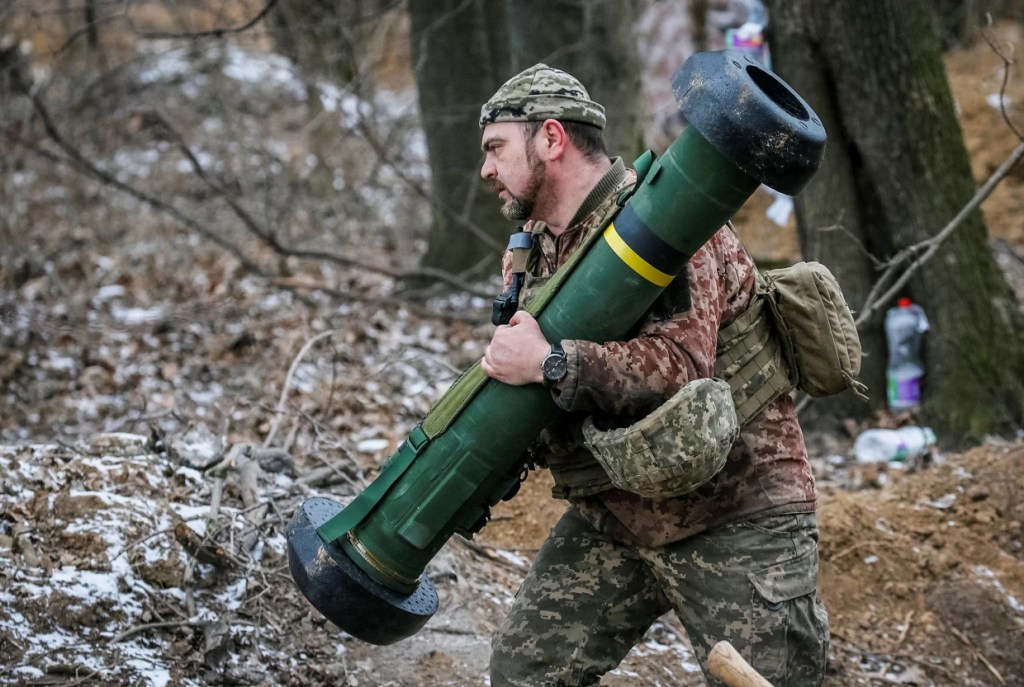
Mr. Biden last weekend authorized a $350 million package of weapons that included Javelin anti-tank missiles and Stinger anti-aircraft missiles as well as small arms and munitions, a shipment that represented the largest single authorized transfer of arms from U.S. military warehouses to another country.

Weapons bought for U.S. troops are being sent for free to Ukraine to be used (in some cases) by neo-Nazi forces. I’m sure nothing bad will come from this.

Many lawmakers want to go further. Several Republican senators have endorsed setting up a separate fund to support the Ukrainian resistance, signaling an appetite to continue arming those in Ukraine willing to fight for an extended period of time, even in the event their government falls.

“I want to see more Javelins,” said Sen. Jim Risch, of Idaho, the top Republican on the Armed Services Committee. “I want to see more Stingers.”

Missiles are the answer! More Russian and Ukrainian dead! Hooah!

An emotional virtual meeting on Saturday in which President Volodymyr Zelenskyy, of Ukraine, who has been defiant in the face of continuing Russian attacks, pleaded with senators for additional weapons rallied more support for his cause.

Sen. Ted Cruz, R-Texas, called for Congress to pass an additional military aid emergency spending bill. And Rep. Tom Malinowski, D-N.J., suggested that Congress quickly approve funding to reimburse Eastern European allies if they provide Ukraine with planes or surface-to-air missiles.

“We should be signaling to the Poles and Romanians and others that this is something we would want to help them do,” Mr. Malinowski said.

Lawmakers are eyeing long-term solutions, too, in Europe and beyond. At an Armed Services Committee hearing last week, both Republicans and Democrats endorsed increasing the U.S. military presence in the Baltics.

Rep. Elissa Slotkin, D-Mich., who is a former Pentagon official, called Mr. Putin’s invasion “a sea change” for “how both the Defense Department and the State Department should think about our presence in Europe.”

“I couldn’t agree more with my colleagues who have talked about putting more force in right now,” Ms. Slotkin said, adding later, “We have to completely re-evaluate deterrence and how we re-establish it.”

What we’re witnessing is the U.S. Congress foaming at the mouth to send more weapons to Ukraine to kill more Russians (and doubtless Ukrainians too), while boosting Pentagon spending against a Russian threat that will be considerably lower, assuming this war doesn’t spiral out of control because of ill-judged and incendiary responses by the U.S.

Readers, what do you think of all this?

Why It’s So Hard to Give Peace A Chance in America

W.J. Astore

It sure is hard to give peace a chance in America, as recent events with Russia and Ukraine show. The Washington consensus is all about weapons and more weapons, of economic sanctions, i.e. economic warfare, of not being seen as a pitiful helpless giant, as Richard Nixon once said during the Vietnam War. America can never stand on the sidelines, even when its national security interests aren’t even threatened. Something must be done, something forceful, something involving troops and weapons and ultimatums that could very well escalate into disaster.

Revealingly, Washington insiders always talk of “all options” being on a metaphorical table, meaning the most violent ones, including war, for the president to choose from. They lie. Because the one option that’s never on that imaginary table is peace.

Peacemakers might be the children of God, but perhaps America is more godless than it knows. Or maybe it just worships the god of war, a Pentagod. It’s discouraging to face the obstacles to peace in America, because these obstacles are not going to be removed just by singing songs and writing articles or even by protesting. What is truly needed is a mass movement against war, as we saw during the Vietnam War years, but even that mass movement took years to have an impact. And it was motivated as well by resistance to the draft, which no longer exists.

A short list of the obstacles to peace is sobering indeed:

  • The power of the military-industrial-congressional complex. It doesn’t want to get smaller or less powerful. It thrives off weaponry and wars. It has no interest in peace.
  • The mainstream media. It’s owned by major corporations and advances corporate agendas. It smears antiwar voices as naive (at best) and often as traitorous and/or weak. Antiwar voices simply aren’t heard on the MSM. Instead, retired colonels and generals, as well as senior ex-CIA officials, are put forward as unbiased voices of reason as they promote the most hawkish lines.
  • The absence of a draft. Let’s face it: the youth of America are much more likely to resist war if they have to risk their lives. But America has an “all volunteer force,” and if these volunteers are sent off to war, that’s what they signed up for. Right?
  • American culture in general is suffused with violence and misinformed about the world, especially America’s imperial role in it. Myths about American exceptionalism and beliefs about the troops as freedom-fighters serve to inhibit antiwar criticism and protests.
  • The difficulty of launching any kind of sustained protest nowadays. Ready to gather in the streets to march against war? Sorry, do you have a permit? Covid restrictions may prevent you from gathering. And maybe we’ll move you to a special “free speech” zone, which I assure you will be far away from media cameras. What good is protesting if you gain no traction because few people see you and the media ignores you?

Don’t get me wrong. I’m not saying it’s impossible to give peace a chance. Just that it’s very difficult, given the power structures of our society and our collective national ethos. It’s mind-boggling that America has so many agencies for “defense” and “intelligence.” We have the Pentagon, the Department of Homeland Security (a domestic mini-Pentagon), something like 17 intelligence agencies like the CIA and NSA, the list goes on. State and local police forces are now heavily militarized and generally unsympathetic to your right to assemble and to protest vigorously. Get a job, commie peacenik!

Meanwhile, society’s heroes are U.S. military troops, or the “thin blue line” of police that “protect and serve.” Those who are committed to peace are generally not viewed as heroes, at least not by society at large. Again, Christ may have seen peacemakers as God’s children, but in the U.S. there’s a preference (judging by gun sales) for Colt Peacemakers.

How to overcome these obstacles to truly give peace a chance is perhaps the most pressing issue of our age, given the risk of war going nuclear and ending most life on our planet. Readers, I don’t have easy answers, but I’d begin with Ike’s warning about the military-industrial complex in 1961, JFK’s peace speech in 1963, MLK’s speech against the Vietnam War on April 4th, 1967, perhaps even John Lennon’s song “Imagine.”

How do we imagine — and then create — a new reality that favors peace instead of war? How do we pursue a just and lasting peace with ourselves and with all nations that Abraham Lincoln spoke of near the end of the U.S. Civil War?

The words are there. The vision is there. Tapping the nobility of Lincoln, Ike, JFK, and MLK and their antiwar messages is possible. Isn’t it?

As JFK said in his “peace speech,” to believe that war is inevitable is a “dangerous defeatist belief.” I’m with JFK.

The antiwar movement helped to stop the disastrous Vietnam War, but it sure wasn’t easy

Reading Defense Contractor Ads

W.J. Astore

I subscribe to a news feed called “Breaking Defense” (the name may be more ironic than the site creators intended). I saw this advertisement today, which sums up much of what is common in America, where jargon substitutes for thought:

Kratos’ next generation unmanned aerial target drones and their capabilities continue to evolve to represent ever changing, evolving threats from near-peer adversaries to best prepare the American warfighter while keeping costs down for the American taxpayer

I know nothing about the company (Kratos), but it does appear to have a good command of Pentagon jargon. Those “near-peer adversaries” (meaning China and Russia, mainly). Those “ever changing, evolving threats.” And of course the almost obligatory appeal to the “warfighter.”

From this ad (and others like it), it’s simply assumed that America will always be at war. There’s also an assumption that Americans fall into two basic categories: warfighters and taxpayers. Warfighters are the doers, the hard men and women on the front lines, deserving of everlasting support and praise, and the taxpayers are there to fund it all and cheer along. Naturally, there’s no mention of “peacemakers.”

If we truly want to keep costs down for the American taxpayer, maybe we shouldn’t buy any of these target drones?

In the same email send-out, here’s a sample of the articles at “Breaking Defense”:


For Space Force, it’s acquisition, acquisition, acquisition: 2022 Preview 

In 2022, the Pentagon will need to see real movement on acquisition reform to reduce long understood vulnerabilities that have been essentially ignored for many years.

The Pentagon’s new strategy might already be behind the times: 2022 Preview 

A Russian invasion of Ukraine could derail the Defense Department’s planning. 

For the Army, looming budgets and multi-domain everything: 2022 Preview 

Here’s the key Army storylines we’ll be tracking at Breaking Defense next year. 

Seems like the “Space Force” will be spending lots of money in 2022 due to “vulnerabilities.” Meanwhile, a Russian invasion of Ukraine might “derail” the DoD’s “new strategy.” And the Army is looking at “multi-domains,” which I assume is a smart way for the Army to expand its budgetary reach in the new year.

Nice to know the Pentagon has a new strategy, but how could a Russian incursion into Ukraine derail it? If the U.S. invaded Mexico, would that derail Russia’s defense planning? Or China’s?

Here’s another ad from a different “Breaking Defense” send-out.

Systel’s fully rugged computing solutions are purpose-built for the most demanding environments and workloads. High performance, SWaP-optimized, single LRU solutions supporting edge AI and force-protection missions. MOSA/CMOA, SAVE, and GCIA-compliant. Fully rugged, configurable, and modular. Centralized sensor ingest and data fusion support.

Ah, the good old days of military acronyms! Again, I know nothing about Systel, but the company has a solid command of opaque acronyms. Even the ad has redundancy in the sense that it mentions “fully rugged” twice! Note the mission of “force-protection,” as in keeping U.S. “warfighters” safe while in harm’s way.

Maybe we should keep our troops safe by not putting them in harm’s way, unless the defense of America truly requires it?

There’s nothing special about these ads or stories, which is why I cite them here. Just another day in the American empire of warfighters buying weapons systems to force-protect and confront near-peer threats out to exploit our vulnerabilities across multiple domains. Or, put simply, multi-domain everything!

Happy New Year, everyone.

Bombing Kills Lots of Innocents: Who Knew?

W.J. Astore

Extensive U.S. bombing overseas kills lots of innocent people: who knew?

So this blinding statement of the obvious popped up in my email today from the New York Times:

A five-year Times investigation found that the U.S. air wars in Iraq, Syria and Afghanistan led to thousands of civilian deaths.
Hidden Pentagon records show a pattern of failures in U.S. airstrikes — a sharp contrast to the American government’s image of war waged by all-seeing drones and precision bombs.
The military’s own confidential assessments of over 1,300 reports of civilian casualties since 2014, obtained by The Times, lays bare how the air war has been marked by deeply flawed intelligence, rushed and often imprecise targeting and the deaths of thousands of civilians, many of them children. None of these failures resulted in a finding of wrongdoing. We are making these Pentagon records public.
This is the first of a two-part investigation. Here are the key takeaways.

Finally, at the end of 2021, the Times is willing to speak up against America’s murderous regimen of bombing overseas. I wrote about this myself at this site in 2016 and 2017, and I’m hardly the only person to have pointed this out. At TomDispatch.com, Tom Engelhardt has been reporting for years and years on wedding parties being wiped out by U.S. bombing missions based on “faulty intelligence.” The mainstream media have largely played down these atrocities until now, when the war in Afghanistan is finally (mostly) over, at least for the U.S.

As I wrote in 2013 for TomDispatch.com, airpower is neither cheap nor surgical nor decisive. Indeed, because it provides an illusion of effectiveness, and because America dominates the “high ground” of the air, all of this “precision” bombing serves to keep America in wars for far longer than is tenable on tactical grounds. Imagine how long the Iraq and Afghan wars would have lasted if America didn’t dominate the air, if the U.S. military had to rely exclusively on ground troops, and thus had suffered much higher casualties in ground combat. My guess is that these wars would have ended earlier, but “progress” could always be faked with all those statistics of bombs dropped and alleged “high value targets” eliminated.

I suppose it’s good to see the “liberal” New York Times cover this issue of murderous bombing after 20 years of the global war on terror. The question remains: why did it take them two decades to cover this issue in depth?

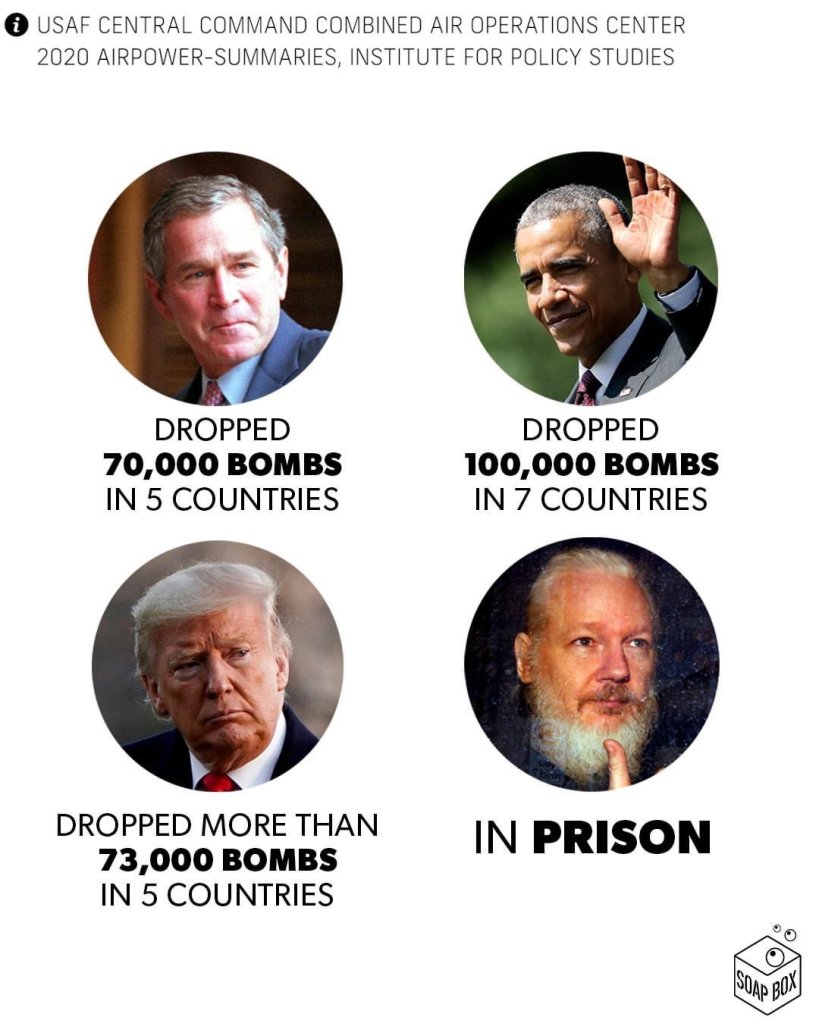
Presidents become “presidential” when they bomb other countries. Meanwhile, Julian Assange rots in prison. Maybe he needs to bomb a few countries?

Update (12/21/21)

More notes on U.S. bombing and the Times report, courtesy of ReThink Round Up:

“Not a single file [from the military about the bombings] includes a finding of wrongdoing. An effort within the military to find lessons learned to prevent future civilian harm was suppressed. An analyst who captures strike imagery even told the Times that superior officers would often “tell the cameras to look somewhere else” because “they knew if they’d just hit a bad target.”

Responding to the report, a Pentagon spokesperson acknowledged that preventing civilian deaths is not just a “moral imperative” but a strategic issue because civilian casualties can fuel recruiting for extremist groups. [New York Times/ Azmat Khan]”

*****

Again, to state the obvious here:

1. There’s no accountability in the system. Murderous mistakes are covered up and no one is held responsible (“tell the cameras to look somewhere else”).

2. The bombing attacks were counterproductive. Guess what? Killing innocents creates more “terrorists.” Who knew?

Murderous inaccuracy, making matters worse, with no accountability: WTF? So much for America’s “awesome” military, as Andrew Bacevich writes about today at TomDispatch.com.

How Awesome Is “Awesome”?

The Pentagon as Pentagod

W.J. Astore

The other day, retired General Michael Flynn called for “one religion under God” in the United States.

Ah, General Flynn, we already have one religion of militant nationalism and imperialism, and we already have one god, the Pentagod, which is the subject of my latest article for TomDispatch.com.

First, one religion. This weekend I watched the New England Patriots play the Cleveland Brown during which a Pentagon recruiting commercial broke out. The coaches wore camouflage jackets and caps, the game started with military flyovers of combat jets, and there even was a mass military swearing-in ceremony hosted by a four-star general and admiral. That same general claimed during an on-field interview during the game that the military is what keeps America free, which might just be the best definition of militarism that I’ve heard.

(Aside: In a true democracy, the military is seen as a necessary evil, because all militaries are essentially undemocratic. The goal of a true democracy is to spend as little as possible on the military while still providing for a robust defense.)

Here’s an illustration, sent by a friend, of America’s one religion:

So, according to the NFL and the mainstream media, “all of us” need to honor “our” military and indeed anyone who’s ever worn a uniform, no questions asked, apparently. I wore a military uniform for 24 years: four years as a cadet, twenty as a military officer, and I’m telling you this is nonsense — dangerous nonsense. Don’t “salute” authority. Question it. Challenge it. Hold it accountable and responsible. At the very least, be informed about it. And don’t mix sports, which is both business and entertainment, with military service and the machinery of war.

OK, so now let’s talk about America’s god. As I argue below, it certainly isn’t the Jesus Christ I learned about by reading the New Testament and studying the Gospels in CCD. America has never worshipped that god. Clearly the god we worship — at least as measured by money and societal influence — is the Pentagod, which leads me to my latest article at TomDispatch. Enjoy!

The Pentagon As Pentagod

Who is America’s god? The Christian god of the beatitudes, the one who healed the sick, helped the poor, and preached love of neighbor? Not in these (dis)United States. In the Pledge of Allegiance, we speak proudly of One Nation under God, but in the aggregate, this country doesn’t serve or worship Jesus Christ, or Allah, or any other god of justice and mercy. In truth, the deity America believes in is the five-sided one headquartered in Arlington, Virginia.

In God We Trust is on all our coins. But, again, which god? The one of “turn the other cheek”? The one who found his disciples among society’s outcasts? The one who wanted nothing to do with moneychangers or swords? As Joe Biden might say, give me a break.

America’s true god is a deity of wrath, whose keenest followers profit mightily from war and see such gains as virtuous, while its most militant disciples, a crew of losing generals and failed Washington officials, routinely employ murderous violence across the globe. It contains multitudes, its name is legion, but if this deity must have one name, citing a need for some restraint, let it be known as the Pentagod.

Yes, the Pentagon is America’s true god. Consider that the Biden administration requested a whopping $753 billion for military spending in fiscal year 2022 even as the Afghan War was cratering. Consider that the House Armed Services Committee then boosted that blockbuster budget to $778 billion in September. Twenty-five billion dollars extra for “defense,” hardly debated, easily passed, with strong bipartisan support in Congress. How else, if not religious belief, to explain this, despite the Pentagod’s prodigal $8 trillion wars over the last two decades that ended so disastrously? How else to account for future budget projections showing that all-American deity getting another $8 trillion or so over the next decade, even as the political parties fight like rabid dogs over roughly 15% of that figure for much-needed domestic improvements?

Paraphrasing Joe Biden, show me your budget and I’ll tell you what you worship. In that context, there can’t be the slightest doubt: America worships its Pentagod and the weapons and wars that feed it.

Prefabricated War, Made in the U.S.A.

I confess that I’m floored by this simple fact: for two decades in which “forever war” has served as an apt descriptor of America’s true state of the union, the Pentagod has failed to deliver on any of its promises. Iraq and Afghanistan? Just the most obvious of a series of war-on-terror quagmires and failures galore.

That ultimate deity can’t even pass a simple financial audit to account for what it does with those endless funds shoved its way, yet our representatives in Washington keep doing so by the trillions. Spectacular failure after spectacular failure and yet that all-American god just rolls on, seemingly unstoppable, unquenchable, rarely questioned, never penalized, always on top.

Talk about blind faith!

To read the rest of my article, please go to TomDispatch here. Here’s my conclusion:

Yet, before I bled Air Force blue, before I was stationed in a cathedral of military power under who knows how many tons of solid granite, I was raised a Roman Catholic. Recently, I caught the words of Pope Francis, God’s representative on earth for Catholic believers. Among other entreaties, he asked “in the name of God” for “arms manufacturers and dealers to completely stop their activity, because it foments violence and war, it contributes to those awful geopolitical games which cost millions of lives displaced and millions dead.”

Which country has the most arms manufacturers? Which routinely and proudly leads the world in weapons exports? And which spends more on wars and weaponry than any other, with hardly a challenge from Congress or a demurral from the mainstream media?

And as I stared into the abyss created by those questions, who stared back at me but, of course, the Pentagod.

Being Right For the Wrong Reasons

W.J. Astore

Were you against the Afghan War? The Iraq War? Events proved you right, of course, but for the wrong reasons. And if you were pro-war in both cases, you were of course wrong but for the right reasons. Therefore you will still be celebrated and featured on mainstream media outlets, whereas those “right” people will still be ignored because, again, they may have been right about those disastrous wars, but their reasons were all wrong.

I think I heard this formulation first in Jeremy Scahill’s book “Dirty Wars.” An official said opponents of the war on terror had been “right for the wrong reasons,” but that proponents of war, the Kristols and Krauthammers of the necon world, had been “wrong for the right reasons.”

Nick Turse picks up on this theme in his latest for TomDispatch.com. In 2010, Turse edited a book of essays: “The Case for Withdrawal from Afghanistan.” In his latest essay, and with tongue firmly in cheek, Turse asks why he’s not being invited to speak on the mainstream media networks, why he’s not being celebrated for his prescience, why he’s not being lauded for being right. And of course Turse knows the answer: he was right — but for the wrong reasons.

If you’re confused, allow me to translate. It’s OK, even laudable, to argue that the Pentagon will win; that wars should be fought; and that U.S. generals are so many reincarnations of Napoleon and Alexander and Caesar.  Because being “wrong” here means that the Pentagon grows ever more powerful; that the U.S. always looks tough (if perhaps dumb); and that America’s generals are celebrated as the “finest” while never being called to account. Again, all these things are “right,” even when, indeed especially when, they’re so obviously wrong.

But it’s not OK, indeed it’s deplorable, to suggest the Pentagon will lose; that wars should not be fought; that U.S. generals are mostly time-serving mediocrities.  Because being “right” here means a weaker Pentagon; it means America fights fewer wars, an obvious sign of national weakness and a calamity to the military-industrial complex; it means holding generals responsible for their self-serving lies and obfuscations.

Being right about all this weakens militarism in America and could lead to lower “defense” budgets and fewer wars. And we can’t have that in America!

So, remember, in America it’s better to be wrong and thus feed the military-industrial complex than to be right and thus possibly to chart a wiser and less bellicose course. To paraphrase Mister Spock, it is not logical, but it is often true.

Sorry, Nick: You were right but for the wrong reasons

Support Our Troops — But How?

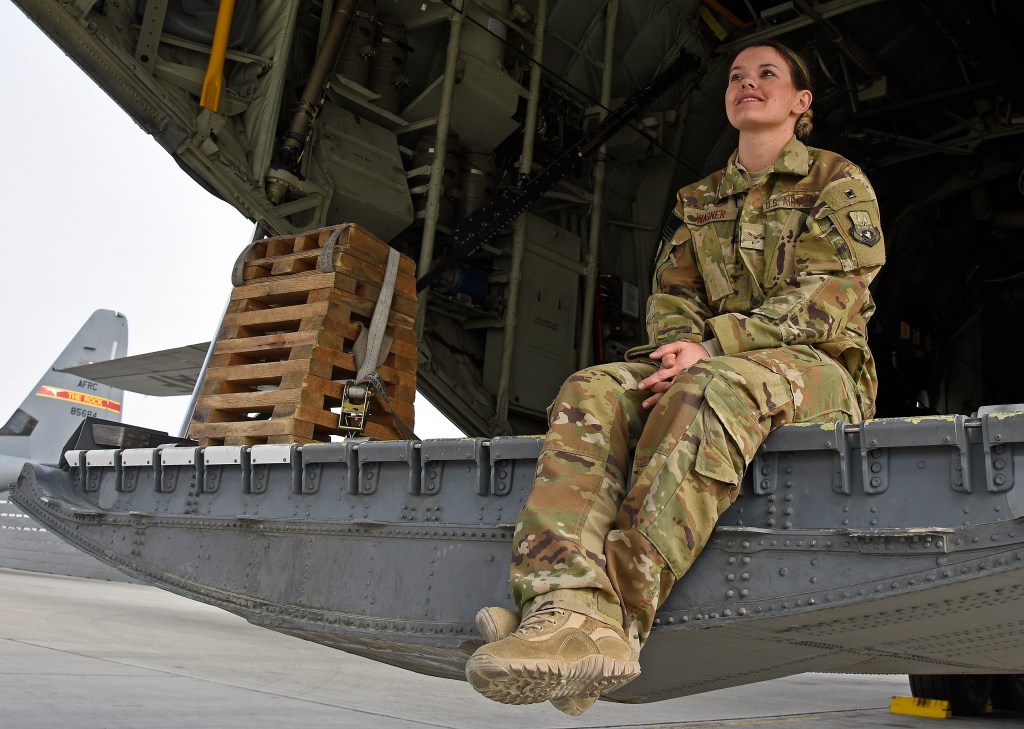
A1C Courtney Wagner, getting the job done as the 774th Expeditionary Airlift Squadron loadmaster in 2017. When America thinks of “our” troops, someone like A1C Wagner may come to mind (U.S. Air Force photo/Staff Sgt. Divine Cox)

W.J. Astore

Today I saw a “support our troops” magnetic ribbon on a pickup truck.  I used to see more of them, especially in the Bush/Cheney years of the Afghan and Iraq Wars.  I don’t oppose the sentiment, though the “support” it encourages is undefined.  I’ve always thought the best way to “support” our troops is to keep them out of unnecessary and disastrous wars.  Even to bring them home, not only from these wars but from imperial outposts around the globe.  But, again, “support” on these ribbons is unspecified, though the Pentagon seems to equate it with huge budgets that approach a trillion dollars every year.

Americans continue to profess confidence in “their” military, with 69% of us saying so in July 2021, whereas only 12% of us have much confidence in Congress.  Can it be said we hold Congress in contempt?  Americans know, I think, that Congress is bought and paid for, that it answers to the rich and the strong while dismissing the poor and the weak.  If you’re looking for affordable health care, for higher pay, for fair treatment, best not look to Congress.

Indeed, if you want a $15 minimum wage, free government health care, and a government-funded college education, your only option is to enlist in the U.S. military.  These “socialist” programs are a big part of the military, including government-provided housing as well.  Yet we don’t think of them as socialistic when the person getting these benefits is wearing a military uniform.

It’s truly remarkable that despite disastrous wars in Afghanistan, Iraq, Libya, and elsewhere, Americans continue to “support” and have great confidence in “our troops.”  There are many reasons for this.  I think most Americans recognize now that the wars our troops are sent to are losing concerns from the get-go.  You really can’t blame the troops for failing to win unwinnable wars.  You can, and should, blame the leaders for lying us into these wars and then lying again and again about (false) progress in Iraq, Afghanistan, and elsewhere.  But the troops who bleed on the frontlines?  No – we sense it’s not their fault.

I think many Americans also support our troops out of guilt and ignorance.  Most Americans are isolated from the military and therefore have little understanding of its ways and even less understanding of its wars.  Less than 1% of Americans currently serve in the military, plus there’s no draft, so young Americans can safely ignore, so they think, the discomforts and potential perils of a few years spent within the ranks.  After a flurry of attention paid to a humiliating withdrawal from Afghanistan, the mainstream media is back to saluting the troops while warning of potential conflicts elsewhere, perhaps with China over Taiwan.

The disasters of Afghanistan and Iraq, among others, are already being sent down the Memory Hole to oblivion.  After all, there’s always another war looming, so we’re told, which serves to convince most Americans that a strong “defense” is needed.  So why not support our troops.  We’re going to need them to fight the next war, right?

This is precisely how we fail to support our troops.  We don’t ask enough tough questions – and we don’t demand enough honest answers – about why the next war is necessary.  How it serves national defense and the ideals of the U.S. Constitution.  We are always pressured to salute smartly, even if we’ve never served in the military.  And that way lies militaristic madness.

So, if I had to define how best to support our troops, I’d answer with another bumper sticker motto: Question Authority.  Especially when it’s wrapped in the flag and camouflaged by a military uniform.

It’s folly in the extreme that Americans routinely acquiesce to Pentagon “defense” budgets – let’s face it, these are war budgets — that consume more than half of federal discretionary spending each year, even as the Pentagon loses wars and fails audits. Nevertheless, our very unpopular Congress continues to throw money at the generals and admirals and war contractors, and indeed these groups are often interchangeable, as many senior officers join corporate “defense” boards after retiring from the military.

It’s not Private Jones (or A1C Wagner, pictured above) who’s cashing in here.  It’s America’s military-industrial-congressional complex, which is guided and motivated by one word: more. More money, more power, and, often enough, more wars.

If we keep “supporting” our troops while funneling vast and unaccountable funds to the Pentagon and the weapons makers, America will get more weapons and more wars.  It’s that simple.  And more weapons and more wars will combine to destroy what little is left of our democracy, no matter how many “support our troops” ribbons we stick to our pickup trucks.

Do you really want to support our troops?  Besides questioning authority, one might best begin by reducing their numbers.  America’s military should be no larger than what it needs to be to provide for a robust national defense.  Then we need to remember that a state of permanent war represents a death blow to democracy, no matter how much we profess confidence in our troops.  Since Congress is already deeply unpopular, it should have the guts to cut and limit military and war spending to no more than 25% of federal discretionary spending.

Cutting funds to the military-industrial complex will help bring it to heel – and force more than few spoiled and hidebound generals and admirals to bring our troops home rather than wasting them in faraway countries fighting unwinnable conflicts.

What say you, America?  Ready to support our troops?

The Pentagon Gets More Money

W.J. Astore

Imagine you’re a parent with a difficult son. You send him to the most expensive schools, you give him prodigious sums of money, but when Johnny comes home from school with his report card, you see he got an “F” in Afghanistan, an “F” in Iraq, and an “F” in Libya, among other “classes.” Projects he’s working on, like the F-35 jet fighter or Ford-class carriers, are also proving to be expensive failures. Even in deportment he’s receiving an “F,” with the teachers telling you he’s prone to bullying his fellow students as he boasts of being the most exceptional student in the world.

How would you handle Johnny? Well, our collective Johnny is the Pentagon and the National Security State, and our government’s way of handling him is to shove more money his way, another $24 billion or so, with more promised in the future.

Is it any wonder why Johnny Pentagon never changes its behavior?

That’s the subject of my latest article at TomDispatch.com. Here’s the first half of the article; please go to TomDispatch.com to read the rest. Many thanks!

William Astore, A Bright Future for Weapons and War

Yoda, the Jedi Master in the Star Wars films, once pointed out that the future is all too difficult to see and it’s hard to deny his insight. Yet I’d argue that, when it comes to the U.S. military and its wars, Yoda was just plain wrong. That part of the future is all too easy to imagine. It involves, you won’t be shocked to know, more budget-busting weaponry for the Pentagon and more military meddling across the globe, perhaps this time against “near-peer” rivals China and Russia, and a global war on terror that will never end. What’s even easier to see is that peace will be given no chance at all. Why? Because it’s just not in the interests of America’s deeply influential military-congressional-industrial complex.

When that vast complex, which President Dwight Eisenhower warned us about six decades ago, comes to my mind, I can’t help thinking of a song from the last years of the then seemingly endless Cold War. (How typical, by the way, that when the Soviet Union finally imploded in 1991, it barely affected Pentagon funding.)

“The future’s so bright (I gotta wear shades)” was that 1986 song’s title. And I always wonder whether that future could indeed be nuclear-war bright, given our military’s affection for such weaponry. I once heard the saying, “The [nuclear] triad is not the Trinity,” which resonated with me given my Catholic upbringing. Still, it’s apparently holy enough at the Pentagon or why would the high command there already be planning to fund the so-called modernization of the American nuclear arsenal to the tune of at least $1.7 trillion over the next 30 years? Given this nation’s actual needs, that figure blows me away (though not literally, I hope).

What is that “triad” the complex treats as a holy trinity? It consists of land-based intercontinental ballistic missiles, or ICBMs; nuclear-weapons-capable bombers like the B-1, B-2, and the venerable B-52; and submarine-launched ballistic missiles, or SLBMs. Given our present vast nuclear arsenal, there’s no strategic need for building new ICBMs at a price beyond compare. In fact, as the most vulnerable “leg” of the triad, the ones the Air Force currently has should be decommissioned.

Nor is there a strategic need for an ultra-expensive new bomber like the Air Force’s proposed B-21 Raider (basically, an updated version of the B-2 Spirit “stealth” bomber that’s most frequently used these days for flyovers at big college and Super Bowl football games). America’s Ohio-class nuclear submarines that still wander the world’s oceans armed with Trident missiles are more than capable of “deterring” any conceivable opponent into the distant future, even if they also offer humanity a solid shot at wholesale suicide via a future nuclear winter. But reason not the need, as Shakespeare once had King Lear say. Focus instead on the profits to be made (he might have added, had he lived in our time and our land) by building “modernized” nukes.

As my old service, the Air Force, clamors for new nuclear missiles and bombers, there’s also the persistent quest for yet more fighter jets, including overpriced, distinctly underperforming ones like the F-35, the “Ferrari” of fighter planes according to the Air Force chief of staff. If the military gets all the F-35s it wants, add another $1.7 trillion to the cost of national “defense.” At the same time, that service is seeking a new, “lower-cost” (but don’t count on it) multirole fighter — what the F-35 was supposed to be once upon a time — even as it pursues the idea of a “6th-generation” fighter even more advanced (read: pricier) than 5th-generation models like the F-22 and F-35.

I could go on similarly about the Navy (more Ford-class aircraft carriers and new nuclear-armed submarines) or the Army (modernized Abrams tanks; a new infantry fighting vehicle), but you get the idea. If Congress and the president keep shoveling trillions of dollars down the military’s gullet and those of its camp followers (otherwise known as “defense” contractors), count on one thing: they’ll find ever newer ways of spending that dough on anything from space weaponry to robot “companions.”

Indeed, I asked a friend who’s still intimate with the military-industrial complex what’s up with its dreams and schemes. The military’s latest Joint Warfighting Concept, he told me, “is all about building Systems of Systems based in AI [artificial intelligence] and quantum computing.” Then he added: “All it will do is give us more sophisticated ways to lose wars.” (You can see why he’s my friend.) The point is that AI and quantum computing sound futuristically super-sexy, which is why they’ll doubtless be used to justify super-expensive future budgetary requests by the Pentagon.

In that context, don’t you find it staggering how much the military spent in Afghanistan fighting and losing all too modernistically to small, under-armed units of the Taliban? Two trillion-plus dollars to wage a counterinsurgency campaign that failed dismally. Imagine if, in the next decade or two, the U.S. truly had to fight a near-peer rival like China. Even if the U.S. military somehow won the battles, this nation would undoubtedly collapse into bankruptcy and financial ruin (and it would be a catastrophe for the whole endangered planet of ours). It could get so bad that even Jeff Bezos and Elon Musk might have to pay higher taxes, if, that is, they haven’t already slipped the surly bonds of Earth to mingle with the twinkling stars.

If America’s post-9/11 war-on-terror military spending, including for the Afghan and Iraq wars, has indeed reached the unimaginable sum of $8 trillion, as Brown University’s Costs of War Project estimates, imagine how much a real war, a “conventional” war, featuring the air force, the fleet, big battalions, and major battles, would cost this country. Again, the mind (mine at least) boggles at the prospect. Which is not to say that the U.S. military won’t fight for every penny so that it’s over-prepared to wage just such a war (and worse).

The idea that this country faces a perilous new cold war that could grow hot at any moment, this time with China, crops up in unusual places. Consider this passage by Dexter Filkins, a well-known war reporter, that appeared recently in the New Yorker:

“We’ve spent decades fighting asymmetrical wars, but now there’s a symmetrical one looming. The United States has never faced an adversary of China’s power: China’s G.D.P. is, by some measures, greater than ours, its active-duty military is larger than ours, and its weapon systems are rapidly expanding. China appears determined to challenge the status quo, not just the territorial one but the scaffolding of international laws that govern much of the world’s diplomatic and economic relations. If two forever wars are finally coming to an end, a new Cold War may await.”

A new war is “looming.” Our adversary has more money and more troops than us and is seeking better weaponry. Its leadership wants to challenge a “status quo” (that favors America) and international laws (which this country already routinely breaks when our leaders feel in the mood).

Why are so many otherwise sane people, including Joe Biden’s foreign policy team, already rattling sabers in preparation for a new faceoff with China, one that would be eminently avoidable with judicious diplomacy and an urge to cooperate on this embattled planet of ours?

Why indeed? Please read the rest of my article at TomDispatch.com.

Ten Reasons Why America’s Afghan War Lasted So Long and Ended So Disastrously

One thing is certain: The U.S. military succeeded in arming the Taliban (captured military equipment; photo from The Guardian)

W.J. Astore

The headlines claim America’s war in Afghanistan has finally ended, but of course no war ends just because someone claims it to be so. The Afghan people will be living with the chaos and destruction of this war for decades to come, even as mainstream media pundits in the USA and at the Pentagon pivot quickly to new wars or rumors of war in China, Africa, Iran, and elsewhere.

The Afghan War, I’ve argued, was never America’s to win. The U.S. military had the watches but the Afghan people had the time, as the saying goes, and unless U.S. forces stayed there forever (as retired General David Petraeus advised with his empty talk of “sustainable, sustained commitment”), the Taliban or indigenous forces like them were always going to prevail. After all, it’s their country, their culture, their people, and they want to live their way, free of foreign interference, whether it’s British or Russian or American.

That said, why did America persist in a lost cause for two decades? What explains this debacle? If we can explain it, perhaps we can avoid similar catastrophes in the future. 

In that spirit of optimism, here are ten reasons why America’s Afghan War lasted so long and ended so disastrously:

  1. Lack of a military draft in the USA. No, I’m not advocating for a return of the draft. But because there is no draft, because America allegedly has an “all-volunteer” military, most Americans pay it little mind, including the wars it fights, no matter how long they last.
  2. Related to (1) is the Pentagon’s practice of isolating Americans from the true costs of war. Elsewhere, I’ve called it the new American isolationism. We are simply encouraged not to look at the true face of war and its many horrors. Isolation from wars’ costs, I’d argue, acts to prolong the killing and dying.
  3. Related to (1) and (2) is the lack of a sustained anti-war movement in America. When there’s no draft and little exposure to war’s horrors, there is neither the cause nor the outrage needed to generate a significant anti-war movement. The lack of a strong anti-war movement serves to prolong Pentagon folly, which is fine with the Pentagon, as long as budgets for war continue to increase.
  4. Related to (2) and (3) is extensive Pentagon lying, which is abetted by mainstream media propaganda. The Afghan Papers in 2019 revealed how the American people had been lied to repeatedly about “progress” in Afghanistan, but those revelations came late, and most Americans, isolated from the war, paid them little mind anyway.
  5. Politics. It seems like every decision about Afghanistan was driven more by U.S. domestic politics than by realities on the ground. Firstly, the U.S. invaded as revenge for 9/11, even though the Taliban wasn’t responsible for that attack. Attempts by the Taliban to surrender or to turn over Osama bin Laden were rebuffed. Later, Barack Obama and the Democrats cynically turned the Afghan War into the “good” war as opposed to the badly botched Iraq War of Bush/Cheney. Obama persisted in fighting the Afghan War partly as a way of showing his “seriousness” as U.S. President. Trump inherited the war, thought about ending it, then decided he’d prosecute it even more vigorously than Obama did, after which he decided to negotiate with the Taliban without bringing the war to a conclusive end. Biden inherited that mess, a mess he’d helped to create as Obama’s Vice President, and is now being blamed for a chaotic withdrawal, even as he tried to tie the war’s conclusion to the 20th anniversary of 9/11. It’s a sordid record with plenty of cynical manipulation by Democrats and Republicans alike. In Washington, the war became a political football, tossed about willy-nilly with plenty of unforced fumbles resulting. 
  6. Solipsism.  Everywhere we go, there we are. Did the Afghan people even exist in the minds of Washington officials?
  7. Profit. Endless wars generate boundless profits for a select few. As General Smedley Butler noted in the 1930s, war is a racket. Many warrior-corporations got very rich off the Afghan War. Most in Congress willingly went along with this: they were getting paid too. Hence Dwight D. Eisenhower’s warning about the military-industrial-Congressional complex as a vastly powerful entity. It only gains strength as war is prolonged.
  8. Poor strategy. You simply can’t deliver a “government in a box” to Afghan peoples destabilized by decades of war exacerbated by foreign meddling and manipulation. Creating well-armed “national” police and security forces, meanwhile, is a great way to build an authoritarian police state, but not a participatory democracy. Did the U.S. spend so much time creating police and military forces in Afghanistan because that is what the Pentagon and its various mercenary camp followers understood best? If so, the effort still failed spectacularly.
  9. Dereliction of duty. The U.S. military knew it was losing the war. It hid the truth by massaging metrics and by lying repeatedly, including to Congress. Senior commanders were never held accountable for these lies. Indeed, the two most famous U.S. commanders, David Petraeus and Stanley McChrystal, were fired from their jobs for reasons unrelated to lies and lack of progress in this war.
  10.  Too many guns brought to a knife fight.  The U.S. military used massive firepower in the cause of limiting American casualties. Afghan casualties didn’t matter. But every time a drone strike hit a wedding party, or a Hellfire missile generated “collateral damage,” more Afghans turned against America and its military occupation.

Looking at these ten reasons, facing them squarely, is tougher than it sounds. Addressing them is even tougher. Some suggested reforms:

  1. A return to a military draft that picks the most privileged sons and daughters of America first. Start with the families of Members of Congress and the Executive Branch. Fill out the ranks with anyone attending the Ivy League and all private prep schools. And fight no war without a Congressional declaration of the same. (If this all sounds like nonsense, because you “know” the rich and privileged won’t allow their sons and daughters to be drafted and to serve in harm’s way, then you should also know from this that America’s wars since 1945 are dishonest as well as avoidable.)
  2. Face the true costs of war. Any expenditures on war should result in an immediate tax hike on the richest Americans (those in the top 10% of wealth). Casualties of war, whether of U.S. troops or foreign innocents, should be aired on national media in a manner similar to the New York Times’ coverage of 9/11 victims in 2001.
  3. Anti-war voices deserve at least an equal hearing in the mainstream media as pro-war ones. Indeed, anti-war voices should be amplified to provide a humane balance to pro-war ones.
  4. Given the evidence of consistent Pentagon mendacity, whether in Vietnam or Iraq or Afghanistan and elsewhere, the default position of the mainstream media should be supreme skepticism. At the same time, information about war should be declassified and shared with the American people so that informed decisions can be made about the war’s true course and progress toward victory (or lack thereof).
  5. War, the Prussian military theorist Carl von Clausewitz said, is the continuation of politics by other means. By this he didn’t mean that war should be defined and driven by an internal politics focused tightly on partisan advantage. War may be too important to be left to generals; it is also most assuredly too important (and deadly) to be left to partisan politicians striking tough guy poses.  Coda: Any politician making noises about putting on “big boy pants” and similar bellicose nonsense shall be handed a rifle and deployed immediately to the front.
  6. Before waging war with or against a people, those people should be recognized as, well, people, possessing their own unique culture, mindsets, and abilities.
  7. Taking the profit out of war is perhaps the best way of ending it. If America must wage war, it should be a non-profit operation.
  8. Strategy at the highest level should be agreed upon by the American people and be explicable by the same. Americans should be able to explain “why we fight,” with clear ideas about ending the war quickly, i.e., an exit strategy.
  9. Military officials caught lying to the American people, whether before Congress or elsewhere, demonstrate a lack of integrity and should be fired with loss of all future benefits. More serious lies shall result in prison sentences.
  10. Any war that requires U.S. military forces to use massive firepower merely to tread water against much weaker enemies is a lost war from day one. Using sledgehammers to kill gnats is never wise, no matter how much Americans like to sling sledgehammers. 

For any self-avowed democracy, a politics based on honesty, equity of burden-sharing, and humane values among citizens is a must. If America is to wage war, which I would prefer it not do, except in those rarest of cases when America is directly attacked or imminently in danger, that war’s causes and goals should be debated honestly and fully, with the burden of warfighting shared fairly.  A quick cessation of hostilities should be the goal.

Ultimately, you wage war long, you wage it wrong, should become the byword of U.S. policy now and forever.